Turbulent Londoners: Jayaben Desai, 1933-2010

Turbulent Londoners is a series of posts about radical individuals in London’s history who contributed to the city’s contentious past, with a particular focus of women, whose contribution to history is often overlooked. My definition of ‘Londoner’ is quite loose, anyone who has played a role in protest in the city can be included. Any suggestions for future Turbulent Londoners posts are very welcome. The 20th Turbulent Londoner is Jayaben Desai, the fierce and inspirational leader of the 1976-8 Grunwick Strike.


Throughout it’s history, London has relied on immigration to function. Jayaben Desai was one such immigrant, who refused to accept the long hours, low pay, and poor working conditions that have also been a feature of London for most of it’s history. She was one of the most prominent leaders of the Grunwick Strike, which

Born on 2nd April 1933 in the north-western state of Gujarat in India, Jayaben was defiant and headstrong from an early age. At school, she rejected passive obedience in favour of supporting the Indian independence movement. In 1955 she married Suryakant Desai, a tyre-factory manager from Tanganyika. The couple settled there in 1965, by which point the country had united with Zanzibar to become Tanzania. East African Asians were members of the mercantile and administrative classes, and Jayaben had a comfortable lifestyle. It did not last however, the Desais were expelled along with tens of thousands of others as part of “africanisation” policies. They fled to Britain and settled in the north London borough of Brent. The couples’ socio-economic status dropped considerably; Suryakant got a job as an unskilled labourer and Jayaben worked part time as a sewing machinist whilst bringing up their two children, Shivkumar and Rajiv. In 1974 Desai started work at the Grunwick factory which processed mail order photographic film.

Two years later, on 23rd August 1976, Jayaben walked out of the Grunwick factory. The final straw was being ordered to work overtime; she persuaded 100 of her colleagues to go with her. Jayaben was known for having a way with words; she apparently told her manager: “What you are running is not a factory, it is a zoo. But in a zoo there are many types of animals. Some are monkeys who dance on your fingertips. Others are lions who can bite your head off. We are those lions, Mr Manager.”

Jayaben is known as being a trade unionist, but I don’t think that really does justice to what her and her colleagues achieved. They were not members of a union when they first walked out, the Trades Union Council advised them to join Apex, a white collar union that is now part of the GMB. The strikers were also mainly Asian and women, two groups who did not have a strong tradition of striking in the past.

Another factor which set the Grunwick strike apart was the solidarity that the strikers received from employees in other workplaces and industries. Newly arrived migrants accepted (and still do) long hours and low pay because they had no choice. This has frequently caused resentment amongst British workers. The Grunwick strikers, however, received significant moral and practical support from other workers. For example, postal workers in the local sorting office in Cricklewood refused to handle Grunwick’s post. As the factory processed mail-order photographs, this move almost won the strike for Jayaben and her colleagues. In November a High Court ruling forced the postmen to start handling Grunwick post again, a big blow to the strikers. The strike committee visited more than 1000 workplaces around the country garnering support- many workers came to join the picket lines outside the factory. On 11th July 1977 the TUC organised a 20000 strong march to the factory. The workers at Cricklewood again refused to handle Grunwick’s mail. They were suspended for 3 weeks for their defiant act of solidarity.

The Labour Prime Minister, James Callahan, persuaded the TUC and Apex to allow a court of inquiry under Lord Justice Scarman to resolve the dispute. It was highly unusual for employers to defy the conclusions of inquiry, but Jayaben was convinced that Grunwick’s managing director, George Ward, would. She was right; Scarman recommended that the strikers be given their jobs back and that their union be recognised. Ward refused. With few options left and almost two years of hardship behind them, the strikers conceded defeat on 14th July 1978.

After the strike, Jayaben’s health declined. She got another sewing job, which led to teaching for the Brent Indian Association, and she developed an Asian dressmaking course at Harrow College. She passed her driving test aged 60, and when her husband retired the couple traveled extensively. She passed away on 23rd December 2010.

At just 4ft 10in, Jayaben Desai shocked many with her strength and resolve. She was inspirational, and known for her charm, tact, and diplomacy, even in the face of aggression and threatening behaviour from police and the Grunwick bosses. Although the Grunwick strike failed, it had a big impact on industrial relations for women and ethnic minorities, forcing the union establishment to taken them seriously for the first time. Whilst Jayaben did not do this alone, her bravery and determination should be remembered, celebrated, and learnt from.

2016 was the 40th anniversary of the start of the Grunwick strike. The Grunwick40 group was set up to commemorate this event. They organised events, a museum exhibition, and a mural. More information can be found about their work here.

Sources and Further Reading

Dromey, Jack. “Jayaben Desai Obituary.” The Guardian. Last updated 23 February 2012, accessed 20 December 2016. Available at  https://www.theguardian.com/politics/2010/dec/28/jayaben-desai-obituary

Pattinson, Terry.”Jayaben Desai: Trade Unionist Who Shot to National Prominence during the Bitter Grunwick Dispute of 1976-77.” The Independent. Last updated 21 February, 2011, accessed 24 December 2016. Available at  http://www.independent.co.uk/news/obituaries/jayaben-desai-trade-unionist-who-shot-to-national-prominence-during-the-bitter-grunwick-dispute-of-2220589.html

Wikipedia, “Jayaben Desai.” Last updated 17 December 2016, accessed 20 December 2016. Available at https://en.wikipedia.org/wiki/Jayaben_Desai

How to Write a Good PhD Thesis Conclusion: Collected Resources

Two stacks of books next to each other
I asked the internet for help writing my PhD conclusion, and I got a great response! (Photo: Horia Varlan)

A few weeks ago, I started drafting the conclusion of my PhD thesis. I had absolutely no idea where to start, so I hit Twitter and Google looking for advice. I tweeted the PhDForum asking for advice, and got a brilliant response. As well as loads of good advice, it also gave me an emotional boost, reminding me that I am not going through the PhD process alone. I also found some great blog posts and websites. So I thought I would put a few of the best tweets and links together in a post of my own, in case they were of any use to anyone else.

I used Twitter’s newfangled Moments feature to collect up all the Tweets I received, they can be found here.

And links to the blog posts and websites I found, with a short description, are here:

The WritePass Journal: Writing your PhD Thesis Conclusion A nice short summary of what a PhD conclusion should do, what it should include, and some top tips. Also has links to other advice on how to write conclusions. WritePass is an organisation that students can pay to write essays etc. for them, but the WritePass Journal provides helpful advice on a range of topics, for undergraduates as well as graduate students.

Patter: What Not to do in a Conclusion, Part One: Christmas Present Five A discussion of four common mistakes in thesis conclusions.Patter is a blog run by Pat Thomson, a Professor of Educatuon at the University of Nottingham. It is a great source of advice for all aspects of academia. Conclusion Mise-en-place. Christmas Present Six A blog post about preparation you can do before writing your conclusion to make the writing go more smoothly. It poses six questions to answer before you start writing.

Global PAD Open House: Writing a Conclusion Not quite as relevant as the other posts mentioned here, as it its about conclusions generally rather than just focusing on a PhD thesis. However, it does talk about the need to be interesting and avoid being too formulaic, which I think could be an easy trap to fall into when other advice pretty much gives you a checklist to follow. Global PAD Open House is developed and maintained by staff in the Centre of Applied Linguistics at the University of Warwick.

PhD Talk: Writer’s Lab: How to Write your Conclusions, Part II: Doctoral Dissertation Provides some helpful practical tips, such as putting all your chapter conclusions into one document to use as a starting point. PhD Talk is a blog run by engineer Dr. Eva Longsoght and contains some really helpful advice.

DoctoralWriting SIG: How to Make a Great Conclusion Recommends starting a folder for ideas about your conclusion about halfway through your PhD. For those already beyond that point, it has a freewriting task that might be helpful. Doctoral Writing SIG is a forum for those interested in doctoral writing.

James Hayton PhD: What Goes in the Introduction, What goes in the Conclusion? A brief blog post about the differences between an introduction and conclusion, which might be helpful if you are writing them both at roughly the same time. James Hayton is a PhD consultant.

Radical Voices Exhibition at Senate House

dav
The Radical Voices Exhibition is at Senate House Library until 31st of March (Source: Senate House Library).

Senate House Library is the University of London’s centralised library in Bloomsbury. The library has a small exhibition space which they use to display some of the library’s collections, around which public event series are organised. The current exhibition is on the theme of Radical Voices, so I felt almost obliged to go and check it out.

The exhibition is organised according to different ways in which dissenting opinion has been expressed through history, including posters, badges, poems, cartoons, and pamphlets. The items are displayed in glass cases, with labels detailing a bit of information about each form of communication.

One method of communicating dissent featured in the exhibition which was not illustrated with examples from the library’s collections was blogs. Examples of rebellious blogs were displayed using a large touch screen monitor. I liked this technique, as it did not alter the materiality of the blogs. Despite descending from printed pamphlets, blogs are a digital phenomenon, and displaying them in a more traditional format would have detracted from this.

2017-01-24 12.03.04.jpg
The Radical Voices exhibition at Senate House Library (Photo: Hannah Awcock).

The exhibition is fairly minimal in its labelling of the objects on display; some labels do not even have a date. If I had been paying more attention, I would have noticed that the free exhibition guide contained more information about each item, but I still think I would have preferred to have more basic information on the label.

The Radical Voices exhibition is small, but it provides an insight into the various ways that radical opinions can be expressed, as well as Senate House Library’s collections. If you’re in the area, and have a spare half an hour, I would definitely recommend a visit.

London’s Protest Stickers: Health and the NHS

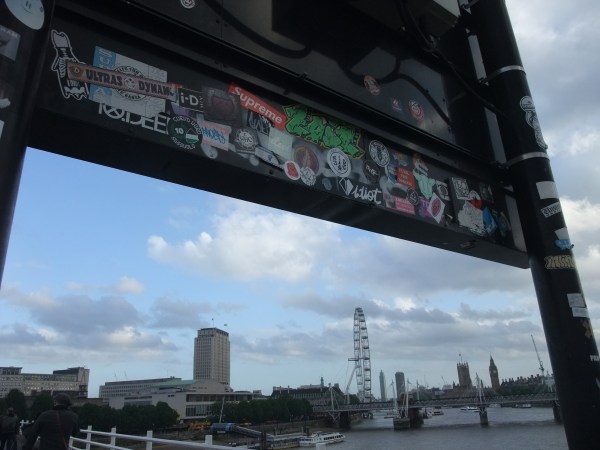
02-06-15-waterloo-bridge-5
Stickers of all kinds are a significant part of London’s urban fabric (Photo: Hannah Awcock, Waterloo Bridge, 15/12/16).

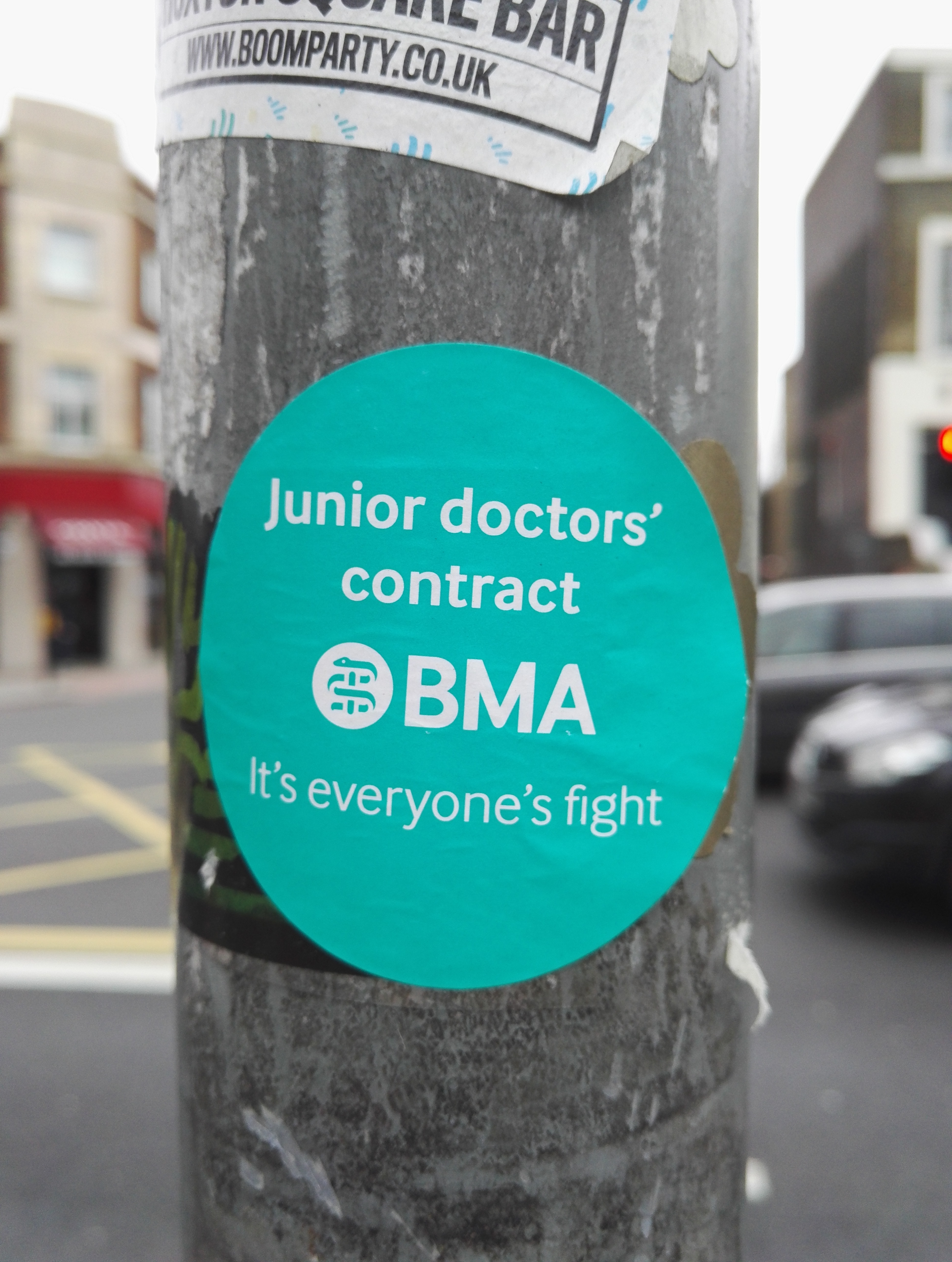
The conflict over Junior Doctors’ contracts was arguably one of the biggest news stories of 2016 with the Health Secretary, Jeremy Hunt, imposing new working and pay conditions. The NHS more generally is one of the biggest battlegrounds of modern British politics, with constant debates about funding, privatisation, and the quality of the services provided. Like other key issues and events in politics (such as the EU Referendum, immigration, and housing), the conflict over the NHS has manifested itself in London’s protest stickers. Some stickers refer to other health-related issues, such as the legalisation of drugs and mental health.

dav
Stickers that were designed to be worn by people often end up being worn by the city, like this sticker produced by the British Medical Association (BMA) in support of the Junior Doctors. Stickers like these caused some controversy amongst Junior Doctors, when the BMA sent out stickers for Junior Doctors to wear at work as an alternative method of protest to striking (Photo: Hannah Awcock, Grafton Way, 03/05/16).
dav
One of the main arguments against the new contracts was that the changes would risk the health of patients. As such, it is not just Junior Doctors who should take an interest in the dispute (Photo: Hannah Awcock, Lewisham Way, 20/03/16).
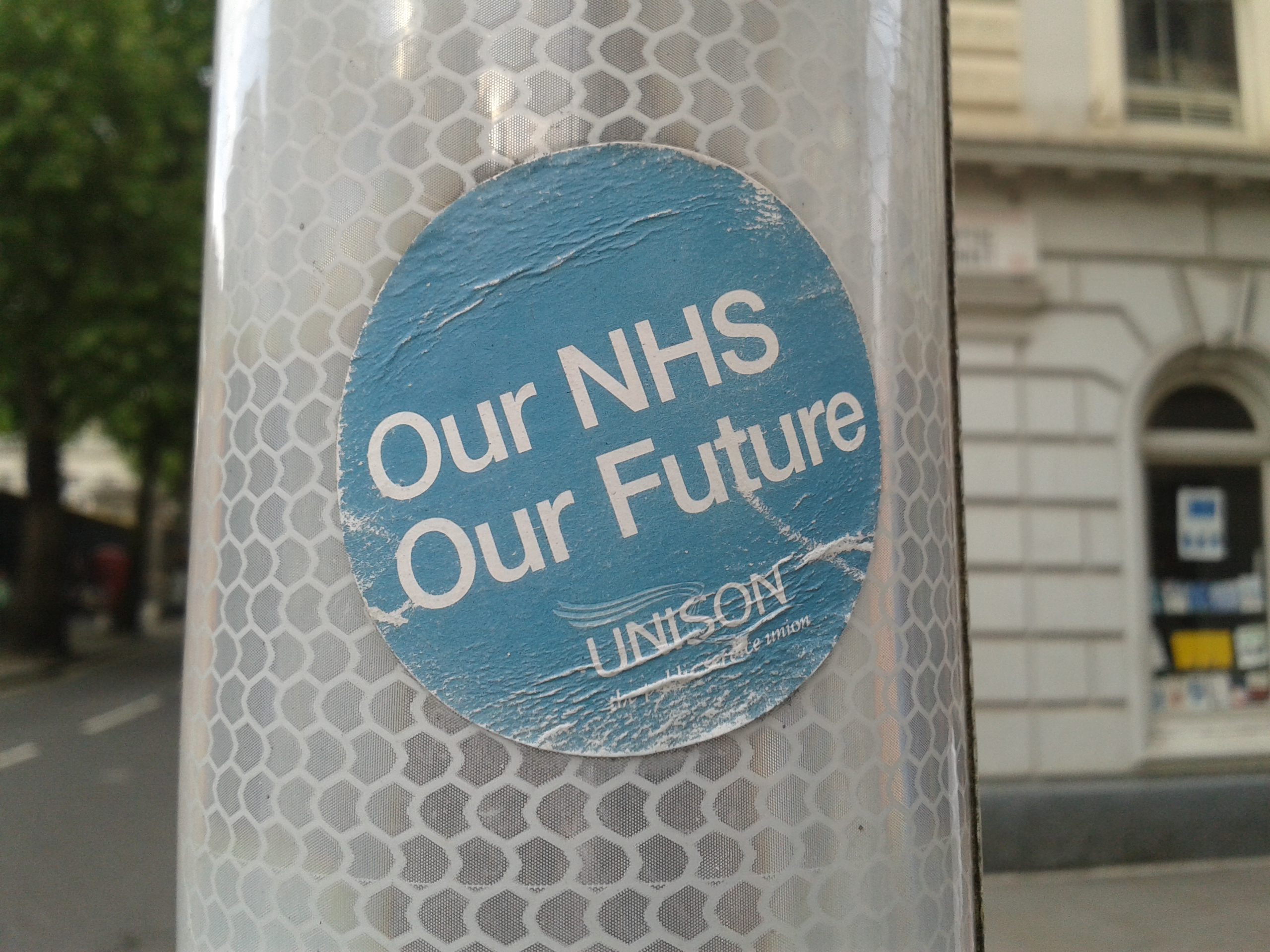
16-06-15-great-russell-street
Unison is a union for people who work in public services, including employees of the NHS. This sticker is also making the argument that the users of the NHS should be just as involved in the fight for to save the NHS as those who work in it (Photo: Hannah Awcock, Great Russell Street, 16/06/15).
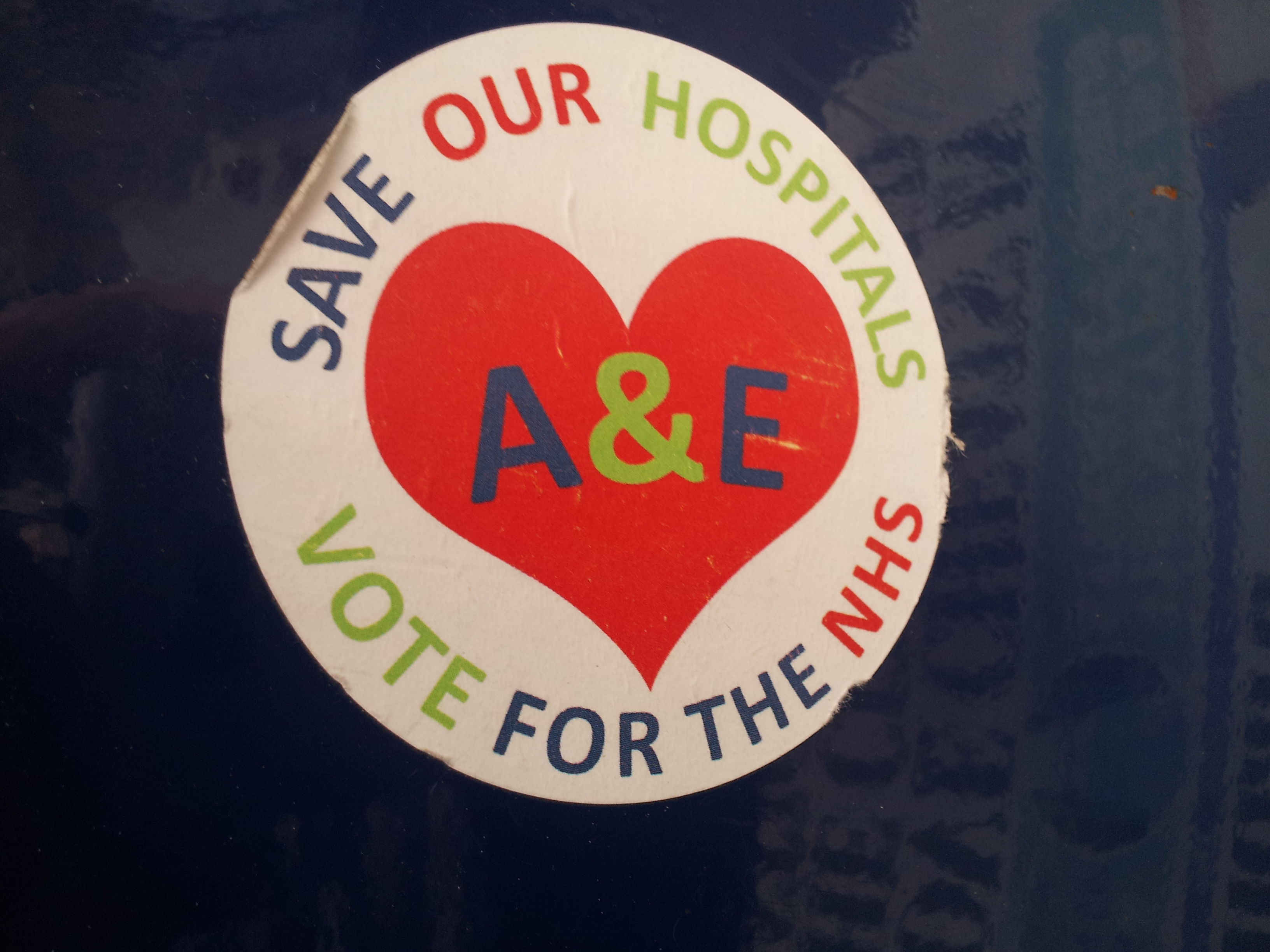
19-08-15-borough-high-street
The NHS is an important political issue. The funding and running of the NHS often becomes a topic of debate during elections. The Conservative Party, for example, are frequently accused of trying to underfund and privatise the NHS. (Photo: Hannah Awcock, Borough High Street, 19/08/15).
17-04-15-euston-road
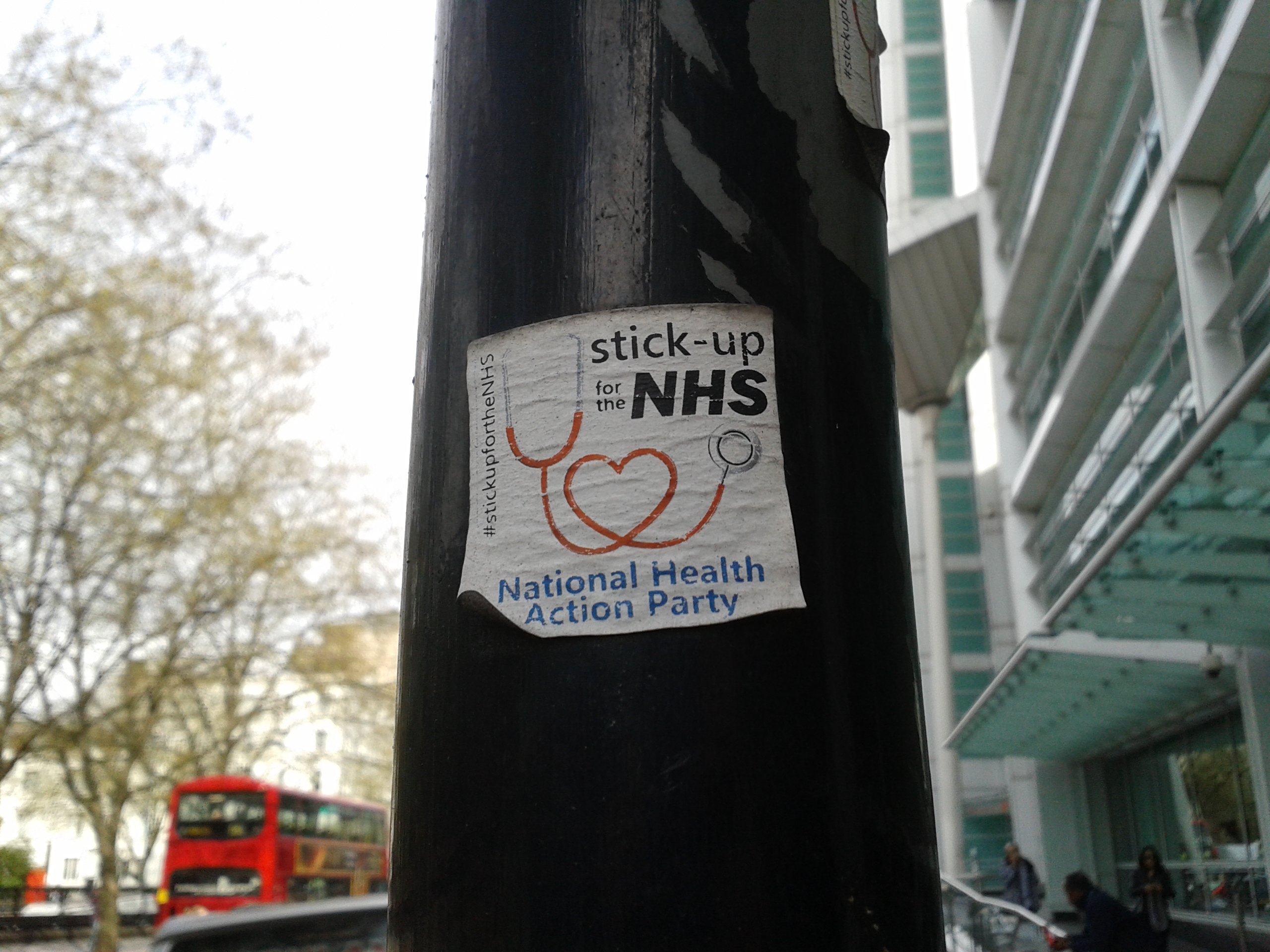
The National Health Action Party is a group that campaigns to halt and reverse the privatisation of the NHS. I found this sticker on the Euston Road, outside the University College London hospital. Sometimes, the location of protest stickers can contribute to their meaning (Photo: Hannah Awcock, Euston Road, 16/06/15).
09-08-15-high-holborn-4
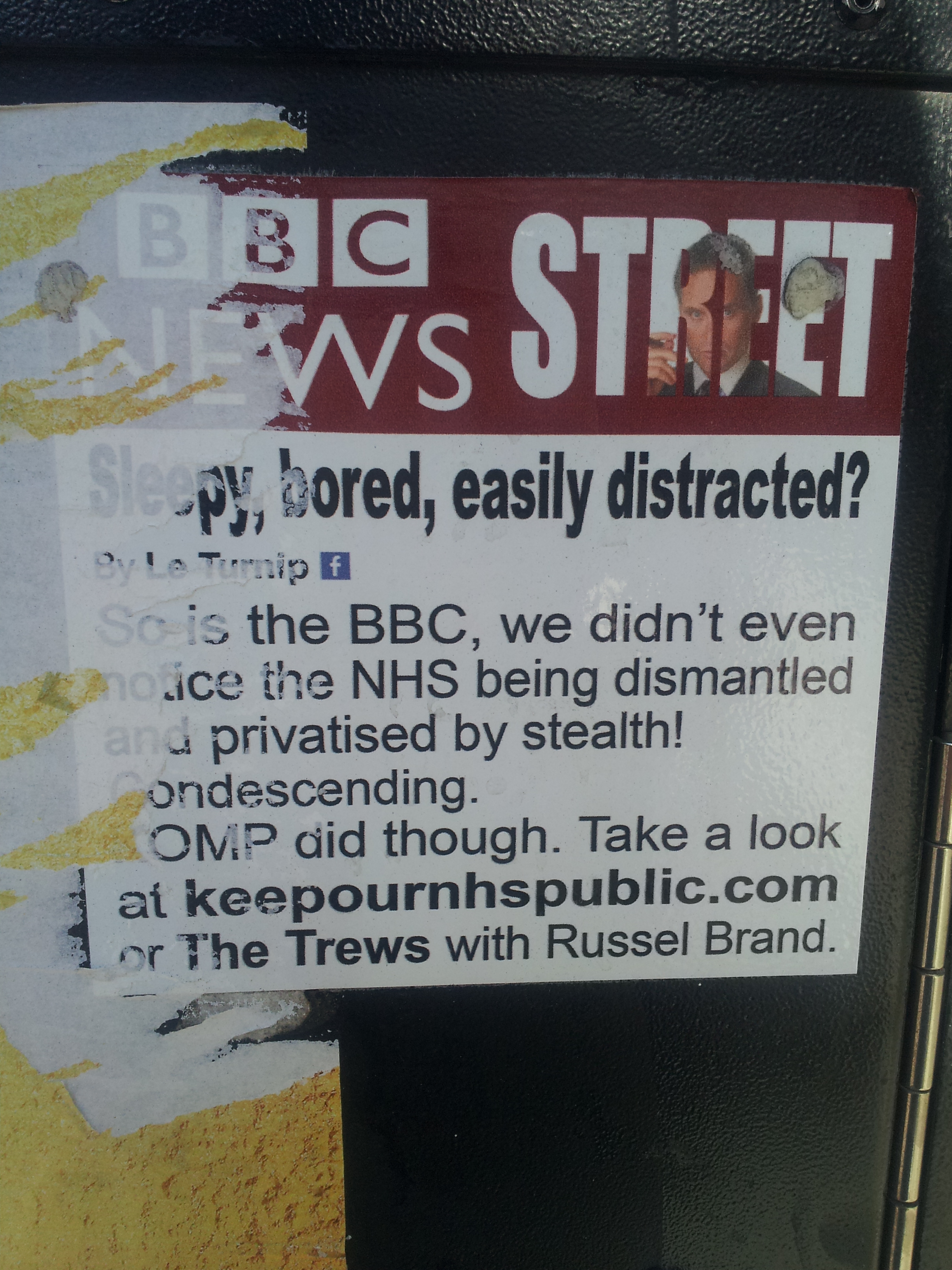
Keep Our NHS Public is another group that campaigns for the preservation of the NHS. Le Turnip produces protest stickers that take a lighthearted and sarcastic view on a whole range of issues (Photo: Hannah Awcock, High Holborn, 09/08/15).
09-07-15-prince-consort-road-1
The NHS is not the only health-related issue to inspire the production of protest stickers. Feed the Birds is a campaign run by the London Cannabis Club. The campaign aims to destigmatise cannabis and call for its legalisation by feeding hemp seeds to birds (Photo: Hannah Awcock, Prince Consort Road, 09/07/15).
09-08-15-high-holborn-5
The Feed the Birds campaign makes some bold claims about the powers of cannabis (Photo: Hannah Awcock, High Holborn, 09/08/15).
14-04-15-upper-street-islington-3
This sticker was produced by the Psychadelic Society, which advocates for the legalisation of psychadelic drugs (Photo: Hannah Awcock, Upper Street, Islington, 14/04/15).
dav
Mental health is also a topic which gets people talking. This sticker is objecting to the way in which mental health terms are used in everyday language, which can belittle mental health problems (Photo: Hannah Awcock, Euston Road, 03/08/16).

To see where I found all these protest stickers, check out the Turbulent London Map.

Book Review: The Leveller Revolution- Radical Political Organisation in England, 1640-1650

the-leveller-revolution-front-cover
The Leveller Revolution by John Rees.

John Rees. The Reveller Revolution: Radical Political Organisation in England, 1640-1650. London: Verso, 2016. £25.

John Rees co-authored one of my favourite books, A People’s History of London. As such, I was really looking forward to the publication of The Leveller Revolution: Radical Political Organisation in England, 1640-1650, and I had high expectations. Whilst it doesn’t quite live up to A People’s History of London, it is a very good book.

The Leveller Revolution is derived from Rees’ doctoral research. As such it is thoroughly researched, as evidenced by the detailed content and and considered analysis. The book is not just a narrative of the rise and fall of the Levellers as a political force, it is also an intervention in the scholarly debate on the nature and significance of the Levellers. Rees argues that whilst other groups used similar organisational and campaigning tactics, no one else used them as consistently and to such effect as the Levellers. He also argues that the Levellers were the only group to focus on popular politics and mobilisation, as opposed to social and political elites.

I have tried to…examine the Levellers as a political movement integrating activists from different constituencies, and creating still broader alliances with other political currents, for the joint pursuance of revolutionary ends.

(Rees, The Leveller Revolution, p. xx)

The Leveller Revolution has multiple strengths. Rees’ arguments are persuasive; he makes a strong case that the Leveller organisation emerged out of pre-existing radical networks consisting of individuals who already had extensive experience of activism. Rees argues that London was significant to the development of the Levellers, but the book is not London-centric; many of the examples Rees uses to demonstrate his arguments come from elsewhere in the country. In addition, whenever there is historical doubt (e.g. over the authorship of a pamphlet, or exactly who was present at a particular event), Rees is open about that uncertainty, then justifies his own opinion. I always appreciate it when authors who are willing to acknowledge these kind of metholodogical subtleties.

Unfortunately, I often struggled to keep track of the book’s narrative, and I think there are 2 reasons for this. The first is that there were a large number of individuals involved in the radical networks around the time of the English Civil Wars, many of whom had quite similar names. As such, I found it difficult to remember who was who. Whilst there is little Rees could have done about the number of individuals involved and their names, a dramatis personae might have been helpful. The second reason for my confusion is, I think, that Rees assumes that the reader has a confident knowledge of the chronology of the Civil Wars. The book refers to events or battles by name only, making it hard to follow the narrative if you do not know when they took place or what happened. I did study the period as part of an A-level in Early Modern History, but that was almost a decade ago, and my knowledge is a bit rusty. If you are not familiar with the period, then I suggest reading The Leveller Revolution in conjunction with another book that details the key events of that time (I would recommend A Brief History of The English Civil Wars: Roundheads, Cavaliers and the Execution of the King by John Miller).

The Leveller Revolution is a thoroughly-researched, well-argued book. Whilst I found it less approachable than A People’s History of London, I would definitely recommend it to anyone who has a interest in the English Civil Wars, or the history of protest and dissent.

On This Day: The Mud March, 9th February 1907

At the start of the twentieth century, the campaign for women’s suffrage was gathering momentum. The National Union of Women’s Suffrage Societies (NUWSS) organised the first large march for the cause on the 9th of February 1907. The women planned to march from Hyde Park to Exeter Hall, a large meeting hall on the north side of the Strand. Unfortunately the weather was not on the marchers’ side, and heavy rain made the streets of London very muddy, hence the name of the march. Despite this, the march was considered a great success.

mud-march-flyer
A flyer advertising the event which became known as the Mud March (Source: Woman and her Sphere).

Unlike the Women’s Social and Political Union (WSPU), the NUWSS refused to use militant or violent tactics in its attempt to win the vote for women. They were known as suffragists, which differentiated them from the suffragettes in the WSPU. However, they understood the need to have a visible presence in society; this march was their first attempt at using protest marches to attract attention.

Around 3000 women took part, from a range of social classes and occupations, and representing over 40 suffrage organisations. The march was organised by Phillipa Strachey, daughter of Lady Strachey. The march was considered so successful that she went on to organise all the NUWSS’s large marches. The march was led by Millicent Fawcett, leader of the NUWSS, and Lady Strachey, Lady Frances Balfour, and Keir Hardie, also prominent suffragists. The Artist’s Suffrage League designed posters and postcards advertising the march, and designed and made around 80 embroidered banners for the march itself.

Despite the wet weather, thousands of people turned out to watched the march. The sight of thousands of women from across social divides marching together was enough of a novelty to persuade people to brave the rain. Press from across Europe and America were fascinated by the diversity of women involved. At the time, it was perceived that women were reluctant to make displays of themselves in public. As such, the participants in the march were considered to be even more dedicated to the suffrage because they were willing to put themselves through such an experience. Kate Frye was on the march, and she obviously relished taking part, writing in her diary that she “felt like a martyr of old and walked proudly along.”

The suffragists marched from Hyde Park to Exeter Hall in the Strand, where the Strand Palace Hotel stands today. The Hall was opened in 1831 as an organisational and meeting space for evangelical groups. The Great Hall could hold 4000 people, and lots of causes held meetings there, including anti-Slavery and temperance. In 1880 Exeter Hall was taken over by the YMCA, but the Great Hall could still be used for meetings. The suffragists’ rally must have been one of the last meetings to take place there, as the building was sold and demolished in 1907. It required expensive alterations that the YMCA were unwilling to pay for. The suffragist’s rally featured music from an all-female orchestra, and speakers such as Keir Hardy, Israel Zangwill, Millicent Fawcett, and Lady Strachey.

The success of the Mud March, despite the foul weather, established the large-scale organised procession as a key tactic for the campaign for women’s suffrage in Britain. It has also been argued that the march gave the women’s suffrage movement a sense of respectability that the militant tactics of the WSPU did not.

Sources and Further Reading

Cowie, Leonard W. “Exeter Hall.” History Today 18, no. 6 (1968): 390-397.

Crawford, Elizabeth. “Kate Frye’s Suffrage Diary: The Mud March, 9 February 1907.” Woman and her Sphere. Last  updated 21 November 2012, accessed 24 December 2016. Available at https://womanandhersphere.com/2012/11/21/kate-fryes-suffrage-diary-the-mud-march-9-february-1907/

The Armchair Anglophile. “The Mud March.” Last updated 7 February 2012, accessed 24 December 2016. Available at http://www.armchairanglophile.com/the-mud-march/

Wikipedia. “Mud March (Suffragists)” Last updated 17 December 2016, accessed 21 December 2016. Available at https://en.wikipedia.org/wiki/Mud_March_(Suffragists)

The Wicked Witch of the West: Terrorist or Freedom Fighter?

Spoiler Warning: This post contains spoilers about the musical Wicked.

wicked-logo
The successful musical Wicked has been running in London since 2006 (Photo: Wicked).

A few weeks ago, I went to see Wicked: The Untold Story of the Witches of Oz at the Apollo Victoria theatre in London. Based on the 1995 novel Wicked: The Life and Times of the Wicked Witch of the West by Gregory Maguire, the musical retells the story of The Wizard of Oz, focusing on Elphaba, otherwise known as the Wicked Witch of the West.  Wicked turns the well-known narrative on it’s head, portraying Elphaba as a misunderstood rebel instead of an evil villain. As well as being a brilliant musical, the play is an ideal example of the idea that one man’s terrorist is another man’s freedom fighter, and demonstrates the importance of representation and perspective when it comes to dissent.

elphaba
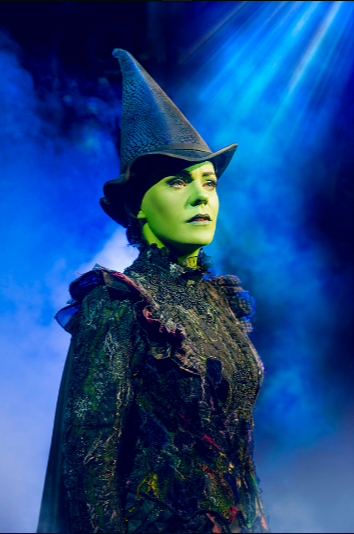
Rachel Tucker as Elphaba (Photo: Matt Crockett/Wicked).

Wicked begins long before Dorothy and Toto arrive in Oz. Elphaba is an isolated young woman, hated by her father and shunned by her classmates because she was born with green skin and strange magical abilities. At university, she becomes concerned with the plight of animals, who are being demonised and suppressed in Oz to the extent that they are losing their ability to talk. The final straw comes when Elphaba’s history teacher, Doctor Dillamond, is fired because he’s a goat, and she uses her magic to rescue a caged lion cub.

Elphaba travels to the Emerald City to meet the Wonderful Wizard of Oz in the hope that he will stop the ill-treatment of animals when he learns of their fate. She is distraught when she realises that the Wizard is in fact responsible for the anti-animal feeling, scapegoating them in order to unite the majority of ‘Ozians’. Refusing to participate in this Machiavellian form of government, Elphaba runs away and becomes what we might call an animal rights activist. Determined to prevent her speaking out, the Wizard vilifies Elphaba, transforming her in the public eye into the Wicked Witch of the West. She is only able to escape the persecution by faking her death at the hands of Dorothy, and leaving Oz forever.

Towards the end of Act 2, Elphaba confronts the Wizard, demanding to know how he can be comfortable lying to the people of Oz. He responds with the song ‘Wonderful’, which contains a brilliant explanation of the importance of perspective when it comes to how actions are perceived:

{spoken}: Elphaba, where I come from, we believe all sorts of things that aren’t true. We call it history.
{Sung}:
A man’s called a traitor
or liberator. A rich man’s a thief
or philanthropist. Is one a crusader
or ruthless invader? It’s all in which label
is able to persist.
There are precious few at ease
with moral ambiguities, so we act as though they don’t exist.

Wicked – Wonderful Lyrics | MetroLyrics

Scapegoating a minority group by blaming them for all of society’s ills is a tactic which unfortunately feels very familiar at the moment. Elphaba’s treatment for refusing to go along with it also has contemporary parallels; Attorney General Sally Yates being branded a ‘traitor’ by Donald Trump for speaking out against his Muslim Ban springs to mind. Others have praised Yates for speaking out- the way her actions are perceived is a matter of perspective. Another real-life example is Guy Fawkes, who’s position as terrorist/freedom fighter I have written about before.

defying-gravity
The London cast of Wicked performing the well-known song ‘Defying Gravity’ (Photo: Matt Crockett/Wicked).

Elphaba is a fictional character, but fiction can make us think about real life in ways that we haven’t before. Wicked is a hugely popular musical; it has been seen by millions of people around the world, and even those who haven’t seen it have heard it’s soundtrack (‘Defying Gravity’ used to be as popular as Frozen’s ‘Let it Go’). This popularity makes it influential. Wicked contains messages of friendship, acceptance, and tolerance, urging audiences to stand up for what they believe in, and not to blindly accept what they are told by those in power-lessons that are just as important now as they ever were.

Runnymede: Exploring Legacies of Rebellion in a Field in Suburban Surrey

dav
King John was forced to sign the Magna Carta by rebellious barons at Runnymede in 1215 (Photo: Hannah Awcock).

Apart from playing host to Royal Holloway, Egham’s other claim to fame is Runnymede, the meadow by the river Thames where King John signed the Magna Carta in 1215. It is a significant location in British history, as well as the history of democracy more generally. there are several memorials located on the meadow, maintained by the National Trust. Despite studying at Royal Holloway for over 7 years, I visited the memorials for the first time a few weeks ago.

As you would expect, there is a memorial to Magna Carta at Runnymede. What you might not expect is that it was paid for by American lawyers. The memorial was funded by the American Bar Association, a kind of union for lawyers. Built in 1957, the aesthetics remind me of Captain America. A sloping paths leads from the meadow up to the classical columns, which are surrounded by 10 English oak trees. Magna Carta as a symbol has provided hope and inspiration to campaigners and radicals for hundreds of years. I think in some ways it is more important to Americans than the English, as it is cited as a basis for the American constitution and the Bill of Rights. There certainly are a lot of American connections on Runnymede meadow. As well as the Magna Carta memorial there is the JFK memorial nearby, and an oak tree planted in soil fro, Jamestown, Virginia, which was the first permanent English settlement in America.

magna-carta-memorial
The Magna Carta memorial was built in 1957 and is maintained by the Magna Carta Trust (Photo: Hannah Awcock).

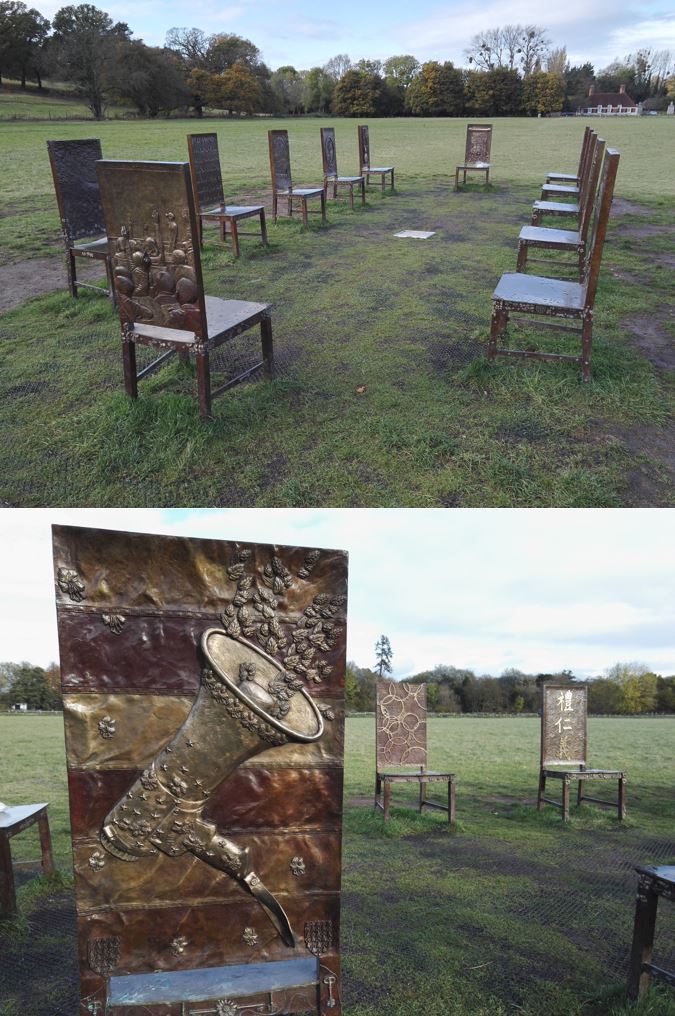
2015 marked the 800th anniversary of the signing of Magna Carta. As part of the celebrations, a new piece of art by Hew Locke was installed at Runnymede. Entitled The Jurors, the artwork consists of 12 bronze chairs, each decorated with images and symbols of struggles for freedom and rights. You can pick up a leaflet explaining what each of the chairs represent, and providing a bit of information about the artist and the work’s commission. This leaflet states that “The Jurors is not a memorial, but rather an artwork which challenges us to consider the ongoing significance and influences of Magna Carta.” I found this interesting, and it got me wondering about the difference between a memorial and a piece of art. I would think that a good memorial is just as capable of making people think as art is. From my perspective, I enjoyed searching the chairs for images and symbols I recognised, such as the portrait of Mary Prince, a lesser-known anti-slavery campaigner.

the-jurors
The Jurors (2015) by Hew Locke is designed to encourage to sit and think or discuss the images and issues represented on the chairs (Photo: Hannah Awcock).

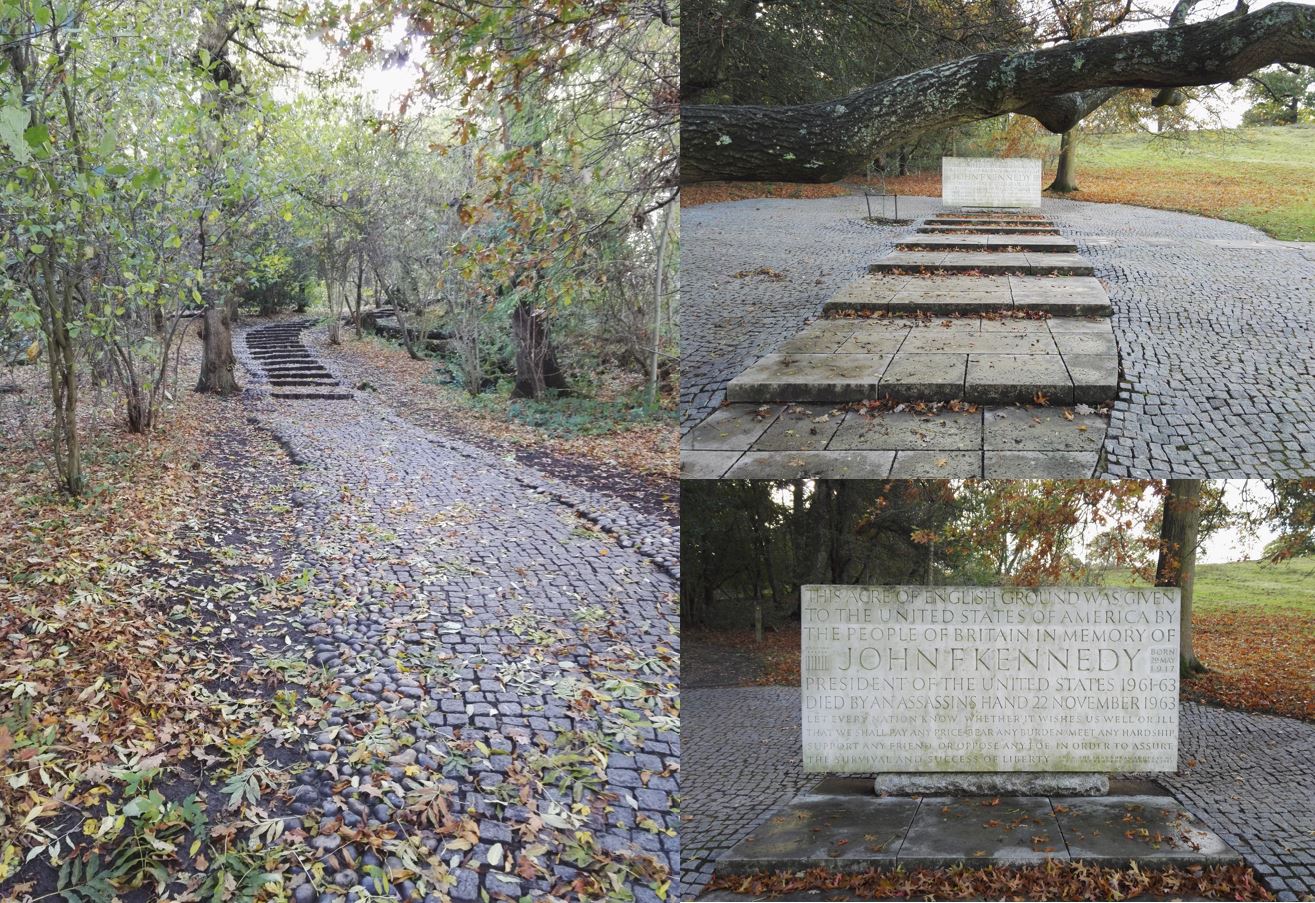
The other large memorial is for John F. Kennedy, President of the United States from 1961 until his assassination in 1963. After his death, the British government wanted to establish a memorial somewhere in the UK. They chose Runnymede because of the association with freedom and democracy. The land on which the memorial sits was given to the United States, so when a visitor passes through the entrance gate they are stepping onto American soil. The memorial itself is full of symbolism; 50 steps represent the 50 states, two stone seats represent the King-Queen/ President-Consort relationship, a hawthorn represents Kennedy’s Catholicism, and the overall theme is that of life, death, and progress, taken from Bunyan’s Pilgrim’s Progress. The wide range of metaphors and analogies seem messy on paper, but when I visited the different elements seemed to fit together well; I got a sense of peace and harmony.

jfk-memorial
The JFK memorial has a lot of interesting symbolism involved in its design, and is a lovely place to sit and think (Photo: Hannah Awcock).

I visited Runnymede meadow the day after the US presidential election. Despite the busy A308 running alongside the meadow,  it is a wonderfully tranquil place to be, especially on a sunny Wednesday afternoon in late autumn. Visiting the memorials gave me a chance to reflect on the events on the previous day. I was not surprised about Trump’s election, the Brexit vote in the summer has taught me to take nothing for granted in politics, but I was shocked. As I sat on the benches of the memorials I wondered what JFK would make of Donald Trump. I also thought about how Trump relates to the ideals that the magna carta has come to embody; he is a product of democracy, but I fear for his impact on freedom and civil rights. Whatever happens, Runnymede meadow will remain a lovely place to spend a few hours, whether you need a place to think or just somewhere to walk the dog.

Sources and Further Reading

Anon. “The Jurors.” No date, accessed 06 January 2017. Available at  http://artatrunnymede.com/

National Trust. “Memorials at Runnymede.” No date, accessed 06 January 2017. Available at https://www.nationaltrust.org.uk/runnymede/features/memorials-at-runnymede

Olive Evelyn Awcock, 1926-2016

img_6537
My Nan and I at a family Christmas party in 2012 (Photo: Hannah Awcock).

At the beginning of December, my grandmother passed away. Olive Evelyn Awcock was stubborn, blunt, and wonderful, and she will be sorely missed by my entire family. Born in nearby Rottingdean, Nan lived in Brighton for most of her life. She married her childhood sweetheart, John, and they were together for more than 50 years. They had two children, Hilary and Graeme, my Dad. I knew her as Nan though, and it was a role she performed very well. Since her passing I have spent a lot of time reflecting on my memories of Nan, and I was surprised to find a lot of connections between her and my politics.

Nan was not one to mince her words, or hold back on her opinions. The two of us frequently differed in our political opinions, although we did agree in not liking or respecting most leading politicians. I mostly chose not to engage her in political debate, because she was my Nan and it didn’t really feel right. We all found her intransigence desperately frustrating at times, but it was one of her defining characteristics and we loved her for it.

img_7192
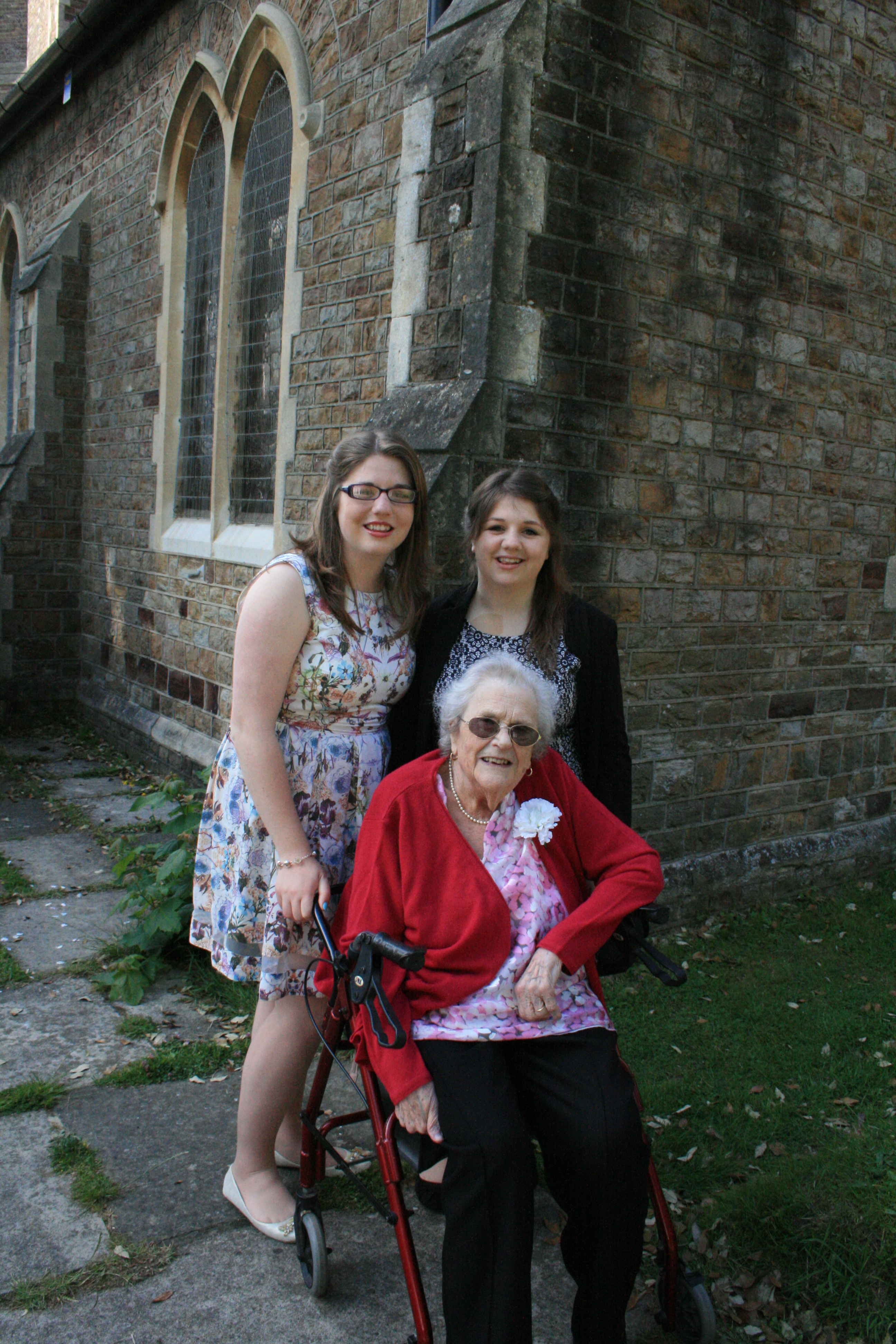
My sister Emily and I with Nan at my cousin Ben’s wedding in 2013 (Photo: Hannah Awcock).

Nan was not what you might call a radical, but I think in her own way she embodied feminist ideals. She was fiercely independent. My grandfather was in the Royal Marines, so was frequently away, and Nan had to look after my Dad and Aunty on her own. This included a two-and-a-half year stint in Malta in the late 1950s, when my Dad was just 10 months old. It must have been terrifying to move to a new country with two young children, leaving behind the support networks that she had in Brighton. She was also keen to have her own income independent from my grandfather, so worked in a local post office for more than a decade before her retirement. She tried to instil that desire for independence in her grandchildren. It was one of her biggest regrets that she never learnt to drive, so frequently had to depend on others to get around. As such, she helped every one of her grandchildren who wanted to learn to drive to do so. These are perhaps not the actions of your stereotypical feminist, and I very much doubt she would have described herself as such. However her attitude was one which I think any feminist would be proud of.

mum-dad-graeme-hannah-happy-on-bench002
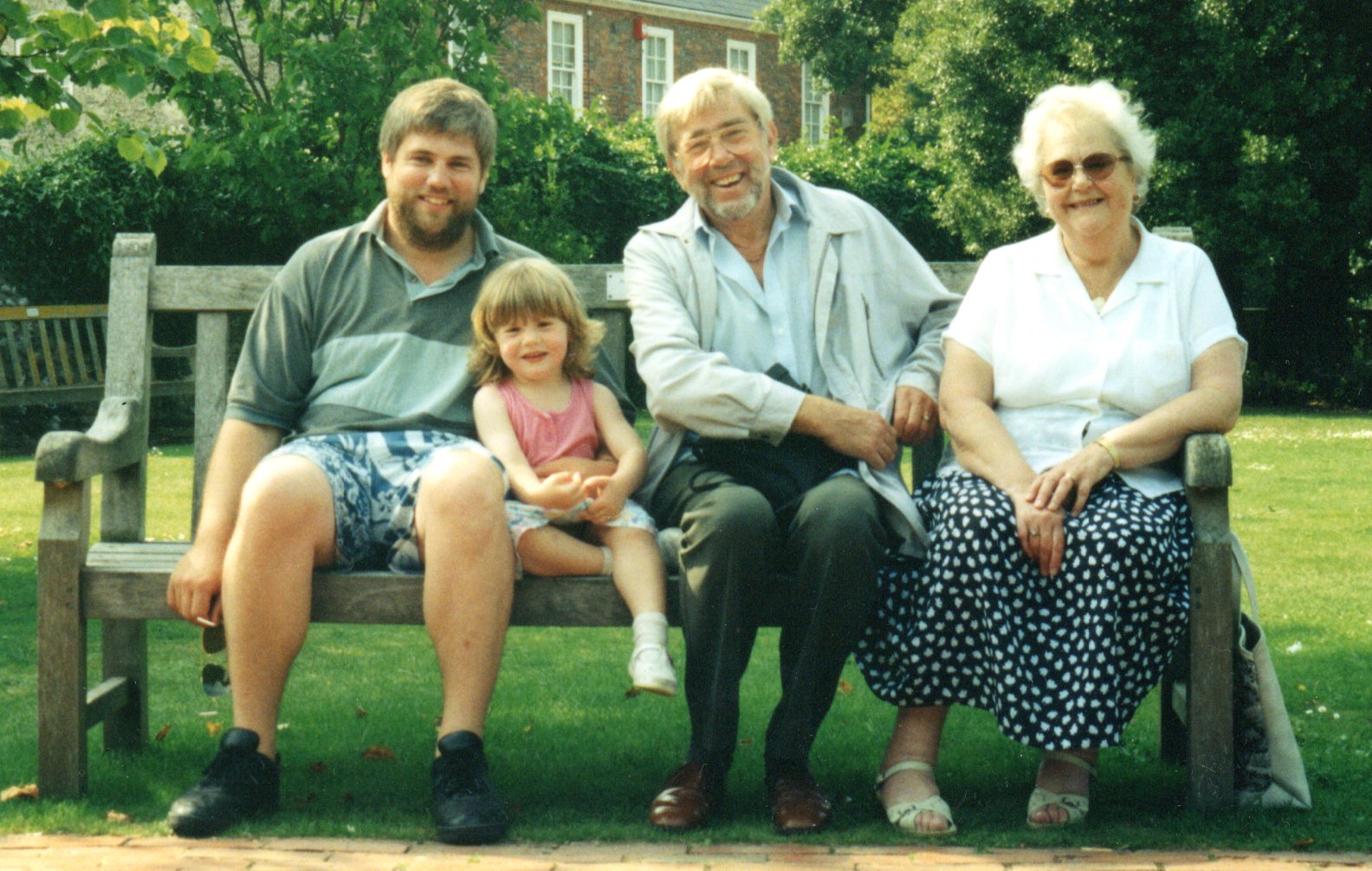
My Dad, my grandparents, and I on a day out, probably some time in the mid-90s (Photo: Graeme Awcock).

Despite my Dad already having achieved a PhD, I don’t think she really understood what one was, or what it entailed. Nevertheless, she had strong opinions on my topic, and never failed to let me, or the rest of my family, know what they were. Nan was more than a little surprised when I decided to study for a PhD on the historical geography of protest in London. She was concerned that it meant I must be a “closet red,” and it didn’t fit with her opinion of me as a gentle, kind, shy young woman. In a way, she was right. I am scared of protesting, and terrified by the prospect of getting arrested. I do go on protest marches, but I have always been too nervous to participate in more daring ways than that. I strongly believe in the need for protest and social movements, and I hope I will someday find a form of activism that I am comfortable with. In the meantime, I feel like studying protest, as well as being enjoyable and engaging, is a way in which I can comfortably contribute to the ongoing struggles and conflicts.

Nan and I shared many traits. I too am stubborn, and like to be independent. I am not as blunt when voicing my opinions, but I think that the elderly, like children, can get away with saying things that most people cannot, so perhaps that is a trait that I will develop with age. Everyone that we love impacts us in ways that are hard to define, and it is through the characteristics I have inherited from Nan that she will remain with me.

IWM North

On a recent visit to Manchester I visited the northern branch of the Imperial War Museums (IWM) in Trafford. I liked the museum, and enjoyed making comparisons with the IWM site in south London. The IWM North was opened in 2002 as the IWM’s first (and only) branch in the north of England. It receives around 300,000 visitors a year. In comparison, the IWM London is visited almost one million times annually. The museum’s focus is people, and how they have been affected by conflict.

dav
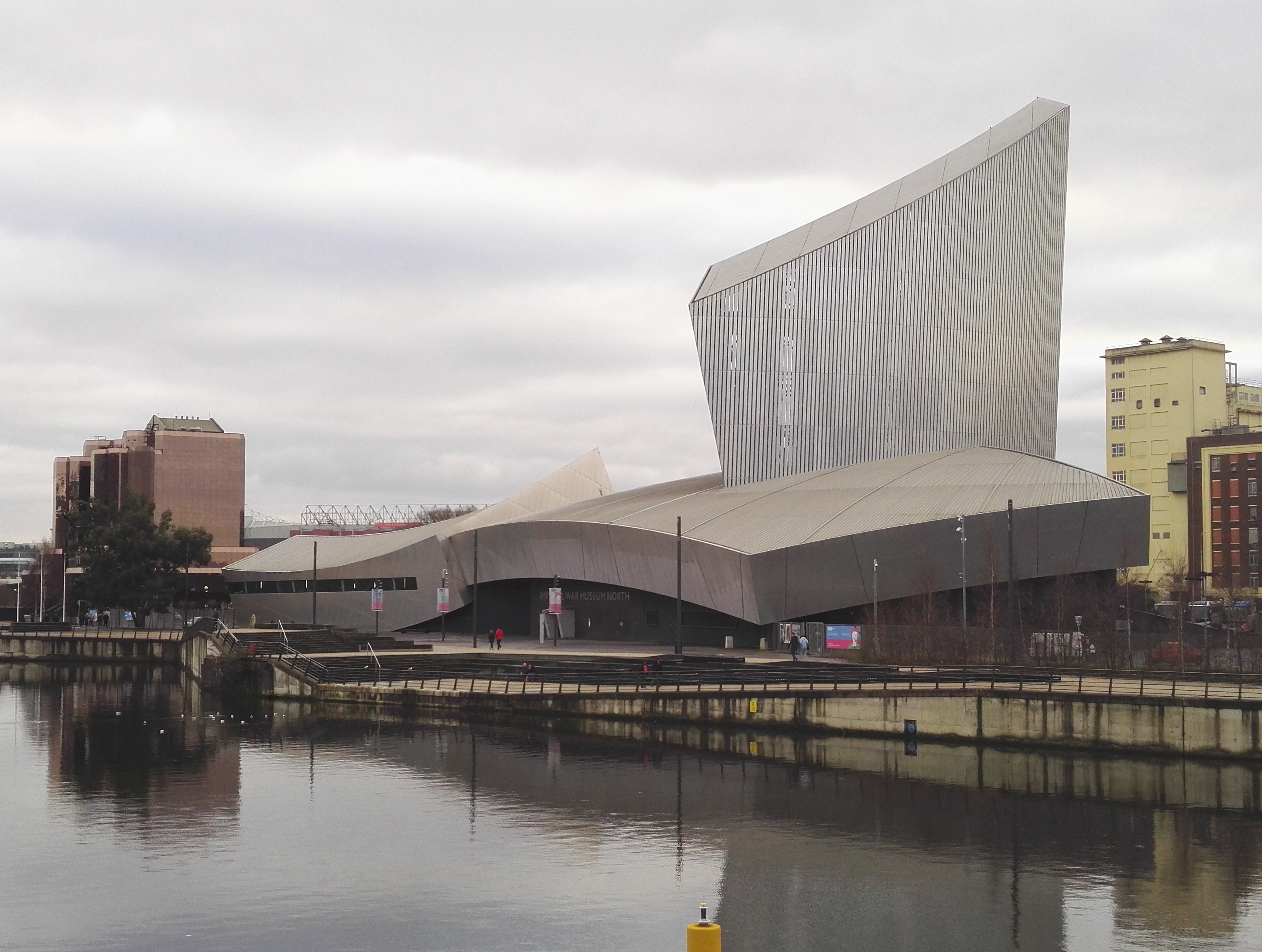
The Imperial War Museums North was designed to mimic the effects of war. The building is meant to represent a shattered globe (Photo: Hannah Awcock).

The IWM North is a striking, modern building, purpose-built and designed by Polish architect Daniel Libeskind, who also designed the Ground Zero site in New York. It is very different from the IWM London, which is housed in the former building of the Bethlem Royal Hospital in Southwark, built in 1815. The London building is flooded with natural light from the roof of the atrium, which stretches the entire height of the building. In contrast, the IWM North building was designed to be disorientating, in order to give the visitor a taste of the effects of war. There are no windows in the entrance hall or main exhibition space. It works; I didn’t like the interior of the building when I first walked in, it felt oppressive and disjointed. However, I thought the main exhibition space on the first floor was well-suited to its purpose, even more so when I discovered it was meant to be disorientating.

The permanent exhibitions are all housed in one space. They are arranged chronologically, from 1914 to the present. Dotted around the space are six ‘silos’, enclosed spaces that focus on specific themes such as ‘Women in War’, and ‘Impressions of War’. Every hour the entire space is taken over by ‘Big Picture’ shows, audiovisual presentations that fill the space with pictures and sounds from the IWM’s archival collections. The shows are immersive, and you have little choice to stop whatever you were doing and watch it. I quite like the idea that everyone in the space is watching, listening to, and thinking about, the same things.

img_2251
A Big Picture audiovisual show in the museum’s main exhibition space (Photo: Hannah Awcock).

The museum’s use of artefacts feels minimal, with lots of text and open space. This is in sharp contrast to the Museum of Science and Industry (MOSI) that I had visited the day before. MOSI is housed across five buildings close to central Manchester, several of which are chock full of planes, cars, motorbikes, trains and engines of various kinds. In contrast, IWM North felt almost sparse. I prefer this minimal approach; too many objects can make it difficult to take anything in.

The curatorial decisions in any museum can be controversial, but the representation of conflict and war must be particularly difficult. In some ways I think the IWM North makes better decisions than the IWM London, for example it is more inclusive of conflicts in which the British armed forces were not involved. In other respects, the IWM North makes some decisions that I think could have been improved upon. Like the IWM London, there is very little information on conscientious objectors and peace movements. Most of what there is is located in the ‘Women in War’ silo, implying it is only women who object to war and conflict. Also, the museum has some steel from the World Trade Centre on display. Whilst I do not necessarily think that it shouldn’t be there, I do think there should be some explicit discussion of the relationship between terrorism and war. The ‘War on Terror’ is a very different kind of conflict from the World Wars, the Falklands War, or the Gulf Wars, but the IWM North’s display does not acknowledge this.

img_2258
Part of the World Trade Centre on display in the main gallery space (Photo: Hannah Awcock).

Over three days in Manchester I visited three museums. The People’s History Museum, the Museum of Science and Industry and the IWM North are all brilliant, and well worth a visit. The IWM North is certainly the most innovative in terms of architecture and display, and although my favourite has to be the People’s History Museum (I am fully prepared to admit bias here), the IWM North has to be one of the most intriguing museums I have ever been to.

Sources and further reading

Museum of Science and Industry. “About Us.” No date, accessed 1 January 2017. Available at http://msimanchester.org.uk/about

Tully, Lucy. “8 Things You Didn’t Know About the IWM North Building.” Imperial War Museum. No date, accessed 1 January 2017. Available at  http://www.iwm.org.uk/history/8-things-you-didnt-know-about-the-iwm-north-building

Wikipedia. “Imperial War Museum.” Last updated 11 December 2016, accessed 1 January 2017. Available at https://en.wikipedia.org/wiki/Imperial_War_Museum

Wikipedia. “Imperial War Museum North. Last update 11 December 2016, accessed 1 January 2017. Available at https://en.wikipedia.org/wiki/Imperial_War_Museum_North