Stickers of all kinds are a common sight on the streets of London. I am particularly interested in the ones with a rebellious or subversive tone (Photo: Hannah Awcock).
London’s protest stickers cover a whole range of topics, from housing to race and immigration. However, some of them don’t fit into any specific category, instead embodying a rebellious ethos. This post is about these stickers, the ones providing good advice for anyone with a subversive streak.
This sticker, photographed on the Tottenham Court Road on 03/09/15, seems like a good place to start. Why should anyone else have a say over the way you live your life? (Photo: Hannah Awcock).
This sticker encourages people to think for themselves- an important quality for anyone involved in social movements or activism (Photo: Hannah Awcock, Waterloo Bridge, 02/06/15).
This sticker links nicely to the previous one- critical thought is an important ability for academics as well as activists. Question everything, never just accept what you are told as the truth. This sticker was photographed outside King’s Cross Station, near the British Library, on 06/06/15 (Photo: Hannah Awcock).
This sticker was photographed in Elephant and Castle on 05/03/15. Even small, everyday acts can be rebellious (Photo: Hannah Awcock).
This sticker is a reminder to everyone that your happiness does not depend on the sadness or deprivation of others. The photo was taken on Albany Road, near the occupied Aylesbury Estate on 02/04/15, making it all the more pertinent (Photo: Hannah Awcock).
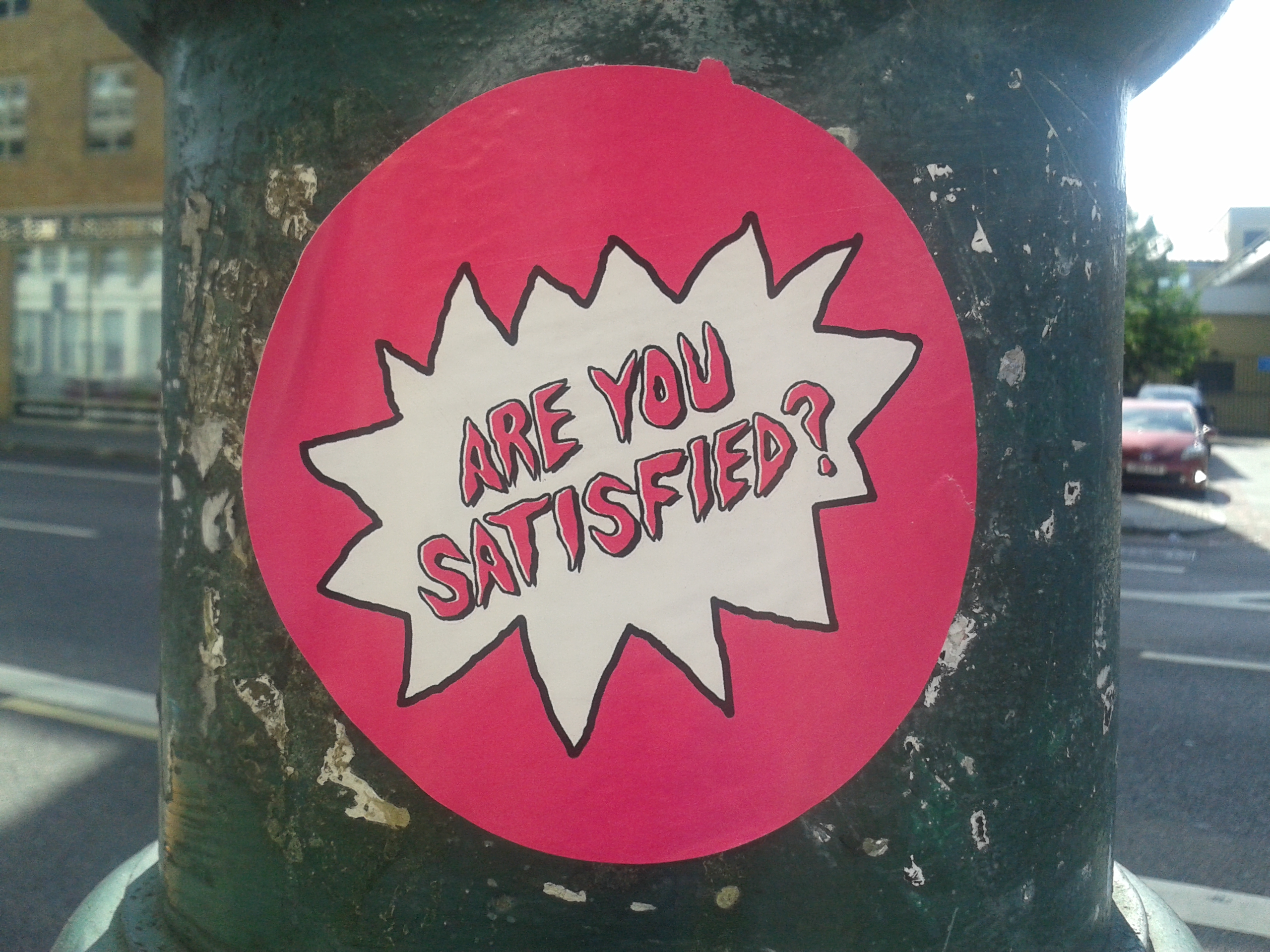
This is a question that everyone should ask themselves every once in a while. If you aren’t, then what can you do to try and change things? (Photo: Hannah Awcock, 07/06/15, Shoreditch Hight Street).
Activists are often told that their demands are impossible, that they will never achieve the change they want to see. It takes a lot of determination to keep going in the face of all that negativity. rs21 is a news and analysis website run by British revolutionary socialists (Photo: Hannah Awcock, 12/03/15, Gordon Square, Bloomsbury).
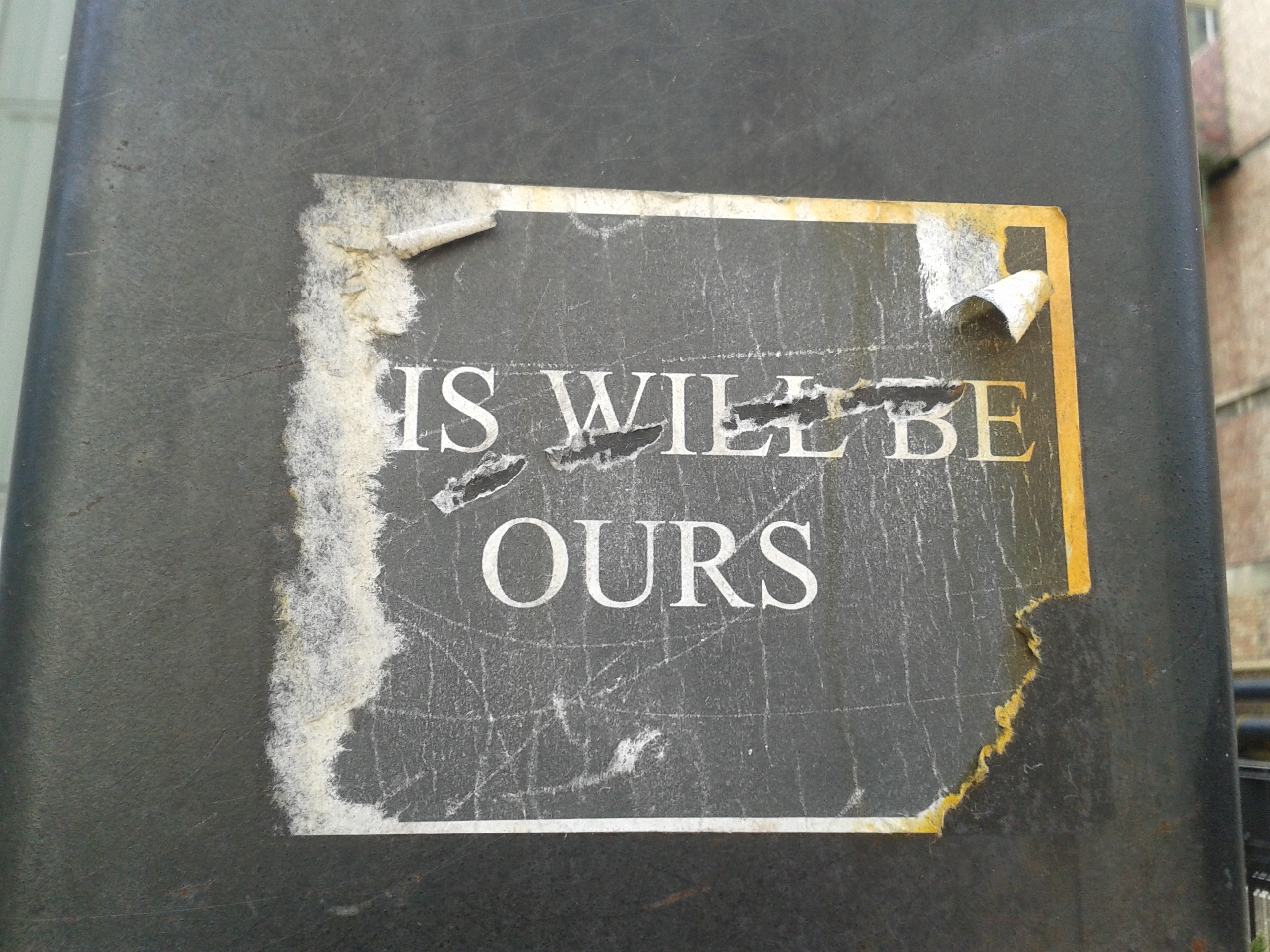
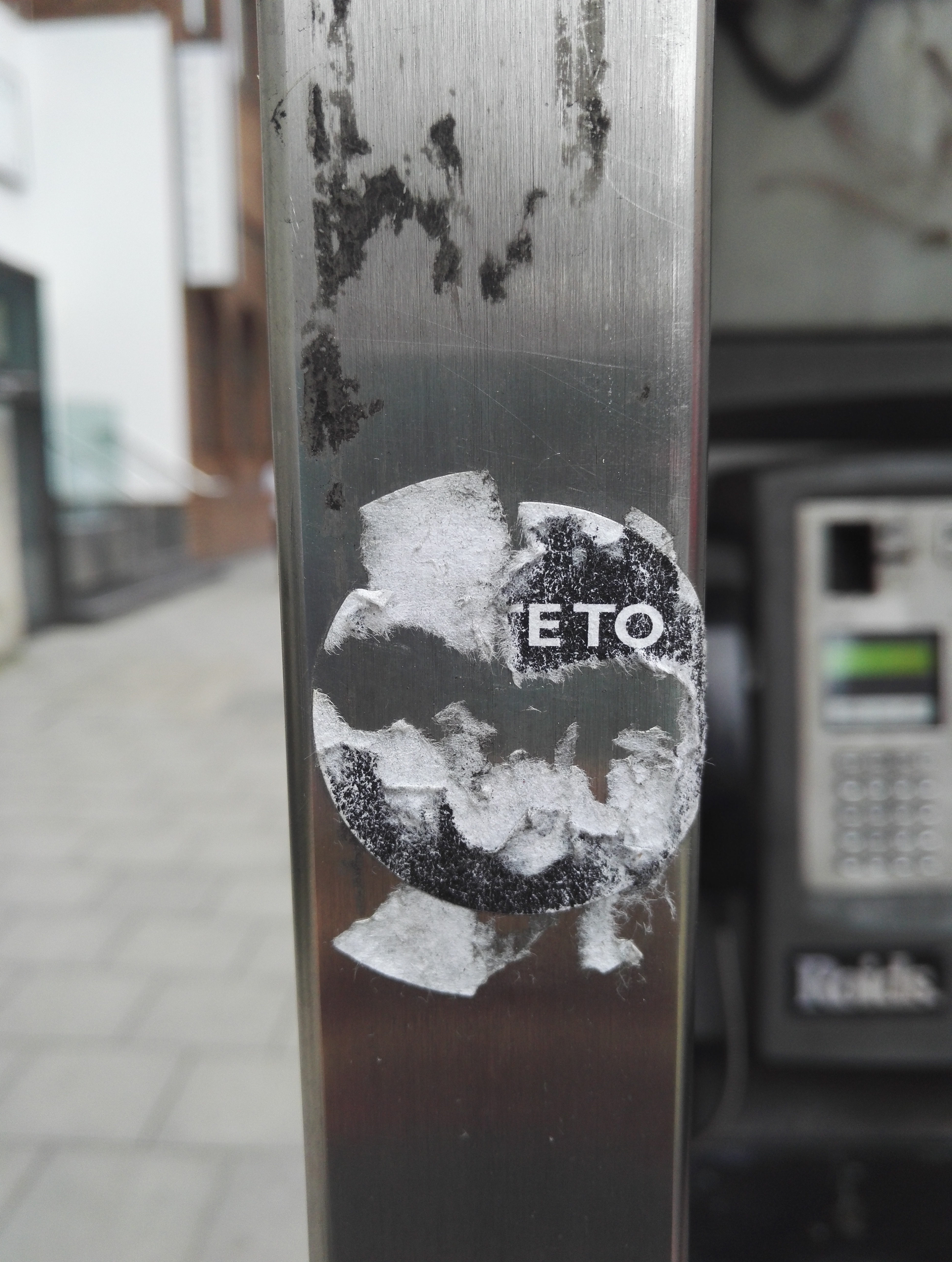
Although scratched and torn, it is easy to make out the intent of this sticker. The message- “This will be ours,” is a determined statement of intent (Photo: Hannah Awcock, 17/04/15, Gordon Street).
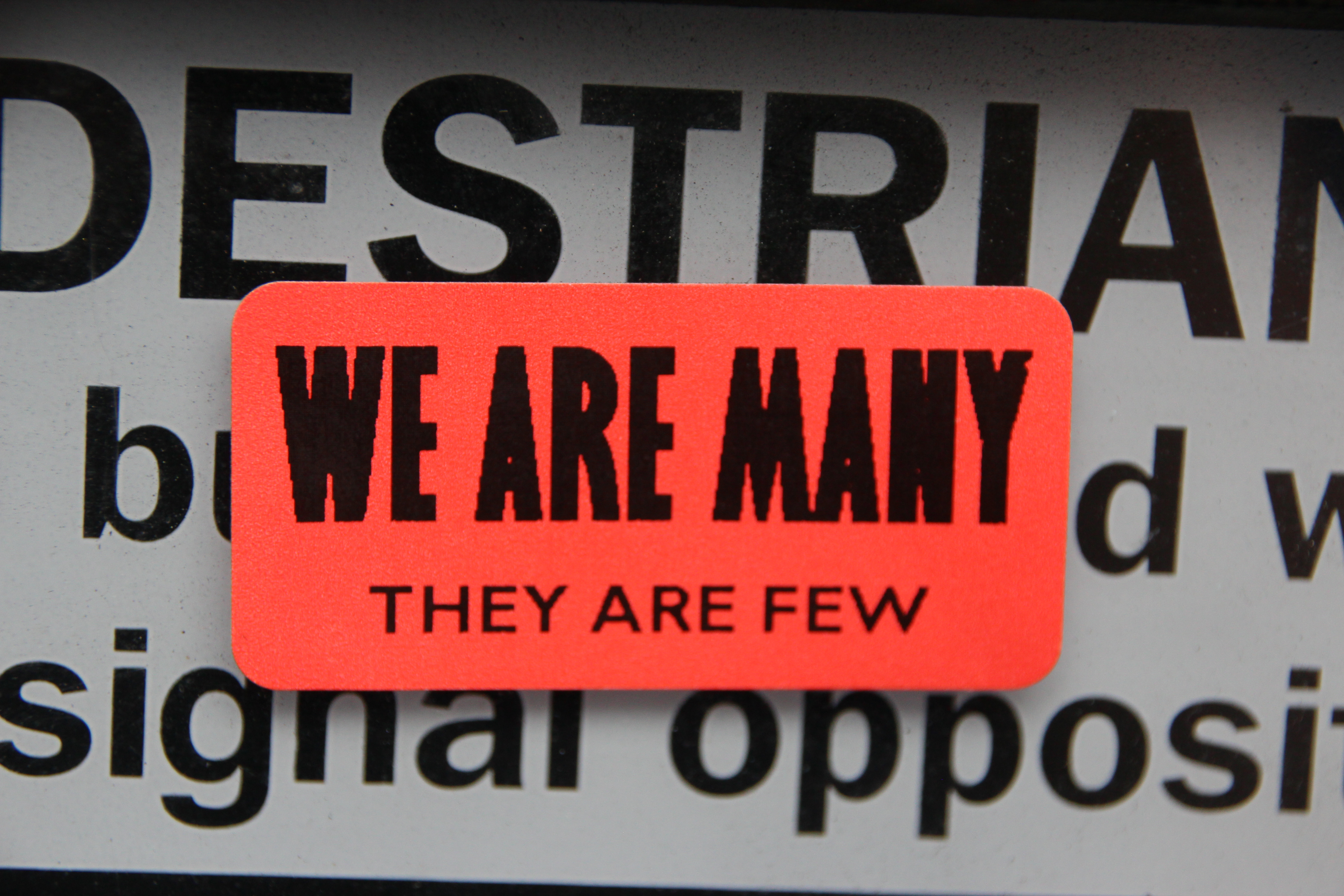
This empowering sticker is a reminder that the government only governs because we allow it to. If everyone decided to act together, it would create a very powerful force (Photo: Hannah Awcock, 20/06/15 Fleet Street).
This sticker isn’t protest-related, but I liked it so much that I had to include it. It makes me smile every time I walk past, even if I’m having a bad day. If only all street furniture was so complementary (Photo: Hannah Awcock, 21/05/15, Borough High Street).
Janet Polansky. Revolution without Borders: The Call to Liberty in the Atlantic World. London: Yale University Press, 2015.
Back in May, I went to a seminar given by historian Janet Polansky organised by the London Group of Historical Geographers. I enjoyed the seminar so much that I got the book so I could read Polansky’s arguments in more detail. And I wasn’t disappointed; I think Revolutions without Borders: The Call to Liberty in the AtlanticWorld is a very good read.
In the late eighteenth century Europe and the Americas went through a period of political turmoil which saw revolutions “From the Americas to Geneva, the Netherlands, Ireland, the Belgian provinces, France, Saint-Domingue, Guadaloupe, Poland, Martinique, Sierra Leone, Italy, Hungary, and Haiti” (Polansky, 2015; p.2 ). The American and French Revolutions are by far the best known, but almost no country surrounding the Atlantic Ocean remained untouched. Ideas, information, and people circulated back and forth across the Atlantic in an age before the Internet, telephones, even a postal service. Revolutions without Borders is about how these radical ideas and individuals traveled, both adapting to and shaping the contexts that they found themselves in.
Two centuries before the Arab Spring, without social media or even an international postal system, revolutionaries shared ideals of liberty and equality across entire continents. Theirs, too, was an international movement connected by ideas that traveled.
(Polansky, 2015; p. 3)
Polanksy structured the book by source material- each chapter is devoted to a different method of circulation such as official decrees, rumours, letters and travelers. Overall, I like this unusual approach because it brings archival research to the fore, which a lot of history books tend to gloss over. Different sources contain different kinds of information, and the structure of Revolutions without Borders highlights this. However, structuring the book in this way does necessitate some jumping back and forwards in terms of time, which did prove a little confusing on occasion. There is a Dramatis Personae and a Chronology, which may alleviate the effects of this confusion for some.
Sometimes when you read a book it resonates with current events. I experienced this whilst reading Revolutions without Borders. Chapter 9 focuses on itinerant revolutionaries, individuals who traveled the world during the revolutionary period, sometimes running from failed revolutions, sometimes running towards budding ones. Many of these people, including Benjamin Franklin, who lived in London for two decades*, had high hopes for the future of cosmopolitanism. They dreamt of universal citizenship, where a traveler would be welcomed as if returning home wherever they went in the world. Unfortunately this dream was not to be, and as the 1790s progressed travelers returning to America from Europe were shunned as dangerous radicals. The dream of universal citizenship struck a chord with me as I was reading this book, in the aftermath of the EU Referendum, and I couldn’t help but think that Benjamin Franklin would be disappointed with the result of the referendum. Universal citizenship seems that much further away now.
Revolutions without Borders is well-written and accessible. Relevant to both historians and geographers, I think it would also be enjoyable for those who read for leisure.
The 4th of October 2016 marked the 80th anniversary of the Battle of Cable Street, a well-known protest in which around 100,000 people prevented the anti-Semitic British Union of Fascists (BUF) from marching through the East End of London, which had a large Jewish population at the time. Since the late 70s, it has become tradition for the 5- and 10-year anniversaries of the Battle to be celebrated with a march, and a rally in St George’s Gardens near the Cable Street Mural. On Sunday the 9th of October I went along to the latest commemoration, Cable Street 80.
A campaigner outside Altab Ali Park, where the march began. The park is named after a Bangladeshi textile worker who was killed in a racist attack in 1978. Anniversary marches of the Battle of Cable Street have started in the park since the 60th anniversary in 1996 (Photo: Hannah Awcock).
The commemoration was organised by Cable Street 80, a loose coalition of community and campaigning groups. David Rosenberg (pictured here in the blue vest), a local author and historian, played a key role in organising events (Photo: Hannah Awcock).
Sadly there are not many people left who were actually present at the Battle, but many people on the march on Sunday had parents or grandparents who were there (Photo: Hannah Awcock).
A large number of different groups were represented on the march. This is Sarah Jackson, one of the co-founders of the East End Women’s Museum, a fantastic project to commemorate the lives and activism of women in the East End (Photo: Hannah Awcock).
GMB is a general union which has its roots in the Gas Workers and General Union, formed in the East End in 1889 (Photo: Hannah Awcock).
The Battle of Cable Street has become a source of inspiration and pride for many on the political left, so a large range of different groups and causes were represented at the march (Photo: Hannah Awcock).
The march sets off from Altab Ali Park (Photo: Hannah Awcock).
The march makes it way along Commercial Road (Photo: Hannah Awcock).
As time went on and migration brought new communities into the area, the Battle of Cable Street came to be symbolic for whole new generations of East Londoners. It has come to stand as rejection of xenophobia of all kinds, not just anti-Semitism. The Bangladeshi community in East London faced prejudice and violence in the 1970s and 80s, much like the Jewish community had 50 years earlier (Photo: Hannah Awcock).
The Battle of Cable Street is continually connected to new and ongoing struggles. For many who marched on Sunday, it was as much about demonstrating a determination to combat the rise of the far-right in Europe today as it was commemorating an event that happened 80 years ago (Photo: Hannah Awcock).
The march makes its way down Cable Street, which looks very different now to how it would have done in 1936 (Photo: Hannah Awcock).
The march arrives at the Cable Street mural, on the side of St. George’s Town Hall. The mural itself is nearly 40 years old, and has an interesting history in its own right (Photo: Hannah Awcock).
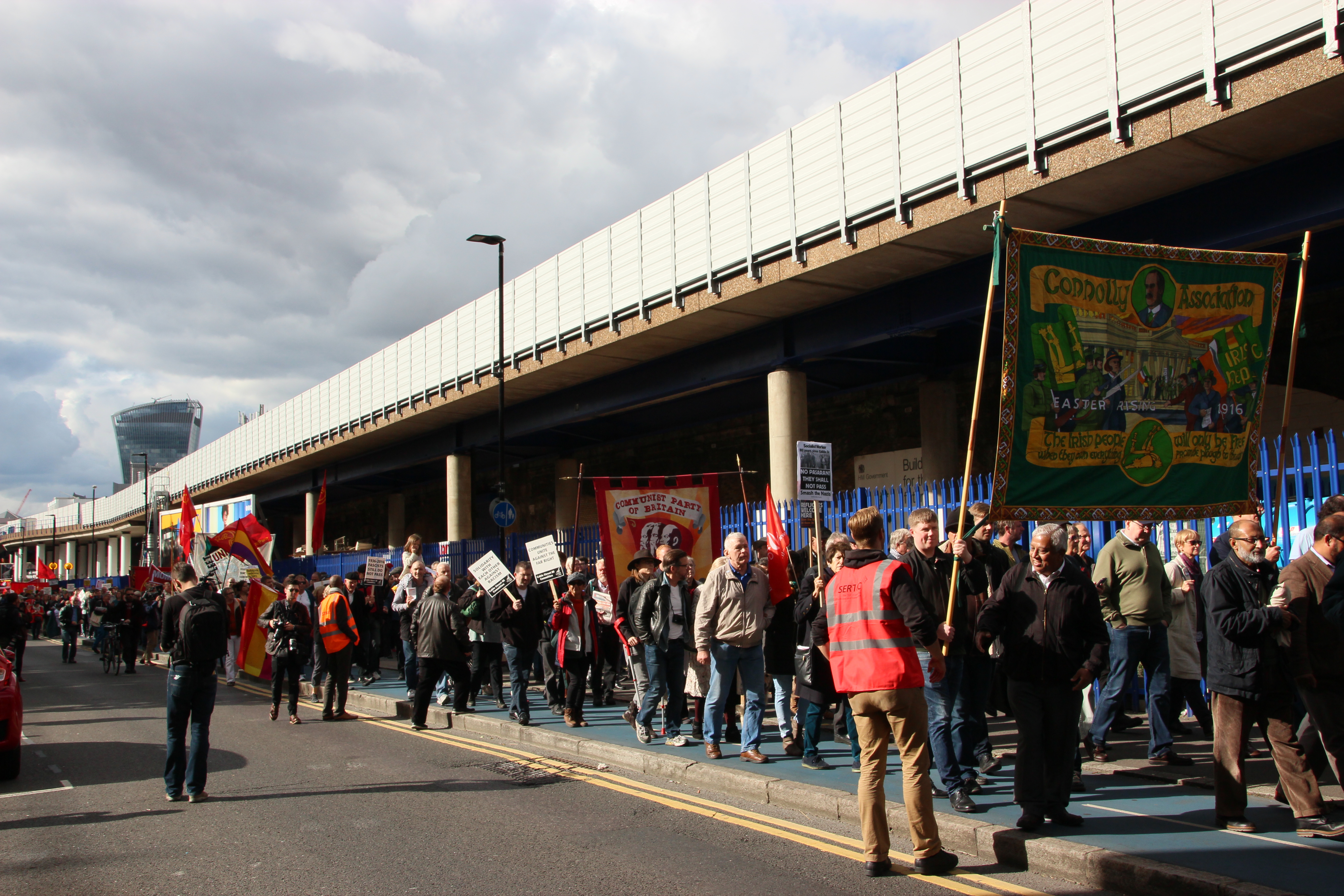
In 1936, the Irish community in the East End also took part to prevent the BUF marching, when many doubted they would. The Connolly Association campaigns for a united and independent Ireland (Photo: Hannah Awcock).
The Battle of Cable Street also has a Spanish connection, which explains the presence of the Spanish Communist Party. The Battle’s slogan ‘No Pasaran’ is Spanish for ‘They Shall Not Pass’, and comes from the Spanish Civil Way, which was underway in 1936. Many participants in the Battle of Cable Street went on to volunteer in the International Brigade to fight for the Spanish Republic (Photo: Hannah Awcock).
Unsurprisingly, there was a strong anti-fascist presence on the march. There are large number of anti-fascist groups in the UK, as evidenced by the amount of anti-fascist protest stickers I have found on the streets of London (Photo: Hannah Awcock).
After the march there was a large rally in St. George’s Gardens, near the mural. Speaking here is 101-year old Max Levitas, one of the few remaining veterans of the Battle of Cable Street (Photo: Hannah Awcock).
This is Michael Rosen, the well-known author and poet. His parents were both at the Battle of Cable Street, and he is a keen supporter of the process of remembrance (Photo: Hannah Awcock).
The ‘headliner’ was Jeremy Corbyn, controversial leader of the Labour Party. He is a constant presence at protests and rallies of all kinds (Photo: Hannah Awcock).
The recent Black Lives Matter campaign could give the impression that institutional racism is a distinctly American problem. Britain has had to deal with its own fair share of problems in this regard however, and like in Ferguson and other American cities, tension between the police and ethnic minorities has occasionally flared into violence. The Broadwater Farm Riots, on the 6th of October 1985, were one such occasion.
Overturned and burnt out cars in Broadwater Farm Estate on the day after the riots/uprising. Taken 7 October 1985 (Source: Jim Moody).
At the beginning of October 1985, tensions between police and the black community in Tottenham, north London, were running high. Longstanding grievances were exacerbated by riots in Brixton the previous week, following the shooting of a black woman, Dorothy Groce, during a police search. At lunchtime on the 5th of October Floyd Jarrett, a young black man who lived about a mile away from the Broadwater Farm estate, was arrested and charged with theft and assault- he was later acquitted of both charges. Later that day, however, the police decided to search the house of Floyd’s mother, Cynthia. During the search, 49-year-old Cynthia Jarrett collapsed and died of a heart attack. Her daughter claimed that Cynthia had been pushed by an officer called DC Randle, and the resulting fall could have contributed to her death. Randle denied it, and no police officer was charged or disciplined for what happened.
The black community in London already believed that the Metropolitan Police was institutionally racist (they were probably right!), and the treatment of Cynthia Jarrett sparked outrage. Bernie Grant, local council leader at the time, condemned the search of Cynthia’s house and called for local police chiefs to resign. A demonstration gathered outside Tottenham police station in the early hours of the next morning, the 6th of October. Violence between police and some members of the local community escalated throughout the day; centring on the Broadwater Farm estate. The rioters built barricades, set fire to cars, and threw bricks, molotov cocktails and other projectiles at police, making effective use of the raised walkways on the estate.
At about 9:30 p.m., the police and fire brigade were called to a fire on the upper level of Tangmere House, a block of flats and shops on the estate. Whilst attending the fire, the officers were attacked by rioters and forced to retreat rapidly. A police officer, Constable Keith Blakelock, tripped and fell in the confusion. He was immediately surrounded by rioters, who beat and repeatedly stabbed him in a vicious attack. PC Bl//akelock became the first police officer to be killed in a riot in Britain since 1919. n
The riot tailed off during the night as it started to rain and news of Blakelock’s death spread. The impacts of the riots, however, would last a lot longer than 24 hours. Determined to find Blakelock’s killers, the Metropolitan Police maintained a heavy presence on the Broadwater estate for several months, arresting and questioning over 300 people, many of whom were denied access to a lawyer. The riots led to changes in the police’s tactics and equipment for dealing with riots, and efforts to reengage with the local community.
Six people were eventually charged with the murder of Keith Blakelock; although the investigation and ensuing court cases were severely hampered by officers who were willing to cut corners and ignore the law. Three children had their cases dismissed after a judge ruled that they had been held and questioned inappropriately. Three adults, Winston Silcott, and Engin Raghip and Mark Braithwaite, were convicted and sentenced to life imprisonment despite there being no witnesses and no forensic evidence. All three were cleared by the Court of Appeals in November 1991. In July 2013, a man named Nicholas Jacobs was charged with Blakelock’s murder, but was cleared at trial.
Neither Cynthia Jarrett nor Keith Blakelock have received justice for what happened to them. Although from different ‘sides’ of the conflict, both were victims of an institutionally racist society that was creating tension between those in authority and communities in London and across Britain. We are kidding ourselves if we think these tensions no longer exist, and the Broadwater Farm Riots are a stark reminder of the danger of overlooking such problems.
Don’t forget to check out the location of the Broadwater Farm Riots on the Turbulent London Map!
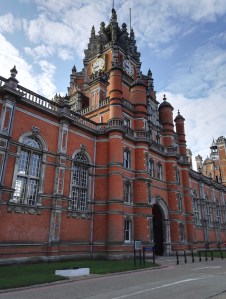
Last week I began my eighth year of study at Royal Holloway (Photo: Hannah Awcock).
Last week was my eighth Welcome Week at Royal Holloway (although it was still called Fresher’s Week in my day!), and my fifth as a postgraduate. Every year, as part of the Welcome Week programme in the Geography Department, two PhD students organise the Postgraduate Forum, a one-day conference in which current PhD students present their work. It gives current PhD students the chance to present in a friendly environment, and introduces new Masters and PhD students to the breadth of postgraduate research going on in the department.
The research community at Royal Holloway is split into three research groups: the Centre for Quaternary Research (which is where you’ll find the physical geographers), the Politics, Development and Sustainability group, and the Social, Cultural, and Historical Geography group (which is where you’ll find me!) For most of the year, these three groups operate quite separately, although there is quite a lot of overlap between the PDS and SCHG groups. On just one day a year, at the Postgraduate Forum, these three groups come together to share their research with each other, and I think it’s great.
Ashley Abrook very helpfully adapted his presentation to suit his audience, and included an explanation of what the Quaternary period is (Photo: Hannah Awcock).
Geography is a a very broad academic discipline which encompasses a wide range of topics, methodologies and theoretical approaches. For example, the Forum was organised this year by Rachael Squire and Rachel Devine (who did a fantastic job, by the way). Rachael Squire’s PhD is about the geopolitics of the ocean, focusing on the US Navy’s Sealab projects during the Cold War. Rachel Devine’s PhD is about trying to find evidence to support a new theory about what caused a period of cooling during the last interglacial transition (apologies in advance if I haven’t summarised the projects well!) You couldn’t get much more different than that, and because the different areas of geography can be so diverse, you don’t often get human and physical geographers in the same room discussing each other’s research. Which is why the Postgraduate Forum is such a good event. In the space of just one day we heard about: using the size of fossil teeth to investigate past climates; a radical eco-squat in Camden; the response of vegetation to centennial-scale climate variations; the tensions involved in being a black Christian rapper from Ealing; using rocks to reconstruct the movement of glaciers; and whether or not the Estonian government’s use of digital technologies are creating a more transparent and accountable form of government.
A few weeks ago I wrote about the RGS-IBG Annual Conference acting as a social nexus. I was kind of joking, but the analogy actually works quite well here too. The Postgraduate Forum brings PhD students together who otherwise might never interact. At the Postgraduate Forum, I met second- and third-year PhD students who are studying in the same department as me, but who I have never met before, because we’re not in the same research group. In one respect, it’s a shame that I haven’t had the chance to get to know them until now, but on the other hand I’m really pleased that we get this chance every year.
So whilst I hope, for the sake of my sanity and my bank balance, that this is the last Postgraduate Forum I will attend at Royal Holloway (as a student anyway- I’ll gladly stick around if they’d pay me!), I hope that it carries on for many more Welcome Weeks.
Turbulent Londoners is a series of posts about radical individuals in London’s history who contributed to the city’s contentious past, with a particular focus of women, whose contribution to history is often overlooked. My definition of ‘Londoner’ is quite loose, anyone who has played a role in protest in the city can be included. Any suggestions for future Turbulent Londoners posts are very welcome. My next Turbulent Londoner is Elizabeth Elstob, known as one of Britain’s first feminists.
Elizabeth Elstob by Burnet Reading, published by Edward Evans. Line engraving, early 19th century. NPG D31035 (Source: National Portrait Gallery).
Elizabeth Elstob was a renowned Anglo-Saxon scholar at a time when the medieval period was not considered worth studying, and when women were not considered worthy of education. Like fellow Geordie Mary Astell, she has since become known as one of England’s first feminists.
Born in Newcastle-Upon-Tyne to a merchant family on the 29th of September 1683, Elizabeth was orphaned young, and raised by her uncle, Charles Elstob, in Canterbury. Depite disaproving of women’s education, he allowed the young girl to learn Latin and French. 10 years her senior, Elizabeth’s brother, William, was sent to Eton and Cambridge before joining the church, becoming a scholar as she was also destined to. He introduced the teenaged Elizabeth to a small group of Anglo-Saxon scholars.
From 1696, Elizabeth lived with William in Oxford, and moved to London with him as his housekeeper in 1702. William Elstob did not share the same reservations as his uncle, and in London Elizabeth had the freedom to learn Old English. The siblings encouraged and supported each other in their academic endeavours. Elizabeth used her brother’s scholarly connections and her own force of will to gain access to intellectual circles and resources that she would have otherwise been denied. Being in London also allowed Elizabeth to join Mary Astell’s circle of female intellectuals, who helped her find subscribers for her publications.
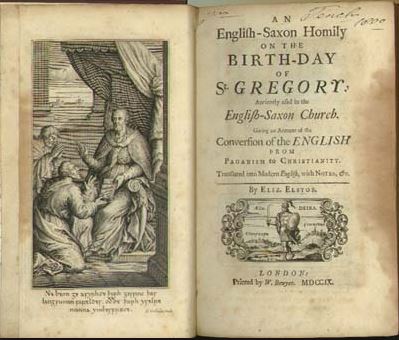
Elizabeth’s first major work was published in 1709, a beautiful edition of Abbot Ælfric of Eynsham’s tenth-century An English Saxon Homily on the Birthday of St. Gregory. In the preface, she argued for the importance of women’s education, using religious reasoning to support her arguments. He second major publication came out in 1715, and was entitled Rudiments of Grammar for the English-Saxon Tongue. It was the first such work to be written in English rather than Latin. This was a deliberate decision on Elstob’s part- she wrote in English so that her work would be more accessible to other women. It was not only women who appreciated her work, however; Thomas Jefferson owned a copy of Rudiments which he used to understand terms he came across during his legal studies.
Unfortunately, William Elstob died in 1715, leaving Elizabeth homeless and with large debts from financing their expensive scholarly publications. She started a girl’s school in Chelsea, which proved very popular but did not make a profit- it closed after just six months. In 1718 Elizabeth fled London, abandoning her books and an unfinished manuscript of Ælfric’s Catholic Homilies, a project she had worked hard to finance. She moved to rural Worcestershire where she ran a small school under the assumed name of Frances Smith. It seems that no one in the scholarly community knew where she was for almost 20 years, until 1735. In 1738 she was given the comfortable position of governess to the children of the Duke and Duchess of Portland, and she remained in their service at Bulstrode Park, Buckinghamshire, until her death on the 3rd of June 1756.
Elizabeth Elstob must have possessed incredible determination and resolve to become such a well respected scholar, despite her unpopular subject area and particularly her gender. Sadly, without the support of her brother she was not able to overcome the odds that were so heavily stacked against her as a woman. Nevertheless, her brief scholarly career demonstrated what women were capable of given half the chance, and she used her influence to support the education of other women, a revolutionary prospect at the time.
The recent EU Referendum was arguably one of the biggest political events to happen in my lifetime. I haven’t written about it before because I felt there were enough opinions being voiced and, quite frankly, I didn’t know what to say. In the weeks since, however, I have started to come to terms with the result, and on recent trips to London I have found something that I do know how to talk about- protest stickers. Like all big events and political topics (other recent ones include the 2015 General Election, the London housing crisis, and immigration), the EU Referendum left its mark on the streets of London in the form of protest stickers, which serve as constant reminders of the Brexit result.
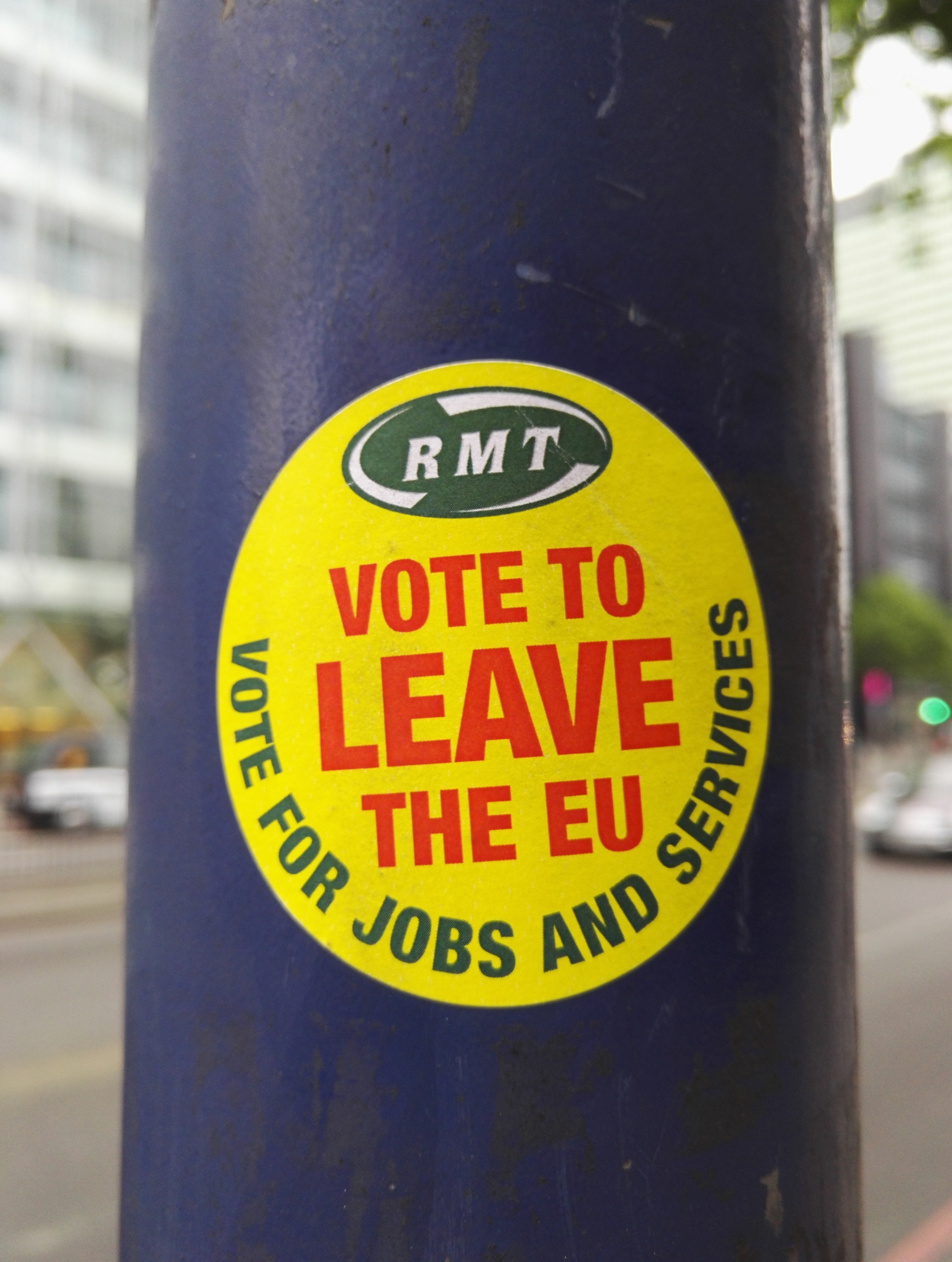
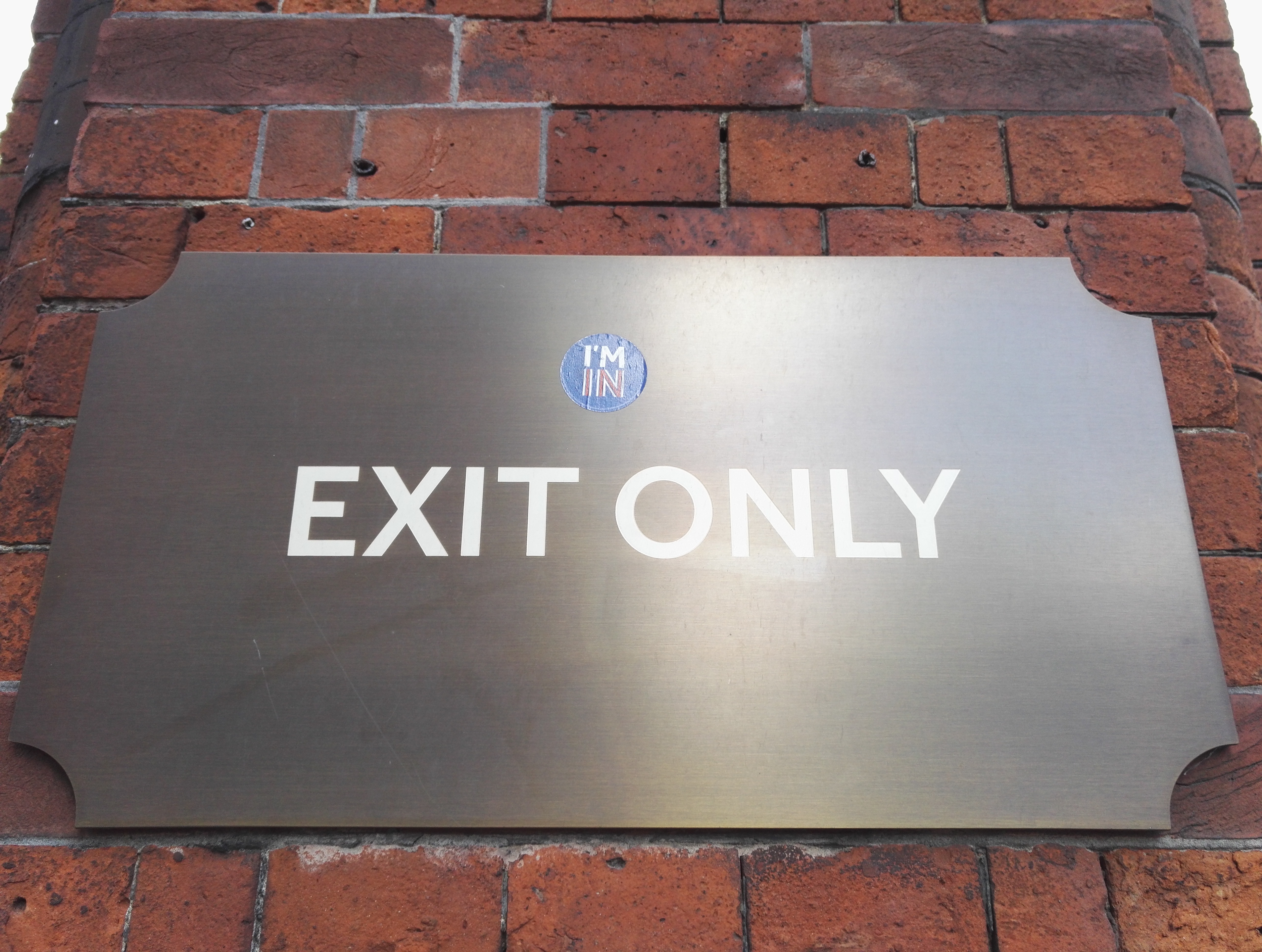
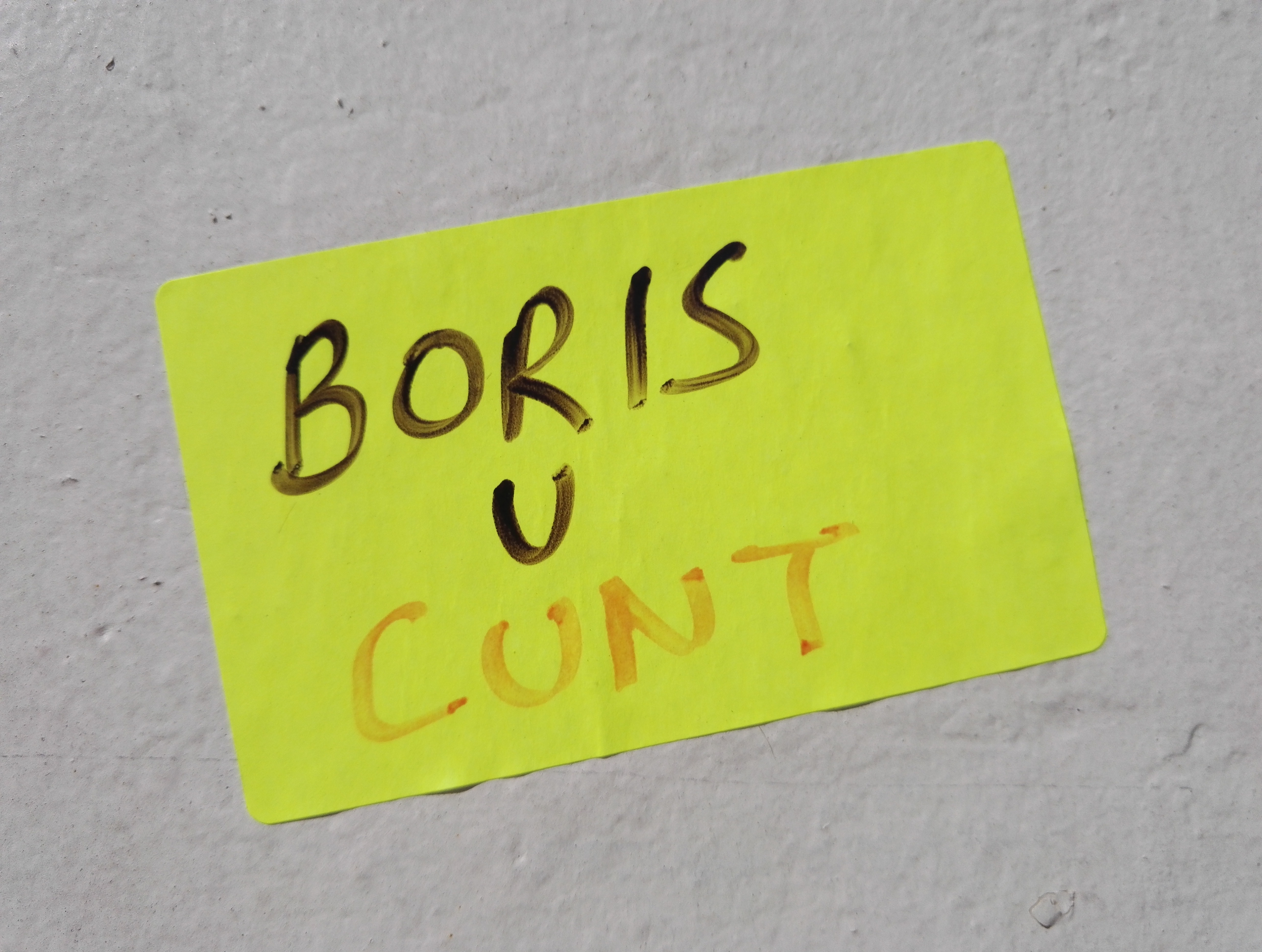
Some stickers were produced by the official remain campaign, like this one on the Euston Road (Photo: Hannah Awcock, 03/08/16).This sticker, in Malet Street, Bloomsbury, is also recognisable by the slogan and colour scheme of the official Remain campaign (Photo: Hannah Awcock, 15/07/16).This sticker, advocating a Leave vote, was also quite common, but it doesn’t share an obvious connection with the Leave campaign (Photo: Hannah Awcock, Russell Square, 13/04/16).This sticker is also urging a Leave vote. It refers to 1215, the year in which the Magna Carta was signed, declaring that the British have been a “free peoples” since then. It is a good example of how the Magna Carta is repeatedly brought into debates about freedom and liberty, having achieved symbolic status hundreds of years ago (Photo: Hannah Awcock, Great Portland Street, 03/06/16).Many individual groups and organisations took sides during the EU Referendum campaign. The Alliance for Worker’s Liberty, a socialist campaign group, declared themselves for Remain. This sticker alludes to the employment rights enforced by EU law (Photo: Hannah Awcock, Borough High Street, 15/07/16).This sticker was also produced by the Alliance for Worker’s Liberty. It reads “Lower Borders, Don’t Raise Them.” One of the big issues of the referendum was immigration (Photo: Hannah Awcock, Borough High Street, 15/07/16).The RMT, a transport union, supported the Leave campaign (Photo: Hannah Awcock, Euston Road, 03/06/16).The location of protest stickers can have a big influence on how it is interpreted (Photo: Hannah Awcock, Euston Road, 03/08/16).Protest stickers are ephemeral, and last for varying amounts of time. Sometimes, they are scratched away in a way that suggests there was a deliberate attempt to obscure the message of the sticker. This is what I think happened to this sticker on Borough High Street (Photo: Hannah Awcock, 15/07/16).There were lots of people who were not happy with the actions of Boris Johnson after the referendum. This blunt sticker expresses that disapproval in no uncertain terms (Photo: Hannah Awcock, Byng Place, 15/07/16).
The Royal Geographical Society with the Institute of British Geographers Annual Conference took place this year at the RGS-IBG in Kensington (Photo: Hannah Awcock).
I spent most of last week at the Royal Geographical Society with the Institute of British Geographers (more commonly known as the RGS-IBG to save time!) Annual Conference in South Kensington. It is the fourth big international conference I have attended since I started my PhD, and apart from being more familiar with big conferences and how they work, I noticed one big difference from my previous conference experiences: I know people now. During the tea breaks, lunch breaks, and drinks receptions, I could be fairly confident that I would find someone I know to talk to. Not that there’s anything wrong starting a conversation with a stranger; I did a little of that too. But knowing that I could probably find someone I already knew to talk to make the prospect of networking less intimidating.
The overarching theme of the conference this year was Nexus Thinking. One of the latest buzzwords in geography, a nexus is a space of connections, of junctures, and of interaction. It got me thinking about the way in which conferences bring people together from a wide range of geographical locations and subject areas- they function as social nexuses (see what I did there?).
I saw lots of people that I know at the RGS-IBG, many that I haven’t seen in quite a while. There were previous Royal Holloway students who have now moved on to further study at other universities; current Hollowegians who I haven’t seen since the end of the summer term, or who I don’t normally get to talk to in the day-to-day life of my PhD; and people that I only really see at conferences.
Myself with some fellow Hollowegians during a lunch break. From left to right: Ben Newman, Rachel Squire, Innes Keighren, Hannah Awcock (Photo: Hannah Awcock).
Many of them were fellow PhD students, whose PhDs I have followed via conference papers and chats over tea and biscuits, lunch, or a drink in the pub at the end of the day. I have watching from afar as their research has developed and progressed, and it was really nice to see them last week, as we all come in to the final stretch.
The RGS-IBG Historical Geography Research Group too, have been an intermittent presence throughout my PhD, particularly at the annual Practising Historical Geography conferences. The more established members are so supportive and generous with their time, never seeming to get tired of the incessant questioning from postgraduate students.
Sometimes when I am sat at home at my desk staring at a computer screen for hours on end, a PhD can feel quite lonely. Last week I was reminded that I have become part of a community; a group of people who know and understand what I’m going through, and that feels really nice. It might be a largely long-distance community, that requires a social nexus like the RGS-IBG Annual Conference to bring us together, but it is one that means a lot to me. And I am now confident that I will always be able to find someone to eat with during the conference lunch breaks.
I have found timetables a useful way of motivating myself during my PhD (Photo: Altug Karakoc).
A PhD is a very individual experience; everyone works in different ways, and finds different aspects challenging. For me, one of the hardest things has been keeping myself motivated. Doing a PhD, it is largely up to you how you spend your time. You might get guidance from your supervisors, you might have work, family or other commitments that you have to work around, but ultimately it comes down to you. Self-motivation is a really important part of doing a PhD!
When I started my PhD, I had 3-4 years to write 100000 words, a mammoth task that seemed both hard to comprehend and far away. It was difficult to know how much work I needed to do each day, week, month, in order to get it done. I tried to stick to a 9 to 5, Monday to Friday schedule, but it was easy enough to talk myself into an afternoon or a day off if I got a more appealing offer, or even if I just wasn’t in the right frame of mind. My favourite argument I used on myself was “well, 9-5 Monday to Friday is a social construct anyway, so why should I stick to it?”- I wonder if that one works on employers? Now, as I approach the end of my third year, the panic has set in but I still find it hard to motivate myself to work on occasion.
Something that I have found useful in recent months is timetables. I never used to find them helpful, I was never one of those people who made revision timetables in the run up to exams, for example. At Royal Holloway, PhD students have to undertake Annual Reviews to make sure they are still on track. One of the materials you have to produce for the annual review is a timetable of the work you plan to do over the next year. I must admit that for the first few years, I made the timetable then promptly forgot all about it. However, as the end of my PhD started to loom, I decided to try and make a timetable and actually stick to it.
I planned out every week until the end of my PhD, including conferences, teaching, and time off. I included self-imposed deadlines, on which I have to send pieces of writing to my supervisors, so I have concrete objectives to work towards. And for the most part, I have found it very helpful. I know what I need to get done by the end of each week, and from that I can work out what I need to do each day. It is helping to keep me focused and motivated, as well as breaking down the PhD into chucks that are more manageable.
I have also discovered one important caveat, however. Timetables are only helpful for as long as they are actually helping. There is a fine line between good pressure, which forces you to get on with things, and bad pressure, which puts your mental health at risk. Sometimes things happen which you didn’t predict, and sometimes specific tasks take longer than you anticipated, despite your best efforts. When I was writing up my most recent case study, it became obvious that I just didn’t have the material to analyse the issues convincingly. I had to spend another two weeks doing more research. It put me behind schedule, but it was necessary to ensure I come out with a good quality PhD. In fact, I have revised my timetable several times since I decided to take it seriously. I have even moved my self-imposed final deadline back by a month, because it was becoming clear that my previous date was unrealistic (I was aiming for December, I am now hoping to submit by the end of January. Royal Holloway requires me to submit by the end of September 2017, so I still have some wiggle room). My timetable isn’t set in stone; it is there to help me, and if it’s not helping me, then I can change it.
As I have said, the process of doing a PhD is different for everyone, and what I find useful might not be helpful for everyone, or even anyone, else. However, I think its important for PhD students to talk openly about our experiences, and discuss what works and what doesn’t. So please let me know if you’ve tried timetables, and if so, whether or not they’ve been useful to you.
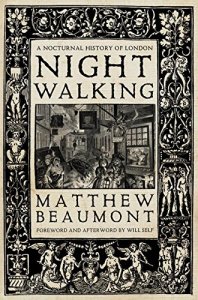
Matthew Beaumont. Nightwalking: A Nocturnal History of London. London: Verso, 2015. £9.99
Nightwalking by Matthew Beaumont is an exploration of London at night through the eyes of the men (and it is all men) who wrote about it. Starting with Chaucer, Beaumont traces evolving societal attitudes to night time and darkness in the city. He ends the book with Dickens (well, sort of- Edgar Allen Poe features heavily in the conclusion), “the great heroic and neurotic nightwalker of the nineteenth century” (Beaumont, 2015; p.6). The writers Beaumont studies walked the line between polite society and the world of the social outcasts; the prostitutes, criminals, orphans, and homeless who inhabited London’s streets after dark. Some writers managed the balance better than others.
Who walks the streets alone at night? The sad, the mad, the bad. The lost, the lonely. The hypomanic, the catatonic. The sleepless, the homeless. All the city’s internal exiles.
Beaumont, 2015; p.3
When I first got Nightwalking, I was a little disappointed to realise that it had a literary focus. I like to read, but I’m not a fan of literary analysis; perhaps there are too many bad memories from GCSE and A-Level English Literature. I thought Nightwalking was a straight social history, and I wasn’t sure I would enjoy the literary angle.
I needn’t have worried. Beaumont uses the cultural history of the London night to explore its social, political and economic history. He strikes a nice balance between detailed textual analysis and wider contextual discussion. The social and legal discourses surrounding those who wander the streets of the city at night have developed over time, but in an uneven manner. For hundreds of years, being caught outside after dark was a criminal offence. As society and technology developed, the night became a space of recreation, initially just for the wealthy; the evolution of cheap and effective street lighting is one factor that contributed to this process. Although the legal restrictions faded, moral restrictions remained, dictating which kinds of activity, and which kinds of people, were acceptable on London’s streets after dark.
London’s writers were drawn to this moral ambiguity, taking to the streets at night in order to better understand the city or themselves, to have a good time, and sometimes because they had no choice. Men such as Chaucer, Shakespeare, Johnson, Blake, and Dickens “used the night as a means of creatively thinking the limits of an increasingly enlightened, rationalist culture” (Beaumont, 2015; p.10). Beaumont balances all the contradictory and sometimes vague associations and motivations for nightwalking well, explaining his arguments in a clear and concise manner. It is obvious to me that Beaumont is an academic, and that the book is based on extensive scholarly research, but I don’t think that the book would be unapproachable to non-academics, although another reviewer has said his style can be “cloudily academic.”
Nightwalking is a well-researched, well-reasoned book that manages to tell a complicated story in a way that is easy to follow. I can see this book being useful to students of English Literature and History alike, but I would also recommend it to those who just enjoy reading a good book.















 Turbulent Isles