Book Review: March, Women, March

'March, Women, March' by Lucinda Hawksley.
‘March, Women, March’ by Lucinda Hawksley.

Hawksley, Lucinda. March, Women, March. London: André Deutsch, 2013.

Lucinda Hawksley’s March, Women, March, recently released in paperback, serves as a fantastic introduction to the history of the women’s movement in the UK, introducing the reader to all the key players from Mary Wollstoncraft through to Christabel Pankhurst, including quite a few who are not so well known nowadays. The book traces the struggle for women’s rights and female suffrage from the end of the eighteenth century to the late 1920s, using extensive quotes from those directly involved to help tell the story.

Hawksley uses numerous extracts from the diaries, letters and publications from those directly involved in the events she describes, so much of the story is told in the words of those who were there and took part. Not only does this act as proof of the huge amount of research that must have gone into the book, it also gives it a personal feel; you can almost feel the determination and strength of the women emanating from the pages.

One of the great strengths of this book is the fact that it tells the whole story of the women’s movement, putting the well-known suffragettes into the context of their predecessors and contemporaries. The Women’s Social and Political Union (WSPU) and the suffragettes did not spring up out of nowhere- they were inspired by, and worked alongside, vast numbers of other women such as Caroline Norton, Clementina Black and Charlotte Despard. March, Women, March acknowledges and celebrates the whole of this history, not just the bits that have successfully made their way into the collective consciousness.

In fact, my main criticism of the book is that I would have liked more detail about the early pioneers of the women’s movement. Women such as Caroline Norton, who railed against the way that she was treated by both her husband and the law after her marriage, and campaigned tireless for the rights of married women to see their children and control their own income, are much less familiar to me than the Pankhursts, and I would have liked to hear more about them.

March, Women, March also puts the campaign for suffrage into the context of other campaigns that aimed to benefit women, such as attempts to raise awareness about sexual health and contraception, and the ‘rational dress’ movement, which sought to free women from the physical constraints of tight corsets, high heels and excess frills and bows. These campaigns made social pariahs of their champions, appalling mainstream society with their frank and radical opinions. Many of the campaigners, such as Clementina Black who worked tirelessly to improve the conditions of working women, believed that the situation would not truly improve until women were granted the vote, for why should politicians listen to them when they could not influence the outcome of elections? Everything came back to suffrage.

If you are acquainted with the events and figures of the women’s suffrage campaign after 1900, much of this book will feel familiar, although you will probably still learn something new. If you are not familiar with the activities of the WSPU and others, then this book is an ideal introduction to the topic. Either way, March, Women, March is a very enjoyable read, and I would highly recommend it.

Rebellious New York: A Radical Guide to NYC

Last week I went on a second year undergraduate field trip in New York as a member of staff. I was running a project group on protests and riots in the city, so I spent the week immersing myself in the radical past and present of the big apple. There are loads of things you can do to learn about New York’s radical side, and I had a great week getting to know them all.

New York's iconic skyline from the top of the Rockefeller Centre.
New York’s iconic skyline from the top of the Rockefeller Centre (Photo: Hannah Awcock).

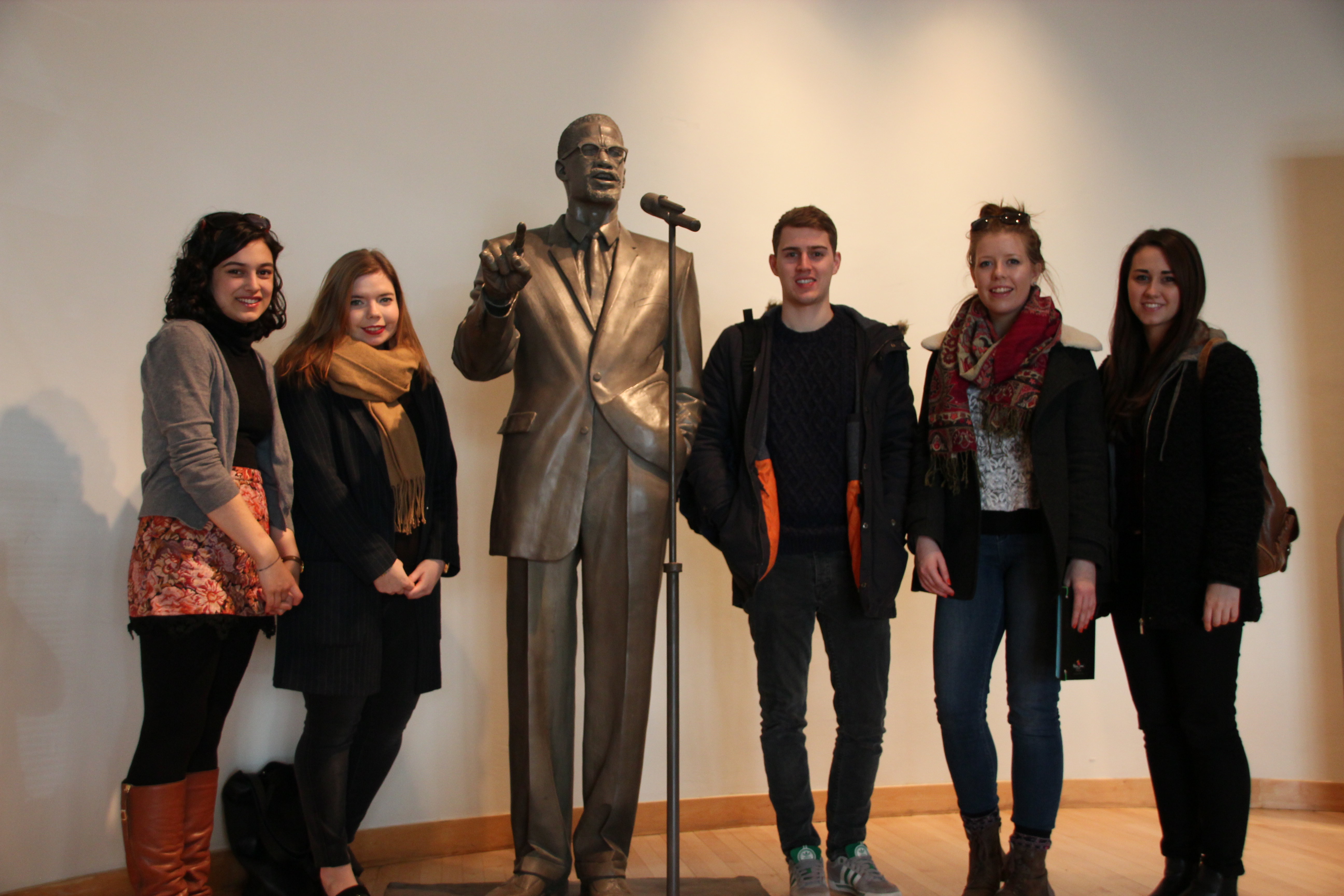
With my group of students, I visited the Malcolm X and Dr. Betty Shabazz Memorial and Education Centre in Washington Heights. The Centre aims to honour Malcolm X and his wife by continuing their legacy, supporting campaigns that fight for social justice and human rights. It is in the building in which Malcolm X was assassinated; the very spot where it happened is sectioned off, and some of the original floorboards remain. It is a very interesting space, and I think it is a much better memorial than a statue or mural (although the centre does have both of these) because it continues their campaign work rather than just passively existing as a reminder.

My students with a statue of Malcolm X at the Shabazz Centre.
My students with a statue of Malcolm X at the Shabazz Centre (Photo: Hannah Awcock).

We also went on an Occupy Wall St. walking tour with founding member of Occupy and qualified tour guide, Michael Pellagatti. Pellagatti uses his extensive knowledge of the history of New York to put the Occupy movement into the context of other protests in the city, and his experience as one of the original members of Occupy Wall St. to give fascinating details about exactly what happened where in Zucotti Park and the surrounding areas.

Michael Pellagatti, the Radikal Tour Guide.
Michael Pellagatti, the Radikal Tour Guide (Photo: Hannah Awcock).

The Museum of the City of New York’s exhibition Activist New York is another way to learn about the radical side of the city. It details various protest movements, from resistance to religious intolerance in New Amsterdam to the recent controversy over plans to build a mosque at 51 Park Street near Ground Zero. It is a fantastic introduction to the city’s radical history, particularly if, like me, you have little prior knowledge. Unfortunately it is not a permanent exhibition, so won’t be around forever. The Museum also has a 20 minute video about the history of New York, which is a brilliant introduction to how the city developed.

The Activist New York Exhibition at the Museum of the City of New York.
The Activist New York Exhibition at the Museum of the City of New York (Photo: Hannah Awcock).

If you are interested in doing your own research about protest in New York, then the Interference Archive in Brooklyn is an ideal place to go. The archive’s collection houses ephemera (leaflets, posters, t-shirts, badges, banners, zines etc.) from a wide variety of protests across the world. The aim of the archive is to explore the relationship between cultural production and social movements, and it does this through a whole range of events and exhibitions, as well as its collections.

The Interference Archive.
The Interference Archive (Photo: Hannah Awcock).

As with other cities, there are also sign of contention and controversy all over the streets of New York. Graffiti is common, as are protest stickers, although I did not spot as many stickers in New York as I have done in London. Some of my students witnessed a Black Lives Matter protest in a clothes store whilst they were out shopping. It was a case of being in the right place at the right time, and shows how protest can occur in every aspect of urban life.

A protest sticker referring to the recent controversy over the police treatment of black people.
A protest sticker referring to the recent controversy over the police treatment of black people (Photo: Hannah Awcock).

Although not as old as London, New York still has a vibrant and fascinating history, and protest and contentious politics are a big part of that history. Obviously there is any number of things to see and do in New York, but if you do go, perhaps consider getting to know its radical side, as it is such an integral part of the city.

Turbulent Londoners: Clementina Black, 1854-1922

Turbulent Londoners is a series of posts about radical individuals in London’s history who contributed to the city’s contentious past. My definition of ‘Londoner’ is quite loose, anyone who has played a role in protest in the city can be included. Any suggestions for future Turbulent Londoners posts are very welcome. The next Turbulent Londoner is Clementina Black, a writer, feminist and trade unionist.


Clementina Black was a writer, feminist and early trade unionist, and another inspiring radical who has slipped through the cracks of history. She was an adopted Londoner, like many millions before and since, who was born in Brighton (my home town, so I felt an immediate affinity!) in 1854. She helped to found and run numerous campaign organisations, with a focus on trying to improve the lives of working women. Her writing included multiple reports on the social conditions of the poor and 7 novels, including The Agitator, which was based on her experience in the trade union movement. She died in December 1922, when she was 68 years old.

Clementina’s mother died when she was 21, leaving her to look after her invalid father and 7 younger siblings. During this time she wrote her first novel, A Sussex Idyll. When Clementina’s father died she moved on London to continue her writing career, and this is also where her radical career really began. In 1886 she became Honorary Secretary of the Women’s Trade Union League, a role in which she thrived, travelling the country attempting to persuade women to join Unions. In 1888 she proposed an equal pay motion at the Trades Union Congress, fighting an injustice which has still not been resolved to this day.

In 1889 Clementina helped form the Women’s Trade Union Association, later the Women’s Industrial Council (WIC), which she would eventually become president of. In 1895 she became the Editor of WIC’s journal, Women’s Industrial News. The middle class women of the WIC went to see the working conditions of working class women, and wrote reports on them in an attempt to raise awareness. By 1914 they had investigated 117 different trades.

Clementina was also involved in the Consumers League, which put pressure on employers who paid their female workers low wages through their customers- they were involved in the boycott of the Bryant and May matchmakers, who would go on to be defeated in the Matchwomen’s Strike of 1888. In 1896 Clementina began to campaign for a legal minimum wage, viewing low wages as the root of the problem for female workers. She was also a member of the executive committee of the Anti-Sweating League, and helped organise several conferences on the topic in the years before the First World War.

As the campaign for women’s suffrage took off after 1900, Clementina also threw herself into that, believing that women lacked real power to affect change as long as they lacked the ability to vote. In 1906 she was made Honorary Secretary of the Women’s Franchise Declaration Committee, where she organised a petition in favour of female suffrage with 257,000 signatures. She was an active member of both the National Union of Women’s Suffrage Societies (NUWSS) and the London Society for Women’s Suffrage. The NUWSS was the non-violent equivalent of the WSPU and the suffragettes, and were arguably just as important in winning the vote for women. In 1912-3, Clementina was the acting editor of The Common Cause, the NUWSS’s paper which called itself ‘the organ of the women’s movement for reform.’

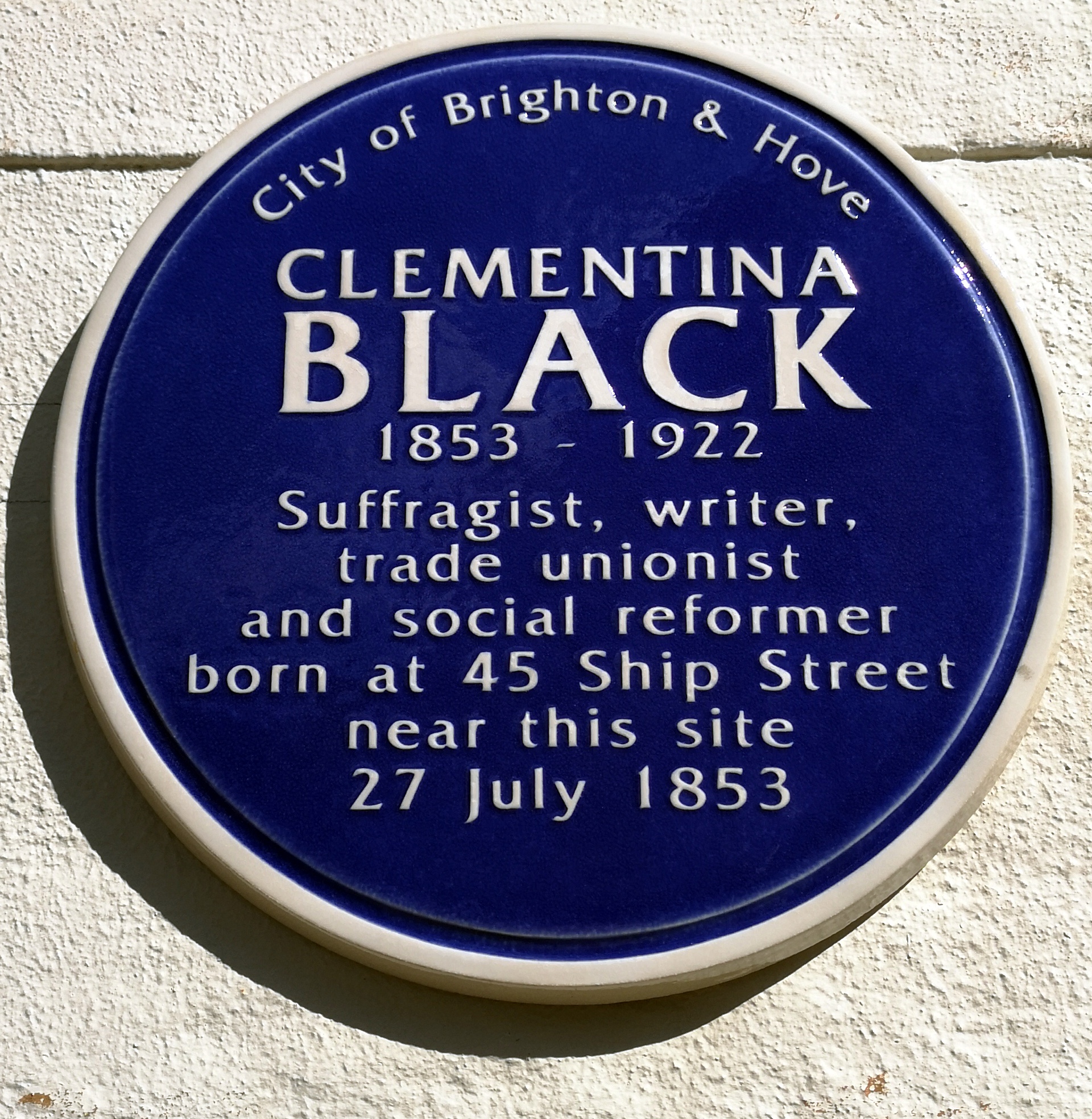
A plaque commemorating Clementina Black in Brighton (Source: Simon Harriyott).

Like many female activists of her era, Clementina was a tireless force in the campaign to improve the lives of women. Unlike other prominent campaigners for women’s rights such as Emmeline Pankhurst, she focussed on working women, those who needed the most help. She was not only a member, but in several cases a key leader, of multiple campaign groups. She didn’t really participate in direct action, instead using her skills as a writer to persuade others. She is not a woman who deserves to be forgotten.

Sources and Further Reading

Anon. ‘Clementina Black,’ Wikipedia. Last modified 19 January 2015, accessed 20 March 2015. http://en.wikipedia.org/wiki/Clementina_Black

Anon. ‘Clementina Black,’ Women of Brighton. No date, accessed 20 March 2015. http://www.womenofbrighton.co.uk/clementina-black.html

Simkin, John. ‘Clementina Black,’ Spartacus Educational. Last modified January 2015, accessed 20 March 2015. http://spartacus-educational.com/Wblack.htm

Simkin, John. ‘The Common Cause,’ Spartacus Educational. Last modified August 2014, accessed 20 March 2015. http://spartacus-educational.com/Wcommoncause.htm

Sans Dust: Flickr and Instagram as Archives

Rachel Taylor graduated from Royal Holloway’s research-based MA Cultural Geography last year. She is currently working for the Royal Geographical Society (with IBG). Her research interests include public engagement with academia, museums, identity politics and how we understand human remains. Here she reflects on online archives, particularly photographic ones, as a research method. The internet is not one of the first things that springs to mind when you think of archives, but it is a valuable resource for academics if we only made use of it. Follow Rachel on Twitter: @mereplacenames


A photo of the British Museum available on Flickr. Rachel Taylor used websites such as Flickr and Instagram to analyse visitor behaviour in museums in the research for her Masters dissertation (Source: Patrick Down).

In an age where the most popular ‘camera’ used by Flickr uploaders is the iPhone 4S, it’s time to reconsider photography, contemporary archival methods and move beyond the idea that dust – “the scholar’s choice of dirt” (Lorimer, 2009: 248) and tangibility are the only bedfellows of archival scholarship. Cultural geographers and non-geographers alike are beginning to consider the importance of the online archives that are increasingly playing an important role in our day to day life, and what follows are some brief reflections on the promise and pitfalls of working with these modern archives.

The field of online research is still in its infancy. Having conducted research on the place of Web 2.0 in understanding modern museum behaviour, I’m interested in the many ways in which this infancy provokes questions on the methodological difficulties of working with online archives.

While working with archives has often involved accessing material fiercely guarded by gatekeepers, with a strong emphasis on the physicality of the archive, contemporary visual archives such as Flickr and Instagram offer the chance to conduct research from any location and to gain an immediate appreciation of how the ‘photographers’ that use these sites articulate their social identities and make memories. Rather than delving into little seen and barely touched sources, the empirical data of online archives is generally available to anyone with an internet connection, with “the family photo album, once confined to living rooms…brought into the equivalent of the town square” (Kramer-Duffield and Hank, 2008: 1).

Visitors look at cares in the Otrębusy Museum in Poland (Source: Sabastian Jakubik).

Despite online photographic repositories offering innovation in archival methodology, both Flickr and Instagram can be accused of hosting throwaway images, with each Instagram photograph “rapidly replaced by the next” (Champion, 2012: 86). Champion draws upon van Dijk in considering the disposability of Instagram images, suggesting they can be equated “to postcards which were meant to be thrown away” (2012: 87). While online visual archives act as a repository of memory, the very fact that they serve as repositories means permanence and importance are not privileged. In a world where some feel the need to photograph every morsel of food they eat, images are no longer confined to capturing the extraordinary. Rather, the banal, everyday moments of life take centre stage.

On a practical note, this disposable nature of the online world hinders attempts at locating images, often exponentially increasing the labour of data collection and encapsulates the difficulties of carrying out research on the Internet. Instagram’s web platform allows a maximum of twenty images to be viewed at any one time, with no means of viewing large amounts of images at once. Web platform such as spots.io and Websta do provide assistance, but issues with cached data and partial information ensure data collection remains a demanding task.

Opening of the “Taoid”, Museum of the Cordilleras in Ilocos Norte, located at the La Tabacalera Lifestyle Center in Laoag City (beside Museo Ilocos Norte). November 21, 2015 (Source: Ilocos Norte).

While paper may crumple and ink fade, webpages can be edited, deleted and moved. More traditional forms of archival scholarship are reliant upon gatekeepers’ superior knowledge of their collections to guide the researcher in knowing what to look for. In the online world, images are effectively lost if one does not know what they are looking for, with elements such as hashtags, captions and geotags all serving as digital clues to contextualise the images in the vast visual banks of photographic repositories. The wealth of information contained within these non-visual cues demonstrate that when carrying out archival research with online sources, visuality is only one element of the photographic archives.

Despite these challenges, platforms such as Instagram and Flickr offer the chance to engage with how users visually curate their lives. The act of photographing something denotes it as something ‘worth’ seeing. These images then are “increasingly active objects” (de Rijcke and Beaulieu, 2011: 665). These active objects shouldn’t be viewed as objective records, but rather seek to actively represent the person taking the photograph, “negotiated” with an audience in mind (Goffman, 1959 in Larsen, 2005: 419). Photographic practice acts as a form of memory making and establishing one’s presence, allowing content producers to self-curate their everyday life and activities. In an ever increasingly visual world, online archival work offers the ability to understand and interpret contemporary behaviour – sans dust.

Rachel Taylor.

Turbulent Westminster: Time to Act and Million Women Rise Marches

Westminster was very busy on Saturday (the 7th of March), with both the Time to Act and Million Women Rise marches taking place. No sooner did the end of the Climate Change march pass Trafalgar Square towards Parliament Square, than Million Women Rise entered the square for a rally, demonstrating just how important this small area of London is to British politics. The marches represented very different issues, with Time to Act calling for urgent changes to the way we deal with climate change, and Million Women Rise demanding an end to male violence against women, tying in with International Women’s Day on the 8th of March. The beautiful weather combined with the bright placards creative chants and upbeat atmosphere to create a thoroughly enjoyable spectacle. Here are some of my photos from the day.

People had come from all over the country to protest against issues related to climate change in their local area, but  there were several London groups.
People had come from all over the country to protest against issues related to climate change in their local area, but there were several London groups (Photo: Hannah Awcock).
People of all ages attended the march....
People of all ages attended the march…. (Photo: Hannah Awcock)
...from the young...
…from the young… (Photo: Hannah Awcock)
...to the old, several generations were represented by the demonstrators. I think climate change marches tend to be more friendly and safe events than protests around some issues.
…to the old, several generations were represented by the demonstrators. I think climate change marches tend to be more friendly and safe events than protests around some issues (Photo: Hannah Awcock).
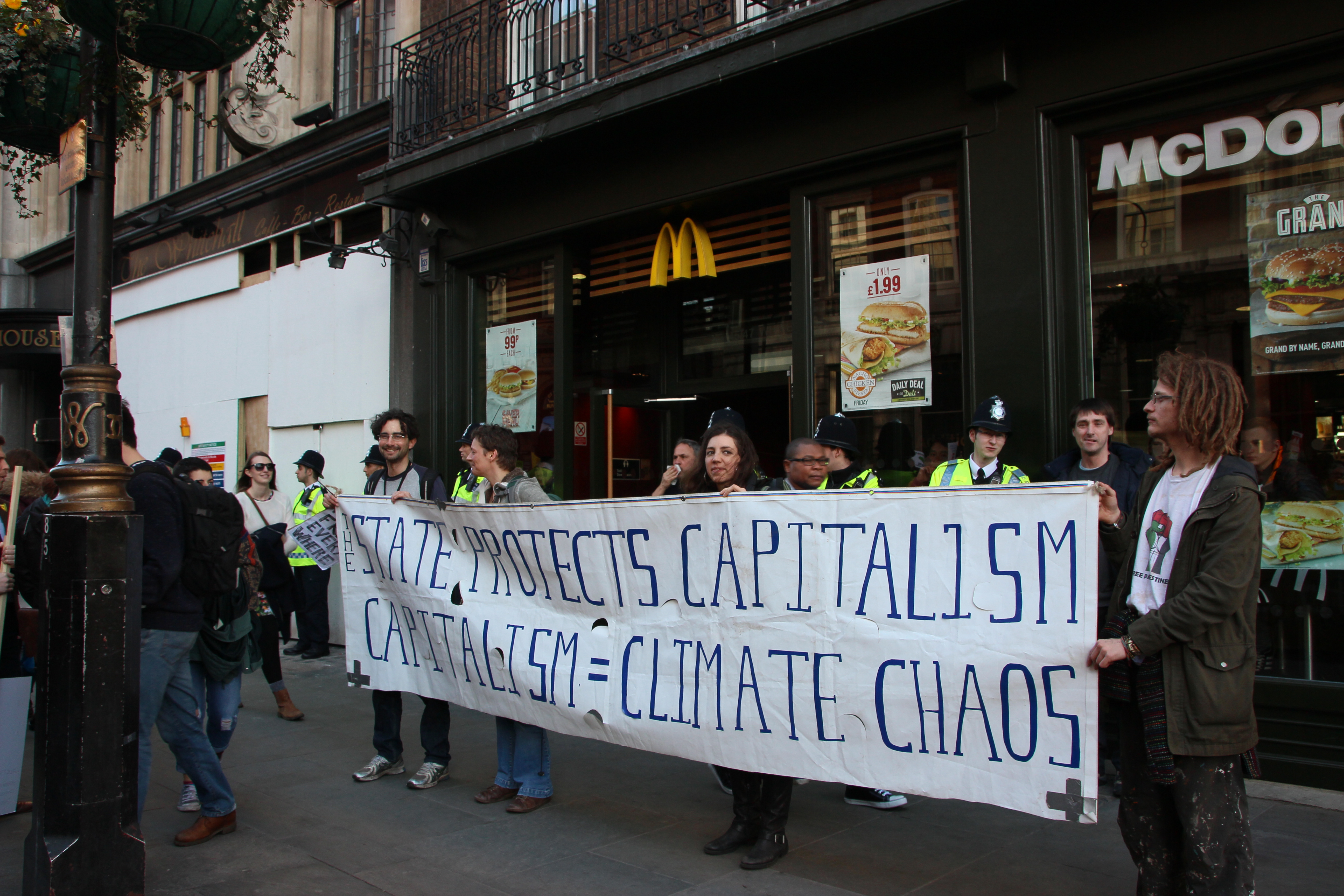
This group stopped in front of a McDonalds to help make their point.
This group stopped in front of a McDonalds to help make their point (Photo: Hannah Awcock).
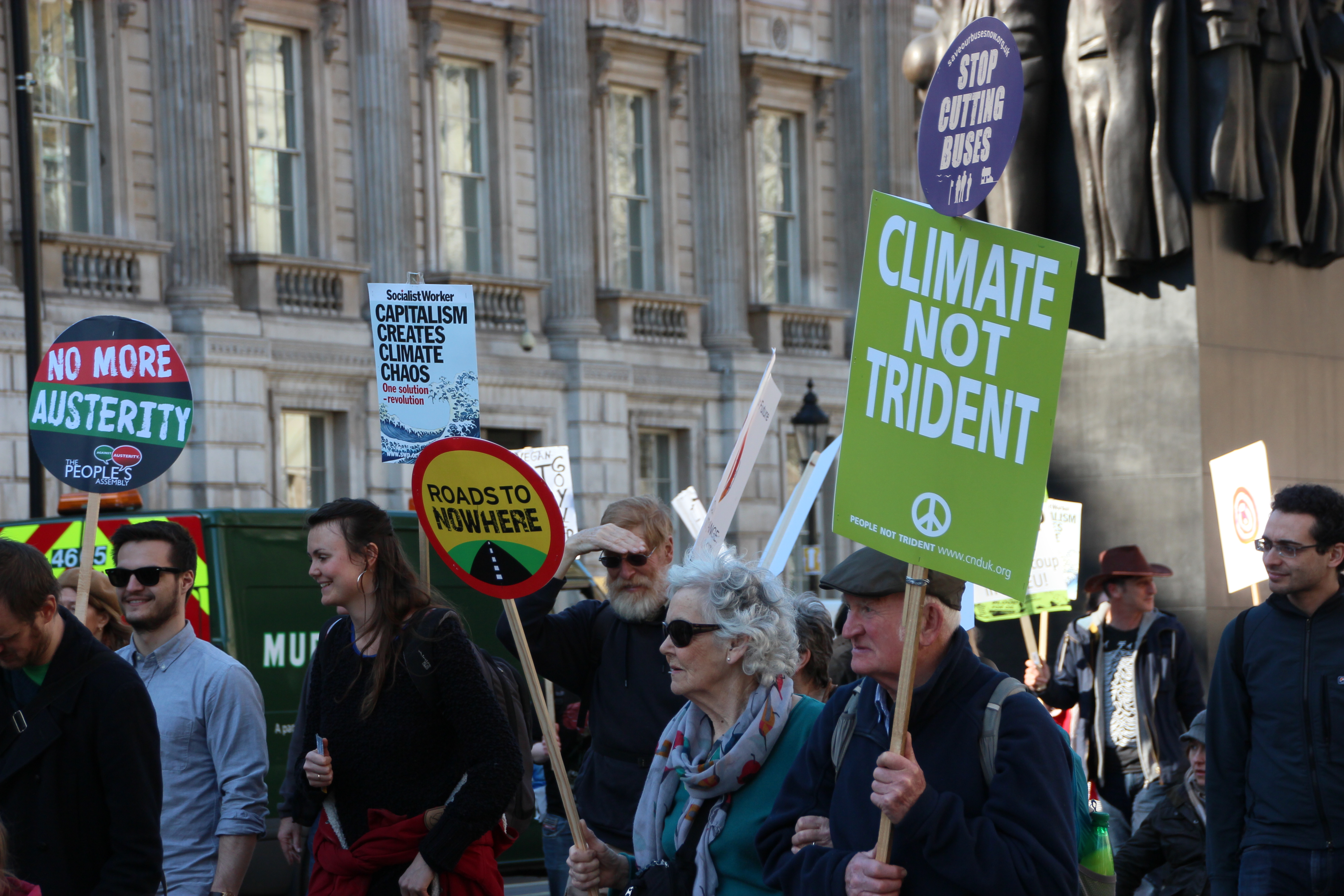
As usual, there were generic placards printed large numbers by groups such as the Green Party, the CND, and Left Unity...
As usual, there were generic placards printed large numbers by groups such as the Green Party, the CND, and Left Unity… (Photo: Hannah Awcock)
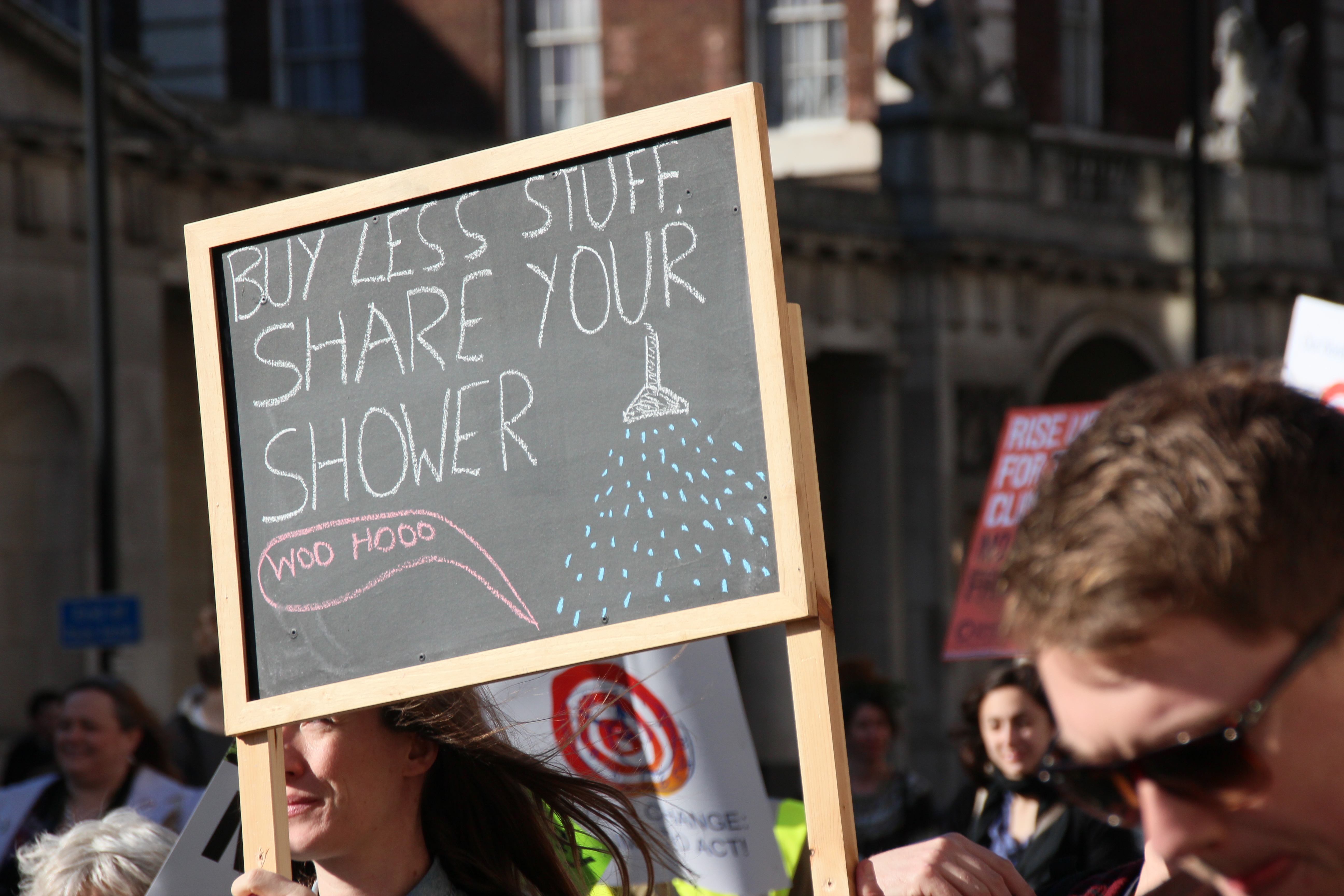
...as well as home-made efforts, which frequently take a comic approach to the issues.
…as well as home-made efforts, which frequently take a comic approach to the issues (Photo: Hannah Awcock).
Lots of issues were represented in the Time to Act march, including fossil fuels, TTIP, runways and Trident. Drax is a coal-fired power station in Yorkshire that provides about 7% of the UK's electricity supply.
Lots of issues were represented in the Time to Act march, including fossil fuels, TTIP, runways and Trident. Drax is a coal-fired power station in Yorkshire that provides about 7% of the UK’s electricity supply (Photo: Hannah Awcock).
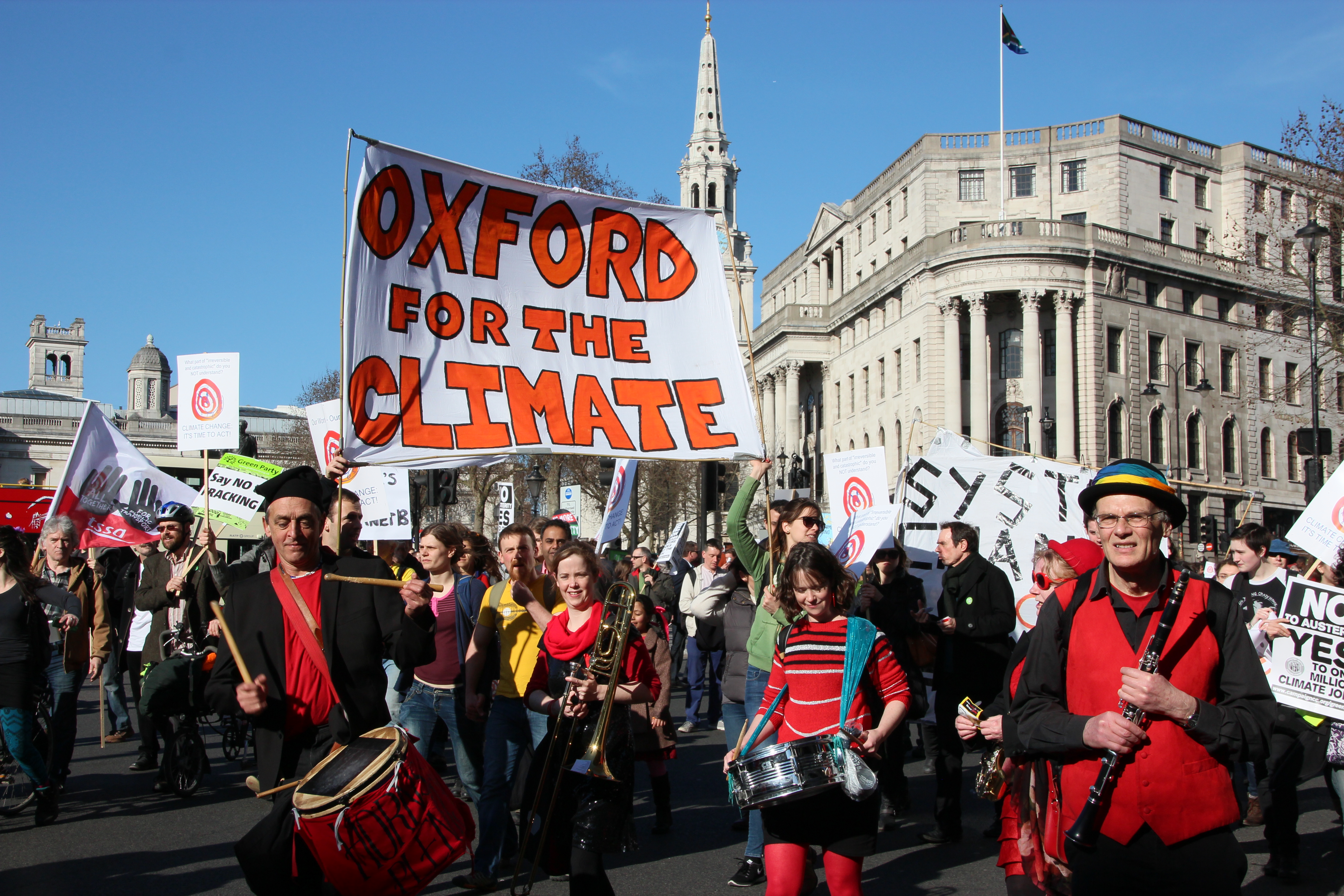
This contingent from Oxford brought their own band. Music is a really important part of protest marches, helping to left the mood and keep the marchers upbeat and energised.
This contingent from Oxford brought their own band. Music is a really important part of protest marches, helping to left the mood and keep the marchers upbeat and energised (Photo: Hannah Awcock).
Whilst fracking was a popular topic of disdain for the marchers, this gentleman decided to focus on tar sands.  Tar sands is not a method of fossil fuel extraction that is used in the UK, but many contemporary activists take an international approach to their campaigning.
Whilst fracking was a popular topic of disdain for the marchers, this gentleman decided to focus on tar sands. Tar sands is not a method of fossil fuel extraction that is used in the UK, but many contemporary activists take an international approach to their campaigning (Photo: Hannah Awcock).
This protester brought his bike along, presumably to promote the environmentally -friendly form of travel. The placard in his basket is a play on Shell's logo and name.
This protester brought his bike along, presumably to promote the environmentally -friendly form of travel. The placard in his basket is a play on Shell’s logo and name (Photo: Hannah Awcock).
One of the last placards of the Time to Act march was this one, calling for spectators to join the march.
One of the last placards of the Time to Act march was this one, calling for spectators to join the march (Photo: Hannah Awcock).
The Million Women Rise march arrived in Trafalgar Square just as the last Time to Act protester passed by. They too had many mass-produced placards.
The Million Women Rise march arrived in Trafalgar Square just as the last Time to Act protester passed by. They too had many mass-produced placards (Photo: Hannah Awcock).
But there were also home-made placards too, like this one.
But there were also home-made placards too, like this one (Photo: Hannah Awcock).
Although violence against women is a more focussed topic than climate change, other issues were still brought in by demonstrators, such as this sign about migration.
Although violence against women is a more focussed topic than climate change, other issues were still brought in by demonstrators, such as this sign about migration (Photo: Hannah Awcock).
IMG_6786
Lots of different groups were represented on the march, from a huge variety of backgrounds. From Essex… (Photo: Hannah Awcock)
IMG_6781
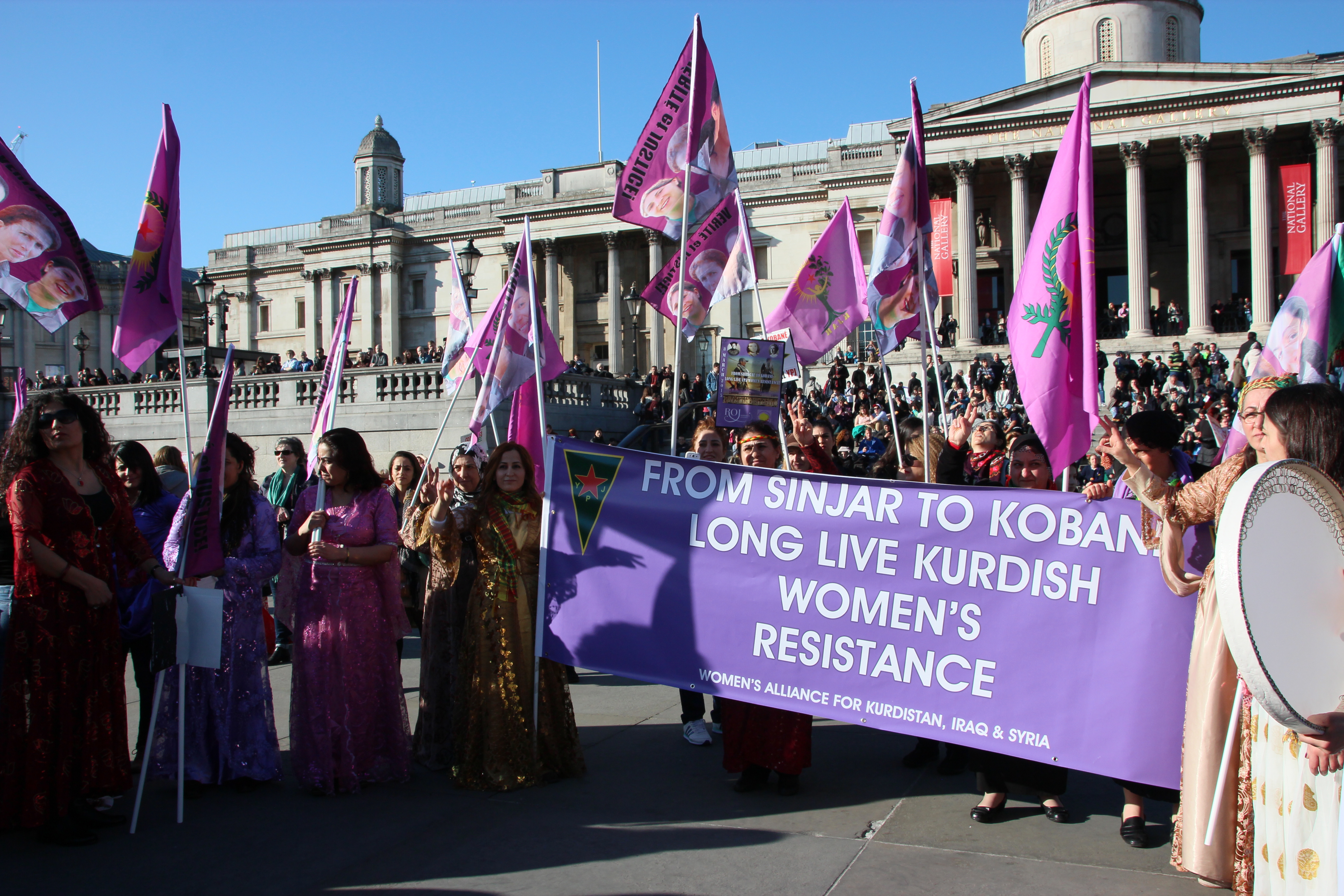
…to Kurdistan, each group had a different style and approach (Photo: Hannah Awcock).
IMG_6794
This was one of my favourite banners from the day, with the bright colours and striking imagery. Unfortunately, I doubt it will ever be seen in the National Gallery! (Photo: Hannah Awcock).
Most marches end with a rally, witch speakers, and sometimes music. The Million Women Rise stage was set up in front of Nelson's Column.
Most marches end with a rally, with speakers, and sometimes music. The Million Women Rise stage was set up in front of Nelson’s Column (Photo: Hannah Awcock).

‘Going through the Change!’: The Story of the National Women Against Pit Closures

On Tuesday evening I went to the London premiere of the film Going through the Change! at the Bishopsgate Institute. Made by Anne-Marie Sweeney, it is a film about the 20th anniversary weekend of the National Women Against Pit Closures (NWAPC) in 2004. Anne-Marie Sweeney and Bridget Bell, Joint Secretary of the NWAPC, both spoke and led the discussion after the film. Because of the recent 30th anniversary, the 1984-5 miners’ strike has been the focus of renewed attention, most prominently in the form of the film Pride. Going through the Change! is a reflection on this commemorative process, as well as a celebration of the past, present, and future work of  working class female activists.

Women against Pit Closures is still remembered in former mining communities today, as this banner from a march in 2022 confirms (Source: Tim Dennell).

The NWAPC is a national organisation set up to coordinate the efforts of local Women Against Pits Closure groups that sprang up around the country almost as soon as the miners’ strike started. The film is made up almost entirely of footage from the weekend held to celebrate the 20th anniversary of the strike. It uses footage of the weekend’s speakers, many of whom were involved in entirely different campaigns from the miners’ strike, to show footage of other disputes, including dock strikes in Liverpool, action by the Fire Brigade’s Union and protests demanding improved treatment of asylum seekers. In this way the film really emphasises the importance of solidarity between campaigns and social movements, in terms of moral as well as financial and practical support.

One thing that the film and discussion made me think about was the way in which anniversaries such as the 30th anniversary of the miners’ strike are used. As I said, many of the speakers shown in the film were from campaigns that were nothing to do with the strike, many of them still ongoing at the time the footage was filmed in 2004. Then, as now, the NWAPC is using the anniversary not as an excuse for a nostalgia trip, but as a focus point for what is still yet to be achieved. In a similar way, the Lesbians and Gays Support the Miners group (LGSM) has received a boost from the publicity surrounding the anniversary and Pride (see @LGSMPride on Twitter). Unlike other historical events, the anniversary of the strike is being used as an opportunity to look forward as well as back.

When the women of the NWAPC do look back, it seems to be mainly for the purpose of taking inspiration and lessons for future campaigns. Education is clearly an important part of campaigns such as this one. Many of the women involved in NWAPC had no experience of activism or politics before the strike began. The title of the film Going through the Change! initially invokes thoughts of the menopause, but is actually a quote from one the speakers. And the change she is referring too is that from housewife to political activist. All of the women featured seemed to have experienced this sense of empowerment, the realisation that actually they can make a difference and cause change. They were fierce and proud, and perfectly capable of articulating themselves in public, something several of them said they never dreamed they would be able to do before they were politicised. As campaigns continue and develop, more women will be empowered in this way, will learn how to use direct action and campaigning to fight for their goals. Women who have already gone through this transformation should be able to help based on their own experiences, which is another reason that solidarity and networks between different campaigns are so important.

Going through the Change! is an inspiring film, and it was a pleasure to be part of a discussion where so many of the women from the film were present. These are strong women who have had long, accomplished activism careers, and who continue to fight in times that they see as just as bad, if not worse, than the 1980s. Many of them are now fighting for the futures of the grandchildren rather than their children, but they remain as passionate and fierce as ever, and a lesson to us all.

The people involved in making Going through the Change! are keen for the film to be seen. If you would like to buy a copy, or arrange a screening, then get in touch via their Facebook group.


Sources

‘Going through the Change!’ Bristol Radical History Group. Last modified 6th February 2015, accessed 4th March 2015. http://www.brh.org.uk/site/events/going-change/

Graham, Sarah. ‘Women Against Pit Closures: memories from the miners’ strike, 30 years on.’ Feminist Times. Last modified 5th March 2014, accessed 4th March 2015.  http://www.feministtimes.com/women-against-pit-closures-memories-from-the-miners-strike-30-years-on/

‘Greetings card: The Banner of the National Women Against Pit Closures.’ Pastpixels. No date, accessed 4th march 2015. http://www.pastpixels.co.uk/en/product/greetings-card-banner-national-women-against-pit-closures

Book Review: Sally Heathcote: Suffragette

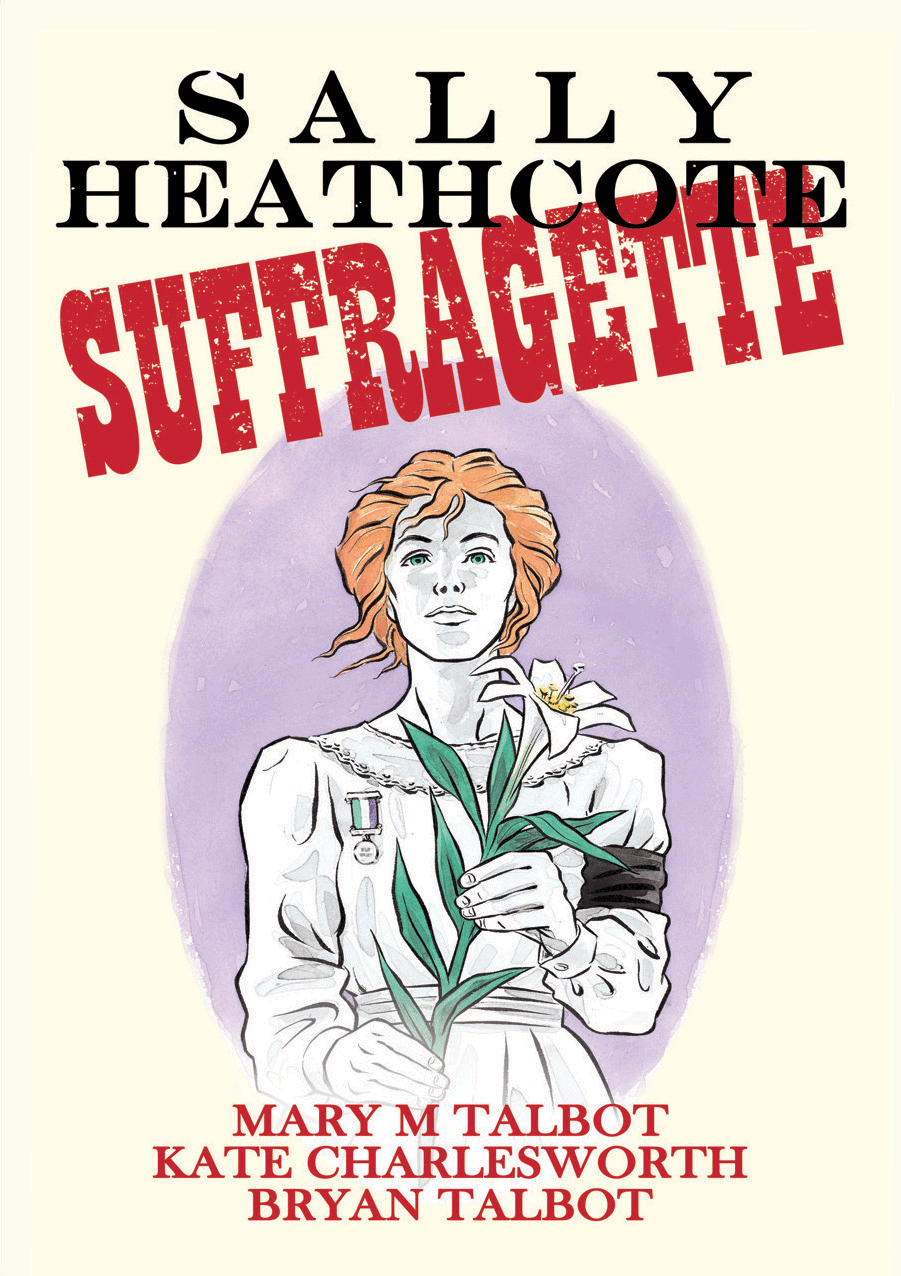
'Sally Heathcote: Suffragette' by May Talbot, Kate Charlesworth and Bryan Talbot.
‘Sally Heathcote: Suffragette’ by Mary Talbot, Kate Charlesworth and Bryan Talbot.

Talbot, Mary M, Kate Charlesworth and Bryan Talbot. Sally Heathcote: Suffragette. London: Jonathan Cape, 2014.

Sally Heathcote: Suffragette is a graphic novel that follows Sally Heathcote, a fictional young woman from Manchester who works for the Pankhurst family before they move to London. The story of the suffragettes, from the early days in Manchester through to World War One, is told through the eyes of Sally, a young working class woman who grew up in the workhouse. The book is thoughtful, historically accurate and beautifully illustrated; and a refreshing alternative to traditional depictions of the suffragettes.

Protest and graphic novels are not strangers. I recently reviewed Fight the Power  on this blog, which tells the story of many key examples of historical protest in the English-speaking world. V for Vendetta is a well-known example, with V masks becoming a common feature at marches and demonstrations across the world over the past few years. The recent Comics Unmasked exhibition at the British Library had a whole section on the connections between comics, graphic novels and dissent, which showed that comics frequently constitute protest as well as just representing them.

Sally Heathcote in a WSPU march (Source: Sally Heathcote, 2014).

In a nursing home in Hackney in 1969, an aged Sally dreams about her youth as a suffragette. After leaving the workhouse, Sally became a domestic servant for the Pankhursts. She moves to London several years after the family, and eventually gets a job working for the WSPU. All of the major features of the history of WSPU are then told through Sally’s own experience of them. She is arrested and imprisoned, where she embarks on a hunger strike and is force-fed, like many real-life suffragettes did when they were refused the right to be treated as political prisoners. She  joins the Young Hot Bloods, a secretive militant group within the WSPU, and participates in the bombing of a house belonging to Lloyd George. The divisions within the women’s suffrage movement are seen through Sally’s eyes, as is the death of Emily Wilding-Davison, who was killed by the King George V’s  Horse at the Epsom Derby in 1913.

Apart from the fictional main character, Sally Heathcote is historically accurate and incredibly well researched, with several pages at the back of the book dedicated to explaining the historical sources and contexts of particular events in the story. Also, some speeches and newspaper articles in the book are lifted directly from genuine historical documents. The story does not idealise the WSPU, depicting many of the movement’s weaknesses and divisions. Throughout the book, Sally talks with a mancunian accent, and her story illustrates the class prejudices that were present amongst the leading members of the WSPU. The splits and acrimony between the Pankhursts and many of their closest allies are also shown. As a result the book is a balanced account of history, showing that maintaining solidarity across differences is one of the most difficult challenges faced by a social movement.

Sally is imprisoned in Holloway Jail (Source: Sally Heathcote, 2014)

Sally Heathcote is not perfect however. Frequently with graphic novels I struggle to tell some of the characters apart, and I find myself failing to develop a connection with the characters, gaining little insight into their emotions and motivations. Although Sally can always be identified by her bright red hair (colour is used sparingly and to great effect within the book), I often couldn’t identify which of the other main protagonists were speaking. This difficulty may be accentuated if the reader is not familiar with the leading members of the women’s suffrage movement. In addition the reader never gets an explanation as to why Sally is so committed to the WSPU.  As the book progresses we learn she is headstrong and brave, and feels like she owes a debt to Emmeline Pankhurst for hiring her when she left the workhouse, but she never actually says why the right to vote is so important to her. I think this is a major oversight, as it is harder to identify with Sally if you don’t understand her motives.

Sally Heathcote: Suffragette is a poignant, realistic tale of struggle at the turn of the twentieth century. The Suffragettes are possibly one of the most well-known social movements in British history, so it must be a daunting prospect to try and tell their story from a fresh perspective. Sally Heathcote, with it’s unusual format and brave protagonist, does a pretty good job.

We are the Angry Mob: the Politics of the Kaiser Chiefs

The Kaiser Chiefs perfoming at the O2 arena in February 2014 (Photo by author).

Last week I saw the Kaiser Chiefs live at the O2. It was a fantastic concert, and nostalgic for me, because I last saw them live back in 2007 when I was a teenager in Brighton. But it also brought home to me the political nature of many of the Kaiser Chief lyrics.

For those of you who are unfamiliar with them, the Kaiser Chiefs are an indie rock band from Leeds that formed in 2003. They are named after a South African football club, the first club of an ex-Leeds United Captain. The band consists of Ricky Wilson, Andrew White, Nick Baines, Simon Rix, and Vijay Mistry, who replaced the previous drummer in 2012. The band has had a successful decade, releasing 5 studio albums, 2 of which reached number 1 in the UK. They have also done several memorable live performances, including opening the Live-8 festival in Philadelphia in 2005, and performing at the closing ceremony of the London 2012 Olympics. They have also been one of my favourite bands since I was 13.

We are the angry mob

We read the papers every day

We like who we like

We hate who we hate

But we’re all so easily swayed

The Angry Mob, 2007

The Kaiser Chiefs have always had critical lyrics in their songs, and they haven’t been very subtle about it. With songs such as I Predict a Riot from the 2005 album Employment and The Angry Mob and Everything is Average Nowadays from 2007’s Yours Truly, Angry Mob, a sense a resentment is obvious. It doesn’t seem obvious to me exactly who, or what, this anger is directed at though, except perhaps modern society in general.
They tell you day after day

To make your way through the factory gates

‘Til they can’t break your will anymore

You are contractually tied to death’s door

The Factory Gates, 2014

The Kaiser Chief's most recent album, 'Education, Education, Education and War.'
The Kaiser Chief’s most recent album, ‘Education, Education, Education and War.’

More recently however, their critique has become more directed. The title of their most recent album Education, Education, Education and War (2014) is a clear critique of Tony Blair, British Prime Minister between 1997 and 2007. It is well known that Blair’s priorities for his time in office were “education, education, education,” and he is blamed by many for the UK’s involvement in the Iraq war. The album also includes the poem The Occupation, written by Ricky Wilson and narrated by Bill Nighy. It is a modern anti-war poem inspired by the centenary of the first world war. It tells the story of an assault by a superpower on Hell, but could be applied to almost any recent conflict, and the result is a damning critique of war and imperial attitudes.

The Occupation

The occupation of Damnation Eternal

Decreed by Commander in Chief

Won by the infantry, led by the Colonel

Came at costs that would beggar belief

As they marched upon the inferno

And the infidels dropped to their knees

Millions of civilians crammed in pavilions

Came to watch it on big screen TVs

The population of Damnation Eternal

Went from millions to thousands to one

The survivor then wrote in his journal

“Why on Earth did it take them so long?”

Within weeks we constructed a pipeline

Within years we’ll have run the place dry

It’ll just about last us our lifetime

So it’s hip hip hoorays and high fives

On the factory floor there’s a whisper

We built cannons before it began

But the engines still pumping its piston

And the turbine still whirring its fan

The assembly line spits out the surplus

Into purpose built lead lined white vans

Rockets stockpile as ministry workers

Fill their pockets with all that they can

Secret meetings are held in the senate

What to do with this excess supply

There’s a plan to abandon the planet

One V.I.P at a time

So we get up each day and have breakfast

Read the news and the weather forecast

As we sit and we open our letters

And we pray that it won’t be our last.

Words by Ricky Wilson, narrated by Bill Nighy, 2014.

This is not the first time that I have written about the ability of music to make a political statement. Music, songs and chants have always been an important part of protest, and the popularity of modern musicians means they have quite a lot of power to publicise their point of view and influence people. The Kaiser Chiefs’ music has evolved over the last 10 years, but they have never been afraid to use it to express their opinions, which I think only adds to their appeal.

Sources and Further Reading

Adam Sherwin. ‘Kaiser Chiefs and Bill Nighy write modern day anti-war poem for the World War One centenary’ The Independent. Last modified 6th march 2014, accessed 16th February 2015.  http://www.independent.co.uk/arts-entertainment/music/news/kaiser-chiefs-and-bill-nighy-write-modern-day-antiwar-poem-for-the-world-war-one-centenary-9174405.html

Turbulent Londoners: Robert Lockyer, 1625/6–1649

Turbulent Londoners is a series of posts about radical individuals in London’s history who contributed to the city’s contentious past. My definition of ‘Londoner’ is quite loose, anyone who has played a role in protest in the city can be included. Any suggestions for future Turbulent Londoners posts are very welcome. The fourth Turbulent Londoner is Robert Lockyer, a 17th Century Leveller and parliamentarian who became a martyr for his cause.


Illustration from the 1649 title page of The Declaration and Standard of the Levellers of England (Source: Wikimedia).

Since 2009, Crossrail has been burrowing its way beneath central London. Considering London has over 2000 years of history, it is not surprising that Crossrail is engaged in one of the largest archaeological projects the UK has ever seen. Excavation is soon to begin on the Bedlam burial ground under Liverpool Street Station, which was used in the 16th and 17th Centuries, and is the location of the final resting place of Robert Lockyer, Leveller and parliamentarian.

Robert Lockyer was alive several hundred years before any of the Londoners I have featured so far, and he was not a member of the aristocracy, so relatively little is known about his life. He would have faded into obscurity if not for the dramatic circumstances of his death when he was just 25. Lockyer was probably born in Bishopsgate, London, and joined the parliamentarian army in 1642, the year in which civil war broke out between King Charles I and the Long Parliament.

Lockyer was a Leveller, a group that was considered radical even in the English republic established after the execution of Charles I in 1649. They were the first democratic movement in Britain, demanding universal manhood suffrage, equality before the law, and religious tolerance. Their ideas were influential in the American and French revolutions, and they continue to inspire activists.

London was politically volatile after Charles’ execution, and some units of the army were moved outside the city to separate them from Leveller influence. Lockyer’s regiment was already restless, and when the order was given to move to Essex on the 26th April 1649 Lockyer and the other men under Captain John Savage refused to leave. They took the troop’s colours and barricaded themselves in The Bull Inn, a well-known radical meeting place. Captain Savage found them and ordered them back, but they refused unless they were paid a fortnight’s wages with arrears. Lockyer was singled out with a direct order to obey, but still he refused.

Eventually the Commander-in-chief of the Army, Sir Thomas Fairfax, and Oliver Cromwell himself arrived, and everyone was arrested. The 6 ringleaders, including Lockyer, were sentenced to death. Lockyer was the only one who was executed though, by firing squad in St Paul’s Churchyard the next day. He became a martyr for the Leveller cause, and his funeral was attended by 4000 Londoners wearing black and sea green (the colour of the Levellers) ribbons, a powerful show of force for the Leveller cause.

Robert Lockyer was not rich, famous, or politically powerful. Yet as a result of his actions he is still remembered nearly four centuries later, and out of the 3000 skeletons expected to be dug up during the Crossrail excavation, his is the one causing excitement. Neither Lockyer nor the Levellers managed to achieve their goals, and he and many others suffered a great deal for their beliefs. However he proved an inspiration for many activists and campaigners since, and it is impossible to tell how many successful campaigns his story played a role in motivating.

Sources and Further Reading

Benn, Tony. ‘The Levellers and the Tradition of Dissent.’ BBC History. Last modified 17th February 2011, accessed 9th February 2015. http://www.bbc.co.uk/history/british/civil_war_revolution/benn_levellers_01.shtml

Gentles, Ian J. ‘Lockyer, Robert (1625/6–1649)’, Oxford Dictionary of National Biography. Oxford University Press. 2004, accessed 9th February 2015 http://www.oxforddnb.com/view/article/47102

Keys, David. ‘Could Crossrail have uncovered the last resting place of Britain’s left-wing martyr in Bedlam burial ground under Liverpool Street station?’ Independent. Published February 9th 2015, accessed February 9th 2015. http://www.independent.co.uk/news/science/archaeology/news/could-crossrail-have-uncovered-the-last-resting-place-of-britains-leftwing-martyr-in-bedlam-burial-ground-under-liverpool-street-station-10032619.html

Sea Green Society, The. ‘For the Liberties of England…’ The Sea Green Society. Last modified 18th August 2009, accessed 9th February 2015. https://seagreensociety.wordpress.com/2009/08/18/for-the-liberties-of-england/ 

Disobedient Objects: Mainstreaming the Subversive

IMG_6372
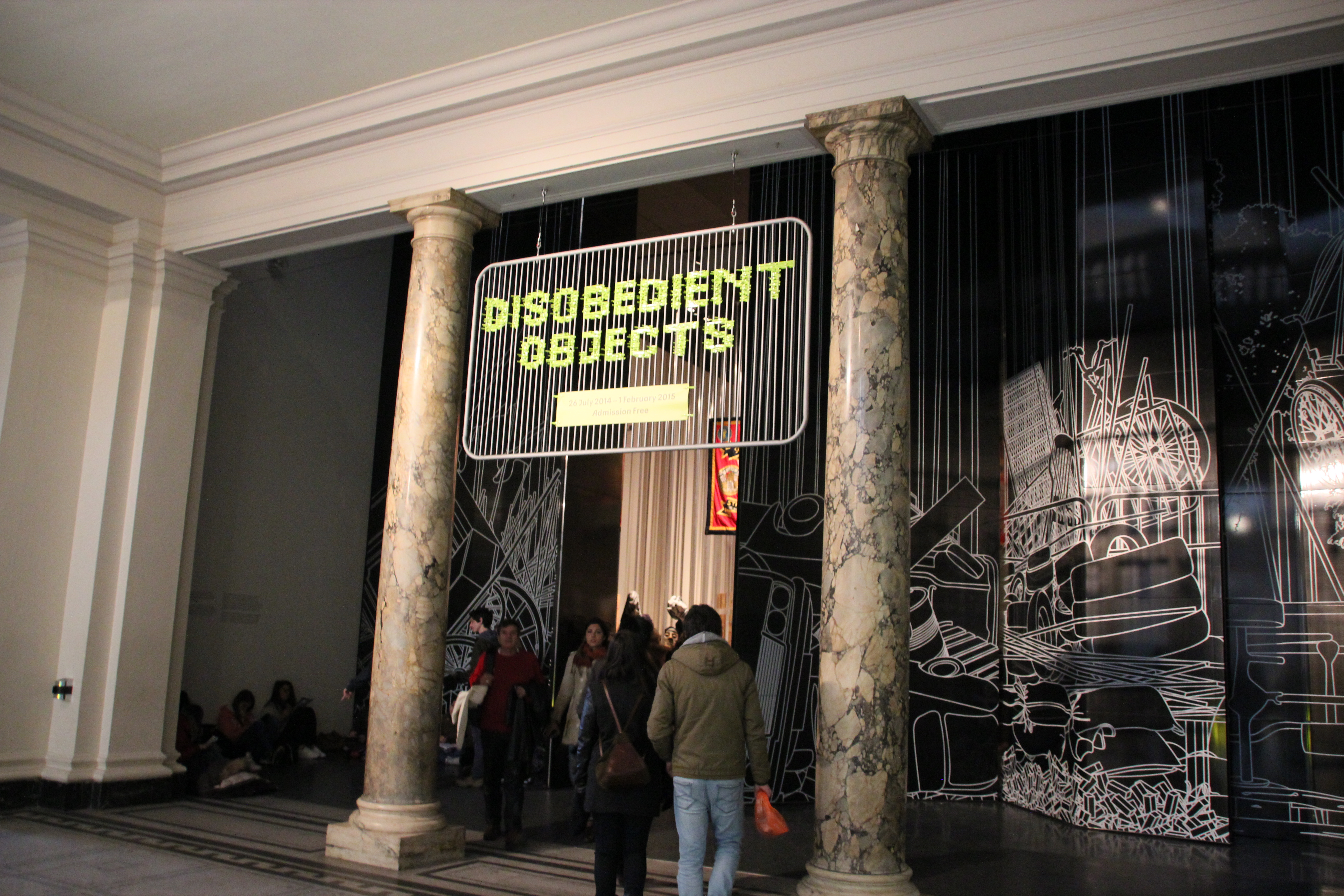
The entrance to the ‘Disobedient Objects’ exhibition at the V&A museum (Photo: Hannah Awcock).

Last weekend, the Disobedient Objects exhibition at the V&A museum in South Kensington closed. For the past 6 months, when you walked into the front entrance of the museum on Cromwell Road you could turn right and walk into a gallery filled with the objects of protest, from a suffragette branded teacup, through a remote-controlled spray-paint machine, to giant inflatable cobblestones. Safe to say it’s not what you would usually expect to find in “the world’s greatest museum of art and design.”

Since its foundation in 1852, the V&A museum (named after Queen Victoria and her husband Prince Albert), has housed a collection representing 5,000 years of human history, in the form of art works of all kinds, from all over the world. The purpose of Disobedient Objects was “to examine the powerful role of objects in movements for social change” (V&A, n.d.) using “objects that open histories of making from below.” (Flood and Grindon, 2014; 8).

The 'Disobedient Objects' exhibition.
The ‘Disobedient Objects’ exhibition (Photo: Hannah Awcock).

I visited the exhibition several times, and I thought it was fantastic. It had objects of all shapes and sizes from social movements and protests all over the word, and it even had an empty space on the wall for visitors to contribute to as more social movements and contentious issues developed over the course of the exhibition. However I did notice some interesting conflicts between the culture of the museum and the cultures of protest represented by the objects in the exhibition. Protest is ephemeral, messy, and anti-hierarchical, and it was very interesting to observe how the museum, a place of quiet permanence, dealt with these characteristics.

The ceramic 'intervention' at the entrance to the V&A.
The ceramic ‘intervention’ at the entrance to the V&A (Photo: Hannah Awcock).

The first example of conflict appeared before you even entered the exhibition. On the walls outside the main entrance to the V&A is a ceramic ‘intervention,’ made by Carrie Reichardt and the Treatment Rooms Collective. It is beautiful, but it was done with the full permission and approval of the museum, and is mounted on metal frames, so it can easily be removed. It demonstrates a common phenomenon that occurs when subversive subcultures are accepted into mainstream culture; they lose some of their edge, their spontaneity, often the things that made them so exciting in the first place.

The seating provided for watching a short film.
The seating provided for watching a short film (Photo: Hannah Awcock).

Another example I noticed of the clash between museum and protest culture was during my last visit. It was the final day that the exhibition was open, and it was very busy. A short film was projected onto the back wall of the gallery, and there were a few bench-like things in the ply-wood used for displays so that people could sit and watch it. On this day people were sitting on the backs of the benches, with their feet on the ‘seat’ bit, to watch the film because it was so busy. They were ordered down by a V&A employee, a triumph of the strict rules of museum spaces over the freedom of protest spaces.

A sticker in the exhibition protesting a pay cut for V&A staff.
A sticker in the exhibition protesting a pay cut for V&A staff (Photo: Hannah Awcock).

My final example is less a contradiction, and more just something I thought noteworthy. I have already mentioned the space in the exhibition set aside for visitor-generated materials as the exhibition progressed. On this wall, and dotted around the rest of the exhibit were stickers protesting a 10% pay cut at the V&A. If you celebrate methods and practices of criticism, you have to be prepared to receive some criticism yourself.

Subversive subcultures such as graffiti, skateboarding and protest have all been appropriated by mainstream culture to various extents over the past few decades. I think that Disobedient Objects is a good example of this process, and highlights some of the difficulties involved. The social norms and expectations of museums are very different from those of protest. Disobedient Objects existed on the border between the two, a precarious position that was reflected in the constant negotiations around how the space was used by visitors and controlled by the museum.

Sources

“Disobedient Objects: About the Exhibition.” V&A. No date, accessed February 2nd, 2015. http://www.vam.ac.uk/content/exhibitions/disobedient-objects/disobedient-objects-about-the-exhibition/

Flood, Catherine and Gavin Grindon. “Introduction” in Catherine Flood and Gavin Grindon (eds.) Disobedient Objects. London: V&A, 2014.

“Victoria and Albert Museum.” Wikipedia. No date, accessed February 2nd, 2015. http://en.wikipedia.org/wiki/Victoria_and_Albert_Museum