Book Review: Voices From History- East London Suffragettes

'Voices from History: East London Suffragettes' by Sarah Jackson and Rosemary Taylor.
‘Voices from History: East London Suffragettes’ by Sarah Jackson and Rosemary Taylor.

Jackson, Sarah and Rosemary Taylor. Voices from History: East London Suffragettes. Stroud: The History Press, 2014.

Voices from History: East London Suffragettes marks 100 years since the formation of the East London Federation of Suffragettes (ELFS), a group led by Sylvia Pankhurst which was asked to leave the Women’s Social and Political Union after they refused to toe the party line. Not content with  campaigning for female suffrage, this inspiring group of women worked to aid and empower the local community. They started a nursery, 3 ‘cost-price’ restaurants and a co-operative toy factory, as well as campaigning for a living wage and better housing. Voices from History is a brilliant account of these achievements and others.

Voices from History is aptly named, telling the story of the ELFS with the aid of numerous first-hand accounts. One of the aims of the book is to celebrate the work of everyone involved in the Federation, even if their names have now been forgotten. The extensive quotes from multiple contemporary sources does this well, highlighting that the achievements of the Federation were down to the efforts of hundreds of individuals, not just well known leaders like Sylvia Pankhurst.

The book is very well contextualised, with female activism in the East End of London both before and after the  ELFS being detailed. I think it is often easy to view groups like the Suffragettes as isolated and unusual incidents, but in fact that is most often not the case, and the structure of the book demonstrates that well. There is a long tradition of radical activism in the East End, and the book situates the ELFS within this history. The final chapter discusses women’s activism in the East End since the suffragettes, right up to the present day. I particularly liked this way of concluding the book, as it shows that the story is not in fact over; there are many more battles to be fought against poverty and inequality in the East End.

Any criticisms that I have are minor really. In the middle of the book there are some wonderful pictures that illustrate the story brilliantly, but I would prefer it if they were interspersed throughout the book, so that you don’t have to keep skipping back and forth to the relevant images. Also, I would have liked more information about the archives and sources used during the research for the book. Even just a few sentences about how and where the research was conducted would have been much appreciated.

Voices from History is a thoroughly enjoyable read about a fascinating period of radicalism in the history of the East End of London. I attended the launch of the book as part of the East London Suffragette Festival in August this year and it was clear that the project was a labour of love for the two authors. Their admiration of the East London Suffragettes, and their determination that the ELFS get the recognition it deserves, shines through the pages of the book. The reader can’t help but feel the same.

#RGSIBG14: Twitter @ an Academic Conference

2014-08-28 09.17.12.jpg
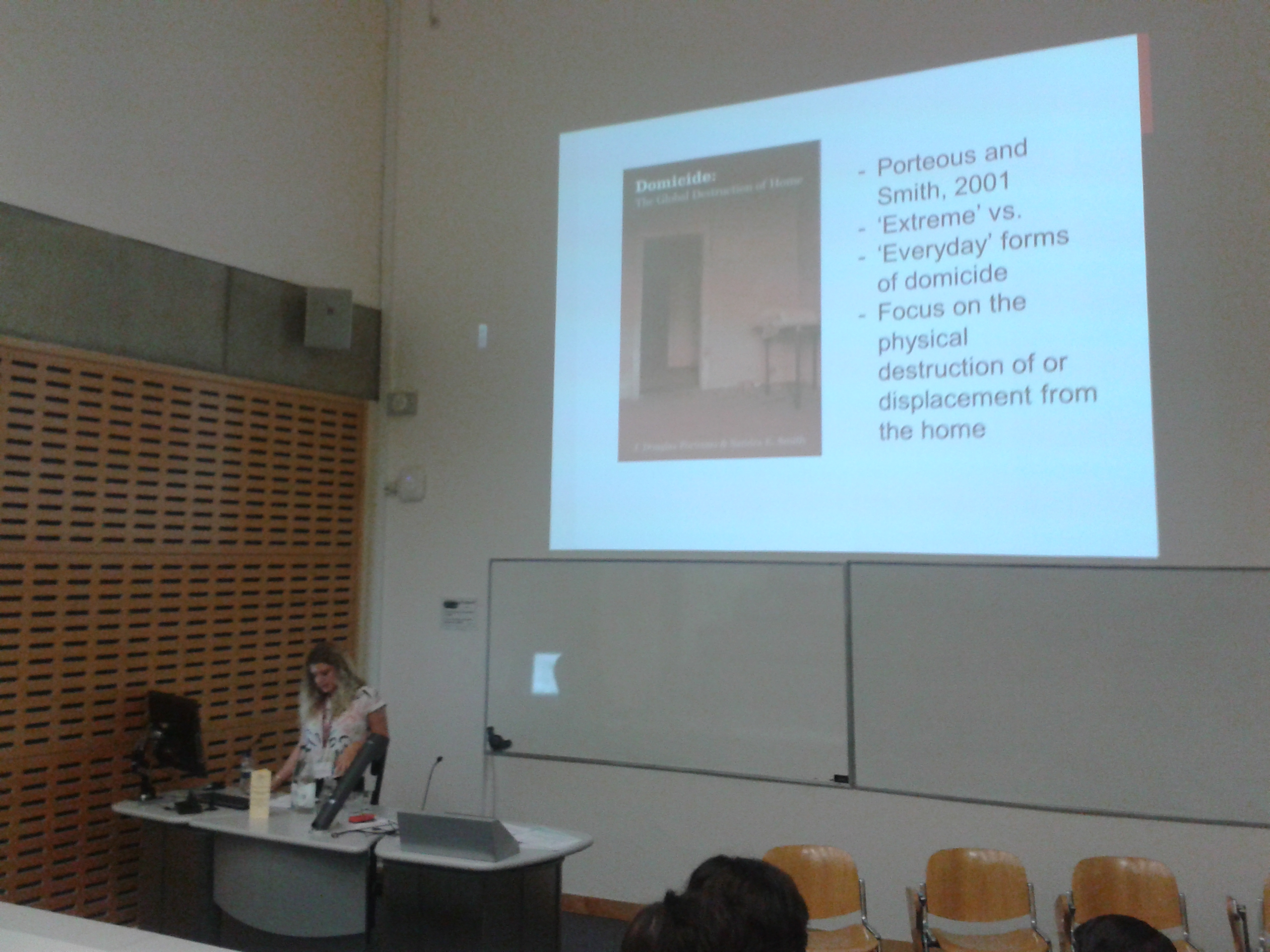
A Presentation at the RGS-IBG 2014 Annual Conference (Photo: Hannah Awcock).

I recently attended the Royal Geographical Society with the Institute of British Geographers (RGS-IBG for short) annual conference in London. It was my first major conference, and it was also my first academic event since I began using Twitter in earnest. I tried to engage with Twitter and the conference hashtag (#RGSIBG14) as much as possible during the week-long event. As a result I felt that my experience of the conference was enhanced. In addition, I  gained around 10 new Twitter followers,  and this blog was even mentioned on the Eventifier social media summary of the conference due to my shameless self-promotion.

#RGSIBG14 Twitter Feed
Some of my tweets from the conference (Photo: Hannah Awcock).

Tweeting during events is not something that feels natural to me. I mostly tweet using my phone, and it goes against a lifetime of my parents’ scolding to use my phone whilst talking or listening to someone. Particularly when listening to someone present a paper, tweeting just felt a bit rude so I tried to do it as surreptitiously as possible. The boundaries surrounding the live-tweeting of academic events should perhaps be a topic for discussion. Not everyone uses Twitter, and the last thing I want is for people to be put off or upset because I appear bored by their paper, whilst actually they have just said something that I thought was interesting enough to share with others. Is it rude, or is it just extending the debate into another format?

There are obvious benefits to using Twitter at conferences. If I like someone’s paper, I can follow them on Twitter to keep up with them and their work as it progresses. I can get the gist of sessions that I don’t go to as other people tweet about them. Through my use of Twitter, I have also raised my profile as an academic. Several times during the conference, I had the surreal experience of someone that I had never met coming up to introduce themselves, because we had communicated previously through Twitter. It was nice to put faces to Twitter handles, but it also proved to me the merits of Twitter as a networking tool. I am better known amongst the academic community than I otherwise would be because of my participation in the twittersphere.

I know that Twitter is not everyone’s cup of tea, and I think there needs to be more discussion about it’s use amongst the academic community, but I also think it can be an incredibly useful tool. Please comment on this post with your own thoughts and experiences on Twitter, I would love to get a discussion going!

RGS-IBG Annual Conference 2014

2014-08-28 08.32.42.jpg
South Kensington Station, which became quite familiar over the week (Photo: Hannah Awcock).

Although I have been to conferences before, I have never been to one quite as big as the RGS-IBG annual conference. With around 2000 delegates, and 414 sessions to  choose from, I couldn’t really comprehend the size of it until I saw it for myself. Over the course of 4 days, I went to 13 sessions, and listened to 40 papers. I have had a great week, although I do feel like I need another week to recover (It’s a good thing I’m on holiday as I write this!) I have met some great people, and listened to some fascinating papers on a range of topics from war, conflict, protest and fascism through to music, cold war bunkers and gay bars.

2014-08-26 18.11.55.jpg
The Chair’s opening panel discussion on co-production (Photo: Hannah Awcock).

The overarching theme of the conference was co-production, the idea of producing knowledge and other outputs in collaboration with others. As a historical geographer, it was not something that I thought really applied to me. However, during a panel discussion at the conference on co-production, it was pointed out that all knowledge is co-produced. No knowledge, or anything else for that matter, is produced in a vacuum, it always involves other people to some extent. When I do archival research, I am working with the people who wrote the sources, the people who chose to preserve them, and the people who look after and organise them. I think it is important to be aware of these other actors that contribute to your research, not only in order to give them the credit they deserve, but also to ensure that your research is as informed and considered as possible.

2014-08-28 09.46.49.jpg
My RHUL colleague, Mel Nowicki, presenting her paper (Photo: Hannah Awcock).

One thing that was really brought home to me over the course of the conference was how far I, and the other PhD students who started at Royal Holloway with me, have come. We started almost a few weeks short of a year ago, and we’ve all achieved a lot since then. I was surprised at the number of people I knew at the conference, I didn’t realise how many interesting and engaging people I have met at various events since last September. I did not present, but many of my colleagues did, with a few even presenting two papers. I only saw one of them, but it was lovely to see her (Mel Nowicki, @melnowicki) research taking shape. It can sometimes feel like a PhD will never end, so it was really reassuring to realise that I am making progress.

So I think it’s safe to say that my first major academic research was a resounding success. I have had a lot of fun, a lot of ideas, and some interesting thoughts on the process of PhD. Roll on next year!

What’s in a Name?

This sculpture of Wat Tyler and other participants in the Peasant’s Revolt stands in the Wat Tyler Country Park in Pitsea in Essex (Source: Andreas-photography).

Occupy. The French Revolution. The Notting Hill Riots. The Battle of Cable Street. The Gordon Riots. The American War of Independence.

Many episodes of protest and contentious politics have been given a catchy name by which they are remembered. It is one of those things that you ( or I, anyway) don’t tend to think about very much. A name is often the first thing you learn about an event or period of time, and it is frequently the only thing you remember long after you have forgotten any other details. As such, it has a lot of power to shape perceptions of the event or time period they are referring to. But names can be misleading, creating perceptions that are inaccurate, or even flat out wrong. I have recently come across several examples of such misconceptions, which highlight the importance of  an awareness of how these names came about, who came up with them, what their purpose was, and, on occasion, the need for a new name.

The recent BBC2 series Melvyn Bragg’s Radical Lives devotes an entire episode to John Ball, fourteenth century preacher and inspiration behind the Peasant’s Revolt of 1381. In it, Bragg briefly argues the the Peasant’s Revolt is a misnomer, because  it was not only peasants that took part. Artisans, shopkeepers and other members of the middle class were also involved in the insurrection. Bragg doesn’t mention where the title Peasant’s Revolt came from, but it clearly may have served to belittle and minimise the movement by attributing it solely to the least powerful group in society. It may even have been a deliberate attempt to reduce the significance of the event in the eyes of history, by hiding the fact that a cross section of society were not supportive of the government, rather than just one group.

A similar example is the Matchgirl’s Strike of 1888. Louise Raw’s excellent book Striking a Light argues for the use of the term ‘matchwomen’ instead of ‘matchgirls’. Although many of the women involved were very young, the use of the word ‘girls’ rather than ‘women’ paints a particular picture of the strikers, portraying them as innocent, inexperienced, vulnerable, and in need of help. This image served the purposes of both supporters and critics of the strike at the time, but it has contributed to a skewing of the way that history views the events. Over time the agency of the women has been removed reducing the popular narrative of what happened  during the strike to an inaccurate caricature.

The effects of these derogatory names are not always negative, however. During the course of the wonderful East London Suffragette’s Festival recently, I learnt that the name ‘Suffragette’ was coined by a reporter for the Daily Mail, aiming to shame and belittle these women conducting themselves in such an outrageous manner. The insult backfired however, as the women of the suffrage movement embraced the title, taking ownership and turning it from an insult to a celebration of the women’s tactics.

Of course it is not possible for a name to encompass every single aspect of a protest or social movement, and I am not arguing that it should be able to. I am merely pointing out that, like most things, names are not neutral, unbiased descriptors. Like almost everything else, they should be viewed with a critical eye, and their purpose and effects should be carefully considered.

References

‘Now is the Time: John Ball.’ Melvyn Bragg’s Radical Lives. BBC2. Broadcast 2nd August 2014.

Raw, Louise. Striking a Light: The Bryant and May Matchwomen and their Place in History. London: Bloomsbury, 2011.

East London Suffragettes Festival

2014-08-09 15.10.32
‘The Awakening of Miss Appleby,’ a pro-suffrage play (Photo: Hannah Awcock).

Between the 1st and the 10th of August 2014 was the East London Suffragettes Festival (http://eastlondonsuffragettes.tumblr.com), celebrating the centenary of the East London Federation of Suffragettes. Over the course of the 10-day period, a series of events were organised across East London, including a film night, talks, a book launch, a walking tour and, on Saturday the 9th, a full day of talks, events, and stalls at Toynbee Hall in Tower Hamlets. Organised solely by volunteers, I think it is safe to say that the festival was a huge success. I attended the book launch, the day at Toynbee Hall, and the walking tour, and I thoroughly enjoyed myself at all three.

2014-08-10 11.49.01
East London Suffragettes Walking Tour, led by David Rosenberg (Photo: Hannah Awcock).

The East London Federation of Suffragettes were more radical and broad in their aims than more well-known groups campaigning for women’s suffrage. The group started out as a branch of the WSPU (Women’s Social and Political Union), run by Sylvia Pankhurst. As the mainstream suffrage movement focussed on the emancipation of middle and upper class women, Sylvia worked with working class women in the East End of London.The East End women were asked to leave the WSPU when Sylvia disobeyed her mother’s (Emmeline Pankhurst) orders and spoke at a rally in support of Irish Home Rule. It was at this point that the East London Federation of Suffragettes came about. Whilst other suffrage groups suspended their campaigns during the First World War, Sylvia and her fellow activists kept campaigning, becoming increasingly anti-war as time progressed. As well as campaigning, the group set up a cost-price restaurant, a nursery, and a cooperative toy factory to help support the local community. 

2014-08-09 14.06.36.jpg
Poetry in Toynbee Hall (Photo: Hannah Awcock)

All of the above information I learnt during the course of the festival, I had no previous knowledge of the East London Federation of Suffragettes. So for me at least, the festival’s goal of revealing the ‘Hidden Histories’ (one of the panel discussions organised by the festival) of the women of the East End was a resounding success. Another of the festival’s goals was to look forward as well as back, connecting the work of the suffragettes with campaigns that are still going on today, in particular the issue of tackling domestic abuse in East London. This is an admirable goal, and it proves that the study of historical protest has a purpose beyond entertainment or commemoration. Activists and campaigners can learn from their past counterparts, and also take heart and inspiration. Sylvia Pankhurst and the women of the East End were brave, strong, and fiercely independent, embodying qualities that many modern women, campaigners or not, aspire to. We should remember them because they deserve to be celebrated, but also because their actions continue to inspire and empower.

Thank you and congratulations to everyone involved in the organising and running of the festival, you did a wonderful job.

Protest Songs at the Cambridge Folk Festival

IMG_0324.JPG
The Cambridge Folk Festival 2014 (Photo: Hannah Awcock).

This weekend, I went to the Cambridge Folk Festival for the first time. I had a thoroughly enjoyable weekend, but it also got me thinking. Due to my chronic inability to stop relating absolutely everything I do and see to the topic of my PhD, I started thinking about the role of music in protest and contentious politics. Obviously folk music has a long history, and is a time-honoured way of expressing  the whole range of human emotion, including anger, resentment and discontent.

Modern folk musicians play a key role in preserving traditional folk songs. Many bands and artists at the festival performed songs that have been around for a long time, and commemorated some of the more contentious periods in history. For example the Welsh band Calan performed a song about a fierce battle between the red dragon of Wales and the white dragon of England. The white dragon was soundly beaten, the song being a remnant of times when the relationship between the two countries was not quite as cordial.

Performers also used music to commemorate important figures in the history of protest. Ladysmith Black Mambazo, a South African choir, sung a song about the achievements of Nelson Mandela.  Music and song has been used for centuries to memorialise great people, acts, and events, and the tradition continues to this day.

img_0226.jpg
Pokey LaFarge at the Cambridge Folk Festival 2014 (Photo: Hannah Awcock).

However the festival was not entirely focused on the past. Musicians used original songs to voice critique about the current state of society. For example Pokey LaFarge, an American singer, performed a song decrying the state of the American healthcare system. Before performing the song, he said that it was important to him that his opinions on the issue were ‘on record’, and perhaps in several hundred years the song will still be remembered and performed by other musicians like him. This also brings to mind more popular artists like Bruce Springsteen and Morrissey, whose politics permeate their music.

The aural is a factor which is frequently overlooked in human geography, although there are some who are trying to address that imbalance (see for example the work of Anja Kanngieser (http://anjakanngieser.com/). I think the archives are particularly vulnerable to a silent perspective on life, as our ability to capture sound is a relatively recent phenomenon. In the hushed atmosphere of the archive, it is easy to forget the sounds and noises that would have accompanied the events you are reading about. It is important to bear in mind that protest, and life in general, does not take place in silence, far from it in fact. Music and sound play a key role in protest, be it in the form of chants, political song lyrics, or simply just loud, upbeat music to lift spirits and get a protest noticed. The Cambridge Folk Festival reminded me that life is loud and music is powerful, and that is a lesson I will try to hang on to.

‘Archaeology by Twilight’ at the Museum of London Archaeological Archive

2014-07-17 19.03.23
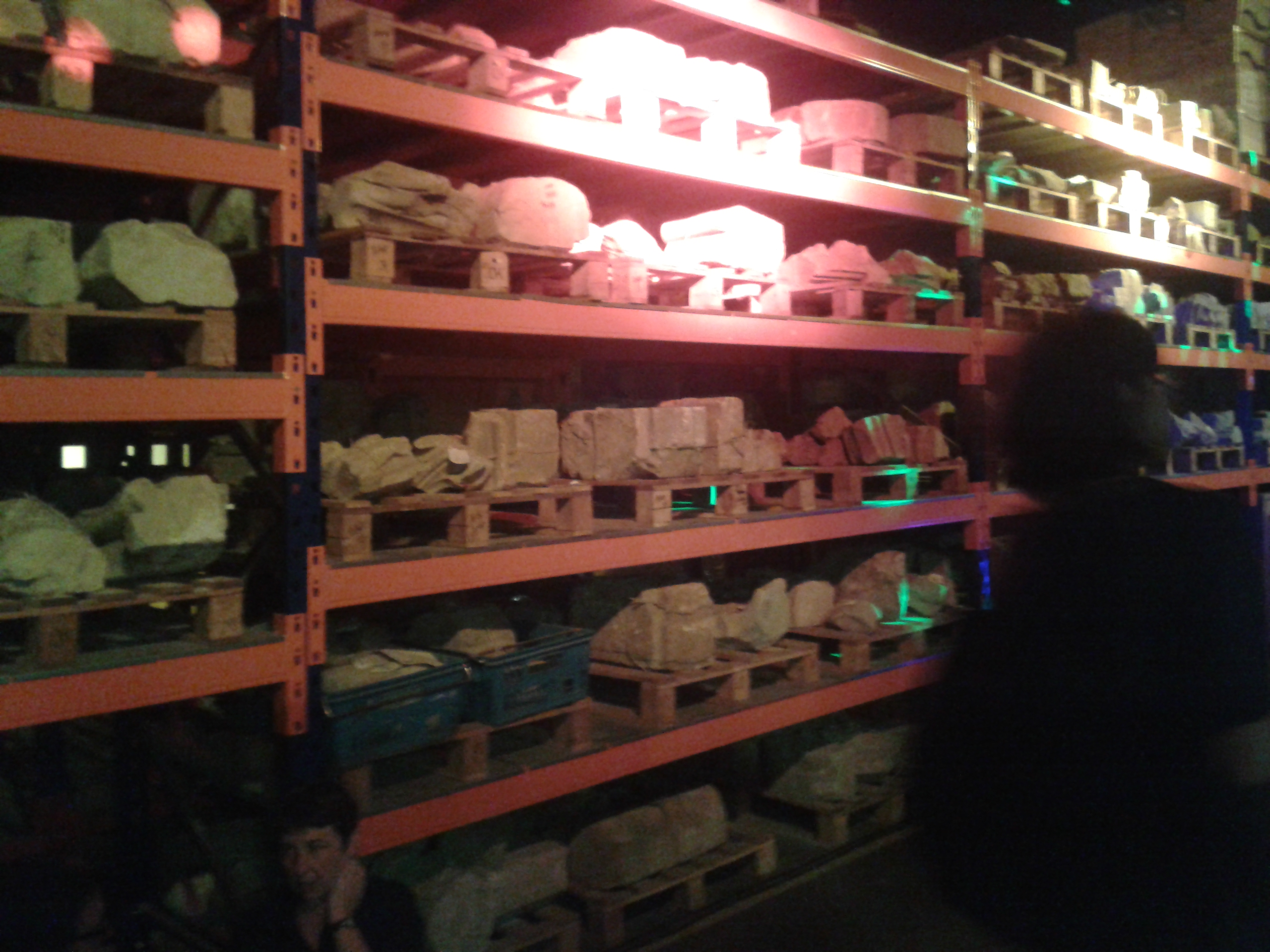
Archaelogy by Twilight at the Museum of London Archaelogical Archive (Photo: Hannah Awcock).

Last Thursday, I went to the ‘Archaeology by Twilight’ open evening at the Museum of London Archaeological Archive in Hackney. Part of a summer series of tours and events at the archive, the evening included tours, displays of items, spoken word performances and a bar. The archive holds information on almost 8,500 archaeological sites that have been investigated in Greater London over the past century, including many of the items found (http://www.museumoflondon.org.uk/collections-research/laarc/). With a huge variety of items, from human remains, medieval hairnets, cars and carriages to board games, horns, and Roman pots, it was a fascinating evening.

My favourite part of the evening was an atmospheric tour around the ceramics and glass archive, with the lights switched off and the chanting of medieval monks playing in the background. Armed with torches, we were let loose amongst the rows of cabinets and shelves, to gaze at pottery that was, in some cases, more than 2,000 years old. Once I got over the sensation that this was exactly how an episode of a murder mystery drama would start, I was struck by the sheer volume of material, each item with a story to tell about London’s past. The further we moved away from the door, towards the back of the room, the further back in time we went, to the Romans and beyond. I’m not ashamed to admit that I was very excited to see so much history in one room!

For me, the evening highlighted the process of museum exhibits. Displays and exhibitions in museums have the air of being complete, an accurate record of the past. This glimpse ‘behind the scenes’ suggested how much work goes into curating an exhibit in a museum. Most of the items in the archive will probably never go on display, what a visitor sees in the galleries of the Museum of London is just a fraction of everything that they hold. One of the most fundamental lessons I have learnt since starting my university education as an undergraduate is to question everything, to take nothing at face value. But I still find myself overlooking things, and welcome being reminded of the complexity and intricacy of seemingly simple things as I was on Thursday evening.

Another element that struck me was the particular materiality of this archive. When imagining archives, most people probably think of documents, records, letters, photos, maps, pieces of paper in various shapes and sizes. And whilst the Archaeological Archive no doubt has this kind of thing too, it also has thousands upon thousands of objects. Listening to the curators on Thursday night it was obvious that huge amounts can be learnt from the collections in the archive. For example, because the volume of material is so large, comparisons can be made between similar objects, leading to more general conclusions about life in London than it would be possible to make from one object. After exploring what the archive has to offer, it’s clear that it does not fit into the stereotypical image of ‘the archive’. Materiality has become a popular topic within geography over recent years, and I can think of at least a few historical geographers who use objects in their research. However I’m sure it is not the sort of research that springs to mind when people think of historical geography (when they think about historical geography at all!). ‘Archaeology by Twilight’ reminded me of the huge variety and potential of archives, which is something I wish that more people knew about!

2014-07-17 20.01.45
The Archaeology by Twilight bar (Photo: Hannah Awcock).

Call for Papers: Contesting the Capital- Historical Geographies of Protest in London

International Conference of Historical Geographers 2015, London, 5-10 July 2015

“Contesting the capital: Historical geographies of protest in London”

Convenors: Hannah Awcock (Royal Holloway, University of London, UK) and Diarmaid Kelliher (University of Glasgow, UK).

In recent years London has been the site for a wide range of protests: marches against austerity, student occupations, the 2011 riots, UK Uncut and protests by (and against) the English Defence League. Such protests in the capital and elsewhere have coincided with a growing interest in protest in the past amongst geographers and historians (Navickas 2012). Within this work there has often been a strong rural focus (for example, Griffin 2014). This session seeks to explore the historical geographies of protest in London as a contribution to these debates.

A number of recent works in geography have suggested ways in which the politics of London is embedded in expansive translocal and international connections (Featherstone 2010; McDowell, Anitha, and Pearson 2012; Brown and Yaffe 2014). From the Peasants’ Revolt to Women Against Pit Closures marching in London during the 1984-5 miners’ strike, the national and imperial capital has also often functioned as a focus for a broad political imaginary. This session invites both empirically-based papers and methodological debates on researching London’s relationship to historical geographies of protest. A broad understanding of ‘protest’ will be employed, and we welcome papers reflecting on what constitutes protest.

Please send abstracts of no more than 200 words to both convenors by 29 August. In a separate paragraph, please provide details of any special audio-visual requirements or mobility requirements.

Hannah Awcock, Department of Geography, Royal Holloway, University of London, hannah.awcock.2009@live.rhul.ac.uk; Diarmaid Kelliher, School of Geographical and Earth Sciences, University of Glasgow, UK, d.kelliher.1@research.gla.ac.uk.

Further details on the ICHG Conference are available at:
http://www.ichg2015.org/

Details of conference fees are available at:
http://www.ichg2015.org/registration/

References
Brown, Gavin, and Helen Yaffe (2014). Practices of Solidarity: Opposing Apartheid in the Centre of London. Antipode 46(1): 34–52.
Featherstone, David (2010). Contested Relationalities of Political Activism: The Democratic Spatial Practices of the London Corresponding Society. Cultural Dynamics 22(2): 87–104.
Griffin, Carl (2014). Protest, Politics and Work in Rural England, 1700-1850.
McDowell, Linda, Sundari Anitha, and Ruth Pearson (2012). Striking Similarities: Representing South Asian Women’s Industrial Action in Britain. Gender, Place & Culture 19(2): 133–152.
Navickas, Katrina (2012). Protest History or the History of Protest? History Workshop Journal 73(1): 302–307.