Book Review: Fight the Power! A Visual History of Protest Among the English Speaking Peoples

'Fight the Power!' by Wilson et al.
‘Fight the Power!’ by Wilson et al.

Wilson, Seán Michael, Benjamin Dickson, Hunt Emerson, John Spelling and Adam Pasion. Fight the Power! A Visual History of Protest Among the English-Speaking Peoples. Oxford: New Internationalist, 2013.

The title of Fight the Power! A Visual History of Protest among the English-Speaking Peoples may be a little long winded, but it does sum up the book well. Through the medium of comic strips, the book tells the story of some of the key moments in the history of protest in the English-speaking world (well, from the last 2 centuries anyway). The protests discussed are wide ranging in terms of topic and geography, taking in race, class, labour and governance issues, as well as such diverse countries as Ireland, Australia, America, and the former British Empire.

The format of the book makes it incredibly approachable and engaging, ideal for young people (although some of the images are a little graphic) or those with little previous knowledge of protest. The examples lack detail and can be one-sided, but neither of these are inherently bad things. The book is a fantastic introduction to many protests, and it does not claim to be an unbiased account.

Despite the diversity of the examples, several themes recur throughout the book. One is police brutality. The actions taken by those in authority attempting to suppress protest have frequently proved provocative, causing demonstrations to escalate into violent clashes. The Battle of Peterloo (1819) and the Battle of Toledo (1934), amongst others, are good examples of this. Violence, or the lack of it, is another theme that recurs throughout the book. Whether or not to use violence is one of the most fundamental decisions a protest movement makes, which can drastically influence the outcome of a campaign. There is no ‘right’ answer; apart from the moral debate, both violent and non-violent movements have proved successful in the past.

The lasting impression which the book leaves is one of hope. Particularly in the past few years, it can be very easy to believe that protest does not achieve anything, that  it is all too easy for those in authority to repress or ignore demonstrations and social movements. But what the examples in Fight the Power prove is that protest can force change. The Suffragettes, Rosa Parks, and the various independence movements of the British empire demonstrate that change may take time, decades even, and it may not be exactly the progress that you imagined, but it can be achieved.

Another key message of the book, which is particularly relevant to my PhD, is that past protests can provide both practical suggestions and inspiration to contemporary protest movements. As Tariq Ali writes in the Introduction, “History rarely repeats itself, but its echoes never go away” (p5). An image on the back cover of the book shows an Occupy protester holding a “We are the 99%” placard, backed by a Suffragette, Rosa Parks, Nelson Mandela, and others mentioned in the book. It is a powerful image of historical solidarity.

This book was given to me as a Christmas present (I got a lot of books this year, so brace yourself for a lot of reviews over the next few months!), and it certainly fulfills that role perfectly. It is a nice introduction to some of the most famous protests in the history of the English-speaking world, but I would recommend it even if you are already familiar with most of them as a refreshing approach to the history of protest.

Book Review: To End All Wars

'To End All Wars' by Adam Hochschild
‘To End All Wars’ by Adam Hochschild

Hochschild, Adam. To End All Wars. London: Pan Books, 2011.

By the time we reach the centenary of Armistice Day in 2018, I get the feeling that we might be suffering from a certain degree of World War 1 fatigue. The sheer number of  documentaries, dramatisations, books, ceremonies and art installations will likely make it difficult for any one thing to stand out. I think that To End All Wars by Adam Hochschild has a good chance of leaving a lasting impression.

The story of the first world war is familiar to most of us, but To End All Wars tells the narrative from an unfamiliar perspective; it is about those people who spoke out against the war. Opposition is not discussed in the traditional narratives of the war, the general perception appears to be that it wasn’t criticised until years afterwards. Admittedly critics of the war were few, tested as they were by the “mass patriotic hysteria” (Hochschild, 2011) but they most certainly did exist. On the 2nd of August 1914, there was a huge anti-war rally in Trafalgar Square, with calls for a general strike if war was declared. Prominent campaigners like Keir Hardie, Charlotte Despard and Sylvia Pankhurst continued to oppose the war, with Pankhurst proposing a Women’s Peace Expeditionary Force, where 1000 women would march into no-man’s land between the two armies.

Publicly criticising the war required a great deal of bravery. Those that did were almost instantly ostracised, derided or accused of treachery, labeled as German spies trying to undermine the war effort. Many paid a heavy price for their defiance. For example, the Wheeldon family, socialists who hid soldiers escaping conscription, were convicted in 1917 of the completely false charge of attempting to murder Lloyd George and another member of the war cabinet, victims of a government attempt to disgrace the anti-war movement. 3 family members were sentenced to 5-10 years hard labour after a sham trial that didn’t even last a week.

To End All Wars is arranged chronologically, making the tragic progress of the war appear even more inevitable as the reader can do absolutely nothing to prevent the horrors that we know full well are coming. The style of writing is dramatic, and the book often reads more like a novel than non-fiction. Charlotte Despard, the famous suffragette and anti-war campaigner, was actually the sister of John French, the Commander-in-Chief of the British Army until 1915. Hochschild hides this connection though, revealing it like a plot twist at the end of a chapter. The first chapter is spent introducing the key players in the book, developing them like characters. Whilst the approach felt a bit unusual at first, it makes for an engaging and accessible read.

Admittedly, Hochschild does spend a lot of time describing the events of the war, and whilst this is generally useful context, it does sometimes feel like filler, padding out the relatively rare examples of opposition to the war. However on balance this is a thoroughly enjoyable book, that provokes thought about the nature of war and opposition to it, as well as providing a rare new insight into the First World War.

Book Review: Striking a Light- The Bryant and May Matchwomen and their Place in History

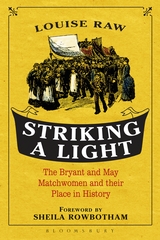
Striking a Light Front Cover
Striking a Light by Louise Raw.

Raw, Louise. Striking a Light: The Bryant and May Matchwomen and their Place in History. London: Bloomsbury, 2011.

I recently finished reading Striking a Light, Louise Raw’s wonderful book about the Bryant and May matchwomen’s strike in East London in 1888. My friends and family would be able to tell you how much of an impression it made on me, as I have spent a lot of time telling them how much I enjoyed it and recommending that they should read it themselves. The matchwomen’s (known to most as the matchgirls) strike is one of the most well-known examples of protest in London’s history, but as Raw expertly explains, much of what we think we know is inaccurate, and doesn’t give the strikers the credit they deserve. The thorough and innovative methodology used in the research also deserves recognition.

Raw conducted thorough analysis of the primary sources to re-evaluate the established narrative of the strike. She argues that the matchwomen were not as helpless and innocent as they were frequently portrayed to be, both at the time and in subsequent historical accounts. Annie Besant, a well-known campaigner at the time, is generally credited with leading the strike, helping the women to achieve what they could not alone. Raw easily demonstrates that although Besant did help the strikers, she did not have an organisational role, it was the women themselves that decided to strike, and organised the following campaign. Raw also uses census data and other sources to dispute the assertion that the women were too disconnected from the dockworkers in East London to have had an influence on the Great Dock Strike in 1889. Striking a Light recognises the bravery and strength of the matchwomen, acknowledging their achievements in a way that has not been done before.

The other element of the book which I particularly admire is the methodology. Raw is clear and explicit about how she conducted her research, including the difficulties she faced, which is something I personally would like to see more of in historical geography. In addition, Raw tracked down the grandchildren of some of the women involved in the strike, in order to find out more about them as women. Although this is a time-consuming method, with some obvious concerns about accuracy, the stories and insights uncovered brought the women to life. Finding sources from the perspective of those who actually took part in historical protests has been a major difficulty for me, as well as more established historians (for example Rudé (2005). Raw’s approach brought home the fact that the strikers were human beings, each with their own unique lives, aspirations, and motivations, something which is easy to forget in the midst of conventional archival research. This is a methodology that I hope I can use in my own research.

Sources

Raw, Louise. Striking a Light: The Bryant and May Matchwomen and their Place in History. London: Bloomsbury, 2011.

Rudé, George. The Crowd in History. London: Serif, 2005 [1964].

Book Review: Voices From History- East London Suffragettes

'Voices from History: East London Suffragettes' by Sarah Jackson and Rosemary Taylor.
‘Voices from History: East London Suffragettes’ by Sarah Jackson and Rosemary Taylor.

Jackson, Sarah and Rosemary Taylor. Voices from History: East London Suffragettes. Stroud: The History Press, 2014.

Voices from History: East London Suffragettes marks 100 years since the formation of the East London Federation of Suffragettes (ELFS), a group led by Sylvia Pankhurst which was asked to leave the Women’s Social and Political Union after they refused to toe the party line. Not content with  campaigning for female suffrage, this inspiring group of women worked to aid and empower the local community. They started a nursery, 3 ‘cost-price’ restaurants and a co-operative toy factory, as well as campaigning for a living wage and better housing. Voices from History is a brilliant account of these achievements and others.

Voices from History is aptly named, telling the story of the ELFS with the aid of numerous first-hand accounts. One of the aims of the book is to celebrate the work of everyone involved in the Federation, even if their names have now been forgotten. The extensive quotes from multiple contemporary sources does this well, highlighting that the achievements of the Federation were down to the efforts of hundreds of individuals, not just well known leaders like Sylvia Pankhurst.

The book is very well contextualised, with female activism in the East End of London both before and after the  ELFS being detailed. I think it is often easy to view groups like the Suffragettes as isolated and unusual incidents, but in fact that is most often not the case, and the structure of the book demonstrates that well. There is a long tradition of radical activism in the East End, and the book situates the ELFS within this history. The final chapter discusses women’s activism in the East End since the suffragettes, right up to the present day. I particularly liked this way of concluding the book, as it shows that the story is not in fact over; there are many more battles to be fought against poverty and inequality in the East End.

Any criticisms that I have are minor really. In the middle of the book there are some wonderful pictures that illustrate the story brilliantly, but I would prefer it if they were interspersed throughout the book, so that you don’t have to keep skipping back and forth to the relevant images. Also, I would have liked more information about the archives and sources used during the research for the book. Even just a few sentences about how and where the research was conducted would have been much appreciated.

Voices from History is a thoroughly enjoyable read about a fascinating period of radicalism in the history of the East End of London. I attended the launch of the book as part of the East London Suffragette Festival in August this year and it was clear that the project was a labour of love for the two authors. Their admiration of the East London Suffragettes, and their determination that the ELFS get the recognition it deserves, shines through the pages of the book. The reader can’t help but feel the same.