Turbulent Londoners: Jane Cobden, 1851-1947

Turbulent Londoners is a series of posts about radical individuals in London’s history who contributed to the city’s contentious past, with a particular focus of women, whose contribution to history is often overlooked. My definition of ‘Londoner’ is quite loose, anyone who has played a role in protest in the city can be included. Any suggestions for future Turbulent Londoners posts are very welcome. My next Turbulent Londoner is Jane Cobden, one of the first women to be elected to the London County Council.


(Emma) Jane Catherine Cobden Unwin by Fradelle & Young. Albumen print, 1890s. NPG x131220 (Source: National Portrait Gallery).

Fans of Victorian crime drama Ripper Street might recognise Jane Cobden from series 2 and 3. Played by Leanne Best, Cobden was a strong, opinionated London County Councillor, more than a match for love interest Detective Inspector Edmund Reid. But how does the character match up to the real Jane Cobden?

Born Emma Jane Catherine Cobden on the 28th of April 1851 in Westbourne Terrace, London, Jane was the fourth of sixth children of the well-known reformer and politician Richard Cobden. She devoted her life to campaigning for women’s rights and protecting and developing her father’s legacy- she was committed to the’Cobdenite’ issues of land reform, peace and social justice.

In 1869 Jane moved to South Kensington with her sisters Ellen, Anne and Kate, also dedicated activists. Jane was active on the radical wing of the Liberal Party, and became increasingly committed to the cause of women’s suffrage over the 1870s. In 1871, she attended the Women’s Suffrage Conference in London with her sister Anne. In about 1879 she joined the National Society for Women’s Suffrage, and by the following year she was the organisation’s Treasurer.

The National Society was cautious, avoiding close association with political parties and excluding married women from their demand for the vote. This was too conservative for some, and the Central National Society broke away in 1888. In 1889 this group split again, and the Women’s Franchise League (WFL) was formed, including Cobden and Emmeline Pankhurst. The WFL’s aims were more radical- they wanted votes for women on the same basis as men, and women to be eligible for all political offices. Jane was politically pragmatic as well as ambitious, however. She disagreed with the mainstream Liberal Party’s stance on many issues, but remained a member because she believed it was the best way to advance her causes.

In the late 1880s, no one was sure whether women could serve as councillors or not; the law was unclear. In November 1888, the Society for Promoting the Return of Women as County Councillors (SPRWCC) was set up to test the law. This catchily-named organisation set up a £400 election fund and choose two women to stand as Liberal candidates for the newly established London County Council. Jane stood in Bromley and Bow, and Margaret Sandhurst stood in Brixton. Jane campaigned on a variety of issues, including opposition the tax on coal, better housing for the poor, “fair” wages, and opposition to sweat shops. Both women won, but their positions were not secure; there were many who opposed their election and tried to overturn the results. Sandhurst’s election was challenged by the man she defeated, and her election was declared invalid. Jane was supported by her runner-up, who was also a member of the Liberal Party. However, a judge eventually ruled that Jane’s election was unlawful, and therefore so were her votes in the council. She quietly served the rest of her term, and did not stand for reelection. It wasn’t until the Qualification of Women Act in 1907 that women legally gained the right to sit on county councils; Cobden was truly a woman before her time.

In 1892, aged 41, Jane married Thomas Fisher Unwin, a publisher. Encouraged by him, Jane expanded her interests to include international peace and justice, and rights of aboriginal people around the world. The couple strongly opposed the Boer War. In 1893, Jane represented the WFL at the World Congress of Representative Women in Chicago.

jane-cobden-ripper-street
Jane Cobden as portrayed by Leanne Best in BBC/Amazon drama Ripper Street (Photo: BBC).

As the campaign for women’s suffrage gained pace after 1900, Jane chose not to participate in the illegal activities of the WSPU, but she fiercely defended her sister, Anne, when she was imprisoned for a month in October 1906. She organised the Indian women’s delegation in the Women’s Coronation Procession on the 17th of June 1911, a few days before the coronation of George V. Cobden never gave up on a political solution to women’s suffrage. The Conciliation Bills of 1910-12 would have given a small number of propertied women the vote. Cobden asked the Irish Parliamentary Party to support the doomed bills, because of the support that women had given to the Land League campaign in England. She also continued to campaign for other causes she cared about during this time, publishing two books on the subject of land reform: The Hungry Forties: Life Under the Bread Tax (1904) and The Land Hunger: Life Under Monopoly (1913).

Jane Cobden died on the 7th of July 1974, aged 96. The BBC’s synopsis of her character in Ripper Street describes her as “one of the giants on whose shoulders the Suffragette Movement was to stand,” and it doesn’t exaggerate. Cobden may be more well-known than other women’s rights pioneers because of her portrayal in Ripper Street, but I think her achievements still deserve more recognition.

Sources and Further Reading

Baldwin, Anne. “Women’s History Month: Persistence Pays Off, as Women are Finally Elected to the London County Council.” Women’s History Network. Last updated 5 March 2010, accessed 31 October 2016. Available at http://womenshistorynetwork.org/blog/?tag=jane-cobden

Hurley, Ann. “Emma Jane Catherine Cobden-Unwin 1851-1947.” Hurley and Skidmore Family History. No date, accessed 31 October 2016. Available at http://www.hurleyskidmorehistory.com.au/emma-jane-catherine-cobden-.html

Richardson, Sarah. “What Next, and Next? The Cobden Movement: Fleeting or Fundamental?” Liberty Fund. Last updated 8 January 2015, accessed 31 October 2016. Available at http://oll.libertyfund.org/pages/lm-cobden

Wikipedia. “Jane Cobden.” Last updated 4 September 2016, Accessed 31 October 2016. Available at https://en.wikipedia.org/wiki/Jane_Cobden

Turbulent Londoners: Minnie Baldock, c.1864-1954

Turbulent Londoners is a series of posts about radical individuals in London’s history who contributed to the city’s contentious past, with a particular focus on women, whose contribution to history is often overlooked. My definition of ‘Londoner’ is quite loose, anyone who has played a role in protest in the city can be included. Any suggestions for future Turbulent Londoners posts are very welcome. My next Turbulent Londoner Minnie Baldock, an early member of the WSPU who helped establish the organisation in East London


Minnie Baldock 1909: Photograph by Colonel L. Blathwayt (Source: Wikipedia, image in the public domain). 

Minnie Baldock was an early member of the Women’s Social and Political Union (WSPU), who helped the organisation establish a presence in London, particularly amongst the working class women of the East End. Born in the East End in about 1864, she worked in a shirt factory as a young woman, and had two sons after her marriage to Harry Baldock.

Female suffrage was not the cause which brought out Minnie’s radicalism; she was a member of the Independent Labour Party, and in 1903 held a public meeting to complain about women’s low wages with her MP, Keir Hardie. As a member of the WSPU, however, Minnie flourished as an activist.

Minnie joined the WSPU early on, before it moved to London, and was soon involved in many of its activities in the capital. In December 1905 she was ejected from not one but two public meetings for heckling Herbert Asquith and Henry Campbell Bannerman, leader of the Liberal Party. In January 1906, Minnie established the first London branch of the WSPU in Canning Town, in an attempt to recruit working class women. Several other branches soon followed in the East End. Minnie was at the heart of networks of radical women in London; she helped Annie Kenney make connections when she first moved to London, she knew Sylvia Pankhurst and Charlotte Despard, and was a mentor to Daisy Parsons.

Also in 1906, Minnie became a full-time organiser for the WSPU. For the next few years she toured the country, promoting the cause of female suffrage. In October that year she was arrested at the opening of Parliament. She was arrested again outside Parliament in February 1908, and this time spent a month in Holloway Prison. She was worried about leaving her two sons alone with her husband, which illustrates the tension many female activists feel between their activism and their caring responsibilities.

Minnie worked for the WSPU until 1911, when she became seriously ill with cancer. She did not return to the WSPU after she recovered, although she remained a member of the Church League for Women’s Suffrage, which united all kinds of suffragists who were also religious. This suggests that she had become disillusioned by the WSPU’s methods rather than their main objective; they became increasingly violent, authoritarian, and dismissive of the concerns of working class women in the years before the First World War. Minnie moved to Southampton with her family in 1913, and was living in Poole when she died in 1954.

The WSPU was much more than the Pankhurst family; women like Minnie Baldock were essential to the successful running of the organisation. Minnie helped the WSPU establish a presence in London, and went on to campaign tirelessly for them around the country. Her name may not have survived the lottery of history, but the impact of her actions still resonates.

Sources and Further Reading

Brooker, Janice. “Suffragette.” Lost in London. Last modified 1st May 2007, accessed 11th October 2016. Available at http://www.brooker.talktalk.net/suffragette.htm

Simkin, John. “Minnie Baldock.” Spartacus Educational. Last modified January 2015, accessed 12th October 2016. Available at http://spartacus-educational.com/WbaldockM.htm

Walker, John. “Forest Gate’s Proud Suffragette Legacy.”E7 Now and Then. Last modified 6th March 2015, accessed 14th October 2016. Available at http://www.e7-nowandthen.org/2015/03/forest-gates-proud-suffragette-legacy.html

Turbulent Londoners: Elizabeth Elstob, 1683-1756

Turbulent Londoners is a series of posts about radical individuals in London’s history who contributed to the city’s contentious past, with a particular focus of women, whose contribution to history is often overlooked. My definition of ‘Londoner’ is quite loose, anyone who has played a role in protest in the city can be included. Any suggestions for future Turbulent Londoners posts are very welcome. My next Turbulent Londoner is Elizabeth Elstob, known as one of Britain’s first feminists.


Elizabeth Elstob by Burnet Reading, published by Edward Evans. Line engraving, early 19th century. NPG D31035 (Source: National Portrait Gallery).

Elizabeth Elstob was a renowned Anglo-Saxon scholar at a time when the medieval period was not considered worth studying, and when women were not considered worthy of education. Like fellow Geordie Mary Astell, she has since become known as one of England’s first feminists.

Born in Newcastle-Upon-Tyne to a merchant family on the 29th of September 1683, Elizabeth was orphaned young, and raised by her uncle, Charles Elstob, in Canterbury. Depite disaproving of women’s education, he allowed the young girl to learn Latin and French. 10 years her senior, Elizabeth’s brother, William, was sent to Eton and Cambridge before joining the church, becoming a scholar as she was also destined to. He introduced the teenaged Elizabeth to a small group of Anglo-Saxon scholars.

From 1696, Elizabeth lived with William in Oxford, and moved to London with him as his housekeeper in 1702. William Elstob did not share the same reservations as his uncle, and in London Elizabeth had the freedom to learn Old English. The siblings encouraged and supported each other in their academic endeavours. Elizabeth used her brother’s scholarly connections and her own force of will to gain access to intellectual circles and resources that she would have otherwise been denied. Being in London also allowed Elizabeth to join Mary Astell’s circle of female intellectuals, who helped her find subscribers for her publications.

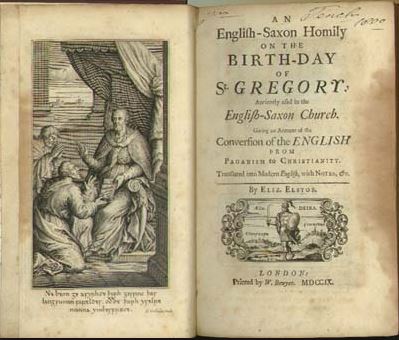
Elizabeth’s first major work was published in 1709, a beautiful edition of Abbot Ælfric of Eynsham’s tenth-century An English Saxon Homily on the Birthday of St. Gregory. In the preface, she argued for the importance of women’s education, using religious reasoning to support her arguments. He second major publication came out in 1715, and was entitled Rudiments of Grammar for the English-Saxon Tongue. It was the first such work to be written in English rather than Latin. This was a deliberate decision on Elstob’s part- she wrote in English so that her work would be more accessible to other women. It was not only women who appreciated her work, however; Thomas Jefferson owned a copy of Rudiments which he used to understand terms he came across during his legal studies.

English-Saxon Homily
The title page of An English Saxon Homily on the Birthday of St. Gregory (Source: University of Glasgow Library Special Collections).

Unfortunately, William Elstob died in 1715, leaving Elizabeth homeless and with large debts from financing their expensive scholarly publications. She started a girl’s school in Chelsea, which proved very popular but did not make a profit- it closed after just six months. In 1718 Elizabeth fled London, abandoning her books and an unfinished manuscript of Ælfric’s Catholic Homilies, a project she had worked hard to finance. She moved to rural Worcestershire where she ran a small school under the assumed name of Frances Smith. It seems that no one in the scholarly community knew where she was for almost 20 years, until 1735. In 1738 she was given the comfortable position of governess to the children of the Duke and Duchess of Portland, and she remained in their service at Bulstrode Park, Buckinghamshire, until her death on the 3rd of June 1756.

Elizabeth Elstob must have possessed incredible determination and resolve to become such a well respected scholar, despite her unpopular subject area and particularly her gender. Sadly, without the support of her brother she was not able to overcome the odds that were so heavily stacked against her as a woman. Nevertheless, her brief scholarly career demonstrated what women were capable of given half the chance, and she used her influence to support the education of other women, a revolutionary prospect at the time.

Sources and Further Reading

Seale, Yvonne. “The First Female Anglo-Saxonist.” History Today. Last modified February 4th, 2016, accessed August 3rd 2016. Available at http://www.historytoday.com/yvonne-seale/first-female-anglo-saxonist

Wikipedia. “Elizabeth Elstob.” Last modified May 10th 2016, accessed August 3rd 2016. Available at https://en.wikipedia.org/wiki/Elizabeth_Elstob

Turbulent Londoners: Ada Salter, 1866-1942

Turbulent Londoners is a series of posts about radical individuals in London’s history who contributed to the city’s contentious past, with a particular focus of women, whose contribution to history is often overlooked. My definition of ‘Londoner’ is quite loose, anyone who has played a role in protest in the city can be included. Any suggestions for future Turbulent Londoners posts are very welcome. My next Turbulent Londoner is Ada Salter, a social reformer, environmentalist, and pacifist, who became the first female mayor in London.


A statue of Ada Salter in Rotherhithe, London. It is by artist Diane Gorvin (Source: Loz Pycock).

Ada Salter was a strong-willed and radical woman, who dedicated her life to the people of Bermondsey. Originally moving there as a charity worker, she became a local councillor and eventually mayor, the first in London (Daisy Parsons became Mayor of West Ham in 1936, 14 years after Ada). Born Ada Brown on the 20th of July 1866 in Raunds, Northamptonshire, Ada was an active Methodist and member of the radical wing of the Liberal Party from an early age. In 1896, aged 30, she moved to London to work as a ‘Sister of the People’ in the St. Pancras slums. The following year she moved to the Bermondsey Settlement, and joined the community which she would spend the rest of her life fighting for.

The Settlement movement started in the 1880s, and encouraged the rich and poor to live closely together in interdependent communities. Volunteers lived in the Settlements and shared knowledge and culture with their low income neighbours, as well as alleviating poverty. The Bermondsey Settlement was founded in 1892, and stayed open until 1967. Ada worked with young women, and was admired for her ability to get through to them. Whilst at the Settlement Ada met Dr. Alfred Salter, whom she persuaded to convert to Christianity and join the Liberal Party (he was previously a socialist). They were married on the 22nd of August 1900.

After the Salters’ marriage Ada wanted to stay in Bermondsey, so Alfred set up a GP practice in Jamaica Road, whilst Ada continued to work at the Settlement. In 1902 the couples’ only child, Ada Joyce, was born. Four years later Ada left the Liberal Party because they reneged on their promise to grant women the vote. She joined the International Labour Party (ILP) and co-founded the Women’s Labour League (WLL). The ILP was the best party in regards to womens’ rights, and they wanted to stand female candidates at the next local council elections, including Ada. As a Liberal Councillor for the London County Council, Ada’s move must have put her husband in an awkward position. He supported her, however, and eventually joined her, founding a Bermonsdey branch of the ILP in 1908.

In November 1909, Ada was elected the first female and first Labour councillor in Bermondsey. Tragedy struck the following year when Ada Joyce was killed by scarlet fever in one the periodic epidemics that swept through the overcrowded community. The Salters’ had made the conscious decision not to send their daughter away from Bermondsey to protect her health. Joyce attended the local Keeton’s Road School, and caught scarlet fever 3 times in her 8-year life. It was an admirable decision to keep their entire family within Bermondsey, but the guilt after Joyce’s death must have been overwhelming.

Devastated, Ada threw herself into her political and charity work. She started to recruit local female factory workers into the National Federation of Women Workers. At first there was little response, but in August 1911, 14000 women struck for, and won, better working conditions. Ada was hailed as the inspiration of the ‘Bermondsey Uprising,’ although in fact she was only one contributing factor. She continued to support worker’s disputes, setting up food relief points during strikes. Ada became National Treasurer of the WLL, and President in 1914. The WLL wasn’t affiliated to any specific suffrage movement, but Ada supported the non-violent Women’s Freedom League (she was friends with the President, Charlotte Despard). The Salters had become Quakers in the early 1900s, which had solidified Ada’s commitment to non-violence.

After the start of the First World War the Salters’ dedicated themselves to campaigning against it. Ada was a founding member of the Women’s International League for Peace and Freedom, and they both worked for the Non-Conscription League from 1916. They used their house in Kent to help conscientious objectors recover from harsh treatment in prison. In 1915 the government prevented Ada from attending the Hague Peace Conference, but she did make it to Bern, Switzerland to represent the ILP at a conference of socialist women opposed to the war. Vocally opposing the war was an incredibly brave stance to take, and the Salters were threatened and abused for their views.

Whilst in the WLL Ada conducted research into social housing; she advocated replacing slums with council houses designed to suit the needs of working class women. She also believed that fresh air and nature helped physically, mentally, and morally, so advocated urban gardening and pioneered organised campaigning against air pollution in London. In 1919 Ada was re-elected to Bermondsey Council, and in 1920 she launched the Beautification Committee, which went on to plant 9000 trees and 60000 plants.

In 1922 Ada was made Mayor, which gave her the power to launch a housing campaign. She demolished slums, and beautified those that couldn’t be knocked down with window boxes, trees and flowers. Also believing in the ‘beautification’ of the individual, Ada organised cultural and sporting events across the borough. She finally managed to get her perfect council housing built in Wilson Grove, small cottages inspired by the Garden City movement. They were too low density to really be a solution to housing problems in London, but the small estate was successful, and still stands today.

Despite the risks, the Salters’ refused to leave Bermondsey at the outbreak of  the Second World War. Their house was bombed in 1942, and Ada died on the 4th of December 1942. Ada Salter was a brave and determined woman who dedicated most of her life to the community of Bermondsey. She didn’t compromise, even refusing to wear the mayoral chain because it contradicted her Quaker beliefs. She is an important figure in local London history, and her perspectives on social housing are still relevant today, as the fight for affordable housing in the capital increases in intensity.

Bibliography and Further Reading

Brown, Matthew: “ILP@120: Ada Salter- Sister of the People,” Independent Labour Publications. Last modified 11th November 2013, accessed 22nd July 2016. Available at  http://www.independentlabour.org.uk/main/2013/11/11/ilp120-ada-salter-%E2%80%93-sister-of-the-people/

Oldfield, Sybil. “Salter, Ada (1866-1942),” Oxford Dictionary of National Biography. Last modified 2004, accessed 22nd July 2016. Available at http://www.oxforddnb.com.ezproxy01.rhul.ac.uk/view/article/38531 (subscription required for access)

Quakers in the World. “Quakers in Action: Ada Salter.” No date, accessed 22nd July 2016. Available at http://www.quakersintheworld.org/quakers-in-action/297

Simkin, John. “Ada Salter,” Spartacus Educational. Last modified August 2014, accessed 22nd July 2016. Available at http://spartacus-educational.com/PRsalterAD.htm

Wikipedia. “Ada Salter.” Last modified 2nd March, 2016, accessed 21st July 2016. Available at https://en.wikipedia.org/wiki/Ada_Salter

Wikipedia. “Bermondsey Settlement.” Last modified 24th April 2015, accessed 21st July 2016. Available at https://en.wikipedia.org/wiki/Bermondsey_Settlement

Wikipedia. “Settlement Movement.” Last modified 27th April 2016, accessed 21st July 2016. Available at https://en.wikipedia.org/wiki/Settlement_movement

Turbulent Londoners: Mary Prince, 1788-?

Turbulent Londoners is a series of posts about radical individuals in London’s history who contributed to the city’s contentious past, with a particular focus of women, whose contribution to history is often overlooked. My definition of ‘Londoner’ is quite loose, anyone who has played a role in protest in the city can be included. Any suggestions for future Turbulent Londoners posts are very welcome. This post is about Mary Prince, a woman who escaped slavery to become a key figure in the campaign to abolish slavery.


Mary Prince Plaque
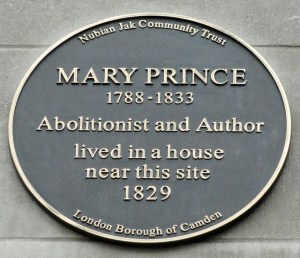
There are no surviving images of Mary Prince, but this plaque, on Senate House in Bloomsbury, commemorates her (Source: Peter Hughes).

In 1807, the Abolition Act abolished the slave trade, marking a great victory for abolitionists. They had won a significant battle, but had not yet won the war; the slave trade was gone, but slavery itself was not. Slaves, and any children they had, remained indentured. Women were over a century away from winning the vote in Britain, but they found other ways to influence politics and were key to the success of the abolition movement. As the main food purchasers, they were ideally placed to organise boycotts of slave-grown sugar in the 1790s, 1820s, and 1830s. Mary Prince was both a slave and a woman, significant disadvantages in the early nineteenth century. However it was these characteristics that made her such a powerful tool for the abolition movement.

Prince was born to an enslaved family in Bermuda in 1788. She was passed between owners and suffered from awful treatment. In 1815 she was bought by the Wood family, her last owners, for $300. In December 1826, Prince was in Antigua when she married Daniel James, a former slave who had bought his freedom. She did not seek permission from the Wood family, and they badly beat her as punishment.

Despite a deteriorating relationship with the Woods, they took Prince with them when they travelled to England in 1828. She ran away, but was legally only free in England. The Woods refused to emancipate or sell her, so if she returned to her husband in Antigua the Woods would have been able to claim her as their property once again. She petitioned Parliament to grant her freedom, but this too failed.

History of Mary Prince Title Page
The title page of Mary’s biography (Source: Yale Center for British Art).

Prince got a job with Thomas Pringle, an abolitionist writer and Secretary of the Anti-slavery Society. With the help of the Society, she published an autobiography entitled The History of Mary Prince: A West Indian Slave (1831). It was the first account of a black woman’s life published in Great Britain. The book went through three printings in its first year; Mary’s personal story helped to raise awareness of how bad conditions still were for those in slavery.

Nobody knows what happened to Prince after her book was published. In 1833, the Slavery Abolition Act was passed, which banned slavery in the British Empire. Colonies were given time to allow their economies to adapt, so slavery was abolished in Bermuda in 1834 and the West Indies in 1838. If she was still alive, Prince could have gone back to her place of birth or to her husband.

Mary Prince was not seen as a campaigner in her own right, not even by her supporters; as a black, working class woman her social status was about as low as it could get. Nevertheless, her powerful and shocking narrative played an important role in maintaining the momentum of the abolition movement. Sarah Salih, who edited a recent edition of Prince’s book, argues that Mary was a defiant woman; her illicit marriage, and her tendency to defend herself and others both verbally and physically, hinted at a rebellious streak that culminated with the publication of her History. Mary may not have been respected in her lifetime, but she certainly deserves our respect now.

Sources and Further Reading

100 Great Black Britons. “Mary Prince.” No date, accessed 25th May 2016. Available at  http://www.100greatblackbritons.com/bios/mary_prince.html

Abolition Project, The. “Mary Prince (1788-c.1833): The First Woman to Present a Petition to Parliament.” No date, accessed 25th May 2016. Available at  http://www.theguardian.com/uk/2007/oct/19/race.historybooks

Hochschild, Adam. “The Unsung Heroes of Abolition: Mary Prince.” BBC History. Last modified 17th February 2011, accessed 25th May 2016. Available at  http://www.bbc.co.uk/history/british/abolition/abolitionists_gallery_04.shtml

Simkin, John. “Mary Prince.” Sparacus Educational. Last modified August 2014, accessed 25th May 2016. Available at http://spartacus-educational.com/SprinceM.htm

Wajid, Sara. “‘They Bought Me as a Butcher Would a Calf or Lamb.'” The Guardian. Last modified 19th October 2007, accessed 25th May 2016. Available at   http://www.theguardian.com/uk/2007/oct/19/race.historybooks

Wikipedia. “Mary Prince.” Last modified 11th May 2016, accessed 25th May 2016. Available at https://en.wikipedia.org/wiki/Mary_Prince

Turbulent Londoners: Daisy Parsons, 1890-1957

Turbulent Londoners is a series of posts about radical individuals in London’s history who contributed to the city’s contentious past, with a particular focus of women, whose contribution to history is often overlooked. My definition of ‘Londoner’ is quite loose, anyone who has played a role in protest in the city can be included. Any suggestions for future Turbulent Londoners posts are very welcome. My next Turbulent Londoner is Daisy Parsons, a Suffragette and the first female Mayor of West Ham.


Daisy Parsons- Beckton Lido
Daisy Parsons at the opening of the Beckton Lido in August 1927 (Source: © Newham Heritage Service).

Daisy Parsons was a formidable woman. Despite leaving school at the age of 12 to help support her family she became a force to be reckoned with in East End politics, working closely with Sylvia Pankhurst in the East London Federation of Suffragettes (ELFS), then going on to become the first female Mayor of West Ham.

Born Marguerite Lena Millo on the 25th of May 1890, Daisy must have had a difficult childhood. She was born in Poplar in East London, her family moving to nearby Canning Town when Daisy was 8 months old. She had 5 younger brothers, and because her father was an invalid, her mother had to take on washing and charring work. Daisy was given a certificate of exemption in 1902 so that she could leave Beckton Road School early to look after her brothers, a necessity she always regretted. When she was 14 she left home to work as a maid, but later became a cigarette packer at the Carreras Tobacco Company in Aldgate, because the pay was better. Women and girls were paid 3d for every 1000 cigarettes they packed (most managed about 3000 a day).

It was whilst working at the tobacco company that Daisy had her first contact with the trade union movement; male employees at the factory had a fixed lunch hour and a space to eat because their union had fought for them. Female employees had to eat in the toilets! Daisy’s husband Tom was a driver for Stepney Borough Council and an active union member. They married in December 1908 when Daisy was 18.

Daisy obviously had a keen interest in politics in her own right- she joined the Women’s Social and Political Union and the International Labour Party, and was one of the founding members and the secretary of the ELFS. She was remembered as being assertive and persuasive. She was clearly not one to shy away from action- at Suffragette demonstrations she carried a ‘Saturday Nights’ (a length of hemp rope tied at one end, a sort of improvised cosh) hidden up her sleeve in case she needed to defend herself.

Daisy took part in a deputation of working women to Prime Minister Asquith on the 12th of June 1914, trying to persuade him of the necessity of female suffrage. By this point she had 2 daughters, and was also looking after her niece. Daisy stuck with Sylvia Pankhurst after the split with her mother and sister, and ELFS worked tirelessly during the first world war, setting up a Mother and Child Welfare Centre in West Ham to help women who were struggling whilst their husbands were away, or had been killed.

When women over 30 were given the right to vote in 1918 Daisy still couldn’t vote because she was only 29! This did not deter her from moving into mainstream local politics however, and she was elected as a Labour Councillor for Beckton ward in 1922. She became deputy Mayor of West Ham in 1931, and Mayor in 1936. She also became a Justice of the Peace in 1933, and an Alderman of West Ham in 1935. During World War 2 Daisy organised the evacuation of local children and helped to organise the Women’s Voluntary Service. Her efforts did not spare her from tragedy however; her brother and niece were killed in the Blitz.

Daisy Parsons was obviously respected and admired. She was awarded the Freedom of West Ham in 1939, the highest honour which the borough can bestow, and was made an MBE in 1951 in recognition of her public service. She had gone from radical Suffragette to respected local official, but I get the impression she retained her determined and caring nature.

Sources and Further Reading

Anon. ‘Daisy Parsons, MBE.’ The Newham Story. No date, accessed 21st March 2016.  http://newhamstory.com/node/991

Brooker, Janice. ‘Daisy Parsons.’ Lost in London. Last modified 1st May 2007, accessed 21st March 2016. http://www.brooker.talktalk.net/daisy_parsons.htm

McCarthy, Ka. ‘Daisy Parsons.’ The Great British Community. Last modified 8th March 2016, accessed 21st March 2016. http://greatbritishcommunity.org/daisy-parsons/

Turbulent Londoners: Elisabeth Jesser Reid, 1789-1866

Turbulent Londoners is a series of posts about radical individuals in London’s history who contributed to the city’s contentious past, with a particular focus of women, whose contribution to history is often overlooked. My definition of ‘Londoner’ is quite loose, anyone who has played a role in protest in the city can be included. Any suggestions for future Turbulent Londoners posts are very welcome. The twelth Turbulent Londoner is Elisabeth Jesser Reid. She was the founder of Bedford College, which is now part of Royal Holloway and Bedford New College, my university.


Plaque dedicated to Elisabeth Jesser Reid, founder of Bedford College for Women, on her house in Bedford Square, London, England (Source: Oosoom).

Elisabeth Jesser Reid was a social reformer, abolitionist, and advocate of women’s education. Known as single-minded and tactless, she used her relatively privileged status as an independent widow to further the causes she believed in. This included founding Bedford College, one of the first venues of higher education for women in Britain.

The second daughter of wealthy Unitarian ironmonger William Sturch and his wife Elisabeth, Elisabeth Jesser Sturch was born to a life of relative privilege on the 25th of December 1789. In 1821 she married John Reid, a physician. Dr. Reid owned land on the River Clyde in Glasgow, which became valuable as the port expanded. When John died only 13 months after their marriage, Elisabeth was left with a large, independent income. Historically, widows with an independent income have enjoyed more freedom than other women, being beyond the control of both father and husband. Elisabeth used her freedom to fight for the causes she supported.

Elisabeth was a social reformer. She used her money to support benevolent schemes set up by women, such as Harriet Martineau’s project to enable the poor in the Lake District to buy their own homes. She also sponsored the studies of pupils who couldn’t otherwise afford it. Another of Elisabeth’s passions was abolitionism. She attended the World Anti-Slavery Convention in London in 1840, where she met female American delegates who had not been permitted to speak, such as Lucretia Mott. She was a member of the Garrisonian London Emancipation Committee, the British branch of an anti-slavery group that held progressive views on gender and racial equality.

Elisabeth Jesser Reid is best known for her role in the development of female education. In 1849 she founded Bedford College, with a loan of £1500, which she converted to a gift in 1856 when the college was experiencing financial difficulties. The college was first located at 47 Bedford Square in Bloomsbury, moving to Regent’s Park in 1874. Although not the first college for the higher education of women in Britain, it was the first that believed in education for purposes other than vocational training. Bedford College aimed to enable women to improve themselves as they wanted to, not just gain the skills to become a governess.

This philosophy was radical, and Elisabeth was frustrated by the lack of support she received, particularly from prominent men. She expected hundreds of applications when the college opened, and was bitterly disappointed to receive only around a dozen. Nevertheless, she persevered, insisting that 3 Lady Visitors were included in the governing body, which was the first  time women officially shared in controlling the direction of a British institution. She used her social connections to get respected scholars to teach at the college, and eventually the college became successful. Notable early students include  novelist George Eliot, feminist and artist Barbara Bodichon, and Sarah Parker Redmond, the first black woman to do a lecture tour in the UK on the topic of slavery. Bedford College became part of the University of London in 1900, and merged with Royal Holloway in 1985, to become Royal Holloway and Bedford new College. In this form it is still going strong today, with over 8000 students (and a wonderful geography department!)

I feel a personal connection to Elisabeth Jesser Reid because of the happy and fulfilling times I have spent at Royal Holloway and Bedford New College, but even without that I would admire her as a headstrong and opinionated woman who did not let her relative freedom go to waste. She used her wealth and independence to make the world a better place, and she fought hard for what she believed in, significantly advancing women’s education.

Sources and Further Reading

Anon. “Black History Month: Garrisonian Abolitionists.” Oxford University Press Blog. Last modified 27 February 2007, accessed 25 February 2016. Available at  http://blog.oup.com/2007/02/black_history_m4/ 

Anon. “Elisabeth Jesser Reid: Pioneering Education for Women.” Royal Holloway, University of London. No date, accessed 27 February 2016. Available at  https://www.royalholloway.ac.uk/aboutus/ourhistory/elisabethjesserreid.aspx

Anon. “Elizabeth Jesser Reid.” Wikipedia. Last modified 13 January 2016, accessed 25 February 2016. Available at https://en.wikipedia.org/wiki/Elizabeth_Jesser_Reid

Anon. “History of Elizabeth Jesser Reid.” Reflex Managed Offices. Last modified 9 September 2015, accessed 25 February 2016. Available at http://www.reflex.london/history-of-elizabeth-jesser-reid/

Colville, Deborah. “Bloomsbury People.” UCL Bloomsbury Project. Last modified 7 April 2011, accessed 25 February 2016. Available at http://www.ucl.ac.uk/bloomsbury-project/articles/individuals/reid_elisabeth_jesser.htm

Oldfield, Sybil. “Reid [nee Sturch], Elisabeth Jesser.” Oxford Dictionary of National Biography. Last modified May 2011, accessed 25 February 2016. Available at  http://www.oxforddnb.com.ezproxy01.rhul.ac.uk/view/article/37888 (This website is behind a paywall, I had to use my Royal Holloway login to access it).

Pakenham-Walsh, M. ‘Bedford College, 1849-1985’ in Crook J (ed.) Bedford College University of London- Memories of 150 Years. Royal Holloway and Bedford New College: Egham, Surrey (2001): 13-46

Turbulent Londoners: Ellen Wilkinson, 1891-1947

Turbulent Londoners is a series of posts about radical individuals in London’s history who contributed to the city’s contentious past. My definition of ‘Londoner’ is quite loose, anyone who has played a role in protest in the city can be included. Any suggestions for future Turbulent Londoners posts are very welcome. Today I’m looking at Ellen Wilkinson, a radical politician who became the Minister for Education.


Ellen Cicely Wilkinson
by Howard Coster
10 x 8 inch film negative, 1937
NPG x14687
© National Portrait Gallery, London

Ellen Cecily Wilkinson was an impressive woman. Rebellious and outspoken from a young age, she was a founding member of the Communist Party of Great Britain in 1920. As she aged, she either mellowed or suppressed her more radical side, rising through the Labour Party to become the Minister of Education in 1945, only the second woman to ever gain a place in the British cabinet.

Wilkinson was born on the 8th of October 1891 to a working-class family in Manchester. Her father encouraged her to read and learn, and she was academically accomplished. She got involved in politics young, joining the International Labour Party when she was 16. She also campaigned for the suffragist cause, handing out leaflets and putting up posters. She started teacher training college, but her unconventional teaching style was not appreciated and she left, deciding that teaching was not for her.

Teachings’ loss was politics’ gain. In 1910 Wilkinson won a scholarship to Manchester University, where she joined the Fabian Society and Manchester Society for Women’s Suffrage. She met many leaders of the radical left during this period, including the indefatigable Charlotte Despard. In her first year at university, she joined the executive committee of the University Socialist Federation, which was formed to unite socialist students across the country.

When she left university in 1913, Ellen got a job working for the National Union of Women’s Suffrage Societies.  She was also active in the Women’s International League for Peace and Freedom, and strongly opposed the First World War. The Suffrage movement was divided by the war, so in 1915 Ellen became National Women’s Organiser for the Amalgamated Union of Cooperative Employees (AUCE). She was the first woman they employed as an official. Here she fought for equal pay and rights for unskilled workers, which were often actively opposed by the better-off craft unions. Her time working for unions made her a skilled speaker and organiser.

As with many of her contemporaries, Ellen was inspired by the Russian Revolution, and in 1920 she was a founding member of the Communist Part of Great Britain. She also remained in the Labour Party, but it 1923 the Labour Party stopped allowing membership of both, and Ellen chose to stay with Labour, criticising the Communist Party’s dictatorial methods. By this point the AUCE had merged with another union to become the National Union of Distributive and Allied Workers (NUDAW), who sponsored Ellen to run for Parliament. After several failed attempts, she was elected the Labour MP for Middlesborough East in 1924, under a Conservative government. She was the only female Labour MP in the 1924 Parliament.

In Parliament Ellen fought for women’s rights, opposed imperialism, and was a vocal supporter of the May 1926 General Strike. She was elected to the Labour Party’s National Executive in 1927, which gave her a say in Party policy. She campaigned for the voting age for men and women to be equalised, which was achieved in 1928. As the Great Depression struck Ellen continued to fight for worker’s rights, although she lost her Parliamentary seat in 1932.

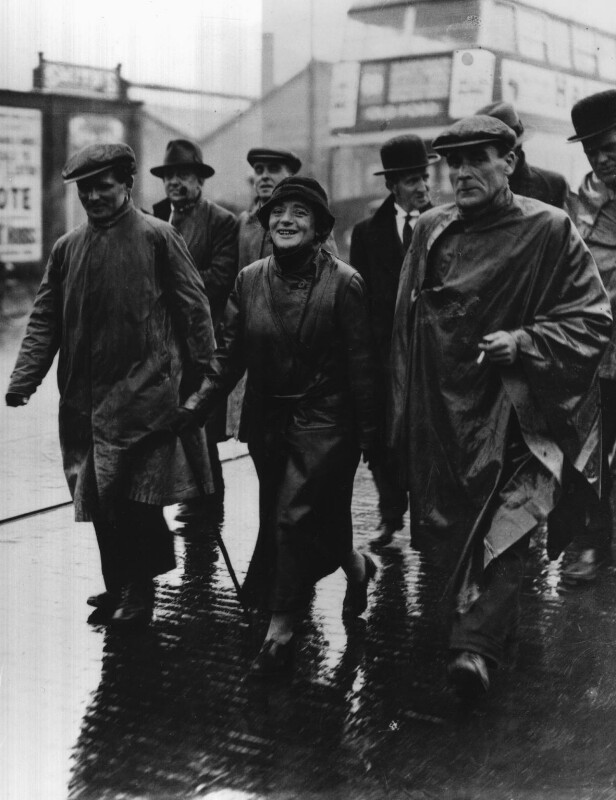
She continued to campaign whilst out of office, and in 1935 she was elected as the MP for Jarrow, a small town in Tyneside which is known for the Jarrow March, which took place in 1936. Despite criticism, even from within the Labour Party, Ellen supported the marchers, and joined them for some stretches of the march. On the 4th of November she presented the marchers’ petition to Parliament, which contained 11,000 signatures. Although not immediately successful, it is thought that the march helped shaped future attitudes and policies towards unemployment.

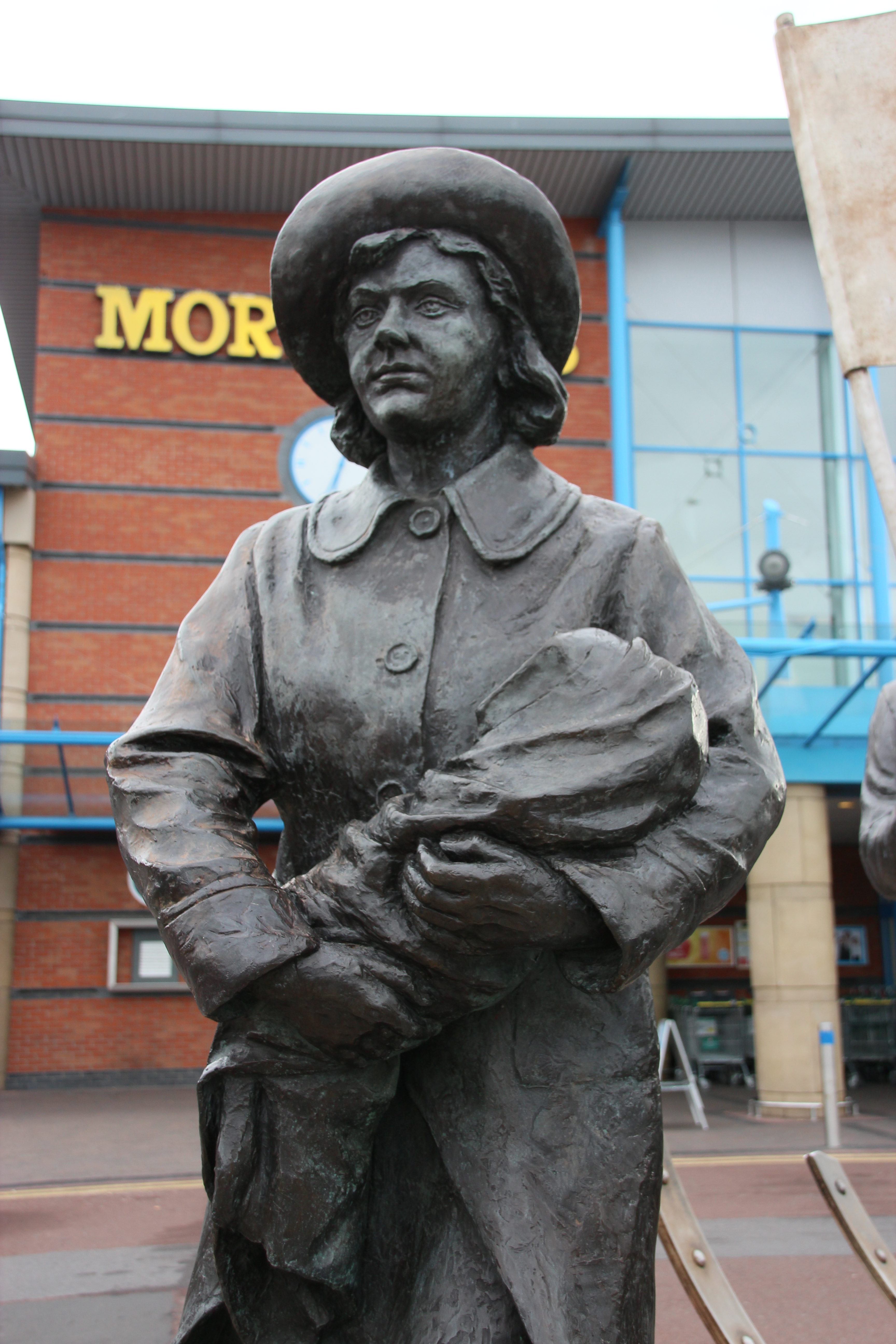
The female marcher in the Spirit of Jarrow carrying a bundle that is probably a baby.
A statue in Jarrow commemorating the Jarrow March. As Wilkinson was the only woman permitted to join the march, I assume this is supposed to be her (Source: Hannah Awcock).

During the 1930s Ellen travelled Europe attempting to combat fascism, and was critical of the government’s policy of non-intervention in the Spanish civil war. She was also strongly opposed to appeasement as a method of dealing with Hitler. She supported the declaration of the Second World War in 1939, but disapproved of the way Chamberlain conducted the war. When Churchill took over the government, Ellen was put in charge of air raid shelters and civil defence. During the war she became less radical, and was accepted by the Labour Party mainstream.

In 1945, Ellen Wilkinson became only the third woman to be made a privy councillor. After Labour’s landslide election victory, Atlee made her the Minister for Education. She focused on implementing the 1944 Education Act, which provided universal free secondary education and raised the school leaving age from 14 to 15. She was criticised as the system of the 11+ exams, and grammar, technical, and modern schools was seen as elitist. She stuck by her guns, arguing that the Education Act was the only realistic way of achieving positive change. As well as this, she also increased the amount of university scholarships and part time adult education, both positive steps forward.

Ellen Cicely Wilkinson leading the Jarrow Marchers through Cricklewood in London
by Fox Photos Ltd
modern bromide print from original negative, 31 October 1936
NPG x88278
© National Portrait Gallery, London

Ellen Wilkinson died in office on the 6th of February 1947. She had always suffered from bronchial asthma, and this killed her, exacerbated by heavy smoking, overwork and an overdose of medicine. Her death was declared accidental, but some still suspect that she committed suicide. Ellen was well known for her fiery hair and matching temperament, and even when her politics mellowed, her passion and conviction did not. She is particularly interesting in the light of the Labour Party’s shift to the left with the election of Jeremy Corbyn as Party Leader, and it will be interesting to see if he too moves towards the centre as his career progresses. Regardless, Ellen was an inspiring woman who carved her own political path in a world dominated by men, often in the face of heavy opposition. She fought hard for what she believed in, and proved that politicians can have principles.

Sources and Further Reading

Anon. “Ellen Wilkinson,” Wikipedia. Last modified 13th September 2015, accessed 2nd October 2015. Available at https://en.wikipedia.org/wiki/Ellen_Wilkinson

Harrison, Brian. “Wilkinson, Ellen Cicely (1891–1947)”, Oxford Dictionary of National Biography. Last updated 2004, accessed 2nd October 2015. Available at http://www.oxforddnb.com/view/article/36902 (Not free to access)

Simkin, John. “Ellen Wilkinson,” Spartacus Educational. Last modified August 2014, accessed 2nd October 2015. Available at http://spartacus-educational.com/TUwilkinson.htm 

Stevenson, Graham. “Glossary of People: Ellen, Wilkinson,” marxists.org. No date, accessed 2nd October 2015. Available at https://www.marxists.org/glossary/people/w/i.htm#wilkinson-ellen

Turbulent Londoners: Bernie Grant, 1944-2000

Turbulent Londoners is a series of posts about radical individuals in London’s history who contributed to the city’s contentious past. My definition of ‘Londoner’ is quite loose, anyone who has played a role in protest in the city can be included. Any suggestions for future Turbulent Londoners posts are very welcome. The next Turbulent Londoner is Bernie Grant, who devoted his life to campaigning for equality across various forums.


A plaque commemorating the work of Bernie Grant can be found on Tottenham Town Hall in London (Source: jelm6).

Bernard Alexander Montgomery Grant, known to most as Bernie Grant, was an influential campaigner for civil rights in Britain and around the world. In a political career that spanned four decades, he fought to promote equality of all kinds as a trade union leader, a member of local government, and a Member of Parliament. Although he spent the majority of his career in mainstream politics, he still deserves the status of a Turbulent Londoner as he continued to fight for what he believed in once he was elected, and acted as “a red rag to the bulls of rightwing politics” (Phillips, 2000).

Born in Georgetown, Guyana on the 17th February 1944, Bernie Grant moved to London with his parents when he was 19. He studied at Heriot-Watt University in Edinburgh, but left in 1969 in protest against discrimination against black students. He started working as a telephonist for the Post Office at the International Telephone Exchange in King’s Cross, and became involved in trade union politics during the Post Office strike in 1970. In 1978 Bernie became an Area Officer for the National Union of Public Employees, a full-time job.

Also in 1978, Bernie became a Labour Councillor in the north London borough of Haringey. He founded the Black Trades Unionists Solidarity Movement, and worked there full time between 1981 and 1984. In 1985, he earned the nickname ‘Barmy Bernie’ from the tabloid press because of his leadership of the opposition against the Conservative government’s rate-capping, which meant that central government could restrict the spending of local councils. He is in good company; the name ‘Suffragettes’ was coined by a reporter at the Daily Mail.

Haringey Council emerged from the dispute with central government with Bernie Grant as leader. He was the first black man to hold such a position in Europe. Bernie practiced what he preached, and Haringey was one of the few local councils to develop policies that tackled discrimination on the basis of disability, gender, race, or sexual orientation. After the controversial Broadwater Farm riots on the 6th of October 1985 Bernie stood up for the local youth, despite widespread and frequently vicious criticism.

The Broadwater Farm controversy didn’t damage Bernie’s reputation enough to prevent him being elected the Member of Parliament for Tottenham in 1987. He caused a stir by attending his first state opening of parliament in African dress, another of his ‘red rag’ moments. Once in Parliament, Bernie continued to fight for what he believed in. He founded the Parliamentary Black Caucus, and campaigned to end racism in the UK and abroad, against racist policing methods, deaths in police custody, and institutionalised racism in education, housing, and health. He also fought for the rights of refugees, greater resources for inner city areas, the elimination of overseas debt for poor nations, and the recognition of past colonialism and enslavement. He worked hard for his constituency, campaigning for a major cultural and arts facility, now called the Bernie Grant Arts Centre in his name.

Bernie Grant remained the MP for Tottenham until his death on the 8th of April 2000, aged 56. He was a man who never shied away from what he thought was right, even in the face of party politics and widespread criticism. He proved that it is possible to make positive changes from within the official system of government, a lesson which is worth hanging onto in the face of modern mainstream politics.

Sources and Further Reading

Anon. “Bernie Grant.” Wikipedia. Last modified 4th May 2015, accessed 18th June 2015. https://en.wikipedia.org/wiki/Bernie_Grant

Phillips, Mike. “Bernie Grant.” The Guardian. Last modified 10th April 2000, accessed 18th June 2015. http://www.theguardian.com/news/2000/apr/10/guardianobituaries.obituaries

The Bernie Grant Archive. No date, accessed 18th June 2015. http://berniegrantarchive.org.uk/

Turbulent Londoners: Muriel Lester, 1883-1968

Turbulent Londoners is a series of posts about radical individuals in London’s history who contributed to the city’s contentious past. My definition of ‘Londoner’ is quite loose, anyone who has played a role in protest in the city can be included. Any suggestions for future Turbulent Londoners posts are very welcome. Next up is Muriel Lester, a social reformer and pacifist.


Muriel Lester in 1938 (Source: Wikimedia Commons).

Muriel Lester was a social reformer, pacifist, feminist and non-conformist. Like Charlotte Despard, she turned away from her privileged life, dedicating herself to helping the poor and advocating peace. Born in Leytonstone on the 8th of February 1883 to a wealthy Baptist family, by the time of her death aged 83 she had travelled the world, founded a social centre that still exists today, and been nominated for the Nobel Peace Prize. Twice.

Muriel moved to Bow in East London with her sister Doris in 1908. At the start of the twentieth century the East End was crowded and very poor. Many middle- and upper-class humanitarians were embarking on charitable projects in the area around this time, such as the lesser-known Pankhurst daughter Sylvia. In 1915, with money from their father, the Lester sisters bought a disused chapel and opened it as a ‘teetotal pub’, so that local people could have a place to meet in the evenings. They named it Kingsley Hall, after their brother who had died the previous year.

Between 1922 and 1926 Muriel was an Alderman on the radical Poplar Borough Council, and she chaired the Maternal and Child Welfare Committee. In 1928 a new purpose-built Kingsley Hall was designed as a community centre and place of worship. Muriel herself took on the role of vicar. Her spirituality was an important part of her campaigning throughout her life. In 1929 Muriel and Doris set up a second Kingsley Hall in Dagenham, where many Bow residents had been relocated after huge slum clearance programmes in the East End. Both Halls are still going strong today.

Modern-day Kingsley Hall in Bow (Source: Peter Thwaite).

But community work in the East End was not the only way in which Muriel tried to make the world a better place. She was also a dedicated pacifist, and in 1914 was a founding member of the Fellowship of Reconciliation (FoR), a Christian Pacifist organisation which is also still active today. In 1926 she travelled to India and met Gandhi, with whom she developed a strong friendship. When he travelled to London for a conference in 1931, he stayed at the Kingsley Hall in Bow.

In 1934, Muriel began working as a secretary for the International FoR. She travelled the world spreading the message of non-violence. During a trip to Japan she was dubbed the ‘Mother of World Peace’, and she was detained in Trinidad in 1941 because of the success of her pacifist speeches in the US.

Muriel Lester was a woman who never stopped trying to help people. This mission continued even in death, as her body was donated to science. She used her privilege to benefit others, and demonstrated incredible bravery by taking the unpopular and frequently dangerous position of pacifist during two world wars. I make a point of featuring admirable women in the Turbulent Londoners series, and Muriel Lester would certainly make a good role model for any young woman.

Sources and Further Reading
Anon. “Lester, Muriel.” Bishopsgate Institute. No date, accessed 13th June 2015. http://www.bishopsgate.org.uk/Library/Library-and-Archive-Collections/Protest-and-Campaigning/Lester-Muriel
Anon. “Muriel Lester.” Wikipedia. Last modified 15th May 2015, accessed 13th June 2015. https://en.wikipedia.org/wiki/Muriel_Lester
Anon. “The East End’s Global Peace Messenger.” BBC. Last modified 10th October 2008, accessed 13th June 2015. http://www.bbc.co.uk/london/content/articles/2008/10/08/muriel_lester_feature.shtml