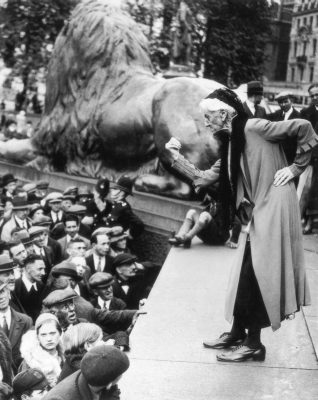
Turbulent Londoners: Mary Astell, 1666-1731

Turbulent Londoners is a series of posts about radical individuals in London’s history who contributed to the city’s contentious past. My definition of ‘Londoner’ is quite loose, anyone who has played a role in protest in the city can be included. Any suggestions for future Turbulent Londoners posts are very welcome. Next up is Mary Astell, a philosopher and writer who is considered by many to be England’s first feminist.


The title page of Astell's first publication.
The title page of Astell’s first publication.

Mary Astell was a philosopher and writer from Newcastle whose ability to reason and argue made her a formidable force in intellectual circles in London in the late 17th and early 18th centuries. Her advocacy of women’s education and her opinions on marriage has led her to be seen by many as England’s first feminist.

Mary was born in Newcastle on the 12th of November 1666 to an upper middle class family; her father managed a local coal company. Mary’s father died when she was 12, leaving her family with very little income. She received some education from her uncle, who was affiliated with a group of radical philosophers in Cambridge, but she also taught herself by reading widely. After her mother died in 1684, Mary moved to Chelsea in London, where she became acquainted with an influential and wealthy circle of women who helped her to develop and publish her work.

Between 1694 and 1709, Mary published a number of texts on a range of subjects, but she is best known for her arguments relating to women. She used her extensive understanding of philosophical ideas to argue that women were just as rational as men, and therefore just as deserving of education. After withdrawing from public life in 1709, Mary set up a charity school for girls in Chelsea. She devised the curriculum, putting her ideas into practice. Mary Astell died of cancer on the 11th of May 1731, leaving behind a lasting legacy.
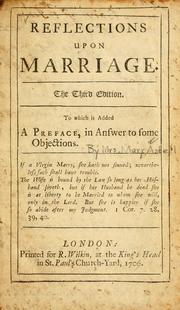
The title page of the third edition of Astell's 'Reflections Upon Marriage.'
The title page of the third edition of Astell’s ‘Reflections Upon Marriage.’

Mary’s first publication came out in 1694 and was entitled Serious Proposal to the Ladies for the Advancement of their True and Greatest Interest. In it, she proposes a female-only college, where women learn through reading and discussion, rather than a formal, hierarchical program of study. In Some Reflections Upon Marriage (1700), Mary continues advocating for women. She argues that an education would enable women to make better matrimonial choices, and be better prepared for married life. She warns women against making hasty choices when it came to marriage, and believed marriage should be based on friendship rather than necessity or fleeting attraction.

Mary’s ideas were groundbreaking for more than just their content. The way that she used philosophical ideas to support her arguments was unique, and she addressed women directly in her writing- talking to them, not about them. Her arguments disputed the Protestant belief, dominant at the time, that reason and emotion should be separate; for Mary, knowledge was intimately connected to happiness. Linked to this, one of the most frequent criticisms levelled against Mary’s ideas was that they were ‘too Catholic’; her plan for an all-female college sounded too much like a nunnery to be accepted by mainstream society. Mary’s ideas about women’s education caused substantial debate, and she was widely respected for her ability to debate freely and confidently with both men and women, but she did not receive widespread support.

“If all Men are born free, how is it that all Women are born slaves?”

Astell, Some Reflections Upon Marriage

The above quote is probably Mary Astell’s most famous, and it is easy to see why. This was a truly radical sentiment in the early eighteenth century. Not only did she express these radical ideas, Mary could support them with reasoned, rational, philosophical arguments. And she did all this at a time when there were few historical campaigners for women’s rights from which she could take inspiration and hope. As one of England’s first feminists she deserves to be remembered and celebrated, but she can also be for contemporary campaigners something she herself didn’t have- a role model.

Sources and Further Reading

Anon. ‘Astell, Mary.’ Encyclopaedia.com. Last modified 2005, accessed 28th July 2015.  http://www.encyclopedia.com/topic/Mary_Astell.aspx

Anon. ‘Mary Astell.’ Wikipedia. Last modified 19th May 2015, accessed 28th July 2015.  https://en.wikipedia.org/wiki/Mary_Astell

Manzanedo, Julia Cabaleiro. ‘The Love of Knowledge: Mary Astell.’ Women’s Research Centre, University of Barcelona. Last modified 2004, accessed 28th July 2015.  http://www.ub.edu/duoda/diferencia/html/en/secundario2.html

Sowaal, Alice. ‘Mary Astell.’ Stanford Encyclopaedia of Philosophy. Last modified 12th August 2008, accessed 28th July 2015. http://plato.stanford.edu/entries/astell/
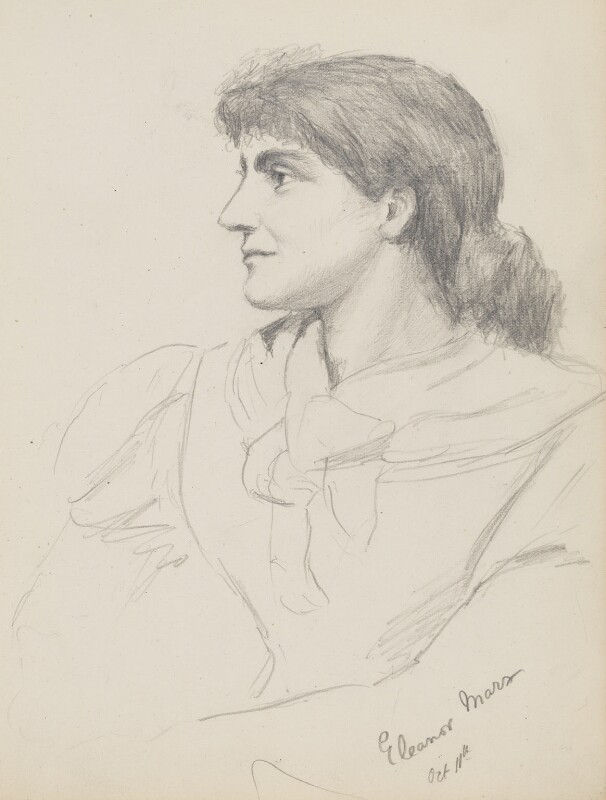
Turbulent Londoners: Eleanor Marx, 1855-1898

Turbulent Londoners is a series of posts about radical individuals in London’s history who contributed to the city’s contentious past. My definition of ‘Londoner’ is quite loose, anyone who has played a role in protest in the city can be included. Any suggestions for future Turbulent Londoners posts are very welcome. The next Turbulent Londoner is Eleanor Marx, a socialist campaigner and translator, and close friend of Clementina Black


(Jenny Julia) Eleanor Marx (later Marx-Aveling)
by Grace Black (later Grace Human)
pencil, 1881
NPG 6771
© National Portrait Gallery, London

Eleanor Marx was the youngest daughter of Karl Marx, one of the most famous political revolutionaries of all time. She managed to cause quite a stir in her own right however, and her achievements deserve to be recognised. She was a socialist activist and translator, but also worked as a teacher and carer for her ailing parents during her short life; she was only 43 when she committed suicide.

Unsurprisingly because of her family, Eleanor took an interest in politics at a young age. The execution of the Manchester Martyrs when she was 12 years old in 1867 sparked her lifelong support for the Fenians. She must have been very intelligent, because at just 16 she became her father’s secretary, travelling with him to socialist conferences around the world. In 1872 she met and fell in love with Hippolyte Lissagaray, a member of the failed Paris Commune living in exile in London. She helped him write a history of the 1871 commune and translated it, but ended in the relationship in 1882, not long after her father finally agreed to approve the match (Lissagaray was 17 years older than Eleanor).

Her father must have trusted her judgement, because after his death in 1883 he charged Eleanor with publishing his unfinished manuscripts and the English translation of Capital, his most famous work. Her political career did not die with her father however, and in 1884 she joined, and was elected to the executive of, the Social Democratic Federation (SDF). Later that same year she became a founding member of the Socialist League after splits within the SDF, although she later rejoined the SDF the year before she died.

Also in 1884, Eleanor became heavily involved in the Women’s Trade Union League, supporting numerous strikes over the following decade. In 1889 she helped women at a plant in Silvertown form one of the first female branches of a union. The National Union of Gasworkers and General Labourers (NUG&GL) was one of the first trade unions to admit female members. She was a firm believer in participation in political campaigns, a view that frequently alienated her from the majority of the Socialist League. She backed up her beliefs with action too, for example she was present in Trafalgar Square during Bloody Sunday in 1887. Known as compelling speaker, she campaigned tirelessly for workers rights and international solidarity. She also wrote numerous books and articles during this period, and took up acting- she believed the arts were a powerful socialist and feminist tool, and even learnt Norwegian just so she could translate the works of playwright Henrik Ibsen into English.

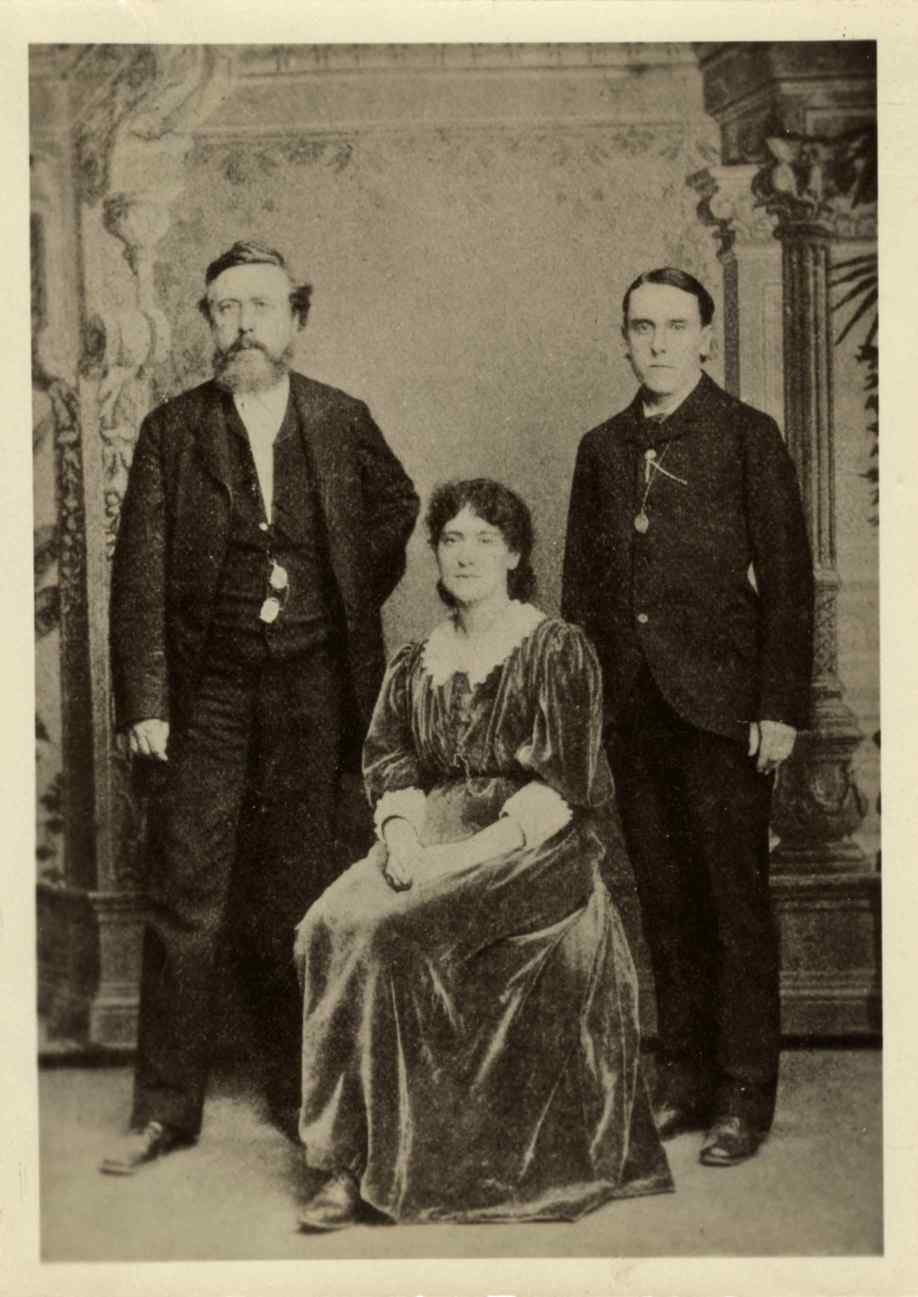
Eleanor Marx with Edward Aveling and William Liebknecht in 1886 (Source: Wikipedia).
Eleanor Marx with Edward Aveling and William Liebknecht in 1886 (Source: Wikimedia Commons).

In 1885 she helped to organise the International Socialist Congress in Paris, and the following year she toured America with German socialist Wilhelm Liebknecht and Edward Aveling, raising money for the German Social Democratic Party. Eleanor met Aveling, a prominent British Marxist, when she joined the SDF, and she spent the rest of her life with him.

Eleanor Marx poisoned herself on 31 March 1898. It is not known for sure why, but members of the British socialist community blamed Aveling, as Eleanor had found out that he married a young actress in secret the previous year. Her ashes were kept by various socialist organisations over the years, including the SDF, the British Socialist Party, and the Communist Party of Great Britain, before eventually being buried with her family at Highgate in 1956. This tribute, whilst bizarre, demonstrates just how much she meant to the socialist community in Britain.

Eleanor Marx’s life was full of relationships with well known, radical men, but her life was not defined by them. She was an influential campaigner in her own right, and successfully made her own mark on a political landscape that was still very much dominated by males. She has my admiration and respect not only because she spoke several languages (I have enough trouble with English!) but also because she made her own name, and didn’t just rely on those of the men in her life.

Sources and Further Reading

Anon. ‘Datei:Wilhelm Liebknecht Edward Aveling und Eleanor Marx Aveling 1886.jpeg,’ Wikipedia. No date, accessed 17 March 2015.  http://de.wikipedia.org/wiki/Datei:Wilhelm_Liebknecht_Edward_Aveling_und_Eleanor_Marx_Aveling_1886.jpeg

Anon. ‘Eleanor Marx,’ Wikipedia. Last modified 30 January 2015, accessed 17 March 2015. http://en.wikipedia.org/wiki/Eleanor_Marx

Anon. ‘Eleanor Marx,’ Socialist Party. No date, accessed 17 March 2015. http://www.socialistparty.org.uk/socialistwomen/sw12.htm

Anon. ‘Eleanor Marx,’ Spartacus Educational. No date, accessed 17 March 2015. http://spartacus-educational.com/Wmarx.htm

Blunden, Andy. ‘Eleanor Marx,’ marxists.org. No date, accessed 17 March 2015. https://www.marxists.org/archive/eleanor-marx/

Tully, John. Silvertown: The Lost Story of a Strike that Shook London and Helped Launch the Modern Labour Movement. London: Lawrence & Wishart, 2014.

Turbulent Londoners: William Cuffay, 1788-1870

Turbulent Londoners is a series of posts about radical individuals in London’s history who contributed to the city’s contentious past. My definition of ‘Londoner’ is quite loose, anyone who has played a role in protest in the city can be included. Any suggestions for future Turbulent Londoners posts are very welcome. The next Turbulent Londoner is William Cuffay, a prominent Chartist leader and activist, despite significant disadvantages.


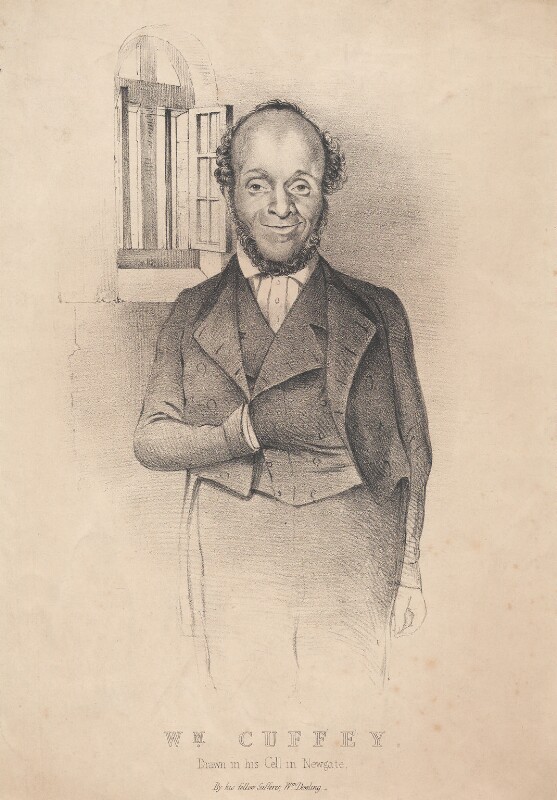
William Cuffay
after William Paul Dowling
lithograph, 1848
NPG D13148
© National Portrait Gallery, London

William Cuffay was the son of an ex-slave from St. Kitts and a woman from Kent. Born in 1788 in Medway Towns (now Gillingham), he trained as a tailor and moved to London in about 1819. He married 3 times, and had 1 daughter. Despite being mixed race, less than 5 feet tall and disabled (he had a deformed spine and shinbones), Cuffay became a well-known, daring, respected and committed activist and Chartist leader, to the extent that The Times described the London Chartists as “the black man and his party.”

Cuffay came to activism relatively late in life. In 1834, when he was 36, he was fired and blacklisted after taking part in a tailors’ strike for shorter hours and better pay. This experience convinced him that workers needed representation in Parliament, so got involved in the Chartist movement.

He rose quickly through the ranks of local and national Chartism. He helped form the Metropolitan Tailors’ Charter Association in 1839, was elected to the Chartist Metropolitan Delegate Council in 1841, and the following year he was elected President of the London Chartists, and to the Chartist national executive.

Cuffay was a Physical Force Chartist. They advocated the use of violence for their cause, whilst the Moral Force Chartists believed they could achieve their goals with only the weight of their arguments. Cuffay helped to organise the fateful Chartist demonstration on Kennington Common on the 10th of April 1848, and was dismayed by what he saw as the cowardly behaviour of his fellow Chartist leaders. The Kennington demonstration was supposed to be the crowning glory of the Chartist movement, but instead the leaders decided to back down because of the huge numbers of police.

Now utterly convinced that peaceful protest would not get the People’s Charter into law, Cuffay became involved in plans for a violent uprising. He was betrayed by a government spy and convicted of preparing acts of arson- the fires were to meant to signal the start of the rebellion. The affair became known as The Orange Tree Plot, after the pub in Red Lion Square where the leaders of the uprising would meet to plan.

Cuffay was convicted and sentenced to 21 years penal transportation. He arrived in Tasmania in November 1849, after what must have been a truly awful sea journey for a 61-year-old with Cuffay’s health problems. He was pardoned after 3 years, but chose to stay in Tasmania. His wife saved enough money to join him in 1853, and he carried on pretty much as he left off in London, working as a tailor and playing a prominent role in local radical politics. He sadly died in poverty in July 1870, aged 82.

William Cuffay was a man who would not be defined by his colour or physical attributes. Despite being only 4 ft 11, he was known as a charismatic and engaging public speaker, and he quickly became one of the best-known Chartist leaders. He was admired by his fellow Chartists, and fought with conviction for what he believed was right. As far as I know, there are no memorials for Cuffay, in London or Tasmania, but I think he was a man we could all learn a few lessons from.

Sources and Further Reading

Anon. ‘Chartism,’ Wikipedia. Last modified 24 April, 2015, accessed 10 May 2015. http://en.wikipedia.org/wiki/Chartism

Anon. ‘Chartists,’ National Archives. No date, accessed 10 May 2015.http://www.nationalarchives.gov.uk/pathways/blackhistory/rights/chartists.htm 

Anon. ‘William Cuffay,’ Wikipedia. Last modified 1 May 2015, accessed 10 May 2015.  http://en.wikipedia.org/wiki/William_Cuffay

Anon. ‘William Cuffay (1788-1870),’ BBC History. No date, accessed 10 May 2015. http://www.bbc.co.uk/history/historic_figures/cuffay_william.shtml

Gregory, Mark. ‘ Cuffay’s book circumnavigates the World: 1849-2013,’ William Cuffay, 1788-1870. No date, accessed 10 May 2015. http://cuffay.blogspot.co.uk/

Rosenberg, David. Rebel Footprints: A Guide to Uncovering London’s Radical History. London: Pluto Press, 2014.

Simkin, John. ‘William Cuffay,’ Spartacus Educational. Last modified April 2014, accessed 10 May 2015. http://spartacus-educational.com/CHcuffay.htm 

Turbulent Londoners: Clementina Black, 1854-1922

Turbulent Londoners is a series of posts about radical individuals in London’s history who contributed to the city’s contentious past. My definition of ‘Londoner’ is quite loose, anyone who has played a role in protest in the city can be included. Any suggestions for future Turbulent Londoners posts are very welcome. The next Turbulent Londoner is Clementina Black, a writer, feminist and trade unionist.


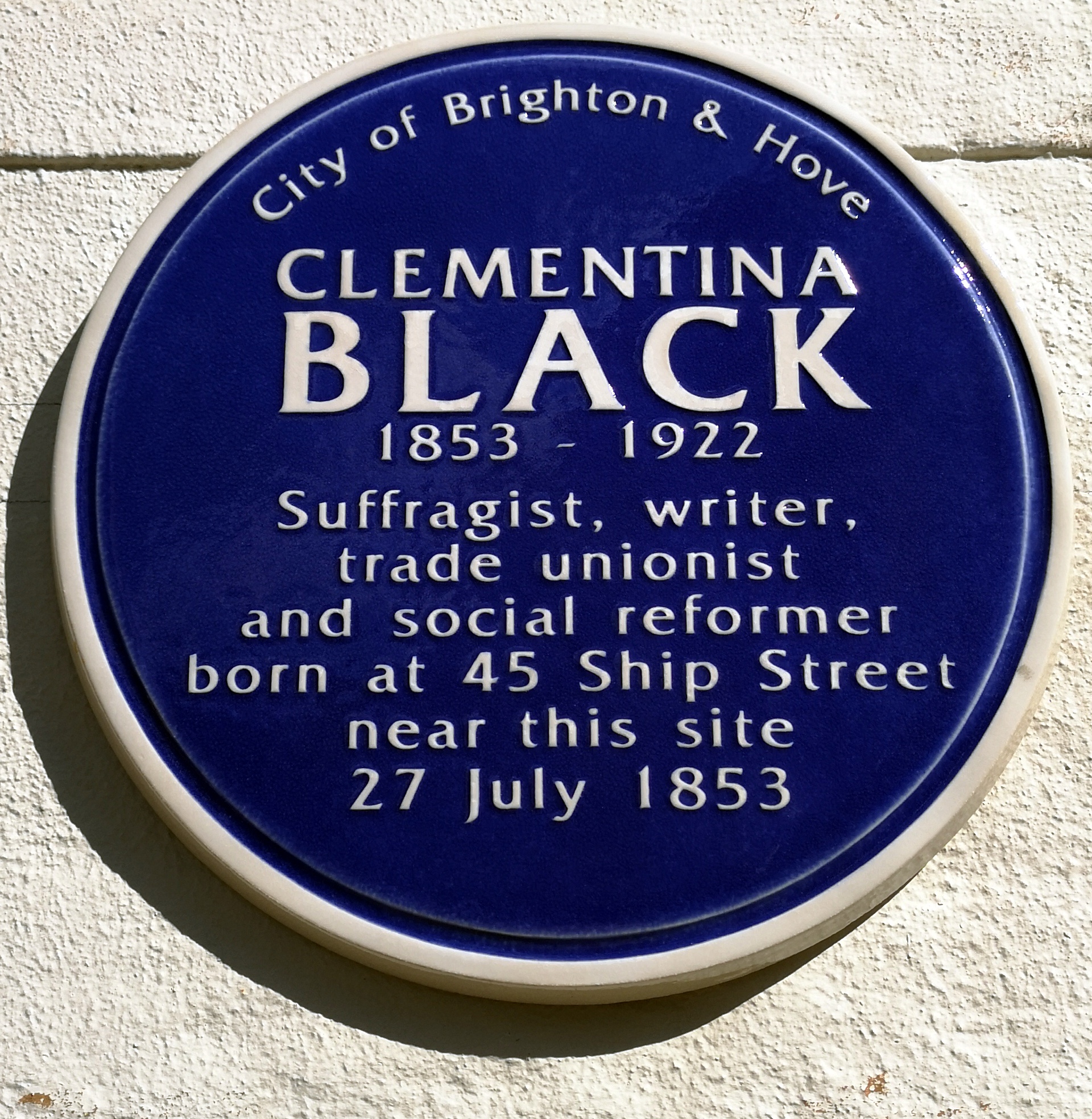
Clementina Black was a writer, feminist and early trade unionist, and another inspiring radical who has slipped through the cracks of history. She was an adopted Londoner, like many millions before and since, who was born in Brighton (my home town, so I felt an immediate affinity!) in 1854. She helped to found and run numerous campaign organisations, with a focus on trying to improve the lives of working women. Her writing included multiple reports on the social conditions of the poor and 7 novels, including The Agitator, which was based on her experience in the trade union movement. She died in December 1922, when she was 68 years old.

Clementina’s mother died when she was 21, leaving her to look after her invalid father and 7 younger siblings. During this time she wrote her first novel, A Sussex Idyll. When Clementina’s father died she moved on London to continue her writing career, and this is also where her radical career really began. In 1886 she became Honorary Secretary of the Women’s Trade Union League, a role in which she thrived, travelling the country attempting to persuade women to join Unions. In 1888 she proposed an equal pay motion at the Trades Union Congress, fighting an injustice which has still not been resolved to this day.

In 1889 Clementina helped form the Women’s Trade Union Association, later the Women’s Industrial Council (WIC), which she would eventually become president of. In 1895 she became the Editor of WIC’s journal, Women’s Industrial News. The middle class women of the WIC went to see the working conditions of working class women, and wrote reports on them in an attempt to raise awareness. By 1914 they had investigated 117 different trades.

Clementina was also involved in the Consumers League, which put pressure on employers who paid their female workers low wages through their customers- they were involved in the boycott of the Bryant and May matchmakers, who would go on to be defeated in the Matchwomen’s Strike of 1888. In 1896 Clementina began to campaign for a legal minimum wage, viewing low wages as the root of the problem for female workers. She was also a member of the executive committee of the Anti-Sweating League, and helped organise several conferences on the topic in the years before the First World War.

As the campaign for women’s suffrage took off after 1900, Clementina also threw herself into that, believing that women lacked real power to affect change as long as they lacked the ability to vote. In 1906 she was made Honorary Secretary of the Women’s Franchise Declaration Committee, where she organised a petition in favour of female suffrage with 257,000 signatures. She was an active member of both the National Union of Women’s Suffrage Societies (NUWSS) and the London Society for Women’s Suffrage. The NUWSS was the non-violent equivalent of the WSPU and the suffragettes, and were arguably just as important in winning the vote for women. In 1912-3, Clementina was the acting editor of The Common Cause, the NUWSS’s paper which called itself ‘the organ of the women’s movement for reform.’

A plaque commemorating Clementina Black in Brighton (Source: Simon Harriyott).

Like many female activists of her era, Clementina was a tireless force in the campaign to improve the lives of women. Unlike other prominent campaigners for women’s rights such as Emmeline Pankhurst, she focussed on working women, those who needed the most help. She was not only a member, but in several cases a key leader, of multiple campaign groups. She didn’t really participate in direct action, instead using her skills as a writer to persuade others. She is not a woman who deserves to be forgotten.

Sources and Further Reading

Anon. ‘Clementina Black,’ Wikipedia. Last modified 19 January 2015, accessed 20 March 2015. http://en.wikipedia.org/wiki/Clementina_Black

Anon. ‘Clementina Black,’ Women of Brighton. No date, accessed 20 March 2015. http://www.womenofbrighton.co.uk/clementina-black.html

Simkin, John. ‘Clementina Black,’ Spartacus Educational. Last modified January 2015, accessed 20 March 2015. http://spartacus-educational.com/Wblack.htm

Simkin, John. ‘The Common Cause,’ Spartacus Educational. Last modified August 2014, accessed 20 March 2015. http://spartacus-educational.com/Wcommoncause.htm

Turbulent Londoners: Robert Lockyer, 1625/6–1649

Turbulent Londoners is a series of posts about radical individuals in London’s history who contributed to the city’s contentious past. My definition of ‘Londoner’ is quite loose, anyone who has played a role in protest in the city can be included. Any suggestions for future Turbulent Londoners posts are very welcome. The fourth Turbulent Londoner is Robert Lockyer, a 17th Century Leveller and parliamentarian who became a martyr for his cause.


Illustration from the 1649 title page of The Declaration and Standard of the Levellers of England (Source: Wikimedia).

Since 2009, Crossrail has been burrowing its way beneath central London. Considering London has over 2000 years of history, it is not surprising that Crossrail is engaged in one of the largest archaeological projects the UK has ever seen. Excavation is soon to begin on the Bedlam burial ground under Liverpool Street Station, which was used in the 16th and 17th Centuries, and is the location of the final resting place of Robert Lockyer, Leveller and parliamentarian.

Robert Lockyer was alive several hundred years before any of the Londoners I have featured so far, and he was not a member of the aristocracy, so relatively little is known about his life. He would have faded into obscurity if not for the dramatic circumstances of his death when he was just 25. Lockyer was probably born in Bishopsgate, London, and joined the parliamentarian army in 1642, the year in which civil war broke out between King Charles I and the Long Parliament.

Lockyer was a Leveller, a group that was considered radical even in the English republic established after the execution of Charles I in 1649. They were the first democratic movement in Britain, demanding universal manhood suffrage, equality before the law, and religious tolerance. Their ideas were influential in the American and French revolutions, and they continue to inspire activists.

London was politically volatile after Charles’ execution, and some units of the army were moved outside the city to separate them from Leveller influence. Lockyer’s regiment was already restless, and when the order was given to move to Essex on the 26th April 1649 Lockyer and the other men under Captain John Savage refused to leave. They took the troop’s colours and barricaded themselves in The Bull Inn, a well-known radical meeting place. Captain Savage found them and ordered them back, but they refused unless they were paid a fortnight’s wages with arrears. Lockyer was singled out with a direct order to obey, but still he refused.

Eventually the Commander-in-chief of the Army, Sir Thomas Fairfax, and Oliver Cromwell himself arrived, and everyone was arrested. The 6 ringleaders, including Lockyer, were sentenced to death. Lockyer was the only one who was executed though, by firing squad in St Paul’s Churchyard the next day. He became a martyr for the Leveller cause, and his funeral was attended by 4000 Londoners wearing black and sea green (the colour of the Levellers) ribbons, a powerful show of force for the Leveller cause.

Robert Lockyer was not rich, famous, or politically powerful. Yet as a result of his actions he is still remembered nearly four centuries later, and out of the 3000 skeletons expected to be dug up during the Crossrail excavation, his is the one causing excitement. Neither Lockyer nor the Levellers managed to achieve their goals, and he and many others suffered a great deal for their beliefs. However he proved an inspiration for many activists and campaigners since, and it is impossible to tell how many successful campaigns his story played a role in motivating.

Sources and Further Reading

Benn, Tony. ‘The Levellers and the Tradition of Dissent.’ BBC History. Last modified 17th February 2011, accessed 9th February 2015. http://www.bbc.co.uk/history/british/civil_war_revolution/benn_levellers_01.shtml

Gentles, Ian J. ‘Lockyer, Robert (1625/6–1649)’, Oxford Dictionary of National Biography. Oxford University Press. 2004, accessed 9th February 2015 http://www.oxforddnb.com/view/article/47102

Keys, David. ‘Could Crossrail have uncovered the last resting place of Britain’s left-wing martyr in Bedlam burial ground under Liverpool Street station?’ Independent. Published February 9th 2015, accessed February 9th 2015. http://www.independent.co.uk/news/science/archaeology/news/could-crossrail-have-uncovered-the-last-resting-place-of-britains-leftwing-martyr-in-bedlam-burial-ground-under-liverpool-street-station-10032619.html

Sea Green Society, The. ‘For the Liberties of England…’ The Sea Green Society. Last modified 18th August 2009, accessed 9th February 2015. https://seagreensociety.wordpress.com/2009/08/18/for-the-liberties-of-england/ 

Turbulent Londoners: Claudia Jones, 1915–1964

Turbulent Londoners is a series of posts about radical individuals in London’s history who contributed to the city’s contentious past. My definition of ‘Londoner’ is quite loose, anyone who has played a role in protest in the city can be included. Any suggestions for future Turbulent Londoners posts are very welcome. The third Londoner in the series would probably get on well with the previous Turbulent Londoner, Charlotte Despard. Claudia Jones was a black equal rights activist, and is known as the mother of the Notting Hill Carnival.


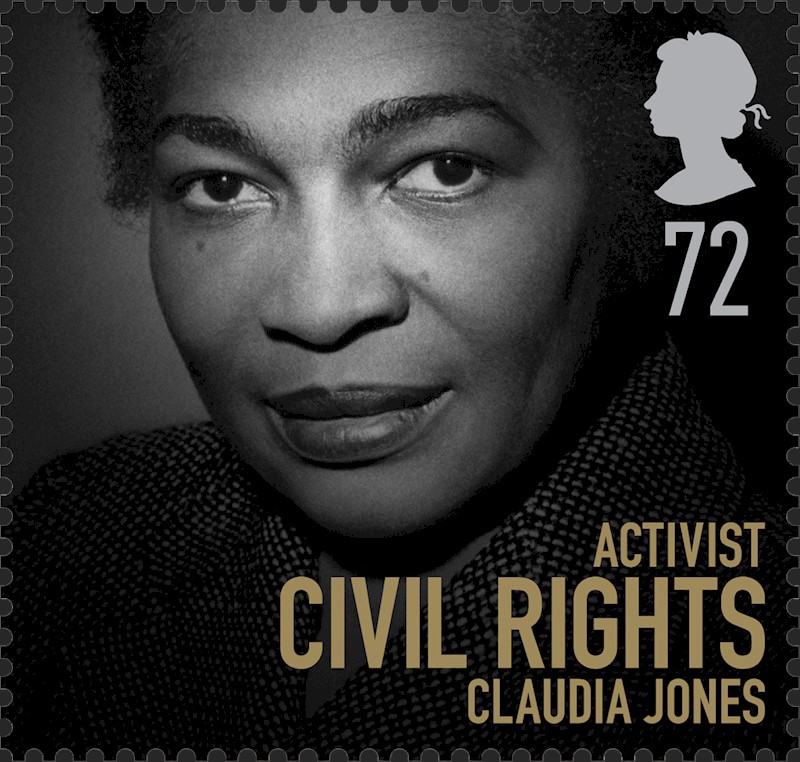
Claudia Jones was featured in the 2008 Women of Distinction series of British postal stamps (Source: Royal Mail).

Claudia Jones was an influential campaigner for London’s Caribbean community from the mid-1950s until her death a decade later. She is known as ‘the mother of Notting Hill Carnival’, and founded The West Indian Gazette, the first newspaper printed in London for the Black community. Born in Trinidad, she was deported to the UK from America after being imprisoned for ‘un-American activities.’ She continued to campaign right up until her death in 1964.

Claudia Jones was born in Port of Spain, Trinidad, in 1915. Her family emigrated to New York City when she was 9, where they unfortunately remained poor. When she was 17, Claudia caught tuberculosis, which irreparably damaged her lungs, troubling her for the rest of her life. Despite this ill health she became a committed campaigner, joining the American Communist party in 1936. She proved to be a talented journalist, in 1945, she became the youngest staff member for the Daily Worker, as the ‘Negro Affairs’ editor.

As well as writing, Claudia organised youth, Civil Rights and religious groups as well as immigrant rights committees. She was a victim of McCarthyism after World War II, and was deported in 1955. Trinidad refused to accept her, and she was eventually offered asylum in Britain in October.

Claudia arrived in the UK at a time of massive immigration from the Caribbean. Many of the new immigrants were discriminated against by landlords, shopkeepers, employers and even the government because of their colour. Finding that many British Communists were hostile to a black woman, Claudia became a key leader in the African-Caribbean community, organising access to basic facilities, as well as taking an active role in the early campaign for racial equality.

From her work in the US, Claudia knew it was important for minority groups to have a voice, so in 1958 she founded The West Indian Gazette and Afro-Asian Caribbean News, and edited it until her death 6 years later. Anti-racist and anti-imperialist, the paper provided a forum for the discussion of civil rights, and reported news that was frequently overlooked by the mainstream media.

In August 1958 racial riots occurred in Notting Hill in London and Robin Hood Chase in Nottingham. Claudia and several other leaders of the British black community were concerned by the racist analysis of the riots in the British media. She recognised the need to improve relations between different local communities, so she helped to organise the first Mardi-Gras style Caribbean carnival in St Pancras Town Hall in January 1959. It was a big event, and televised nationally by the BBC. Claudia and The West Indian Gazette also arranged five other annual indoor Caribbean Carnivals in London, which are seen as precursors to the Notting Hill Carnival, one of the most popular events in London’s calendar.

Claudia was one of the founders of what became the Notting Hill Carnival, which is still going strong today (Source: Rob Schofield).

Claudia died on Christmas Eve 1964, when she was just 49. Despite struggling with the impacts of tuberculosis for much of her short life, she faced the dual disadvantages of being female and black with confidence, becoming a successful journalist and respected community leader and activist. She didn’t chose to move to London but she embraced her new home with gusto, fighting hard to make the city a better place for its burgeoning black community.

Sources

Azikiwe, Abayomi. “Claudia Jones Defied Racism, Sexism and Class Oppression.” Workers World. Last modified February 6, 2013, accessed January 15, 2015. http://www.workers.org/articles/2013/02/06/claudia-jones-defied-racism-sexism-and-class-oppression/

“Claudia Jones.” Wikipedia. No date, accessed January 15, 2015. http://en.wikipedia.org/wiki/Claudia_Jones

“Claudia Jones Honoured on Postage Stamp.” The Cocoa Diaries. Last modified October 20, 2008, accessed January 23, 2015. http://cocoadiaries.com/uncategorized/claudia-jones-honoured-on-postage-stamp/

“Claudia Jones ‘the Mother of the Notting Hill Carnival.” Black History Month. No date, accessed January 15, 2015. http://www.blackhistorymonth.org.uk/claudia-jones/4566344886

Foster, Kimberly. “27 Black Women Activists Everyone Should Know.” For Harriet. Last modified February 28, 2014, accessed January 15, 2015. http://www.forharriet.com/2014/02/27-black-women-activists-everyone.html

“Home” The London Notting Hill Carnival. No date, accessed January 23, 2015 http://thelondonnottinghillcarnival.com/

“Jones, Claudia.” Exploring 20th Century. No date, accessed January 23, 2015. http://www.20thcenturylondon.org.uk/jones-claudia

Turbulent Londoners: Charlotte Despard, 1844-1939

Turbulent Londoners is a series of posts about radical individuals in London’s history who contributed to the city’s contentious past. My definition of ‘Londoner’ is quite loose, anyone who has played a role in protest in the city can be included. Any suggestions for future Turbulent Londoners posts are very welcome. The second Londoner to be profiled is Charlotte Despard, an inspirational pacifist, feminist and socialist campaigner.


Charlotte Despard (née French)
attributed to Charles Mendelssohn Horsfall
oil on canvas
NPG 4345
© National Portrait Gallery, London

Charlotte Despard was a prominent feminist and social campaigner in the late-nineteenth and early twentieth centuries, who fought for many causes during her long life. Born into a wealthy French family in Kent in 1844, she married in 1870. She was brought up as a young Victorian lady should be, and frequently railed against her lack of a proper education. After her husband died in 1890, she became a dedicated and inspiring campaigner, although she was well known for her simple black clothing for the rest of her life.

Despard organised and funded a health clinic, a soup kitchen for the unemployed and youth and working men’s clubs in the slum called Nine Elms in Battersea, London. Not content with mere philanthropy, she actually moved into the area, living amongst those she worked so hard to help. In 1894 she became a Poor Law Guardian in Lambeth, a job at which she excelled, using her position to care for the most vulnerable ‘paupers’.

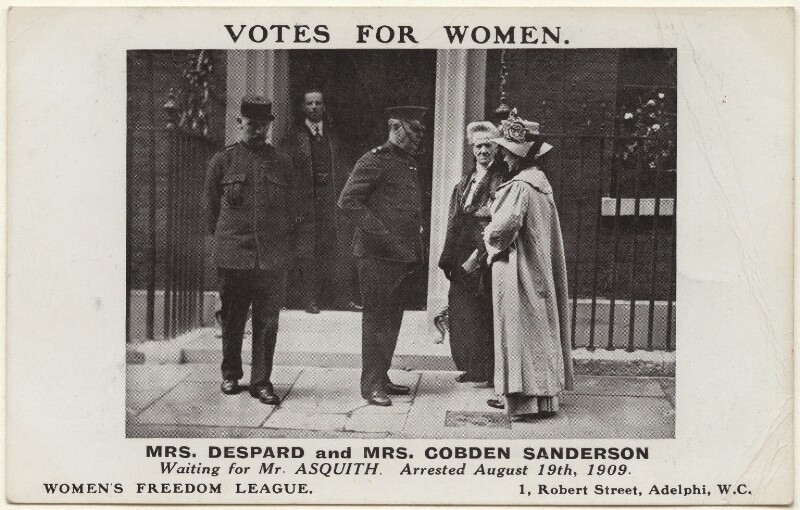
Politically, Despard was an active supporter of the Social Democratic Party and the Independent Labour Party, running in the 1918 general election as a pacifist Labour candidate for Battersea. By the time the Women’s Social and Political Union moved to London in 1906, she was a well-known progressive speaker, and an obvious choice for an ally. She became the WSPU’s honorary secretary, and was imprisoned twice in 1907 for her actions as a suffragette, at the age of 63. However, later that year the Suffragette movement split, and Despard became President of the Women’s Freedom League, which unlike the WSPU was democratically organised and advocated a campaign of passive resistance.

Charlotte Despard (née French); Anne Cobden-Sanderson with three unknown men
by Unknown photographer
halftone postcard print, 19 August 1909
NPG x45197
© National Portrait Gallery, London

Despard was a pacifist, opposing the Boer War and World War One, despite her brother, Sir John French, being the commander-in-chief of the British Expeditionary Force in France until 1915. The two remained close throughout the First World War, until Charlotte declared her support of Irish home rule and later independence. As the Lord Lieutenant of Ireland, Sir John French was tasked with trying to supress the very people she supported, and their previously close relationship suffered badly. In 1921 she moved to Ireland, where she continued to campaign for civil rights and the relief of poverty and distress. Despite her advanced years, she was classed as a dangerous subversive under the Irish Free State’s 1927 Public Safety Act. In 1933 her house in Dublin was attacked by an anti-communist mob.

As if all that wasn’t enough, Despard was also active in promoting a variety of other causes, including Save the Children, the Indian independence movement, theosophy, and the London Vegetarian Society. She died after a fall at the age of 95, but left behind an enduring legacy. Charlotte Despard was a confident, strong-willed, independent woman, who frequently defied convention and suffered hardship to fight for what she believed in. She is an inspiration.

Sources

History Today. http://www.historytoday.com/sites/default/files/despard1.jpg (accessed 12/11/14).

Hochschild, Adam. To End All Wars: A Story of Protest and Patriotism in the First World War. London: Pan Books, 2011.

Mulvihill, Margaret. ‘Despard, Charlotte (1844–1939)’, Oxford Dictionary of National Biography, Oxford University Press, 2004; online edn, May 2014 [http://www.oxforddnb.com/view/article/37356, accessed 12 Nov 2014.

Open University, The. ‘Charlotte Despard.’ Making Britain (no date) http://www.open.ac.uk/researchprojects/makingbritain/content/charlotte-despard (accessed 12/11/14).

Oxford Dictionary of National Biography (no date) http://www.oxforddnb.com/images/article-imgs/37/37356_1_200px.jpg (accessed 12/11/14).

Turbulent Londoners: Lord George Gordon, 1751-1793

Turbulent Londoners is a series of posts about radical individuals in London’s history who contributed to the city’s radical and contentious past. My definition of ‘Londoner’ is quite loose, anyone who has played a role in protest in the city can be included. Any suggestions for future Turbulent Londoners posts are very welcome. First up is Lord George Gordon, a charismatic individual who played a big role in the Gordon Riots. 


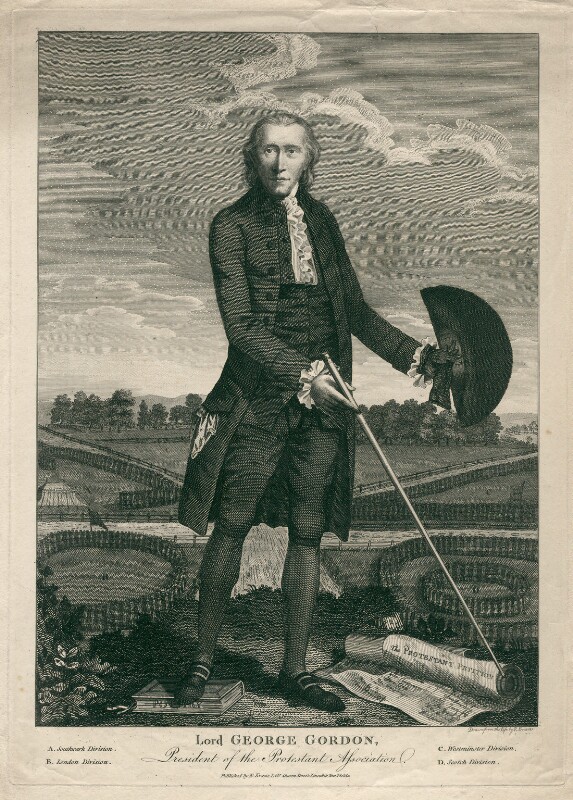
Lord George Gordon
after R. Bran
line engraving, published 1780
NPG D2793
© National Portrait Gallery, London

Lord George Gordon was an eccentric, irresponsible, but charismatic aristocrat who probably would have faded into obscurity if it wasn’t for the Gordon Riots, to which he gave his name. The Riots, which took place in June 1870, were a week-long series of anti-Catholic disturbances which have been called “the most serious disturbances ever seen in London.” (German and Rees, 2012; 87). Sparked by Parliament’s refusal to consider a petition to repeal the 1778 Catholic Relief Act, the riots took on a distinct anti-establishment flavour in their later days, which terrified those in authority.

Although charged with high treason after the riots, it seems that George Gordon did not intend to spark such dramatic events, which involved the largest number of people killed or executed in an episode of civil disorder either before or since (Archer, 2000). Becoming an MP with a reputation for rambling, boring speeches in 1774, Gordon was elected president of the London Protestant Association in November 1779. The Association was an organisation with the goal of repealing the Catholic Relief Act, which had relaxed some of the restrictions on Catholics in Britain.

Gordon and the Protestant Association organised a petition containing up to 100,000 signatures demanding the act be repealed. Against the advice of the rest of the Association’s leadership, Gordon called for a rally on the 2nd of June, followed by a march to Parliament where he would present the petition. An estimated 60,000 people attended, an unprecedented amount for a political meeting at this time (Bloom, 2010). The same evening that the petition was presented, two Catholic chapels were burnt down by an anti-Catholic ‘mob’. Over the following nights, the houses of many wealthy Catholics were destroyed, as well as the Langdale distillery and most of the capital’s prisons, including the infamous Newgate. Calm was not restored until the 10th of June, a week later.

At first suspected of deliberately engineering the riots, Gordon’s failed attempts to calm the situation proved he had no control over the rioters. He was acquitted of high treason, but continued to loudly voice his controversial and provocative opinions. He converted to Judaism in 1787, and was eventually imprisoned for libel following publications criticising transportation to Botany Bay as a method of punishment, and insulting Marie Antoinette, the Queen of France. He died of gaol fever in Newgate on the 1st of November 1793.

Lord George Gordon was admired by some, and considered insane by others. Whilst he was progressive in some of his views, for example his strong opposition to the death penalty, his hatred of Catholics complicates an interpretation of him as a radical reformer. However he is viewed, Gordon was a fascinating individual, who contributed to the history of disturbance in the capital, making London that bit more turbulent.

Sources

Archer J (2000) Social Unrest and Popular Protest in England 1780-1840, Cambridge: Cambridge University Press.

Bloom C (2010) Violent London- 2000 Years of Riots, Rebels and Revolts, Basingstoke: Palgrave.

German L and Rees J (2012) A People’s History of London, London: Verso.

Haydon C (2004) ‘Gordon, Lord George (1751-1793)’, Oxford Dictionary of National Biography, http://www.oxfordddnb.com/view/article/11040 (Accessed on 15.04.13).

Haywood I and Seed J (ed.) (2012) The Gordon Riots- Politics, Culture and Insurrection in Late-Eighteenth Century Britain, Cambridge: Cambridge University Press.