Royal Holloway, University of London, has pretty good credentials when it comes to historical feminism. Officially called Royal Holloway and Bedford New College, it was formed from a merger of Royal Holloway and Bedford College in 1985. Both of the original institutions started out as women’s colleges. Bedford College was the first higher education college for women in the United Kingdom, founded by Elisabeth Jesser Reid in 1849. Royal Holloway was founded in 1879 by the entrepreneur and philanthropist Thomas Holloway. As such, both colleges have a number of notable female alumni, including…
The Emily Wilding Davison Building is a striking new Library and Student Services hub located in the centre of Royal Holloway’s campus. It is named after the well-known suffragette who was killed at the Epsom Derby in 1913 after running in front of the King’s horse, who attended Royal Holloway in the early 1890s (Photo: Hannah Awcock).
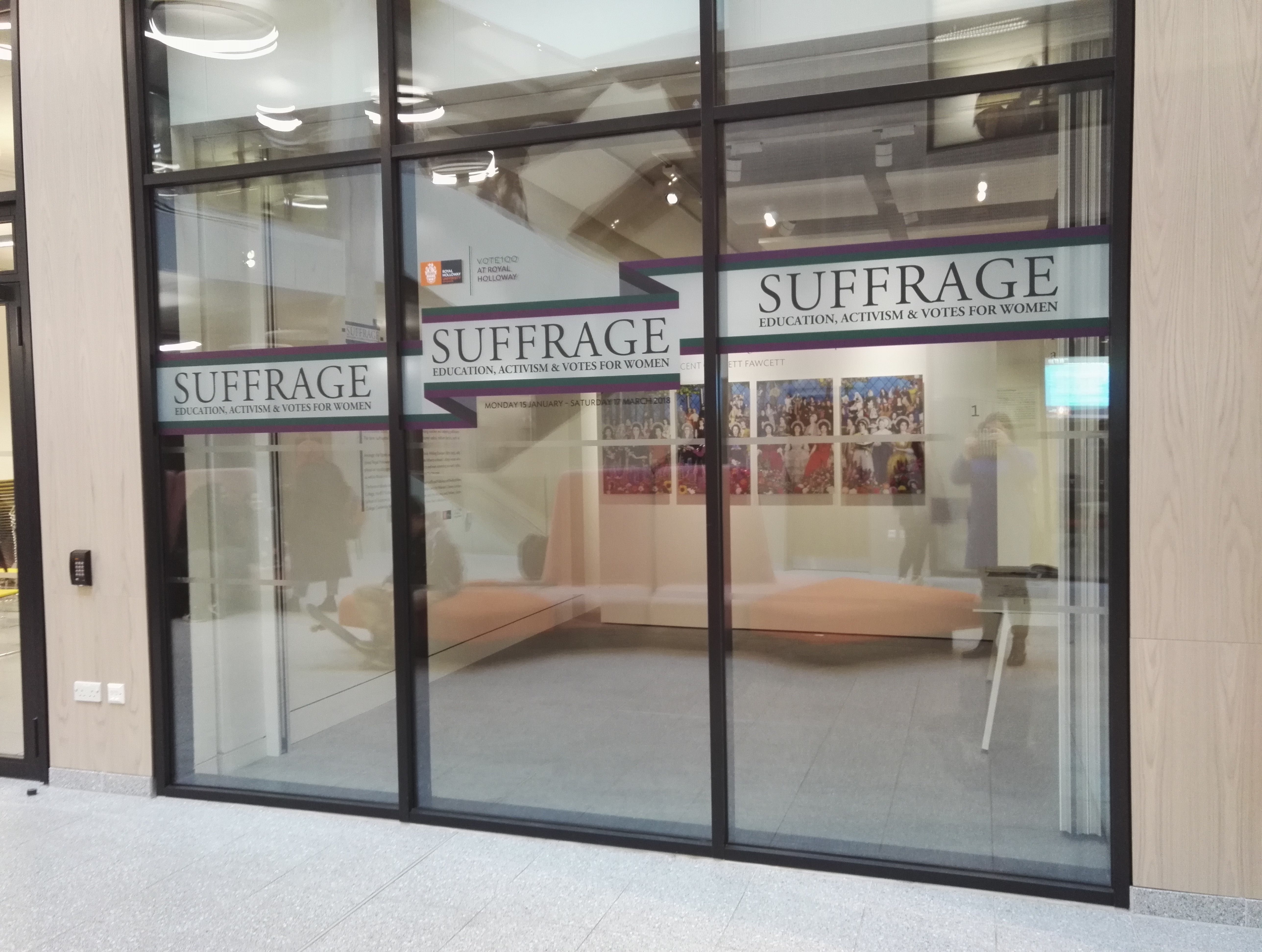
In 2017, Royal Holloway opened a new library building named after the well-known suffragette, Emily Wilding Davison. She studied English at Royal Holloway in 1891 although she could not complete her studies because she could not afford the fees after the death of her father in 1893. The Emily Wilding Davison Building includes a small exhibition space, which is currently hosting Suffrage: Education, Activism and Votes for Women until the 17th of March 2018. As someone studying historical protest at Royal Holloway, I felt almost obliged to go and check it out.
The exhibition includes items from Royal Holloway’s own Special Collections, as well as the British Film Institute, the Museum of London, and the Women’s Library at the London School of Economics. It covers the period from the foundation of Bedford College in 1849 to 1918, when the Representation of the People Act entitled some women to vote. The items are mostly textual, but there are also images, video footage, posters, and suffrage-based souvenirs.
The exhibition space in the Emily Wilding Davison Building (Photo: Hannah Awcock).
The exhibition space is small, but Suffrage makes good use of it. It is covers both suffragettes and suffragists, which is good to see– although suffragette organisations like the Women’s Social and Political Union and the Women’s Freedom League were good at attracting publicity and are still quite well-known, most of the women who campaigned for the right to vote were suffragists, believing in legal methods of persuasion. Unsurprisingly given the exhibition’s location, Suffrage also makes a strong connection between the suffrage campaign and women’s education. The fight for the right to vote is one of the most studied and represented campaigns in British history, particularly in this centenary year, so it is refreshing to see the topic approached from a different angle. I also like the long time period covered by the exhibition; events after 1905 tend to receive the most attention, but campaigners had been working hard for half a century before that.
At the back of the exhibition, almost hidden behind a partition, footage of suffrage demonstrations is projected onto a wall. The campaign was one of the first to be filmed quite extensively, and I have always found the black and white grainy footage captivating. I suspect that I am not the only one who enjoys watching such footage, I think it helps to make historical protest more accessible. I was pleased to see the films included in Suffrage, therefore, although I think they could have been given more prominence.
Due to its origins, Royal Holloway and Bedford New College has a strong connection to women’s history. Suffrage: Education, Activism and Votes for Women highlights some of that history in a balanced and accessible way, as well as showcasing the College’s impressive archival collections.
Lauren Elkin. Flaneuse: Women walk the City in Paris, New York, Tokyo, Venice, and London. London: Vintage, 2017. RRP £9.99 paperback.
As a Geographer, the flaneur is a familiar figure. It refers to some one who walks through cities, normally with no specific destination in mind, observing the city, it’s people, and it’s character. Flaneurs are mostly wealthy, and overwhelmingly male. But that has never quite sat right with me. After all, I love wandering around cities seeing what I can see, and I am not wealthy. Or male. So when I first heard Lauren Elkin speak, at an event at the Museum of London, I was intrigued by what she had to say about the female flaneur; the flaneuse.
But surely there have always been plenty of women in cities, and plenty of women writing about cities, chronicling their lives, telling stories, taking pictures, making films, engaging with the city in any way they can…The joy of walking in the cities belongs to men and women alike.
Elkin, 2017; p.11
Flaneuse: Women Walk the City in Paris, New York, Tokyo, Venice, and London is hard to categorise. It’s publisher defines it as memoir/social and cultural history and whilst this sounds like an odd mix, it is quite accurate. I think at its heart, it is an argument to redefine the concept of the flaneur to include women. Elkin offers up her new definition, and then spends the rest of the book providing us with examples; attempting to persuade us of the existence of the flaneuse. As evidence, Elkins tells us about women whose walking in cities is in some way central to who they are, such as their identity or livelihood. Some of the examples are well known; Virginia Woolf in London and George Sand in Paris. Others are perhaps less so: French filmmaker Agnes Cards in Paris and Elkin herself in Tokyo and Paris. I would say Elkin makes a very convincing argument, but she was pushing against an open door with me; others may be harder to convince.
If you are expecting a straight social history of women walking in cities, then you will be disappointed. It is more a series of snapshots into this history. Some of these snapshots contain quite detailed descriptions of the cultural outputs of the women featured, such as the novels of Jean Rhys and the art of Sophie Calle. Elkin is an English Lecturer, and at these points in the book this background comes through the clearly. In this way, Flaneuse is similar to Nightwalking: A Nocturnal History of Londonby Matthew Beaumont, about the writings of the (overwhelmingly male) people who walked the streets of London after dark. Nightwalking feels like a more coherent history than Flaneuse, but that is largely because it focuses on one city rather than five. To be fair to Elkin, I don’t think she set out to narrate a history, and what she has done is done well.
I read Flaneuse over two days, mainly on two long journeys. Even if I am enjoying a book, I sometimes lose focus after an hour or two of reading. This wasn’t the case with Flaneuse; chapter after chapter kept me hooked. Elkin is a good writer, her work is engaging and thoughtful. The book is a nice balance of Elkin’s own story and the stories of the women and cities who have shaped her.
Some sections of Flaneuse were published elsewhere first, but there was only one point that I guessed the book wasn’t written as a coherent whole. The chapter on Tokyo revolves around Elkin’s relationship with a French banker–she moves to Japan to be with him when he is transferred. In a later chapter, she mentions this relationship as if she is telling the reader about him for the first time. It is a minor detail however, perhaps made so noticeable because it is the only such slip-up in the whole book. Each chapter is named after the city in which it is set. I think this is slightly misleading as, although the cities are very important, it is the women who wander them that are the book’s driving force.
I thoroughly enjoyed reading Flaneuse: Women Walk the City in Paris, New York, Tokyo, Venice, and London. I would recommend it to anyone interested in women’s or urban history, anyone who fancies something a bit different, or anyone who just appreciates a good book.
There are lots of stickers in Brighton, of all kinds (Photo: Hannah Awcock, Queens Road, 02/04/17).
One of the most common themes of protest stickers is anti-fascism in pretty much every city I have visited (see London’s Protest Stickers: Anti-Fascism 1 and 2), and Brighton is no exception. There is a strong tradition of anti-fascism in the UK, inspired by events such as the Battle of the Cable Street (1936) and the Battle of Lewisham (1977). I have found anti-fascist stickers all over Brighton, some unique to the city, others that I have also found elsewhere. There is a local group called Brighton Anti-fascists, but the stickers I have found suggest that the city is also visited by a lot of other anti-fascist groups.
Right wing groups often choose Brighton as a location for marches and demonstrations, probably because of its liberal reputation. They are almost always met by counter demonstrations (Photo: Hannah Awcock, Robertson Road, 08/07/16).
Brighton Antifascists is the local anti-fascist group. This sticker features the city’s mascot, the seagull (Photo: Hannah Awcock, Churchill Square, 24/03/17).
There are a large number of local anti-fascist groups around the country, many connected by the Anti-fascist Network. They frequently travel to other places in order to participate in demonstrations and events. When groups travel, they often put stickers up (Photo: Hannah Awcock, Trafalgar Square, 24/04/15).
Some anti-fascist groups are not opposed to violence, as this sticker produced by the Leicester Antifascists demonstrates (Photo: Hannah Awcock, London Road, 24/12/16).
The Clapton Ultras are an antifascist group of supporters of Clapham FC. They support the football team, working to keep football accessible, and participate in political campaigns (Photo: Hannah Awcock, Gloucester Place, 31/12/15).
This sticker was produced by Berkshire Anti-fascists (Photo: Hannah Awcock, Brighton Station, 07/01/17).
This sticker was also made by the Berkshire antifascists. The red flag of the anti-fascist logo has faded, which suggests that the sticker has been there for some time (Photo: Hannah Awcock, Providence Place, 25/10/16).
The 161 Crew is a Polish anti-fascist group that has quite a strong presence in the UK (Photo: Hannah Awcock, Bartholomew Road, 04/02/17).
This sticker is designed in a vintage style, which is quite unusual for anti-fascist stickers. Active Distribution sells a range anarchist products, including protest stickers. Disorder Rebel is a radical shop in Berlin (Photo: Hannah Awcock, York Place, 31/12/15).
This sticker has no obvious producer. It is reminiscent of an aggressive neighbourhood watch sign (Photo: Hannah Awcock, Ann Street, 24/12/16).
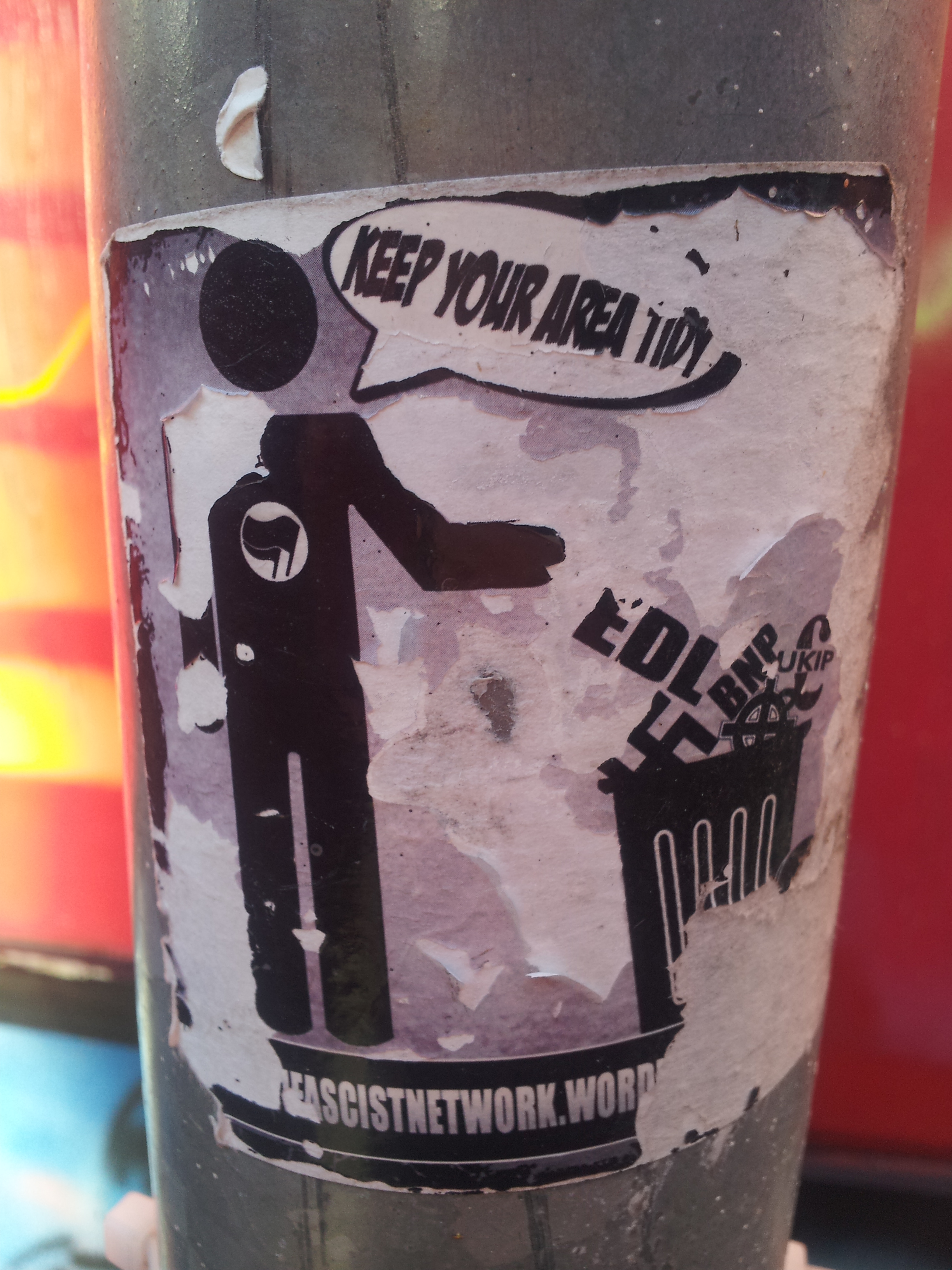
This sticker is imitating signs that encourage you to throw away litter. In this case, the litter is fascist groups like the English Defence League and the British National Party (Photo: Hannah Awcock, London Road, 31/12/15).
Anti-fascism is not universally popular in Brighton. This is the first anti-anti-fascist sticker that I have ever found (Photo: Hannah Awcock, Queens Road, 03/12/16).
Turbulent Londoners is a series of posts about radical individuals in London’s history who contributed to the city’s contentious past, with a particular focus of women, whose contribution to history is often overlooked. My definition of ‘Londoner’ is quite loose, anyone who has played a role in protest in the city can be included. Any suggestions for future Turbulent Londoners posts are very welcome. To celebrate the centenary of the Representation of the People Act, all of the Turbulent Londoners featured in 2018 will have been involved in the campaign for women’s suffrage. The second of my suffragists is Millicent Garrett Fawcett, a pioneer of the campaign before the WSPU was even a twinkle in Emmeline Pankhurst’s eye.
A few weeks ago, my sister and I were having a conversation about Millicent Garrett Fawcett being the first woman to be commemorated with a statue in Parliament Square. When our Dad, a man with quite high levels of general knowledge, responded to the conversation by asking “who?”, I knew who my next Turbulent Londoner was going to be. Millicent Garrett Fawcett was a writer and campaigner, and was President of the National Union of Women’s Suffrage Societies (NUWSS) for more than two decades.
Millicent Garrett was born in Aldeburgh, Suffolk, on the 11th of June 1847, the eighth of ten children. The family was close and prosperous, and Millicent’s childhood was happy. The children were encouraged to read, speak their minds, and take an interest in politics. At the age of 12, Millicent was sent to school in Blackheath with her sister Elizabeth. Her older sisters introduced her to radical ideas and thinkers. In 1866, Millicent went to hear a speech given by John Stuart Mill, an early supporter of women’s suffrage. His words helped her decide to take action. That same year, at the age of 19, she became the Secretary of the London Society for Women’s Suffrage.
Through her new political connections Millicent soon met Henry Fawcett, the radical Liberal MP for Brighton. Despite the 14-year age gap they were married in 1867, and had their first and only child, Philippa, in April 1868. The couple were politically well matched, and it seems that they had a happy and loving marriage.
Henry was blinded in a shooting accident in 1858, so Millicent acted as his Secretary, alongside her activism and a successful writing career. In 1868, she joined the London Suffrage Committee, and spoke at the first public pro-suffrage meeting. It was unusual for women to speak in the public at the time, and Millicent got very nervous before making a speech. Despite this, she was known for her clear speaking voice, and her ability to explain complex arguments simply. In 1870, Millicent published Political Economy for Beginners. It was very successful, going through 10 editions in 41 years. Along with her sister Agnes, Millicent also raised 4 of her cousins whose parents had died.
Millicent was a strong supporter of women’s education. In 1875, she co-founded Newnham College, one of the first Cambridge Colleges for women. She also supported a controversial campaign for women to actually receive degrees from the University of Cambridge, rather than just being able to study there. This wasn’t achieved until 1948.
Henry died unexpectedly in November 1884, leaving Millicent a widow at the age of 38. She sold the family homes in Cambridge and London, and took Philippa to live with Agnes. When she re-entered public life in 1885, Millicent began to concentrate on politics. She was a key member of what became the Women’s Local Government Society–a cross party group that campaigned for women to be allowed to stand as local councillors. This goal was achieved in 1907.
After the death of Lydia Becker in 1890, Millicent became the Chair of the Central Committee of the National Society for Women’s Suffrage. In 1897, the National Union of Women’s Suffrage Societies (NUWSS) was formed as an umbrella organisation for all the suffrage societies in the country. Millicent became President of this new group, a role she kept until 1919. Although the Women’s Social and Political Union (WSPU) frequently commanded the headlines and publicity, the NUWSS consistently had the majority of the support of the women’s movement. By 1905, the NUWSS had 305 constituent societies and 50,000 members. Millicent disapproved of militant tactics, believing that they alienated politicians and the general public. Despite this, she admired the courage of militant activists.
In July 1901, Millicent was asked to lead a commission of women to South Africa to investigate allegations that the families of Boer soldiers were being held in awful conditions in concentrations camps during the Boer War. It was the first time British women were trusted with such a responsibility in war time.
The NUWSS lost patience with the Liberal Party in early 1912, giving up the long-held hope that they would eventually give women the vote. Instead, they formed an electoral alliance with the Labour Party, which was the only political party that supported women’s suffrage. By 1913, the NUWSS had 100000 members, and organised the Women’s Suffrage Pilgrimage to demonstrate how many women wanted the vote. On the 18th of June, NUWSS members from all over the country set off for London, meeting in Hyde Park six weeks later on the 29th of July. Now aged 66, Millicent took an active part in the pilgrimage, and was the headline speaker at the Hyde Park rally.
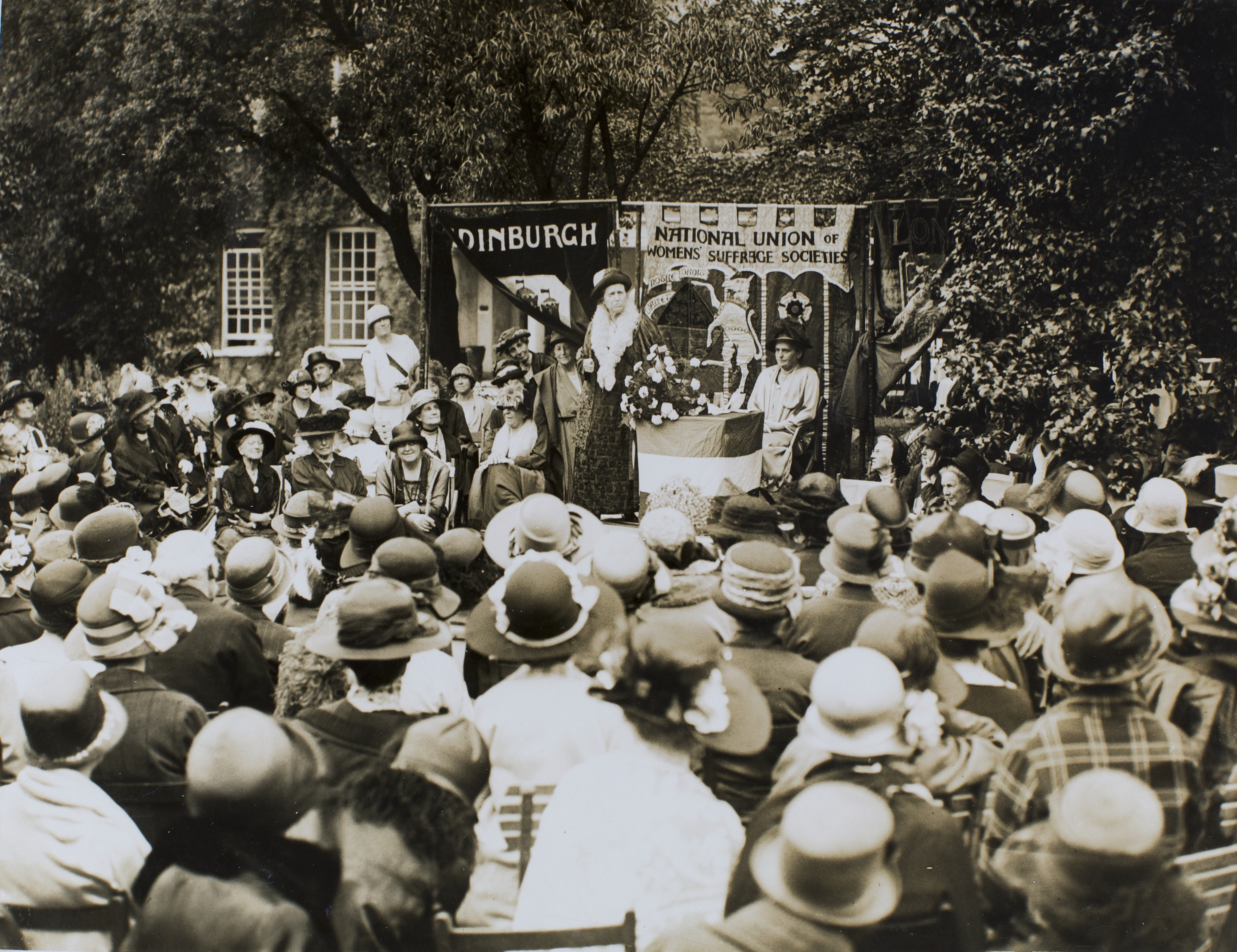
Millicent Garrett Fawcett and Eleanor Rathbone, 1925. Photograph, printed, paper, monochrome, Millicent Garrett Fawcett and Eleanor Rathbone at NUSEC open-air platform at Aubrey House, Camden Hill, Kensington, with National Union of Women’s Suffrage Societies (NUWSS) banner behind them, speak to a large audience of seated women; on reverse, printed ‘Copyright photograph by PHOTOPRESS, Johnson’s Court, Fleet Street EC. Telephone: City 7070′, ’23 Jul 1925 With affectionate thanks to Mary Fielden for all she did to make this party the success it was’ (Millicent’s handwriting) (Source: LSE Library TWL.2009.02.189).
Millicent was a not a pacifist, but the NUWSS continued to campaign for the vote during the First World War, unlike the WSPU. It will never be possible to find out whether the NUWSS or the WSPU’s campaigning methods were more effective for winning women the right to vote. There is no doubt, however, that Millicent Garrett Fawcett played a huge role in winning that right. After the Representation of the People Act was passed in 1918, Millicent largely withdrew from the suffrage campaign. Throughout her long career, however, she had supported a large number of campaigns, not all of which were successful. These included: raising the age of sexual consent; criminalising incest; preventing child marriage; repealing the Contagious Diseases Act; and Clementina Black’s campaign to help protect low-paid female workers.
Her hard work and dedication were recognised in 1925, when she was made a Dame Grand Cross of the British Empire. She passed away four years later on the 5th of August 1929. In 1953, the London’s Society for Women’s Suffrage was renamed the Fawcett Society in her honour. The Society continues to campaign for women’s rights and gender equality. In 2017, it was announced that Millicent would become the first woman to be commemorated with a statue in Parliament Square, which is due to be unveiled in February 2018.
After Emmeline and Christabel Pankhurst, Millicent Garrett Fawcett is perhaps one of the best-known suffragists. But that doesn’t mean she is well-known. Despite having a charity named after and a statue in Parliament Square planned to honour her, most people don’t seem to recognise her name, let alone are aware of what she achieved. I think that’s a real shame.
Women’s Local Government Society. “Women’s Local Government Society.” Suffrage Pioneers. No date, accessed 29 January 2018. Available at http://www.suffrage-pioneers.net/wlgs/
Jenni Murray. A History of Britain in 21 Women. London: Oneworld, 2016. RRP £9.99 paperback.
A few weeks before Christmas, I was browsing a bookshop when I noticed the vibrant cover of A History of Britain in 21 Women by Jenni Murray. I was sorely tempted, but, remembering my overflowing bookshelves and the growing piles of books at the bottom of my bed, I restrained myself. I put the book on my Christmas list instead, so I at least didn’t have myself to blame when my piles of books grew a little bit taller. I am very glad that I was given the book; it is a thoroughly enjoyable read that has left me more determined than ever not to allow misogyny to hold me back.
The twenty-one women in this book rose above the low expectations of their gender and defied anyone who insisted ‘a girl can’t do that.’ Slowly, slowly, over the centuries, they changed the gender landscape for those of us who came after.
Murray, 2016; p.4
As the name implies, A History of Britain in 21 Women profiles 21 women from British history. Each chapter is about 15 pages long, and details the women’s biography, their achievements, and their impact on society, politics, and culture. The selection is historically comprehensive, beginning in the first century with Boadicea, and ending in the modern day with Nicola Sturgeon. Inevitably, many women are left out, but Murray is careful to justify her choices, explaining why the 21 she chose resonate with her personally.
The book is more personal than I was expecting. It does have the subtitle A Personal Selection, but this is only mentioned in the front matter, not on the title. After initially being unsure about this, I came to enjoy Murray’s short personal reflections and anecdotes. I was particularly charmed by a conversation she describes having with one of her sons when John Major took over from Margaret Thatcher as prime minister.
Beyond being thrown at first by the tone of the book, I can find very little to criticise in A History of Britain in 21 Women. Each chapter is self-contained, so it feels almost like a collection of short stories, but I wasn’t put off if I read several chapters in one sitting, as I often am with similarly structured books. Each chapter is accompanied by a portrait by Peter Locke, the style of which suits the book’s message really well. Locke’s sketches don’t feel idealised or ‘touched up,’ the women in the sketches feel…real; they look like they’ve lived. It’s quite hard to put my finger on it, but I like them.
It is the women themselves, their lives, actions, experiences, and attitudes that are the real stars of this book. Some of them are familiar–such as Elizabeth I, Jane Austen, and Margaret Thatcher–whilst others are less well-known–like Aphra Behn, Mary Somerville, Gwen John. But they are all remarkable. Every one exelled in the field they chose, whether it be medicine, art, politics, or science, often despite massive obstacles and prejudice. They are inspirational.
I was given A History of Britain in 21 Women as a Christmas present, and I do think it makes a wonderful gift, even for those who aren’t avid readers. It’s especially good for those who need a reminder of just how much it can be possible to achieve.
This representation of the Extinction Symbol is a tile, so doesn’t technically count as a protest sticker, but I like this photo, so I decided to include it! (Photo: Hannah Awcock, South Bank, 03/08/16).
Environmental issues have been a focus of activists for decades, but campaigning specifically around the issue of climate change has only been going on since the 1990s. It has continued to gather momentum since then, however, although it seems to go through cycles of prominence amongst the general public. The recent BBC television series Blue Planet 2 has led to a significant backlash against the wasteful use of plastic, so I thought that now seemed like an appropriate time to look at climate change and environmental issues through the medium of protest stickers.
To see the location of these stickers, and all the protest stickers featured on this blog, check out the Turbulent London Map.
A frequent refrain of animal rights campaigners is that animals are unable to speak out themselves, so humans must do it for them. This sticker echoes that sentiment. Climate Games was a period of concerted civil disobedience in protest against climate change in 2015 (Photo: Hannah Awcock, Malet Street, 20/10/15).
Many people see climate change as inextricably linked to climate change–if we don’t change our dominant economic system, we cannot hope to halt climate change. The Alliance for Worker’s Liberty is a working class socialist group (Photo: Hannah Awcock, Euston, 15/04/15).
The People’s March for Climate, Justice and Jobs took place in 2015, with an estimated turnout of 70,000 (although it is notoriously difficult to accurately estimate the numbers present at a protest). I really like the design of this sticker (Photo: Hannah Awcock, Malet Street, 17/11/15).
Time to Act was another climate change march that took place in 2015. I went along to this march–you can see some of my photos here. I particularly like the request in the bottom right corner to “Please sticker responsibly”; I wonder what constitutes responsible stickering? (Photo: Hannah Awcock, King’s Cross Station, 11/03/15).
EcoHustler is an independent online magazine that focuses on ecological concerns. Excessive consumerism is often held up as one of the causes of climate change and environmental damage. One frequently proposed solution is to buy less stuff (Photo: Hannah Awcock, King’s Cross Station, 06/06/15).
This is another advert for EcoHustler, using the silhouette of Samuel L Jackson’s character from the 1994 film Pulp Fiction, Jules Winnfield (Photo: Hannah Awcock, Woburn Place, 15/04/15).
Fossil Free UCL is a campaign to stop University College London from investing in the fossil fuel industry. I don’t really understand the retort, but it shows how protest stickers can spark political debate on the street (Photo: Hannah Awcock, Malet Street, 24/01/17).
Fracking is one of the most controversial environmental issues of recent years, sparking resistance across Britain. This anti-fracking sticker has a particularly striking design (Photo: Hannah Awcock, Cable Street, 09/10/16).
Stick it to the Tories is a stickering campaign by the People’s Assembly against Austerity. They produce protest stickers on a whole range of issues (Photo: Hannah Awcock, Little Venice, 01/05/16).
Protest stickers are ephemeral objects–they are not meant to last forever. I think that this one was about fracking, but it is hard to tell (Photo: Hannah Awcock, Broad Sanctuary, 18/10/16).
Turbulent Londoners is a series of posts about radical individuals in London’s history who contributed to the city’s contentious past, with a particular focus of women, whose contribution to history is often overlooked. My definition of ‘Londoner’ is quite loose, anyone who has played a role in protest in the city can be included. Any suggestions for future Turbulent Londoners posts are very welcome. To celebrate the centenary of the Representation of the People Act, all of the Turbulent Londoners featured in 2018 will have been involved in the campaign for women’s suffrage. First up is Emmeline Pethick-Lawrence, one of the key members of the Women’s Social and Political Union until 1913.
Emmeline Pethick-Lawrence by Bassano Ltd. Whole-plate glass negative, 28 October 1910. NPG x28361 (Source: National Picture Gallery).
Most of you probably know this already, but 2018 marks the centenary of the Representation of the People Act, which granted some British women the right to vote. There are a huge number of events, exhibitions and book publications happening this year to commemorate the event, but I wanted to play my own small part in marking the event on Turbulent London. As such, all Turbulent Londoners featured this year will have played some role in the campaign for women’s suffrage. First up is Emmeline Peckith-Lawrence, one of the key members of the Women’s Social and Political Union (WSPU) between 1906 and 1913.
Emmeline Peckith was born in Bristol on the 21st of October 1867 to a wealthy Methodist family. One of 13 children, Emmeline was sent to boarding school at the age of 8. Reluctant to conform from an early age, she was often in trouble at school, and the teachers thought she was a bad influence on other children. In 1891 Emmeline moved to London to work with some of the city’s poorest inhabitants as a voluntary social worker. She worked at the Sisterhood of the West London Mission, where she helped to run the girl’s club. It was here that Emmeline became a socialist.
Growing frustrated with the constraints of the Mission, in 1895 Emmeline left to co-found the Esperance Club, a girl’s club which experimented with dance and drama. She also started the Maison Esperance, a dress-making co-operative with a minimum wage, an 8 hour day and a holiday scheme. She wanted to give the young women she worked with a practical example of socialism. In 1899 Emmeline met, and fell for, the wealthy lawyer Frederick Lawrence, but she refused to marry him unless he shared her socialist ideals. By 1901, he had come around to her way of thinking. The equality of their marriage was unheard of in polite society–they chose to double-barrel their surnames and kept separate bank accounts to retain their independence.
In 1906, Emmeline joined the WSPU. She must have thrown herself into the movement wholeheartedly; in October of that year she was arrested and imprisoned with other prominent suffragists such as Annie Kenney, Dora Montefiore, and Adela and Sylvia Pankhurst after a ‘riot’ in the House of Commons lobby. Emmeline would go to prison six times for her political beliefs. Frederick publicly declared that he would donate £10 to the suffrage movement for each day that his wife remained in prison. It was the start of a close relationship between the Pethick-Lawrence’s and the WSPU’s finances–Emmeline became the group’s Treasurer, and raised £134000 over 6 years. The couple also donated large amounts of their own money. Also in 1906, the Pankhursts moved the headquarters of the WSPU from Manchester to London. The Peckith-Lawrences offered their own home as the location for the new offices. They also opened their home to activists recovering from prison sentences. The couple masterminded, edited, and funded the journal Votes for Women from 1907.
As the years passed the WSPU turned to increasingly violent tactics. In 1912, Emmeline and Christabel Pankhurst endorsed a campaign of window smashing. Emmeline Peckith-Lawrence did not support these violent methods, but remained loyal to the WSPU. In March, she was arrested along with her husband and imprisoned for conspiracy, despite not participating in the window smashing. Christabel Pankhurst escaped to France, but the Peckith-Lawrences spent 9 months in prison, including being force-fed. They were also successfully sued for the costs of the window smashing campaign, which left them close to bankruptcy. After the Pethick-Lawrence’s release, the Pankhursts announced plans for the WSPU to begin a campaign of arson. For Emmeline and Frederick this was too far, and they spoke out against the increasingly violent actions and rhetoric of the WSPU. Emmeline and Christabel Pankhurst hated dissent within the WSPU, and despite all the Pethick-Lawrences had done for the group, they were expelled.
For Emmeline Pethick-Lawrence, the expulsion was a personal as well as a political betrayal. It did not halt or even slow her activism however. She joined the Women’s Freedom League, which had formed after another group of campaigners left the WSPU in 1907 (Charlotte Despard was the group’s first President). She also joined the United Suffragists, which was formed in 1914 by former WSPU members. Unlike the WSPU, they admitted men and non-violent suffragists, and continued to campaign throughout World War One. The United Suffragists adopted Votes for Women as their official paper.
During the war, Emmeline was a member of the Women’s International League for Peace. She saw the conflict as the ultimate demonstration of men’s unsuitability to being responsible for humanity. At the beginning of the war, Emmeline was invited to America to promote the cause of women’s suffrage. She went, hoping she could also persuade Americans to support peace negotiations. Because she was travelling from the US and not Britain, Emmeline was one of only 3 British women who were able to attend the Women’s Peace Congress at the Hague in 1915. At the end of the war, she argued that a fair peace settlement was the only way to prevent further conflict. She lived long enough to see herself proved right.
Emmeline Pethick-Lawrence travelled to the 1915 Women’s Peace Congress with the American delegation–she is on the far left of this picture (Source: Bain News Service/United States Library of Congress)
When women finally won the right to vote in 1918, Emmeline stood as the Labour candidate for Manchester-Rusholme, with policies such as nationalisation and equal pay. Pacifists were incredibly unpopular at the time however, and she came last, winning a sixth of the vote. During the 1920s and 30s she worked for the Women’s International League, which campaigned for World Peace. Between 1925 and 1935, she was President of the Women’s Freedom League. She was also involved in Marie Stopes’ campaign to provide information on birth control to working class women. Emmeline continued campaigning until she had a serious accident in 1950. Frederick looked after her until her death on the 11th of March 1954.
At the time, Emmeline Pethick-Lawrence was one of the most well-known campaigners for women’s suffrage. Nowadays, she is largely unknown, which I think is a real shame. Born into privilege, she used her advantages to help others, and to fight for what she believed in. Her political activism spanned six decades and huge social and political change. As I’m sure will become clear as 2018 progresses there were many brave and remarkable women involved in the campaign for women’s suffrage. Emmeline Pethick-Lawrence is just one of many who deserves our admiration and respect.
Sources and Further Reading
Hawksley, Lucinda. March, Women, March: Voices from the Women’s Movement from the First Feminist to the Suffragettes. London: Andre Deutsch, 2013.
Stuart Maconie. Long Road from Jarrow: A Journey through Britain Then and Now. London: Ebury Press, 2017. RRP £16.99 hardback.
Before I read of Long Road from Jarrow: A Journey Through Britain Then and Now, I kind of knew who Stuart Maconie was, mainly through his radio-presenting double act with Mark Radcliffe. I was drawn to the book because of my interest in the Jarrow Crusade; a protest march by a group of unemployed men from Jarrow in Newcastle to London in late 1936. To mark the 80th anniversary of the Crusade, Maconie recreated it, following the exact route and timetable that the marchers took almost a century ago. Along the way he talks to the people he meets about the Crusade, their knowledge and opinions of it, and their perspective on modern politics (Brexit looms large throughout). As a result, the book is a lot of things: a travelogue, a history book, a memoir, a snapshot of two particularly turbulent moments in British politics, and a reflection on the way society remembers and commemorates its history. I can’t remember ever having come upon a protest-based travelogue before, and I thoroughly enjoyed it.
‘Jarrow’ (the whole matrix of events reducible to one word like ‘Aberfan’, ‘Hillsborough’ or ‘Orgreave’) has become mythic, storied; a thing of lore and romance as much as hard fact, one whose details and legacy are still debated today.
Maconie, 2017; p.7
Maconie is a likeable narrator, striking a nice balance between the serious and the humourous, the personal and the general. His reflections on modern society feel considered and genuine. I really like the chance meetings and discussions he has with people he meets along the way, highlights of which include: the dogwalker on the A41; Julia, the Russian waitress in Leeds; the well-known author and graphic novelist Alan Moore; Lynn, a guide at the John Bunyan museum in Bedford; and Labour MP for Luton North Kevin Hopkins. Some of these encounters are only brief, but they are nonetheless brilliant insights into the wonderful variety of people living in modern Britain. The spontaneity of these meetings demonstrates how open and welcoming strangers can be.
The book is very time specific; for example Maconie often discusses Twitter exchanges he had on his journey, including one with then Education Secretary Michael Gove over the scrapping of the Art History A Level. Whilst these details make the narrative rich, the book may age quickly as a result– it runs the risk of rapidly feeling out-of-date. The book is also much more about the cities, towns, and villages Maconie passes through than the journey itself. Again, this is not necessarily a criticism, but if you’re expecting a book about walking, you’ll be disappointed. One issue that definitely is a criticism is the distinct lack of pictures and maps– there is only a basic map of the route on the back cover. Maconie describes the places he visits well, but I still would have liked some pictures to document his journey. And what self-respecting Geographer wouldn’t be disappointed with a lack of maps?
Long Road from Jarrow is a curious hybrid of travelogue, history book, and memoir, framed by the Jarrow March. It is a comparison between two distinct moments in British history, 1936 and 2016. It is well written and engaging, and I would happily read anything else Maconie has written. The book provides a competent day-by-day account of the Jarrow March. It is also a thoughtful reflection on the way that historical events are remembered, mythologised, and commemorated. I would highly recommend it.
This is too big to strictly be a protest sticker, but it was too good to leave out! (Photo: Hannah Awcock, King’s Road, 26/03/17).
For the past year or so, I have been living in my home city of Brighton. As a place with a general anti-authoritarian vibe, the city has a pretty lively culture of radical street art and protest stickers. I have featured Brighton’s protest stickers on Turbulent London before, but now I’m living in the city again I’ve decided to do some more blog posts on the topic. Electoral politics often feature in protest stickers, mostly as the target of criticism. Occasionally, however, stickers are supportive of mainstream political parties, particularly Labour. Perhaps because Brighton regularly plays host to the Labour Party annual conference, quite a few of the protest stickers in the city relate to mainstream electoral politics. Below are some of the stickers that I’ve found on my various wanders around the city.
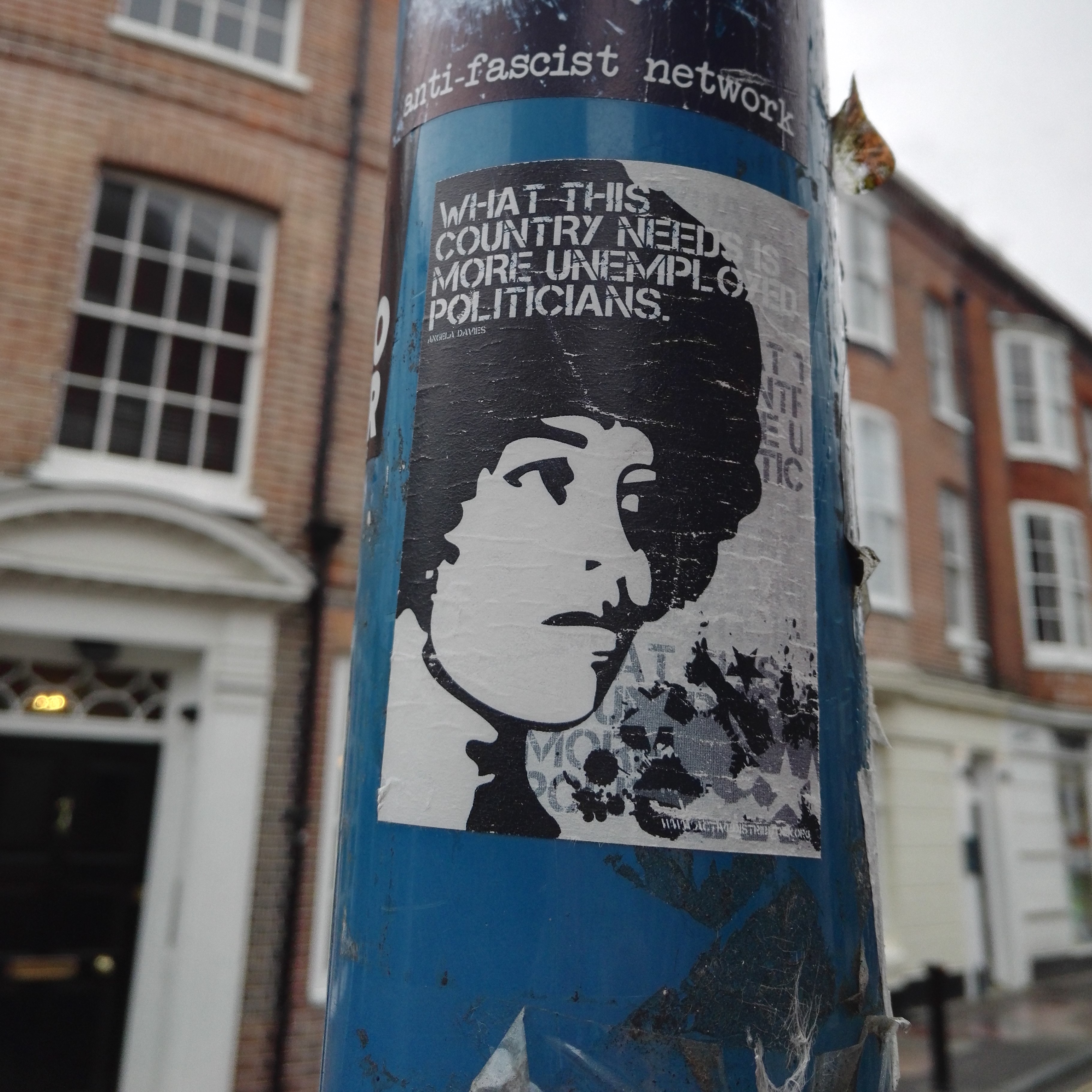
Some stickers are critical of the political system as a whole. This is a quote from the well-known American activist and scholar, Angela Davis (Photo: Hannah Awcock, Prince Albert Street, 09/08/17).
Brexit is just as controversial in Brighton as it is in the rest of the country. This sticker dates from before the referendum, and is encouraging people to think carefully about the implications of voting Leave (Photo: Hannah Awcock, 18/05/16 Queen’s Road).
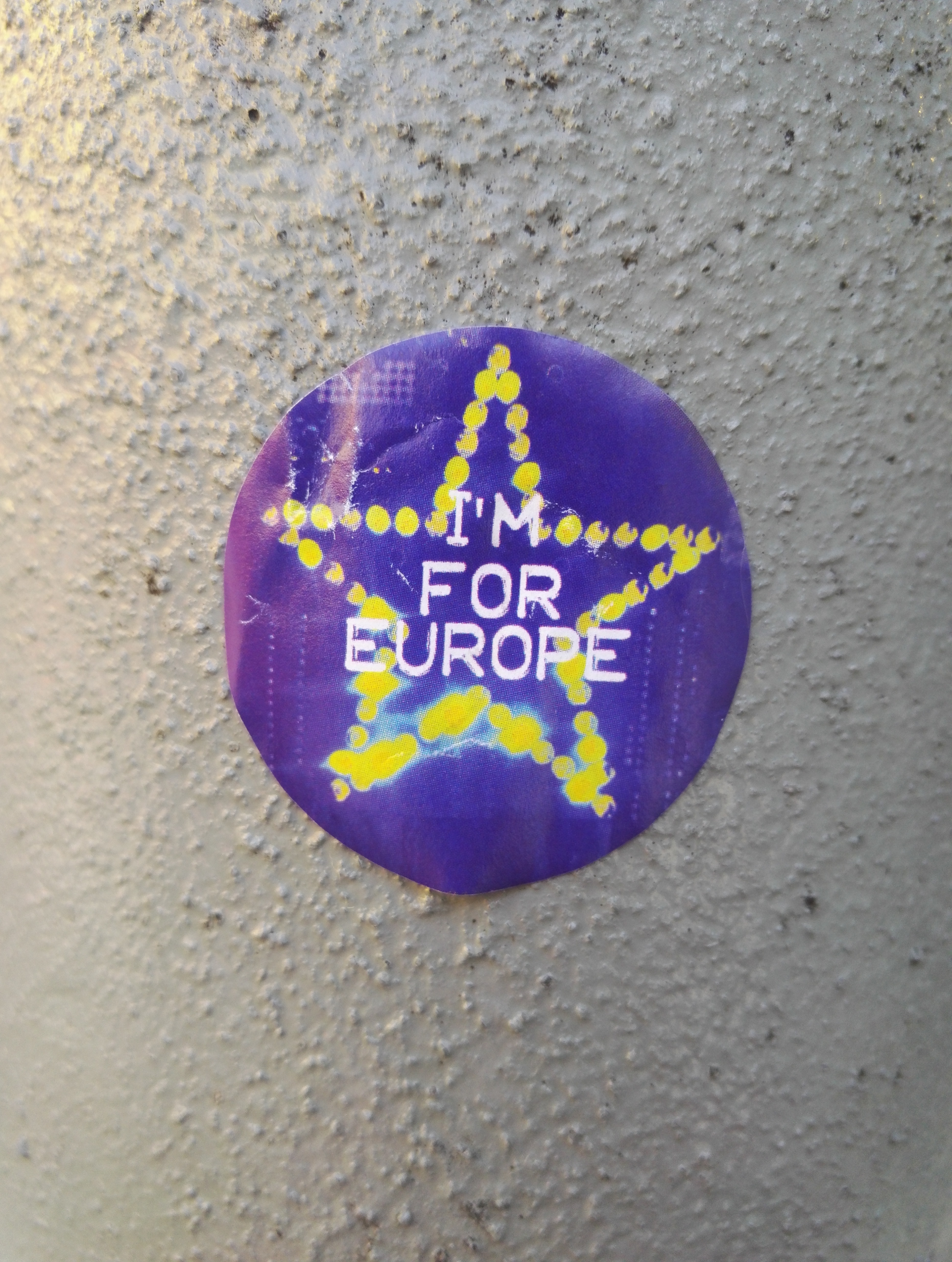
68.6% of Brightonians voted to remain in the European Union, and if this sticker is anything to go by, there are still people who are actively opposing Brexit (Photo: Hannah Awcock, West Street, 01/10/17).
This sticker could be interpreted as supportive of Brexit, suggesting that Britain is making a timely exit from a burning building, escaping whilst it has the chance. I think it’s a clever use of imagery, reproducing a symbol that is so familiar to us in order to convey and political message (Photo: Hannah Awcock, Upper Gardner Street 09/05/16).
The message of this sticker is much more explicit. I would guess that it was meant to be worn on clothing, but was placed somewhere on the street instead (Photo: Hannah Awcock, Gardner Street, 26/03/17).
Some stickers are related to specific political parties. This sticker uses the colour scheme and logo of the Conservative Party to criticise their policies (Photo: Hannah Awcock, Ship Street, 09/08/17).
This sticker has superimposed the face of Theresa May onto the face of Margaret Thatcher, implying that no matter who leads the Conservative Party, their policies and attitudes remain unchanged (Photo: Hannah Awcock, 09/08/17, King’s Road).
The snap election called by Theresa May in June this year inspired it’s own set of anti-Conservative protest stickers. This sticker is playing on the use of the word landslide to describe an overwhelming victory in an election (Photo: Hannah Awcock, 10/06/17, North Street).
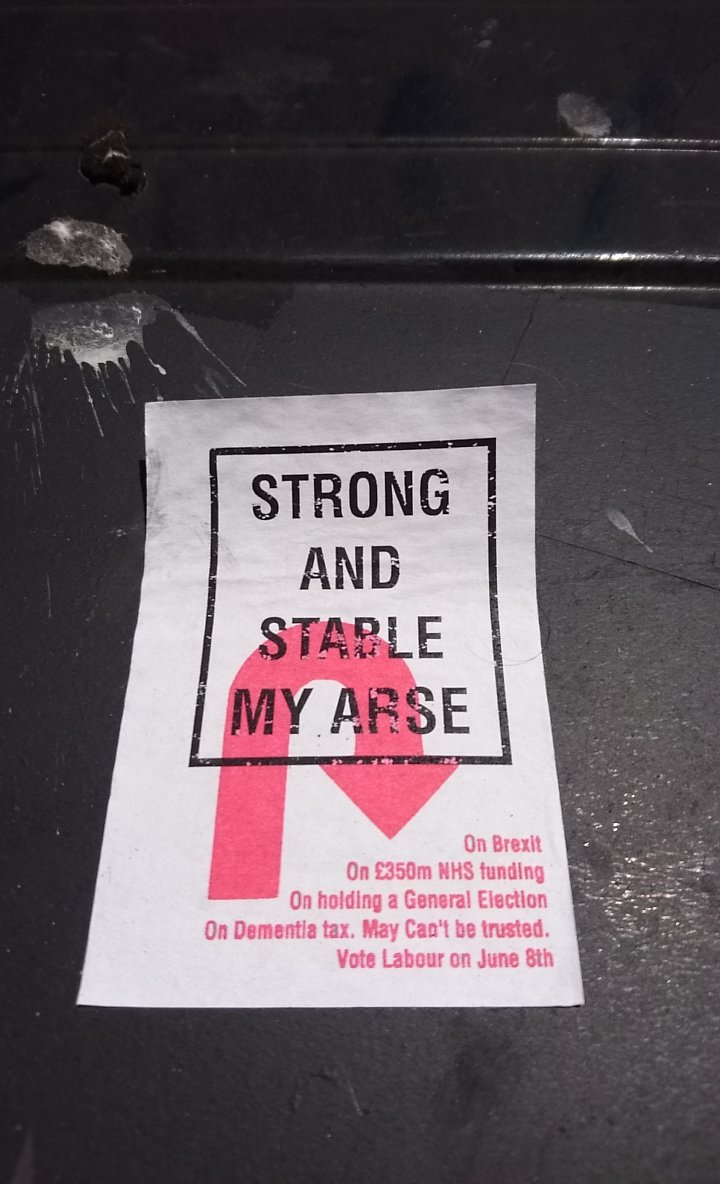
This sticker is referencing Theresa May’s favourite catchphrase during the election campaign, ‘Strong and Stable.’ It is drawing unfavourable comparisons between that phrase and May’s own behaviour (Photo: Hannah Awcock, 10/06/17, North Street).
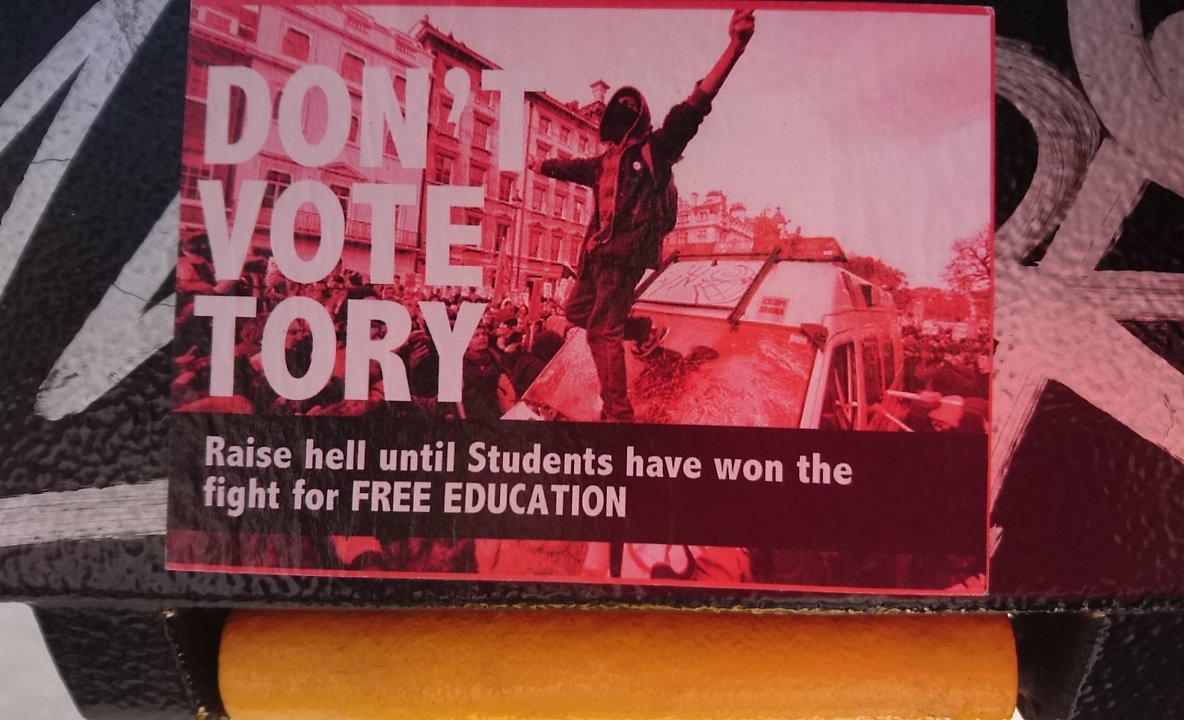
There are two universities in Brighton, as well as many schools and colleges, so there is a high number of students in the city. This sticker is appealing to them, although it doesn’t specifically mention the general election in June 2017 (Photo: Hannah Awcock, 10/06/17, North Street).
Whilst protest stickers about the Conservative Party tend to be negative, those about the Labour Party are more likely to be supportive. This one is linking the Labour Party to support for the NHS (Photo: Hannah Awcock, 18/05/16, Queen’s Road).
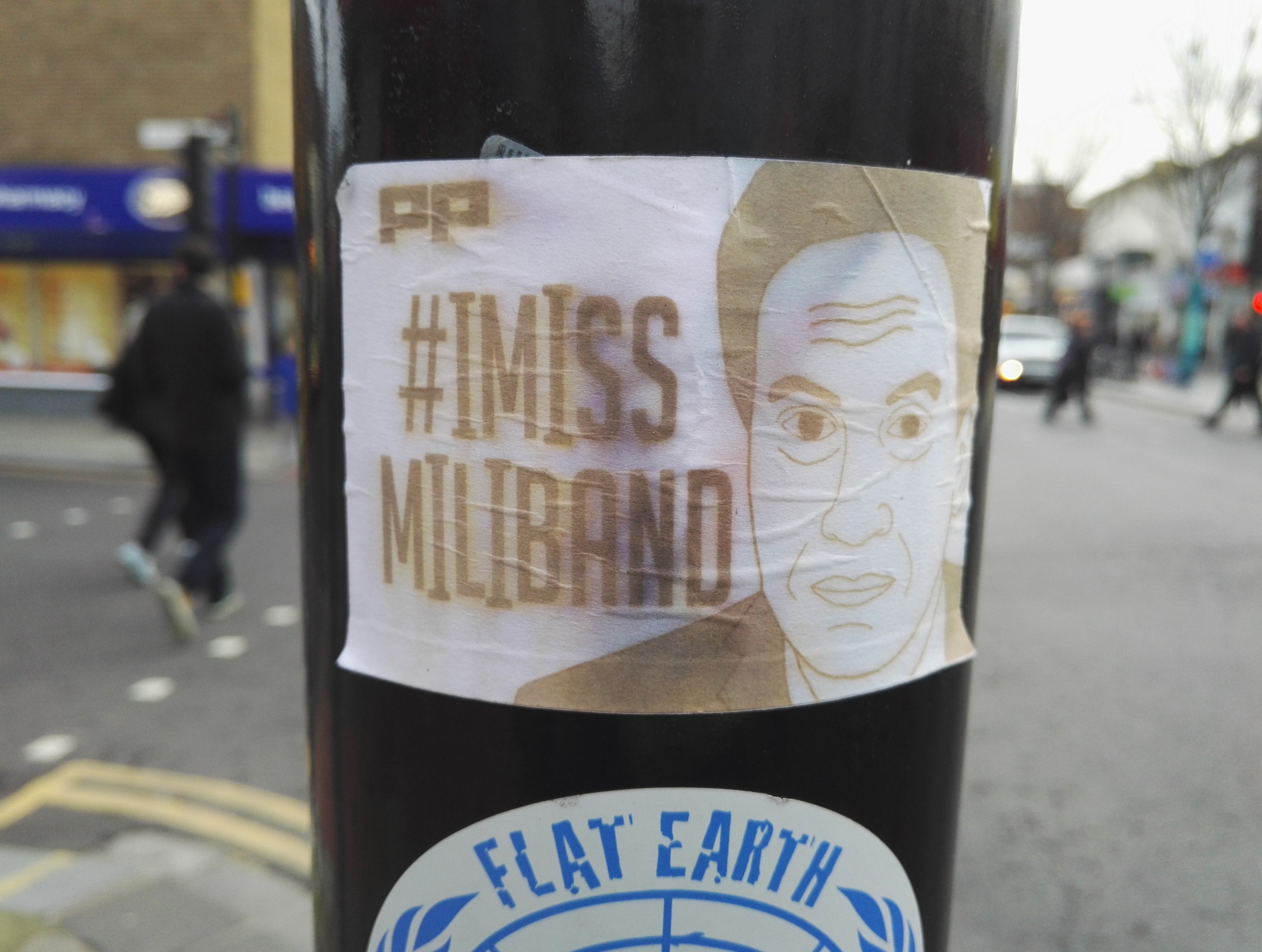
This sticker could be interpreted as critical of the current Labour Party leadership. Ed Miliband wasn’t especially popular when he was leading the party, but this sticker implies that even he did a better job than Jeremy Corbyn. Whatever the intent, the #Imissmiliband hashtag hasn’t caught on (Photo: Hannah Awcock, 24/12/16, London Road).
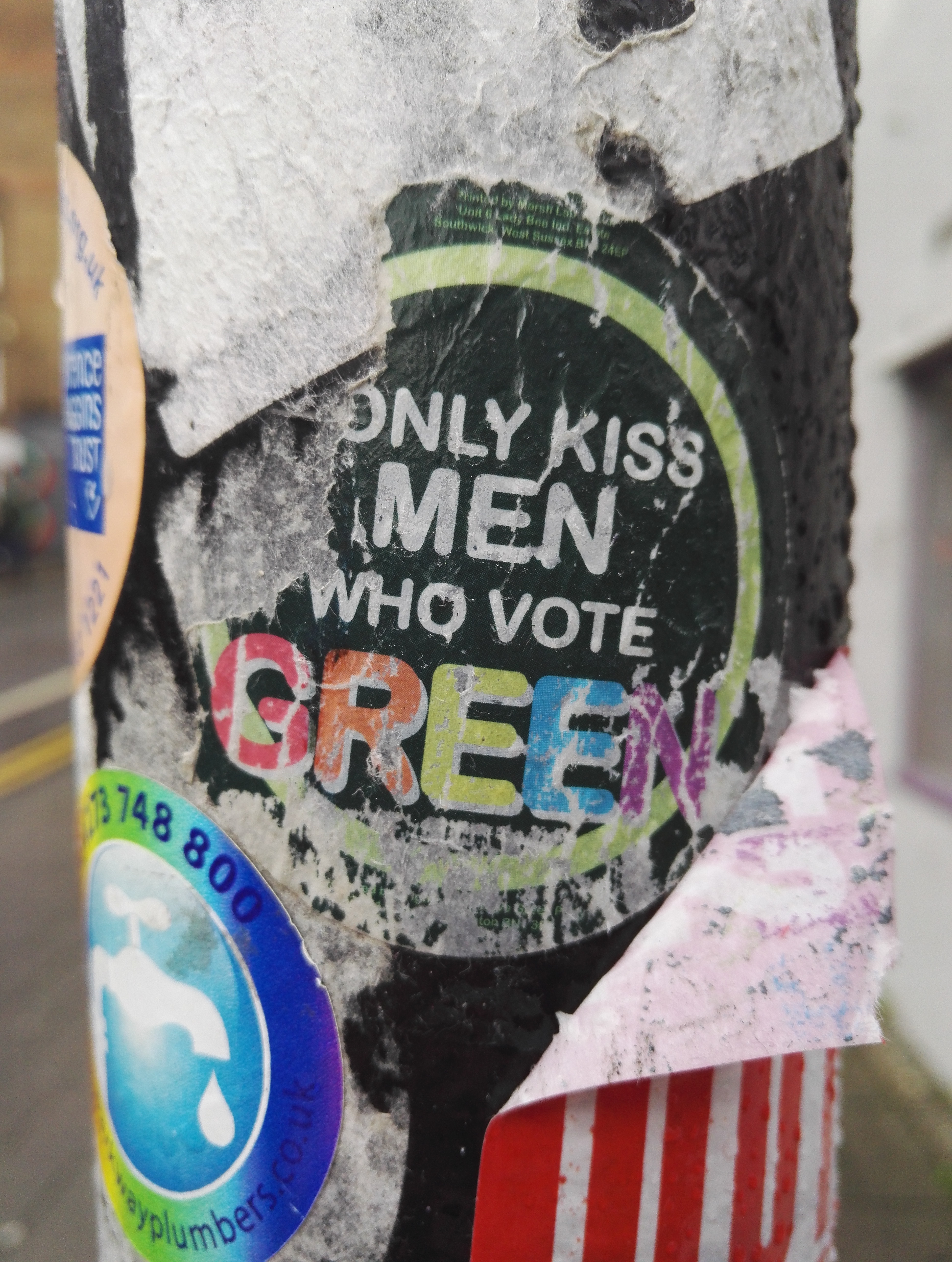
Brighton is the only city in the country that has a Green MP. The colours of the sticker suggest that it is also supporting something else Brighton is well-known for, the city’s large LGBTQI+ community (Photo: Hannah Awcock, 04/02/17, Church Street).
It is not just British electoral politics that is the subject of protest stickers in Brighton, American politics, particularly Donald Trump, is also a focus. This sticker is fairly self explanatory, I think (Photo: Hannah Awcock, 26/03/17, York Place).
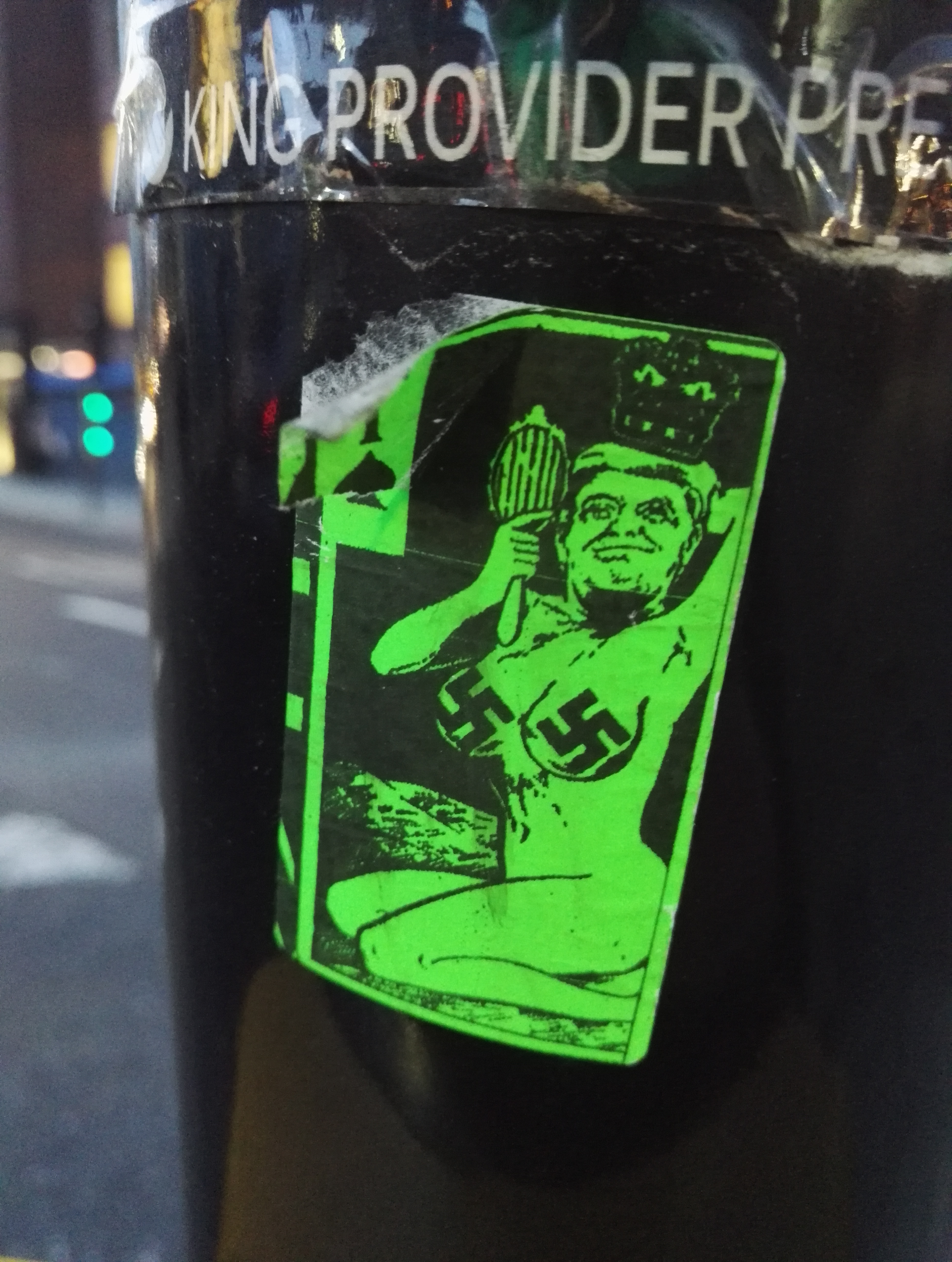
I particularly like this sticker, as I think it would really upset Trump if he ever saw it. He is an incredibly vain man, and I don’t think his vanity would cope well with the representation of him (Photo: Hannah Awcock, 24/03/17 Queen’s Road).
I also think that this sticker would massively upset Trump, so it’s another favourite of mine! It was produced by Sonny Flynn (Photo: Hannah Awcock, 18/05/16, Queen’s Road).
On the 8th of November 2017, I gave the Postgraduate Voices talk at the Historical Geography Research Group’s (HGRG) annual postgraduate conference, Practising Historical Geography. I talked about my experience of academic communities, because of how important they have been to me during my PhD. I have decided to turn my talk into three blog posts, which I will publish here over the next few weeks. Part 1 was the about the various groups that make up my academic community. Part 2 was about the various activities I have taken part in to build and maintain that community. Part 3 is about the challenges I faced whilst building those networks.
The Dreaded ‘Networking’
Most people don’t like networking, but I try to think of it from a different perspective, and then it doesn’t seem so bad (Source: Jurgen Appelo).
I don’t think I’ve ever met anyone that actually enjoys networking. It can be awkward and embarrassing, particularly if you think of yourself as lacking natural social skills. However, what have I been talking about today if not networking? So instead of thinking about networking as a way of making connections that might further my career, which I think makes most of us feel slightly callous and uncomfortable, I try to think of it in a different way, based more around the idea of being part of a community. If I think of networking as meeting like-minded, interesting people who are overwhelmingly friendly and supportive, I actually start enjoying it, as weird as that might sound.
Jealousy
I’m going to ask a question now and I’d like you to be honest: have you ever felt jealous when a colleague or fellow PhD student has had something published, won an award, got a job, or achieved something similar? I think it’s very common, but it’s hard to know because it can be a hard thing to admit to. I personally struggle with jealousy, and it’s not a part of myself that I’m proud of. It has sometime even caused me to cut myself off from my academic community, at times when I most needed support. I desperately want to be happy for my peers when they achieve something wonderful, and part of me is. But another part of me starts to question if they are just better than me, and whether I will ever reach the same milestones.
There are multiple theories around what causes jealousy. Many argue that it is a defence mechanism, causing us to protect things or relationships that we value.[1] For those of us pursuing a career in academia, it has to be something we value, or we would probably choose a different career. For other researchers, jealousy is linked to low self-esteem; and what is imposter syndrome but a form of low self-esteem?[2] Journalist Dawn Foster contends that capitalism exacerbates the issue, arguing that “Capitalism mandates that everyone be in perpetual competition with each other. This naturally spills over into personal, as well as professional, lives.”[3] I think there is something to be said for all of these arguments, but they don’t really help us to find solutions.
Whenever I feel the green-eyed monster rearing its ugly head, because a contemporary has got a job, or had something published, or submitted their thesis, I have a set of mantras that I repeat to myself. These include:
Every PhD is different and progresses at different paces, so making comparisons is futile.
You should publish or present when you have something to say, not because you need to tick a box on your CV.
To be perfectly honest, sometimes this helps, sometimes it doesn’t. So, like the other problems I’ve encountered during my PhD, I’m trying to talk about it more. As with most challenges, realising I’m not the only one that sometimes feels this way has been incredibly helpful.
Myself and Dr. Jo Cagney in New York City during a Royal Holloway undergraduate field trip. I really enjoyed taking part in the trip as a member of staff (Photo: Hannah Awcock).
My academic community has been incredibly important to me over the course of my PhD. The people I have met and got to know have given me opportunities, advice, and support. Just as important is that I’ve had a lot of fun along the way. In the last three blog posts I have tried to convey that, as well as explaining what I have done to become a part of that academic community. I’ll acknowledge it isn’t easy, particularly at first, but it is most definitely worth the effort. Being a postgraduate can be a lonely existence, but only if you don’t make the most of the opportunities you are offered to be a part of something. Grab those opportunities, take part. I did, and hopefully as these three blog posts have conveyed, I’ve had a wonderful time.
Sources
[1] David De Steno, Piercalo Valdesolo, and Monica Y. Bartlett, “Jealousy and the Threatened Self: Getting to the Heart of the Green-Eyed Monster,” Journal of Personality and Social Psychology 91, no. 4 (2006): 626–641.
[2] Mark R. Leary, Lisa S. Schreindorfer, and Alison L. Haupt, “The Role of Low Self-Esteem in Emotional and Behavioural Problems: Why is Low Self-Esteem Dysfunctional?” Journal of Social and Clinical Psychology 14, no. 3 (1995): 297–314.
[3] Dawn Foster, Lean Out (Repeater: London, 2016): 10.






















 Turbulent Isles