The Value of Academic Communities Part 2: Being Part of the Community

On the 8th of November 2017, I gave the Postgraduate Voices talk at the Historical Geography Research Group’s (HGRG) annual postgraduate conference, Practising Historical Geography. I talked about my experience of academic communities, because of how important they have been to me during my PhD. I have decided to turn my talk into three blog posts, which I will publish here over the next few weeks. Part 1 was the about the various groups that make up my academic community. Part 2 is about the activities I have taken part in to build and maintain that community.

Seminars

My Seminar Groups
The Landscape Surgery and London Group of Historical Geographers seminar groups have been very important to me during my PhD.

Just as there are probably different types of people in your academic community, there are different ways in which you can extend and strengthen it. Seminars are not just a way to hear about new research, they are also a way of participating in various communities. Attending departmental seminars are a good way for PhD students to be part of an academic department, particularly if you don’t have an office or desk in the university. The Social, Cultural and Historical Geography Research Group at Royal Holloway have a bi-weekly seminar series in central London called Landscape Surgery, for postgraduates and staff. It is a forum for Landscape Surgeons to share our work and ideas, and also sometimes features external speakers.  Landscape Surgery has been a lifeline for me during my PhD. The Human Geography postgraduates at Royal Holloway are quite geographically dispersed—most of us don’t go into the department on a regular basis. So Landscape Surgery was frequently my only contact with an academic community. It helped me to maintain my connection to the staff and students of the Royal Holloway Geography Department.

However, seminars can also introduce you to communities that go beyond your department. Another important seminar series for me is the London Group of Historical Geographers, which also meets every other week in central London. The seminars, and the trip to Olivelli’s Italian restaurant for dinner afterwards, have really helped me to develop my academic social skills over the years. The dinners in particular have introduced me to a range of historians and historical geographers in a less formal setting, which made it easier for me to actually carry on a semi-intelligent conversation.

Conferences
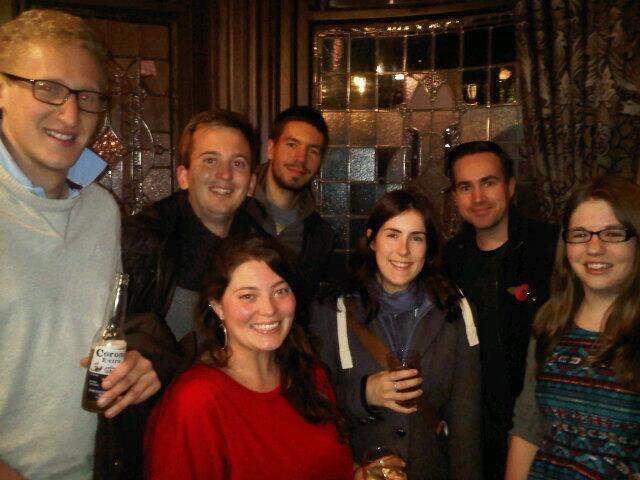
Converted_file_73ecfd55
The Royal Holloway contingent in a pub in Preston the night before the 19th Practising Historical Geography conference in 2013 (Photo: Innes Keighren).

I have been to quite a few conferences during my PhD, from small-ish ones like Practising Historical Geography to massive international conferences like the RGS Annual Conference and the Annual Meeting of the Association of American Geographers. Like seminars, attending conferences is a brilliant way of meeting other academics. If you are presenting a paper, people will often come and introduce themselves to you, and it also serves as something to talk about, thus helping to avoid awkward silences or introductions. I have found organising conference sessions to be even more helpful. Putting out a Call for Papers connects you with people who have similar research interests. Or, you can invite people to take part in your session, providing you with a reason to get in touch with that Professor that you’ve always wanted to talk to. I’m convening a session at the International Conference of Historical Geographers in Warsaw next year. The prospect that I would get silence in response to my invitations and Call for Papers was a scary one, but I actually got a fantastic response. So I’m making new connections and extending my academic community, as well as building on my pre-existing connections with excellent academics and the conference is still months away.

The point that conferences help to maintain and develop pre-existing connections as well as making new ones is important. There are a number of my peers from all over the country that I only ever really see at conferences, so they represent a good chance to catch up. Being part of a community isn’t just about making new connections and meeting new people, it’s also about staying connected to people you’ve already met but don’t see very often.

Research Groups

DGWG Symposium cropped
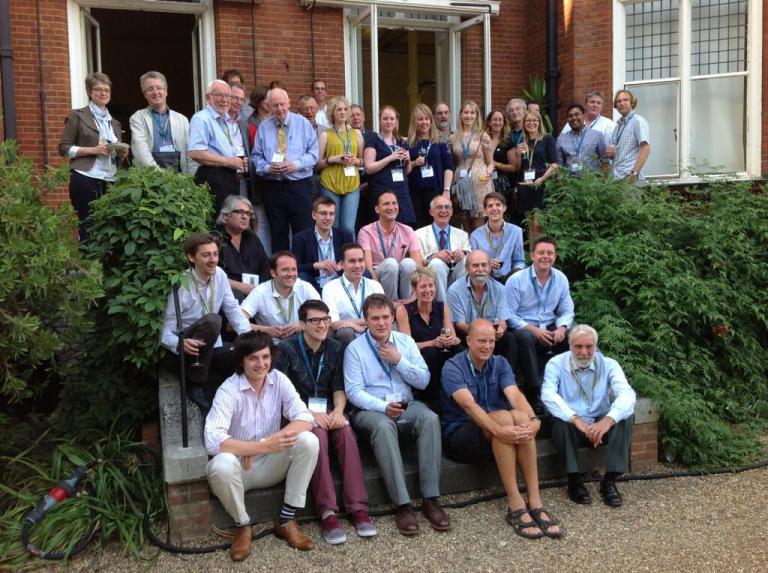
The attendees of the Digital Geographies Working Group’s (DGWG) first annual symposium in London in June 2017 (Photo: DGWG).

Research Groups are open, welcoming, and often actively encourage the participation of postgraduates. They also organise events that give you the chance to participate in academic communities.

Research groups also give you the opportunity to give back to your academic community. For just over a year, I have been a member of the committee of the Digital Geographies Working Group. Serving on a Committee provides you with the opportunity to meet new people, and work with those you already know, but it also allows you to develop new skills, such as organising academic events, managing budgets and accounts, or running a website. I helped to organise the first annual Digital Geographies Symposium last year. It was a steep learning curve, but it was also great fun.

Social Media

Faxsly Twitter
I am active on social media, including Twitter and this blog.

Not every academic makes use of social media, but I have found it to be very beneficial. I am active on Twitter, and I also run this blog. Twitter has allowed me to make new connections, and stay in touch with people in between conferences. Twitter can also act as a sort of leveller, making it less intimidating to approach and start a discussion with a big name.

As well as being something that I really enjoy doing, and allowing me to toy with the concept of impact, my blog gives me a presence on the internet beyond your normal Twitter account or departmental webpage. If someone wanted to, they could get a good sense of who I am and what my research interests are from Turbulent London. I am also keen to publish contributions from guest authors, which is another reason to make connections with people that you perhaps otherwise wouldn’t. Although not universal, there is no doubt that social media has changed the way that academics interact. I personally think it is a great way to participate in the academic community.

Participating in academic networks can be time consuming, but it is incredibly worthwhile; you can learn new skills, cement your place in academic communities, and it is great fun. In is not all plain sailing however; in Part 3 of The Value of Academic Communities, I will talk about some of the challenges I have faced whilst building my academic communities.

The Value of Academic Communities Part 1: My Academic Community

On the 8th of November 2017, I gave the Postgraduate Voices talk at the Historical Geography Research Group’s (HGRG) annual postgraduate conference, Practising Historical Geography. I talked about my experience of academic communities, because of how important they have been to me during my PhD. I have decided to turn my talk into three blog posts, which I will publish here over the next few weeks.

RGS 2016 cropped
Myself with some of my Royal Holloway peers and my PhD supervisor at the 2016 RGS-IBG Annual Conference. From left to right: Ben Newman, Dr. Rachael Squire, Dr. Innes Keighren, myself (Photo: Hannah Awcock).

A PhD can be a lonely experience. I have spent many days sat on my own in the archives or in front of my computer. As such, I have always embraced opportunities to work or interact with other PhD students and academics. There are a number of reasons why it’s a good idea to actively participate in the academic community, ranging from the strategic to the emotional. It can lead to opportunities that are helpful for career progression, it provides access to a wealth of advice and experience, and it can be a source of support when you’re struggling. Talking to others who know what I’m going through has been one of the key strategies I have developed to deal with the stress of doing a PhD. Every PhD is different, and as such, it seems likely that every PhD student’s academic communities are also different. Because of this, I thought I should explain what I consider my academic community to be.

PhD Supervisors

IMG_4207.JPG
This is the only photo I could find of myself and both of my PhD supervisors. Professor David Gilbert is on the far left in the back row, and Dr. Innes Keighren is on the far right in the back row (Photo: Graeme Awcock).

In many ways, your PhD supervisors are your first point of contact with the academic world, so your relationship with them is an important one. My supervisors have been incredible, helping me through all aspects of academic life as well as the thesis itself. My department runs an annual training session on called Managing Your Supervisor, which always gets a bit of a giggle, but it is actually important to think about. What do you want or need from your supervisor? What do you expect from them? What do they expect from you? The relationship between postgraduates and supervisors varies a lot depending on the individuals involved, but it’s worth investing some time thinking about what works best for you. I have two supervisors: Professor David Gilbert and Dr. Innes Keighren. I almost always met with both of them, which I think is quite unusual from what I’ve gathered talking to others. I guess my key piece of advice is be honest with them, especially when things aren’t going well. It can be embarrassing to admit you’re struggling, but how are they supposed to help you if they don’t know what’s really going on? Your supervisors are probably your most valuable source of advice, support, and feedback: don’t waste it. However, you also have to be wary of being over reliant. At the end of the day your PhD is your project, and at some point you have to take ownership of it.

Peers

06_RGS
My Masters class on a trip to the Royal Geographical Society archives in December 2012 (Photo: Innes Keighren).

There isn’t really a concise way of saying ‘people who are doing a PhD at roughly the same time as you,’ so I’ve settled for peers. There are quite a few PhD students in the Geography Department at Royal Holloway, and I have also met PhD students from other departments along the way. My peers have been really important to me, because they understand what I’m going through. It can be hard for those outside of academia to grasp a PhD; I have had to field quite a few questions over the years about what I’m going to do in my summer holiday, when my next exams are, and what I actually do with my time. Other PhD students get all that though, and more. They know it feels to get stuck writing a chapter, or hit a dead end in the archive, or have a frustrating supervision meeting. Equally, they know how it feels to have an abstract accepted for a conference, or to find that perfect source in the archive, or to get some great feedback from your supervisors. My peers understand it all–the triumphs and the tragedies. Peers are a wonderful source of advice, and if they can’t help, they can at least sympathise.

Established Academics

hgrg40
Past and present committee members of the Historical Geography Research Group in 2013. (Photo: HGRG).

Another endless source of wisdom is academics who are further along their career path. I have found them to be unceasingly generous with their time and advice. Although it was a while ago for some of them, they know what it’s like to go through a PhD too, and I have been the grateful recipient of many pearls of wisdom over the years. I know it can be intimidating to talk to a high-flying professor when you are just a lowly postgraduate, but they don’t bite, honestly!

Over the course of a PhD, you get the opportunity to meet a lot of interesting people, who you will probably have a lot in common with. In Part 2 of The Value of Academic Communities, I will talk about the various opportunities that I have made the most of to establish and maintain myself in academic communities.

Revolting New York: How 400 Years of Riot, Revolt, Uprising, and Revolution Shaped a City

Revolting New York cover
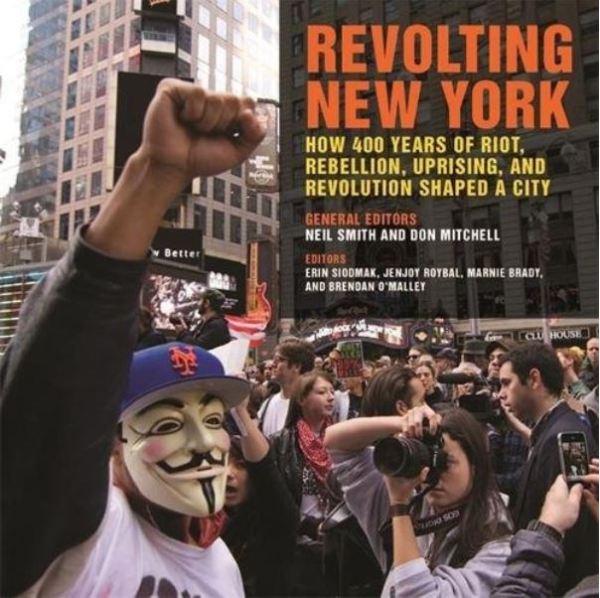
Revolting New York will be published early next year.

On my trips to New York City (in 2015 and 2016), I have scoured bookshops looking for a history of protest in the city, assuming that there must be one. After all, there are at least two books about London’s turbulent past. Whilst there is lots of great research about dissent in New York, there has not been an overarching survey–until now. Next year, a book will be published not just about the history of protest in New York, but about the historical geography of protest in the city. Revolting New York: How 400 Years of Riot, Revolt, Uprising, and Revolution Shaped a City began as a project by Neil Smith with some of his post-graduate students at the City University of New York. When he passed away in 2012, Professor Don Mitchell took over the task of editing the collection, and it is finally being published next year. As you can imagine, I’m quite excited about it, whilst also being a bit frustrated that I didn’t get there first!

Last week, Professor Mitchell gave a lecture about the project at Queen Mary, University of London. I went along to find about more about the project. Mitchell used various examples to demonstrate the strength of the relationship between dissent and the material landscape. We tend to view demonstrations, riots, and other expressions of dissent as unusual events, but they are actually very common, particularly in large cities like London and New York. It is actually more uncommon to have a peaceful period.

Mitchell started the lecture with an in-depth look at a decade of bombings in New York, culminating in anarchist Mario Buda’s attack on Wall Street on the 16th of September 1920 (I have written a review of Mike Davis’ excellent book about this bombing’s part in the early history of the car bomb here.) The bombings contributed to the deindustrialization of New York, as the small-scale manufacturing and transport networks that produced and planted the bombs were driven out of the city. Finance, insurance, and real estate came to dominate the city’s economy. In attempting to strike a devastating blow against the bankers of Wall Street, Buda inadvertently helped them tighten their grip on New York.

Mitchell used this narrative, and others, to argue that “landscape is power materialised.” Whilst this is not a new argument, Revolting New York applies it in a new context. Space is produced through social struggle, the result of constant negotiation and conflict between groups with different visions for that space. Protest is just one form that this process takes. As such, protest shapes and reshapes the city you see when you look out the window (apologies to those of you who are not currently in a city!)

The lecture was an introduction to the Revolting New York project, outlining it’s history, structure, and key arguments. It is particularly exciting for me because of its parallels with my own work on London. The book will be affordable too, less than £25 for the paperback, so hopefully it will help bring historical geography to a wider audience. I for one can’t wait to read it!

Academic Job Interviews: Collected Resources

(Source: The Daily English Show).

I recently got my first academic job interview, after several months of silence and rejection emails. Unfortunately I wasn’t offered the job, but it was still good experience for me, and it was a huge step in the right direction in terms of getting an academic job. Whilst I was preparing for the interview, I spent time reading blog posts and webpages with advice about interviews, and other people’s experiences of interviews. Below are links to the ones I found particularly helpful.

Vitae: Academic Job Interviews provides advice about how to prepare for a job interview, what kind of research to do beforehand, what kind of questions to expect (the questions are assuming that the job is research-based though, there are no questions about teaching), and giving presentations.

Guardian Higher Education Network: Written by Steve Joy, How to Shine in an Academic Interview has some helpful tips on how to prepare for interviews, including sharing experiences with others, and orally practising your responses to typical questions.

Jobs.ac.uk: In Succeeding in Academic Interviews, Neil Harris  has some good general tips about interviews, including body language.

The University of Edinburgh Careers Service: Academic Interviews has a link to a comprehensive list of typical questions.

Dr. Nadine Muller: Academic Job Interviews is a detailed blog post written by Dr. Caroline Edwards, who has experience from both sides of the interview process.  It has typical questions, as well advice for all stages of an interview day, including lunch, which you might be expected to eat with the other candidates and members of the department. An Academic Interview recounts an interview that Dr. Muller went to, at which she was ultimately successful. At this point she had only recently finished her PhD, so the post is particularly helpful for those at a similar stage.

If you are currently looking for an academic job then I wish you luck, and remember that you are not alone!

The Book of Erebus: Archives in Blade

Blad film poster
Enter a caption

There is an anecdote in my family that my parents once tried to rent Blade Runner (1982). Instead of Ridley Scott’s epic visual masterpiece they ended up with Blade (1998), an over-the-top vampire film starring Wesley Snipes. Also a good film, but very different. We will probably never know if the mistake was my parents’ or Blockbusters’, but my Mum still thinks Blade Runner is about a leather-clad vampire hunter.

I recently rewatched Blade, and apart from being shocked by the dodgy CGI, I was interested by the film’s representation of archives. Archives, libraries, and other repositories of knowledge are often used in films as a method of exposition, or of revealing some information that moves the plot along, and Blade is no different. Blade and his plucky but naive companion Dr. Karen Jenson fight their way through a club to find a vampire archive, the entrance to which is hidden in an industrial fridge.

Inside, they find futuristic data banks and a grossly overweight and flatulent archivist, who reveals to Blade and Dr. Jensen the plans of the film’s baddie, evil vampire Deacon Frost. Frost has been using the archive to translate the the Book of Erebus, the vampire bible whose meaning had been long since forgotten. Frost was trying to enact a prophecy he found in the Bible, which would give him enough power to take over the world and bring an end to humans. Blade the sets out to try and stop Frost. The archive is the means through which the good guy finds out what the bad guy is up to, thus progressing the story.

Blade archivist
The archivist in Blade is not a particularly flattering depiction of researchers (Blade, 1998).

I would say that there are two main stereotypes of archives in popular culture. The first is old, dusty stacks of books and scrolls, stacked floor to ceiling in a dark, dingy room. The other is much more modern, even futuristic, with high-tech data banks, in large, sparse rooms. The archive in Blade falls into the latter category, as the images below demonstrate (the Empire’s archives on Scarif in Rogue One: A Star Wars Story (2016) are another example of this type). I think the archives are a reflection of the vampire community in Blade as a whole; they are very old, but they have changed and developed to keep up with the times, blending in with human society. So much so, that the ability to translate the Book of Erebus has been lost, as has much of the vampires’ history and lore.

Blade vampire archive
The archives in Blade are stored on large, white data banks in otherwise empty rooms (Blade, 1998).
Blade the Book of Erebus
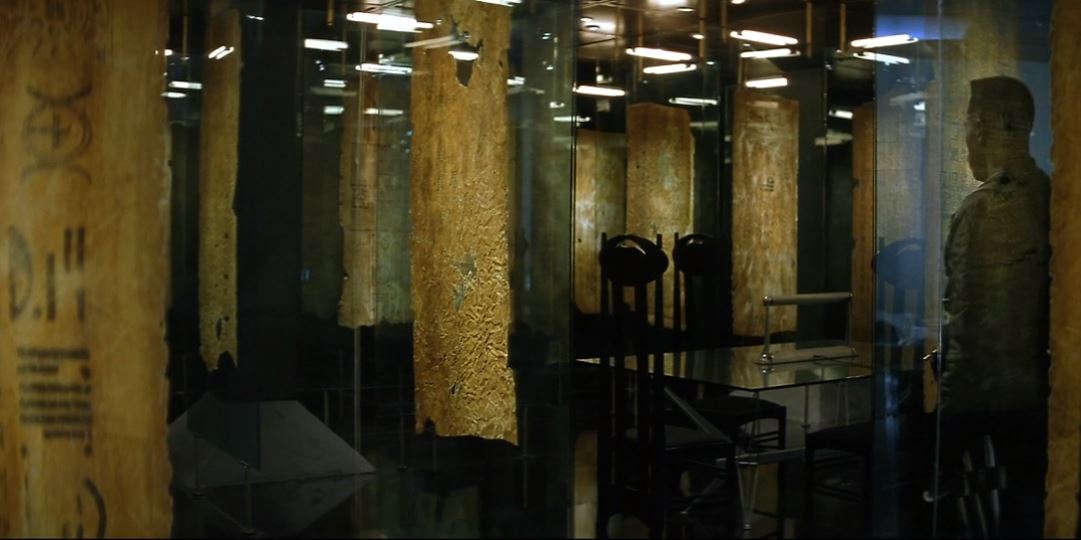
The Book of Erebus, the vampire’s bible, is hidden within the vampire archive. Even though the pages themselves are old and yellowed, the way they are stored is modern (Blade, 1998).

Archives and libraries are represented frequently in popular culture, often as a source of exposition or plot progression. These representations shape the way that non-researchers understand and perceive of archives, and as such I think it is important for academics to spend time analysing them, and thinking about what impact they might have. The archive is Blade is modern and hi-tech, much more so than any real archive currently is. The archivist is also much more unpleasant than any archivist I’ve ever met!

23rd Practising Historical Geography Conference

IMG_2210
The 2017 Practising Historical Geography Conference was held in Manchester (Photo: Hannah Awcock).

Last week, I went to Manchester Metropolitan University for the 23rd annual Practising Historical Geography Conference, organised by the Historical Geography Research Group (HGRG).  It was my fifth time attending the conference (I wrote about the last one I attended, in 2015, here), but my first time presenting. As always, I thought it was a great day, well organised, with really interesting speakers.

The day involves: two keynote speakers; two methodological workshops; a Postgraduate Voices presentation by a recently completed PhD student; and a paper by the HGRG undergraduate dissertation prize winner. This year, I gave the Postgraduate Voices talk. It meant a lot to be asked, as the Practising Historical Geography conferences have been a really important part of my PhD. I have valued the time spent with other enthusiastic researchers who have been unfailingly supportive over the last five years. Because of how much I have gotten out of these conferences, I decided to use my Postgraduate Voices presentation to talk about my place in the academic communities that played such an important role in my PhD. Doing a PhD can be a lonely experience, so I think it’s really important to take a bit of time and effort to participate in academic networks when you get the chance.

dav
The Royal Holloway contingent at the 23rd Practising Historical Geography conference. Left to right: Ben Newman, myself, and Ed Armstron-Sheret (Photo: Hannah Awcock).

In her introduction to the conference, President of the HGRG Dr. Briony McDonagh said that the field of historical geography was in “rude health.” By the end of the day, I couldn’t help but agree. The keynote lectures, given by Professor Jon Stobbart and Dr. Kimberly Peters, were both fantastic, and they highlighted the diversity of research being conducted in the field. Professor Stobbart discussed the construction of ‘comfortable’ homes in Georgian England using material objects, whilst Dr. Peters talked about the development of maritime ‘motorways,’ shipping lanes designed to minimise the chance of large container ships colliding head-on. I never thought that I would find maritime trade so interesting!

The two workshops were also excellent. The first, organised by Dr. Sarah Mills, was about the ethics of archival research. I must admit I generally fall into the trap of assuming that I don’t need to think too much about ethics because I research the past, but the workshop made me realise it was something I should pay more attention to. The second workshop, run by Dr. James Kneale, was about the merits and challenges of time capsules for historical research. During the recent demolition of the Temperance Hospital in London, two time capsules were found, and Dr. Kneale was asked to consult on their contents. Whilst it seems unlikely that many historical geographers will find themselves in a similar situation during their careers, we had some great discussions about the nature, meaning, purpose, and use of time capsules.

Practising Historical Geography is always a brilliant event, and this year was no different. I drove home feeling energised, with a renewed enthusiasm for my own research. I would like to say thank you to the HGRG committee, particularly Dr. Cheryl McGeachan and Dr. Hannah Neate, for organising such a wonderful event.

Turbulent Londoners: Harriet Taylor Mill, 1807-1858

Turbulent Londoners is a series of posts about radical individuals in London’s history who contributed to the city’s contentious past, with a particular focus of women, whose contribution to history is often overlooked. My definition of ‘Londoner’ is quite loose, anyone who has played a role in protest in the city can be included. Any suggestions for future Turbulent Londoners posts are very welcome. The next Turbulent Londoner is Harriet Taylor Mill, a radical thinker who made a significant contribution to the work of John Stuart Mill.


Harriet Taylor Mill
Harriet Mill (née Hardy) by Unknown artist. Oil on canvas laid on board, circa 1834
NPG 5489 (Source: National Portrait Gallery).

The well-known phrase ‘Behind every man is a great woman’ could have been invented for the philosopher John Stuart Mill. His wife Harriet Taylor Mill was hugely significant to his work, and, whilst we may never know the full extent of her contribution, she may well have co-authored substantial amounts of the writing attributed to him. She was also a radical thinker and writer in her own right.

Harriet Hardy was born in Walworth, south London on the 8th of October 1807. The daughter of a surgeon, she was educated at home. Her relationship with John Stuart  Mill was unconventional, even by modern standards. In 1826 Harriet married he first husband, the merchant John Taylor. They had three children. Four years into their marriage, Harriet became active in the Unitarian church community in London, and was introduced to John Stuart Mill. The two became close friends, exchanging essays on marriage and women’s rights. Mill was the first man to treat Harriet as an intellectual equal. Harriet was the more radical of the two, criticising the degrading effects of women’s economic dependence on men. She believed the situation could only be changed by the drastic reform of marriage laws.

By 1833, Harriet was living apart from John Taylor with her daughter, Helen. She spent six weeks in Paris with John Stuart Mill, and despite claiming they did not have a sexual relationship, they caused a scandal that left them both socially isolated. Harriet lived in a house in Walton-on-Thames, and Mill visited her at the weekends. John Taylor eventually accepted Harriet’s relationship with Mill, on the condition that she move back in with him.

John Taylor died in 1849, and Harriet married Mill two years later. The same year, 1851, ‘The Enfranchisement of Women’ was published by The Westminster Review. It is one of the few pieces of writing that can be solely attributed to Harriet, but at the time it was published in Mill’s name. Mill would build on Harriet’s arguments in The Subjection of Women (1869), although his arguments were less radical than Harriet’s.

Harriet published little of her own work, but contributed extensively to Mill’s. It is hard to know exactly the extent of this contribution though. At least, Harriet commented on all of Mill’s writing. In his autobiography, he claimed that she co-authored most of his work. In 1832, Early Essays on Marriage on divorce was published, co-authored by Harriet and Mill. It is unclear why Harriet might have been reluctant to take credit for her work– perhaps she was worried it would affect how the ideas were received. What was clear, however, was that Mill valued Harriet’s contribution; he dedicated On Liberty (1859) to her.

In her later years, Harriet traveled a lot due to ill health. She died in Avignon on the 3rd of November 1858. Mill bought a villa near Avignon, and spent most of the rest of the life there. Harriet’s daughter Helen helped Mill finish The Subjection of Women.

Even if Harriet Taylor Mill wasn’t a significant contributor to the work of John Stuart Mill, I think she would be worthy of admiration for to bravery she showed in pursuing happiness in her personal life in the face of social ostracism. Although the extent of her abilities will probably never be know for sure, she was also an accomplished thinker and writer. She deserves recognition.

Sources and Further Reading

Anschutz, Richard Paul. “John Stuart Mill.’ Encyclopaedia Britannica. Last modified June 15, 2017, accessed November 9, 2017. Available at  https://www.britannica.com/biography/John-Stuart-Mill.

Miller, Dale E. “Harriet Taylor Mill.’ Stanford Encyclopedia of Philosophy. Last modified October 5, 2015, accessed November 9, 2017. Available at  https://plato.stanford.edu/entries/harriet-mill/#EnfWom

Simkin, John. “Harriet Mill.” Spartacus Educational. Last modified August 2014, accessed November 9, 2017. Available at http://spartacus-educational.com/Wtaylor.htm

Wikipedia, “Harriet Taylor Mill.” Last modified August 22 2017, accessed September 28, 2017. Available at https://en.wikipedia.org/wiki/Harriet_Taylor_Mill

Protest Stickers: Haywards Heath

dav
Haywards Heath in Sussex wouldn’t exist if it wasn’t for the train station (Photo: Hannah Awcock).

A common side effect of academia can be moving around a lot. For the first 2 years of my PhD I lived in London, and I am now back in my home town of Brighton, but for a year in between that I lived in Haywards Heath, a semi-rural commuter town on the London-Brighton train line in Sussex. Like Egham in Surrey, it is not the sort of town where you would expect to find protest stickers. It is not the sort of place where you expect to find any alternative politics, to be honest. Nevertheless, I did find protest stickers, although  not all of them promoted the left-wing, progressive politics that I normally expect to find.

01-12-15-haywards-heath-station
Like many towns south of London, the commuters have Haywards Heath have suffered as a result of the dispute between Southern Rail and the RMT Union. The conflict has been dragging on for some time now, but I was surprised when I realised I took this photo more than two years ago; no wonder patience is running out on all sides. I found this sticker in the Haywards Heath train station (Photo: Hannah Awcock, 01/12/15).
dav
This sticker is on the back of a traffic sign on the outskirts of Haywards Heath. It is referring to the fox hunting ban, which was introduced in 2005, so there’s a possibility that this sticker is quite old. Haywards Heath is surrounded by small, rural villages, so there is a lot of support for fox hunting in the area (Photo: Hannah Awcock, 05/07/16).
dav
This is the detail of the logo from the above sticker. It is hard to make out the words because the sticker has been scratched, but I think it says “Felix says keep hunting.” The web address no longer works, further evidence that the sticker is old (Photo: Hannah Awcock, 05/07/16).
mde
This was placed on  the entrance sign on one of the numerous office blocks that line one of the main roads in Haywards Heath. Needless to say, it was removed quite quickly. I was surprised to find such radical sentiment expressed in Haywards Heath (Photo: 06/08/16).
07-12-15-haywards-heath-sainsburys
This sticker is produced by Active Distribution, who make quite a lot of the protest stickers I come across (Photo: Hannah Awcock, 07/12/15).
IMG_20161001_165330.jpg
This sticker was trying to persuade people to vote Remain in the 2016 EU Referendum for the sake of the environment. Haywards Heath did vote to remain in the European Union, by a small margin (Photo: Hannah Awcock, 01/10/16).
dav
Most protest stickers are left wing, but I do come across some supporting right wing groups and policies. This small sticker was advertising the British National Party, a far right political party which has been in decline over the last few years (Photo: Hannah Awcock, 12/01/16).
22-12-15-burrell-road
The National Front is another small far-right party. It advocates a form of racist nationalism, seeing anyone who isn’t white British as a threat, hence the demand this sticker makes (Photo: Hannah Awcock, 22/12/15).
06-01-16-sainsburys
Sadly, I found a higher proportion of right wing and racist stickers in Haywards Heath than I have done in other cities.  Overall, the town is quite conservative politically, and I guess that results in a relatively large proportion of people with far-right beliefs (Photo: Hannah Awcock, 06/01/16)
dav
I have seen this sticker in a few cities around the country, and to be honest I’m not entirely sure it counts as a protest sticker. There are some people who still beleive that the world is flat, but I’m not sure if that’s what this sticker is really about (Photo: Hannah Awcock, 11/01/16).
06-01-16-south-road
I know this isn’t a protest sticker, but I wanted to finish on a positive note! (Photo, Hannah Awcock, 06/01/16).

Vienna’s Street Art

IMG_2589
Central Vienna is beautiful, but a little too formal for my liking (Photo: Hannah Awcock).

This summer, I spent a few days in Vienna on a family holiday. Although beautiful, I found the city, particularly the city centre, had an add, formal feel that didn’t sit very well with me. It didn’t feel lived in, more like a model city than an actual place. There were some parts of the city I did connect with however, like the Prater funfair, the city’s lively protest sticker culture, and the street art. I quickly discovered however, that the advice the guide books give you about finding street art is not necessarily the best.

Dotted around the Museum Quarter of the city there are a series of Micromuseums, small passageways that focus on different art genres, including literature, typography, and sound art. They are the brainchild of Q21, which provides creative work and exhibition spaces in the Museum Quarter. One of these Micromuseums is called Street Art Passage Vienna, and its where a lot of guide books direct you if you want to see street art in the city. Whilst I like the idea of turning “simple means of entrance and exit to innovative art spaces,” I found the reality a bit disappointing. The space is almost 10 years old, and it feels a little neglected.

IMG_2728
The Street Art Passage Vienna was looking a little neglected when I saw it in July (Photo: Hannah Awcock).
IMG_2734
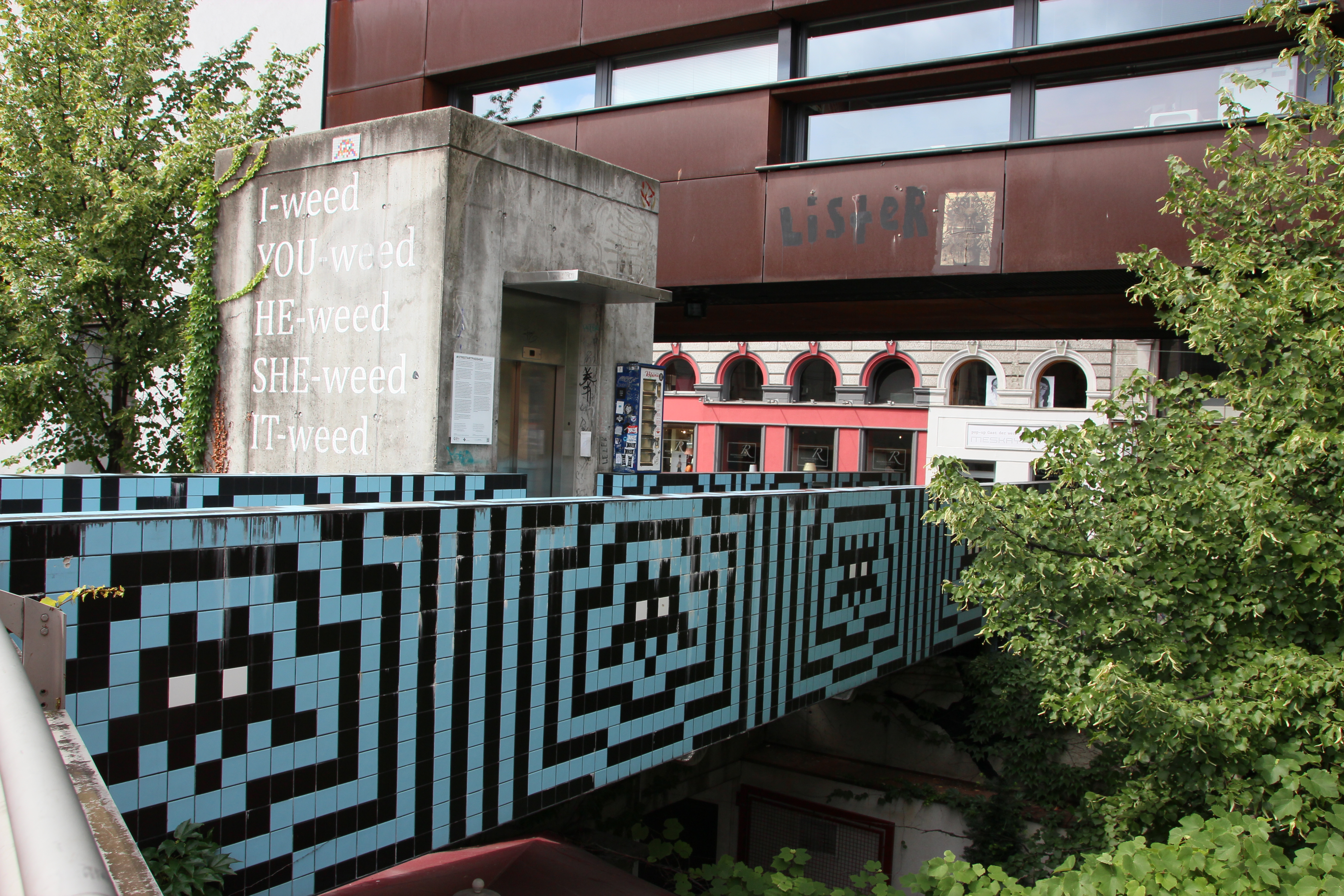
The two  permanent pieces of art in the passage by Invader (2008) and Lois Weinberger (2013) (Photo: Hannah Awcock).

The main feature of the passage is a tiled bridge by French artist Invader (2008). His distinctive Space Invader mosaics are a recognisable feature of many cities. There is also a permanent typographic piece by Lois Weinberger (2013), which is visible in the above picture on the wall behind the Invader bridge. There are also temporary exhibitions by a wide range of artists (you can see a full list here). There are two vending machines, which are supposed to contain mini catalogues and sets of stickers that you can buy for 2 Euros, but the machines were empty when I went there. In addition, each temporary artists produces a limited number of affordable screen prints, designed to encourage young art collectors.

When there is crossover between the informal, ephemeral tradition of  street art and more formalised traditions of artistic display like art galleries and museums, there can be tensions. Whilst street art is often associated with a certain urban ‘scruffiness,’ in the case of the Street Art Passage Vienna it just felt neglected. For me, street art is exciting and vibrant, it makes a city feel more alive. The Street Art Passage felt…stagnant.

If you want to see dynamic and vivid street art in Vienna, and lots of it, then I would recommend going to the Danube Canal, which splits of from the Danube proper north of the city centre, then loops round to the west of the river before rejoining the Danube further south. The canal is below street level, with a tow path on either side and concrete walls rising to the main roads that run either side. The walls on both sides of the canal are covered in street art, and there are also some sculptures along the tow paths. In the hour or so I was walking along the canal, I saw several artists working on pieces on the walls.

IMG_2640
The Danube canal is below street level, with concrete walls between the tow path and the street. The walls are covered in street art and grafitti (Photo: Hannah Awcock).
IMG_2671
The confluence of the Danube Canal with Wienfluss. In the bottom right of the photo, there is an artist working on an image of a woman (Photo: Hannah Awcock).
IMG_2654.JPG
An in-progress piece of street art on the wall under a bridge across the Danube Canal (Photo: Hannah Awcock).
Central Vienna map.JPG
A map of central Vienna with the Street Art Passage Vienna and the Danube Canal marked on it (Source: Google Maps, with alterations by the author).

Most guide books and websites will send you to the Street Art Passage Vienna if you’re looking for street art in the city. But I wouldn’t recommend it. The litter, dust bins, and empty vending machines felt a little sad. The street art at the Danube Canal, however, is energetic and vibrant, and helped me to connect to a city that had I had struggled to relate to previously.

Film Review: We Are Many

Rise, like lions after slumber

In unvanquishable number!

Shake your chains to earth like dew

Which in sleep had fallen on you:

Ye are many—they are few!”

The Masque of Anarchy, Percy Shelly, 1819.

We Are Many Landscape
A film poster for We Are Many, directed by Amir Amirani (Source: We are Many).

Many of you who has ever been to a protest will be familiar with at least part of the above quote, the final stanza of a poem written by Percy Shelley after the Peterloo massacre. We Are Many, a documentary film that tells the story of the Stop the War protests on the 15th February 2003, takes it’s name from the final line of this evocative poem. The film is not unjustified in borrowing such powerful words; it is a forceful and effecting documentary.

Directed by Amir Amirani, and first released at Sheffield Doc/Fest in 2014, We Are Many tells the story of the global protests against the imminent Iraq War on the 15th of February 2003. Up to 30 million people in nearly 800 cities took part, many of whom had never been to a protest before. The film uses news footage, interviews with participants, experts, and journalists, footage of protests, and clips of political speeches to tell the narrative of the protests themselves, as well as the events that led up to them, and the political movements they helped to inspire (you can see the trailer here).

Starting with 9/11 and the beginning of the War on Terror; the documentary traces the foundation of the Stop the War coalition; the growing opposition to military intervention in Iraq; the protests themselves; further attempts to prevent Western intervention in Iraq; the war itself; and the Tahir Square protests in Egypt. It ends with the vote by British Parliament in 2013 in which they decided against military intervention in Syria, an indication that, although the Iraq War was not prevented, the protest was not necessarily a waste of time. It is a comprehensive account, and I think it could have benefited from doing less, the last half and hour or so does drag somewhat.

A shot of the march against the Iraq war in London from the We Are Many press material (Source: We Are Many).

Overall, however, I thought it was a brilliant documentary. The interviews were particularly effective: a US air force veteran who came to oppose the war and US government officials admitting the war was wrong make for convincing viewing. The documentary also featured footage of the interviewees speechless. When the narrative arrives at the 19th of March when the war started, many of the interviewees were lost for words, even after a decade. That was pretty powerful.

When a protest doesn’t result in direct changes, it can be difficult to assess its impact. We Are Many admits that the Stop the War protests failed in their primary objective, and left many so demoralised that they withdrew from political engagement. The documentary does, however, make the argument that the 2003 demonstrations had long-term, positive impacts. It argues that the democracy movement in Egypt in 2011 was the product of the global anti-war movement, and highlights that when Britain faced the choice to invade Syria in 2013, MPs made a different decision than the government made a decade before. It is an interesting attempt to assess the impacts that a protest can have.

We Are Many is a comprehensive and emotive account of the events of the 15th February 2003. The global day of protest is thoroughly contextualised in both the events leading up to it, and the possible impacts it may have had. I would recommend this film as a teaching resource about both dissent and the Iraq War, or for those who are just curious about one of the biggest globally coordinated protests the world has ever seen.