This is not technically a sticker, but I like the work of this artist, so I decided to include it (Photo: Hannah Awcock, Oxford Street, 15/04/15).
On the 25th of August, Frankfurt City Council approved a bill that will ban the use of municipal funds for Boycott, Divestment Sanctions (BDS) activities targeting Israel, if it is approved by the city parliament. Frankfurt is the first German city to take this step, but it looks like Munich will follow suit in the autumn (Jerusalem Post, 2017).Uwe Becker, the deputy mayor and city treasurer for Frankfurt, argues that the movement is anti-Semitic. The BDS movement campaigns to put economic pressure on the Israeli state in order to compel Israel to obey international law in its dealings with Palestine. Founded in 2005, BDS is a coalition of groups from Palestine and around the world. London’s protest stickers suggest that support for the BDS movement is much stronger here than it is in Germany. In fact, every sticker I have found in relation to the Israel-Palestine conflict in London is pro-Palestine.
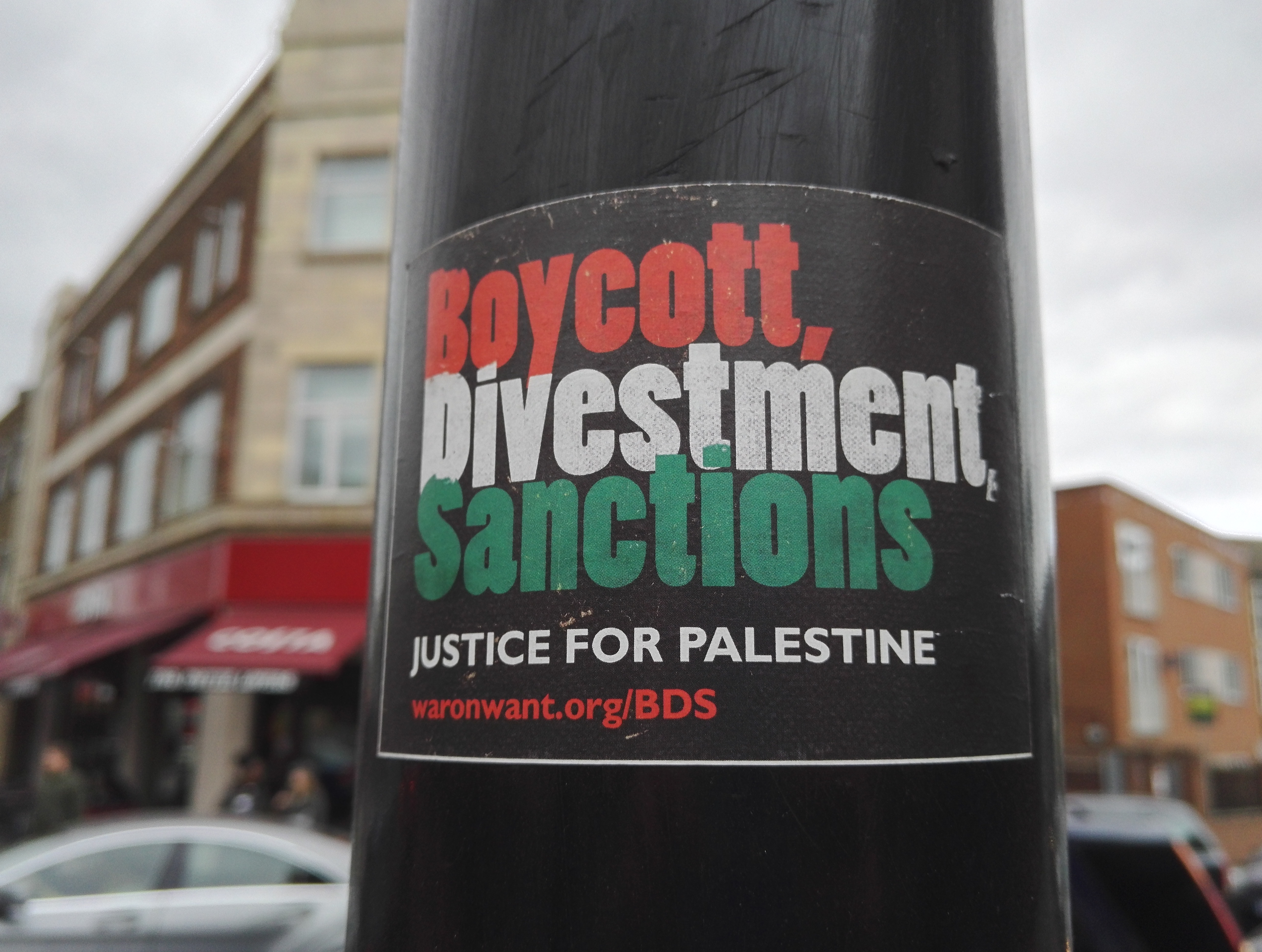
The colour scheme of BDS stickers usually reflects the Palestinian flag, which has three horizontal strips of black, white, and green, overlaid with a red triangle on the left hand side. War on Want is an organisation that campaigns on multiple issues relating to human rights, social justice, and the root causes of poverty (Photo: Hannah Awcock, Lewisham Way, 20/03/16).
This sticker, which features the Palestian flag, is produced by the Palestine Solidarity Campaign, which claims to be the biggest organisation in the UK campaigning for Palestinian human rights (Photo: Hannah Awcock, Royal Mint Street, 25/02/15).
This sticker doesn’t directly refer to the BDS campaign, but it does also use the colours of the Palestinian flag (Photo: Hannah Awcock, Cable Street, 25/02/15).
Again, this sticker uses the colour scheme of the Palestinian flag (Photo: Hannah Awcock, Pentonville Road, 23/03/17)
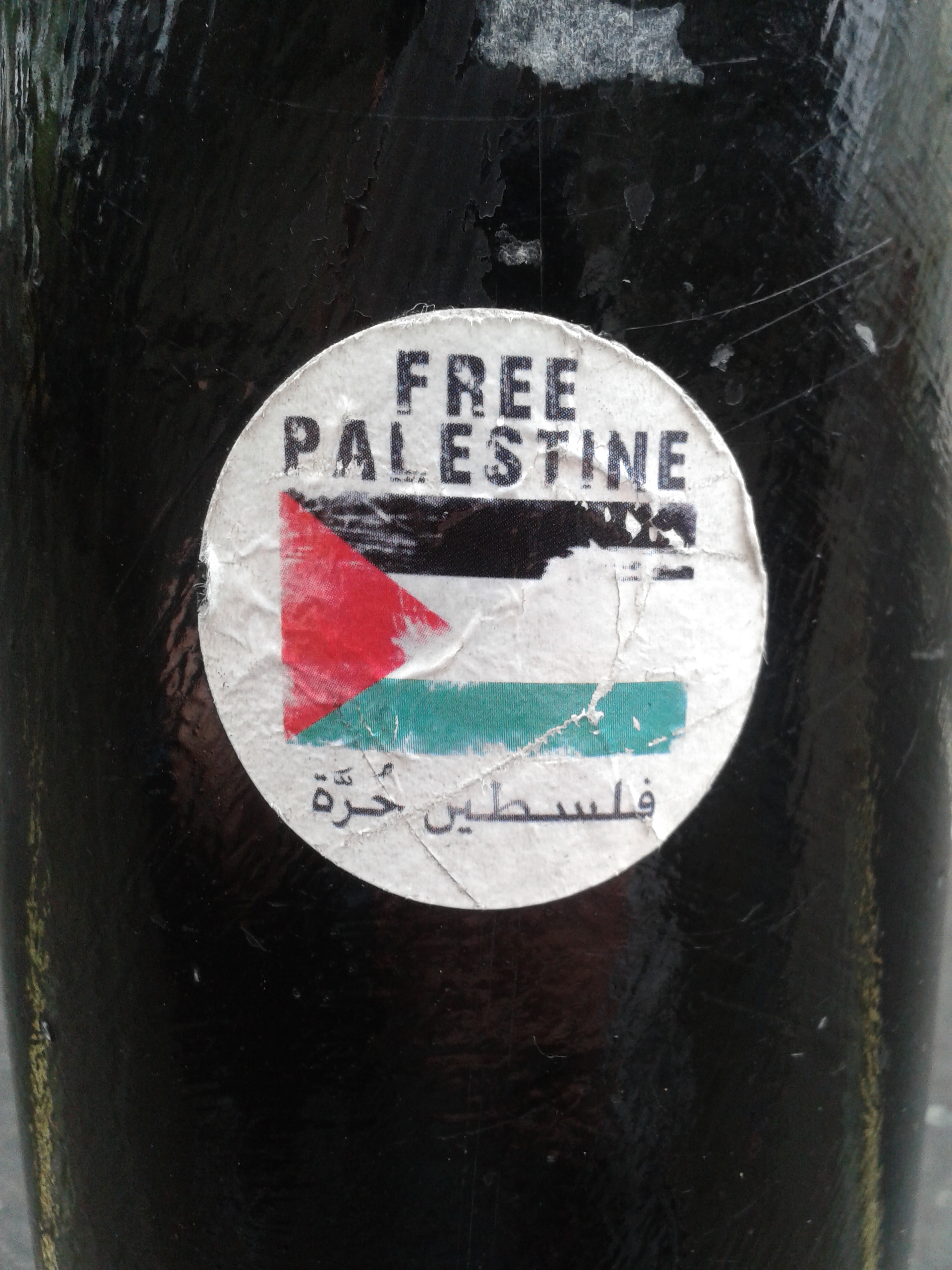
I suspect that this sticker was designed to be worn by people rather than street furniture, because of its small, round shape. However, stickers worn on street furniture tends to last longer than stickers worn on clothes (Photo: Hannah Awcock, British Museum, 12/05/15).
This sticker was produced by the Socialist Worker Student Society, the student arm of the Socialist Worker’s Party, a revolutionary party that campaigns for socialism and internationalism (Photo: Hannah Awcock, Malet Street, 28/05/17).
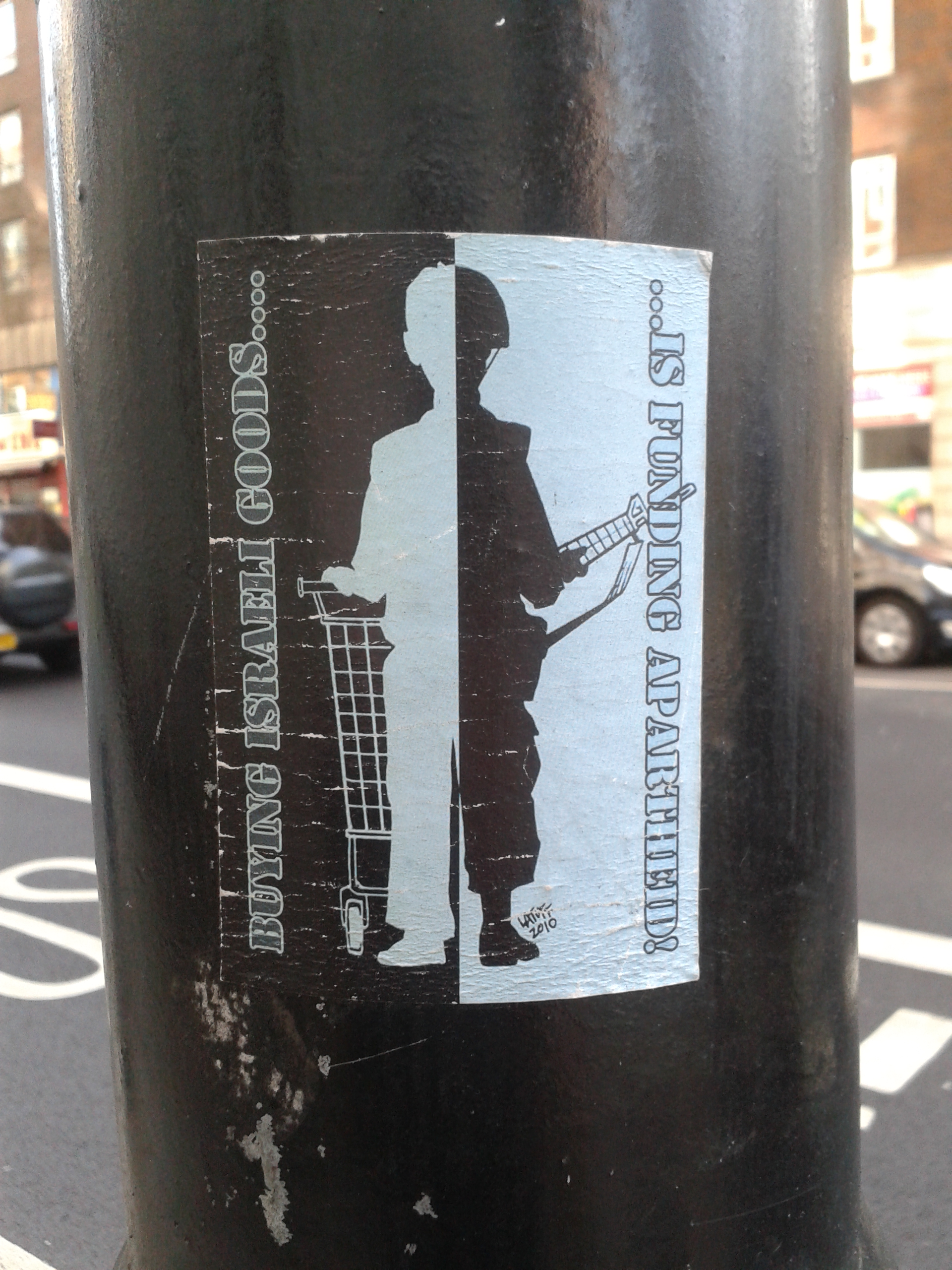
This sticker does not use the traditional BDS colour scheme, but it does illustrate the logic behind BDS in a way that I think is quite striking (Photo: Hannah Awcock, Russell Square, 15/04/15).
The boycott element of BDS includes academia. In 2015, the SOAS Student Union held a referendum over whether or not the university should implement an academic boycott. The students voted yes to the boycott (Photo: Hanna Awcock, Malet Street, 17/02/15).
This sticker Revolutionary Socialism in the 21st century is a group that campaigns on a whole range of issues. This sticker is calling for BDS, using the image of Benjamin Netanyahu, Israel’s prime minister (Photo: Hannah Awcock, Gordon Street, Bloomsbury, 09/08/15).
The printed copies of my thesis before I submitted them (Photo: Hannah Awcock)
A few weeks ago, I passed my PhD viva! As my viva got closer, I spoke to lots of people about theirs, and many had actually enjoyed the chance to talk in-depth about their work. I also trusted the work that I have put in over the last four years, and trusted that my supervisors would have told me if they thought my thesis would fail the viva. So whilst I was nervous about my viva, I was also quite looking forward to it. Whilst I wouldn’t go so far as to say I enjoyed the viva, I definitely would not say it was a negative experience, and it definitely wasn’t the terrifying occasion that some people expect it to be.
I think part of the reason I wasn’t too nervous before and during my viva was the preparation I had done. I read my thesis, trying to identify anything my examiners might ask about, and made notes on a series of general questions that I thought might come up. I found this to be quite a good way of getting ready for the viva; I felt well-prepared. I put the list of possible questions together from advice from my supervisors and others, and from the websites listed below. The list of questions that I prepared for, in no particular order, are:
How did you come to research the topic/how does it relate to your earlier studies?
Who are your intellectual influences?
Summarise your key findings?
Why did you choose your case studies?
Explain your relationship with theory.
What is original about your work/ what are your contributions to knowledge?
How does your work contribute to geographical debates?
Which topics overlap with your area?
What are the strongest parts of your work? What are the weakest?
Looking back, what might you have done differently?
Do you have any plans for publishing your work?
What did you learn from the process of doing your PhD?
What are the main issues and debates in this subject area?
Why was your research worth doing?
What published work is closest to yours? How is it different?
How have you evaluated your work?
How has your thinking about the topic changed as your research went on?
Did you have any problems with the data collection process?
How would you hope that this research could be followed up and taken further?
Do you have any questions for the examiners?
I didn’t get asked all of these questions during my viva, but most of them came up in some shape or form.
And here is a list of webpages and blogs that I used to collate my list of questions and for other general advice:
Nasty PhD Viva Questions by Dr. Andrew Broad is written from a Computer Science perspective, but I think that most of it is generic enough to be helpful to other subjects. As well as a list of possible viva questions, it also contains advice for preparing for the viva in other ways, such as preparing a summary of your thesis.
David Denyer:Questions in a PhD Viva provides another list, as well as some general tips about the attitude with which to approach your viva. Many of the questions are similar to those in the other resources listed here, but I thin that is quite reassuring, as it shows that similar kinds of questions do tend to come up again and again.
The Guardian Higher Education Network:How to Survive a PhD Viva: 17 Top Tips is a compilation of advice from different people. It covers both before and during the viva.
A celebratory post-viva selfie with my family and partner (Photo: Hannah Awcock).
I have two main pieces of advice about doing a PhD viva. The first is don’t blag answers; if you feel like you can’t answer a question, or need to spend a bit more time thinking about it, then have the confidence to say that. The second piece of advice is take a few moments to think before you answer each question; there’s no rush, and the examiners will appreciate a more thoughtful answer. Fundamentally though, try to relax– you never know, you might actually enjoy yourself! Whilst the viva itself is important, your thesis is what really matters. The viva lasts only a few hours, but the thesis is your lasting legacy, and in many ways, it speaks for itself.
Walk the Lines: The London Underground, Overground by Mark Mason.
Mark Mason. Walk the Lines: The London Underground, Overground. London: Random House, 2011. RRP £8.99 paperback.
The London Underground is one of the most distinctive elements of the city, but it does result in a disjointed perception of the metropolis–I don’t feel like I really got to know how the various areas of London fit together until I moved there and started to walk or get the bus more. Walk the Lines: The London Underground, Overground is the ultimate exercise in getting to know London; author Mark Mason walked the route of every underground line from beginning to end, then wrote a book about it.
I think the concept for this book is excellent; but unfortunately I am not so keen on its execution. I think it would be really interesting to repeat this challenge in a decade or so, London changes so quickly that some of Mason’s observations already feel out of date.
Sadly, I did not get on so well with Mark Mason’s writing. I did not like the tone of the book at all when I started reading it; it felt like Mason was trying too hard to be funny. This did become less noticeable as I progressed through the book, but I couldn’t say whether it’s because the tone improves or because I just got used to it. I also dislike Mason’s heavy use of footnotes. They interrupt the flow of the writing, and sometimes I missed the superscript, and found myself searching the page for the relevant point. I think they are unnecessary in Walk the Lines.
I also found Mason himself to be a bit arrogant–one of his reasons for undertaking the challenge was to own London, a desire which I think is conceited and a bit odd, quite frankly (p. 4-5). Nobody owns London. If anything, the opposite is true; there have been several occasions when I have felt that London’s influence over my life has been a bit too significant for comfort. In addition, Mason is snobbish about anything that is ‘not London.’ He seems to look down on other cities and London’s suburbs, and view them as automatically inferior. I understand that both of these attitudes come from a great love of London, I too am captivated by it. I am just not so keen on how this affection manifests itself in Mason’s writing.
The final significant issue with Walk the Lines is the lack of photographs. This is a book about the many different faces of London, but there is not a single image of Mason or the different aspects of London he encountered on his walks.
The concept of Walk the Lines is not the only element of the book that I liked however. I enjoyed Mason’s musings on the subjectivity and power of maps, although these are not new ideas to geographers. The book also contains some decent historical facts. For example, London cabbies call the junction on which the Royal Geographical Society sits ‘Hot and Cold Corner,’ because the building has statures of David Livingstone and Ernest Shackleton. Finally, I enjoyed the sections when Mason stops along his walks to talk to other people about their perceptions of London, such as: artist and ex-Popstar Bill Drummond; The Archers actor Tim Bentinck, who was the ‘Mind the Gap’ voice on the Piccadilly Line for 15 years; and John Pearson, the official biographer of the Kray twins.
I enjoy reading books about London, and I admire the inventive approach in Walk the Lines. I’ve always thought that the best way to get to know a city is to walk around it, and I like the idea of using a city’s transport network, effectively its circulatory system, to organise such exploration. However, I am not so keen on Mason’s writing style or attitude towards London. This is not a bad book, it just isn’t a great one either.
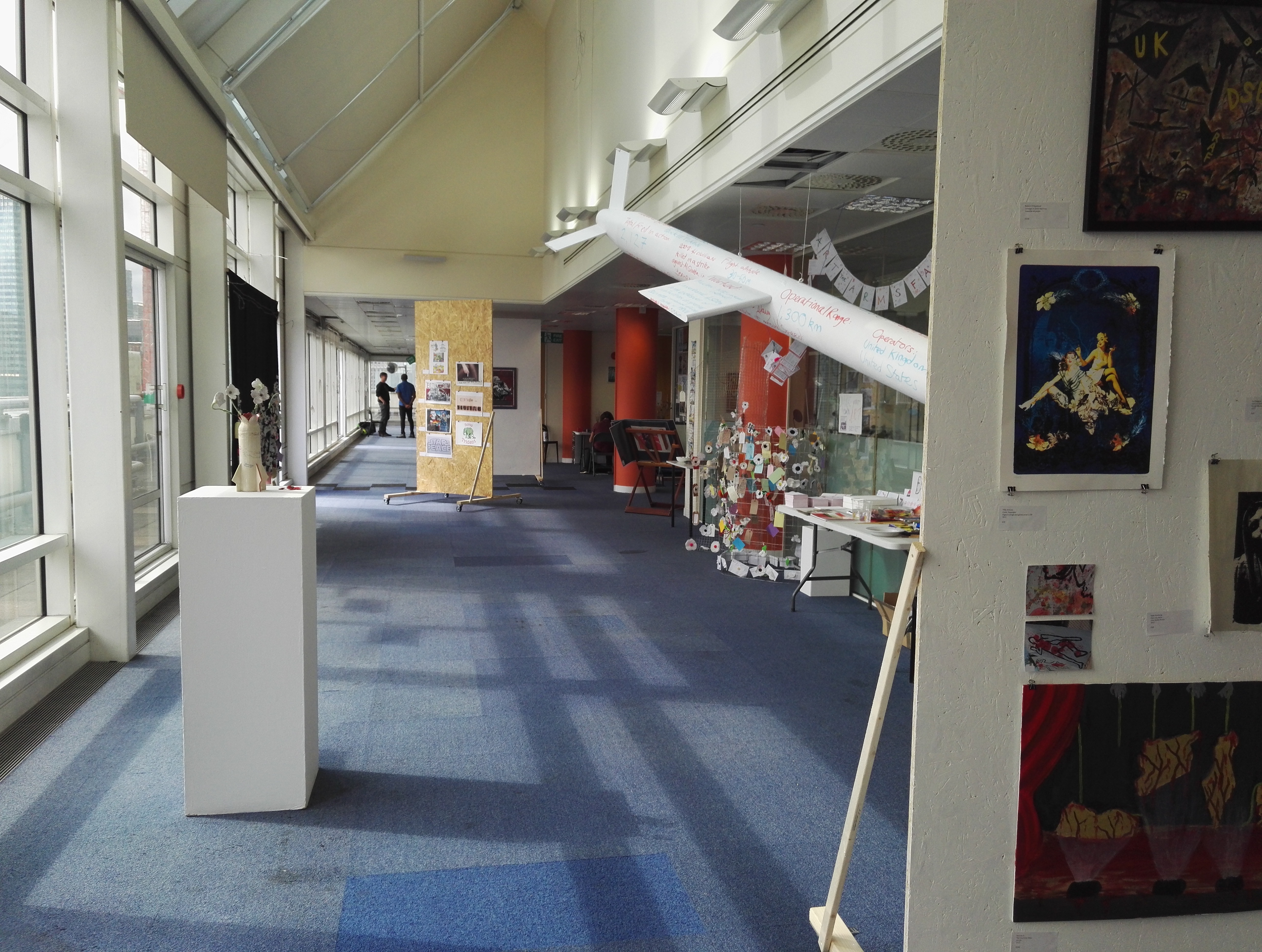
Poppies in a rocket (2017) by Anonymous. One of the pieces on display at the Art the Arms Fair exhibition (Photo: Hannah Awcock).
Every two years, the Defence and Security International exhibition, known colloquially as the DSEI arms fair, takes place in the vast ExCel Centre in East London. People come from all over the world to see and purchase the latest weapons and defence technology at one of the world’s largest arms fairs. Every year, there are protests attempting to stop, disrupt, and draw attention to the event. This year, at the same time, the 12th-15th of September, a very different kind of exhibition also took place in East London, with the aim of raising awareness of the DSEI, an event which most Londoners have no idea exists. The Art the Arms Fair exhibition took place at SET Studios in Capstan House in Poplar. It was preceded by an art event on the 9th of September at the ExCel Centre, where artists produced works in a variety of mediums. The exhibition displayed art that responded to the arms trade. Events, such as spoken word and comedy, were held in the space in the evenings. Works were sold to support the Campaign Against Arms Trade (CAAT), an organisation which aims to end the international arms trade. I have always been a little sceptical about the significance and power of art, so I went along to see if I could be convinced.
To begin with, SET Studios is not your typical art gallery. SET is an initiative that provides artists with affordable studio and project space in buildings that would otherwise be empty. Capstan House is a stylish new office block, with an imposing foyer and fancy elevators. SET occupies the seventh floor, with beautiful views across the Thames to the O2 arena and the Emirates Airline Cable Car. You can see the artists’ studio space through the glass walls that are so fashionable in modern offices. The art, some of it attached haphazardly to plywood display boards, sits oddly in this environment. But none of that detracted from the effect the exhibition had on me. In fact, it might well have contributed to the disconcerted feeling with which I left the exhibition.
Capstan House in Poplar, the location of the Art the Arms Fair exhibition (Photo: Hannah Awcock).
The Art the Arms Fair was not housed in what I would describe as a typical art gallery space, but I think that only added to its impact (Photo: Hannah Awcock).
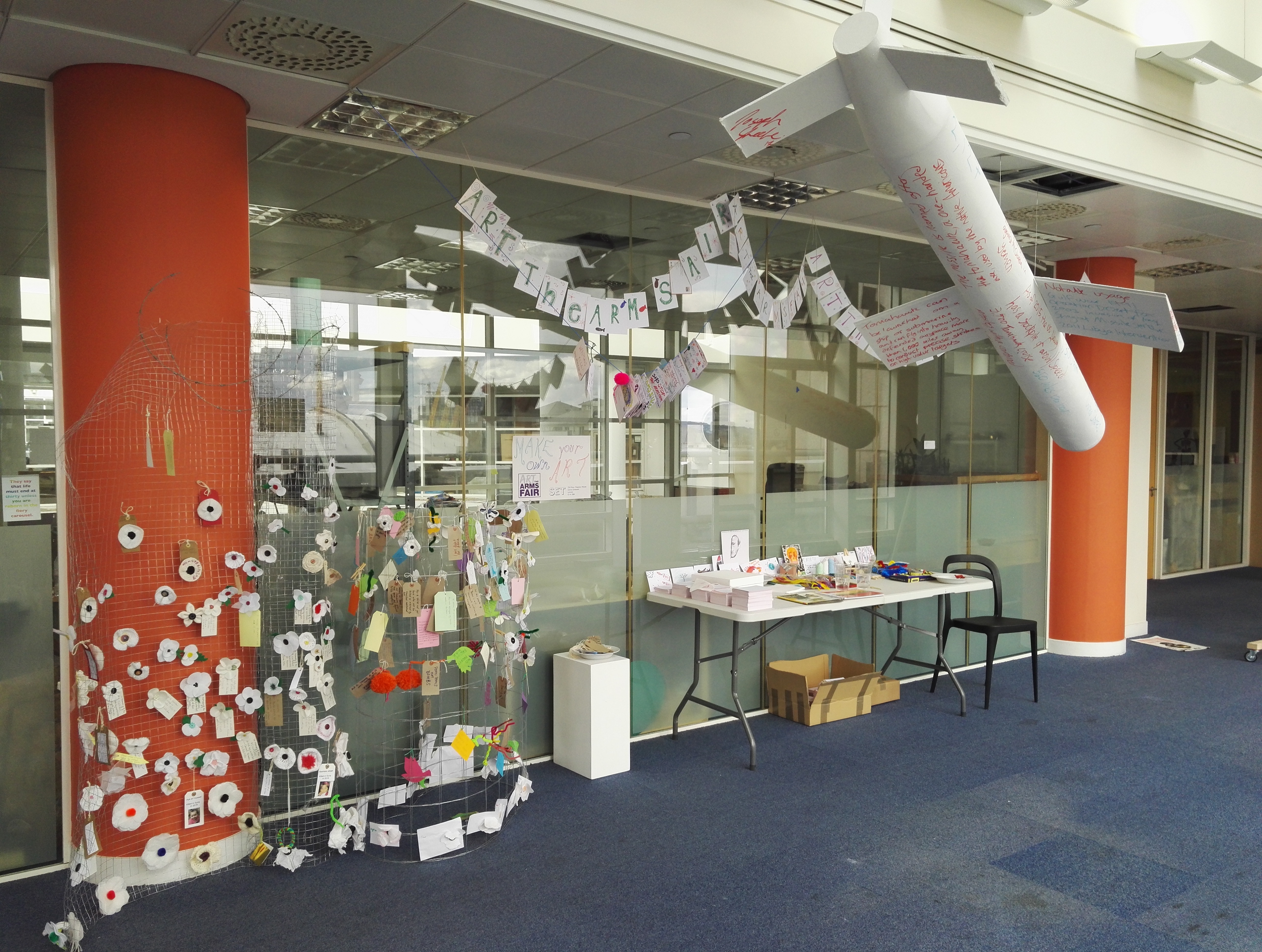
As I said at the beginning of this post, I am not a great believer in the power of art. I did not need to be convinced that the arms trade was a bad thing; I was already a strong believer in the futility and cruelty of war. But I left the exhibition feeling a lot more emotional than I expected to. Whilst I thought some of the artwork was good, I think what really affected me was the opportunity to ‘Make Your Own Art’ on blank postcards. Attempting to focus my response to the arms trade on one small rectangle of white card clarified and crystalised my feelings in a way that I was not expecting.
The ‘Make Your Own Art Section’ of the exhibition. The piece suspended from the ceiling is Half scale Tomahawk missile by Joseph Steele (2017). I think this is what made me connect with the exhibition so much (Photo: Hannah Awcock).
Some of the art produced by visitors to the exhibition (I’m not going to say which one is mine!) (Photo: Hannah Awcock).
The Art the Arms Fair exhibition was powerful and emotive. It’s main stated goal was to make the DSEI arms fair visible, to make people aware of its existence. It would be hard to say how far that goal was achieved; the exhibition was nowhere near the ExCel Centre, and the area didn’t seem like the kind of place that people just pass through, so it was unlikely to attract many people who didn’t already intend to visit. I do wonder if an art exhibition in an out-of-the-way office block in East London is really the best way to raise the profile of the DSEI. Nevertheless, it hopefully raised some money for CAAT, and provided a space for creative opposition to the arms trade. At the end of the day, I am reluctant to criticise anyone who is attempting to make a positive difference in the world, as doing something is very often better than doing nothing.
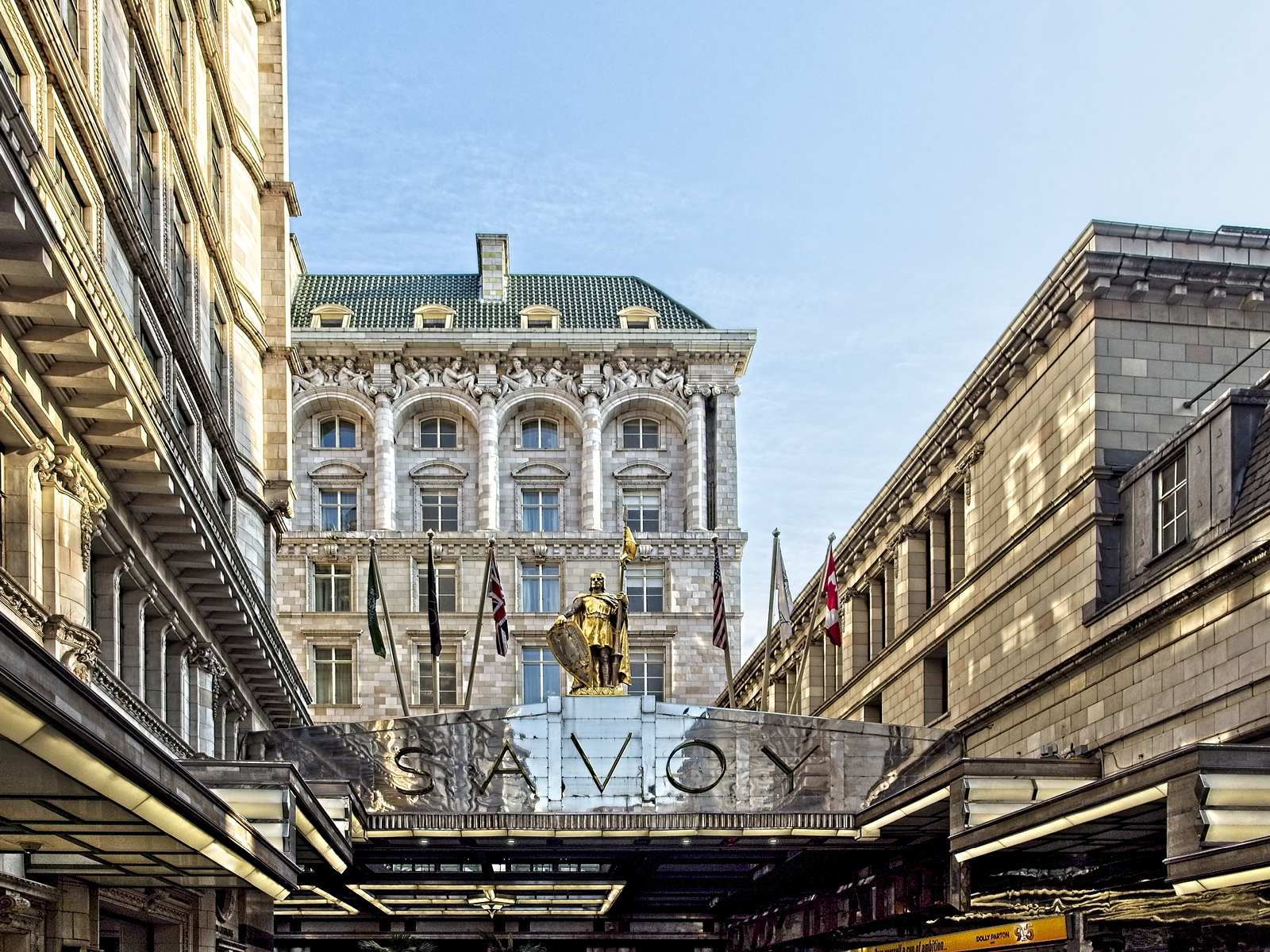
When we think of London during the Second World War, we think of the Blitz. When we think of the Blitz, we think of the Blitz spirit epitomising the British stiff upper lip. There is a collective imaginary of Londoners banding stoically together, facing down the Nazis with a grim smile, a cup of tea, and maybe a sing song. But London was not always united in the face of the enemy. The occupation of the Savoy Hotel on the night of the 14th September 1940, the 8th night of the Blitz, was a manifestation of some of these divisions.
In the early days of the Blitz, there was a serious lack of deep shelters in the East End, which was particularly hard hit due to the high levels of industry in the area. Pre-war planning by the government had rejected deep shelters in London, afraid that a ‘shelter mentality’ would develop. They decided instead to issue gas masks and rely on surface level shelters, such as the Anderson shelter. It very quickly became obvious that this provision was insufficient. What shelters there were lacked facilities and were overcrowded.
The Communist Party immediately took up the cause. the London district printed 100,000 leaflets and 5,000 posters calling for better provision of shelters and the requisitioning of empty houses for the homeless. The East End Communists decided to march for better air raid shelters in the East End, and to highlight the fact that not all Londoners suffered the effects of the bombs equally.
With the help of some sympathetic waiters, between 40 and 70 protesters occupied the Savoy’s luxurious air raid shelter. The shelter was divided into cubicles, with beds and armchairs. Nurses and waiters served the hotel’s guests during raids. When the air raid siren went off, the Savoy’s manager realised he could not chuck the occupiers out; they would have to stay the night. After some negotiation with the catering staff, the occupiers were provided with tea, bread, and butter. All in all, it was a pretty pleasant way of drawing attention to the disparity of deep shelter provision across the capital.
The contrast between the shelter conditions for the rich and the poor called for exposure. This was done…One Saturday evening we gathered some seventy people, among them a large sprinkling of children, and we took them to the Savoy Hotel. We had heard from building workers of the well-constructed and luxurious shelter which had been built for their guests. We decided that what was good enough for the Savoy Hotel parasites was reasonably good enough for Stepney workers and their families.
Phil Piratin, Our Flag Stays Red (London: Lawrence and Wishart, 2006); p. 73. Phil Piratin was a prominent member of the Communist Party, and became one of the party’s first MPs in 1945. He was present during the occupation of the Savoy.
The Blitz was one of the darkest periods in London’s history. By the time it ended 43,000 British civilians had been killed, half of them in London. Protest and dissent was less common during the world wars than in peace time, but Londoners were willing to fight for decent air raid shelter provision. Thanks to actions such as the occupation of the Savoy Hotel, the situation greatly improved, making the lives of Londoners that much more bearable as the bombs fell.
Sources and Further Reading
German, Lindsey, and John Rees. A People’s History of London. London: Verso, 2012.
Piratin, Phil. Our Flag Stays Red. London: Lawrence and Wishart, 2006.
The RGS-IBG Annual Conference is held at the Society’s headquarters in South Kensington two years out of every three (Photo: Hannah Awcock).
I spent most of last week at the Annual Conference of the Royal Geographical Society with the Institute of the British Geographers (RGS-IBG). It is one of the biggest events in British academic geography’s calendar; this year there were more than 1600 participants and 380 sessions. This was my third time at the conference (my previous trips were in 2016 and 2014), and as always, I had a brilliant time. One of the things that I love most about geography is that is such a broad and varied subject; you can study the geography of anything and everything. The conference really brought that home. I attended a wide variety of sessions, on topics from digital geography to the geographies of dissent to historical geography.
For the last year, I have been on the committee of the RGS-IBG’s Digital Geographies Working Group. As part of that, I looked after the Group’s Twitter account during the conference, so I went to several digital geography-themed sessions, including really interesting sessions on the role of the digital in commemoration, and the geography of video games. Digital geography relates to a whole range of different elements of academia; it can be a topic of research, a method of research, or a way of communicating research. My interest in digital geography comes from thinking about the ways that social media and the internet is used by protesters.
Because of the topic of my research, the geographies of dissent was also a big part of the conference for me. Conferences are a great way of keeping up to date with new research in your field, and they also allow you to meet the people doing that research. I presented my research in a session called Geographies of Activism and Protest, and a had a brilliant time meeting the other presenters and discussing our research. There was also quite a large audience as well, which was especially nice considering it was the final session on the last day. I also went to some really interesting sessions on the geographies of opposition, political geographies of the event, populism, and anti-colonialism.
When I’m at a conference, I also like to go to some sessions that have nothing to do with my research or any other commitments, but just sound interesting. I went to the second of three New and Emerging Research in Historical Geography, and heard some great papers on Scottish travelling fairgrounds, the property of eighteenth-century widows, and the practice of Victorian monarchy, amongst others. The conference’s opening plenary, on decolonising geographical knowledge, was brilliant, and I went to a lecture on land titles that was much more interesting than it sounds!
Big international conferences like the RGS-IBG are exhausting, and sometimes a bit bewildering. But they are also great fun, and can be incredibly rewarding. At the RGS-IBG, you can find geographies of all kinds, and I personally think that embracing that variety is a great way to make the most out of the conference.
Turbulent Londoners is a series of posts about radical individuals in London’s history who contributed to the city’s contentious past, with a particular focus of women, whose contribution to history is often overlooked. My definition of ‘Londoner’ is quite loose, anyone who has played a role in protest in the city can be included. Any suggestions for future Turbulent Londoners posts are very welcome. The next Turbulent Londoner is Katherine Chidley, an activist for religious toleration and a leader of Leveller women.
A drawing of a servant or housewife in 1640 by Wenceslas Hollar. Katherine Chidley might have dressed like this (Source: ECW Living History Resources).
The further back in time you go, the harder it is to find out about individuals who weren’t members of the aristocracy, especially if they were women. There are some women who managed to leave a trace in the archives, often thanks to their radicalism, such as Mary Astell (1666-1731) and Elizabeth Elstob (1683-1756). Katherine Chidley lived even earlier, between the 1590s and about 1653. She was a religious dissenter and a key member of the radical networks that preceded the Levellers, as well as the Levellers themselves.
The first time Katherine Chidley appears in the historical record she is already married with seven children. Along with her husband Daniel, she set up an independent church in Shrewsbury in the 1620s which clashed with the local established church. At this point everyone was required by law to be a member of the Church of England, and there was no toleration for anyone who wanted to worship differently. Radical religious sects had an emphasis on church democracy, which meant that women played more of a role than in other sectors of society, as preachers, prophetesses and petitioners. In 1626 Katherine was charged with refusing to attend church, along with 18 others. She also got in trouble for refusing to attend church for an obligatory cleansing after childbirth.
The Chidley family moved to London in 1629. Katherine’s husband became a member of Haberdashers Company, and their oldest son Samuel started an apprenticeship in 1634 . The family’s views became more radical and separatist after they moved to London. Daniel and Samuel helped to establish a dissenting congregation headed by John Duppa. The congregation claimed the right to choose their own pastor not paid for by Church funds. The congregation itself was illegal, and its members faced harassment, arrest, and imprisonment.
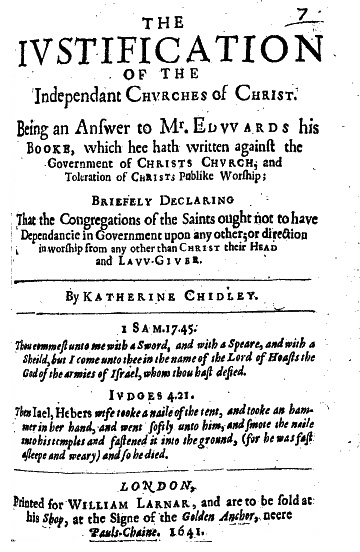
Katherine authored several pamphlets in defence of religious radicalism. Thomas Edwards was a popular puritan preacher at the time, who argued against religious Independents from a conservative Presbyterian perspective. In 1641 he published a pamphlet, addressed to Parliament, arguing against religious tolerance. Katherine was the first to attack Edwards’ arguments in print, in her first pamphlet. It was called The Justification of the Independent Churches of Christ, and it was very unusual for a woman to take such a step. Edwards ignored her response, embarrassed to have been so publicly confronted by a woman.
Katherine’s concept of toleration was broad, even extending to Jews and Anabaptists, groups that faced extreme discrimination at the time. She believed that everyone should be able to organise their own churches if they so desired. Katherine did view women as weak and inferior to men, but she defended a wife’s right to make her own decisions about religion. She also frequently discussed examples of God using the weak or socially inferior to defeat the powerful and ungodly. Katherine may not have been a feminist by modern standards, but her views were radical for the time. She published 2 more pamphlets in 1645. The first was another attack on Thomas Edwards, called A New-Yeares-Gift, or a Brief Exhortation to Mr. Thomas Edwards; that he may breake off his old sins, in the old yeare, and begin the New yeare, with new fruits of Love, first to God, and then to his Brethren. They didn’t really go for snappy titles in the seventeenth century.
When the Leveller network emerged, Katherine became a leader of Leveller women. The Levellers were a radical movement that argued for popular sovereignty, equality before the law, and religious toleration. They gained significant popular support between the First and Second English Civil Wars, but were considered too radical even for Oliver Cromwell and the Protectorate. Daniel died in 1649, and it seems as though Katherine took over his business with the help of Samuel. As well as being a religious radical, she was also a successful businesswoman, handling government contracts worth significant amounts. In 1649 Katherine was one of the organisers, and probably the author, of a women’s petition to free four Leveller leaders from the Tower of London. In 1653, when Leveller leader John Lilburne was again imprisoned and charged with treason, Katherine led a group of 12 women to Parliament to present a petition demanding his release signed by 6000 women.
An image of a meeting of Leveller women in 1647, created by Red Saunders in 2014 as part of the Hidden Project (Source: Red Saunders).
Although much of her activism involved male family members, and she believed that women were inferior to men, Katherine Chidley was a fierce woman who fought for the right to make her own decisions about how she worshipped. There is no trace of her in the historical record after 1653, so the rest of her life is a mystery.
Sources and Further Reading
Rees, John. The Leveller Revolution: Radical Political Organisation in England, 1640-1650. London: Verso, 2016.
The Reformers’ Memorial stands in the non-conformist section of Kensal Green Cemetery in the London borough of Brent (Photo: Hannah Awcock).
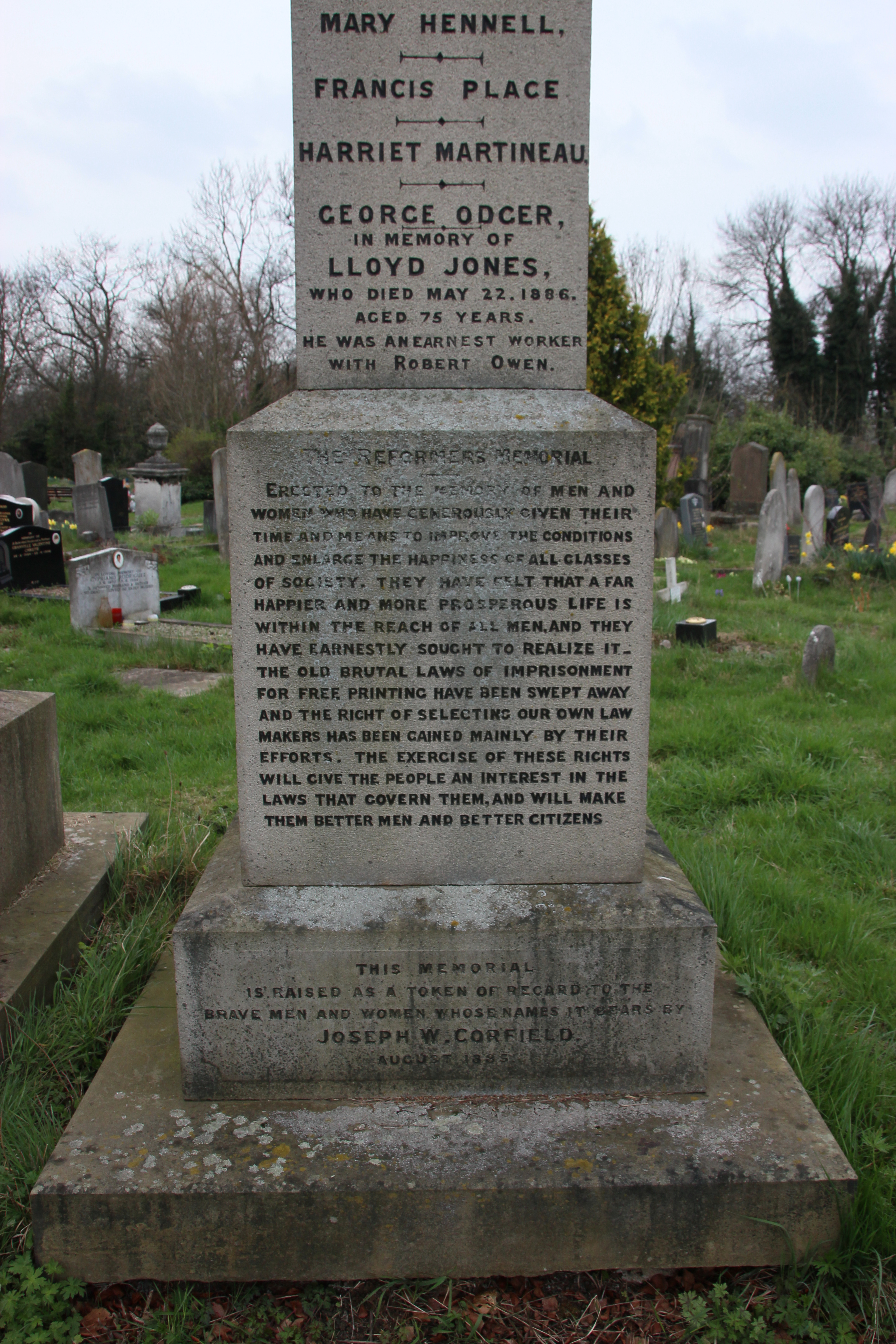
The Reformers’ Memorial in Kensal Green Cemetery in Brent in north east London is a lesser-known memorial to 75 British reformers. Some of the better known include: Elizabeth Fry, prison reformer; Charles Bradlaugh, MP and atheist; John Ruskin, writer, artist, and social reformer; William Cobbett, parliamentary reformer; and John Stuart Mill, philosopher and political economist. Erected in 1858, the memorial was update in 1907, restored in 1997, and given Grade II listed status in 2001.
Kensal Green Cemetery was the first of the ‘Magnificent 7’, cemeteries established in the 1830s and 40s in what was then the suburbs of London to reduce overcrowding in inner city burial grounds. Highgate Cemetery, the final resting place of Karl Marx, was the third of the Magnificent 7 to be established, in 1839. Kensal Green Cemetery is well worth a visit in its own right, it has a peaceful, eerie beauty that contrasts sharply with the often manic atmosphere of modern London.
The Reformers’ Memorial is located in the non-conformist section of the cemetery, located close to the main entrance, near the crossroads of Harrow Road and Ladbroke Grove/Killburn Lane (I’m giving detailed directions because I had trouble finding the memorial–I entered the cemetery by a smaller gate, where they weren’t giving out maps).
The memorial and it’s pair, an obelisk dedicated to the memory of Robert Owen, stand out amongst the graves of Kensal Green Cemetery’s non-conformist section (Photo: Hannah Awcock).
The two memorials in around 1900. The Reformer’s Memorial only had 50 names inscribed on it at this point; the rest were added in 1907 by Emma Corfield (Photo: People’s Collection Wales).
The memorial is a grey granite obelisk on a sandstone base, signed by J.S. Farley masons. It was erected in 1885 by Joseph William Corfield. The names of 50 well-reformers, “who have generously given their time and means to improve the conditions and enlarge the happiness of all classes of society,” were inscribed in the stone. Two decades later, in 1907, Joseph’s daughter Emma added a further 25 names. It is a pair to the Robert Owen memorial, a pink and grey granite obelisk erected in 1879, by public subscription organised by Joseph Corfield. Owen was a Welsh social reformer, and one of the founders of the cooperative movement. Both memorials were refurbished in 1997, at the instigation of Stan Newens, an MP and MEP for both the Labour and Co-operative parties. Both memorials were given Grade II listed status in 2001 for their “special architectural or historic interest” (Historic England, n.d.). It is unusual to have non-funerary monuments in a public cemetery, so the two memorials stand out in this regard too.
The main inscription of the Reformer’s Memorial (Photo: Hannah Awcock).
Radicals and activists place a great deal of significance on the past; historical movements, groups, and individuals, are a powerful source of inspiration, encouragement, and identity. Both the Reformer’s Memorial and the Robert Owen Memorial are a reflection of this appreciation of the past. They give us an insight into how late-Victorian non-Conformists perceived their radical history. The reformers listed on the memorial indicate who the Corfield family looked up (or back) to, and what kinds of behaviour and causes they were inspired by. Memorials are as much a reflection of the time in which they were produced as they are of the past they are representing, which is one of the things that makes them so interesting.
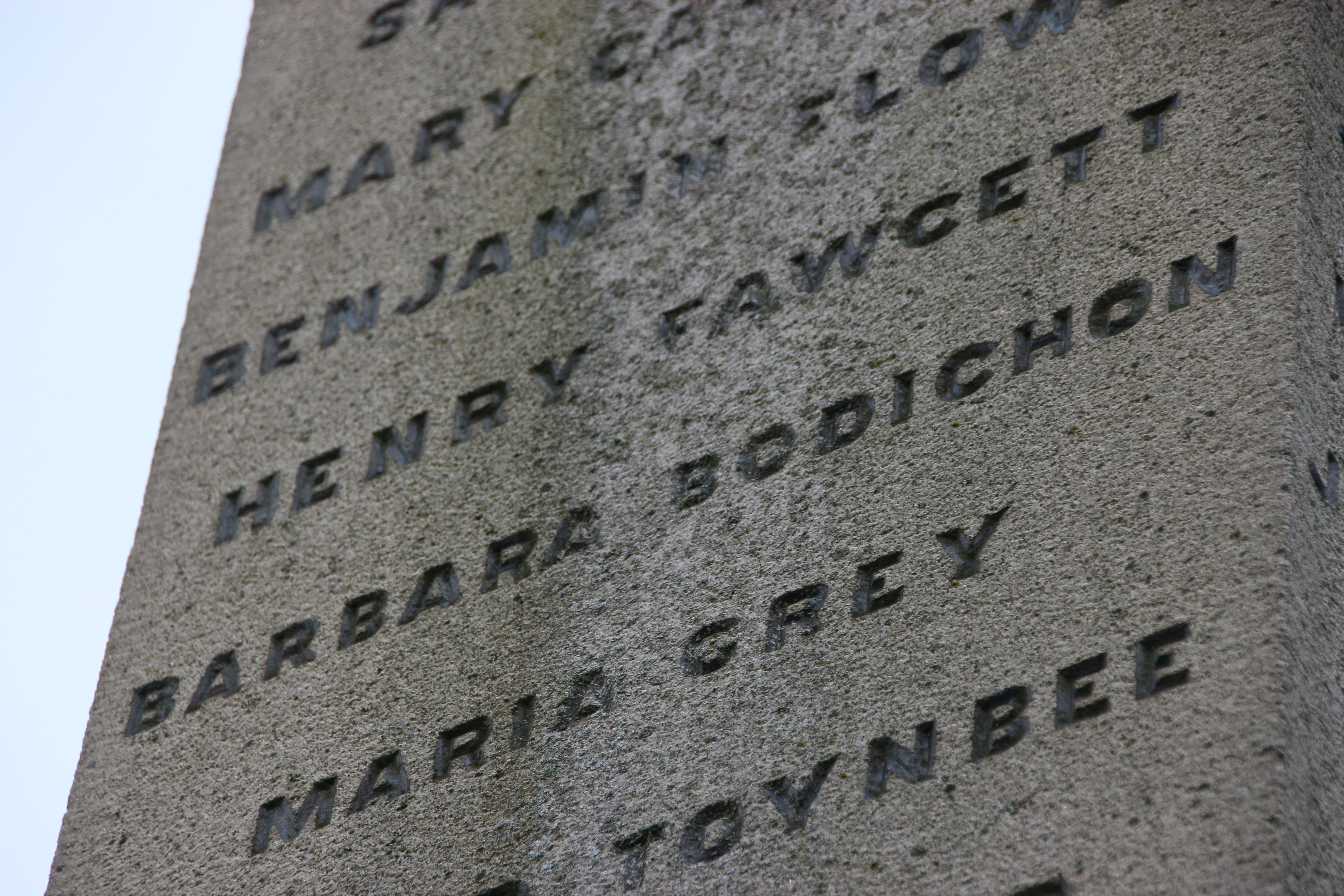
Some of the names on the Reformer’s Memorial are beginning to be obscured by the effects of the weather and time (Photo: Hannah Awcock).
I don’t imagine that the Reformer’s Memorial receives that many visitors. It’s a little obscure; even a stonemason working in the cemetery didn’t know what it was when I asked for directions. It is also starting to look a bit weathered, and some of the names at the top of the obelisk are partially obscured. I for one think this is a shame, so if you ever find yourself with a bit of time to kill in London, why not pay it a visit, and commemorate those who “felt that a happier and more prosperous life is within the reach of all.”
People’s Collection Wales, “Robert Owen Memorial Obelisk at Kensal Green Cemetery, London, c.1900.” No date, accessed 13th August 2017. Available at https://www.peoplescollection.wales/items/7192
Manchester is a wonderful blend of old and new (Photo: Hannah Awcock).
A few months ago, I spent a couple of days in Manchester. I’ve already blogged about the brilliant museums I visited whilst I was up there (the People’s History Museum, and the Imperial War Museum North), but I also found some great protest stickers whilst exploring the city. Paying attention to a city’s protest stickers helps me get to know a place, by giving me an insight into the issues that matter to the city. Manchester had a lot of protest stickers, many of which I hadn’t seen before, which is just one of the reasons I liked it so much. Manchester is a vibrant city with a fascinating history. Protest stickers in some cities are dominated by only one or two issues (Newcastle, for example, had a lot of stickers relating to animal rights), but this was not the case in Manchester. Its diversity is reflected in the wide range of issues that are represented in the city’s stickers. There were also a lot of stickers in Manchester that I haven’t seen before; I have not seen any of the stickers featured in the post anywhere else. I’m not saying they are all unique to Manchester, but it is an indication of the city’s healthy culture of dissent.
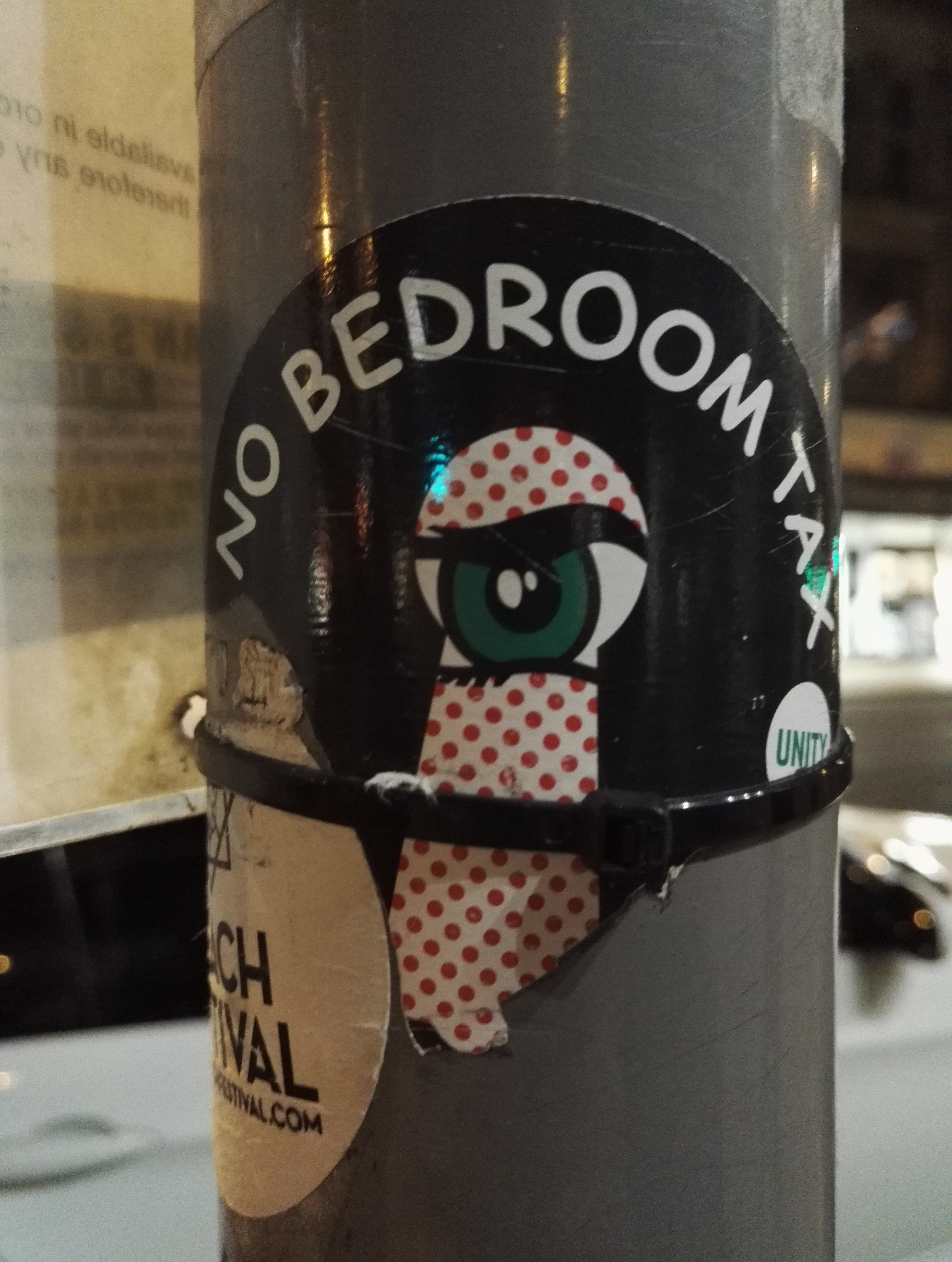
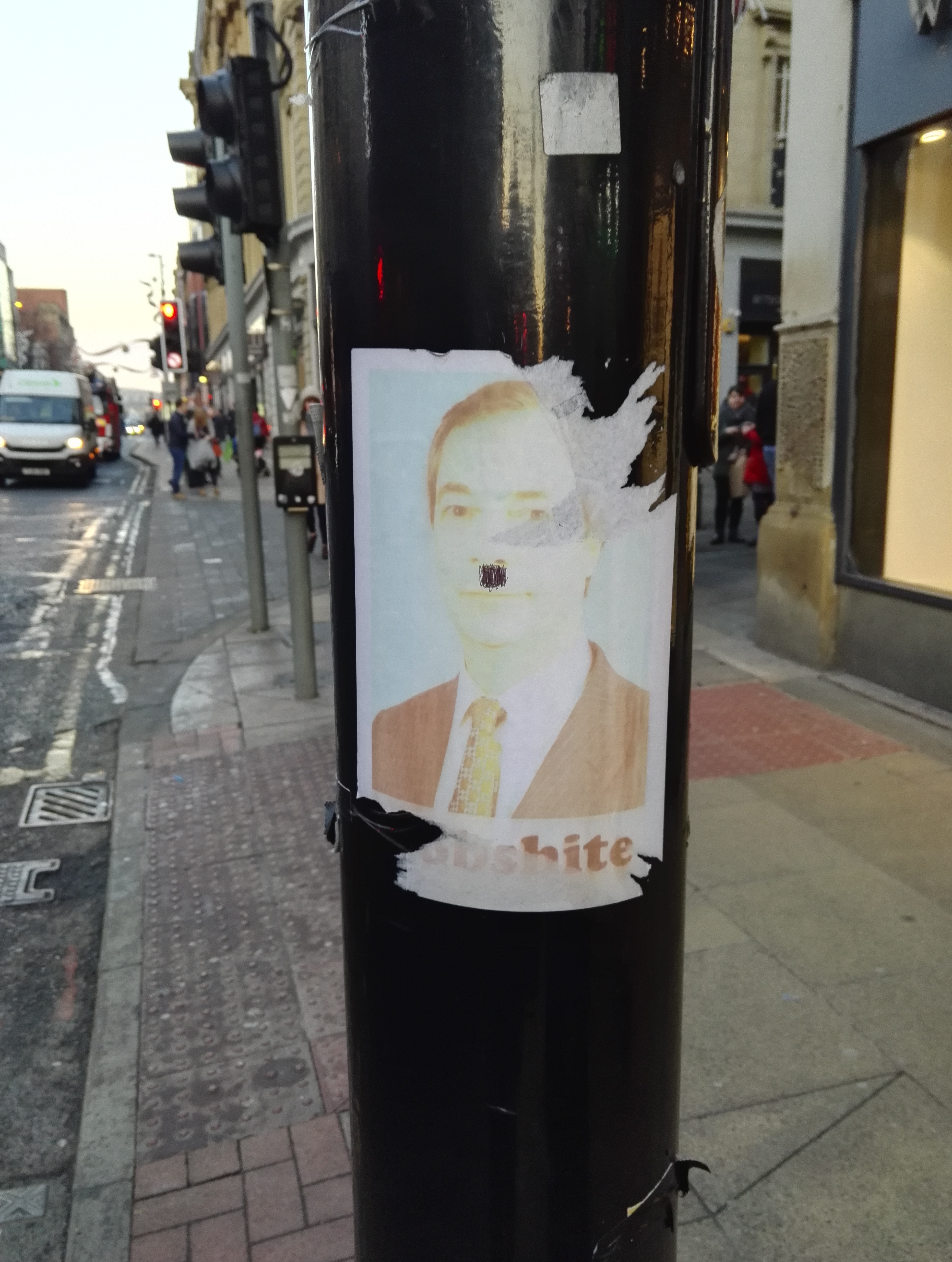
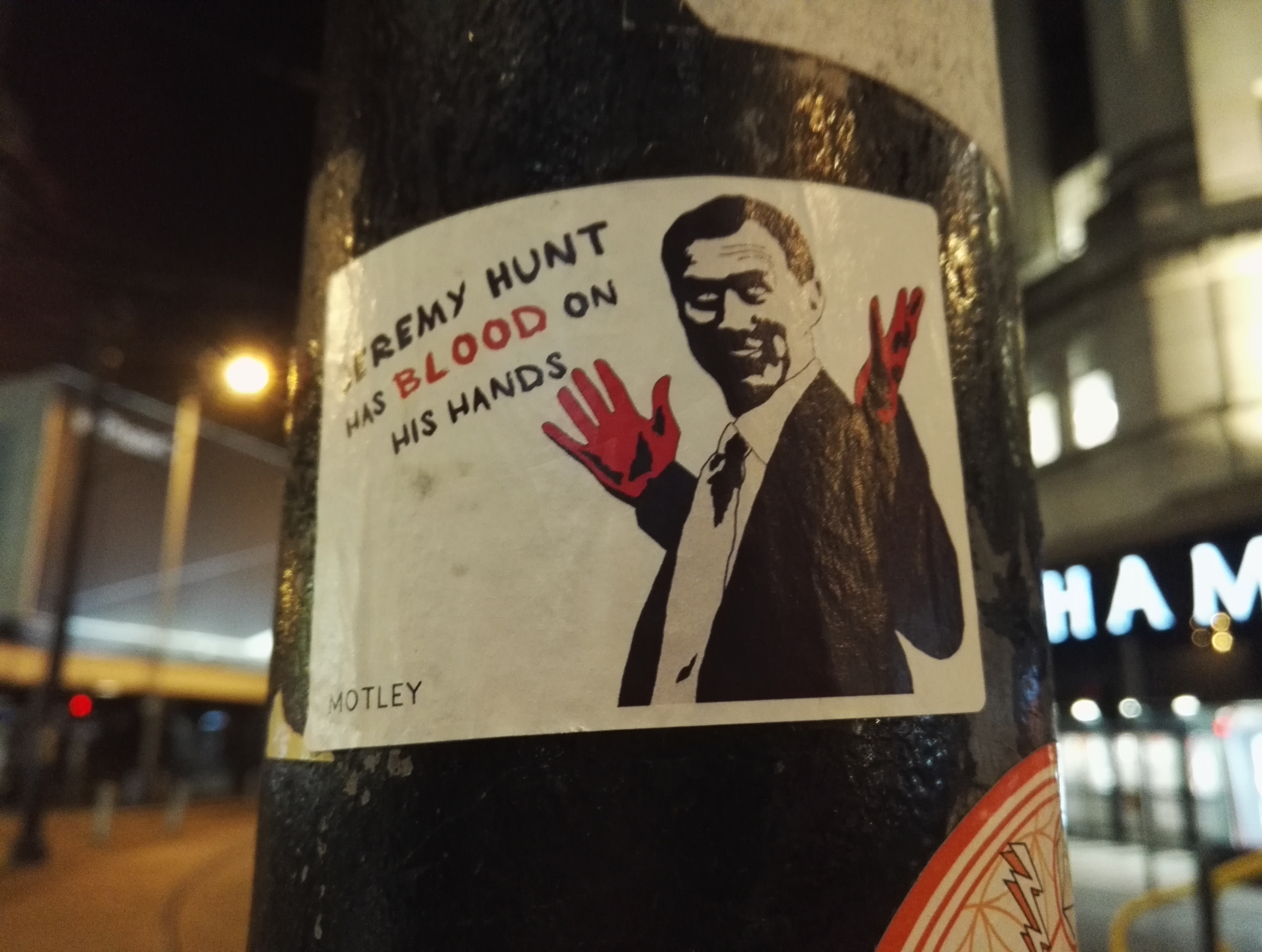
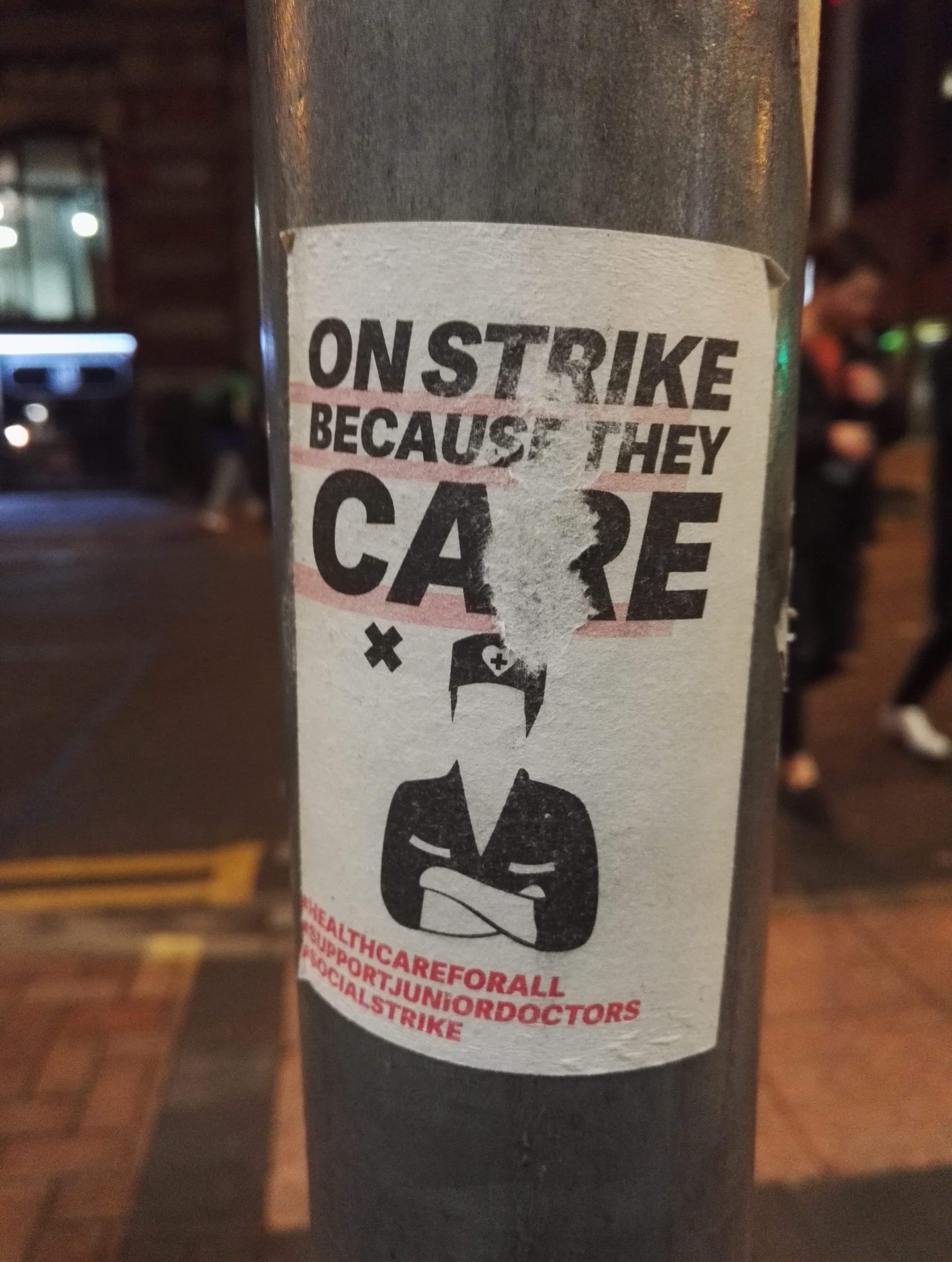
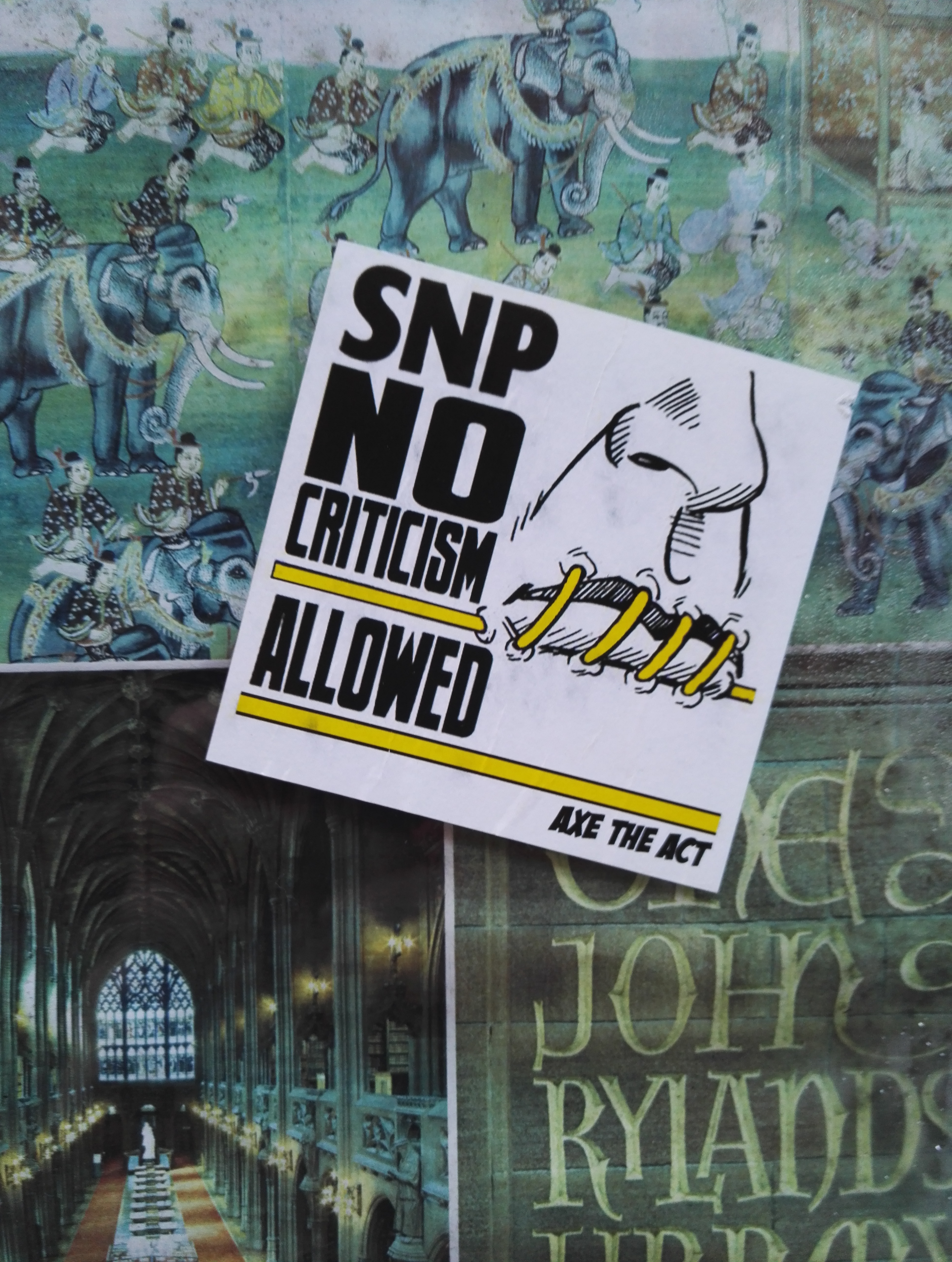
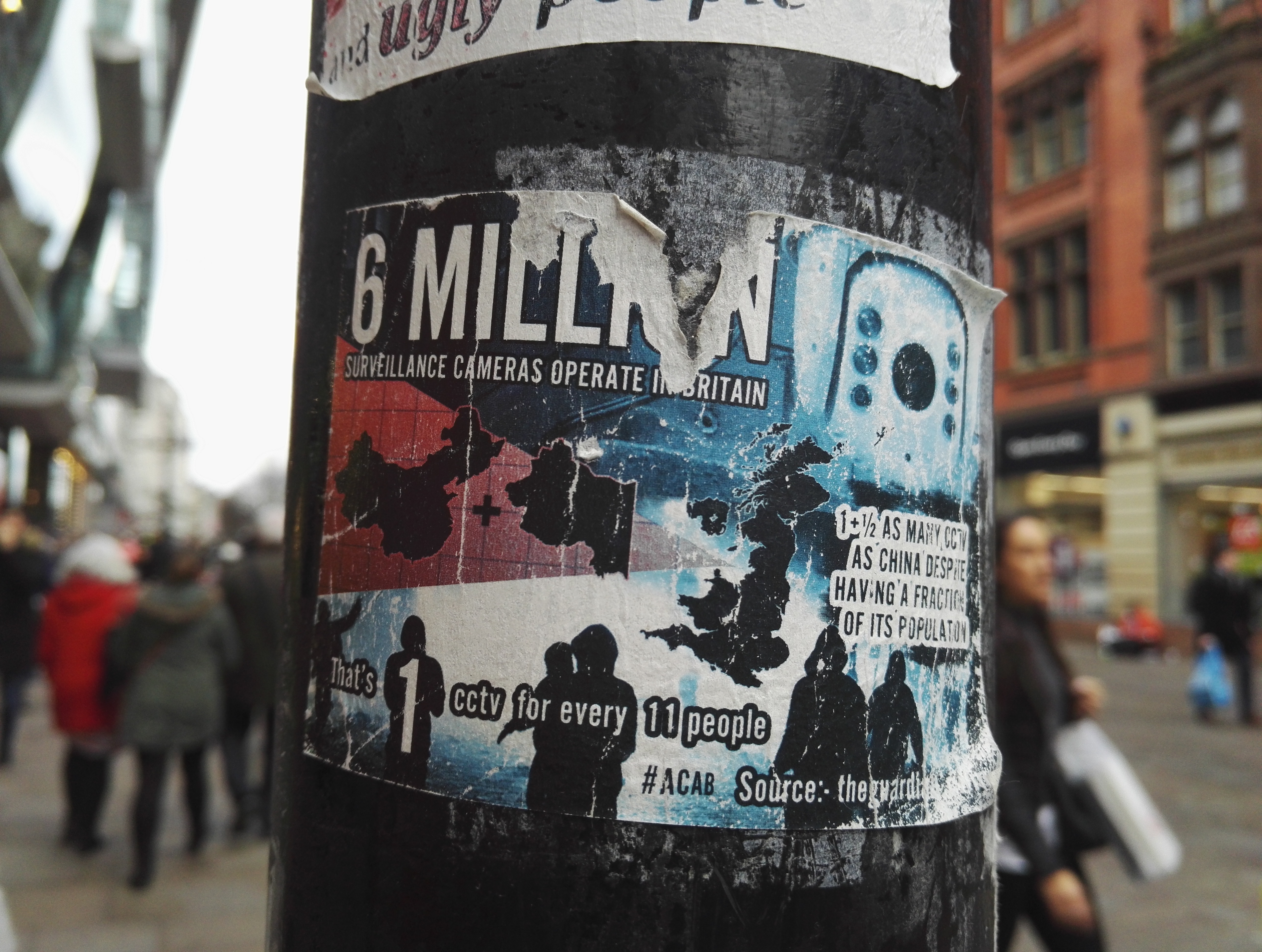
This is the first sticker I found when I arrived in Manchester. Although the Bedroom Tax has been a contentious issue since it was introduced in 2013, this is the first sticker I have ever found about it (Photo: Hannah Awcock).Stickers relating to the EU, both pro- and anti-Brexit, were quite common in Manchester. Most of them were supportive of the EU, such as this one (Photo: Hannah Awcock).This is probably more of a poster than a sticker, but I wanted to include it because it’s unsual to see hand-drawn protest stickers or posters, they are usually designed on a computer and printed. This poster is advertising an anti-Brexit protest in central Manchester, a few weeks after the referendum (Photo: Hannah Awcock)Again, this is probably too big to be a protest sticker, but I think it sums up Manchester’s irreverent attitude nicely. I also don’t like Nigel Farage (Photo: Hannah Awcock).You are much more likely to find stickers that criticise the Conservative Party than supporting them, and Manchester is no exception. This sticker is referring to the Conservative Party Annual Conference, which is frequently held in Manchester (Photo: Hannah Awcock).Bun the Tories also started out as a call to protest the Conservative Party Conference in 2015. If you follow the link there’s an…interesting music video, and you can buy a Bun the Tories t-shirt, the proceeds of which go to homeless charities in Manchester (Photo: Hannah Awcock).It is not just the Conservative Party that Mancunians object to, but also their policies whilst in government. Jeremy Hunt has been Health Secretary since 2012, and is blamed by many for the difficulties which the NHS now faces (Photo: Hannah Awcock).The conflict over Junior Doctor’s contracts in 2015 and 2016 is perhaps one of the most controversial episodes of Jeremy Hunt’s career. Hunt tried to impose new contracts on Junior Doctors, which they refused to accept. Neither side would back down, leading to strikes in which Junior Doctors only provided emergency care. A survey by Ipsos MORI found that 66% of the public supported the Junior Doctors (Photo: Hannah Awcock).The Scottish National Party also comes under fire in Manchester’s protest stickers. Most of the stickers I have seen in London relating to Scottish politics have been pro-Scottish Independence, so I was interested to find a sticker with a different perspective (Photo: Hannah Awcock).Anti-fascism is one of the most common topics of protest stickers that I find in London. I particularly like the design of this sticker, which was produced by a Mancunian anti-fascist group (Photo: Hannah Awcock).Animal welfare is another relatively common topic of protest stickers. Although it’s a common topic, I have never seen this particular sticker before (Photo: Hannah Awcock).Working class solidarity is also a topic I have seen before in protest stickers. They make the argument that the working classes should be uniting against the rich and powerful (Photo: Hannah Awcock).Football is a huge part of Mancunian life and culture. The sport, particularly the Premier League, is now a multi-million pound industry, and there is increasing opposition to it being commercialised to such an extent (Photo: Hannah Awcock).I have seen protest stickers relating to prisons before, but they are quite rare. I found several different ones in Manchester, which is very unusual. This sticker was produced by the Empty Cages Collective, which campaigns for the abolition of prisons (Photo: Hannah Awcock).The prevalence of CCTV cameras is not something I have seen before on protest stickers. The statistics on this sticker are pretty eye-opening, and I like the way that whoever made it included their source–perhaps they have had academic training at some point? (Photo: Hannah Awcock).
I have had some feedback that the blog posts I put together on resources for writing thesis Introductions and Conclusions. The latest thing I turned to the internet for help with is my Acknowledgments, and I’m glad I did. Although the Acknowledgements aren’t assessed, they are significant, not only because it’s important to thank the people that have helped and supported you, but also because it says something about you as a researcher.
Newcastle University Writing Development Centre: Acknowledgements is a short post that provides some useful vocab if you run out of ways of saying “Thank you to…”
For Acknowledgement: Useful Expressions for Acknowledgement: Samples and Examples has a somewhat longer list of possible vocab. What’s Acknowledgment? provides a brief introduction to acknowledgments and what they should include. It is aimed more towards journal articles than PhDs, but it still came in handy.
Patter: I’d Like to Thank…The Important Work of Acknowledgments is a brief reflection on what the author of acknowledgments gets out of them. It points out that acknowledgements can situate a researcher in academic networks, showing the reader the author’s scholarly context. This is something I hadn’t thought about before.
Times Higher Education: The Best Academic Acknowledgments Ever is perhaps a better indication of what not to do rather than good practice, unless you want to passive-agressively criticise someone, or propose to your partner. It may be a reminder that it’s all been done before, so it’s probably not worth trying to be original or witty, unless you’re very good at it.


























 Turbulent Isles