Discovering Brighton’s Suffragettes

Last Friday, I went on a walking tour in Brighton about the city’s suffragettes. Organised by Dr. Louise Fitzgerald of the University of Brighton, the tour was given by Karen Antoni, a historian and actress. I have written about protest in my home town before, but I still have a lot to learn, so I was keen to go along and find out more. The event was organised to coincide with the release of the film Suffragette (which I still haven’t seen- I want to see it with my Mum, who is hard of hearing, and subtitled film showings are in woefully short supply!) and The Time is Now Campaign, a series of events focused around film exploring the role women play in affecting change.

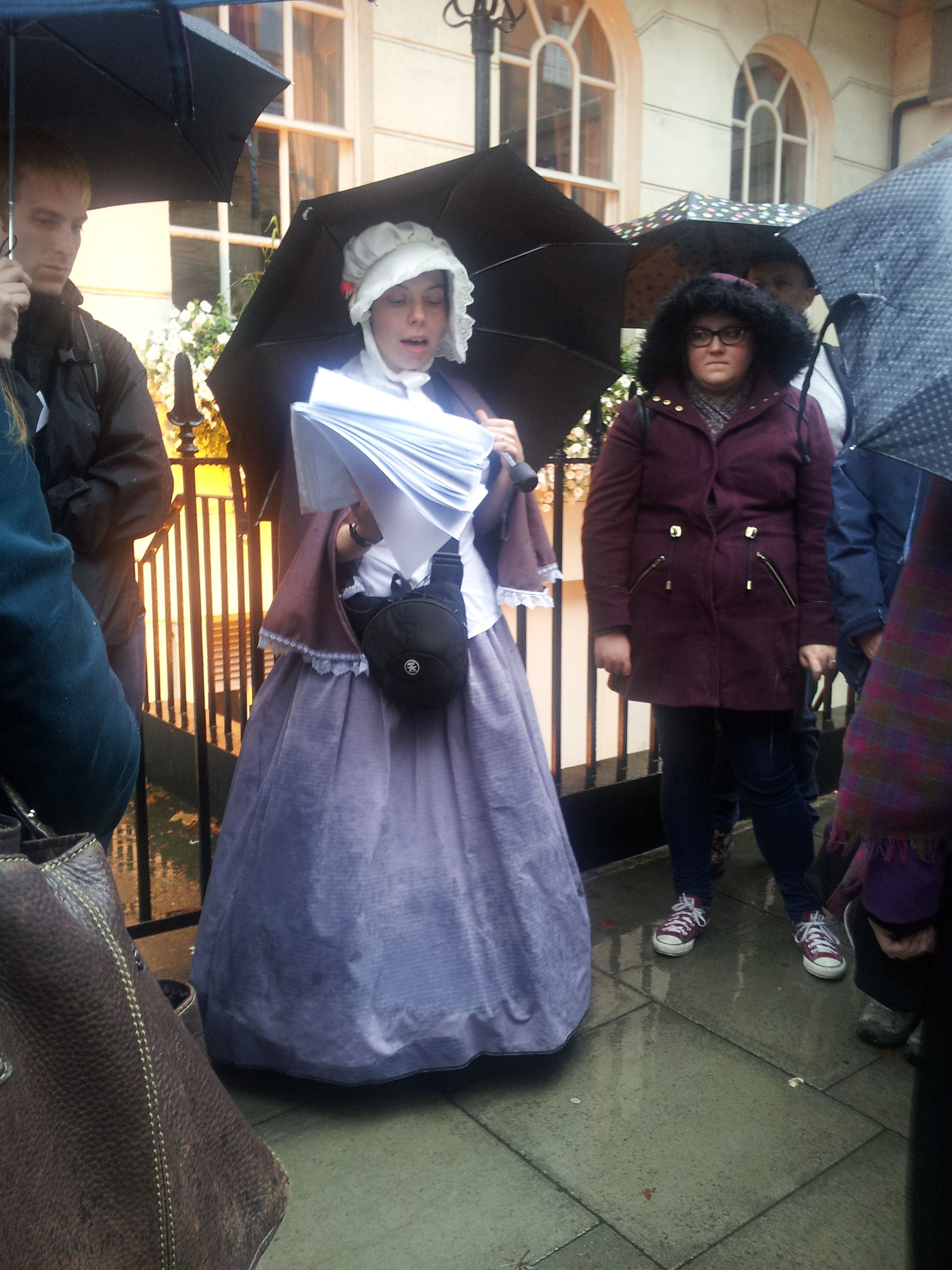
Historian and actress Karen Antoni led a wonderful walking tour about Brighton's suffragettes (Photo: Hannah Awcock)
Historian and actress Karen Antoni led a wonderful walking tour about Brighton’s suffragettes (Photo: Hannah Awcock)

With Brighton’s reputation as a cosmpolitan and contentious city, it is no surprise that Brightonians were no strangers to the campaign for women’s suffrage. The Women’s Social and Political Union (WSPU) set up a local branch in 1907, and many of the organisation’s most well known members, such as Christabel Pankhurst, Annie Kenney, and Emily Wilding Davison, came to visit the city. The tour started in Pavilion Gardens, which is bordered by the Royal Pavilion and the Brighton Dome, both of which were used for meetings which the WSPU hosted, and tried to disrupt. We learnt the lyrics to a popular suffragette song, which adapted the well-known Mine Eyes Have Seen the Glory/The Battle Song of the Republic, and sung the song as we travelled around the city. There’s nothing quite like the feeling of singing an empowering song in the middle of the street with over 50 other people, even if we did get a few funny looks!

Glory glory hallelujah, glory glory hallelujah,

Glory, glory hallelujah,

And the cause goes marching on!

Rise up women for the fight is hard and long,

Rise in thousands singing loud a battle song,

Right is might and in its strength we shall be strong,

And the cause goes marching on!

Suffragette song, sung to the tune of Glory glory hallelujah. If the religious reference puts you off, you can always replace ‘hallelujah’ with ‘revolution’, although most of those campaigning for female suffrage would probably not have approved!

Karen Antoni outside the Brighton Dome. Two suffragettes, Eva Bourne and Mary Leigh, once tried to sneak into a meeting by hiding in the organ overnight. They were discovered because the organ was so dusty that it made them sneeze (Photo: Hannah Awcock)
Karen Antoni outside the Brighton Dome. Two suffragettes, Eva Bourne and Mary Leigh, once tried to sneak into a meeting where Henry Asquith was speaking by hiding in the organ the night before. They were discovered because the organ was so dusty that it made them sneeze (Photo: Hannah Awcock).

The next stop on the tour was the intersection of North Street and West Street/Queen’s Road (the Clock Tower). This is where the headquarters of the Brighton WSPU branch was located, above the Singer Sewing Machine Company. The building is still there, although the ground floor is taken up by more contemporary chain stores now. Just around the corner on Queen Square used to stand a church where a suffragette-themed wedding was held; the wedding vows were adapted accordingly (the wedding was still between a man and a woman, the suffragettes weren’t that radical!)

The next stop was Victoria Road, a short walk from the town centre. Number 13/14 used to be a boarding house called Sea View, run by local suffragette Minnie Turner. By 1913 Minnie’s guest house had a reputation for hosting suffragettes, and in April her windows were stoned by disgruntled locals. Minnie was arrested 3 times for her suffragette activities, and imprisoned in Holloway Prison for 3 weeks in 1911 for breaking a window at the Home Office. In July 1912 Emily Wilding Davison stayed at Sea View whilst recovering from being on hunger strike in prison. The tour finished outside Churchill Square, the city’s main shopping centre, where we had one final sing song.
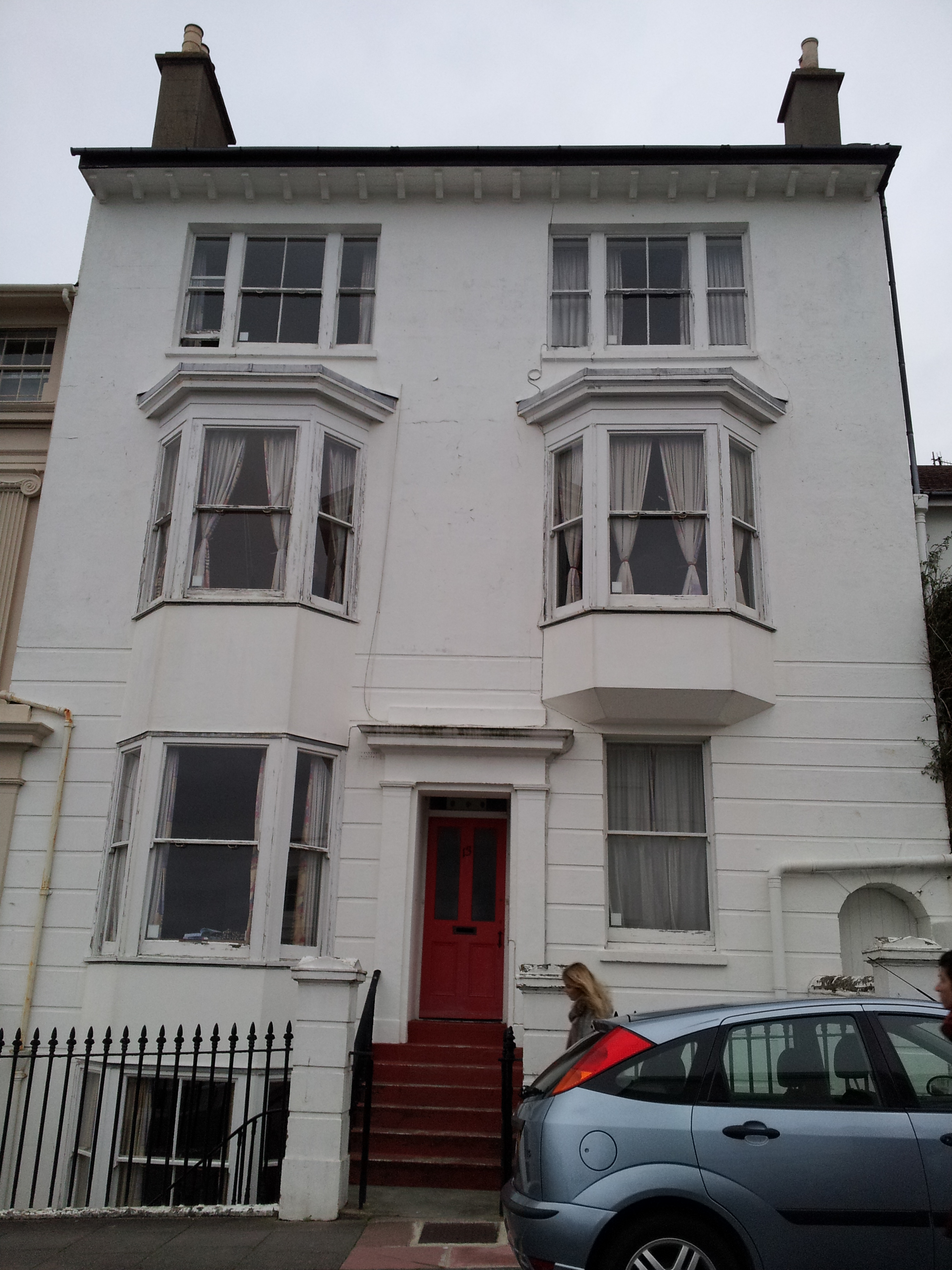
Minnie Turner's House in Victoria Road, Brighton. The current resident's are aware of the their home's proud past (Photo: Hannah Awcock).
Minnie Turner’s House in Victoria Road, Brighton. The current residents are aware of the their home’s proud past (Photo: Hannah Awcock).

I have always thought that walking tours are a fantastic way of communicating and engaging with historical research, and this Brighton Suffragette walking tour is no exception. It is informed by 7 years of research- many hours spent trawling though local newspapers and the collections of the Brighton Museum. It is wonderful research, and it is so important that it is accessible to all, academic or otherwise. Walking tours are just one of the many ways to disseminate historical research, but they are a very good one.

I couldn't resist the opportunity to wear a suffragette sash (Photo: Tricia Awcock).
I couldn’t resist the opportunity to wear a suffragette sash (Photo: Tricia Awcock).

A campaign is being started to try and get some blue plaques put up around Brighton honouring the city’s suffragettes. To join the campaign or find out more, check out the Facebook group here.

Sources and Further Reading

Dyhouse, Carol. “Minnie Turner’s “Suffragette Boarding House,”” Clifton Montpelier Powis Community Alliance. Last updated ….accessed on 26/10/15. Available at http://www.cmpcaonline.org.uk/page_id__85_path__0p36p21p55p.aspx

Kisby, Anna. “Found! Suffragettes Hiding in the Brighton Dome.” Brighton Museums. Last updated 11th March 2011, accessed 26th October 2015. Available at http://brightonmuseums.org.uk/discover/2011/03/08/found-suffragettes-hiding-in-the-brighton-dome/

Simkin, John. “Minnie Turner.” Spartacus Educational. Last updated August 2014, accessed 26th October 2015. Available at: http://spartacus-educational.com/WturnerM.htm

Book Review: London-A Short History

London- A Short History Book Cover
London: A Short History by A.N. Wilson

Wilson, A.N. London: A Short History. London: Phoenix, 2005.

An architectural tour of London is… so much more than merely and aesthetic experience. It is a personal encounter with Londoners of the past. Every district of London…is haunted by memories. The past and the present are always blended here.
(Wilson, 2005; p.146)

When I saw London-A Short History on the shelf in the bookshop, I had to buy it. The book is slim, and smaller than A5, and I had to see how the entire 2,000+ year history of London could possibly fit within it. A.N. Wilson takes the reader on a whistle-stop tour of the metropolis’ past, with an emphasis on the city’s architecture. I personally find his disdain for modern London hard to forgive, but nonetheless Wilson does a satisfactory job of fitting London’s vast history into just 166 small pages.

Perhaps the book’s most distinguishing feature is its brevity. Wilson’s account necessarily sticks to the most significant events in London’s history, and to say he is brief is putting it mildly; he spends just five pages on Tudor and Stuart London, for example. A disproportionate amount of pages are devoted to the city’s recent past, the last 100 years takes up around half the book. Each chapter is structured in a similar way, with a description of social, cultural and economic factors before turning to the architecture of the relevant period. Wilson also focuses on the great men (and they are overwhelmingly male) that he feels shaped London and the way it is perceived; Samuel Pepys, Charles Dickens, John Nash and Winston Churchill amongst others.

Look down upon London, as we did at the beginning of this chapter, from Hampstead Heath and a great splurge of needlessly dreary buildings spreads itself at your feet: hospitals, schools, roads, blocks of flats everywhere from the Isle of Dogs to Chiswick, from Hampstead to Sydenham—badly executed, badly designed and ugly, ugly, ugly.
(Wilson, 2005; p.11)

Reading this book, I discovered that I see London in a similar way to a close relative; I’m allowed to complain about it, but nobody else is. As far as Wilson is concerned, London has been going downhill since the end of World War II, ruined by modernist architecture, international capitalism and tourism. Unfortunately this attitude quickly influenced my perceptions of this book and Wilson’s writing. He argues that “much of modern London looks hideous by day, especially by wet day” (Wilson, 2005; p. 138). I don’t pretend to know much about architecture and aesthetics, but I think that is unnecessarily harsh. London does have ugly parts, but what city doesn’t?

Not only does Wilson criticise the city’s looks, he also disdains its people, accusing them of “extraordinary idleness” (Wilson, 2005; p123). He argues Londoners spend their time shopping, eating out, and being entertained. The service industry is significant in London, but Wilson is completely ignoring the workers that staff these shops, restaurants, pubs, clubs, and theatres. Perhaps London isn’t full of stevedores and labourers any more, but the suggestion that Londoners don’t work hard is extremely misleading.

Wilson does have hope for our city. He celebrates the diversity and vibrancy created by generations of immigration, and admires the architecture of the Jubilee Line underground stations. But it’s not enough to redeem him in my eyes. If you can’t face Peter Ackroyd’s epic 822-page London- A Biography, then London-A Short History will do the job. Otherwise, in the view of this London-loving incomer, probably don’t bother.

Soldiers and Suffragettes: The Photography of Christina Broom

Me outside the Museum of London Docklands, contributing to the #museumselfie Twitter hashtag (Photo: Hannah Awcock).

Soldiers and Suffragettes: The Photography of Christina Broom is a temporary exhibition at the Museum of London Docklands in Canary Wharf, open until Sunday the 1st of November. I went along because not only did Christina Broom photograph the campaign for female suffrage in the early twentieth century, she was also an impressive woman in her own right, as the first female British press photographer. The exhibition is worth checking out if you are interested in photography or social history, as well as the two main topics; Brooms photography of the suffrage movement and the armed forces.

In 1903 at the age of 40, Christina Broom noticed the increasing popularity of postcards, and began photographing local views and events in order to produce her own. Her husband had never fully recovered from an injury acquired during a game of cricket, and she took up photography to provide for her family. For the next four decades Broom hauled her heavy camera and tripod back and forth across London documenting the city and its people. Soldiers and Suffragettes is the first exhibition devoted solely to Broom’s work, and aims to share her story so she can receive some of the appreciation she deserves.

Suffragette March in Hyde Park
by Mrs Albert Broom (Christina Livingston)
cream-toned velox print, 23 July 1910
NPG x17396

Because of my own interests I was mostly drawn to Broom’s photos of the suffrage movement, but I also found her military photography engaging. Broom was trusted by the soldiers, and she photographed many before they left to take part in the First World War. The photos of soldiers with their families on the platforms at Waterloo Station are particularly moving. The knowledge that this might have been the last time the men ever saw their loved ones is haunting, and the fact that Broom was allowed to capture these significant moments is an indication of how good she was at her job.

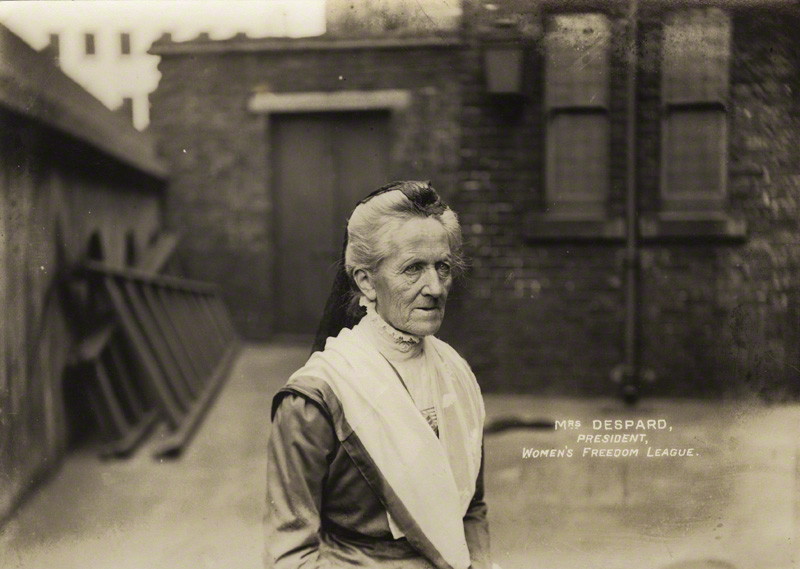
Broom’s pictures of the suffrage campaign are wonderful. She photographed campaigners both famous (including the Pankhursts) and obscure, capturing the sheer number of people involved. It is easy to think that Emmeline and Christabel Pankhurst won the vote for women single-handed, but this is far from the case. Broom’s photos depict many of the organisations involved in the campaign, including the National Union of Women’s Suffrage Societies, and the Women’s Freedom League, led by the incredible Charlotte Despard.

A photograph of Charlotte Despard taken by Christina Broom (Sources: National Portrait Gallery).
Charlotte Despard (née French)
by Mrs Albert Broom (Christina Livingston)
cream-toned velox print, 1908-1910
NPG x13391
© National Portrait Gallery, London

The exhibition also highlights the economics of the suffrage campaign. Although a supporter of female suffrage, Broom’s main reason for photographing the movement was financial. Supporters of female suffrage would collect memorabilia, the proceeds of which helped to fund campaigning. The WSPU had their own shops, in which they sold everything from postcards like the ones Broom produced to tea sets designed by Sylvia Pankhurst. The exhibition also includes photos of fairs held by various suffrage groups. One of the purposes of these fairs was to raise money. For example, at the Women’s Exhibition in Knightsbridge in 1909, a replica prison cell was constructed. Visitors were charged 6d to see inside and hear about what life was like for suffragettes in prison. The economics of social movements is something that I think gets frequently overlooked, so it was good to see it so prominent in Soldiers and Suffragettes.

Soldiers and Suffragettes is an exhibition that appeals on a whole range of levels. I even enjoyed the section about the technology of developing and printing the images- the backlit negatives of Broom’s photos were beautiful, making the Suffragettes look like vibrant ghosts. I would definitely recommend checking it out over the new few weeks before it closes.

Not only was Christina Broom a pioneer, leading the way for other female professional photographers, she was also very talented. Her images are moving and personal, as well as a fantastic record of a dynamic period in London’s history.

Turbulent Londoners: Mary Astell, 1666-1731

Turbulent Londoners is a series of posts about radical individuals in London’s history who contributed to the city’s contentious past. My definition of ‘Londoner’ is quite loose, anyone who has played a role in protest in the city can be included. Any suggestions for future Turbulent Londoners posts are very welcome. Next up is Mary Astell, a philosopher and writer who is considered by many to be England’s first feminist.


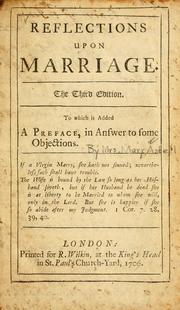
The title page of Astell's first publication.
The title page of Astell’s first publication.

Mary Astell was a philosopher and writer from Newcastle whose ability to reason and argue made her a formidable force in intellectual circles in London in the late 17th and early 18th centuries. Her advocacy of women’s education and her opinions on marriage has led her to be seen by many as England’s first feminist.

Mary was born in Newcastle on the 12th of November 1666 to an upper middle class family; her father managed a local coal company. Mary’s father died when she was 12, leaving her family with very little income. She received some education from her uncle, who was affiliated with a group of radical philosophers in Cambridge, but she also taught herself by reading widely. After her mother died in 1684, Mary moved to Chelsea in London, where she became acquainted with an influential and wealthy circle of women who helped her to develop and publish her work.

Between 1694 and 1709, Mary published a number of texts on a range of subjects, but she is best known for her arguments relating to women. She used her extensive understanding of philosophical ideas to argue that women were just as rational as men, and therefore just as deserving of education. After withdrawing from public life in 1709, Mary set up a charity school for girls in Chelsea. She devised the curriculum, putting her ideas into practice. Mary Astell died of cancer on the 11th of May 1731, leaving behind a lasting legacy.

The title page of the third edition of Astell's 'Reflections Upon Marriage.'
The title page of the third edition of Astell’s ‘Reflections Upon Marriage.’

Mary’s first publication came out in 1694 and was entitled Serious Proposal to the Ladies for the Advancement of their True and Greatest Interest. In it, she proposes a female-only college, where women learn through reading and discussion, rather than a formal, hierarchical program of study. In Some Reflections Upon Marriage (1700), Mary continues advocating for women. She argues that an education would enable women to make better matrimonial choices, and be better prepared for married life. She warns women against making hasty choices when it came to marriage, and believed marriage should be based on friendship rather than necessity or fleeting attraction.

Mary’s ideas were groundbreaking for more than just their content. The way that she used philosophical ideas to support her arguments was unique, and she addressed women directly in her writing- talking to them, not about them. Her arguments disputed the Protestant belief, dominant at the time, that reason and emotion should be separate; for Mary, knowledge was intimately connected to happiness. Linked to this, one of the most frequent criticisms levelled against Mary’s ideas was that they were ‘too Catholic’; her plan for an all-female college sounded too much like a nunnery to be accepted by mainstream society. Mary’s ideas about women’s education caused substantial debate, and she was widely respected for her ability to debate freely and confidently with both men and women, but she did not receive widespread support.

“If all Men are born free, how is it that all Women are born slaves?”

Astell, Some Reflections Upon Marriage

The above quote is probably Mary Astell’s most famous, and it is easy to see why. This was a truly radical sentiment in the early eighteenth century. Not only did she express these radical ideas, Mary could support them with reasoned, rational, philosophical arguments. And she did all this at a time when there were few historical campaigners for women’s rights from which she could take inspiration and hope. As one of England’s first feminists she deserves to be remembered and celebrated, but she can also be for contemporary campaigners something she herself didn’t have- a role model.

Sources and Further Reading

Anon. ‘Astell, Mary.’ Encyclopaedia.com. Last modified 2005, accessed 28th July 2015.  http://www.encyclopedia.com/topic/Mary_Astell.aspx

Anon. ‘Mary Astell.’ Wikipedia. Last modified 19th May 2015, accessed 28th July 2015.  https://en.wikipedia.org/wiki/Mary_Astell

Manzanedo, Julia Cabaleiro. ‘The Love of Knowledge: Mary Astell.’ Women’s Research Centre, University of Barcelona. Last modified 2004, accessed 28th July 2015.  http://www.ub.edu/duoda/diferencia/html/en/secundario2.html

Sowaal, Alice. ‘Mary Astell.’ Stanford Encyclopaedia of Philosophy. Last modified 12th August 2008, accessed 28th July 2015. http://plato.stanford.edu/entries/astell/

Following the Chartists around London

Last Monday, I took part in an event organised by Dr. Katrina Navickas of the University of Hertfordshire and British Library Labs called Following the Chartists around London. Dr. Navickas won a competition run by the Labs to develop a project that makes use of the British Library’s digital resources. As a result she is currently working on the Political Meetings Mapper, a project mapping all of the Chartist meetings listed in the Northern Star, one of the most popular Chartist newspapers. The Following the Chartists event was part of this project.

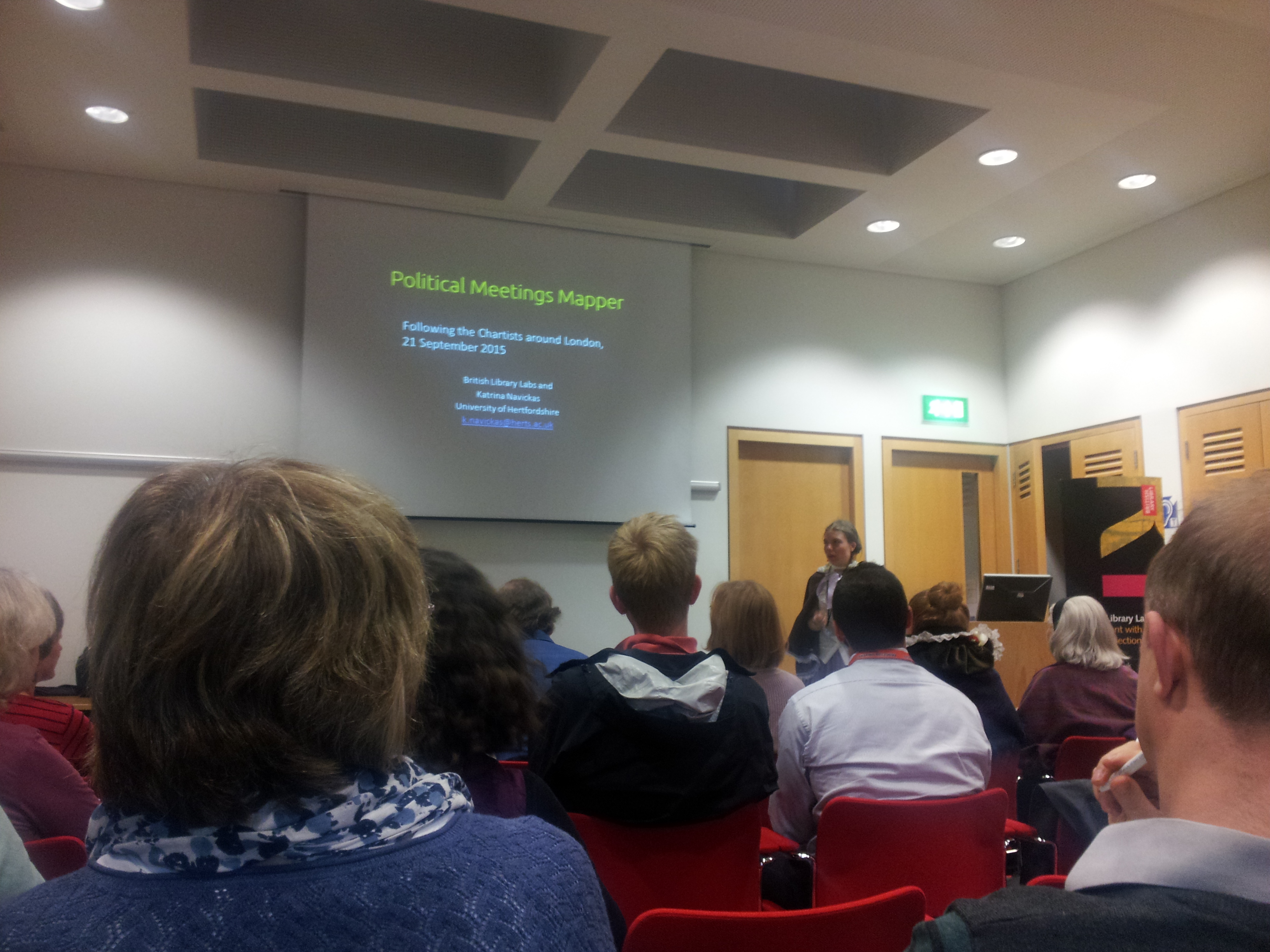
Katrina Navickas, in full Chartist costume, introduces her Political Meetings Mapper project.
Dr. Katrina Navickas, in full Chartist costume, introduces her Political Meetings Mapper project (Photo: Hannah Awcock).

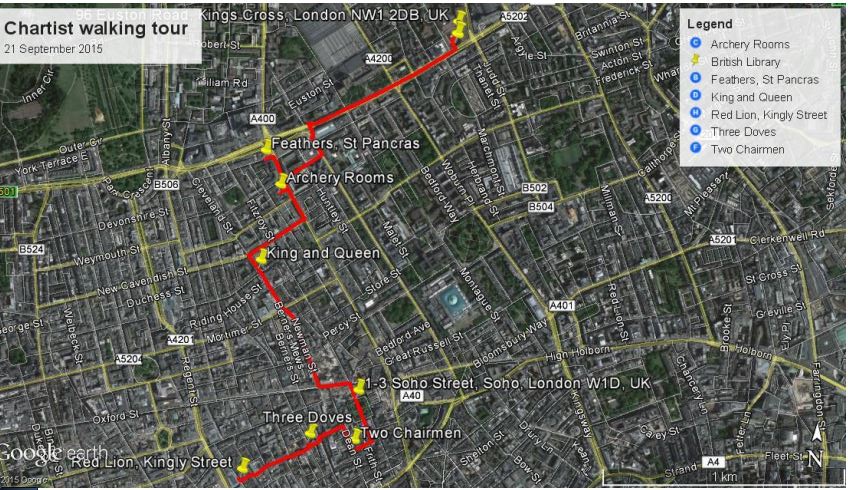
The afternoon began with lunch and a series of talks. Mahendra Mahey, manager of the British Library Labs project, introduced the British Library Labs and their work. Dr. Navickas explained the Political Meetings Mapper and gave a brief history of the Chartists. Dr. Matthew Sangster (Birmingham University) talked about his website romanticlondon.org, which uses contemporary maps and representations to explore romantic-era London. Finally, Professor Ian Haywood (Roehampton University) discussed the visual representations of ‘monster’ meetings- large, outdoor political meetings. The Chartists used this tactic frequently. We then embarked on a rather damp walking tour of Bloomsbury and Soho, visiting the sites of Chartist meeting places. In some cases, the pubs are still there, in others they have become stationary shops, or the building sadly no longer exists. The tour ended at the Red Lion in Kingly Street in Soho, which hosted meetings of both the Chartists and the London Corresponding Society.

Following the Chartists around London walking tour route (Source: Katrina Navickas).

At the Red Lion we re-enacted a Chartist meeting that took place in December 1838. This is where I came in; I played the roles of a female Chartist of St. Pancras/ Mr. Cardo, who proposed the following resolution:

This is the most important crisis that has existed for the working classes. At the present moment we possess a power most mighty in its operation, one that is to be viewed by us with the highest feelings of delight and by our enemies with dread and alarm (Cheers.) … the Radicals are determined to be staunch to a man, and the people united will carry the day.

RESOLUTION: That this meeting considers a perfect union among all the Radicals absolutely necessary for the accomplishment of Universal Suffrage.

A recent Chartist conference in Edinburgh had proved devisive, and there was a sense that all the various groups and factions needed to get back on the same track, quickly. Only with a united front could universal (male) suffrage be won. Mr. Cardo’s motion was passed unanimously by our meeting.

We weren't about to let a little bit of rain stop us!
We weren’t about to let a little bit of rain stop us! (Photo: Hannah Awcock).

The whole afternoon was great fun. I thoroughly enjoyed wearing a bonnet and apron, even if we did get some funny looks as we wandered around London. The talks highlighted the potential of digital research methods in relation to archives. Around 2% of the British Library’s collections have been digitised, which may not sound like a lot, but considering the Library holds well over 150 million items, it is a huge amount. Dr. Navickas has used computer programmes to transcribe newspaper articles, date meetings, and create maps that begin to interpret the data. The transcription software still needs a human to check its results, and all of this could have been done by hand, but it would have taken an awful lot longer. When it is finished, I think the Political Meetings Mapper will be a valuable tool for academics, students, and the simply curious; a resource which others can use to develop our understanding of the Chartist movement.The walking tour and re-enactment demonstrated how the Political Meetings Mapper could be used.

The British Library Labs project is doing valuable work raising awareness and promoting engagement with the Library’s digital collections. I learnt a lot about the possibilities of digital research methods, and would love to try and work it into my own work somehow!

If you want to do the walking tour yourself, see Dr. Navickas’ guide here.

The East End’s Radical Murals

Cities are too often bleak places to live in and a mural is one way of making them more attractive and human.

The East End can boast a large number and variety—in sharp contrast to the lack of art galleries in the area.

(East End News, 1986)

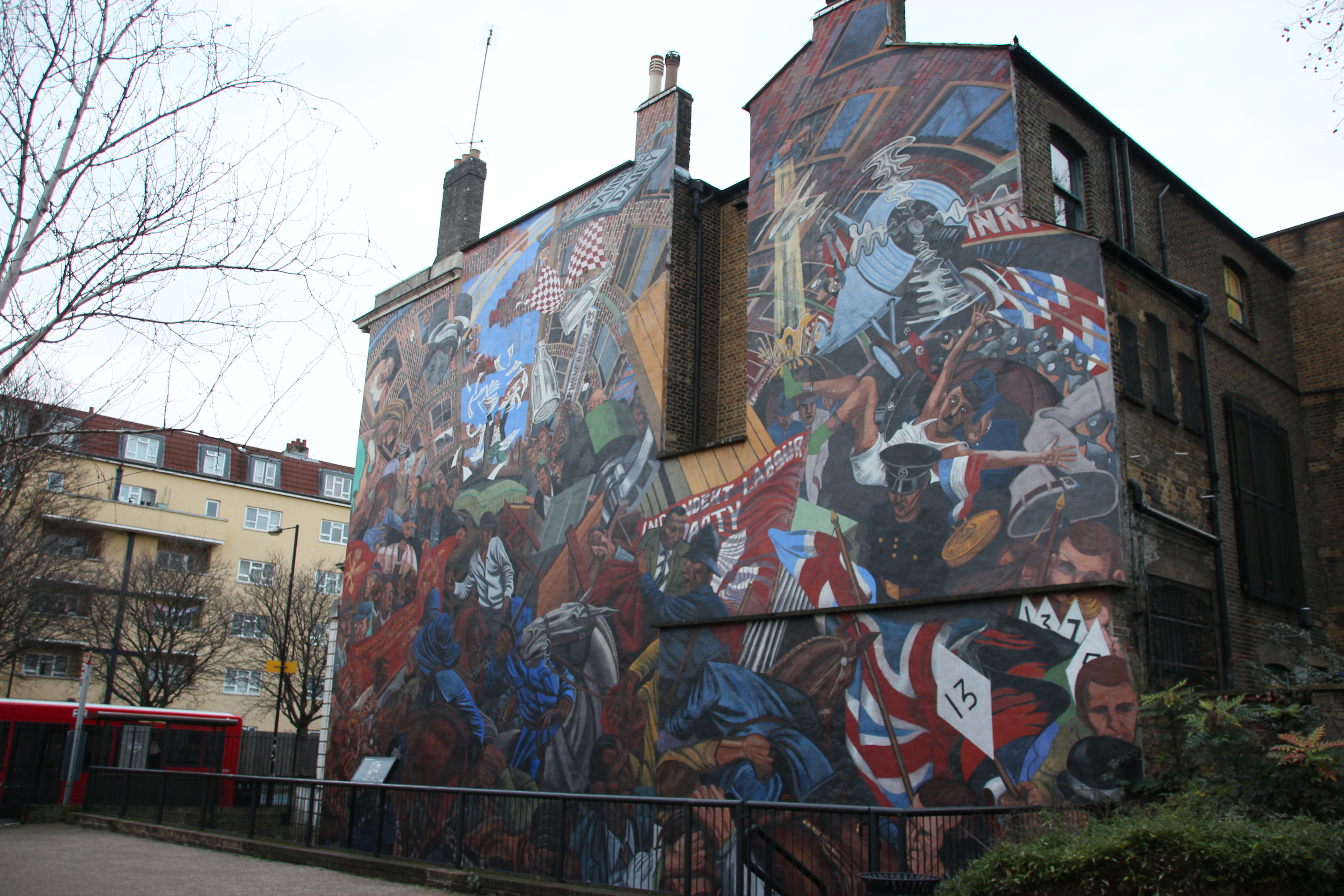
I have recently been doing some research on the Cable Street Mural in the Tower Hamlets Local History Library and Archive (which is, by the way, a lovely place to work- the staff are very helpful). The Mural is located on the west wall of St. George’s Town Hall in Cable Street, and was completed in 1983. It is over 3,500 square feet, and it commemorates the Battle of Cable Street, which took place in the area on the 4th October 1936. Demonstrators clashed with police as they tried to clear a route through the East End for the British Union of Fascists to march. The march was called off, and ‘They Shall Not Pass!’ the demonstrators’ slogan, has become a catchphrase of anti-fascist movements of all kinds.

The Cable Street Mural on the side of St. George's Town Hall.
The Cable Street Mural on the side of St. George’s Town Hall (Source: Hannah Awcock).
Detail of a policeman fighting with protesters in the Cable Street Mural.
Detail of a policeman fighting with protesters in the Cable Street Mural (Source: Hannah Awcock).

When doing archival research, it is not uncommon to get distracted by not strictly relevant, but still very interesting, material. I discovered that the East End does indeed seem to have a strong tradition of street murals, and the Cable Street Mural is not the only one with radical subject matter. London is perhaps not the first city that springs to mind when you think of politically motivated murals- Belfast or Dublin might seem more obvious. London does not like to be outdone however, and political murals do exist here if you are willing to look for them.

Sadly, there are not as many protest-themed murals in East London as there used to be. The Peasants Revolt mural, previously located in Bow Common Lane, was unveiled in 1981 to commemorate the 600th anniversary of the Peasant’s Revolt. The peasants had camped in Mile End on their way to London to demand reduced taxation, an end to serfdom and the removal of the King’s senior officials and law courts. Richard II did not meet their demands, but it remains a well-known period in English history. The mural was designed by Ray Walker, who was one of the three artists who took over from David Binnington when he resigned from the Cable Street Mural project in 1982. I have not been able to find out exactly when or why this mural was removed, and why it wasn’t afforded the same protection and investment that the Cable Street Mural has. The Cable Street Mural has been repaired every time it has been vandalised, and was restored in 2011 to mark the 75th anniversary of the Battle.

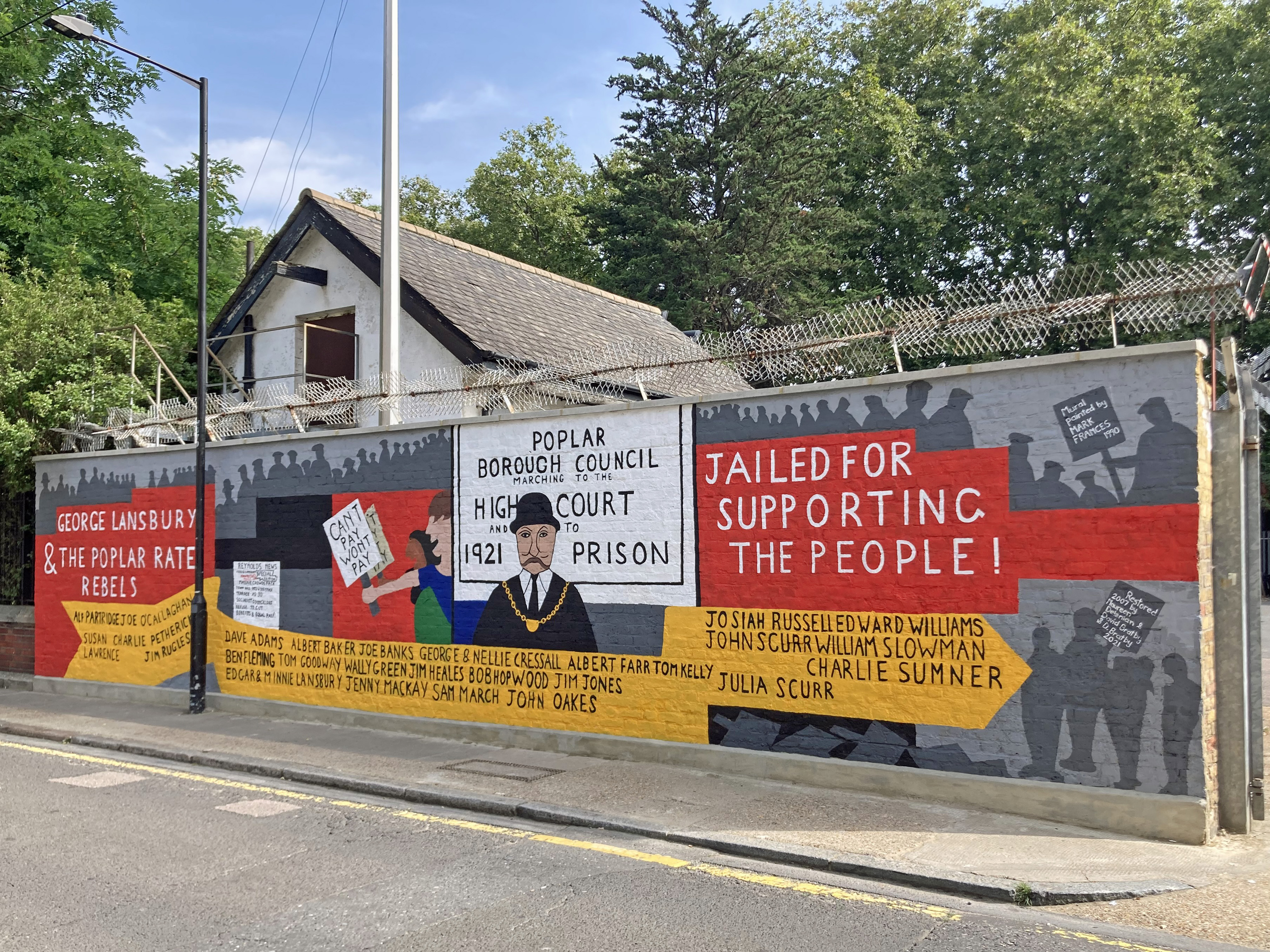
One radical East End mural which can still be seen today is that commemorating the Poplar Rates Rebellion. Located in Hale Road in Poplar, the mural was completed by Mark Francis in 1990, and restored in 2007 by David Bratby and Maureen Delenian with help from local children. In 1921 30 local councillors were sent to prison after refusing to collect the rates from residents because they were unfair. The mural tells the story of the Rebellion in 4 panels, mainly using words. It does include an image of the well-known political radical George Lansbury, and local residents holding placards that declare ‘Can’t Pay, Won’t Pay.”

The Poplar Rates Rebellion mural was first painted in 1990, but it has clearly been restored since then (Source: Diamond Geezer).

The East End has a strong tradition of radicalism and protest, but a lot of it is not well known. Murals and other forms of public art are a good way of ensuring that historical protests are not forgotten. The Cable Street Mural in particular still draws visitors, and its striking colours and imagery are well worth going to see for yourself. If you have a few spare hours, why not go and check out these memorials to the East End’s turbulent history?

Sources and Further Reading

Anon. “Mural by George.” East London Advertiser. 31st August 1990.

Anon. “Murals in the East End.” East End News. May 1986.

Anon. “Poplar Rates Rebellion Mural.” London Mural Preservation Society. No date, accessed 9th September 2015. Available at http://www.londonmuralpreservationsociety.com/murals/poplar-rates-rebellion-mural/

Anon. “Trade Union and Labour Movement Heroes Commemorated.” Unite. No date, accessed 9th September 2015. Available at http://www.unitetheunion.org/growing-our-union/education/rebelroad/murals/

Rolston, Bill. “Politics, Painting and Popular Culture: The Political Wall Murals of Northern Ireland.” Media, Culture, and Society. 9, no.1 (1987): 5–28.

On Blackheath Festival: A Turbulent Setting

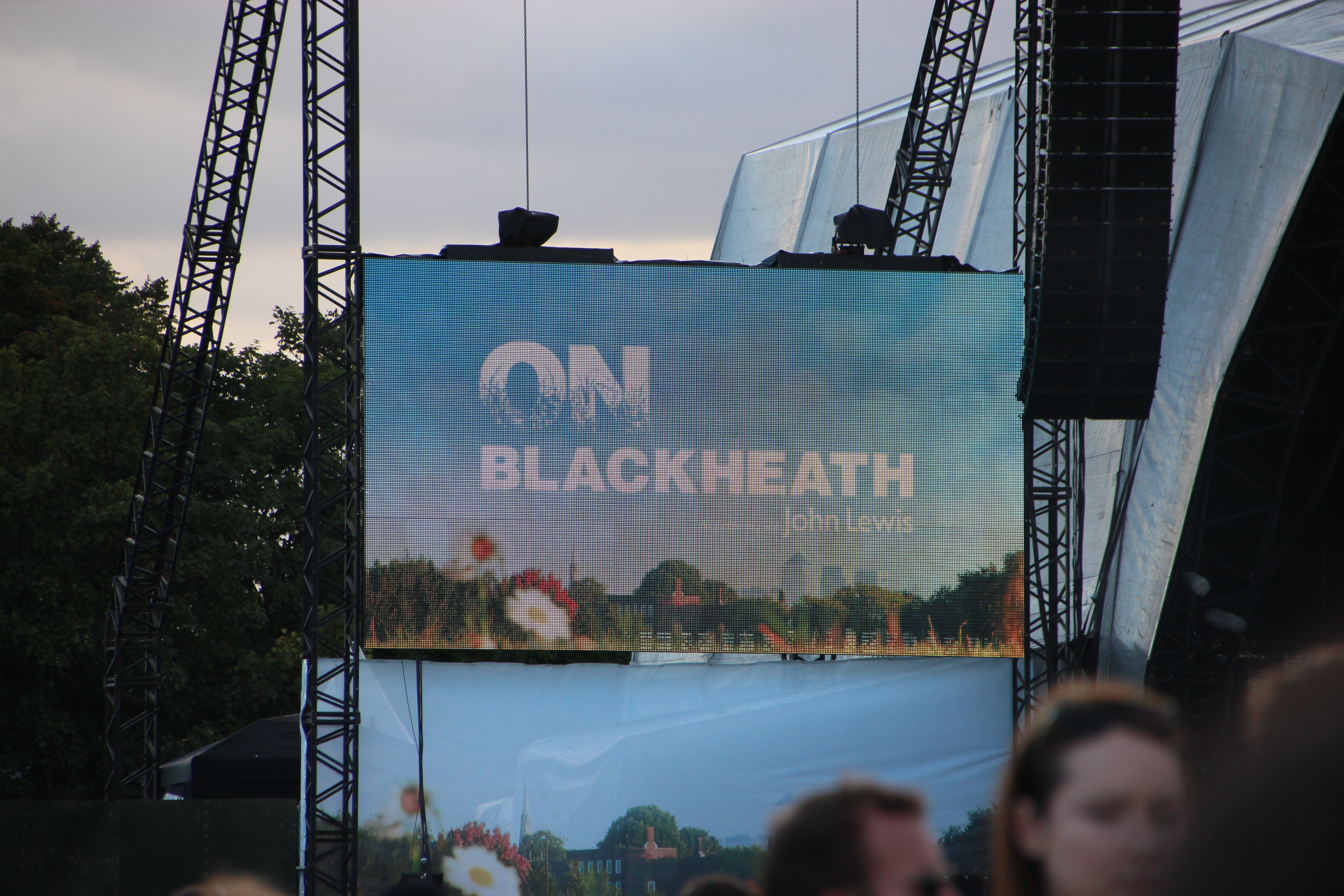
The On Blackheath festival took place on the 12th-13th September 2015, on Blackheath in south east London.
The On Blackheath festival took place on the 12th-13th September 2015, on Blackheath in south east London (Photo: Hannah Awcock).

Last weekend, I went with my Mum and sister to the On Blackheath festival which is, funnily enough, on Blackheath in south east London. Shared between the boroughs of Lewisham and Greenwich, it is one of the largest areas of common land in London today. It is a fantastic setting for a family-oriented festival; when it gets dark you can see the lights of the towers in Canary Wharf glinting from across the river. But Blackheath is ancient, going back at least as far as the Doomsday Book, and it has hosted countless other gatherings of a more turbulent nature.

The festival has a laid back, family friendly atmosphere, but not every gathering on Blackheath has been so pleasant.
The festival has a laid back, family friendly atmosphere, but not every gathering on Blackheath has been so pleasant (Photo: Hannah Awcock).

The common land of London has always played a role in the life of turbulent London, hosting many a protest and political meeting. Before the Gordon Riots in 1780 the Protestant Association held a mass meeting in St. George’s Fields, the area of modern day Waterloo and Lambeth. In 1848 the Chartists held a rally on Kennington Common (all that remains of which is the Oval cricket ground) which did not go their way and effectively ended the Chartist movement. The similarity between St. George’s Fields and Kennington Common is that they no longer exist. Blackheath does, and when you go there you can imagine standing in the footsteps of famous radicals.

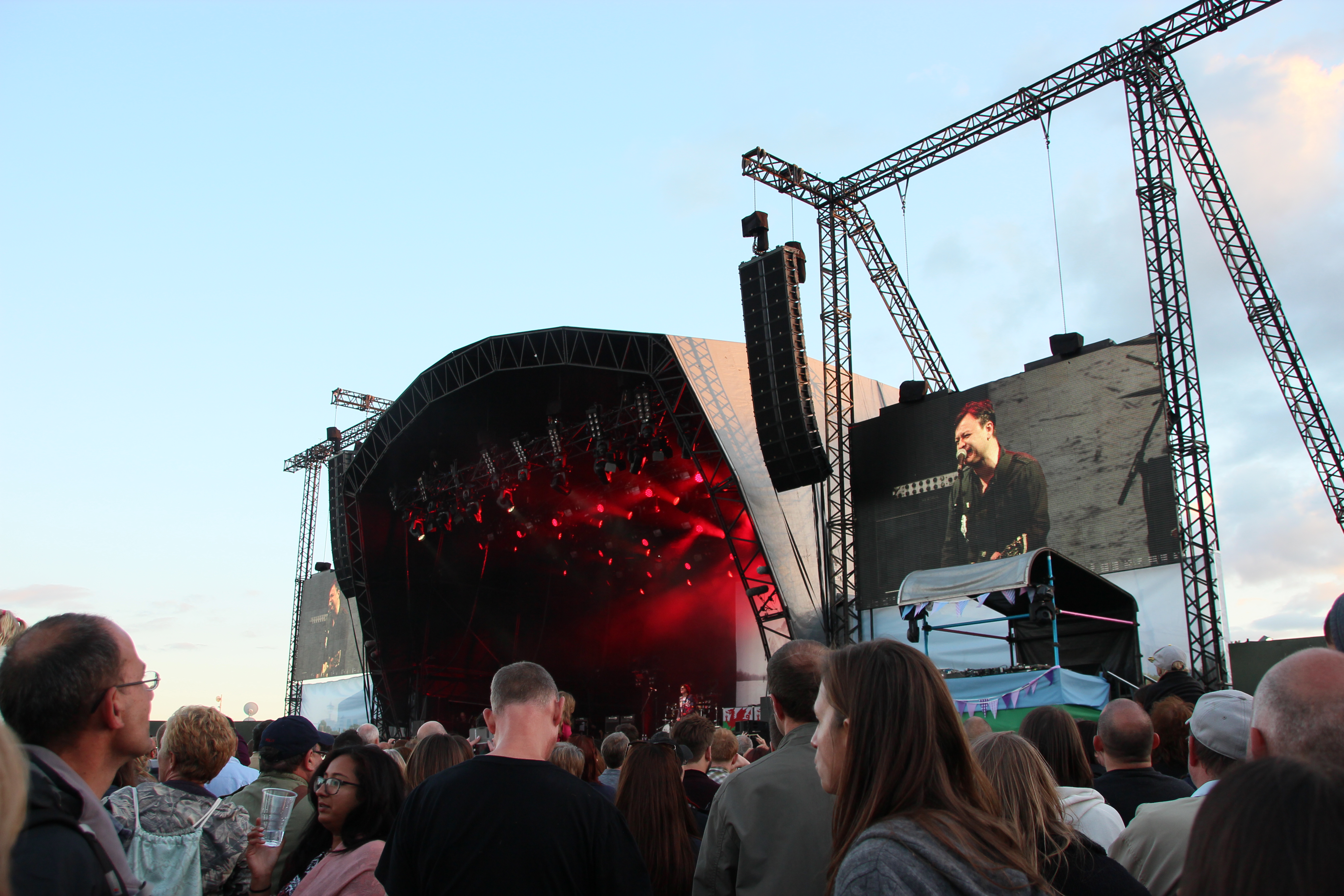
The Manic Street Preachers performing at the On Blackheath festival 2015.
The Manic Street Preachers performing at the On Blackheath festival 2015 (Photo: Hannah Awcock).

So when I was standing on Blackheath on Saturday night, listening to the Manic Street Preachers performing “If You Tolerate This Your Children Will Be Next,” which is inspired by the 1936 Spanish Civil War, I got thinking about Blackheath’s radical history. The Manic Street Preachers are not afraid to be political in their performances, and they may not have realised it but they were continuing a strong Blackheath tradition by doing so at On Blackheath. During the 1381 Peasant’s Revolt, and the 1450 Kentish Rebellion both used Blackheath as a rallying point. Wat Tyler, the leader of the Peasant’s Revolt, is commemorated by Wat Tyler Road, which runs across the heath. After camping on Blackheath, Cornish rebels angry at a war tax imposed by Henry VII were defeated at the Battle of Deptford Bridge (otherwise known as the Battle of Blackheath) in June 1497.

In the middle of Blackheath is a mound of earth called Whitefield’s Mount (or Whitfield’s Mount/Mound), which at one point was known as Wat Tyler’s mound because it was used for making speeches during the Peasant’s Revolt. One of the speakers was John Ball, who uttered that well-known statement of equality:

 When Adam delved and Eve span, who was then the gentleman?

He didn’t necessarily make this speech on Whitefield’s Mount, but wouldn’t it be great if he did? It has been speculated that the Mount is the final resting place of some of the 200-2000 Cornishmen killed during the Battle of Deptford Bridge. True or not, Whitefield’s Mount is clearly intimately linked with London’s turbulent past.

Street performers at the On Blackheath festival. The Cornish Rebellion in 1497 was started when King Henry VII raised taxes to fight a war with the Scots.
Street performers at the On Blackheath festival. The Cornish Rebellion in 1497 was started when King Henry VII raised taxes to fight a war with the Scots (Photo: Hannah Awcock).

By the 1830s and 40s, radicals were addressing a new set of issues, and the Chartists had began using Blackheath as a location for meetings as part of their campaign for universal male suffrage. Almost a hundred years later, it would also be used for meetings calling for female suffrage. More recently, Blackheath was used in 2009 for a week-long climate camp, complete with compost toilets, and a pedal-powered radio station and TV channel. In 2013, there was a protest against Zippo’s Circus who were set up on Blackheath, one of the few UK circuses that still use animals in their performances. Even the On Blackheath festival itself has been the subject of protest, with anarchist Ian Bone objecting to common land being fenced off for a ‘foodie fest’ that was not accessible to the poor communities in surrounding areas. 

London’s open spaces play a vital role in the city’s life by hosting gatherings of all kinds. From festivals to protests, they are a key part of the social, political and cultural life of the city. London’s 2000+ year history means that almost anywhere you go in London will have been the site of past protest of some sort, but areas of common land have been particularly contentious, and Blackheath is no exception. By performing songs such as “If You Tolerate This Your Children Will Be Next,” the Manic Street Preachers were both drawing from and continuing a tradition of dissent on Blackheath that stretches back hundreds of years.

Sources and Further Reading

Anon. “Blackheath, London.” Wikipedia. Last modified 12th September 2015, accessed 13th September 2015. Available at  https://en.wikipedia.org/wiki/Blackheath,_London 

Anon. “Cornish Rebellion of 1497.” Wikipedia. Last modified 13th September 2015, accessed 14th September 2015. Available at  https://en.wikipedia.org/wiki/Cornish_Rebellion_of_1497

Anon. “Zippos Circus Protest in Blackheath!” The London Animal Rights Meetup Group. No date, accessed 15th September 2015. Available at  http://www.meetup.com/animalrights-202/events/112127872/

Chandler, Mark. “BLACKHEATH: Climate Camp Protest Criticised by Councillors and Police.” News Shopper. Last modified 27th August 2009, accessed 15th September 2009. Available at  http://www.newsshopper.co.uk/news/4568764.BLACKHEATH__Climate_Camp_protest_criticised_by_councillors_and_police/?ref=rl 

Read, Carly. “I predict a riot! Hell-raising anarchist Ian Bone set to boycott posh On Blackheath music and food festival – and urges The Levellers not to perform.” News Shopper. Last modified 29th July 2014, accessed 15th September 2015. Available at http://www.newsshopper.co.uk/news/11372522.Hell_raising_anarchist_set_to_boycott_On_Blackheath_festival/

Runner500. “In Search of the Battle of Deptford Bridge.” Running Past. Last modified 2nd January 2014, accessed 14th September 2015. Available at https://runner500.wordpress.com/tag/deptford-bridge/ 

Runner500. “Whitefield’s Mount- A Rallying Point for Protest and Preaching.” Running Past. Last modified 29th October 2014, accessed 14th September 2015. Available at  https://runner500.wordpress.com/2014/10/29/whitefields-mount-a-rallying-point-for-protest-and-preaching/

Materialities of Protest: Tarpaulins and Tents at Occupy Wall St.

Laura Shipp is a Second Year Geography undergraduate at Royal Holloway. She is particularly interested in Political Geography and is currently undertaking dissertation research surrounding emotional geographies and perceptions of security in everyday circumstances. Following on from research carried out on an undergraduate fieldtrip to New York, she considers the ways that protest camps can entangle objects, change their associations and recreate their meanings.


My own photo of Zuccotti Park along the Occupy Wall Street Tour in late March.
My own photo of Zuccotti Park along the Occupy Wall Street Tour in late March (Photo: Laura Shipp).

In September 2011, Zuccotti Park, Lower Manhattan became overtaken as the home of Occupy Wall Street. A unique ephemeral environment was established which can only be described as a protest camp. From this picture, the park now has no physical marks of the camp’s existence and yet it had contained a temporary city with its own newspaper, food supply chain and Wi-Fi (Chappell, 2011).

Feigenbaum, (2014, pp.35) defines protest camps “as place-based sites of on-going protest and daily social acts of ‘re-creation’ largely describing both the situated-ness of such camps to their location but also the significance of seemingly banal process within them”. They are spaces where people coalesce and imagine a different social world, often in contention with the state (Frenzel et al., 2013). In make-shift bedrooms, kitchens and meeting places, objects have significance and become bound in new narratives. The meaning and use of objects evolve to fit exceptional environments which alters the legacy of the objects.

With an aim to put focus on some of the seemingly banal objects that became entangled with Occupy Wall Street I used two slightly abnormal methods for the study. The first was a tour of the main sites of Occupy Wall Street and an oral history from Occupy tour guide Michael Pellagatti. The second method was the Interference Archive which stores ephemera and news articles to create an animated story of social history (Interference Archive, 2015)

From what I found, the tarpaulin and the tent seemed to have an importance. Fundamentally, protest camps must negotiate the task of providing basic necessities to its occupants whilst getting across its message; this is partly done by occupying the space through thick and thin. Tarpaulins provided shelter required from the first week of the camp, as shown in the picture below.

Michael’s photograph of Occupy Wall Street encampment in its first week occupying Zuccotti Park (Source: Michael P. Pellagatti).

The tarpaulin’s crowning moment, however, was Day 6 of the camp when a storm was forecast to hit Manhattan. After much deliberation, a human-tarp shield was erected around the equipment and the camp physically weathered the storm from under it. Michael stresses the prominence of this instance, claiming it as the “genesis of the movement”. It transformed the camp’s population from strangers with similar frustrations to a group dedicated to its cause. From this process, they were able to create both strong ties in that place as well as maintaining the resources they needed to survive as a protest (Nicholls, 2009).

My Photograph of archived Wall Street Journal article showing Occupiers of Zuccotti Park surviving the winter weather.
My Photograph of archived Wall Street Journal article showing Occupiers of Zuccotti Park surviving the winter weather (Photo: Wall Street Journal/Laura Shipp).

The tarp has another significance, physically representing the struggles faced by the homeless population of New York. Often they are used to create makeshift bivouac shelters, retaining heat on city streets (Newman, 2014). They are the difference between life and death. Using those same items, the Occupiers were a visceral reminder of difficulties and people who may otherwise be ignored. What Ehrenreich (2011) argues is that not only are the two related, but Occupy Wall Street took up the cause of homelessness as its own, as a problem that is not dissociated with the greed of the 1%. As time passed tents became more prolific at the camp. The picture below shows the camp the week before its eviction.

Michael’s photograph of the Zuccotti Park encampment in Mid-November, the week before the eviction (Source: Michael P. Pellagatti).

From the outside they may have seemed like a sensible shelter for the protesters. From Michael’s perspective, however, they broke down the unity that came from living in each other’s company. The name of the park became sullied with incidents of sexual harassment and drug use (Moynihan, 2015). Without ensuring the security of its occupants a protest camp cannot provide well-being to them. These things are needed in order to create a ‘home’ and therefore sustain the camp (Frenzel et al., 2013).

Overall, the materiality of protests has many entanglements which can reconfigure their meanings. The role of the tent in dividing the camp shows how objects can become entangled within a protest camp in ways that can undermine them but also produces opportunities for objects to be unintentionally constructive, like the tarpaulin. What is so different about protest camps is their ability to politicise “the embodied practices involved in sustaining the protest camp as a home space” (Frenzel et al., 2013, pp.464). Through this process they connect the domestic to the political and give them the ability to influence each other.

Laura Shipp, Royal Holloway, University of London

Sources and Further Reading

Chappell, B. (2011) ‘Occupy Wall Street: From a blog post to a movement’, NPR, 20 October [Online]. Available at: http://www.npr.org/2011/10/20/141530025/occupy-wall-street-from-a-blog-post-to-a-movement Accessed: 19 May 2015

Ehrenreich, B. (2011) ‘Throw them out with the trash’, Tom Dispatch, 23 October. [Online] (Available at: http://www.tomdispatch.com/post/175457/tomgram%3A_barbara_ehrenreich,_homeless_in_america/) Accessed 17 May 2015

Feigenbaum, A. (2014) ‘The disobedient objects of protest camps’, in in Flood, C. and Grindon. G. (eds.), Disobedient Objects, London: V&A Publishing pp. 34 – 44.

Frenzel, F. Feigenbaum, A. and McCurdy, P. (2013) ‘Protest camps: an emerging field of sociological movement research’, The Sociological Review, 62, pp. 457- 474.

Interference Archive (2015) ‘Our Mission’, About, (Available at http://interferencearchive.org/our-mission/) Accessed 2 March 2015

Moynihan, C. (2015) ‘Occupy Wall Street, the tour’, The New York Times, 2 April. [Online] (Available at: http://www.nytimes.com/2015/04/03/nyregion/occupy-wall-street-the-tour.html) Accessed 2 April 2015

Newman, S. M. (2014) ‘Policy and plastic tarps: Surviving winter while homeless’, Next City, 21 November [Online] (Available at: http://nextcity.org/daily/entry/homeless-winter-survival-chicago-mayors-policy) Accessed 25 May 2015

Nicholls, W. (2009) ‘Place, networks, space: theorising the geographies of social movements’, Transactions of the Institiute of British Geographers, 34(1), pp. 78-93.

Protest Stickers: New York City

Like in London, stickers of various kinds are ubiquitous in New York.
Like in London, stickers of various kinds are ubiquitous in New York (Photo: Hannah Awcock).

A few months ago, I visited New York on an undergraduate field trip. As I explored the city, I took pictures of protest stickers as I do in London. This post is about some of the stickers that I saw. At first I thought that explicitly political stickers were less common in New York than London, as it took me quite a while to find any. However I discovered that in some areas, such as the East Village in Manhattan, protest stickers are just as common as in London.

I spotted this sticker in several locations around the city. It is advertising a demonstration that was due to take place several weeks after I was in New York. The treatment of the city's citizens, especially black citizens, by police has resurfaced as a contentious issue in recent months.
I spotted this sticker in several locations around the city. It is advertising a demonstration that was due to take place several weeks after I was in New York. The treatment of the city’s citizens, especially black citizens, by police has resurfaced as a contentious issue in recent months (Photo: Hannah Awcock).
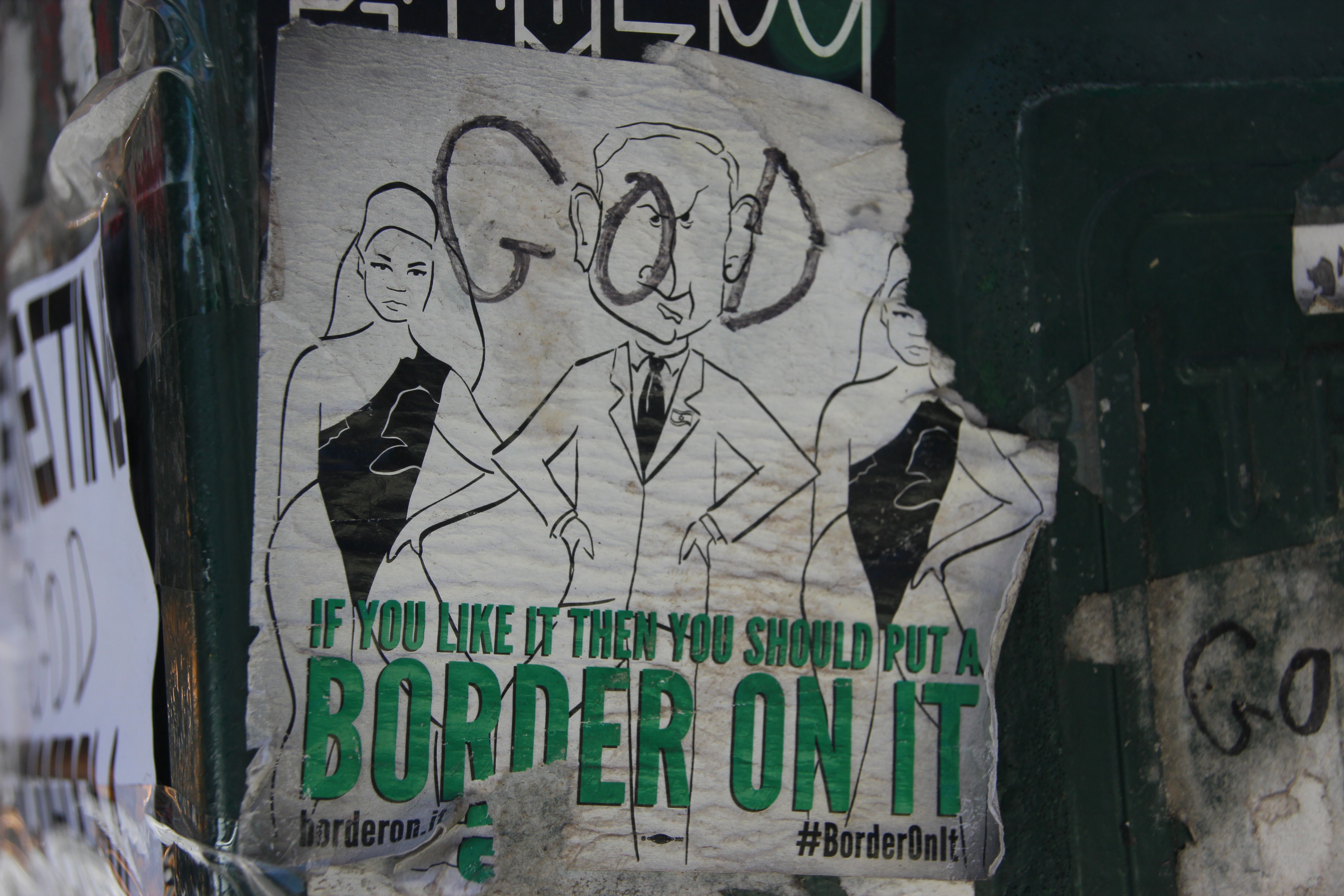
Some issues that are common subjects of protest stickers in London also occur in New York, like this one advocating a boycott of Israel.
Some issues that are common subjects of protest stickers in London also occur in New York, like this one advocating a boycott of Israeli produced goods (Photo: Hannah Awcock).
Other issues are unique to the US, such as this sticker declaring that 9/11 was the result of a conspiracy. It looks as if it has been scratched with a key or something similar in an attempt to obscure the image, suggesting the controversy of this kind of opinion.
Other issues are unique to the US, such as this sticker declaring that 9/11 was the result of a conspiracy. It looks as if it has been scratched with a key or something similar in an attempt to obscure the image, suggesting the controversy of this kind of opinion (Photo: Hannah Awcock).
This sticker plays on the iconic posters from Obama's campaign during the last election, but replaces the image of Obama with that of a protester in a V for Vendetta mask.
This Occupy sticker plays on the iconic posters from Obama’s campaign during the last election, but replaces the image of Obama with that of a protester in a V for Vendetta mask (Photo: Hannah Awcock).
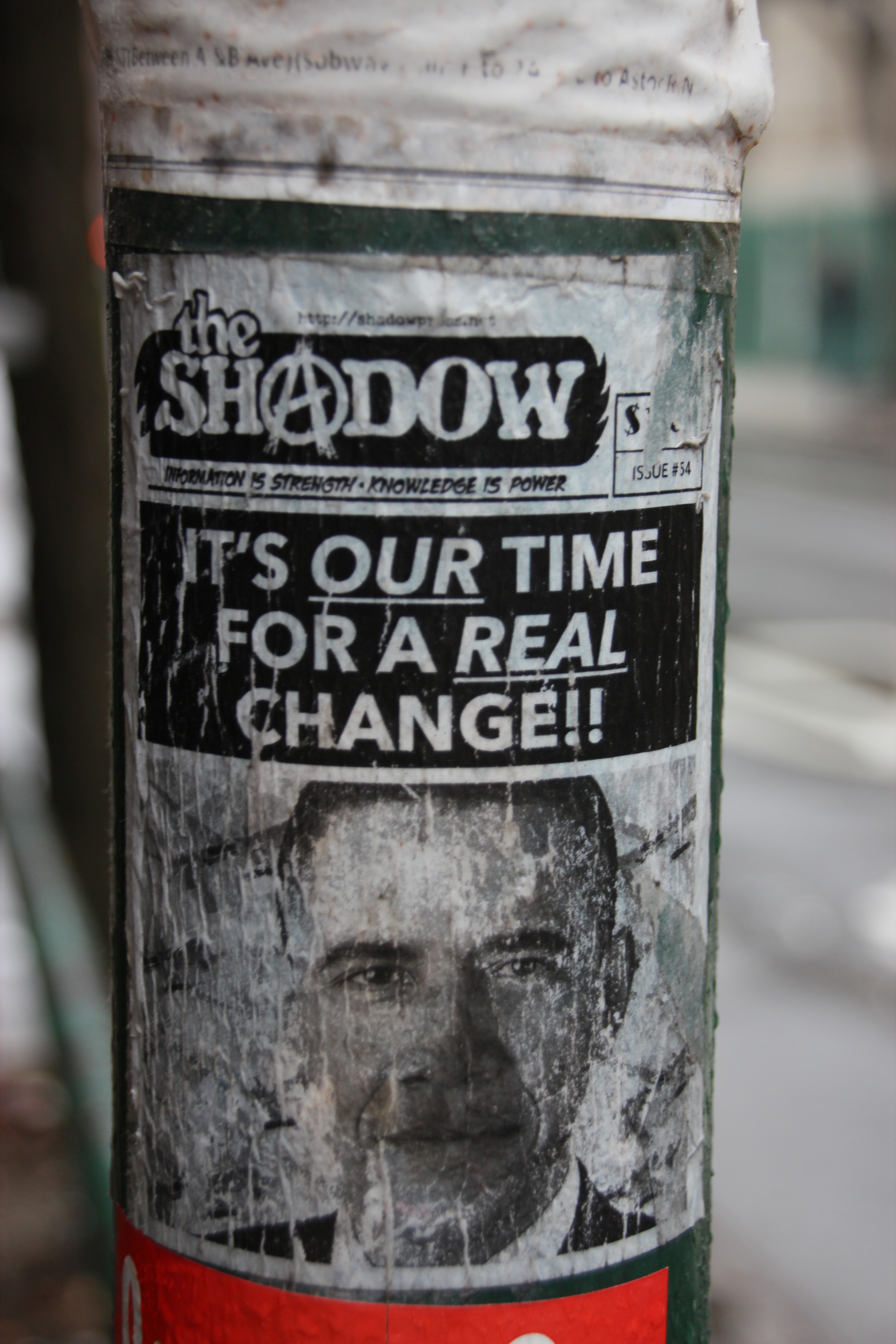
This sticker also refers to Obama. I saw sever different issues of 'The Shadow' whilst in New York.
This sticker also refers to Obama. I saw sever different issues of ‘The Shadow’ whilst in New York (Photo: Hannah Awcock).
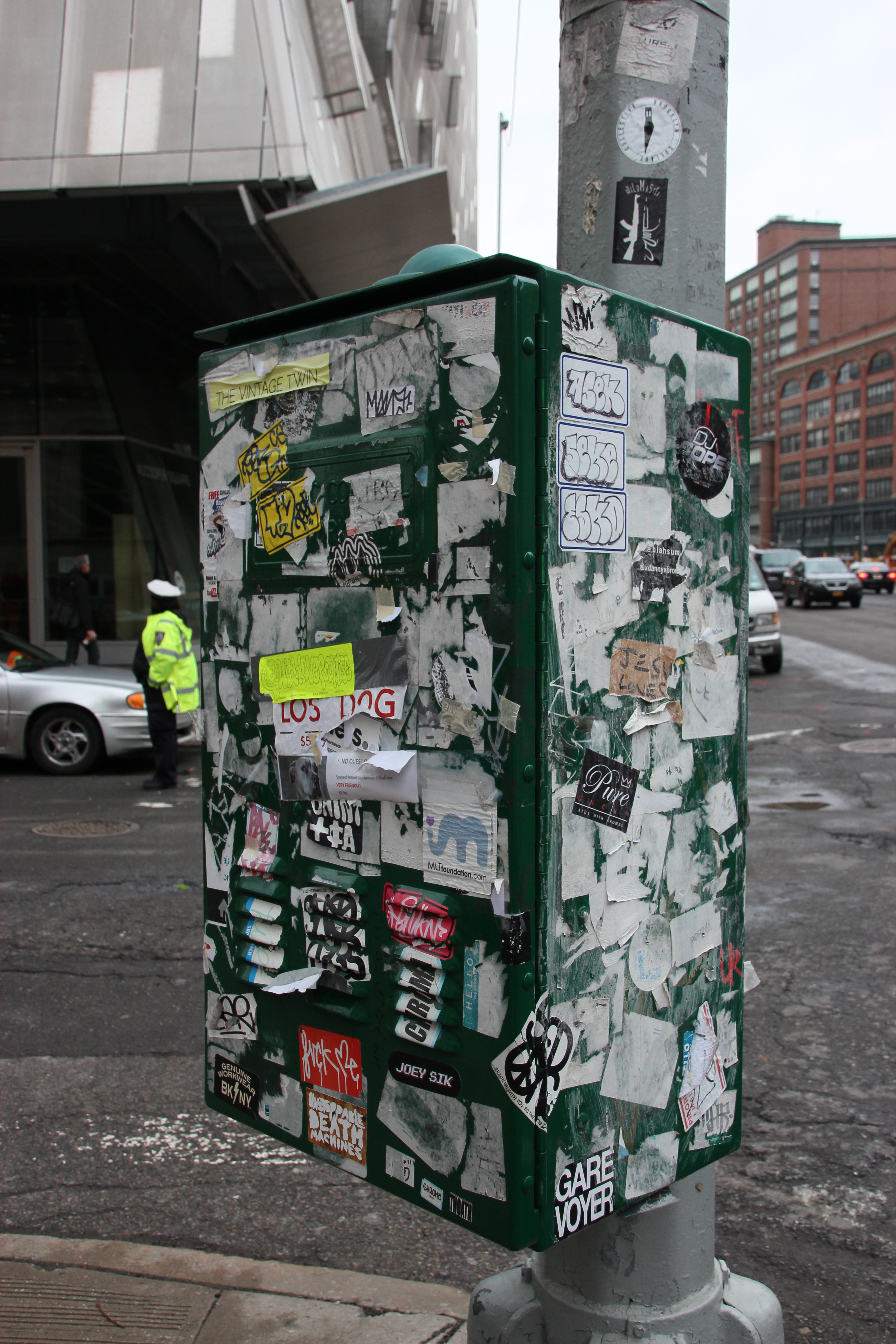
Anti-fascism was not such a common topic of protest stickers in New York as London.
Anti-fascism was not such a common topic of protest stickers in New York as London, but it is there (Photo: Hannah Awcock).
IMG_7465
This sticker was produced by an organisation called Truth Move, which also produced the anti-fascist sticker above. Anti-fascism and environmental issues are not usually tackled by the same social movement groups; Truth Move is an organisation that argues that equality and democracy come from equal access to knowledge and facts (Photo: Hannah Awcock).
IMG_7470
This sticker is handmade, it looks as if a postage label has been painted over (Photo: Hannah Awcock).
I know I am cheating a little bit with this one, it is in the collection in the Interference Archive. But I liked it too much to leave out!
I know I am cheating a little bit with this one, it is in the collection in the Interference Archive rather than on the streets. But I liked it too much to leave out! (Photo: Hannah Awcock)
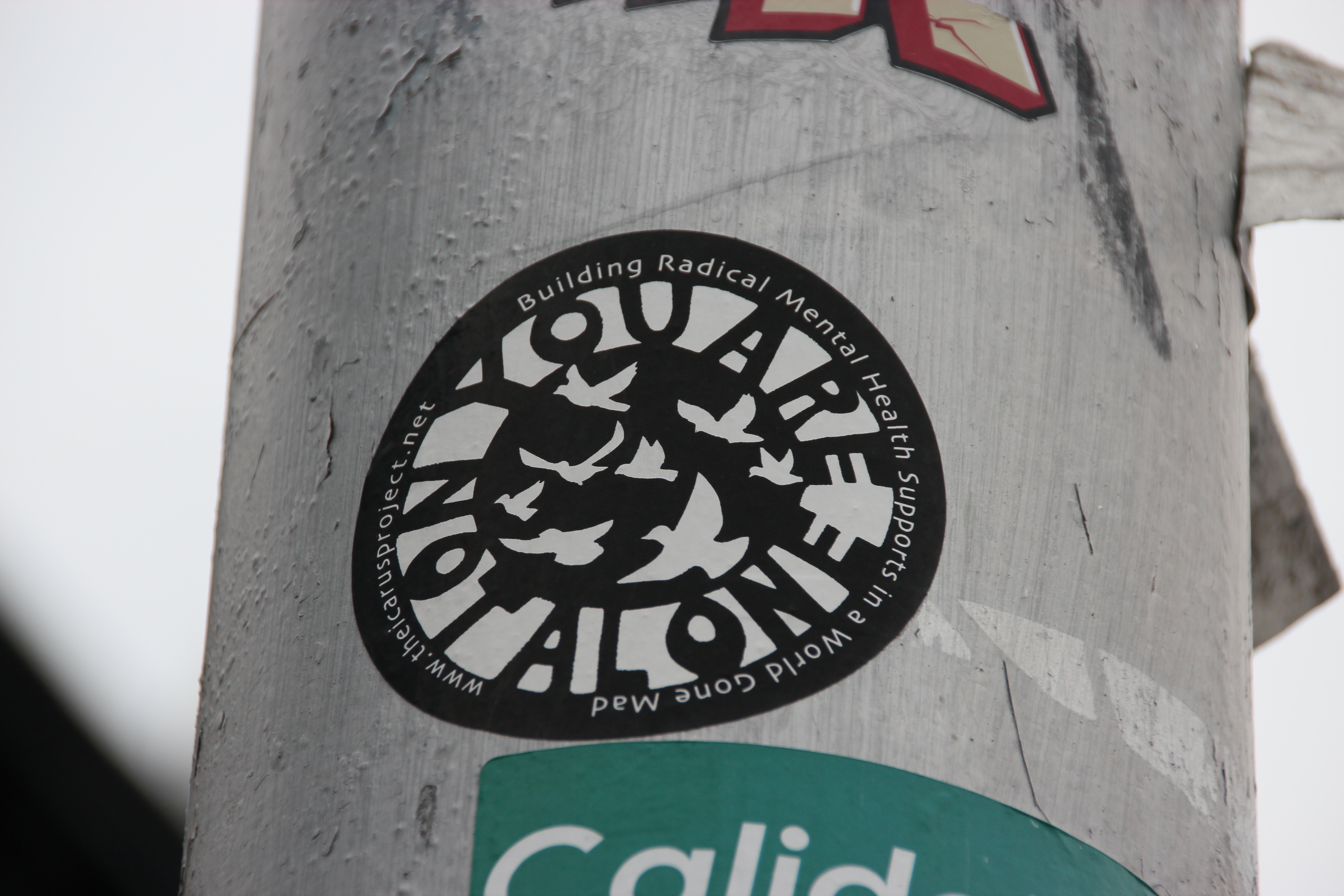
I like the design of this sticker, and it's topic, mental health is also unusual.
I like the design of this sticker, and it’s topic, mental health, is also unusual (Photo: Hannah Awcock).
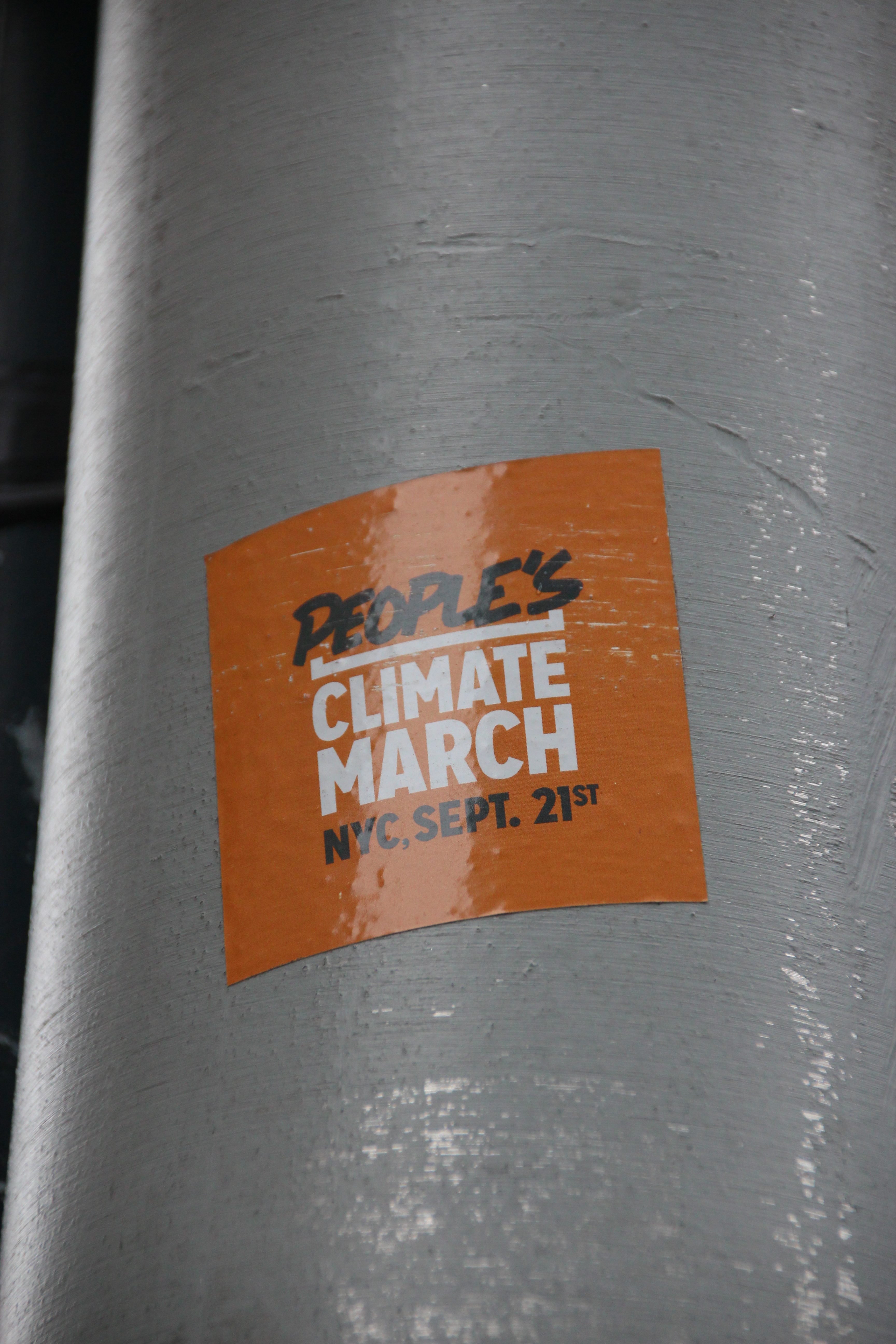
This sticker, advertising a climate march, could also be found in Spanish, a language with is widely spoken in America and New York.
This sticker, advertising a climate march, could also be found in Spanish, a language with is widely spoken in America and New York (Photo: Hannah Awcock).
I love the politeness of this anti-racist sticker in the East Village.
I love the politeness of this anti-racist sticker in the East Village (Photo: Hannah Awcock).
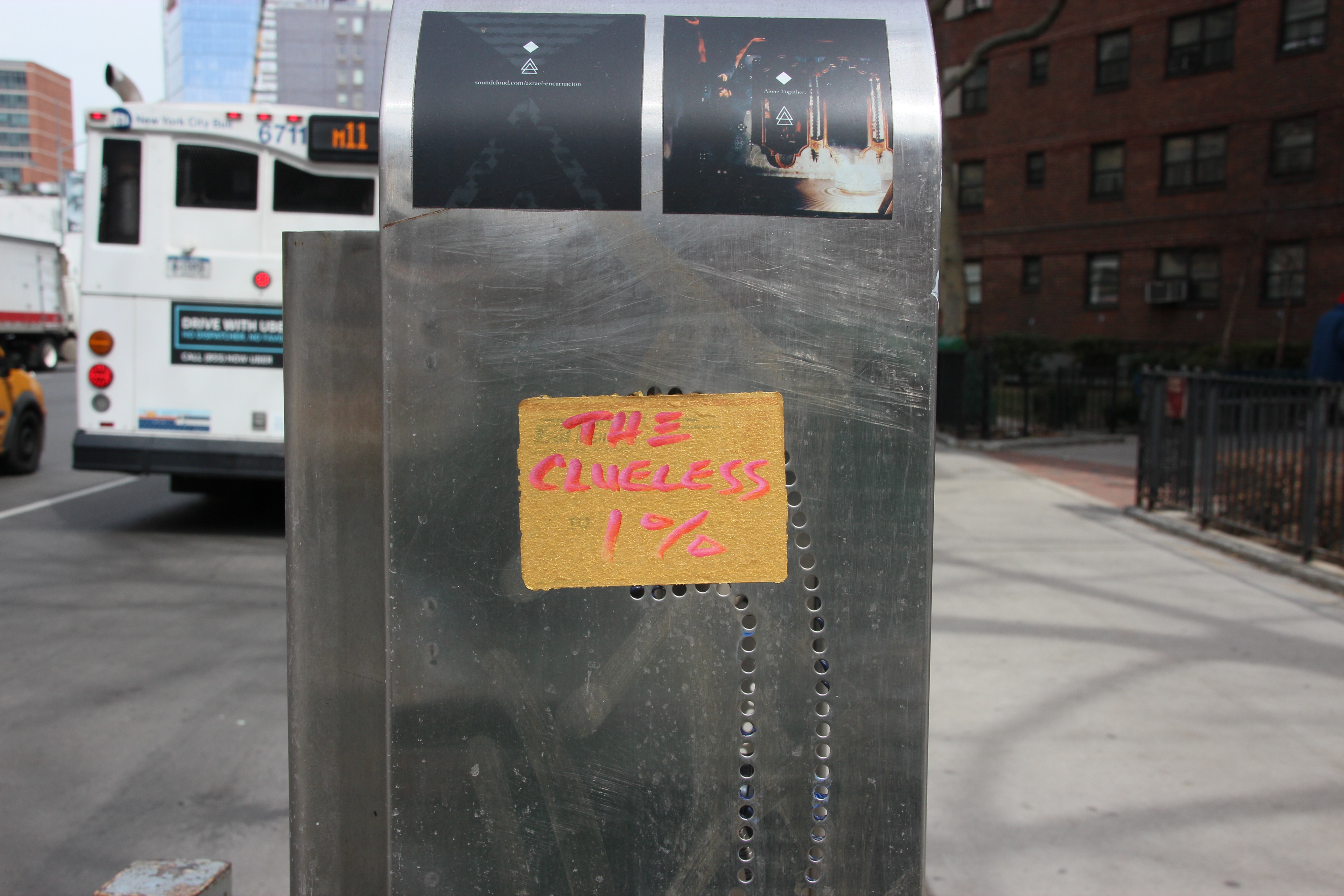
Although I do not agree with the sentiment of this sticker, I can't help but admire it's wit.
Although I do not agree with the sentiment of this sticker, I can’t help but admire it’s wit (Photo: Hannah Awcock).

Book Review: Silvertown- The Lost Story of a Strike that Shook London and Helped Launch the Modern Labour Movement

Silvertown by John Tully
Silvertown: The Lost Story of a Strike that Shook London and Helped Launch the Modern Labour Movement by John Tully

Silvertown: The Lost Story of a Strike that Shook London and Helped Launch the Modern Labour Movement. Tully, John. London: Lawrence and Wishart, 2014.

“Silvertown’s workers and their families were not just passive victims of the industrial system. They were flesh-and-blood human beings who sorrowed and hoped, swore and fought, loved and hated, enjoyed themselves when they could at pub knees-ups or their teetotal equivalents, dreamed of a better life for their children, and bore adversity with simple stoicism and very Cockney, Irish-influenced, irreverent and ironic sense of humor.”

(Tully, 2014; p. 83)

The above quote epitomises John Tully’s approach in Silvertown: The Lost Story of a Strike that Shook London and Helped Launch the Modern Labour Movement. Tully tells the story of this once-forgotten strike without losing sight of the human element. Thoroughly researched and well-written, this book about British labour history, written by an Australian for an American audience is a valuable addition to labour movement literature.

Silvertown is an industrial area in the London borough of Newham north of the Thames. It is dominated by the Tate & Lyle sugar refinery, but the area was named after Silver’s India-Rubber, Gutta-Percha and Telegraph Works that opened in 1852, when the area was little more than marshland. In September 1888, the workers at the Silver Works went out on strike when they were denied a pay rise. The bitter dispute lasted for 3 months before the workers reluctantly returned to work at their original levels of pay- those that weren’t blacklisted, anyway.

The Silvertown Strike was part of a wave of strikes and organisation in the 1880s that is now known as New Unionism. For the first time, semi-skilled and unskilled workers were unionising, and unlike the more established craft unions, they had socialist leanings and were willing to take militant action. Silvertown was not the only strike that has been left out of the dominant narrative of New Unionism, Louise Raw’s excellent book Striking a Light attempts to give the 1888 Bryant and May Matchwomens’ strike the place it deserves in labour history. Silvertown contributes to the constant process of reassessment that is so important for academic research.

There are any number of reasons why a strike or protest might be left out of the history books, and in the case of Silvertown it is probably because the strikers lost. After 3 months of hunger, picketing, marches and victimisation, the strikers were forced back to work. Tully does an excellent job of analysing why the strike did not succeed. His attention to detail is admirable- he even researched the weather conditions during the strike in order to consider the impacts the weather might have had on the strikers’ resolve. Despite the loss, Tully argues that the strike was a turning point in New Unionism, not least because the merciless tactics used by the owners of Silver’s rubber and electrical plant became a blue print for any employer trying to break a strike.

There are some gaps in the story- for example Tully has few sources that detail what the factory managers were thinking during the strike, so he has to make a few educated guesses. To be fair however, Tully always makes it clear that they are educated guesses, and he cannot use sources that don’t exist. Tully also uses too many sub-headings for my liking, which makes the text feels disjointed and awkward, but this is a minor criticism.

John Tully balances considered analysis with descriptive writing that conveys the more emotive, human aspects of the Silvertown strike. Not only is Silvertown: The Lost Story of a Strike that Shook London and Helped Launch the Modern Labour Movement a fantastic piece of scholarly research, it is also an enjoyable read, two qualities that don’t always go hand in hand.