Understanding Conflict: Protest and Political Violence

Provide tea and biscuits, and you're sure to get a good turnout!
Provide tea and biscuits, and you’re sure to get a good turnout! (Photo: Hannah Awcock)

This Monday, I attended the annual symposium of the University of Brighton’s conflict research group (or to give it it’s full name, Understanding Conflict: Forms and Legacies of Violence Research Cluster). With members from disciplines across the arts and humanities, the group seeks to understand violent conflict and its legacies. The annual symposium was organised by postgraduates from the research cluster, and featured a range of presentations by staff and students on themes that ranged from Belfast’s ‘peace walls’ to the aesthetics of AK-47s.

The first question asked by Professor Bob Brecher during his introduction to the symposium was ‘what is political violence?’ It may be a question that the research cluster never fully answers to their satisfaction, but I wonder if protest will be included in any definition that they do come up with. Certainly some members of the research group are working on protest or protest-related topics; Tim Huzar presented at the symposium on the topic of ‘Black Lives Matter and the Question of Non-Violence’, and Zeina Maasri talked about the aesthetics of the AK-47 rifle, and its symbolic role for anti-imperialist struggles during the Cold War. I have often thought about the role of violence in protest movements, and I was hoping that attending this symposium might crystallise some of my ideas.

At the very least, I was about to draw lots of connections between the papers presented at the symposium and my own work on the historical geographies of protest in London. One interesting idea that came out of a lively discussion about drone warfare was the idea of the threat of violence as a controlling force. Drones, or Unmanned Aerial Vehicles (UAVs) and the intense surveillance they enable can give the appearance of God-like omnipotence. The threat of a drone strike can have as much as an impact on people, if not more, than a strike itself. In a similar way, the threat of violent and excessive policing can be used to alter the behaviour of protesters and potential protesters. The threat of being arrested, kettled, or manhandled by police can prevent people protesting; I know it has factored into decisions I have made about whether or not to attend protests.

A recurring theme during the symposium was the ways in which violence is remembered and memorialised. Ian Cantoni presented a paper about the new memorial museum at Camp Joffre in southern France, used as an internment camp for much of the 20th Century. Dr. Eugene Michael talked about the use of the Holocaust metaphor to interpret the conflicts in former Yugoslavia during the 1990s. Just like conflicts, protests can often have difficult and contested legacies. I am currently working on the Battle Cable Street, which is memorialised in the mural shown below. It is a contentious site, and has been vandalised several times since the project began in 1976. As the name suggests, the Battle of Cable Street was a violent protest, and there are multiple conflicting narratives that surround it. The legacies of violent pasts are difficult to process, yet we continue to try, whether that violence took the form of a protest, a riot, or a war.

The Battle of Cable Street memorial in Cable Street, in Tower Hamlets in East London.
The Battle of Cable Street memorial in Cable Street, in Tower Hamlets in East London (Photo: Hannah Awcock).

There is clearly a lot of overlap between conflict and protest, especially violent protest. Protest has an uneasy relationship with violence; violence is a frequent part of unrest, but many activists reject it, for a whole variety of reasons. Nevertheless, I think that any study of protest (even those about deliberately non-violent protest) would be improved by at least a passing consideration of the causes, characteristics, and impacts of political violence.

Thank you to the Conflict research cluster at the University of Brighton for organising such an interesting day and giving me so much to think about!

Undying Archivists: Representations of Archives in Video Games

Video games can be a controversial topic; they are frequently condemned for their violence and accused of corrupting vulnerable young people. However as the variety and scope of games continue to expand, and online gamers create ever more complicated virtual communities, it becomes increasingly difficult to ignore or dismiss them. Computer games have become for focus of a lot of scholarly research, and there is even an entire journal dedicated to the topic, called Game Studies. I dabble in gaming myself, and of course my attention has been drawn to the variety of ways in which archives are represented in the myriad of virtual worlds brought to life through my computer screen.

One of my personal favourites, Fallout 3, is also the game which has one of the most realistic representations of an archive in gaming, in some respects anyway. Fallout 3 is a first person shooter/RPG (Role-Playing Game, for the uninitiated), set in a post apocalyptic world where civilisation has been destroyed by nuclear war. The action takes place in and around Washington D.C. in the year 2277, and many of the locations are based on real places, including the National Archives. Now obviously the building is looking a little the worse for wear after 250 years and a nuclear apocalypse, but it is much the same in the game as it is in real life, right down to those awkward microfiche machines that have dogged many an archival researcher. The player can embark on a quest to retrieve a copy of the Declaration of Independence from the archive’s basement, copies of which are held in the real National Archives.

A room in the National Archives from 'Fallout 3', complete with bookshelves and microfiche reader.
A room in the National Archives from ‘Fallout 3’, complete with bookshelves and microfiche reader (Source: Fallout 3/Bethesda Game Studios).
The rotunda of the National archives in 'Fallout 3', looking a little rough around the edges compared to how it looks today.
The rotunda of the National archives in ‘Fallout 3’, looking a little rough around the edges compared to how it looks today (Source: Fallout 3/Bethesda Game Studios).

Not all games are set in our world, however. Path of Exile and Diablo 3 are medieval dark fantasy action RPGs, set in worlds full of magic, swords and necromancy. They are both played in the axonometric projection, which is a posh way of saying that the player looks down on the action. And they also both have archives, although they are not ones that a modern day archival researcher would necessarily recognise. They are arguably more similar to the archives of the popular imagination, full of dark corners and scrolls. In Path of Exile, the player has to fight their way through hordes of zombie skeletons called ‘Undying Archivists’ to reach their objective, the Golden Pages. In Diablo 3, the archives are the domain of Zultan Kulle, an evil warlock who collected his archive as part of his unceasing quest for more power. In both cases, they are evil places, full of enemies and danger.

The archives in 'Path of Exile.' Here, aisle of catalogue drawers create a maze for the players to navigate. The feeling of confused frustration may be familiar to those of who to do research in archives.
The archives in ‘Path of Exile.’ Here, aisles of catalogue drawers create a maze for the players to navigate. The feeling of confused frustration may be familiar to those of who to do research in archives (Source: Path of Exile/Grinding Gear Games).
This screenshot shows another area of the archives from 'Path of Exile.
This screenshot shows another area of the archives from ‘Path of Exile.” Here, the walls are lined with books (Source: Path of Exile/Grinding Gear Games).
The archives in 'Diablo 3' are a bit sparse, but this is how most areas of the game are designed.
The archives in ‘Diablo 3’ are a bit sparse, but this is how most areas of the game are designed (Diablo 3/Blizzard).

Dark Souls is another medieval dark fantasy action RPG, but it is played in the third person (the camera is behind the player, not above). Widely acknowledged as one of the hardest games of recent years, it has also been incredibly popular. And it also has an archive, also collected by a villain, and also not a particularly nice place to be. In this case the baddie is Seath the Scaleless, a giant dragon who betrayed his own kind and now hides out in his archives, desperately searching for the key to immortality because he has no scales to protect him.

Seath the Scaleless' archives in 'Dark Souls', which actually looks like the kind of old-fashioned library I would love, if it wasn't for all the enemies trying to kill you (Source: Daniel Dougherty)
Seath the Scaleless’ archives in ‘Dark Souls’, which actually looks like the kind of old-fashioned library I would love, if it wasn’t for all the enemies trying to kill you (Source: Dark Souls/FromSoftware, Inc.).
Seath's archive contains a huge round tower with books from floor to ceiling (Source: Daniel Dougherty).
Seath’s archive contains a huge round tower with books from floor to ceiling (Source: Dark Souls/FromSoftware, Inc.).

Archives also crop up in science fiction games. Destiny is a first person shooter set in a far-off future where the player is a guardian of the last safe city on earth. The player explores the ruins of human civilisation spread throughout the universe, but even in this era there are archives. In one quest, the player is sent to Venus to prevent the accumulated knowledge of the Golden Age being obtained by the Fallen, one of civilisation’s many enemies. In this case the archives are the domain of the goodies, not the bad guys, but it is still a risk, capable of doing great damage if it falls into the wrong hands. Knowledge, in many of these games, is dangerous.

The futuristic archive in 'Destiny', on the planet Venus (Source: Daniel Dougherty).
The futuristic archive in ‘Destiny’, on the planet Venus (Source: Daniel Destiny/Bungee).

The world of video games is vast, and games come in a huge range of shapes and sizes. Archives do seem to crop up relatively often though, and I’m sure I’ve only shown you a fraction of the examples here (please do let me know if the comments about games I’ve missed!) Perhaps it is just the nature of video games, but archives are frequently the domain of villains, bad people intent on getting what they want, whether it’s more power or more life. This bears little resemblance to real-life archives, which makes me wonder why this image appears so often. Where does it come from, and what impact does it have on popular understandings of the archive?

Special thanks for this post go to Daniel Dougherty, who provided some of the images, most of the information, and who introduced me to video games in the first place.

Sources and Further Reading

Anon. “National Archives and Records Association.” Wikipedia. Last modified 25th May 2015, accessed 4th June 2015.  http://en.wikipedia.org/wiki/National_Archives_and_Records_Administration

Anon. “The National Archives.” Fallout Wiki. No date, accessed 4th June 2015. http://fallout.wikia.com/wiki/National_Archives

Davies, Martin. “Gamers Don’t Want Any More Grief.” The Guardian. Last modified 15th June 2006, accessed 4th June 2015. http://www.theguardian.com/technology/2006/jun/15/games.guardianweeklytechnologysection2 

Stuart, Keith. “The Cliche of the Lone Male Gamer Needs to be Destroyed.” The Guardian. Last modified 11th May 2015, accessed 12th May 2015. http://www.theguardian.com/technology/2015/may/11/the-cliche-of-lone-male-gamer-needs-to-be-destroyed 

Turbulent Chicago: Representations of Protest at the Chicago History Museum

A selfie with an Illinois suffragette in the Facing Freedom exhibition at the Chicago History Museum.
A selfie with an Illinois suffragette in the Facing Freedom exhibition at the Chicago History Museum (Photo: Hannah Awcock).

A few weeks ago I went to the Annual Meeting of the Association of American Geographers in Chicago. Amongst all the geography-ing I had some time to look around the city, and I spent a really enjoyable morning in the Chicago History Museum. Like any other city, Chicago has a history of riots and protest, and some of this history is represented in the museum. There are two main areas in which protest is represented in the museum’s permanent exhibits. The first is Facing Freedom, which explores the concept of freedom and how it has been negotiated, fought for and denied in America’s recent history. The second is Chicago: Crossroads of America, which narrates the city’s history through a series of themed galleries.

The Facing Freedom exhibition has an interactive element where visitors can become part of the exhibit.
The Facing Freedom exhibition has an interactive element where visitors can become part of the exhibit (Photo: Hannah Awcock).
A hot worn by Illinois suffragists at a national march in Washington DC in 1913 in the Facing Freedom Exhibition.
A hat worn by Illinois suffragists at a national march in Washington DC in 1913 in the Facing Freedom Exhibition (Photo: Hannah Awcock).

The Facing Freedom exhibition examines the relationship between the United States of America and freedom, which has been patchy to say the least. Slavery, Japanese internment camps during WW2 and the treatment of Native Americans are all covered, but of course what interests me most are the protests and social movements.  The exhibition features the Brotherhood of Sleeping Car Porter’s in the 1920s-30s, the United Farm Workers in the 1960s, the Chicago school boycott in 1963, and the Illinois suffragists movement in the early 1900s. All of these movements and groups were successful to a greater or lesser extent; nothing was featured that didn’t achieve at least some of their goals. In this way these social movements, people who fought and won for freedom, are counter posed with those who had their freedom taken from them, the Japanese-Americans, slaves and Native Americans. The general message of the gallery is that freedom must be fought for and protected, and protest is positioned as a necessary part of that process.

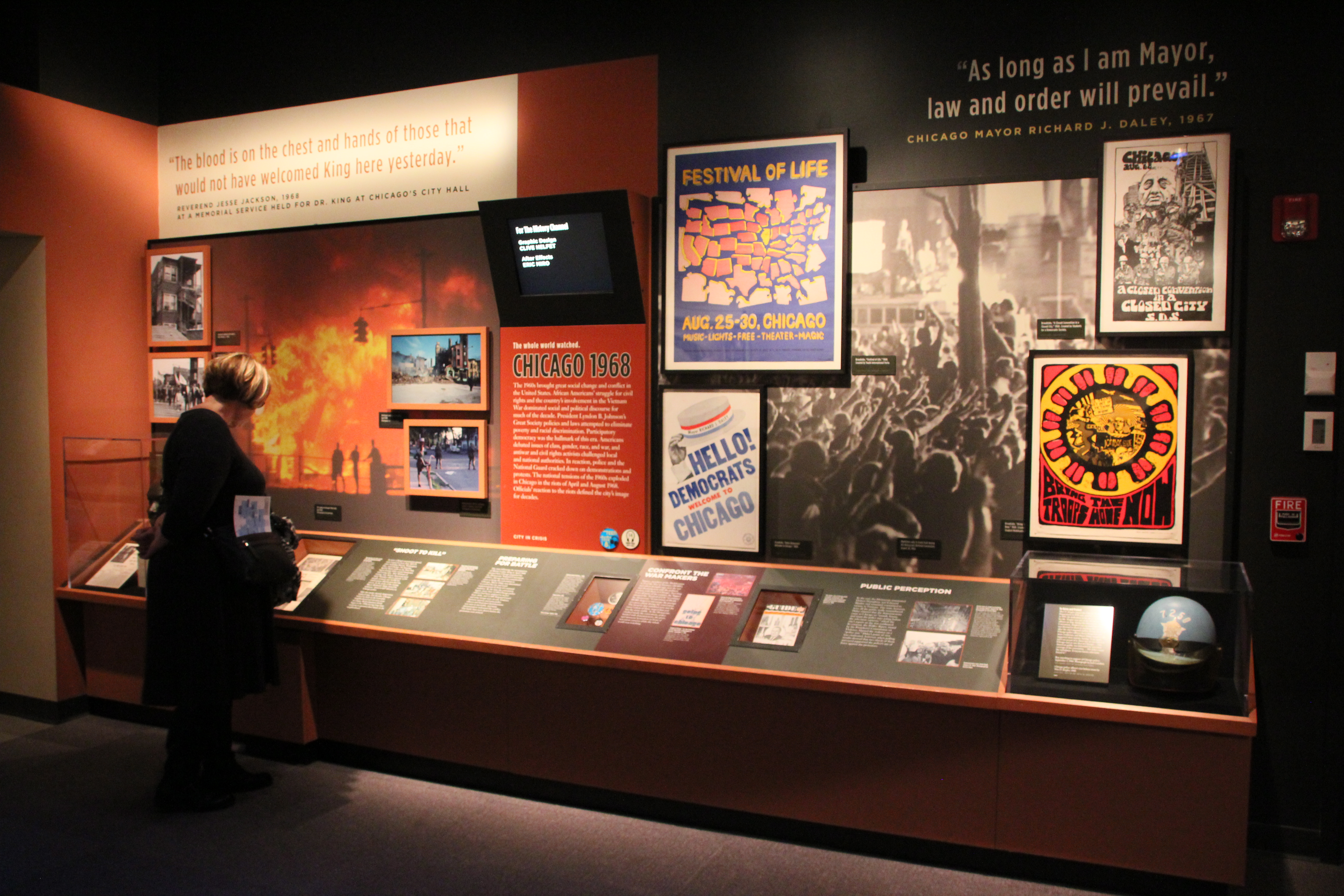
The riots during the 1968 Democratic National convention are portrayed as a negative event, the divisive legacies of which can still be found in Chicago today.
The riots during the 1968 Democratic National convention are portrayed as a negative event, the divisive legacies of which can still be found in Chicago today (Photo: Hannah Awcock).

In contrast, protest is represented in a more negative light in the Chicago: Crossroads of America exhibition. 3 protests are depicted in the Chicago in Crisis gallery: the Haymarket Affair, the 1919 Race Riots, and the Democratic National Convention riots in 1968. Along with the 1871 Great Fire that destroyed huge swathes of the city, the Gangland Era, and the sinking of the passenger ship the SS Eastland in which 844 people died, these protests are represented as turning points in the history of Chicago; negative experiences which the city dealt with with varying degrees of success. In this gallery, protest is not viewed as a positive, or even a necessary evil. The understanding of protest represented here is fundamentally at odds with that of the Facing Freedom exhibition.

In Chicago’s complex urban environment, powerful economic, social and political forces converge and collide, creating tensions that periodically explode into crisis. Chicago’s greatest crises include the Great Fire of 1871, the Haymarket Affair, the 1919 Race Riot, the Gangland Era, and the West Side and Democratic National Convention riots in 1968.

Chicago’s response to each crisis shaped its identity. A triumphant recovery from fire earned Chicago the “I Will” motto, but its failure to heal racial divisions following the 1919 and 1968 riots fostered segregation that plagued the city. Likewise, Chicago’s reputation for gangland violence continues, despite the bootlegger’s demise.

Text from the Chicago in Crisis gallery, Chicago History Museum

These 2 exhibitions demonstrate how protests can be interpreted in different ways. In this age of mass media and instant news, the way that a protest is viewed by people removed from the event itself is crucial. The presence of positive and negative representations of protest within the same museum illustrate the richness involved in thinking about how protests are perceived, and hints at the complexity of museum geographies. Next time you see a protest represented in a museum, trying thinking about some of these issues. And if you’ve ever in Chicago, the Chicago History Museum is well worth a visit (it is also close to Lincoln Park Zoo, one of the oldest zoo’s in America, and free to get in, although a little dreary on a cold April day!)

London’s Protest Stickers: Mainstream Politics

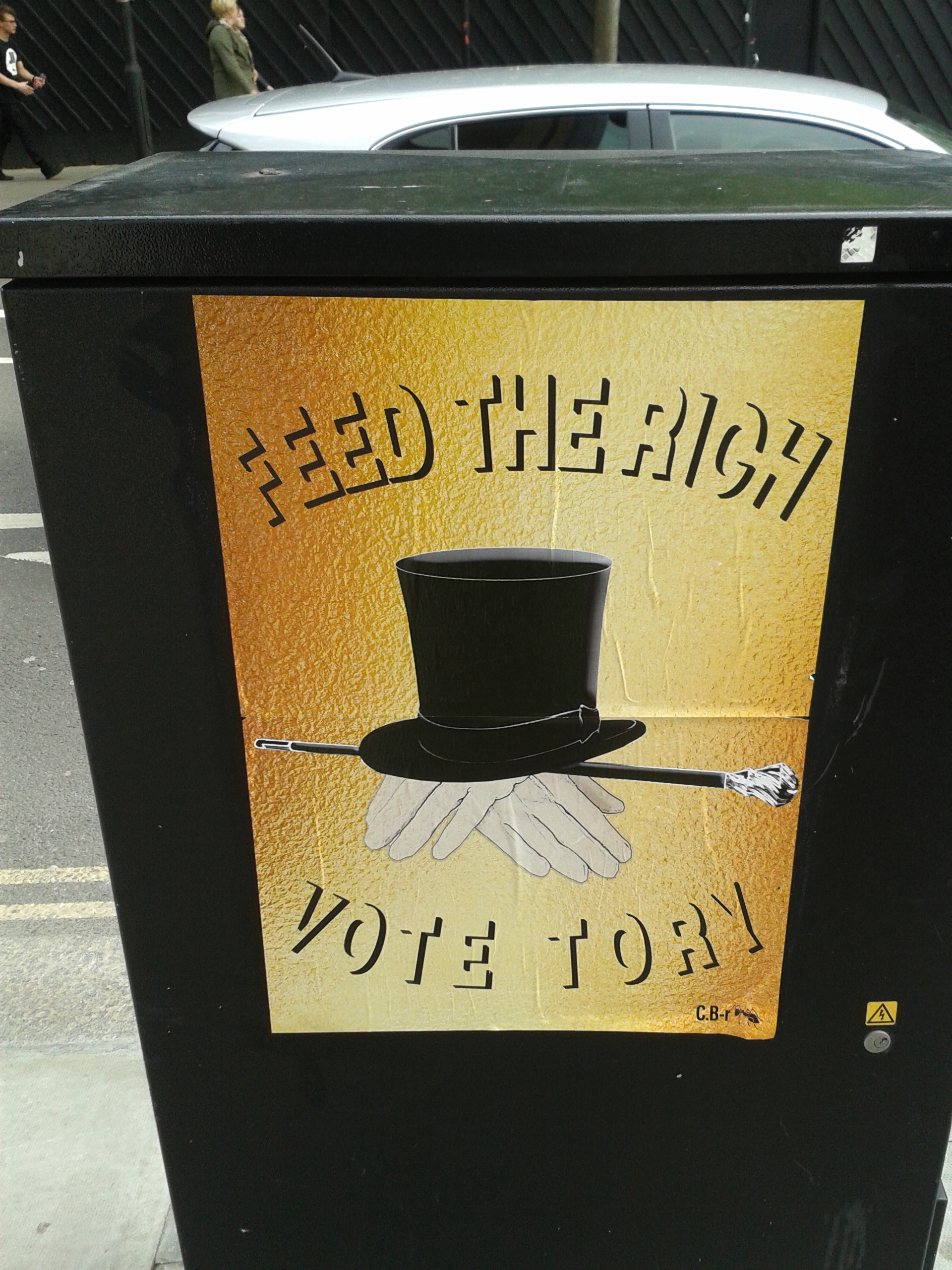
Protest has a complicated relationship with mainstream politics. Governments and political parties are frequently the targets of social movements and demonstrations, such as the recent Anti-government protests after the 2015 General Election. Political parties and politicians often appear as the subject of protests stickers. In London, the frequency of these kind of stickers increased in the weeks before the recent General Election. Generally, the streets of London did not agree with Britain’s voters.

There was a decidedly anti-Conservative tone of many of the protest stickers that appeared in the weeks before the 2015 General Election (Tottenham Court Road,  17/04/15).
There was a decidedly anti-Conservative tone of many of the protest stickers that appeared in the weeks before the 2015 General Election (Photo: Hannah Awcock, Tottenham Court Road, 17/04/15).
UKIP also received a certain amount of criticism on the streets of London, although it then went on to win 12.6% of the vote (Gordon Street, Bloomsbury, 17/04/15).
UKIP also received a certain amount of criticism on the streets of London, although it then went on to win 12.6% of the vote (Photo: Hannah Awcock, Gordon Street, Bloomsbury, 17/04/15).
This example, more of a poster than a sticker really, directly referenced the election (New Oxford Street, Holborn, 03/05/15)
This example, more of a poster than a sticker really, directly referenced the election (Photo: Hannah Awcock, New Oxford Street, Holborn, 03/05/15).
These stickers criticized the electoral system as a whole rather than specific politic parties. They had been removed the next day (28/04/15).
These stickers criticized the electoral system as a whole rather than specific politic parties. They had been removed the next day (Photo: Hannah Awcock, Borough High Street, 28/04/15).
A sticker calling for Muslims not to vote. Some argue that voting is polytheism, because no one has the right to make laws except God. The sticker has an official appearance, looking more like a warning sign than a protest sticker (Euston Station, 12/05/15).
A sticker calling for Muslims not to vote. Some argue that voting is polytheism, because no one has the right to make laws except God. The sticker has an official appearance, looking more like a warning sign than a protest sticker (Photo: Hannah Awcock, Euston Station, 12/05/15).
This sticker, by the Anarchist Federation, is also calling for people not to vote, although I'm sure the motive was very different. This sticker was located on a bin, which might have been an attempt to equate voting with rubbish. Or it might have been a coincidence (Camden High Street, 20/05/15).
This sticker, by the Anarchist Federation, is also calling for people not to vote, although I’m sure the motive was very different. This sticker was located on a bin, which might have been an attempt to equate voting with rubbish. Or it might have been a coincidence (Photo: Hannah Awcock, Camden High Street, 20/05/15).
The writing on this sticker has been removed, but the image of David Cameron with vampiric teeth gets the message across I think! (Borough High Street, 28/04/15).
The writing on this sticker has been removed, but the image of David Cameron with vampiric teeth gets the message across I think! (Photo: Hannah Awcock, Borough High Street, 28/04/15).
This sticker, along with the next one, rank amongst my favourite stickers come across so far in London. Avengers: Age of Ultron was released in UK cinemas on the 23rd of April, so the reference is topical as well as humorous. (New Oxford Street, Holborn, 03/05/15).
This sticker, along with the next one, rank amongst my favourite stickers that I’ve come across so far in London. Avengers: Age of Ultron was released in UK cinemas on the 23rd of April, so the reference is topical as well as humorous (Photo: Hannah Awcock, New Oxford Street, Holborn, 03/05/15).
Not to be left out, Nigel Farage also gets the Avengers treatment (New Oxford Street, Holborn, 03/05/15).
Not to be left out, Nigel Farage also gets the Avengers treatment (Photo: Hannah Awcock, New Oxford Street, Holborn, 03/05/15).
This sticker also criticises Nigel Farage's party, using wordplay to warn of the dangers of complacency (King's Cross, 05/05/15).
This sticker also criticises Nigel Farage’s party, using wordplay to warn of the dangers of complacency (Photo: Hannah Awcock, King’s Cross, 05/05/15).
This sticker is another criticism of UKIP, but it has been grafittied, accusing the person who made the sticker of bigotry (Regent's Canal tow path, Camden, 20/05/15).
This sticker is another criticism of UKIP, but it has been grafittied, accusing the person who made the sticker of bigotry (Photo: Hannah Awcock, Regent’s Canal tow path, Camden, 20/05/15).
Many people are disillusioned with the current political system, and feel like the current political parties do not offer real choice. They all argue that there is a need for continued austerity, for example. This sticker is referring to that sense of disillusionment (Euston Road, 06/05/15).
Many people are disillusioned with the political system, and feel like the current political parties do not offer real choice. They all argue that there is a need for continued austerity, for example. This sticker is referring to that sense of disillusionment (Photo: Hannah Awcock, Euston Road, 06/05/15).
This sticker refers to an entirely different vote, although the issue of Scottish independence was still an important one during the election campaign. This sticker is from the Yes Campaign, that argued for Scottish independence during the referendum in 2014 (Malet Street, Bloomsbury, 17/04/15).
This sticker refers to an entirely different vote, although the issue of Scottish independence was still an important one during the election campaign. This sticker is from the Yes Campaign, that argued for Scottish independence during the referendum in 2014 (Photo: Hannah Awcock, Malet Street, Bloomsbury, 17/04/15).

Highs and Lows of the AAG: Perspective of a Lone Travelling PhD Researcher

Who Am I?

My name is Llinos Brown and I am a final year EPSRC CASE award PhD student at the University of Central Lancashire (UCLan), Preston. My PhD research explores energy cultures in a workplace case study environment. I am particularly interested in exploring how energy cultures differ between manufacturing and office environments within the same workplace. If you are interested in hearing more about my research please get in touch – Lbrown5@uclan.ac.uk or follow me on twitter @LlinosBrownGeog


The AAG this year was held in Chicago, the city that invented the skyscraper.
The AAG this year was held in Chicago, the city that invented the skyscraper. The main conference venue was the Hyatt Regency hotel, to the left of this image (Photo: Hannah Awcock).

Like the majority of conferences, the AAG is a great opportunity to catch up with colleagues/friends, build up relationships, meet new people and network…..what you would expect from any conference. But the AAG is a bit different to any conference I had attended. It is extremely big – over 9000 geographers attending, with over 1700 sessions submitted – split over two main venues and two smaller venues, with over 90 parallel sessions. It has a conference app and there are lots of very well-known geographers in attendance (someone should create a Geographer Bingo).

Something that I struggled with and something that overwhelmed me was – how do you systematically go through which session to attend? My approach was first look at the speciality groups, the main one for me– energy, and highlight them. Then look for some key words – for me energy, workplace, and behaviour, and highlight them. Finally if there are any gaps (and I had time to look in more detail) look through particular session slots and highlight anything that you think was a bit different. I spent around 20 minutes each evening going through what I had highlighted for the next day and working out what I really wanted to see. Each day I also popped in something a little bit different into my schedule. I would definitely recommend this, some of the most thought provoking sessions that I attended were sessions that had nothing to do with my sub-discipline of energy geographies. The AAG has a bit of everything, embrace the amazing discipline of Geography and the variety of sessions that are on offer.

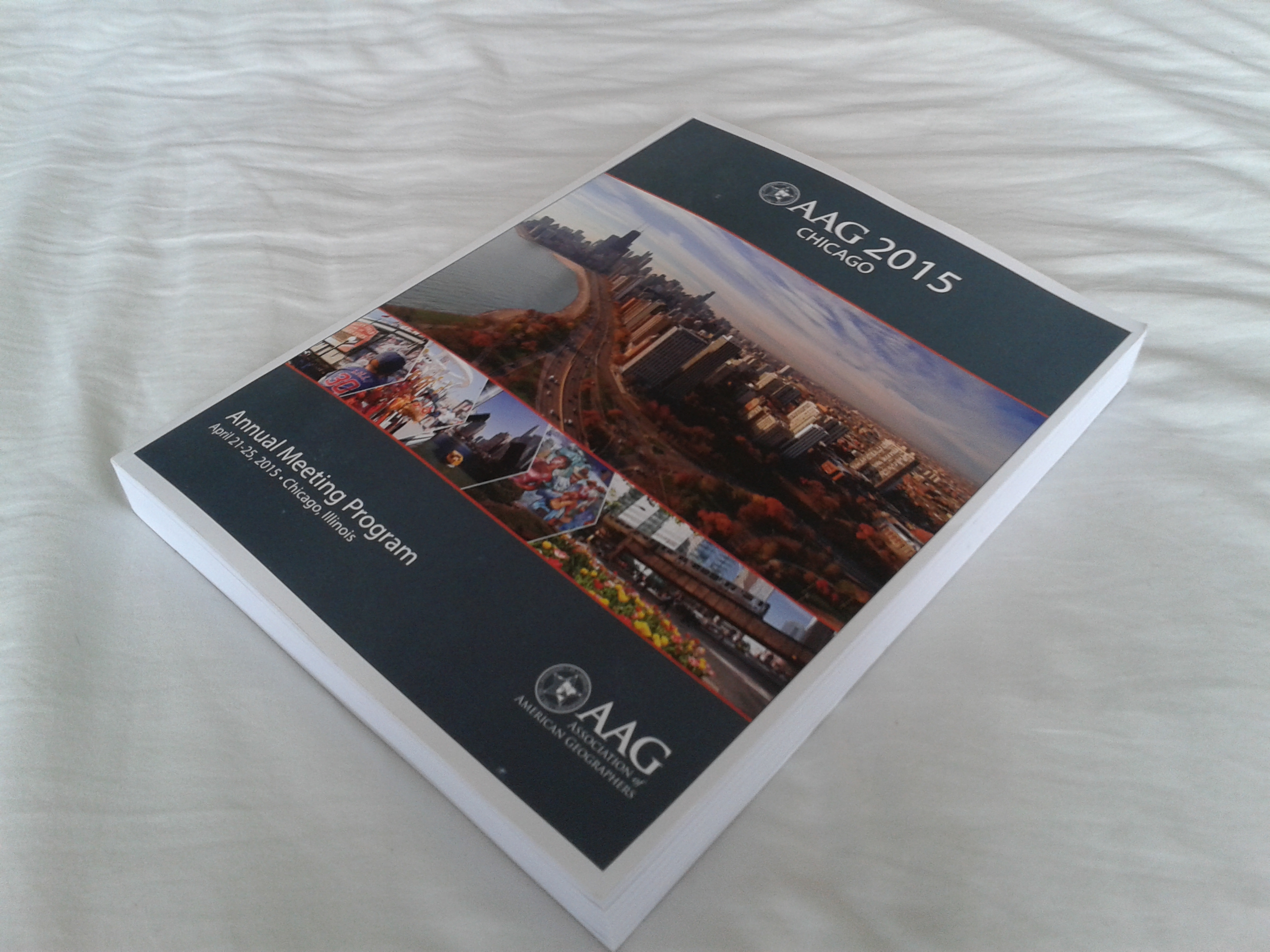
The printed program for the AAG is the size of a telephone book!
The printed program for the AAG is the size of a telephone book! (Photo: Hannah Awcock)

One of the highs of the conference for me that I did not realise until I was on the plane home, was how embracing geography for a week helped me formulated new ideas. It’s not just about presenting your paper, networking, or handing out business cards. The conference has helped me develop empirical chapters for my thesis and it has made it much clearer to me how all the bits of my future thesis will link together. Maybe this wasn’t the AAG and it was just having time away from my desk and not directly thinking about my PhD but it was very extremely beneficial all the same.

One of the lows of the conference for me was its size. It is extremely big and it can be a lonely experience. Lunch and refreshments are not provided by the organisers so you can easily end up on your own at lunchtime. There are not the opportunities to chat to the person in front of you or sit next to someone while eating dinner and get chatting to them – which I’ve done at the RGS Annual Conference.  One thing I noticed at the AAG is that there are a lot of British geographers in attendance but they often stay in their university groups which mean if you’re the sole representative from your university it can mean you’re on your own for an evening or two. I was lucky enough to gate crash the Royal Holloway ‘crew’ so most evenings I joined them for food and drink – Thanks guys!

Llinos doing a bit of networking.
Llinos doing a bit of networking (Photo: Hannah Awcock).

The N word – ‘Networking’ – we all know the benefits of it and how beneficial it can be but sometimes it can make you reflect on your experience as a researcher and make you wish you were in the person you are speaking to shoe’s. Yes, there is the saying ‘the grass is always greener on the other side’ and this might link to me being the only person from UCLan attending the AAG but some evenings when I was back in my hotel room and had time to reflect on the day, I was a bit jealous of the additional support networks, the variety of supervision and the diversity of PhD research communities at other universities. This can be a bit of a low but there are also some positives such as realising you’ve got better resources than other PhD students – such as a permanent desk.

So to round up some top tips from me:

  • Don’t attend every session, there is a lot going on and you need time to digest the information you’ve obtained;
  • Get in contact with people you have met at previous conferences and see if they are attending, buddy up with them, exchange details and go for a drink.
  • Follow the twitter hashtag, if you’re ever not sure what session to attend check out twitter and see if something exciting is happening.
  • Head to a random session not related to your discipline – embrace Geography

Llinos Brown, University of Central Lancashire.

On this Day: The Nore Mutiny, 12th May 1797

On this day 208 years ago a mutiny started at the Nore anchorage in the Thames estuary that would last for a month and would come to threaten the beating heart of London, they city’s incredibly lucrative trade economy. Great Britain was at war with revolutionary France, which put a huge strain on the nation’s navy, and also meant that the government could not afford to have the navy mutinying. Discontent had been brewing within the navy since the start of 1797; the men were poorly treated, their wages had not changed for over a century, and high rates of inflation were severely eroding their value. As well as this, the French revolution had badly scared Britain’s ruling elites, and they feared a similar uprising here.

A caricature of the mutineers. ‘The delegates in council or beggars on horseback’
by Isaac Cruikshank, published by Samuel William Fores
hand-coloured etching, published 9 June 1797
NPG D15627
© National Portrait Gallery, London

In April the ships at the Spithead anchorage near Portsmouth mutinied, demanding better pay and working conditions. They won their demands, and everyone who took part was pardoned. The seamen at Nore took inspiration from those at Spithead, but their mutiny was not destined to be so successful, for a number of reasons.

The crew of the Sandwich were the first to mutiny, on the evening of the 12th of May 1797. They were joined by other ships, but some ships left the Nore to avoid taking part in the mutiny. Organisation was difficult amongst the sailors at Nore, as the ships were spread out, and they didn’t belong to a single fleet, as was the case at Spithead. Nevertheless delegates were elected from every ship, and a man named Richard Parker was elected ‘President of the Delegates of the Fleet.’

On the 20th of May (which also happens to be my birthday!), the mutineers presented a list of 8 demands to Admiral Charles Buckner. The demands started off fairly average, including pardons for the mutineers and increased pay. However the demands soon took on a more radical turn, as the mutineers demanded that the King dissolve Parliament, and immediately make peace with France. This turn outraged the Admiralty, who offered the Nore sailors only the same concessions they had given to the men at Spithead.

The mutineers blockaded the Thames, and tried to prevent any ship from entering or leaving London. Had they been successful for any great length of time, they would have crippled London’s booming economy. They also made plans to sail to France, a plan which alienated many of the sailors, causing more ships to abandon the mutiny. The government and Admiralty didn’t want to make any further concessions, especially as they were wary of the political aims of some of the more radical leaders.

The mutineers were denied food, and eventually so many ships slipped away, despite being fired on by those that remained, that the mutiny collapsed. Richard Parker was swiftly convicted of treason and piracy and hanged from the yardarm of the Sandwich, where the mutiny started. 29 leaders were also hanged, and others were flogged, imprisoned or transported to Australia.

The men at Nore were fighting for better conditions and pay, but their more radical demands meant they the government and Admiralty could not be seen to back down. The mutineers also threatened London’s economy, which the authorities could not allow to stand. The seamen’s status as members of the navy put them in a different position to civilians when it came to their working rights. Members of the armed forces do not have the same rights as the average worker; to this day, they are not allowed to join a union or go on strike. These restrictions make the actions of the sailors at Nore all the more admirable. They faced dire consequences to stand up for themselves, and Richard Parker and many others paid the price when the mutiny collapsed.

Sources and Further Reading

Anon. ‘Research Guide B8: The Spithead and Nore Mutinies,’ National Maritime Museum. Last modified April 2008, accessed 15 April 2015 http://www.rmg.co.uk/researchers/library/research-guides/the-royal-navy/research-guide-b8-the-spithead-and-nore-mutinies-of-1797

Anon. ‘Spithead and Nore Mutinies,’ Wikipedia. Last modified 13 February 2015, accessed 15 April 2015. http://en.wikipedia.org/wiki/Spithead_and_Nore_mutinies

Anon. ‘The Naval Mutinies at Spithead and the Nore,’ Socialist Appeal. Last modified 15 January 2008, accessed 15 April 2015. http://www.socialist.net/the-naval-mutinies-at-spithead-and-the-nore.htm

Moore, Richard. ‘Mutiny at the Nore,’ Napoleonic Guide. No date, accessed 15 April 2015. http://www.napoleonguide.com/navy_nore.htm

‘Still the Enemy Within:’ May Day Screening

‘Still the Enemy Within’ film poster.

Last Friday (May the 1st), I went to a showing of the documentary film Still the Enemy Within (2014), organised by Reel Islington and Radical Islington at London Metropolitan University. The film tells the story of the 1984-5 miner’s strike, from the perspective of those who took part. The film’s executive producer, Mike Simons, and Mike Jackson, the secretary of Lesbians and Gays Support the Miner’s (LGSM) were there for a Q&A after the screening. I have been meaning to see the film for a while, and it seemed like an appropriate thing to do with my May Day.

Still the Enemy Within reconstructs the narrative of the miner’s strike using archive footage and photos, interviews and dramatisations. It starts in 1979, when Margaret Thatcher was elected Prime Minister, and runs right through to the recent anti-austerity protests, although these only get a brief mention in the last few minutes. It is engaging and entertaining, and does a fantastic job of telling the story with a nice balance of poignancy and humour. With the 30th anniversary of the strike recently, and films such as Pride and Going through the Change!, I had an awareness of the miner’s strike and knowledge of specific parts, but Still the Enemy Within improved my general knowledge of the strike immeasurably. It goes through the major events of the strike in chronological order, including how the strike began, the reluctance of Nottinghamshire miners and other unions to join the strike, the death of David Jones at a picket, and the eventual defeat.

With the benefit of hindsight, it is easy to think of the miner’s strike as doomed to fail, but the interviews with strikers and their supporters tell a different story. Especially at the beginning of the year-long strike, the miners were confident in their ability to win, largely thanks to their victory over Conservative Prime Minister Edward Heath in 1974. The National Union of Mineworker’s (NUM) was one of the strongest in the country, and the miner’s had faith in the NUM’s president, Arthur Scargill. Hearing the story from the perspective of those who took part gives a sense of what it was like to live through the highs and lows, the joys of solidarity and strength and the bitterness of hunger, failed marriages and defeat.

2015-05-01 20.45.00
Mike Simon and Mike Jackson after the screening of ‘Still the Enemy Within’ (Photo: Hannah Awcock).

Those interviewed for the film also have a wonderful sense of humour, which brings me to my next point. I think the film really benefited from being seen with a large group of politically-minded people. Some of the jokes and stories that the strikers tell are laugh-out-loud funny, and I enjoyed the experience of everyone else in the crowded lecture theatre laughing along with me. A political audience also made for a lively, if brief, discussion after the film. It turned out there was a former Nottinghamshire miner in the audience, who was keen to share his experiences.

However, I would highly recommend watching the film even if you were on your own. It really is a wonderful resource, and would be fantastic for undergraduate teaching. The film-makers have a list of screenings on their website, from which you can also buy the film. I myself am now a proud owner of the DVD!

The AAG: Why Did I Sign Up For This?

The Chicago skyline from the top of the Willis Tower, the tallest building  in the Western hemisphere.
The Chicago skyline from the top of the Willis Tower, the tallest building in the Western hemisphere (Photo: Hannah Awcock).

Last week, I attended the Annual Meeting of the American Association of Geographers, otherwise known as the AAG. Probably the biggest Geography conference in the world, the AAG continues to grow every year and this year over 9000 delegates gathered in Chicago for the 5 day event. It was my first time attending the conference, and although I had a fantastic time I did find the whole thing a little overwhelming at times. Amongst everything, it is easy to forget why you’re there in the first place. I decided to put this post together of what I believe are the 3 main purposes of going to a large international conference like the AAG, so you can reassure yourself when you find yourself asking the question, which you almost certainly will at some point, ‘Why did I sign up for this?’

IMG_8210
A welcome sign at the AAG (Photo: Hannah Awcock).
  1. Present. And/or organising a session. Although you don’t have to present your work when you go to a conference, it seems a bit daft to fly all the way over the Atlantic Ocean and not present. Each presenter at the AAG only gets 20 minutes for their talk, including questions, so it really isn’t a big commitment. Presenting allows you to share your work with, and get feedback from, people outside your normal academic circle, which can be incredibly helpful. Presenting at such a prominent conference also allows you to stake your claim to your research topic, to make sure other people know what your research involves. Plus, it can actually be quite fun- you might actually enjoy yourself!
Me Presenting at Chicago AAG
Yours truly presenting a paper on the Battle of Cable Street (Photo: Innes Keighren).
  • Network. The sheer size of the AAG makes it a unique opportunity for networking, particularly for international contacts. Some really big names in Geography attend the AAG, and it can be a great chance to introduce yourself (I was sat behind David Harvey in one session, although I didn’t say hello!) If you are thinking about publishing your work, many publishers have booths in the exhibition hall, and a lot of journal editors also attend, so there are plenty of people to talk to about your ideas. It is a great chance to meet other PhD students, and catch up with existing friends who you haven’t seen since the last big conference. A PhD can sometimes be a lonely experience, so I like to take every chance I get to socialise with other people in the same boat.
  • 2015-04-17 16.40.12
    My business cards, an invaluable networking tool! (Photo: Hannah Awcock)
  • Learn. My final purpose of going to a large international conference is a bit cheesy I know, but I think it’s a really important one. Conferences are a great chance to find out the latest ideas, theories and concepts in geography and your particular field. As I said, some of the biggest names in Geography attend the AAG, so it’s a great chance to hear them speak, and learn directly from them. Plus, it gives you the chance to ask questions about things you don’t understand, which you can’t do when reading a journal article or book. You can develop your own current projects by listening to others, and perhaps even get some ideas for future projects.
  • And if all that wasn’t enough to convince you to go along to the next AAG, the 2016 meeting is being held in San Francisco, so if you’ve always wanted to see Alcatraz or the Bay Bridge, then why not squeeze in a massive international conference whilst you’re at it?

    Book Review: London: The Biography

    'London: The Biography' by Peter Ackroyd.
    ‘London: The Biography’ by Peter Ackroyd.

    Ackroyd, Peter. London: The Biography. London: Vintage, 2001.

    [London] contains every wish or word ever spoken, every action or gesture ever made, every harsh or noble statement ever expressed. It is illimitable. It is Infinite London.

    Ackroyd, 2001; p779.

    At a grand total of 822 pages, Peter Ackroyd’s London: The Biography is not a read to be taken on lightly. But when you accept that the book is a comprehensive social, cultural, political and economic history of one of the oldest and most powerful capital cities still functioning in the world today, 800 pages suddenly doesn’t seem like so much any more. The book is epic, but so is London.

    London: The Biography is arranged thematically rather than chronologically, which I think was a wise decision. You still get a sense of the drastic changes over the last 2000 years, but rather than one huge description, it feels like Ackroyd is trying to get at some of those essential characteristics that make London London, that give the city its unique London-ness. For Ackroyd, this comes down to commerce; he believes that the city’s insatiable progress from the Roman to the modern era has been fuelled by an unquenchable desire for profit.

    It is in fact the very universality of London that establishes these contrasts and separations, it contains every aspect of human life within itself, and is thus perpetually renewed. Yet do the rich and poor inhabit the same city? It may be that each citizen has created a London in his or own head, so that the same moment there may exist seven million different cities.

    Ackroyd, 2001; p772.

    This rather uncomplimentary take on a city for which many, myself included, hold in high regard can sometimes feel a little uncomfortable, but Ackroyd is just being frank. His London is ruthless, uncontrollable and indifferent to suffering, its people aggressive, loud, violent and prone to being over-dramatic. Perhaps it makes me uncomfortable because I do not disagree.

    The book is aimed at a popular rather than an academic audience. Ackroyd does not reference his sources in the text, although there is “An Essay on Sources” at the back of the book. This can be frustrating if you are using the book as a starting point for conducting your own research on the city’s history. As the quotes above demonstrate, Ackroyd’s writing style can be poetic, and although most of the time it works well he does tend to personify London, giving the city a will and an autonomy that it cannot possibly have. Although I will admit that it can feel like London has a personality and a consciousness of it’s own, it isn’t actually true.

    Attempting to tell the entire story of London is no mean feat, and Peter Ackroyd has made a valiant effort. As he himself admits, London is an incredibly diverse and complicated city, with a history stretching back over 2000 years. It would be impossible to fit it all into several books, let alone one. Ackroyd does a good job of making you feel like you know the unknowable city  just that bit better.

    London’s Protest Stickers

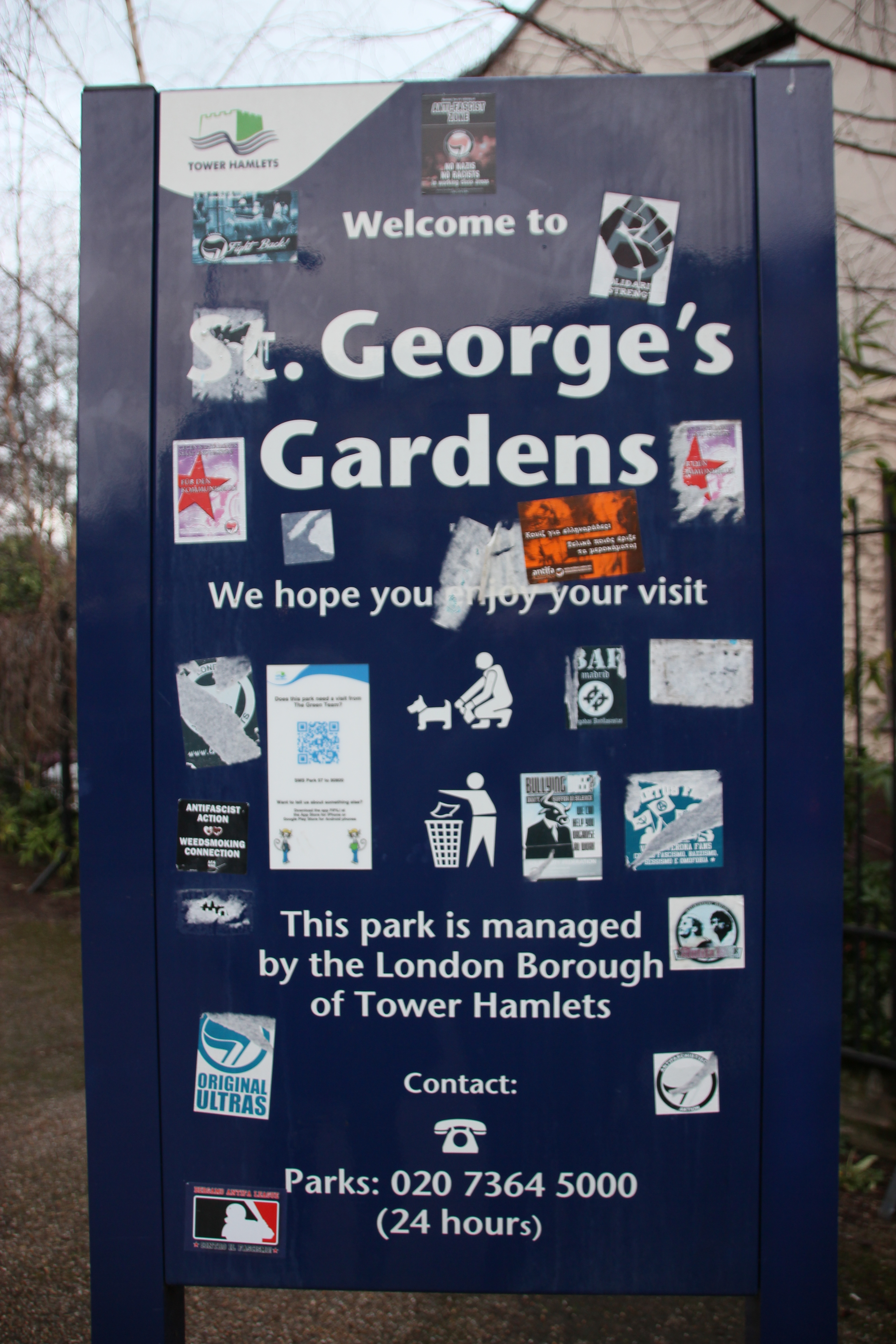
    Stickers are a ubiquitous part of the urban environment, like this sign in Cable Street.
    Stickers are a ubiquitous part of the urban environment, like this sign in Cable Street (Photo: Hannah Awcock).

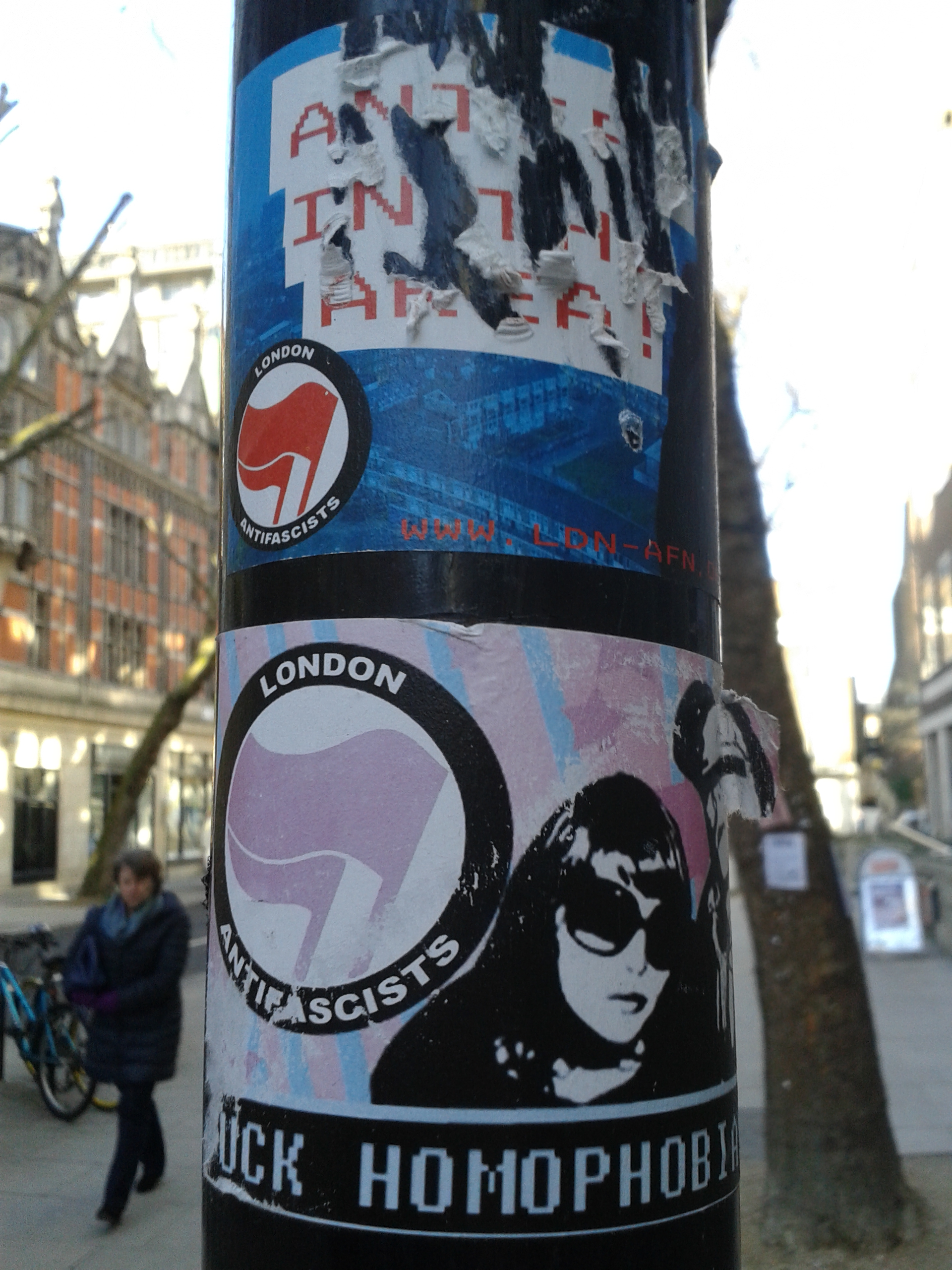
    Stickers are a ubiquitous part of the urban environment, often more common than graffiti in city centres. They are quick, easy and cheap to produce and put up, so they are an effective way of getting a message across. They are employed for a variety of purposes, such as advertising, art and dissent. The meaning of many is not obvious, they remain indecipherable to all but the author and those with the right knowledge to decode them. They also come in many shapes and sizes, with many different techniques used to produce them. Like graffiti they are meant to be ephemeral, gradually disintegrating under the weight of the weather, idle hands and cleaners. As I move around London I photograph many of the protest stickers that I see, gradually building up a map of dissent in our capital. Below are some of the stickers I have seen.

    A free education sticker outside of the University of London Union building in Malet Street on  17/02/15.
    A free education sticker outside of the University of London Union building in Malet Street on 17/02/15 (Photo: Hannah Awcock).
    Occupy Parliament Square Sticker seen on the 2/2/15 at King's Cross Station.
    Occupy Parliament Square Sticker seen on the 02/02/15 at King’s Cross Station. This sticker has been weathered, picked, and written on- demonstrating how protest stickers can spark political debate (Photo: Hannah Awcock).
    Some stickers are printed, whilst others look more handmade, like this one seen in Brick Lane on 5/6/14.
    Some stickers are printed, whilst others look more handmade, like this one seen in Brick Lane on 05/06/14 (Photo: Hannah Awcock).
    Some stickers advertise a particular protest, like this one in Malet Street, seen on 17/02/15.
    Some stickers advertise a particular protest, like this one in Malet Street, seen on 17/02/15 (Photo: Hannah Awcock).
    Not all protest stickers are left-wing, like this one seen at Euston Station on 14/11/14.
    Not all protest stickers are left-wing, like this one seen at Euston Station on 14/11/14 (Photo: Hannah Awcock).
    Something as simple as speech bubbles can drastically alter meaning, as with this government advert, seen on 4/2/15 in Elephant and Castle
    Something as simple as speech bubbles can drastically alter meaning, as with this government advert, seen on 04/02/15 in Elephant and Castle. These stickers allow a sort of audience participation, so others can add more tax dodging companies (Photo: Hannah Awcock).
    This sticker has creatively recycled a page from a book to oppose Israel. Seen in Soho on 31/12/14.
    This sticker has creatively recycled a page from a book to oppose Israel. Seen in Soho on 31/12/14 (Photo: Hannah Awcock).
    Protest stickers are particularly common in some areas, such Malet Street in Bloomsbury, where the University of London Union building is. This photo was taken there on 17/02/15.
    Protest stickers are particularly common in some areas of the city, such Malet Street in Bloomsbury, where the University of London Union building is. This photo was taken there on 17/02/15 (Photo: Hannah Awcock).
    Som stickers can be seen in multiple locations across the capital. This photo was taken outside the Inner London Crown Court in Southwark, but it has also been seen at Euston Station.
    Some stickers can be seen in multiple locations across the capital. This photo was taken outside the Inner London Crown Court in Southwark, but it has also been seen at Euston Station (Photo: Hannah Awcock).