Times Are A Changin’: Temporality, Memory and Social Movements in the Digital Age

Times Are A Changin'
The Times Are A Changin’ Symposium was held at the University of Westminster on the 2nd and 3rd of June 2016 (Photo: Hannah Awcock).

I spent Thursday and Friday of last week at Times Are A Changing: Temporality, Memory and Social Movements in the Digital Age, a two-day symposium at the University of Westminster organised by Dr. Samuel Merrill and Dr. Anastasia Kavada. I really enjoyed the chance to meet new people, listen to some fantastic presentations and engage with some new concepts. Most of the other attendees were from Memory Studies or Media Studies, so there were a lot of new ideas for me to think about, particularly around the key themes of the symposium, temporality and memory.

As a Geographer, I am aware of just how significant time is (although space will always be my favourite!) However, the ways that different temporalities can impact, and be used by, activists and social movements is not something I had considered before. In her paper, Dr. Veronica Barassi argued that temporalities are constructed through practice, which means that activists can resist or reproduce hegemonic temporalities through their actions. Dr. Kavada’s presentation about the recent Nuit Debout protests in France provided a good example of this. The activists varied the speed at which they posted on social media depending on when they wanted attention; they would increase the intensity of posts before a important protest or meeting, for example. Dr. Kavada called this ‘temporal agency’; activists can gain power by negotiating with, or interfering in, temporal rhythms. It could be interesting to think through these ideas in the context of my PhD as the activists involved in my case studies had very different media technologies available to them, which all involved different temporalities.

The other key theme of the symposium was memory. For some activists and social movements, the memory of past events, people, and movements can be an important source of inspiration, morale, and identity. There were several papers relating to the various ways in which activists carry out ‘memory-work,’ such as Lorenzo Zamponi’s paper on #ioricordo, a hashtag created to memorialise the 2001 Genoa G8 protests. Archives have a significant role to play in the preservation of memory. Foteini Aravani, the Digital Curator at the Museum of London, gave a fascinating presentation about the museum’s experiences collecting items and digital media relating to recent protests, such as Occupy London. You do not have to be a museum to create an archive, however, and some movements choose to keep their own records.  Dr. Anne Kaun’s paper, entitled “Archiving Protest: Changing Temporal Regimes of the Archive,” discussed how modern social movement groups create their own digital archives. Occupy Wall Street had an archiving working group in order to capture representations of the movement from their own perspective. For my case study on the Battle of Cable Street, I am focusing on the various ways in which the Battle has been remembered, and how these memories are constructed and used, so this element of the symposium was also very helpful for me.

I have only mentioned a few of the great papers and speakers from Times Are A Changin’, there was so much interesting research presented that I can’t discuss it all. Suffice it to say that the symposium gave me a lot to think about, and I am confident that my own research will be better because I went. With that in mind, I would like to thank Sam Merrill and Anastasia Kavada for organising the symposium, and particularly Sam Merrill for inviting me. I look forward to seeing what comes next.

Practising Historical Geography

Last Wednesday (the 28th of October), the 21st Practising Historical Geography conference took place at the University of Sussex in Brighton. The conference is organised by the Historical Geography Research Group of the Royal Geographical Society with the Institute of British Geographers (or HGRH and RGS-IBG for short!), and is aimed at undergraduates and postgraduates. This was my forth year attending the conference (previously held at the University of Bristol (2014), University of Central Lancashire in Preston (2013) and the University of Hull (2012). I first attended as a Masters student (all those studying the MA Cultural Geography at Royal Holloway are encouraged to attend), and even now, in the third year of my PhD, I still found it to be a beneficial and enjoyable experience.

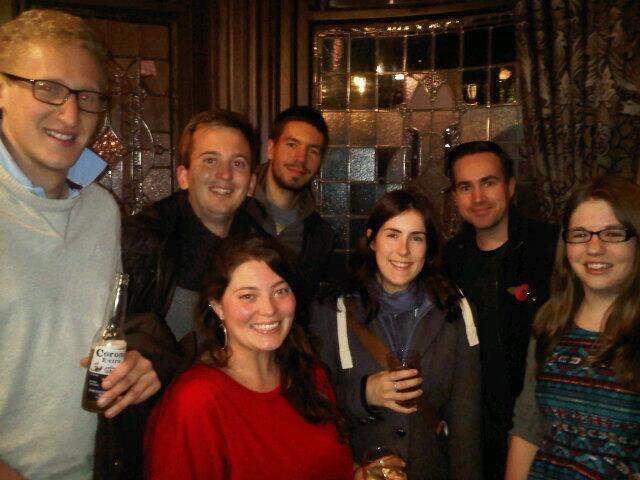
The Royal Holloway contingent at the 21st Practising Historical Geography conference at the University of Sussex (Photo: Innes Keighren).

The conference combines keynote speakers, workshops, and chances to network. The first keynote was given by Dr. Simon Rycroft (University of Sussex) and was entitled ‘Mid-century Representation: John Latham’s Cosmos.’ Using the work of artist John Latham, Dr. Rycroft argued that it is important to be alert to the changing practices of representation. Representations reflect the ways we think about materials, which changes over time. Academics need to take such things into account when analysing representations.

Dr. Simon Rycroft talking about the work of artist John Latham (Photo: Hannah Awcock).

After the first keynote is a section called Postgraduate Voices, where someone who has recently completed their PhD gives advice based on their experiences. This year, Dr. Jake Hodder talked about the 3 major crises he faced during his PhD, which roughly align with the 3(ish) years that a PhD takes:

  1. Imposter syndrome:  The fear that someone will realise you are not good enough to be here, and tell you to go home, in a very public and humiliating way.
  2. Project isn’t coming together: At some points it can feel like you will never be able to make a coherent whole out of all the work you have done.
  3. Uncertainty: Particularly in the third and fourth years, financial insecurity and a sense of ‘what the hell am I going to do next?!’ can take its toll.

I found myself agreeing with everything Jake said. It is always reassuring to know that others are facing the same difficulties as you, and knowing that Jake overcame them to become Dr. Hodder is a welcome confidence boost!

Every year, the Historical Geography Research Group runs a competition for undergraduate dissertations in the field of historical geography. This year, the prize was won by Victoria Bellamy (University of Cambridge), who told us about her research on Victoria Park in East London in the second half of the nineteenth century. Parks are ideologically contested spaces; there is constant debate about their purpose and how they can be used. Victoria’s research explores how some of these debates played out in Victoria Park, surrounded by some of the most deprived areas of Victorian London. She did a fantastic job of presenting her work.

2015-10-28 11.20.29
Victoria Bellamy summarised her prize-winning undergraduate dissertation in just 10 minutes (Photo: Hannah Awcock).

The middle section of the day is taken up by 2 workshops, which focus on what it’s like to actually do historical research. Previous workshops have involved all kinds of things, from taxidermy to the Preston bus station, but this year they focused on extreme weather events in Britain (run by Dr. Lucy Veale, University of Nottingham) and the spatial politics of British households in the nineteenth-century, particularly the relationships between domestic servants and employers (run by  Dr. Fae Dussart, University of Sussex). Chances to discuss the practice of researching the past with other researchers are rare, so I always look forward to this part of the day. It is an opportunity to talk about the difficulties of historical research, as well as explore some methodologies that may be unfamiliar.

Lucy Veale running a workshop about researching extreme weather events in the archive (Photo: Hannah Awcock).

The day was rounded off by the second keynote speaker, Dr. James Kneale (University College London), who spoke on the subject of ‘Looking for Drink in the Archive.’ Dr. Kneale has been researching alternative approaches to Victorian understandings of alcohol. There is plenty of evidence of the moral debates surrounding alcohol in the archives, but the Victorians didn’t just talk about alcohol, they experienced it in a whole range of other ways. Dr. Kneale has been using the archive to investigate practice, which is no simple task.

2015-10-28 15.46.58
James Kneale discussing looking for evidence of alcohol in the archives (Photo: Hannah Awcock).

If all goes according to plan, I will probably be too busy putting the finishing touches to my thesis to attend the 22nd Practising Historical Geography conference next year. This is a shame, as it is a great event. I would thoroughly recommend it for any Masters or PhD students whose work even remotely relates to historical geography, especially if you are relatively new to academia. The atmosphere is friendly and welcoming, and it would be an ideal first conference. I have learnt a lot over the past four years, and met people who have become both colleagues and friends. Thank you to the Historical Geography Research Group (particularly Lucy Veale, who has organised the last 3 conferences) for putting on such wonderful events.

The 2012-3 MA Cultural Geography cohort in a pub in Hull the night before the 18th Practising Historical Geography conference (Photo: Innes Keighren).
The Royal Holloway contingent in a pub in Preston the night before the 19th Practising Historical Geography conference in 2013 (Photo: Innes Keighren).
The Royal Holloway contingent at the 20th Practising Historical Geography conference in Bristol- we don't spend all our time in pubs! (Photo: Innes Keighren).
The Royal Holloway contingent at the 20th Practising Historical Geography conference in Bristol- we don’t spend all our time in pubs! (Photo: Innes Keighren).

Contesting the Capital: Exploring London’s History of Protest at the International Conference of Historical Geographers

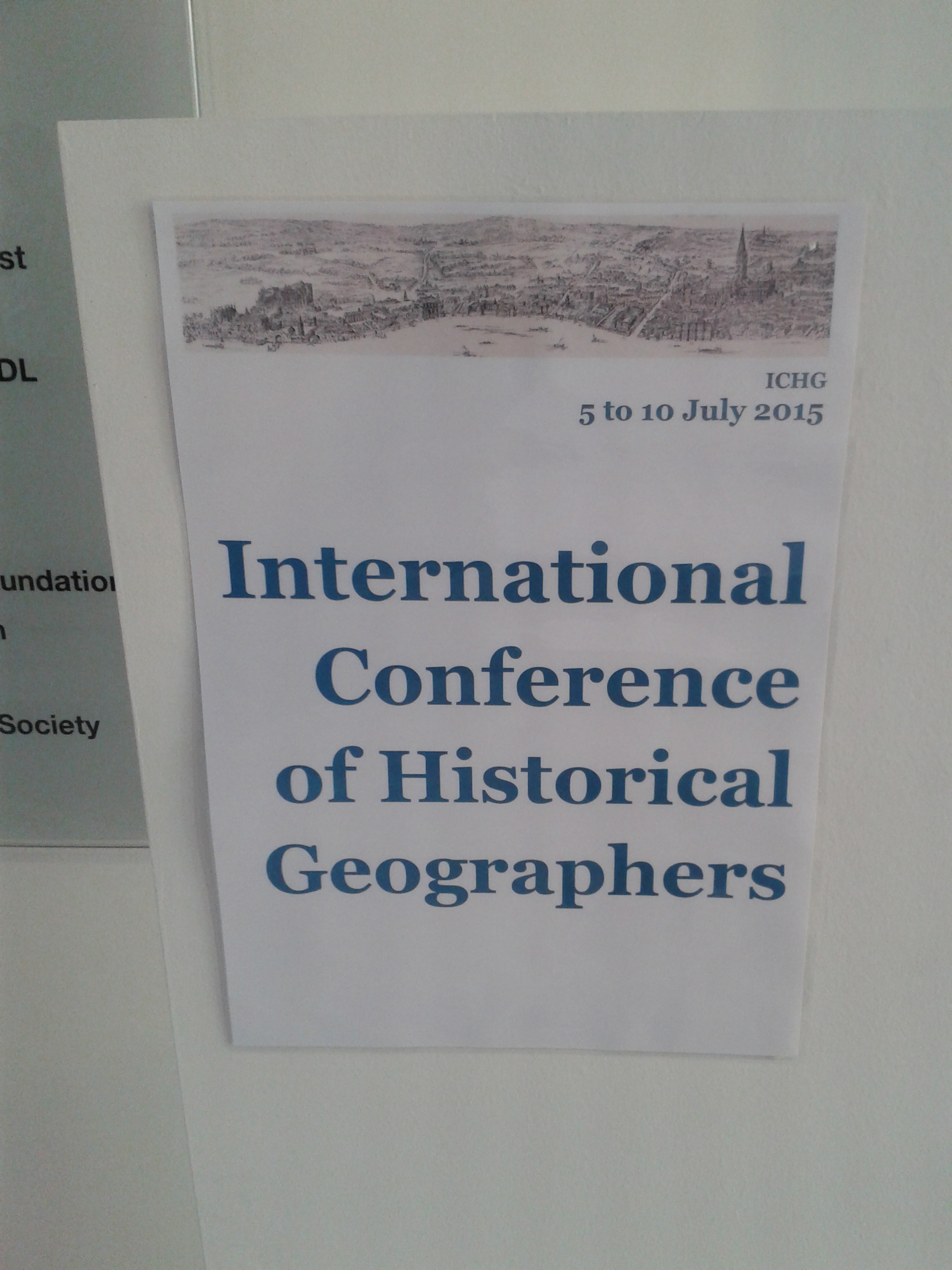
The International Conference of Historical Geography 2015 took place at the RGS-IBG in Kensington, London.
The International Conference of Historical Geography 2015 took place at the RGS-IBG in Kensington, London (Photo: Hannah Awcock).

Between the 5th and 10th of July, the International Conference of Historical Geographers (ICHG) took place at the Royal Geographical Society with the Institute of British Geographers in South Kensington, London. The conference takes place every 3 years in a different city; in 2012 it was in Prague, in 2018 it will be in Warsaw. This year the conference was 40 years old, and over 700 delegates, 60% of which came from beyond Britain, gathered to talk all things historical geography.

Along with Diarmaid Kelliher, a PhD student at the University of Glasgow, I convened a session called Contesting the Capital: Historical Geographies of Protest in London, exploring the relationship between protest and London. As regular readers of this blog are probably aware, London has a long and vibrant history of protest. This is often attributed to Londoners themselves; “Londoners have for many centuries been considered far too ‘bolshie’ to do what they are ordered for long” (Bloom, 2010; p.xxxviii). Whether this is the reason or not, London is a particularly contentious city. For example, on the 30th of May this year (2015), there was a demonstration in Trafalgar Square to support striking workers at the National Gallery; a protest outside the offices of the Daily Mail about the paper’s treatment of Pilipino nurses; and a march organised by UKUncut in Westminster, in which a huge anti-austerity banner was hung from Westminster Bridge. Three major protests, all in one day. London’s rebellious streak makes it fantastic to study, and Contesting the Capital aimed to celebrate and explore this rich history.

Contesting the Capital included 4 papers; by myself, Gavin Brown, Claire Nally and Diarmaid Kelliher. My paper was about the characteristics of urban areas in general, and London specifically, that encourages protest. Gavin Brown discussed the geographies of the 24-hour picket outside the South African embassy between 1986 and 1990. Claire Nally talked about the Crossbones graveyard in Southwark, the ways it has been represented and ways it fits into networks of memorialisation and feminism. Finally, Diarmaid Kelliher presented a paper about solidarity and London support groups for the 1984-5 miner’s strike.

Claire Nally presenting about the Crossbones Graveyard in Southwark (apologies for the poor-quality camera phone!)
Claire Nally presenting about the Crossbones Graveyard in Southwark (apologies for the poor-quality camera phone!) (Photo: Hannah Awcock).

For me, the session highlighted some of the key issues involved in studying protest in London, one of which is networks. Walter Nicholls (2009) has demonstrated that networks are a useful tool for thinking about the processes and activities of social movements. Fran Tonkiss (2005) has argued that cities tend to have good information and mobilisation networks, which allow the easy circulation of ideas and people. She also points out that cities bring together extensive social networks that can support protest. Contesting the Capital demonstrated how some of these theories work in practice, placing London in national and international networks of solidarity, communication, and support.  For example, during the 1984-5 miner’s strike multiple support groups were active in London offering financial, physical and emotional support to the strikers in far flung places like Wales and Yorkshire. The Non-stop picket outside the South African embassy in the 1980s was part of an international anti-apartheid movement that aimed to put pressure on the South African government. Neither of these issues are obviously related to the lives and concerns of Londoners, but nevertheless people felt strongly enough to take action.

Protests in London highlight the city's place in local, nation, and international networks (Source: City of London Anti-Apartheid Group).
Protests in London highlight the city’s place in local, nation, and international networks (Source: City of London Anti-Apartheid Group).

Another key issue which Contesting the Capital highlighted for me is that London is constantly changing. As Roy Porter (2000; p.7) says “change is the essence” of cities. Economically, politically, socially, culturally, demographically, physically; London hasn’t sat still since it was founded two thousand years ago. For example, the Crossbones graveyard in Southwark was rediscovered during the construction of the Jubilee Line; London’s future helped to uncover its forgotten past. In terms of protest, solidarity has to be carefully constructed and maintained. The strong networks of solidarity that were evident during the miner’s strike have arguably been lost; the fierce criticism of workers whenever there is a tube strike is evidence of this. Along with the city’s sheer size, these constant processes of change make it very difficult to make any meaningful generalisations about London as a whole.

Contesting the Capital aimed to explore the relationship between London and the historical geographies of protest, and it was pretty successful, if I do say so myself. The history of protest in London is an almost inexhaustible resource for studying dissent, alternative politics and the urban, and there is lots more work to be done, although I think it’s fair to say we’re making a good start.

Sources and Further Reading

Bloom, Clive. Violent London: 2000 Years of Riots, Rebels and Revolts. Basingstoke: Palgrave Macmillan, 2010.

Nicholls, Walter. “Place, Networks, Space: Theorising the Geographies of Social Movements.” Transactions of the Institute of British Geographers 33 (2009); 78–93.

Porter, Roy. London: A Social History. London, Penguin, 2000.

Tonkiss, Fran. Space, the City, and Social Theory. Cambridge: Polity, 2005.

Understanding Conflict: Protest and Political Violence

Provide tea and biscuits, and you're sure to get a good turnout!
Provide tea and biscuits, and you’re sure to get a good turnout! (Photo: Hannah Awcock)

This Monday, I attended the annual symposium of the University of Brighton’s conflict research group (or to give it it’s full name, Understanding Conflict: Forms and Legacies of Violence Research Cluster). With members from disciplines across the arts and humanities, the group seeks to understand violent conflict and its legacies. The annual symposium was organised by postgraduates from the research cluster, and featured a range of presentations by staff and students on themes that ranged from Belfast’s ‘peace walls’ to the aesthetics of AK-47s.

The first question asked by Professor Bob Brecher during his introduction to the symposium was ‘what is political violence?’ It may be a question that the research cluster never fully answers to their satisfaction, but I wonder if protest will be included in any definition that they do come up with. Certainly some members of the research group are working on protest or protest-related topics; Tim Huzar presented at the symposium on the topic of ‘Black Lives Matter and the Question of Non-Violence’, and Zeina Maasri talked about the aesthetics of the AK-47 rifle, and its symbolic role for anti-imperialist struggles during the Cold War. I have often thought about the role of violence in protest movements, and I was hoping that attending this symposium might crystallise some of my ideas.

At the very least, I was about to draw lots of connections between the papers presented at the symposium and my own work on the historical geographies of protest in London. One interesting idea that came out of a lively discussion about drone warfare was the idea of the threat of violence as a controlling force. Drones, or Unmanned Aerial Vehicles (UAVs) and the intense surveillance they enable can give the appearance of God-like omnipotence. The threat of a drone strike can have as much as an impact on people, if not more, than a strike itself. In a similar way, the threat of violent and excessive policing can be used to alter the behaviour of protesters and potential protesters. The threat of being arrested, kettled, or manhandled by police can prevent people protesting; I know it has factored into decisions I have made about whether or not to attend protests.

A recurring theme during the symposium was the ways in which violence is remembered and memorialised. Ian Cantoni presented a paper about the new memorial museum at Camp Joffre in southern France, used as an internment camp for much of the 20th Century. Dr. Eugene Michael talked about the use of the Holocaust metaphor to interpret the conflicts in former Yugoslavia during the 1990s. Just like conflicts, protests can often have difficult and contested legacies. I am currently working on the Battle Cable Street, which is memorialised in the mural shown below. It is a contentious site, and has been vandalised several times since the project began in 1976. As the name suggests, the Battle of Cable Street was a violent protest, and there are multiple conflicting narratives that surround it. The legacies of violent pasts are difficult to process, yet we continue to try, whether that violence took the form of a protest, a riot, or a war.

The Battle of Cable Street memorial in Cable Street, in Tower Hamlets in East London.
The Battle of Cable Street memorial in Cable Street, in Tower Hamlets in East London (Photo: Hannah Awcock).

There is clearly a lot of overlap between conflict and protest, especially violent protest. Protest has an uneasy relationship with violence; violence is a frequent part of unrest, but many activists reject it, for a whole variety of reasons. Nevertheless, I think that any study of protest (even those about deliberately non-violent protest) would be improved by at least a passing consideration of the causes, characteristics, and impacts of political violence.

Thank you to the Conflict research cluster at the University of Brighton for organising such an interesting day and giving me so much to think about!

Highs and Lows of the AAG: Perspective of a Lone Travelling PhD Researcher

Who Am I?

My name is Llinos Brown and I am a final year EPSRC CASE award PhD student at the University of Central Lancashire (UCLan), Preston. My PhD research explores energy cultures in a workplace case study environment. I am particularly interested in exploring how energy cultures differ between manufacturing and office environments within the same workplace. If you are interested in hearing more about my research please get in touch – Lbrown5@uclan.ac.uk or follow me on twitter @LlinosBrownGeog


The AAG this year was held in Chicago, the city that invented the skyscraper.
The AAG this year was held in Chicago, the city that invented the skyscraper. The main conference venue was the Hyatt Regency hotel, to the left of this image (Photo: Hannah Awcock).

Like the majority of conferences, the AAG is a great opportunity to catch up with colleagues/friends, build up relationships, meet new people and network…..what you would expect from any conference. But the AAG is a bit different to any conference I had attended. It is extremely big – over 9000 geographers attending, with over 1700 sessions submitted – split over two main venues and two smaller venues, with over 90 parallel sessions. It has a conference app and there are lots of very well-known geographers in attendance (someone should create a Geographer Bingo).

Something that I struggled with and something that overwhelmed me was – how do you systematically go through which session to attend? My approach was first look at the speciality groups, the main one for me– energy, and highlight them. Then look for some key words – for me energy, workplace, and behaviour, and highlight them. Finally if there are any gaps (and I had time to look in more detail) look through particular session slots and highlight anything that you think was a bit different. I spent around 20 minutes each evening going through what I had highlighted for the next day and working out what I really wanted to see. Each day I also popped in something a little bit different into my schedule. I would definitely recommend this, some of the most thought provoking sessions that I attended were sessions that had nothing to do with my sub-discipline of energy geographies. The AAG has a bit of everything, embrace the amazing discipline of Geography and the variety of sessions that are on offer.

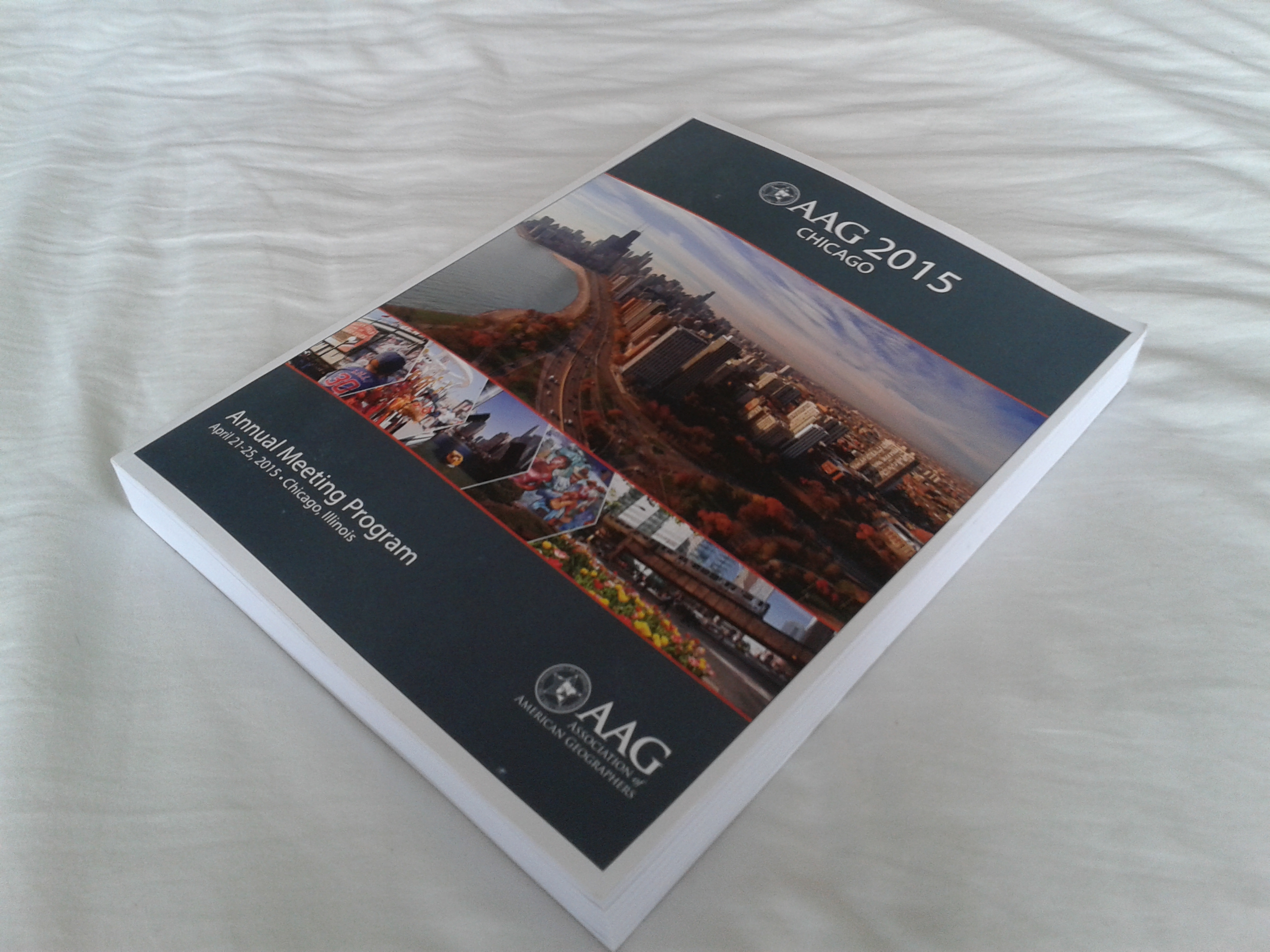
The printed program for the AAG is the size of a telephone book!
The printed program for the AAG is the size of a telephone book! (Photo: Hannah Awcock)

One of the highs of the conference for me that I did not realise until I was on the plane home, was how embracing geography for a week helped me formulated new ideas. It’s not just about presenting your paper, networking, or handing out business cards. The conference has helped me develop empirical chapters for my thesis and it has made it much clearer to me how all the bits of my future thesis will link together. Maybe this wasn’t the AAG and it was just having time away from my desk and not directly thinking about my PhD but it was very extremely beneficial all the same.

One of the lows of the conference for me was its size. It is extremely big and it can be a lonely experience. Lunch and refreshments are not provided by the organisers so you can easily end up on your own at lunchtime. There are not the opportunities to chat to the person in front of you or sit next to someone while eating dinner and get chatting to them – which I’ve done at the RGS Annual Conference.  One thing I noticed at the AAG is that there are a lot of British geographers in attendance but they often stay in their university groups which mean if you’re the sole representative from your university it can mean you’re on your own for an evening or two. I was lucky enough to gate crash the Royal Holloway ‘crew’ so most evenings I joined them for food and drink – Thanks guys!

Llinos doing a bit of networking.
Llinos doing a bit of networking (Photo: Hannah Awcock).

The N word – ‘Networking’ – we all know the benefits of it and how beneficial it can be but sometimes it can make you reflect on your experience as a researcher and make you wish you were in the person you are speaking to shoe’s. Yes, there is the saying ‘the grass is always greener on the other side’ and this might link to me being the only person from UCLan attending the AAG but some evenings when I was back in my hotel room and had time to reflect on the day, I was a bit jealous of the additional support networks, the variety of supervision and the diversity of PhD research communities at other universities. This can be a bit of a low but there are also some positives such as realising you’ve got better resources than other PhD students – such as a permanent desk.

So to round up some top tips from me:

  • Don’t attend every session, there is a lot going on and you need time to digest the information you’ve obtained;
  • Get in contact with people you have met at previous conferences and see if they are attending, buddy up with them, exchange details and go for a drink.
  • Follow the twitter hashtag, if you’re ever not sure what session to attend check out twitter and see if something exciting is happening.
  • Head to a random session not related to your discipline – embrace Geography

Llinos Brown, University of Central Lancashire.

The AAG: Why Did I Sign Up For This?

The Chicago skyline from the top of the Willis Tower, the tallest building  in the Western hemisphere.
The Chicago skyline from the top of the Willis Tower, the tallest building in the Western hemisphere (Photo: Hannah Awcock).

Last week, I attended the Annual Meeting of the American Association of Geographers, otherwise known as the AAG. Probably the biggest Geography conference in the world, the AAG continues to grow every year and this year over 9000 delegates gathered in Chicago for the 5 day event. It was my first time attending the conference, and although I had a fantastic time I did find the whole thing a little overwhelming at times. Amongst everything, it is easy to forget why you’re there in the first place. I decided to put this post together of what I believe are the 3 main purposes of going to a large international conference like the AAG, so you can reassure yourself when you find yourself asking the question, which you almost certainly will at some point, ‘Why did I sign up for this?’

IMG_8210
A welcome sign at the AAG (Photo: Hannah Awcock).
  1. Present. And/or organising a session. Although you don’t have to present your work when you go to a conference, it seems a bit daft to fly all the way over the Atlantic Ocean and not present. Each presenter at the AAG only gets 20 minutes for their talk, including questions, so it really isn’t a big commitment. Presenting allows you to share your work with, and get feedback from, people outside your normal academic circle, which can be incredibly helpful. Presenting at such a prominent conference also allows you to stake your claim to your research topic, to make sure other people know what your research involves. Plus, it can actually be quite fun- you might actually enjoy yourself!
Me Presenting at Chicago AAG
Yours truly presenting a paper on the Battle of Cable Street (Photo: Innes Keighren).
  • Network. The sheer size of the AAG makes it a unique opportunity for networking, particularly for international contacts. Some really big names in Geography attend the AAG, and it can be a great chance to introduce yourself (I was sat behind David Harvey in one session, although I didn’t say hello!) If you are thinking about publishing your work, many publishers have booths in the exhibition hall, and a lot of journal editors also attend, so there are plenty of people to talk to about your ideas. It is a great chance to meet other PhD students, and catch up with existing friends who you haven’t seen since the last big conference. A PhD can sometimes be a lonely experience, so I like to take every chance I get to socialise with other people in the same boat.
  • 2015-04-17 16.40.12
    My business cards, an invaluable networking tool! (Photo: Hannah Awcock)
  • Learn. My final purpose of going to a large international conference is a bit cheesy I know, but I think it’s a really important one. Conferences are a great chance to find out the latest ideas, theories and concepts in geography and your particular field. As I said, some of the biggest names in Geography attend the AAG, so it’s a great chance to hear them speak, and learn directly from them. Plus, it gives you the chance to ask questions about things you don’t understand, which you can’t do when reading a journal article or book. You can develop your own current projects by listening to others, and perhaps even get some ideas for future projects.
  • And if all that wasn’t enough to convince you to go along to the next AAG, the 2016 meeting is being held in San Francisco, so if you’ve always wanted to see Alcatraz or the Bay Bridge, then why not squeeze in a massive international conference whilst you’re at it?

    RGS-IBG Annual Conference 2014

    2014-08-28 08.32.42.jpg
    South Kensington Station, which became quite familiar over the week (Photo: Hannah Awcock).

    Although I have been to conferences before, I have never been to one quite as big as the RGS-IBG annual conference. With around 2000 delegates, and 414 sessions to  choose from, I couldn’t really comprehend the size of it until I saw it for myself. Over the course of 4 days, I went to 13 sessions, and listened to 40 papers. I have had a great week, although I do feel like I need another week to recover (It’s a good thing I’m on holiday as I write this!) I have met some great people, and listened to some fascinating papers on a range of topics from war, conflict, protest and fascism through to music, cold war bunkers and gay bars.

    2014-08-26 18.11.55.jpg
    The Chair’s opening panel discussion on co-production (Photo: Hannah Awcock).

    The overarching theme of the conference was co-production, the idea of producing knowledge and other outputs in collaboration with others. As a historical geographer, it was not something that I thought really applied to me. However, during a panel discussion at the conference on co-production, it was pointed out that all knowledge is co-produced. No knowledge, or anything else for that matter, is produced in a vacuum, it always involves other people to some extent. When I do archival research, I am working with the people who wrote the sources, the people who chose to preserve them, and the people who look after and organise them. I think it is important to be aware of these other actors that contribute to your research, not only in order to give them the credit they deserve, but also to ensure that your research is as informed and considered as possible.

    2014-08-28 09.46.49.jpg
    My RHUL colleague, Mel Nowicki, presenting her paper (Photo: Hannah Awcock).

    One thing that was really brought home to me over the course of the conference was how far I, and the other PhD students who started at Royal Holloway with me, have come. We started almost a few weeks short of a year ago, and we’ve all achieved a lot since then. I was surprised at the number of people I knew at the conference, I didn’t realise how many interesting and engaging people I have met at various events since last September. I did not present, but many of my colleagues did, with a few even presenting two papers. I only saw one of them, but it was lovely to see her (Mel Nowicki, @melnowicki) research taking shape. It can sometimes feel like a PhD will never end, so it was really reassuring to realise that I am making progress.

    So I think it’s safe to say that my first major academic research was a resounding success. I have had a lot of fun, a lot of ideas, and some interesting thoughts on the process of PhD. Roll on next year!