Book Review: London- A Social History

The 2000 edition of 'London- A Social History' by Roy Porter.
The 2000 edition of ‘London- A Social History’ by Roy Porter.

Porter, Roy. London- A Social History. London: Penguin, 2000 [1994]

“the physical fabric [of London] engages in endless dialogue with the inhabitants; the townscape shapes them, while they reconstruct it. Factories and flats, railways and roads outlive individuals. People make their own cities, but never under conditions of their own choosing.”

(Porter, 2000; p. xvi)

When he set out to write London- A Social History, Roy Porter (2000; p. xvi) aimed to write “a substantial account and analysis of the making of the metropolis in terms of its people, economy and buildings.” He has achieved this, frequently going beyond descriptions to consider why London is the way that it is. The book is arranged chronologically, but the Georgian, Victorian, and post-War London periods (from chapter 5 onwards) receive significantly more attention than others; each has multiple chapters devoted to them, divided thematically. This can be little confusing; you finish chapter 8 in 1890, then chapter 9 begins back in 1820.

For Porter, London is a city past its prime. The metropolis is “aged and ailing” (Porter, 2000; p. 445), deprived of the empire which Porter argues was the driving force behind its success. In the preface, he looks back on his childhood in 1950s New Cross with nostalgia, and he is quietly critical of Thatcherite policies and a lack of public investment. Porter passed away in 2002, but I do wonder what he would make of London in 2015- somehow, I can’t imagine he would be very impressed. His criticisms feel informed and considered, unlike A.N. Wilson in London- A Short History, Porter explains what he doesn’t like about modern London without making me strongly dislike him.

One of the things that London- A Social History does really well is highlight the continuities of London. Sometimes London at different periods of history can feel so diverse that it calls into question the wisdom of treating it as the same city, but Porter connects Tudor, Georgian and modern London together into a narrative that make sense. For example, the book’s descriptions of housing demonstrate that good quality, affordable housing for the city’s working class has been a constant problem since the Georgians. Porter also does an excellent job of explaining the reasons behind London’s particularly ad-hoc structures of local government. The rivalry between the national government in Westminster and the City goes back centuries, and Westminster has long feared the potential power of a comprehensive pan-London authority.

The book does have some weaknesses. Some chapters, particularly those that describe the massive growth of London during various periods of the last few centuries feel a bit list-y, and are tedious to read. He gives disproportionate space to London since Georgian times, with much less about the preceding history. This is not uncommon in histories of London, perhaps just because the further back you go, the harder it is to find reliable sources. Finally, the book was written 20 years ago, and his assessment of London feels out of date (for example, Porter complains about the lack of ruling authority in London- the Greater London Authority was established in 1999, after the book was written). However, all books age, some better than others, and the past 20 years have not detracted from the rest of Porter’s thoughtful analysis of London history.

The subtitle of Roy Porter’s 541-page epic does not do it justice. This is not just a social history, but also an economic, political, demographic, and cultural history. Despite minor weaknesses, it is a good introduction for those who know little about the city, or a useful addition to the bookshelf of any London connoisseur.
Book Review: Londonopolis- A Curious History of London

Londonopolis Front Cover
Londonopolis: A Curious History of London by Martin Latham.

Martin Latham. Londonopolis: A Curious History of London. London: Batsford, 2014.

To call Londonopolis: A Curious History of London a ‘history’ of London is, I think, a bit of a misnomer. It is a well presented book, full of fascinating facts about the city, but it is not a comprehensive narrative of London’s story. It is arranged chronologically, but if this was the only book you ever read about the city’s past then your knowledge would be patchy at best. To be fair, Latham doesn’t claim to be comprehensive; he has tried to “open a magic casement or two onto different moments of London’s past” (Latham, 2014; 11).

That’s not to say I didn’t enjoy Londonopolis. It makes a refreshing change from some of the other books about London’s past, which can be a little dry and repetitive. The facts Martin Latham has included are very interesting; for example, did you know that the British practice of driving on the left comes from London Bridge? During Tudor times it was decided that people would enter London on the left, and leave on the right, to reduce the chaos on London’s only bridge across the Thames.

As a boy, London was a fairy-tale city to me. The other tenants in my house (apart from us eight kids and my parents) were a female spy, a fading actress, a newly arrived Irish family and the mysterious Miss White, a Dickensian spinster… I used to walk for hours randomly across London and it never disappointed…History was all around in such a way that I got temporal vertigo, that sensation of suddenly seeing the past as a reality.

(Latham, 2014; 10)

Latham’s love for the city is infectious. In fact, I feel that the best sections of the book are the ones where he talks about his own life in London. The paragraphs about the various bookshops he has worked in, and his father’s skill as a water diviner, are lovely. Latham captures beautifully the magic of living in London.

Like A.N. Wilson’s London: A Short HistoryLatham spends a lot of time talking about individuals who have shaped London, focussing especially on creative types- writers and artists. Latham does a better job than Wilson of including London’s notable women however. Turbulent Londoners like Eleanor Marx, Annie Besant, and Sylvia Pankhurst get a whole chapter to themselves. Virginia Wolff, and Dorothea Bate and Joan Proctor (both dedicated scientists at the National History Museum) are also featured. There is also a chapter dedicated to the pioneering fashion designers Mary Quant, Barbara Hulanicki, Lee Bender, and Vivienne Westwood.

Londonopolis-image
One of the simple but effective illustrations from Londonopolis. 

Londonopolis: A Curious History of London is different to the books I normally review on  Turbulent London. It is not necessarily supposed to be read cover to cover, Latham himself says “You can read this book in any order, or leave it in the lavatory for the occasional reverie” (Latham, 2014; 11). In fact, reading it cover to cover feels a bit disjointed. I would recommend the book however, particularly if you like obscure but interesting facts, or need a gift for a London-lover. It takes an irreverent but affectionate approach to London, which I like.

Book Review: Dynamite, Treason and Plot- Terrorism in Victorian and Edwardian London

'Dynamite, Treason and Plot' by Simon Webb.
‘Dynamite, Treason and Plot’ by Simon Webb.

Webb, Simon. Dynamite, Treason and Plot: Terrorism in Victorian and Edwardian London. Stroud: The History Press, 2012.

There is a tendency today to see terrorism as some modern aberration, something that has arisen in recent years and might with luck fade away in time. This is unlikely. Terrorism of different sorts has been a constant backdrop in British history for centuries; it is likely to remain so for centuries to come. The notion that increased vigilance on the part of the public, combined with wise and good laws passed by Parliament, might one day defeat terrorism and usher in a peaceful era, where nobody needs to worry about bombs and assassinations, is a chimera.

Webb, p.151

As far as most people are concerned, Guy Fawke’s plot, the IRA bombings of the 1970s and 7/7 are probably the only examples of terrorism in London. In Dynamite, Treason and Plot: Terrorism in Victorian and Edwardian London, Simon Webb sets out to correct that misconception. From the Clerkenwell Outrage, where 12 people were killed in a Fenian prison break gone wrong; to the Tottenham Outrage (not every event is known as an Outrage, I promise!), a chase that lasted several hours and involved the hijacking of a tram and a milk cart, the stories Webb tells range from the horrific to the downright farcical.

Arguably the biggest strength of Dynamite, Treason and Plot is the emphasis on continuity. Humans have a tendency to believe that everything that happens is new, that the problems faced by modern society are unique to our time. Webb proves the inaccuracy of this belief, demonstrating that not only terrorism, but also immigration and xenophobia, are issues that the people of London have been grappling with for centuries. Irish, Jewish, and more recently Muslim; many minorities have been the subject of fear and discrimination in the city, and terrorism has frequently exacerbated the tensions.

Another of the strengths of Dynamite, Treason and Plot is Webb’s approach to terrorism itself. Webb doesn’t condemn the terrorists he describes outright, but neither does he glorify them. The first chapter of the book is devoted to discussion of the theories and motivations behind terrorism. It is not necessarily the mindless, monstrous violence which it is often portrayed as-there are particular reasons why people choose to resort to terrorism-and Webb takes them into account. Terrorism is an emotive subject, difficult to deal with in a sensitive and balanced way, but I think Webb does a good job of this.

Webb’s writing style can be repetitive; he frequently makes the same point twice in quick succession, and he often says how it was “nothing short of a miracle” that more people weren’t killed or injured in the events he recounts. He makes assertions, making a point without providing any supporting evidence, and often overlooks some of the historical controversies and debates. For example, in the chapter about the Suffragettes, Webb mentions the alleged plot to assassinate David Lloyd George by the Wheeldon family. In Dynamite, Treason and Plot it appears there is no doubt that that is what actually happened, but in To End all Wars by Adam Hochschild the event appears much more complicated. Hochschild suggests that the whole thing may have been a set-up, the plot concocted by the government to harm the opposition to the First World War, of which the Wheeldon family was a part. Whatever the truth, Webb completely ignores the debate, and as such misses out on some of the nuances of the story.

Despite the shortfalls I think Dynamite, Treason and Plot is well worth a read. It is an engaging read that deals with some of London’s darker, overlooked history. Webb puts terrorist into political and social context, rather than treating it as an isolated and inexplicable phenomenon to be instantly condemned.

Book Review: London-A Short History

London- A Short History Book Cover
London: A Short History by A.N. Wilson

Wilson, A.N. London: A Short History. London: Phoenix, 2005.

An architectural tour of London is… so much more than merely and aesthetic experience. It is a personal encounter with Londoners of the past. Every district of London…is haunted by memories. The past and the present are always blended here.
(Wilson, 2005; p.146)

When I saw London-A Short History on the shelf in the bookshop, I had to buy it. The book is slim, and smaller than A5, and I had to see how the entire 2,000+ year history of London could possibly fit within it. A.N. Wilson takes the reader on a whistle-stop tour of the metropolis’ past, with an emphasis on the city’s architecture. I personally find his disdain for modern London hard to forgive, but nonetheless Wilson does a satisfactory job of fitting London’s vast history into just 166 small pages.

Perhaps the book’s most distinguishing feature is its brevity. Wilson’s account necessarily sticks to the most significant events in London’s history, and to say he is brief is putting it mildly; he spends just five pages on Tudor and Stuart London, for example. A disproportionate amount of pages are devoted to the city’s recent past, the last 100 years takes up around half the book. Each chapter is structured in a similar way, with a description of social, cultural and economic factors before turning to the architecture of the relevant period. Wilson also focuses on the great men (and they are overwhelmingly male) that he feels shaped London and the way it is perceived; Samuel Pepys, Charles Dickens, John Nash and Winston Churchill amongst others.

Look down upon London, as we did at the beginning of this chapter, from Hampstead Heath and a great splurge of needlessly dreary buildings spreads itself at your feet: hospitals, schools, roads, blocks of flats everywhere from the Isle of Dogs to Chiswick, from Hampstead to Sydenham—badly executed, badly designed and ugly, ugly, ugly.
(Wilson, 2005; p.11)

Reading this book, I discovered that I see London in a similar way to a close relative; I’m allowed to complain about it, but nobody else is. As far as Wilson is concerned, London has been going downhill since the end of World War II, ruined by modernist architecture, international capitalism and tourism. Unfortunately this attitude quickly influenced my perceptions of this book and Wilson’s writing. He argues that “much of modern London looks hideous by day, especially by wet day” (Wilson, 2005; p. 138). I don’t pretend to know much about architecture and aesthetics, but I think that is unnecessarily harsh. London does have ugly parts, but what city doesn’t?

Not only does Wilson criticise the city’s looks, he also disdains its people, accusing them of “extraordinary idleness” (Wilson, 2005; p123). He argues Londoners spend their time shopping, eating out, and being entertained. The service industry is significant in London, but Wilson is completely ignoring the workers that staff these shops, restaurants, pubs, clubs, and theatres. Perhaps London isn’t full of stevedores and labourers any more, but the suggestion that Londoners don’t work hard is extremely misleading.

Wilson does have hope for our city. He celebrates the diversity and vibrancy created by generations of immigration, and admires the architecture of the Jubilee Line underground stations. But it’s not enough to redeem him in my eyes. If you can’t face Peter Ackroyd’s epic 822-page London- A Biography, then London-A Short History will do the job. Otherwise, in the view of this London-loving incomer, probably don’t bother.

Book Review: Rebel Footprints: A Guide to Uncovering London’s History

Rosenberg, David. Rebel Footprints: A Guide to Uncovering London’s Radical History. London: Pluto Press, 2015

“Londoners today are not short of issues to protest about. And as we continue to march through the streets of our capital city, holding placards and banners, singing, blowing whistles, chanting slogans and voicing our demands, we are walking on well-trodden ground. But we are also elevated, as we stand on the shoulders of those rebels who came before us, who refused to accept the status quo, and who set out on paths of protest. This book honours and celebrates those rebels who dreamt of a better life and aims to ensure that their ideals continue to live in the hearts and minds of those who campaign for justice and equality in our metropolis today.”

Billy Bragg “Foreword,” p.6

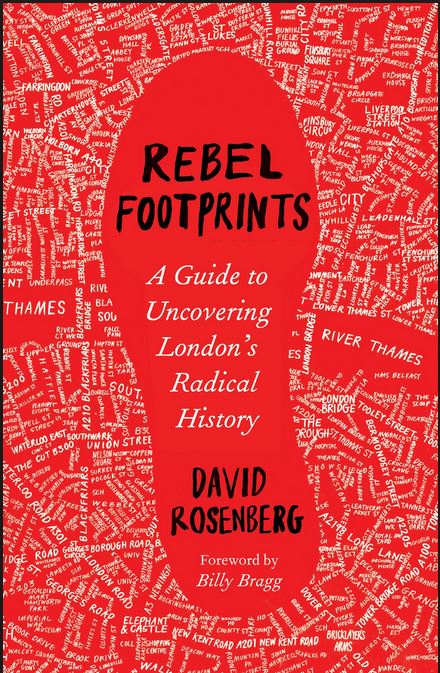
The cover of 'Rebel Footprints: A Guide to Uncovering London's Radical History.'
The cover of ‘Rebel Footprints: A Guide to Uncovering London’s Radical History.’

Rebel Footprints: A Guide to Uncovering London’s Radical History is a sort of hybrid history-guide book. It deals with the radical people and events of London between the 1830s and 1930s, but with a twist. Each chapter is accompanied by a do-it-yourself walking tour, complete with maps, which the reader can use to explore some of London’s most radical areas. Rosenberg points out that London’s physical environments are changing so quickly that the past could be easily forgotten. Radicals such as Charlotte Despard and William Cuffay are not the sort of people who get statues built in their honour, so we need to find others ways to remember them. And what better way than walking in their footsteps, following their footprints through the streets on which they fought for the causes they believed in?

I have always felt that the best way to get to know a city is to walk around it, and Rebel Footprints personifies that belief. The walking tours provide a fresh angle that makes the book stand out from the many, many others about London’s history, and as a geographer I find the way they engage with the spaces of the city especially gratifying. I do wonder how many readers will actually do the walking tours (I haven’t yet, although I am very keen to find the time), but then I also wonder how much that actually matters. Even if the book just makes people think about the spaces of London a bit differently then it has achieved something, and it is still an engaging and well-illustrated read. Rosenberg is actually a tour guide himself, he leads several wonderful tours around radical London, and this experience really shines through the pages, as well as the extensive research that was obviously necessary for the book. As an academic I find the lack of referencing frustrating (I would like to know where Rosenberg got some of his sources from!), but I acknowledge that the book isn’t aimed at an academic audience, so references are not expected.

The map of the Bermondsey walking tour from 'Rebel Footprints' (p. 250).
The map of the Bermondsey walking tour from ‘Rebel Footprints’ (p. 250).

Due to the nature of walking tours, each chapter has a local focus, concentrating on a specific neighbourhood or locale. I think this a really nice approach. If the reader is at all familiar with London then it is likely they will know some of the areas personally, and feel a connection. I have lived in Southwark for almost 2 years now; the University of London has buildings in Bloomsbury, so I spend quite a bit of time there; and before she moved to Crawley after the Second World War my Nan lived in Canning Town- the house where she used to live is still there. So I feel a particular affinity to the chapters focusing on these areas, a sort of pride that the parts of London I am connected to have such a radical history.

Rebel Footprints has special significance in post-General Election 2015. Many people feel a sense of dread at the thought of another five years under a Conservative Government, I am certainly one of them. In some ways the book is depressing, as it shows us all the progress that has been lost since 1940. But in other ways, I found reading Rebel Footprints in the aftermath of the 7th of May quite comforting. The activists, campaigners and radical politicians detailed in the book come from a whole range of backgrounds, and show that anyone can fight for something they feel strongly about. And it is actually possible to win some struggles, as unlikely as that might seem at the moment.

David Rosenberg has written a wonderful book, which greatly benefits from his passion and expertise. I attended a launch event for Rebel Footprints at the Bishopsgate Institute, where Rosenberg said he wanted to write a “history from below,” a book about “ordinary people doing extraordinary things.” I think he has done this, and I think he has done it very well.  

Book Review: London: The Biography

'London: The Biography' by Peter Ackroyd.
‘London: The Biography’ by Peter Ackroyd.

Ackroyd, Peter. London: The Biography. London: Vintage, 2001.

[London] contains every wish or word ever spoken, every action or gesture ever made, every harsh or noble statement ever expressed. It is illimitable. It is Infinite London.

Ackroyd, 2001; p779.

At a grand total of 822 pages, Peter Ackroyd’s London: The Biography is not a read to be taken on lightly. But when you accept that the book is a comprehensive social, cultural, political and economic history of one of the oldest and most powerful capital cities still functioning in the world today, 800 pages suddenly doesn’t seem like so much any more. The book is epic, but so is London.

London: The Biography is arranged thematically rather than chronologically, which I think was a wise decision. You still get a sense of the drastic changes over the last 2000 years, but rather than one huge description, it feels like Ackroyd is trying to get at some of those essential characteristics that make London London, that give the city its unique London-ness. For Ackroyd, this comes down to commerce; he believes that the city’s insatiable progress from the Roman to the modern era has been fuelled by an unquenchable desire for profit.

It is in fact the very universality of London that establishes these contrasts and separations, it contains every aspect of human life within itself, and is thus perpetually renewed. Yet do the rich and poor inhabit the same city? It may be that each citizen has created a London in his or own head, so that the same moment there may exist seven million different cities.

Ackroyd, 2001; p772.

This rather uncomplimentary take on a city for which many, myself included, hold in high regard can sometimes feel a little uncomfortable, but Ackroyd is just being frank. His London is ruthless, uncontrollable and indifferent to suffering, its people aggressive, loud, violent and prone to being over-dramatic. Perhaps it makes me uncomfortable because I do not disagree.

The book is aimed at a popular rather than an academic audience. Ackroyd does not reference his sources in the text, although there is “An Essay on Sources” at the back of the book. This can be frustrating if you are using the book as a starting point for conducting your own research on the city’s history. As the quotes above demonstrate, Ackroyd’s writing style can be poetic, and although most of the time it works well he does tend to personify London, giving the city a will and an autonomy that it cannot possibly have. Although I will admit that it can feel like London has a personality and a consciousness of it’s own, it isn’t actually true.

Attempting to tell the entire story of London is no mean feat, and Peter Ackroyd has made a valiant effort. As he himself admits, London is an incredibly diverse and complicated city, with a history stretching back over 2000 years. It would be impossible to fit it all into several books, let alone one. Ackroyd does a good job of making you feel like you know the unknowable city  just that bit better.

Book Review: March, Women, March

'March, Women, March' by Lucinda Hawksley.
‘March, Women, March’ by Lucinda Hawksley.

Hawksley, Lucinda. March, Women, March. London: André Deutsch, 2013.

Lucinda Hawksley’s March, Women, March, recently released in paperback, serves as a fantastic introduction to the history of the women’s movement in the UK, introducing the reader to all the key players from Mary Wollstoncraft through to Christabel Pankhurst, including quite a few who are not so well known nowadays. The book traces the struggle for women’s rights and female suffrage from the end of the eighteenth century to the late 1920s, using extensive quotes from those directly involved to help tell the story.

Hawksley uses numerous extracts from the diaries, letters and publications from those directly involved in the events she describes, so much of the story is told in the words of those who were there and took part. Not only does this act as proof of the huge amount of research that must have gone into the book, it also gives it a personal feel; you can almost feel the determination and strength of the women emanating from the pages.

One of the great strengths of this book is the fact that it tells the whole story of the women’s movement, putting the well-known suffragettes into the context of their predecessors and contemporaries. The Women’s Social and Political Union (WSPU) and the suffragettes did not spring up out of nowhere- they were inspired by, and worked alongside, vast numbers of other women such as Caroline Norton, Clementina Black and Charlotte Despard. March, Women, March acknowledges and celebrates the whole of this history, not just the bits that have successfully made their way into the collective consciousness.

In fact, my main criticism of the book is that I would have liked more detail about the early pioneers of the women’s movement. Women such as Caroline Norton, who railed against the way that she was treated by both her husband and the law after her marriage, and campaigned tireless for the rights of married women to see their children and control their own income, are much less familiar to me than the Pankhursts, and I would have liked to hear more about them.

March, Women, March also puts the campaign for suffrage into the context of other campaigns that aimed to benefit women, such as attempts to raise awareness about sexual health and contraception, and the ‘rational dress’ movement, which sought to free women from the physical constraints of tight corsets, high heels and excess frills and bows. These campaigns made social pariahs of their champions, appalling mainstream society with their frank and radical opinions. Many of the campaigners, such as Clementina Black who worked tirelessly to improve the conditions of working women, believed that the situation would not truly improve until women were granted the vote, for why should politicians listen to them when they could not influence the outcome of elections? Everything came back to suffrage.

If you are acquainted with the events and figures of the women’s suffrage campaign after 1900, much of this book will feel familiar, although you will probably still learn something new. If you are not familiar with the activities of the WSPU and others, then this book is an ideal introduction to the topic. Either way, March, Women, March is a very enjoyable read, and I would highly recommend it.

Book Review: Sally Heathcote: Suffragette

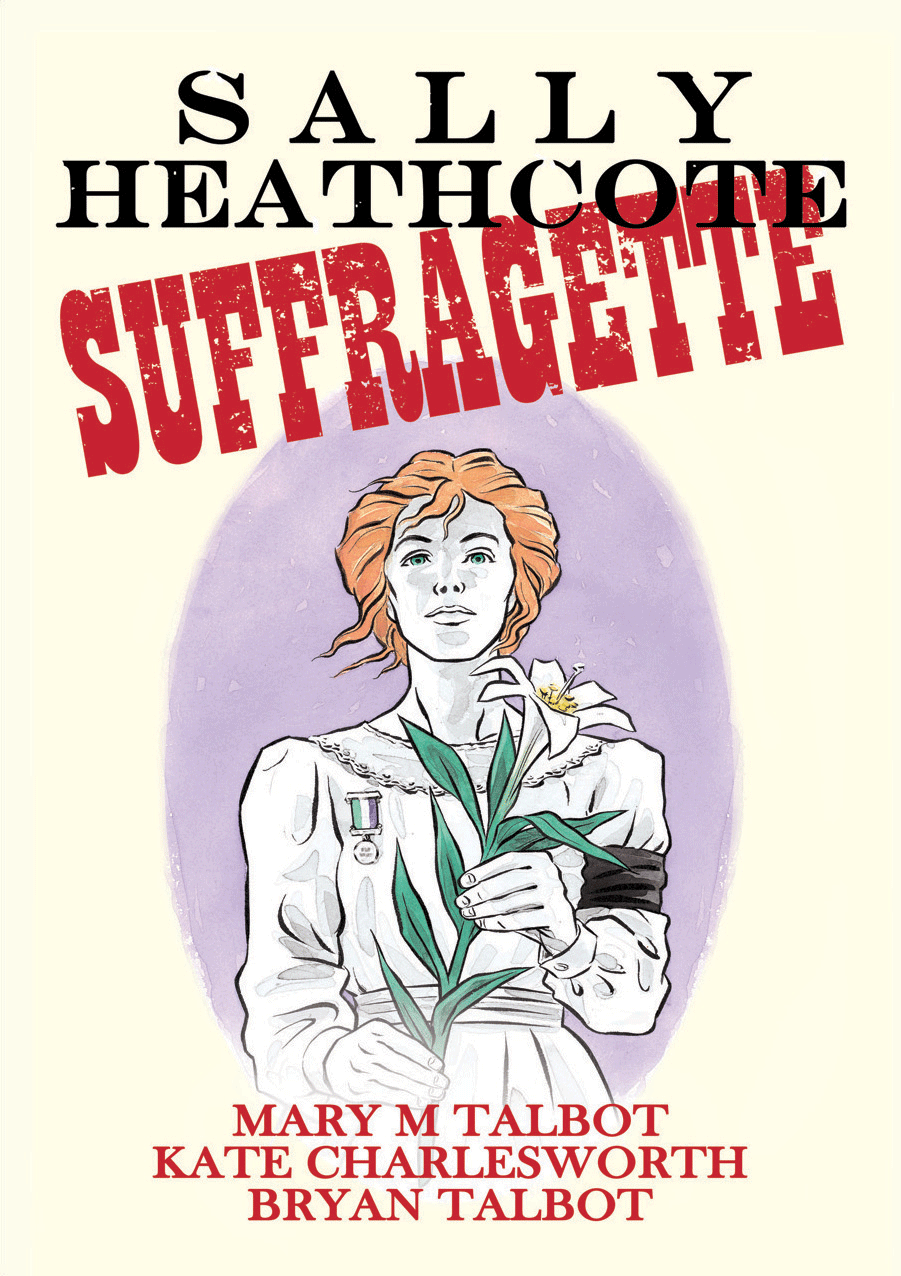
'Sally Heathcote: Suffragette' by May Talbot, Kate Charlesworth and Bryan Talbot.
‘Sally Heathcote: Suffragette’ by Mary Talbot, Kate Charlesworth and Bryan Talbot.

Talbot, Mary M, Kate Charlesworth and Bryan Talbot. Sally Heathcote: Suffragette. London: Jonathan Cape, 2014.

Sally Heathcote: Suffragette is a graphic novel that follows Sally Heathcote, a fictional young woman from Manchester who works for the Pankhurst family before they move to London. The story of the suffragettes, from the early days in Manchester through to World War One, is told through the eyes of Sally, a young working class woman who grew up in the workhouse. The book is thoughtful, historically accurate and beautifully illustrated; and a refreshing alternative to traditional depictions of the suffragettes.

Protest and graphic novels are not strangers. I recently reviewed Fight the Power  on this blog, which tells the story of many key examples of historical protest in the English-speaking world. V for Vendetta is a well-known example, with V masks becoming a common feature at marches and demonstrations across the world over the past few years. The recent Comics Unmasked exhibition at the British Library had a whole section on the connections between comics, graphic novels and dissent, which showed that comics frequently constitute protest as well as just representing them.

Sally Heathcote in a WSPU march (Source: Sally Heathcote, 2014).

In a nursing home in Hackney in 1969, an aged Sally dreams about her youth as a suffragette. After leaving the workhouse, Sally became a domestic servant for the Pankhursts. She moves to London several years after the family, and eventually gets a job working for the WSPU. All of the major features of the history of WSPU are then told through Sally’s own experience of them. She is arrested and imprisoned, where she embarks on a hunger strike and is force-fed, like many real-life suffragettes did when they were refused the right to be treated as political prisoners. She  joins the Young Hot Bloods, a secretive militant group within the WSPU, and participates in the bombing of a house belonging to Lloyd George. The divisions within the women’s suffrage movement are seen through Sally’s eyes, as is the death of Emily Wilding-Davison, who was killed by the King George V’s  Horse at the Epsom Derby in 1913.

Apart from the fictional main character, Sally Heathcote is historically accurate and incredibly well researched, with several pages at the back of the book dedicated to explaining the historical sources and contexts of particular events in the story. Also, some speeches and newspaper articles in the book are lifted directly from genuine historical documents. The story does not idealise the WSPU, depicting many of the movement’s weaknesses and divisions. Throughout the book, Sally talks with a mancunian accent, and her story illustrates the class prejudices that were present amongst the leading members of the WSPU. The splits and acrimony between the Pankhursts and many of their closest allies are also shown. As a result the book is a balanced account of history, showing that maintaining solidarity across differences is one of the most difficult challenges faced by a social movement.

Sally is imprisoned in Holloway Jail (Source: Sally Heathcote, 2014)

Sally Heathcote is not perfect however. Frequently with graphic novels I struggle to tell some of the characters apart, and I find myself failing to develop a connection with the characters, gaining little insight into their emotions and motivations. Although Sally can always be identified by her bright red hair (colour is used sparingly and to great effect within the book), I often couldn’t identify which of the other main protagonists were speaking. This difficulty may be accentuated if the reader is not familiar with the leading members of the women’s suffrage movement. In addition the reader never gets an explanation as to why Sally is so committed to the WSPU.  As the book progresses we learn she is headstrong and brave, and feels like she owes a debt to Emmeline Pankhurst for hiring her when she left the workhouse, but she never actually says why the right to vote is so important to her. I think this is a major oversight, as it is harder to identify with Sally if you don’t understand her motives.

Sally Heathcote: Suffragette is a poignant, realistic tale of struggle at the turn of the twentieth century. The Suffragettes are possibly one of the most well-known social movements in British history, so it must be a daunting prospect to try and tell their story from a fresh perspective. Sally Heathcote, with it’s unusual format and brave protagonist, does a pretty good job.

Book Review: Fight the Power! A Visual History of Protest Among the English Speaking Peoples

'Fight the Power!' by Wilson et al.
‘Fight the Power!’ by Wilson et al.

Wilson, Seán Michael, Benjamin Dickson, Hunt Emerson, John Spelling and Adam Pasion. Fight the Power! A Visual History of Protest Among the English-Speaking Peoples. Oxford: New Internationalist, 2013.

The title of Fight the Power! A Visual History of Protest among the English-Speaking Peoples may be a little long winded, but it does sum up the book well. Through the medium of comic strips, the book tells the story of some of the key moments in the history of protest in the English-speaking world (well, from the last 2 centuries anyway). The protests discussed are wide ranging in terms of topic and geography, taking in race, class, labour and governance issues, as well as such diverse countries as Ireland, Australia, America, and the former British Empire.

The format of the book makes it incredibly approachable and engaging, ideal for young people (although some of the images are a little graphic) or those with little previous knowledge of protest. The examples lack detail and can be one-sided, but neither of these are inherently bad things. The book is a fantastic introduction to many protests, and it does not claim to be an unbiased account.

Despite the diversity of the examples, several themes recur throughout the book. One is police brutality. The actions taken by those in authority attempting to suppress protest have frequently proved provocative, causing demonstrations to escalate into violent clashes. The Battle of Peterloo (1819) and the Battle of Toledo (1934), amongst others, are good examples of this. Violence, or the lack of it, is another theme that recurs throughout the book. Whether or not to use violence is one of the most fundamental decisions a protest movement makes, which can drastically influence the outcome of a campaign. There is no ‘right’ answer; apart from the moral debate, both violent and non-violent movements have proved successful in the past.

The lasting impression which the book leaves is one of hope. Particularly in the past few years, it can be very easy to believe that protest does not achieve anything, that  it is all too easy for those in authority to repress or ignore demonstrations and social movements. But what the examples in Fight the Power prove is that protest can force change. The Suffragettes, Rosa Parks, and the various independence movements of the British empire demonstrate that change may take time, decades even, and it may not be exactly the progress that you imagined, but it can be achieved.

Another key message of the book, which is particularly relevant to my PhD, is that past protests can provide both practical suggestions and inspiration to contemporary protest movements. As Tariq Ali writes in the Introduction, “History rarely repeats itself, but its echoes never go away” (p5). An image on the back cover of the book shows an Occupy protester holding a “We are the 99%” placard, backed by a Suffragette, Rosa Parks, Nelson Mandela, and others mentioned in the book. It is a powerful image of historical solidarity.

This book was given to me as a Christmas present (I got a lot of books this year, so brace yourself for a lot of reviews over the next few months!), and it certainly fulfills that role perfectly. It is a nice introduction to some of the most famous protests in the history of the English-speaking world, but I would recommend it even if you are already familiar with most of them as a refreshing approach to the history of protest.

Book Review: To End All Wars

'To End All Wars' by Adam Hochschild
‘To End All Wars’ by Adam Hochschild

Hochschild, Adam. To End All Wars. London: Pan Books, 2011.

By the time we reach the centenary of Armistice Day in 2018, I get the feeling that we might be suffering from a certain degree of World War 1 fatigue. The sheer number of  documentaries, dramatisations, books, ceremonies and art installations will likely make it difficult for any one thing to stand out. I think that To End All Wars by Adam Hochschild has a good chance of leaving a lasting impression.

The story of the first world war is familiar to most of us, but To End All Wars tells the narrative from an unfamiliar perspective; it is about those people who spoke out against the war. Opposition is not discussed in the traditional narratives of the war, the general perception appears to be that it wasn’t criticised until years afterwards. Admittedly critics of the war were few, tested as they were by the “mass patriotic hysteria” (Hochschild, 2011) but they most certainly did exist. On the 2nd of August 1914, there was a huge anti-war rally in Trafalgar Square, with calls for a general strike if war was declared. Prominent campaigners like Keir Hardie, Charlotte Despard and Sylvia Pankhurst continued to oppose the war, with Pankhurst proposing a Women’s Peace Expeditionary Force, where 1000 women would march into no-man’s land between the two armies.

Publicly criticising the war required a great deal of bravery. Those that did were almost instantly ostracised, derided or accused of treachery, labeled as German spies trying to undermine the war effort. Many paid a heavy price for their defiance. For example, the Wheeldon family, socialists who hid soldiers escaping conscription, were convicted in 1917 of the completely false charge of attempting to murder Lloyd George and another member of the war cabinet, victims of a government attempt to disgrace the anti-war movement. 3 family members were sentenced to 5-10 years hard labour after a sham trial that didn’t even last a week.

To End All Wars is arranged chronologically, making the tragic progress of the war appear even more inevitable as the reader can do absolutely nothing to prevent the horrors that we know full well are coming. The style of writing is dramatic, and the book often reads more like a novel than non-fiction. Charlotte Despard, the famous suffragette and anti-war campaigner, was actually the sister of John French, the Commander-in-Chief of the British Army until 1915. Hochschild hides this connection though, revealing it like a plot twist at the end of a chapter. The first chapter is spent introducing the key players in the book, developing them like characters. Whilst the approach felt a bit unusual at first, it makes for an engaging and accessible read.

Admittedly, Hochschild does spend a lot of time describing the events of the war, and whilst this is generally useful context, it does sometimes feel like filler, padding out the relatively rare examples of opposition to the war. However on balance this is a thoroughly enjoyable book, that provokes thought about the nature of war and opposition to it, as well as providing a rare new insight into the First World War.