Turbulent Londoners: Mary Astell, 1666-1731

Turbulent Londoners is a series of posts about radical individuals in London’s history who contributed to the city’s contentious past. My definition of ‘Londoner’ is quite loose, anyone who has played a role in protest in the city can be included. Any suggestions for future Turbulent Londoners posts are very welcome. Next up is Mary Astell, a philosopher and writer who is considered by many to be England’s first feminist.


The title page of Astell's first publication.
The title page of Astell’s first publication.

Mary Astell was a philosopher and writer from Newcastle whose ability to reason and argue made her a formidable force in intellectual circles in London in the late 17th and early 18th centuries. Her advocacy of women’s education and her opinions on marriage has led her to be seen by many as England’s first feminist.

Mary was born in Newcastle on the 12th of November 1666 to an upper middle class family; her father managed a local coal company. Mary’s father died when she was 12, leaving her family with very little income. She received some education from her uncle, who was affiliated with a group of radical philosophers in Cambridge, but she also taught herself by reading widely. After her mother died in 1684, Mary moved to Chelsea in London, where she became acquainted with an influential and wealthy circle of women who helped her to develop and publish her work.

Between 1694 and 1709, Mary published a number of texts on a range of subjects, but she is best known for her arguments relating to women. She used her extensive understanding of philosophical ideas to argue that women were just as rational as men, and therefore just as deserving of education. After withdrawing from public life in 1709, Mary set up a charity school for girls in Chelsea. She devised the curriculum, putting her ideas into practice. Mary Astell died of cancer on the 11th of May 1731, leaving behind a lasting legacy.
The title page of the third edition of Astell's 'Reflections Upon Marriage.'
The title page of the third edition of Astell’s ‘Reflections Upon Marriage.’

Mary’s first publication came out in 1694 and was entitled Serious Proposal to the Ladies for the Advancement of their True and Greatest Interest. In it, she proposes a female-only college, where women learn through reading and discussion, rather than a formal, hierarchical program of study. In Some Reflections Upon Marriage (1700), Mary continues advocating for women. She argues that an education would enable women to make better matrimonial choices, and be better prepared for married life. She warns women against making hasty choices when it came to marriage, and believed marriage should be based on friendship rather than necessity or fleeting attraction.

Mary’s ideas were groundbreaking for more than just their content. The way that she used philosophical ideas to support her arguments was unique, and she addressed women directly in her writing- talking to them, not about them. Her arguments disputed the Protestant belief, dominant at the time, that reason and emotion should be separate; for Mary, knowledge was intimately connected to happiness. Linked to this, one of the most frequent criticisms levelled against Mary’s ideas was that they were ‘too Catholic’; her plan for an all-female college sounded too much like a nunnery to be accepted by mainstream society. Mary’s ideas about women’s education caused substantial debate, and she was widely respected for her ability to debate freely and confidently with both men and women, but she did not receive widespread support.

“If all Men are born free, how is it that all Women are born slaves?”

Astell, Some Reflections Upon Marriage

The above quote is probably Mary Astell’s most famous, and it is easy to see why. This was a truly radical sentiment in the early eighteenth century. Not only did she express these radical ideas, Mary could support them with reasoned, rational, philosophical arguments. And she did all this at a time when there were few historical campaigners for women’s rights from which she could take inspiration and hope. As one of England’s first feminists she deserves to be remembered and celebrated, but she can also be for contemporary campaigners something she herself didn’t have- a role model.

Sources and Further Reading

Anon. ‘Astell, Mary.’ Encyclopaedia.com. Last modified 2005, accessed 28th July 2015.  http://www.encyclopedia.com/topic/Mary_Astell.aspx

Anon. ‘Mary Astell.’ Wikipedia. Last modified 19th May 2015, accessed 28th July 2015.  https://en.wikipedia.org/wiki/Mary_Astell

Manzanedo, Julia Cabaleiro. ‘The Love of Knowledge: Mary Astell.’ Women’s Research Centre, University of Barcelona. Last modified 2004, accessed 28th July 2015.  http://www.ub.edu/duoda/diferencia/html/en/secundario2.html

Sowaal, Alice. ‘Mary Astell.’ Stanford Encyclopaedia of Philosophy. Last modified 12th August 2008, accessed 28th July 2015. http://plato.stanford.edu/entries/astell/

Book Review: Silvertown- The Lost Story of a Strike that Shook London and Helped Launch the Modern Labour Movement

Silvertown by John Tully
Silvertown: The Lost Story of a Strike that Shook London and Helped Launch the Modern Labour Movement by John Tully

Silvertown: The Lost Story of a Strike that Shook London and Helped Launch the Modern Labour Movement. Tully, John. London: Lawrence and Wishart, 2014.

“Silvertown’s workers and their families were not just passive victims of the industrial system. They were flesh-and-blood human beings who sorrowed and hoped, swore and fought, loved and hated, enjoyed themselves when they could at pub knees-ups or their teetotal equivalents, dreamed of a better life for their children, and bore adversity with simple stoicism and very Cockney, Irish-influenced, irreverent and ironic sense of humor.”

(Tully, 2014; p. 83)

The above quote epitomises John Tully’s approach in Silvertown: The Lost Story of a Strike that Shook London and Helped Launch the Modern Labour Movement. Tully tells the story of this once-forgotten strike without losing sight of the human element. Thoroughly researched and well-written, this book about British labour history, written by an Australian for an American audience is a valuable addition to labour movement literature.

Silvertown is an industrial area in the London borough of Newham north of the Thames. It is dominated by the Tate & Lyle sugar refinery, but the area was named after Silver’s India-Rubber, Gutta-Percha and Telegraph Works that opened in 1852, when the area was little more than marshland. In September 1888, the workers at the Silver Works went out on strike when they were denied a pay rise. The bitter dispute lasted for 3 months before the workers reluctantly returned to work at their original levels of pay- those that weren’t blacklisted, anyway.

The Silvertown Strike was part of a wave of strikes and organisation in the 1880s that is now known as New Unionism. For the first time, semi-skilled and unskilled workers were unionising, and unlike the more established craft unions, they had socialist leanings and were willing to take militant action. Silvertown was not the only strike that has been left out of the dominant narrative of New Unionism, Louise Raw’s excellent book Striking a Light attempts to give the 1888 Bryant and May Matchwomens’ strike the place it deserves in labour history. Silvertown contributes to the constant process of reassessment that is so important for academic research.

There are any number of reasons why a strike or protest might be left out of the history books, and in the case of Silvertown it is probably because the strikers lost. After 3 months of hunger, picketing, marches and victimisation, the strikers were forced back to work. Tully does an excellent job of analysing why the strike did not succeed. His attention to detail is admirable- he even researched the weather conditions during the strike in order to consider the impacts the weather might have had on the strikers’ resolve. Despite the loss, Tully argues that the strike was a turning point in New Unionism, not least because the merciless tactics used by the owners of Silver’s rubber and electrical plant became a blue print for any employer trying to break a strike.

There are some gaps in the story- for example Tully has few sources that detail what the factory managers were thinking during the strike, so he has to make a few educated guesses. To be fair however, Tully always makes it clear that they are educated guesses, and he cannot use sources that don’t exist. Tully also uses too many sub-headings for my liking, which makes the text feels disjointed and awkward, but this is a minor criticism.

John Tully balances considered analysis with descriptive writing that conveys the more emotive, human aspects of the Silvertown strike. Not only is Silvertown: The Lost Story of a Strike that Shook London and Helped Launch the Modern Labour Movement a fantastic piece of scholarly research, it is also an enjoyable read, two qualities that don’t always go hand in hand.

Book Review: Rebel Footprints: A Guide to Uncovering London’s History

Rosenberg, David. Rebel Footprints: A Guide to Uncovering London’s Radical History. London: Pluto Press, 2015

“Londoners today are not short of issues to protest about. And as we continue to march through the streets of our capital city, holding placards and banners, singing, blowing whistles, chanting slogans and voicing our demands, we are walking on well-trodden ground. But we are also elevated, as we stand on the shoulders of those rebels who came before us, who refused to accept the status quo, and who set out on paths of protest. This book honours and celebrates those rebels who dreamt of a better life and aims to ensure that their ideals continue to live in the hearts and minds of those who campaign for justice and equality in our metropolis today.”

Billy Bragg “Foreword,” p.6

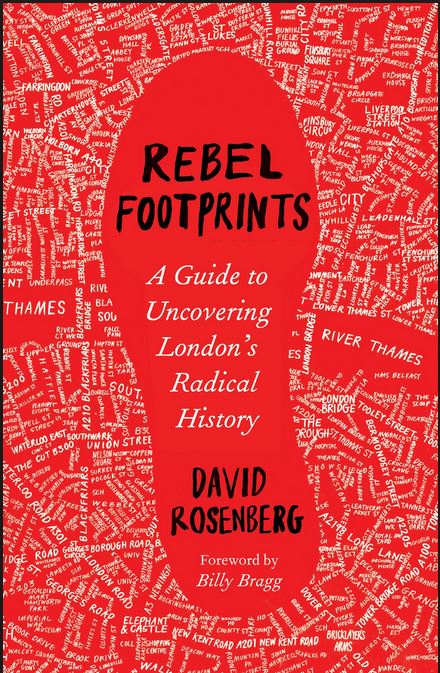
The cover of 'Rebel Footprints: A Guide to Uncovering London's Radical History.'
The cover of ‘Rebel Footprints: A Guide to Uncovering London’s Radical History.’

Rebel Footprints: A Guide to Uncovering London’s Radical History is a sort of hybrid history-guide book. It deals with the radical people and events of London between the 1830s and 1930s, but with a twist. Each chapter is accompanied by a do-it-yourself walking tour, complete with maps, which the reader can use to explore some of London’s most radical areas. Rosenberg points out that London’s physical environments are changing so quickly that the past could be easily forgotten. Radicals such as Charlotte Despard and William Cuffay are not the sort of people who get statues built in their honour, so we need to find others ways to remember them. And what better way than walking in their footsteps, following their footprints through the streets on which they fought for the causes they believed in?

I have always felt that the best way to get to know a city is to walk around it, and Rebel Footprints personifies that belief. The walking tours provide a fresh angle that makes the book stand out from the many, many others about London’s history, and as a geographer I find the way they engage with the spaces of the city especially gratifying. I do wonder how many readers will actually do the walking tours (I haven’t yet, although I am very keen to find the time), but then I also wonder how much that actually matters. Even if the book just makes people think about the spaces of London a bit differently then it has achieved something, and it is still an engaging and well-illustrated read. Rosenberg is actually a tour guide himself, he leads several wonderful tours around radical London, and this experience really shines through the pages, as well as the extensive research that was obviously necessary for the book. As an academic I find the lack of referencing frustrating (I would like to know where Rosenberg got some of his sources from!), but I acknowledge that the book isn’t aimed at an academic audience, so references are not expected.

The map of the Bermondsey walking tour from 'Rebel Footprints' (p. 250).
The map of the Bermondsey walking tour from ‘Rebel Footprints’ (p. 250).

Due to the nature of walking tours, each chapter has a local focus, concentrating on a specific neighbourhood or locale. I think this a really nice approach. If the reader is at all familiar with London then it is likely they will know some of the areas personally, and feel a connection. I have lived in Southwark for almost 2 years now; the University of London has buildings in Bloomsbury, so I spend quite a bit of time there; and before she moved to Crawley after the Second World War my Nan lived in Canning Town- the house where she used to live is still there. So I feel a particular affinity to the chapters focusing on these areas, a sort of pride that the parts of London I am connected to have such a radical history.

Rebel Footprints has special significance in post-General Election 2015. Many people feel a sense of dread at the thought of another five years under a Conservative Government, I am certainly one of them. In some ways the book is depressing, as it shows us all the progress that has been lost since 1940. But in other ways, I found reading Rebel Footprints in the aftermath of the 7th of May quite comforting. The activists, campaigners and radical politicians detailed in the book come from a whole range of backgrounds, and show that anyone can fight for something they feel strongly about. And it is actually possible to win some struggles, as unlikely as that might seem at the moment.

David Rosenberg has written a wonderful book, which greatly benefits from his passion and expertise. I attended a launch event for Rebel Footprints at the Bishopsgate Institute, where Rosenberg said he wanted to write a “history from below,” a book about “ordinary people doing extraordinary things.” I think he has done this, and I think he has done it very well.  

Book Review: London: The Biography

'London: The Biography' by Peter Ackroyd.
‘London: The Biography’ by Peter Ackroyd.

Ackroyd, Peter. London: The Biography. London: Vintage, 2001.

[London] contains every wish or word ever spoken, every action or gesture ever made, every harsh or noble statement ever expressed. It is illimitable. It is Infinite London.

Ackroyd, 2001; p779.

At a grand total of 822 pages, Peter Ackroyd’s London: The Biography is not a read to be taken on lightly. But when you accept that the book is a comprehensive social, cultural, political and economic history of one of the oldest and most powerful capital cities still functioning in the world today, 800 pages suddenly doesn’t seem like so much any more. The book is epic, but so is London.

London: The Biography is arranged thematically rather than chronologically, which I think was a wise decision. You still get a sense of the drastic changes over the last 2000 years, but rather than one huge description, it feels like Ackroyd is trying to get at some of those essential characteristics that make London London, that give the city its unique London-ness. For Ackroyd, this comes down to commerce; he believes that the city’s insatiable progress from the Roman to the modern era has been fuelled by an unquenchable desire for profit.

It is in fact the very universality of London that establishes these contrasts and separations, it contains every aspect of human life within itself, and is thus perpetually renewed. Yet do the rich and poor inhabit the same city? It may be that each citizen has created a London in his or own head, so that the same moment there may exist seven million different cities.

Ackroyd, 2001; p772.

This rather uncomplimentary take on a city for which many, myself included, hold in high regard can sometimes feel a little uncomfortable, but Ackroyd is just being frank. His London is ruthless, uncontrollable and indifferent to suffering, its people aggressive, loud, violent and prone to being over-dramatic. Perhaps it makes me uncomfortable because I do not disagree.

The book is aimed at a popular rather than an academic audience. Ackroyd does not reference his sources in the text, although there is “An Essay on Sources” at the back of the book. This can be frustrating if you are using the book as a starting point for conducting your own research on the city’s history. As the quotes above demonstrate, Ackroyd’s writing style can be poetic, and although most of the time it works well he does tend to personify London, giving the city a will and an autonomy that it cannot possibly have. Although I will admit that it can feel like London has a personality and a consciousness of it’s own, it isn’t actually true.

Attempting to tell the entire story of London is no mean feat, and Peter Ackroyd has made a valiant effort. As he himself admits, London is an incredibly diverse and complicated city, with a history stretching back over 2000 years. It would be impossible to fit it all into several books, let alone one. Ackroyd does a good job of making you feel like you know the unknowable city  just that bit better.

Book Review: March, Women, March

'March, Women, March' by Lucinda Hawksley.
‘March, Women, March’ by Lucinda Hawksley.

Hawksley, Lucinda. March, Women, March. London: André Deutsch, 2013.

Lucinda Hawksley’s March, Women, March, recently released in paperback, serves as a fantastic introduction to the history of the women’s movement in the UK, introducing the reader to all the key players from Mary Wollstoncraft through to Christabel Pankhurst, including quite a few who are not so well known nowadays. The book traces the struggle for women’s rights and female suffrage from the end of the eighteenth century to the late 1920s, using extensive quotes from those directly involved to help tell the story.

Hawksley uses numerous extracts from the diaries, letters and publications from those directly involved in the events she describes, so much of the story is told in the words of those who were there and took part. Not only does this act as proof of the huge amount of research that must have gone into the book, it also gives it a personal feel; you can almost feel the determination and strength of the women emanating from the pages.

One of the great strengths of this book is the fact that it tells the whole story of the women’s movement, putting the well-known suffragettes into the context of their predecessors and contemporaries. The Women’s Social and Political Union (WSPU) and the suffragettes did not spring up out of nowhere- they were inspired by, and worked alongside, vast numbers of other women such as Caroline Norton, Clementina Black and Charlotte Despard. March, Women, March acknowledges and celebrates the whole of this history, not just the bits that have successfully made their way into the collective consciousness.

In fact, my main criticism of the book is that I would have liked more detail about the early pioneers of the women’s movement. Women such as Caroline Norton, who railed against the way that she was treated by both her husband and the law after her marriage, and campaigned tireless for the rights of married women to see their children and control their own income, are much less familiar to me than the Pankhursts, and I would have liked to hear more about them.

March, Women, March also puts the campaign for suffrage into the context of other campaigns that aimed to benefit women, such as attempts to raise awareness about sexual health and contraception, and the ‘rational dress’ movement, which sought to free women from the physical constraints of tight corsets, high heels and excess frills and bows. These campaigns made social pariahs of their champions, appalling mainstream society with their frank and radical opinions. Many of the campaigners, such as Clementina Black who worked tirelessly to improve the conditions of working women, believed that the situation would not truly improve until women were granted the vote, for why should politicians listen to them when they could not influence the outcome of elections? Everything came back to suffrage.

If you are acquainted with the events and figures of the women’s suffrage campaign after 1900, much of this book will feel familiar, although you will probably still learn something new. If you are not familiar with the activities of the WSPU and others, then this book is an ideal introduction to the topic. Either way, March, Women, March is a very enjoyable read, and I would highly recommend it.

Book Review: Sally Heathcote: Suffragette

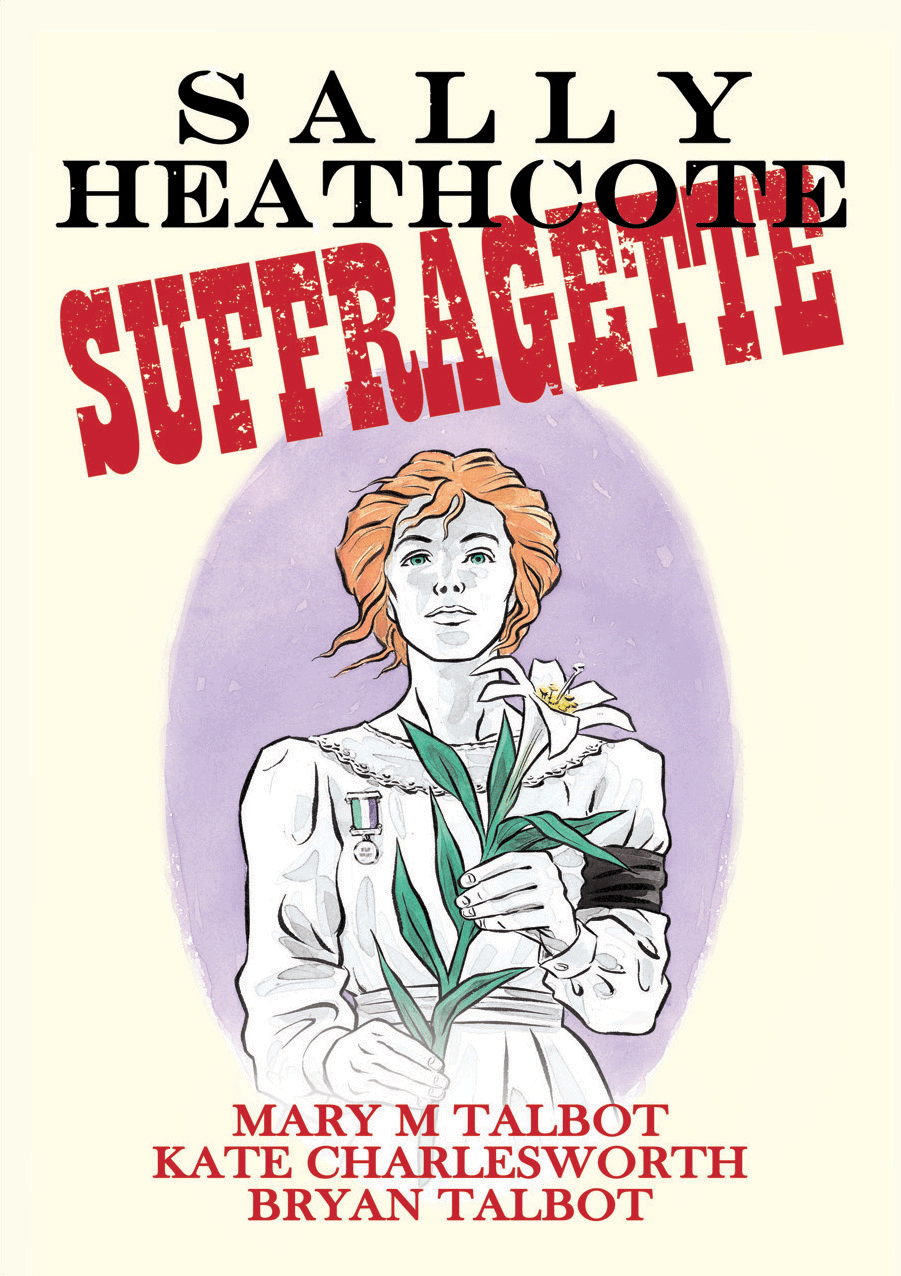
'Sally Heathcote: Suffragette' by May Talbot, Kate Charlesworth and Bryan Talbot.
‘Sally Heathcote: Suffragette’ by Mary Talbot, Kate Charlesworth and Bryan Talbot.

Talbot, Mary M, Kate Charlesworth and Bryan Talbot. Sally Heathcote: Suffragette. London: Jonathan Cape, 2014.

Sally Heathcote: Suffragette is a graphic novel that follows Sally Heathcote, a fictional young woman from Manchester who works for the Pankhurst family before they move to London. The story of the suffragettes, from the early days in Manchester through to World War One, is told through the eyes of Sally, a young working class woman who grew up in the workhouse. The book is thoughtful, historically accurate and beautifully illustrated; and a refreshing alternative to traditional depictions of the suffragettes.

Protest and graphic novels are not strangers. I recently reviewed Fight the Power  on this blog, which tells the story of many key examples of historical protest in the English-speaking world. V for Vendetta is a well-known example, with V masks becoming a common feature at marches and demonstrations across the world over the past few years. The recent Comics Unmasked exhibition at the British Library had a whole section on the connections between comics, graphic novels and dissent, which showed that comics frequently constitute protest as well as just representing them.

Sally Heathcote in a WSPU march (Source: Sally Heathcote, 2014).

In a nursing home in Hackney in 1969, an aged Sally dreams about her youth as a suffragette. After leaving the workhouse, Sally became a domestic servant for the Pankhursts. She moves to London several years after the family, and eventually gets a job working for the WSPU. All of the major features of the history of WSPU are then told through Sally’s own experience of them. She is arrested and imprisoned, where she embarks on a hunger strike and is force-fed, like many real-life suffragettes did when they were refused the right to be treated as political prisoners. She  joins the Young Hot Bloods, a secretive militant group within the WSPU, and participates in the bombing of a house belonging to Lloyd George. The divisions within the women’s suffrage movement are seen through Sally’s eyes, as is the death of Emily Wilding-Davison, who was killed by the King George V’s  Horse at the Epsom Derby in 1913.

Apart from the fictional main character, Sally Heathcote is historically accurate and incredibly well researched, with several pages at the back of the book dedicated to explaining the historical sources and contexts of particular events in the story. Also, some speeches and newspaper articles in the book are lifted directly from genuine historical documents. The story does not idealise the WSPU, depicting many of the movement’s weaknesses and divisions. Throughout the book, Sally talks with a mancunian accent, and her story illustrates the class prejudices that were present amongst the leading members of the WSPU. The splits and acrimony between the Pankhursts and many of their closest allies are also shown. As a result the book is a balanced account of history, showing that maintaining solidarity across differences is one of the most difficult challenges faced by a social movement.

Sally is imprisoned in Holloway Jail (Source: Sally Heathcote, 2014)

Sally Heathcote is not perfect however. Frequently with graphic novels I struggle to tell some of the characters apart, and I find myself failing to develop a connection with the characters, gaining little insight into their emotions and motivations. Although Sally can always be identified by her bright red hair (colour is used sparingly and to great effect within the book), I often couldn’t identify which of the other main protagonists were speaking. This difficulty may be accentuated if the reader is not familiar with the leading members of the women’s suffrage movement. In addition the reader never gets an explanation as to why Sally is so committed to the WSPU.  As the book progresses we learn she is headstrong and brave, and feels like she owes a debt to Emmeline Pankhurst for hiring her when she left the workhouse, but she never actually says why the right to vote is so important to her. I think this is a major oversight, as it is harder to identify with Sally if you don’t understand her motives.

Sally Heathcote: Suffragette is a poignant, realistic tale of struggle at the turn of the twentieth century. The Suffragettes are possibly one of the most well-known social movements in British history, so it must be a daunting prospect to try and tell their story from a fresh perspective. Sally Heathcote, with it’s unusual format and brave protagonist, does a pretty good job.