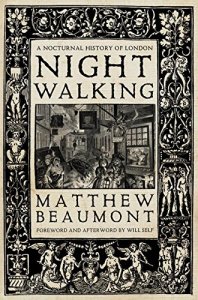
Book Review: Nightwalking- A Nocturnal History of London

Nightwalking Front Cover
Nightwalking by Matthew Beaumont.

Matthew Beaumont. Nightwalking: A Nocturnal History of London. London: Verso, 2015. £9.99

Nightwalking by Matthew Beaumont is an exploration of London at night through the eyes of the men (and it is all men) who wrote about it. Starting with Chaucer, Beaumont traces evolving societal attitudes to night time and darkness in the city. He ends the book with Dickens (well, sort of- Edgar Allen Poe features heavily in the conclusion), “the great heroic and neurotic nightwalker of the nineteenth century” (Beaumont, 2015; p.6). The writers Beaumont studies walked the line between polite society and the world of the social outcasts; the prostitutes, criminals, orphans, and homeless who inhabited London’s streets after dark. Some writers managed the balance better than others.

Who walks the streets alone at night? The sad, the mad, the bad. The lost, the lonely. The hypomanic, the catatonic. The sleepless, the homeless. All the city’s internal exiles.

Beaumont, 2015; p.3

When I first got Nightwalking, I was a little disappointed to realise that it had a literary focus. I like to read, but I’m not a fan of literary analysis; perhaps there are too many bad memories from GCSE and A-Level English Literature. I thought Nightwalking was a straight social history, and I wasn’t sure I would enjoy the literary angle.

I needn’t have worried. Beaumont uses the cultural history of the London night to explore its social, political and economic history. He strikes a nice balance between detailed textual analysis and wider contextual discussion. The social and legal discourses surrounding those who wander the streets of the city at night have developed over time, but in an uneven manner. For hundreds of years, being caught outside after dark was a criminal offence. As society and technology developed, the night became a space of recreation, initially just for the wealthy; the evolution of cheap and effective street lighting is one factor that contributed to this process. Although the legal restrictions faded, moral restrictions remained, dictating which kinds of activity, and which kinds of people, were acceptable on London’s streets after dark.

London’s writers were drawn to this moral ambiguity, taking to the streets at night in order to better understand the city or themselves, to have a good time, and sometimes because they had no choice. Men such as Chaucer, Shakespeare, Johnson, Blake, and Dickens “used the night as a means of creatively thinking the limits of an increasingly enlightened, rationalist culture” (Beaumont, 2015; p.10). Beaumont balances all the contradictory and sometimes vague associations and motivations for nightwalking well, explaining his arguments in a clear and concise manner. It is obvious to me that Beaumont is an academic, and that the book is based on extensive scholarly research, but I don’t think that the book would be unapproachable to non-academics, although another reviewer has said his style can be “cloudily academic.”

Nightwalking is a well-researched, well-reasoned book that manages to tell a complicated story in a way that is easy to follow. I can see this book being useful to students of English Literature and History alike, but I would also recommend it to those who just enjoy reading a good book.

Getting Grants, Getting Published and Staying Sane: Life After the PhD

dav
Getting Grants: Getting Published and Staying Sane: Life after PhD was organised by History Lab Plus at the Institute of Historic Research in London on the 15th of July 2016 (Photo: Hannah Awcock).

As I near the end of the third year of my PhD, what comes after is starting to loom increasingly large on my mind. As a result, I signed up for an event organised by History Lab Plus about life after the PhD. Getting Grants, Getting Published and Staying Sane: Life after the PhD took place on the 15th of July at the Institute of Historical Research in London, and I found it very helpful. There was a workshop about our post-PhD hopes and fears, and four panel-based sessions on making the transition, getting funding grants, getting published, and jobs outside academia/impact/public history.

The thing about advice is that it is personal; you can only really talk from your own experience, and it quickly became obvious that the post-PhD period is just as varied as the PhD itself. For example, it is very hard to get an academic job without a publication, but almost everyone seems to know at least one person who managed it. Any career is an individual experience, and people can only really give advice from their own personal experiences, which may not be relevant to yours for any number of reasons. This is something I always try to remember when given advice.

One piece of advice that does seem to be universally applicable is to spend time thinking about what you want to do after your PhD. Do you want an academic career? Do you want to turn your thesis into a book? Do you want to focus more on teaching or research? Think about what you want to achieve, and then decide which jobs/opportunities/ experiences will help you to get there. Also think about what skills you have, what you can offer to a potential employer. What are you interested in, and what are you good at? I spend a lot of time thinking about life after the PhD, but before this event it hadn’t occurred to me to try and think in these practical, concrete terms that might actually be helpful instead of just terrifying.

sdr
There were four panels covering multiple different aspects of life after the PhD (Photo: Hannah Awcock).

There were other bits of advice that I think would be useful for everyone; for example Emily Russell, an editor at Palgrave Macmillan, gave a talk about the process of converting a thesis into a book, but I think the aspect of the day that I found most helpful was the sense that we are all the same boat here. There must have been around 30 people sitting in that room, all of whom are coming close to finishing their PhD, or just recently had, who all had very similar questions about what comes next. As a PhD student, I am constantly being made aware of how difficult it is to get an academic job, how competitive it is (the ‘CV arms race’ is an analogy I like). As a result, I often find it hard to be happy for my contemporaries when they achieve something that might give them an advantage over me if we applied for the same job. My first reaction is frequently jealously, or despair that I haven’t managed to achieve the same thing yet, and I hate it. Life After the PhD was a reminder that we are all in the same boat. We are all dealing with the pressure, we are all getting frustrated about the structural systems that make academia so tough in the first place, and we are all worrying about how we are going to pay rent and feed ourselves when our funding runs out (those of use who were lucky enough to get funding in the first place). So we need to look out for one another. This can take the form of joining a union or a campaign like FACE (Fighting Against Casualisation in Academia), or simply being nice to one another- one of my favourite pieces of advice from the day came from Dr. Will Pooley and is a favourite saying of comedian Adam Hills: “Don’t be a dick!” Will posted the text of his talk on his blog.

I am scared about what is going to happen when I finish my PhD- this is the first time in my life when I don’t know what I’m going to do next, where I don’t have a solid, concrete plan that I know is going to work out. However, events like Life After the PhD  help me to put it into perspective. As well as providing advice, the day was an opportunity to discuss my fears, and my ambitions, with others who are going through the same thing, which I found helpful.

I would like to thank History Lab Plus for organising the event, particularly Kelly Spring and Jessica Hammett.

Turbulent Londoners: Daisy Parsons, 1890-1957

Turbulent Londoners is a series of posts about radical individuals in London’s history who contributed to the city’s contentious past, with a particular focus of women, whose contribution to history is often overlooked. My definition of ‘Londoner’ is quite loose, anyone who has played a role in protest in the city can be included. Any suggestions for future Turbulent Londoners posts are very welcome. My next Turbulent Londoner is Daisy Parsons, a Suffragette and the first female Mayor of West Ham.


Daisy Parsons- Beckton Lido
Daisy Parsons at the opening of the Beckton Lido in August 1927 (Source: © Newham Heritage Service).

Daisy Parsons was a formidable woman. Despite leaving school at the age of 12 to help support her family she became a force to be reckoned with in East End politics, working closely with Sylvia Pankhurst in the East London Federation of Suffragettes (ELFS), then going on to become the first female Mayor of West Ham.

Born Marguerite Lena Millo on the 25th of May 1890, Daisy must have had a difficult childhood. She was born in Poplar in East London, her family moving to nearby Canning Town when Daisy was 8 months old. She had 5 younger brothers, and because her father was an invalid, her mother had to take on washing and charring work. Daisy was given a certificate of exemption in 1902 so that she could leave Beckton Road School early to look after her brothers, a necessity she always regretted. When she was 14 she left home to work as a maid, but later became a cigarette packer at the Carreras Tobacco Company in Aldgate, because the pay was better. Women and girls were paid 3d for every 1000 cigarettes they packed (most managed about 3000 a day).

It was whilst working at the tobacco company that Daisy had her first contact with the trade union movement; male employees at the factory had a fixed lunch hour and a space to eat because their union had fought for them. Female employees had to eat in the toilets! Daisy’s husband Tom was a driver for Stepney Borough Council and an active union member. They married in December 1908 when Daisy was 18.

Daisy obviously had a keen interest in politics in her own right- she joined the Women’s Social and Political Union and the International Labour Party, and was one of the founding members and the secretary of the ELFS. She was remembered as being assertive and persuasive. She was clearly not one to shy away from action- at Suffragette demonstrations she carried a ‘Saturday Nights’ (a length of hemp rope tied at one end, a sort of improvised cosh) hidden up her sleeve in case she needed to defend herself.

Daisy took part in a deputation of working women to Prime Minister Asquith on the 12th of June 1914, trying to persuade him of the necessity of female suffrage. By this point she had 2 daughters, and was also looking after her niece. Daisy stuck with Sylvia Pankhurst after the split with her mother and sister, and ELFS worked tirelessly during the first world war, setting up a Mother and Child Welfare Centre in West Ham to help women who were struggling whilst their husbands were away, or had been killed.

When women over 30 were given the right to vote in 1918 Daisy still couldn’t vote because she was only 29! This did not deter her from moving into mainstream local politics however, and she was elected as a Labour Councillor for Beckton ward in 1922. She became deputy Mayor of West Ham in 1931, and Mayor in 1936. She also became a Justice of the Peace in 1933, and an Alderman of West Ham in 1935. During World War 2 Daisy organised the evacuation of local children and helped to organise the Women’s Voluntary Service. Her efforts did not spare her from tragedy however; her brother and niece were killed in the Blitz.

Daisy Parsons was obviously respected and admired. She was awarded the Freedom of West Ham in 1939, the highest honour which the borough can bestow, and was made an MBE in 1951 in recognition of her public service. She had gone from radical Suffragette to respected local official, but I get the impression she retained her determined and caring nature.

Sources and Further Reading

Anon. ‘Daisy Parsons, MBE.’ The Newham Story. No date, accessed 21st March 2016.  http://newhamstory.com/node/991

Brooker, Janice. ‘Daisy Parsons.’ Lost in London. Last modified 1st May 2007, accessed 21st March 2016. http://www.brooker.talktalk.net/daisy_parsons.htm

McCarthy, Ka. ‘Daisy Parsons.’ The Great British Community. Last modified 8th March 2016, accessed 21st March 2016. http://greatbritishcommunity.org/daisy-parsons/

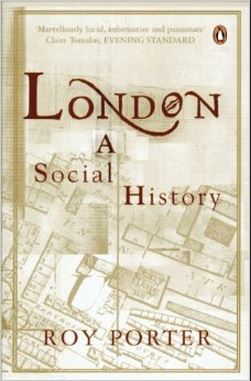
Book Review: London- A Social History

The 2000 edition of 'London- A Social History' by Roy Porter.
The 2000 edition of ‘London- A Social History’ by Roy Porter.

Porter, Roy. London- A Social History. London: Penguin, 2000 [1994]

“the physical fabric [of London] engages in endless dialogue with the inhabitants; the townscape shapes them, while they reconstruct it. Factories and flats, railways and roads outlive individuals. People make their own cities, but never under conditions of their own choosing.”

(Porter, 2000; p. xvi)

When he set out to write London- A Social History, Roy Porter (2000; p. xvi) aimed to write “a substantial account and analysis of the making of the metropolis in terms of its people, economy and buildings.” He has achieved this, frequently going beyond descriptions to consider why London is the way that it is. The book is arranged chronologically, but the Georgian, Victorian, and post-War London periods (from chapter 5 onwards) receive significantly more attention than others; each has multiple chapters devoted to them, divided thematically. This can be little confusing; you finish chapter 8 in 1890, then chapter 9 begins back in 1820.

For Porter, London is a city past its prime. The metropolis is “aged and ailing” (Porter, 2000; p. 445), deprived of the empire which Porter argues was the driving force behind its success. In the preface, he looks back on his childhood in 1950s New Cross with nostalgia, and he is quietly critical of Thatcherite policies and a lack of public investment. Porter passed away in 2002, but I do wonder what he would make of London in 2015- somehow, I can’t imagine he would be very impressed. His criticisms feel informed and considered, unlike A.N. Wilson in London- A Short History, Porter explains what he doesn’t like about modern London without making me strongly dislike him.

One of the things that London- A Social History does really well is highlight the continuities of London. Sometimes London at different periods of history can feel so diverse that it calls into question the wisdom of treating it as the same city, but Porter connects Tudor, Georgian and modern London together into a narrative that make sense. For example, the book’s descriptions of housing demonstrate that good quality, affordable housing for the city’s working class has been a constant problem since the Georgians. Porter also does an excellent job of explaining the reasons behind London’s particularly ad-hoc structures of local government. The rivalry between the national government in Westminster and the City goes back centuries, and Westminster has long feared the potential power of a comprehensive pan-London authority.

The book does have some weaknesses. Some chapters, particularly those that describe the massive growth of London during various periods of the last few centuries feel a bit list-y, and are tedious to read. He gives disproportionate space to London since Georgian times, with much less about the preceding history. This is not uncommon in histories of London, perhaps just because the further back you go, the harder it is to find reliable sources. Finally, the book was written 20 years ago, and his assessment of London feels out of date (for example, Porter complains about the lack of ruling authority in London- the Greater London Authority was established in 1999, after the book was written). However, all books age, some better than others, and the past 20 years have not detracted from the rest of Porter’s thoughtful analysis of London history.

The subtitle of Roy Porter’s 541-page epic does not do it justice. This is not just a social history, but also an economic, political, demographic, and cultural history. Despite minor weaknesses, it is a good introduction for those who know little about the city, or a useful addition to the bookshelf of any London connoisseur.

On This Day: The Cato Street Conspiracy, 23rd February 1820

The early nineteenth century was a turbulent time. Economic depression was exacerbated by returning soldiers flooding the job market after the Napoleonic Wars in 1815, and the Industrial Revolution was causing food shortages and new patterns of employment. One radical group was called the Spencean Philanthropists, after the radical speaker Thomas Spence. Led by Arthur Thistlewood, they were a revolutionary group involved in unrest and propaganda, with the ultimate goal of starting a revolution. They wanted to assassinate the cabinet, seize key buildings, overthrow the government and establish a Committee of Public Safety to oversee a radical revolution.

Cato Street Plaque
The plaque in Cato Street commemorating the conspiracy being discovered (Photo: Simon Harriyott).

The death of King George III on the 29th of January sparked a political revolution. The Spencean Philanthropists planned to take advantage of the confusion, and assassinate the Prime Minister (Lord Liverpool) and all the cabinet ministers when they gathered for a dinner at the home of Lord Harrowby. However, George Edwards, the groups’ second in command, was a police spy, and there was never any risk of the plot succeeding. Thanks to Edwards, the Home Office knew about the entire thing, and the cabinet dinner was a fiction designed to entrap the group.

We will probably never know how many people were involved in the conspiracy—there were a lot of groups sympathetic to the aims of the Spencean Philanthropists—but 13 men were arrested in a dramatic showdown in the groups’ rented headquarters in Cato Street. The rented building was a stable and hayloft, close to Lord Harrowby’s House in Grosvenor Square. On the 23rd of February Richard Birnie, the Bow Street magistrate, waited in a pub across the road with 12 members of the Bow Street Runners, predecessors of the Metropolitan Police. They were waiting for promised reinforcements from the Coldstream Guards, but at 7:30pm they decided to go in alone.

In the resulting scuffle Arthur Thistlewood killed Richard Smithers, one of the Bow Street Runners, and escaped out a back window with 3 others. They were arrested a few days later. Some of the conspirators gave evidence on the others to avoid conviction, so on the 28th of April 10 men were sentenced to be hung, drawn, and quartered for high treason. This barbaric punishment was commuted for all 10, but that’s not as good as it sounds—5 men were hung and beheaded, and the other 5 were transported to Australia. Thistlewood and 4 others were executed at the infamous Newgate jail on the 1st of May 1820.

Edwards did not give evidence during the trial. Police spies were controversial at the time, and Edwards was accused of being an agent provocateur—he had suggested targeting the dinner in the first place, and he had even provided money to help the conspirators buy weapons. Some people questioned whether the group would ever have gone so far if it wasn’t for the spy who was supposed to be trying to stop them.

What would have happened if the Cato Street Conspiracy had succeeded? Whether it would have sparked the uprising Thistlewood hoped for, or merely put new faces in the same old positions of power is impossible to predict. Nevertheless, it was a bold and desperate attempt to cause change, and although I can’t approve of the Spencean Philanthropists’ methods, I can’t help but admire their vision.

Sources and Further Reading

Anon. “Cato Street Conspiracy.” Wikipedia. Last modified 12th December 2015, accessed 22nd January 2016. Available at https://en.wikipedia.org/wiki/Cato_Street_Conspiracy

Anon. “The Cato Street Conspiracy.” The National Archives. No date, accessed 22nd January 2016. Available at http://www.nationalarchives.gov.uk/pathways/blackhistory/rights/cato.htm

Bloy, Marjie. “The Cato Street Conspiracy: 23 February 1820.” The Victorian Web. Last modified 30th August 2003, accessed 22nd January 2016. Available at http://www.victorianweb.org/history/riots/cato.html

Marjie, Bloy. “The Cato Street Conspiracy: 23 February 1820.” A Web of English History. Last modified 12th January 2016, accessed 22nd January 2016. Available at http://www.historyhome.co.uk/c-eight/distress/cato.htm

Simpkin, John. “Cato Street Conspiracy.” Spartacus Educational. Last modified August 2014, accessed 22nd January 2016. Available at http://spartacus-educational.com/PRcato.htm

Breaking the Peace: A Century of London Protest on Film

This Monday, I went to a talk at the Birkbeck Cinema called Breaking the Peace: A Century of London Protest on Film given by  Professor Ian Christie, part of a series of events exploring London on film in association with the Raphael Samuel History Centre. Over the course of an hour and a half, Professor Christie showed us footage of the Suffragettes (1910-13), the 1926 General Strike, a 1932 Hunger March, the Battle of Cable Street (1936), Anti-Vietnam War protests (1968), the disruption of the 1970 Miss World competition at the Royal Albert Hall, the 2003 Anti-Iraq War demonstration, and Occupy London (2011). I had a great afternoon watching the footage, looking out for all the things that have (and haven’t) changed about protest in London over the last one hundred years.

Occupy London Still
A still from a film made by Occupy London about the protests outside St. Paul’s Cathedral in 2011 (Source: Conscious Collective).

Apart from fashion, one of the biggest changes that stood out was the development, and democratisation, of film technology. The afternoon began with grainy, silent, black-and-white newsreel footage,  and finished with colour and sound, probably filmed by amateurs with handheld cameras. As film technology has developed, it has also got cheaper, allowing wider excess. In the 1960s the new TV production company Granada started making World in Action,  a hard-hitting news programme that presented London protesters in a more balanced light than older, more established sources of news. By the 2010s, the Occupy movement were making and editing their own films, presenting themselves exactly the way they wanted. Organisers of protests want their message to reach further than the people who witnessed the protest directly, and the more control they have over the communication media that spreads that message,  the more successful they are likely to be in getting that message out.

One thing which has not changed much is the language used by outsiders to describe protest. In almost every example there was the perception that a largely peaceful protest had been subverted by a small minority of ‘criminals’, ‘anarchists’, or ‘hawks’ (I particularly liked the Cold War terminology creeping in here). Protesters were also frequently described as ‘converging on London’, giving the impression of disgruntled Britons descending on the capital from all corners of the country. London is the political and economic centre of the country,  it is no surprise that it is chosen as the site of many national demonstrations.

The tactics of the demonstrators themselves has also remained largely the same. The content and methods of production may have changed, but banners and placards are still an integral part of protest marches, as is costume. The protest march itself has also changed little since the women of the suffrage movement proved it could be done with dignity and respectability. Scholars sometimes talk about ‘repertoires of resistance’- the specific set of tactics available to demonstrators to make their point. These repertoires are often shared between and within communities, including on a national scale. This means that many protests utilise similar strategies. There is also a tendency to take inspiration from what came before; the anti-Vietnam demonstrators may have mimicked the successful strategies of the Suffragettes, for example.

Another constant throughout the films was London itself. Both Hyde Park and Trafalgar Square are described in the newsreels as ‘the home of free speech’, and landmarks such as Nelson’s Column act as a familiar backdrop to events. London is no stranger to protest. Due to its role as the political and economic centre of Britain, the city is full of buildings which can act as symbolic stand-ins for intangible power structures (the Houses of Parliament, the Bank of England, and foreign embassies are some examples). The fact that places like Hyde Park have become known as the home of free speech also attracts more protest groups, reinforcing the city’s reputation for protest.

The purpose of this series of events organised by the Raphael Samuel History Centre and Professor Ian Christie was to think about how film can be used for research. There is a vast amount of film of London protest available, much of it more accessible than ever thanks to resources such as YouTube. Whilst it is important to be wary of possible biases (the early newsreels are almost entirely concerned with the preservation of law and order), film is a perfectly viable source to use for investigating historical research. It’s just a shame half of my case studies occurred before the invention of film!

Discovering Brighton’s Suffragettes

Last Friday, I went on a walking tour in Brighton about the city’s suffragettes. Organised by Dr. Louise Fitzgerald of the University of Brighton, the tour was given by Karen Antoni, a historian and actress. I have written about protest in my home town before, but I still have a lot to learn, so I was keen to go along and find out more. The event was organised to coincide with the release of the film Suffragette (which I still haven’t seen- I want to see it with my Mum, who is hard of hearing, and subtitled film showings are in woefully short supply!) and The Time is Now Campaign, a series of events focused around film exploring the role women play in affecting change.

Historian and actress Karen Antoni led a wonderful walking tour about Brighton's suffragettes (Photo: Hannah Awcock)
Historian and actress Karen Antoni led a wonderful walking tour about Brighton’s suffragettes (Photo: Hannah Awcock)

With Brighton’s reputation as a cosmpolitan and contentious city, it is no surprise that Brightonians were no strangers to the campaign for women’s suffrage. The Women’s Social and Political Union (WSPU) set up a local branch in 1907, and many of the organisation’s most well known members, such as Christabel Pankhurst, Annie Kenney, and Emily Wilding Davison, came to visit the city. The tour started in Pavilion Gardens, which is bordered by the Royal Pavilion and the Brighton Dome, both of which were used for meetings which the WSPU hosted, and tried to disrupt. We learnt the lyrics to a popular suffragette song, which adapted the well-known Mine Eyes Have Seen the Glory/The Battle Song of the Republic, and sung the song as we travelled around the city. There’s nothing quite like the feeling of singing an empowering song in the middle of the street with over 50 other people, even if we did get a few funny looks!

Glory glory hallelujah, glory glory hallelujah,

Glory, glory hallelujah,

And the cause goes marching on!

Rise up women for the fight is hard and long,

Rise in thousands singing loud a battle song,

Right is might and in its strength we shall be strong,

And the cause goes marching on!

Suffragette song, sung to the tune of Glory glory hallelujah. If the religious reference puts you off, you can always replace ‘hallelujah’ with ‘revolution’, although most of those campaigning for female suffrage would probably not have approved!

Karen Antoni outside the Brighton Dome. Two suffragettes, Eva Bourne and Mary Leigh, once tried to sneak into a meeting by hiding in the organ overnight. They were discovered because the organ was so dusty that it made them sneeze (Photo: Hannah Awcock)
Karen Antoni outside the Brighton Dome. Two suffragettes, Eva Bourne and Mary Leigh, once tried to sneak into a meeting where Henry Asquith was speaking by hiding in the organ the night before. They were discovered because the organ was so dusty that it made them sneeze (Photo: Hannah Awcock).

The next stop on the tour was the intersection of North Street and West Street/Queen’s Road (the Clock Tower). This is where the headquarters of the Brighton WSPU branch was located, above the Singer Sewing Machine Company. The building is still there, although the ground floor is taken up by more contemporary chain stores now. Just around the corner on Queen Square used to stand a church where a suffragette-themed wedding was held; the wedding vows were adapted accordingly (the wedding was still between a man and a woman, the suffragettes weren’t that radical!)

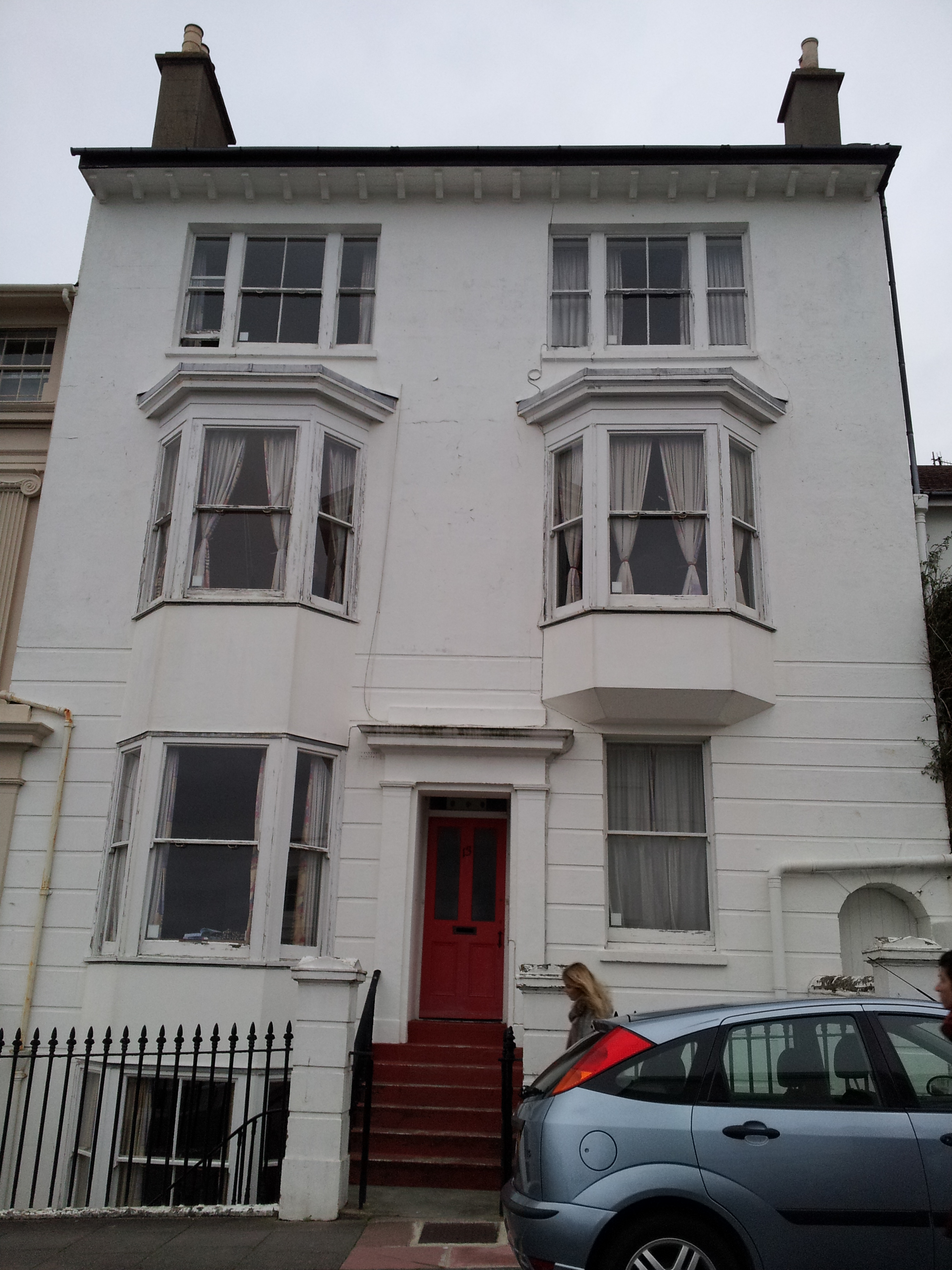
The next stop was Victoria Road, a short walk from the town centre. Number 13/14 used to be a boarding house called Sea View, run by local suffragette Minnie Turner. By 1913 Minnie’s guest house had a reputation for hosting suffragettes, and in April her windows were stoned by disgruntled locals. Minnie was arrested 3 times for her suffragette activities, and imprisoned in Holloway Prison for 3 weeks in 1911 for breaking a window at the Home Office. In July 1912 Emily Wilding Davison stayed at Sea View whilst recovering from being on hunger strike in prison. The tour finished outside Churchill Square, the city’s main shopping centre, where we had one final sing song.

Minnie Turner's House in Victoria Road, Brighton. The current resident's are aware of the their home's proud past (Photo: Hannah Awcock).
Minnie Turner’s House in Victoria Road, Brighton. The current residents are aware of the their home’s proud past (Photo: Hannah Awcock).

I have always thought that walking tours are a fantastic way of communicating and engaging with historical research, and this Brighton Suffragette walking tour is no exception. It is informed by 7 years of research- many hours spent trawling though local newspapers and the collections of the Brighton Museum. It is wonderful research, and it is so important that it is accessible to all, academic or otherwise. Walking tours are just one of the many ways to disseminate historical research, but they are a very good one.

I couldn't resist the opportunity to wear a suffragette sash (Photo: Tricia Awcock).
I couldn’t resist the opportunity to wear a suffragette sash (Photo: Tricia Awcock).

A campaign is being started to try and get some blue plaques put up around Brighton honouring the city’s suffragettes. To join the campaign or find out more, check out the Facebook group here.

Sources and Further Reading

Dyhouse, Carol. “Minnie Turner’s “Suffragette Boarding House,”” Clifton Montpelier Powis Community Alliance. Last updated ….accessed on 26/10/15. Available at http://www.cmpcaonline.org.uk/page_id__85_path__0p36p21p55p.aspx

Kisby, Anna. “Found! Suffragettes Hiding in the Brighton Dome.” Brighton Museums. Last updated 11th March 2011, accessed 26th October 2015. Available at http://brightonmuseums.org.uk/discover/2011/03/08/found-suffragettes-hiding-in-the-brighton-dome/

Simkin, John. “Minnie Turner.” Spartacus Educational. Last updated August 2014, accessed 26th October 2015. Available at: http://spartacus-educational.com/WturnerM.htm

Turbulent Londoners: Mary Astell, 1666-1731

Turbulent Londoners is a series of posts about radical individuals in London’s history who contributed to the city’s contentious past. My definition of ‘Londoner’ is quite loose, anyone who has played a role in protest in the city can be included. Any suggestions for future Turbulent Londoners posts are very welcome. Next up is Mary Astell, a philosopher and writer who is considered by many to be England’s first feminist.


The title page of Astell's first publication.
The title page of Astell’s first publication.

Mary Astell was a philosopher and writer from Newcastle whose ability to reason and argue made her a formidable force in intellectual circles in London in the late 17th and early 18th centuries. Her advocacy of women’s education and her opinions on marriage has led her to be seen by many as England’s first feminist.

Mary was born in Newcastle on the 12th of November 1666 to an upper middle class family; her father managed a local coal company. Mary’s father died when she was 12, leaving her family with very little income. She received some education from her uncle, who was affiliated with a group of radical philosophers in Cambridge, but she also taught herself by reading widely. After her mother died in 1684, Mary moved to Chelsea in London, where she became acquainted with an influential and wealthy circle of women who helped her to develop and publish her work.

Between 1694 and 1709, Mary published a number of texts on a range of subjects, but she is best known for her arguments relating to women. She used her extensive understanding of philosophical ideas to argue that women were just as rational as men, and therefore just as deserving of education. After withdrawing from public life in 1709, Mary set up a charity school for girls in Chelsea. She devised the curriculum, putting her ideas into practice. Mary Astell died of cancer on the 11th of May 1731, leaving behind a lasting legacy.

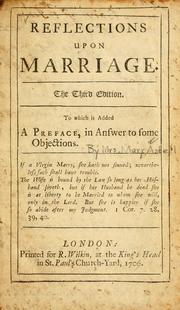
The title page of the third edition of Astell's 'Reflections Upon Marriage.'
The title page of the third edition of Astell’s ‘Reflections Upon Marriage.’

Mary’s first publication came out in 1694 and was entitled Serious Proposal to the Ladies for the Advancement of their True and Greatest Interest. In it, she proposes a female-only college, where women learn through reading and discussion, rather than a formal, hierarchical program of study. In Some Reflections Upon Marriage (1700), Mary continues advocating for women. She argues that an education would enable women to make better matrimonial choices, and be better prepared for married life. She warns women against making hasty choices when it came to marriage, and believed marriage should be based on friendship rather than necessity or fleeting attraction.

Mary’s ideas were groundbreaking for more than just their content. The way that she used philosophical ideas to support her arguments was unique, and she addressed women directly in her writing- talking to them, not about them. Her arguments disputed the Protestant belief, dominant at the time, that reason and emotion should be separate; for Mary, knowledge was intimately connected to happiness. Linked to this, one of the most frequent criticisms levelled against Mary’s ideas was that they were ‘too Catholic’; her plan for an all-female college sounded too much like a nunnery to be accepted by mainstream society. Mary’s ideas about women’s education caused substantial debate, and she was widely respected for her ability to debate freely and confidently with both men and women, but she did not receive widespread support.

“If all Men are born free, how is it that all Women are born slaves?”

Astell, Some Reflections Upon Marriage

The above quote is probably Mary Astell’s most famous, and it is easy to see why. This was a truly radical sentiment in the early eighteenth century. Not only did she express these radical ideas, Mary could support them with reasoned, rational, philosophical arguments. And she did all this at a time when there were few historical campaigners for women’s rights from which she could take inspiration and hope. As one of England’s first feminists she deserves to be remembered and celebrated, but she can also be for contemporary campaigners something she herself didn’t have- a role model.

Sources and Further Reading

Anon. ‘Astell, Mary.’ Encyclopaedia.com. Last modified 2005, accessed 28th July 2015.  http://www.encyclopedia.com/topic/Mary_Astell.aspx

Anon. ‘Mary Astell.’ Wikipedia. Last modified 19th May 2015, accessed 28th July 2015.  https://en.wikipedia.org/wiki/Mary_Astell

Manzanedo, Julia Cabaleiro. ‘The Love of Knowledge: Mary Astell.’ Women’s Research Centre, University of Barcelona. Last modified 2004, accessed 28th July 2015.  http://www.ub.edu/duoda/diferencia/html/en/secundario2.html

Sowaal, Alice. ‘Mary Astell.’ Stanford Encyclopaedia of Philosophy. Last modified 12th August 2008, accessed 28th July 2015. http://plato.stanford.edu/entries/astell/

Contesting the Capital: Exploring London’s History of Protest at the International Conference of Historical Geographers

The International Conference of Historical Geography 2015 took place at the RGS-IBG in Kensington, London.
The International Conference of Historical Geography 2015 took place at the RGS-IBG in Kensington, London (Photo: Hannah Awcock).

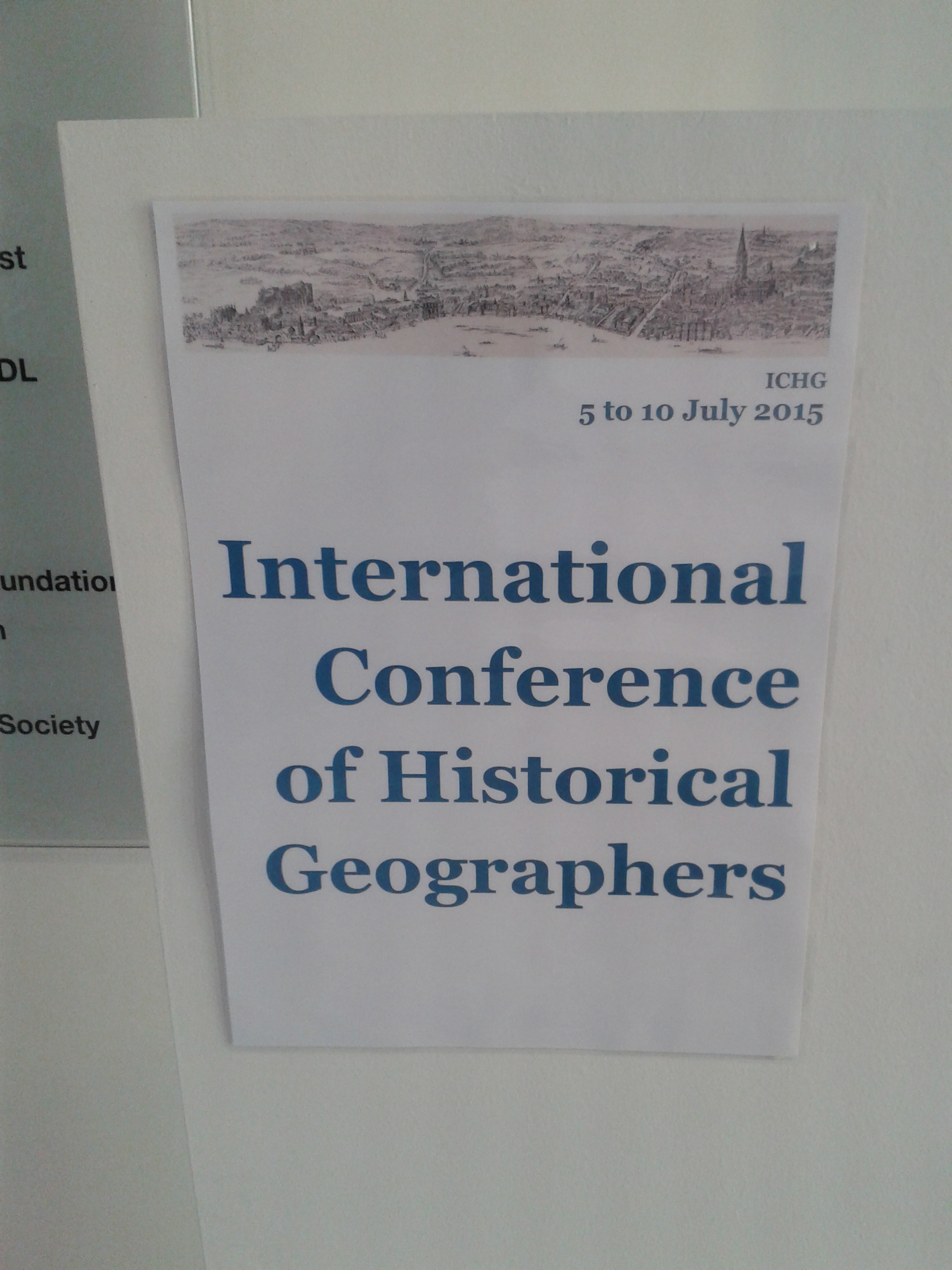
Between the 5th and 10th of July, the International Conference of Historical Geographers (ICHG) took place at the Royal Geographical Society with the Institute of British Geographers in South Kensington, London. The conference takes place every 3 years in a different city; in 2012 it was in Prague, in 2018 it will be in Warsaw. This year the conference was 40 years old, and over 700 delegates, 60% of which came from beyond Britain, gathered to talk all things historical geography.

Along with Diarmaid Kelliher, a PhD student at the University of Glasgow, I convened a session called Contesting the Capital: Historical Geographies of Protest in London, exploring the relationship between protest and London. As regular readers of this blog are probably aware, London has a long and vibrant history of protest. This is often attributed to Londoners themselves; “Londoners have for many centuries been considered far too ‘bolshie’ to do what they are ordered for long” (Bloom, 2010; p.xxxviii). Whether this is the reason or not, London is a particularly contentious city. For example, on the 30th of May this year (2015), there was a demonstration in Trafalgar Square to support striking workers at the National Gallery; a protest outside the offices of the Daily Mail about the paper’s treatment of Pilipino nurses; and a march organised by UKUncut in Westminster, in which a huge anti-austerity banner was hung from Westminster Bridge. Three major protests, all in one day. London’s rebellious streak makes it fantastic to study, and Contesting the Capital aimed to celebrate and explore this rich history.

Contesting the Capital included 4 papers; by myself, Gavin Brown, Claire Nally and Diarmaid Kelliher. My paper was about the characteristics of urban areas in general, and London specifically, that encourages protest. Gavin Brown discussed the geographies of the 24-hour picket outside the South African embassy between 1986 and 1990. Claire Nally talked about the Crossbones graveyard in Southwark, the ways it has been represented and ways it fits into networks of memorialisation and feminism. Finally, Diarmaid Kelliher presented a paper about solidarity and London support groups for the 1984-5 miner’s strike.

Claire Nally presenting about the Crossbones Graveyard in Southwark (apologies for the poor-quality camera phone!)
Claire Nally presenting about the Crossbones Graveyard in Southwark (apologies for the poor-quality camera phone!) (Photo: Hannah Awcock).

For me, the session highlighted some of the key issues involved in studying protest in London, one of which is networks. Walter Nicholls (2009) has demonstrated that networks are a useful tool for thinking about the processes and activities of social movements. Fran Tonkiss (2005) has argued that cities tend to have good information and mobilisation networks, which allow the easy circulation of ideas and people. She also points out that cities bring together extensive social networks that can support protest. Contesting the Capital demonstrated how some of these theories work in practice, placing London in national and international networks of solidarity, communication, and support.  For example, during the 1984-5 miner’s strike multiple support groups were active in London offering financial, physical and emotional support to the strikers in far flung places like Wales and Yorkshire. The Non-stop picket outside the South African embassy in the 1980s was part of an international anti-apartheid movement that aimed to put pressure on the South African government. Neither of these issues are obviously related to the lives and concerns of Londoners, but nevertheless people felt strongly enough to take action.

Protests in London highlight the city's place in local, nation, and international networks (Source: City of London Anti-Apartheid Group).
Protests in London highlight the city’s place in local, nation, and international networks (Source: City of London Anti-Apartheid Group).

Another key issue which Contesting the Capital highlighted for me is that London is constantly changing. As Roy Porter (2000; p.7) says “change is the essence” of cities. Economically, politically, socially, culturally, demographically, physically; London hasn’t sat still since it was founded two thousand years ago. For example, the Crossbones graveyard in Southwark was rediscovered during the construction of the Jubilee Line; London’s future helped to uncover its forgotten past. In terms of protest, solidarity has to be carefully constructed and maintained. The strong networks of solidarity that were evident during the miner’s strike have arguably been lost; the fierce criticism of workers whenever there is a tube strike is evidence of this. Along with the city’s sheer size, these constant processes of change make it very difficult to make any meaningful generalisations about London as a whole.

Contesting the Capital aimed to explore the relationship between London and the historical geographies of protest, and it was pretty successful, if I do say so myself. The history of protest in London is an almost inexhaustible resource for studying dissent, alternative politics and the urban, and there is lots more work to be done, although I think it’s fair to say we’re making a good start.

Sources and Further Reading

Bloom, Clive. Violent London: 2000 Years of Riots, Rebels and Revolts. Basingstoke: Palgrave Macmillan, 2010.

Nicholls, Walter. “Place, Networks, Space: Theorising the Geographies of Social Movements.” Transactions of the Institute of British Geographers 33 (2009); 78–93.

Porter, Roy. London: A Social History. London, Penguin, 2000.

Tonkiss, Fran. Space, the City, and Social Theory. Cambridge: Polity, 2005.

Book Review: Fight the Power! A Visual History of Protest Among the English Speaking Peoples

'Fight the Power!' by Wilson et al.
‘Fight the Power!’ by Wilson et al.

Wilson, Seán Michael, Benjamin Dickson, Hunt Emerson, John Spelling and Adam Pasion. Fight the Power! A Visual History of Protest Among the English-Speaking Peoples. Oxford: New Internationalist, 2013.

The title of Fight the Power! A Visual History of Protest among the English-Speaking Peoples may be a little long winded, but it does sum up the book well. Through the medium of comic strips, the book tells the story of some of the key moments in the history of protest in the English-speaking world (well, from the last 2 centuries anyway). The protests discussed are wide ranging in terms of topic and geography, taking in race, class, labour and governance issues, as well as such diverse countries as Ireland, Australia, America, and the former British Empire.

The format of the book makes it incredibly approachable and engaging, ideal for young people (although some of the images are a little graphic) or those with little previous knowledge of protest. The examples lack detail and can be one-sided, but neither of these are inherently bad things. The book is a fantastic introduction to many protests, and it does not claim to be an unbiased account.

Despite the diversity of the examples, several themes recur throughout the book. One is police brutality. The actions taken by those in authority attempting to suppress protest have frequently proved provocative, causing demonstrations to escalate into violent clashes. The Battle of Peterloo (1819) and the Battle of Toledo (1934), amongst others, are good examples of this. Violence, or the lack of it, is another theme that recurs throughout the book. Whether or not to use violence is one of the most fundamental decisions a protest movement makes, which can drastically influence the outcome of a campaign. There is no ‘right’ answer; apart from the moral debate, both violent and non-violent movements have proved successful in the past.

The lasting impression which the book leaves is one of hope. Particularly in the past few years, it can be very easy to believe that protest does not achieve anything, that  it is all too easy for those in authority to repress or ignore demonstrations and social movements. But what the examples in Fight the Power prove is that protest can force change. The Suffragettes, Rosa Parks, and the various independence movements of the British empire demonstrate that change may take time, decades even, and it may not be exactly the progress that you imagined, but it can be achieved.

Another key message of the book, which is particularly relevant to my PhD, is that past protests can provide both practical suggestions and inspiration to contemporary protest movements. As Tariq Ali writes in the Introduction, “History rarely repeats itself, but its echoes never go away” (p5). An image on the back cover of the book shows an Occupy protester holding a “We are the 99%” placard, backed by a Suffragette, Rosa Parks, Nelson Mandela, and others mentioned in the book. It is a powerful image of historical solidarity.

This book was given to me as a Christmas present (I got a lot of books this year, so brace yourself for a lot of reviews over the next few months!), and it certainly fulfills that role perfectly. It is a nice introduction to some of the most famous protests in the history of the English-speaking world, but I would recommend it even if you are already familiar with most of them as a refreshing approach to the history of protest.