Contesting the Capital: Exploring London’s History of Protest at the International Conference of Historical Geographers

The International Conference of Historical Geography 2015 took place at the RGS-IBG in Kensington, London.
The International Conference of Historical Geography 2015 took place at the RGS-IBG in Kensington, London (Photo: Hannah Awcock).

Between the 5th and 10th of July, the International Conference of Historical Geographers (ICHG) took place at the Royal Geographical Society with the Institute of British Geographers in South Kensington, London. The conference takes place every 3 years in a different city; in 2012 it was in Prague, in 2018 it will be in Warsaw. This year the conference was 40 years old, and over 700 delegates, 60% of which came from beyond Britain, gathered to talk all things historical geography.

Along with Diarmaid Kelliher, a PhD student at the University of Glasgow, I convened a session called Contesting the Capital: Historical Geographies of Protest in London, exploring the relationship between protest and London. As regular readers of this blog are probably aware, London has a long and vibrant history of protest. This is often attributed to Londoners themselves; “Londoners have for many centuries been considered far too ‘bolshie’ to do what they are ordered for long” (Bloom, 2010; p.xxxviii). Whether this is the reason or not, London is a particularly contentious city. For example, on the 30th of May this year (2015), there was a demonstration in Trafalgar Square to support striking workers at the National Gallery; a protest outside the offices of the Daily Mail about the paper’s treatment of Pilipino nurses; and a march organised by UKUncut in Westminster, in which a huge anti-austerity banner was hung from Westminster Bridge. Three major protests, all in one day. London’s rebellious streak makes it fantastic to study, and Contesting the Capital aimed to celebrate and explore this rich history.

Contesting the Capital included 4 papers; by myself, Gavin Brown, Claire Nally and Diarmaid Kelliher. My paper was about the characteristics of urban areas in general, and London specifically, that encourages protest. Gavin Brown discussed the geographies of the 24-hour picket outside the South African embassy between 1986 and 1990. Claire Nally talked about the Crossbones graveyard in Southwark, the ways it has been represented and ways it fits into networks of memorialisation and feminism. Finally, Diarmaid Kelliher presented a paper about solidarity and London support groups for the 1984-5 miner’s strike.

Claire Nally presenting about the Crossbones Graveyard in Southwark (apologies for the poor-quality camera phone!)
Claire Nally presenting about the Crossbones Graveyard in Southwark (apologies for the poor-quality camera phone!) (Photo: Hannah Awcock).

For me, the session highlighted some of the key issues involved in studying protest in London, one of which is networks. Walter Nicholls (2009) has demonstrated that networks are a useful tool for thinking about the processes and activities of social movements. Fran Tonkiss (2005) has argued that cities tend to have good information and mobilisation networks, which allow the easy circulation of ideas and people. She also points out that cities bring together extensive social networks that can support protest. Contesting the Capital demonstrated how some of these theories work in practice, placing London in national and international networks of solidarity, communication, and support.  For example, during the 1984-5 miner’s strike multiple support groups were active in London offering financial, physical and emotional support to the strikers in far flung places like Wales and Yorkshire. The Non-stop picket outside the South African embassy in the 1980s was part of an international anti-apartheid movement that aimed to put pressure on the South African government. Neither of these issues are obviously related to the lives and concerns of Londoners, but nevertheless people felt strongly enough to take action.

Protests in London highlight the city's place in local, nation, and international networks (Source: City of London Anti-Apartheid Group).
Protests in London highlight the city’s place in local, nation, and international networks (Source: City of London Anti-Apartheid Group).

Another key issue which Contesting the Capital highlighted for me is that London is constantly changing. As Roy Porter (2000; p.7) says “change is the essence” of cities. Economically, politically, socially, culturally, demographically, physically; London hasn’t sat still since it was founded two thousand years ago. For example, the Crossbones graveyard in Southwark was rediscovered during the construction of the Jubilee Line; London’s future helped to uncover its forgotten past. In terms of protest, solidarity has to be carefully constructed and maintained. The strong networks of solidarity that were evident during the miner’s strike have arguably been lost; the fierce criticism of workers whenever there is a tube strike is evidence of this. Along with the city’s sheer size, these constant processes of change make it very difficult to make any meaningful generalisations about London as a whole.

Contesting the Capital aimed to explore the relationship between London and the historical geographies of protest, and it was pretty successful, if I do say so myself. The history of protest in London is an almost inexhaustible resource for studying dissent, alternative politics and the urban, and there is lots more work to be done, although I think it’s fair to say we’re making a good start.

Sources and Further Reading

Bloom, Clive. Violent London: 2000 Years of Riots, Rebels and Revolts. Basingstoke: Palgrave Macmillan, 2010.

Nicholls, Walter. “Place, Networks, Space: Theorising the Geographies of Social Movements.” Transactions of the Institute of British Geographers 33 (2009); 78–93.

Porter, Roy. London: A Social History. London, Penguin, 2000.

Tonkiss, Fran. Space, the City, and Social Theory. Cambridge: Polity, 2005.
On This Day: The Hyde Park Railings Affair, 23rd July 1866

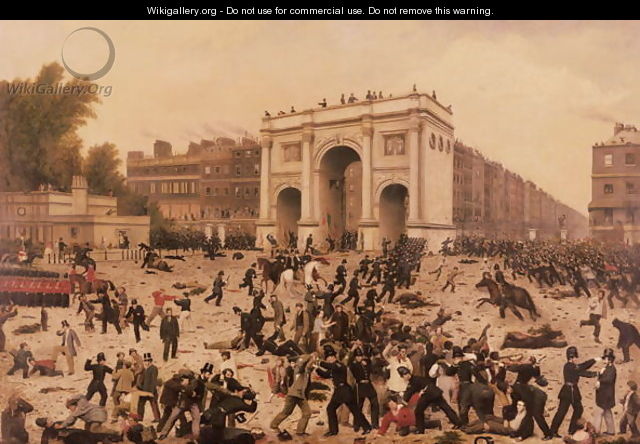
The Hyde Park Railings Affair is a little-known protest that took place 149 years ago today in Hyde Park. When the Home Secretary banned a rally organised by the Reform League from taking place in Hyde Park, the League decided to question the legality of the ban by marching to Hyde Park anyway. Demonstrators managed to break into the park, which led to scuffles with police and several days of rioting. The protest questioned the nature and control of public space in London, and contributed to Hyde Park’s radical legacy.

‘Manhood Suffrage Riots in Hyde Park; by artist Nathan Turner (Source: Wikigallery).

The Reform League was an organisation formed in 1865 to campaign for universal manhood suffrage in Britain. They had their origins in the Chartist movement, but they were not as radical. After the failure of the 1866 Reform Bill, controversy over which brought down the government in June, the Reform League decided to step up their campaigning by organising mass meetings. Meetings on the 29th of June and 2nd of July in Trafalgar Square were relatively peaceful, but the League’s next meeting was destined to be more controversial.

The Conservative Home Secretary, Spencer Walpole, banned the planned meeting in Hyde Park. Edmond Beales, the president of the Reform League, argued that the Home Secretary had no right to ban the demonstration, as the park either belonged to the people or the monarchy. Spencer Walpole was neither, therefore he had to right to dictate what was allowed to happen in the park. The protest became about more than electoral reform; it was now also about who had the right to use, control, and police public space. The Reform League decided to challenge the legality of the ban by marching to Hyde Park anyway.

On the afternoon of the 23rd of July, the League and their supporters set out from their headquarters in Adelphi Place towards Hyde Park. When they got to Marble Arch, they found the gates locked and guarded by the police. Edmond Beales requested to be allowed entry, but he was not prepared to start a violent confrontation, so he withdrew when he was refused permission to enter. Beales and the Executive Committee of the Reform League led the march to Trafalgar Square, where they had a peaceful meeting.

Not everyone followed Beales and the Reform League however. A group of protesters stayed behind, and soon discovered that if the railings surrounding Hyde Park were rocked back and forth, they could be pulled from their foundations and toppled over. This happened at several locations around the park, leading to clashes with police as demonstrators poured into Hyde Park. There were injuries on both sides, but no deaths, and 40-70 people were arrested. The Police used Marble Arch as a temporary holding cell.

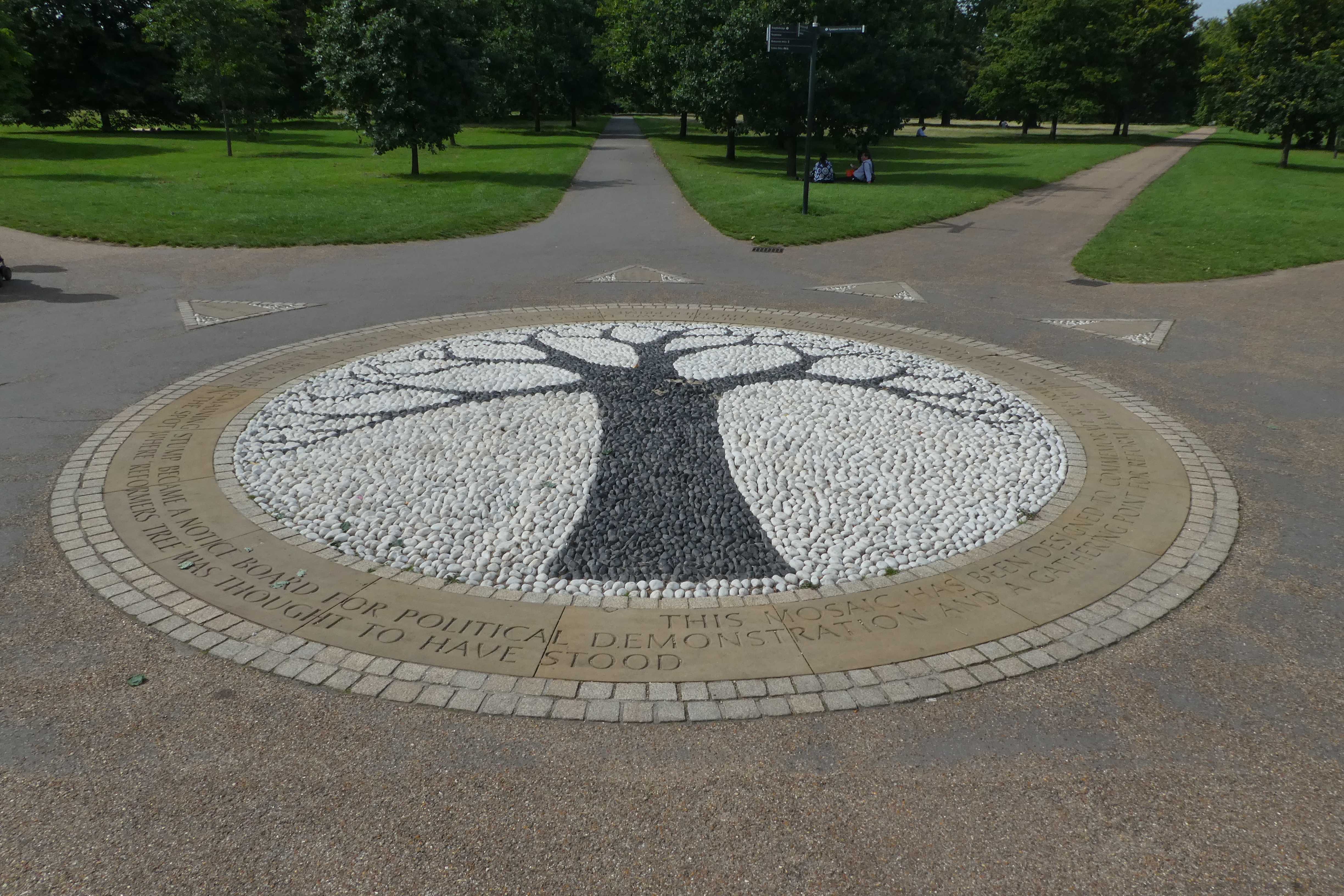
Rioting continued in the park for several days, which resulted in a lot of damage to the park. The stump of one oak tree which the protesters burnt down became known as the Reformers’ Tree. It became a focus point for radical activity in the park, and is commemorated by a mosaic. In 1872 the right of assembly and free speech was officially recognised in the northeastern corner of Hyde Park by the Royal Parks and Gardens Act. Speaker’s Corner is now a world famous site of public speech and debate.

The memorial to the Reformer’s Tree, near the site where the tree was thought to be located (Source: Duncan Cummings).

The Hyde Park Railings Affair is one of several protests in London that escalated because of government attempts to suppress protest, and Londoner’s determination to assert their rights; Bloody Sunday is another. Access to public space and the right to assembly is something many of us take for granted, but it is not a given. It has been fought for by generations of Londoners, and still needs to be defended.

Sources and Further Reading

Anon., “History and Architecture,” Royal Parks. No date, accessed 28th September 2014 https://www.royalparks.org.uk/parks/hyde-park/about-hyde-park/history-and-architecture.

Tames, Richard. Political London: A Capital History. London: Historical, 2007.

London’s Protest Stickers: Housing

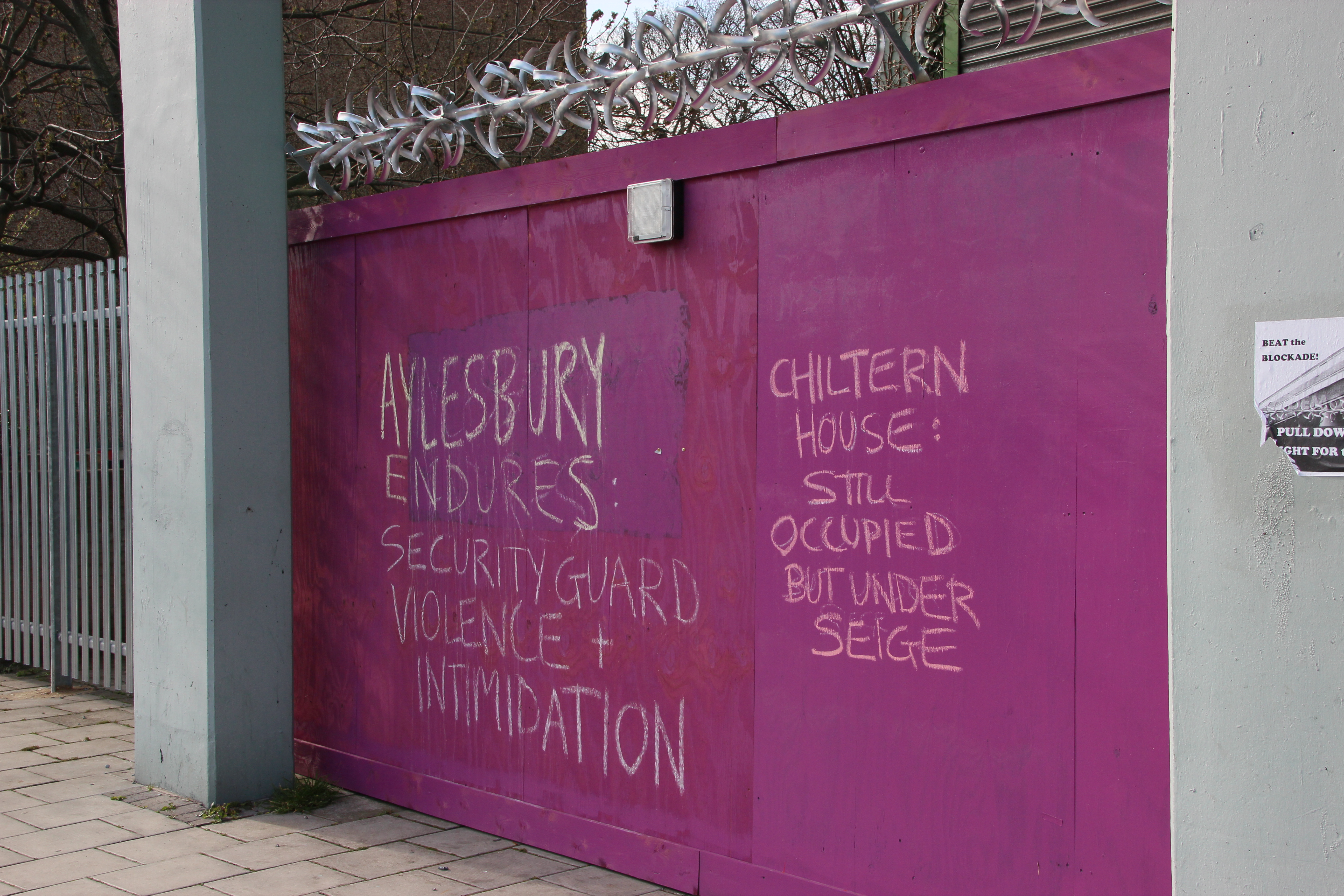
The fencing around Chiltern House on the Aylesbury Estate, which was occupied after the March for Homes on 31/01/15.
The fencing around Chiltern House on the Aylesbury Estate, which was occupied after the March for Homes on 31/01/15 (Photo: Hannah Awcock).

Recently, housing has become one of the most contentious issues in London. The city is growing faster than its housing stock, which is putting real pressure on Londoners. Many, particularly those with low incomes, are struggling with high prices, soaring rents and a chronic shortage of council housing. A numbers of campaign groups, such as FocusE15 and Housing Action Southwark and Lambeth, have started to combat the problem by raising awareness, protesting and intervening in evictions.The recent March for Homes is just one of the examples of the actions taking place. This focus is reflected in London’s protest stickers, and housing is one of the most common specific issues that stickers refer to. Most of the following pictures come from the area around the Aylesbury estate, an section of which was occupied after the March for Homes in protest of the estate gradually being sold off by Southwark Council for private redevelopment.

This sticker refers directly to the occupation at Aylesbury, and was photographed on 13/04/15 at Elephant and Castle.
This sticker refers directly to the occupation at Aylesbury, and was photographed on 13/04/15 at Elephant and Castle (Photo: Hannah Awcock).
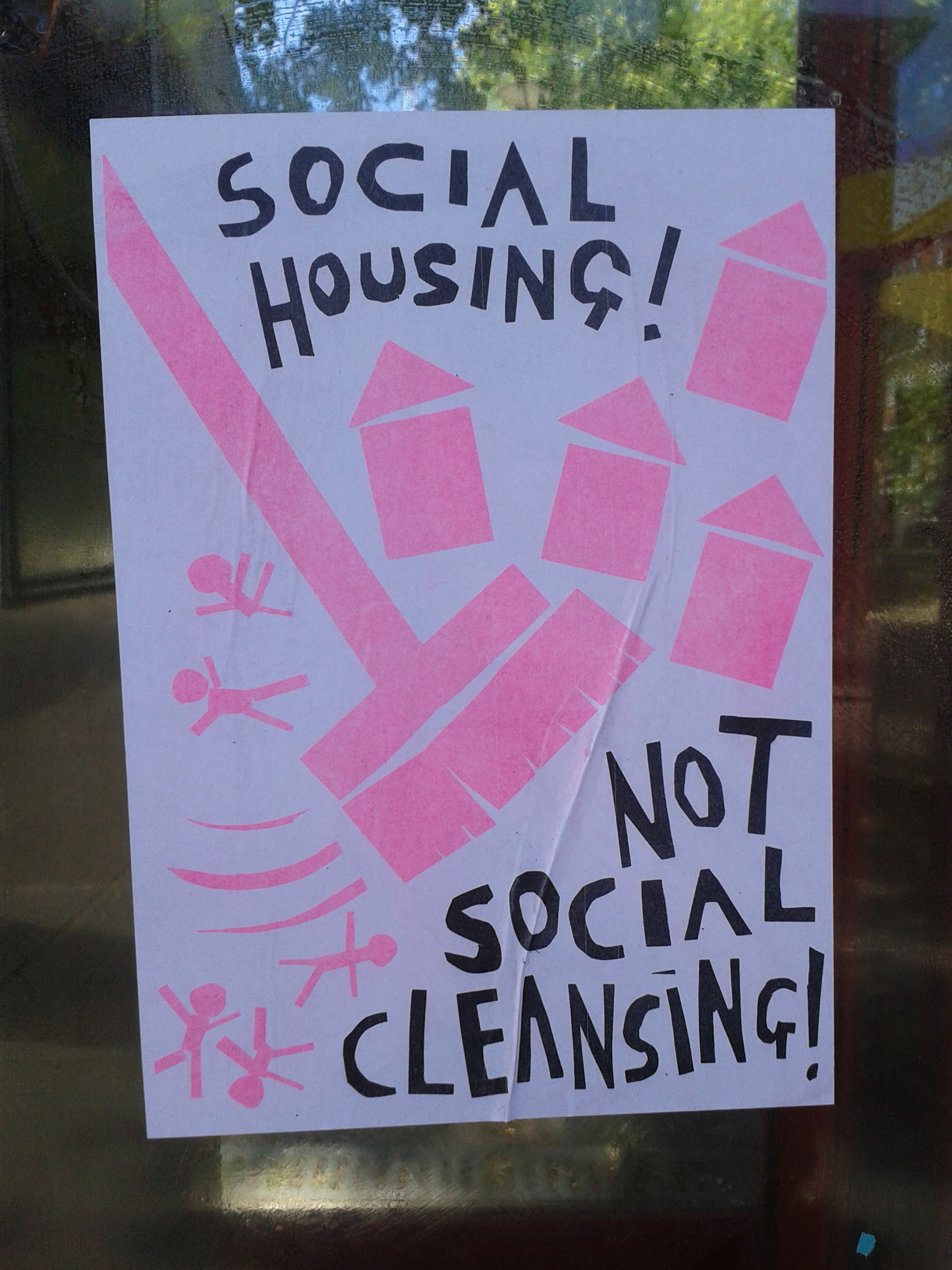
Many of London's poorest inhabitants are being pushed out by rising prices and redevelopments, leading to accusations of social cleansing (Aylesbury Estate, 02/04/15).
Many of London’s poorest inhabitants are being pushed out by rising prices and redevelopments, leading to accusations of social cleansing (Photo: Hannah Awcock, Aylesbury Estate, 02/04/15).
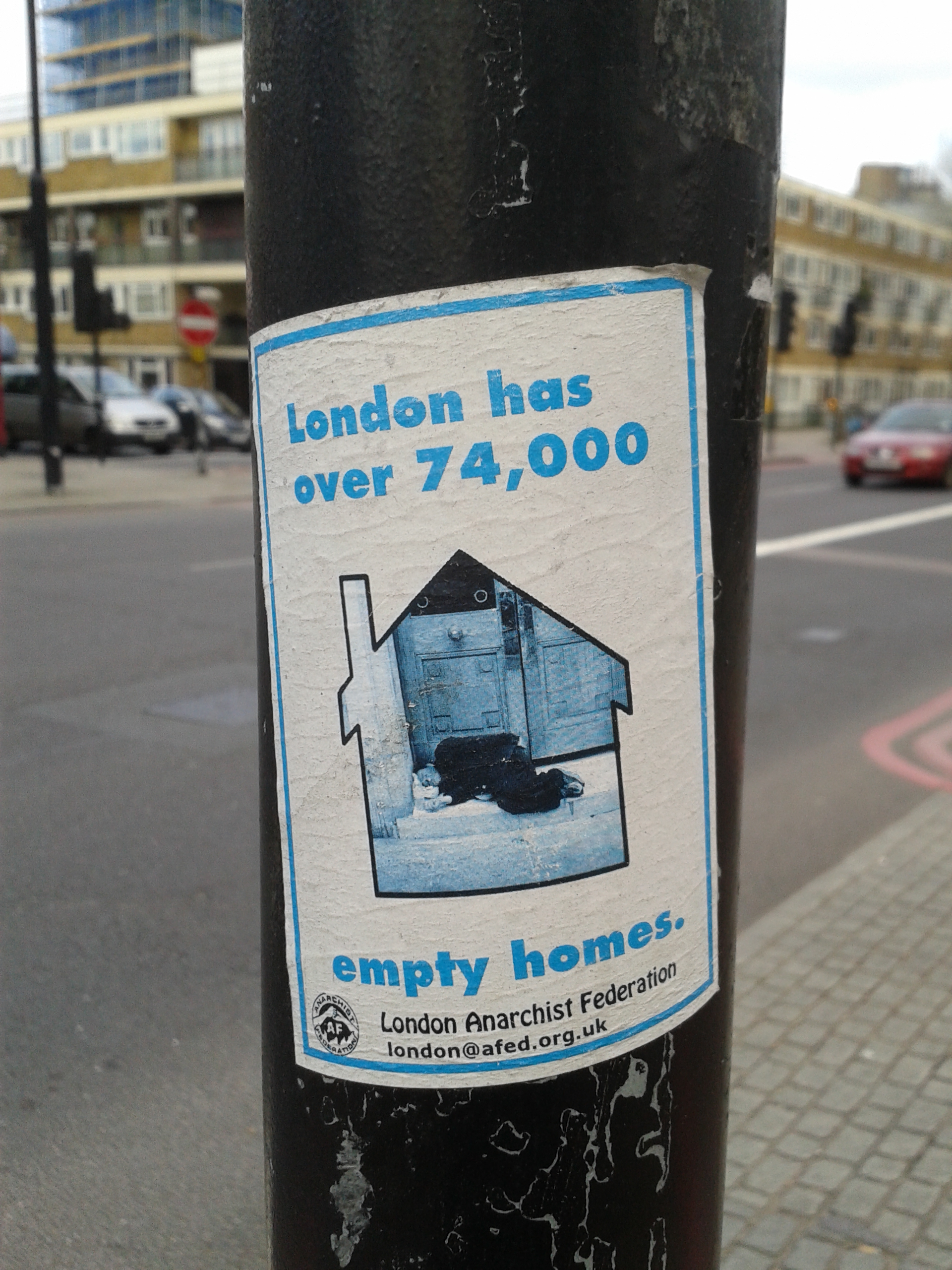
Many homes are bought by investors, kept empty and then sold off for profit a year or two later once the price has risen (08/03/15, Elephant and Castle).
Many homes are bought by investors, kept empty and then sold off for profit a year or two later once the price has risen (Photo: Hannah Awcock, Elephant and Castle, 08/03/15).
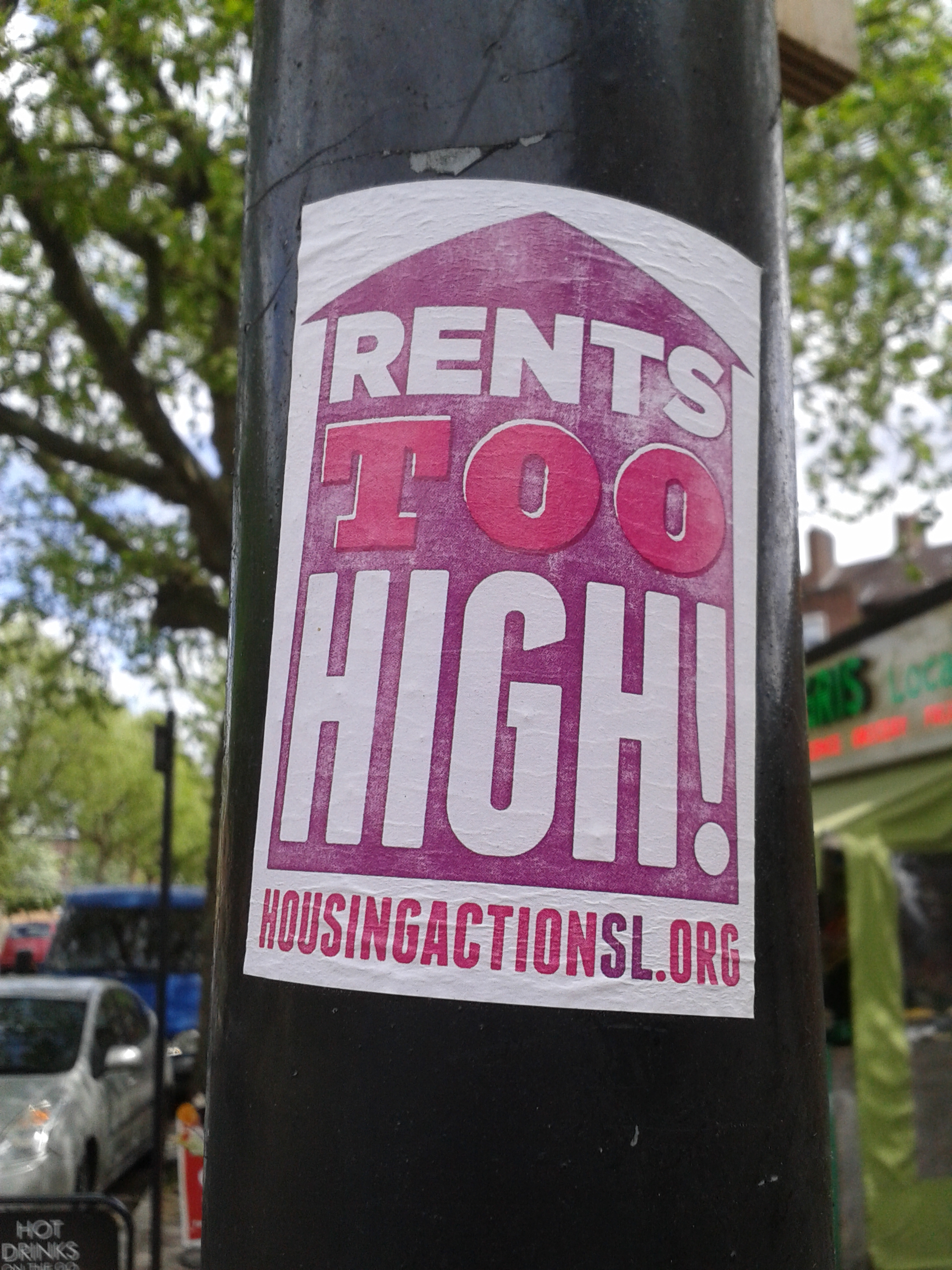
This sticker was produced by Housing Action Southwark and Lambeth, along with several others featured in this post (Flint Street, SE1, 05/05/15).
This sticker was produced by Housing Action Southwark and Lambeth, along with several others featured in this post (Photo: Hannah Awcock, Flint Street, SE1, 05/05/15).
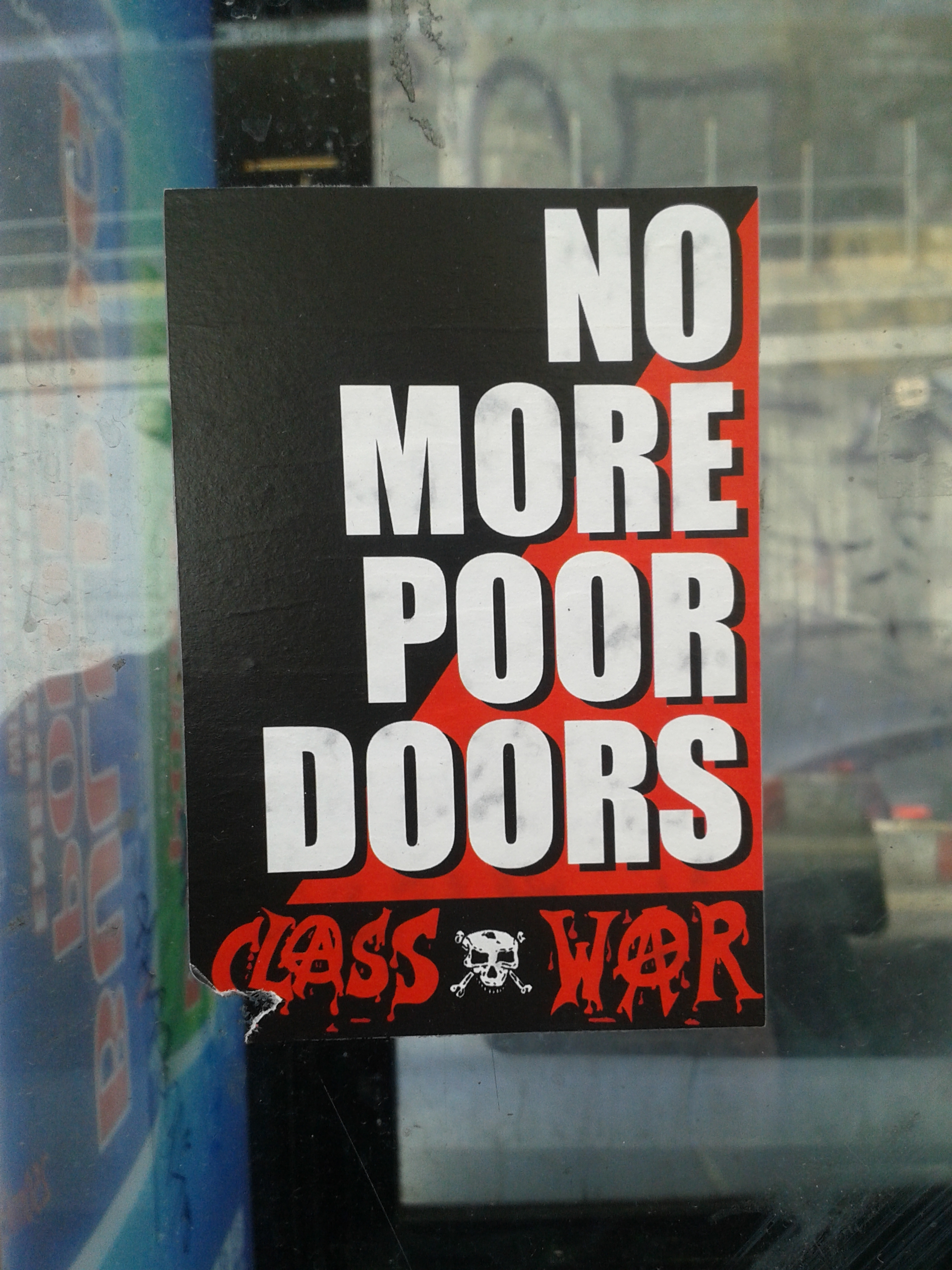
Over the past few months, it has come to light that some property developers build separate entrances for the social housing in their developments.  This sticker is calling for an end to these 'poor doors'.
Over the past few months, it has come to light that some property developers build separate entrances for the social housing in their developments. This sticker is calling for an end to these ‘poor doors’ (Photo: Hannah Awcock, Elephant and Castle, 03/03/15).
Some of the detail on this sticker is hard to make out because of the weathering, but I think it is calling for the Bedroom Tax to be replaced with a 50% Mansion Tax (Cable Street, 25/02/15).
Some of the detail on this sticker is hard to make out because of the weathering, but I think it is calling for the Bedroom Tax to be replaced with a 50% Mansion Tax (Photo: Hannah Awcock, Cable Street, 25/02/15).
This sticker was obviously made by the same people as the previous one,  but it is slightly different. Also, 'Vote for Class War' has been changed to 'Fight for Class War' (Borough High Street, 18/02/15).
This sticker was obviously made by the same people as the previous one, but it is slightly different. Also, ‘Vote for Class War’ has been changed to ‘Fight for Class War’ (Photo: Hannah Awcock, Borough High Street, 18/02/15).
This design was produced by Housing Action Southwark and Lambeth. The picture was taken in East Street, which has recently got attention because of resistance to raids by the UK Border Agency (East Street, Southwark, 04/06/15).
This design was produced by Housing Action Southwark and Lambeth. The picture was taken in East Street, which has recently got attention because of resistance to raids by the UK Border Agency (Photo: Hannah Awcock, East Street, Southwark, 04/06/15).
This design was also produced by HASL, and also refers to social cleansing (East Street, 04/06/15).
This design was also produced by HASL, and also refers to social cleansing (Photo: Hannah Awcock, East Street, 04/06/15).

Turbulent Londoners: William Cuffay, 1788-1870

Turbulent Londoners is a series of posts about radical individuals in London’s history who contributed to the city’s contentious past. My definition of ‘Londoner’ is quite loose, anyone who has played a role in protest in the city can be included. Any suggestions for future Turbulent Londoners posts are very welcome. The next Turbulent Londoner is William Cuffay, a prominent Chartist leader and activist, despite significant disadvantages.


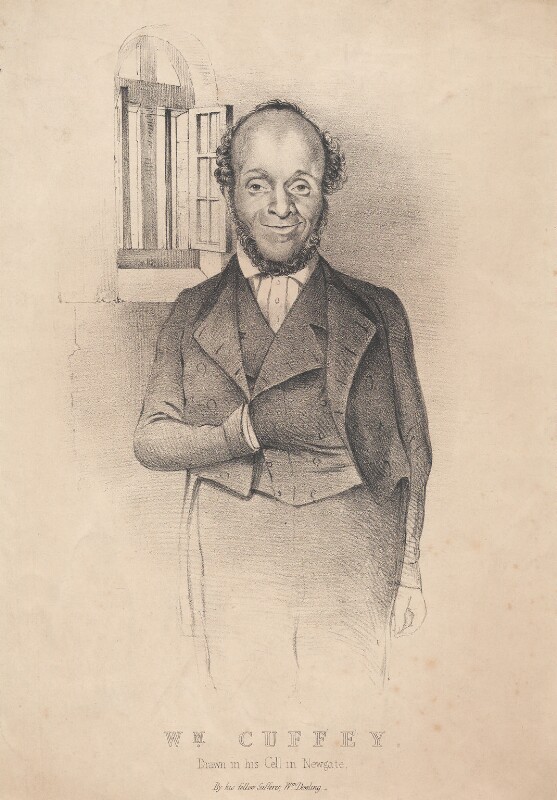
William Cuffay
after William Paul Dowling
lithograph, 1848
NPG D13148
© National Portrait Gallery, London

William Cuffay was the son of an ex-slave from St. Kitts and a woman from Kent. Born in 1788 in Medway Towns (now Gillingham), he trained as a tailor and moved to London in about 1819. He married 3 times, and had 1 daughter. Despite being mixed race, less than 5 feet tall and disabled (he had a deformed spine and shinbones), Cuffay became a well-known, daring, respected and committed activist and Chartist leader, to the extent that The Times described the London Chartists as “the black man and his party.”

Cuffay came to activism relatively late in life. In 1834, when he was 36, he was fired and blacklisted after taking part in a tailors’ strike for shorter hours and better pay. This experience convinced him that workers needed representation in Parliament, so got involved in the Chartist movement.

He rose quickly through the ranks of local and national Chartism. He helped form the Metropolitan Tailors’ Charter Association in 1839, was elected to the Chartist Metropolitan Delegate Council in 1841, and the following year he was elected President of the London Chartists, and to the Chartist national executive.

Cuffay was a Physical Force Chartist. They advocated the use of violence for their cause, whilst the Moral Force Chartists believed they could achieve their goals with only the weight of their arguments. Cuffay helped to organise the fateful Chartist demonstration on Kennington Common on the 10th of April 1848, and was dismayed by what he saw as the cowardly behaviour of his fellow Chartist leaders. The Kennington demonstration was supposed to be the crowning glory of the Chartist movement, but instead the leaders decided to back down because of the huge numbers of police.

Now utterly convinced that peaceful protest would not get the People’s Charter into law, Cuffay became involved in plans for a violent uprising. He was betrayed by a government spy and convicted of preparing acts of arson- the fires were to meant to signal the start of the rebellion. The affair became known as The Orange Tree Plot, after the pub in Red Lion Square where the leaders of the uprising would meet to plan.

Cuffay was convicted and sentenced to 21 years penal transportation. He arrived in Tasmania in November 1849, after what must have been a truly awful sea journey for a 61-year-old with Cuffay’s health problems. He was pardoned after 3 years, but chose to stay in Tasmania. His wife saved enough money to join him in 1853, and he carried on pretty much as he left off in London, working as a tailor and playing a prominent role in local radical politics. He sadly died in poverty in July 1870, aged 82.

William Cuffay was a man who would not be defined by his colour or physical attributes. Despite being only 4 ft 11, he was known as a charismatic and engaging public speaker, and he quickly became one of the best-known Chartist leaders. He was admired by his fellow Chartists, and fought with conviction for what he believed was right. As far as I know, there are no memorials for Cuffay, in London or Tasmania, but I think he was a man we could all learn a few lessons from.

Sources and Further Reading

Anon. ‘Chartism,’ Wikipedia. Last modified 24 April, 2015, accessed 10 May 2015. http://en.wikipedia.org/wiki/Chartism

Anon. ‘Chartists,’ National Archives. No date, accessed 10 May 2015.http://www.nationalarchives.gov.uk/pathways/blackhistory/rights/chartists.htm 

Anon. ‘William Cuffay,’ Wikipedia. Last modified 1 May 2015, accessed 10 May 2015.  http://en.wikipedia.org/wiki/William_Cuffay

Anon. ‘William Cuffay (1788-1870),’ BBC History. No date, accessed 10 May 2015. http://www.bbc.co.uk/history/historic_figures/cuffay_william.shtml

Gregory, Mark. ‘ Cuffay’s book circumnavigates the World: 1849-2013,’ William Cuffay, 1788-1870. No date, accessed 10 May 2015. http://cuffay.blogspot.co.uk/

Rosenberg, David. Rebel Footprints: A Guide to Uncovering London’s Radical History. London: Pluto Press, 2014.

Simkin, John. ‘William Cuffay,’ Spartacus Educational. Last modified April 2014, accessed 10 May 2015. http://spartacus-educational.com/CHcuffay.htm 

End Austerity Now Demo

On Saturday the 20th of June, the People’s Assembly organised a massive national demonstration in London opposing the Conservative government’s policy of austerity, called End Austerity Now. The People’s Assembly is a coalition of anti-austerity campaigns and groups, so there was a wide variety of places and interests represented on the demonstration. Thousands of people turned up protest against the cuts, and I was one of them.

The marched started outside of the Bank of England, a symbolic location. The route went through the city, along Fleet Street and the Strand to Parliament Square, where a rally was held.
The marched started outside of the Bank of England, a symbolic location. The route went through the city, along Fleet Street and the Strand to Parliament Square, where a rally was held (Photo: Hannah Awcock).
The words on this banner is a stanza from the poem 'The Masque of Anarchy' written by the poet Percy Shelley after the Peterloo massacre in 1819.
The words on this banner is a stanza from the poem ‘The Masque of Anarchy’ written by the poet Percy Shelley after the Peterloo massacre in 1819 (Photo: Hannah Awcock).
The People's Republic of Brighton and Hove was 'founded' after the general election, when the city's two constituencies were the only two not to elect a Conservative MP in the south-east.
The People’s Republic of Brighton and Hove was ‘founded’ after the general election, when two of the city’s constituencies were the only two not to elect a Conservative MP in the south-east. The Republic already has a flag and a passport, and a policy of deporting all Conservatives (Photo: Hannah Awcock).
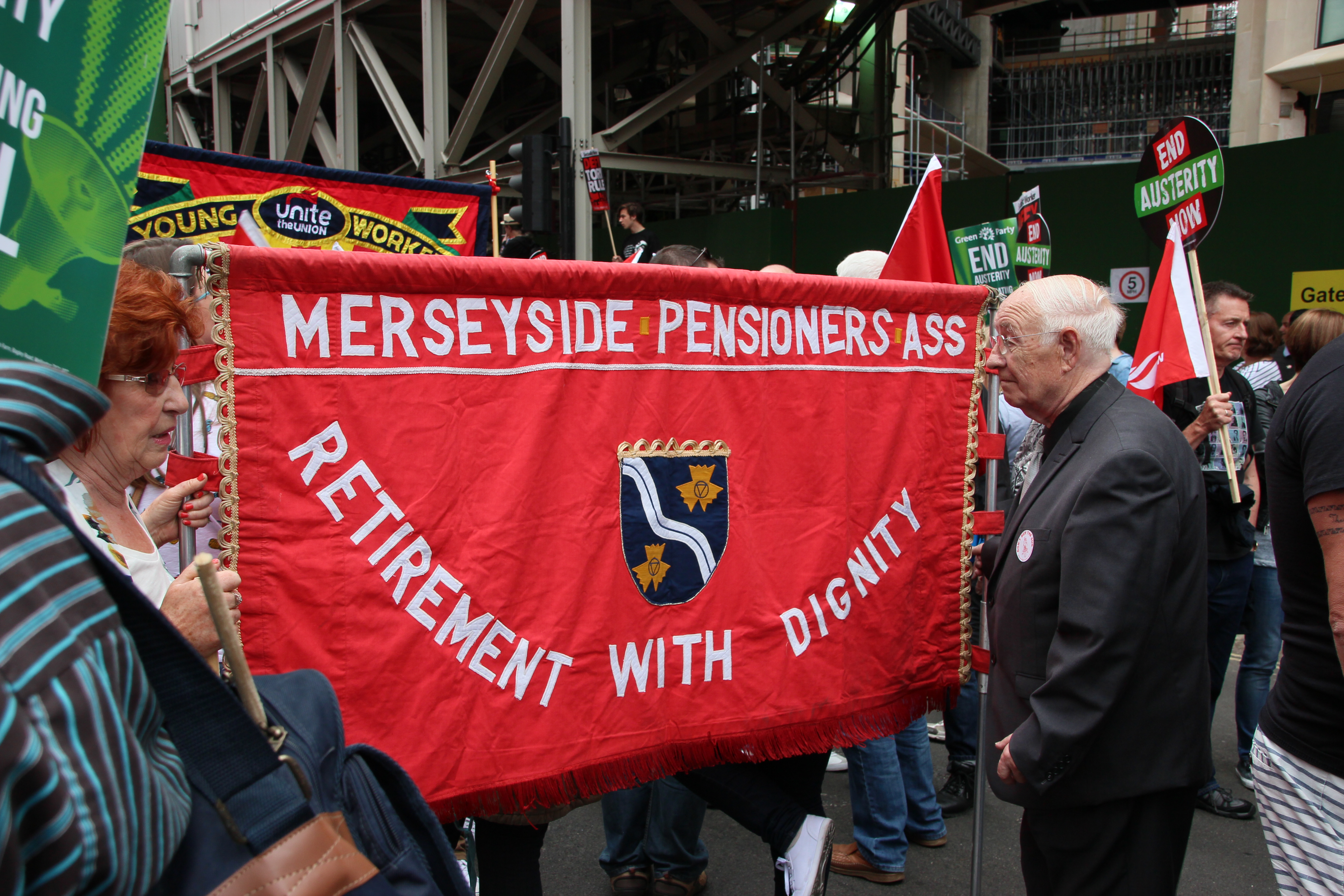
People of all ages attended the End Austerity Now demonstration, and I saw several pensioner's organisations represented.
People of all ages attended the End Austerity Now demonstration, and I saw several pensioner’s organisations represented (Photo: Hannah Awcock).
Unite's big floating balls were a very visible presence.
Unite’s big floating balls were a very visible presence (Photo: Hannah Awcock).
Everyone loves a reference to popular culture, but the image of David Cameron's head on Miley Cyrus' body is not one I will forget in a hurry!
Everyone loves a reference to popular culture, but the image of David Cameron’s head on Miley Cyrus’ body is not one I will forget in a hurry! (Photo: Hannah Awcock)
The City of London provided a meaningful backdrop to the demonstration, but does tend to be empty at the weekends, so there weren't many spectators until the march made it to Westminster.
The City of London provided a meaningful backdrop to the demonstration, but does tend to be empty at the weekends, so there weren’t many spectators until the march made it to Westminster (Photo: Hannah Awcock).
Some protesters turned themselves into placards, like this gentleman.
Some protesters turned themselves into placards, like this gentleman (Photo: Hannah Awcock).
Another witty homemade placard that I quite like.
Another witty homemade placard that I quite like (Photo: Hannah Awcock).
There was music of various forms along the march.
There was music of various forms along the march. These supporters of Hare Krishna seemed to go down particularly well. (Photo: Hannah Awcock)
There was a large bloc of students and teachers on the demonstration, and thanks to this inflatable they were hard to miss!
There was a large bloc of students and teachers on the demonstration, and thanks to this inflatable they were hard to miss! (Photo: Hannah Awcock)
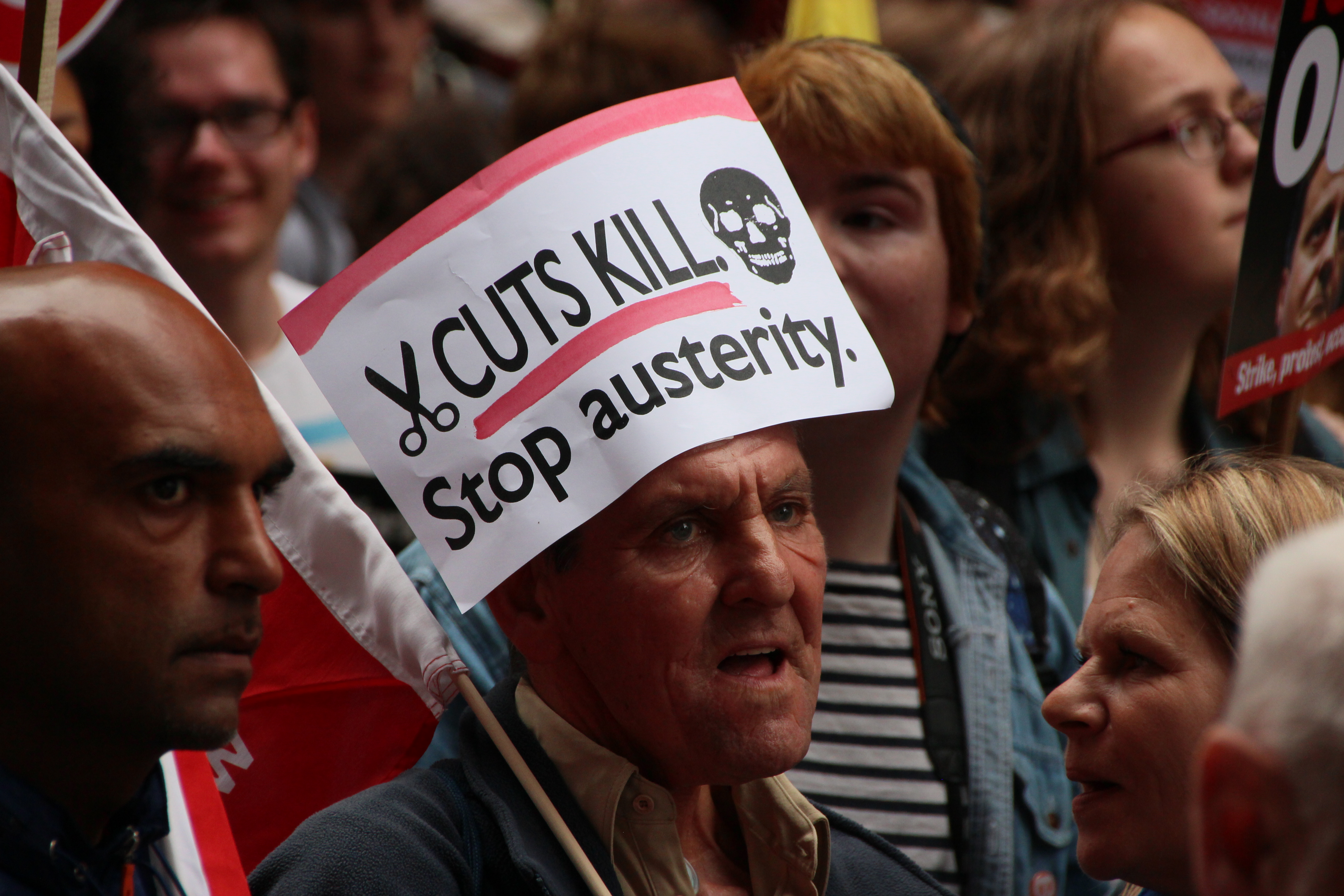
It is estimated that a quarter of a million people came on the march.
It is estimated that a quarter of a million people came on the march (Photo: Hannah Awcock).
The Fire Brigade's Union were another group who made an impression.
The Fire Brigade’s Union were another group who made an impression (Photo: Hannah Awcock).
Sister's Uncut is a women-only group that uses direct action to try and protect domestic violence services. They also have some pretty good chants!
Sisters Uncut is a women-only group that uses direct action to try and protect domestic violence services. They also have some pretty good chants! (Photo: Hannah Awcock)
Housing, and many of the issues and protest tactics that surround it, like squatting, is a particularly contentious issue in London.
Housing, and many of the issues and protest tactics that surround it, like squatting, is a particularly contentious issue in London (Photo: Hannah Awcock).
This gentleman had some rather good songs about Ian Duncan Smith.
This gentleman had some rather good songs about Ian Duncan Smith (Photo: Hannah Awcock).
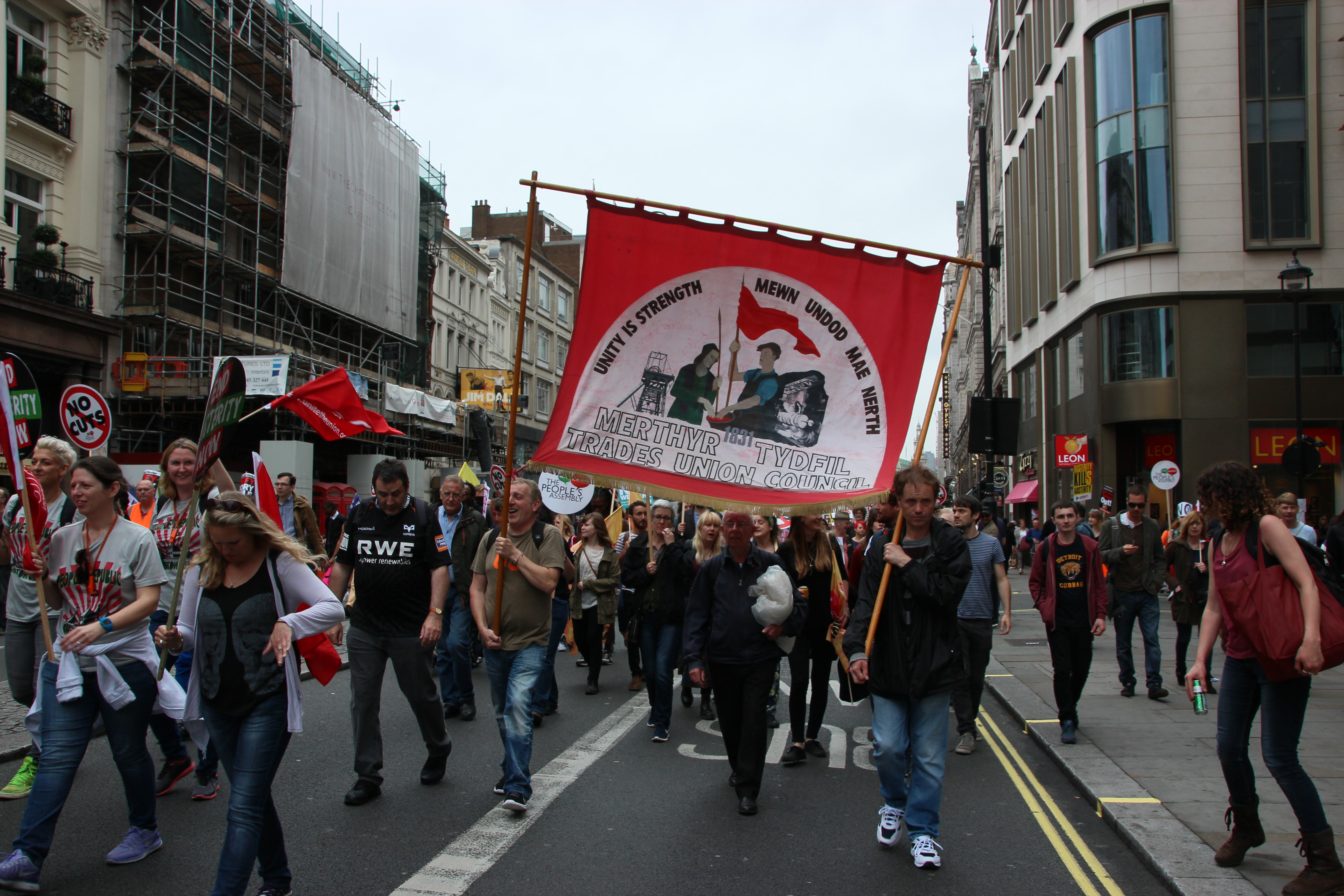
Various unions were present on the demonstration, and their banners are always works of art.
Various unions were present on the demonstration, and their banners are always works of art (Photo: Hannah Awcock).
I'm not sure why David Cameron is a crab, but this costume is fantastic!
I’m not sure why David Cameron is a crab, but this costume is fantastic! (Photo: Hannah Awcock)
I couldn't resist taking a picture of placards in front of Big Ben- it's democracy in action!
I couldn’t resist taking a picture of placards in front of Big Ben- it’s democracy in action! (Photo: Hannah Awcock)
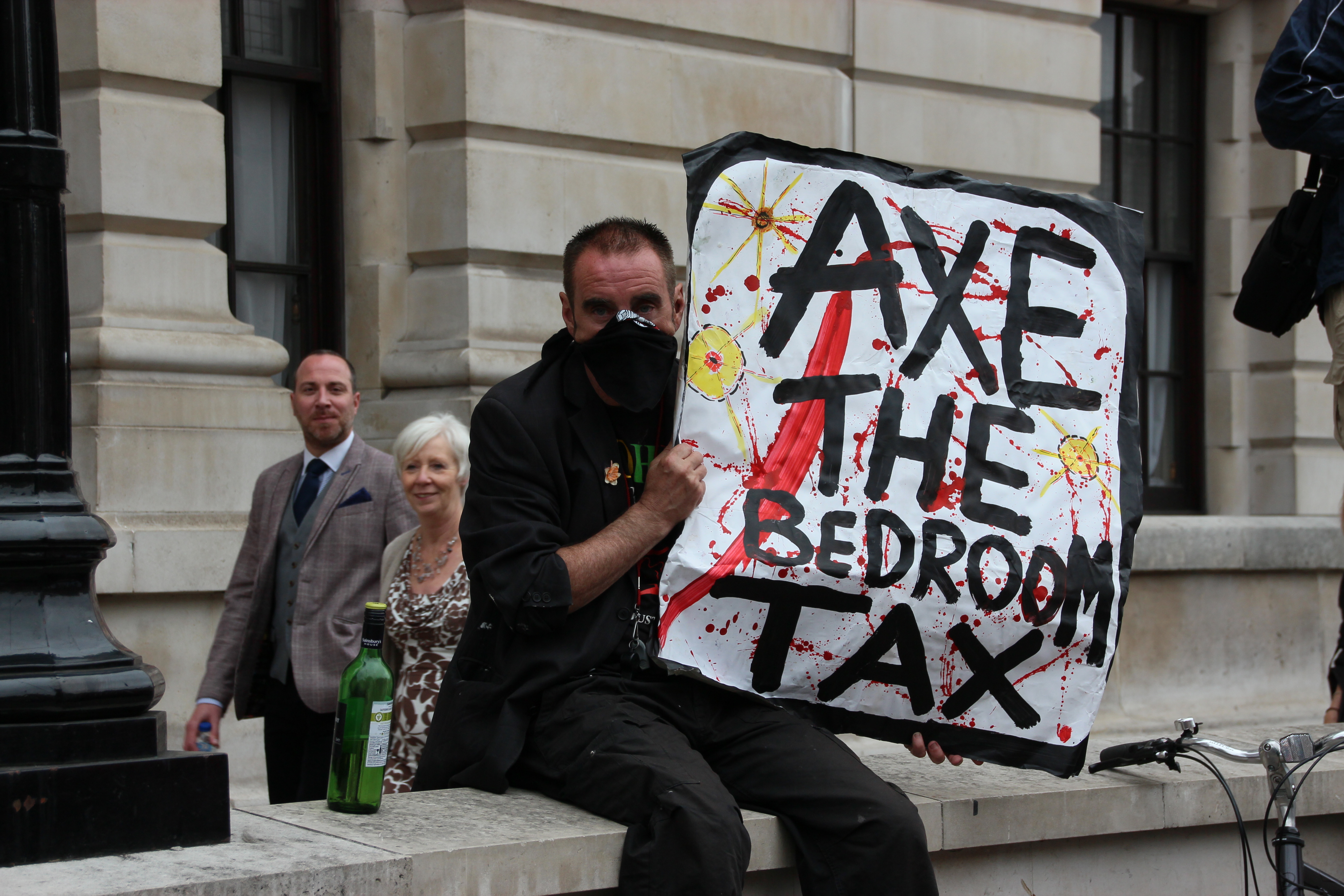
The bedroom tax is a highly controversial government policy. Lots of people with banners and placards stopped along Whitehall, presumably to promote their cause as the rest of the march passed by.
The bedroom tax is a highly controversial government policy. Lots of people with banners and placards stopped along Whitehall, presumably to promote their cause as the rest of the march passed by (Photo: Hannah Awcock).

Understanding Conflict: Protest and Political Violence

Provide tea and biscuits, and you're sure to get a good turnout!
Provide tea and biscuits, and you’re sure to get a good turnout! (Photo: Hannah Awcock)

This Monday, I attended the annual symposium of the University of Brighton’s conflict research group (or to give it it’s full name, Understanding Conflict: Forms and Legacies of Violence Research Cluster). With members from disciplines across the arts and humanities, the group seeks to understand violent conflict and its legacies. The annual symposium was organised by postgraduates from the research cluster, and featured a range of presentations by staff and students on themes that ranged from Belfast’s ‘peace walls’ to the aesthetics of AK-47s.

The first question asked by Professor Bob Brecher during his introduction to the symposium was ‘what is political violence?’ It may be a question that the research cluster never fully answers to their satisfaction, but I wonder if protest will be included in any definition that they do come up with. Certainly some members of the research group are working on protest or protest-related topics; Tim Huzar presented at the symposium on the topic of ‘Black Lives Matter and the Question of Non-Violence’, and Zeina Maasri talked about the aesthetics of the AK-47 rifle, and its symbolic role for anti-imperialist struggles during the Cold War. I have often thought about the role of violence in protest movements, and I was hoping that attending this symposium might crystallise some of my ideas.

At the very least, I was about to draw lots of connections between the papers presented at the symposium and my own work on the historical geographies of protest in London. One interesting idea that came out of a lively discussion about drone warfare was the idea of the threat of violence as a controlling force. Drones, or Unmanned Aerial Vehicles (UAVs) and the intense surveillance they enable can give the appearance of God-like omnipotence. The threat of a drone strike can have as much as an impact on people, if not more, than a strike itself. In a similar way, the threat of violent and excessive policing can be used to alter the behaviour of protesters and potential protesters. The threat of being arrested, kettled, or manhandled by police can prevent people protesting; I know it has factored into decisions I have made about whether or not to attend protests.

A recurring theme during the symposium was the ways in which violence is remembered and memorialised. Ian Cantoni presented a paper about the new memorial museum at Camp Joffre in southern France, used as an internment camp for much of the 20th Century. Dr. Eugene Michael talked about the use of the Holocaust metaphor to interpret the conflicts in former Yugoslavia during the 1990s. Just like conflicts, protests can often have difficult and contested legacies. I am currently working on the Battle Cable Street, which is memorialised in the mural shown below. It is a contentious site, and has been vandalised several times since the project began in 1976. As the name suggests, the Battle of Cable Street was a violent protest, and there are multiple conflicting narratives that surround it. The legacies of violent pasts are difficult to process, yet we continue to try, whether that violence took the form of a protest, a riot, or a war.

The Battle of Cable Street memorial in Cable Street, in Tower Hamlets in East London.
The Battle of Cable Street memorial in Cable Street, in Tower Hamlets in East London (Photo: Hannah Awcock).

There is clearly a lot of overlap between conflict and protest, especially violent protest. Protest has an uneasy relationship with violence; violence is a frequent part of unrest, but many activists reject it, for a whole variety of reasons. Nevertheless, I think that any study of protest (even those about deliberately non-violent protest) would be improved by at least a passing consideration of the causes, characteristics, and impacts of political violence.

Thank you to the Conflict research cluster at the University of Brighton for organising such an interesting day and giving me so much to think about!

London’s Protest Stickers: Mainstream Politics

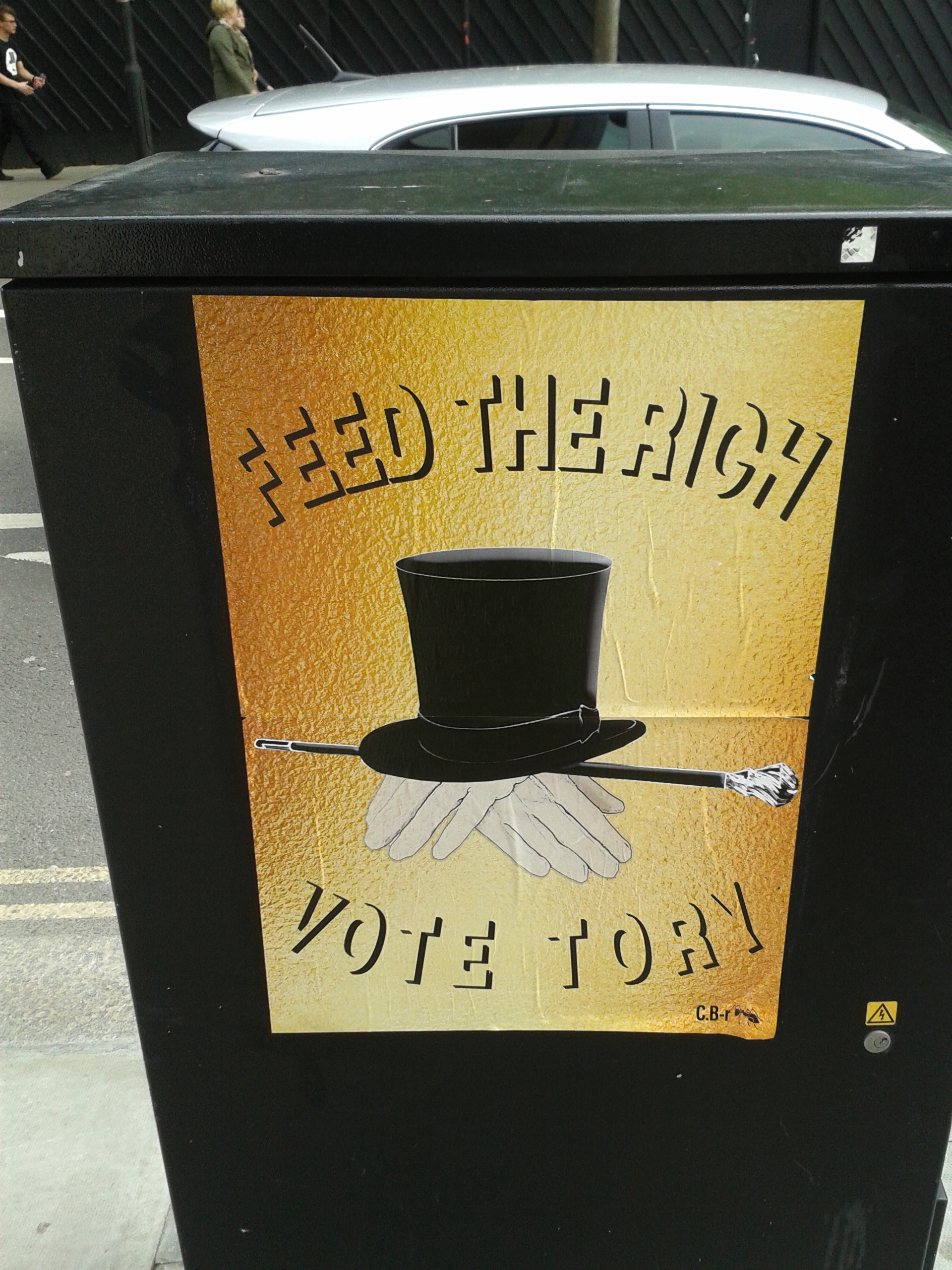
Protest has a complicated relationship with mainstream politics. Governments and political parties are frequently the targets of social movements and demonstrations, such as the recent Anti-government protests after the 2015 General Election. Political parties and politicians often appear as the subject of protests stickers. In London, the frequency of these kind of stickers increased in the weeks before the recent General Election. Generally, the streets of London did not agree with Britain’s voters.

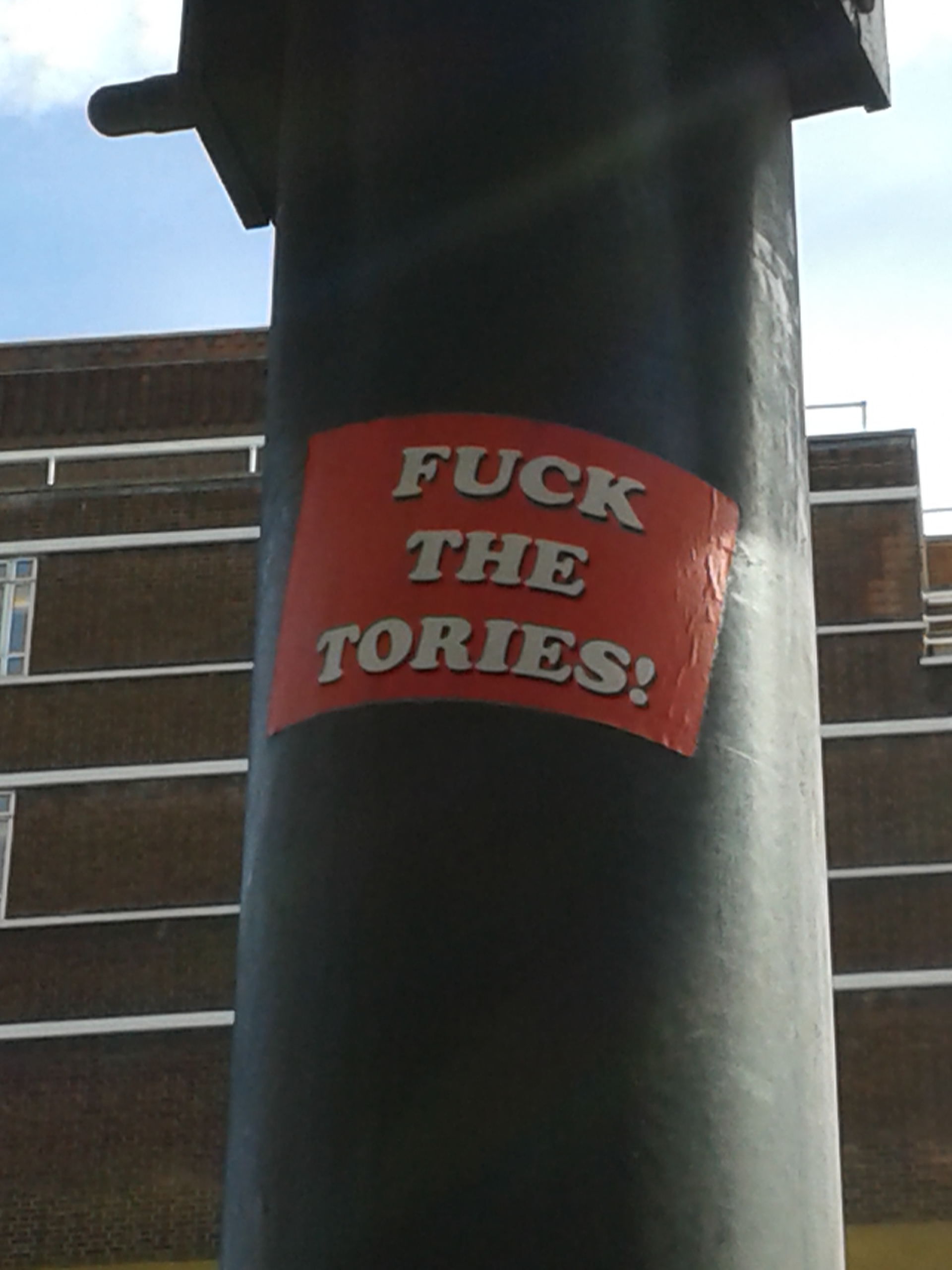
There was a decidedly anti-Conservative tone of many of the protest stickers that appeared in the weeks before the 2015 General Election (Tottenham Court Road,  17/04/15).
There was a decidedly anti-Conservative tone of many of the protest stickers that appeared in the weeks before the 2015 General Election (Photo: Hannah Awcock, Tottenham Court Road, 17/04/15).
UKIP also received a certain amount of criticism on the streets of London, although it then went on to win 12.6% of the vote (Gordon Street, Bloomsbury, 17/04/15).
UKIP also received a certain amount of criticism on the streets of London, although it then went on to win 12.6% of the vote (Photo: Hannah Awcock, Gordon Street, Bloomsbury, 17/04/15).
This example, more of a poster than a sticker really, directly referenced the election (New Oxford Street, Holborn, 03/05/15)
This example, more of a poster than a sticker really, directly referenced the election (Photo: Hannah Awcock, New Oxford Street, Holborn, 03/05/15).
These stickers criticized the electoral system as a whole rather than specific politic parties. They had been removed the next day (28/04/15).
These stickers criticized the electoral system as a whole rather than specific politic parties. They had been removed the next day (Photo: Hannah Awcock, Borough High Street, 28/04/15).
A sticker calling for Muslims not to vote. Some argue that voting is polytheism, because no one has the right to make laws except God. The sticker has an official appearance, looking more like a warning sign than a protest sticker (Euston Station, 12/05/15).
A sticker calling for Muslims not to vote. Some argue that voting is polytheism, because no one has the right to make laws except God. The sticker has an official appearance, looking more like a warning sign than a protest sticker (Photo: Hannah Awcock, Euston Station, 12/05/15).
This sticker, by the Anarchist Federation, is also calling for people not to vote, although I'm sure the motive was very different. This sticker was located on a bin, which might have been an attempt to equate voting with rubbish. Or it might have been a coincidence (Camden High Street, 20/05/15).
This sticker, by the Anarchist Federation, is also calling for people not to vote, although I’m sure the motive was very different. This sticker was located on a bin, which might have been an attempt to equate voting with rubbish. Or it might have been a coincidence (Photo: Hannah Awcock, Camden High Street, 20/05/15).
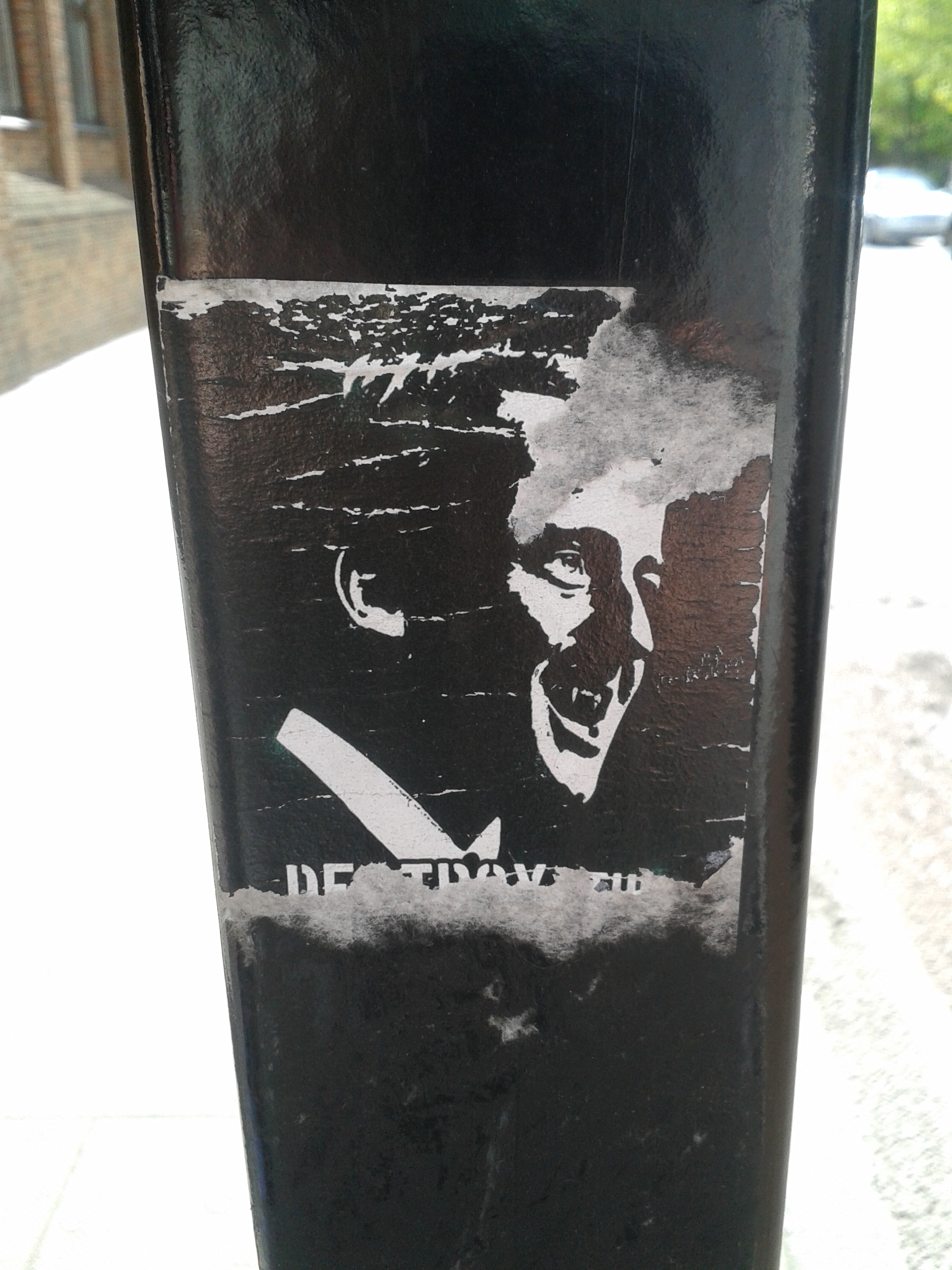
The writing on this sticker has been removed, but the image of David Cameron with vampiric teeth gets the message across I think! (Borough High Street, 28/04/15).
The writing on this sticker has been removed, but the image of David Cameron with vampiric teeth gets the message across I think! (Photo: Hannah Awcock, Borough High Street, 28/04/15).
This sticker, along with the next one, rank amongst my favourite stickers come across so far in London. Avengers: Age of Ultron was released in UK cinemas on the 23rd of April, so the reference is topical as well as humorous. (New Oxford Street, Holborn, 03/05/15).
This sticker, along with the next one, rank amongst my favourite stickers that I’ve come across so far in London. Avengers: Age of Ultron was released in UK cinemas on the 23rd of April, so the reference is topical as well as humorous (Photo: Hannah Awcock, New Oxford Street, Holborn, 03/05/15).
Not to be left out, Nigel Farage also gets the Avengers treatment (New Oxford Street, Holborn, 03/05/15).
Not to be left out, Nigel Farage also gets the Avengers treatment (Photo: Hannah Awcock, New Oxford Street, Holborn, 03/05/15).
This sticker also criticises Nigel Farage's party, using wordplay to warn of the dangers of complacency (King's Cross, 05/05/15).
This sticker also criticises Nigel Farage’s party, using wordplay to warn of the dangers of complacency (Photo: Hannah Awcock, King’s Cross, 05/05/15).
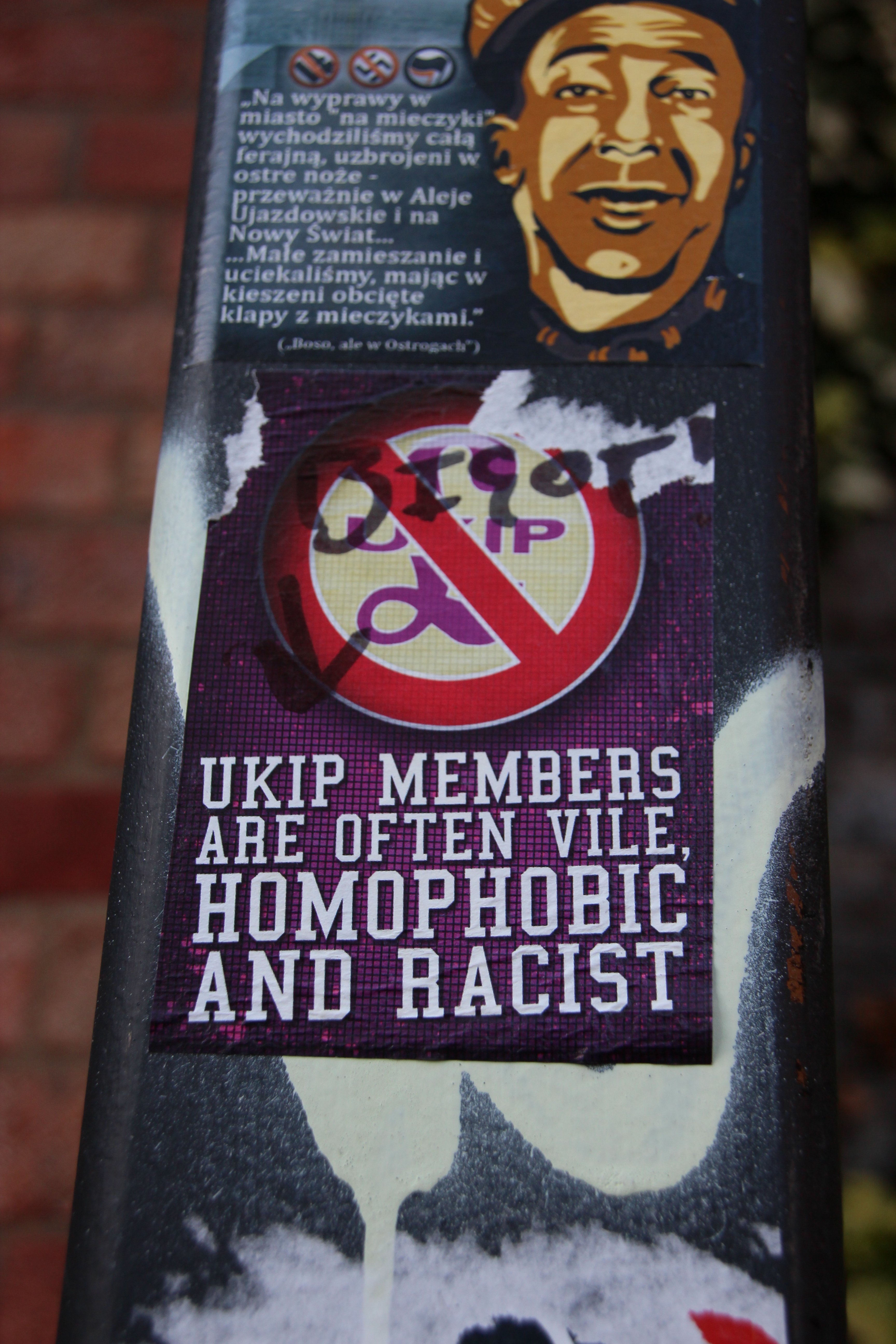
This sticker is another criticism of UKIP, but it has been grafittied, accusing the person who made the sticker of bigotry (Regent's Canal tow path, Camden, 20/05/15).
This sticker is another criticism of UKIP, but it has been grafittied, accusing the person who made the sticker of bigotry (Photo: Hannah Awcock, Regent’s Canal tow path, Camden, 20/05/15).
Many people are disillusioned with the current political system, and feel like the current political parties do not offer real choice. They all argue that there is a need for continued austerity, for example. This sticker is referring to that sense of disillusionment (Euston Road, 06/05/15).
Many people are disillusioned with the political system, and feel like the current political parties do not offer real choice. They all argue that there is a need for continued austerity, for example. This sticker is referring to that sense of disillusionment (Photo: Hannah Awcock, Euston Road, 06/05/15).
This sticker refers to an entirely different vote, although the issue of Scottish independence was still an important one during the election campaign. This sticker is from the Yes Campaign, that argued for Scottish independence during the referendum in 2014 (Malet Street, Bloomsbury, 17/04/15).
This sticker refers to an entirely different vote, although the issue of Scottish independence was still an important one during the election campaign. This sticker is from the Yes Campaign, that argued for Scottish independence during the referendum in 2014 (Photo: Hannah Awcock, Malet Street, Bloomsbury, 17/04/15).

Book Review: London: The Biography

'London: The Biography' by Peter Ackroyd.
‘London: The Biography’ by Peter Ackroyd.

Ackroyd, Peter. London: The Biography. London: Vintage, 2001.

[London] contains every wish or word ever spoken, every action or gesture ever made, every harsh or noble statement ever expressed. It is illimitable. It is Infinite London.

Ackroyd, 2001; p779.

At a grand total of 822 pages, Peter Ackroyd’s London: The Biography is not a read to be taken on lightly. But when you accept that the book is a comprehensive social, cultural, political and economic history of one of the oldest and most powerful capital cities still functioning in the world today, 800 pages suddenly doesn’t seem like so much any more. The book is epic, but so is London.

London: The Biography is arranged thematically rather than chronologically, which I think was a wise decision. You still get a sense of the drastic changes over the last 2000 years, but rather than one huge description, it feels like Ackroyd is trying to get at some of those essential characteristics that make London London, that give the city its unique London-ness. For Ackroyd, this comes down to commerce; he believes that the city’s insatiable progress from the Roman to the modern era has been fuelled by an unquenchable desire for profit.

It is in fact the very universality of London that establishes these contrasts and separations, it contains every aspect of human life within itself, and is thus perpetually renewed. Yet do the rich and poor inhabit the same city? It may be that each citizen has created a London in his or own head, so that the same moment there may exist seven million different cities.

Ackroyd, 2001; p772.

This rather uncomplimentary take on a city for which many, myself included, hold in high regard can sometimes feel a little uncomfortable, but Ackroyd is just being frank. His London is ruthless, uncontrollable and indifferent to suffering, its people aggressive, loud, violent and prone to being over-dramatic. Perhaps it makes me uncomfortable because I do not disagree.

The book is aimed at a popular rather than an academic audience. Ackroyd does not reference his sources in the text, although there is “An Essay on Sources” at the back of the book. This can be frustrating if you are using the book as a starting point for conducting your own research on the city’s history. As the quotes above demonstrate, Ackroyd’s writing style can be poetic, and although most of the time it works well he does tend to personify London, giving the city a will and an autonomy that it cannot possibly have. Although I will admit that it can feel like London has a personality and a consciousness of it’s own, it isn’t actually true.

Attempting to tell the entire story of London is no mean feat, and Peter Ackroyd has made a valiant effort. As he himself admits, London is an incredibly diverse and complicated city, with a history stretching back over 2000 years. It would be impossible to fit it all into several books, let alone one. Ackroyd does a good job of making you feel like you know the unknowable city  just that bit better.

London’s Protest Stickers

Stickers are a ubiquitous part of the urban environment, like this sign in Cable Street.
Stickers are a ubiquitous part of the urban environment, like this sign in Cable Street (Photo: Hannah Awcock).

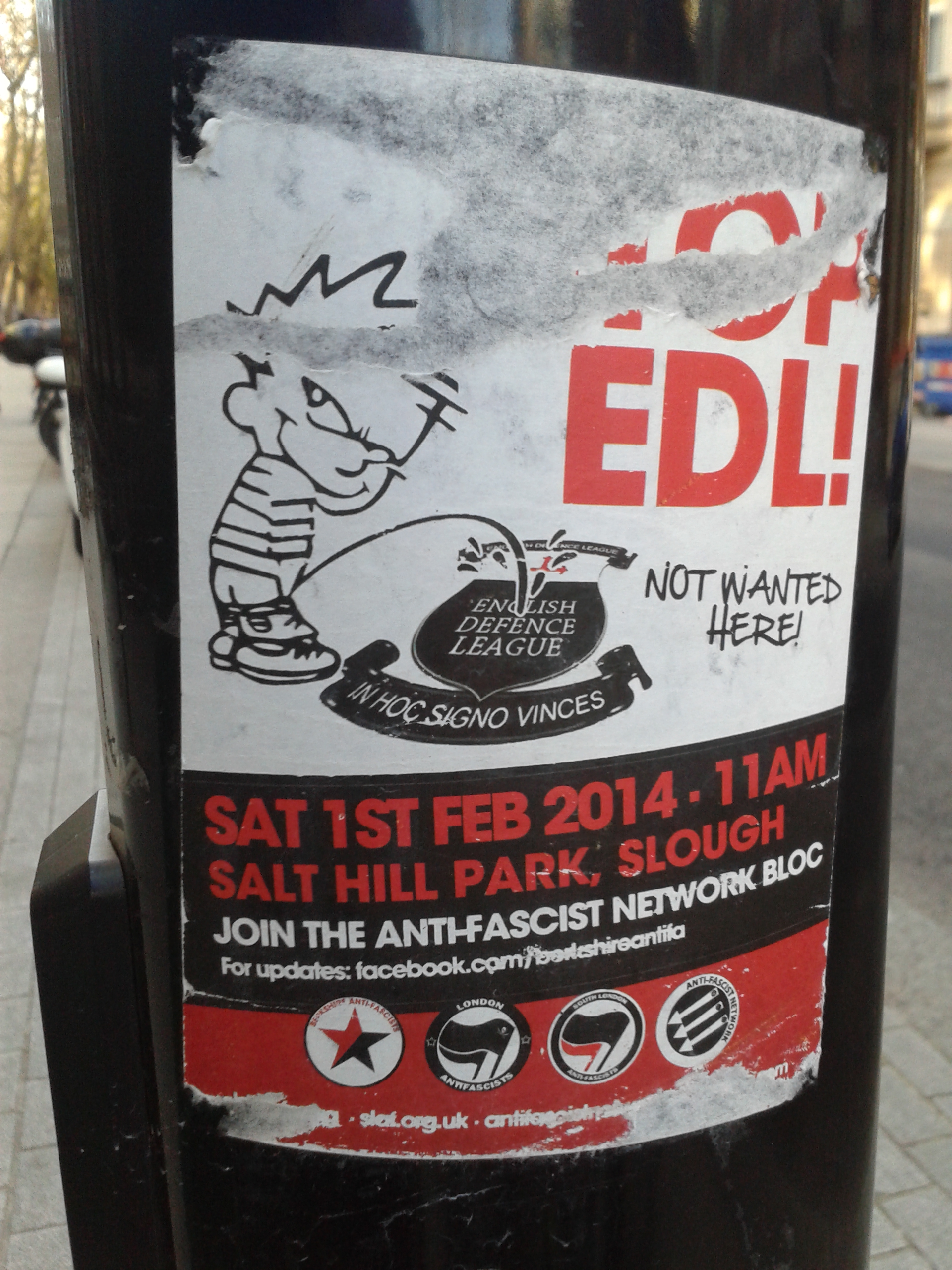
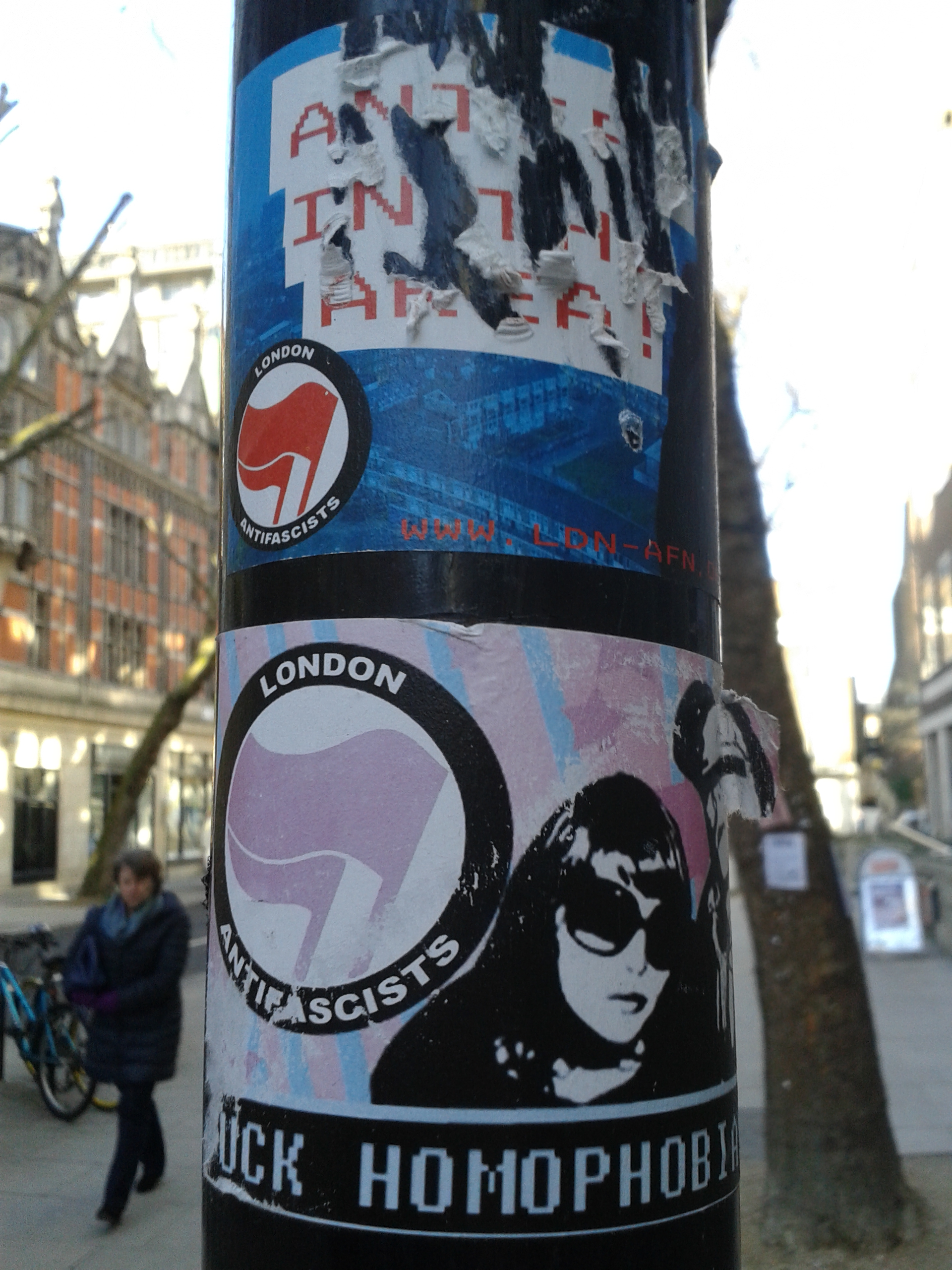
Stickers are a ubiquitous part of the urban environment, often more common than graffiti in city centres. They are quick, easy and cheap to produce and put up, so they are an effective way of getting a message across. They are employed for a variety of purposes, such as advertising, art and dissent. The meaning of many is not obvious, they remain indecipherable to all but the author and those with the right knowledge to decode them. They also come in many shapes and sizes, with many different techniques used to produce them. Like graffiti they are meant to be ephemeral, gradually disintegrating under the weight of the weather, idle hands and cleaners. As I move around London I photograph many of the protest stickers that I see, gradually building up a map of dissent in our capital. Below are some of the stickers I have seen.

A free education sticker outside of the University of London Union building in Malet Street on  17/02/15.
A free education sticker outside of the University of London Union building in Malet Street on 17/02/15 (Photo: Hannah Awcock).
Occupy Parliament Square Sticker seen on the 2/2/15 at King's Cross Station.
Occupy Parliament Square Sticker seen on the 02/02/15 at King’s Cross Station. This sticker has been weathered, picked, and written on- demonstrating how protest stickers can spark political debate (Photo: Hannah Awcock).
Some stickers are printed, whilst others look more handmade, like this one seen in Brick Lane on 5/6/14.
Some stickers are printed, whilst others look more handmade, like this one seen in Brick Lane on 05/06/14 (Photo: Hannah Awcock).
Some stickers advertise a particular protest, like this one in Malet Street, seen on 17/02/15.
Some stickers advertise a particular protest, like this one in Malet Street, seen on 17/02/15 (Photo: Hannah Awcock).
Not all protest stickers are left-wing, like this one seen at Euston Station on 14/11/14.
Not all protest stickers are left-wing, like this one seen at Euston Station on 14/11/14 (Photo: Hannah Awcock).
Something as simple as speech bubbles can drastically alter meaning, as with this government advert, seen on 4/2/15 in Elephant and Castle
Something as simple as speech bubbles can drastically alter meaning, as with this government advert, seen on 04/02/15 in Elephant and Castle. These stickers allow a sort of audience participation, so others can add more tax dodging companies (Photo: Hannah Awcock).
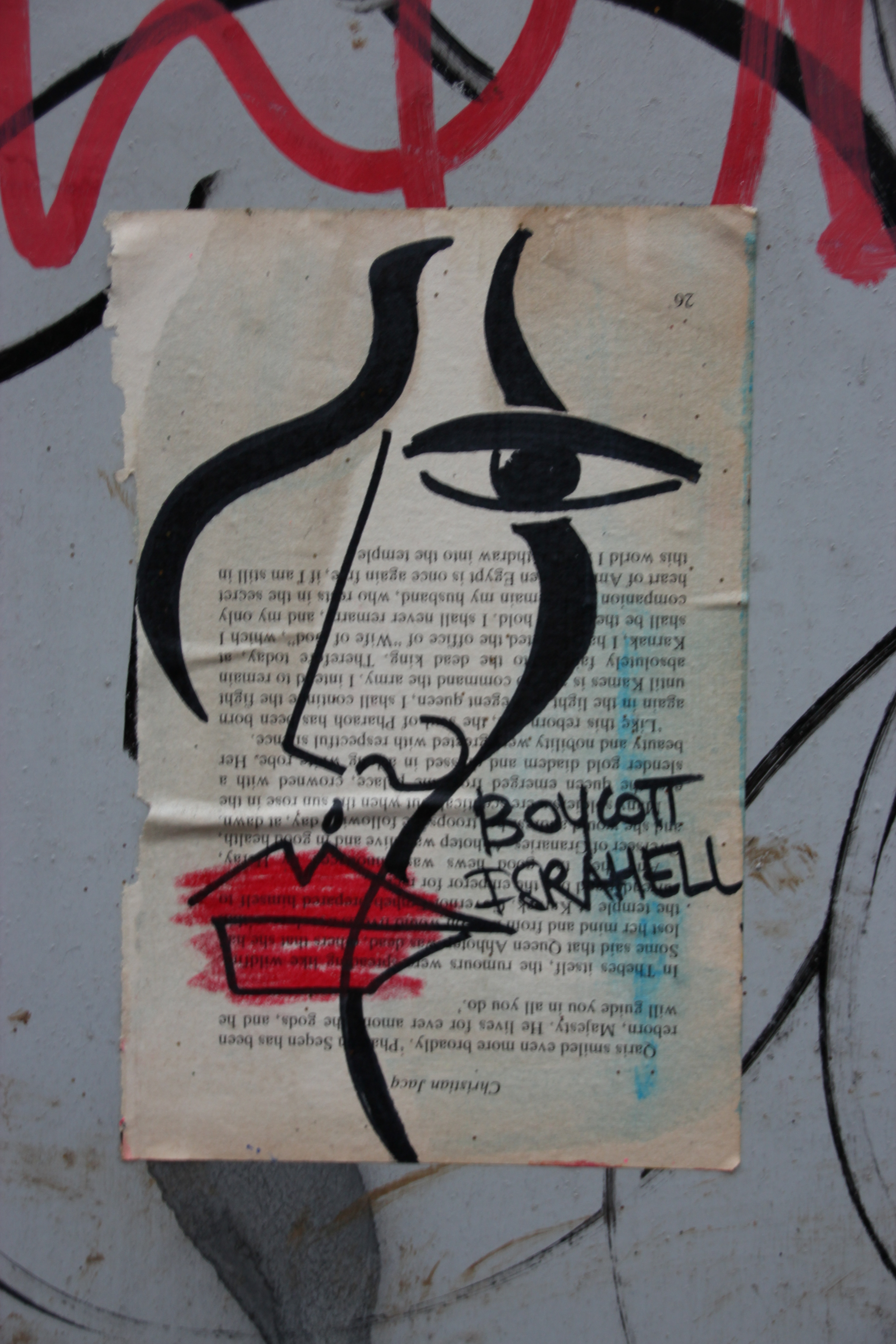
This sticker has creatively recycled a page from a book to oppose Israel. Seen in Soho on 31/12/14.
This sticker has creatively recycled a page from a book to oppose Israel. Seen in Soho on 31/12/14 (Photo: Hannah Awcock).
Protest stickers are particularly common in some areas, such Malet Street in Bloomsbury, where the University of London Union building is. This photo was taken there on 17/02/15.
Protest stickers are particularly common in some areas of the city, such Malet Street in Bloomsbury, where the University of London Union building is. This photo was taken there on 17/02/15 (Photo: Hannah Awcock).
Som stickers can be seen in multiple locations across the capital. This photo was taken outside the Inner London Crown Court in Southwark, but it has also been seen at Euston Station.
Some stickers can be seen in multiple locations across the capital. This photo was taken outside the Inner London Crown Court in Southwark, but it has also been seen at Euston Station (Photo: Hannah Awcock).

Turbulent Westminster: Time to Act and Million Women Rise Marches

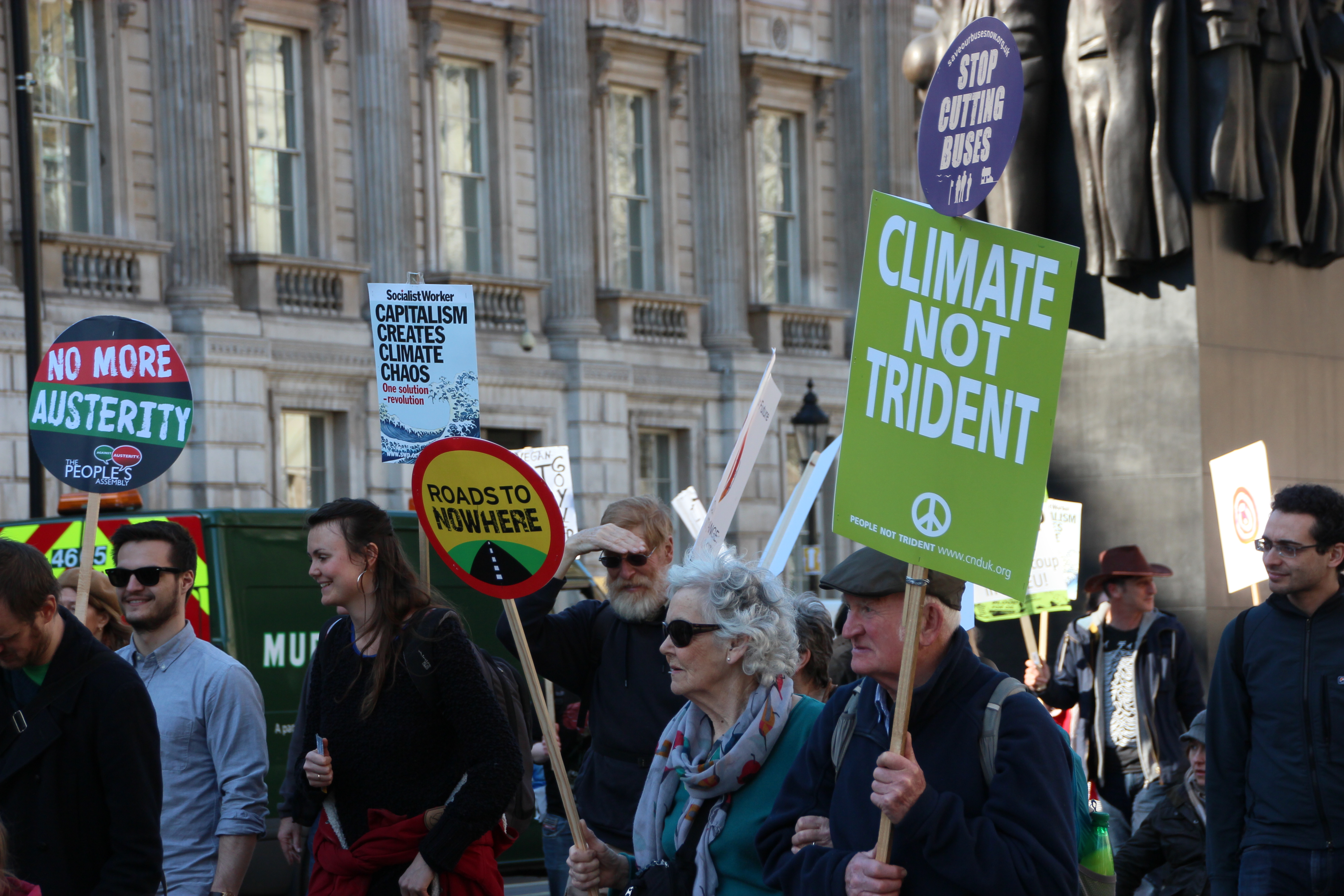
Westminster was very busy on Saturday (the 7th of March), with both the Time to Act and Million Women Rise marches taking place. No sooner did the end of the Climate Change march pass Trafalgar Square towards Parliament Square, than Million Women Rise entered the square for a rally, demonstrating just how important this small area of London is to British politics. The marches represented very different issues, with Time to Act calling for urgent changes to the way we deal with climate change, and Million Women Rise demanding an end to male violence against women, tying in with International Women’s Day on the 8th of March. The beautiful weather combined with the bright placards creative chants and upbeat atmosphere to create a thoroughly enjoyable spectacle. Here are some of my photos from the day.

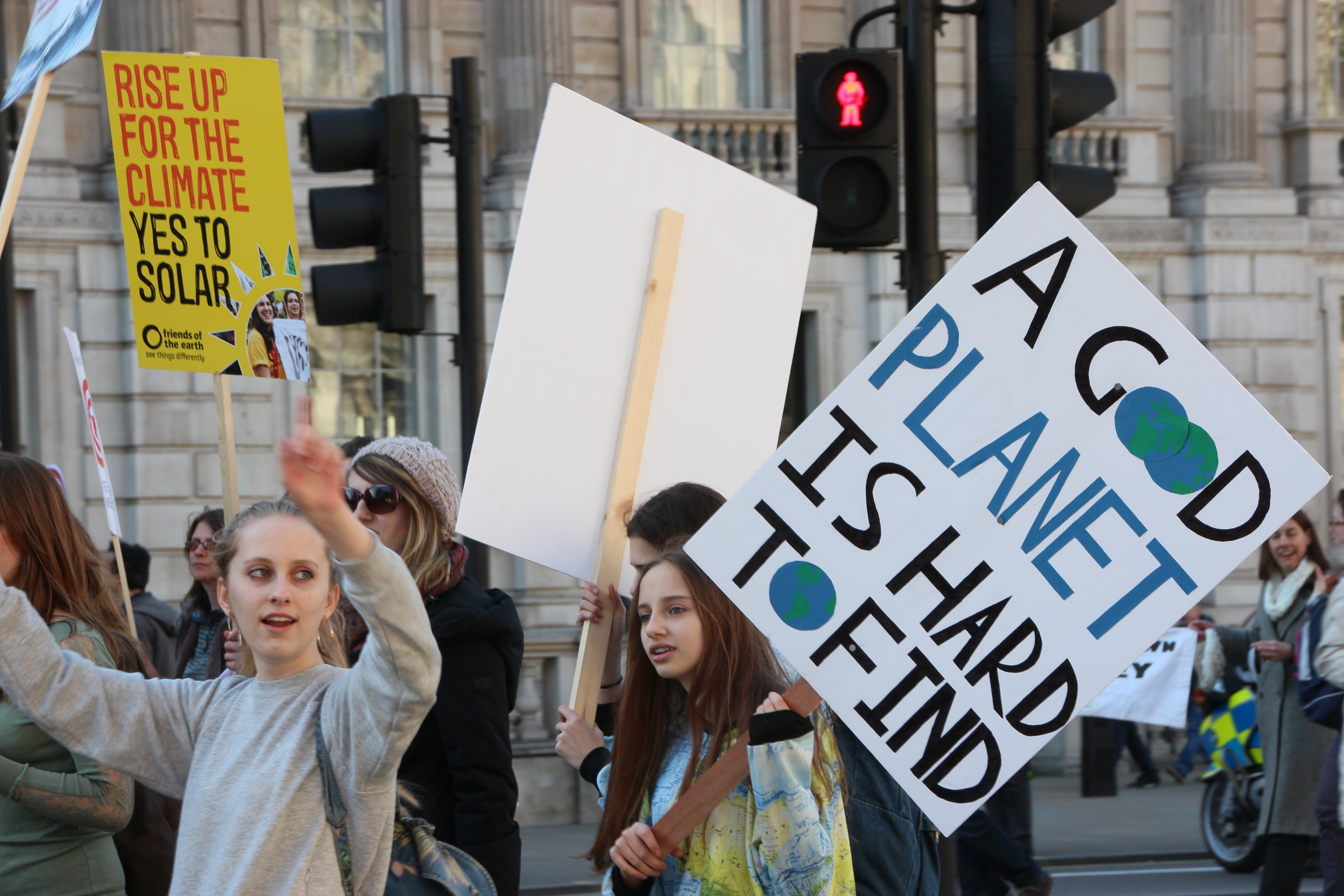
People had come from all over the country to protest against issues related to climate change in their local area, but  there were several London groups.
People had come from all over the country to protest against issues related to climate change in their local area, but there were several London groups (Photo: Hannah Awcock).
People of all ages attended the march....
People of all ages attended the march…. (Photo: Hannah Awcock)
...from the young...
…from the young… (Photo: Hannah Awcock)
...to the old, several generations were represented by the demonstrators. I think climate change marches tend to be more friendly and safe events than protests around some issues.
…to the old, several generations were represented by the demonstrators. I think climate change marches tend to be more friendly and safe events than protests around some issues (Photo: Hannah Awcock).
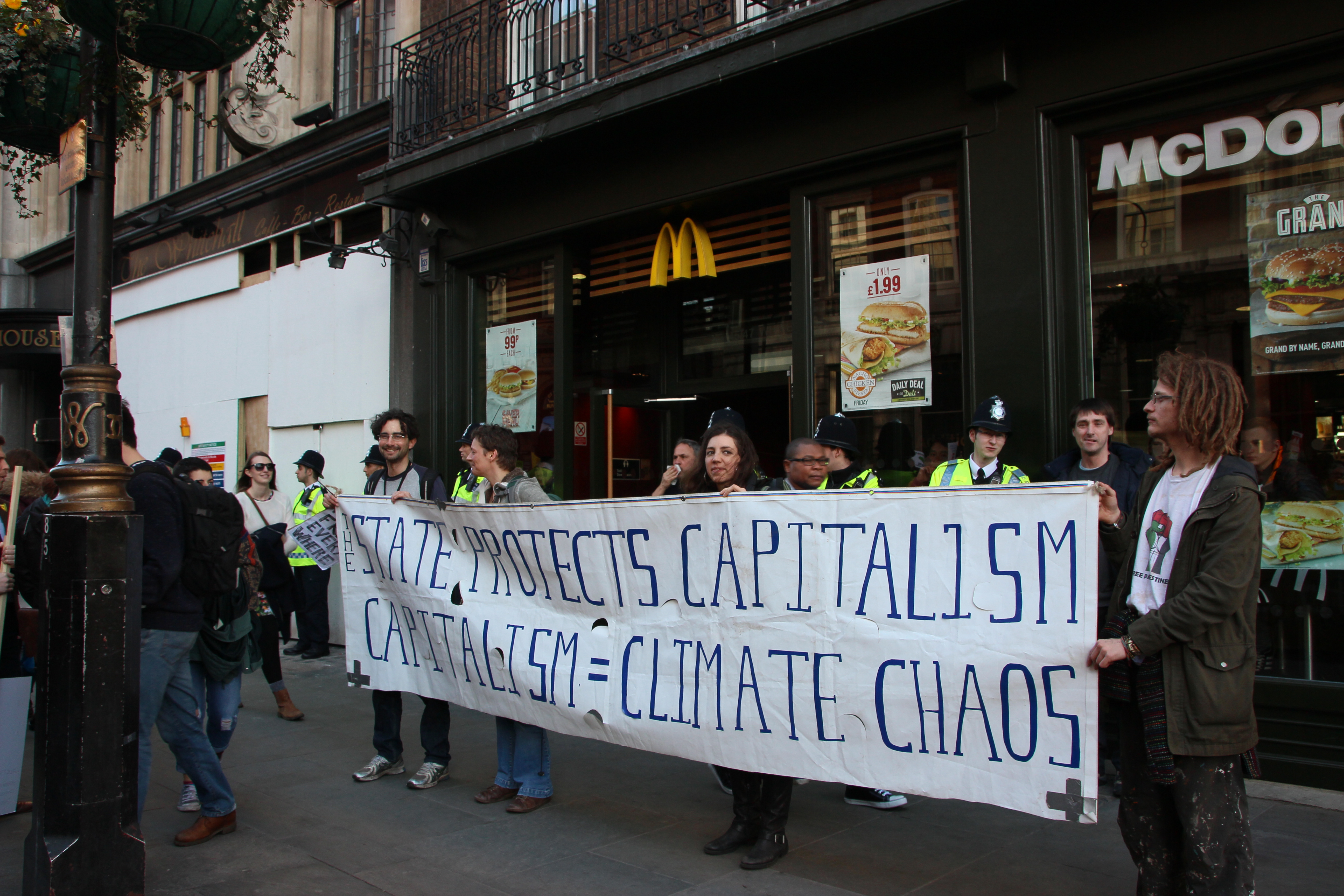
This group stopped in front of a McDonalds to help make their point.
This group stopped in front of a McDonalds to help make their point (Photo: Hannah Awcock).
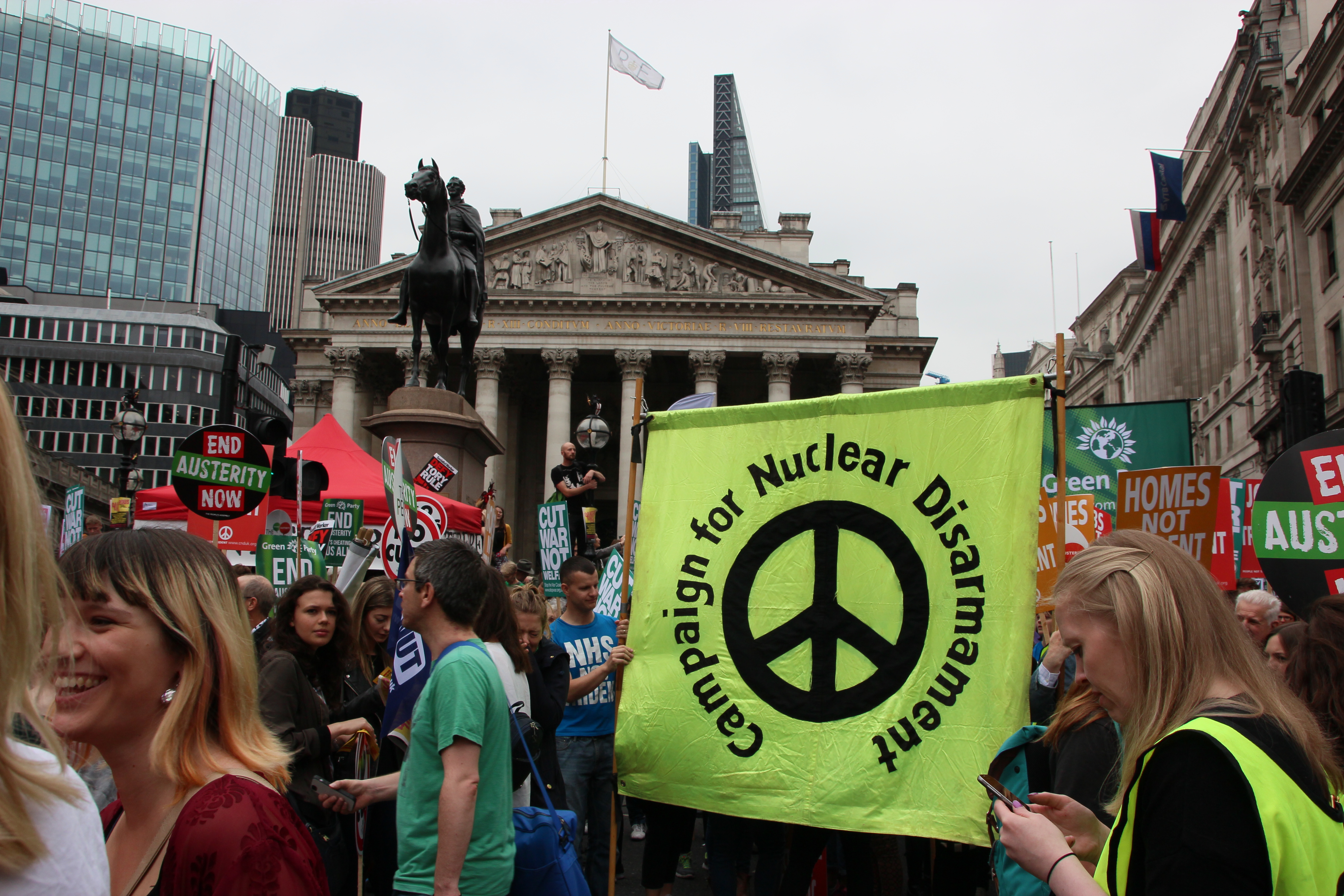
As usual, there were generic placards printed large numbers by groups such as the Green Party, the CND, and Left Unity...
As usual, there were generic placards printed large numbers by groups such as the Green Party, the CND, and Left Unity… (Photo: Hannah Awcock)
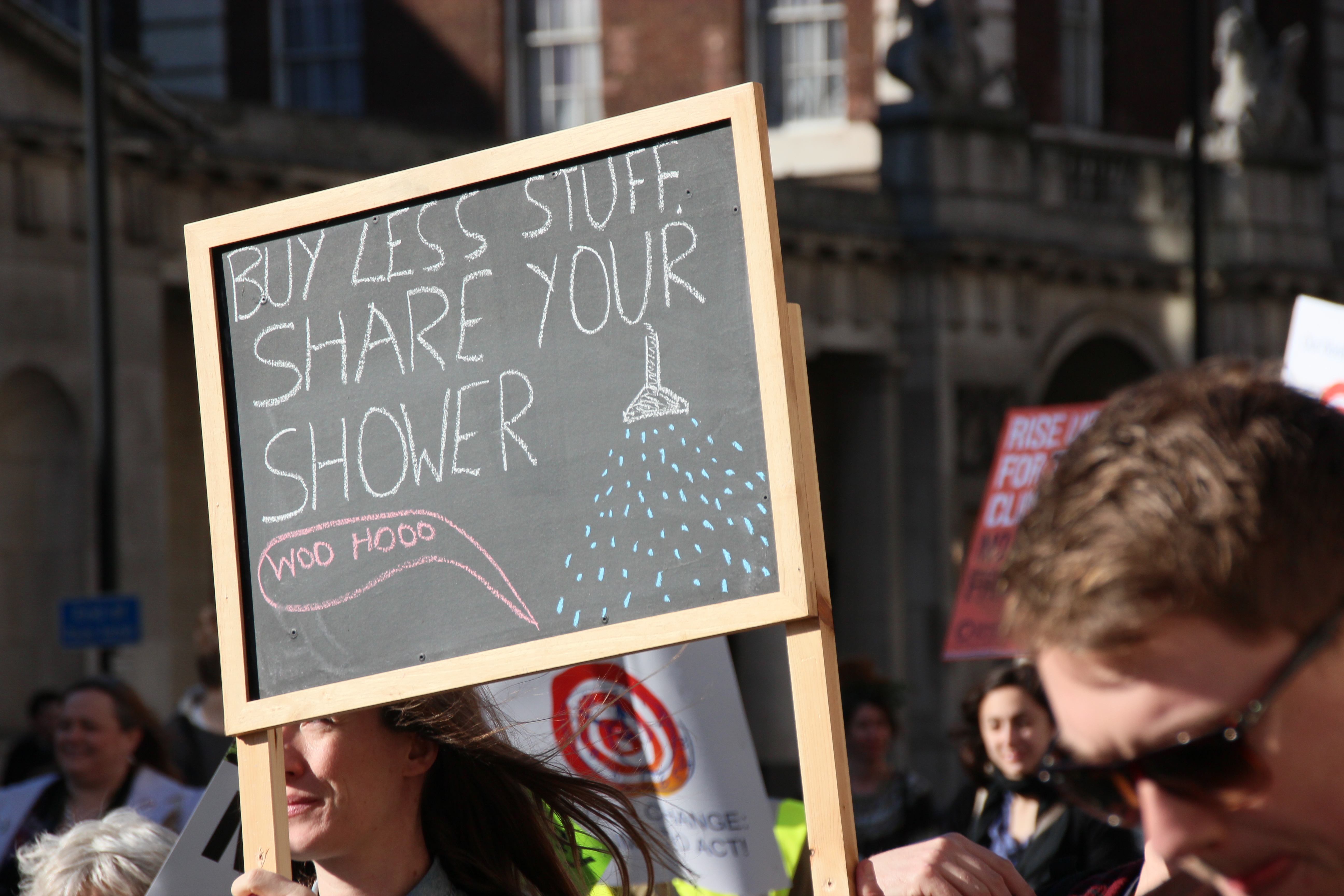
...as well as home-made efforts, which frequently take a comic approach to the issues.
…as well as home-made efforts, which frequently take a comic approach to the issues (Photo: Hannah Awcock).
Lots of issues were represented in the Time to Act march, including fossil fuels, TTIP, runways and Trident. Drax is a coal-fired power station in Yorkshire that provides about 7% of the UK's electricity supply.
Lots of issues were represented in the Time to Act march, including fossil fuels, TTIP, runways and Trident. Drax is a coal-fired power station in Yorkshire that provides about 7% of the UK’s electricity supply (Photo: Hannah Awcock).
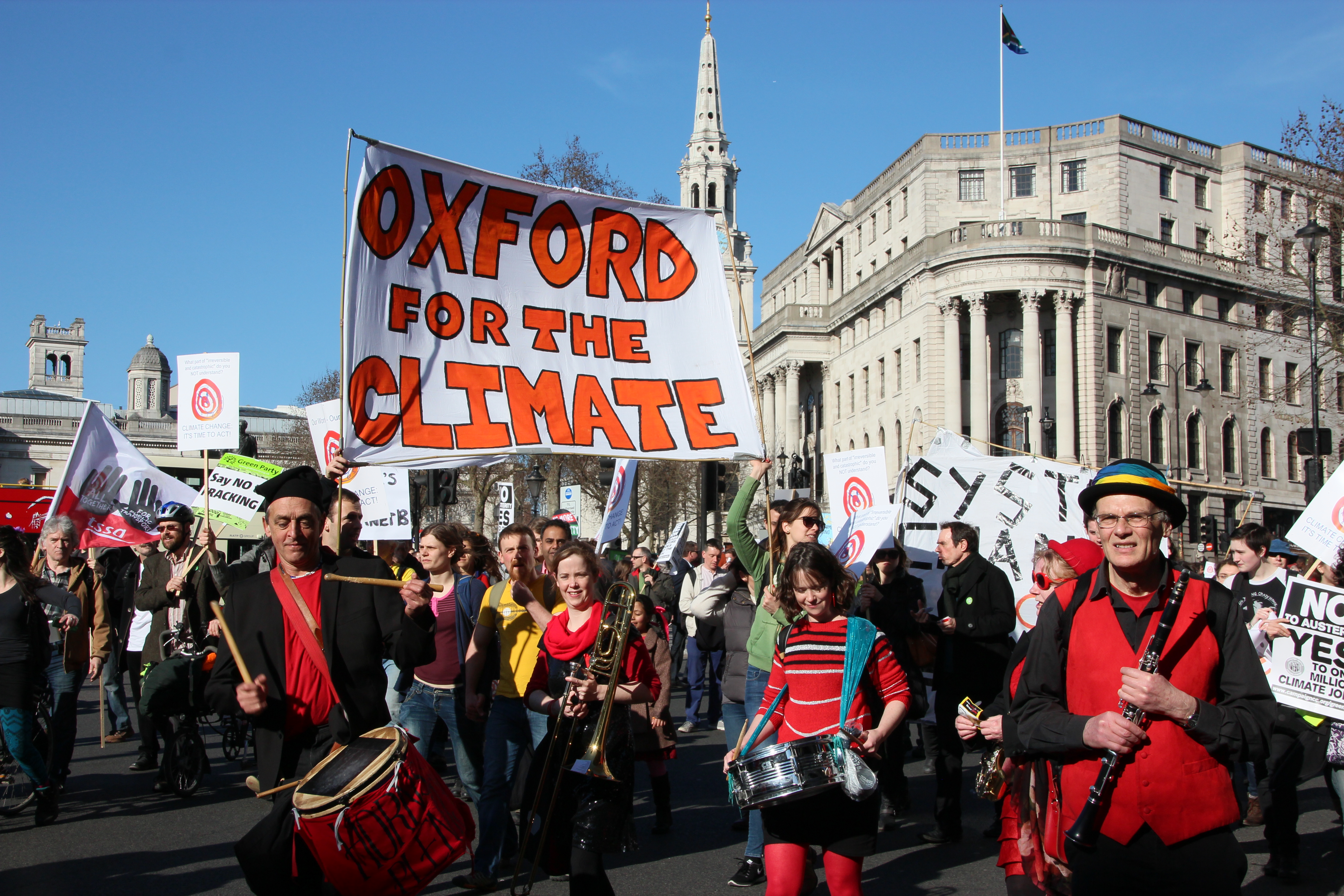
This contingent from Oxford brought their own band. Music is a really important part of protest marches, helping to left the mood and keep the marchers upbeat and energised.
This contingent from Oxford brought their own band. Music is a really important part of protest marches, helping to left the mood and keep the marchers upbeat and energised (Photo: Hannah Awcock).
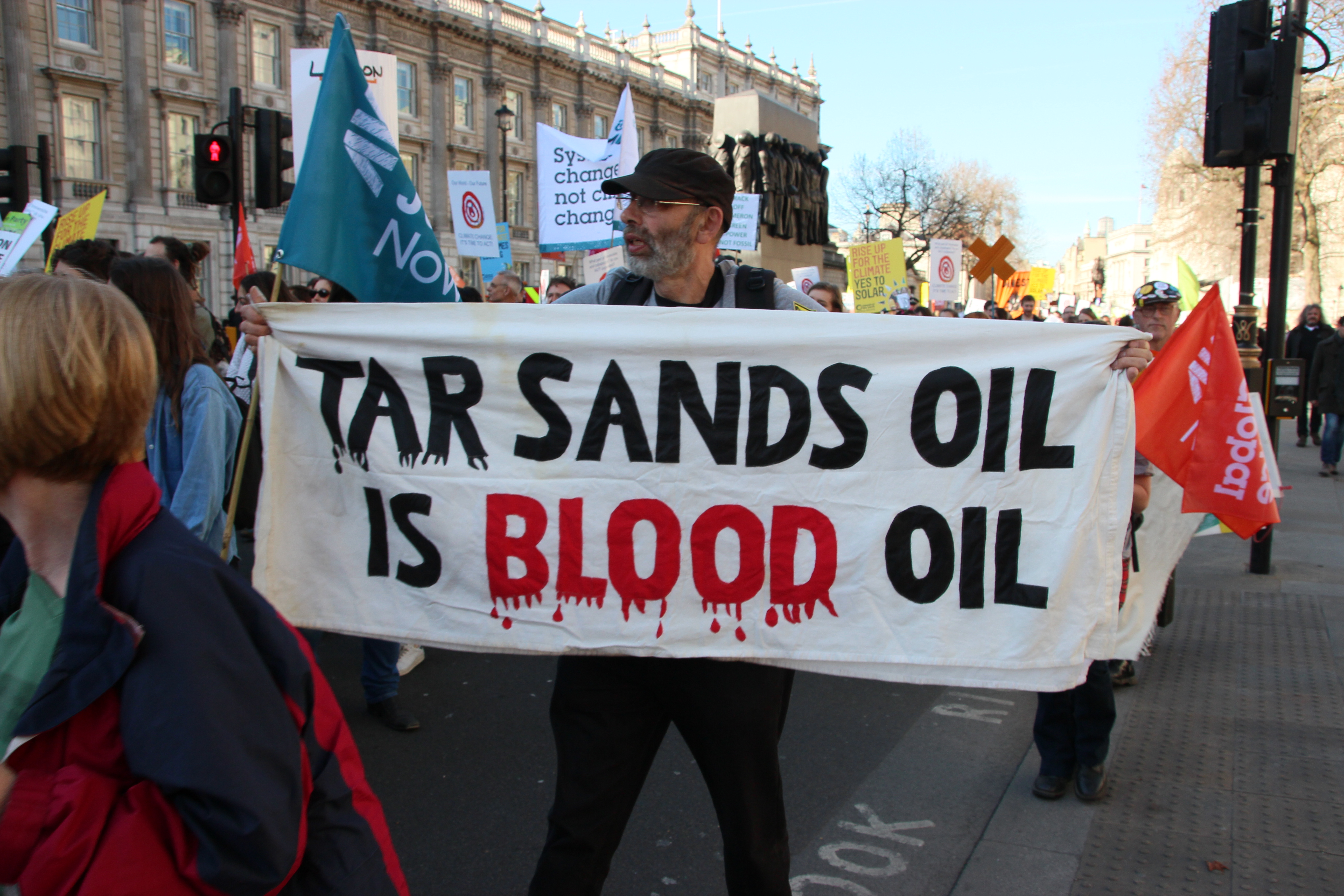
Whilst fracking was a popular topic of disdain for the marchers, this gentleman decided to focus on tar sands.  Tar sands is not a method of fossil fuel extraction that is used in the UK, but many contemporary activists take an international approach to their campaigning.
Whilst fracking was a popular topic of disdain for the marchers, this gentleman decided to focus on tar sands. Tar sands is not a method of fossil fuel extraction that is used in the UK, but many contemporary activists take an international approach to their campaigning (Photo: Hannah Awcock).
This protester brought his bike along, presumably to promote the environmentally -friendly form of travel. The placard in his basket is a play on Shell's logo and name.
This protester brought his bike along, presumably to promote the environmentally -friendly form of travel. The placard in his basket is a play on Shell’s logo and name (Photo: Hannah Awcock).
One of the last placards of the Time to Act march was this one, calling for spectators to join the march.
One of the last placards of the Time to Act march was this one, calling for spectators to join the march (Photo: Hannah Awcock).
The Million Women Rise march arrived in Trafalgar Square just as the last Time to Act protester passed by. They too had many mass-produced placards.
The Million Women Rise march arrived in Trafalgar Square just as the last Time to Act protester passed by. They too had many mass-produced placards (Photo: Hannah Awcock).
But there were also home-made placards too, like this one.
But there were also home-made placards too, like this one (Photo: Hannah Awcock).
Although violence against women is a more focussed topic than climate change, other issues were still brought in by demonstrators, such as this sign about migration.
Although violence against women is a more focussed topic than climate change, other issues were still brought in by demonstrators, such as this sign about migration (Photo: Hannah Awcock).
IMG_6786
Lots of different groups were represented on the march, from a huge variety of backgrounds. From Essex… (Photo: Hannah Awcock)
IMG_6781
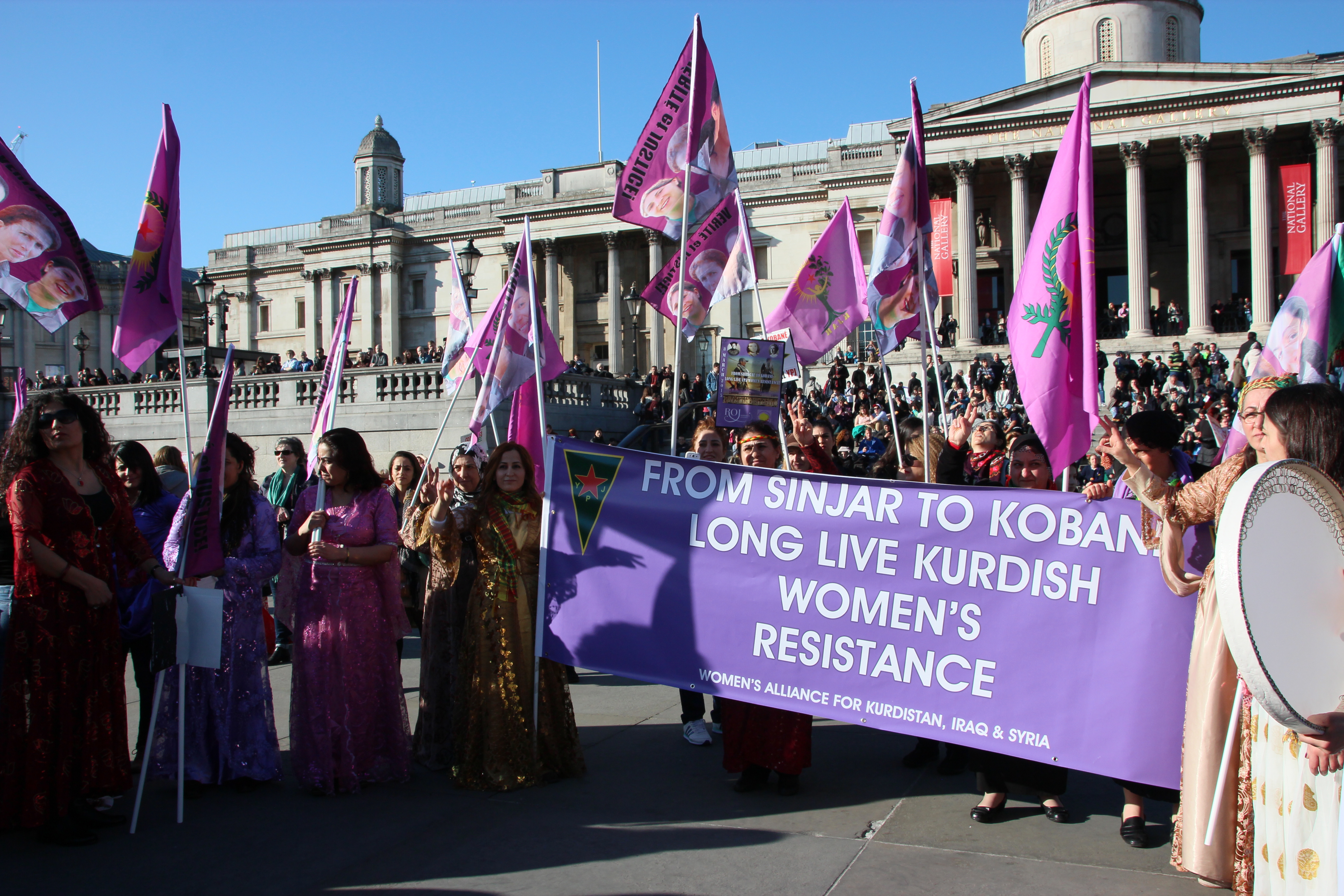
…to Kurdistan, each group had a different style and approach (Photo: Hannah Awcock).
IMG_6794
This was one of my favourite banners from the day, with the bright colours and striking imagery. Unfortunately, I doubt it will ever be seen in the National Gallery! (Photo: Hannah Awcock).
Most marches end with a rally, witch speakers, and sometimes music. The Million Women Rise stage was set up in front of Nelson's Column.
Most marches end with a rally, with speakers, and sometimes music. The Million Women Rise stage was set up in front of Nelson’s Column (Photo: Hannah Awcock).