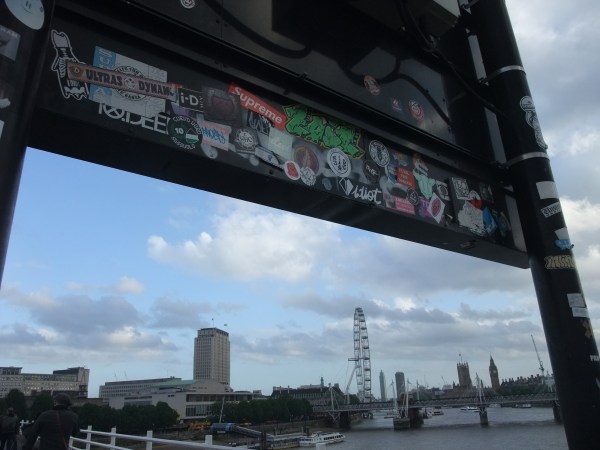
Stickers of all kinds are a significant part of London’s urban fabric (Photo: Hannah Awcock, Waterloo Bridge, 15/12/16).
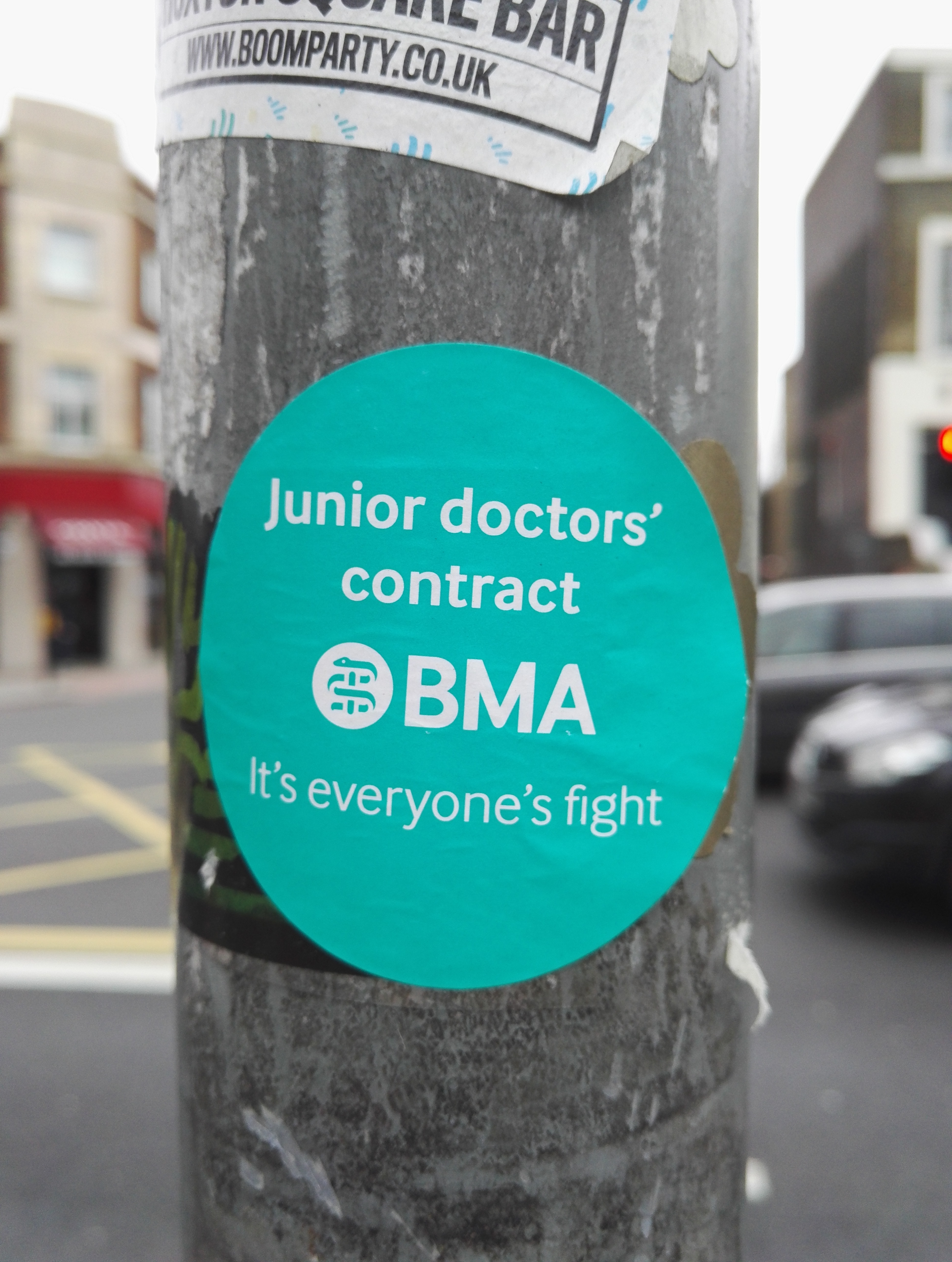
The conflict over Junior Doctors’ contracts was arguably one of the biggest news stories of 2016 with the Health Secretary, Jeremy Hunt, imposing new working and pay conditions. The NHS more generally is one of the biggest battlegrounds of modern British politics, with constant debates about funding, privatisation, and the quality of the services provided. Like other key issues and events in politics (such as the EU Referendum, immigration, and housing), the conflict over the NHS has manifested itself in London’s protest stickers. Some stickers refer to other health-related issues, such as the legalisation of drugs and mental health.
One of the main arguments against the new contracts was that the changes would risk the health of patients. As such, it is not just Junior Doctors who should take an interest in the dispute (Photo: Hannah Awcock, Lewisham Way, 20/03/16).
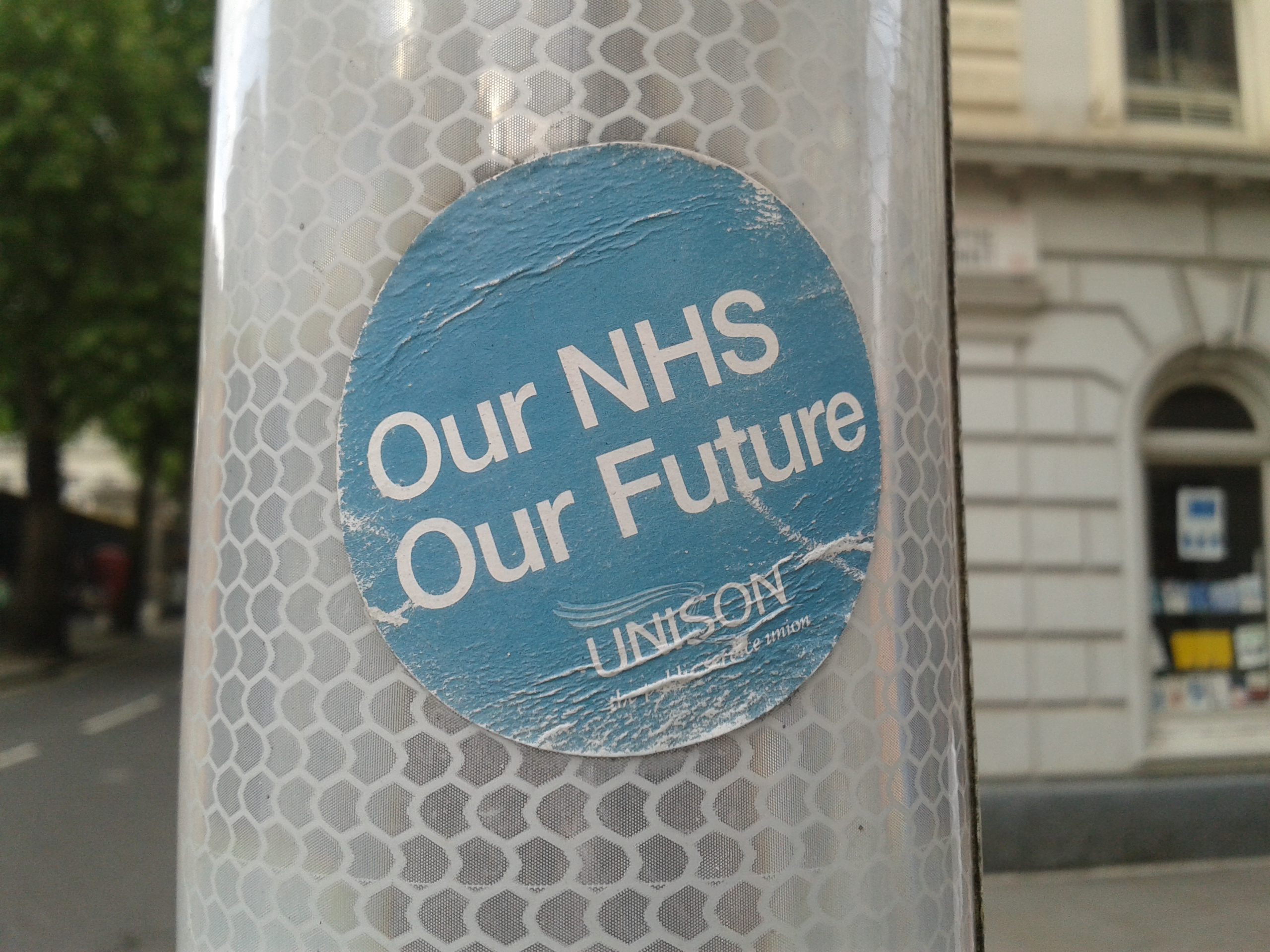
Unison is a union for people who work in public services, including employees of the NHS. This sticker is also making the argument that the users of the NHS should be just as involved in the fight for to save the NHS as those who work in it (Photo: Hannah Awcock, Great Russell Street, 16/06/15).
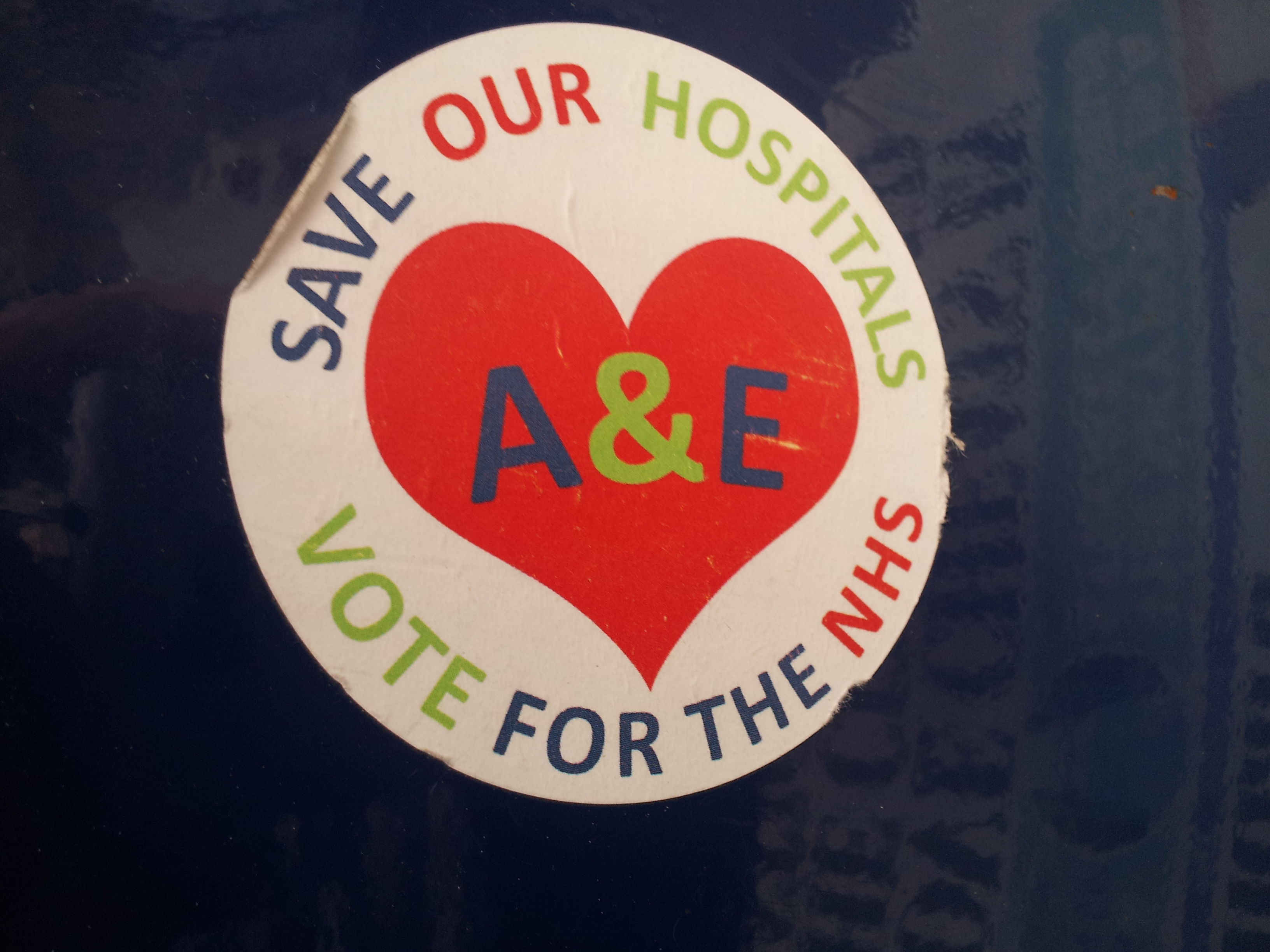
The NHS is an important political issue. The funding and running of the NHS often becomes a topic of debate during elections. The Conservative Party, for example, are frequently accused of trying to underfund and privatise the NHS. (Photo: Hannah Awcock, Borough High Street, 19/08/15).
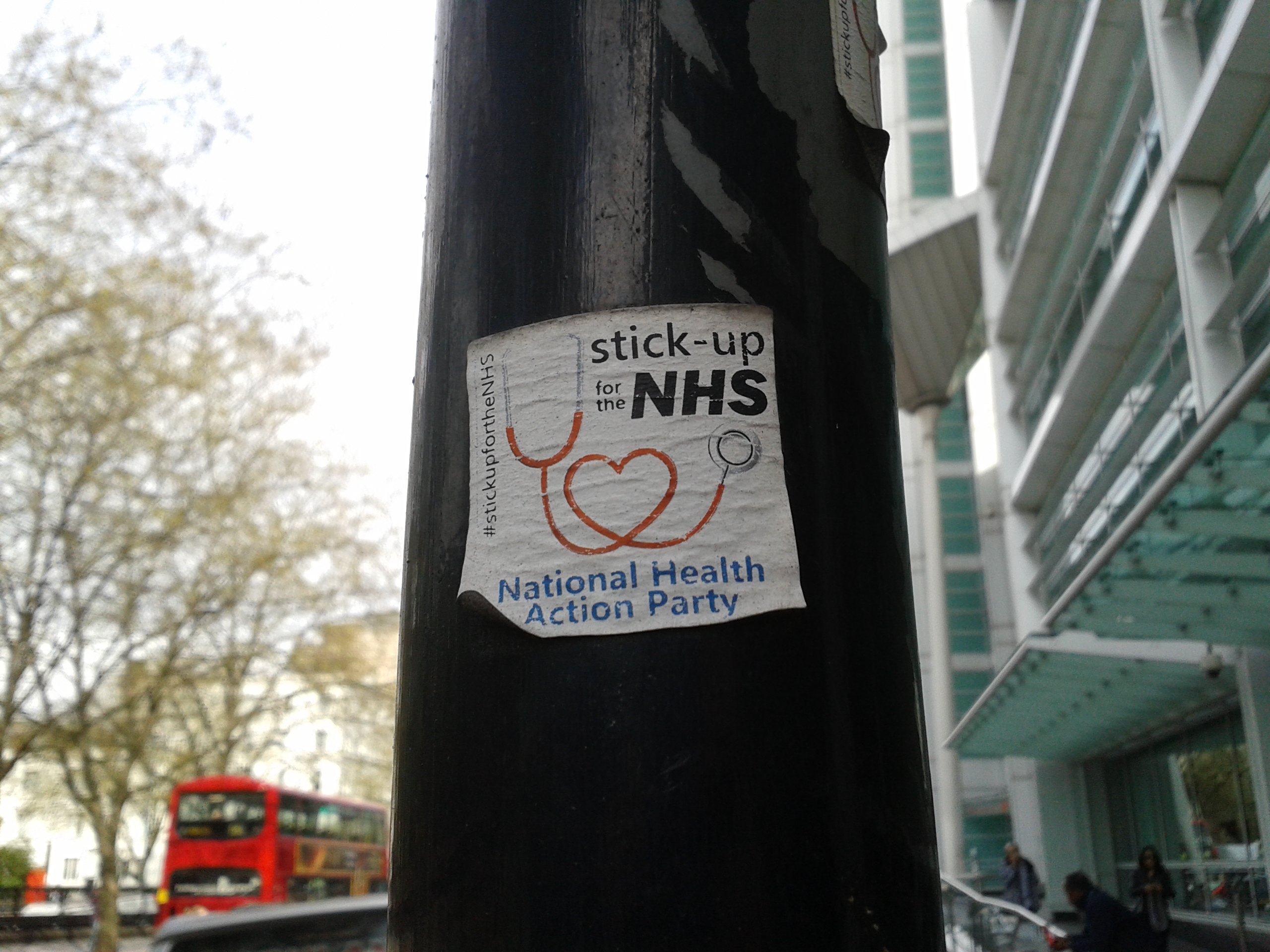
The National Health Action Party is a group that campaigns to halt and reverse the privatisation of the NHS. I found this sticker on the Euston Road, outside the University College London hospital. Sometimes, the location of protest stickers can contribute to their meaning (Photo: Hannah Awcock, Euston Road, 16/06/15).
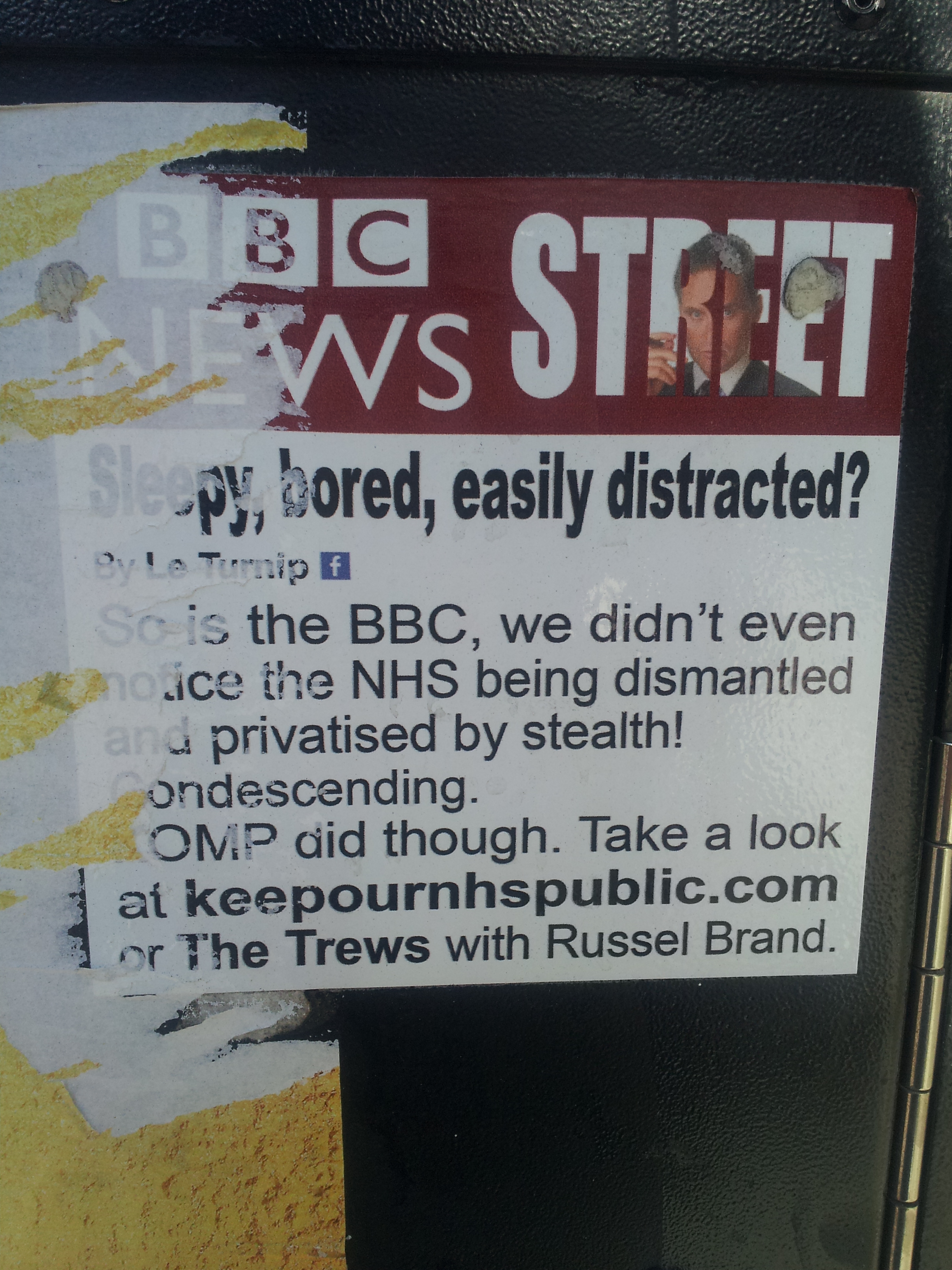
Keep Our NHS Public is another group that campaigns for the preservation of the NHS. Le Turnip produces protest stickers that take a lighthearted and sarcastic view on a whole range of issues (Photo: Hannah Awcock, High Holborn, 09/08/15).
The NHS is not the only health-related issue to inspire the production of protest stickers. Feed the Birds is a campaign run by the London Cannabis Club. The campaign aims to destigmatise cannabis and call for its legalisation by feeding hemp seeds to birds (Photo: Hannah Awcock, Prince Consort Road, 09/07/15).
The Feed the Birds campaign makes some bold claims about the powers of cannabis (Photo: Hannah Awcock, High Holborn, 09/08/15).
This sticker was produced by the Psychadelic Society, which advocates for the legalisation of psychadelic drugs (Photo: Hannah Awcock, Upper Street, Islington, 14/04/15).
Mental health is also a topic which gets people talking. This sticker is objecting to the way in which mental health terms are used in everyday language, which can belittle mental health problems (Photo: Hannah Awcock, Euston Road, 03/08/16).
To see where I found all these protest stickers, check out the Turbulent London Map.
John Rees. The Reveller Revolution: Radical Political Organisation in England, 1640-1650. London: Verso, 2016. £25.
John Rees co-authored one of my favourite books, A People’s History of London. As such, I was really looking forward to the publication of The Leveller Revolution: Radical Political Organisation in England, 1640-1650,and I had high expectations. Whilst it doesn’t quite live up to A People’s History of London, it is a very good book.
The Leveller Revolution is derived from Rees’ doctoral research. As such it is thoroughly researched, as evidenced by the detailed content and and considered analysis. The book is not just a narrative of the rise and fall of the Levellers as a political force, it is also an intervention in the scholarly debate on the nature and significance of the Levellers. Rees argues that whilst other groups used similar organisational and campaigning tactics, no one else used them as consistently and to such effect as the Levellers. He also argues that the Levellers were the only group to focus on popular politics and mobilisation, as opposed to social and political elites.
I have tried to…examine the Levellers as a political movement integrating activists from different constituencies, and creating still broader alliances with other political currents, for the joint pursuance of revolutionary ends.
(Rees, The Leveller Revolution, p. xx)
The Leveller Revolution has multiple strengths. Rees’ arguments are persuasive; he makes a strong case that the Leveller organisation emerged out of pre-existing radical networks consisting of individuals who already had extensive experience of activism. Rees argues that London was significant to the development of the Levellers, but the book is not London-centric; many of the examples Rees uses to demonstrate his arguments come from elsewhere in the country. In addition, whenever there is historical doubt (e.g. over the authorship of a pamphlet, or exactly who was present at a particular event), Rees is open about that uncertainty, then justifies his own opinion. I always appreciate it when authors who are willing to acknowledge these kind of metholodogical subtleties.
Unfortunately, I often struggled to keep track of the book’s narrative, and I think there are 2 reasons for this. The first is that there were a large number of individuals involved in the radical networks around the time of the English Civil Wars, many of whom had quite similar names. As such, I found it difficult to remember who was who. Whilst there is little Rees could have done about the number of individuals involved and their names, a dramatis personae might have been helpful. The second reason for my confusion is, I think, that Rees assumes that the reader has a confident knowledge of the chronology of the Civil Wars. The book refers to events or battles by name only, making it hard to follow the narrative if you do not know when they took place or what happened. I did study the period as part of an A-level in Early Modern History, but that was almost a decade ago, and my knowledge is a bit rusty. If you are not familiar with the period, then I suggest reading The Leveller Revolution in conjunction with another book that details the key events of that time (I would recommend A Brief History of The English Civil Wars: Roundheads, Cavaliers and the Execution of the King by John Miller).
The Leveller Revolution is a thoroughly-researched, well-argued book. Whilst I found it less approachable than A People’s History of London, I would definitely recommend it to anyone who has a interest in the English Civil Wars, or the history of protest and dissent.
Turbulent Londoners is a series of posts about radical individuals in London’s history who contributed to the city’s contentious past, with a particular focus of women, whose contribution to history is often overlooked. My definition of ‘Londoner’ is quite loose, anyone who has played a role in protest in the city can be included. Any suggestions for future Turbulent Londoners posts are very welcome. Today I’m looking at Barbara Leigh Smith Bodichon, a feminist and campaigner for women’s rights.
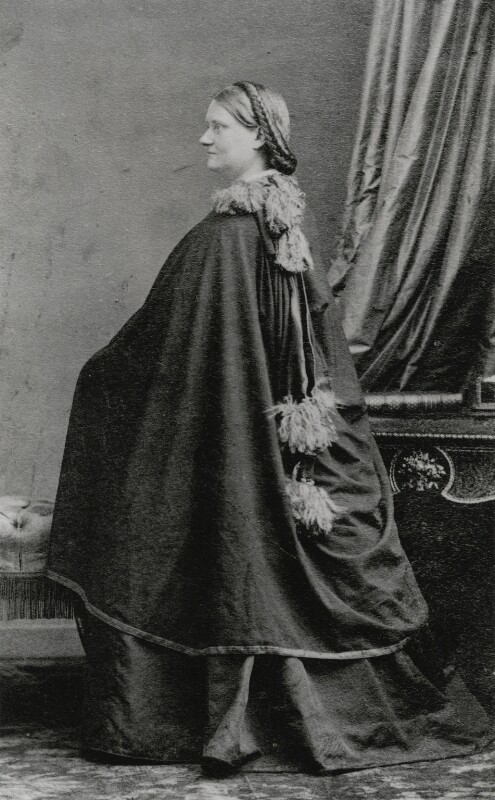
Barbara Leigh Smith Bodichon by Disdéri, copied by Emery Walker Ltd. Copy glass plate negative of an albumen carte-de-visite, circa 1860. NPG x200062 (Source: National Portrait Gallery).
Barbara Leigh Smith was born on the 8th of April 1827, the oldest of 5 children. Her mother was Anne Longden, a milliner, and her father was Ben Leigh Smith, a radical Whig politician. Barbara’s parents never married, but lived openly together, so she must have been used to controversy from a young age. Ben Leigh Smith held radical political views, despite being a member of the landed gentry. He treated all five of his children the same; he gave each of them £300 a year when they turned 21. It was highly unusual to for women to be treated this way. Like Elisabeth Jesser Reid, Barbara’s wealth gave her independence, a rare condition for single women at the time.
Barbara used her wealth to start a progressive school in London, researching other schools in London when deciding how to set it up. Later in life she co-founded Girton College in Cambridge, the first residential college for women that offered education to degree level. She gave generously to the college, in terms of both time and money. Her primary concern, however, was women’s rights. She was a member of one of the first organised women’s movements, known as The Ladies of Langham Place. They were a group of women who met regularly during the 1850s at no. 19 Langham Place to discuss women’s rights. They campaigned on many issues, including the property rights of married women. Langham Place served as sort of gentlemen’s club for women; it had a reading room, coffee shop, and meeting room. In 1858 it also became the base of the English Women’s Journal. Barbara set up the monthly periodical for the discussion of women’s employment and equality, such as expanding employment opportunities and legal rights.
As well as a campaigner and publisher, Barbara was also an author. In 1854 she published Brief Summary of the Laws of England Concerning Women, and in 1858 she wrote Women and Work, in which she argued that women’s dependence on their husbands was degrading. She practiced what she preached too; as a young woman she fell in love with John Chapman, the editor of the Westminster Review. She refused to marry Chapman because of her views on the legal position of married women. Barbara did marry eventually however, to French physician Dr. Eugene Bodichon in 1857. This is also the year that the Matrimonial Causes Act was passed. The Act protected the property rights of divorced women, and allowed divorce through the courts rather than by an act of Parliament, which was a slow and expensive process. Barbara had testified to a House of Commons committee looking into the legal position of married women, which led to the Act.
Married life did not mellow Barbara, however. Although she started spending the winter in Algiers, she continued to take an active role in women’s rights campaigns. In 1866 she founded the first ever group asking for women’s suffrage. The Women’s Suffrage Committee organised a petition, which was presented to the House of Commons by John Stuart Mill.
Barbara Leigh Smith Bodichon was a strong character, sympathetic to many causes. Her primary cause, however, was women’s rights, and she used the full range of skills and opportunities available to her to advance this cause. Her efforts had very real effects, particularly in relation to married women.
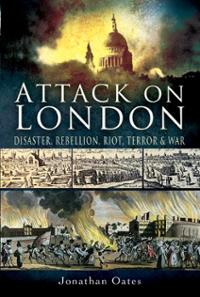
Jonathan Oates. Attack on London: Disaster, Rebellion, Riot, Terror and War. Barnsley: Wharncliffe Local History, 2009. RRP £19.99.
Out of all the high street chains of bookstores, I have a particular fondness for The Works. If you’ve never come across one before, it’s a sort of outlet store for books and stationary, and I can rarely resist having a browse when I walk past one. I have found numerous bargains in there over the years, including Attack on London by Jonathan Oates.
Dr. Jonathan Oates is the Ealing Borough Archivist and Local History Librarian, but he has also published numerous books on London’s history, particularly its more criminal elements. In Attack on London Oates, inspired by the 7/7 bombings, traces how Londoners have reacted to tragedy, shock, and trauma. Starting with the Peasant’s Revolt in 1381, Oates documents some of the most severe hardships faced by London, including the Great Plague (1665-1666), the Gordon Riots (1780), the Clerkenwell Outrage (1867), Bloody Sunday (1887), aerial bombing during both World Wars, IRA bombings during the 1970s, and the 7/7 bombings in 2005. Oates concludes by arguing that such dramatic events bring out both the best and the worst of Londoners; there has been resilience, bravery, and unity, but also looting and xenophobia.
If you are familiar with London’s history, then there probably isn’t much in Attack on London that will be new to you, although I was surprised to learn about the extent of aerial bombing on the capital during the First World War. However, the way the which Londoners reacted to these well-known events is a new angle, which brings together disparate events such as riot, war, disease, and fire in an interesting way. Oates’ referencing style is not very detailed, so it is difficult to identify the exact sources of his work, but it seems to be a well-researched book.
There are some elements of Attack on London that feel a little ‘amateur’. For example, each chapter ends with a conclusion identified as such with a subheading. This feels a little out of place in a history book aimed at a popular audience. Also, one of the photos reproduced in the book, of a plaque commemorating the deaths of 77 people in an air raid bombing in Southwark in October 1940, is blurry. I know I’m being picky, but little things like these combine to give a general impression of not-quite-finishedness that could have been so easily avoided. In addition, the book commits one of my biggest personal faux pas; putting all of the images on a few glossy pages in the middle of the book, and not referring to them in the main text. I know that lots of books have their images arranged in such a way, I guess it is an effective or cost-efficient way of illustrating books. I can understand that, although I would prefer to have the images close to the relevant text. However, when the author does not refer to the images in the text, then they become almost pointless, as they do not serve to back up or illustrate a particular point. Attack on London is by no means the only book that does this, but it winds me up nonetheless.
Because I found Attack on London in a bargain bookshop, it cost me quite a bit less than the £19.99 recommended retail price, which is a bit steep, in my opinion, for what you get. Nevertheless, it is an easy-to-read, engaging reflection on the best and the worst facets of Londoners.
Turbulent Londoners is a series of posts about radical individuals in London’s history who contributed to the city’s contentious past, with a particular focus of women, whose contribution to history is often overlooked. My definition of ‘Londoner’ is quite loose, anyone who has played a role in protest in the city can be included. Any suggestions for future Turbulent Londoners posts are very welcome. My next Turbulent Londoner is Jane Cobden, one of the first women to be elected to the London County Council.
Fans of Victorian crime drama Ripper Street might recognise Jane Cobden from series 2 and 3. Played by Leanne Best, Cobden was a strong, opinionated London County Councillor, more than a match for love interest Detective Inspector Edmund Reid. But how does the character match up to the real Jane Cobden?
Born Emma Jane Catherine Cobden on the 28th of April 1851 in Westbourne Terrace, London, Jane was the fourth of sixth children of the well-known reformer and politician Richard Cobden. She devoted her life to campaigning for women’s rights and protecting and developing her father’s legacy- she was committed to the’Cobdenite’ issues of land reform, peace and social justice.
In 1869 Jane moved to South Kensington with her sisters Ellen, Anne and Kate, also dedicated activists. Jane was active on the radical wing of the Liberal Party, and became increasingly committed to the cause of women’s suffrage over the 1870s. In 1871, she attended the Women’s Suffrage Conference in London with her sister Anne. In about 1879 she joined the National Society for Women’s Suffrage, and by the following year she was the organisation’s Treasurer.
The National Society was cautious, avoiding close association with political parties and excluding married women from their demand for the vote. This was too conservative for some, and the Central National Society broke away in 1888. In 1889 this group split again, and the Women’s Franchise League (WFL) was formed, including Cobden and Emmeline Pankhurst. The WFL’s aims were more radical- they wanted votes for women on the same basis as men, and women to be eligible for all political offices. Jane was politically pragmatic as well as ambitious, however. She disagreed with the mainstream Liberal Party’s stance on many issues, but remained a member because she believed it was the best way to advance her causes.
In the late 1880s, no one was sure whether women could serve as councillors or not; the law was unclear. In November 1888, the Society for Promoting the Return of Women as County Councillors (SPRWCC) was set up to test the law. This catchily-named organisation set up a £400 election fund and choose two women to stand as Liberal candidates for the newly established London County Council. Jane stood in Bromley and Bow, and Margaret Sandhurst stood in Brixton. Jane campaigned on a variety of issues, including opposition the tax on coal, better housing for the poor, “fair” wages, and opposition to sweat shops. Both women won, but their positions were not secure; there were many who opposed their election and tried to overturn the results. Sandhurst’s election was challenged by the man she defeated, and her election was declared invalid. Jane was supported by her runner-up, who was also a member of the Liberal Party. However, a judge eventually ruled that Jane’s election was unlawful, and therefore so were her votes in the council. She quietly served the rest of her term, and did not stand for reelection. It wasn’t until the Qualification of Women Act in 1907 that women legally gained the right to sit on county councils; Cobden was truly a woman before her time.
In 1892, aged 41, Jane married Thomas Fisher Unwin, a publisher. Encouraged by him, Jane expanded her interests to include international peace and justice, and rights of aboriginal people around the world. The couple strongly opposed the Boer War. In 1893, Jane represented the WFL at the World Congress of Representative Women in Chicago.
Jane Cobden as portrayed by Leanne Best in BBC/Amazon drama Ripper Street (Photo: BBC).
As the campaign for women’s suffrage gained pace after 1900, Jane chose not to participate in the illegal activities of the WSPU, but she fiercely defended her sister, Anne, when she was imprisoned for a month in October 1906. She organised the Indian women’s delegation in the Women’s Coronation Procession on the 17th of June 1911, a few days before the coronation of George V. Cobden never gave up on a political solution to women’s suffrage. The Conciliation Bills of 1910-12 would have given a small number of propertied women the vote. Cobden asked the Irish Parliamentary Party to support the doomed bills, because of the support that women had given to the Land League campaign in England. She also continued to campaign for other causes she cared about during this time, publishing two books on the subject of land reform: The Hungry Forties: Life Under the Bread Tax (1904) and The Land Hunger: Life Under Monopoly (1913).
Jane Cobden died on the 7th of July 1974, aged 96. The BBC’s synopsis of her character in Ripper Street describes her as “one of the giants on whose shoulders the Suffragette Movement was to stand,” and it doesn’t exaggerate. Cobden may be more well-known than other women’s rights pioneers because of her portrayal in Ripper Street, but I think her achievements still deserve more recognition.
Sources and Further Reading
Baldwin, Anne. “Women’s History Month: Persistence Pays Off, as Women are Finally Elected to the London County Council.” Women’s History Network. Last updated 5 March 2010, accessed 31 October 2016. Available at http://womenshistorynetwork.org/blog/?tag=jane-cobden
Richardson, Sarah. “What Next, and Next? The Cobden Movement: Fleeting or Fundamental?” Liberty Fund. Last updated 8 January 2015, accessed 31 October 2016. Available at http://oll.libertyfund.org/pages/lm-cobden
You find stickers of all kinds all over London, sometimes even in posh places, like these outside the National History Museum in South Kensington (Photo: Hannah Awcock, Exhibition Road, 30/08/16).
As regular readers of my blog will know, you can find all kinds of different issues represented on the protest stickers that plaster London’s streets. Over the last year and a half, I have written about protest stickers relating to immigration and race, housing, and the EU referendum, amongst others (see the Turbulent London Map for locations of all the stickers I’ve featured). But all of my topics so far have been rather human-centric, and many activists concern themselves with the non-human. The way that humans treat animals has been a topic of fierce debate for decades. It’s a complex issue, which can escalate rapidly into a philosophical debate about whether or not animals are entitled to certain rights in a similar way to humans. The debate also manifests itself in practical ways however, such as opposition to experiments being carried out on animals, and concern for the treatment of farm animals bred for human consumption. In recent years, ethical consumerism has reduced the amount of product testing carried out on animals, and vegetarianism and veganism has increased (the number of vegans in Britain has gone up 360% in the last 10 years (Source: The Telegraph, 2016). This has not been enough to satisfy everyone, however, and animal welfare continues to be a topic of protest stickers.
This sticker equates animal with human liberation, mirroring the symbolic raised, clenched fist with a raised paw (Photo: Hannah Awcock, New Cross Road, 23/08/16).
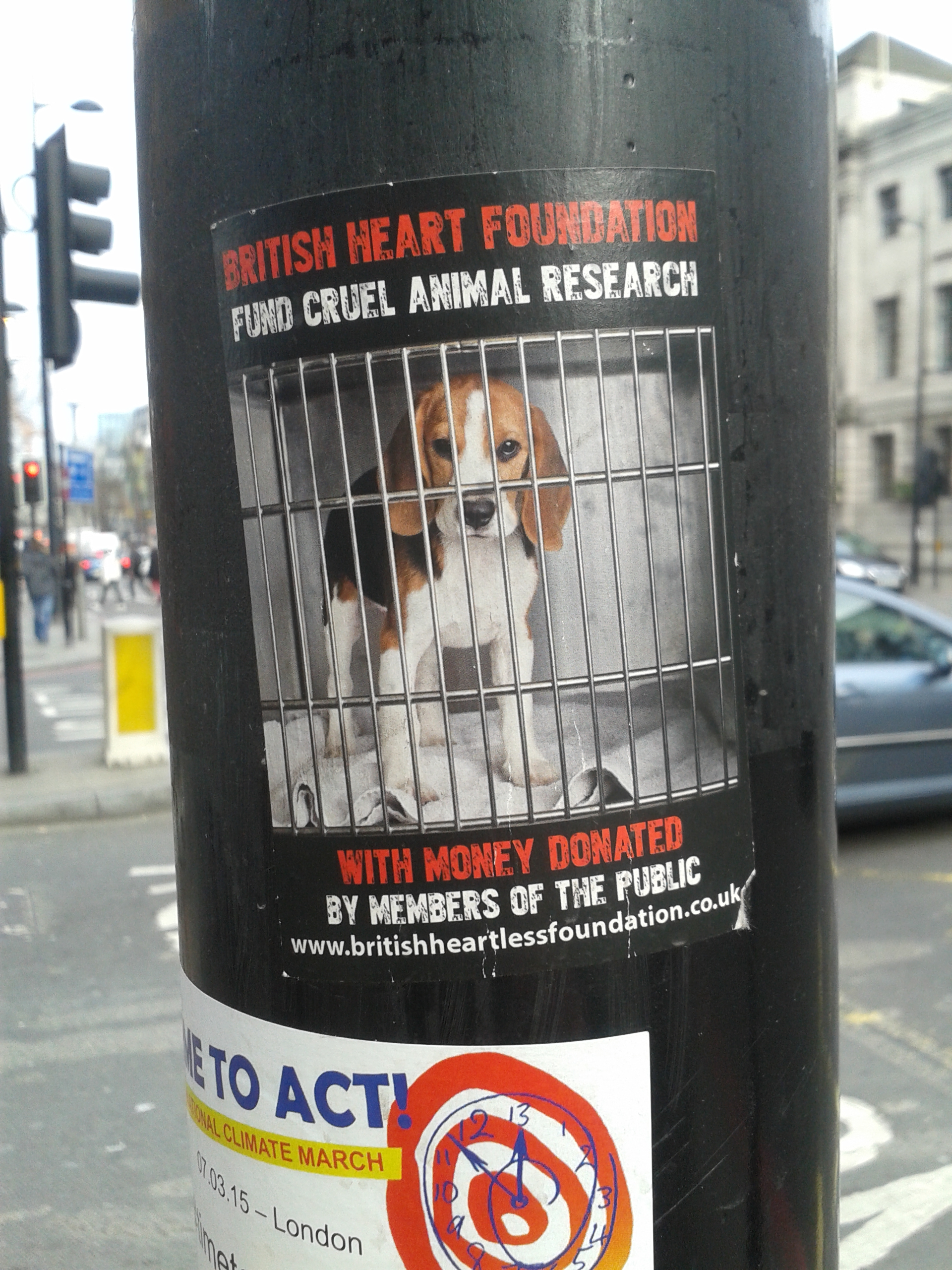
The British Heart Foundation’s (BHF) use of animal experimentation is a common topic of protest stickers in London. The British Heartless Foundation is an organisation that aims to promote the fact that the BHF fund experiments on animals- they argue that less people would donate money to the BHF if they knew that was the case (Photo: Hannah Awcock, Euston Road, 11/03/15).
The British Heartless Foundation produce a variety of different stickers. This one features rats (Photo: Hannah Awcock, East Street, Southwark, 04/06/15).
According to the British Heartless Foundation, BHF also fund experiments on pigs (Photo: Hannah Awcock, Tottenham Court Road, 19/05/15).
This sticker references recent culls of badgers in an attempt to prevent the spread of bovine TB. The effectiveness of the policy has been questioned by campaigners, who argue that the policy is cruel and unnecessary (Photo: Hannah Awcock, Southbank, 12/09/15).
A lot of protest stickers promote vegetarianism and veganism. This sticker equates killing animals for food with murdering a human (Photo: Hannah Awcock, New Cross Road, 20/03/16).
The Friendly Activist is a vegan who campaigns for animal rights and the environment, amongst other things. He seems to have gone quiet recently though (Photo: Hannah Awcock, Borough High Street, 26/06/15).
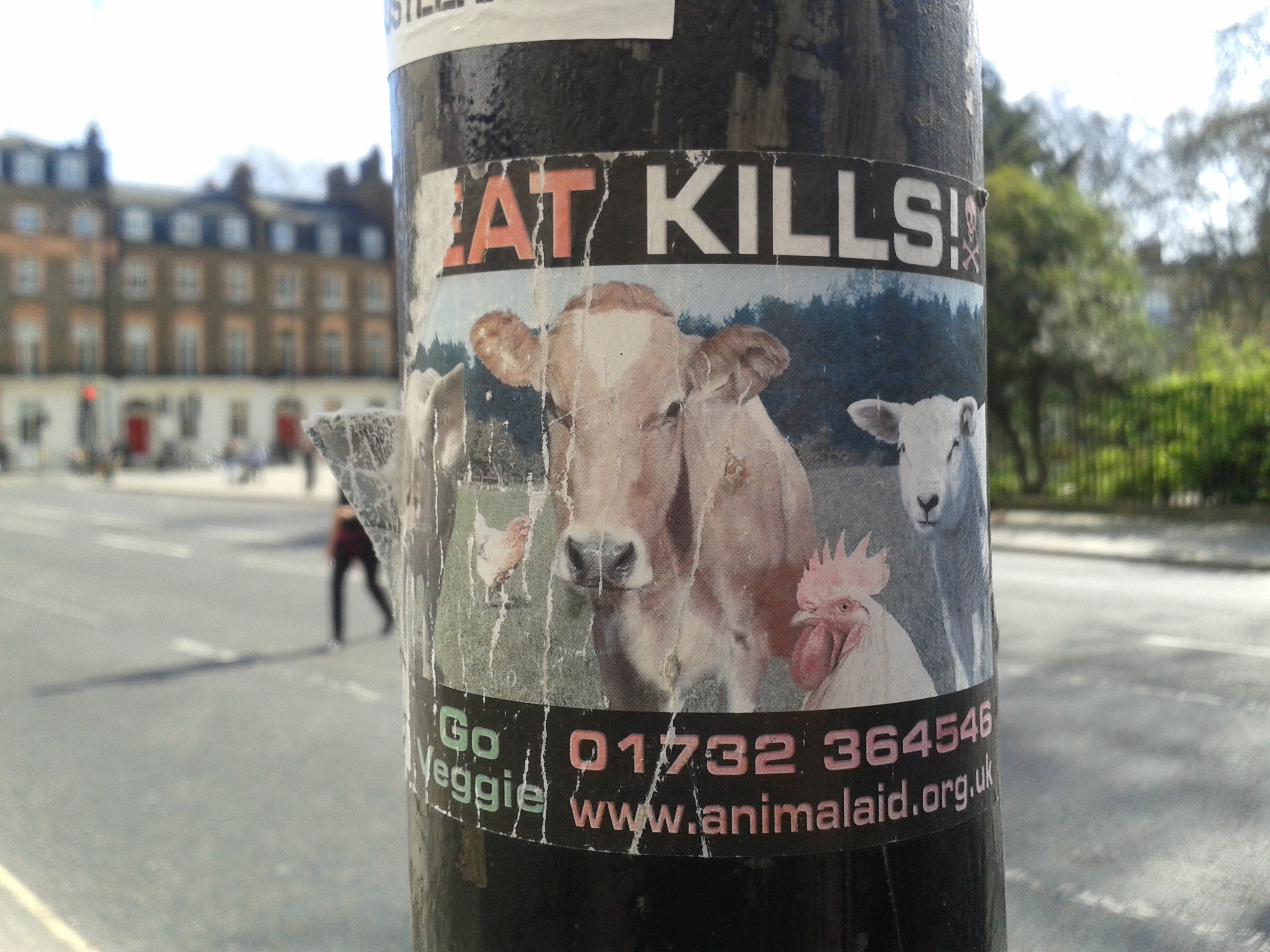
Animal Aid campaigns against all forms of cruelty against animals and promotes what they call ‘cruelty-free living’ (Photo: Hannah Awcock, Russell Square, 15/04/15).
This sticker is relatively low-tech; it is not very waterproof, so is likely to deteriorate quickly. Veganstickers.co.uk sells vegan protest stickers, and Earthlings is a documentary about animal cruelty (Photo: Malet Street, 08/03/16).
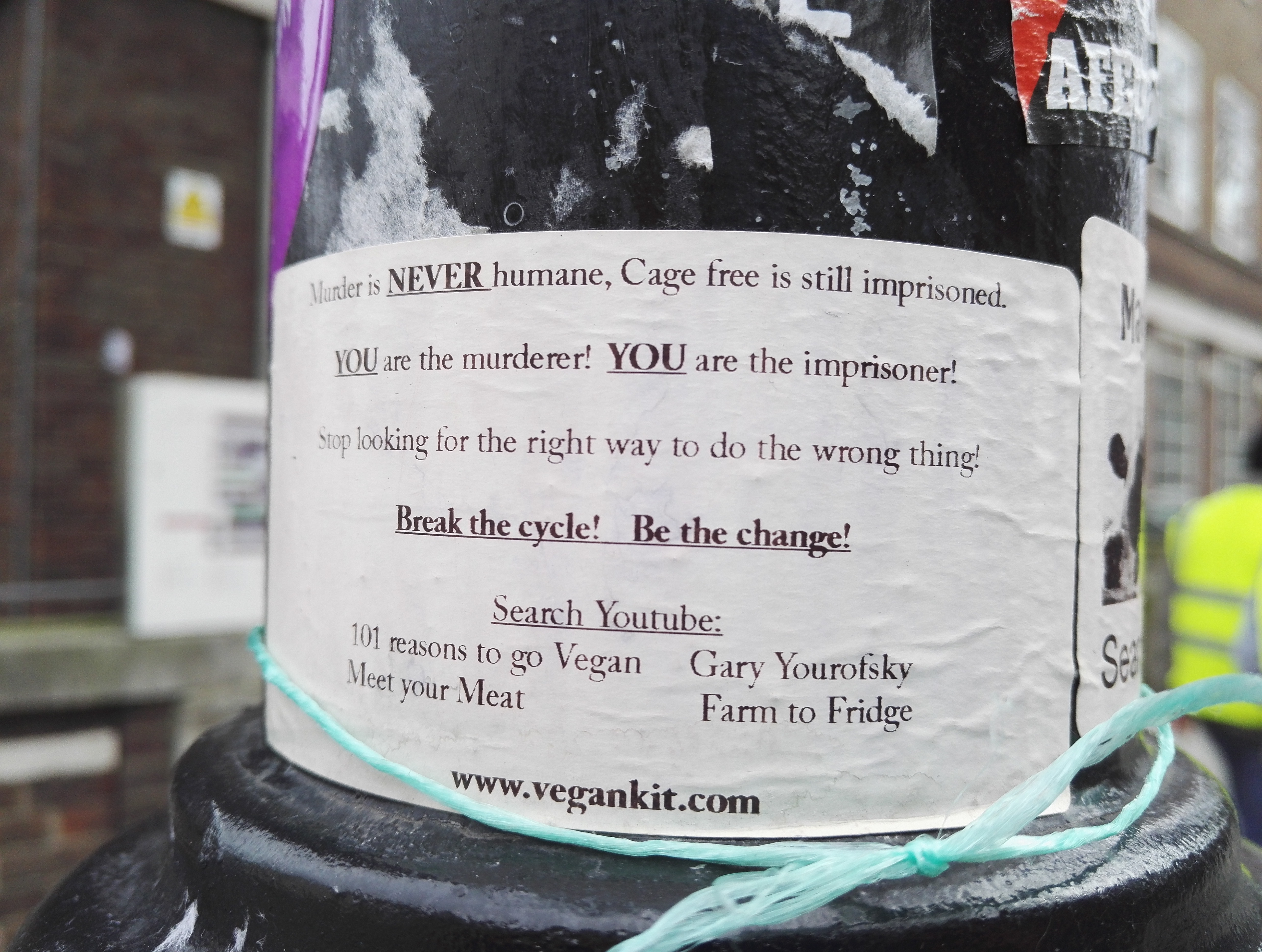
This sticker is a similar style and quality. It is advertising vegankit.com, a website that provides advice, information, and links to vegans and people who are considering veganism (Photo: Hannah Awcock, Malet Street, 08/03/16).
This sticker is the same as the last, although its condition suggests it has been out on the street for longer. The photo was taken two months after the previous one and close by, so they could have been put up at the same time. Someone has crossed out the YouTube videos and web address, perhaps because they disagree with the sticker’s message (Photo: Hannah Awcock, 03/05/16, Gower Street).
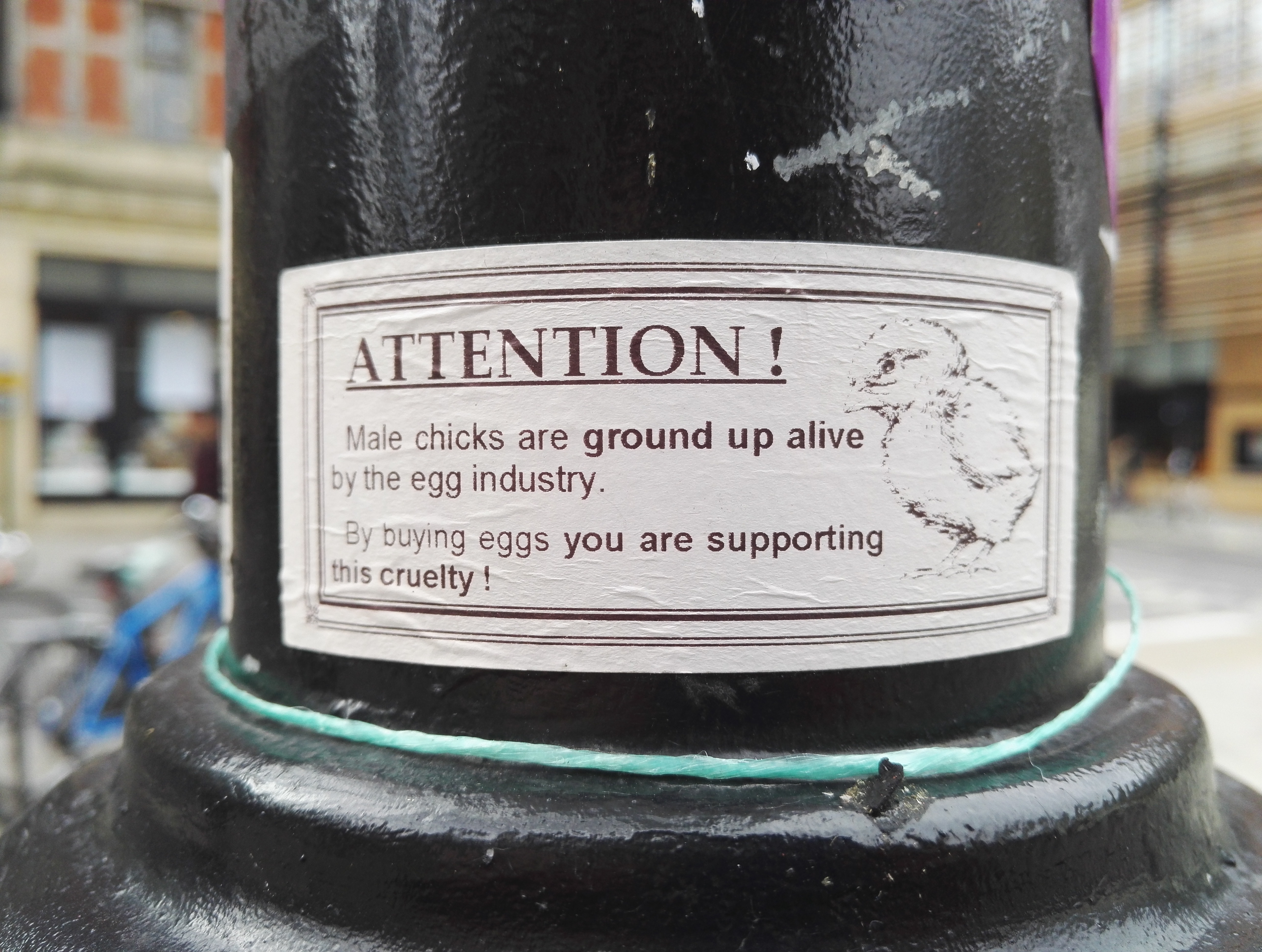
This sticker was also located in the same vicinity as the previous two; they may have been put up by the same person (Photo: Hannah Awcock, Malet Street, 08/03/16).
Location can be very important for protest stickers. I found this sticker outside a McDonalds in Islington (Photo: Hannah Awcock, Upper Street, Islington, 01/12/15).
If you want to see where all these stickers were located, take a look at the Turbulent London Map.
If you asked the average person to name individual suffragettes, they would probably say Emmeline or Christabel Pankhurst, or perhaps Emily Davison. There were, however, many individual women who contributed to the campaign for female suffrage, including Sylvia Pankhurst, Daisy Parsons, Clementina Black, and Charlotte Despard. Sophia: Princess, Suffragette, Revolutionary tells the story of Princess Sophia Duleep Singh, one of these lesser known, but just as fascinating, women who devoted herself to the fight.
Granddaughter of Ranjit Singh, the Maharaj of the Punjab, Princess Sophia and her siblings occupied a unique position in British society. Her father, originally beloved by Queen Victoria, had turned against the British empire which had taken his birthright. Her family relied on the British government for everything, but their status as Indian royalty gave them a degree of protection that meant they could still be troublesome. Sophia did not resent the British government like her father and some of her siblings, but she did care deeply for the people of India, which she visited several times. There was little she could do for the burgeoning independence movement from so far away, however, and women’s suffrage became the cause to which she devoted her energies.
Sophia is a well-written, thoroughly researched, and detailed biography. Anita Anand has included a wealth of rich details that makes you feel like you really know Sophia, that you understand her motivations. Personally, I welcome anything that helps to extend popular awareness of the suffragettes beyond Emmeline Pankhurst and her most famous daughter, and I also appreciate the way Sophia puts the suffragettes in the context of contemporary non-British social movements, particularly the early campaign for Indian independence. They are mostly seen as a stand-alone phenomena, but the campaign for women’s suffrage took place in the context of a whole range of other social justice movements.
Whilst I understand the necessity of context, there are times where it feels like the book goes into too much contextual detail. Sophia isn’t even born until page 44, and the narrative sometimes veers away from Sophia to dwell on other people and events. It feels a little like padding, which seems unnecessary considering how much source material Anand was able to find about Sophia herself.
Sophia is an enjoyable read, and Anita Anand deserves the praise she has received for it. I would recommend it to anyone interested in women’s history, colonialism, or the women’s suffrage movement.
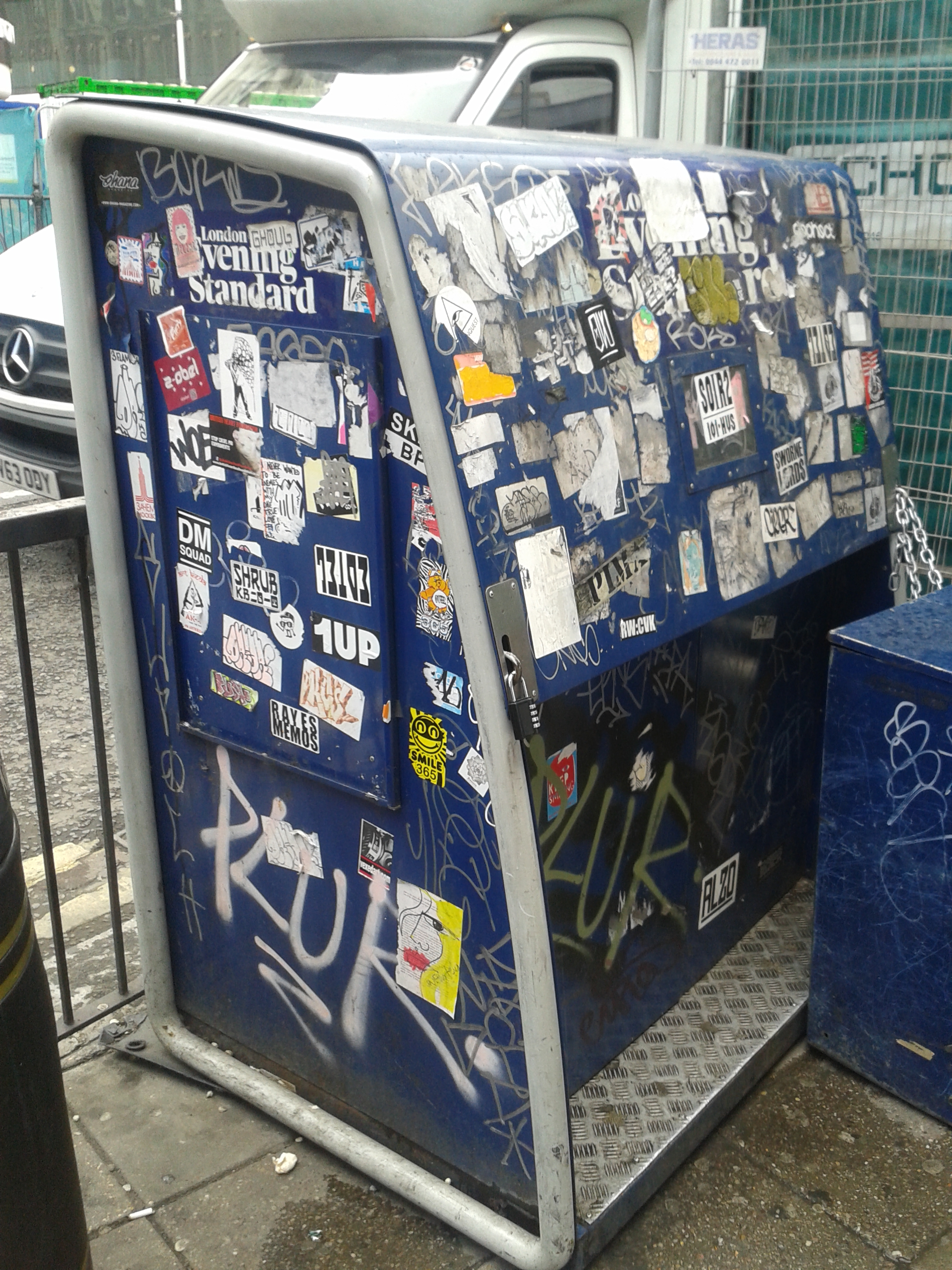
Stickers of all kinds are a common sight on the streets of London. I am particularly interested in the ones with a rebellious or subversive tone (Photo: Hannah Awcock).
London’s protest stickers cover a whole range of topics, from housing to race and immigration. However, some of them don’t fit into any specific category, instead embodying a rebellious ethos. This post is about these stickers, the ones providing good advice for anyone with a subversive streak.
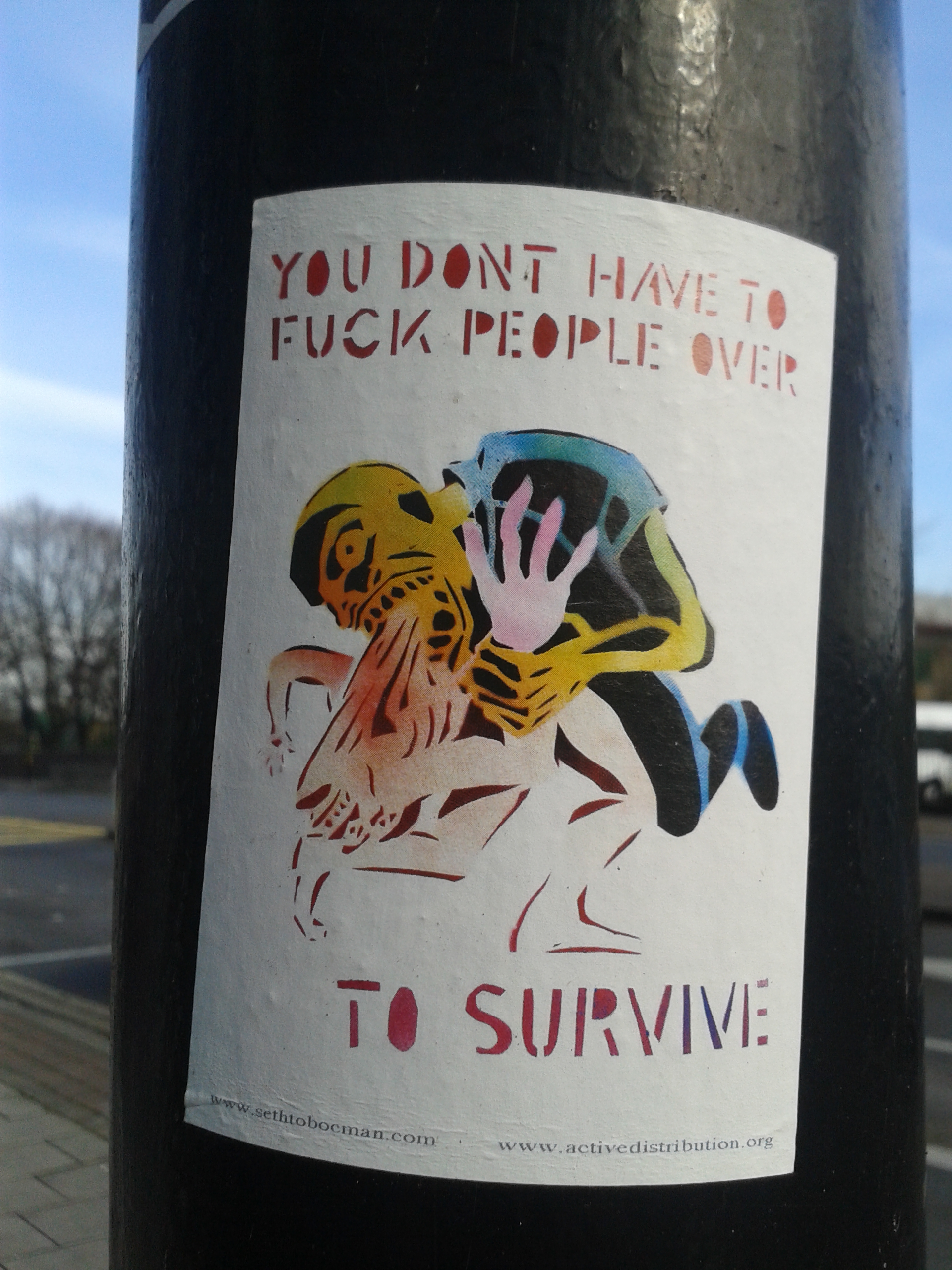
This sticker, photographed on the Tottenham Court Road on 03/09/15, seems like a good place to start. Why should anyone else have a say over the way you live your life? (Photo: Hannah Awcock).
This sticker encourages people to think for themselves- an important quality for anyone involved in social movements or activism (Photo: Hannah Awcock, Waterloo Bridge, 02/06/15).
This sticker links nicely to the previous one- critical thought is an important ability for academics as well as activists. Question everything, never just accept what you are told as the truth. This sticker was photographed outside King’s Cross Station, near the British Library, on 06/06/15 (Photo: Hannah Awcock).
This sticker was photographed in Elephant and Castle on 05/03/15. Even small, everyday acts can be rebellious (Photo: Hannah Awcock).
This sticker is a reminder to everyone that your happiness does not depend on the sadness or deprivation of others. The photo was taken on Albany Road, near the occupied Aylesbury Estate on 02/04/15, making it all the more pertinent (Photo: Hannah Awcock).
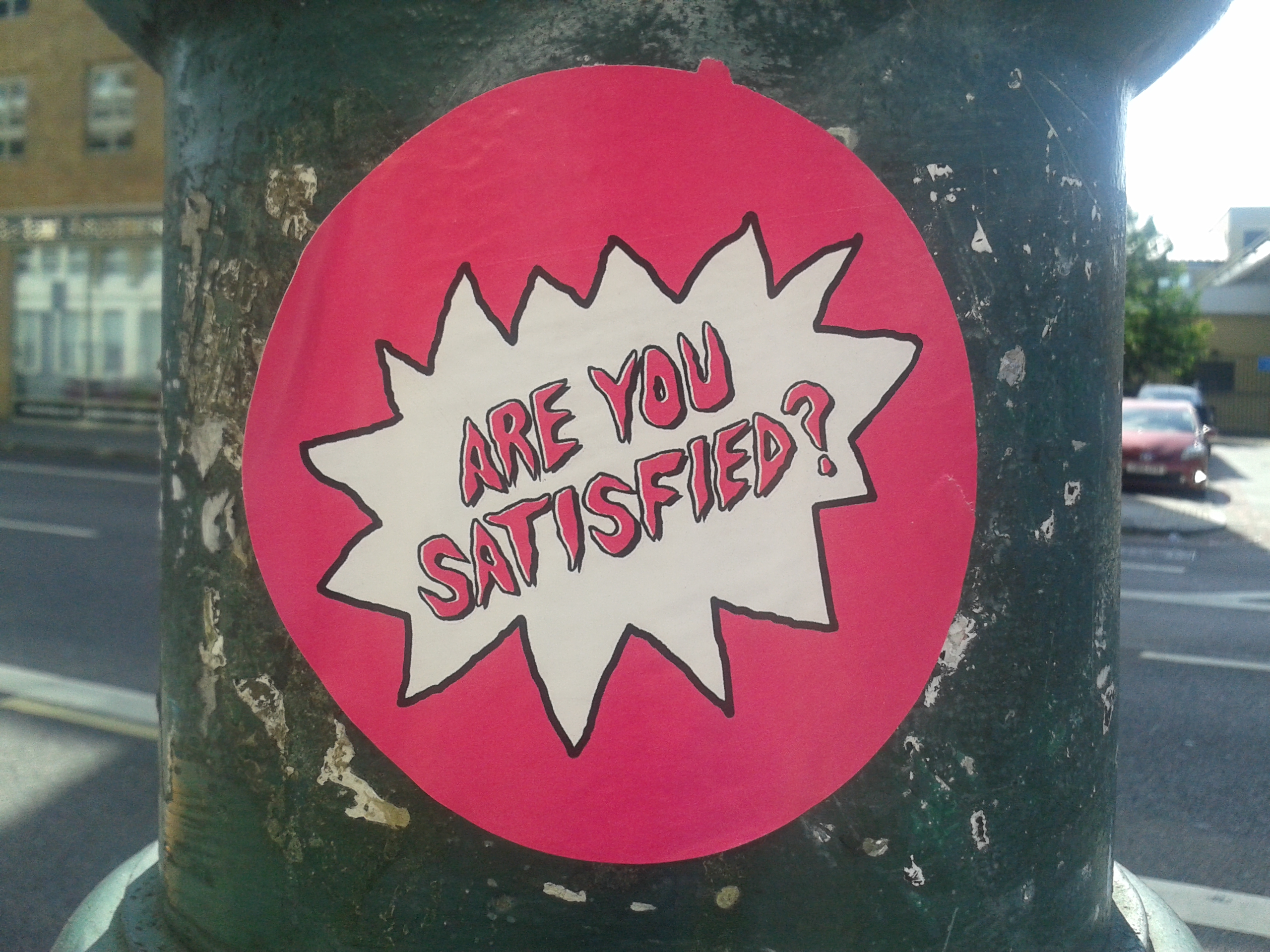
This is a question that everyone should ask themselves every once in a while. If you aren’t, then what can you do to try and change things? (Photo: Hannah Awcock, 07/06/15, Shoreditch Hight Street).
Activists are often told that their demands are impossible, that they will never achieve the change they want to see. It takes a lot of determination to keep going in the face of all that negativity. rs21 is a news and analysis website run by British revolutionary socialists (Photo: Hannah Awcock, 12/03/15, Gordon Square, Bloomsbury).
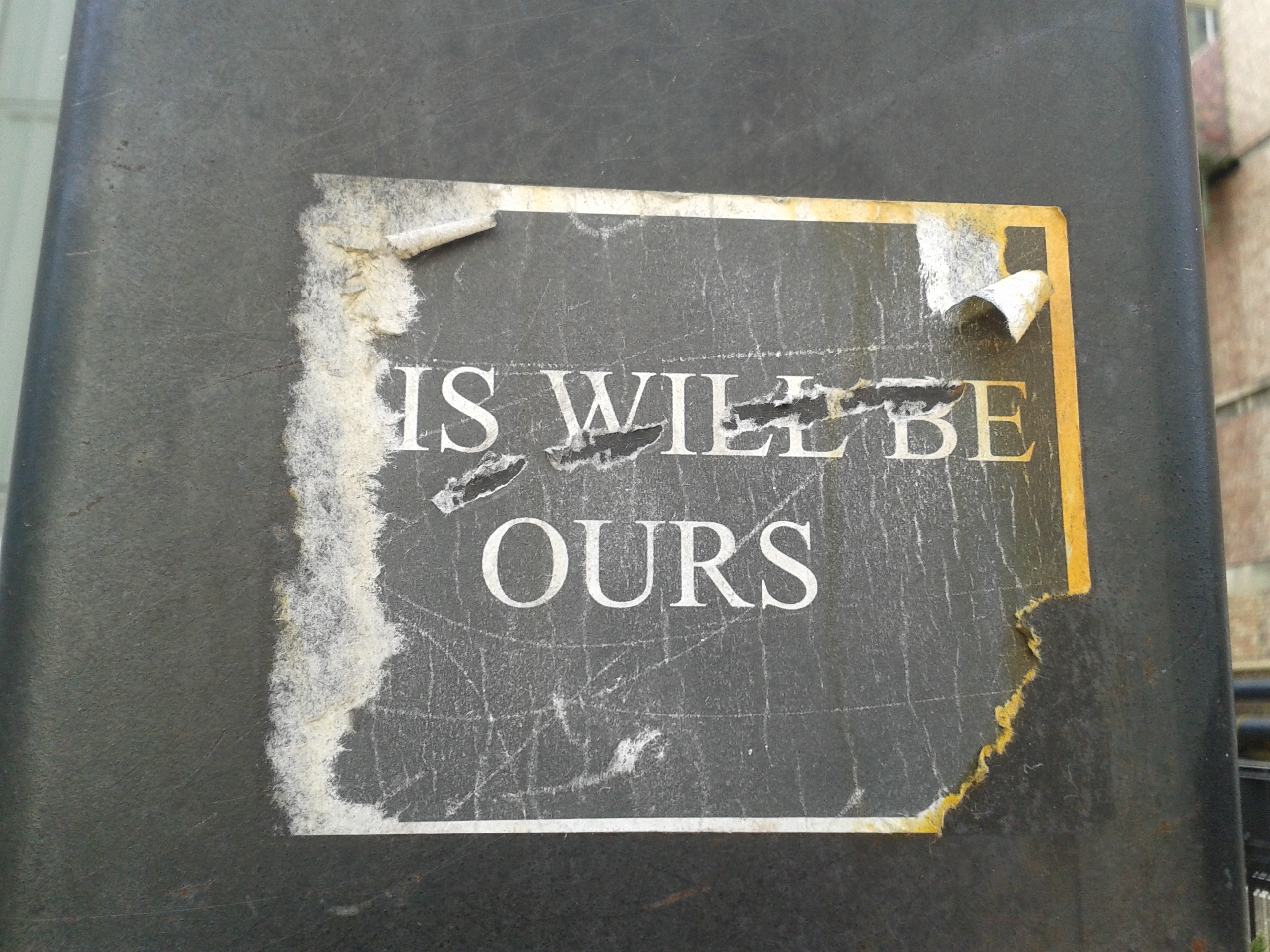
Although scratched and torn, it is easy to make out the intent of this sticker. The message- “This will be ours,” is a determined statement of intent (Photo: Hannah Awcock, 17/04/15, Gordon Street).
This empowering sticker is a reminder that the government only governs because we allow it to. If everyone decided to act together, it would create a very powerful force (Photo: Hannah Awcock, 20/06/15 Fleet Street).
This sticker isn’t protest-related, but I liked it so much that I had to include it. It makes me smile every time I walk past, even if I’m having a bad day. If only all street furniture was so complementary (Photo: Hannah Awcock, 21/05/15, Borough High Street).
The recent Black Lives Matter campaign could give the impression that institutional racism is a distinctly American problem. Britain has had to deal with its own fair share of problems in this regard however, and like in Ferguson and other American cities, tension between the police and ethnic minorities has occasionally flared into violence. The Broadwater Farm Riots, on the 6th of October 1985, were one such occasion.
Overturned and burnt out cars in Broadwater Farm Estate on the day after the riots/uprising. Taken 7 October 1985 (Source: Jim Moody).
At the beginning of October 1985, tensions between police and the black community in Tottenham, north London, were running high. Longstanding grievances were exacerbated by riots in Brixton the previous week, following the shooting of a black woman, Dorothy Groce, during a police search. At lunchtime on the 5th of October Floyd Jarrett, a young black man who lived about a mile away from the Broadwater Farm estate, was arrested and charged with theft and assault- he was later acquitted of both charges. Later that day, however, the police decided to search the house of Floyd’s mother, Cynthia. During the search, 49-year-old Cynthia Jarrett collapsed and died of a heart attack. Her daughter claimed that Cynthia had been pushed by an officer called DC Randle, and the resulting fall could have contributed to her death. Randle denied it, and no police officer was charged or disciplined for what happened.
The black community in London already believed that the Metropolitan Police was institutionally racist (they were probably right!), and the treatment of Cynthia Jarrett sparked outrage. Bernie Grant, local council leader at the time, condemned the search of Cynthia’s house and called for local police chiefs to resign. A demonstration gathered outside Tottenham police station in the early hours of the next morning, the 6th of October. Violence between police and some members of the local community escalated throughout the day; centring on the Broadwater Farm estate. The rioters built barricades, set fire to cars, and threw bricks, molotov cocktails and other projectiles at police, making effective use of the raised walkways on the estate.
At about 9:30 p.m., the police and fire brigade were called to a fire on the upper level of Tangmere House, a block of flats and shops on the estate. Whilst attending the fire, the officers were attacked by rioters and forced to retreat rapidly. A police officer, Constable Keith Blakelock, tripped and fell in the confusion. He was immediately surrounded by rioters, who beat and repeatedly stabbed him in a vicious attack. PC Bl//akelock became the first police officer to be killed in a riot in Britain since 1919. n
The riot tailed off during the night as it started to rain and news of Blakelock’s death spread. The impacts of the riots, however, would last a lot longer than 24 hours. Determined to find Blakelock’s killers, the Metropolitan Police maintained a heavy presence on the Broadwater estate for several months, arresting and questioning over 300 people, many of whom were denied access to a lawyer. The riots led to changes in the police’s tactics and equipment for dealing with riots, and efforts to reengage with the local community.
Six people were eventually charged with the murder of Keith Blakelock; although the investigation and ensuing court cases were severely hampered by officers who were willing to cut corners and ignore the law. Three children had their cases dismissed after a judge ruled that they had been held and questioned inappropriately. Three adults, Winston Silcott, and Engin Raghip and Mark Braithwaite, were convicted and sentenced to life imprisonment despite there being no witnesses and no forensic evidence. All three were cleared by the Court of Appeals in November 1991. In July 2013, a man named Nicholas Jacobs was charged with Blakelock’s murder, but was cleared at trial.
Neither Cynthia Jarrett nor Keith Blakelock have received justice for what happened to them. Although from different ‘sides’ of the conflict, both were victims of an institutionally racist society that was creating tension between those in authority and communities in London and across Britain. We are kidding ourselves if we think these tensions no longer exist, and the Broadwater Farm Riots are a stark reminder of the danger of overlooking such problems.
Don’t forget to check out the location of the Broadwater Farm Riots on the Turbulent London Map!
The recent EU Referendum was arguably one of the biggest political events to happen in my lifetime. I haven’t written about it before because I felt there were enough opinions being voiced and, quite frankly, I didn’t know what to say. In the weeks since, however, I have started to come to terms with the result, and on recent trips to London I have found something that I do know how to talk about- protest stickers. Like all big events and political topics (other recent ones include the 2015 General Election, the London housing crisis, and immigration), the EU Referendum left its mark on the streets of London in the form of protest stickers, which serve as constant reminders of the Brexit result.
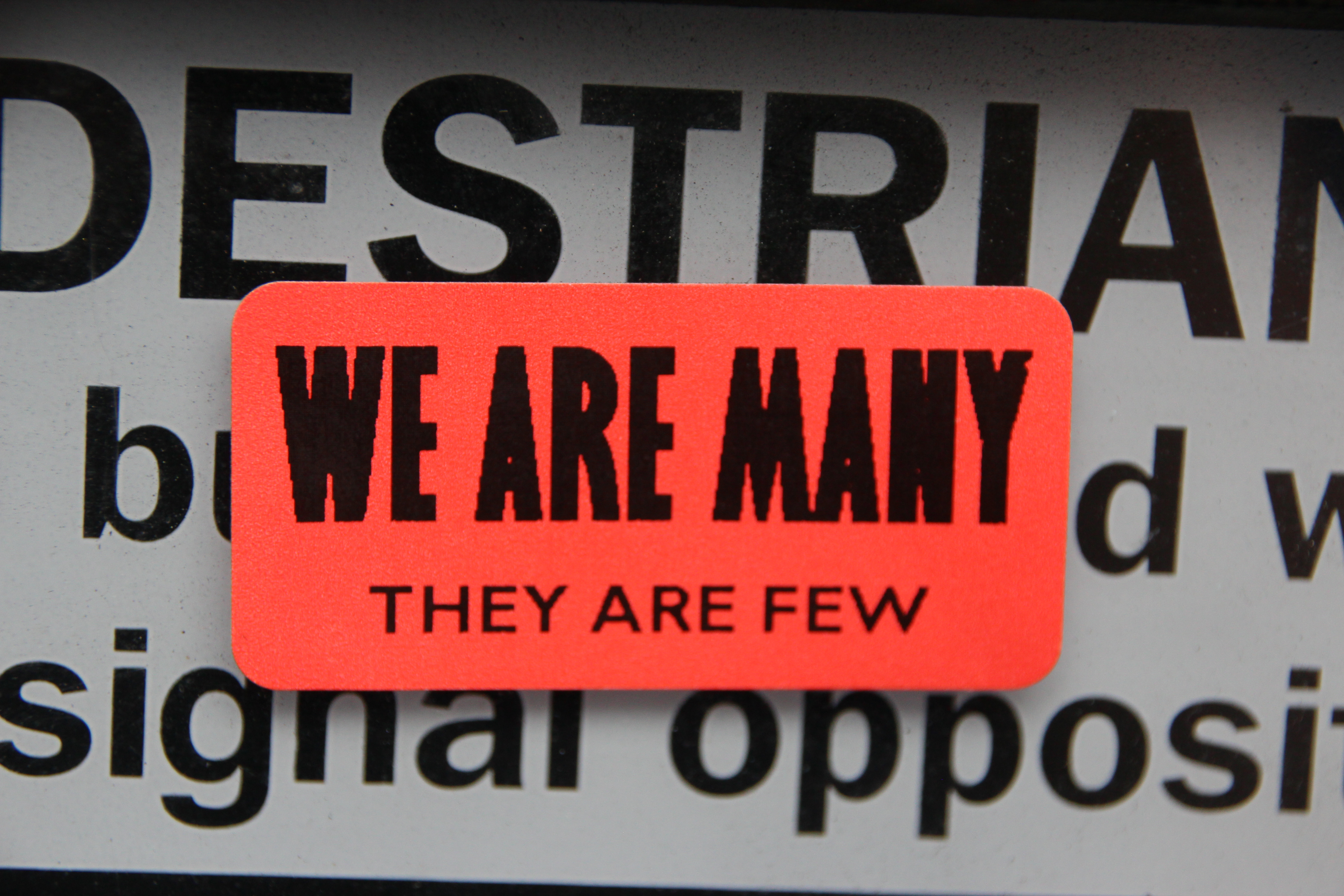
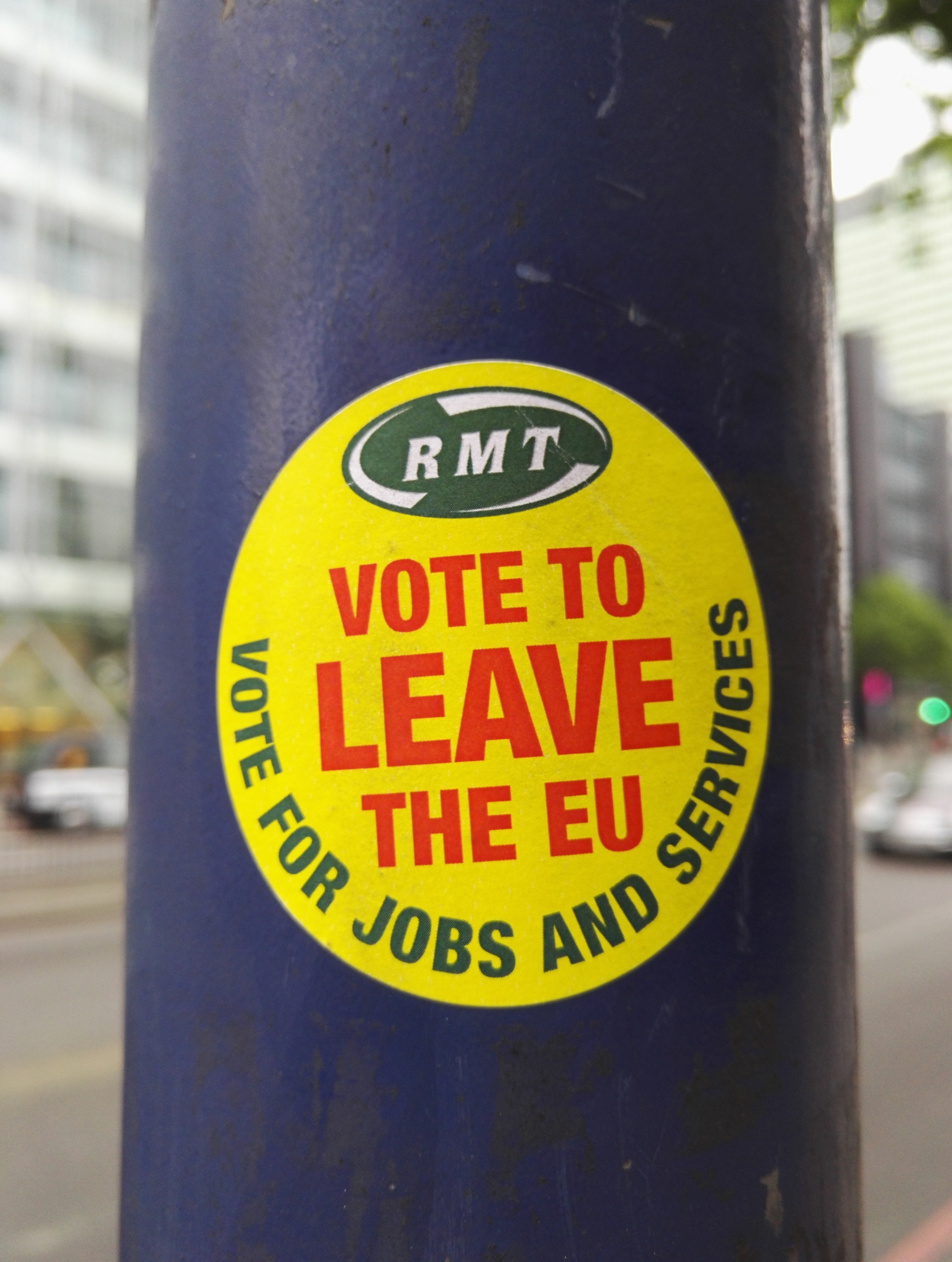
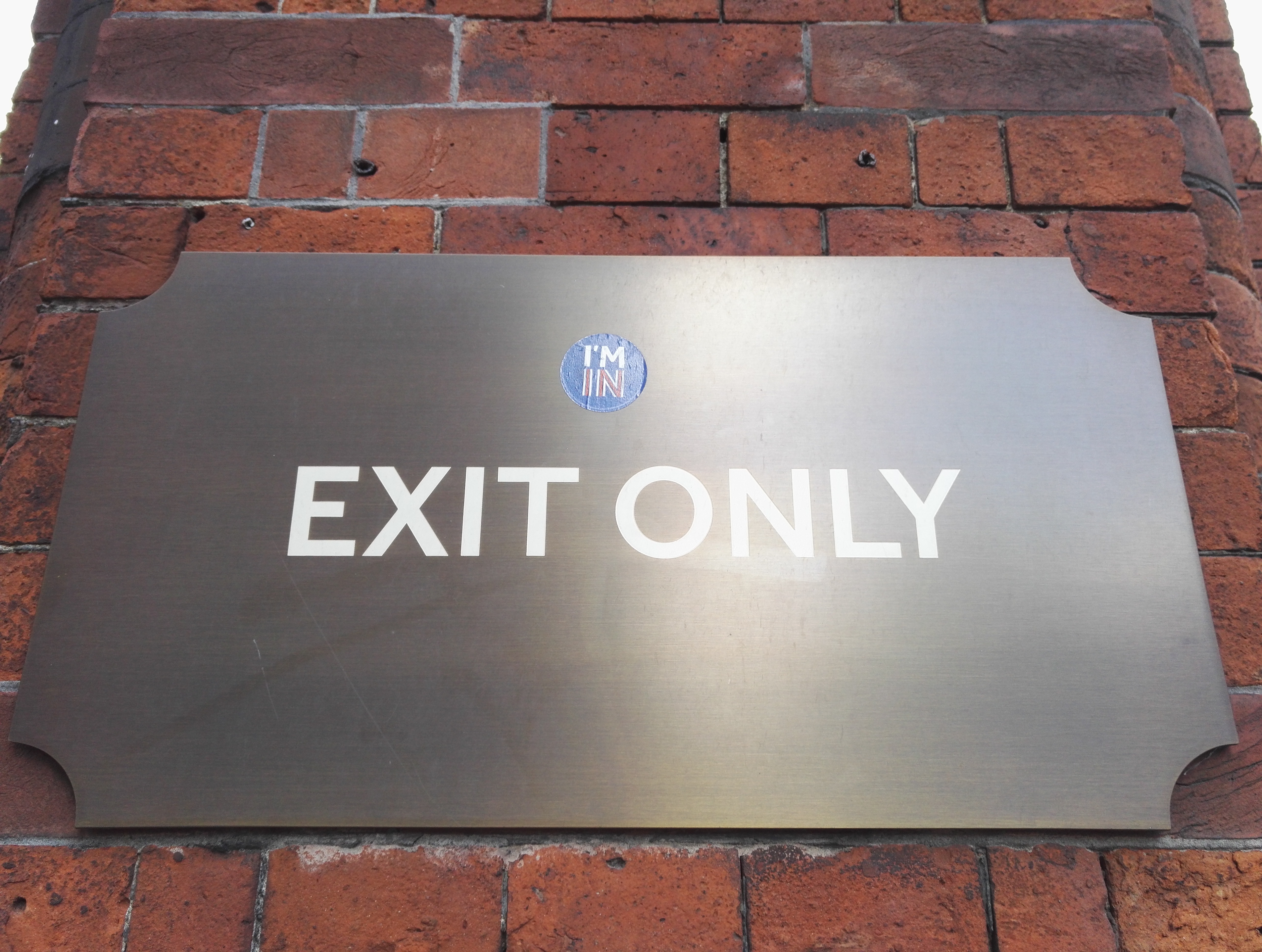
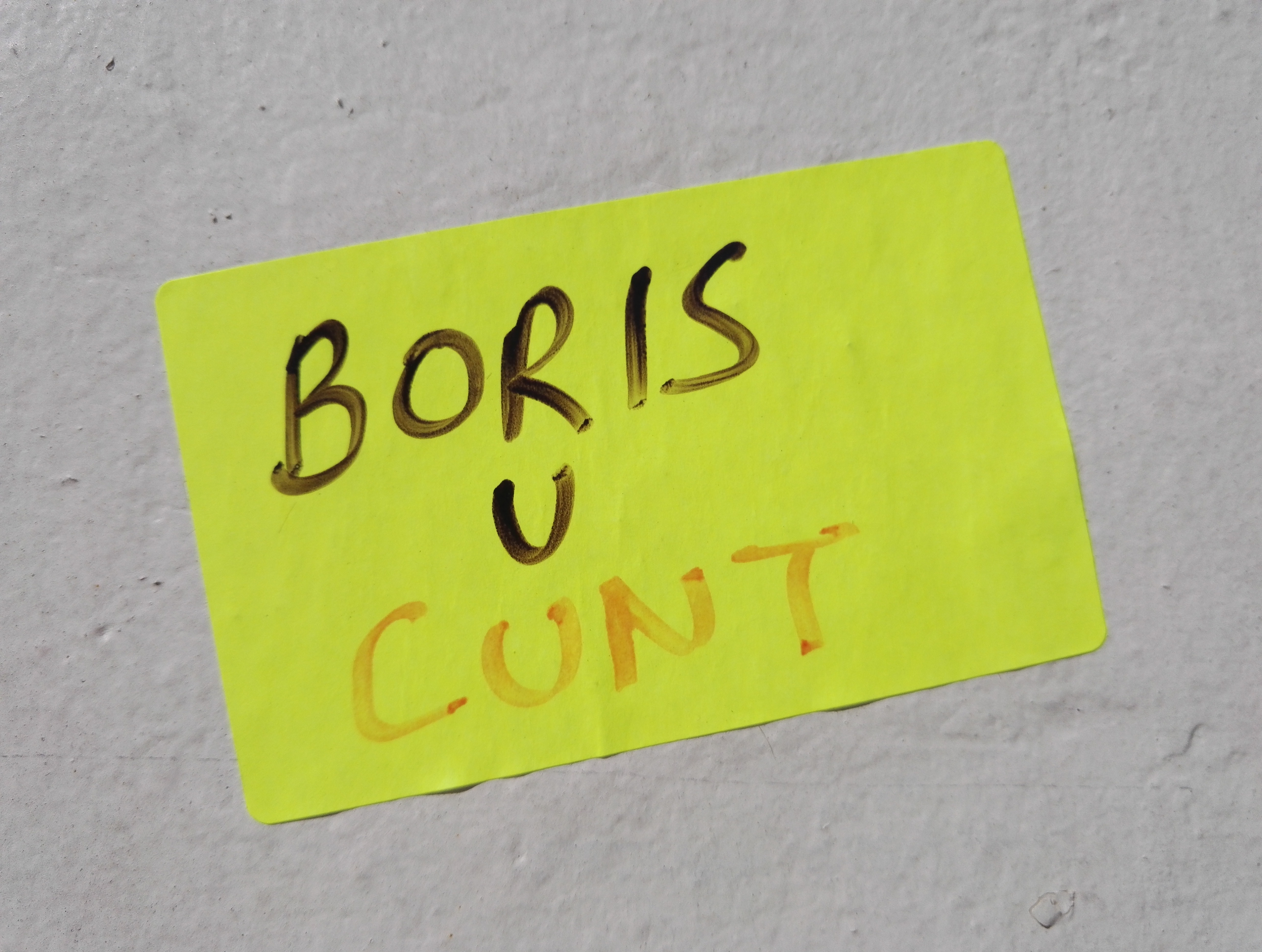
Some stickers were produced by the official remain campaign, like this one on the Euston Road (Photo: Hannah Awcock, 03/08/16).This sticker, in Malet Street, Bloomsbury, is also recognisable by the slogan and colour scheme of the official Remain campaign (Photo: Hannah Awcock, 15/07/16).This sticker, advocating a Leave vote, was also quite common, but it doesn’t share an obvious connection with the Leave campaign (Photo: Hannah Awcock, Russell Square, 13/04/16).This sticker is also urging a Leave vote. It refers to 1215, the year in which the Magna Carta was signed, declaring that the British have been a “free peoples” since then. It is a good example of how the Magna Carta is repeatedly brought into debates about freedom and liberty, having achieved symbolic status hundreds of years ago (Photo: Hannah Awcock, Great Portland Street, 03/06/16).Many individual groups and organisations took sides during the EU Referendum campaign. The Alliance for Worker’s Liberty, a socialist campaign group, declared themselves for Remain. This sticker alludes to the employment rights enforced by EU law (Photo: Hannah Awcock, Borough High Street, 15/07/16).This sticker was also produced by the Alliance for Worker’s Liberty. It reads “Lower Borders, Don’t Raise Them.” One of the big issues of the referendum was immigration (Photo: Hannah Awcock, Borough High Street, 15/07/16).The RMT, a transport union, supported the Leave campaign (Photo: Hannah Awcock, Euston Road, 03/06/16).The location of protest stickers can have a big influence on how it is interpreted (Photo: Hannah Awcock, Euston Road, 03/08/16).Protest stickers are ephemeral, and last for varying amounts of time. Sometimes, they are scratched away in a way that suggests there was a deliberate attempt to obscure the message of the sticker. This is what I think happened to this sticker on Borough High Street (Photo: Hannah Awcock, 15/07/16).There were lots of people who were not happy with the actions of Boris Johnson after the referendum. This blunt sticker expresses that disapproval in no uncertain terms (Photo: Hannah Awcock, Byng Place, 15/07/16).





















 Turbulent Isles