On This Day: The Death of Blair Peach, 23rd April 1979

blairpeach
Blair Peach, 1946-1979 (Source: Wikipedia, photo is in the public domain)

Mark Duggan, Ian Tomlinson, Jean Charles de Menezes; some people have the misfortune of being famous because they were killed by the Metropolitan Police. Blair Peach is perhaps one of the better known names on that list. Peach died from a broken skull on the 23rd of April 1979, after being struck on the head during a demonstration outside Southall Town Hall. The results of the internal investigation into what happened weren’t published until 2010, three decades after Peach’s death.

Clement Blair Peach was born in New Zealand on the 25th of March 1946. He moved to London in 1969 and started working as a teacher at the Phoenix School in Bow, East London. Peach was no stranger to radicalism and protest; he was a member of the Socialist Worker’s Party, as well as the Socialist Teacher’s Association and the East London Teacher’s Association, both within the National Union of Teachers. In 1974 he was acquitted of a charge of threatening behaviour after he challenged a publican who was refusing to serve black customers. He was also involved in campaigns against far-right and neo-Nazi groups; he was well known for leading a successful campaign to close a National Front building in the middle of the Bangladeshi community around Brick Lane.

On St. George’s Day 1979, the National Front held a meeting in Southall Town Hall. The Anti-Nazi League held a counter demonstration outside the Town Hall. Peach was one of 3000 people to attend. The demonstration turned violent; over 150 people were injured (including around 100 police officers), and 345 arrests were made. Peach was struck on the head by a police officer at the junction of Beachcroft Avenue and Orchard Avenue, as he tried to get away from the demonstration. He died from his injuries later that night in Ealing Hospital.

Peach’s death struck a chord amongst the communities he had stood up for, and across the city as a whole. A few days after his death, 10000 people marched past the spot where he was fatally injured. His funeral was delayed by several months, until the 13th of June, but that was also attended by 10000 people. The night before his funeral, 8000 Sikhs went to see his body at the Dominion Theatre in Southall.

The Metropolitan Police commissioned an internal inquiry into what happened, which was led by Commander John Cass. 11 witnesses saw Peach struck by a member of the Special Patrol Group (SPG). The SPG was a centrally-based mobile group of officers focused on combating serious public disorder and crime that local divisions were unable to cope with. It started in 1961, and was replaces in 1987 by the Territorial Support Group, which also has a less-than stellar reputation amongst activists.

The pathologist’s report concluded that Peach was not hit with a standard issue baton, but an unauthorised weapon like a weighted rubber cosh,or a hosepipe filled with lead shot. When Cass’ team investigated the headquarters of the SPG, they found multiple illegal weapons including truncheons, knives, a crowbar, and a whip. 2 SPG officers had altered their appearance by growing or cutting facial hair since the protest, 1 refused to take part in an identity parade, and another was discovered to be a Nazi sympathiser. All of the officers’ uniforms were dry-cleaned before they were presented for examination.

Cass concluded that one of 6 officers had killed Peach, but he couldn’t be sure who exactly, because the officers had colluded to cover up the truth. He recommended that 3 officers be charged with perverting the course of justice, but no action was ever taken. The results of the inquiry were not published, and the coroner at the inquest into Peach’s death refused to allow it to be used as evidence, despite making use of it himself. On the 27th May 1980, the jury returned a verdict of death by misadventure. After decades of campaigning by Peach’s partner Celia Stubbs, the report was finally published in April 2010, although the Director of Public Prosecutions decided there was still not enough evidence to bring charges against anyone.

If I had written this blog post more than 6 years ago, it would look very different. The death of Blair Peach was a public relations nightmare for the Metropolitan Police; a respected and well-liked activist who fought hard for local communities, Peach was a man for whom many people cared about. The Met should have been transparent, finding out what happened and punishing those responsible quickly and openly. Instead, they covered up the cause of Peach’s death for 3 decades, allowing what happened to fester, contributing to a sense of resentment and distrust that continues to this day.

Sources and Further Reading

Casciani, Dominic. “Blair Peach Report: What the Investigation Uncovered.” BBC News. Last modified 17th April 2010, accessed 12th April 2016. Available at  http://news.bbc.co.uk/1/hi/uk/8646829.stm  

Editorial.”Death of Blair Peach: The Truth at Last.” The Guardian. Last modified 28th April 2010, accessed 12th April 2016. Available at  http://www.theguardian.com/commentisfree/2010/apr/28/death-of-blair-peach-editorial

Lewis, Paul. “Blair Peach Killed By Police at 1979 Protest, Met Report Finds.” The Guardian. Last modified 27th April 2010, accessed 12th April 2016. Available at  http://www.theguardian.com/uk/2010/apr/27/blair-peach-killed-police-met-report

Metropolitan Police. “MPS Publication Scheme: Investiagation into the Death of Blair Peach.” No date, accessed 12th April 2016. Available at  http://www.met.police.uk/foi/units/blair_peach.htm 

Renton, David. “The Killing of Blair Peach.” London Review of Books 36, no. 10 (2014): 23-26. Available at http://www.lrb.co.uk/v36/n10/david-renton/the-killing-of-blair-peach

Wikipedia. “Death of Blair Peach.” Last modified 28th March 2016, accessed 12th April 2016. Available at https://en.wikipedia.org/wiki/Death_of_Blair_Peach

Turbulent Londoners: Elisabeth Jesser Reid, 1789-1866

Turbulent Londoners is a series of posts about radical individuals in London’s history who contributed to the city’s contentious past, with a particular focus of women, whose contribution to history is often overlooked. My definition of ‘Londoner’ is quite loose, anyone who has played a role in protest in the city can be included. Any suggestions for future Turbulent Londoners posts are very welcome. The twelth Turbulent Londoner is Elisabeth Jesser Reid. She was the founder of Bedford College, which is now part of Royal Holloway and Bedford New College, my university.


Plaque dedicated to Elisabeth Jesser Reid, founder of Bedford College for Women, on her house in Bedford Square, London, England (Source: Oosoom).

Elisabeth Jesser Reid was a social reformer, abolitionist, and advocate of women’s education. Known as single-minded and tactless, she used her relatively privileged status as an independent widow to further the causes she believed in. This included founding Bedford College, one of the first venues of higher education for women in Britain.

The second daughter of wealthy Unitarian ironmonger William Sturch and his wife Elisabeth, Elisabeth Jesser Sturch was born to a life of relative privilege on the 25th of December 1789. In 1821 she married John Reid, a physician. Dr. Reid owned land on the River Clyde in Glasgow, which became valuable as the port expanded. When John died only 13 months after their marriage, Elisabeth was left with a large, independent income. Historically, widows with an independent income have enjoyed more freedom than other women, being beyond the control of both father and husband. Elisabeth used her freedom to fight for the causes she supported.

Elisabeth was a social reformer. She used her money to support benevolent schemes set up by women, such as Harriet Martineau’s project to enable the poor in the Lake District to buy their own homes. She also sponsored the studies of pupils who couldn’t otherwise afford it. Another of Elisabeth’s passions was abolitionism. She attended the World Anti-Slavery Convention in London in 1840, where she met female American delegates who had not been permitted to speak, such as Lucretia Mott. She was a member of the Garrisonian London Emancipation Committee, the British branch of an anti-slavery group that held progressive views on gender and racial equality.

Elisabeth Jesser Reid is best known for her role in the development of female education. In 1849 she founded Bedford College, with a loan of £1500, which she converted to a gift in 1856 when the college was experiencing financial difficulties. The college was first located at 47 Bedford Square in Bloomsbury, moving to Regent’s Park in 1874. Although not the first college for the higher education of women in Britain, it was the first that believed in education for purposes other than vocational training. Bedford College aimed to enable women to improve themselves as they wanted to, not just gain the skills to become a governess.

This philosophy was radical, and Elisabeth was frustrated by the lack of support she received, particularly from prominent men. She expected hundreds of applications when the college opened, and was bitterly disappointed to receive only around a dozen. Nevertheless, she persevered, insisting that 3 Lady Visitors were included in the governing body, which was the first  time women officially shared in controlling the direction of a British institution. She used her social connections to get respected scholars to teach at the college, and eventually the college became successful. Notable early students include  novelist George Eliot, feminist and artist Barbara Bodichon, and Sarah Parker Redmond, the first black woman to do a lecture tour in the UK on the topic of slavery. Bedford College became part of the University of London in 1900, and merged with Royal Holloway in 1985, to become Royal Holloway and Bedford new College. In this form it is still going strong today, with over 8000 students (and a wonderful geography department!)

I feel a personal connection to Elisabeth Jesser Reid because of the happy and fulfilling times I have spent at Royal Holloway and Bedford New College, but even without that I would admire her as a headstrong and opinionated woman who did not let her relative freedom go to waste. She used her wealth and independence to make the world a better place, and she fought hard for what she believed in, significantly advancing women’s education.

Sources and Further Reading

Anon. “Black History Month: Garrisonian Abolitionists.” Oxford University Press Blog. Last modified 27 February 2007, accessed 25 February 2016. Available at  http://blog.oup.com/2007/02/black_history_m4/ 

Anon. “Elisabeth Jesser Reid: Pioneering Education for Women.” Royal Holloway, University of London. No date, accessed 27 February 2016. Available at  https://www.royalholloway.ac.uk/aboutus/ourhistory/elisabethjesserreid.aspx

Anon. “Elizabeth Jesser Reid.” Wikipedia. Last modified 13 January 2016, accessed 25 February 2016. Available at https://en.wikipedia.org/wiki/Elizabeth_Jesser_Reid

Anon. “History of Elizabeth Jesser Reid.” Reflex Managed Offices. Last modified 9 September 2015, accessed 25 February 2016. Available at http://www.reflex.london/history-of-elizabeth-jesser-reid/

Colville, Deborah. “Bloomsbury People.” UCL Bloomsbury Project. Last modified 7 April 2011, accessed 25 February 2016. Available at http://www.ucl.ac.uk/bloomsbury-project/articles/individuals/reid_elisabeth_jesser.htm

Oldfield, Sybil. “Reid [nee Sturch], Elisabeth Jesser.” Oxford Dictionary of National Biography. Last modified May 2011, accessed 25 February 2016. Available at  http://www.oxforddnb.com.ezproxy01.rhul.ac.uk/view/article/37888 (This website is behind a paywall, I had to use my Royal Holloway login to access it).

Pakenham-Walsh, M. ‘Bedford College, 1849-1985’ in Crook J (ed.) Bedford College University of London- Memories of 150 Years. Royal Holloway and Bedford New College: Egham, Surrey (2001): 13-46

Book Review: London- A Social History

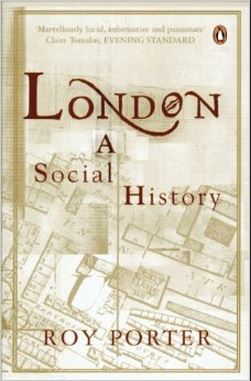
The 2000 edition of 'London- A Social History' by Roy Porter.
The 2000 edition of ‘London- A Social History’ by Roy Porter.

Porter, Roy. London- A Social History. London: Penguin, 2000 [1994]

“the physical fabric [of London] engages in endless dialogue with the inhabitants; the townscape shapes them, while they reconstruct it. Factories and flats, railways and roads outlive individuals. People make their own cities, but never under conditions of their own choosing.”

(Porter, 2000; p. xvi)

When he set out to write London- A Social History, Roy Porter (2000; p. xvi) aimed to write “a substantial account and analysis of the making of the metropolis in terms of its people, economy and buildings.” He has achieved this, frequently going beyond descriptions to consider why London is the way that it is. The book is arranged chronologically, but the Georgian, Victorian, and post-War London periods (from chapter 5 onwards) receive significantly more attention than others; each has multiple chapters devoted to them, divided thematically. This can be little confusing; you finish chapter 8 in 1890, then chapter 9 begins back in 1820.

For Porter, London is a city past its prime. The metropolis is “aged and ailing” (Porter, 2000; p. 445), deprived of the empire which Porter argues was the driving force behind its success. In the preface, he looks back on his childhood in 1950s New Cross with nostalgia, and he is quietly critical of Thatcherite policies and a lack of public investment. Porter passed away in 2002, but I do wonder what he would make of London in 2015- somehow, I can’t imagine he would be very impressed. His criticisms feel informed and considered, unlike A.N. Wilson in London- A Short History, Porter explains what he doesn’t like about modern London without making me strongly dislike him.

One of the things that London- A Social History does really well is highlight the continuities of London. Sometimes London at different periods of history can feel so diverse that it calls into question the wisdom of treating it as the same city, but Porter connects Tudor, Georgian and modern London together into a narrative that make sense. For example, the book’s descriptions of housing demonstrate that good quality, affordable housing for the city’s working class has been a constant problem since the Georgians. Porter also does an excellent job of explaining the reasons behind London’s particularly ad-hoc structures of local government. The rivalry between the national government in Westminster and the City goes back centuries, and Westminster has long feared the potential power of a comprehensive pan-London authority.

The book does have some weaknesses. Some chapters, particularly those that describe the massive growth of London during various periods of the last few centuries feel a bit list-y, and are tedious to read. He gives disproportionate space to London since Georgian times, with much less about the preceding history. This is not uncommon in histories of London, perhaps just because the further back you go, the harder it is to find reliable sources. Finally, the book was written 20 years ago, and his assessment of London feels out of date (for example, Porter complains about the lack of ruling authority in London- the Greater London Authority was established in 1999, after the book was written). However, all books age, some better than others, and the past 20 years have not detracted from the rest of Porter’s thoughtful analysis of London history.

The subtitle of Roy Porter’s 541-page epic does not do it justice. This is not just a social history, but also an economic, political, demographic, and cultural history. Despite minor weaknesses, it is a good introduction for those who know little about the city, or a useful addition to the bookshelf of any London connoisseur.

Turbulent London on Film: Save Our Heritage

Winstan Whitter. Save Our Heritage, uploaded 2011, available at  https://vimeo.com/32541973

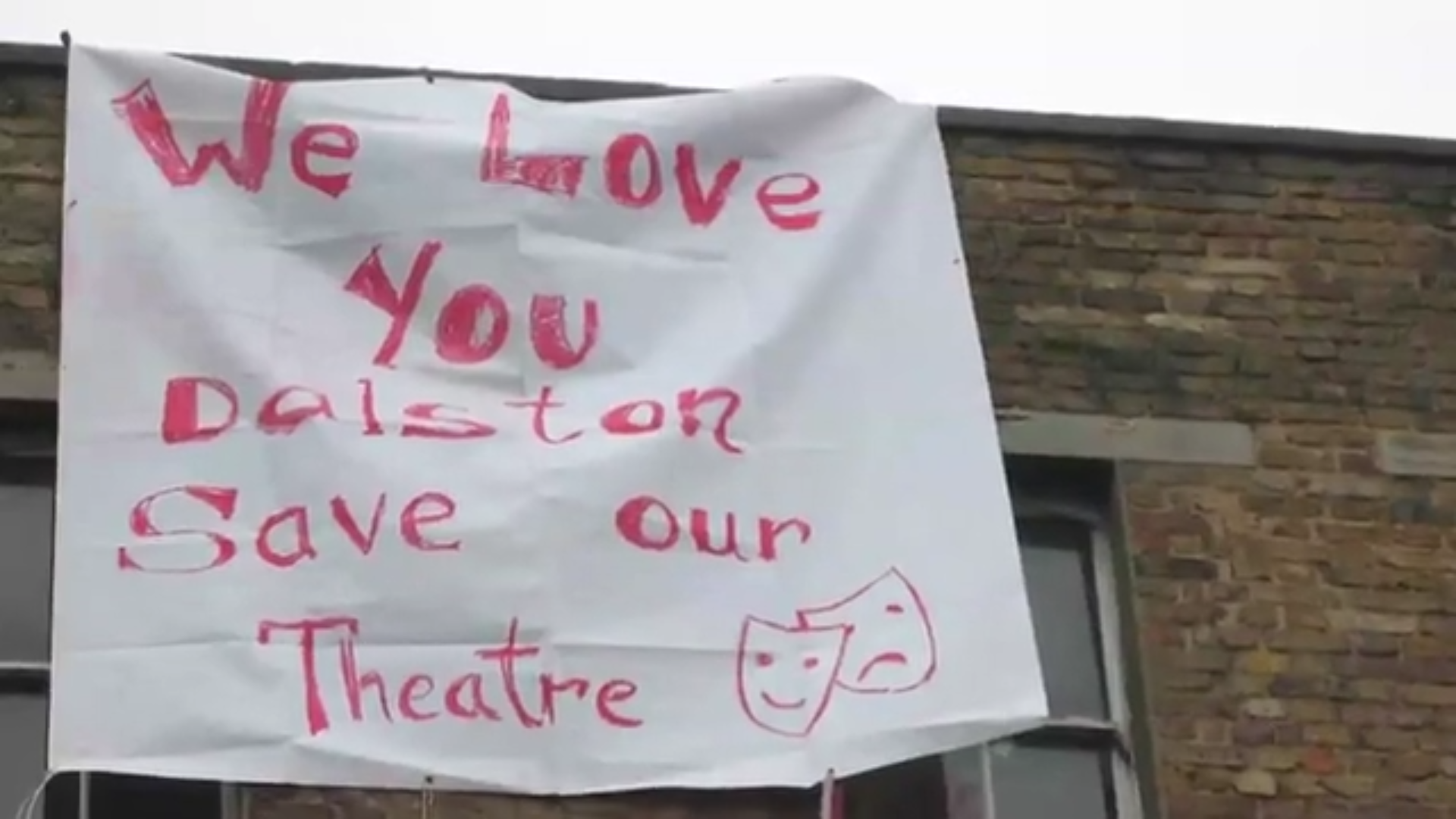
Winstan Whitter was a film-maker in the right place at the right time. A local boy, he filmed throughout the campaign to save the historic Four Aces Club and surrounding buildings in Dalston, Hackney from demolition and redevelopment. Save Our Heritage tells the story from start to finish, from when the the demolition signs first appeared, to the end of the campaign. The documentary is a compelling example of a single-issue social movement, and showcases a mixture of resistance tactics, some official, others less so. The film is particularly pertinent now, as people feel increasingly marginalised in London, thanks to gentrification and rising house prices. Save Our Heritage tells a story that feels very familiar; it is a detailed snapshot of a process that is going on all over the capital.

The narrative is strung together by interviews with Bill Parry-Davies, a founding member of OPEN Dalston (Organisation for Promotion of Environmental Needs), a “community-based company” of local residents and businesses which started campaigning in early 2005 for the improvement of the local area. Mr Parry-Davies is perhaps not what you would expect in a prominent member of a social movement; he is a well-dressed, well-spoken solicitor, and he brings a certain degree of respectability to the film which may surprise some.

Bill Parry-Davies
Bill Parry-Davies, solicitor and founding member of OPEN Dalston, features prominently in Save Our Heritage (Source: Save Our Heritage).

The film focuses on the campaign to save 4-12 Dalston Lane, which at the beginning of the film is threatened with demolition, largely because it had been neglected by its owners, Hackney Borough Council. The buildings included 2 listed Georgian houses and a circus built in 1886, which has since served as a theatre, cinema, and nightclub. As the Four Aces Club, it was a became a well-known centre for black music in London. The roof was removed in the 1990s, presumably with the full knowledge of Hackney Council, and never replaced. The interiors deteriorated, but the building remained structurally sound. In 2005, the Council began their attempts to demolish the buildings.

The film documents the entire campaign to save the buildings, including a public consultation campaign, alternative proposals, high court injunctions, an occupation (which began to restore the buildings and acted as a form of community centre),  a demonstration outside a Hackney council meeting (in which 5 minutes were allocated for ALL those wishing to oppose the development plans). The council’s chosen plans did not provide any facilities which OPEN claimed the community needed, such as affordable housing, cultural facilities, and open green space. To add insult to injury, it emerged that TFL needed  income from the site to plug a £19 million funding gap from their station development on an adjacent site, which meant that Hackney taxpayers were footing the bill for even more upmarket housing.

Dalston Occupation
A sign attached to the roof of the theatre building by the occupiers (Source: Save Our Heritage).

This is a one-sided account of the story; there is no one representing Hackney Council, TFL, or the developers to tell the other side of the story. Nonetheless, I think it is a well made and informative film, that tells this David and Goliath story in an interesting way. Save Our Heritage is well worth 37 minutes of your time, particularly if you are interested in gentrification and the transformation which London has been through in recent years. It would also make an excellent teaching resource; it is a fantastic record of a diverse and enthusiastic campaign.

On This Day: The Cato Street Conspiracy, 23rd February 1820

The early nineteenth century was a turbulent time. Economic depression was exacerbated by returning soldiers flooding the job market after the Napoleonic Wars in 1815, and the Industrial Revolution was causing food shortages and new patterns of employment. One radical group was called the Spencean Philanthropists, after the radical speaker Thomas Spence. Led by Arthur Thistlewood, they were a revolutionary group involved in unrest and propaganda, with the ultimate goal of starting a revolution. They wanted to assassinate the cabinet, seize key buildings, overthrow the government and establish a Committee of Public Safety to oversee a radical revolution.

Cato Street Plaque
The plaque in Cato Street commemorating the conspiracy being discovered (Photo: Simon Harriyott).

The death of King George III on the 29th of January sparked a political revolution. The Spencean Philanthropists planned to take advantage of the confusion, and assassinate the Prime Minister (Lord Liverpool) and all the cabinet ministers when they gathered for a dinner at the home of Lord Harrowby. However, George Edwards, the groups’ second in command, was a police spy, and there was never any risk of the plot succeeding. Thanks to Edwards, the Home Office knew about the entire thing, and the cabinet dinner was a fiction designed to entrap the group.

We will probably never know how many people were involved in the conspiracy—there were a lot of groups sympathetic to the aims of the Spencean Philanthropists—but 13 men were arrested in a dramatic showdown in the groups’ rented headquarters in Cato Street. The rented building was a stable and hayloft, close to Lord Harrowby’s House in Grosvenor Square. On the 23rd of February Richard Birnie, the Bow Street magistrate, waited in a pub across the road with 12 members of the Bow Street Runners, predecessors of the Metropolitan Police. They were waiting for promised reinforcements from the Coldstream Guards, but at 7:30pm they decided to go in alone.

In the resulting scuffle Arthur Thistlewood killed Richard Smithers, one of the Bow Street Runners, and escaped out a back window with 3 others. They were arrested a few days later. Some of the conspirators gave evidence on the others to avoid conviction, so on the 28th of April 10 men were sentenced to be hung, drawn, and quartered for high treason. This barbaric punishment was commuted for all 10, but that’s not as good as it sounds—5 men were hung and beheaded, and the other 5 were transported to Australia. Thistlewood and 4 others were executed at the infamous Newgate jail on the 1st of May 1820.

Edwards did not give evidence during the trial. Police spies were controversial at the time, and Edwards was accused of being an agent provocateur—he had suggested targeting the dinner in the first place, and he had even provided money to help the conspirators buy weapons. Some people questioned whether the group would ever have gone so far if it wasn’t for the spy who was supposed to be trying to stop them.

What would have happened if the Cato Street Conspiracy had succeeded? Whether it would have sparked the uprising Thistlewood hoped for, or merely put new faces in the same old positions of power is impossible to predict. Nevertheless, it was a bold and desperate attempt to cause change, and although I can’t approve of the Spencean Philanthropists’ methods, I can’t help but admire their vision.

Sources and Further Reading

Anon. “Cato Street Conspiracy.” Wikipedia. Last modified 12th December 2015, accessed 22nd January 2016. Available at https://en.wikipedia.org/wiki/Cato_Street_Conspiracy

Anon. “The Cato Street Conspiracy.” The National Archives. No date, accessed 22nd January 2016. Available at http://www.nationalarchives.gov.uk/pathways/blackhistory/rights/cato.htm

Bloy, Marjie. “The Cato Street Conspiracy: 23 February 1820.” The Victorian Web. Last modified 30th August 2003, accessed 22nd January 2016. Available at http://www.victorianweb.org/history/riots/cato.html

Marjie, Bloy. “The Cato Street Conspiracy: 23 February 1820.” A Web of English History. Last modified 12th January 2016, accessed 22nd January 2016. Available at http://www.historyhome.co.uk/c-eight/distress/cato.htm

Simpkin, John. “Cato Street Conspiracy.” Spartacus Educational. Last modified August 2014, accessed 22nd January 2016. Available at http://spartacus-educational.com/PRcato.htm

Turbulent Londoners: Ellen Wilkinson, 1891-1947

Turbulent Londoners is a series of posts about radical individuals in London’s history who contributed to the city’s contentious past. My definition of ‘Londoner’ is quite loose, anyone who has played a role in protest in the city can be included. Any suggestions for future Turbulent Londoners posts are very welcome. Today I’m looking at Ellen Wilkinson, a radical politician who became the Minister for Education.


Ellen Cicely Wilkinson
by Howard Coster
10 x 8 inch film negative, 1937
NPG x14687
© National Portrait Gallery, London

Ellen Cecily Wilkinson was an impressive woman. Rebellious and outspoken from a young age, she was a founding member of the Communist Party of Great Britain in 1920. As she aged, she either mellowed or suppressed her more radical side, rising through the Labour Party to become the Minister of Education in 1945, only the second woman to ever gain a place in the British cabinet.

Wilkinson was born on the 8th of October 1891 to a working-class family in Manchester. Her father encouraged her to read and learn, and she was academically accomplished. She got involved in politics young, joining the International Labour Party when she was 16. She also campaigned for the suffragist cause, handing out leaflets and putting up posters. She started teacher training college, but her unconventional teaching style was not appreciated and she left, deciding that teaching was not for her.

Teachings’ loss was politics’ gain. In 1910 Wilkinson won a scholarship to Manchester University, where she joined the Fabian Society and Manchester Society for Women’s Suffrage. She met many leaders of the radical left during this period, including the indefatigable Charlotte Despard. In her first year at university, she joined the executive committee of the University Socialist Federation, which was formed to unite socialist students across the country.

When she left university in 1913, Ellen got a job working for the National Union of Women’s Suffrage Societies.  She was also active in the Women’s International League for Peace and Freedom, and strongly opposed the First World War. The Suffrage movement was divided by the war, so in 1915 Ellen became National Women’s Organiser for the Amalgamated Union of Cooperative Employees (AUCE). She was the first woman they employed as an official. Here she fought for equal pay and rights for unskilled workers, which were often actively opposed by the better-off craft unions. Her time working for unions made her a skilled speaker and organiser.

As with many of her contemporaries, Ellen was inspired by the Russian Revolution, and in 1920 she was a founding member of the Communist Part of Great Britain. She also remained in the Labour Party, but it 1923 the Labour Party stopped allowing membership of both, and Ellen chose to stay with Labour, criticising the Communist Party’s dictatorial methods. By this point the AUCE had merged with another union to become the National Union of Distributive and Allied Workers (NUDAW), who sponsored Ellen to run for Parliament. After several failed attempts, she was elected the Labour MP for Middlesborough East in 1924, under a Conservative government. She was the only female Labour MP in the 1924 Parliament.

In Parliament Ellen fought for women’s rights, opposed imperialism, and was a vocal supporter of the May 1926 General Strike. She was elected to the Labour Party’s National Executive in 1927, which gave her a say in Party policy. She campaigned for the voting age for men and women to be equalised, which was achieved in 1928. As the Great Depression struck Ellen continued to fight for worker’s rights, although she lost her Parliamentary seat in 1932.

She continued to campaign whilst out of office, and in 1935 she was elected as the MP for Jarrow, a small town in Tyneside which is known for the Jarrow March, which took place in 1936. Despite criticism, even from within the Labour Party, Ellen supported the marchers, and joined them for some stretches of the march. On the 4th of November she presented the marchers’ petition to Parliament, which contained 11,000 signatures. Although not immediately successful, it is thought that the march helped shaped future attitudes and policies towards unemployment.

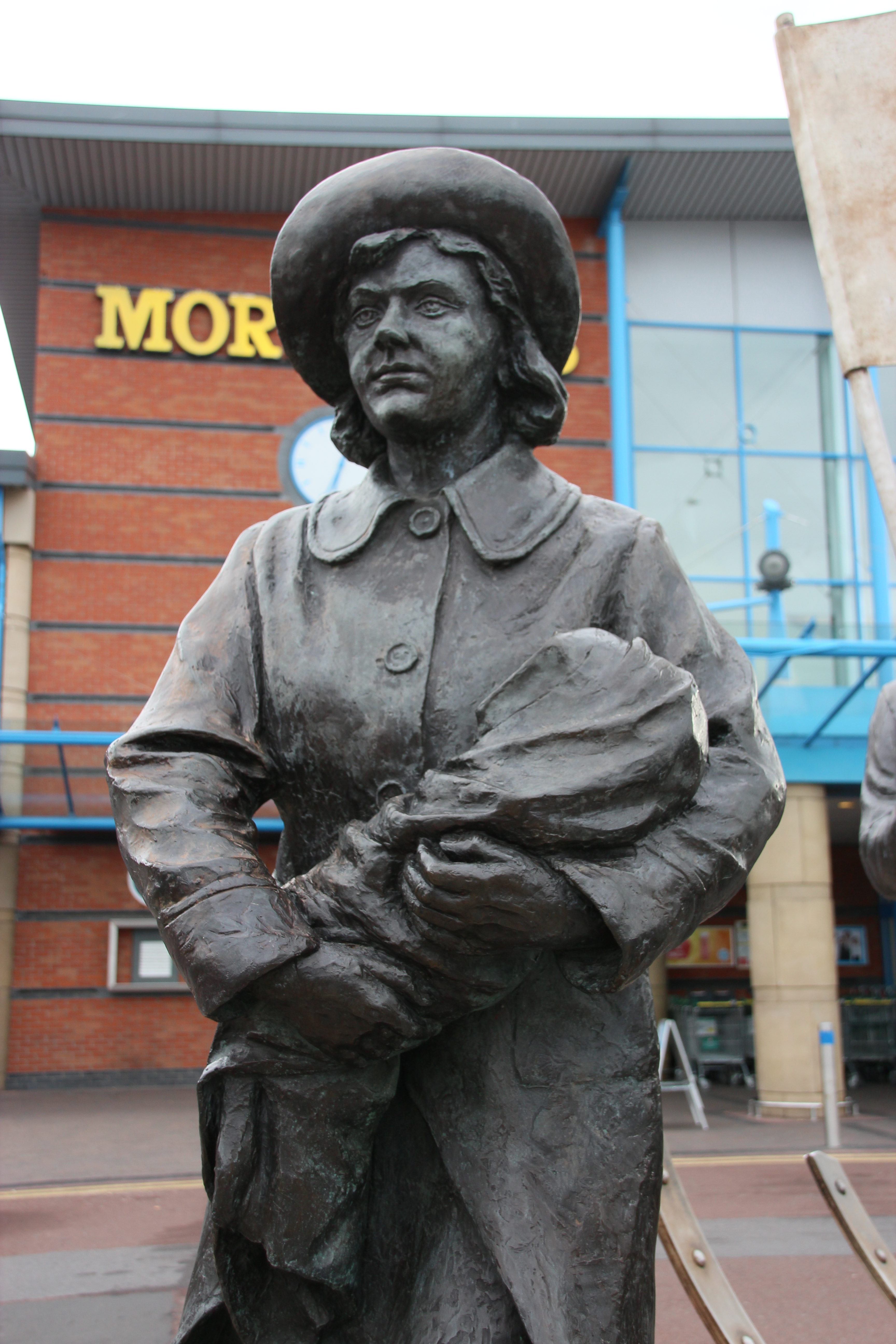
The female marcher in the Spirit of Jarrow carrying a bundle that is probably a baby.
A statue in Jarrow commemorating the Jarrow March. As Wilkinson was the only woman permitted to join the march, I assume this is supposed to be her (Source: Hannah Awcock).

During the 1930s Ellen travelled Europe attempting to combat fascism, and was critical of the government’s policy of non-intervention in the Spanish civil war. She was also strongly opposed to appeasement as a method of dealing with Hitler. She supported the declaration of the Second World War in 1939, but disapproved of the way Chamberlain conducted the war. When Churchill took over the government, Ellen was put in charge of air raid shelters and civil defence. During the war she became less radical, and was accepted by the Labour Party mainstream.

In 1945, Ellen Wilkinson became only the third woman to be made a privy councillor. After Labour’s landslide election victory, Atlee made her the Minister for Education. She focused on implementing the 1944 Education Act, which provided universal free secondary education and raised the school leaving age from 14 to 15. She was criticised as the system of the 11+ exams, and grammar, technical, and modern schools was seen as elitist. She stuck by her guns, arguing that the Education Act was the only realistic way of achieving positive change. As well as this, she also increased the amount of university scholarships and part time adult education, both positive steps forward.

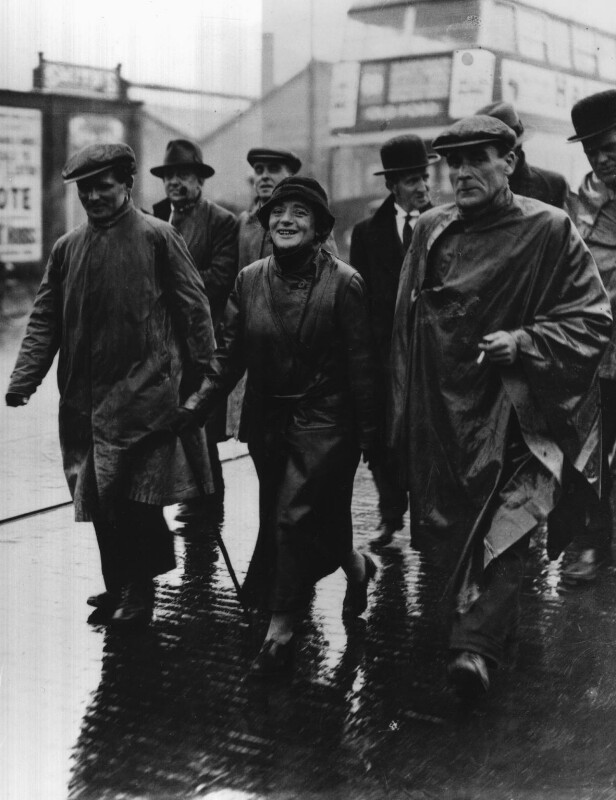
Ellen Cicely Wilkinson leading the Jarrow Marchers through Cricklewood in London
by Fox Photos Ltd
modern bromide print from original negative, 31 October 1936
NPG x88278
© National Portrait Gallery, London

Ellen Wilkinson died in office on the 6th of February 1947. She had always suffered from bronchial asthma, and this killed her, exacerbated by heavy smoking, overwork and an overdose of medicine. Her death was declared accidental, but some still suspect that she committed suicide. Ellen was well known for her fiery hair and matching temperament, and even when her politics mellowed, her passion and conviction did not. She is particularly interesting in the light of the Labour Party’s shift to the left with the election of Jeremy Corbyn as Party Leader, and it will be interesting to see if he too moves towards the centre as his career progresses. Regardless, Ellen was an inspiring woman who carved her own political path in a world dominated by men, often in the face of heavy opposition. She fought hard for what she believed in, and proved that politicians can have principles.

Sources and Further Reading

Anon. “Ellen Wilkinson,” Wikipedia. Last modified 13th September 2015, accessed 2nd October 2015. Available at https://en.wikipedia.org/wiki/Ellen_Wilkinson

Harrison, Brian. “Wilkinson, Ellen Cicely (1891–1947)”, Oxford Dictionary of National Biography. Last updated 2004, accessed 2nd October 2015. Available at http://www.oxforddnb.com/view/article/36902 (Not free to access)

Simkin, John. “Ellen Wilkinson,” Spartacus Educational. Last modified August 2014, accessed 2nd October 2015. Available at http://spartacus-educational.com/TUwilkinson.htm 

Stevenson, Graham. “Glossary of People: Ellen, Wilkinson,” marxists.org. No date, accessed 2nd October 2015. Available at https://www.marxists.org/glossary/people/w/i.htm#wilkinson-ellen

Book Review: Londonopolis- A Curious History of London

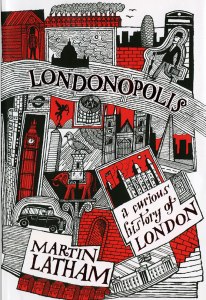
Londonopolis Front Cover
Londonopolis: A Curious History of London by Martin Latham.

Martin Latham. Londonopolis: A Curious History of London. London: Batsford, 2014.

To call Londonopolis: A Curious History of London a ‘history’ of London is, I think, a bit of a misnomer. It is a well presented book, full of fascinating facts about the city, but it is not a comprehensive narrative of London’s story. It is arranged chronologically, but if this was the only book you ever read about the city’s past then your knowledge would be patchy at best. To be fair, Latham doesn’t claim to be comprehensive; he has tried to “open a magic casement or two onto different moments of London’s past” (Latham, 2014; 11).

That’s not to say I didn’t enjoy Londonopolis. It makes a refreshing change from some of the other books about London’s past, which can be a little dry and repetitive. The facts Martin Latham has included are very interesting; for example, did you know that the British practice of driving on the left comes from London Bridge? During Tudor times it was decided that people would enter London on the left, and leave on the right, to reduce the chaos on London’s only bridge across the Thames.

As a boy, London was a fairy-tale city to me. The other tenants in my house (apart from us eight kids and my parents) were a female spy, a fading actress, a newly arrived Irish family and the mysterious Miss White, a Dickensian spinster… I used to walk for hours randomly across London and it never disappointed…History was all around in such a way that I got temporal vertigo, that sensation of suddenly seeing the past as a reality.

(Latham, 2014; 10)

Latham’s love for the city is infectious. In fact, I feel that the best sections of the book are the ones where he talks about his own life in London. The paragraphs about the various bookshops he has worked in, and his father’s skill as a water diviner, are lovely. Latham captures beautifully the magic of living in London.

Like A.N. Wilson’s London: A Short HistoryLatham spends a lot of time talking about individuals who have shaped London, focussing especially on creative types- writers and artists. Latham does a better job than Wilson of including London’s notable women however. Turbulent Londoners like Eleanor Marx, Annie Besant, and Sylvia Pankhurst get a whole chapter to themselves. Virginia Wolff, and Dorothea Bate and Joan Proctor (both dedicated scientists at the National History Museum) are also featured. There is also a chapter dedicated to the pioneering fashion designers Mary Quant, Barbara Hulanicki, Lee Bender, and Vivienne Westwood.

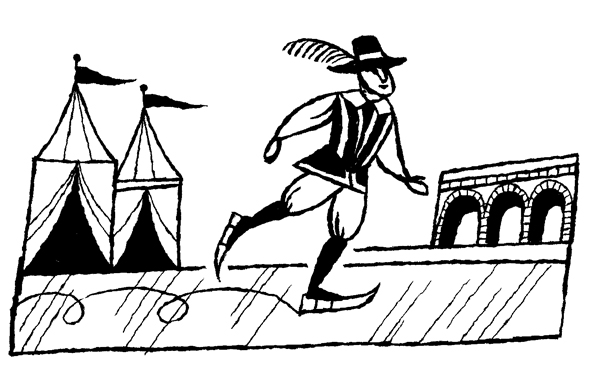
Londonopolis-image
One of the simple but effective illustrations from Londonopolis. 

Londonopolis: A Curious History of London is different to the books I normally review on  Turbulent London. It is not necessarily supposed to be read cover to cover, Latham himself says “You can read this book in any order, or leave it in the lavatory for the occasional reverie” (Latham, 2014; 11). In fact, reading it cover to cover feels a bit disjointed. I would recommend the book however, particularly if you like obscure but interesting facts, or need a gift for a London-lover. It takes an irreverent but affectionate approach to London, which I like.

London’s Protest Stickers: Anti-Fascism

00_26-9-15 Walworth Road
Anti-fascism is one of the most common topics of protest stickers. This photo was taken on the Walworth Road on 26/09/15 (Photo: Hannah Awcock).

If you start looking out for protest stickers as you move around a British city, you will quickly notice that anti-fascists are particularly prolific sticker-ers. I’m not sure why, but anti-fascism is one of the most frequent themes of protest stickers, aside from anarchism. Most large towns and cities have an anti-fascist group, and as the largest of the lot London is home to several groups, as well as drawing in groups from elsewhere.

01_05-05-15 Aylsebury Estate (10)
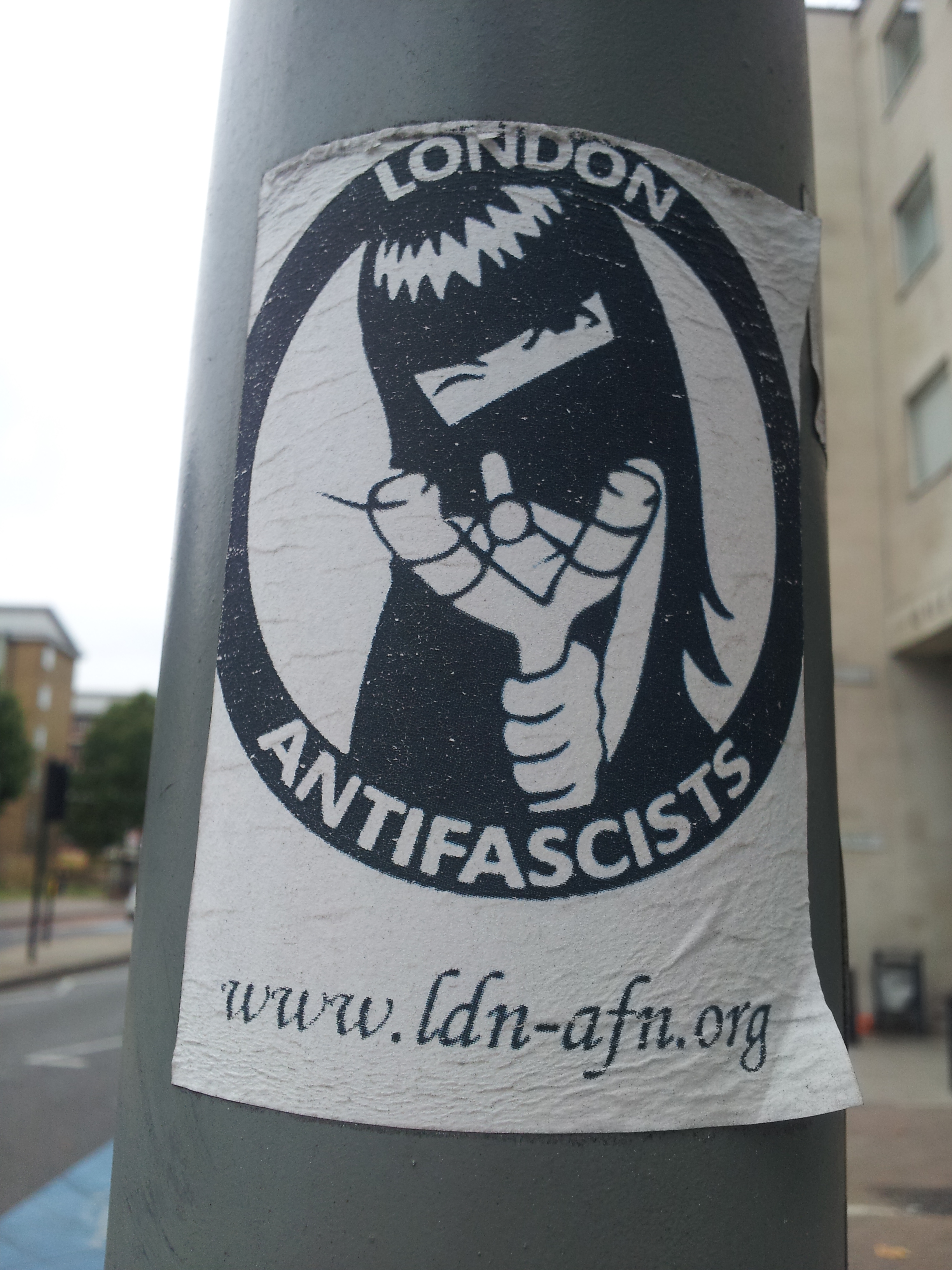
Unsurprisingly, one of the most common groups represented in London anti-fascist protest stickers are London Antifascists. This picture was taken on the Aylesbury Estate on 05/05/15 (Photo: Hannah Awcock).
02_13-08-15 Mile End Road (1)
The logos employed by anti-fascist groups can vary, but an image with a circle is a common feature. This logo features Emily the Strange, a popular gothic character who began life on stickers advertising the clothing line Cosmic Debris. She has since featured on clothing, stationary, and all kinds of objects, but here she comes full circle, appearing on stickers once again. This photo was taken on the Mile End Road on 13/08/15 (Photo: Hannah Awcock).
03_25-02-15 Embankment (1)
Although stickers which just feature a group’s logo and website are common, some are more complicated, like this one photographed on the north bank of the Thames near the City on 25/02/15. This sticker is still quite general in terms of focus however, it doesn’t specify what to fight back against (Photo: Hannah Awcock).
04_28-05-15 Elephant and Castle
Two flags (one red, one back) enclosed in a black circle is the most common and recognisable anti-fascist logo. This sticker points to the complex interconnections between anti-fascism and class politics, suggesting that London Antifascists only care about working-class communities. Or perhaps they are implying that racism and Nazism are only to be found amongst the middle- and upper-classes? This photo was taken at Elephant and Castle on 28/05/15 (Photo: Hannah Awcock).
08_10-03-15 Camden
The double flag logo is so recognisable that I can be quite sure that this sticker is by an anti-fascist group, even though I cannot read the words. This photo was taken near Camden Underground Station on 10/03/15 (Photo: Hannah Awcock).
05_13-04-15 Elephant and Castle
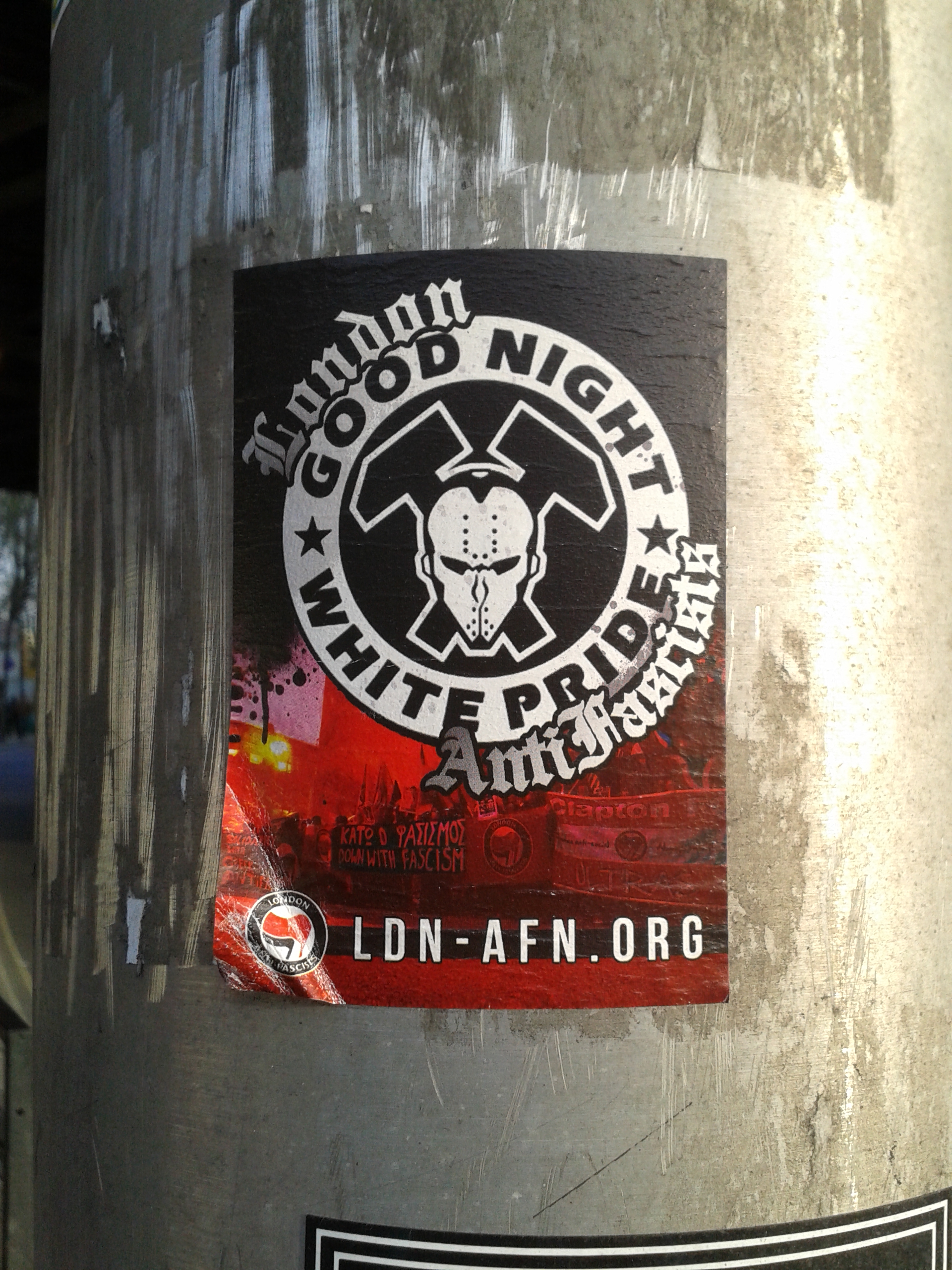
This sticker, photographed at Elephant and Castle on 13/04/15, is also focusing on racism, and has the familiar image surrounded by a circle logo. I must admit that the imagery and font confused me at first, at first glance I thought that this sticker was defending white pride rather than condemning it (Photo: Hannah Awcock).
06_12-03-15 Gordon Street, Bloomsbury (2)
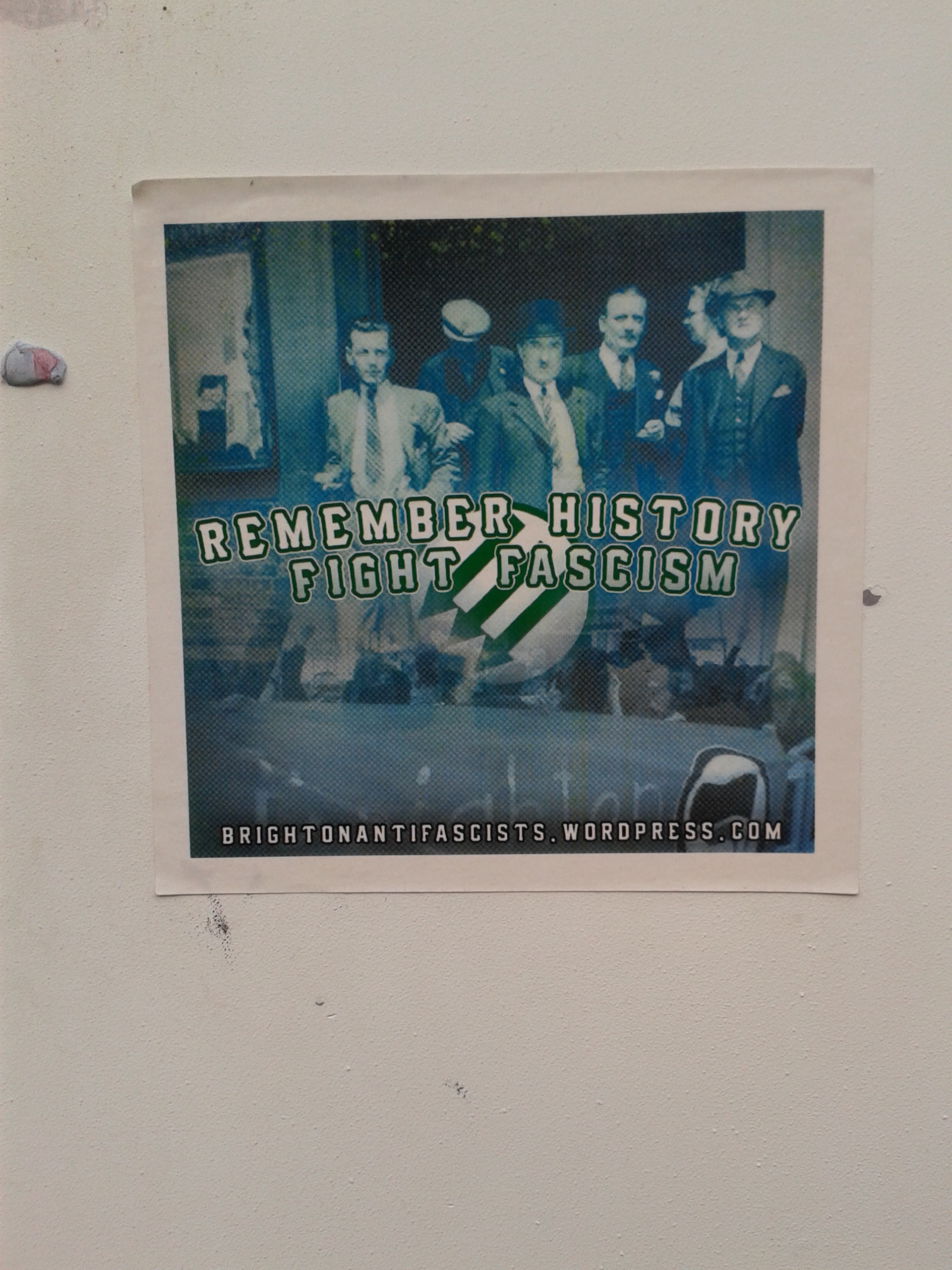
When anti-fascist groups go travelling, they often leave evidence of their presence in the form of protest stickers. This sticker was produced by Brighton Antifascists, although I found it in Gordon Street, Bloomsbury, on 12/03/15 (Photo: Hannah Awcock).
07_14-09-15 Elephant and Castle
The 161 Crew are a Polish antifascist group that has a strong presence in London (the sticker in the previous photo is also one of theirs). This sticker appeared in Elephant and Castle on 14/09/15. I thought it was incredibly brave, as this was during a period of the refugee crisis where the debate around immigration was particularly vicious. Immigrants are supposed to be grateful and loyal to their host country, not encouraging cross-border class-based networks of dissent (Photo: Hannah Awcock).
10_05-05-15 Flint Street SE1 (4)
Unusually, this sticker does not feature an anti-fascist logo, which leads me to suspect it was not made by a specifically anti-fascist group. This photo was taken on Flint Street, near the occupied Aylesbury Estate on 05/05/15 (Photo: Hannah Awcock).
11_25-02-15 Cable Street (5)
Location can be integral to the meaning of protest stickers. I found this sticker in Cable Street, one of the sites of the famous demonstration known as the Battle of Cable Street, which has gone down in anti-fascist collective memory as a rare victory. No Pasaran is Spanish for ‘They Shall Not Pass’, one of the slogans of the Battle which was taken from the Spanish Civil War. The Battle is an important event in British anti-fascist history, a key source of pride and hope (Photo: Hannah Awcock, 25/02/15).
12_25-02-15 Cable Street (9)
This photo was also taken in Cable Street, next to the mural which memorialises the Battle of Cable Street. The double flag logo is present, although within a heart rather than a circle. Not surprisingly, Cable Street has a high concentration of anti-fascist stickers of various types, making it feel almost shrine-like (Photo: Hannah Awcock, 25/02/15).
20_29-05-15 Borough High Street (2)
Not every Londoner is an anti-fascist supporter. The word ‘Antifascists’ and the website has been scratched off this sticker very deliberately. Someone clearly took exception to London Antifascists publicising themselves. This photo was taken on Borough High Street on 29/05/15 (Photo: Hannah Awcock).

Introducing the Turbulent London Map

London has been the subject of an untold number of maps over its long history, and now there’s one more. Maps serve many more purposes than getting you from A to B, they can also educate, entertain, and look good, as the maps featured below demonstrate. As a geographer, it’s basically compulsory for me to have an interest in maps, and I have always enjoyed looking at, and thinking about, them.

I have been thinking about the potential of mapping protest events and protest stickers for a while now. It can help build up an image of how protests and stickers are spread out across the capital. If you can identify areas of concentration for example, you can begin to think about why that might be. Unfortunately I haven’t had the skills to put this idea into practice…until now.

So without further ado, I would like to introduce the latest innovation in the world of London mapping: The Turbulent London Map! It features the location of every London protest and protest sticker featured on the blog. Purple pins are protest events, and orange pins are protest stickers. Click on the pins for more information and images.

The map is far from complete; to map every protest that’s ever taken place in London would be a gargantuan task that I cannot feasibly do alongside a PhD (although it might make a good post-doctoral project!). I will keep adding protests as I mention them in the blog. Also, the spread of the protest stickers is biased to reflect my own personal map of London; I have more pictures from locations that I visit most often, and no pictures from the places I haven’t been to (or the places I went to in the dark- my camera phone has not always been up to scratch). Again, it would be a huge project to map protest stickers across the whole city (another post-doc idea!), so here I’m asking for a little help. If you’re out and about in London and see a protest sticker, please take a picture, take a note of the street you’re on and the date, send it to me, and I’ll add to the map. I would really like to start building a more complete picture of protest stickers in London.

Turbulent Londoners: Bernie Grant, 1944-2000

Turbulent Londoners is a series of posts about radical individuals in London’s history who contributed to the city’s contentious past. My definition of ‘Londoner’ is quite loose, anyone who has played a role in protest in the city can be included. Any suggestions for future Turbulent Londoners posts are very welcome. The next Turbulent Londoner is Bernie Grant, who devoted his life to campaigning for equality across various forums.


A plaque commemorating the work of Bernie Grant can be found on Tottenham Town Hall in London (Source: jelm6).

Bernard Alexander Montgomery Grant, known to most as Bernie Grant, was an influential campaigner for civil rights in Britain and around the world. In a political career that spanned four decades, he fought to promote equality of all kinds as a trade union leader, a member of local government, and a Member of Parliament. Although he spent the majority of his career in mainstream politics, he still deserves the status of a Turbulent Londoner as he continued to fight for what he believed in once he was elected, and acted as “a red rag to the bulls of rightwing politics” (Phillips, 2000).

Born in Georgetown, Guyana on the 17th February 1944, Bernie Grant moved to London with his parents when he was 19. He studied at Heriot-Watt University in Edinburgh, but left in 1969 in protest against discrimination against black students. He started working as a telephonist for the Post Office at the International Telephone Exchange in King’s Cross, and became involved in trade union politics during the Post Office strike in 1970. In 1978 Bernie became an Area Officer for the National Union of Public Employees, a full-time job.

Also in 1978, Bernie became a Labour Councillor in the north London borough of Haringey. He founded the Black Trades Unionists Solidarity Movement, and worked there full time between 1981 and 1984. In 1985, he earned the nickname ‘Barmy Bernie’ from the tabloid press because of his leadership of the opposition against the Conservative government’s rate-capping, which meant that central government could restrict the spending of local councils. He is in good company; the name ‘Suffragettes’ was coined by a reporter at the Daily Mail.

Haringey Council emerged from the dispute with central government with Bernie Grant as leader. He was the first black man to hold such a position in Europe. Bernie practiced what he preached, and Haringey was one of the few local councils to develop policies that tackled discrimination on the basis of disability, gender, race, or sexual orientation. After the controversial Broadwater Farm riots on the 6th of October 1985 Bernie stood up for the local youth, despite widespread and frequently vicious criticism.

The Broadwater Farm controversy didn’t damage Bernie’s reputation enough to prevent him being elected the Member of Parliament for Tottenham in 1987. He caused a stir by attending his first state opening of parliament in African dress, another of his ‘red rag’ moments. Once in Parliament, Bernie continued to fight for what he believed in. He founded the Parliamentary Black Caucus, and campaigned to end racism in the UK and abroad, against racist policing methods, deaths in police custody, and institutionalised racism in education, housing, and health. He also fought for the rights of refugees, greater resources for inner city areas, the elimination of overseas debt for poor nations, and the recognition of past colonialism and enslavement. He worked hard for his constituency, campaigning for a major cultural and arts facility, now called the Bernie Grant Arts Centre in his name.

Bernie Grant remained the MP for Tottenham until his death on the 8th of April 2000, aged 56. He was a man who never shied away from what he thought was right, even in the face of party politics and widespread criticism. He proved that it is possible to make positive changes from within the official system of government, a lesson which is worth hanging onto in the face of modern mainstream politics.

Sources and Further Reading

Anon. “Bernie Grant.” Wikipedia. Last modified 4th May 2015, accessed 18th June 2015. https://en.wikipedia.org/wiki/Bernie_Grant

Phillips, Mike. “Bernie Grant.” The Guardian. Last modified 10th April 2000, accessed 18th June 2015. http://www.theguardian.com/news/2000/apr/10/guardianobituaries.obituaries

The Bernie Grant Archive. No date, accessed 18th June 2015. http://berniegrantarchive.org.uk/