Rioting across France has made the news over the last week, sparked by the killing of Nahel Merzouk, a teenager of Algerian descent, by a police officer. Nahel was shot in the chest during a traffic stop in Nanterre, a suburb of Paris, on 27th of June. The officer involved has been charged with voluntary homicide, but that has not calmed the rioting that has erupted in cities across France. Also last week, a BBC documentary named a sixth suspect in the racially-motivated murder of black teenager Stephen Lawrence in London in 1993, leading to calls for further investigations into institutional racism in the Metropolitan Police. The combination of these two stories prompted me to take a look at anti-police political stickers in Edinburgh. The Police are not the most common topic of protest stickers, but whilst other topics come and go, this one does remain fairly constant (I have written two blog posts about anti-police stickers in London, here and here).
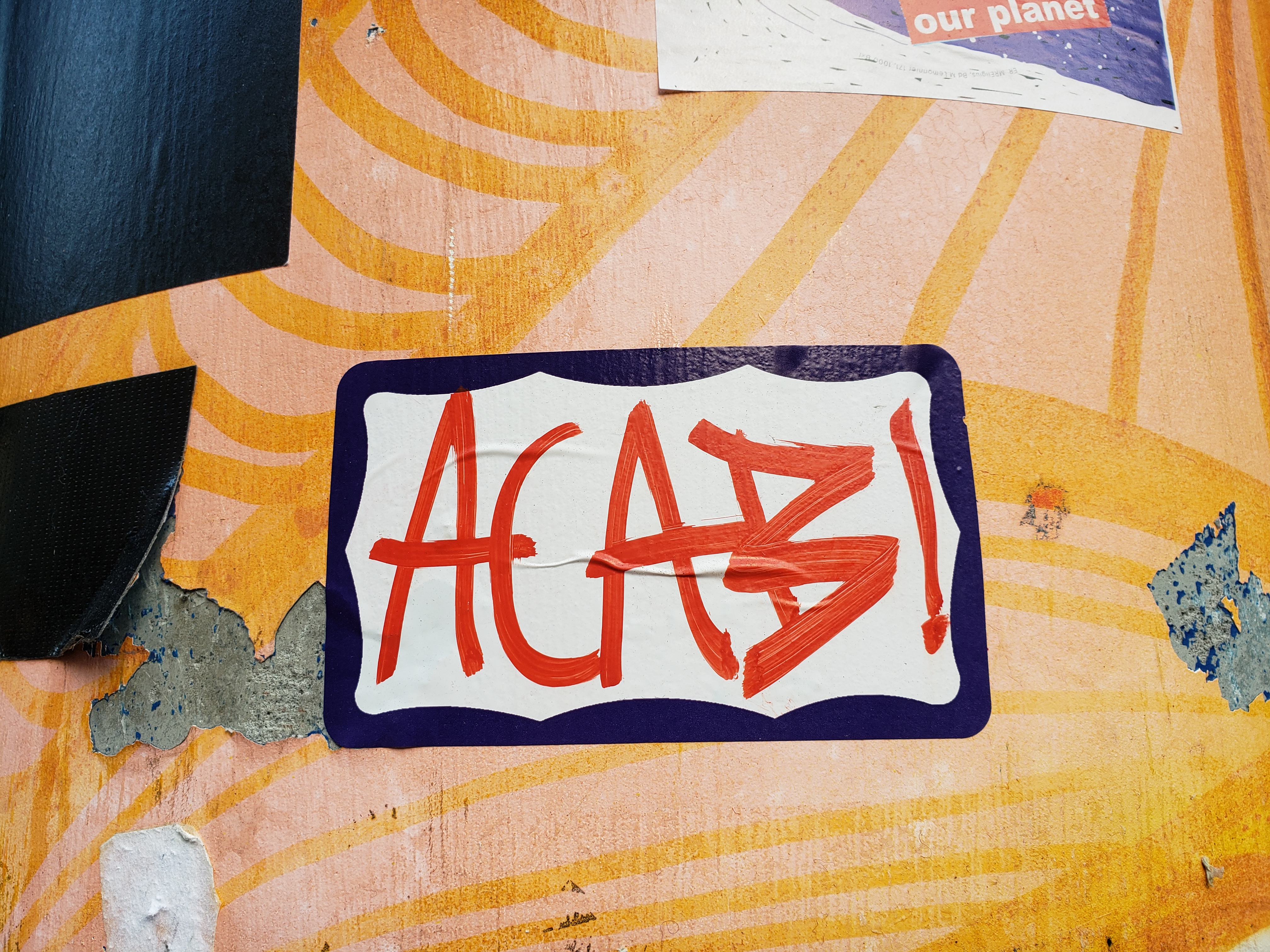
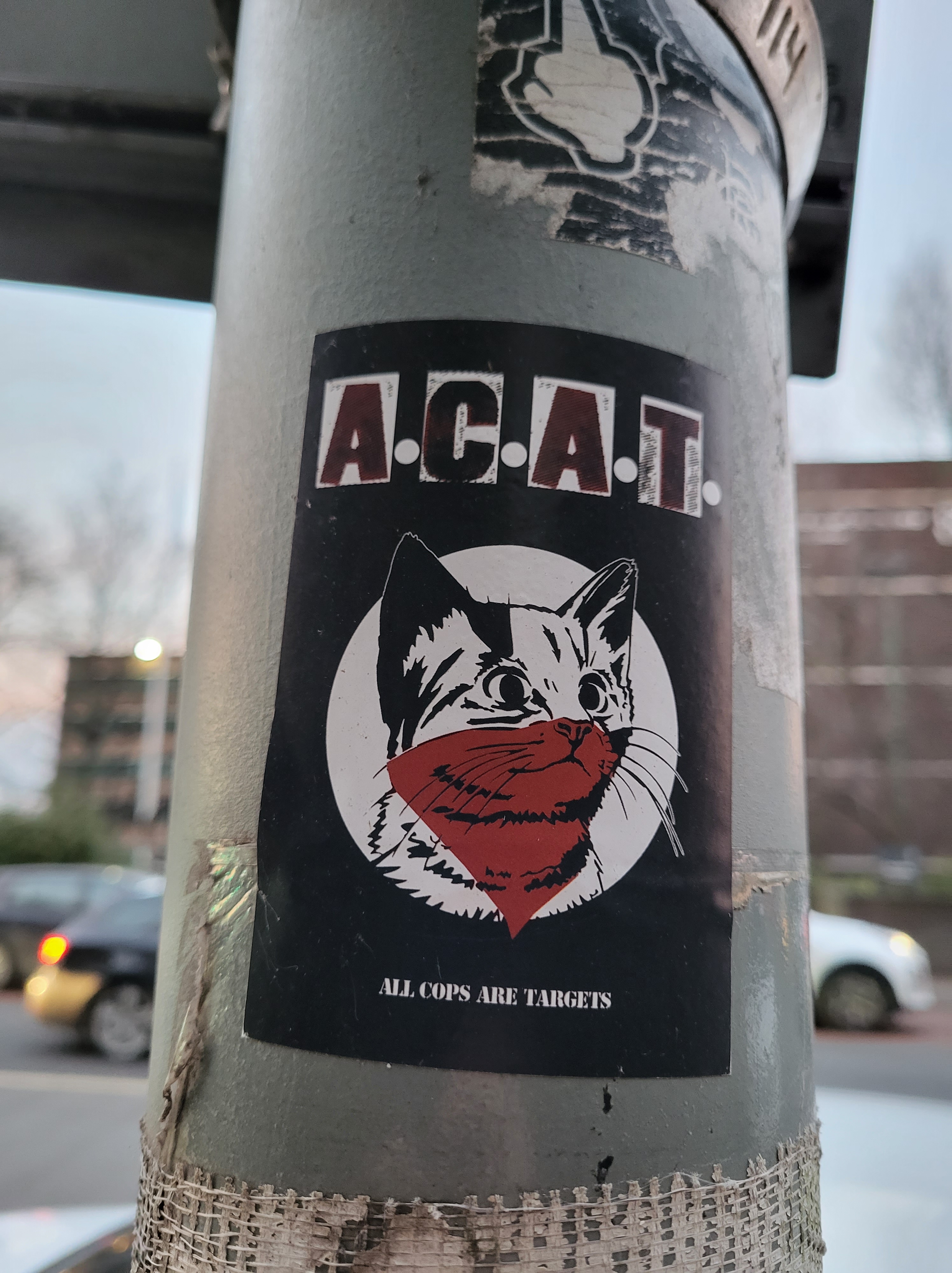
A lot of stickers criticising the polica use this acronym, which stands for ‘All Cops are Bastards’. This ties into the argument that the violence and discrimination committed by police officers, particularly against minority groups, is not the result of a few ‘bad apples’, but is actually a feature of the policing system (Photo: Hannah Awcock, 28/11/2021).A more complex design that also incoporates the ACAB acronym (Photo: Hannah Awcock, 28/11/2021).Stickers like this one play with the acronym, suggesting it stands for other things, but the anti-police meaning is always there (Photo: Hannah Awcock, 06/10/2022).This sticker also builds on the ACAB acronym by changing it to make it even less forgiving (Photo: Hannah Awcock, 05/02/2023).This sticker has a rather more elaborate design, but the message is just as clear (Photo: Hannah Awcock, 31/08/2020).The text on this sticker is in German and translates as ‘No friend, no helper.’ Police officers sometimes use seemingly innocent friendly conversations to gater intelligence, particularly during protests, so activists engage with them as little as possible (Photo: Hannah Awcock, 27/03/2021).This sticker conveys the same message, although I’m not sure what the relevance of the shark-human hybrid is! (Photo: Hannah Awcock, 28/09/2022).A simple design, but it gets the message across. This sticker was produced by Dog Section Press, an anti-profit radical publisher (Photo: Hannah Awcock, 28/09/2022). This sticker also calls for the abolition of police, describing them as the ‘biggest gang in town’ (Photo: Hannah Awcock, 17/02/2022).This sticker plays with the common association of police officers and pigs. Describing police as pigs goes back to the 1870s. (Photo: Hannah Awcock, 28/11/2022).This sticker includes a more specific criticism of the UK police, and mimics the style of material produced by the British governmment (Photo: Hannah Awcock, 16/05/2021). Blue Lives Matter was a slogan that appeared in response to the Black Lives Matter campaign, arguing that police officers have a right to use violence to defend themselves. This sticker subverts that slogan in turn, and also incorporates the ACAB acronym (Photo: Hannah Awcock, 26/10/2021)
Blair Peach, 1946-1979 (Source: Wikipedia, photo is in the public domain)
Mark Duggan, Ian Tomlinson, Jean Charles de Menezes; some people have the misfortune of being famous because they were killed by the Metropolitan Police. Blair Peach is perhaps one of the better known names on that list. Peach died from a broken skull on the 23rd of April 1979, after being struck on the head during a demonstration outside Southall Town Hall. The results of the internal investigation into what happened weren’t published until 2010, three decades after Peach’s death.
Clement Blair Peach was born in New Zealand on the 25th of March 1946. He moved to London in 1969 and started working as a teacher at the Phoenix School in Bow, East London. Peach was no stranger to radicalism and protest; he was a member of the Socialist Worker’s Party, as well as the Socialist Teacher’s Association and the East London Teacher’s Association, both within the National Union of Teachers. In 1974 he was acquitted of a charge of threatening behaviour after he challenged a publican who was refusing to serve black customers. He was also involved in campaigns against far-right and neo-Nazi groups; he was well known for leading a successful campaign to close a National Front building in the middle of the Bangladeshi community around Brick Lane.
On St. George’s Day 1979, the National Front held a meeting in Southall Town Hall. The Anti-Nazi League held a counter demonstration outside the Town Hall. Peach was one of 3000 people to attend. The demonstration turned violent; over 150 people were injured (including around 100 police officers), and 345 arrests were made. Peach was struck on the head by a police officer at the junction of Beachcroft Avenue and Orchard Avenue, as he tried to get away from the demonstration. He died from his injuries later that night in Ealing Hospital.
Peach’s death struck a chord amongst the communities he had stood up for, and across the city as a whole. A few days after his death, 10000 people marched past the spot where he was fatally injured. His funeral was delayed by several months, until the 13th of June, but that was also attended by 10000 people. The night before his funeral, 8000 Sikhs went to see his body at the Dominion Theatre in Southall.
The Metropolitan Police commissioned an internal inquiry into what happened, which was led by Commander John Cass. 11 witnesses saw Peach struck by a member of the Special Patrol Group (SPG). The SPG was a centrally-based mobile group of officers focused on combating serious public disorder and crime that local divisions were unable to cope with. It started in 1961, and was replaces in 1987 by the Territorial Support Group, which also has a less-than stellar reputation amongst activists.
The pathologist’s report concluded that Peach was not hit with a standard issue baton, but an unauthorised weapon like a weighted rubber cosh,or a hosepipe filled with lead shot. When Cass’ team investigated the headquarters of the SPG, they found multiple illegal weapons including truncheons, knives, a crowbar, and a whip. 2 SPG officers had altered their appearance by growing or cutting facial hair since the protest, 1 refused to take part in an identity parade, and another was discovered to be a Nazi sympathiser. All of the officers’ uniforms were dry-cleaned before they were presented for examination.
Cass concluded that one of 6 officers had killed Peach, but he couldn’t be sure who exactly, because the officers had colluded to cover up the truth. He recommended that 3 officers be charged with perverting the course of justice, but no action was ever taken. The results of the inquiry were not published, and the coroner at the inquest into Peach’s death refused to allow it to be used as evidence, despite making use of it himself. On the 27th May 1980, the jury returned a verdict of death by misadventure. After decades of campaigning by Peach’s partner Celia Stubbs, the report was finally published in April 2010, although the Director of Public Prosecutions decided there was still not enough evidence to bring charges against anyone.
If I had written this blog post more than 6 years ago, it would look very different. The death of Blair Peach was a public relations nightmare for the Metropolitan Police; a respected and well-liked activist who fought hard for local communities, Peach was a man for whom many people cared about. The Met should have been transparent, finding out what happened and punishing those responsible quickly and openly. Instead, they covered up the cause of Peach’s death for 3 decades, allowing what happened to fester, contributing to a sense of resentment and distrust that continues to this day.
Sources and Further Reading
Casciani, Dominic. “Blair Peach Report: What the Investigation Uncovered.” BBC News. Last modified 17th April 2010, accessed 12th April 2016. Available at http://news.bbc.co.uk/1/hi/uk/8646829.stm




 Turbulent Isles