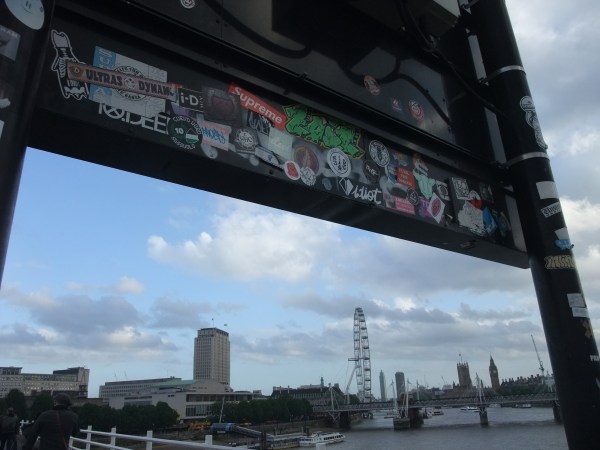
Stickers of all kinds are a significant part of London’s urban fabric (Photo: Hannah Awcock, Waterloo Bridge, 15/12/16).
The conflict over Junior Doctors’ contracts was arguably one of the biggest news stories of 2016 with the Health Secretary, Jeremy Hunt, imposing new working and pay conditions. The NHS more generally is one of the biggest battlegrounds of modern British politics, with constant debates about funding, privatisation, and the quality of the services provided. Like other key issues and events in politics (such as the EU Referendum, immigration, and housing), the conflict over the NHS has manifested itself in London’s protest stickers. Some stickers refer to other health-related issues, such as the legalisation of drugs and mental health.
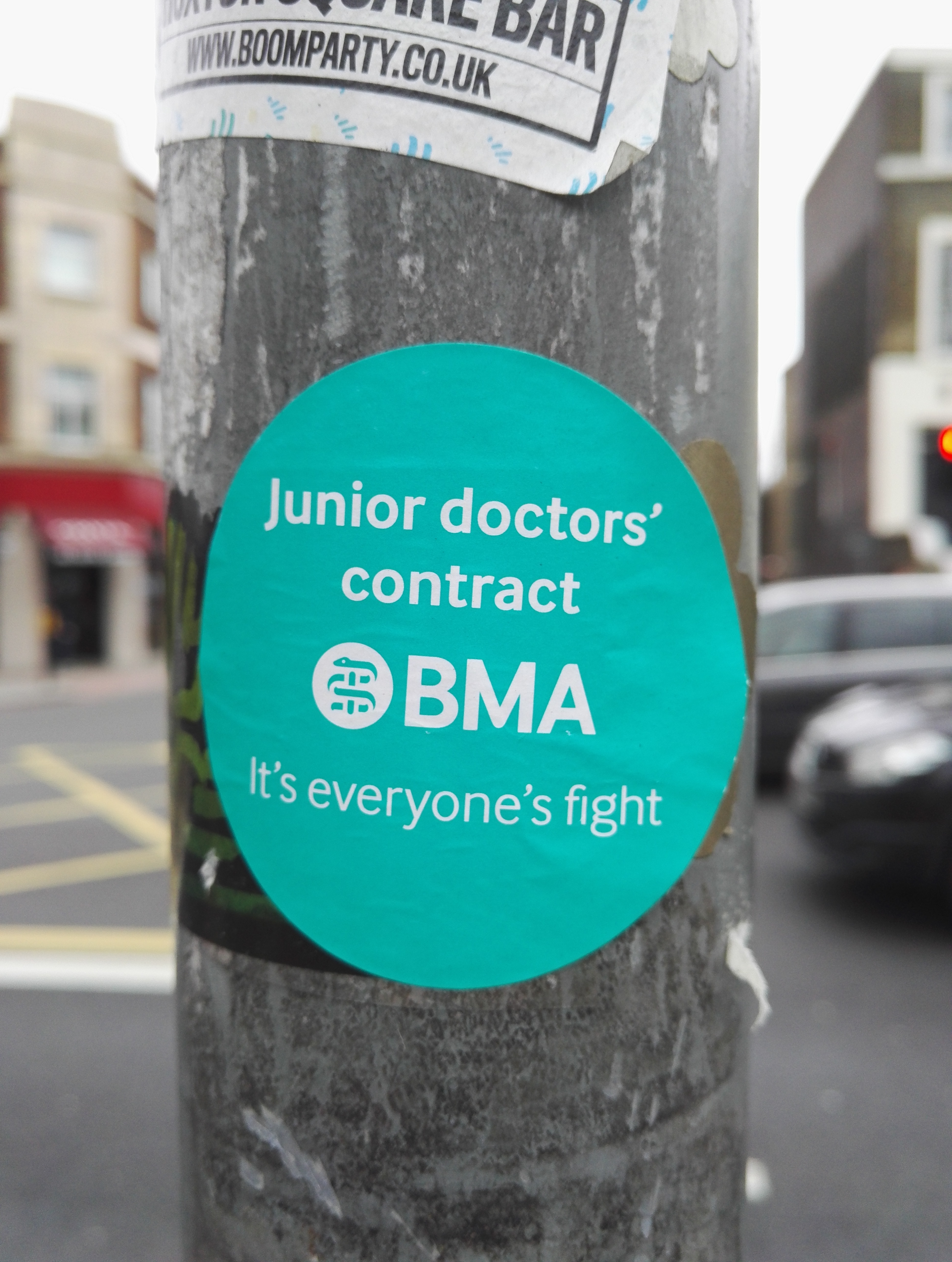
One of the main arguments against the new contracts was that the changes would risk the health of patients. As such, it is not just Junior Doctors who should take an interest in the dispute (Photo: Hannah Awcock, Lewisham Way, 20/03/16).
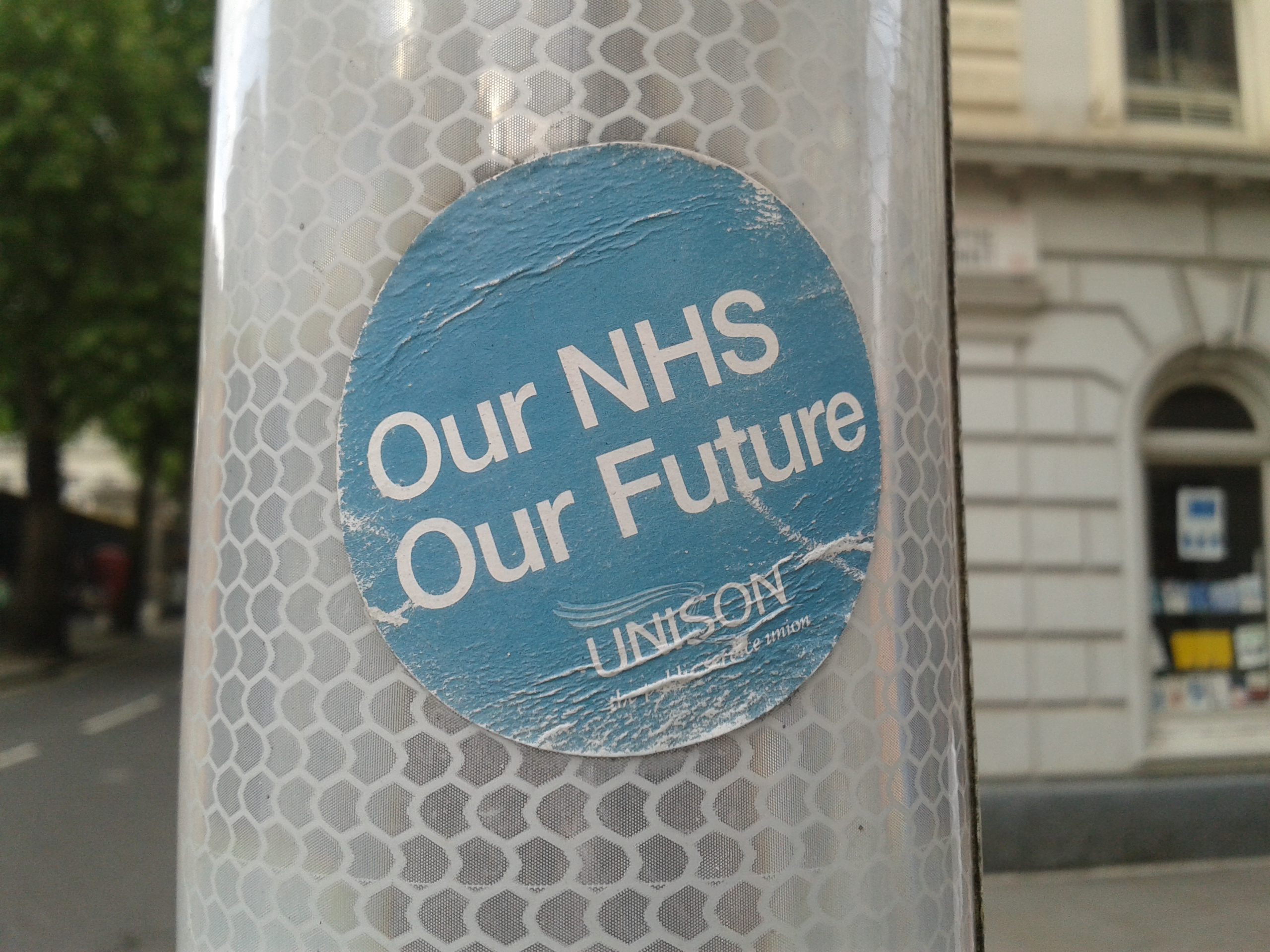
Unison is a union for people who work in public services, including employees of the NHS. This sticker is also making the argument that the users of the NHS should be just as involved in the fight for to save the NHS as those who work in it (Photo: Hannah Awcock, Great Russell Street, 16/06/15).
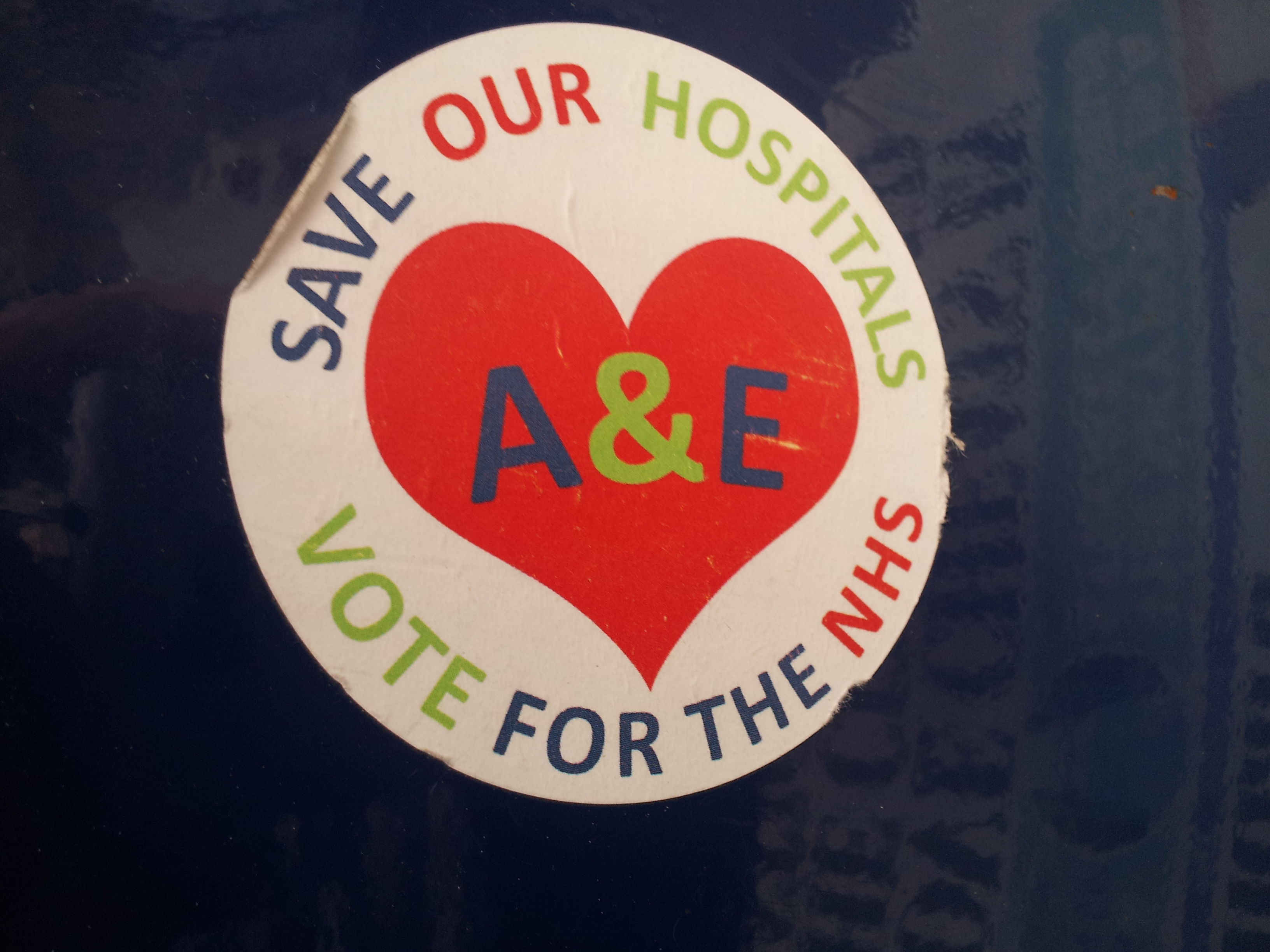
The NHS is an important political issue. The funding and running of the NHS often becomes a topic of debate during elections. The Conservative Party, for example, are frequently accused of trying to underfund and privatise the NHS. (Photo: Hannah Awcock, Borough High Street, 19/08/15).
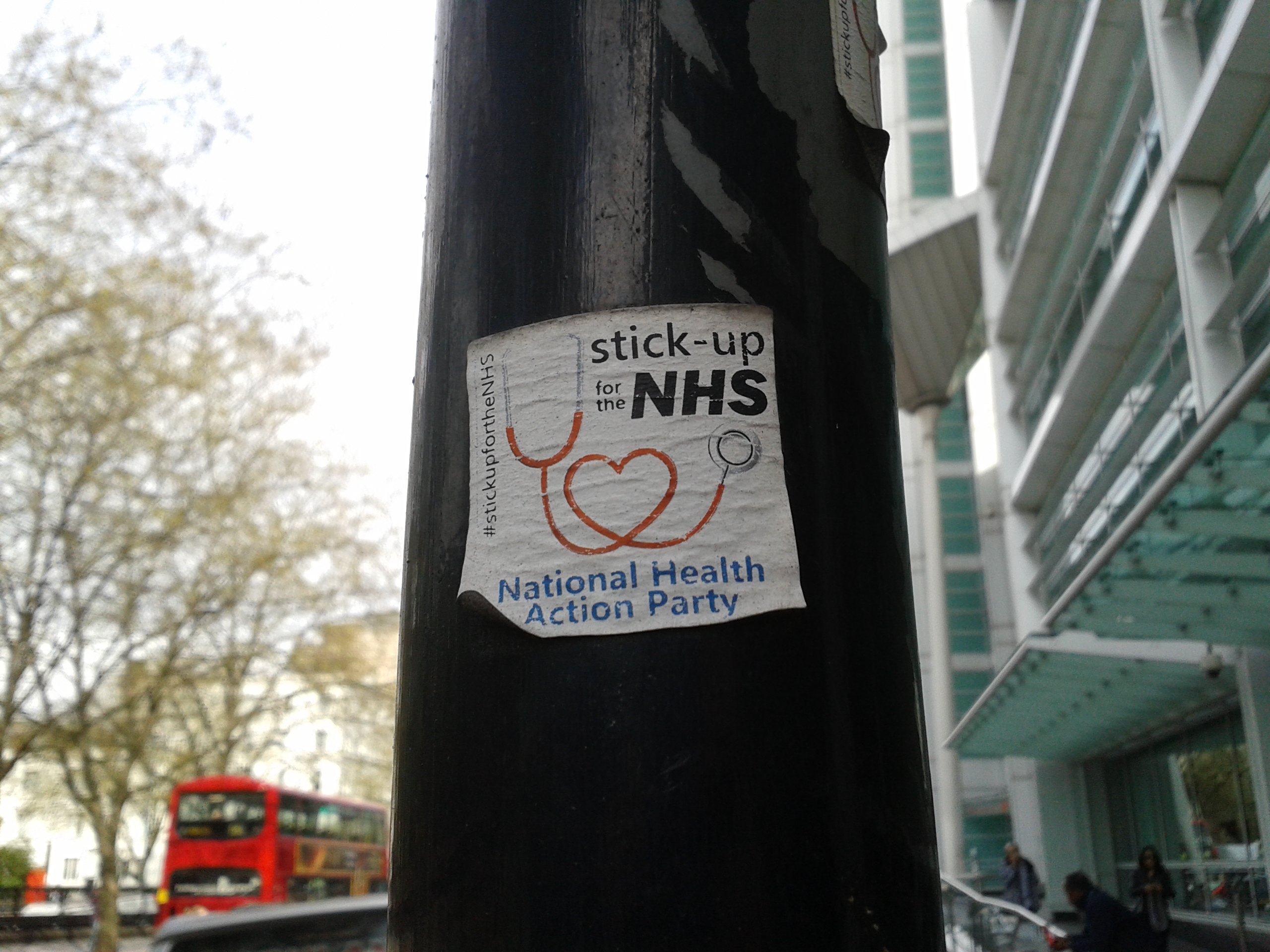
The National Health Action Party is a group that campaigns to halt and reverse the privatisation of the NHS. I found this sticker on the Euston Road, outside the University College London hospital. Sometimes, the location of protest stickers can contribute to their meaning (Photo: Hannah Awcock, Euston Road, 16/06/15).
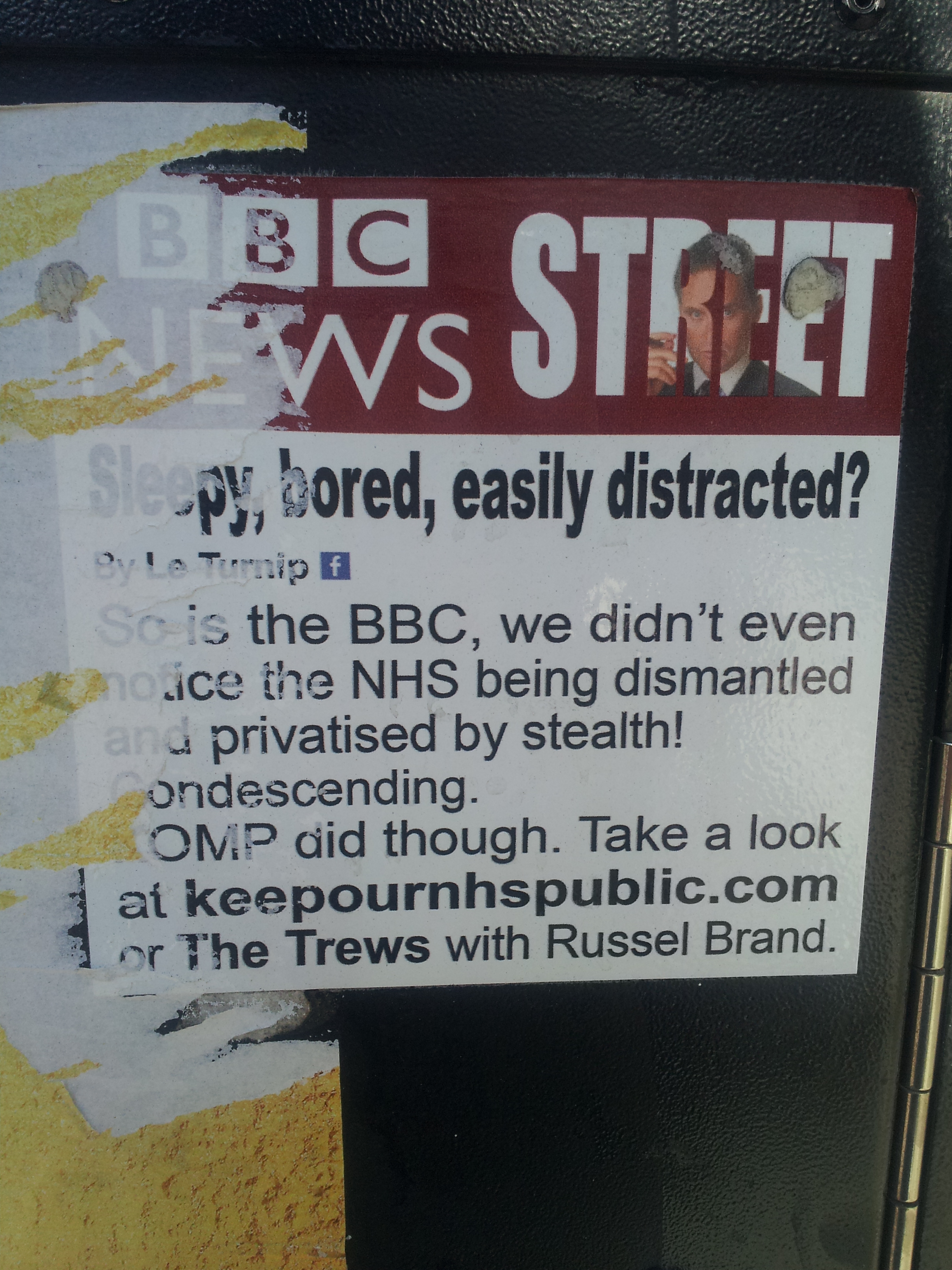
Keep Our NHS Public is another group that campaigns for the preservation of the NHS. Le Turnip produces protest stickers that take a lighthearted and sarcastic view on a whole range of issues (Photo: Hannah Awcock, High Holborn, 09/08/15).
The NHS is not the only health-related issue to inspire the production of protest stickers. Feed the Birds is a campaign run by the London Cannabis Club. The campaign aims to destigmatise cannabis and call for its legalisation by feeding hemp seeds to birds (Photo: Hannah Awcock, Prince Consort Road, 09/07/15).
The Feed the Birds campaign makes some bold claims about the powers of cannabis (Photo: Hannah Awcock, High Holborn, 09/08/15).
This sticker was produced by the Psychadelic Society, which advocates for the legalisation of psychadelic drugs (Photo: Hannah Awcock, Upper Street, Islington, 14/04/15).
Mental health is also a topic which gets people talking. This sticker is objecting to the way in which mental health terms are used in everyday language, which can belittle mental health problems (Photo: Hannah Awcock, Euston Road, 03/08/16).
To see where I found all these protest stickers, check out the Turbulent London Map.
Founders building on the Royal Holloway, University of London campus (Photo: Hannah Awcock).
Generally, protest stickers tend to be found in large towns and cities rather than smaller towns and villages. There are some exceptions however, such as Egham, a small town in suburban Surrey. It is the location of Royal Holloway, the University of London college at which I have been studying for the last seven years. Students have historically been associated with radical politics, and student politics has experienced a resurgence since the campaign against the increase in English university tuition fees in 2010.
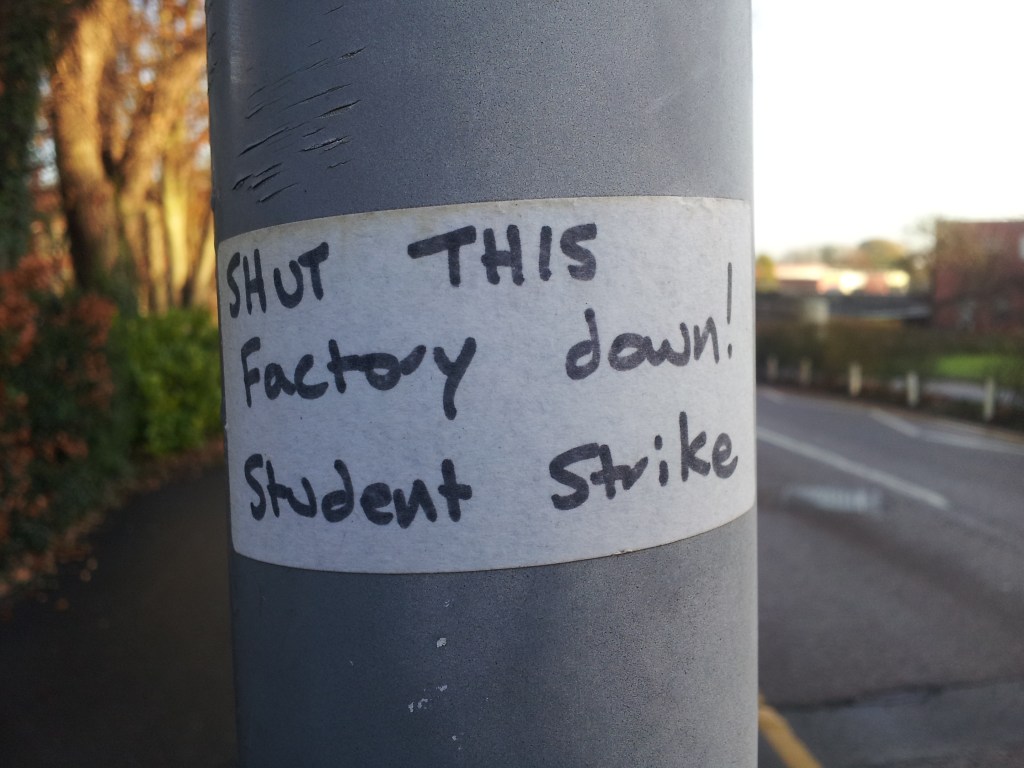
In recent years, there has been a backlash against the commodification of university education. For some, the focus of contemporary university programmes is too much on developing productive employees rather than education for the sake of education. This sticker is a reflection of this opinion, alluding to the university as a factory, churning out workers to keep the economy going (Photo: Hannah Awcock, Royal Holloway campus, 26/11/15).
The recent EU referendum permeated almost every aspect of British life. The position of students and academics from the EU, vital to the health of the British academic system, is uncertain in post-Brexit Britain. The National Union of Students (NUS) campaigned for a Remain vote (Photo: Hannah Awcock, Royal Holloway Campus, 08/06/16).
Most of the stickers I’ve come across in Egham are not directly related to student politics. This sticker is also advocating a Remain vote in the EU referendum, but it is a generic sticker that I have seen elsewhere, such as London and Brighton (Photo: Hannah Awcock, Royal Holloway Campus, 08/06/16).
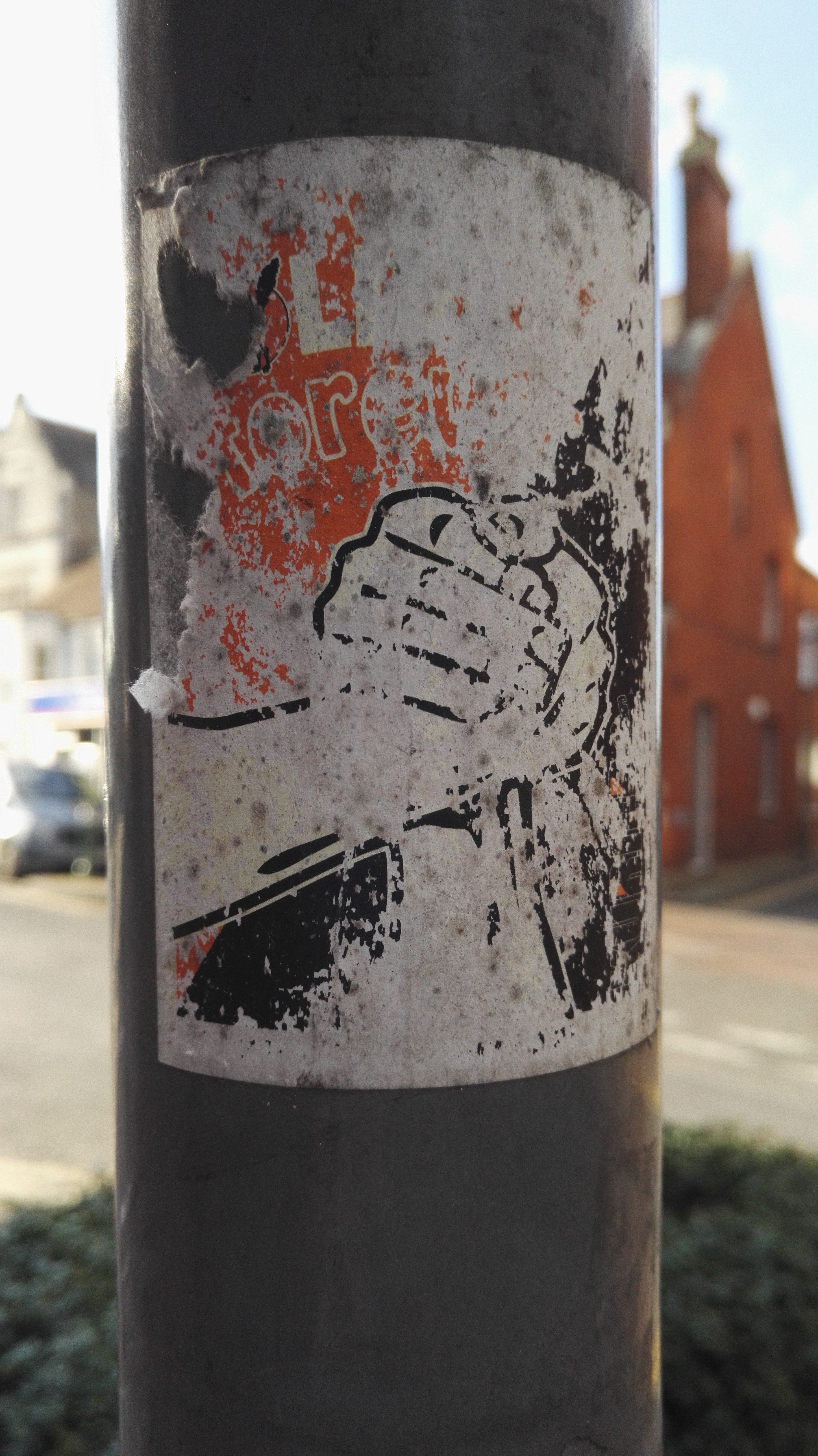
Some stickers become so weathered that it can be difficult to see their original message. It is possible to make out two clasped hands however, which a common visual symbol of solidarity. If I had to guess, I would say that the words read ‘Solidarity Forever’ (Photo: Hannah Awcock, Egham High Street, 24/02/16).
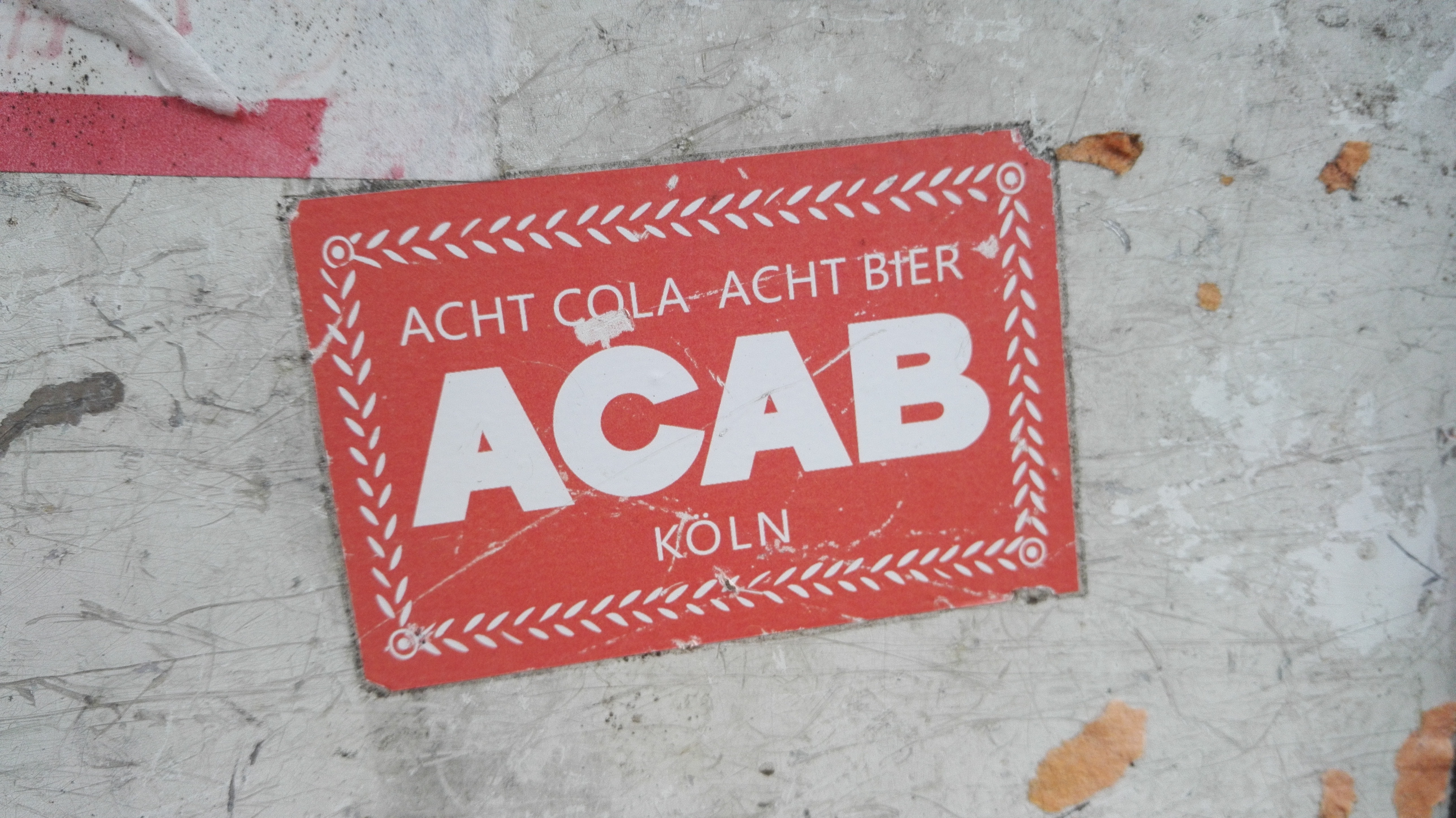
ACAB (All Cops Are Bastards) is a common way of expressing discontent with the police in Britain. This sticker demonstrates that the phrase is also recognised in other countries, in this case Germany. ‘Acht Cola Acht Bier’ (which means eight cokes and eight beers) is apparently a common method in Germany of disguising ACAB as a drinks order (Photo: Hannah Awcock, Egham High Street, 24/02/16).
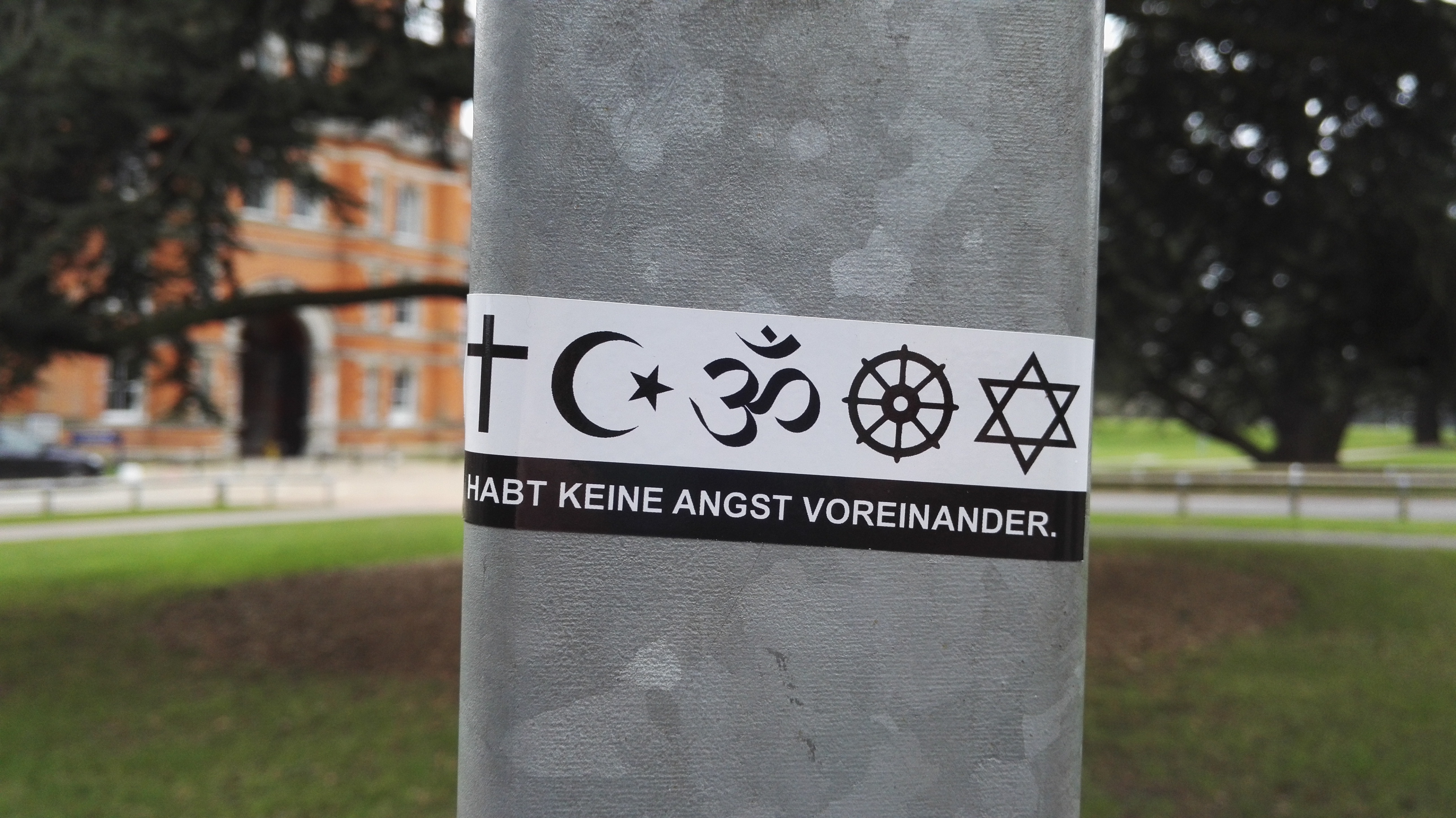
This sticker is also in German. The texts beneath the symbols of the five major world religions translates to ‘Do not be afraid of each other,’ an admirable sentiment (Photo: Hannah Awcock, Royal Holloway Campus, 01/02/16).
This sticker, which is located near the library on the Royal Holloway Campus, looks as if attempts have been made to deliberately scratch it off. It is difficult to judge the motivation of people who deface protest stickers; this could have been done by students on a cigarette break, or by someone who opposes the sticker’s message (Photo: Hannah Awcock, Royal Holloway Campus, 01/02/16).
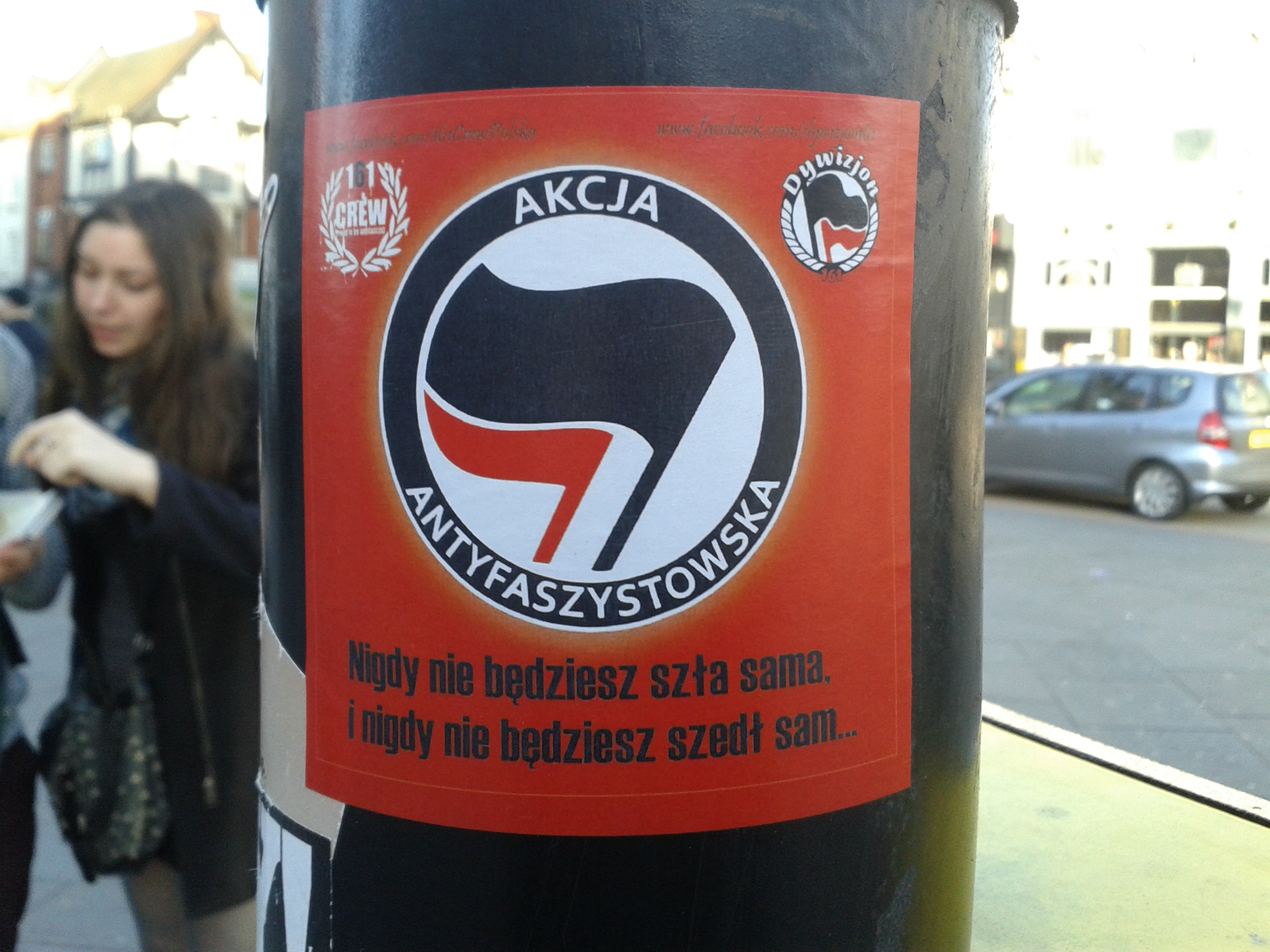
This sticker was produced by the 161 Crew, a Polish Anti-fascist group (Photo: Hannah Awcock, Egham Hill, 01/02/16).
Anti-fascist groups are some of the most prolific stickerers I have ever come across. When localised groups travel, they often put stickers up in the place that they travel to. I assume that is what happened here (Photo: Hannah Awcock, Egham Hill, 01/02/16).
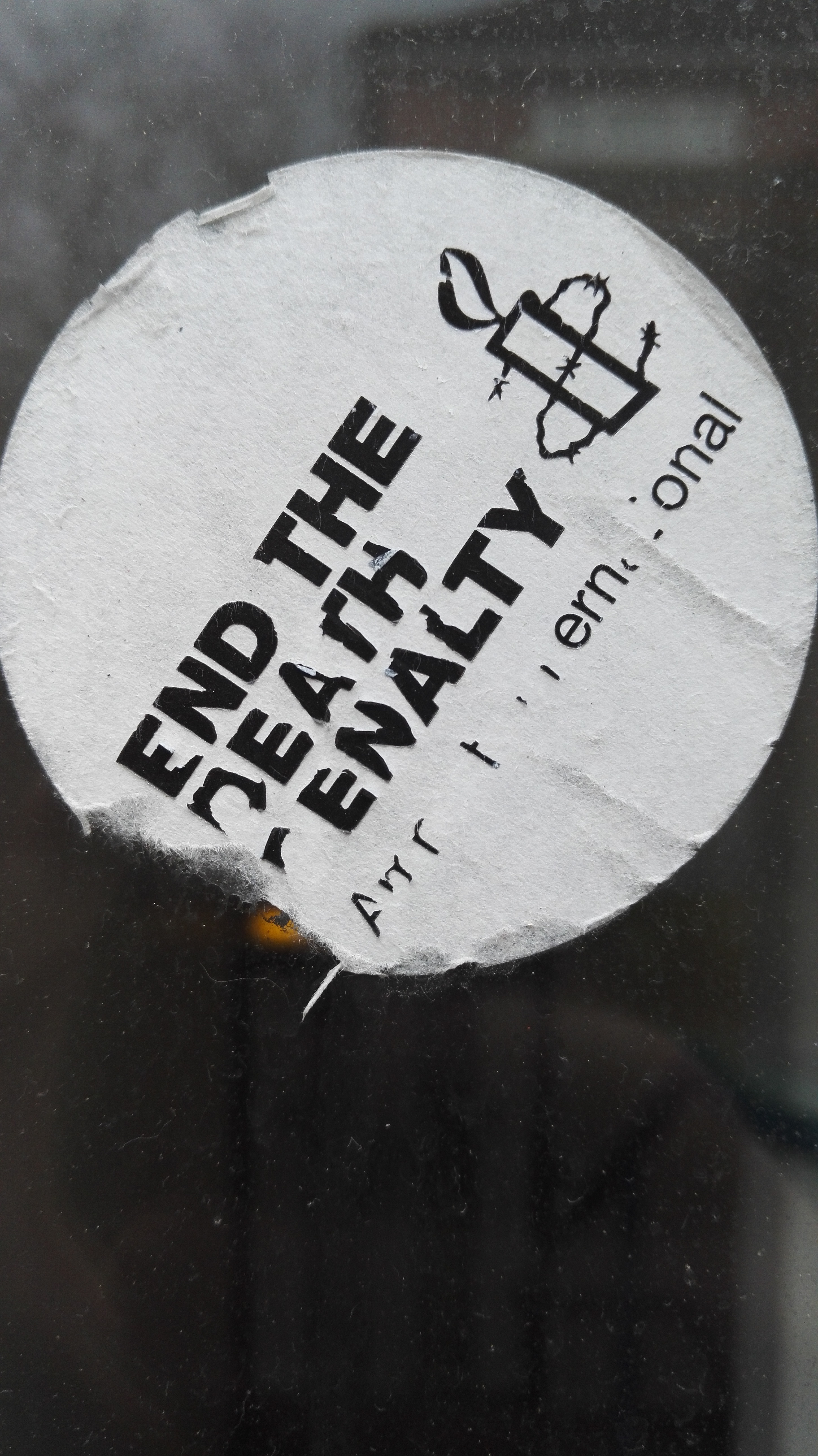
There are over 100 student Amnesty International groups in the UK, so they are a familiar presence on many university campuses (Photo: Hannah Awcock, Royal Holloway Campus, 14/01/16).
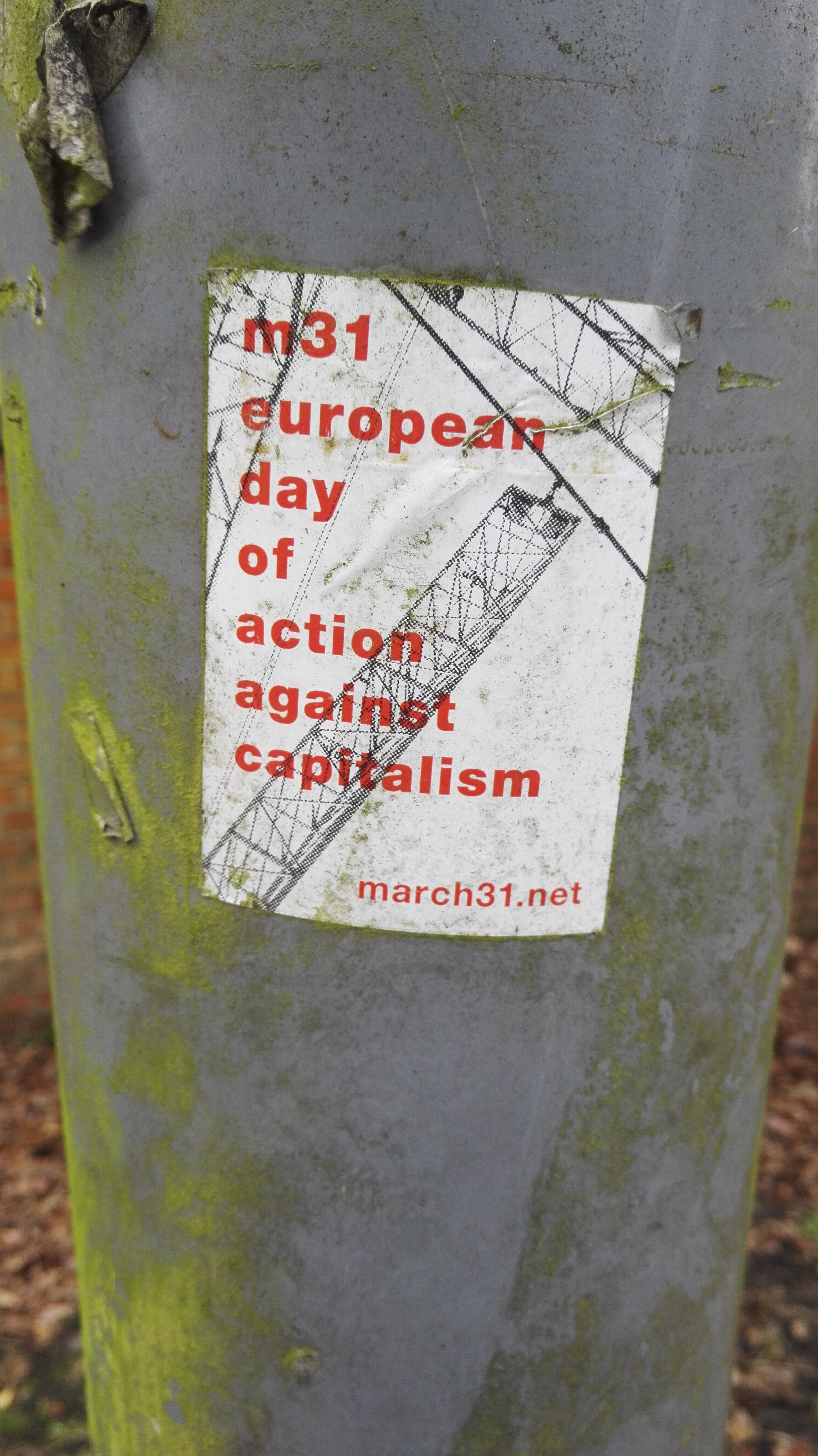
M31 was an event that took place in 2012, so this sticker is at least 4 years old. Not many stickers achieve this kind of longevity (Photo: Hannah Awcock, 01/02/16).
You find stickers of all kinds all over London, sometimes even in posh places, like these outside the National History Museum in South Kensington (Photo: Hannah Awcock, Exhibition Road, 30/08/16).
As regular readers of my blog will know, you can find all kinds of different issues represented on the protest stickers that plaster London’s streets. Over the last year and a half, I have written about protest stickers relating to immigration and race, housing, and the EU referendum, amongst others (see the Turbulent London Map for locations of all the stickers I’ve featured). But all of my topics so far have been rather human-centric, and many activists concern themselves with the non-human. The way that humans treat animals has been a topic of fierce debate for decades. It’s a complex issue, which can escalate rapidly into a philosophical debate about whether or not animals are entitled to certain rights in a similar way to humans. The debate also manifests itself in practical ways however, such as opposition to experiments being carried out on animals, and concern for the treatment of farm animals bred for human consumption. In recent years, ethical consumerism has reduced the amount of product testing carried out on animals, and vegetarianism and veganism has increased (the number of vegans in Britain has gone up 360% in the last 10 years (Source: The Telegraph, 2016). This has not been enough to satisfy everyone, however, and animal welfare continues to be a topic of protest stickers.
This sticker equates animal with human liberation, mirroring the symbolic raised, clenched fist with a raised paw (Photo: Hannah Awcock, New Cross Road, 23/08/16).
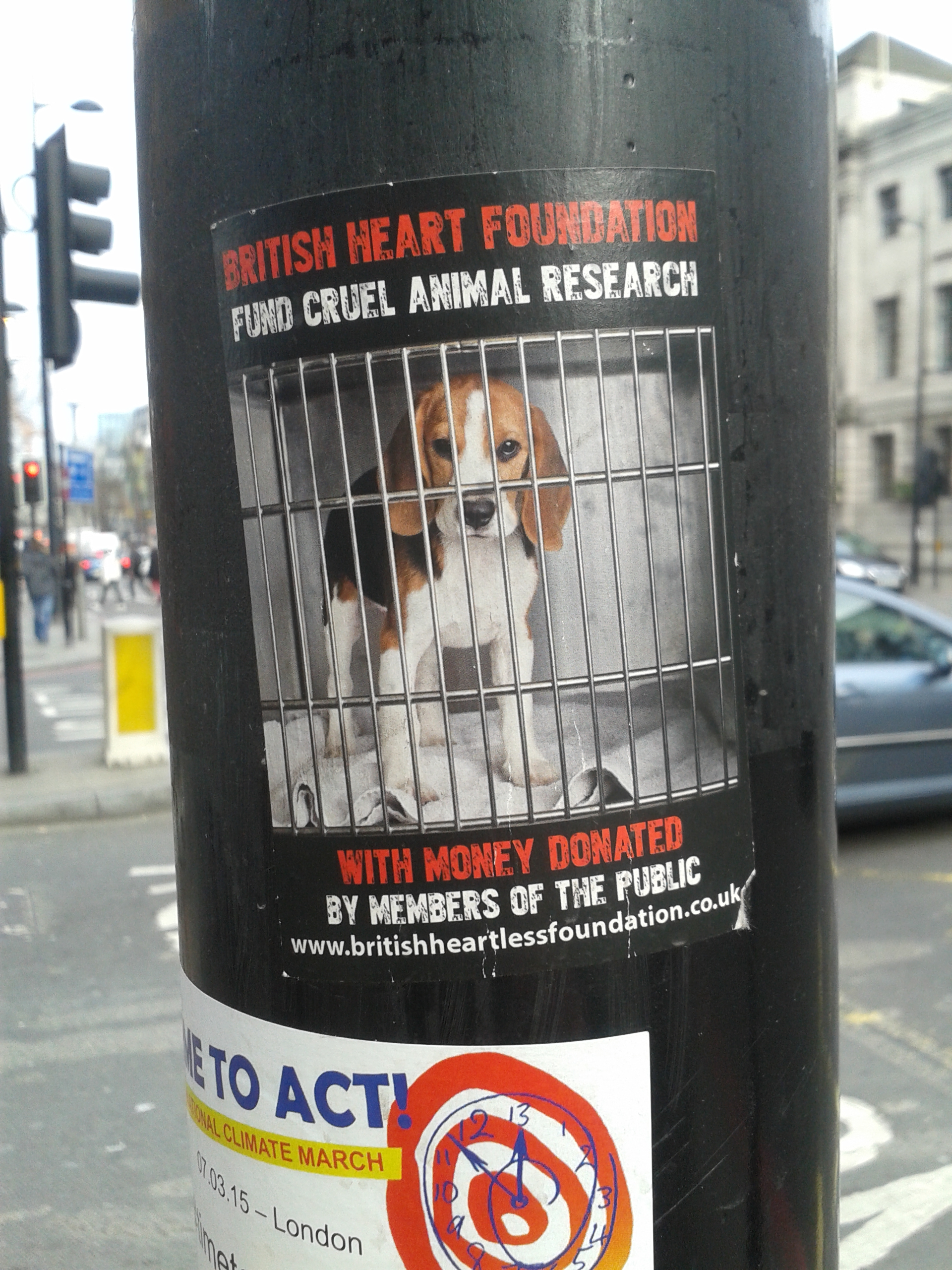
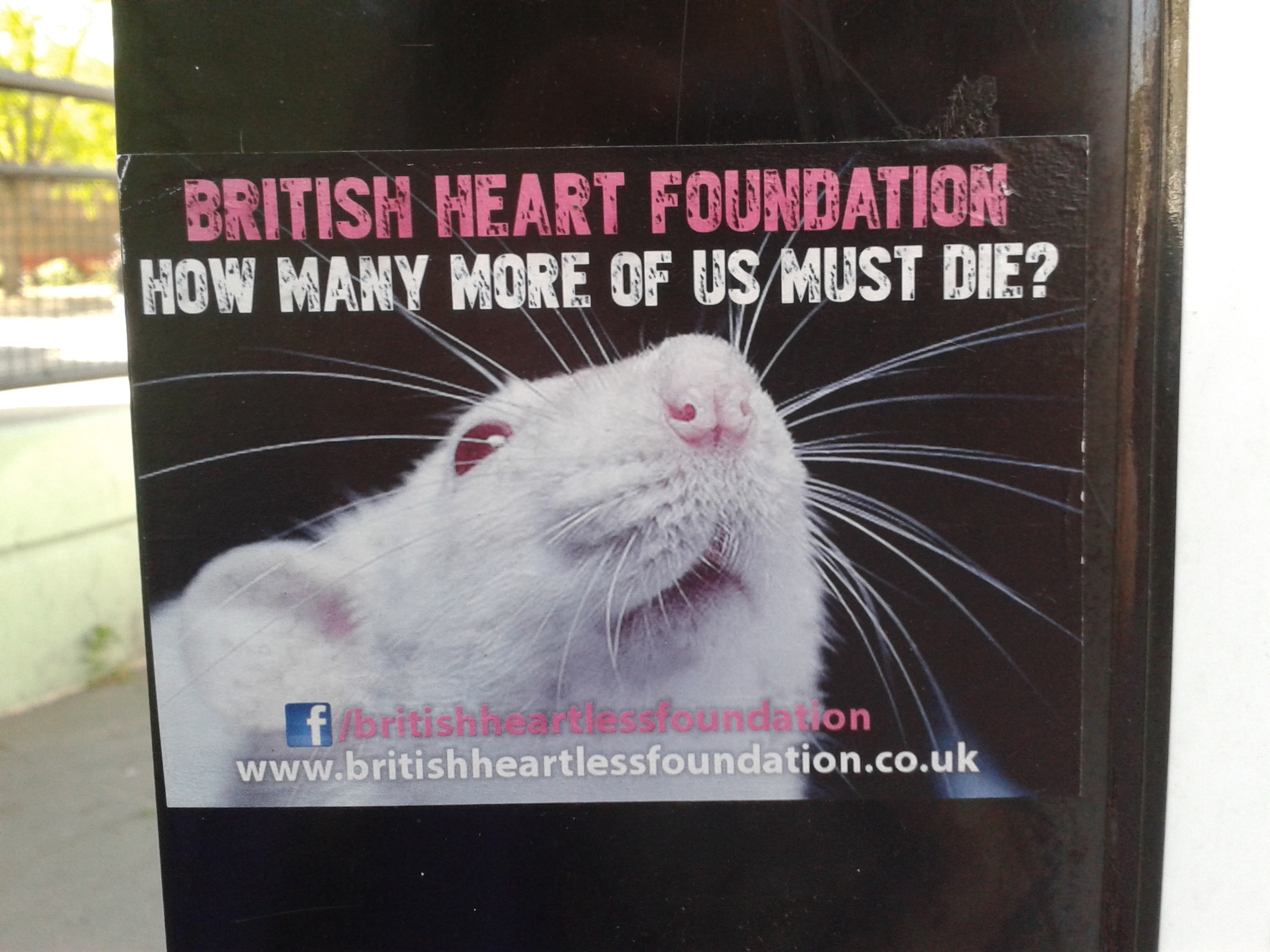
The British Heart Foundation’s (BHF) use of animal experimentation is a common topic of protest stickers in London. The British Heartless Foundation is an organisation that aims to promote the fact that the BHF fund experiments on animals- they argue that less people would donate money to the BHF if they knew that was the case (Photo: Hannah Awcock, Euston Road, 11/03/15).
The British Heartless Foundation produce a variety of different stickers. This one features rats (Photo: Hannah Awcock, East Street, Southwark, 04/06/15).
According to the British Heartless Foundation, BHF also fund experiments on pigs (Photo: Hannah Awcock, Tottenham Court Road, 19/05/15).
This sticker references recent culls of badgers in an attempt to prevent the spread of bovine TB. The effectiveness of the policy has been questioned by campaigners, who argue that the policy is cruel and unnecessary (Photo: Hannah Awcock, Southbank, 12/09/15).
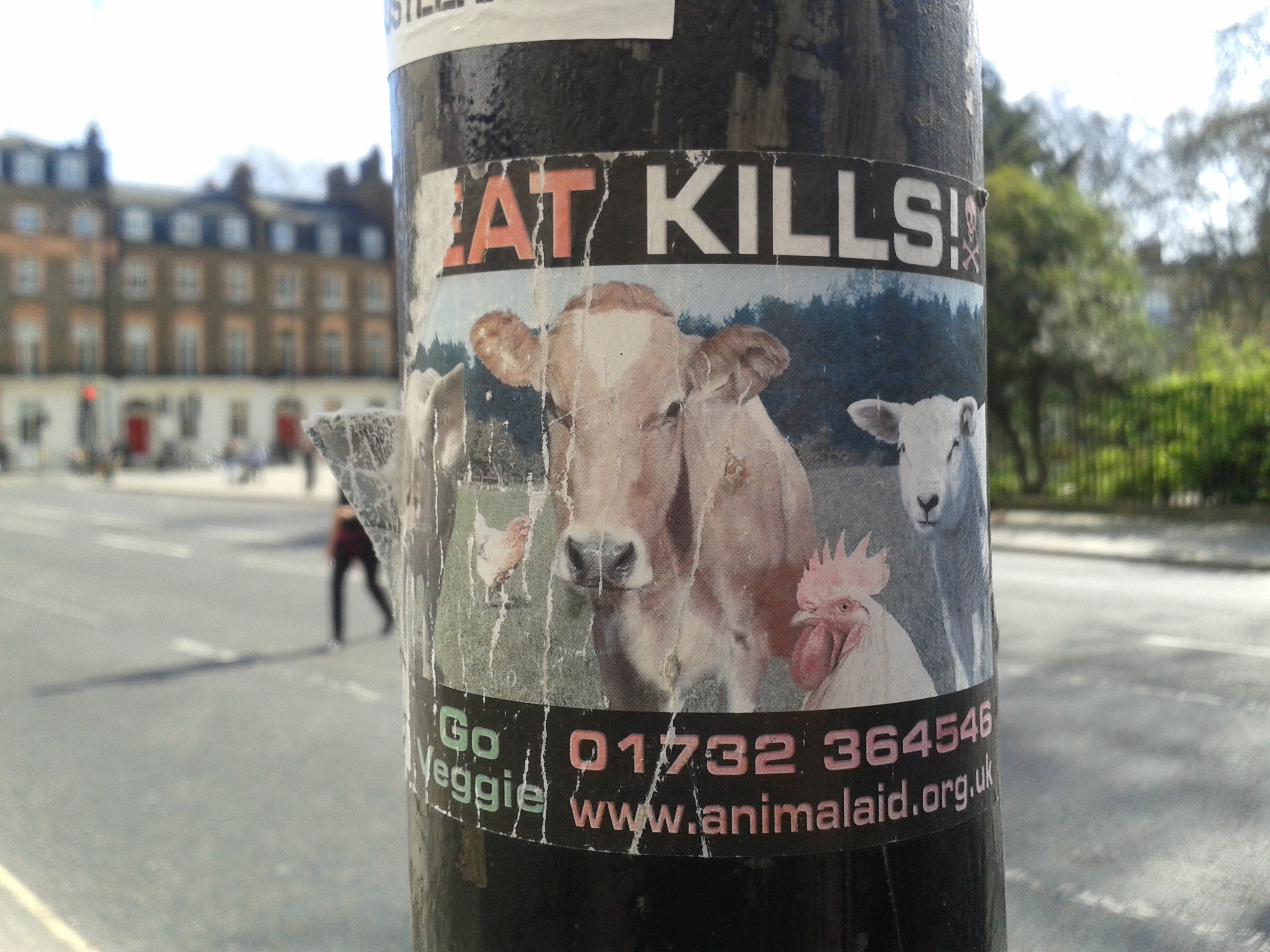
A lot of protest stickers promote vegetarianism and veganism. This sticker equates killing animals for food with murdering a human (Photo: Hannah Awcock, New Cross Road, 20/03/16).
The Friendly Activist is a vegan who campaigns for animal rights and the environment, amongst other things. He seems to have gone quiet recently though (Photo: Hannah Awcock, Borough High Street, 26/06/15).
Animal Aid campaigns against all forms of cruelty against animals and promotes what they call ‘cruelty-free living’ (Photo: Hannah Awcock, Russell Square, 15/04/15).
This sticker is relatively low-tech; it is not very waterproof, so is likely to deteriorate quickly. Veganstickers.co.uk sells vegan protest stickers, and Earthlings is a documentary about animal cruelty (Photo: Malet Street, 08/03/16).
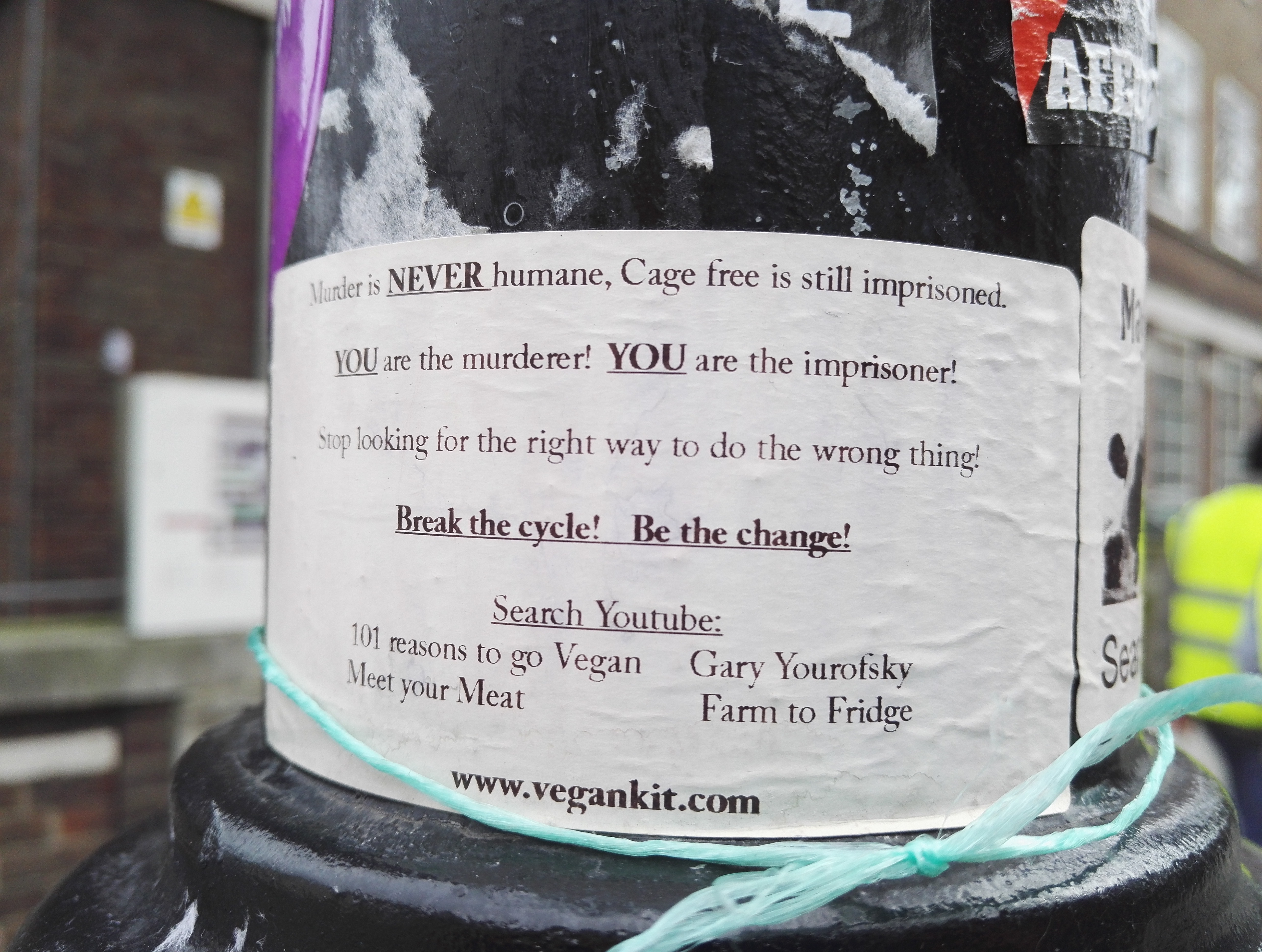
This sticker is a similar style and quality. It is advertising vegankit.com, a website that provides advice, information, and links to vegans and people who are considering veganism (Photo: Hannah Awcock, Malet Street, 08/03/16).
This sticker is the same as the last, although its condition suggests it has been out on the street for longer. The photo was taken two months after the previous one and close by, so they could have been put up at the same time. Someone has crossed out the YouTube videos and web address, perhaps because they disagree with the sticker’s message (Photo: Hannah Awcock, 03/05/16, Gower Street).
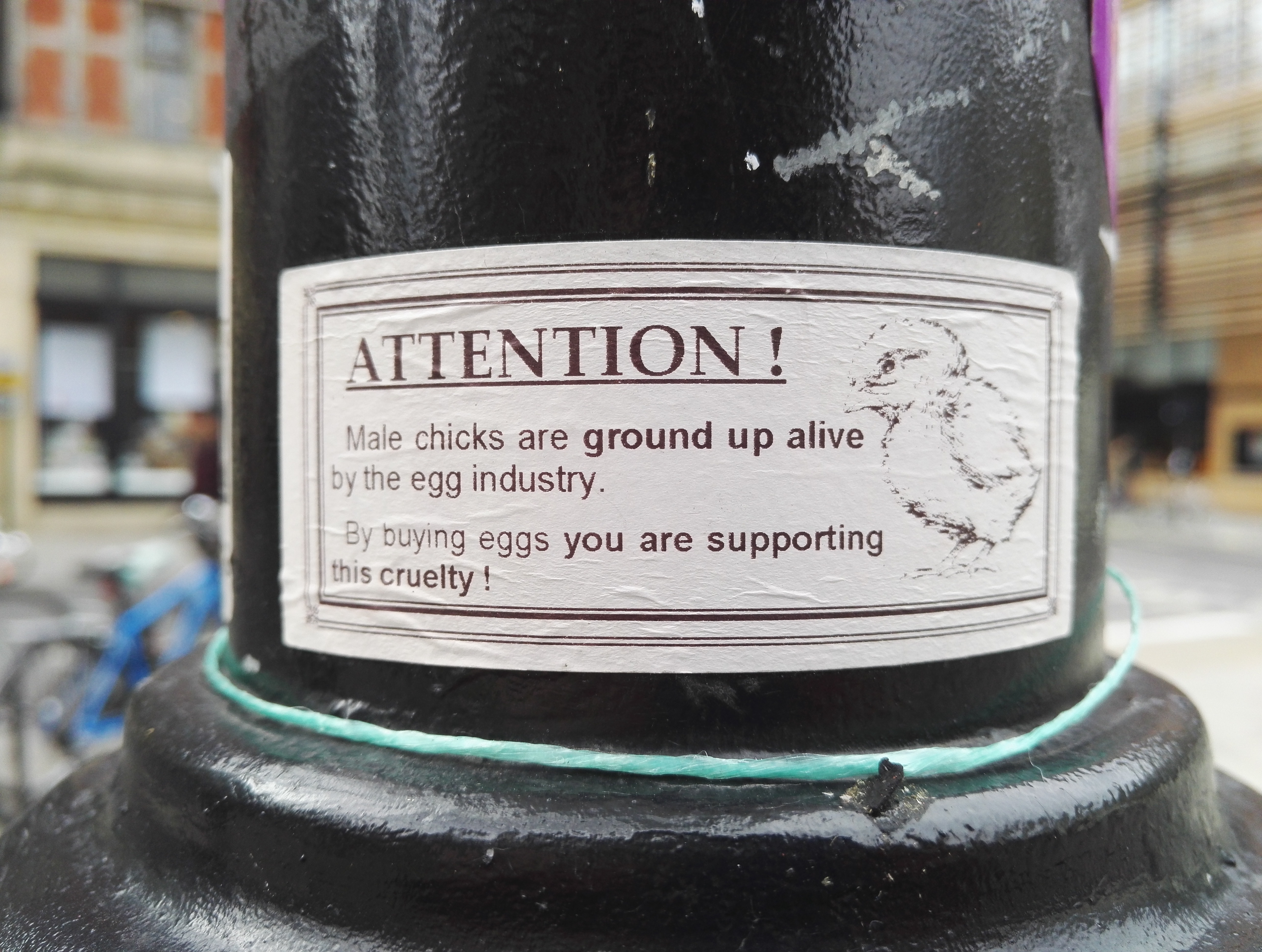
This sticker was also located in the same vicinity as the previous two; they may have been put up by the same person (Photo: Hannah Awcock, Malet Street, 08/03/16).
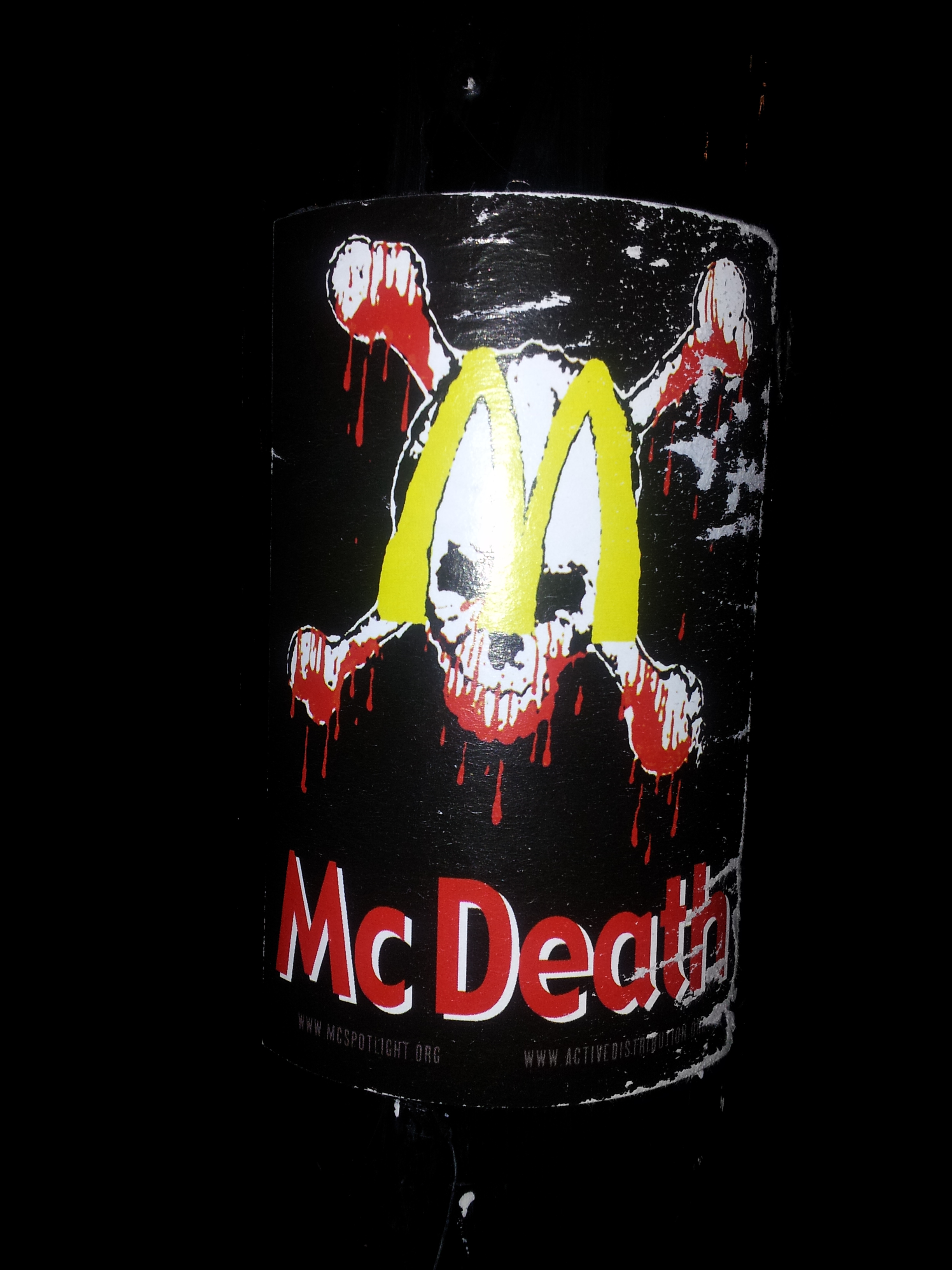
Location can be very important for protest stickers. I found this sticker outside a McDonalds in Islington (Photo: Hannah Awcock, Upper Street, Islington, 01/12/15).
If you want to see where all these stickers were located, take a look at the Turbulent London Map.
Stickers of all kinds are a common sight on the streets of London. I am particularly interested in the ones with a rebellious or subversive tone (Photo: Hannah Awcock).
London’s protest stickers cover a whole range of topics, from housing to race and immigration. However, some of them don’t fit into any specific category, instead embodying a rebellious ethos. This post is about these stickers, the ones providing good advice for anyone with a subversive streak.
This sticker, photographed on the Tottenham Court Road on 03/09/15, seems like a good place to start. Why should anyone else have a say over the way you live your life? (Photo: Hannah Awcock).
This sticker encourages people to think for themselves- an important quality for anyone involved in social movements or activism (Photo: Hannah Awcock, Waterloo Bridge, 02/06/15).
This sticker links nicely to the previous one- critical thought is an important ability for academics as well as activists. Question everything, never just accept what you are told as the truth. This sticker was photographed outside King’s Cross Station, near the British Library, on 06/06/15 (Photo: Hannah Awcock).
This sticker was photographed in Elephant and Castle on 05/03/15. Even small, everyday acts can be rebellious (Photo: Hannah Awcock).
This sticker is a reminder to everyone that your happiness does not depend on the sadness or deprivation of others. The photo was taken on Albany Road, near the occupied Aylesbury Estate on 02/04/15, making it all the more pertinent (Photo: Hannah Awcock).
This is a question that everyone should ask themselves every once in a while. If you aren’t, then what can you do to try and change things? (Photo: Hannah Awcock, 07/06/15, Shoreditch Hight Street).
Activists are often told that their demands are impossible, that they will never achieve the change they want to see. It takes a lot of determination to keep going in the face of all that negativity. rs21 is a news and analysis website run by British revolutionary socialists (Photo: Hannah Awcock, 12/03/15, Gordon Square, Bloomsbury).
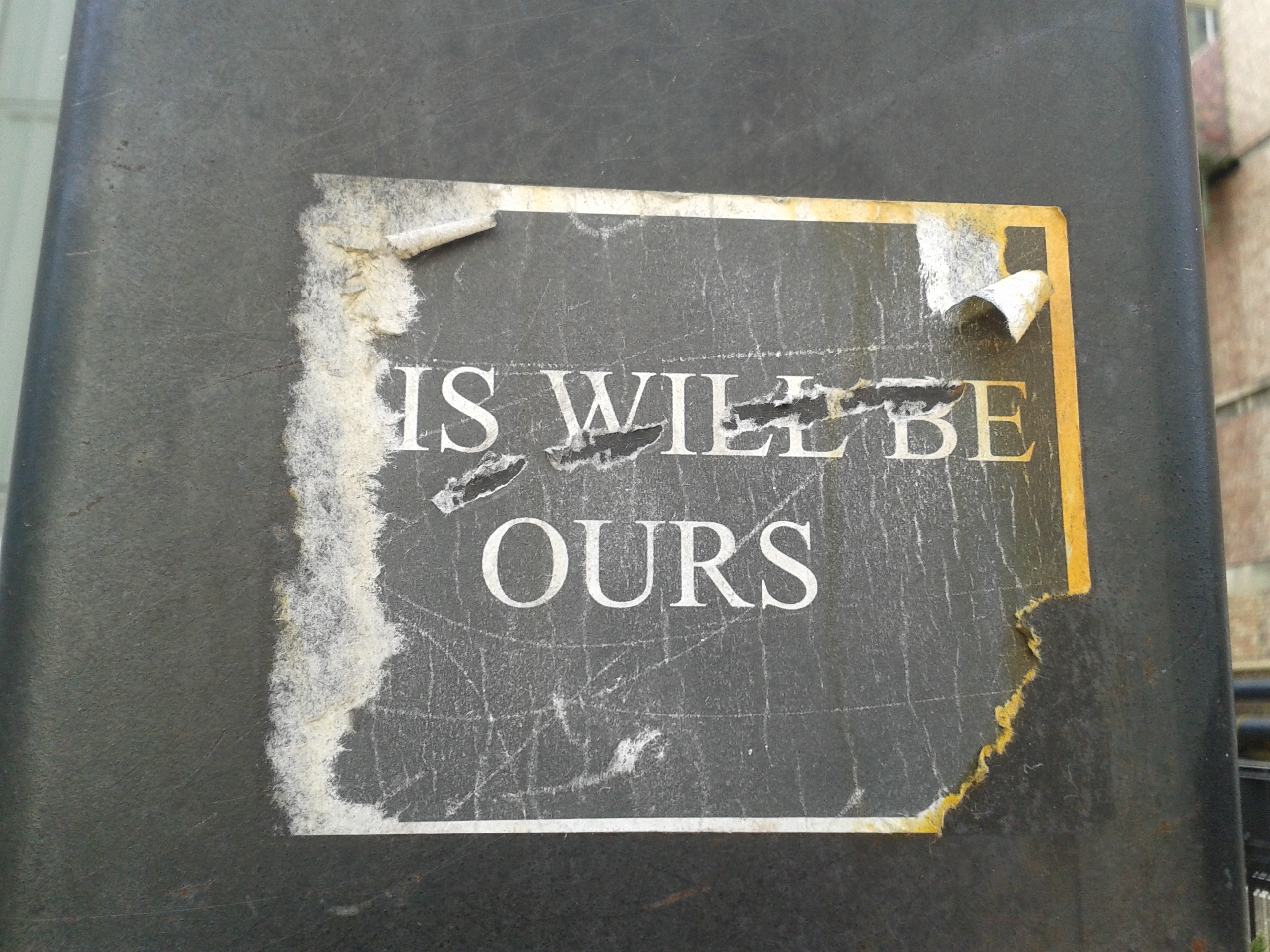
Although scratched and torn, it is easy to make out the intent of this sticker. The message- “This will be ours,” is a determined statement of intent (Photo: Hannah Awcock, 17/04/15, Gordon Street).
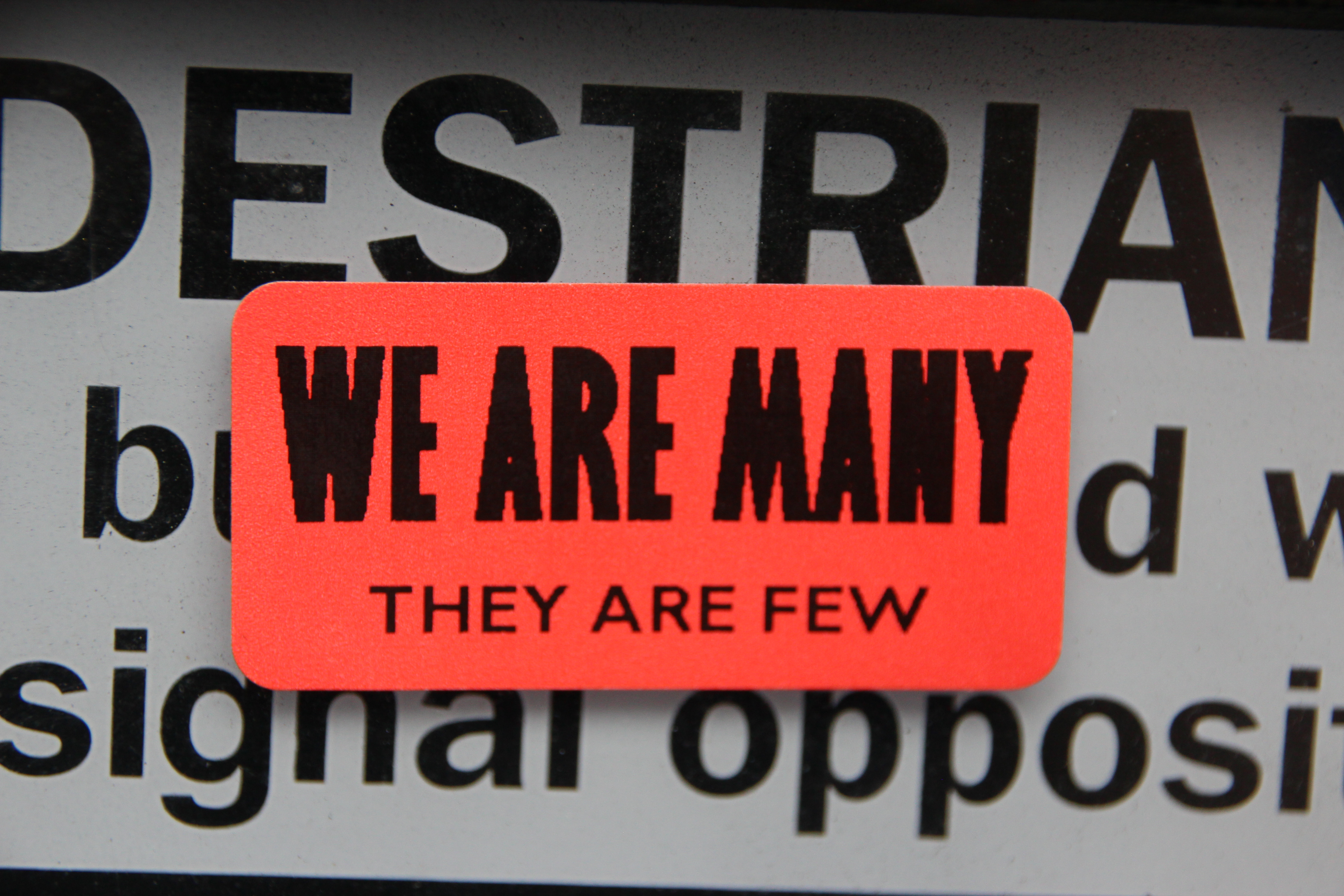
This empowering sticker is a reminder that the government only governs because we allow it to. If everyone decided to act together, it would create a very powerful force (Photo: Hannah Awcock, 20/06/15 Fleet Street).
This sticker isn’t protest-related, but I liked it so much that I had to include it. It makes me smile every time I walk past, even if I’m having a bad day. If only all street furniture was so complementary (Photo: Hannah Awcock, 21/05/15, Borough High Street).
The recent EU Referendum was arguably one of the biggest political events to happen in my lifetime. I haven’t written about it before because I felt there were enough opinions being voiced and, quite frankly, I didn’t know what to say. In the weeks since, however, I have started to come to terms with the result, and on recent trips to London I have found something that I do know how to talk about- protest stickers. Like all big events and political topics (other recent ones include the 2015 General Election, the London housing crisis, and immigration), the EU Referendum left its mark on the streets of London in the form of protest stickers, which serve as constant reminders of the Brexit result.
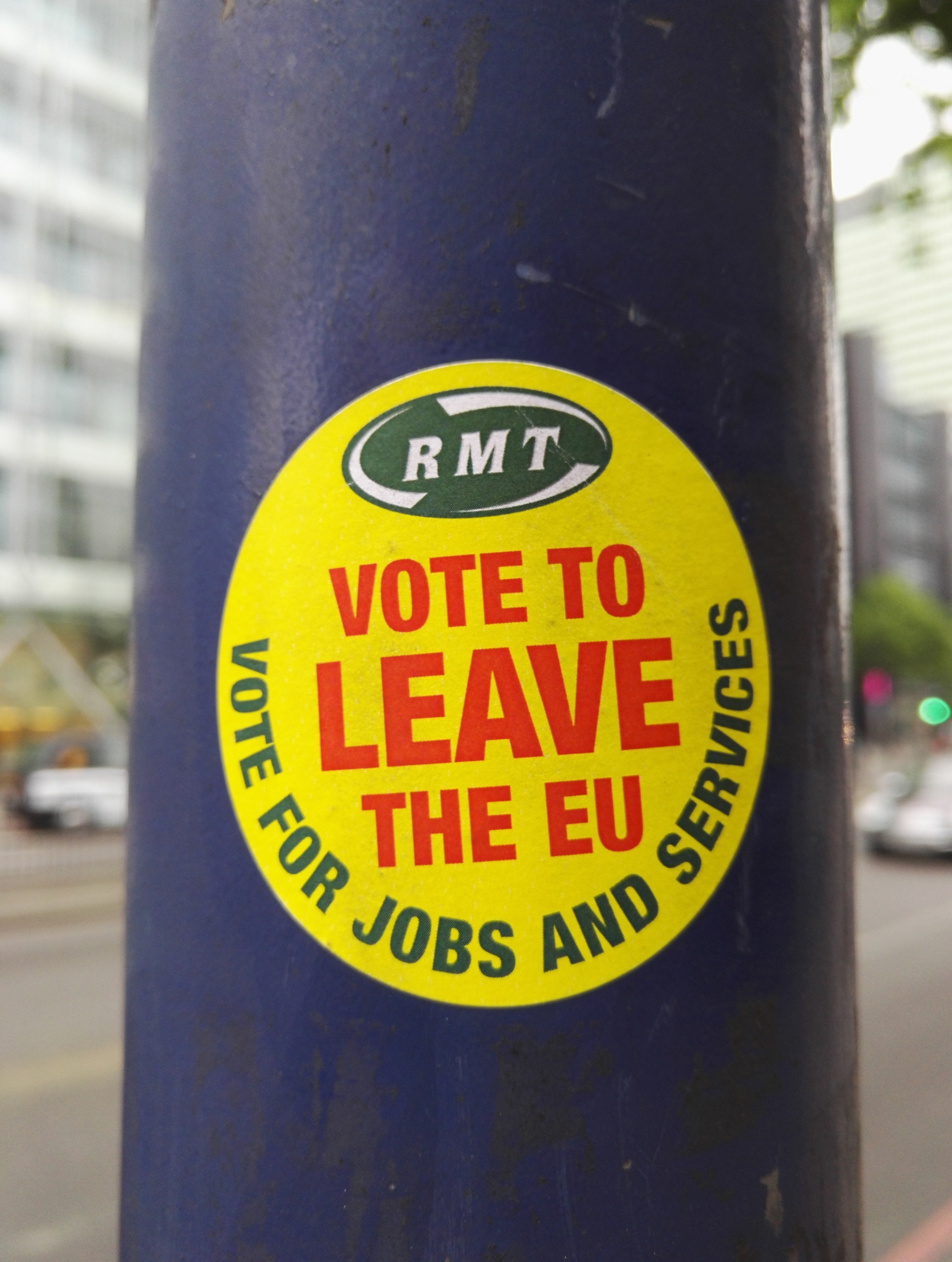
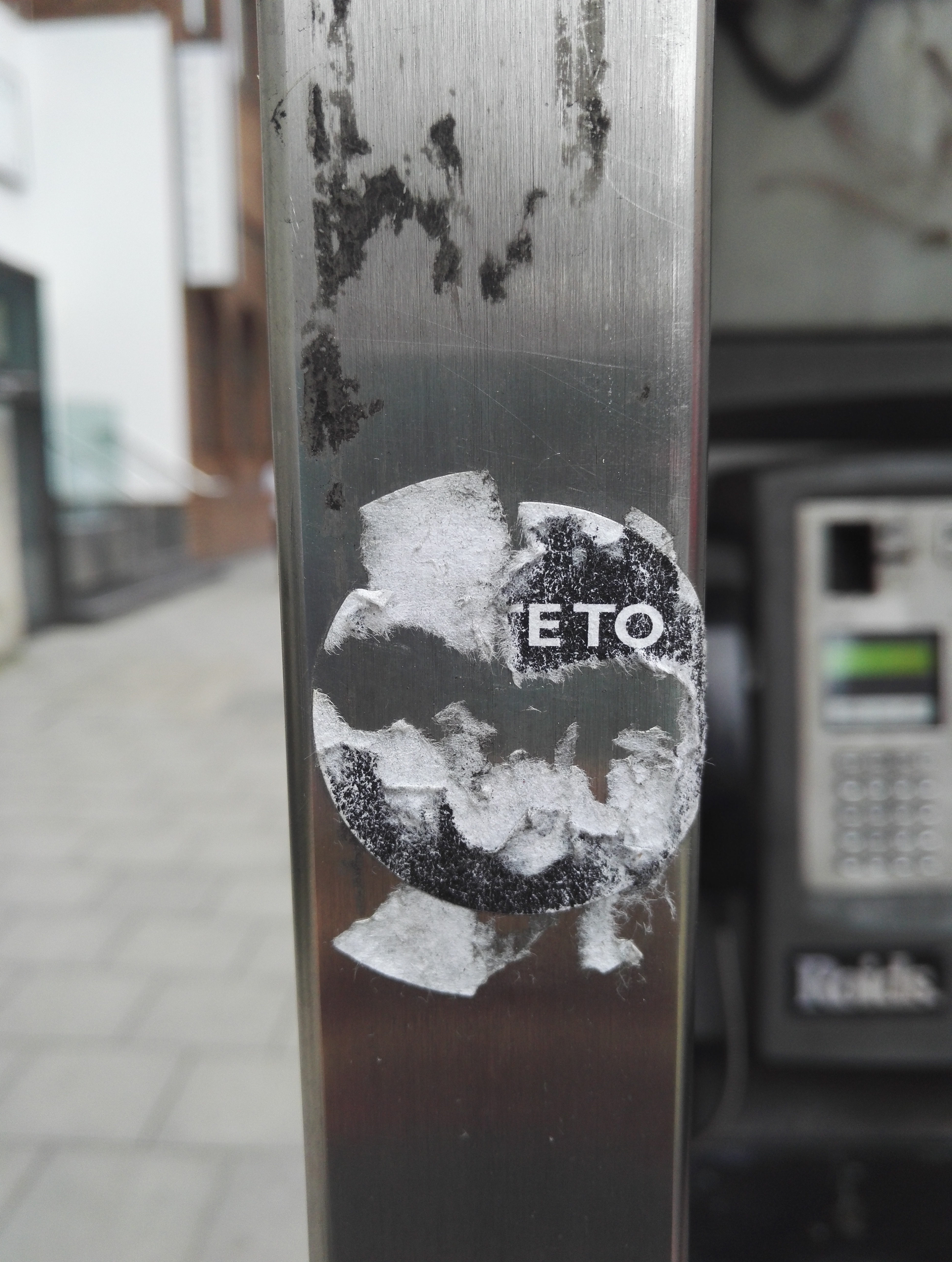
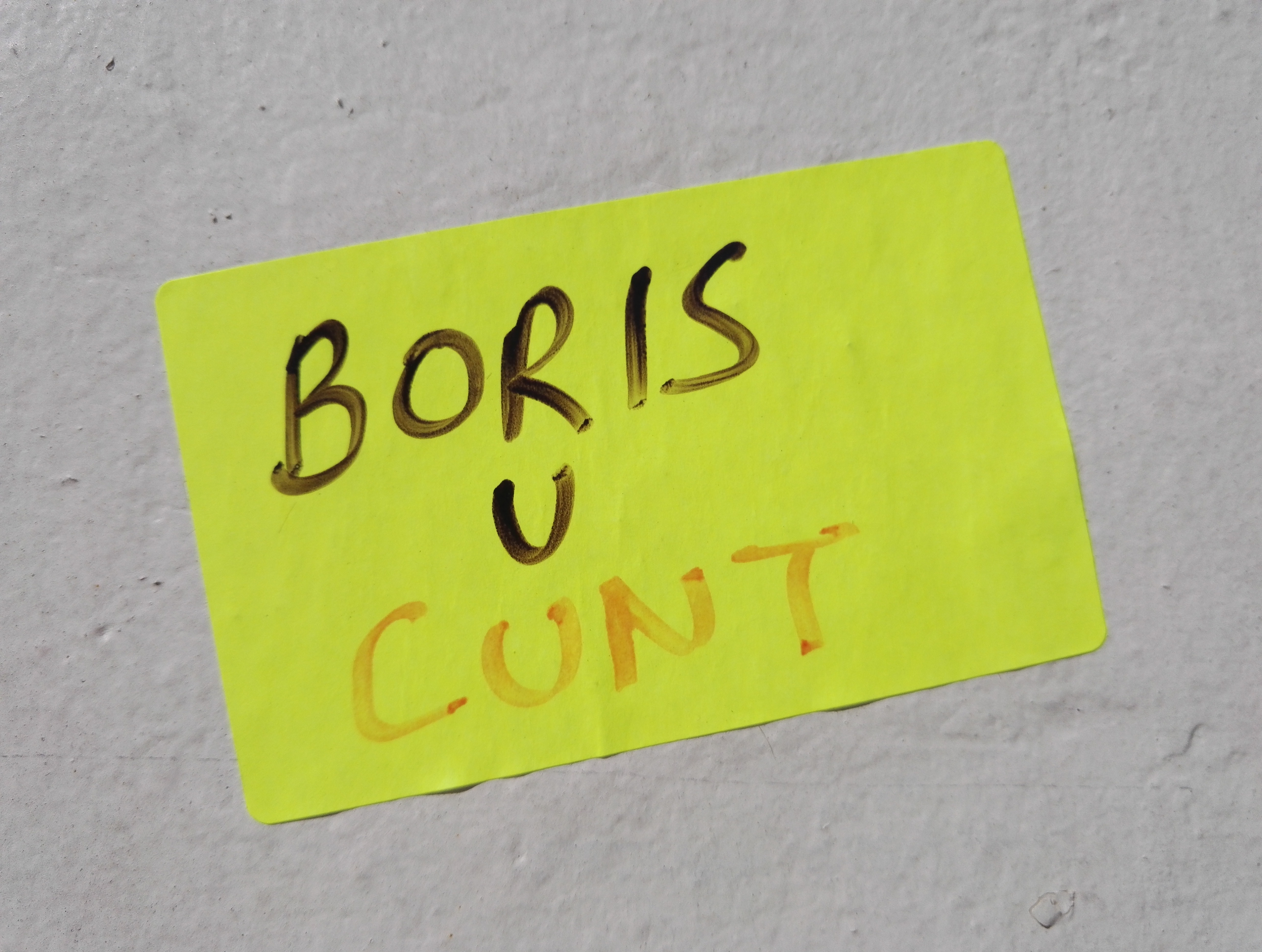
Some stickers were produced by the official remain campaign, like this one on the Euston Road (Photo: Hannah Awcock, 03/08/16).This sticker, in Malet Street, Bloomsbury, is also recognisable by the slogan and colour scheme of the official Remain campaign (Photo: Hannah Awcock, 15/07/16).This sticker, advocating a Leave vote, was also quite common, but it doesn’t share an obvious connection with the Leave campaign (Photo: Hannah Awcock, Russell Square, 13/04/16).This sticker is also urging a Leave vote. It refers to 1215, the year in which the Magna Carta was signed, declaring that the British have been a “free peoples” since then. It is a good example of how the Magna Carta is repeatedly brought into debates about freedom and liberty, having achieved symbolic status hundreds of years ago (Photo: Hannah Awcock, Great Portland Street, 03/06/16).Many individual groups and organisations took sides during the EU Referendum campaign. The Alliance for Worker’s Liberty, a socialist campaign group, declared themselves for Remain. This sticker alludes to the employment rights enforced by EU law (Photo: Hannah Awcock, Borough High Street, 15/07/16).This sticker was also produced by the Alliance for Worker’s Liberty. It reads “Lower Borders, Don’t Raise Them.” One of the big issues of the referendum was immigration (Photo: Hannah Awcock, Borough High Street, 15/07/16).The RMT, a transport union, supported the Leave campaign (Photo: Hannah Awcock, Euston Road, 03/06/16).The location of protest stickers can have a big influence on how it is interpreted (Photo: Hannah Awcock, Euston Road, 03/08/16).Protest stickers are ephemeral, and last for varying amounts of time. Sometimes, they are scratched away in a way that suggests there was a deliberate attempt to obscure the message of the sticker. This is what I think happened to this sticker on Borough High Street (Photo: Hannah Awcock, 15/07/16).There were lots of people who were not happy with the actions of Boris Johnson after the referendum. This blunt sticker expresses that disapproval in no uncertain terms (Photo: Hannah Awcock, Byng Place, 15/07/16).
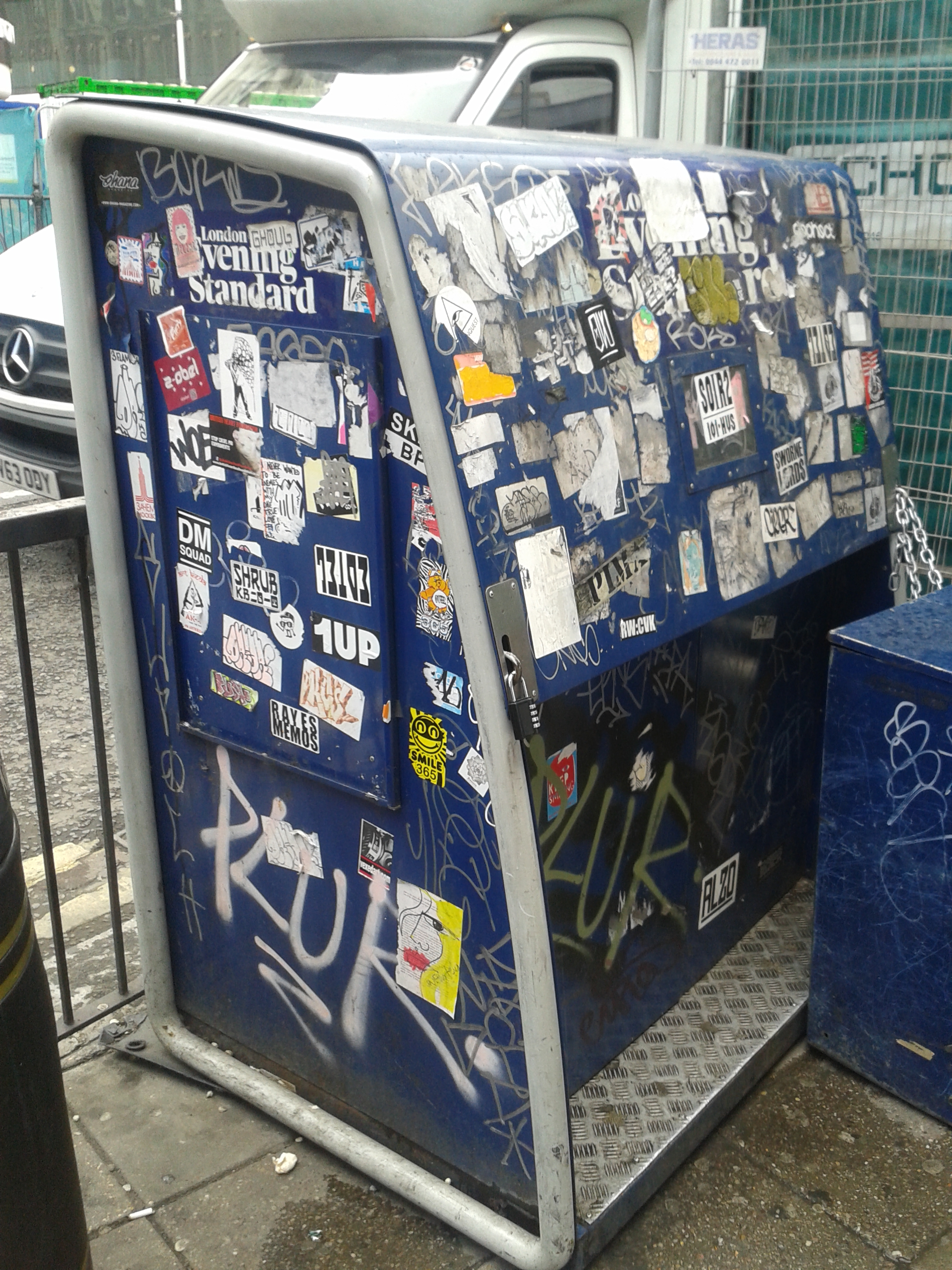
Stickers of all kinds are ubiquitous on street furniture in London, like this post box in Brick Lane (Photo: Hannah Awcock, 07/06/15).
Along with anti-fascists, anarchists are some of the most prolific stickerers I’ve come across in London. The Anarchist Federation (AFed) are particularly keen on stickers as a method of protest. At its simplest, anarchism is the belief in a society based on voluntary, cooperative institutions. Force, compulsion and government are not required. Anarchists believe that this is the only way to achieve a fair and just society. The Anarchist Federation is a working class organisation that works towards achieving that.
As anarchist communists we fight for a world without leaders, where power is shared equally amongst communities, and people are free to reach their full potential. We do this by supporting working class resistance to exploitation and oppression, organise alongside our neighbours and workmates, host informative events, and produce publications that help make sense of the world around us.
This is the most recognisable style of stickers that AFed make. The colours, logo, and web address remain the same, but the content changes. This photo was taken on 20/05/15 in Upper Street, Islington (Photo: Hannah Awcock).
This is another variation of the classic AFed sticker. The group advocates direct action for achieving their goals (Photo: Hannah Awcock, Malet Street, 12/01/16).
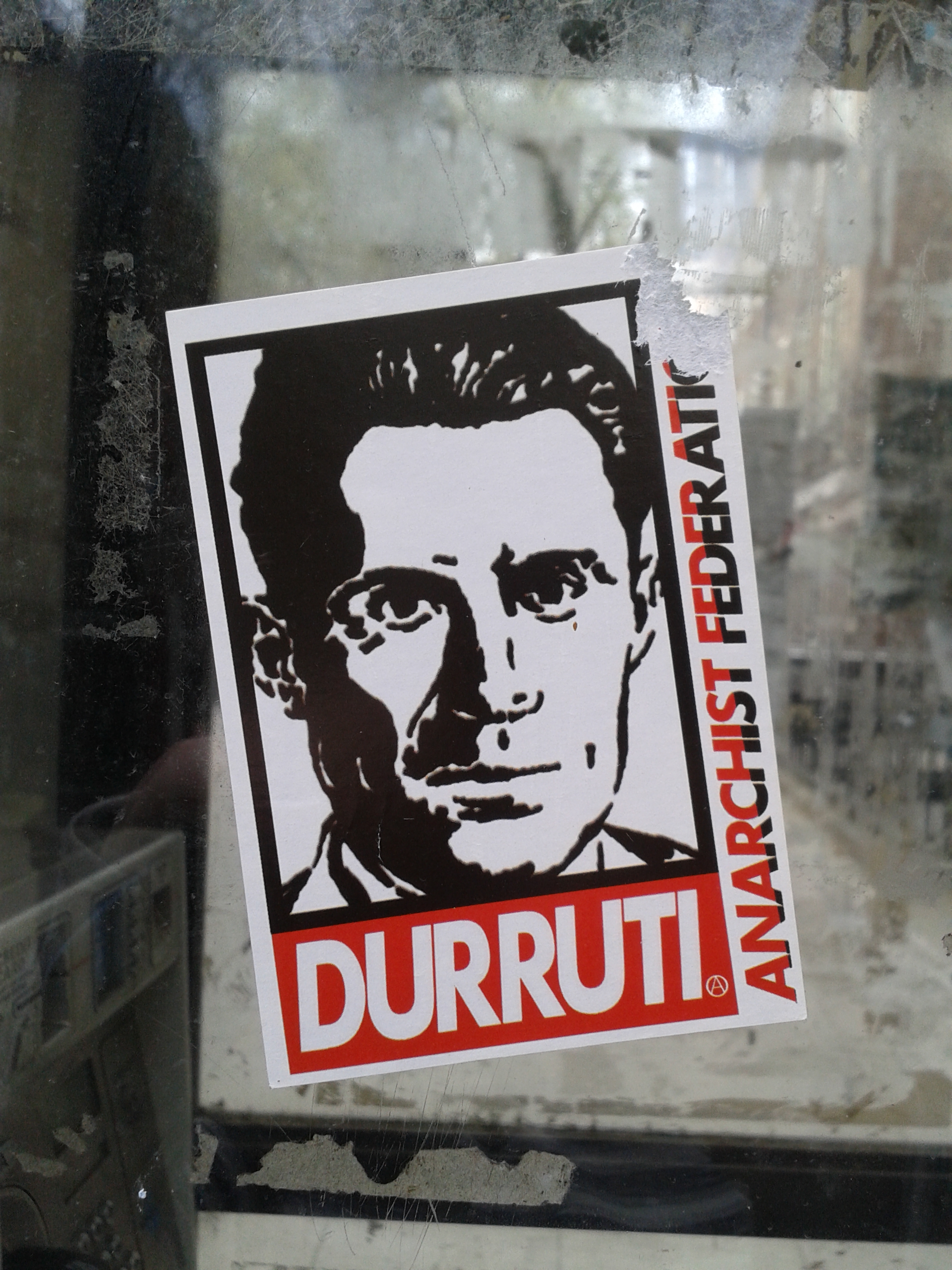
This sticker is part of another series that the AFed produce featuring prominent figures in anarchist history. This is Buenaventura Durruti, a Spaniard who was very active in the run up to the Spanish Civil War, as well as the War itself. He was killed by a sniper in November 1936 (Photo: Hannah Awcock, Malet Street, 17/04/15).
Emma Goldman (1869-1940) was, and still is, well known for her anarchist writing and speeches. Born in present-day Lithuania, she moved to America when she was 16, and was significant in the development of anarchist philosophy in the US (Photo: Hannah Awcock, Byng Place, 12/05/15).
This is one of the best known quotes attributed to Emma Goldman. I don’t know who made this sticker, but it is a sentiment I have seen in other AFed stickers. (Photo: Hannah Awcock, Regent’s Canal Tow Path, 20/05/15).
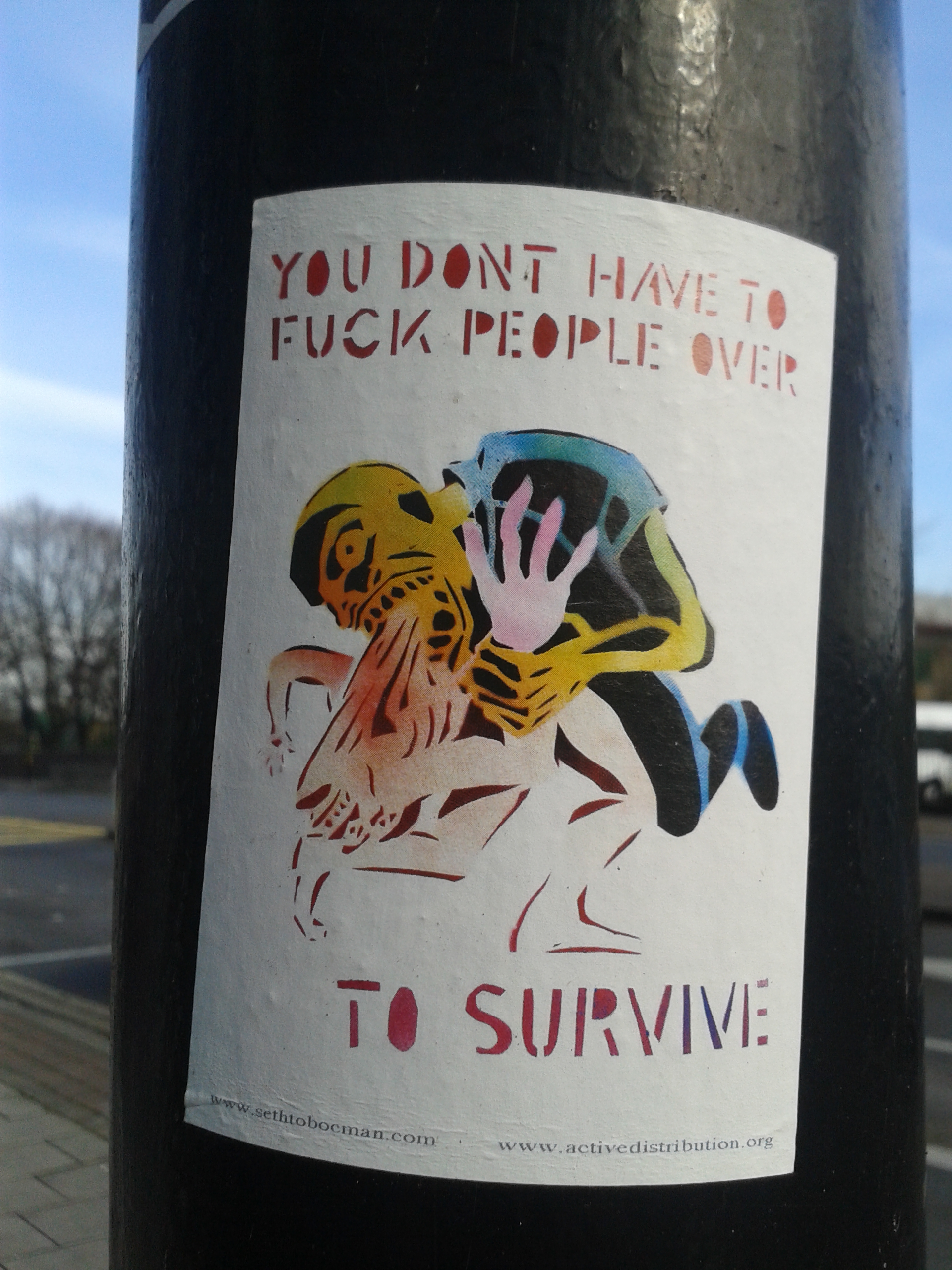
This sticker is one of my favourites. It is made by Active Distribution, which makes and sells all things anarchic. I come across their stickers quite often (Photo: Hannah Awcock, Heygate Road, 04/06/15).
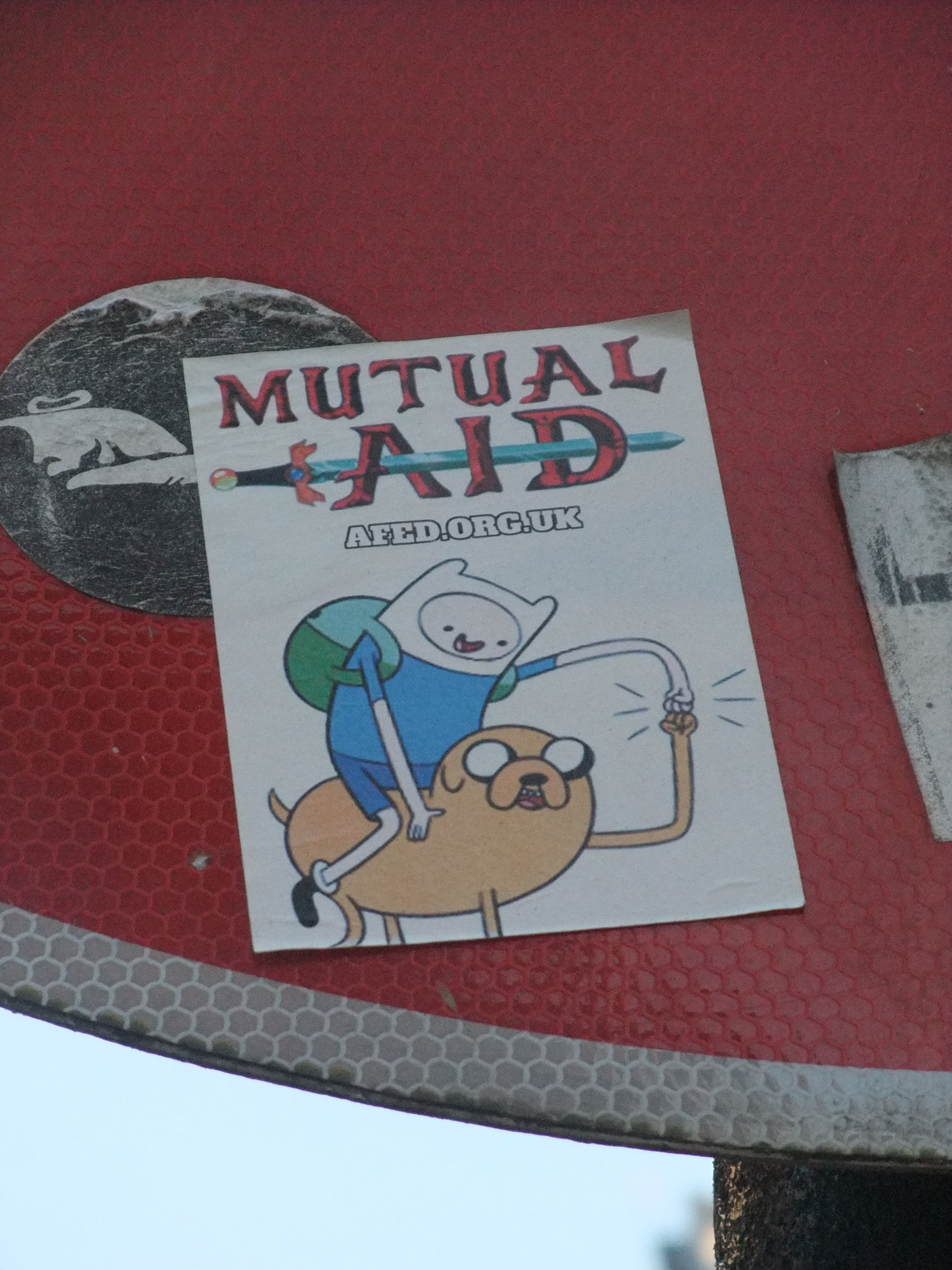
AFed have also been known to use references to popular culture in their stickers. This sticker features Finn and Jake, the main characters of an animated TV series called Adventure Time. It is made for children, but has developed a large adult following (Photo: Hannah Awcock, Elephant and Castle, 25/06/15).
And who doesn’t love a good yoda impression?! (Photo: Hannah Awcock, Euston Station, 27/02/15).
AFed stickers can often be funny. This is a relatively new sticker (I think!), and is particularly pertinent in the context of the Islamaphobia that our society is currently struggling with (Photo: Hannah Awcock, Euston Road, 09/02/16)
This is another one by Active Distribution; you can just make out the web address in the top right corner. I found this sticker on the Ayslebury Estate during the occupation that took place there last year (Photo: Hannah Awcock, Ayslebury Estate, 05/05/15).
This sticker echoes the sentiments of the Emma Goldman quote above. It looks like someone objected to the message however, as the sticker has been quite badly torn. It reads “never be deceived that the rich will permit you to vote away their wealth” (Photo: Hannah Awcock, Tottenham Court Road, 19/05/15).
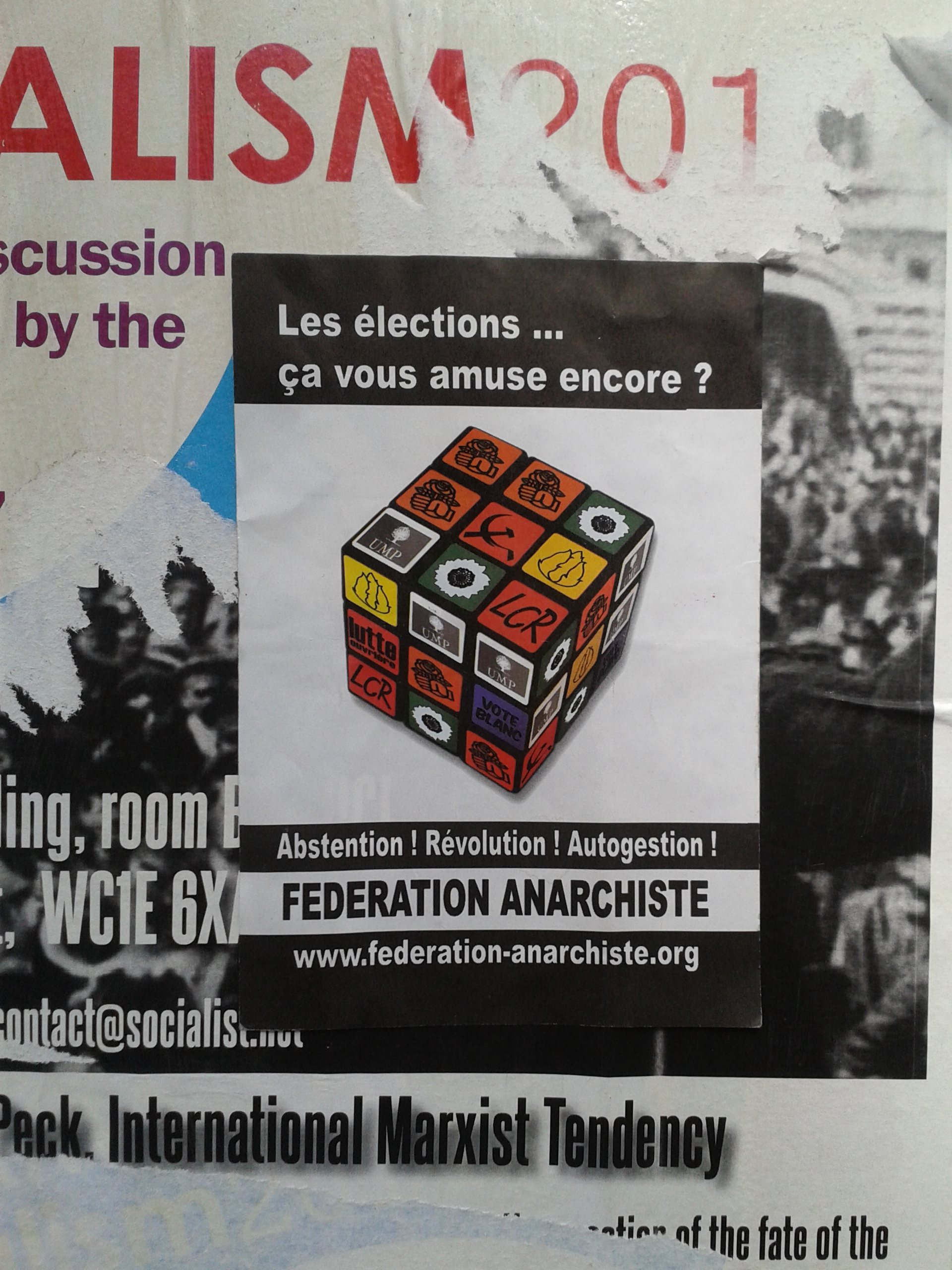
My French is rusty, but I know enough to identify this as an anarchist sticker! I think that it roughly translates to “The elections…are you still having fun? Abstention” Revolution! Self Management!” (Photo: Hannah Awcock, Malet Street, 17/04/15).
Paul de Gregorio has worked in fundraising since 1996; he is currently Head of Mobile at Open, a fundraising and communications agency. In his day job he finds ways to inspire the public to take action for some of the charities and not for profit organisations here in the UK and increasingly overseas. He blogs about it here. He’s also a fellow protest sticker-spotter, a habit he indulged on a recent trip to Berlin. In this post, Paul showcases some of the stickers he found, as well as reflecting on a museum exhibition he visited about antisemitic and racist stickers. He’s sometimes posts pictures of the stickers he finds on Instagram.
In my day job I help charities and non-profit organisations generate mass response to their campaigns and appeals.
In my spare time, down time between meetings and when I’m on holiday I spend an extraordinary amount of time taking pictures of political stickers on my mobile. I do it because I want to amplify some of the messages I see, but also because I find their designs a good source of inspiration for my day job.
Berlin is always a good place to find this stuff. On a recent trip I was lucky enough to be in town for the Sticky Messages exhibition at the Deutsches Historisches Museum. The exhibition, to give it its full name, “Sticky Messages. Antisemitic and racist stickers from 1880 to the present”, was a detailed look at the history of the political sticker in Germany over time.
The exhibition itself is great, and whilst at the exhibition I learnt all about Irmela Mensah-Schramm. She is a 70 year old woman, well known in Germany for her personal commitment to the removal of neo-Nazi messages from public places. For the last 30 years Irmela has been scraping off and spray painting over all the neo-Nazi messages she finds. From time to time this has put her into conflict with local Nazis. But she continues to do it. Having removed over 70,000 stickers since she started, she’s now a hero of mine! You can hear more of her wonderful story in the film below.
And what follows are a tiny handful of the stickers I found on that trip…
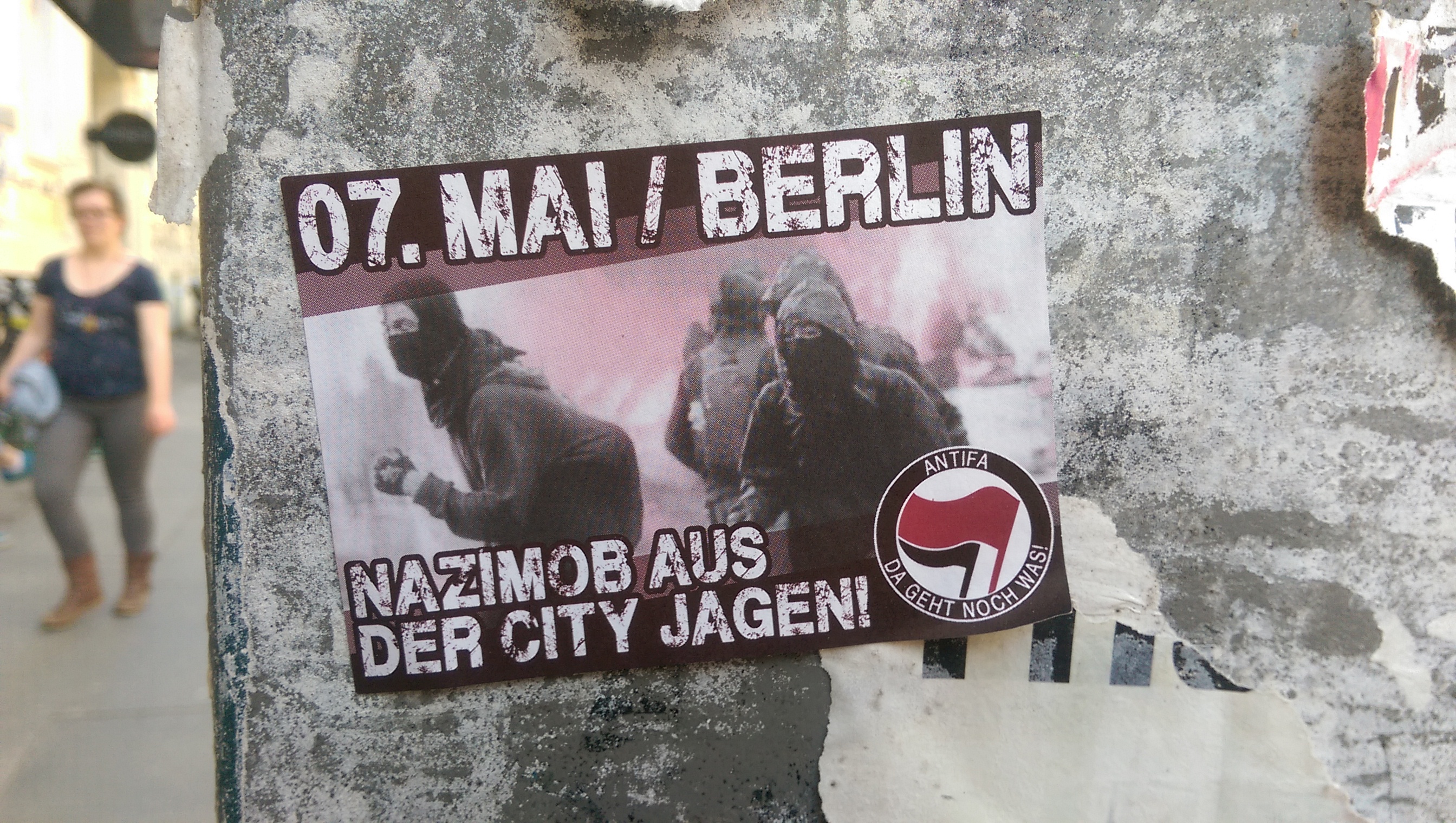
I saw this one on the day we arrived which coincided with a big anti-Nazi protest.
This one reads “Shut you mouth, Germany!”
I’ve seen this one all over Europe. And it’s easily found online which makes it so easily to replicate.
The last three I found on Karl Marx Allee, usually a great place to find stickers. I love these three the most because they were plastered all over terrible advertising and I could tell by people watching that they were getting noticed.
Paul de Gregorio
—————————–
All photographs are my copyright. You can use them, I’d just like you to ask and credit me.
Stickers obscuring a road sign in New York City (Photo: Hannah Awcock).
Street art is everywhere in New York City, and it comes in all shapes and sizes. For those of you that are new to Turbulent London, I am especially interested in stickers, particularly those with political subject matter. So on a recent trip to New York City, I took my camera and my habit of photographing random bits of street furniture to see what protest stickers I could find on the streets of the city that never sleeps. This is the second time I have visited NYC since I started photographing protest stickers, and the first time I struggled to find many. This time however, I found so many stickers that I have decided to do two blog posts, hence the slightly awkward title (the first post, published last week, is here). In the last post, I looked at the different kinds of issues which protest stickers address, the different types of stickers you can find, and some of the most common themes in the stickers I found. This post is far less organised I’m afraid, its just everything else that I wanted to include!
Some American industries. including the building trade, still have very strong unions. Builders in New York tend to plaster their hard hats with stickers, so that they become a walking representation of their unions and the causes that they consider to be important (Photo: Hannah Awcock).
Last week I talked about some of the most common themes that came up in protest stickers, police brutality and the upcoming Presidential election. Animal rights was another common theme; this sticker contains the web addresses of meatvideo.com, which shows abuse at factory farms, and In Defense of Animals, a group which campaigns for animal rights, welfare and habitat (Photo: Hannah Awcock).
This sticker also references meatvideo.com, but it is not quite as well made as the last one. I remember seeing this sticker design when I was here in 2015, so there’s a chance this particular sticker has been there quite a while (Photo: Hannah Awcock).
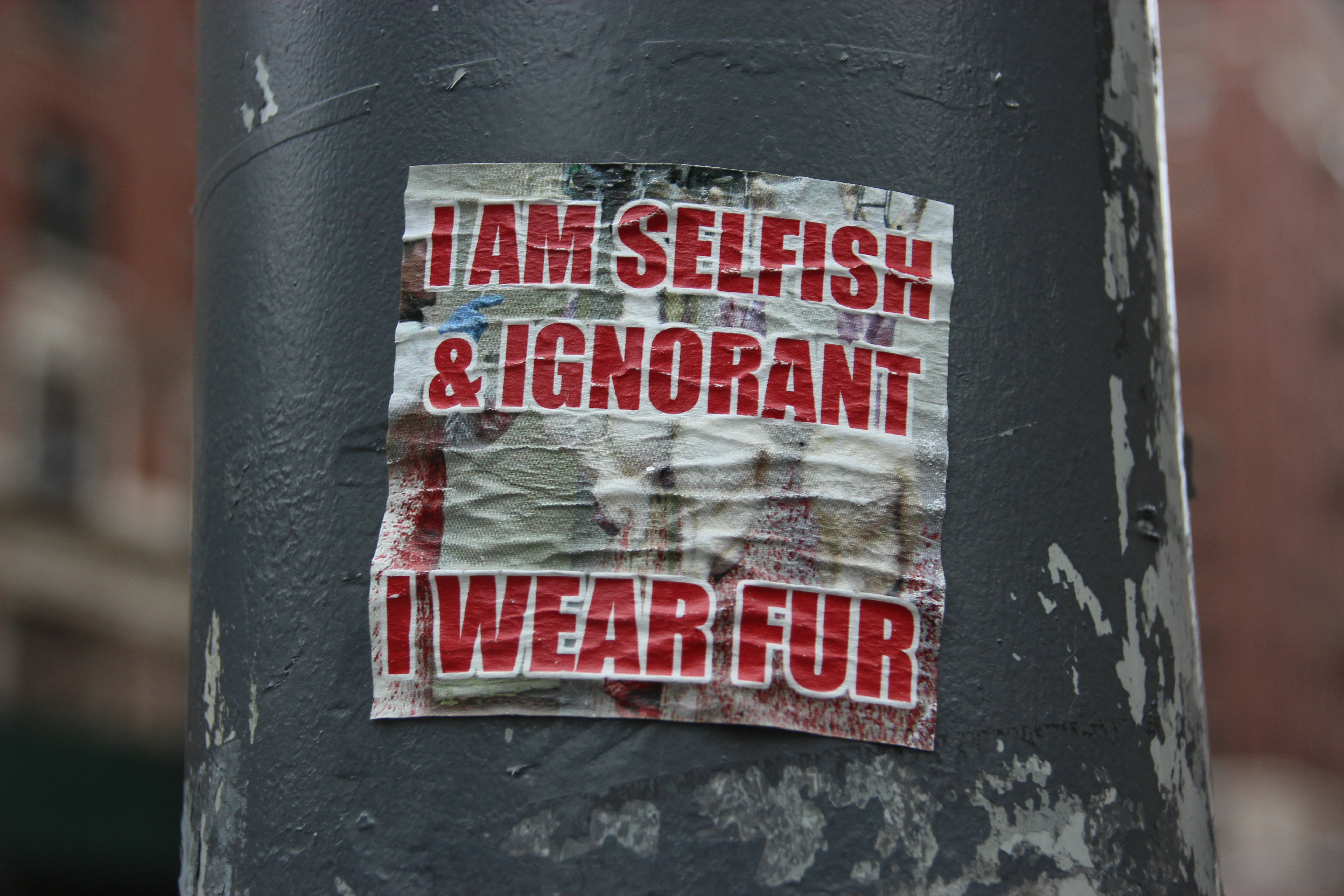
This sticker criticises people who wear fur. The picture is unclear because the sticker has been wrinkled by rain, but the message is still pretty clear thanks to the huge red writing (Photo: Hannah Awcock).
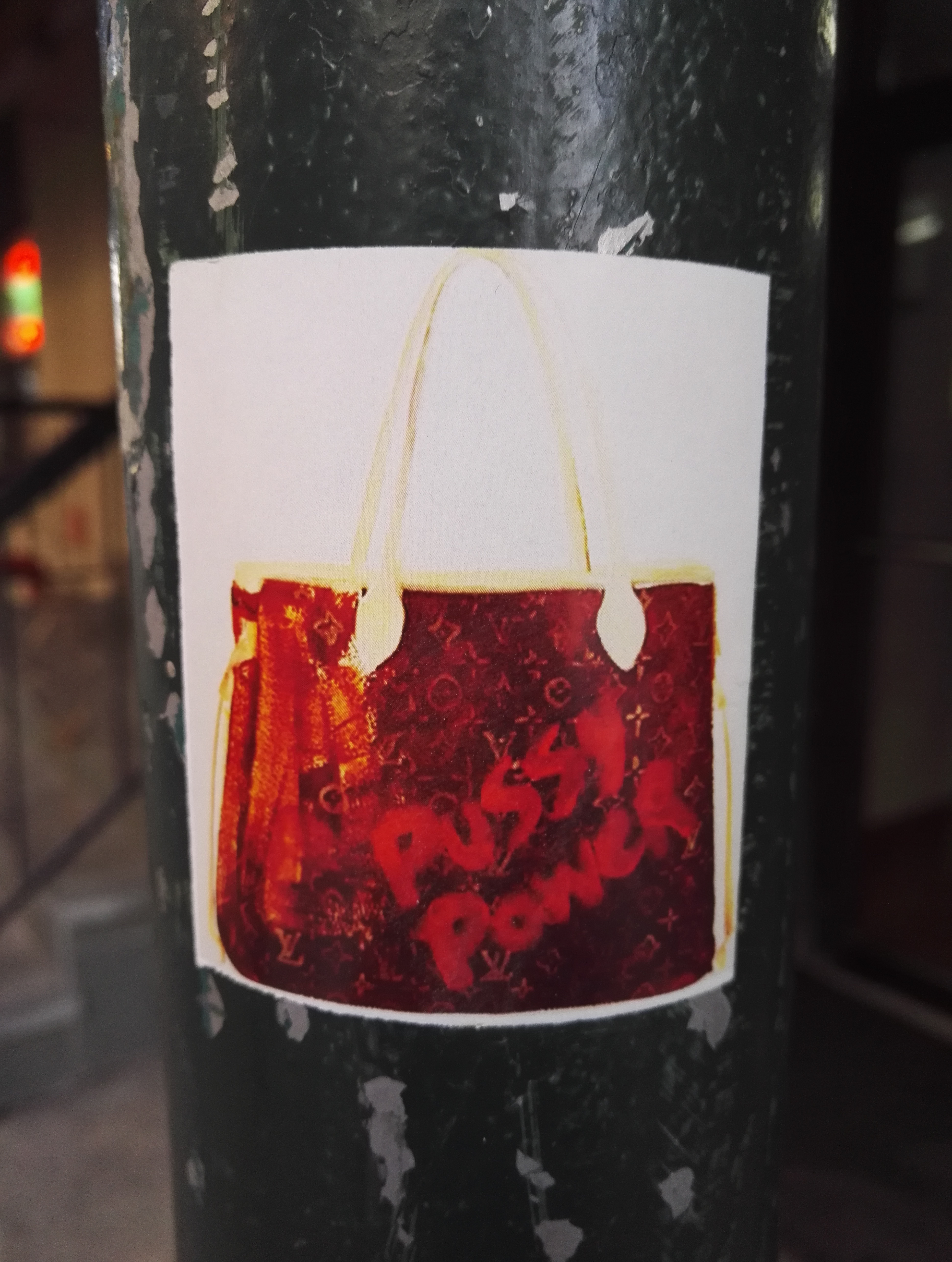
Feminism was a less common theme, but it did crop up now and again (Photo: Hannah Awcock).
I found this sticker on some scaffolding right outside our hotel when we first arrived- I took it as a good omen for the trip! (Photo: Hannah Awcock).
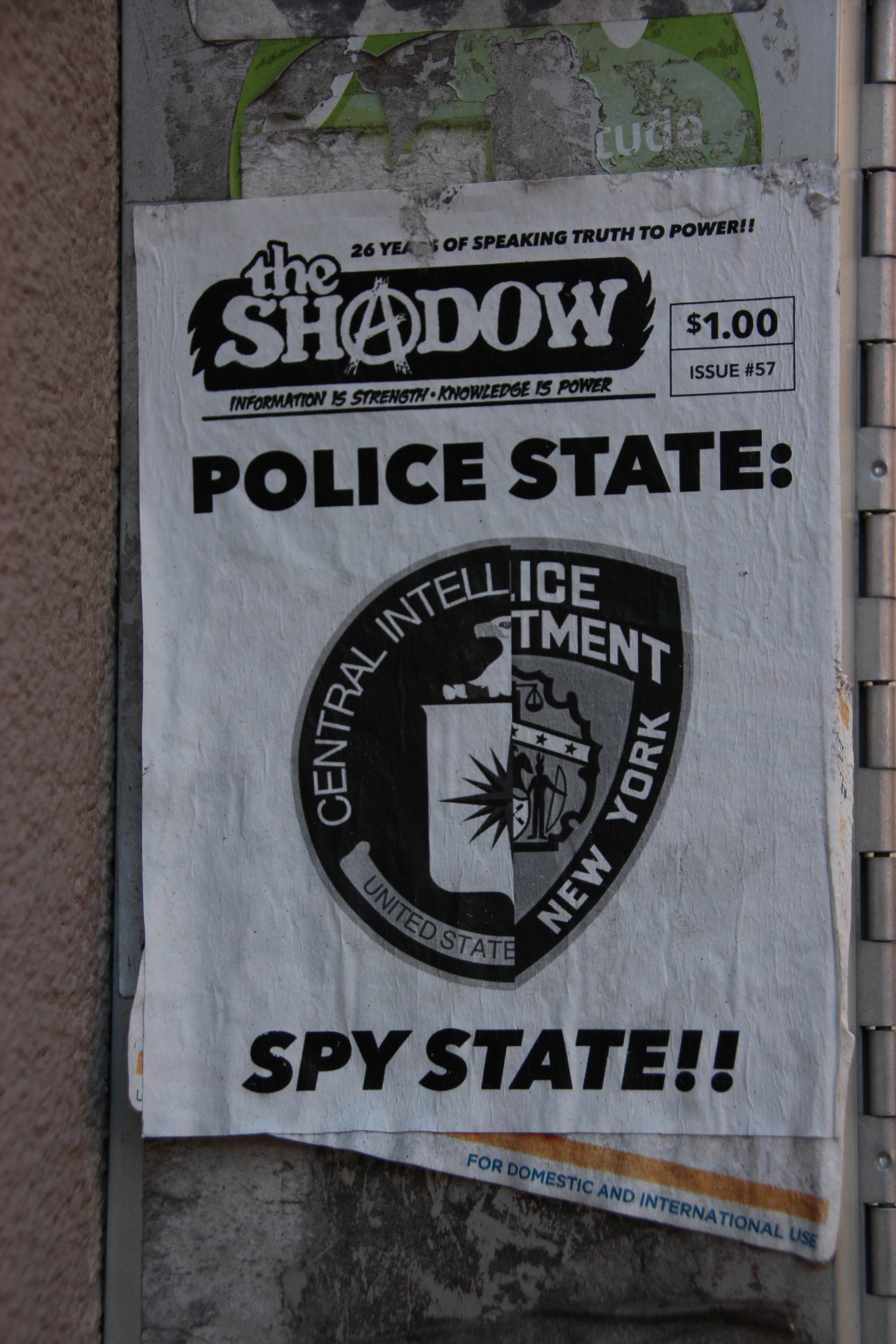
The East Village is one of the ‘coolest’ neighbourhoods on Manhattan, and some stickers are local to this area. The Shadow claims to be New York’s only underground newspaper, and is published from the lower East Side. It was started in 1989, after local people were disillusioned by the mainstream media’s coverage of the Tompkins Square Park riot in 1988. I featured one of The Shadow‘s stickers last time, but didn’t know the story behind it until this trip (Photo: Hannah Awcock).
This sticker was produced by the Museum of Reclaimed Urban Space, which is located in a squat on Avenue C. The Museum is volunteer-run, and focuses on grassroots campaigns to keep communal spaces in the city out of corporate hands (Photo: Hannah Awcock).
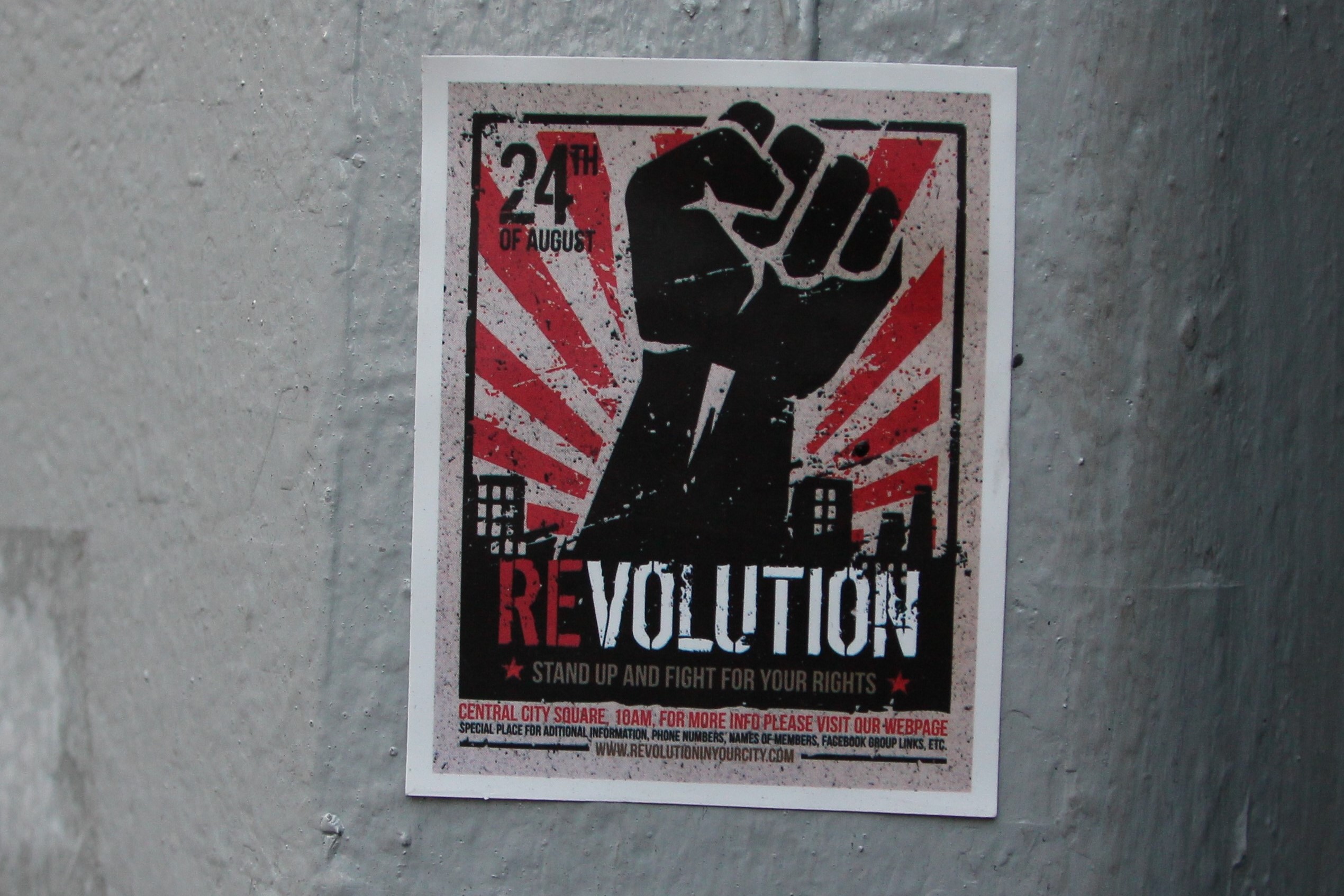
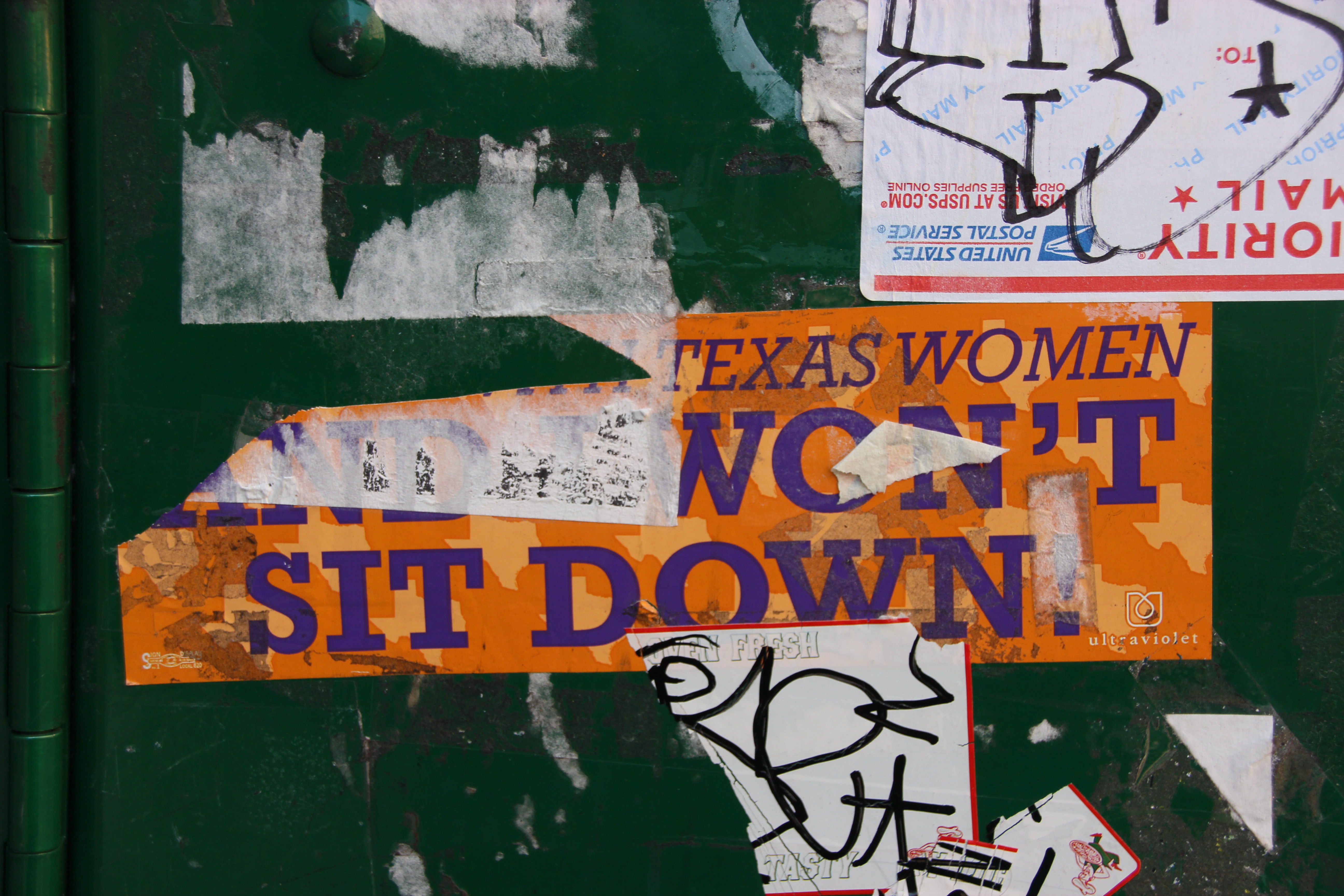
The clenched, raised fist is a common symbol of dissent (Photo: Hannah Awcock).This sticker has been partially obscured, but it reads “We stand with Texas Women, and we won’t sit down!” It was produced by Ultraviolet, a group that campaigns for women’s rights. This particular campaign is about preventing attempts to restrict access to abortions in Texas (Photo: Hannah Awcock).
Being a millennial myself I find this a little harsh, but everyone is entitled to their opinion I guess! (Photo: Hannah Awcock).
The SEIU is the Services Employees International Union, and 32BJ is the local New York branch. It represents cleaners, security guards, and others whose work involves the maintenance and servicing of buildings (Photo: Hannah Awcock).
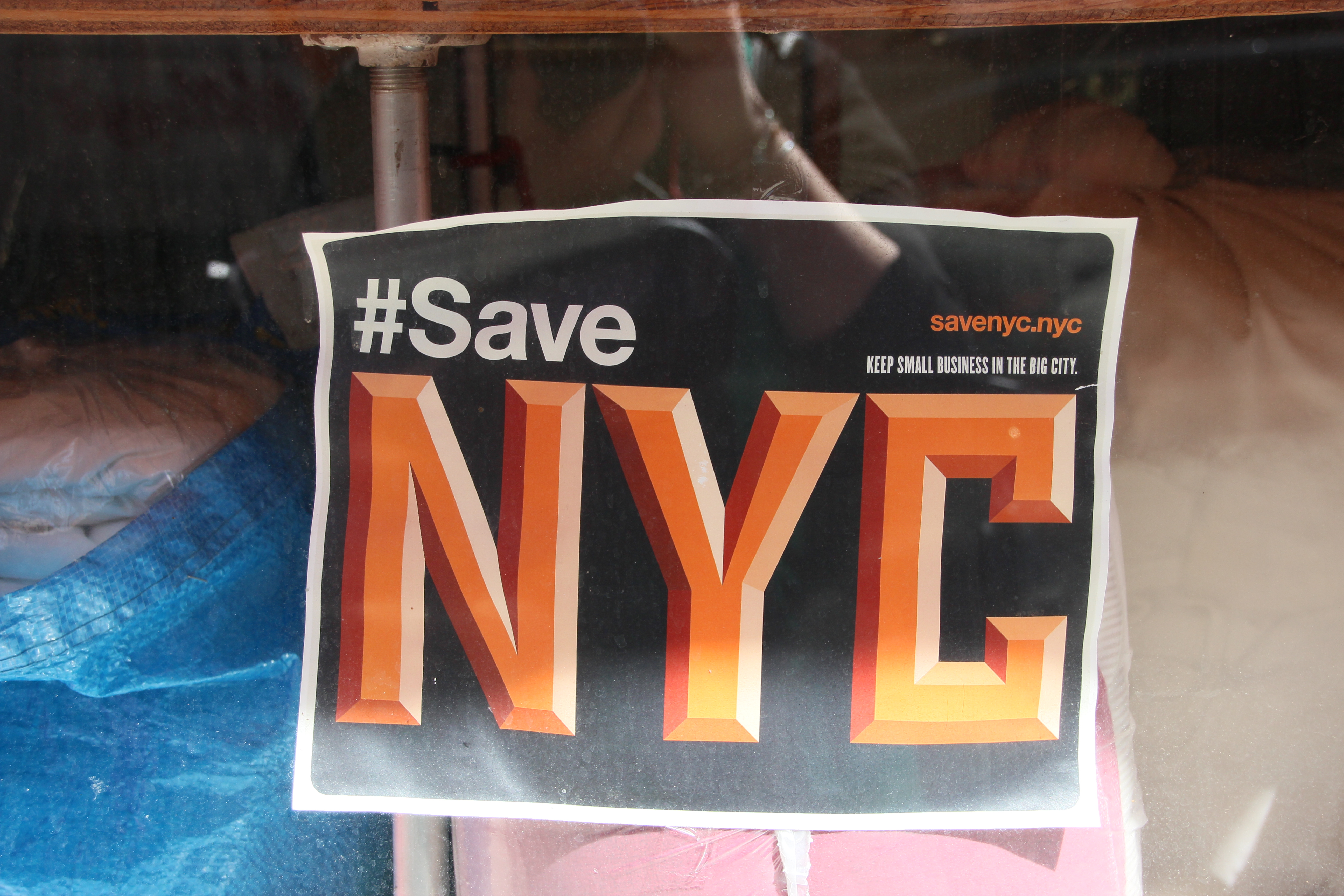
New York City has rents comparable to London, and it must be difficult for small businesses to survive. Save NYC is a campaign to “preserve the diversity and uniqueness” of New York. This was in the window of a dry cleaners in the East Village (Photo: Hannah Awcock).
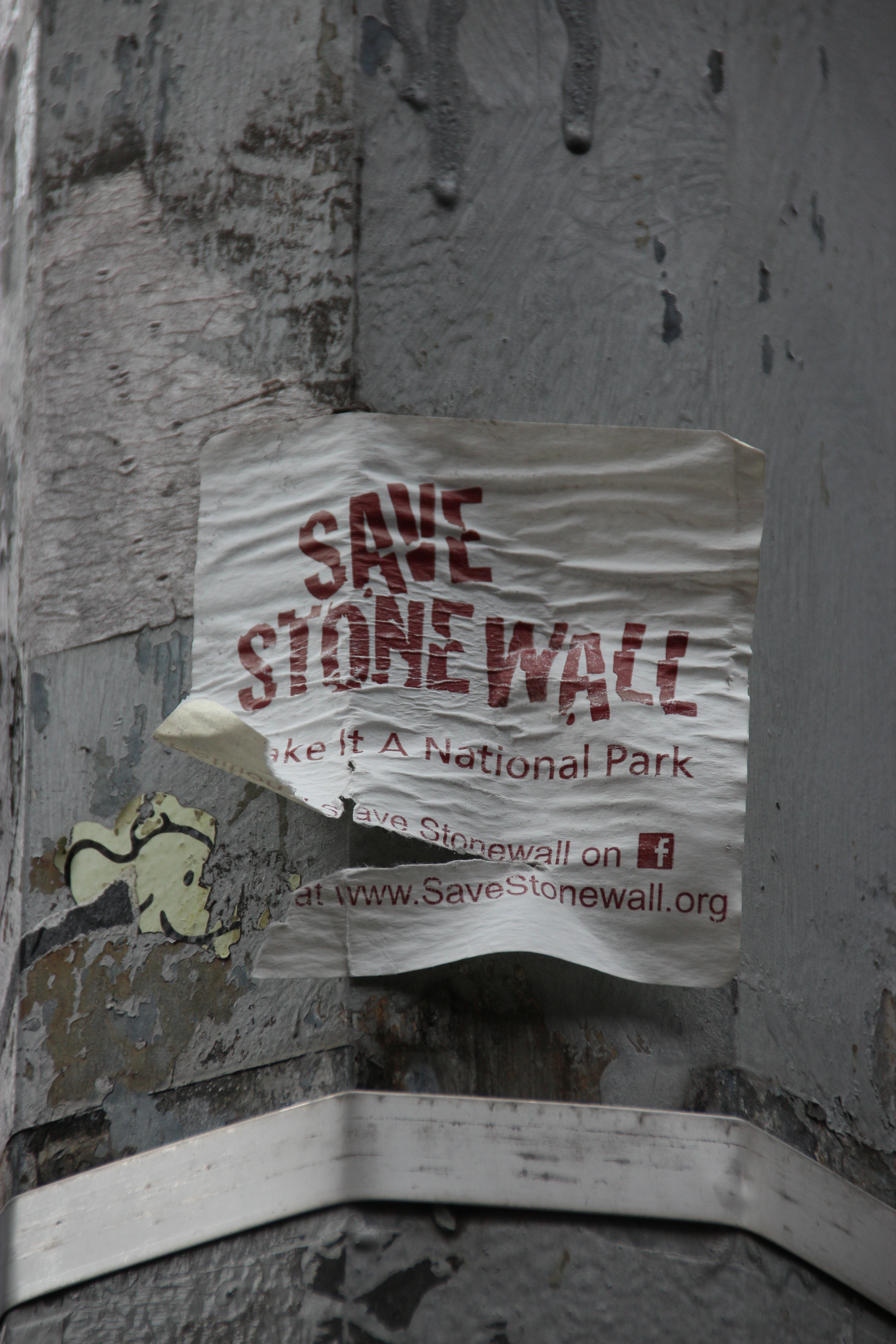
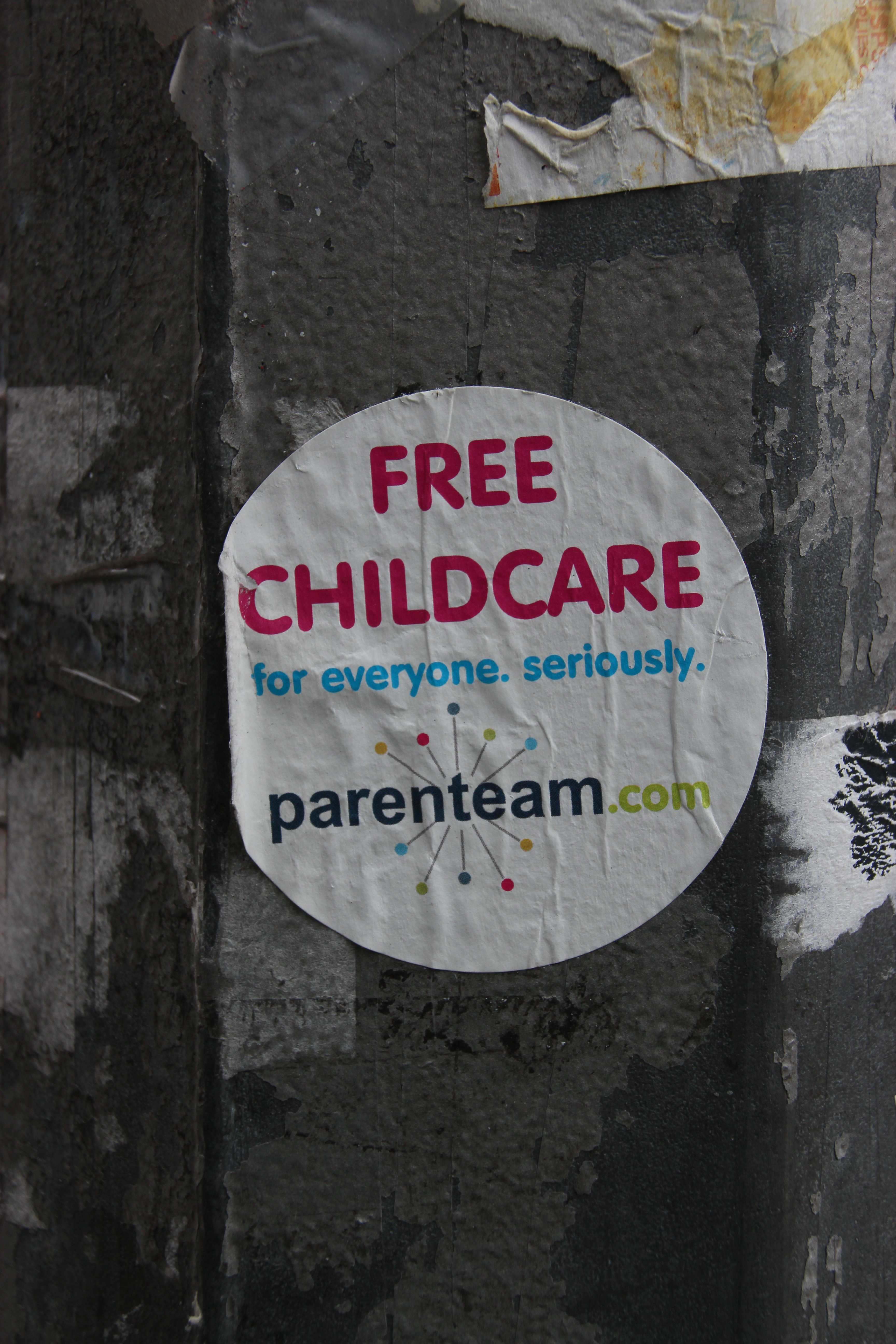
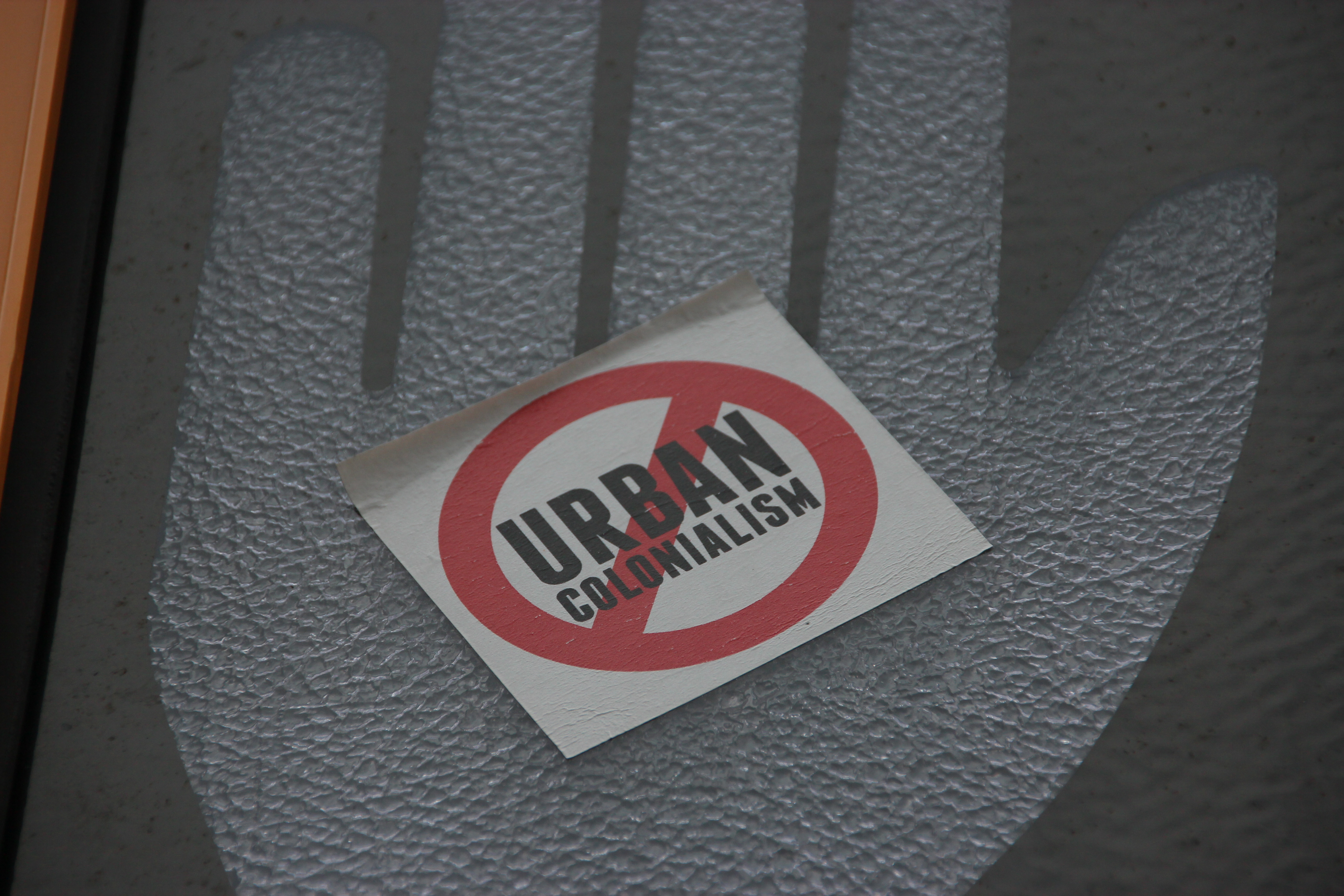
This sticker has adapted the design of the one dollar bill to call for the legalisation of cannabis (Photo: Hannah Awcock).This stickers celebrates the actions of Edward Snowden, a whistleblower who leaked information from the National Security Agency in 2013 which sparked intensive debate about the balance of individual privacy and national security. PeaceSupplies.org sells stickers, shirts and patches related to various campaigns (Photo: Hannah Awcock).This sticker promotes Save Stonewall, a campaign to create a national park to commemorate the Stonewall Riots, which took place in Greenwich Village in 1969 (Photo: Hannah Awcock).Parent Team is a group which supports parents of children dealing with drug or alcohol addiction. Here they are calling for free childcare for all, which doesn’t quite match up with their main purpose, but is an admirable goal none the less (Photo: Hannah Awcock).This is a sticker produced by the street artist and anti-war activist Jef Campion (a.k.a. Army of One/JC2). He used his art to emphasise the ill effects of war. He passed away in 2014, but his memory lives on in his street art (Photo: Hannah Awcock).This photo illustrates how the location of a sticker can influence or reinforce its meaning. This sticker was placed on the stop sign at a pedestrian crossing, emphasising its anti-gentrification message (Photo: Hannah Awcock).The International Museum for Activist Art is a website which displays art that aims to raise awareness of the issues facing society, and I would definitely recommend having a browse through it (Photo: Hannah Awcock).I found this in Washington Square Park on my last day in New York. It uses the story of Goldilocks to call for the preservation of our planet. Earth is ‘just right’ for human habitation, a rare attribute that we shouldn’t take for granted (Photo: Hannah Awcock).
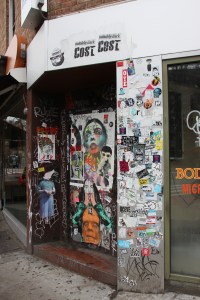
A doorway in Greenwich Village with a high concentration of street art and stickers (Photo: Hannah Awcock).
New York City has a thriving street art culture. Almost every neighbourhood has walls covered in art, both official and unofficial. There are also a lot of stickers, of all kinds- I spotted one sticker advertising a new novel, which is something I haven’t come across in London before. Lots of stickers generally means lots of protest stickers, and during the week that I was there in early March I found loads. I wouldn’t like to say whether the amount of protest stickers is increasing, or I have just got better at spotting them since I visited last time, but it certainly felt like there were a lot. I found so many in fact, that I have decided to split this post into 2 parts, with Part 2 being published this time next week.
Protest stickers are a great way of seeing what kinds of issues are important to the people of a city. Some themes crop up again and again, whilst other topics just appear to be a particular bug bear of one zealous stickerer (I am still looking for a less clumsy way of referring to people who put up stickers!) Stickers are just one of the ways in which protest imprints itself onto the physical fabric of a city, but they can also be one of the most long-lasting, although their transience is one of their defining characteristics.
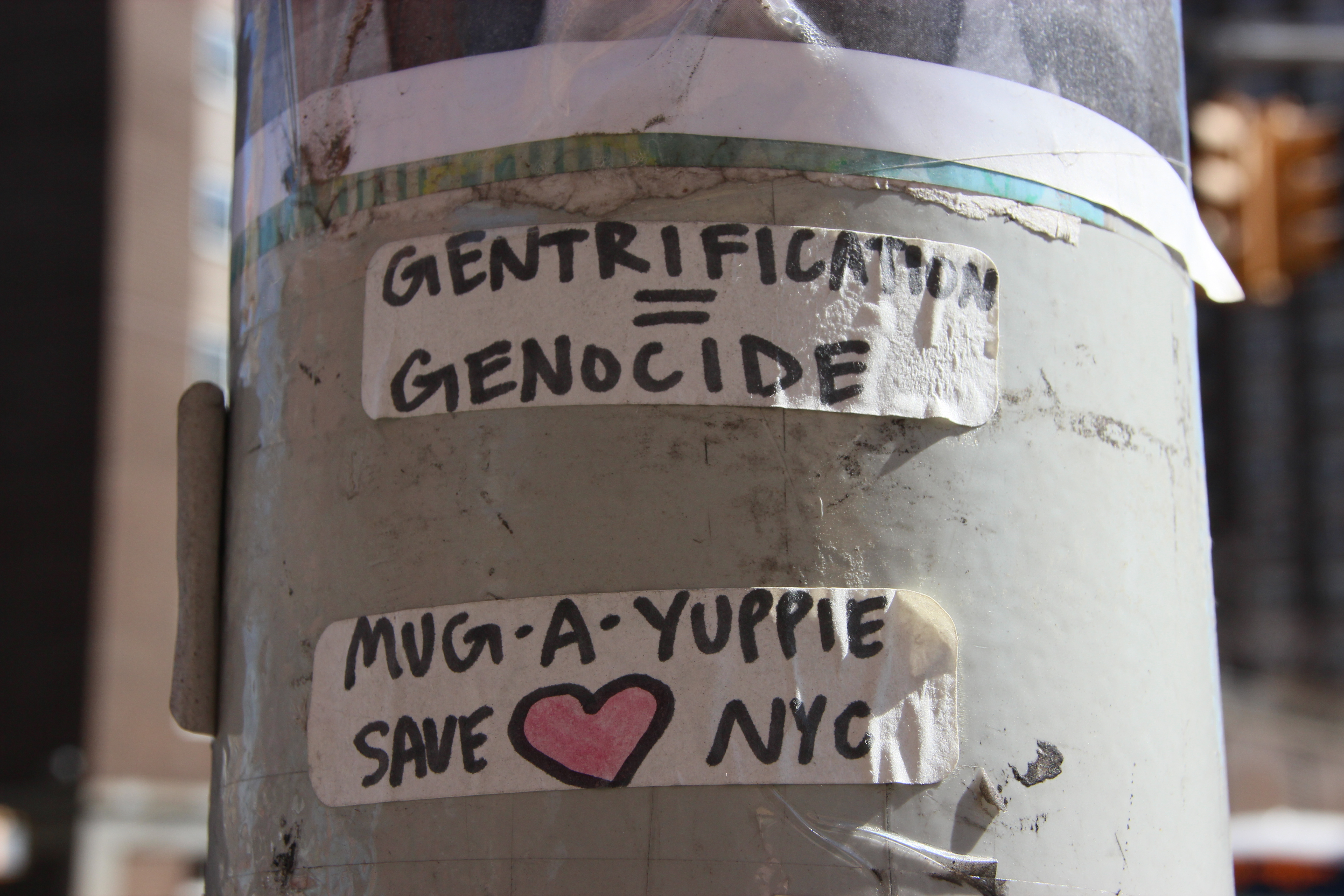
As in London, gentrification is a contentious issue in New York City. These stickers are drawing attention to the issue in a tongue-in-cheek manner (at least I hope it is!) (Photo: Hannah Awcock).
You can find stickers about a whole range of issues, relating to a whole range of scales. The relevance of this sticker is confined to New York City (Photo: Hannah Awcock).
Some stickers refer to national scale issues. The upcoming Presidential election is just about all anyone can talk about in America at the moment, and this obsession is reflected in New York’s protest stickers (Photo: Hannah Awcock).
Some stickers are about international scale issues. In case you can’t read the top line, this sticker says “Stop Iran- We Stand with Israel” (Photo: Hannah Awcock).
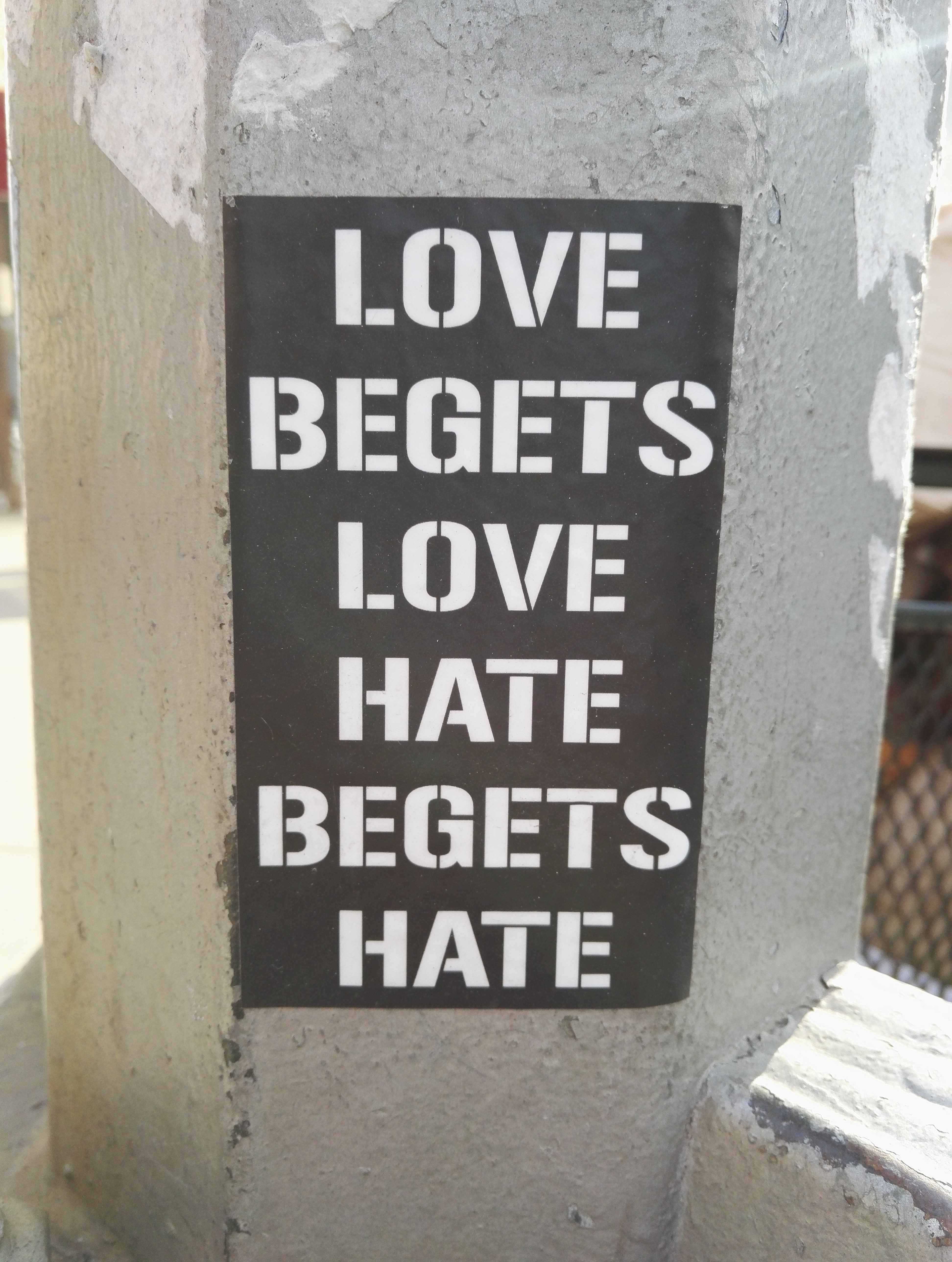
There are some stickers that defy scale; this sticker doesn’t refer to any issue in particular, instead advocating a more forgiving attitude that could probably help a lot of contentious situations (Photo: Hannah Awcock).
This sticker also takes an abstract approach. It is by a street artist called @ApillNYC who, despite the @, has very little information about them on the internet (Photo: Hannah Awcock).
Some stickers are not even remotely relevant to New York City. This sticker comes from the Hillsborough Justice Campaign, which seeks justice for the 96 people who died in a crush at Hillsborough Football Stadium in Sheffield in the United Kingdom. I have seen these stickers before in London and I was very excited to find them here, on the viewing platform at the top of the Rockefeller Centre (Photo: Hannah Awcock).
As well as relating to a whole range of scales, protest stickers come in a whole range of forms. This sticker is basic, and was probably quite easy to make (Photo: Hannah Awcock).
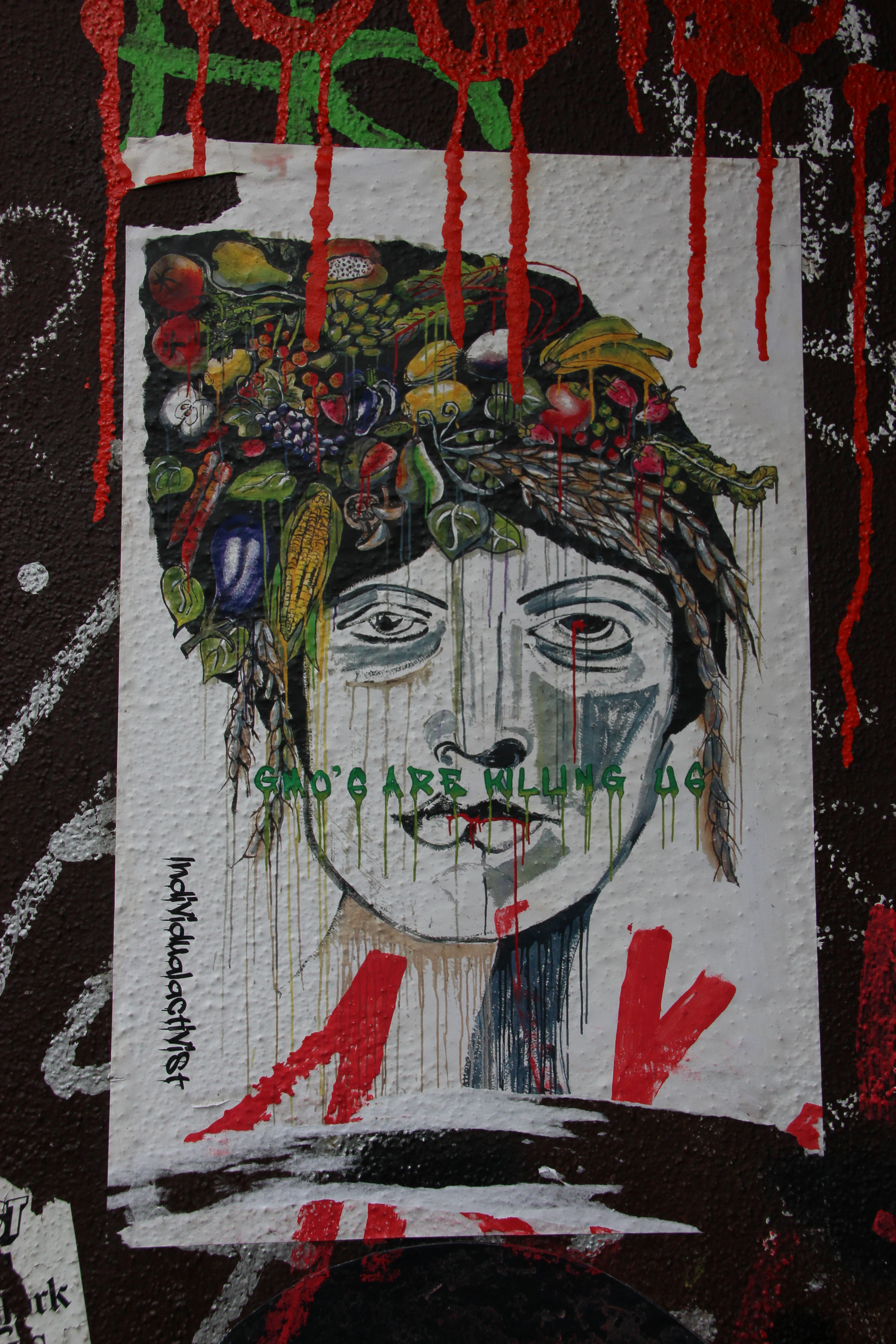
Whereas this sticker blurs the boundary between protest sticker and street art, and likely took a lot longer to produce. This sticker, which I suspect was pasted to the wall rather than being stuck with its own adhesive, is by someone called Individual Activist (Photo: Hannah Awcock).
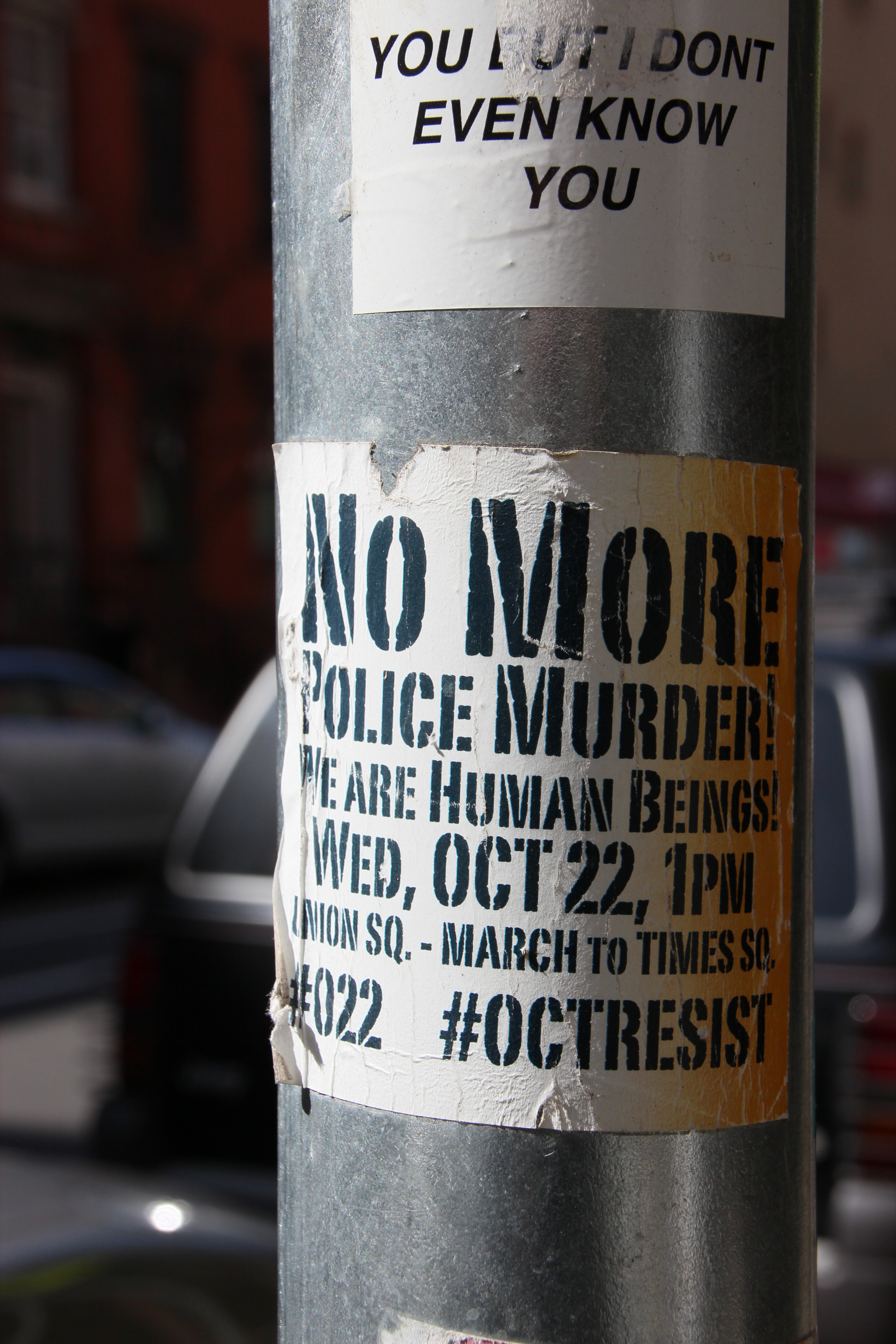
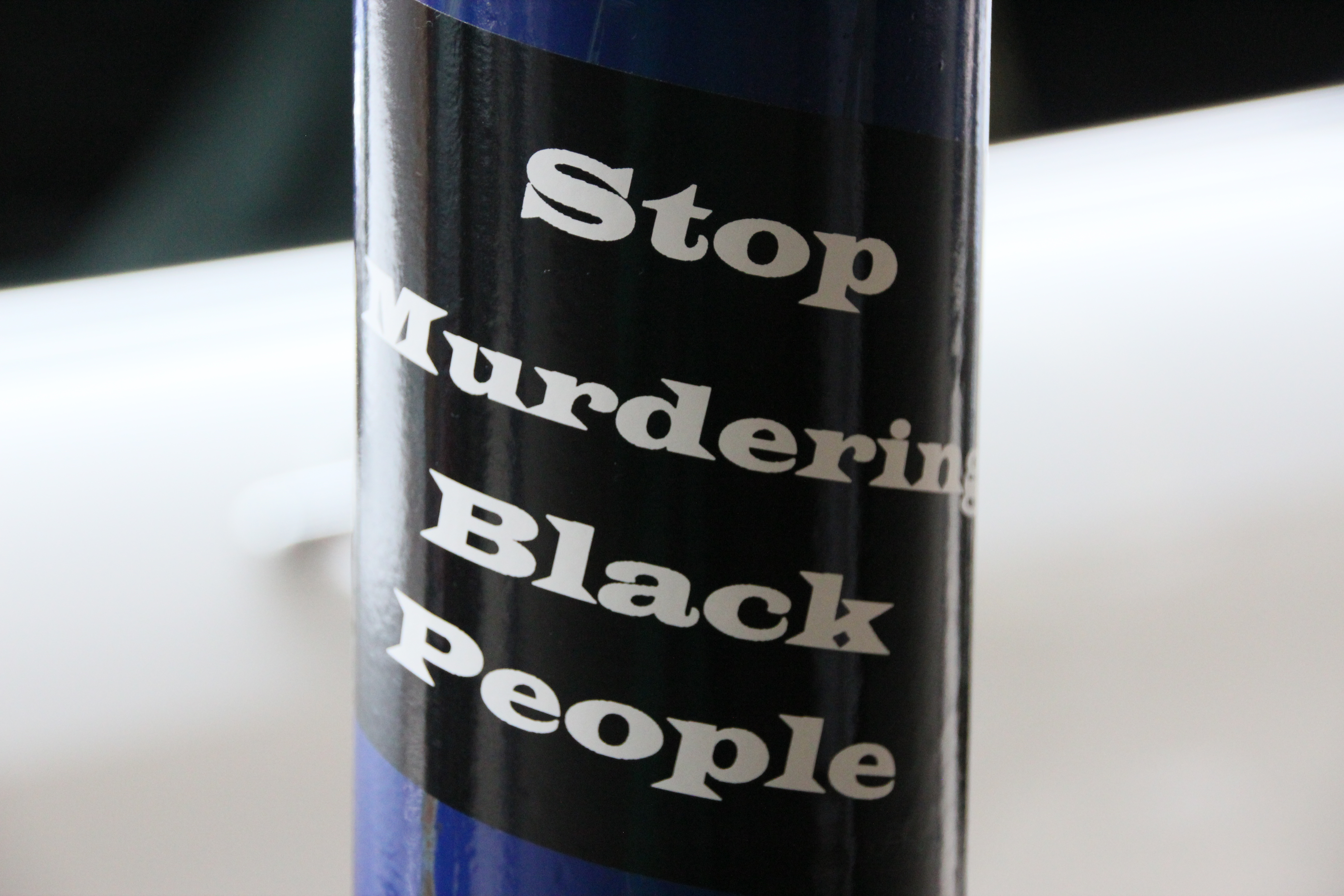
One of the most common themes of protest stickers in New York City is policing. There has been widespread controversy in America over the past few years over the treatment of civilians by police officers, particularly when it comes to ethnic minorities. Rise Up October was organised by the Stop Mass Incarceration Network (Photo: Hannah Awcock).
This sticker plays on the idea that the police should protect citizens, rather than pose a threat to them. In reality, the police can pose a threat, particularly to members of ethnic minorities (Photo: Hannah Awcock).
To serve and protect is another phrase commonly associated with the police. This sticker is implying that the police serve and protect property, rather than people (Photo: Hannah Awcock).
This sticker is advertising a different demonstration against police brutality. I think that #Octresist was also organised by the Stop Mass Incarceration Network, in 2014. If that is the case, then this sticker is getting quite old! (Photo: Hannah Awcock).
Garden State Ultras are a sports fan group with a radical edge. ACAB (All Cops Are Bastards) is part of the international radical language (Photo: Hannah Awcock).
This sticker wouldn’t win any prizes for subtlety, but sometimes that is the best way to get your message across (Photo: Hannah Awcock).
As I mentioned before, the Presidential Election is a hot topic in America. Donald Trump is a controversial figure who nobody seems to like, yet he keeps doing well in the primaries (Photo: Hannah Awcock).
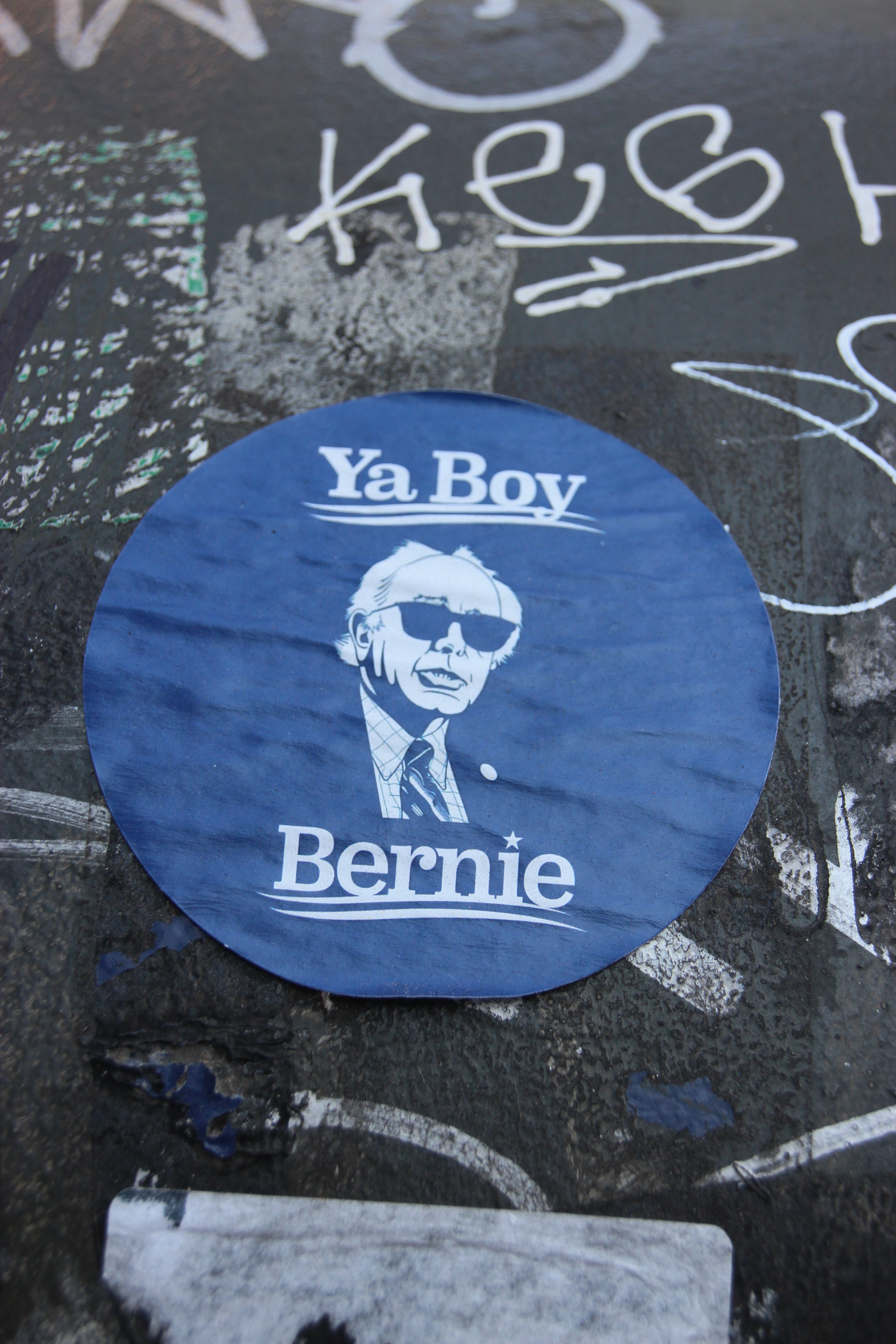
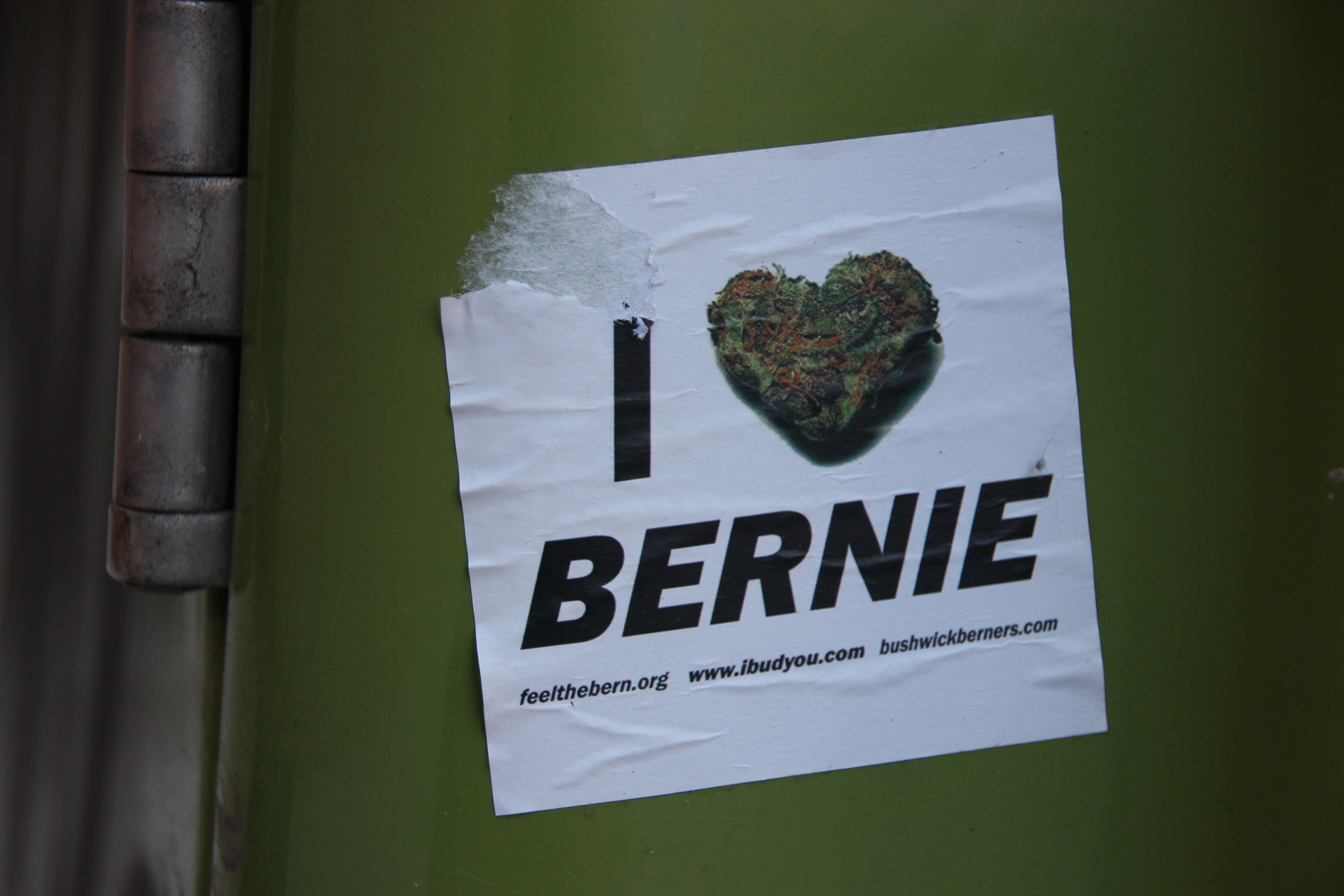
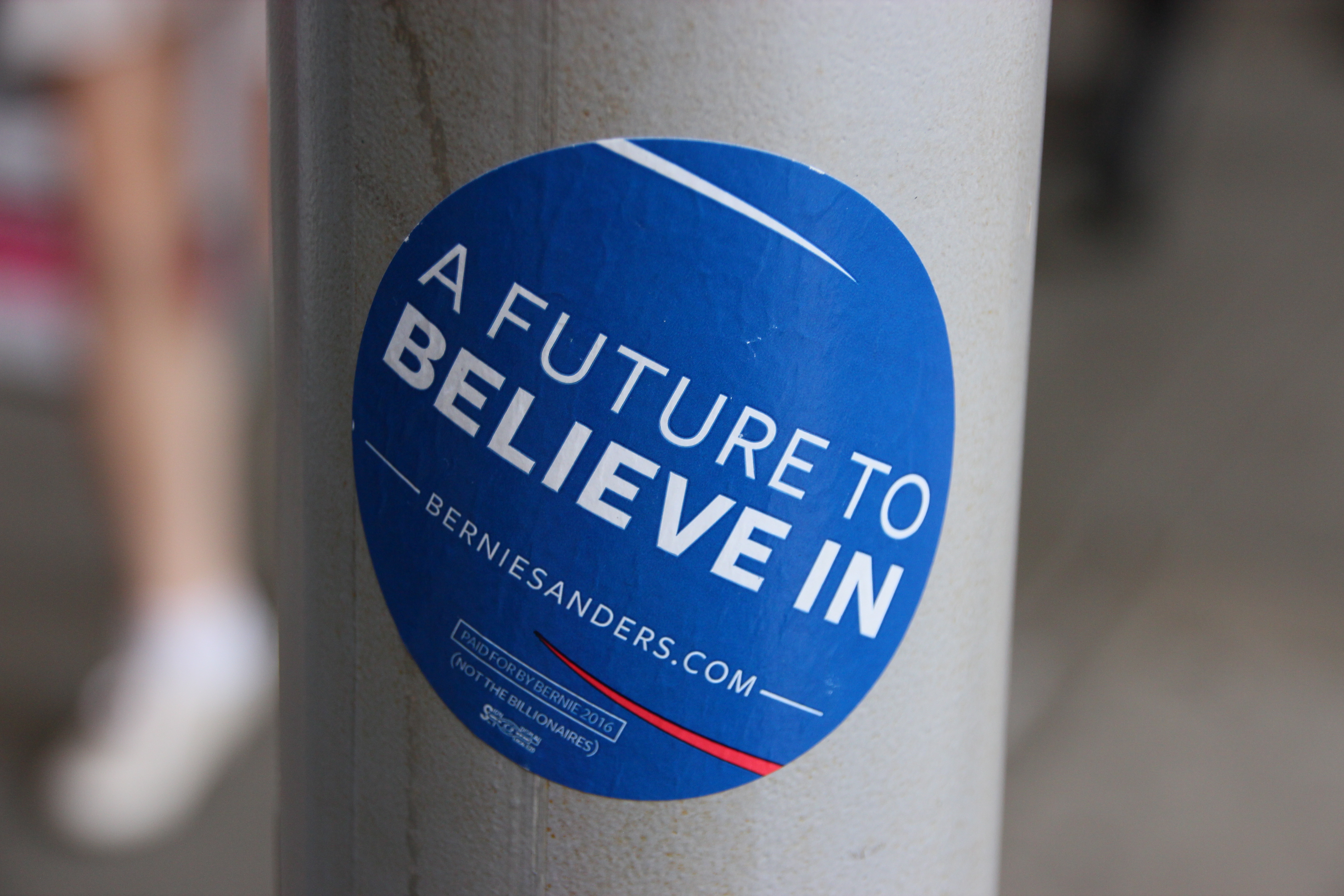
Most New York stickerers seem to be fans of Bernie Sanders. A democrat, he has been called America’s Jeremy Corbyn, he has been giving some people hope that politics can be done differently (Photo: Hannah Awcock).
This sticker was produced by The Personal Stash, which sells marijuana-themed accessories and promotes the reform of laws relating to marijuana (Photo: Hannah Awcock).
This sticker comes from Bernie Sander’s official campaign. Sometimes, the line between protest and formal politics can become blurred as radicals attempt to reform the system from within (Photo: Hannah Awcock).
And just to end the post on a positive note…(Photo: Hannah Awcock)
Don’t forget to check back next week for Part 2 of Protest Stickers: New York City 2!
Anti-fascism is one of the most common topics of protest stickers. This photo was taken on the Walworth Road on 26/09/15 (Photo: Hannah Awcock).
If you start looking out for protest stickers as you move around a British city, you will quickly notice that anti-fascists are particularly prolific sticker-ers. I’m not sure why, but anti-fascism is one of the most frequent themes of protest stickers, aside from anarchism. Most large towns and cities have an anti-fascist group, and as the largest of the lot London is home to several groups, as well as drawing in groups from elsewhere.
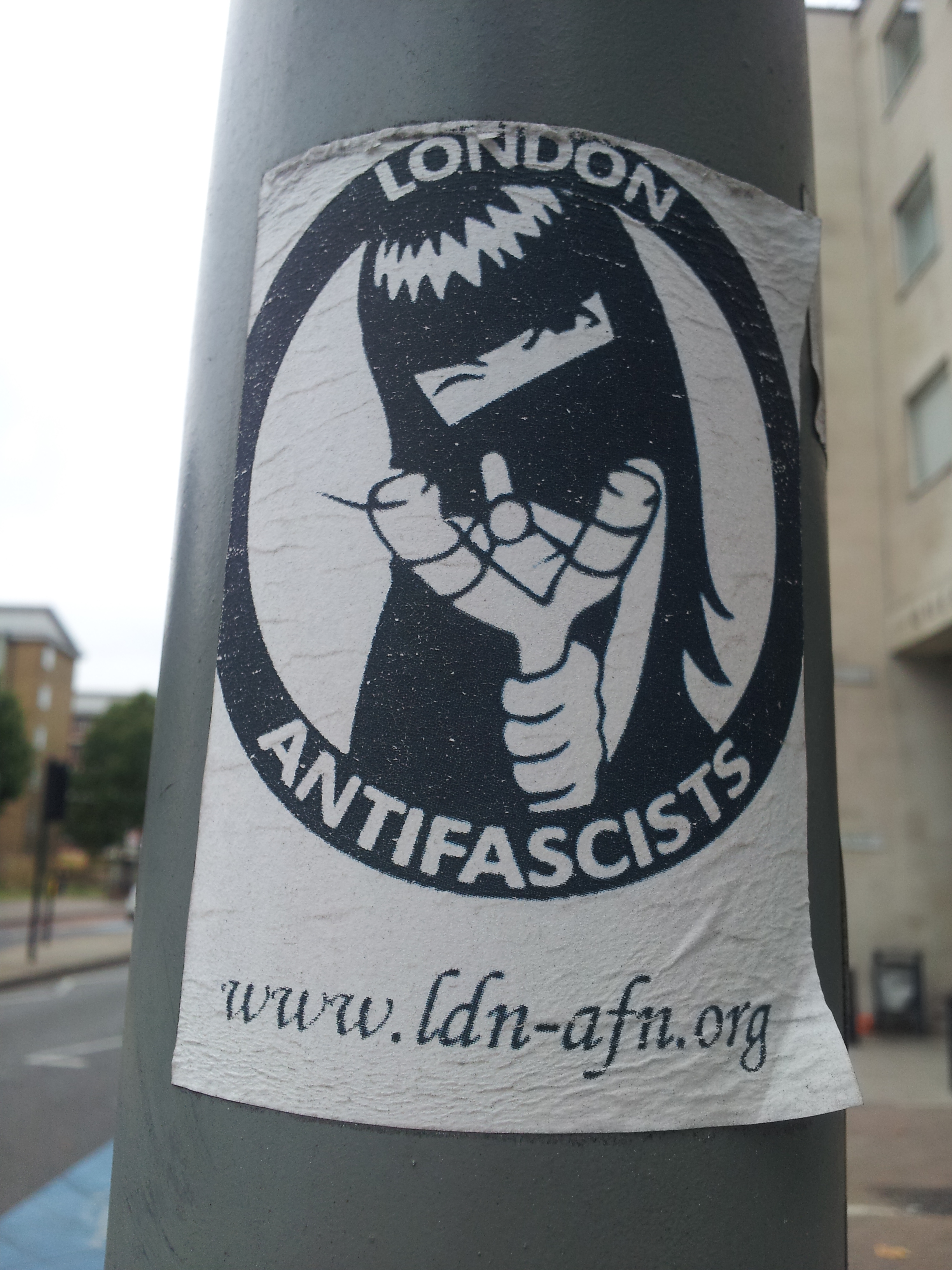
Unsurprisingly, one of the most common groups represented in London anti-fascist protest stickers are London Antifascists. This picture was taken on the Aylesbury Estate on 05/05/15 (Photo: Hannah Awcock).
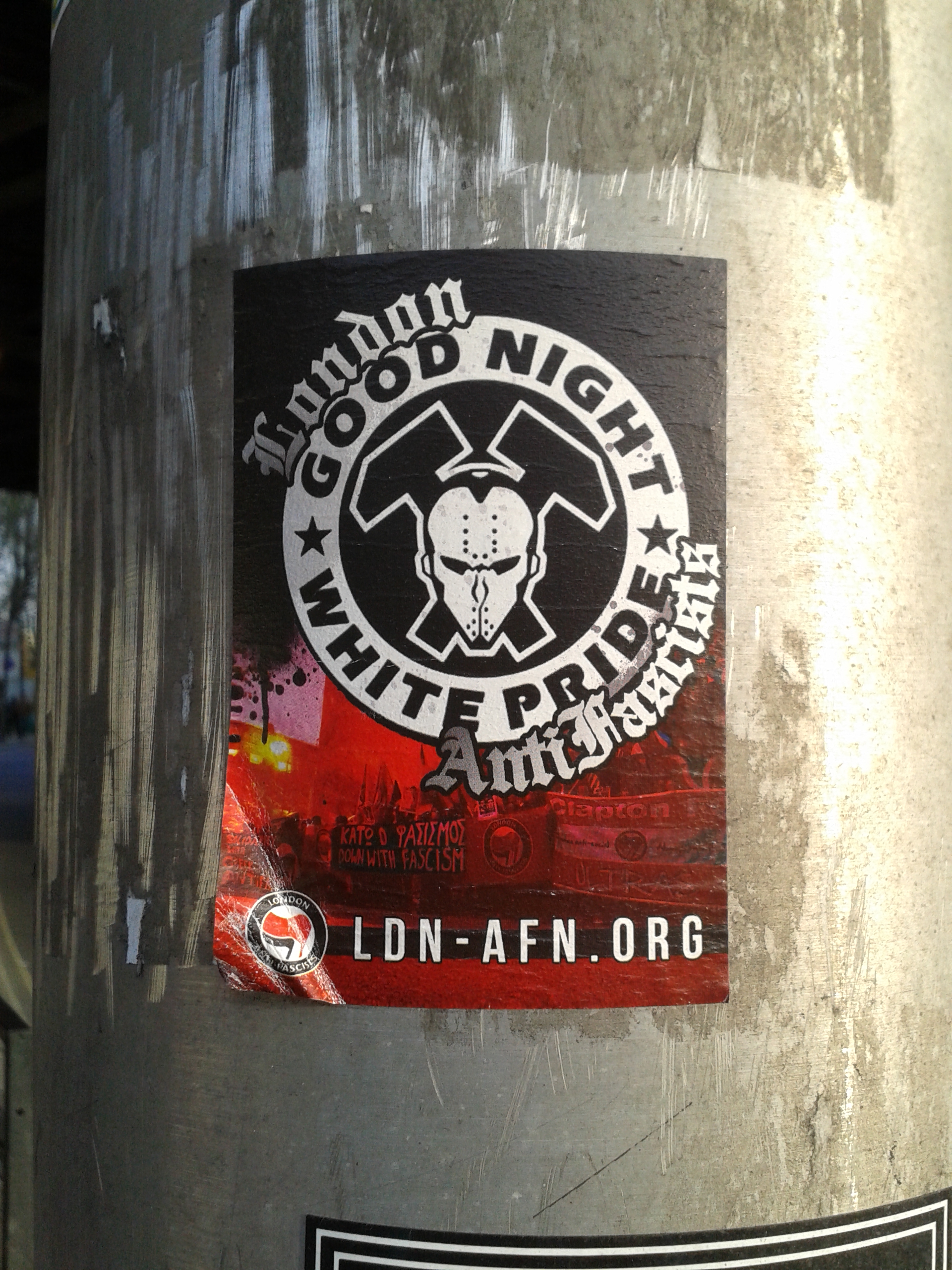
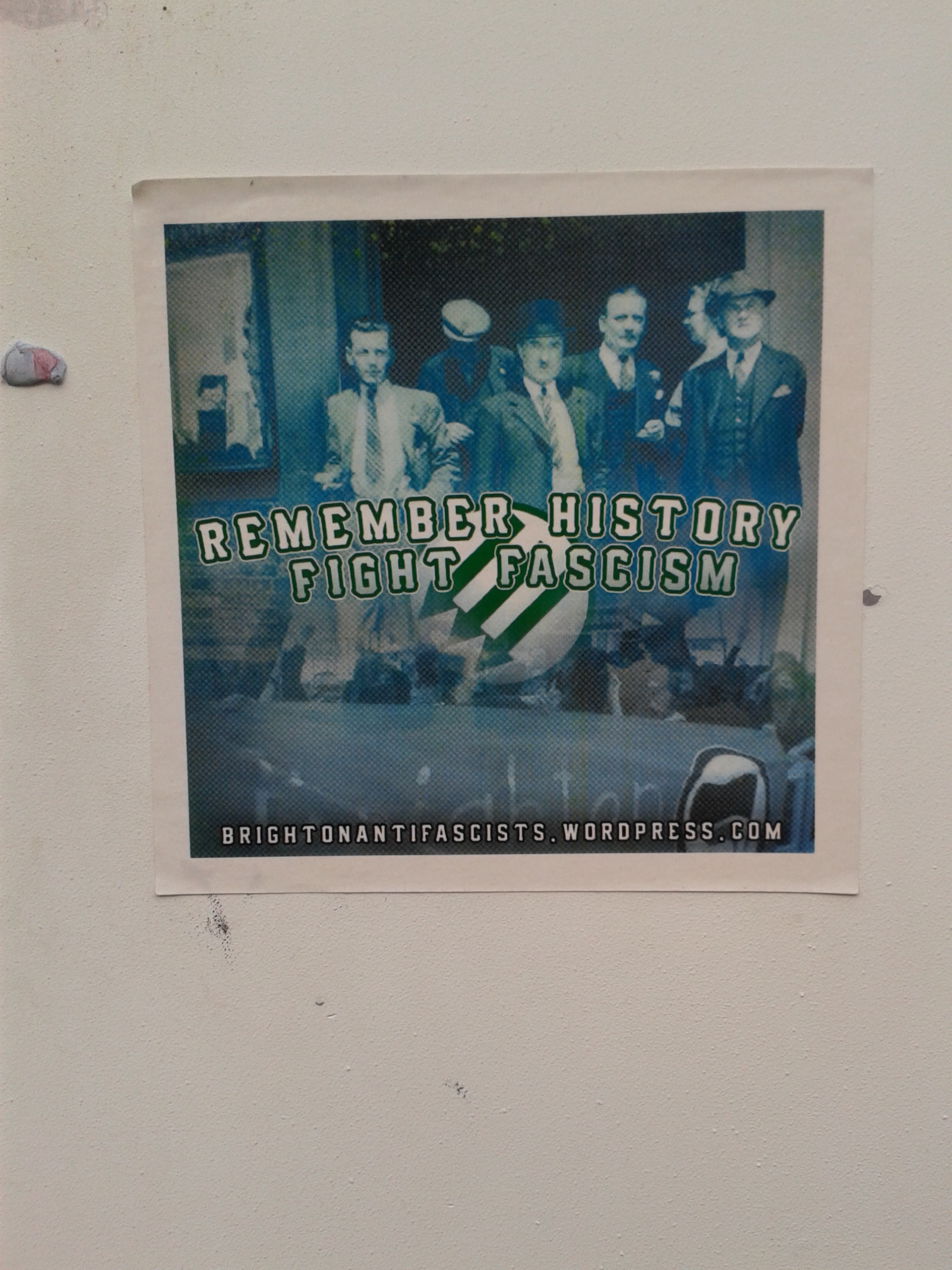
The logos employed by anti-fascist groups can vary, but an image with a circle is a common feature. This logo features Emily the Strange, a popular gothic character who began life on stickers advertising the clothing line Cosmic Debris. She has since featured on clothing, stationary, and all kinds of objects, but here she comes full circle, appearing on stickers once again. This photo was taken on the Mile End Road on 13/08/15 (Photo: Hannah Awcock).Although stickers which just feature a group’s logo and website are common, some are more complicated, like this one photographed on the north bank of the Thames near the City on 25/02/15. This sticker is still quite general in terms of focus however, it doesn’t specify what to fight back against (Photo: Hannah Awcock).Two flags (one red, one back) enclosed in a black circle is the most common and recognisable anti-fascist logo. This sticker points to the complex interconnections between anti-fascism and class politics, suggesting that London Antifascists only care about working-class communities. Or perhaps they are implying that racism and Nazism are only to be found amongst the middle- and upper-classes? This photo was taken at Elephant and Castle on 28/05/15 (Photo: Hannah Awcock).The double flag logo is so recognisable that I can be quite sure that this sticker is by an anti-fascist group, even though I cannot read the words. This photo was taken near Camden Underground Station on 10/03/15 (Photo: Hannah Awcock).This sticker, photographed at Elephant and Castle on 13/04/15, is also focusing on racism, and has the familiar image surrounded by a circle logo. I must admit that the imagery and font confused me at first, at first glance I thought that this sticker was defending white pride rather than condemning it (Photo: Hannah Awcock).When anti-fascist groups go travelling, they often leave evidence of their presence in the form of protest stickers. This sticker was produced by Brighton Antifascists, although I found it in Gordon Street, Bloomsbury, on 12/03/15 (Photo: Hannah Awcock).The 161 Crew are a Polish antifascist group that has a strong presence in London (the sticker in the previous photo is also one of theirs). This sticker appeared in Elephant and Castle on 14/09/15. I thought it was incredibly brave, as this was during a period of the refugee crisis where the debate around immigration was particularly vicious. Immigrants are supposed to be grateful and loyal to their host country, not encouraging cross-border class-based networks of dissent (Photo: Hannah Awcock).Unusually, this sticker does not feature an anti-fascist logo, which leads me to suspect it was not made by a specifically anti-fascist group. This photo was taken on Flint Street, near the occupied Aylesbury Estate on 05/05/15 (Photo: Hannah Awcock).Location can be integral to the meaning of protest stickers. I found this sticker in Cable Street, one of the sites of the famous demonstration known as the Battle of Cable Street, which has gone down in anti-fascist collective memory as a rare victory. No Pasaran is Spanish for ‘They Shall Not Pass’, one of the slogans of the Battle which was taken from the Spanish Civil War. The Battle is an important event in British anti-fascist history, a key source of pride and hope (Photo: Hannah Awcock, 25/02/15).This photo was also taken in Cable Street, next to the mural which memorialises the Battle of Cable Street. The double flag logo is present, although within a heart rather than a circle. Not surprisingly, Cable Street has a high concentration of anti-fascist stickers of various types, making it feel almost shrine-like (Photo: Hannah Awcock, 25/02/15).Not every Londoner is an anti-fascist supporter. The word ‘Antifascists’ and the website has been scratched off this sticker very deliberately. Someone clearly took exception to London Antifascists publicising themselves. This photo was taken on Borough High Street on 29/05/15 (Photo: Hannah Awcock).
























































 Turbulent Isles