On This Day: The Death of Blair Peach, 23rd April 1979

blairpeach
Blair Peach, 1946-1979 (Source: Wikipedia, photo is in the public domain)

Mark Duggan, Ian Tomlinson, Jean Charles de Menezes; some people have the misfortune of being famous because they were killed by the Metropolitan Police. Blair Peach is perhaps one of the better known names on that list. Peach died from a broken skull on the 23rd of April 1979, after being struck on the head during a demonstration outside Southall Town Hall. The results of the internal investigation into what happened weren’t published until 2010, three decades after Peach’s death.

Clement Blair Peach was born in New Zealand on the 25th of March 1946. He moved to London in 1969 and started working as a teacher at the Phoenix School in Bow, East London. Peach was no stranger to radicalism and protest; he was a member of the Socialist Worker’s Party, as well as the Socialist Teacher’s Association and the East London Teacher’s Association, both within the National Union of Teachers. In 1974 he was acquitted of a charge of threatening behaviour after he challenged a publican who was refusing to serve black customers. He was also involved in campaigns against far-right and neo-Nazi groups; he was well known for leading a successful campaign to close a National Front building in the middle of the Bangladeshi community around Brick Lane.

On St. George’s Day 1979, the National Front held a meeting in Southall Town Hall. The Anti-Nazi League held a counter demonstration outside the Town Hall. Peach was one of 3000 people to attend. The demonstration turned violent; over 150 people were injured (including around 100 police officers), and 345 arrests were made. Peach was struck on the head by a police officer at the junction of Beachcroft Avenue and Orchard Avenue, as he tried to get away from the demonstration. He died from his injuries later that night in Ealing Hospital.

Peach’s death struck a chord amongst the communities he had stood up for, and across the city as a whole. A few days after his death, 10000 people marched past the spot where he was fatally injured. His funeral was delayed by several months, until the 13th of June, but that was also attended by 10000 people. The night before his funeral, 8000 Sikhs went to see his body at the Dominion Theatre in Southall.

The Metropolitan Police commissioned an internal inquiry into what happened, which was led by Commander John Cass. 11 witnesses saw Peach struck by a member of the Special Patrol Group (SPG). The SPG was a centrally-based mobile group of officers focused on combating serious public disorder and crime that local divisions were unable to cope with. It started in 1961, and was replaces in 1987 by the Territorial Support Group, which also has a less-than stellar reputation amongst activists.

The pathologist’s report concluded that Peach was not hit with a standard issue baton, but an unauthorised weapon like a weighted rubber cosh,or a hosepipe filled with lead shot. When Cass’ team investigated the headquarters of the SPG, they found multiple illegal weapons including truncheons, knives, a crowbar, and a whip. 2 SPG officers had altered their appearance by growing or cutting facial hair since the protest, 1 refused to take part in an identity parade, and another was discovered to be a Nazi sympathiser. All of the officers’ uniforms were dry-cleaned before they were presented for examination.

Cass concluded that one of 6 officers had killed Peach, but he couldn’t be sure who exactly, because the officers had colluded to cover up the truth. He recommended that 3 officers be charged with perverting the course of justice, but no action was ever taken. The results of the inquiry were not published, and the coroner at the inquest into Peach’s death refused to allow it to be used as evidence, despite making use of it himself. On the 27th May 1980, the jury returned a verdict of death by misadventure. After decades of campaigning by Peach’s partner Celia Stubbs, the report was finally published in April 2010, although the Director of Public Prosecutions decided there was still not enough evidence to bring charges against anyone.

If I had written this blog post more than 6 years ago, it would look very different. The death of Blair Peach was a public relations nightmare for the Metropolitan Police; a respected and well-liked activist who fought hard for local communities, Peach was a man for whom many people cared about. The Met should have been transparent, finding out what happened and punishing those responsible quickly and openly. Instead, they covered up the cause of Peach’s death for 3 decades, allowing what happened to fester, contributing to a sense of resentment and distrust that continues to this day.

Sources and Further Reading

Casciani, Dominic. “Blair Peach Report: What the Investigation Uncovered.” BBC News. Last modified 17th April 2010, accessed 12th April 2016. Available at  http://news.bbc.co.uk/1/hi/uk/8646829.stm  

Editorial.”Death of Blair Peach: The Truth at Last.” The Guardian. Last modified 28th April 2010, accessed 12th April 2016. Available at  http://www.theguardian.com/commentisfree/2010/apr/28/death-of-blair-peach-editorial

Lewis, Paul. “Blair Peach Killed By Police at 1979 Protest, Met Report Finds.” The Guardian. Last modified 27th April 2010, accessed 12th April 2016. Available at  http://www.theguardian.com/uk/2010/apr/27/blair-peach-killed-police-met-report

Metropolitan Police. “MPS Publication Scheme: Investiagation into the Death of Blair Peach.” No date, accessed 12th April 2016. Available at  http://www.met.police.uk/foi/units/blair_peach.htm 

Renton, David. “The Killing of Blair Peach.” London Review of Books 36, no. 10 (2014): 23-26. Available at http://www.lrb.co.uk/v36/n10/david-renton/the-killing-of-blair-peach

Wikipedia. “Death of Blair Peach.” Last modified 28th March 2016, accessed 12th April 2016. Available at https://en.wikipedia.org/wiki/Death_of_Blair_Peach

London’s Protest Stickers: Anti-Police

The Metropolitan Police are a common sight across London today, but for a long time their survival was far from garunteed.
The Metropolitan Police are a common sight across London today, but for a long time their survival was far from guaranteed (Photo: Hannah Awcock).

London has the distinction of being home to the oldest professional police force in the world. The Metropolitan Police was formed in 1829 in an attempt to impose order on the chaotic and undisciplined city. Their primary purpose was to deter crime, but they became involved in the policing of protest in 1830. Ironically, the first protest in which the police were involved was an anti-police demonstration on the 28th of October 1830. Demonstrators chanting ‘No New Police’ clashed with the boys in blue at Hyde Park Corner. The British people had long been hostile to the idea of a professional police force, so the Metropolitan Police faced an uphill battle convincing Londoners that they were necessary. Ever since then, the Met has had an uneasy relationship with some Londoners. Radicals have always been particularly critical, especially in regard to the policing and control of protest. Disapproval and mistrust of the Metropolitan Police is reflected in London’s protest stickers.

You can see the locations of the stickers on the Turbulent London Map.

One of the most common ways of expressing anti-police sentiment is with the acronym ACAB
One of the most common ways of expressing anti-police sentiment is with the acronym ACAB, which stands for ‘All Cops/Coppers Are Bastards’. In most cases, the acronym’s meaning is not spelled out, but this sticker is particularly obliging, so it seemed like a good place to start the post (Photo: Hannah Awcock, Regent’s Canal Tow Path, 20/05/15).
ACAB crops up frequently, in various fonts and colour schemes. In most circumstances though, you would need to know what the acronym means to understand the sticker's message (King's Cross Station, 27/05/15).
ACAB crops up frequently, in various fonts and colour schemes. In most circumstances though, you would need to know what the acronym means to understand the sticker’s message (Photo: Hannah Awcock, King’s Cross Station, 27/05/15).
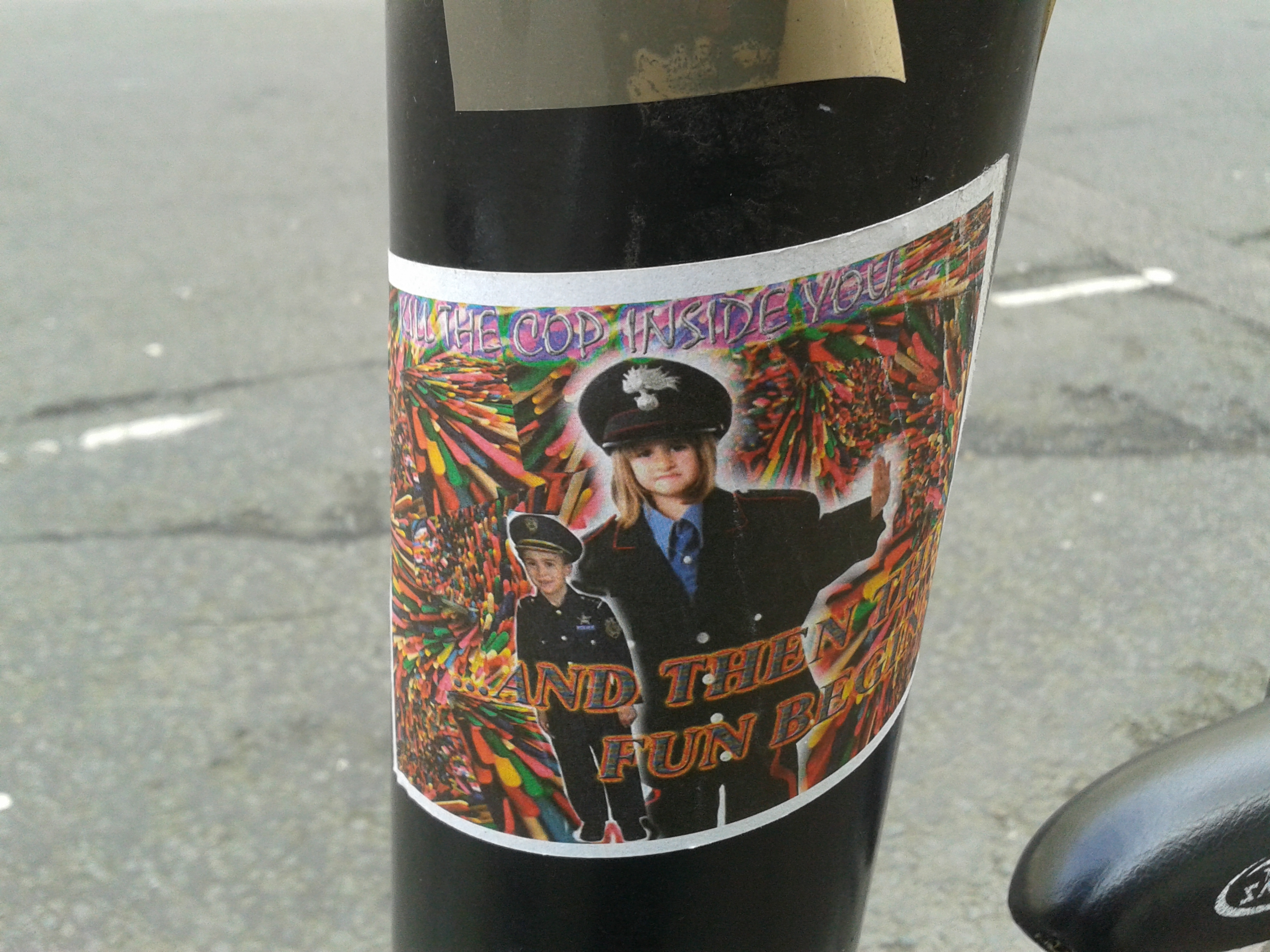
The text on this sticker is difficult to make out, but it reads 'Kill the cop inside you... and then the fun begins' (Bloomsbury, 17/03/15).
The text on this sticker is difficult to make out, but it reads ‘Kill the cop inside you… and then the fun begins’ (Photo: Hannah Awcock, Bloomsbury, 17/03/15).
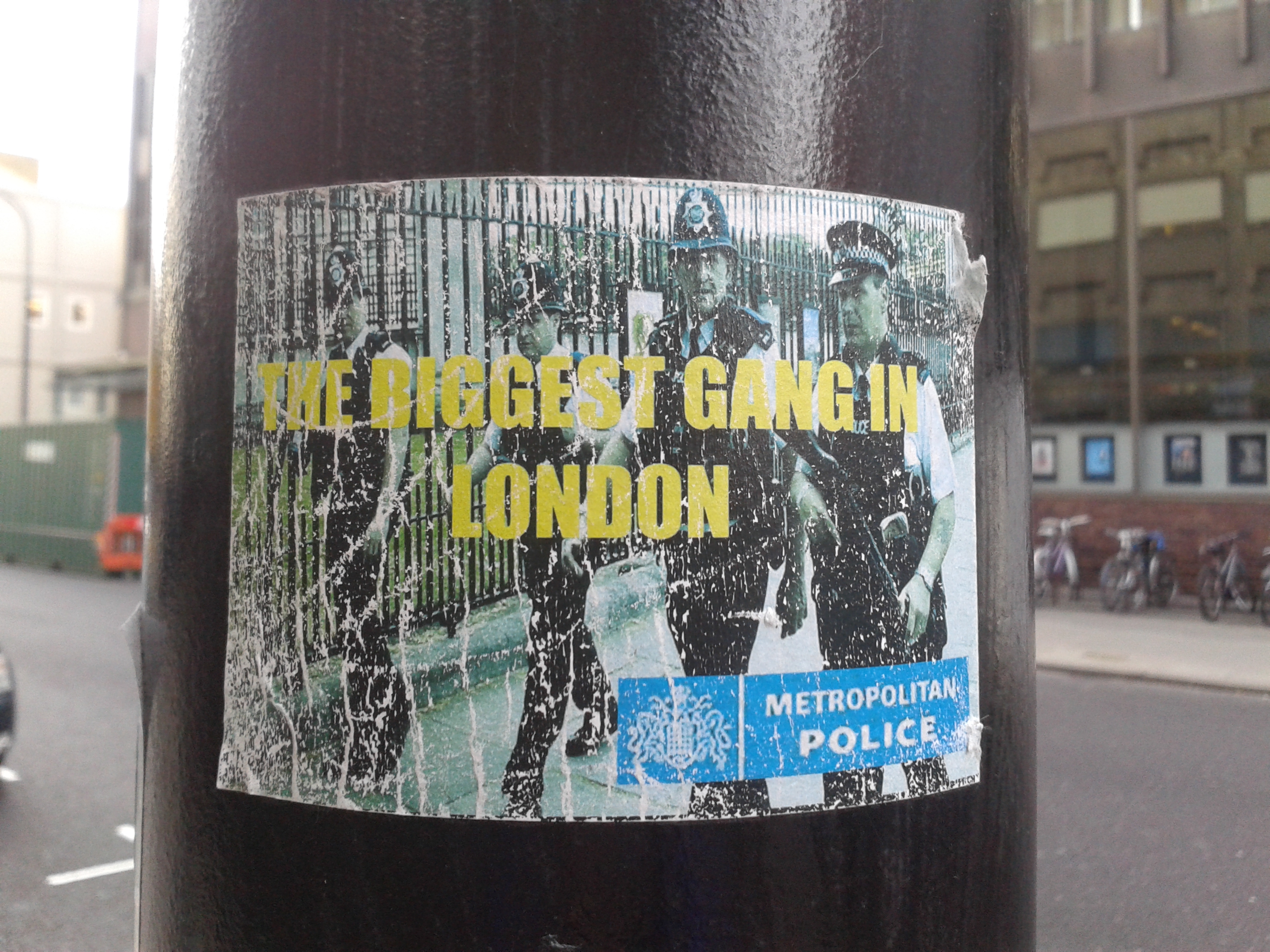
The previous two stickers refer to police in general. This sticker refers to the Metropolitan Police specifically, calling it the biggest gang in London (Gordon Street, Bloomsbury, 12/03/15).
The previous three stickers refer to police in general. This sticker refers to the Metropolitan Police specifically, calling it the biggest gang in London (Photo: Hannah Awcock, Gordon Street, Bloomsbury, 12/03/15).
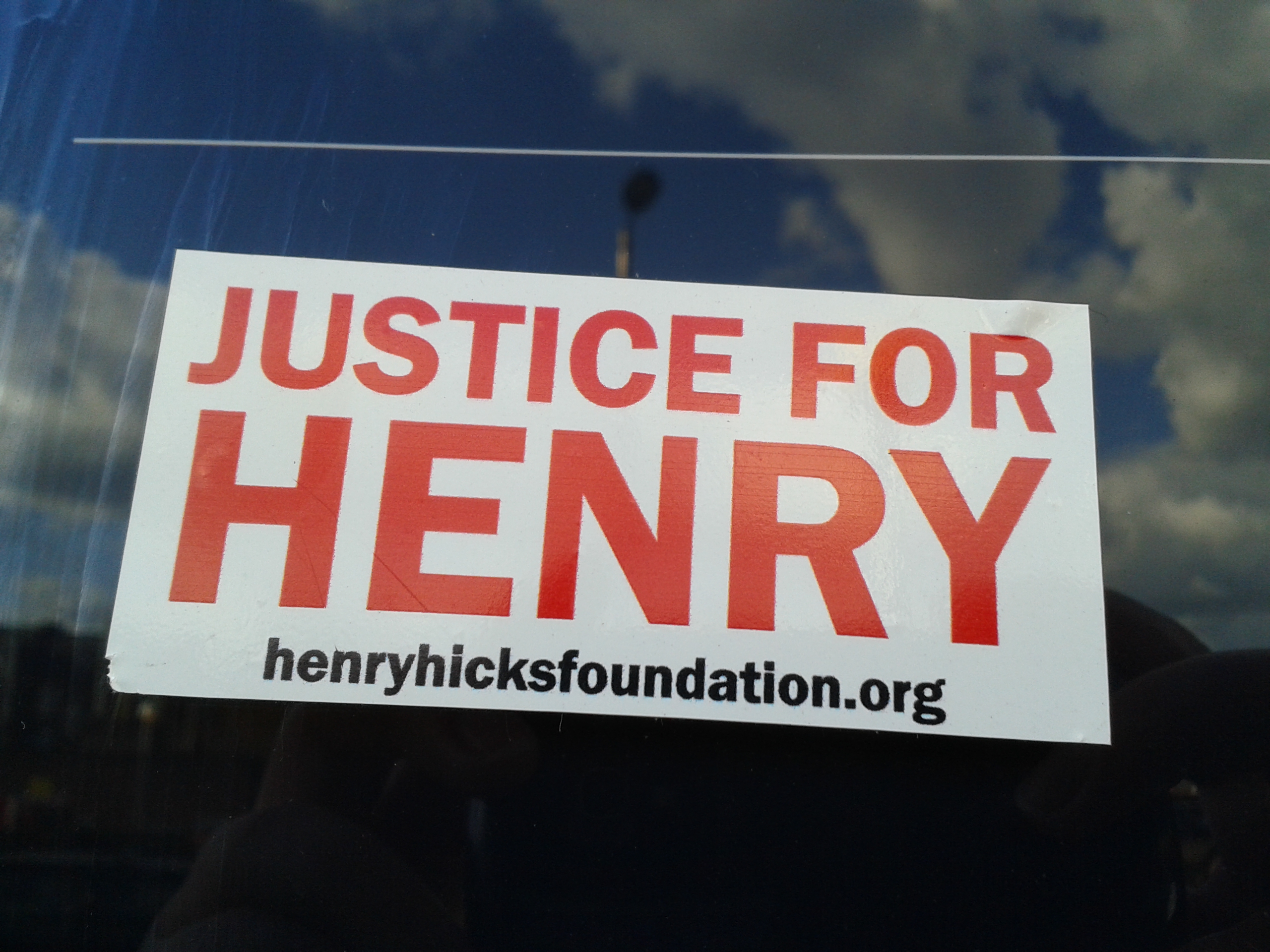
This sticker is even more specific. (King's Cross, 06/06/15).
This sticker is even more specific. Henry Hicks died after being chased by two unmarked police cars in December 2014. This sticker is calling for support in the campaign to get justice for Henry (Photo: Hannah Awcock, King’s Cross, 06/06/15).
This sticker also relates to the Henry Hicks campaign, but contains much less information (Tolpuddle Street, Islington, 20/05/15).
This sticker also relates to the Henry Hicks campaign, but contains much less information (Photo: Hannah Awcock, Tolpuddle Street, Islington, 20/05/15).
This sticker also relates to a specific case. Ian Tomlinson famously collapsed and died after being struck by a police officer at the 2009 G-20 protests. AN inquest found that he had been unlawfully killed (Kennington Park Road, 04/06/15).
This sticker also relates to a specific case. Ian Tomlinson famously collapsed and died after being struck by a police officer at the 2009 G-20 protests. An inquest found that he had been unlawfully killed (Photo: Hannah Awcock, Kennington Park Road, 04/06/15).
There has been a lot of controversy over the pat few years over the policing of student protest. This sticker refers to a campaign to ban police from university campuses (Malet Street, Bloomsbury, 17/03/15).
There has been a lot of controversy over the pat few years over the policing of student protest. This sticker refers to a campaign to ban police from university campuses (Photo: Hannah Awcock, Malet Street, Bloomsbury, 17/03/15).
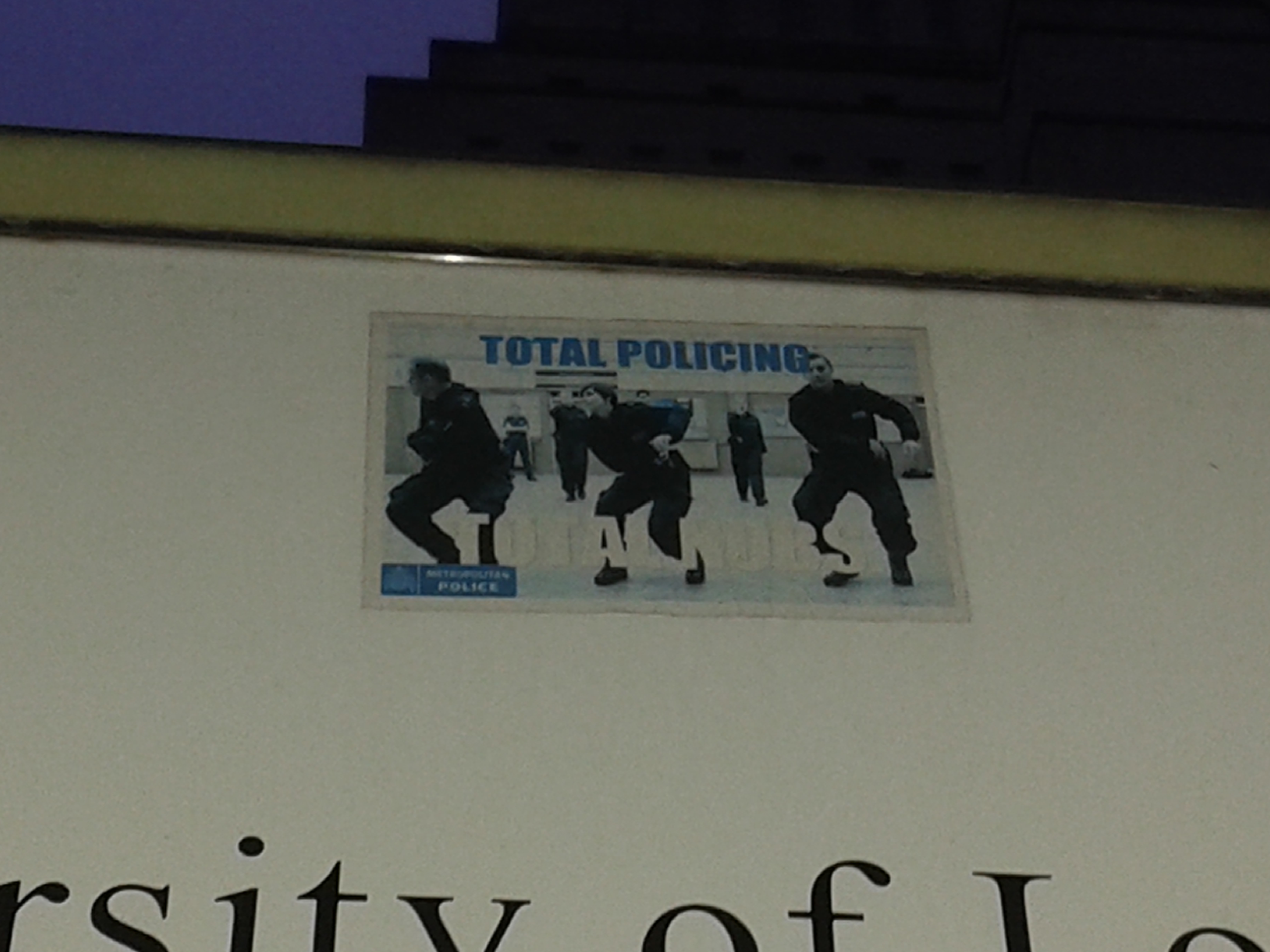
(Senate House, 17/03/15).
I found this sticker close to Senate House, part of the University of London, which suggests it may also be connected to the controversy over student protest. The writing is not easy to make out; it reads ‘Total Policing- Total Nobs.’ (Photo: Hannah Awcock, Senate House, 17/03/15).
(Malet Street, Bloomsbury, 17/03/15).
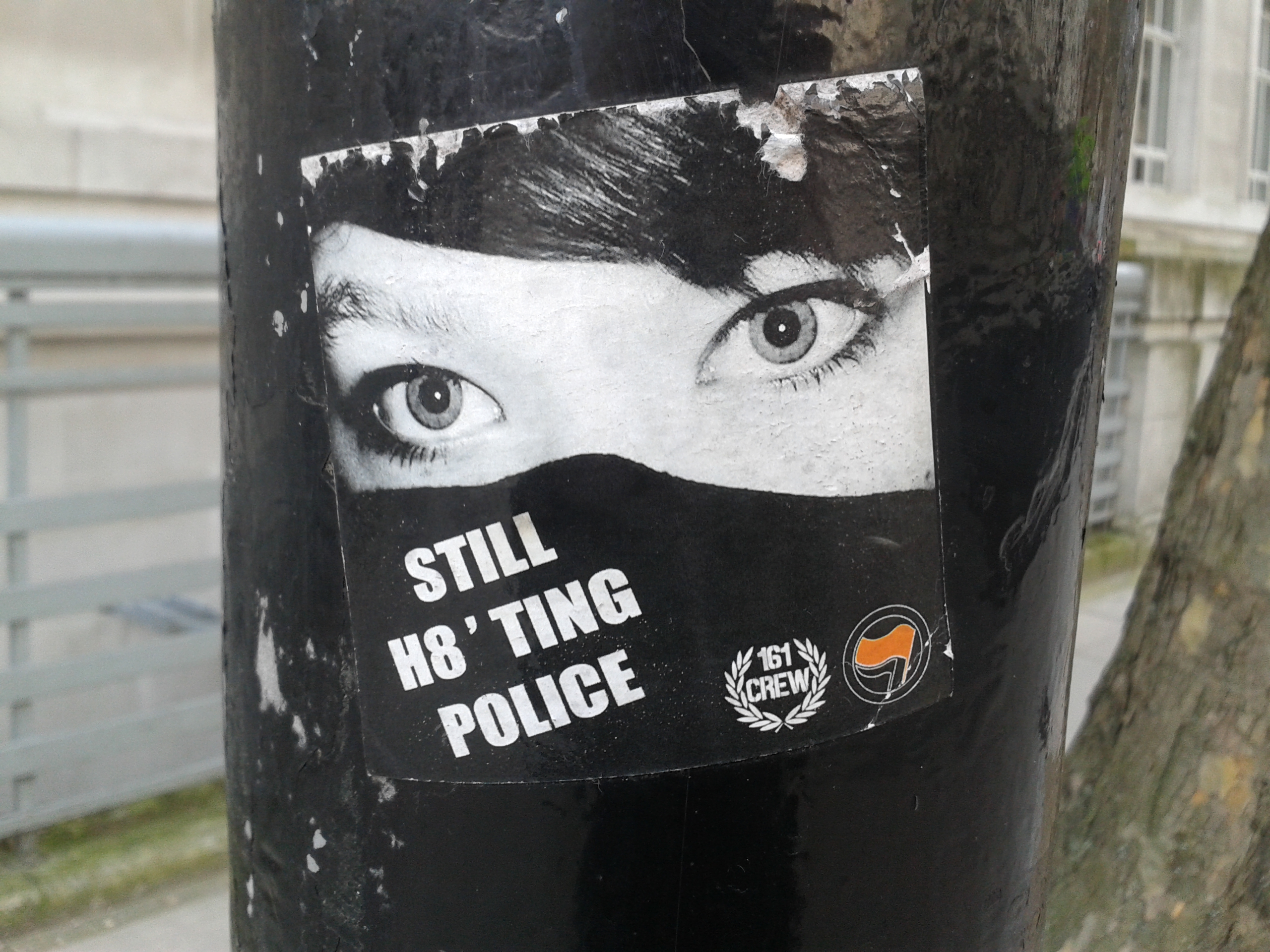
Some stickers feature the logos of the groups who produced them. This sticker was made by the 161 Crew, a Polish anti-fascist group (Photo: Hannah Awcock, Malet Street, Bloomsbury, 17/03/15).
(Westminster Bridge, 20/06/15).
This sticker reworks the logo of the Metropolitan Police, filling it with criticisms of the police force, including terrifying, intimidating, abusive and petty (Photo: Hannah Awcock, Westminster Bridge, 20/06/15).

Sources and Further Reading

Ascoli, David. The Queen’s Peace: The Origins and Development of the Metropolitan Police 1829-1979. London: Hamish Hamilton, 1979.

Rebellious New York: A Radical Guide to NYC 2

Last week, I was lucky enough to run my Rebellious New York project on the Royal Holloway Geography Department’s second year undergraduate field trip for a second year. I really enjoyed it last year, getting to explore New York’s radical side with a group of enthusiastic students, and this trip was no different. I wrote about some of the many ways to explore New York’s turbulent past and present last year, but this time I discovered some new things, as well as revisiting some old ones.

IMG_0778
The Statue of Liberty, donated to America by the French people to commemorate the centenary of American Independence, is one of the most iconic symbols of New York City (Photo: Hannah Awcock).

I took my group on the Occupy Walking Tour with Occupy member Michael Pellagatti, as I did last year. Michael has added some information to the tour that puts the 2008 global financial meltdown that spawned the Occupy Movement in the context of the boom and bust cycle inherent to capitalism. We also had a talk at the Interference Archive, which provided an introduction to the archive and its collections. It is always useful to know why an archive you are working in was started, as it can help you to understand what sort of material might be present in the collections. The students all found something useful for their projects, and the volunteers were very helpful in pointing out potentially relevant material- a great illustration of how beneficial it can be to have the archivist on your side!

dav
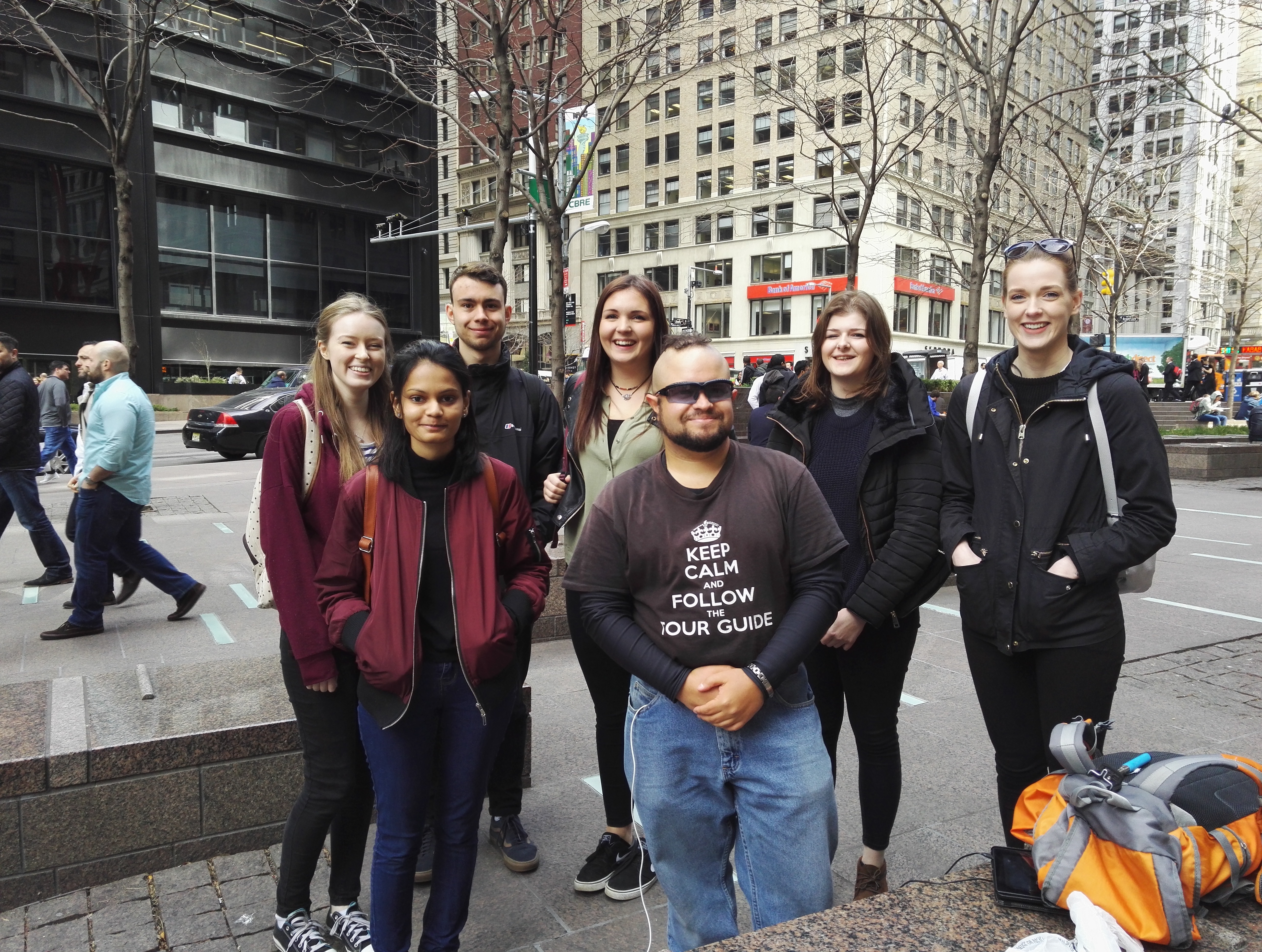
The Rebellious New York group with Michael Pellagati, the Occupy New York tour guide (Photo: Hannah Awcock).
dav
My group getting stuck in to the collections at the Interference Archive (Photo: Hannah Awcock).

The weather was much warmer than it has been on my previous trips to New York, and it was lovely to see the open spaces of the city being used and enjoyed. Union Square Park seemed to be a particularly lively space, with people dancing, drawing, performing and protesting at the south end of the park on the Wednesday evening when we were there. Whilst walking tours and archives are excellent, protest is best experienced by actually experiencing it, and in New York there is no shortage of opportunities!

IMG_0559
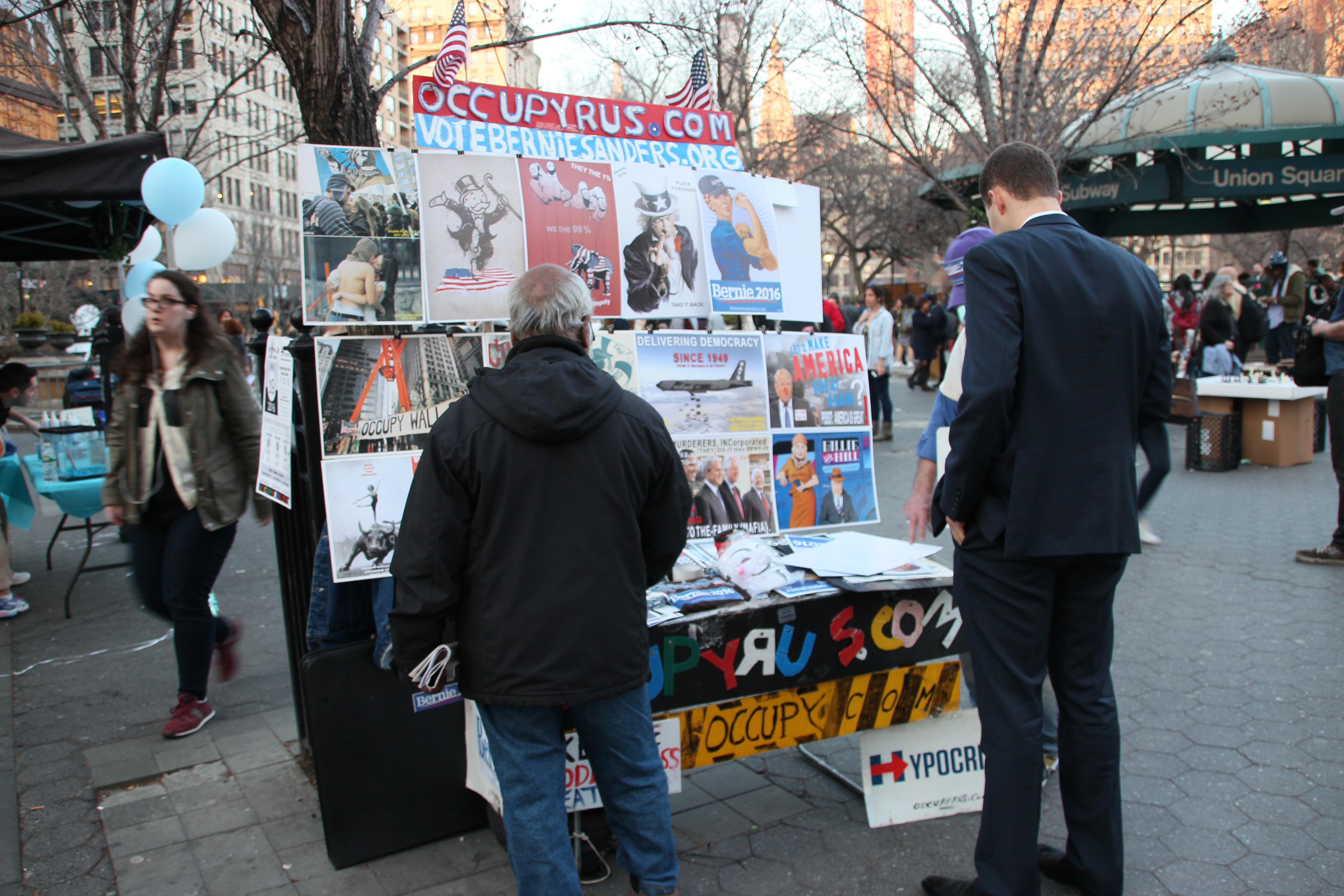
This stall was selling posters and t-shirts with a clear anti-establishment theme (Photo: Hannah Awcock).
IMG_0561
Police violence against civilians, particularly those belonging to ethnic minorities, is a controversial topic in America at the moment (Photo: Hannah Awcock).
IMG_0563
It takes all sorts to make up a political campaign! (Photo: Hannah Awcock).

I spent some time on this trip exploring the rich history of immigration that is an integral part of New York. I visited Ellis Island, which processed 12 million newly arrived immigrants between 1892 and 1924. I also went to the Lower East Side Tenement Museum, which has preserved 97 Orchard Street, and has restored some of the flats to resemble what they would have looked like at various points between 1863 and the 1930s. Many immigrants crammed into tenements in neighbourhoods like the Lower East Side when they first arrived in America, and the museum does a fantastic job of bringing their stories to life. Immigrant groups did not wait long to get involved in politics in New York. Some of the biggest issues for new arrivals were work related; workers faced long hours, tough conditions and low wages. American workers often saw immigrants as competition, but they eventually realised that more could be achieved if they campaigned together. In addition, more established migrant groups helped new arrivals; German radicals helped eastern Europeans set up trade unions and Yiddish language newspapers when they first arrived on the Lower East Side. Radicals were also affected by the increasingly tight laws which aimed to reduce overall immigration numbers and prevent those considered subversive or unable to provide for themselves entering America. Anarchists were banned in 1903, along with epileptics and professional beggars.

IMG_0810
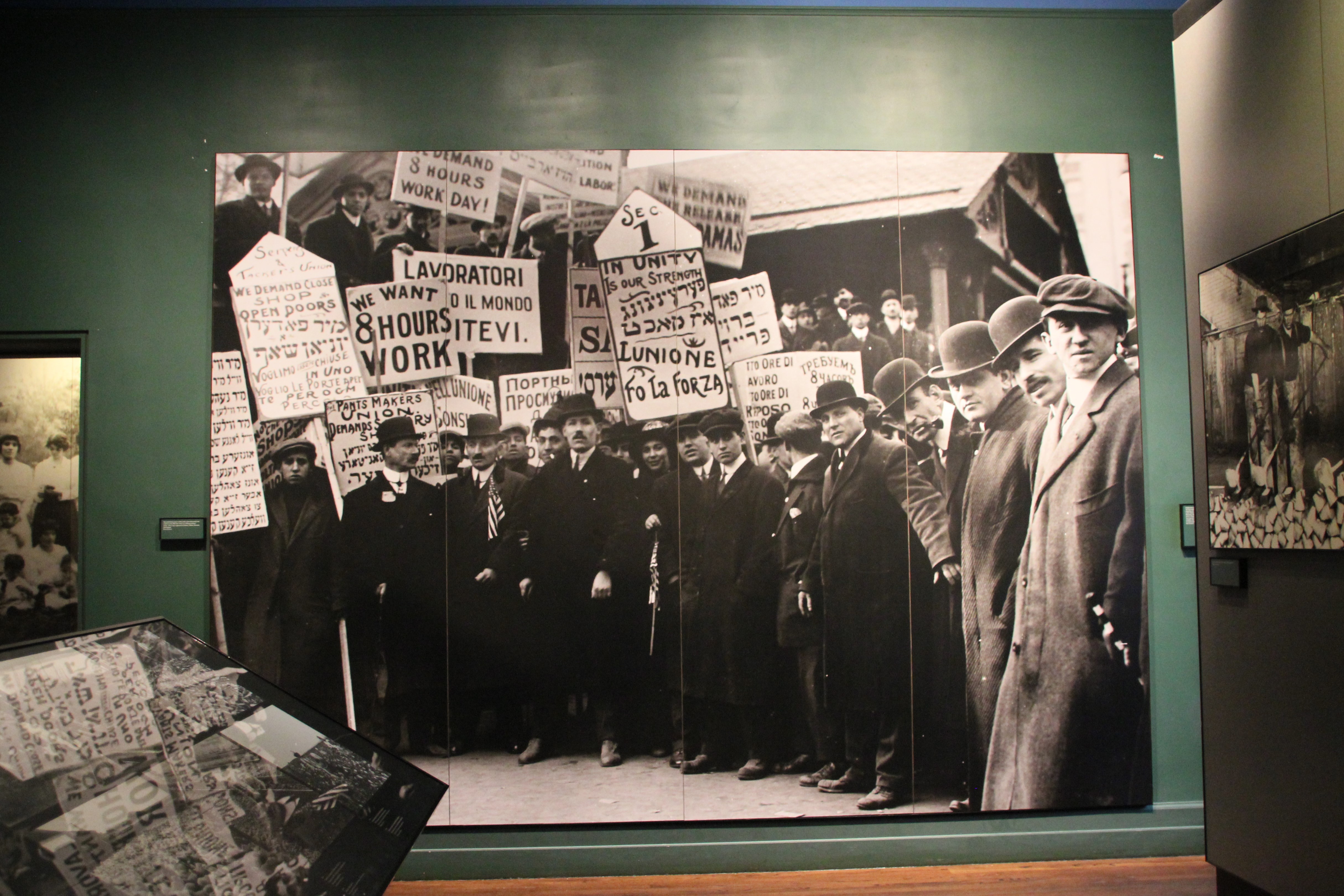
An image from the 1913 New York City clothing workers’ strike, with placards in Italian, Yiddish, and Russian as well as English. The museum on Ellis Island deals with all aspects of migrant life, including work (Photo: Hannah Awcock).

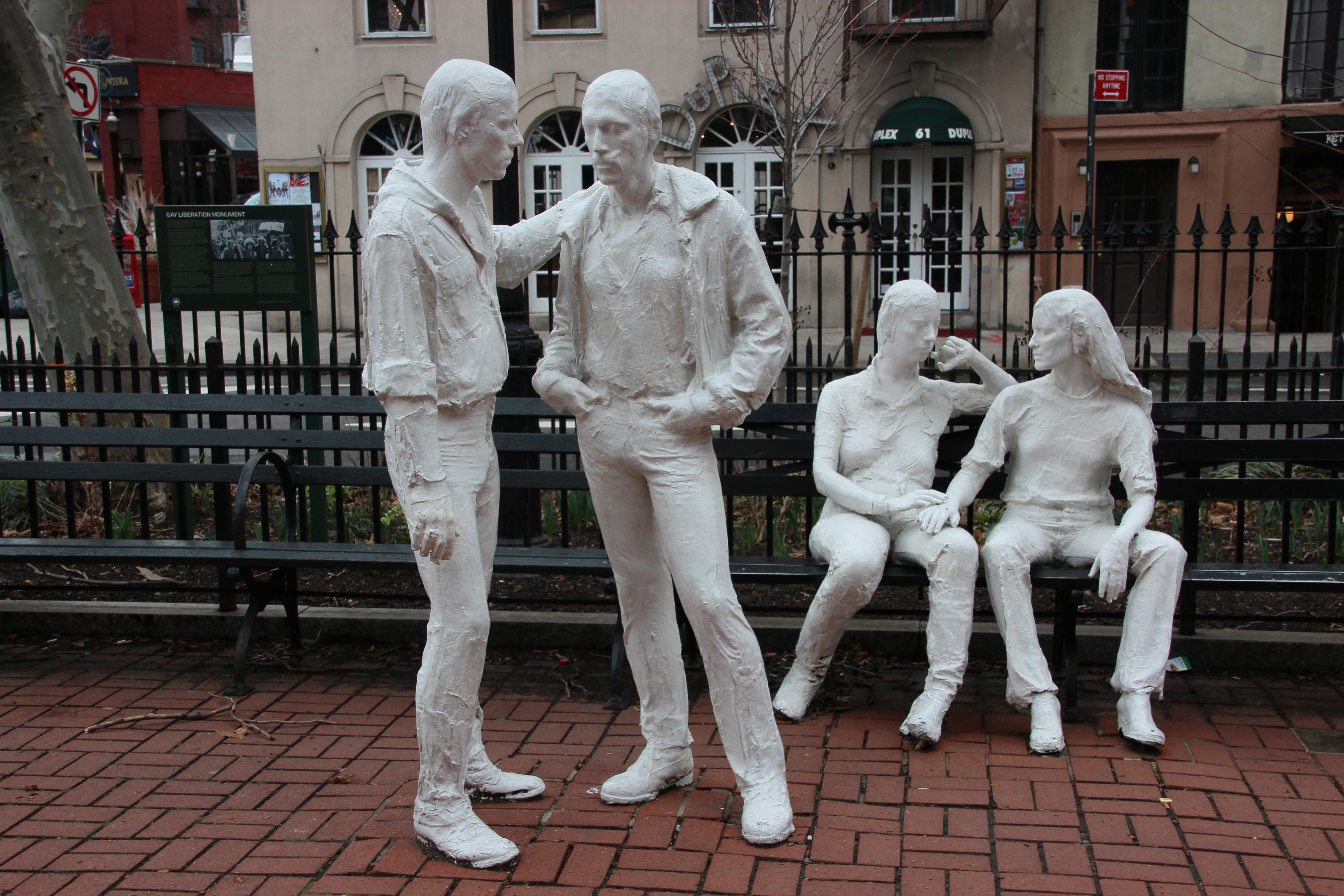
The Stonewall Riots are considered by many to be the the catalyst for the LGBT civil rights movement in America. On the 28th of June 1969 the police raided the Stonewall Inn, a popular gay bar in Greenwich Village. At this point homosexuality in public was illegal in New York, and businesses and establishments frequented by the city’s gay community were continually harassed by the police. This particular night was the final straw however, and a crowd gathered outside the Stonewall Inn and began to riot. The same happened the following night. On the first anniversary of the riots, the first Gay Pride parades took place in Los Angeles, San Francisco and New York. The original Inn closed in 1969, but a bar called Stonewall opened up in the western half of the original location (53 Christopher Street) in 1990. In 2007 the name was changed again to the Stonewall Inn, and this bar is still open today. Across the road in Christopher Park is the Gay Liberation Monument, which was constructed in 1992. Although it memorialises the gay rights movement as a whole, the location of the monument so close to the Stonewall Inn demonstrates how significant the location is considered to be.

IMG_0869
The Gay Liberation Monument in Christopher Park consists of 4 figures (Photo: Hannah Awcock)
IMG_0870
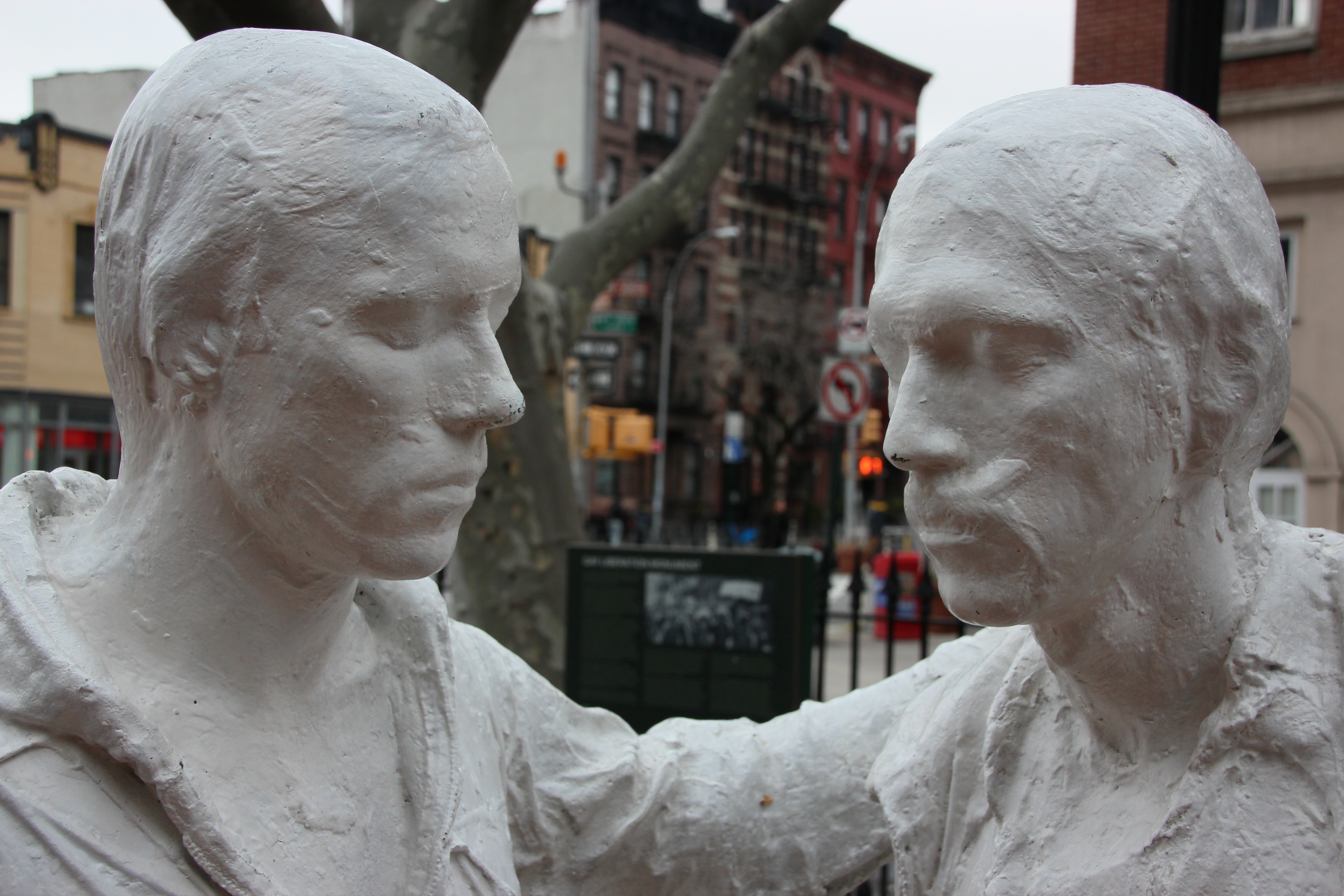
Detail of the two male figures. A plaque, which explains the context of the riots and the history of the memorial, can be seen in the background (Photo: Hannah Awcock).
IMG_0874
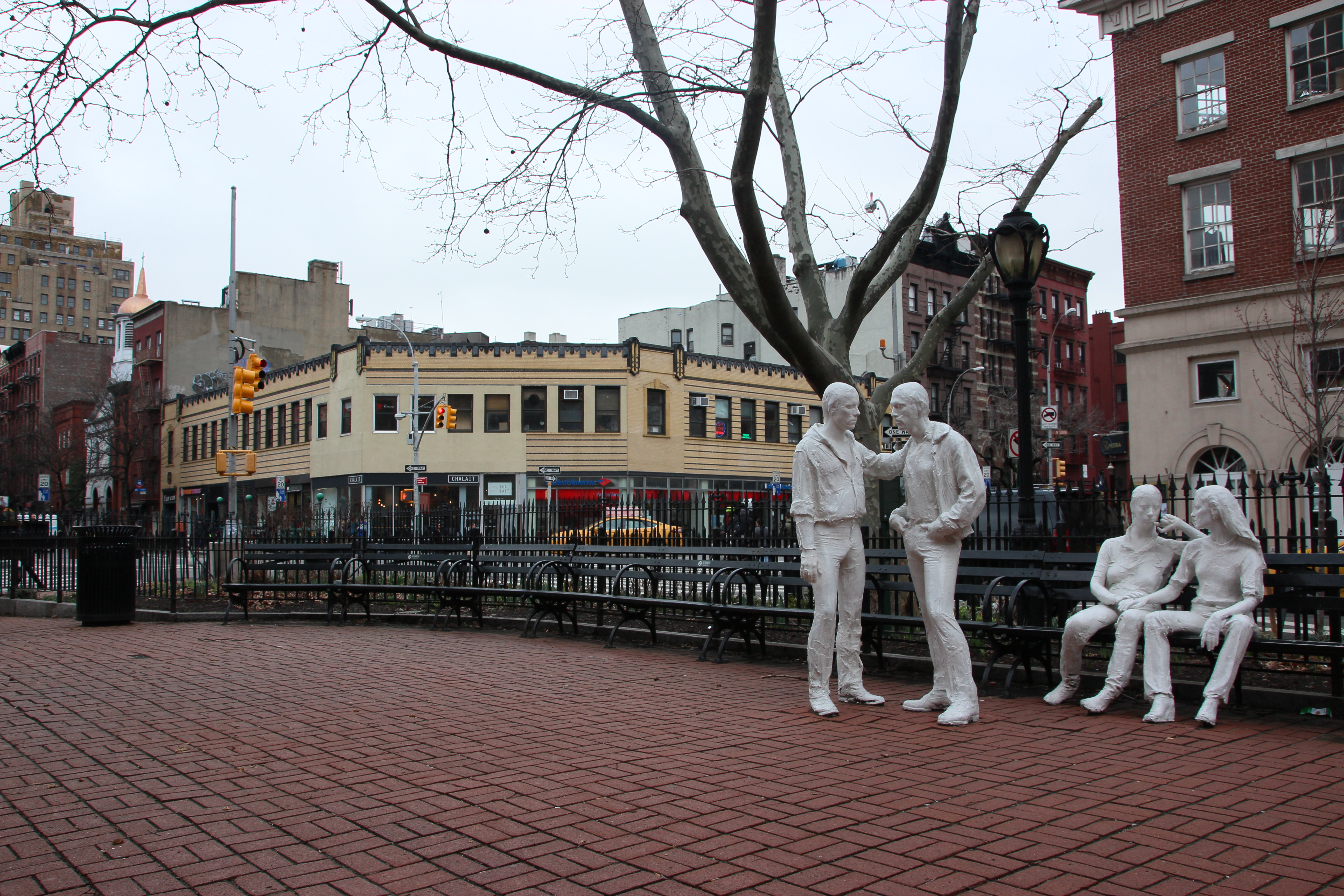
Christopher Park itself is small and quiet, but very close to the busy 7th Avenue, and I saw a lot of people coming in to look at memorial during the 20 minutes I was sat there (Photo: Hannah Awcock).

The radical history of New York is long and diverse, and it would take far more time than I have to get to know it properly, although I would like to someday. For now, I am content with exploring the traces these turbulent events and people have left in the fabric of the city on my brief visits, not to mention helping the wonderful Royal Holloway Geography undergraduates to conduct their own research on protest in the city. If you ever find yourself in this fantastic city, why not take some time to investigate the city’s rebellious side?

Turbulent London on Film: Save Our Heritage

Winstan Whitter. Save Our Heritage, uploaded 2011, available at  https://vimeo.com/32541973

Winstan Whitter was a film-maker in the right place at the right time. A local boy, he filmed throughout the campaign to save the historic Four Aces Club and surrounding buildings in Dalston, Hackney from demolition and redevelopment. Save Our Heritage tells the story from start to finish, from when the the demolition signs first appeared, to the end of the campaign. The documentary is a compelling example of a single-issue social movement, and showcases a mixture of resistance tactics, some official, others less so. The film is particularly pertinent now, as people feel increasingly marginalised in London, thanks to gentrification and rising house prices. Save Our Heritage tells a story that feels very familiar; it is a detailed snapshot of a process that is going on all over the capital.

The narrative is strung together by interviews with Bill Parry-Davies, a founding member of OPEN Dalston (Organisation for Promotion of Environmental Needs), a “community-based company” of local residents and businesses which started campaigning in early 2005 for the improvement of the local area. Mr Parry-Davies is perhaps not what you would expect in a prominent member of a social movement; he is a well-dressed, well-spoken solicitor, and he brings a certain degree of respectability to the film which may surprise some.

Bill Parry-Davies
Bill Parry-Davies, solicitor and founding member of OPEN Dalston, features prominently in Save Our Heritage (Source: Save Our Heritage).

The film focuses on the campaign to save 4-12 Dalston Lane, which at the beginning of the film is threatened with demolition, largely because it had been neglected by its owners, Hackney Borough Council. The buildings included 2 listed Georgian houses and a circus built in 1886, which has since served as a theatre, cinema, and nightclub. As the Four Aces Club, it was a became a well-known centre for black music in London. The roof was removed in the 1990s, presumably with the full knowledge of Hackney Council, and never replaced. The interiors deteriorated, but the building remained structurally sound. In 2005, the Council began their attempts to demolish the buildings.

The film documents the entire campaign to save the buildings, including a public consultation campaign, alternative proposals, high court injunctions, an occupation (which began to restore the buildings and acted as a form of community centre),  a demonstration outside a Hackney council meeting (in which 5 minutes were allocated for ALL those wishing to oppose the development plans). The council’s chosen plans did not provide any facilities which OPEN claimed the community needed, such as affordable housing, cultural facilities, and open green space. To add insult to injury, it emerged that TFL needed  income from the site to plug a £19 million funding gap from their station development on an adjacent site, which meant that Hackney taxpayers were footing the bill for even more upmarket housing.

Dalston Occupation
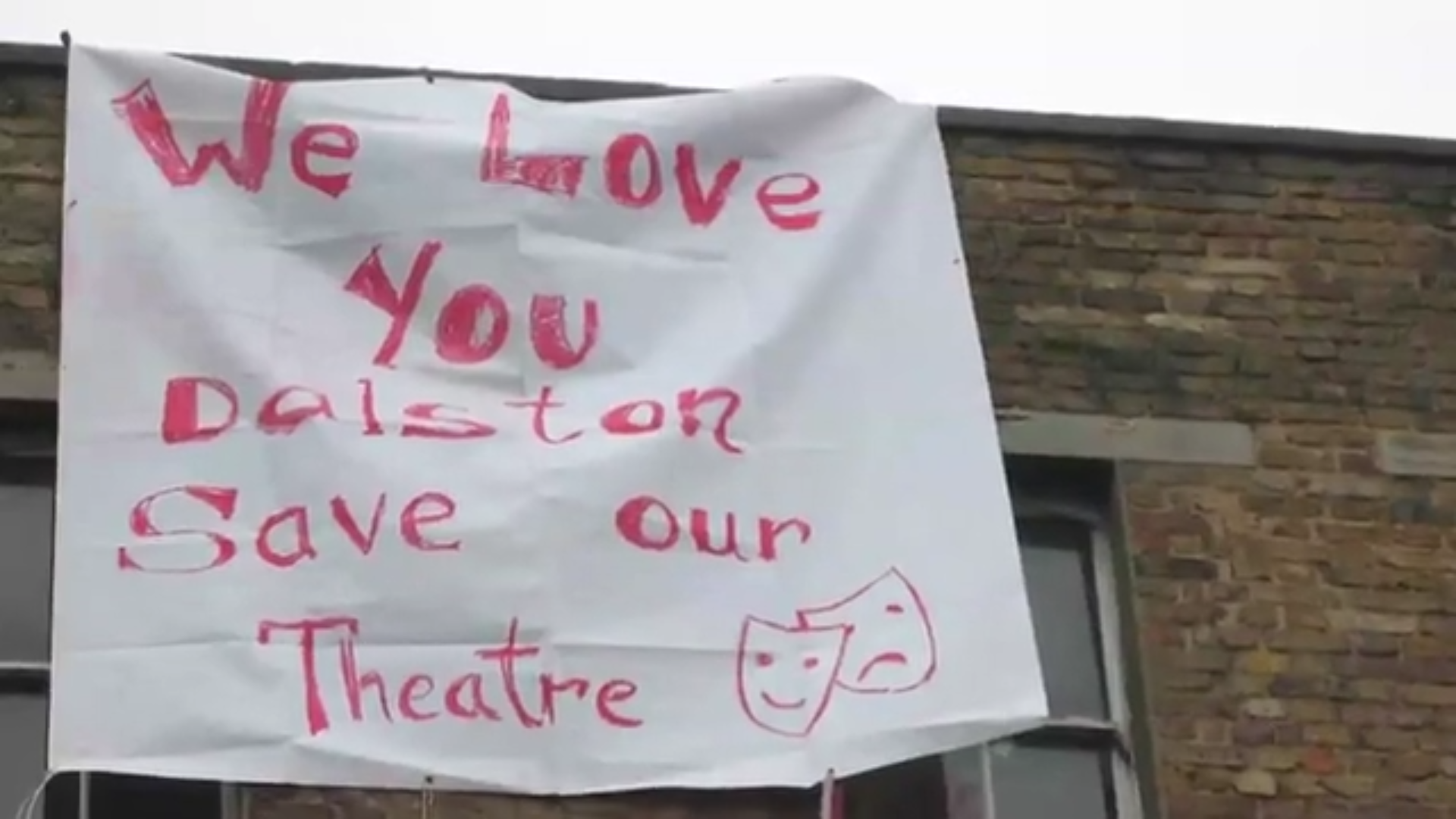
A sign attached to the roof of the theatre building by the occupiers (Source: Save Our Heritage).

This is a one-sided account of the story; there is no one representing Hackney Council, TFL, or the developers to tell the other side of the story. Nonetheless, I think it is a well made and informative film, that tells this David and Goliath story in an interesting way. Save Our Heritage is well worth 37 minutes of your time, particularly if you are interested in gentrification and the transformation which London has been through in recent years. It would also make an excellent teaching resource; it is a fantastic record of a diverse and enthusiastic campaign.

On This Day: The Cato Street Conspiracy, 23rd February 1820

The early nineteenth century was a turbulent time. Economic depression was exacerbated by returning soldiers flooding the job market after the Napoleonic Wars in 1815, and the Industrial Revolution was causing food shortages and new patterns of employment. One radical group was called the Spencean Philanthropists, after the radical speaker Thomas Spence. Led by Arthur Thistlewood, they were a revolutionary group involved in unrest and propaganda, with the ultimate goal of starting a revolution. They wanted to assassinate the cabinet, seize key buildings, overthrow the government and establish a Committee of Public Safety to oversee a radical revolution.

Cato Street Plaque
The plaque in Cato Street commemorating the conspiracy being discovered (Photo: Simon Harriyott).

The death of King George III on the 29th of January sparked a political revolution. The Spencean Philanthropists planned to take advantage of the confusion, and assassinate the Prime Minister (Lord Liverpool) and all the cabinet ministers when they gathered for a dinner at the home of Lord Harrowby. However, George Edwards, the groups’ second in command, was a police spy, and there was never any risk of the plot succeeding. Thanks to Edwards, the Home Office knew about the entire thing, and the cabinet dinner was a fiction designed to entrap the group.

We will probably never know how many people were involved in the conspiracy—there were a lot of groups sympathetic to the aims of the Spencean Philanthropists—but 13 men were arrested in a dramatic showdown in the groups’ rented headquarters in Cato Street. The rented building was a stable and hayloft, close to Lord Harrowby’s House in Grosvenor Square. On the 23rd of February Richard Birnie, the Bow Street magistrate, waited in a pub across the road with 12 members of the Bow Street Runners, predecessors of the Metropolitan Police. They were waiting for promised reinforcements from the Coldstream Guards, but at 7:30pm they decided to go in alone.

In the resulting scuffle Arthur Thistlewood killed Richard Smithers, one of the Bow Street Runners, and escaped out a back window with 3 others. They were arrested a few days later. Some of the conspirators gave evidence on the others to avoid conviction, so on the 28th of April 10 men were sentenced to be hung, drawn, and quartered for high treason. This barbaric punishment was commuted for all 10, but that’s not as good as it sounds—5 men were hung and beheaded, and the other 5 were transported to Australia. Thistlewood and 4 others were executed at the infamous Newgate jail on the 1st of May 1820.

Edwards did not give evidence during the trial. Police spies were controversial at the time, and Edwards was accused of being an agent provocateur—he had suggested targeting the dinner in the first place, and he had even provided money to help the conspirators buy weapons. Some people questioned whether the group would ever have gone so far if it wasn’t for the spy who was supposed to be trying to stop them.

What would have happened if the Cato Street Conspiracy had succeeded? Whether it would have sparked the uprising Thistlewood hoped for, or merely put new faces in the same old positions of power is impossible to predict. Nevertheless, it was a bold and desperate attempt to cause change, and although I can’t approve of the Spencean Philanthropists’ methods, I can’t help but admire their vision.

Sources and Further Reading

Anon. “Cato Street Conspiracy.” Wikipedia. Last modified 12th December 2015, accessed 22nd January 2016. Available at https://en.wikipedia.org/wiki/Cato_Street_Conspiracy

Anon. “The Cato Street Conspiracy.” The National Archives. No date, accessed 22nd January 2016. Available at http://www.nationalarchives.gov.uk/pathways/blackhistory/rights/cato.htm

Bloy, Marjie. “The Cato Street Conspiracy: 23 February 1820.” The Victorian Web. Last modified 30th August 2003, accessed 22nd January 2016. Available at http://www.victorianweb.org/history/riots/cato.html

Marjie, Bloy. “The Cato Street Conspiracy: 23 February 1820.” A Web of English History. Last modified 12th January 2016, accessed 22nd January 2016. Available at http://www.historyhome.co.uk/c-eight/distress/cato.htm

Simpkin, John. “Cato Street Conspiracy.” Spartacus Educational. Last modified August 2014, accessed 22nd January 2016. Available at http://spartacus-educational.com/PRcato.htm

London’s Protest Stickers: Anti-Fascism

00_26-9-15 Walworth Road
Anti-fascism is one of the most common topics of protest stickers. This photo was taken on the Walworth Road on 26/09/15 (Photo: Hannah Awcock).

If you start looking out for protest stickers as you move around a British city, you will quickly notice that anti-fascists are particularly prolific sticker-ers. I’m not sure why, but anti-fascism is one of the most frequent themes of protest stickers, aside from anarchism. Most large towns and cities have an anti-fascist group, and as the largest of the lot London is home to several groups, as well as drawing in groups from elsewhere.

01_05-05-15 Aylsebury Estate (10)
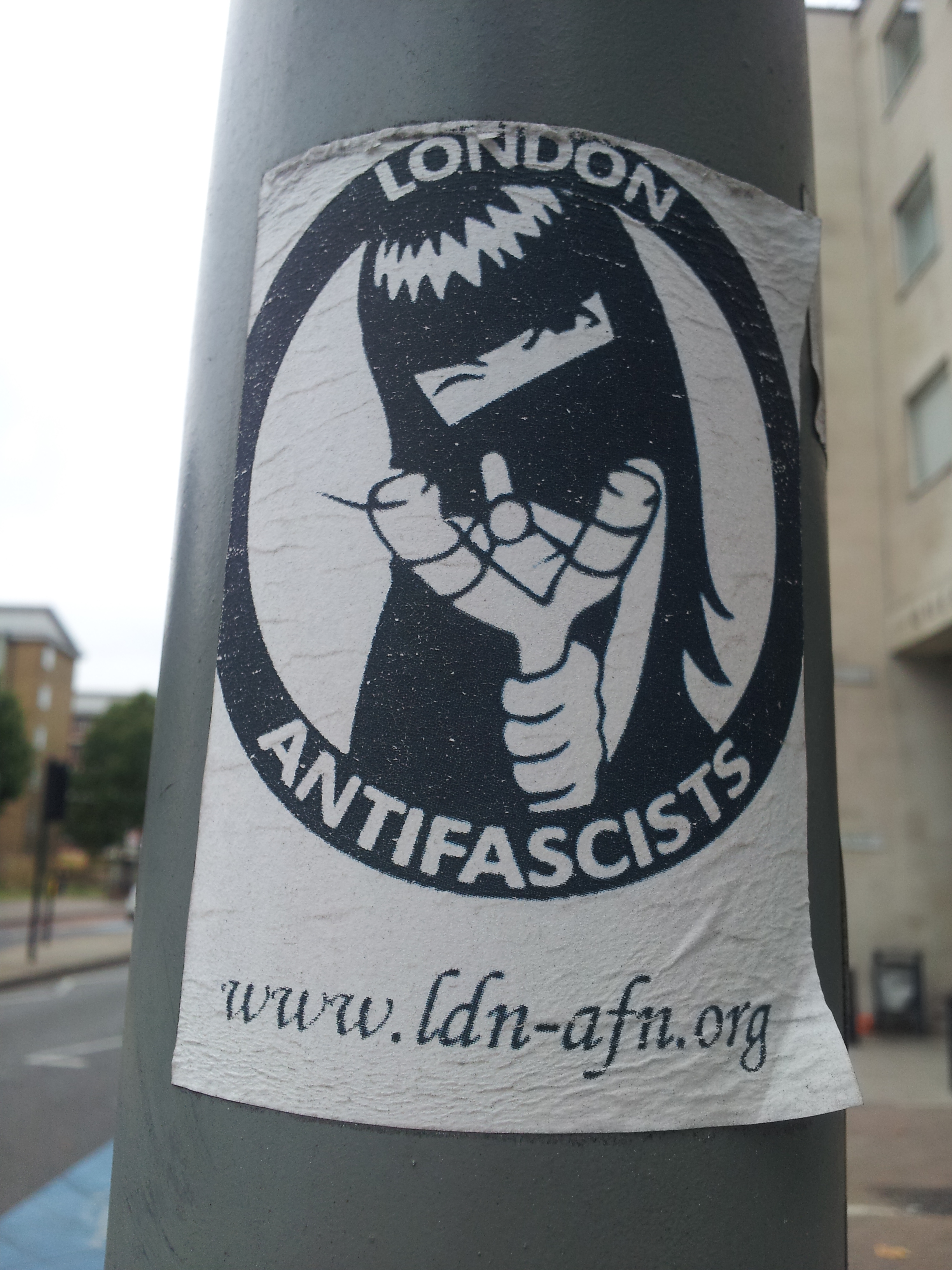
Unsurprisingly, one of the most common groups represented in London anti-fascist protest stickers are London Antifascists. This picture was taken on the Aylesbury Estate on 05/05/15 (Photo: Hannah Awcock).
02_13-08-15 Mile End Road (1)
The logos employed by anti-fascist groups can vary, but an image with a circle is a common feature. This logo features Emily the Strange, a popular gothic character who began life on stickers advertising the clothing line Cosmic Debris. She has since featured on clothing, stationary, and all kinds of objects, but here she comes full circle, appearing on stickers once again. This photo was taken on the Mile End Road on 13/08/15 (Photo: Hannah Awcock).
03_25-02-15 Embankment (1)
Although stickers which just feature a group’s logo and website are common, some are more complicated, like this one photographed on the north bank of the Thames near the City on 25/02/15. This sticker is still quite general in terms of focus however, it doesn’t specify what to fight back against (Photo: Hannah Awcock).
04_28-05-15 Elephant and Castle
Two flags (one red, one back) enclosed in a black circle is the most common and recognisable anti-fascist logo. This sticker points to the complex interconnections between anti-fascism and class politics, suggesting that London Antifascists only care about working-class communities. Or perhaps they are implying that racism and Nazism are only to be found amongst the middle- and upper-classes? This photo was taken at Elephant and Castle on 28/05/15 (Photo: Hannah Awcock).
08_10-03-15 Camden
The double flag logo is so recognisable that I can be quite sure that this sticker is by an anti-fascist group, even though I cannot read the words. This photo was taken near Camden Underground Station on 10/03/15 (Photo: Hannah Awcock).
05_13-04-15 Elephant and Castle
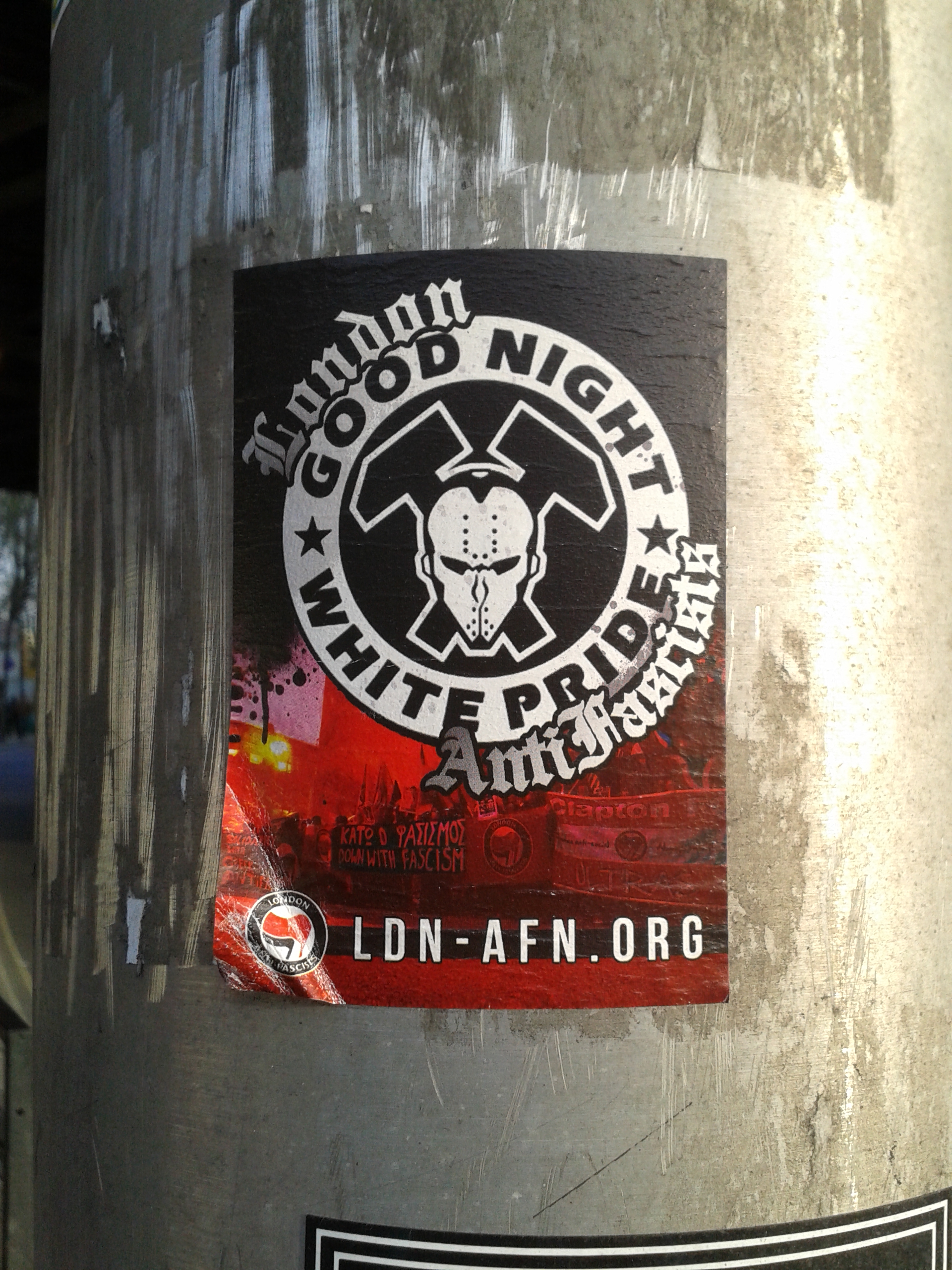
This sticker, photographed at Elephant and Castle on 13/04/15, is also focusing on racism, and has the familiar image surrounded by a circle logo. I must admit that the imagery and font confused me at first, at first glance I thought that this sticker was defending white pride rather than condemning it (Photo: Hannah Awcock).
06_12-03-15 Gordon Street, Bloomsbury (2)
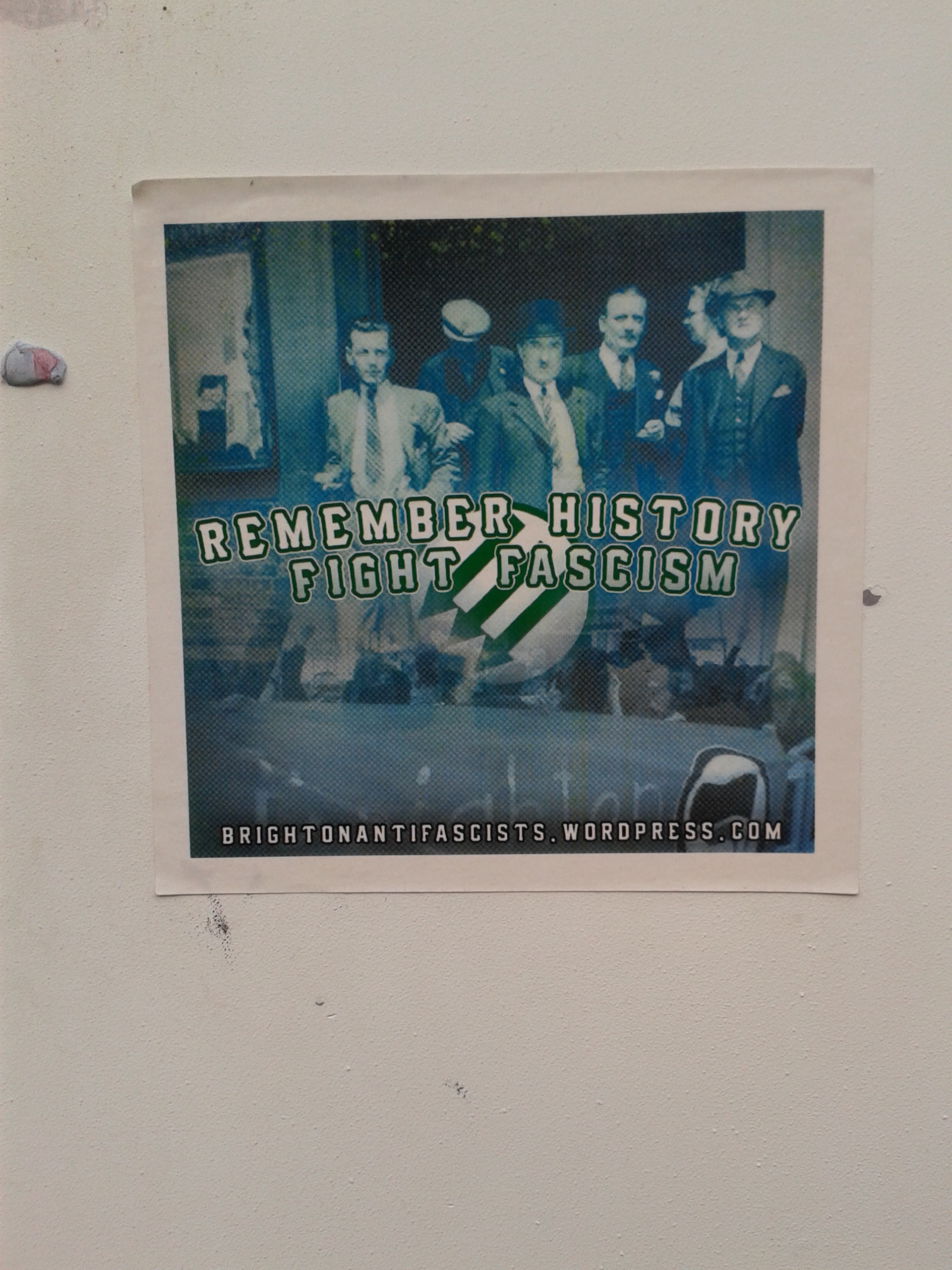
When anti-fascist groups go travelling, they often leave evidence of their presence in the form of protest stickers. This sticker was produced by Brighton Antifascists, although I found it in Gordon Street, Bloomsbury, on 12/03/15 (Photo: Hannah Awcock).
07_14-09-15 Elephant and Castle
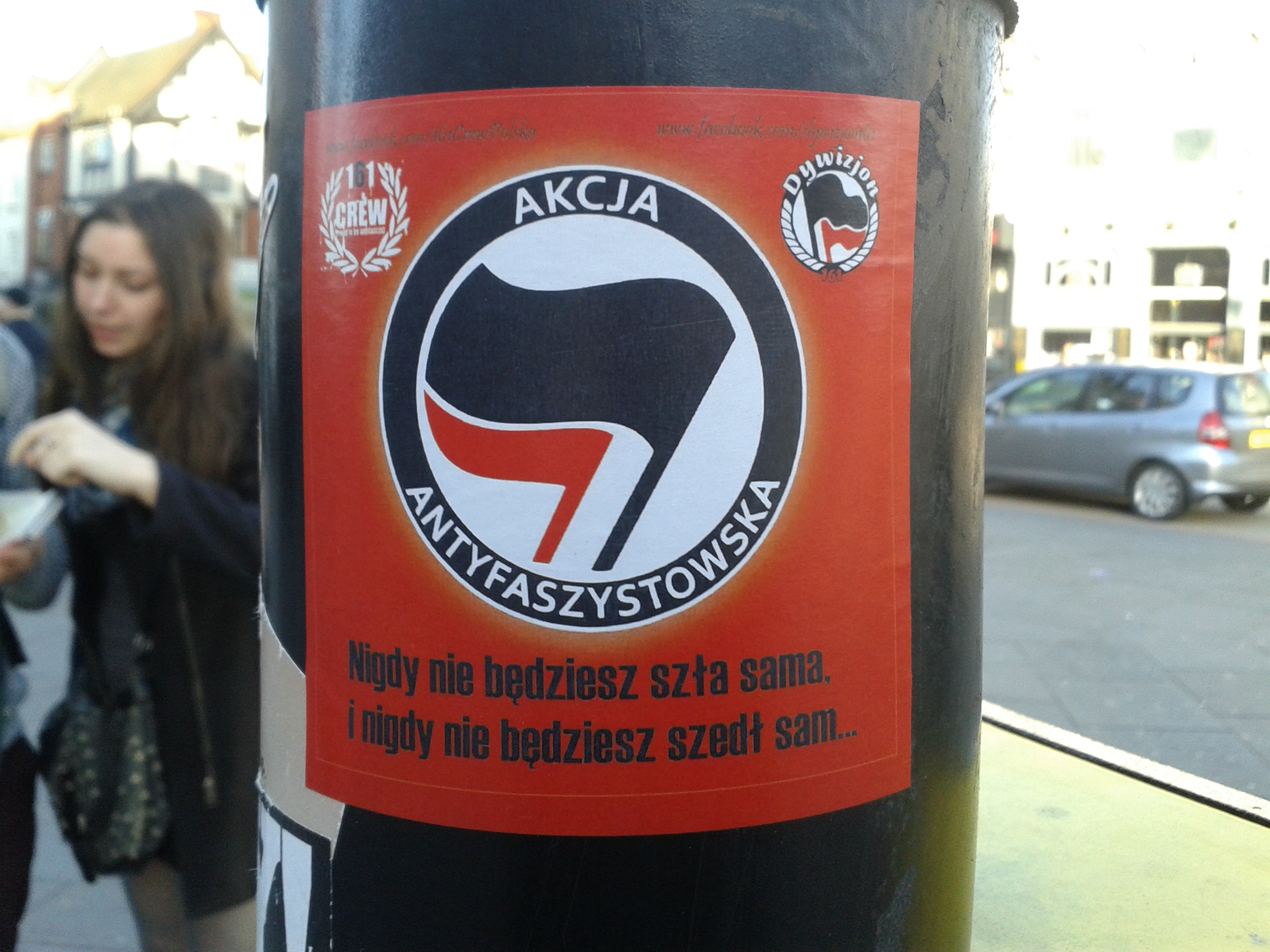
The 161 Crew are a Polish antifascist group that has a strong presence in London (the sticker in the previous photo is also one of theirs). This sticker appeared in Elephant and Castle on 14/09/15. I thought it was incredibly brave, as this was during a period of the refugee crisis where the debate around immigration was particularly vicious. Immigrants are supposed to be grateful and loyal to their host country, not encouraging cross-border class-based networks of dissent (Photo: Hannah Awcock).
10_05-05-15 Flint Street SE1 (4)
Unusually, this sticker does not feature an anti-fascist logo, which leads me to suspect it was not made by a specifically anti-fascist group. This photo was taken on Flint Street, near the occupied Aylesbury Estate on 05/05/15 (Photo: Hannah Awcock).
11_25-02-15 Cable Street (5)
Location can be integral to the meaning of protest stickers. I found this sticker in Cable Street, one of the sites of the famous demonstration known as the Battle of Cable Street, which has gone down in anti-fascist collective memory as a rare victory. No Pasaran is Spanish for ‘They Shall Not Pass’, one of the slogans of the Battle which was taken from the Spanish Civil War. The Battle is an important event in British anti-fascist history, a key source of pride and hope (Photo: Hannah Awcock, 25/02/15).
12_25-02-15 Cable Street (9)
This photo was also taken in Cable Street, next to the mural which memorialises the Battle of Cable Street. The double flag logo is present, although within a heart rather than a circle. Not surprisingly, Cable Street has a high concentration of anti-fascist stickers of various types, making it feel almost shrine-like (Photo: Hannah Awcock, 25/02/15).
20_29-05-15 Borough High Street (2)
Not every Londoner is an anti-fascist supporter. The word ‘Antifascists’ and the website has been scratched off this sticker very deliberately. Someone clearly took exception to London Antifascists publicising themselves. This photo was taken on Borough High Street on 29/05/15 (Photo: Hannah Awcock).

Introducing the Turbulent London Map

London has been the subject of an untold number of maps over its long history, and now there’s one more. Maps serve many more purposes than getting you from A to B, they can also educate, entertain, and look good, as the maps featured below demonstrate. As a geographer, it’s basically compulsory for me to have an interest in maps, and I have always enjoyed looking at, and thinking about, them.

I have been thinking about the potential of mapping protest events and protest stickers for a while now. It can help build up an image of how protests and stickers are spread out across the capital. If you can identify areas of concentration for example, you can begin to think about why that might be. Unfortunately I haven’t had the skills to put this idea into practice…until now.

So without further ado, I would like to introduce the latest innovation in the world of London mapping: The Turbulent London Map! It features the location of every London protest and protest sticker featured on the blog. Purple pins are protest events, and orange pins are protest stickers. Click on the pins for more information and images.

The map is far from complete; to map every protest that’s ever taken place in London would be a gargantuan task that I cannot feasibly do alongside a PhD (although it might make a good post-doctoral project!). I will keep adding protests as I mention them in the blog. Also, the spread of the protest stickers is biased to reflect my own personal map of London; I have more pictures from locations that I visit most often, and no pictures from the places I haven’t been to (or the places I went to in the dark- my camera phone has not always been up to scratch). Again, it would be a huge project to map protest stickers across the whole city (another post-doc idea!), so here I’m asking for a little help. If you’re out and about in London and see a protest sticker, please take a picture, take a note of the street you’re on and the date, send it to me, and I’ll add to the map. I would really like to start building a more complete picture of protest stickers in London.

Reading the Riot Act 2: Luddites and Micks

Last year, I wrote a post about the protest-related origins of the phrase ‘reading the riot act,’ amongst others, and since then I have been on the lookout for other phrases which also have their origins in periods of strife. What I’ve found are two terms to describe people. If you have ever called someone, or been called by someone, a ‘Luddite’ or a ‘Mick’ (to describe an Irish person, not someone who’s name is Michael), then you have been referring to Britain’s long history of dissent.

A Luddite is someone who dislikes technology (Source: Poughkeepsie Day School).

A Luddite is a term frequently used to refer to someone who disapproves of new technologies. For most people, it is an insult, but others embrace the name with pride. If the origins of the term were more widely known, perhaps more people would be proud of the name. The Luddites was the collective name given to English textile workers who protested against the mechanization of their trade between 1811 and 1816. The new technologies of the Industrial Revolution meant that textiles could be mass-produced by unskilled, low-wage workers, forcing skilled artisans out of work.

The (probably) fictional leader of this movement was called General, or King, Ludd, and reportedly lived in Sherwood Forest, the home of another mythical champion of the people, Robin Hood. The name may come from Ned Ludd, who allegedly smashed two stocking frames in 1779.  The Luddite protests began in Nottinghamshire and quickly spread through the midlands and North of England. The demonstrators sent threatening letters to employers and broke into factories to destroy new machines. In 1812, machine breaking became punishable by death, and 17 men were executed the following year. Obviously the Luddites were unsuccessful at halting the march of the Industrial Revolution, but they made such an impression that their name is still used, 200 years later.

‘Mick’ is a derogatory word to describe an Irish person. There are several explanations for the origin of the term, but my favourite comes from London’s contentious past. Michael Barrett has the dubious honour of being the last person to be publicly hanged in England. In May 1868 he was executed for his role in the Clerkenwell Outrage on the 13th of December 1867. 12 people were killed in a bombing outside the Middlesex House of Detention in Clerkenwell, shocking Londoners and turning them against the cause of Irish nationalism. Michael Barrett’s name became synonymous with all Irish people.

The bomb was a failed jailbreak that went disastrously wrong. Prominent Fenians Richard O’Sullivan Burke and Joseph Casey were being held in the Clerkenwell prison. A barrel of gunpowder was placed against the wall of the prison’s exercise yard and set off with a firework, with the aim of blowing a hole in the wall so Burke and Casey could escape. Far too much gunpowder was used and the blast damaged a row of tenement houses on the other side of the road. 12 people were killed and up to 120 were injured. The prison authorities knew something was being planned, so the prisoners were locked in their cells instead of exercising at the time of the bombing, and Burke and Casey failed to escape. Although Michael Barrett was charged along with several others, he was the only one who was actually convicted of the bombing.

The English language has many phrases which, when you actually stop to think about them, appear to be absolute nonsense. But when you start to trace it back, you often find a great story that explains it, and offers a tiny window onto Britain’s chequered past.

Sources and Further Reading

Anon. “Luddite.” Wikipedia. Last modified 7th June 2015, accessed 12th June 2015. https://en.wikipedia.org/wiki/Luddite

Anon. “Michael Barrett (Fenian).” Wikipedia. Last modified 17th December 2014, accessed 23rd June 2015. https://en.wikipedia.org/wiki/Michael_Barrett_(Fenian)

Anon. “Mick.” No date, accessed 12th June 2015. http://www.urbandictionary.com/define.php?term=Mick

Webb, Simon. Dynamite, Treason and Plot: Terrorism in Victorian and Edwardian London. Stroud: The History Press, 2012.

Protest Stickers: Chicago

Like most cities around the world, stickers are a common sight in Chicago.
Like most cities around the world, stickers are a common sight in Chicago (Photo: Hannah Awcock).

In April 2015, I went to the annual conference of the American Association of Geographers, which this year was held in Chicago, Illinois. Seeing as I was flying almost 4000 miles, I also took some time to look around the city. There are plenty of protest stickers to be found in Chicago, just like in New York and London. As in other cities, protest stickers in Chicago give us a clue as to what social movements and subversive political campaigns are striking a chord in the city. These movements reflect multiple scales, from the local to the international. Below are some of my favourite pictures from the Windy City.

This was the first sticker I found in Chicago, on my first evening. That was when I knew I was going to like this city!
This was the first sticker I found in Chicago, on my first evening. That was when I knew I was going to like this city! (Photo: Hannah Awcock).
Many of the stickers were about local issues. Such as this sticker promoting mayoral candidate Emanuel Rahm, who I assuming has an Irish background because of the clovers.
Many of the stickers were about local issues, such as this sticker promoting mayoral candidate Emanuel Rahm, who I assume has an Irish background because of the clovers. I don’t know if the ‘Get Real’ sticker below is intentional or just a coincidence, but I like to think it was put there on purpose! (Photo: Hannah Awcock).
Or this one, supporting Rahm's opponent, Jesus 'Chuy' Garcia. It plays on the Chicago flag, which is four stars on a white background between two blue stripes.
This sticker supports Rahm’s opponent, Jesus ‘Chuy’ Garcia. It plays on the Chicago flag, which is four stars on a white background between two blue stripes. The election took place on the 7th of April 2015, so it’s not surprising there was still a lot of evidence of it when I was there in late April (Photo: Hannah Awcock).
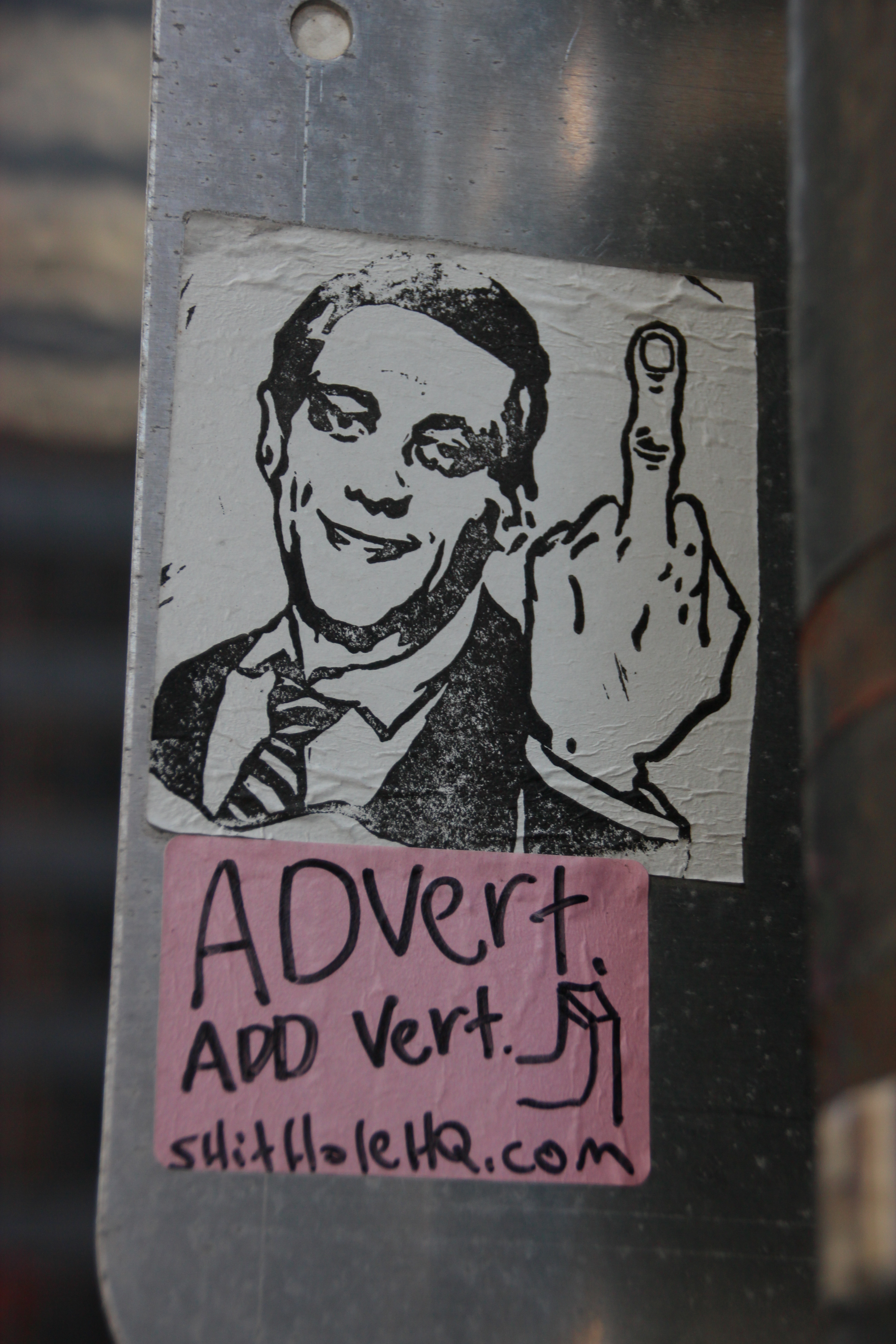
Rahm won the election in April, but he is clearly not universally supported. This sticker is a drawing of him.
Rahm won the election in April, but he is clearly not universally supported. This sticker is a drawing of him (Photo: Hannah Awcock).
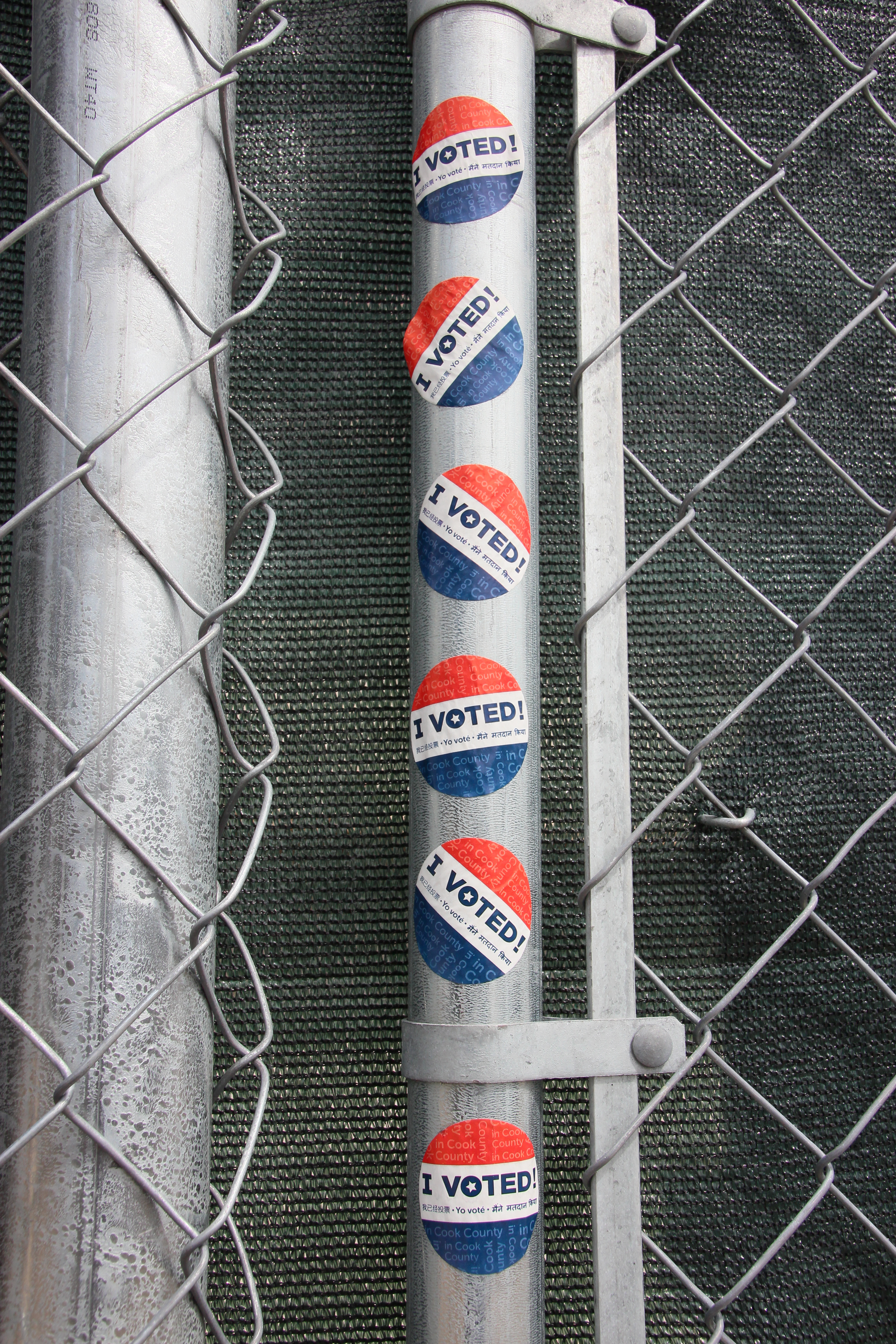
These stickers also relate to electoral politics. I assume they were handed out at a polling station, but I don't know how they ended up on this chain link fence.
These stickers also relate to electoral politics. I assume they were handed out at a polling station, but I don’t know how they ended up on this chain link fence close to Lake Michigan (Photo: Hannah Awcock).
The recent controversy surrounding the relationship between the US police and African Americans was also a common theme. This sticker was advertising a demonstration. Similar stickers were in New York, advertising a protest on the same day.
The recent controversy surrounding the relationship between the US police and African Americans was also a common theme. This sticker was advertising a demonstration. I found similar stickers in New York, advertising a protest on the same day (Photo: Hannah Awcock).
This sticker is decidedly anti-police, playing rather unsubtly on the fact that police are often called 'pigs'.
This sticker is decidedly anti-police, playing rather unsubtly on the fact that police are often called ‘pigs’ (Photo: Hannah Awcock).
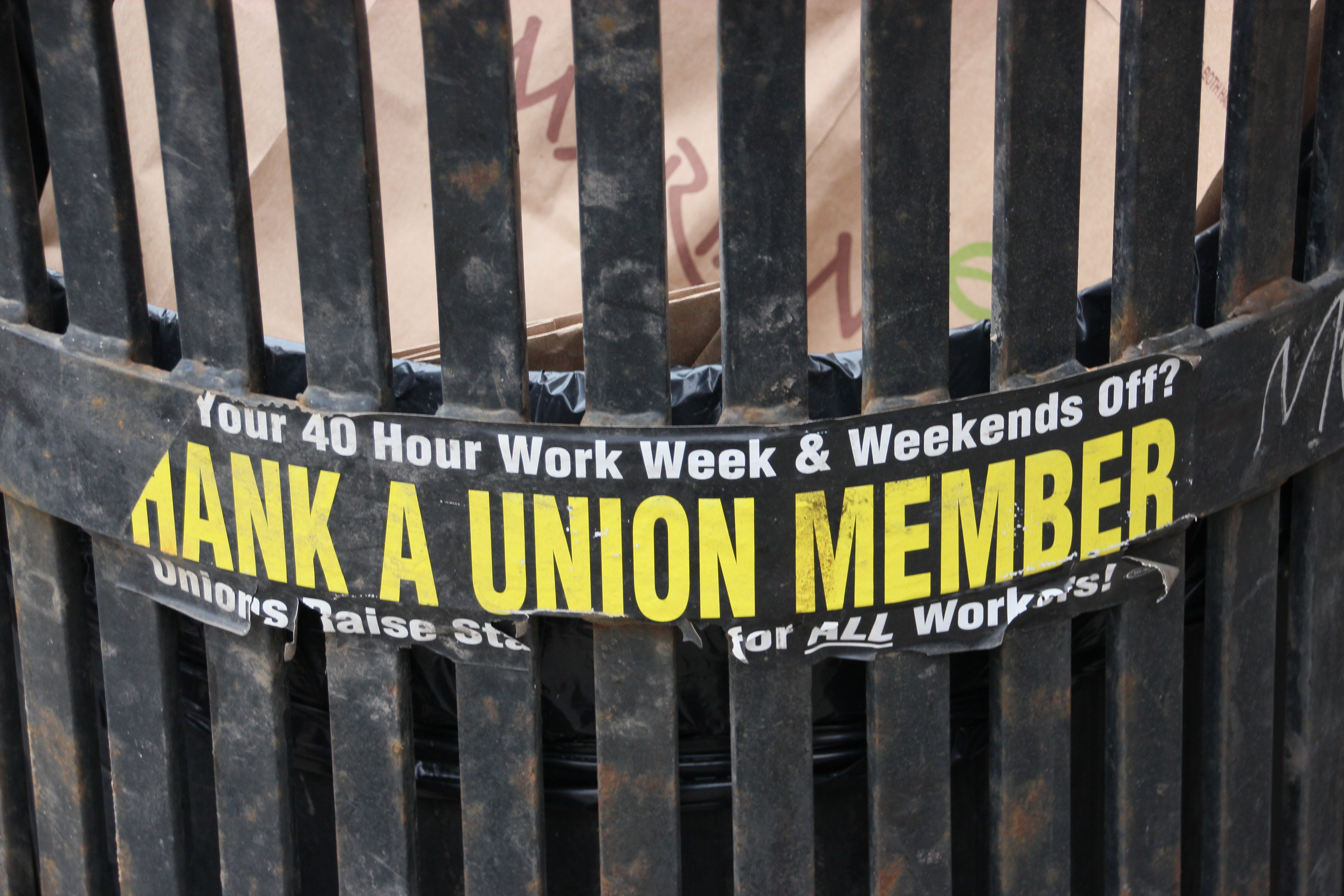
Another recurring theme were unions,. This sticker reminds people of the various workers' rights that unions have fought for in the past.
Another recurring theme were unions. This sticker reminds people of the various workers’ rights that unions have fought for in the past. It is also a good example of how the message of stickers can become harder to decipher as they age and deteriorate (Photo: Hannah Awcock).
Some themes were not so familiar however. This sticker is about anti-bullying.
Some themes were not so familiar however. This sticker is about anti-bullying (Photo: Hannah Awcock).
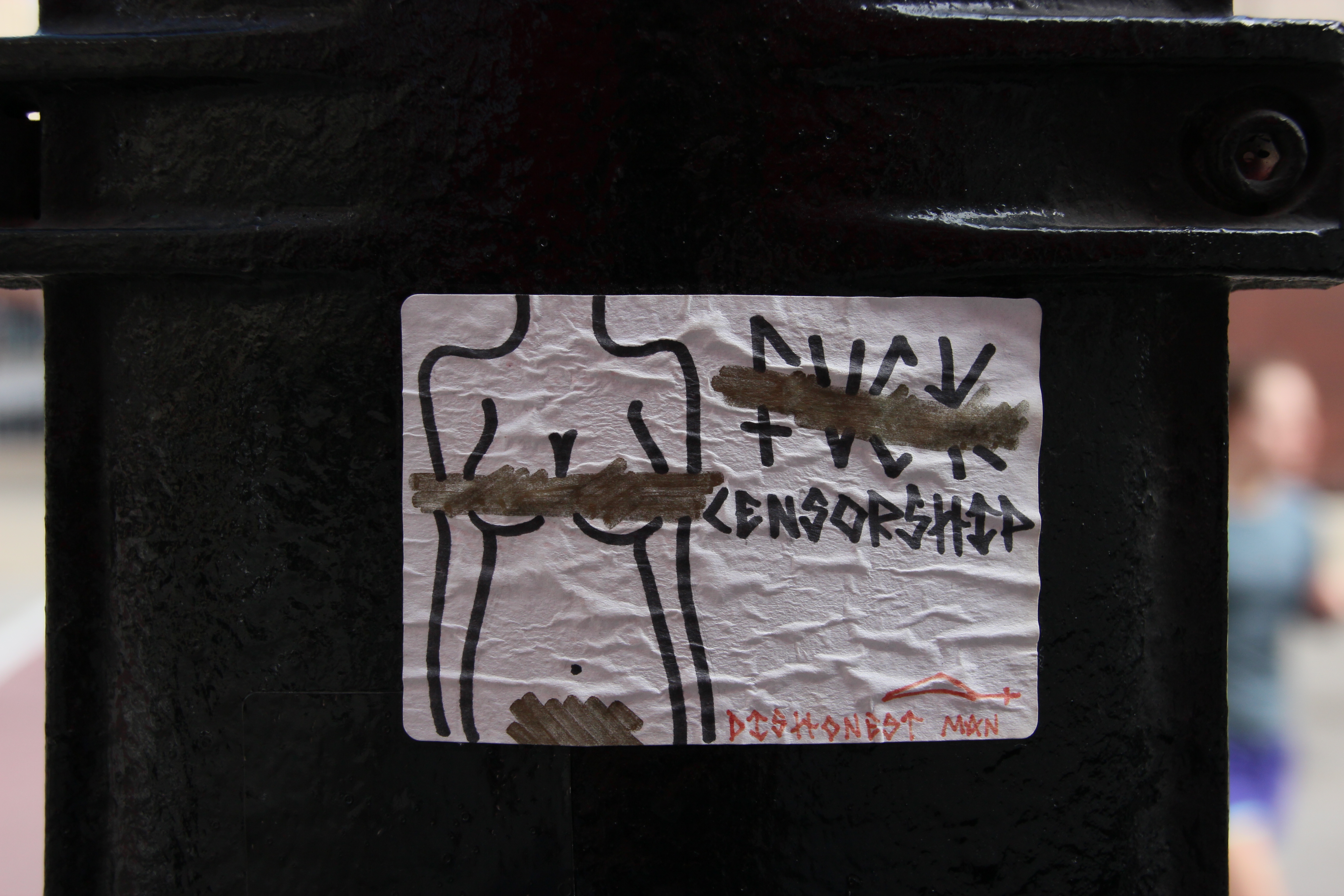
Another uncommon theme was feminism. This sticker criticises censorship of the female body.
Another uncommon theme was feminism. This sticker criticises censorship of the female body…(Photo: Hannah Awcock)
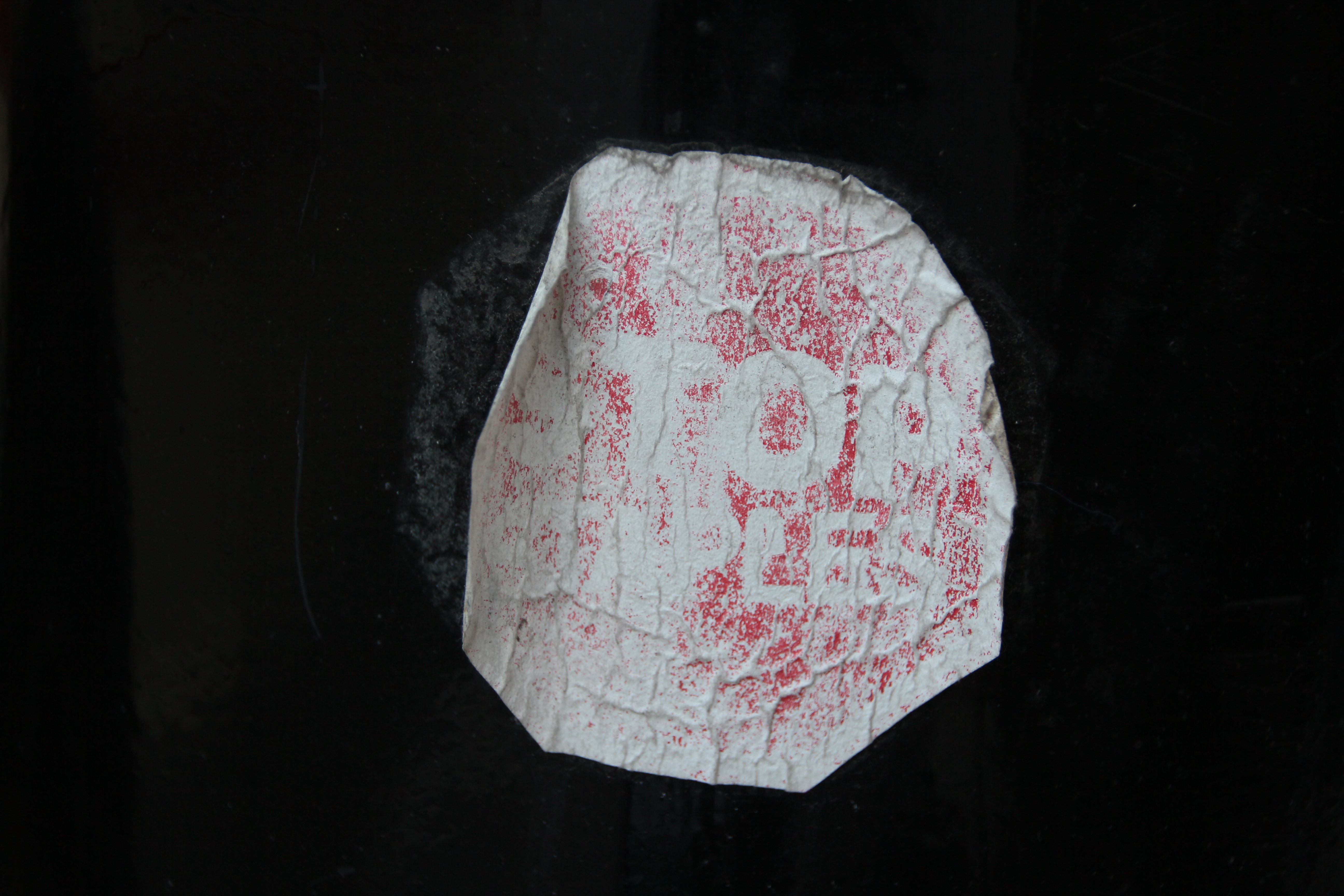
...whilst this handmade sticker encourages women to celebrate their body.
…whilst this handmade sticker encourages women to celebrate their body (Photo: Hannah Awcock).
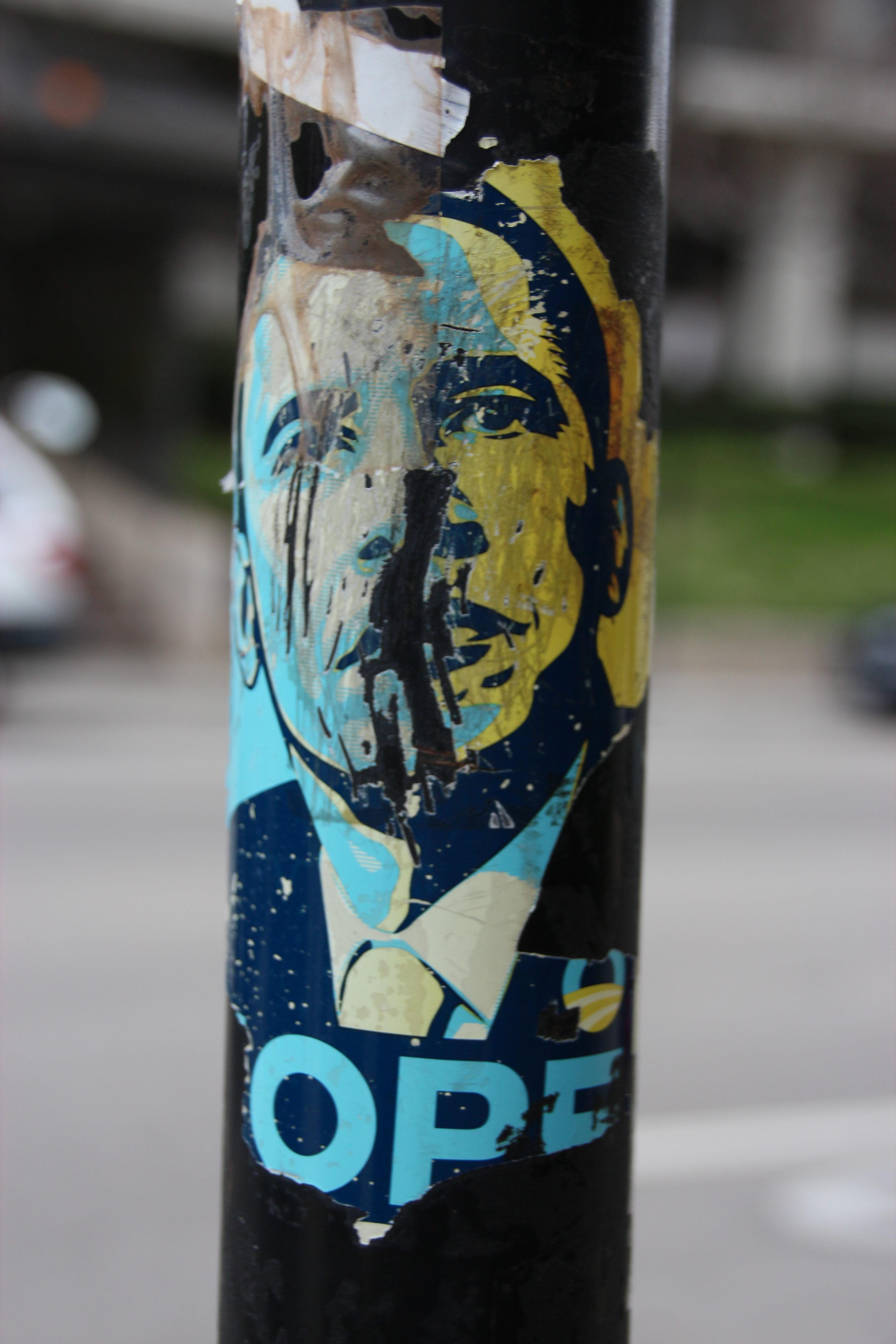
This image of Barack Obama references the Obey theme from the work of street artist Shepard Fairey. It also looks very similar to the iconic poster from Obama's 2008 election campaign, which was also designed by Shepard Fairey.
This sticker is a version of the poster designed for Barack Obama’s 2008 election campaign, which normally has a red and blue colour scheme. It was designed by the street artist Shepard Fairey, who’s Obey street art is world-famous (Photo: Hannah Awcock).
This sticker also references a national campaign. The Fight for 15 is part of the movement demanding a $15/hr minimum wage. Protests took place all over the country on April the 15th, or 4/15 in the American style of dating.
This sticker also references a national campaign. The Fight for 15 is part of the movement demanding a $15/hr minimum wage. Protests took place all over the country on April the 15th, or 4/15 in the American style of dating (Photo: Hannah Awcock).
These stickers are a little more intellectual than usual, and don't exactly make it easy to understand the argument being made.
These stickers are a little more intellectual than usual, and don’t exactly make it easy to understand the argument being made (Photo: Hannah Awcock).
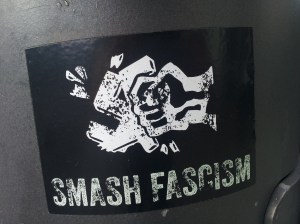
Fascism is a world-wide issue, and so too is the anti-fascism campaign.
Fascism is a world-wide issue, and so too is the anti-fascism campaign. I have seen very similar stickers in London (Photo: Hannah Awcock).
This weathered sticker is for the Stop Staples campaign, which is attempting to prevent Staples from doing a deal with the U.S. Postal Service which would involve setting up postal counters in Staples stores with low-paid, untrained Staples employees.
This weathered sticker is for the Stop Staples campaign, which is attempting to prevent Staples from doing a deal with the U.S. Postal Service which would involve setting up postal counters in Staples stores with low-paid, untrained Staples employees (Photo: Hannah Awcock).
This sticker doesn't appear to be linked to any campaign in particular, and could be referencing any number of issues such as climate change or consumerism.
This sticker doesn’t appear to be linked to any campaign in particular, and could be referencing any number of issues such as climate change or consumerism (Photo: Hannah Awcock).
This is not a protest sticker, but I just liked it so much that I decided to put it in. It's pretty good advice too!
This is not a protest sticker, but I just liked it so much that I decided to put it in. It’s pretty good advice too! (Photo: Hannah Awcock).

Special thanks to Llinos Brown, who put up with my odd habit of taking close-up pictures of random bits of street furniture and also helped me find a few stickers whilst we were in Chicago.

Book Review: Dynamite, Treason and Plot- Terrorism in Victorian and Edwardian London

'Dynamite, Treason and Plot' by Simon Webb.
‘Dynamite, Treason and Plot’ by Simon Webb.

Webb, Simon. Dynamite, Treason and Plot: Terrorism in Victorian and Edwardian London. Stroud: The History Press, 2012.

There is a tendency today to see terrorism as some modern aberration, something that has arisen in recent years and might with luck fade away in time. This is unlikely. Terrorism of different sorts has been a constant backdrop in British history for centuries; it is likely to remain so for centuries to come. The notion that increased vigilance on the part of the public, combined with wise and good laws passed by Parliament, might one day defeat terrorism and usher in a peaceful era, where nobody needs to worry about bombs and assassinations, is a chimera.

Webb, p.151

As far as most people are concerned, Guy Fawke’s plot, the IRA bombings of the 1970s and 7/7 are probably the only examples of terrorism in London. In Dynamite, Treason and Plot: Terrorism in Victorian and Edwardian London, Simon Webb sets out to correct that misconception. From the Clerkenwell Outrage, where 12 people were killed in a Fenian prison break gone wrong; to the Tottenham Outrage (not every event is known as an Outrage, I promise!), a chase that lasted several hours and involved the hijacking of a tram and a milk cart, the stories Webb tells range from the horrific to the downright farcical.

Arguably the biggest strength of Dynamite, Treason and Plot is the emphasis on continuity. Humans have a tendency to believe that everything that happens is new, that the problems faced by modern society are unique to our time. Webb proves the inaccuracy of this belief, demonstrating that not only terrorism, but also immigration and xenophobia, are issues that the people of London have been grappling with for centuries. Irish, Jewish, and more recently Muslim; many minorities have been the subject of fear and discrimination in the city, and terrorism has frequently exacerbated the tensions.

Another of the strengths of Dynamite, Treason and Plot is Webb’s approach to terrorism itself. Webb doesn’t condemn the terrorists he describes outright, but neither does he glorify them. The first chapter of the book is devoted to discussion of the theories and motivations behind terrorism. It is not necessarily the mindless, monstrous violence which it is often portrayed as-there are particular reasons why people choose to resort to terrorism-and Webb takes them into account. Terrorism is an emotive subject, difficult to deal with in a sensitive and balanced way, but I think Webb does a good job of this.

Webb’s writing style can be repetitive; he frequently makes the same point twice in quick succession, and he often says how it was “nothing short of a miracle” that more people weren’t killed or injured in the events he recounts. He makes assertions, making a point without providing any supporting evidence, and often overlooks some of the historical controversies and debates. For example, in the chapter about the Suffragettes, Webb mentions the alleged plot to assassinate David Lloyd George by the Wheeldon family. In Dynamite, Treason and Plot it appears there is no doubt that that is what actually happened, but in To End all Wars by Adam Hochschild the event appears much more complicated. Hochschild suggests that the whole thing may have been a set-up, the plot concocted by the government to harm the opposition to the First World War, of which the Wheeldon family was a part. Whatever the truth, Webb completely ignores the debate, and as such misses out on some of the nuances of the story.

Despite the shortfalls I think Dynamite, Treason and Plot is well worth a read. It is an engaging read that deals with some of London’s darker, overlooked history. Webb puts terrorist into political and social context, rather than treating it as an isolated and inexplicable phenomenon to be instantly condemned.