Turbulent Londoners: Charlotte Despard, 1844-1939

Turbulent Londoners is a series of posts about radical individuals in London’s history who contributed to the city’s contentious past. My definition of ‘Londoner’ is quite loose, anyone who has played a role in protest in the city can be included. Any suggestions for future Turbulent Londoners posts are very welcome. The second Londoner to be profiled is Charlotte Despard, an inspirational pacifist, feminist and socialist campaigner.


Charlotte Despard (née French)
attributed to Charles Mendelssohn Horsfall
oil on canvas
NPG 4345
© National Portrait Gallery, London

Charlotte Despard was a prominent feminist and social campaigner in the late-nineteenth and early twentieth centuries, who fought for many causes during her long life. Born into a wealthy French family in Kent in 1844, she married in 1870. She was brought up as a young Victorian lady should be, and frequently railed against her lack of a proper education. After her husband died in 1890, she became a dedicated and inspiring campaigner, although she was well known for her simple black clothing for the rest of her life.

Despard organised and funded a health clinic, a soup kitchen for the unemployed and youth and working men’s clubs in the slum called Nine Elms in Battersea, London. Not content with mere philanthropy, she actually moved into the area, living amongst those she worked so hard to help. In 1894 she became a Poor Law Guardian in Lambeth, a job at which she excelled, using her position to care for the most vulnerable ‘paupers’.

Politically, Despard was an active supporter of the Social Democratic Party and the Independent Labour Party, running in the 1918 general election as a pacifist Labour candidate for Battersea. By the time the Women’s Social and Political Union moved to London in 1906, she was a well-known progressive speaker, and an obvious choice for an ally. She became the WSPU’s honorary secretary, and was imprisoned twice in 1907 for her actions as a suffragette, at the age of 63. However, later that year the Suffragette movement split, and Despard became President of the Women’s Freedom League, which unlike the WSPU was democratically organised and advocated a campaign of passive resistance.
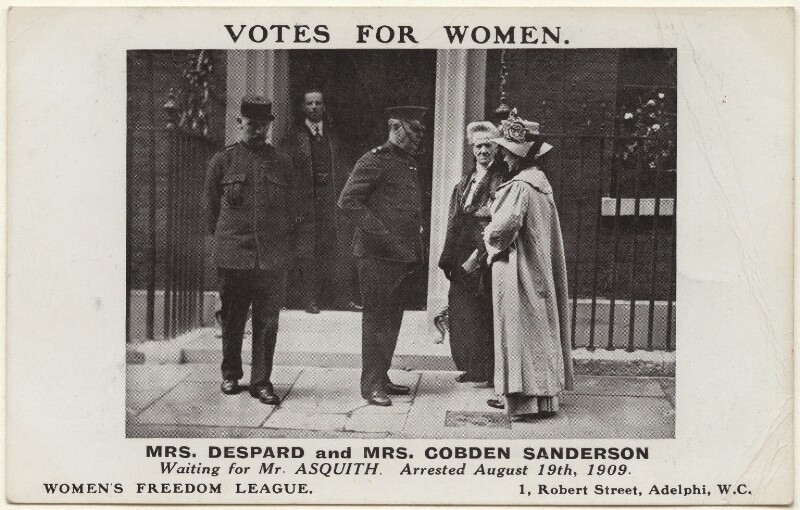
Charlotte Despard (née French); Anne Cobden-Sanderson with three unknown men
by Unknown photographer
halftone postcard print, 19 August 1909
NPG x45197
© National Portrait Gallery, London

Despard was a pacifist, opposing the Boer War and World War One, despite her brother, Sir John French, being the commander-in-chief of the British Expeditionary Force in France until 1915. The two remained close throughout the First World War, until Charlotte declared her support of Irish home rule and later independence. As the Lord Lieutenant of Ireland, Sir John French was tasked with trying to supress the very people she supported, and their previously close relationship suffered badly. In 1921 she moved to Ireland, where she continued to campaign for civil rights and the relief of poverty and distress. Despite her advanced years, she was classed as a dangerous subversive under the Irish Free State’s 1927 Public Safety Act. In 1933 her house in Dublin was attacked by an anti-communist mob.

As if all that wasn’t enough, Despard was also active in promoting a variety of other causes, including Save the Children, the Indian independence movement, theosophy, and the London Vegetarian Society. She died after a fall at the age of 95, but left behind an enduring legacy. Charlotte Despard was a confident, strong-willed, independent woman, who frequently defied convention and suffered hardship to fight for what she believed in. She is an inspiration.

Sources

History Today. http://www.historytoday.com/sites/default/files/despard1.jpg (accessed 12/11/14).

Hochschild, Adam. To End All Wars: A Story of Protest and Patriotism in the First World War. London: Pan Books, 2011.

Mulvihill, Margaret. ‘Despard, Charlotte (1844–1939)’, Oxford Dictionary of National Biography, Oxford University Press, 2004; online edn, May 2014 [http://www.oxforddnb.com/view/article/37356, accessed 12 Nov 2014.

Open University, The. ‘Charlotte Despard.’ Making Britain (no date) http://www.open.ac.uk/researchprojects/makingbritain/content/charlotte-despard (accessed 12/11/14).

Oxford Dictionary of National Biography (no date) http://www.oxforddnb.com/images/article-imgs/37/37356_1_200px.jpg (accessed 12/11/14).

“Those Meddling Kids!”: Student Protest in London in the Twentieth Century

The Scooby Doo gang are often called ‘meddling kids’ by the people they unmask (Source: Krusty Da Clown).

When the Scooby Doo gang unmasked the dastardly villain at the end of each episode, they always lamented “I would have got away with it too, if it wasn’t for those meddling kids, and their dumb dog!” Apart from the dog, I think the gang have a lot in common with the students and young people of London, who have been holding those in authority to account for decades, despite their tender years.

The student demonstrations over tuition fees and the Educational Maintenance Allowance (EMA) in 2010 are still fresh in the minds of many. Students from secondary schools, sixth form colleges and universities made their opinions on the government’s plans to raise tuition fees and scrap EMA known in no uncertain terms. As well as the national marches in central London in November and December, there were countless occupations and smaller demonstrations throughout the capital and across the UK.

The 2010 Student Tuition Fee Demonstrations shocked many in their scale and violence (Source: Sarah).

But student protest in the capital did not begin with the debate over tuition fees and EMA. The very first student occupation took place at the London School of Economics in 1967, in protest at the appointment of a director who had previously been director of the University College in racist Rhodesia. LSE was occupied again the following year to provide accommodation for a huge Vietnam march. Also in 1968, the Revolutionary Socialist Students’ Federation was formed after a conference at LSE, which had obviously become a focus of radical left-wing politics amongst university students.

Some students did not wait until they got to university to make their voices heard. in 1889 and 1911 there were waves of national school strikes, as children struggled with the authorities over compulsory schooling. Usually sparked by a student being punished too severely, the strikes focussed on issues such as the school day, corporal punishment, holidays, the school leaving age, and unpleasant teachers. Schoolchildren would use pickets, marches and demonstrations to get their point across. Such strikes continued in London until 1939. They were mostly met with amusement by the authorities, but some considered them a serious threat, attributing the strikes to class divisions as well as generational ones.

Whether because of the confidence or idealism of youth, or for the more practical reasons of having more free time and fewer responsibilities or dependents than adults, London’s youth does seem to be particularly riotous. For a section of society that are frequently accused of being apathetic and disengaged, they  have proved themselves to be quite the opposite, time and again. Many of them were too young to vote when they took part in their protests, but that did not stop them engaging with the political process in any way that they could.

Sources and further reading

Bloom, Clive. Violent London: 2000 Years of Riots, Rebels and Revolts. Basingstoke: Palgrave Macmillan, 2010.

German, Lindsey, and John Rees. A People’s History of London. London: Verso, 2012.

On this Day: Bloody Sunday, 13th November 1887

There are several events which are remembered with the name ‘Bloody Sunday,’ perhaps most famously Sunday the 30th of January 1972 when members of the British Army opened fire on protesters in Derry, Ireland, killing 13. London has its own Bloody Sunday however, which took place on Sunday the 13th of November 1887, in Trafalgar Square. It was the culmination of months of increasing tension between police and Londoners over the right to demonstrate in Trafalgar Square.

Demonstrations by the unemployed had been taking place in the square daily since the summer. Many unemployed men and women also slept in the square, washing in the fountains. Under pressure from the press to deal with a situation seen as embarrassing to the great metropolis, the police started to disperse meetings in the square from the 17th of October, often resorting to violence. The tension continued, now with frequent clashes between police and protesters, and Irish Home Rulers also began to use the square to protest.

Sir Charles Warren, Commissioner of Police, banned all meetings in Trafalgar Square on the 8th of November. This challenge to the freedom of speech and the right to protest ouraged radicals across London, and a meeting scheduled for the following Sunday suddenly became much more significant. Called initially to demand the release of the Irish MP William O’Brien from prison, the demonstration was a clear and deliberate defiance of the ban, and the police could not allow it to go ahead without suffering severe humiliation.

Sir Charles Warren was Commissioner of the Metropolitan Police when Bloody Sunday took place.
Sir Charles Warren
by Elliott & Fry
albumen cabinet card, circa 1899
NPG x39345
© National Portrait Gallery, London

On the day of the demonstration, London was turned into “an armed camp” (Bloom, 2010; 223).  1,500 police lined the square up to 4 deep, and there were also mounted police, Life Guards and Grenadier Guards. Hundreds of Special Constables, volunteers who wanted peace maintained in their city, were also present. Marchers approached Trafalgar Square from all directions, but were ambushed by police baton charges about half a mile before they reached their destination.

Some protesters did manage to reach the square, where vicious street fighting continued all day. The day was a resounding victory for the police. Using no weapons but their truncheons, they injured at least 200 demonstrators, and killed 2 or 3. The organisers of the march had called for the demonstrators not to use violence, and injuries on the police side were therefore minimal, although 2 police officers were reportedly stabbed.

The official inquest into the day suggested that the police should order stronger truncheons, because so many had broken; clearly the authorities felt no qualms about the level of force used. For activists, Bloody Sunday would be remembered as one of heavy-handed, violent repression, and those protesters who died became martyrs for the labour movement.

Sources and further reading

Bloom, Clive. Violent London: 2000 Years of Riots, Rebels and Revolts. Palgrave Macmillan, 2010.

German, Lindsey and John Rees. A People’s History of London. London: Verso, 2012.

Stedman Jones, Gareth. Outcast London: A Study in the Relationship between Classes in Victorian Society. London: Penguin, 1984.

White, Jerry.  London in the 19th Century. London: Vintage, 2008.

Guy Fawkes: Terrorist or Freedom Fighter?

Remember, remember the fifth of November

Gunpowder, treason and plot.

I see no reason, why gunpowder treason

Should ever be forgot.

Guy Fawkes, guy, t’was his intent

To blow up king and parliament.

Three score barrels were laid below

To prove old England’s overthrow.

By God’s mercy he was catch’d

With a darkened lantern and burning match.

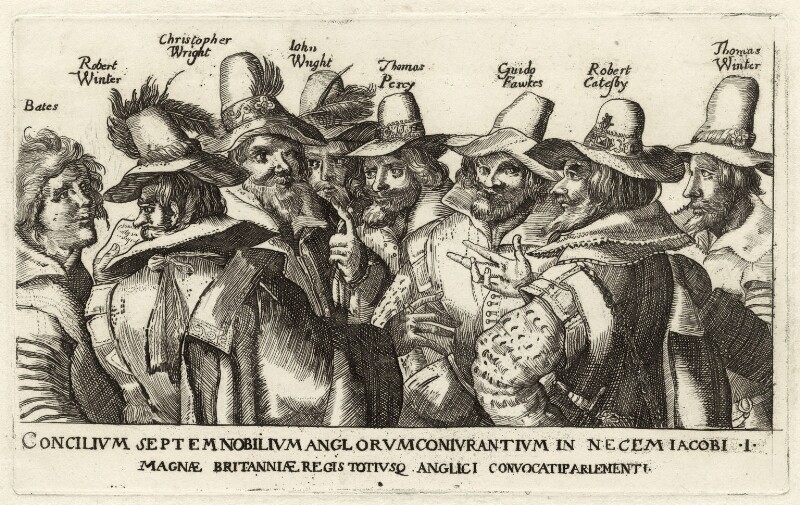
The Gunpowder Plot Conspirators
after Heinrich Ulrich
etching, late 18th to early 19th century
NPG D28145
© National Portrait Gallery, London

Bonfire Night, Fireworks Night, Guy Fawkes Night; there are several names for the celebrations which take place on the 5th of November every year. For most it is an evening of bonfires, fireworks, sparklers, hot drinks and cold noses. Its origins are rather more sinister though. The tradition started on the 5th of November 1605, when Londoners lit bonfires across the city to celebrate the foiling of the Gunpowder Plot. It is a story familiar to many, largely due to the celebration of Guy Fawkes Night. A group of Catholics had planned to assassinate the Protestant King James I and his Parliament by blowing up the House of Commons. Guy Fawkes was caught guarding the barrels of gunpowder, and has become by far the most well-known of the conspirators.

Largely secular now, the annual celebrations became a focus of anti-Catholic feeling. Although Guy Fawkes was executed by being hung, drawn, and quartered, one tradition surrounding the evening is to burn a ‘Guy’ in effigy on the bonfire. It is no longer a common part of the celebrations, but it demonstrates how strong anti-Catholic sentiment used to be. Guy Fawkes was viewed as a traitorous, treasonous terrorist, and treated accordingly.

In the past few decades however, Guy Fawkes has received a new lease of life in the form of the Guy Fawkes mask worn by the main character of the graphic novel V for Vendetta. Set in a dystopic 1984-style future, V is a mysterious man in a mask that sparks a popular insurrection that brings down the fascist, authoritarian government. One of his first acts in the novel is to succeed where Guy Fawkes failed, blowing up the houses of Parliament in spectacular fashion. V dies towards the end of the novel but others take up his mask, and his true identity is never revealed, turning him a symbolic figure of just rebellion. Initially unpopular when it was first published in the early 1980s, V for Vendetta has increased in popularity in recent years, perhaps due to its adaptation into a film in 2006. The Guy Fawkes masks have become a common feature of protests and demonstrations, serving both a symbolic purpose as the spirit of rebellion, and a practical one in helping to hide the faces and identities of protesters from police. In this context, Guy Fawkes is a hero who fought, and won, against overwhelming odds. He is a freedom fighter.

DSCF5728
The ‘V for Vendetta’ mask has become a common sight at demonstrations in recent years (Photo: Hannah Awcock).

I have been thinking about the phrase ‘One man’s terrorist is another man’s freedom fighter’ a lot recently. ‘Terrorism’ has felt almost ubiquitous in the Western world over the last decade or so of the War on Terror, but it is an incredibly subjective term. The same act can be perceived as mindless violence or just necessity, depending on the attitude of those perceiving it. The changing perceptions of Guy Fawkes proves this. I am in no way condoning the way that some people choose to resort to extreme violence in order to make their point, but I do think we should be aware of the complex and subjective nature of the term ‘terrorist’, and should use it accordingly.

Book Review: Striking a Light- The Bryant and May Matchwomen and their Place in History

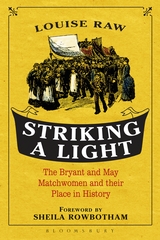
Striking a Light Front Cover
Striking a Light by Louise Raw.

Raw, Louise. Striking a Light: The Bryant and May Matchwomen and their Place in History. London: Bloomsbury, 2011.

I recently finished reading Striking a Light, Louise Raw’s wonderful book about the Bryant and May matchwomen’s strike in East London in 1888. My friends and family would be able to tell you how much of an impression it made on me, as I have spent a lot of time telling them how much I enjoyed it and recommending that they should read it themselves. The matchwomen’s (known to most as the matchgirls) strike is one of the most well-known examples of protest in London’s history, but as Raw expertly explains, much of what we think we know is inaccurate, and doesn’t give the strikers the credit they deserve. The thorough and innovative methodology used in the research also deserves recognition.

Raw conducted thorough analysis of the primary sources to re-evaluate the established narrative of the strike. She argues that the matchwomen were not as helpless and innocent as they were frequently portrayed to be, both at the time and in subsequent historical accounts. Annie Besant, a well-known campaigner at the time, is generally credited with leading the strike, helping the women to achieve what they could not alone. Raw easily demonstrates that although Besant did help the strikers, she did not have an organisational role, it was the women themselves that decided to strike, and organised the following campaign. Raw also uses census data and other sources to dispute the assertion that the women were too disconnected from the dockworkers in East London to have had an influence on the Great Dock Strike in 1889. Striking a Light recognises the bravery and strength of the matchwomen, acknowledging their achievements in a way that has not been done before.

The other element of the book which I particularly admire is the methodology. Raw is clear and explicit about how she conducted her research, including the difficulties she faced, which is something I personally would like to see more of in historical geography. In addition, Raw tracked down the grandchildren of some of the women involved in the strike, in order to find out more about them as women. Although this is a time-consuming method, with some obvious concerns about accuracy, the stories and insights uncovered brought the women to life. Finding sources from the perspective of those who actually took part in historical protests has been a major difficulty for me, as well as more established historians (for example Rudé (2005). Raw’s approach brought home the fact that the strikers were human beings, each with their own unique lives, aspirations, and motivations, something which is easy to forget in the midst of conventional archival research. This is a methodology that I hope I can use in my own research.

Sources

Raw, Louise. Striking a Light: The Bryant and May Matchwomen and their Place in History. London: Bloomsbury, 2011.

Rudé, George. The Crowd in History. London: Serif, 2005 [1964].

Reading the Riot Act: Protest in Everyday Language

2017-06-13 19.51.13.jpg
A Riot Act tea towel (Photo: Hannah Awcock).

How often were you ‘read the riot act’ as a child? When I started researching historical protest in London two years ago, I learnt the origins of this phrase. The Riot Act was passed in 1714, and gave local authorities the power to declare a gathering of twelve or more people illegal, which meant the group would either have to disperse or face arrest. The Act was read to the offending group, after which they had one hour to disperse peacefully. Although the act was often interpreted incorrectly and, as a result, complicated the  policing of public order rather than simplifying it, it was only repealed relatively recently, in 1967. So that is why you are ‘read the riot act’ when you are causing trouble, it basically means stop or face the consequences.

I recently discovered that the Riot Act is not the only element of the history of protest that has made it into everyday language. When recently reading a book about the numerous revolts and revolutions in Europe during the tumultuous year of 1848 (Rapport, 2008), I learnt that the Italians have a phrase which basically means ‘a right royal mess’: ‘un vero quarantotto’, or, in English, ‘a real 48.’ The events of that year stuck in the minds of Italians to the extent that it became synonymous with any situation where chaos reigned.

These two examples demonstrate just how important protest is to society and culture. Protests and contentious politics can be huge events, standing out in the collective memory as a time of dramatic upheaval, great achievements, or perhaps abject fear for the future. It shouldn’t really be surprising that they can work their way into everyday language in this manner.

Delighted with my discovery of ‘a real 48’, I have been racking my brains for any similar phrases in everyday language that come from a protest of contentious politics. I have yet to think of any, but perhaps the collective wisdom of my readership could help me out? Please comment on this post if you know any, in English or otherwise!

References

Rapport, Mike. 1848: Year of Revolution. London: Abacus, 2008.

Turbulent Londoners: Lord George Gordon, 1751-1793

Turbulent Londoners is a series of posts about radical individuals in London’s history who contributed to the city’s radical and contentious past. My definition of ‘Londoner’ is quite loose, anyone who has played a role in protest in the city can be included. Any suggestions for future Turbulent Londoners posts are very welcome. First up is Lord George Gordon, a charismatic individual who played a big role in the Gordon Riots. 


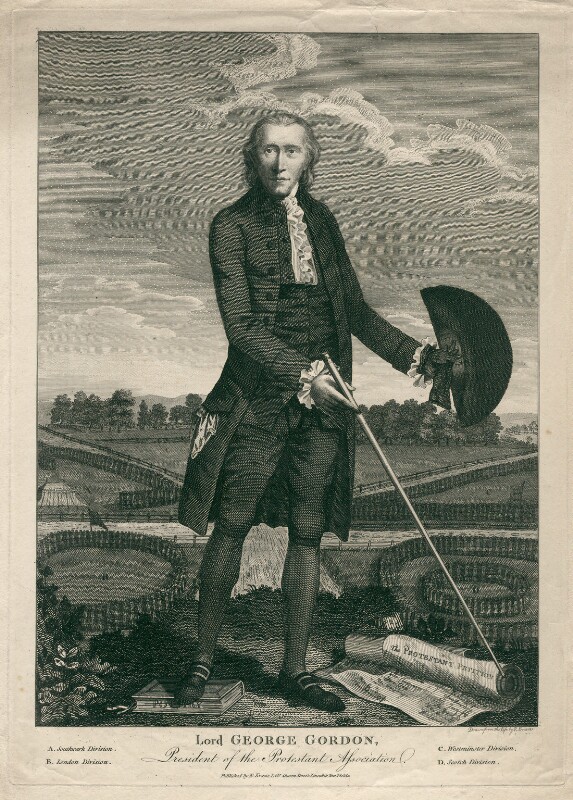
Lord George Gordon
after R. Bran
line engraving, published 1780
NPG D2793
© National Portrait Gallery, London

Lord George Gordon was an eccentric, irresponsible, but charismatic aristocrat who probably would have faded into obscurity if it wasn’t for the Gordon Riots, to which he gave his name. The Riots, which took place in June 1870, were a week-long series of anti-Catholic disturbances which have been called “the most serious disturbances ever seen in London.” (German and Rees, 2012; 87). Sparked by Parliament’s refusal to consider a petition to repeal the 1778 Catholic Relief Act, the riots took on a distinct anti-establishment flavour in their later days, which terrified those in authority.

Although charged with high treason after the riots, it seems that George Gordon did not intend to spark such dramatic events, which involved the largest number of people killed or executed in an episode of civil disorder either before or since (Archer, 2000). Becoming an MP with a reputation for rambling, boring speeches in 1774, Gordon was elected president of the London Protestant Association in November 1779. The Association was an organisation with the goal of repealing the Catholic Relief Act, which had relaxed some of the restrictions on Catholics in Britain.

Gordon and the Protestant Association organised a petition containing up to 100,000 signatures demanding the act be repealed. Against the advice of the rest of the Association’s leadership, Gordon called for a rally on the 2nd of June, followed by a march to Parliament where he would present the petition. An estimated 60,000 people attended, an unprecedented amount for a political meeting at this time (Bloom, 2010). The same evening that the petition was presented, two Catholic chapels were burnt down by an anti-Catholic ‘mob’. Over the following nights, the houses of many wealthy Catholics were destroyed, as well as the Langdale distillery and most of the capital’s prisons, including the infamous Newgate. Calm was not restored until the 10th of June, a week later.

At first suspected of deliberately engineering the riots, Gordon’s failed attempts to calm the situation proved he had no control over the rioters. He was acquitted of high treason, but continued to loudly voice his controversial and provocative opinions. He converted to Judaism in 1787, and was eventually imprisoned for libel following publications criticising transportation to Botany Bay as a method of punishment, and insulting Marie Antoinette, the Queen of France. He died of gaol fever in Newgate on the 1st of November 1793.

Lord George Gordon was admired by some, and considered insane by others. Whilst he was progressive in some of his views, for example his strong opposition to the death penalty, his hatred of Catholics complicates an interpretation of him as a radical reformer. However he is viewed, Gordon was a fascinating individual, who contributed to the history of disturbance in the capital, making London that bit more turbulent.

Sources

Archer J (2000) Social Unrest and Popular Protest in England 1780-1840, Cambridge: Cambridge University Press.

Bloom C (2010) Violent London- 2000 Years of Riots, Rebels and Revolts, Basingstoke: Palgrave.

German L and Rees J (2012) A People’s History of London, London: Verso.

Haydon C (2004) ‘Gordon, Lord George (1751-1793)’, Oxford Dictionary of National Biography, http://www.oxfordddnb.com/view/article/11040 (Accessed on 15.04.13).

Haywood I and Seed J (ed.) (2012) The Gordon Riots- Politics, Culture and Insurrection in Late-Eighteenth Century Britain, Cambridge: Cambridge University Press.

Playful Protest: Popular Culture and Humour in Hong Kong and London

As I’m sure many of you have, I’ve been following the events of the pro-democracy demonstrations in Hong Kong very closely. The protests, known to some as the ‘Umbrella Revolution’ because of protesters using umbrellas to protect themselves from tear gas, have been going on for some weeks now. The protesters accuse the Chinese government of reneging on multiple promises to allow Hong Kong a free and fair democracy by placing restrictions on who is allowed to run for the position of Chief Executive, effectively Hong Kong’s leader, in 2017 (for more information about the Hong Kong demonstrations, see http://www.bbc.co.uk/news/world-asia-29413349). An end appeared to be in sight as talks between the government and the protesters were scheduled for this Friday (the 9th of October), but they were called off the day before they were due to take place. One of the things that struck me as I have watched events unfold is the many similarities between the protests in Hong Kong, and many recent demonstrations in London. One example is the playful, light-hearted approach some protesters take, evidenced in placards and banners made and carried by the demonstrators.

This design was mass produced on placards and posters during the student tuition fee demonstrations in London in 2010.
This design was mass produced on placards and posters during the student tuition fee demonstrations in London in 2010 (Source: Author’s own).

Placards, banners, and signs are an integral part of a demonstration or protest. Along with the shouting of chants and slogans, they convey the message of the demonstrators to observers. Many, such as the poster in the image above, are mass produced by large groups and organisations involved in the demonstration. But many others are home made, painted or drawn onto pieces of cardboard and old bedsheets. These allow individual protesters to express themselves, publicly declaring their own opinions and perspectives. For many the placard is a temporary object, the streets after a demonstration are often scattered with them, and they are sometimes used as fuel for impromptu fires. However in 2011 the Save our Placards project (see http://saveourplacards.blogspot.co.uk/), run by Goldsmiths and the Museum of London sought to change that, collecting placards after the Anti-Austerity March for the Alternative on the 26th of March. They collected over 300 objects, 10 of which are now in the Museum’s collections. The project demonstrated the vast amounts of creativity and variety that can be involved in placards and has shown that they are worthy of attention by those studying protest.

One thing that placards make clear is the playful attitude of many protesters to issues they are trying to draw attention to. In both the recent Umbrella Revolution in Hong Kong and student demonstrations against austerity and raised tuition fees in London in 2010 and 2011, protesters have taken an irreverent approach through the use of humour and references to popular culture.

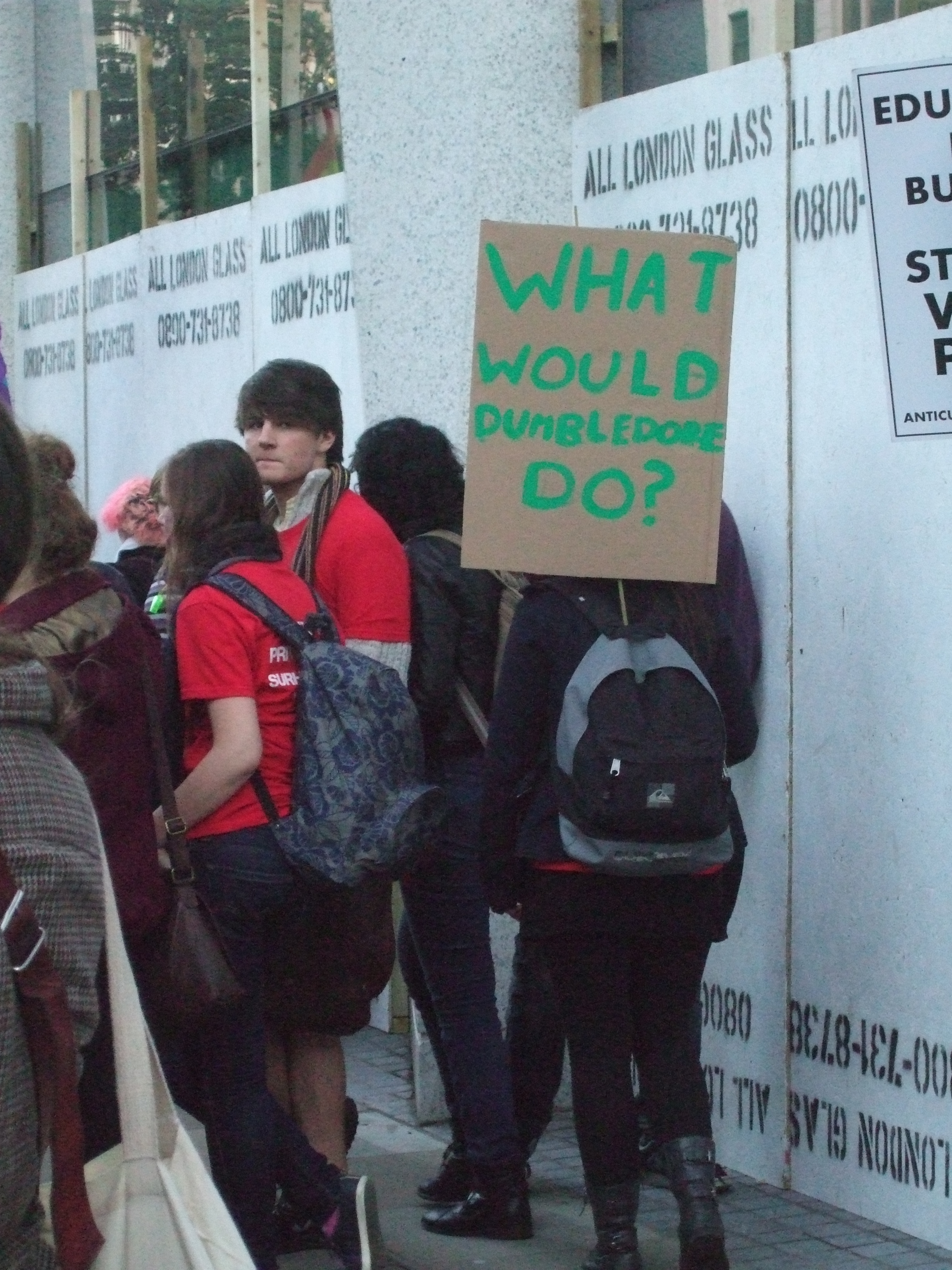
A placard at an anti-austerity student protest in London in 2011 (Source: author's own).
A placard at an anti-austerity student protest in London in 2011 (Source: Hannah Awcock).

During the Hong Kong demonstrations there was a large banner hung from a footbridge across a road which read ‘Do u hear the people sing’. The phrase is a line from one of the most famous songs from the musical Les Miserables, which culminates in the 1832 June Revolution in Paris. The second, taken in London, asks ‘What would Dumbledore do?’, probably a reference to the phrase ‘What would Jesus do?’ sometimes used as a way of making decisions. Dumbledore is the headmaster of Hogwarts School of Witchcraft and Wizardry, the fictitious school of magic in the Harry Potter book and film franchise. The people who made both of these signs are using their knowledge of popular culture to articulate their own opinions and demands, one a demand to be heard, the other a call to the British Authorities to consider their actions.

Pro-Democracy Protester holding a written slogan “I’m so angry , I made a sign” at midnight on 28th September, 2014 in Connaught Road Central (Source: Lamuel Chung).
A humourous topical placard at a demonstration opposing a threefold increase in tuition fees in London in 2010 (Source: Author's own).
A humorous and topical placard at a demonstration opposing a threefold increase in tuition fees in London in 2010 (Source: Hannah Awcock).

The above two photos show placards which take a more humorous approach to protest. The second, taken in London, is particularly topical as it was part of a demonstration against the UK coalition government’s plans to raise the cap on tuition fees from just over £3000 to £9000 a year in 2010. Humour is a common way of dealing with upsetting or traumatic situations, and I think humour in protests is no exception, making the difficult and strenuous task that is activism easier to cope with.

I am often struck by the similarities between different protests around the world. You don’t have to look very hard to find multiple connections and links. A playful approach to protest is one of these similarities, and I’m sure it can be found around the world, not just in Hong Kong and London.

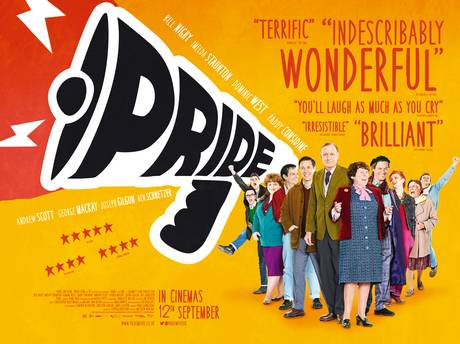
Thoughts on ‘Pride’: What’s Left Out and Why Does it Matter?

This post was written by Diarmaid Kelliher, a PhD student at the University of Glasgow. His research is on solidarity in the miner’s strike in 1984-5, including Lesbians and Gays Support the Miners, who the recent film Pride is about. Follow him on Twitter at @Diarmaid84, or go to  http://www.gla.ac.uk/schools/ges/pgresearch/diarmaidkelliher/


One of Pride's promotional posters.
One of Pride‘s promotional posters.

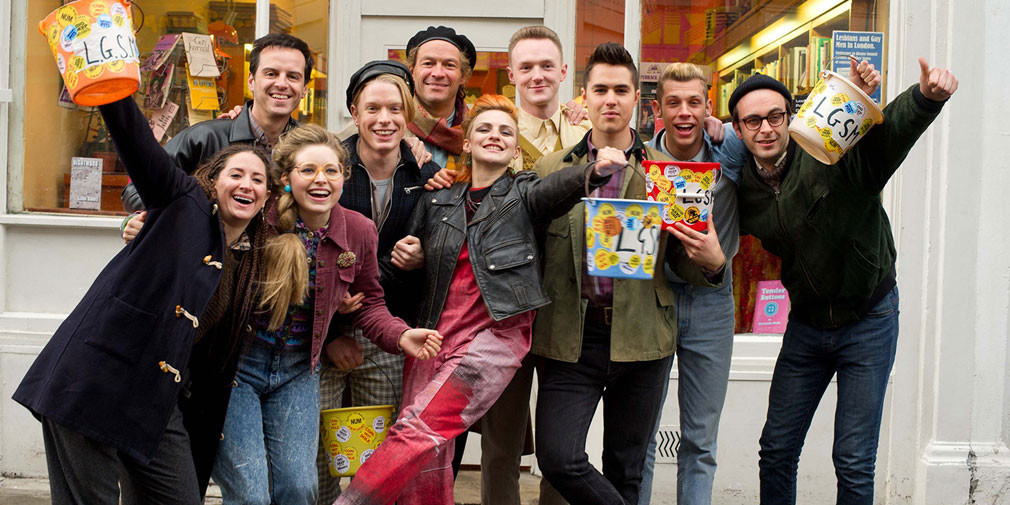
The story of London Lesbians and Gays Support the Miners (LGSM) during the 1984-5 strike has circulated amongst lefties for a while but more broadly has been relatively unknown. This year, however, LGSM has featured in a play, a documentary, and the film Pride which is based entirely on the group. Pride has, rightly I think, received almost universally enthusiastic reviews. One exception is Brendan O’Neill’s ridiculous blog for the Telegraph which concludes that if the miners had been more ‘blokey and rough’ (the opposite of gay apparently) they might have won. Still, with the many positives covered so widely I want to focus on what’s missing.

The film, I think, gives an overly narrow portrayal of LGSM which, while perhaps understandable in narrative terms, somewhat cuts them off from broader political relationships, including with the larger solidarity movement for the miners. In the film, the group never grows beyond the handful of members drawn in early on. In fact, London LGSM at its peak attracted up to fifty people to its weekly meetings. There was eleven or so LGSM groups established outside London. This matters because it suggests that the politics of the group appealed to other lesbian and gay activists – and part of the point of LGSM was to engage and challenge lesbian and gay politics. As one member said at the time, they sought both to bring sexual politics into trade unionism, and to bring ‘socialism onto the agenda of sexual politics in the London lesbian and gay community’.

In the film, LGSM never grows much beyond the original members.

One effect of making the group so small is seen in the treatment of Lesbians Against Pit Closures – a group that separated from London LGSM. The split is largely played for laughs along classic leftist splintering lines. The extent to which women were outnumbered – even at the largest meetings of fifty there were never more than a few women – is not evident in the film’s small group. The idea that having a separate lesbian group was a bit silly is not easily distinguishable from the idea that LGSM itself was unnecessary – why not just work in the broader support campaigns? But how much fragmentation is too much, who decides and how?

One aspect of LGSM pushed a bit to the background in Pride is the political ideology. There is a glimpse of a hammer and sickle on the wall of founder Mark Ashton’s flat and someone calls him a commie – but you might not realise that he was a member of the Communist Party. Other activists in the group included members of left organisations such as the Labour Party and the Socialist Workers Party. The language of socialism so prominent at the time is largely absent from the film. This matters for the way in which we understand the construction of alliances: lesbian and gay support for the miners made sense not just because they were two groups of people under attack by the government, the police and the media. This was significant and possibly enough for some. But  it also relied on a broader left-wing politics which understood the different struggles in something like a totality.

Sheila Rowbotham’s recent reflections on the book Beyond the Fragments (1979) is, I think,  relevant here: ‘At the time, we had a credible word for what we wanted: “socialism” […] I still identity with the word “socialism”, but I realise that many others on the left no longer do so. To avoid unnecessary hair-splitting, I will say, then, that a vital component in “how” is imagining and articulating what else might be possible – what is beyond the beyond?’ Perhaps Pride avoids the language of socialism not as an attempt to appeal to an American market but as a reflection of the fact that ‘socialism’ doesn’t play this role any more. But part of the lesson in LGSM, for me, is the need for this alternative vision of ‘the beyond’ in building such alliances – and if that vision is not socialism, then what is it?

Diarmaid Kelliher, University of Glasgow.

On This Day: The Battle of Cable Street, 4th October 1936

The Battle of Cable Street was a clash between police and protesters who were trying to prevent the British Union of Fascists (BUF) from marching through Stepney, the most concentrated area of Jewish population in the country. The 1930s saw fascism spreading across Europe. Both Germany and Italy were under fascist regimes, and the Spanish civil war was being fought between fascists and republicans. In 1932 the BUF was founded by Sir Oswald Mosley, who hoped to replicate the success of similar organisations across Europe.

A placard from the march on the 80th anniversary of the Battle of Cable Street march in front of the mural which commemorates the Battle (Source: Hannah Awcock)

Over the summer of 1936, tension in the East End increased as marches and meetings were organised in response to the BUF’s anti-Semitic propaganda and frequently violent activities. When the planned march was announced on the 29th of September it was seen as deliberate provocation. One petition against the march gained 10,000 signatures, but the Home Secretary refused to ban the march on the grounds that to do so would be undemocratic. Whilst there was widespread opposition to the march, opinion on how to respond was divided. Moderates feared the inevitable violence that would result from attempting to stop the BUF, so called for people to just ignore the march. However, it was eventually decided that an attempt would be made to stop the march.

Members of the BUF greet Oswald Mosley with Nazi salutes in 1934.
Oswald Mosley
by Central Press
bromide press print, 9 September 1934
NPG x182408
© National Portrait Gallery, London

It was well known that Mosley planned for the BUF to gather in Royal Mint Street, then split into several columns to march through East London before reassembling for a rally in Bethnal Green. However the specific details of the planned route were not known, so the anti-fascists met at 4 different points, attempting to block all possible routes into the East End. It was the responsibility of the police to clear a route for the BUF to march. Although there were minor scuffles between fascists and anti-fascists, the main clashes were with the 6000 police officers who attempted to clear a route for Mosley and the BUF ‘Blackshirts’. The police made numerous baton charges at Gardiner’s Corner in Aldgate, but the way was blocked by a tram which had been stopped by its anti-fascist driver. The only other alternative this left was Cable Street.

Several barricades had already been built, including one constructed from an overturned lorry. The slogan “No Parasan- They Shall Not Pass,” which came from the Republican forces in the Spanish Civil War, had been painted on banners, barricades and the streets. The police were bombarded with projectiles from upper windows as they repeatedly charged, dismantling barricades and obstacles only to find more behind. As injuries and arrests mounted, the Metropolitan Police Commissioner ordered Mosley to abandon his planned route. Furious and humiliated, the BUF marched through London before quietly dispersing at Embankment. In the East End, celebrations continued long into the night.

To me, the Battle of Cable Street was a vocal expression of communal will, as well as a fierce declaration of ownership over the streets and spaces of the East End. A month after the Battle, the Public Order Act was passed, which controlled public processions and banned political uniforms in public. Under the terms of the act marches in East London were prohibited until the BUF was disbanded in 1940. Although it limited their activities too, the ban was a clear victory for anti-fascist campaigners, as it represented a U-turn of the government’s position of supporting the BUF’s right to march at any cost.

Sources and Further Reading

Jackson, Sarah and Rosemary Taylor. Voices from History: The East London Suffragettes. Stroud: The History Press, 2014.

Rosenburg, David. ‘The Battle of Cable Street- 75 Years on.’ History Workshop Online, January 8, 2011, accessed September 17, 2014 http://www.historyworkshop.org.uk/cable-street75/

The Cable Street Group. Battle of Cable Street 1936. Nottingham: Five Leaves, 2011.