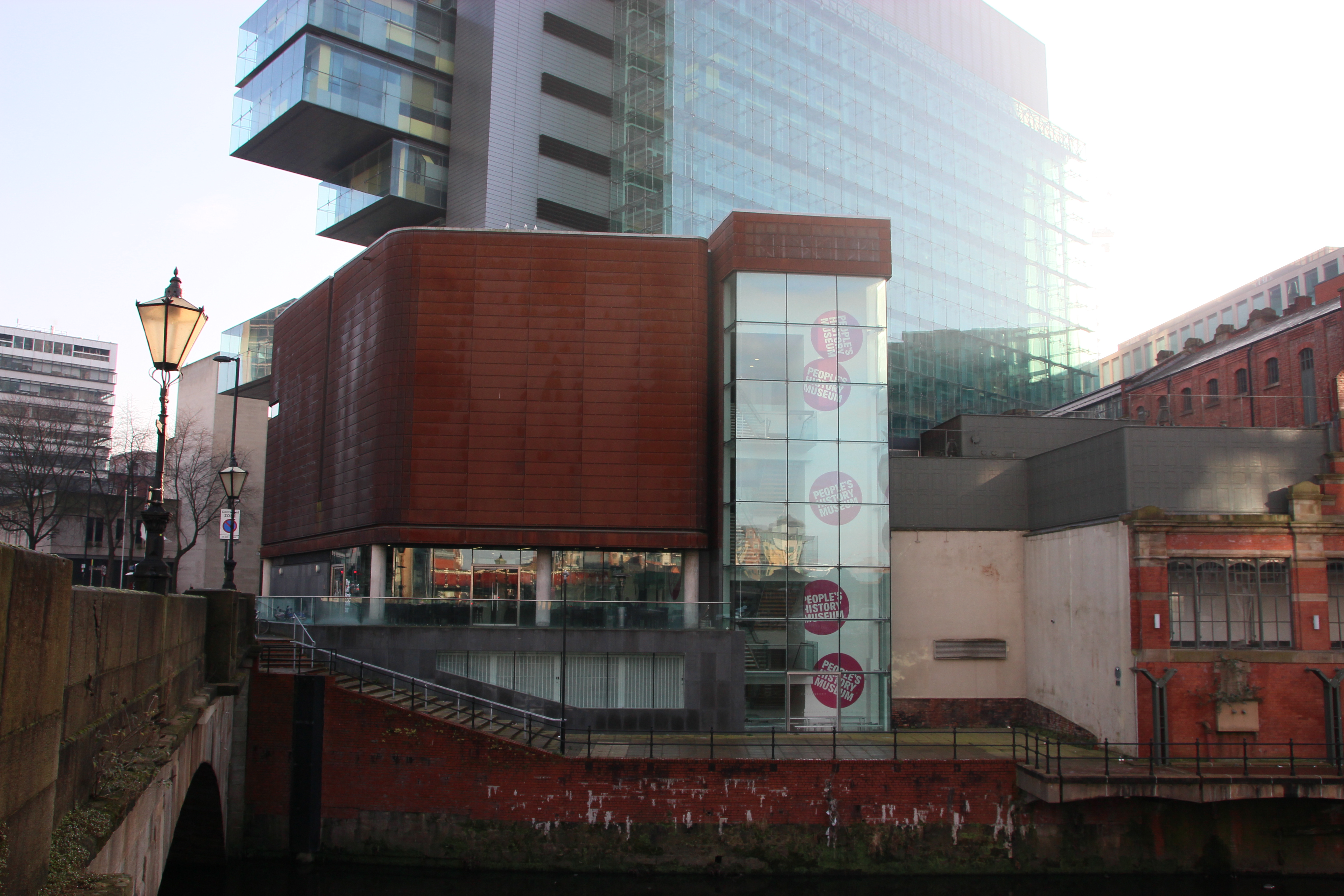
The People’s History Museum

img_2194
The People’s History Museum is housed in an old pump house on the banks of the river Irwell in Manchester (Photo: Hannah Awcock).

I have been studying the historical geography of protest for the last four years. For most of that time, I have wanted to visit the People’s History Museum. The problem was that I am normally in the south of England, and the museum is in Manchester. Last week, I visited Manchester and finally got to see the museum, and I was not disappointed!

The People’s History Museum started life as a collection of protest-related material belonging to a group of activists in the 1960s. They opened a museum in London in the 1970s, but it struggled financially. In the 1980s, the collection was rescued by Manchester City Council and Greater Manchester authorities, with some help from the TUC. In 1990, the People’s History Museum opened on Princess Street in Manchester, in the same building where the TUC had its first meeting, over one hundred years before. In 1994, the museum opened a second site at its current location—an old pump house on Bridge Street. In 2010, the museum relaunched in a restored and expanded pump house. Now the museum has several permanent galleries, a temporary gallery space, and meeting and conference rooms. It describes itself as “the national museum of democracy,” and receives around 100,000 visitors a year.

The permanent gallery spaces are arranged in a largely chronological order. The zones are colour coded, each colour chosen for its symbolism in radical culture (e.g. red for courage and revolution, blue for loyalty). The galleries are accessible, interactive, child-friendly, and well-paced. There is a nice balance between individuals, groups, and events, and between parliamentary and extra-parliamentary politics. I think it is important to highlight the connections between these elements, as it is all too easy to focus solely on one. Whilst the galleries begin with the Peterloo massacre, a local event, the rest of the museum covers the whole country. The museum presents itself as a national museum, and I think it lives up to that.

img_2058
The ‘Reformers’ section of Main Gallery 1. Each section is colour coded according to the symbolism of radical culture. Fittingly, green means reform (Photo: Hannah Awcock).

For me, there were two threads running through the galleries that connected everything together. The first was a series of videos about 5 generations of one family. With each family member, the videos and accompanying text explained what life was like for the individual, what rights and services they were entitled to, and whether or not they could vote. They demonstrated how the conflicts and struggles described in the displays affected people in very real ways, from working conditions to healthcare.

The second unifying thread running through the galleries was the banners. The People’s History Museum has one of the largest collection of protest banners in the country, and they are the only group that specialises in the restoration and preservation of these kinds of banners. There are banners on display in every area of the galleries, from the oldest surviving trade union banner, to a banner protesting the 2012 Bedroom Tax. Some are highly detailed, others were obviously made very quickly, but all are striking. They illustrate that whilst there have been many changes over the past two and a half centuries, there are also a lot of continuities in radical culture. Banners have provided a sense of identity and belonging for radical groups for decades.

img_2144
Some of the magnificent banners on display in the museum. The are spread throughout the gallery spaces, but banners do have their own devoted section in Main Gallery 2 (Photo: Hannah Awcock).

The museum has an open approach to curation which I like. The plaques describing items often explain how the items came into the museum’s collection. Many items were donated by activists or their descendants, and there can sometimes be a disconnect between the received history of an event and the stories that are attached to particular items and passed down through generations. All museums have to make decisions about the authenticity of the items in their collections, but most cover up this process. The People’s History Museum does not, asking the visitor to reflect on such issues—would you trust the descendants of a protester over historians? I liked this honesty, and appreciated the way it engaged visitors in the ongoing debate about how best to represent history.

The People’s History Museum is well worth a visit, even if protest is not something that particularly interests you. It is a museum of social history as well as radical history, and as I look back on 2016 it is a much-needed reminder that many of the rights and privileges we take for granted today had to be fought for, tooth and nail, by earlier generations. If we are not willing to fight, just as fiercely, to protect them, we will lose them.

Getting Grants, Getting Published and Staying Sane: Life After the PhD

dav
Getting Grants: Getting Published and Staying Sane: Life after PhD was organised by History Lab Plus at the Institute of Historic Research in London on the 15th of July 2016 (Photo: Hannah Awcock).

As I near the end of the third year of my PhD, what comes after is starting to loom increasingly large on my mind. As a result, I signed up for an event organised by History Lab Plus about life after the PhD. Getting Grants, Getting Published and Staying Sane: Life after the PhD took place on the 15th of July at the Institute of Historical Research in London, and I found it very helpful. There was a workshop about our post-PhD hopes and fears, and four panel-based sessions on making the transition, getting funding grants, getting published, and jobs outside academia/impact/public history.

The thing about advice is that it is personal; you can only really talk from your own experience, and it quickly became obvious that the post-PhD period is just as varied as the PhD itself. For example, it is very hard to get an academic job without a publication, but almost everyone seems to know at least one person who managed it. Any career is an individual experience, and people can only really give advice from their own personal experiences, which may not be relevant to yours for any number of reasons. This is something I always try to remember when given advice.

One piece of advice that does seem to be universally applicable is to spend time thinking about what you want to do after your PhD. Do you want an academic career? Do you want to turn your thesis into a book? Do you want to focus more on teaching or research? Think about what you want to achieve, and then decide which jobs/opportunities/ experiences will help you to get there. Also think about what skills you have, what you can offer to a potential employer. What are you interested in, and what are you good at? I spend a lot of time thinking about life after the PhD, but before this event it hadn’t occurred to me to try and think in these practical, concrete terms that might actually be helpful instead of just terrifying.

sdr
There were four panels covering multiple different aspects of life after the PhD (Photo: Hannah Awcock).

There were other bits of advice that I think would be useful for everyone; for example Emily Russell, an editor at Palgrave Macmillan, gave a talk about the process of converting a thesis into a book, but I think the aspect of the day that I found most helpful was the sense that we are all the same boat here. There must have been around 30 people sitting in that room, all of whom are coming close to finishing their PhD, or just recently had, who all had very similar questions about what comes next. As a PhD student, I am constantly being made aware of how difficult it is to get an academic job, how competitive it is (the ‘CV arms race’ is an analogy I like). As a result, I often find it hard to be happy for my contemporaries when they achieve something that might give them an advantage over me if we applied for the same job. My first reaction is frequently jealously, or despair that I haven’t managed to achieve the same thing yet, and I hate it. Life After the PhD was a reminder that we are all in the same boat. We are all dealing with the pressure, we are all getting frustrated about the structural systems that make academia so tough in the first place, and we are all worrying about how we are going to pay rent and feed ourselves when our funding runs out (those of use who were lucky enough to get funding in the first place). So we need to look out for one another. This can take the form of joining a union or a campaign like FACE (Fighting Against Casualisation in Academia), or simply being nice to one another- one of my favourite pieces of advice from the day came from Dr. Will Pooley and is a favourite saying of comedian Adam Hills: “Don’t be a dick!” Will posted the text of his talk on his blog.

I am scared about what is going to happen when I finish my PhD- this is the first time in my life when I don’t know what I’m going to do next, where I don’t have a solid, concrete plan that I know is going to work out. However, events like Life After the PhD  help me to put it into perspective. As well as providing advice, the day was an opportunity to discuss my fears, and my ambitions, with others who are going through the same thing, which I found helpful.

I would like to thank History Lab Plus for organising the event, particularly Kelly Spring and Jessica Hammett.