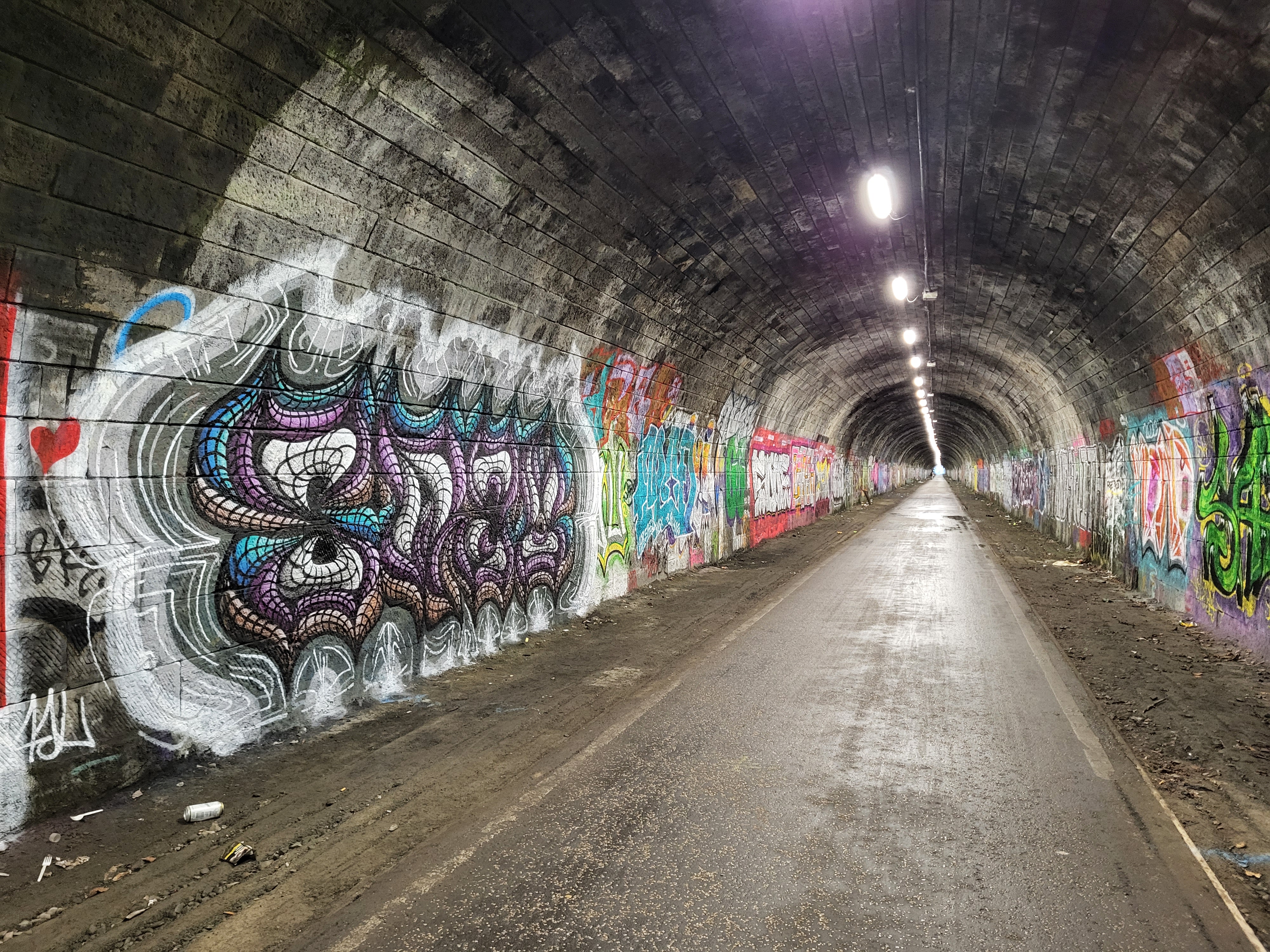
The Innocent Tunnel is part of a former railway that runs under a corner of Holyrood Park. The railway is now a cycle path, and the tunnel has become a hot spot for street art and grafitti (Photo: Hannah Awcock, 12/03/2023).
The Edinburgh and Dalkeith Railway used to run from Newington to Brunstane to the east of Edinburgh. Opened in 1831, the line was built to bring coal in to the city. It started to carry passengers as well, and became very popular. It was known as the Innocent Railway because the trains were pulled by horses. It was quickly overtaken by steam-powered railways though, and closed to passengers in 1847. It stopped carrying goods in 1968, and reopened as a foot and cycle path in the 1980s. The Innocent Railway Tunnel runs for 517m under Holyrood Park and is popular with grafitti and street artists. The entire length of the tunnel is covered with tags, murals, and slogans, and some of it is political.
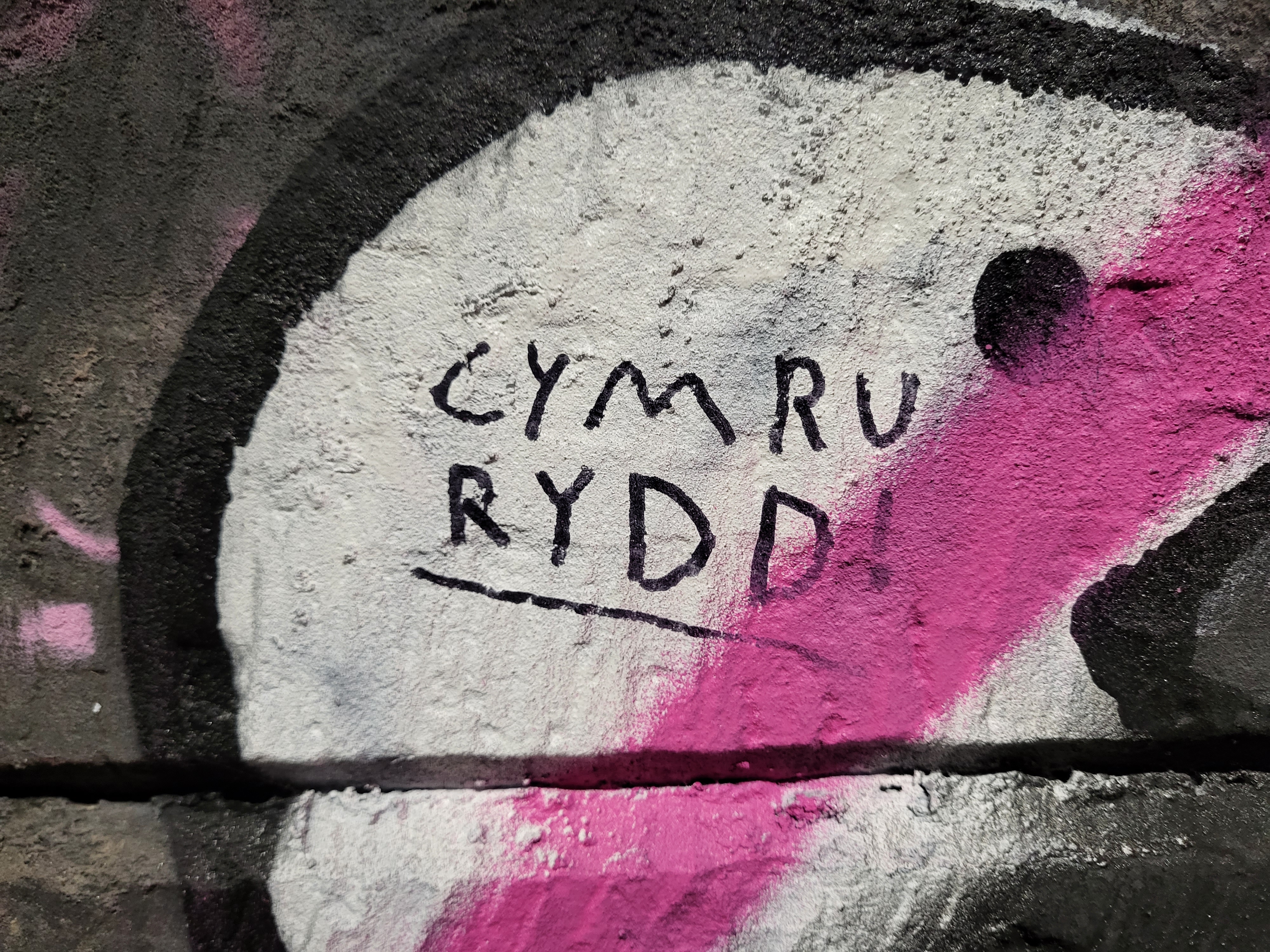
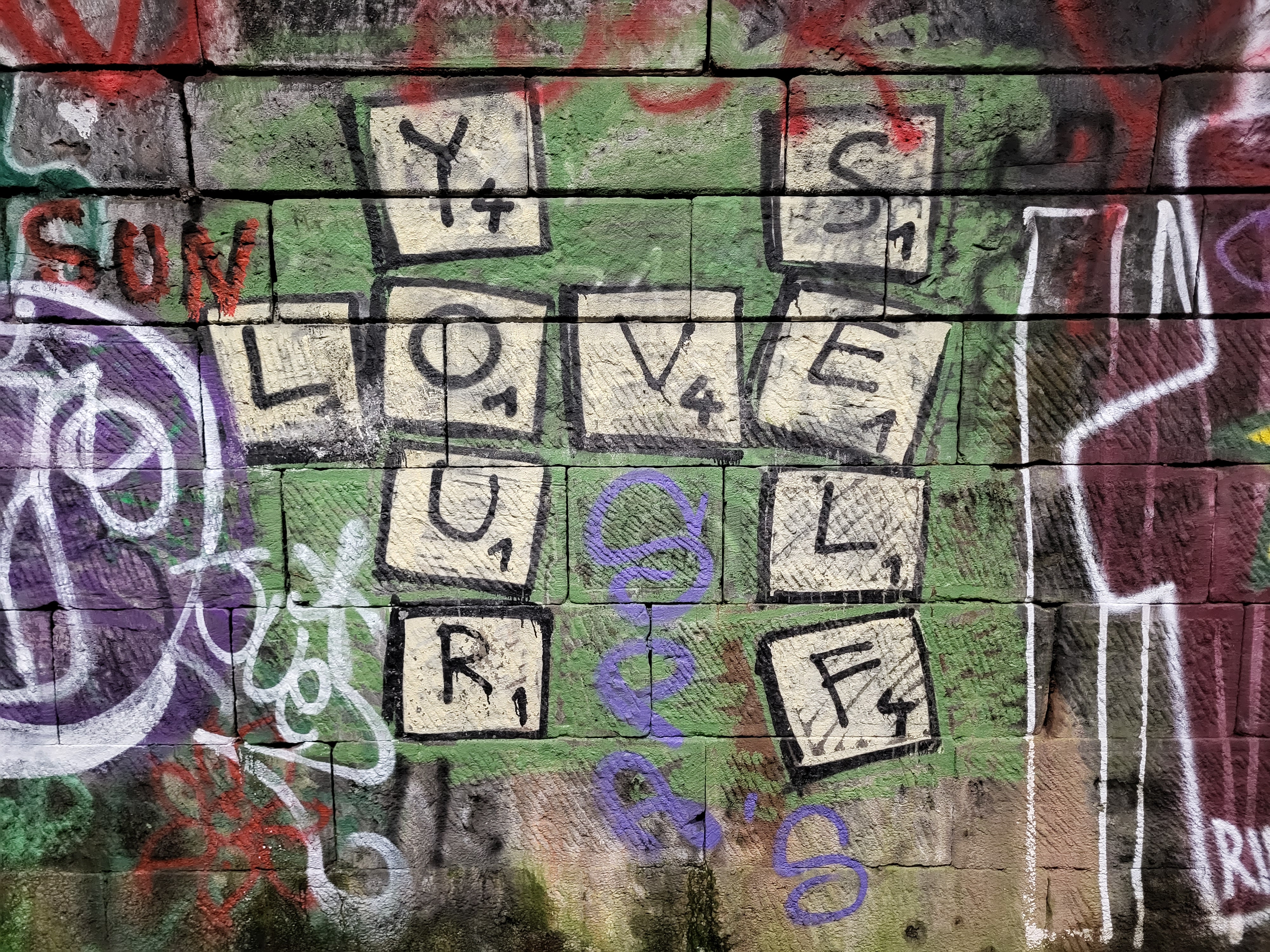
Trans rights should not be controversial, but unfortunately trans people are facing increasing discrimination and attacks in contemporary society. The trans flag is a symbol of defiance as well as acceptance (Photo: Hannah Awcock, 12/03/2023).Russia’s invasion of Ukraine in February 2022 caused in international outpouring of solidarity (Photo: Hannah Awcock, 12/03/2023).‘Slava Ukraine’ means ‘Glory to Ukraine’. It is a patriotic slogan that has gained international recognition over the last year. It looks like the slogan in this piece has been covered up and replaced at least once (Photo: Hannah Awcock, 12/03/2023).This mural has also been at least partially covered up, but it is still possible to make out the Palestinian flag under the white paint on the right hand side of the image. Somebody has sprayed “Free Palestine” on top of the white paint, just in case the original message “Scotland stands with Palestine” isn’t clear (Photo: Hannah Awcock, 12/03/2023).I feel like this one is fairly self-explanatory (Photo: Hannah Awcock, 12/03/2023).ACAB is a well-known acronym amongst radicals and activists. It stands for All Cops Are Bastards (Photo: Hannah Awcock, 12/03/2023).‘Cymru Rydd’ means ‘Free Wales’. I have seen slogans for the Welsh Independence movement relatively often around Edinburgh. It makes sense that there would be solidarity between the various UK Independence movements (Photo: Hannah Awcock, 12/03/2023).This one isn’t exactly political, but I like to finish on a positive note! (Photo: Hannah Awcock, 12/02/2023).
Have you ever wondered what it would be like to have a statue made of you? Unfortunately most people will never know, either because they are not considered worthy of a statue, or because they’re the kind of thing that tends to happen after you die. Well, if you are ever in Dumfries in southern Scotland, you can experience it for yourself with the DIY statue!
Having a great time striking a statuesque pose (Source: Graeme Awcock).
Situated near the Devorgilla Bridge over the River Nith, the DIY statue looks at first glance like a large, empty plinth. Look a little closer however, and there is a pair of shoe prints embedded in the top in front of the words ‘DIY STATUE’ and ‘DUMFRIES LOCAL HERO’ carved near the top. I was in Dumfries this summer with my parents, and when we found the DIY Statue I just had to give it a try. A man who was walking past as I did this gave me a cheer and a round of applause, which was a moment that was simultaneously lovely and highly embarrassing. The whole thing got me thinking about the nature of statues in public space, why we put them up, and how we interact with them.
The DIY statue without yours truly (Source: Hannah Awcock).DUMFRIES LOCAL HERO is carved into the back of the plinth (Source: Hannah Awcock).
Most statues are ignored by most people most of the time. If we pass a statue frequently it tends to fade into the background, and we stop noticing it, if we ever did in the first place. There are occasions where statues become the centre of attention, however. For example, statues have played an important role in the UK’s recent ‘culture wars’, with debates raging about what do about statues of people whose legacies we are no longer proud of (rightly, I think!). Perhaps the most well-known example of this in Edinburgh is the statue of Henry Dundas on a 45m tall plinth in St Andrew Square. As Home Secretary, Dundas argued against the abolition of the slave trade. Statues like the DIY statue encourage people to interact them without commemorating highly problematic people.
Statues are a reflection of who society deems are important. As such, they also reflect society’s prejudices. One of my favourite facts about Edinburgh (not because I like it, but because it’s outrageous) is there are more statues of named animals in the city than there are of women. Recent research by Art UK has shown that just 2% of named statues in the UK represent people of colour. The DIY statue can be representative of all the people of Dumfries in a way that most conventional statues are not.
Another interesting question that the DIY statue raises is what kinds of acts make a person worthy of a statue. Most named statues are of people who did remarkable things in the fields of business, politics, sport, or culture. For example there is a large statue of Robert Burns, the famous Scottish poet who lived in the town for a while, at the top of Dumfries High Street. Decisions about who ‘deserves’ a statue are not simple, uncontested things. As controversies surrounding some statues such as the Dundas memorial in Edinburgh demonstrate, these decisions can be argued against and even reversed. The DIY statue encourages us to think about the standards we use to define a ‘local hero’. Should it only be people who are rich and famous? Why can’t we recognise people who ‘just’ contribute to the local community? After everything that’s happened the last few years, I think we all deserve to be celebrated a little bit just for existing. Thanks to the DIY statue anyone who can climb onto the plinth (it isn’t particularly accessible) can be commemorated, even temporarily.
The statue of poet Robert Burns in Dumfries town centre (Source: Hannah Awcock).
Even though they spend a lot of time being ignored by passersby and pooped on by birds, statues matter. The DIY statue may be just a fun piece of public art that encourages people to interact with public space, but I think it raises important questions about who we choose to commemorate and why. I haven’t been able to find out any information about the DIY statue, so if anyone knows when it was installed or whose idea it was, I would love to know!
Turbulent Scots is a series of posts about radical individuals from history who were either born in, or had an impact on, Scotland. Most of the Turbulent Scots I feature are women, because their contribution to history has so often been overlooked. Any suggestions for future Turbulent Scots posts are very welcome. Next up is Lady Agnes Campbell, a member of the aristocracy in the sixteenth century who was skilled at politics and negotiation.
We tend to think of aristocratic women in the early modern period as powerless pawns, to be married off for political or financial gain. There are several examples, however, that prove that the situation was not always that simple. Elizabeth I is perhaps the most famous, but I recently came across the story of another, Lady Agnes Campbell.
Agnes Campbell was born in around 1526, the second daughter and fifth child of Janet Gordon and Colin Campbell, the third Earl of Argyll. She was well educated at the Scottish court, learning to speak multiple languages. In 1545 she married James MacDonald of Dunyvaig and the Glens, chief of one of the branches of Clan Donald. Over the next twenty years she had five children. During this period there was a struggle between Irish, English, and sometimes Scottish aristocracy for control of Northern Ireland. The MacDonalds of Dunyvaig had started settling in Antrim, and sometimes worked with the local O’Neill clan against the English, but at other times their interests clashed dramatically. On 2nd May 1565 James and his brother Sorley Boy were defeated in battle and captured at Glenshesk in Ireland by Shane O’Neill. James died from his injuries in captivity in August. Shane was assassinated by the MacDonalds in 1567, and the relationship between Sorley Boy and Shane’s successor, Turlough Luineach O’Neill improved so much that on 5th August 1869 Agnes married Turlough.
Agnes took more than 1000 redshanks (Highland infantry mercenaries who fought for Irish chieftans) to Ulster when she got married. In 1570 and 1571, Agnes returned to Scotland to recruit more redshanks for her husband’s cause. The following year, Walter Devereux, the Earl of Essex, was providing military support to English colonists trying to settle in Ulster. In December Agnes left for Scotland, taking a large number of redshanks with her. The English hoped that Agnes’ marriage was collapsing, but actually she was swapping the men for fresh mercenaries. The Earl of Essex withdrew in 1575, after Agnes had negotiated significant land grants for Turlough. Agnes frequently acted as Turlough’s delegate in negotiations. This may have been because it provided him with distance from any agreements and allowed him to go back on his word if it became convenient later, but it was also widely acknowledged that Agnes was a skilled negotiator. Her support for Turlough was invaluable in driving away the Earl of Essex.
In November 1575, Agnes and Turlough met with Henry Sidney, the Lord Deputy of Ireland. Turlough offered to submit to Sidney’s authority in return for an Earldom, land grants, and recognition of Agnes’ sons claims to the Glens in Scotland (Sorley boy, Agnes’ former brother-in-law, also claimed the Glens). Despite Sidney demanding that Agnes stop bringing redshanks from Scotland to Ireland to fight for her husband, she continued to do so. The English believed she had significant influence over Turlough, and she was also seen as a powerful political force in her own right.
In September 1579, Turlough refused to negotiate with Elizabeth I’s representatives without his wife. Throughout the 1580s, Agnes continued to travel back and forth to Scotland to make sure that support for her husband remained strong. She also supported the interests of her sons; she negotiated land for them, and intervened in disputes. In March 1588 she traveled to Edinburgh to plead with James VI on her son’s behalf. She was back in Scotland in April 1590, but after that she disappears from the records.
The further back in time you go, the harder it is to find information about remarkable women. This is not because they didn’t exist, but because they weren’t considered worthy of being recorded. Lady Agnes Campbell was one such remarkable woman, and we do know a bit about her, probably because of her status as an aristocrat. She played a significant role in Irish resistance to English colonisation, she was a skilled negotiator, and a powerful political presence in her own right.
Walshe, Helen Coburn. “Campbell, Lady Agnes.” Oxford Dictionary of National Biography. Last modified 3rd January 2008, accessed 17th May 2022. Available at https://doi.org/10.1093/ref:odnb/69172 [Subscription required to access].
Regular readers of this blog will be familiar with the Turbulent Londoners posts, where I celebrate the lives of Londoners who have played a part in the city’s rebellious history. As I recently moved to Edinburgh, I’ve decided to take a look at some of the women who made an impact on Scotland’s radical history. Next up is Ethel Moorhead, radical suffragette and artist.
Ethel Moorhead (centre) on trial in Glasgow in 1913 with Dorothea Chalmers Smith (Source: Crown Copyright, National Records of Scotland, HH16/40).
On a recent visit to the National Wallace Monument in Stirling, a towering celebration of Scottish nationalism and masculinity, I did not expect to find any reference to the kind of history I write about on this blog. I was pleasantly surprised, therefore, to find a reference to artist and suffragette Ethel Moorhead in the electronic display about the Wallace Sword. In September 1912, Ethel smashed the glass case containing the sword that allegedly belonged to William Wallace in a protest demanding the right to vote for women, and was sentenced to 7 days in prison for her troubles. I set out to learn more about this brave woman who clearly had a flair for the dramatic, and I was not disappointed. Ethel was one of Scotland’s most famous suffragettes, and for good reason.
Ethel Moorhead was born in Kent in 1869, one of six children of a military surgeon. Her childhood, and much of her adult life as well, was spent moving; the family never stayed in one place for long. By the end of the 1800s, however, they were in Scotland. Encouraged by their father, Ethel’s sister Alice qualified as a doctor in 1893 and began practicing in Dundee. Ethel studied art in Paris during the 1890s, supported financially by Alice, but at the turn of the century she was living in Dundee with her parents and one of her brothers. Her first paintings were exhibited at the Dundee Graphics Art Society in 1901, and were well received. She had a studio in Dundee and exhibited her work in galleries across the UK. Her mother died in 1902, and Alice looked after her father until his death in 1911. During this period the pair were close, and Ethel’s father supported both her painting and her activism.
Ethel joined the Dundee branch of the Women Social and Political Union in 1910, and threw herself into the militancy the WSPU was famous for. She was arrested and imprisoned multiple times, often under false names, went on hunger strike several times, and gained the dubious accolade of being the first suffragette to be force fed in Scotland. In December 1910, she threw an egg at Winston Churchill during a political meeting in Dundee (the egg missed). A month later, Ethel became Dundee’s first tax resister. Suffragettes argued that women should not have to pay taxes to a government that they have no say in, so some refused to pay their tax bill. Bailiffs would confiscate goods from the women’s houses to cover the missing tax. A silver candelabra was taken from Ethel, then promptly bought back by her friends when it was put up for auction.
Ethel moved to Edinburgh after her father’s death. In March 1912 she was arrested in London for smashing 2 windows. In September, she wrapped the stone she used to smash the case of the Wallace Sword in a piece of paper that read “Your liberties were won by the sword. Release the women who are fighting for their liberties.” Her actions symbolically linked the suffragette’s fight for the vote with the Scottish fight for freedom. In an October, Ethel was ejected from a meeting in Edinburgh’s Synod Hall for trying to ask questions. She later tracked down the man responsible, a teacher, and attacked him with a dog whip in his classroom. In December, she went on hunger strike after being arrested in Aberdeen.
Although she never had a leadership role in the WSPU, by 1913 Ethel was one of the most famous suffragettes in Scotland due to her brazen defiance of authority. In January, she was sentenced to 30 days in prison for throwing cayenne pepper into the eyes of a police constable, but was released after just 2 days because she was on hunger strike. In July Ethel was sentenced to eight months in prison for attempted ‘fire raising’, but was again quickly released because of a hunger strike. This was the period when the Cat and Mouse Act was in full effect – hunger striking suffragettes were released from prison, then rearrested once they recovered.
Ethel was not a well behaved prisoner. She had a reputation for destroying her cell, and refusing to cooperate with prison authorities. She complained about her treatment and prison conditions frequently and publicly. Suffragettes argued that they should be treated as political prisoners rather than criminals, and often actively resisted the prison system. The hunger strikes were a part of that. Ethel was rearrested in 1914, and became the first suffragette in Scotland to be force fed in Calton Jail in Edinburgh. She was released after catching double pneumonia, and her treatment caused outrage in Scotland. Force feeding had been used on hunger striking suffragettes in England since 1909, and people were enraged that Scottish authorities would also resort to such cruel and violent treatment. It did not deter Ethel however, and she was almost certainly involved in Fanny Parker’s attempt to burn down Robert Burns’ cottage in July 1914.
At the outbreak of the First World War the British government gave suffragettes an amnesty in exchange for a promise that they would halt their activism. Ethel threw her energies into the National Service Organisation, set up by another suffragette group, the Women’s Freedom League. The Organisation helped women to find war work, and also campaigned for them to be paid fairly. After the war, Ethel spent many years travelling Europe. She launched and co-edited This Quarter, an art and literature journal. She died in a care home on 4th March 1955.
On hearing the word ‘suffragettes,’ many people will think of the Pankhursts, but might not know any other names of women who fought for the right to vote. Many women deserve to be remembered for their brave and defiant actions, not least Ethel Moorhead, who fought with words as well as eggs, stones, and dog whips.
Sources and Further Reading
Henderson, Mary. Ethel Moorhead: Dundee’s Rowdiest Suffragette. No date, accessed 23 February 2022. Available at: https://ethelmoorhead.org.uk/
Leneman, Leah. “Moorhead, Ethel Agnes Mary.” Oxford Dictionary of National Biography. Last modified 23 September 2004, accessed 23 February 2022. Available at: https://doi.org/10.1093/ref:odnb/59253 (Subscription required to access).
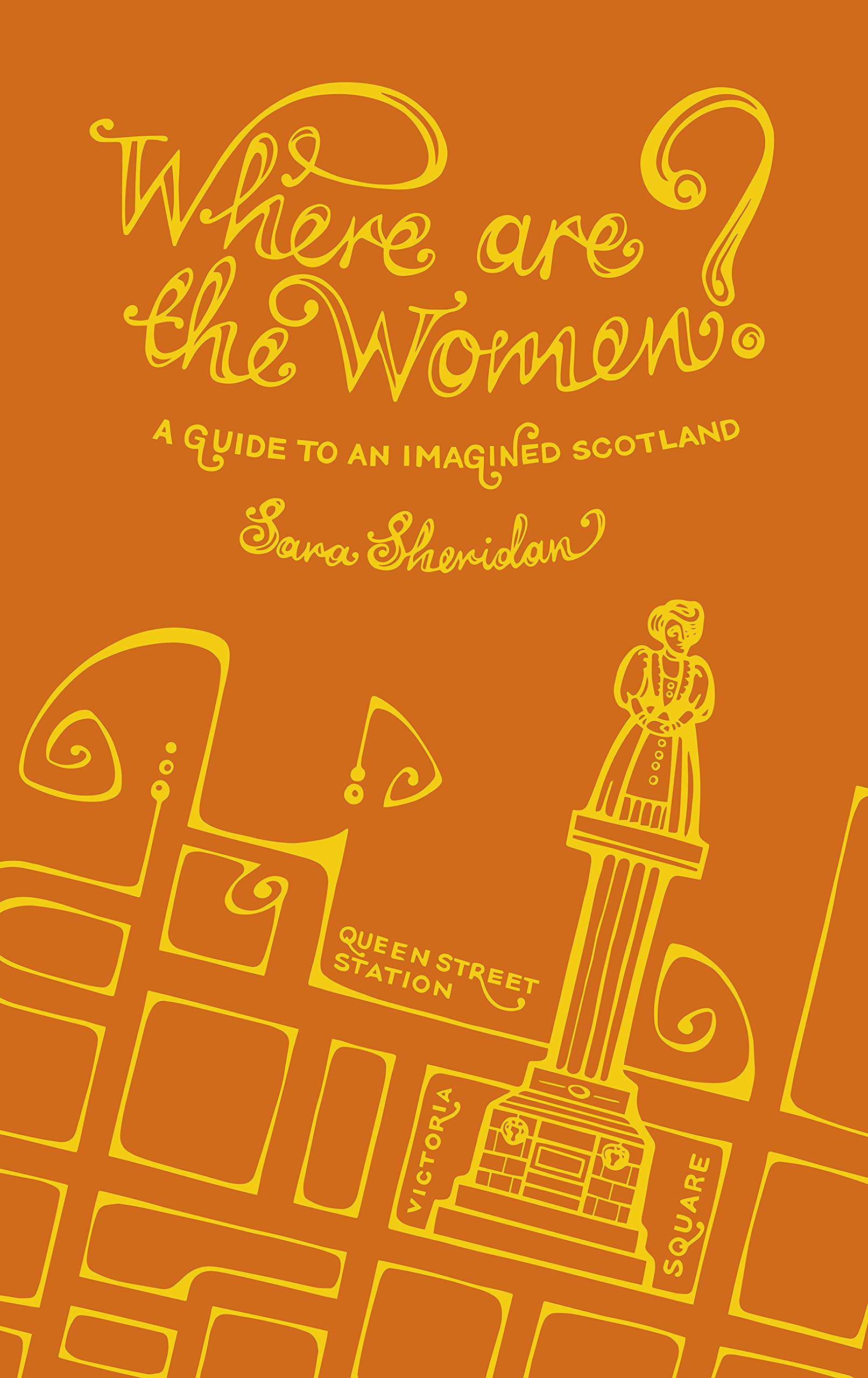
Where are the Women? A Guide to an Imagined Scotland by Sara Sheridan.
Sara Sheridan. Where are the Women? A Guide to an Imagined Scotland. Edinburgh: Historic Environment Scotland, 2019. RRP £9.99 paperback.
In Edinburgh, there are more statues of animals than there are of women. There are only 5 monuments to women in Glasgow. The underrepresentation of women in the built environment is not a uniquely Scottish problem, across the world men are memorialised by monuments, statues, street names, and buildings much more frequently than women. This gives the impression that women just haven’t achieved as much, which is, quite frankly, bullshit. In my Turbulent Londoners and Turbulent Scots blog posts, I recognise and attempt to publicise remarkable women and their achievements. So Where are the Women? A Guide to an Imagined Scotland immediately appealed to me as a creative, and probably more effective, attempt to do the same.
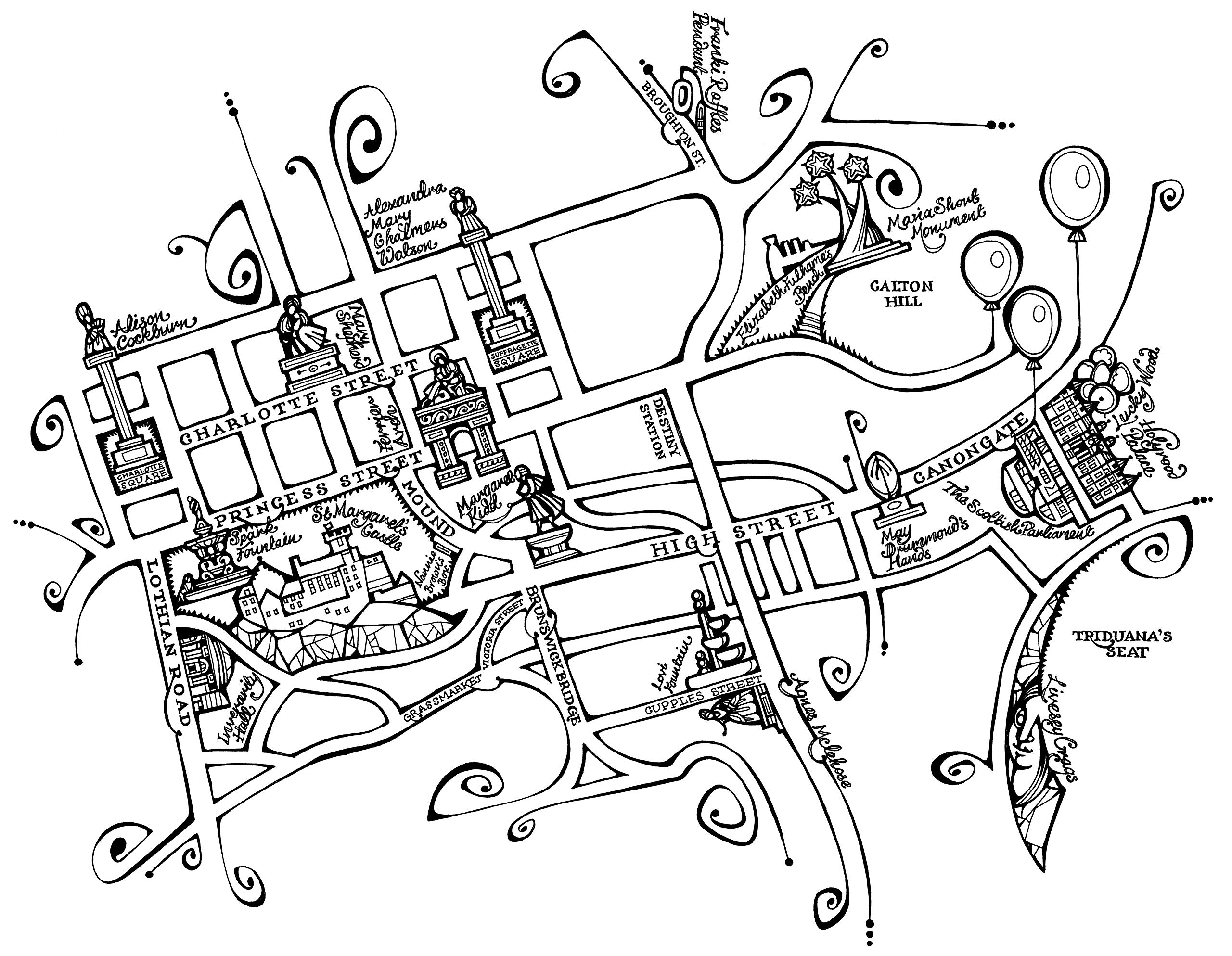
Where are the Women? A Guideto an Imagined Scotland is a guidebook for a hypothetical Scotland in which women are memorialised in the built environment to the same extent as men. Region by region, Sheridan traverses the country, renaming some features and creating others. In each case, she recounts the stories of the women who have contributed to so much, not just in Scotland but around the world. Sheridan also echoes recent calls to move away from statues as a primary form of memorialisation, instead suggesting more creative monuments such as events, benches, murals, fountains, and parks. Each chapter has a beautiful stylised map and sketches of some of the monuments by illustrator and designer Jenny Proudfoot.
The map of central Edinburgh in Where are the Women?
There were times that I found the structure of Where are the Women? a bit repetitive, but this is largely because a guidebook is not meant to be read cover to cover. I am confident that I will go back to this book time again, particularly when I travel in Scotland, and get more out of it each time. Each story does not go into much detail, but Sheridan explains that that this was a deliberate decision: “I wanted to cram this book with stories – making it dense and capturing a real sense of how limited our mainstream history is, in terms of gender” (Sheridan, 2019, p. 411). I found the chapter about Edinburgh easiest to connect too, as it is the only part of Scotland that I have spent any significant amount of time. It frustrated me that I couldn’t get my head around the geography of Scotland’s other regions. However, that is not Sheridan’s fault, and once I stopped trying to figure out how all the monuments related to each other in space (it’s not easy to take off that geographer’s hat!) and just let the stories and memorials wash over me, I enjoyed it much more.
If we want things to change, we need to ask difficult questions about the way our history has been represented and whether some of the things that history currently tells us are valid. We must celebrate our female stories alongside our male ones and make them just as visible.
Sheridan, 2019, p. 14.
Where are the Women? is a beautifully written and designed book that will interest anyone who is interested in histories that have previously been overlooked or ignored. But it is also a demand for history to be represented more equally in the spaces around us. The fact that this book is published by Historic Environment Scotland, the public body charged with protecting and promoting Scotland’s historic spaces, gives me some hope that the demand is being listened to.
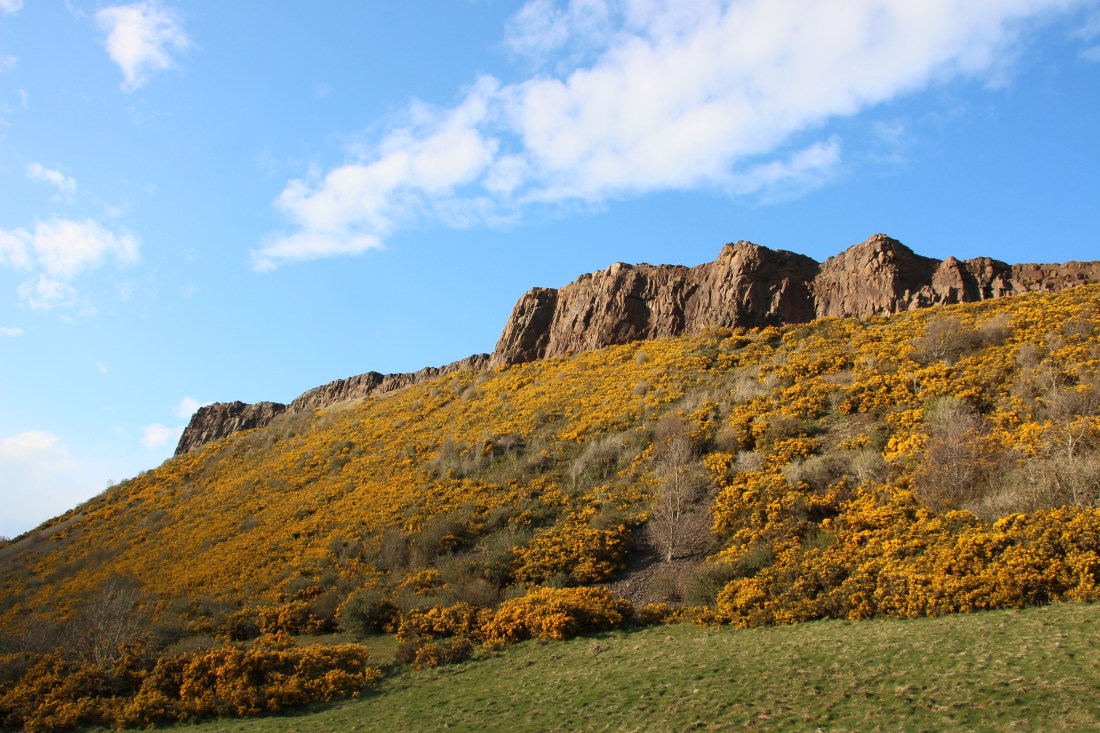
The Radical Road is a path that runs around Salisbury Crags in Holyrood Park. The path sits where the gorse becomes bare rock (Photo: Hannah Awcock).
A 500-year old royal park might not be the first place you look for evidence of Scotland’s turbulent history. But that is exactly what the Radical Road is, a trace of a particularly tempestuous period of history in Edinburgh’s famous Holyrood Park. The path was built in 1822 by unemployed weavers from the west of Scotland after a failed uprising two years earlier. Sadly, the path has been closed ever since a large rockfall in 2018, and it isn’t clear when, or if, it will reopen. Nevertheless, the story of the Radical Road and the events that led up to its construction is fascinating.
The Radical Road runs through Holyrood Park (highlighted in red). The name feels out of place for a royal park (Source: Google).
The American and French Revolutions in the late 1700s sparked radical movements and debates across Europe, and Scotland is no exception. I have written before on this blog about the Political Martyrs Memorial in the Old Calton Burial Ground commemorating 5 reformers that were transported to Australia for their part in a campaign for universal male suffrage and annual elections in the 1790s. This growth in radical ideas and groups was also accompanied by fierce oppression by the authorities, the 1819 Peterloo Massacre being perhaps the most famous British example. The end of the Napoleonic Wars in 1815 led to an economic depression that severely impacted living conditions in Scotland. Demands for reform grew, particularly in the west of Scotland – workers believed that the government didn’t care about their poor living and working conditions. On the 1st of April 1820 a proclamation was posted around Glasgow calling for a general strike. The strike started two days later, with tens of thousands of people across central Scotland refusing to work.
The strike was supposed to be accompanied by an armed uprising. The government had a network of spies, informants and agent provocateurs within the reform movement, so the authorities were aware of most of the plans. The impact of this for the radicals was bigger than just losing the element of surprise, however. The agent provocateurs deliberately encouraged unrest in order to expose the radicals, and exaggerated the threat to the government. Because of this, the number of people willing to take part in armed uprising was lower than both the radicals and the government expected. Largely as a result, the uprising was over before it even began. There were several violent clashes between the authorities and strikers around central Scotland over the next few days. For example, on the 8th of April a crowd managed to free 5 prisoners as they were transported to Greenock Jail. Around 20 people were killed or injured in the fighting. The strike and uprising was crushed quite easily, and 88 people were charged with treason, with 3 men – James Wilson, Andrew Hardie, and John Baird – executed.
The defeat of the uprising pretty much put a stop to radical organising in Scotland. Hundreds of radicals emigrated to escape repression, and the reform movement was decimated. In 1822, George IV visited Scotland. It was the first time a British monarch had visited Scotland in nearly 200 years, and he proved incredibly popular. The visit increased loyalty to the monarchy and further dampened the radical movement. Sir Walter Scott had an important role in organising the visit, and helped to reinvigorate Scottish national identity in the process.
After George IV’s visit, Scott suggested that unemployed weavers from the west of Scotland could be used to build a path in Holyrood Park. As well as giving the men work, it was also designed to discourage further unrest. The work was hard and tiring, leaving the men little time to organise, and they were separated from their local communities and activist networks. A local nursery rhyme was inspired by they scheme:
Round and round the Radical Road the radical rascal ran
If you can tell me how many ‘r’s are in that you can catch me if you can.
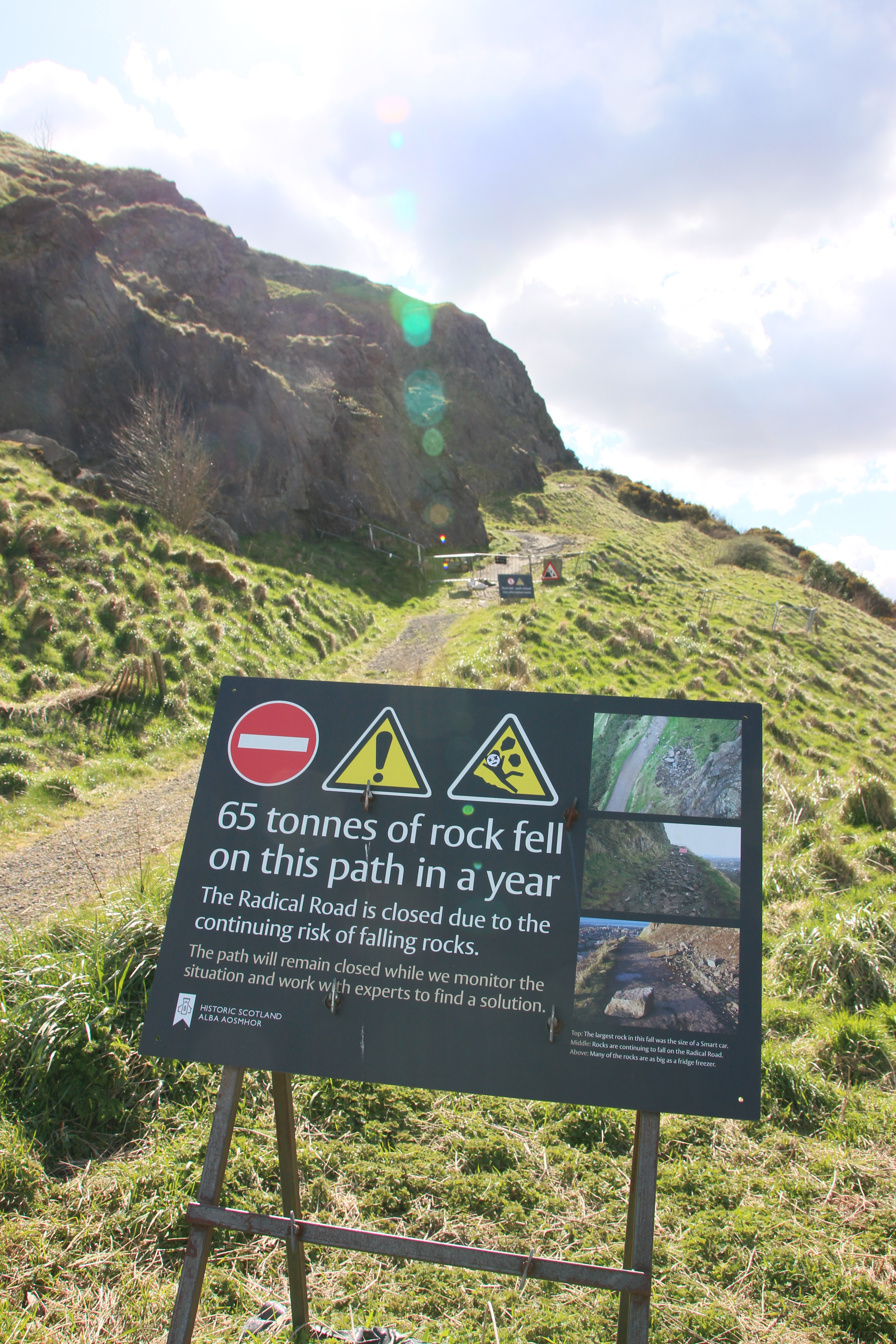
The Radical Road in April 2021. The path has been closed since 2018 (Photo: Hannah Awcock).
The Radical Road became a popular path in Holyrood Park, with views over central Edinburgh and towards the Pentland Hills. In September 2018, 50 tonnes of rock fell onto the path during the daytime, and it was decided the path could no longer remain open. Discussions about how to make it safe for use are ongoing, but the Park’s status as a Ancient Monument makes the situation more complicated. Hopefully it will reopen one day, but until then it remains an important trace of Scotland’s radical history, hidden in plain sight.
Sources and Further Reading
Armstrong, Murray. The Fight for Scottish Democracy: Rebellion and Reform in 1820. London: Pluto Press, 2020.
MacAskill, Kenny. Radical Scotland: Uncovering Scotland’s Radical History from the French Revolutionary Era to the 1820 Rising. London: Biteback, 2020.
Regular readers of this blog will be familiar with the Turbulent Londoners posts, where I celebrate the lives of Londoners who have played a part in the city’s rebellious history. As I recently moved to Edinburgh, I’ve decided to take a look at some of the women who made an impact on Scotland’s radical history.Next up is Helen Crawfurd, a feminist and socialist campaigner.
Helen Crawfurd was a dedicated and talented campaigner. She worked for the causes of women’s rights and socialism for more than four decades. Over the course of her life, she lent her skills to the Women’s Social and Political Union (WSPU), the Independent Labour Party (ILP), and the Communist Party of Great Britain (CPGB), as well as numerous other groups, movements, and committees.
Born in Glasgow on the 9th of November 1877, Helen was the fourth of seven children. The family moved to Ipswich when Helen was young, and returned to Glasgow when she was 17. The family was religious and politically active, so Helen would have grown up surrounded by debate and discussion. Her father was a baker and an enthusiastic union member, and both parents were active in the Conservative Party. In 1898 Helen married the Reverend Alexander Montgomery Crawfurd, a temperance campaigner and opponent of militarism.
Her family may have primed Helen for a life of politics, but the beliefs she developed were quite different to her parents. Shocked by the inequality and poverty that she saw in Glasgow, Helen became a socialist, although the early years of her campaigning were dedicated to the women’s suffrage movement. She joined the National Union of Women’s Suffrage Societies in around 1900 and put her debating skills to good use, becoming one of the most popular speakers in the Scottish suffrage movement. Like many other women, Helen grew frustrated with the slow progress of the movement, and joined the WSPU in 1910, embracing their militant tactics. She was imprisoned several times for her participation in WSPU protests, including being sentenced to two years for her alleged role in the bombing of the botanical gardens in Glasgow in 1914. When in prison, she went on hunger strikes.
1914 was a tumultuous year for Helen. Both her husband and mother died, and she left the WSPU when it came out in support of the First World War. She did not slow down though, joining the ILP. She became Secretary of the Glasgow Women’s Housing Association, and alongside Mary Barbour and Agnes Dollan was instrumental in the 1915 Glasgow rent strikes, which convinced the government to fix rents throughout the UK for the duration of the war. She remained a committed anti-militant, an unpopular stance during the war. In November 1915 she and Agnes formed the Glasgow branch of the Women’s International League, a pressure group opposed to the war. The League had few working class members however, and did not support militant tactics, so in 1916 she helped form the Women’s Peace Crusade. Within a year the Crusade became a national organisation, with Helen as Honorary Secretary.
By the end of the war Helen was a well-known figure, and was appointed Vice-chair of the Scottish divisional council of the ILP. She grew frustrated with what she saw as a lack of radicalism in the ILP though, and became interested by attempts to establish a Communist party in Britain. In July 1920 she traveled to Moscow and interviewed Lenin. Helen tried to establish a Communist faction within the ILP, and when this failed she left and joined the recently formed CPGB, quickly being appointed to it’s executive committee. She worked on increasing female membership, including editing a women’s page of the party’s official paper, the Communist. Helen also continued to campaign on other issues close to her heart. In 1919 she was part of the British delegation to the Conference of the Women’s International League in Zurich, alongside other formidable women such as Charlotte Despard, Ellen Wilkinson and Emmeline Pethick-Lawrence.
In 1922 Helen became secretary of the Worker’s International Relief Organisation, which provided aid and support in struggling industrial regions. She visited Ireland in support of Home Rule, and was involved in organising several international conferences. She threw her efforts behind the 1926 General Strike, giving speeches and distributing food. Helen stood as a Communist candidate in the 1929 and 1931 general elections, losing on both occasions.
During the 1930s Helen worked with the Friends of the Soviet Union, which coordinated global solidarity efforts with the Soviet Union. She also recognised the rising threat of fascism however, and in 1933 became the honorary secretary of two committees aimed at combating fascism and anti-Semitism in Scotland. In 1938 she organised the Peace and Empire Congress, with the goal of coordinating a peace movement across the British Commonwealth. Like many members of the CPGB, she was ambivalent towards the Second World War, arguing the Communists had to be convinced Britain was commited to fighting fascism before they could support it.
During the Second World War, Helen retired to Dunoon in Argyll and Bute. Even retirement did not stop her campaigning efforts however. After the war she served as Dunoon’s first female Councillor for 2 years, and she started a local discussion group on Marxist literature. In 1947 she married George Anderson, a fellow member of the CPGB. She passed away on the 18th of April 1954.
The list of Helen’s activities and achievements throughout her life is formidable. She worked tirelessly for what she believed in, and certainly made her mark on Scotland’s, and in fact British and European, radical culture.
Sources and Further Reading
Corr, Helen. “Crawfurd [née Jack; other married name Anderson], Helen.” Oxford Dictionary of National Biography. Last modified 23rd September 2010, accessed 10th February 2021. Available at https://doi.org/10.1093/ref:odnb/40301 [Subscription required to access].
A stereotypically Scottish public health message on Leith Walk (Photo: Hannah Awcock).
Protest stickers tend to reflect the issues that people care about. It should come as no surprise then that the coronavirus pandemic has emerged as a popular topic of stickers over the last 12 months. I have written about coronavirus protest stickers in Brighton, where I spent the first lockdown, but since I moved to Edinburgh I have found a whole new set of stickers, which have evolved as the pandemic has. From criticism of the government’s handling of the pandemic, workers rights, and complaints from the city’s student population, through to questioning the efficacy of lockdowns and masks and even rejecting the existence of Covid-19, the stickers I have found over the last few months represent a range of conflicting views.
Although this sticker doesn’t explicitly mention Covid, it is in the same style as other stickers I found nearby that did directly mention the virus, so I am fairly confident that this sticker is refering to Covid rather any of the other things Boris Johnson has been criticised for over the last few years (Photo: Hannah Awcock).
This is one of the other stickers in the same style. The text is faded, and it looks like someone tried to scratch it off at some point, but it says “Clapping isn’t enough.” The weekly Clap for Carers started out as a very popular gesture during the first Lockdown, but later was criticised for being just that, an empty gesture (Photo: Hannah Awcock).
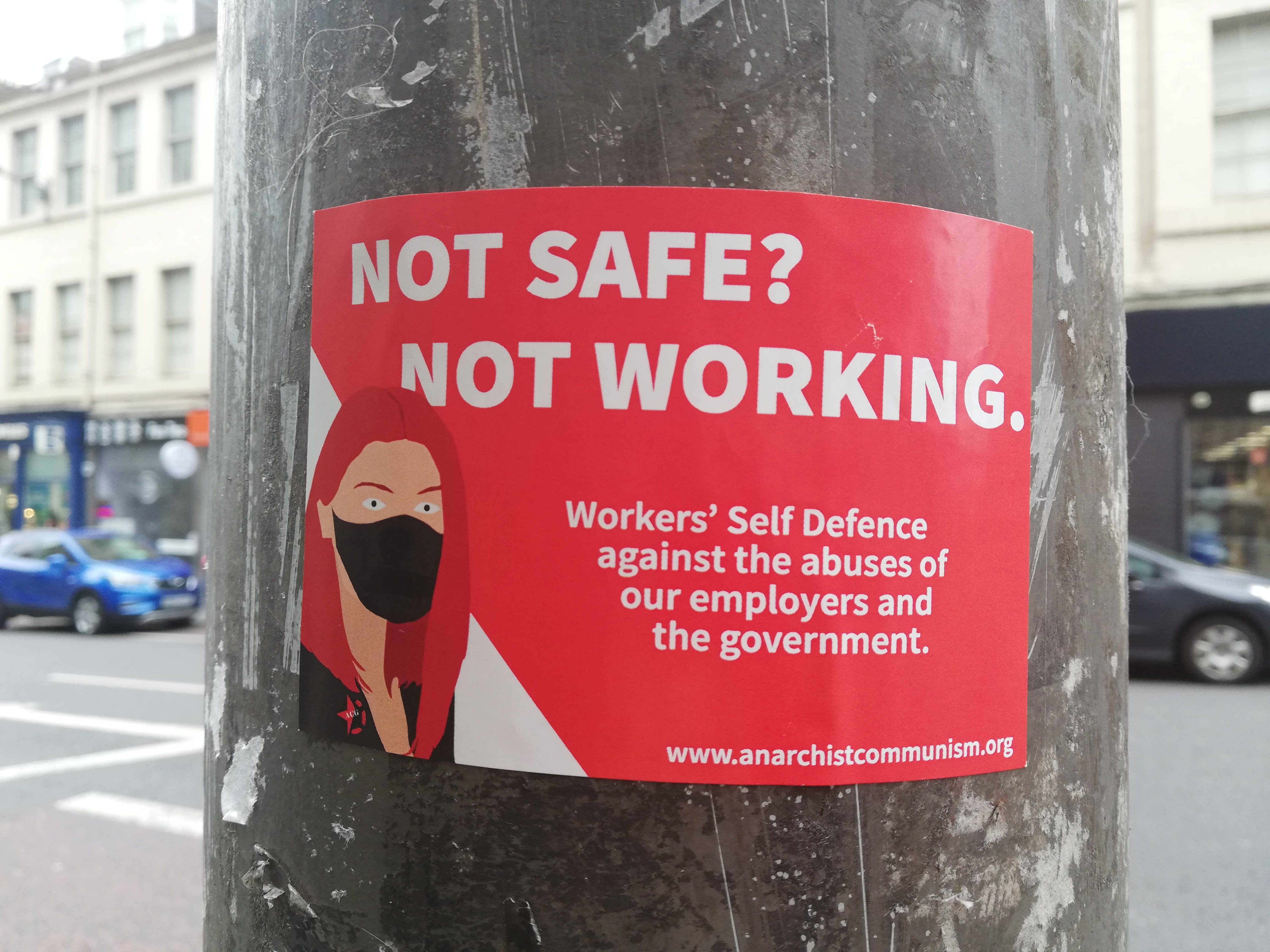
Many employees felt compelled to go back to work after the first lockdown, even if they were worried about their health. The No Safety No Work campaign is a new campaign to protect worker safety during Covid-19 run by the Anarchist Communist Group (Photo: Hannah Awcock).
Another sticker promoting the No Safety No Work campaign. Again, there is no direct reference to Covid (Photo: Hannah Awcock).
Another sticker produced by the Anarchist Communist Group calling for the redistribution of wealth. Many of those classified as key workers during the pandemic are poorly paid, and it has highlighted inequality in wages and income (Photo: Hannah Awcock).
As the pandemic has progressed the number of protests against Lockdowns and masks has increased. There is also a significant proportion of people who do not trust the vaccine. The Saving Scotland Party seems to have been set up to campaign against coronavirus restrictions (Photo: Hannah Awcock).
UK Column is an alternative news website and newspaper founded in 2006. Judging from the cartoon on this sticker, they also disapprove of coronavirus restrictions. Someone has responded by writing on the sticker (Photo: Hannah Awcock).
This sticker is a modified version of a well-known image created by the street artist Shepard Fairey (the mask has been added). Although it isn’t explicitly anti-mask, that is how I interpret it. Many people opposed to coronavirus restrictions have complained that they are authoritarian, and I think this sticker is making a point along those lines. I suppose it could be an honest attempt to encourage people to wear masks, but it doesn’t feel like that! (Photo: Hannah Awcock).
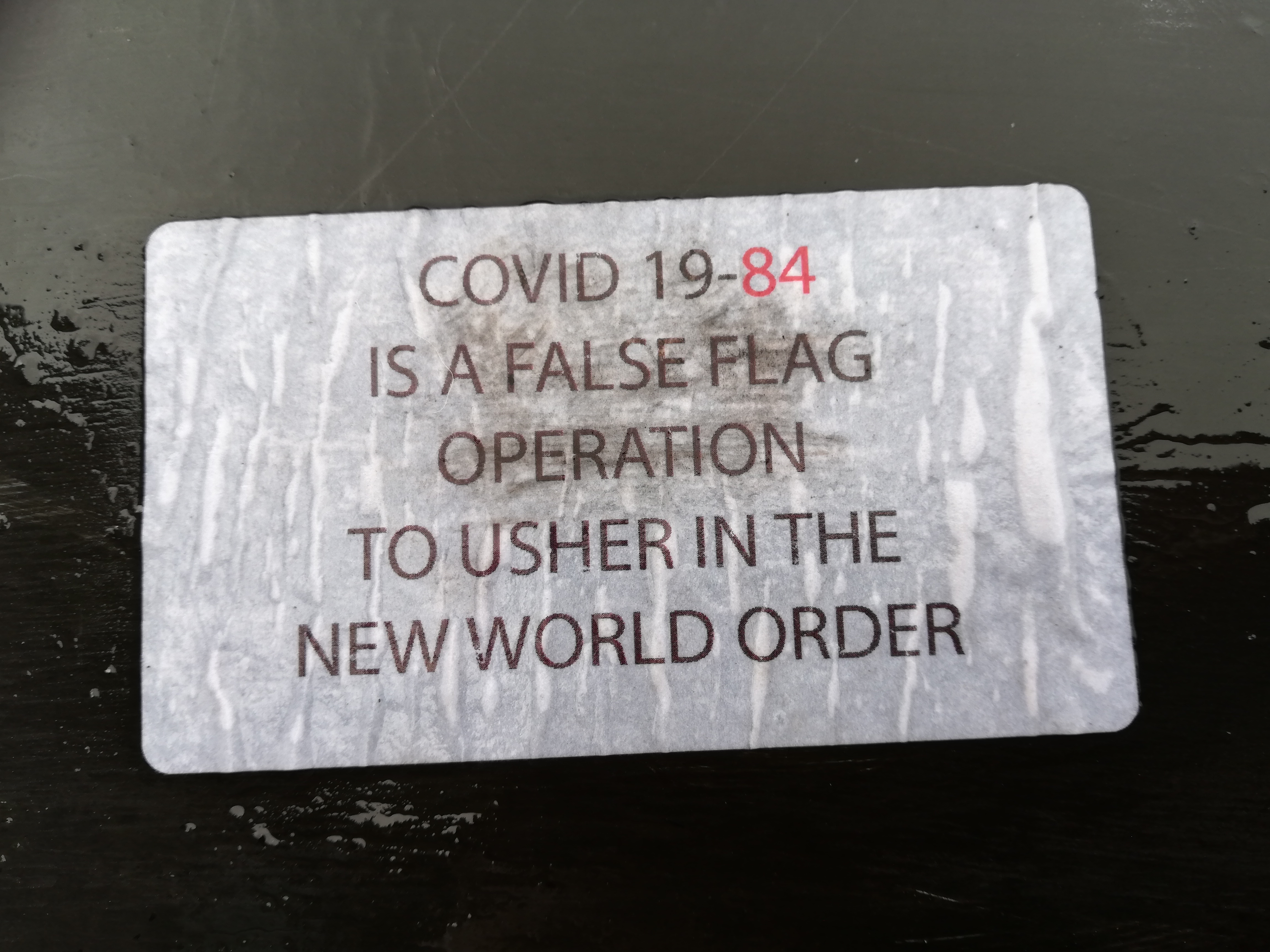
It is not uncommon to see the coronavirus restrictions linked to the dystopic world of George Orwell’s 1984. This sticker is suggesting that Covid-19 is an excuse for cracking down on civil liberties. ‘False flag’ is a phrase popular with conspiracy theorists (Photo: Hannah Awcock).
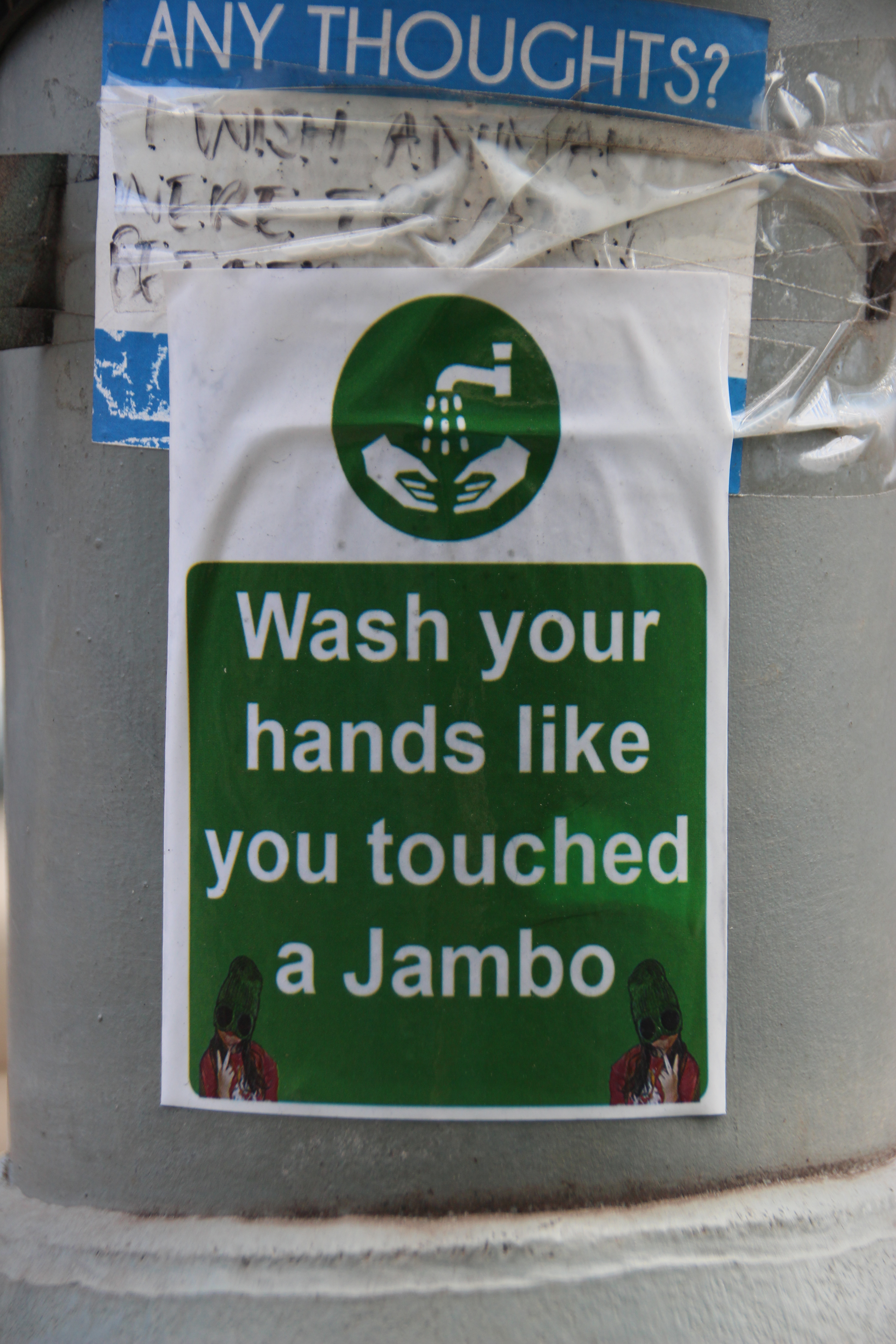
I wanted to end on a slightly more positive note, and this sticker made me smile. Once I figured out what it means, that is! ‘Jambo’ is a nickname for a supporter of the Heart of Midlothian football team, based in Edinburgh. Apparently they have a healthy rivalry with the other Edinburgh team, Hibernian. Something tells me this sticker was made by a Hibs fan! (Photo: Hannah Awcock).
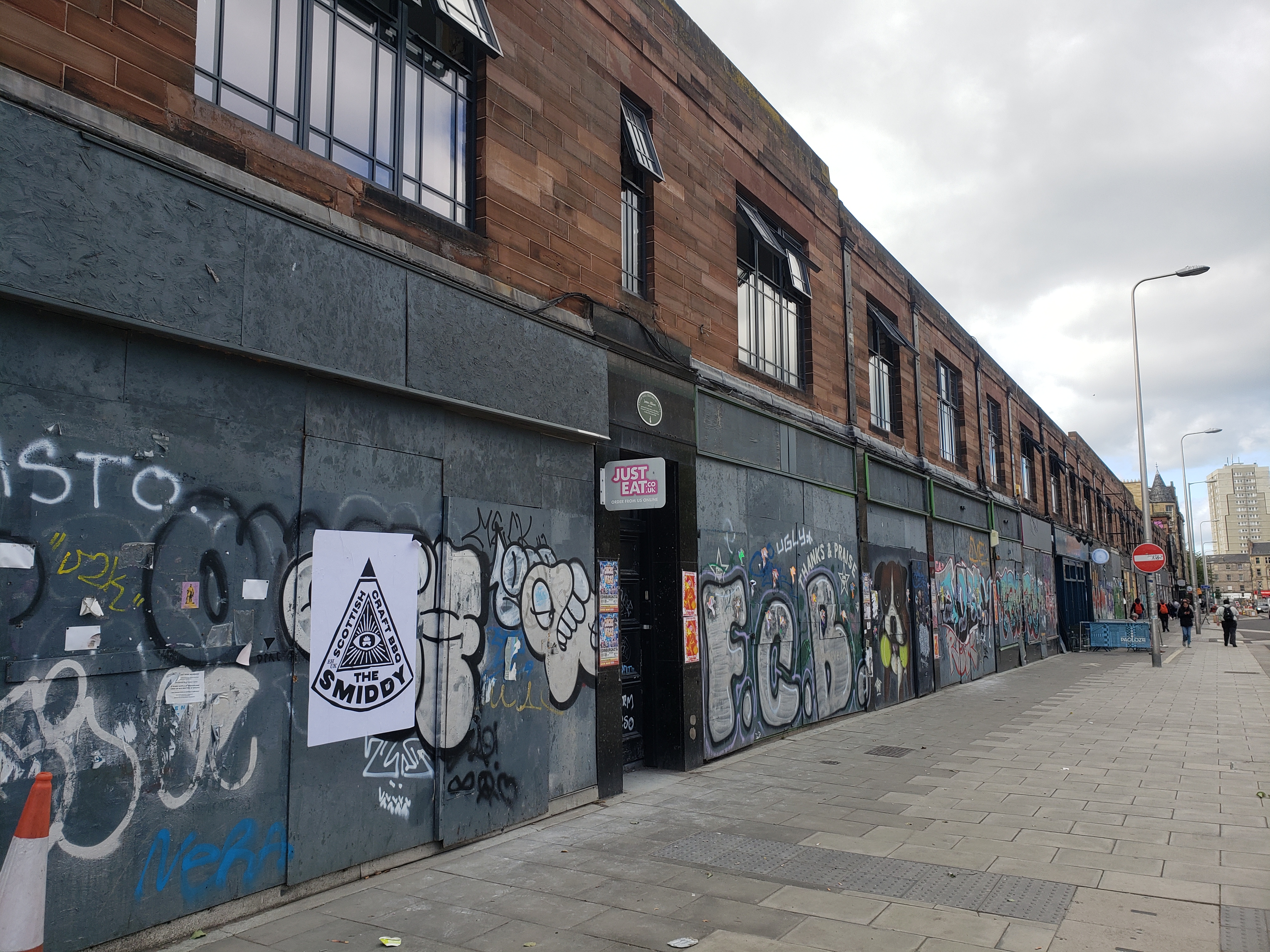
The fate of 106-154 Leith Walk is still yet to be determined (Photo: Hannah Awcock).
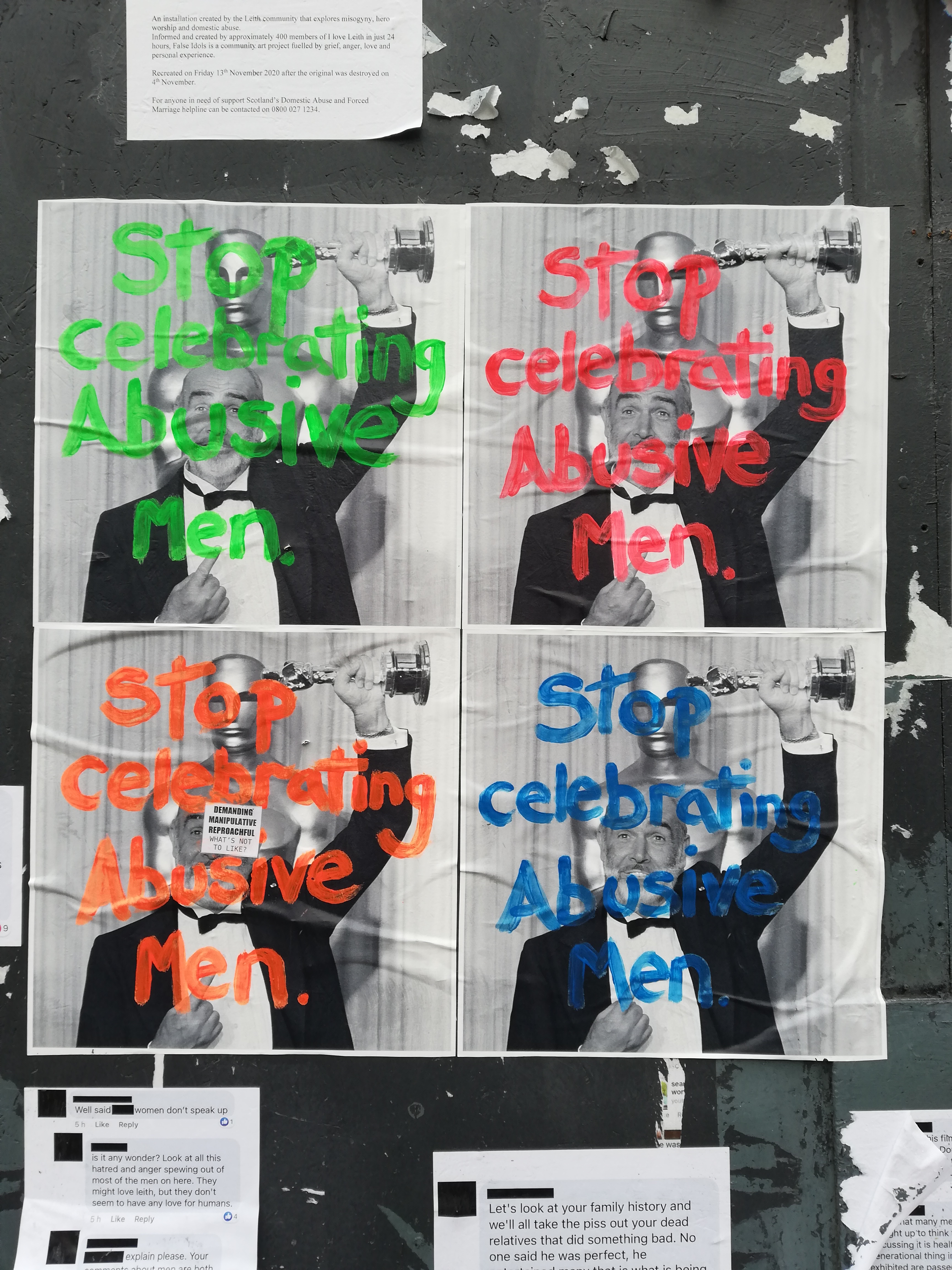
Towards the Leith end of Leith Walk is a long red sandstone building. 106-154 Leith Walk is currently the focus of a bitter struggle between developers who want to demolish the building to build student housing and the grassroots campaign group Save Leith Walk. In January 2019 planning permission for the new development was denied, a significant victory for the community group. New plans have been submitted that propose to keep the building intact and reopen it as commercial spaces, but in the meantime the shop fronts remain boarded up. The dark gray wooden boards have come to serve a purpose of their own however, as a sort of community pin board. Slogans, street art, and other miscellanea appears, disappears, and reappears often. One of the most recent installations is called False Idols, by Creative Electric.
False Idols, an installation on Leith Walk, Edinburgh in November 2020 (Photo: Hannah Awcock).
The death of actor Sean Connery on the 31st October 2020 sparked a predictable outpouring of grief and admiration, particularly in his home city of Edinburgh. Not everyone mourned his loss, however. It was well known that Connery physically abused women. On several occasions he explained how he felt entitled to hit women who ‘deserved’ it, and his first wife Diane Cliento accused him of sustained physical and mental abuse during their marriage. Many people, myself included, didn’t know about this until after Connery’s death, and False Idols questions how such a man could be celebrated as a national hero.
False Idols demands that society stops celebrating abusive men (Photo: Hannah Awcock).
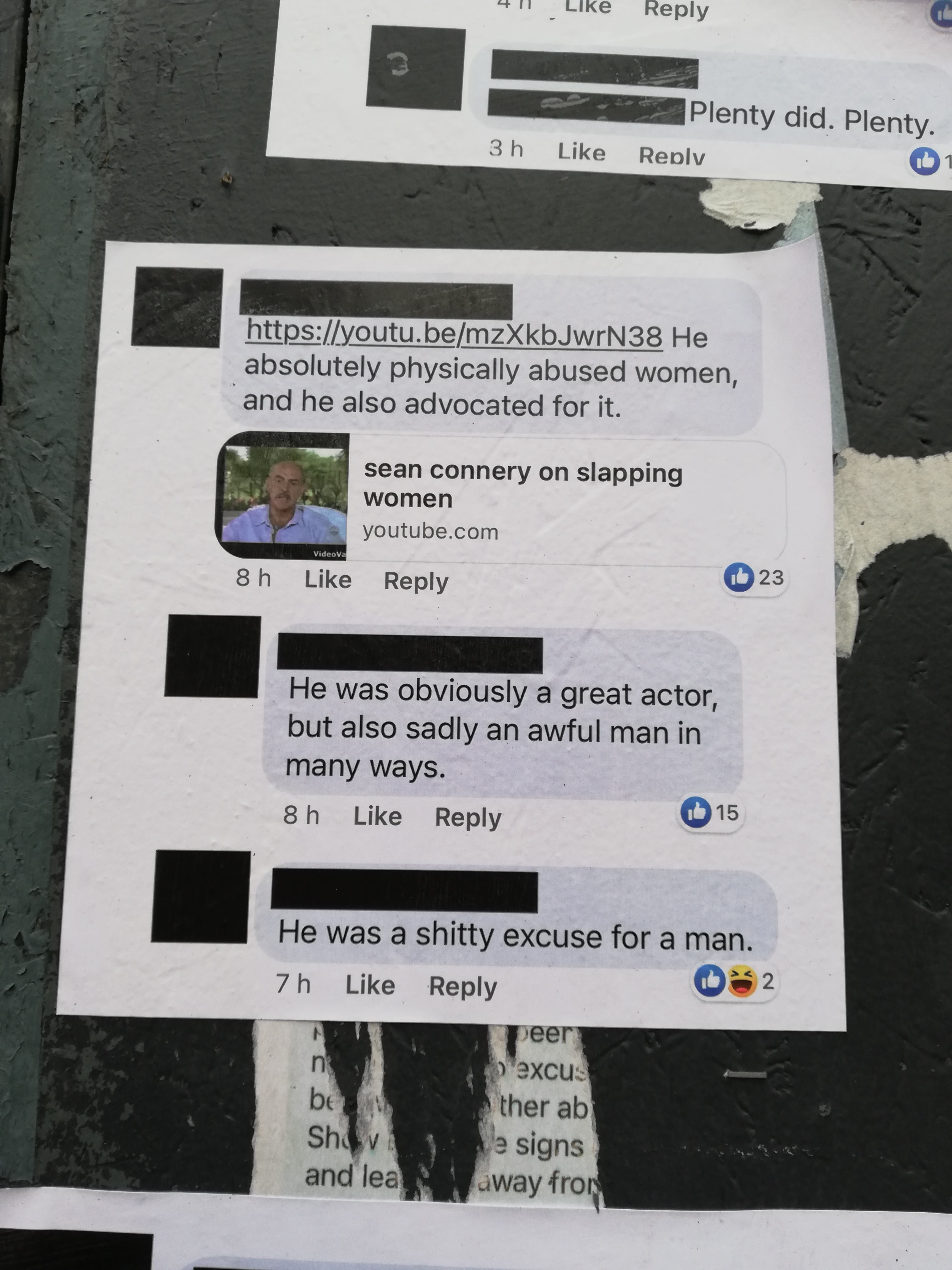
False Idols is described as a community art project, and in some ways it is the literal embodiment of this term. It is made up of comments posted on the I Love Leith Facebook group in the wake of Connery’s death. It must have been installed quickly, because it was destroyed on the 4th of November, just four days after Connery died. It was replaced on the 13th of November, and I took these photos two weeks later, on the 22nd. It was still largely intact when I passed by again on the 29th. You can never be sure how long street art is going to last, and the more controversial something is, the more likely it is to upset someone enough that they will try to obscure or destroy it. This is part of what makes political street art so special; it gives people an opportunity to express their opinion in public space, a privilege normally reserved for those who are rich or famous enough to attract media coverage or buy advertising.
Some of the comments included in False Idols (Photo: Hannah Awcock).
Some of the included comments defend Connery, but they were clearly selected to make us question how such a person could be so revered (Photo: Hannah Awcock).
It is generally accepted that people say things on social media that they wouldn’t be willing to say in ‘real life’. So it is interesting to see the language of social media transposed onto the public space of Leith Walk. The comments have been anonymised, but I wonder how the commenters would react if they suddenly saw their own words as they walked past. Would they regret their choice of words, or their tone? Or would they stand by them? Would they be upset, angry, or proud that their opinions have been plastered onto the physical fabric of Leith? Would they even recognise their own words in this strange context?
Both political street art and social media provide ‘ordinary’ people with a platform to express their opinions. False Idols brings these two platforms together, with thought-provoking results.
Regular readers of this blog will be familiar with the Turbulent Londoners posts, where I celebrate the lives of Londoners who have played a part in the city’s rebellious history. As I recently moved to Edinburgh, I thought it would be fun to take a look at some of the women who made an impact on Scotland’s radical history. Last time I looked at Wendy Wood, artist and campaigner. This time it is the turn of Margo MacDonald, a charismatic politician and broadcaster.
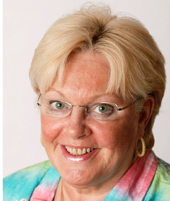
Margo MacDonald in 2011 (Contains information licensed under the Open Scottish Parliament Licence V.2).
The movement for independence in Scotland has been building momentum since the mid-twentieth century, and has made some significant gains over the last 50 years. Central to those gains have been the efforts of some charismatic and driven women, including Wendy Wood, who was the first Turbulent Scot I featured on this blog, and Margo MacDonald, the focus of this post. Like Wendy, Margo was passionate and likeable, although both women struggled with the constraints of membership in a political party.
Margo Aitken was born on the 19th of April 1943, one of 3 children. She grew up in East Kilbride, and trained as a PE teacher when she left school. In 1965 she married her first husband Peter MacDonald, they had 2 children. The couple ran a pub, and Margo’s experiences talking to customers and getting to know the regulars seems to have been influential on her later political beliefs.
Margo embarked on a political career in the early 1970s, winning the Glasgow Govan by-election in 1973 as an SNP candidate. She won by 571 votes. This was a remarkable achievement; the SNP wasn’t considered a serious political force at that point, and it was widely believed that they couldn’t win an election under a Conservative government. Margo proved all the doubters wrong. She wasn’t an MP for long though, as she lost her seat in the 1974 General Election. She lost further elections in 1978 and 1979, but her 1973 victory helped establish the SNP as a serious political force.
In 1974 Margo became Deputy Leader of the SNP. She was critical of the Party’s poor performance in the General Election that year, particularly the failure to convert more Labour voters. She was a prominent member of the 79 Group, which tried to persuade the SNP to move further left to appeal to the working classes. The Group was banned by the SNP in 1982, and many of its members left the Party. However, they were later readmitted to the party and several had successful careers, including Margo and Alex Salmond.
Margo’s membership of the 79 Group meant that she wasn’t re-elected as Deputy Leader of the SNP in 1979, and she was one of those who left the Party in 1982. She established herself as a successful radio presenter, and wrote for several Scottish newspapers. She remarried in 1981, to politician and columnist Jim Sillars. As devolution became more likely in the mid-1990s, Margo rejoined the SNP as she believed it was the only way to achieve Scottish independence. She was elected as an MSP for Lothian in 1999. Margo was popular, but was outspoken on lots of contentious issues such as sex worker’s rights and MSP’s salaries. She struggled with the restrictions of being part of a political party, and was disciplined in 2000 for not toeing the party line.
When the SNP chose its candidates for the Scottish elections in 2003, Margo was 5th on the list, almost guaranteeing that she would not get re-elected. She stood as an independent candidate in protest, and was kicked out of the SNP. Margo had been diagnosed with Parkinson’s disease in 1996; in the run up to the 2003 election this became public knowledge. Margo believed someone in the SNP had leaked the information in an attempt to hamper her chances of getting re-elected, which they denied. However her diagnosis got out, it didn’t prevent her getting elected. She went on to be reelected as an independent candidate in 2007 and 2011. Margo used her platform to continue to fight for what she believed in. She became a fierce advocate for assisted suicide; this was a particularly personal issue because of her illness.
Throughout her career, Margo was suspicious that the British Security Services were interfering in Scottish politics. She believed that MI5 infiltrated the SNP in the 1970s, and in the run up to the 2014 Independence Referendum she asked the Security Services to guarantee that they would not interfere. Throughout her career she supported the causes that mattered to her; she once joined an Anti-Trident protest outside the Scottish Parliament, and she campaigned to ban vuvuzelas in Scottish football grounds.
Known as firebrand and rebel, Margo remained a popular and well-known politician until her death on the 4th of April 2014. She was respected, if not always liked, by allies and opponents alike. Although she never had a smooth relationship with the SNP, she helped to establish the party as a serious political actor. I’m sure that many Scots remember her fondly.
Torrance, David. “MacDonald [nee Aitken], Margo Symington Jack.” Oxford Dictionary of National Biography. Last modified 15th February 2018, accessed 27th October 2020. Available at https://doi.org/10.1093/odnb/9780198614128.013.108517 [Subscription required to access]












 Turbulent Isles