Turbulent Londoners: Katherine Chidley, 1590s-c.1653

Turbulent Londoners is a series of posts about radical individuals in London’s history who contributed to the city’s contentious past, with a particular focus of women, whose contribution to history is often overlooked. My definition of ‘Londoner’ is quite loose, anyone who has played a role in protest in the city can be included. Any suggestions for future Turbulent Londoners posts are very welcome. The next Turbulent Londoner is Katherine Chidley, an activist for religious toleration and a leader of Leveller women.


wenceslas_hollar_-_the_kitchen-maid_state_1
A drawing of a servant or housewife in 1640 by Wenceslas Hollar. Katherine Chidley might have dressed like this (Source: ECW Living History Resources).

The further back in time you go, the harder it is to find out about individuals who weren’t members of the aristocracy, especially if they were women. There are some women who managed to leave a trace in the archives, often thanks to their radicalism, such as Mary Astell (1666-1731) and Elizabeth Elstob (1683-1756). Katherine Chidley lived even earlier, between the 1590s and about 1653. She was a religious dissenter and a key member of the radical networks that preceded the Levellers, as well as the Levellers themselves.

The first time Katherine Chidley appears in the historical record she is already married with seven children. Along with her husband Daniel, she set up an independent church in Shrewsbury  in the 1620s which clashed with the local established church. At this point everyone was required by law to be a member of the Church of England, and there was no toleration for anyone who wanted to worship differently. Radical religious sects had an emphasis on church democracy, which meant that women played more of a role than in other sectors of society, as preachers, prophetesses and petitioners. In 1626 Katherine was charged with refusing to attend church, along with 18 others. She also got in trouble for refusing to attend church for an obligatory cleansing after childbirth.

The Chidley family moved to London in 1629. Katherine’s husband became a member of Haberdashers Company, and their oldest son Samuel started an apprenticeship in 1634 . The family’s views became more radical and separatist after they moved to London. Daniel and Samuel helped to establish a dissenting congregation headed by John Duppa. The congregation claimed the right to choose their own pastor not paid for by Church funds. The congregation itself was illegal, and its members faced harassment, arrest, and imprisonment.

Katherine authored several pamphlets in defence of religious radicalism. Thomas Edwards was a popular puritan preacher at the time, who argued against religious Independents from a conservative Presbyterian perspective. In 1641 he published a pamphlet, addressed to Parliament, arguing against religious tolerance. Katherine was the first to attack Edwards’ arguments in print, in her first pamphlet. It was called The Justification of the Independent Churches of Christ, and it was very unusual for a woman to take such a step. Edwards ignored her response, embarrassed to have been so publicly confronted by a woman.
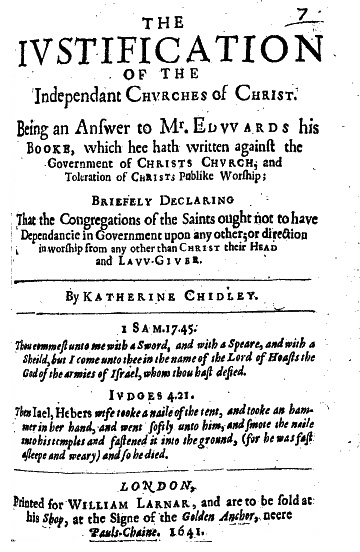
1641-10_Chidley_Justification_TP360
The front page of Katherine’s first pamphlet, from 1641 (Source: Online Library of Liberty).

Katherine’s concept of toleration was broad, even extending to Jews and Anabaptists, groups that faced extreme discrimination at the time. She believed that everyone should be able to organise their own churches if they so desired. Katherine did view women as weak and inferior to men, but she defended a wife’s right to make her own decisions about religion. She also frequently discussed examples of God using the weak or socially inferior to defeat the powerful and ungodly. Katherine may not have been a feminist by modern standards, but her views were radical for the time. She published 2 more pamphlets in 1645. The first was another attack on Thomas Edwards, called  A New-Yeares-Gift, or a Brief Exhortation to Mr. Thomas Edwards; that he may breake off his old sins, in the old yeare, and begin the New yeare, with new fruits of Love, first to God, and then to his Brethren. They didn’t really go for snappy titles in the seventeenth century.

When the Leveller network emerged, Katherine became a leader of Leveller women. The Levellers were a radical movement that argued for popular sovereignty, equality before the law, and religious toleration. They gained significant popular support between the First and Second English Civil Wars, but were considered too radical even for Oliver Cromwell and the Protectorate. Daniel died in 1649, and it seems as though Katherine took over his business with the help of Samuel. As well as being a religious radical, she was also a successful businesswoman, handling government contracts worth significant amounts. In 1649 Katherine was one of the organisers, and probably the author, of a women’s petition to free four Leveller leaders from the Tower of London. In 1653, when Leveller leader John Lilburne was again imprisoned and charged with treason, Katherine led a group of 12 women to Parliament to present a petition demanding his release signed by 6000 women.

Leveller Women 1647
An image of a meeting of Leveller women in 1647, created by Red Saunders in 2014 as part of the Hidden Project (Source: Red Saunders).

Although much of her activism involved male family members, and she believed that women were inferior to men, Katherine Chidley was a fierce woman who fought for the right to make her own decisions about how she worshipped. There is no trace of her in the historical record after 1653, so the rest of her life is a mystery.

Sources and Further Reading

Rees, John. The Leveller Revolution: Radical Political Organisation in England, 1640-1650. London: Verso, 2016.

Wikipedia, “Katherine Chidley.” Last modified 28 May 2017, accessed 15 August 2017. Available at https://en.wikipedia.org/wiki/Katherine_Chidley

Book Review: The Leveller Revolution- Radical Political Organisation in England, 1640-1650

the-leveller-revolution-front-cover
The Leveller Revolution by John Rees.

John Rees. The Reveller Revolution: Radical Political Organisation in England, 1640-1650. London: Verso, 2016. £25.

John Rees co-authored one of my favourite books, A People’s History of London. As such, I was really looking forward to the publication of The Leveller Revolution: Radical Political Organisation in England, 1640-1650, and I had high expectations. Whilst it doesn’t quite live up to A People’s History of London, it is a very good book.

The Leveller Revolution is derived from Rees’ doctoral research. As such it is thoroughly researched, as evidenced by the detailed content and and considered analysis. The book is not just a narrative of the rise and fall of the Levellers as a political force, it is also an intervention in the scholarly debate on the nature and significance of the Levellers. Rees argues that whilst other groups used similar organisational and campaigning tactics, no one else used them as consistently and to such effect as the Levellers. He also argues that the Levellers were the only group to focus on popular politics and mobilisation, as opposed to social and political elites.

I have tried to…examine the Levellers as a political movement integrating activists from different constituencies, and creating still broader alliances with other political currents, for the joint pursuance of revolutionary ends.

(Rees, The Leveller Revolution, p. xx)

The Leveller Revolution has multiple strengths. Rees’ arguments are persuasive; he makes a strong case that the Leveller organisation emerged out of pre-existing radical networks consisting of individuals who already had extensive experience of activism. Rees argues that London was significant to the development of the Levellers, but the book is not London-centric; many of the examples Rees uses to demonstrate his arguments come from elsewhere in the country. In addition, whenever there is historical doubt (e.g. over the authorship of a pamphlet, or exactly who was present at a particular event), Rees is open about that uncertainty, then justifies his own opinion. I always appreciate it when authors who are willing to acknowledge these kind of metholodogical subtleties.

Unfortunately, I often struggled to keep track of the book’s narrative, and I think there are 2 reasons for this. The first is that there were a large number of individuals involved in the radical networks around the time of the English Civil Wars, many of whom had quite similar names. As such, I found it difficult to remember who was who. Whilst there is little Rees could have done about the number of individuals involved and their names, a dramatis personae might have been helpful. The second reason for my confusion is, I think, that Rees assumes that the reader has a confident knowledge of the chronology of the Civil Wars. The book refers to events or battles by name only, making it hard to follow the narrative if you do not know when they took place or what happened. I did study the period as part of an A-level in Early Modern History, but that was almost a decade ago, and my knowledge is a bit rusty. If you are not familiar with the period, then I suggest reading The Leveller Revolution in conjunction with another book that details the key events of that time (I would recommend A Brief History of The English Civil Wars: Roundheads, Cavaliers and the Execution of the King by John Miller).

The Leveller Revolution is a thoroughly-researched, well-argued book. Whilst I found it less approachable than A People’s History of London, I would definitely recommend it to anyone who has a interest in the English Civil Wars, or the history of protest and dissent.

Turbulent Londoners: Robert Lockyer, 1625/6–1649

Turbulent Londoners is a series of posts about radical individuals in London’s history who contributed to the city’s contentious past. My definition of ‘Londoner’ is quite loose, anyone who has played a role in protest in the city can be included. Any suggestions for future Turbulent Londoners posts are very welcome. The fourth Turbulent Londoner is Robert Lockyer, a 17th Century Leveller and parliamentarian who became a martyr for his cause.


Illustration from the 1649 title page of The Declaration and Standard of the Levellers of England (Source: Wikimedia).

Since 2009, Crossrail has been burrowing its way beneath central London. Considering London has over 2000 years of history, it is not surprising that Crossrail is engaged in one of the largest archaeological projects the UK has ever seen. Excavation is soon to begin on the Bedlam burial ground under Liverpool Street Station, which was used in the 16th and 17th Centuries, and is the location of the final resting place of Robert Lockyer, Leveller and parliamentarian.

Robert Lockyer was alive several hundred years before any of the Londoners I have featured so far, and he was not a member of the aristocracy, so relatively little is known about his life. He would have faded into obscurity if not for the dramatic circumstances of his death when he was just 25. Lockyer was probably born in Bishopsgate, London, and joined the parliamentarian army in 1642, the year in which civil war broke out between King Charles I and the Long Parliament.

Lockyer was a Leveller, a group that was considered radical even in the English republic established after the execution of Charles I in 1649. They were the first democratic movement in Britain, demanding universal manhood suffrage, equality before the law, and religious tolerance. Their ideas were influential in the American and French revolutions, and they continue to inspire activists.

London was politically volatile after Charles’ execution, and some units of the army were moved outside the city to separate them from Leveller influence. Lockyer’s regiment was already restless, and when the order was given to move to Essex on the 26th April 1649 Lockyer and the other men under Captain John Savage refused to leave. They took the troop’s colours and barricaded themselves in The Bull Inn, a well-known radical meeting place. Captain Savage found them and ordered them back, but they refused unless they were paid a fortnight’s wages with arrears. Lockyer was singled out with a direct order to obey, but still he refused.

Eventually the Commander-in-chief of the Army, Sir Thomas Fairfax, and Oliver Cromwell himself arrived, and everyone was arrested. The 6 ringleaders, including Lockyer, were sentenced to death. Lockyer was the only one who was executed though, by firing squad in St Paul’s Churchyard the next day. He became a martyr for the Leveller cause, and his funeral was attended by 4000 Londoners wearing black and sea green (the colour of the Levellers) ribbons, a powerful show of force for the Leveller cause.

Robert Lockyer was not rich, famous, or politically powerful. Yet as a result of his actions he is still remembered nearly four centuries later, and out of the 3000 skeletons expected to be dug up during the Crossrail excavation, his is the one causing excitement. Neither Lockyer nor the Levellers managed to achieve their goals, and he and many others suffered a great deal for their beliefs. However he proved an inspiration for many activists and campaigners since, and it is impossible to tell how many successful campaigns his story played a role in motivating.

Sources and Further Reading

Benn, Tony. ‘The Levellers and the Tradition of Dissent.’ BBC History. Last modified 17th February 2011, accessed 9th February 2015. http://www.bbc.co.uk/history/british/civil_war_revolution/benn_levellers_01.shtml

Gentles, Ian J. ‘Lockyer, Robert (1625/6–1649)’, Oxford Dictionary of National Biography. Oxford University Press. 2004, accessed 9th February 2015 http://www.oxforddnb.com/view/article/47102

Keys, David. ‘Could Crossrail have uncovered the last resting place of Britain’s left-wing martyr in Bedlam burial ground under Liverpool Street station?’ Independent. Published February 9th 2015, accessed February 9th 2015. http://www.independent.co.uk/news/science/archaeology/news/could-crossrail-have-uncovered-the-last-resting-place-of-britains-leftwing-martyr-in-bedlam-burial-ground-under-liverpool-street-station-10032619.html

Sea Green Society, The. ‘For the Liberties of England…’ The Sea Green Society. Last modified 18th August 2009, accessed 9th February 2015. https://seagreensociety.wordpress.com/2009/08/18/for-the-liberties-of-england/