Rosenberg, David. Rebel Footprints: A Guide to Uncovering London’s Radical History. London: Pluto Press, 2015
“Londoners today are not short of issues to protest about. And as we continue to march through the streets of our capital city, holding placards and banners, singing, blowing whistles, chanting slogans and voicing our demands, we are walking on well-trodden ground. But we are also elevated, as we stand on the shoulders of those rebels who came before us, who refused to accept the status quo, and who set out on paths of protest. This book honours and celebrates those rebels who dreamt of a better life and aims to ensure that their ideals continue to live in the hearts and minds of those who campaign for justice and equality in our metropolis today.”
Billy Bragg “Foreword,” p.6
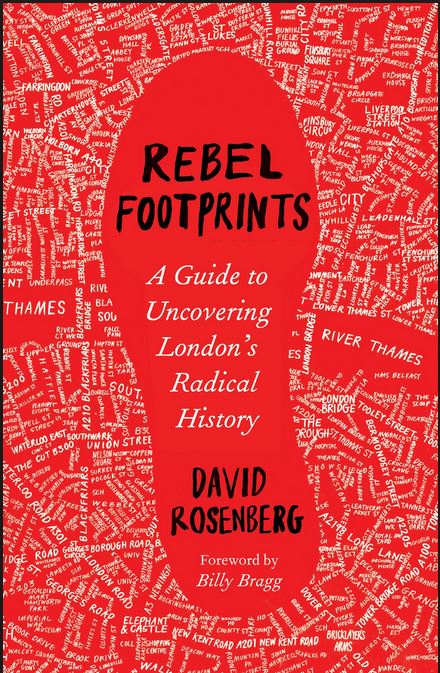
Rebel Footprints: A Guide to Uncovering London’s Radical History is a sort of hybrid history-guide book. It deals with the radical people and events of London between the 1830s and 1930s, but with a twist. Each chapter is accompanied by a do-it-yourself walking tour, complete with maps, which the reader can use to explore some of London’s most radical areas. Rosenberg points out that London’s physical environments are changing so quickly that the past could be easily forgotten. Radicals such as Charlotte Despard and William Cuffay are not the sort of people who get statues built in their honour, so we need to find others ways to remember them. And what better way than walking in their footsteps, following their footprints through the streets on which they fought for the causes they believed in?
I have always felt that the best way to get to know a city is to walk around it, and Rebel Footprints personifies that belief. The walking tours provide a fresh angle that makes the book stand out from the many, many others about London’s history, and as a geographer I find the way they engage with the spaces of the city especially gratifying. I do wonder how many readers will actually do the walking tours (I haven’t yet, although I am very keen to find the time), but then I also wonder how much that actually matters. Even if the book just makes people think about the spaces of London a bit differently then it has achieved something, and it is still an engaging and well-illustrated read. Rosenberg is actually a tour guide himself, he leads several wonderful tours around radical London, and this experience really shines through the pages, as well as the extensive research that was obviously necessary for the book. As an academic I find the lack of referencing frustrating (I would like to know where Rosenberg got some of his sources from!), but I acknowledge that the book isn’t aimed at an academic audience, so references are not expected.

Due to the nature of walking tours, each chapter has a local focus, concentrating on a specific neighbourhood or locale. I think this a really nice approach. If the reader is at all familiar with London then it is likely they will know some of the areas personally, and feel a connection. I have lived in Southwark for almost 2 years now; the University of London has buildings in Bloomsbury, so I spend quite a bit of time there; and before she moved to Crawley after the Second World War my Nan lived in Canning Town- the house where she used to live is still there. So I feel a particular affinity to the chapters focusing on these areas, a sort of pride that the parts of London I am connected to have such a radical history.
Rebel Footprints has special significance in post-General Election 2015. Many people feel a sense of dread at the thought of another five years under a Conservative Government, I am certainly one of them. In some ways the book is depressing, as it shows us all the progress that has been lost since 1940. But in other ways, I found reading Rebel Footprints in the aftermath of the 7th of May quite comforting. The activists, campaigners and radical politicians detailed in the book come from a whole range of backgrounds, and show that anyone can fight for something they feel strongly about. And it is actually possible to win some struggles, as unlikely as that might seem at the moment.
David Rosenberg has written a wonderful book, which greatly benefits from his passion and expertise. I attended a launch event for Rebel Footprints at the Bishopsgate Institute, where Rosenberg said he wanted to write a “history from below,” a book about “ordinary people doing extraordinary things.” I think he has done this, and I think he has done it very well.
 Turbulent Isles