Turbulent Scots: Lady Agnes Campbell (~1526-in or after 1591)

Turbulent Scots is a series of posts about radical individuals from history who were either born in, or had an impact on, Scotland. Most of the Turbulent Scots I feature are women, because their contribution to history has so often been overlooked. Any suggestions for future Turbulent Scots posts are very welcome. Next up is Lady Agnes Campbell, a member of the aristocracy in the sixteenth century who was skilled at politics and negotiation.


We tend to think of aristocratic women in the early modern period as powerless pawns, to be married off for political or financial gain. There are several examples, however, that prove that the situation was not always that simple. Elizabeth I is perhaps the most famous, but I recently came across the story of another, Lady Agnes Campbell.

Agnes Campbell was born in around 1526, the second daughter and fifth child of Janet Gordon and Colin Campbell, the third Earl of Argyll. She was well educated at the Scottish court, learning to speak multiple languages. In 1545 she married James MacDonald of Dunyvaig and the Glens, chief of one of the branches of Clan Donald. Over the next twenty years she had five children. During this period there was a struggle between Irish, English, and sometimes Scottish aristocracy for control of Northern Ireland. The MacDonalds of Dunyvaig had started settling in Antrim, and sometimes worked with the local O’Neill clan against the English, but at other times their interests clashed dramatically. On 2nd May 1565 James and his brother Sorley Boy were defeated in battle and captured at Glenshesk in Ireland by Shane O’Neill. James died from his injuries in captivity in August. Shane was assassinated by the MacDonalds in 1567, and the relationship between Sorley Boy and Shane’s successor, Turlough Luineach O’Neill improved so much that on 5th August 1869 Agnes married Turlough.

Agnes took more than 1000 redshanks (Highland infantry mercenaries who fought for Irish chieftans) to Ulster when she got married. In 1570 and 1571, Agnes returned to Scotland to recruit more redshanks for her husband’s cause. The following year, Walter Devereux, the Earl of Essex, was providing military support to English colonists trying to settle in Ulster. In December Agnes left for Scotland, taking a large number of redshanks with her. The English hoped that Agnes’ marriage was collapsing, but actually she was swapping the men for fresh mercenaries. The Earl of Essex withdrew in 1575, after Agnes had negotiated significant land grants for Turlough. Agnes frequently acted as Turlough’s delegate in negotiations. This may have been because it provided him with distance from any agreements and allowed him to go back on his word if it became convenient later, but it was also widely acknowledged that Agnes was a skilled negotiator. Her support for Turlough was invaluable in driving away the Earl of Essex.

In November 1575, Agnes and Turlough met with Henry Sidney, the Lord Deputy of Ireland. Turlough offered to submit to Sidney’s authority in return for an Earldom, land grants, and recognition of Agnes’ sons claims to the Glens in Scotland (Sorley boy, Agnes’ former brother-in-law, also claimed the Glens). Despite Sidney demanding that Agnes stop bringing redshanks from Scotland to Ireland to fight for her husband, she continued to do so. The English believed she had significant influence over Turlough, and she was also seen as a powerful political force in her own right.

In September 1579, Turlough refused to negotiate with Elizabeth I’s representatives without his wife. Throughout the 1580s, Agnes continued to travel back and forth to Scotland to make sure that support for her husband remained strong. She also supported the interests of her sons; she negotiated land for them, and intervened in disputes. In March 1588 she traveled to Edinburgh to plead with James VI on her son’s behalf. She was back in Scotland in April 1590, but after that she disappears from the records.

The further back in time you go, the harder it is to find information about remarkable women. This is not because they didn’t exist, but because they weren’t considered worthy of being recorded. Lady Agnes Campbell was one such remarkable woman, and we do know a bit about her, probably because of her status as an aristocrat. She played a significant role in Irish resistance to English colonisation, she was a skilled negotiator, and a powerful political presence in her own right.

Sources and Further Reading

Barry, Judy. “Campbell, Lady Agnes. Last modified October 2009, accessed 17th May 2022. Available at https://doi.org/10.3318/dib.006945.v1

Undiscovered Scotland. “Lady Agnes Campbell.” No date, accessed 17th May 2022. Available at https://www.undiscoveredscotland.co.uk/usbiography/c/agnescampbell.html

Walshe, Helen Coburn. “Campbell, Lady Agnes.” Oxford Dictionary of National Biography. Last modified 3rd January 2008, accessed 17th May 2022. Available at https://doi.org/10.1093/ref:odnb/69172 [Subscription required to access].
Turbulent Scots: Ethel Moorhead, 1869-1955

Regular readers of this blog will be familiar with the Turbulent Londoners posts, where I celebrate the lives of Londoners who have played a part in the city’s rebellious history. As I recently moved to Edinburgh, I’ve decided to take a look at some of the women who made an impact on Scotland’s radical history. Next up is Ethel Moorhead, radical suffragette and artist.


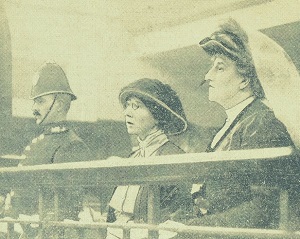
Ethel Moorhead (centre) on trial in Glasgow in 1913 with Dorothea Chalmers Smith (Source: Crown Copyright, National Records of Scotland, HH16/40).

On a recent visit to the National Wallace Monument in Stirling, a towering celebration of Scottish nationalism and masculinity, I did not expect to find any reference to the kind of history I write about on this blog. I was pleasantly surprised, therefore, to find a reference to artist and suffragette Ethel Moorhead in the electronic display about the Wallace Sword. In September 1912, Ethel smashed the glass case containing the sword that allegedly belonged to William Wallace in a protest demanding the right to vote for women, and was sentenced to 7 days in prison for her troubles. I set out to learn more about this brave woman who clearly had a flair for the dramatic, and I was not disappointed. Ethel was one of Scotland’s most famous suffragettes, and for good reason.

Ethel Moorhead was born in Kent in 1869, one of six children of a military surgeon. Her childhood, and much of her adult life as well, was spent moving; the family never stayed in one place for long. By the end of the 1800s, however, they were in Scotland. Encouraged by their father, Ethel’s sister Alice qualified as a doctor in 1893 and began practicing in Dundee. Ethel studied art in Paris during the 1890s, supported financially by Alice, but at the turn of the century she was living in Dundee with her parents and one of her brothers. Her first paintings were exhibited at the Dundee Graphics Art Society in 1901, and were well received. She had a studio in Dundee and exhibited her work in galleries across the UK. Her mother died in 1902, and Alice looked after her father until his death in 1911. During this period the pair were close, and Ethel’s father supported both her painting and her activism.

Ethel joined the Dundee branch of the Women Social and Political Union in 1910, and threw herself into the militancy the WSPU was famous for. She was arrested and imprisoned multiple times, often under false names, went on hunger strike several times, and gained the dubious accolade of being the first suffragette to be force fed in Scotland. In December 1910, she threw an egg at Winston Churchill during a political meeting in Dundee (the egg missed). A month later, Ethel became Dundee’s first tax resister. Suffragettes argued that women should not have to pay taxes to a government that they have no say in, so some refused to pay their tax bill. Bailiffs would confiscate goods from the women’s houses to cover the missing tax. A silver candelabra was taken from Ethel, then promptly bought back by her friends when it was put up for auction.

Ethel moved to Edinburgh after her father’s death. In March 1912 she was arrested in London for smashing 2 windows. In September, she wrapped the stone she used to smash the case of the Wallace Sword in a piece of paper that read “Your liberties were won by the sword. Release the women who are fighting for their liberties.” Her actions symbolically linked the suffragette’s fight for the vote with the Scottish fight for freedom. In an October, Ethel was ejected from a meeting in Edinburgh’s Synod Hall for trying to ask questions. She later tracked down the man responsible, a teacher, and attacked him with a dog whip in his classroom. In December, she went on hunger strike after being arrested in Aberdeen.

Although she never had a leadership role in the WSPU, by 1913 Ethel was one of the most famous suffragettes in Scotland due to her brazen defiance of authority. In January, she was sentenced to 30 days in prison for throwing cayenne pepper into the eyes of a police constable, but was released after just 2 days because she was on hunger strike. In July Ethel was sentenced to eight months in prison for attempted ‘fire raising’, but was again quickly released because of a hunger strike. This was the period when the Cat and Mouse Act was in full effect – hunger striking suffragettes were released from prison, then rearrested once they recovered.

Ethel was not a well behaved prisoner. She had a reputation for destroying her cell, and refusing to cooperate with prison authorities. She complained about her treatment and prison conditions frequently and publicly. Suffragettes argued that they should be treated as political prisoners rather than criminals, and often actively resisted the prison system. The hunger strikes were a part of that. Ethel was rearrested in 1914, and became the first suffragette in Scotland to be force fed in Calton Jail in Edinburgh. She was released after catching double pneumonia, and her treatment caused outrage in Scotland. Force feeding had been used on hunger striking suffragettes in England since 1909, and people were enraged that Scottish authorities would also resort to such cruel and violent treatment. It did not deter Ethel however, and she was almost certainly involved in Fanny Parker’s attempt to burn down Robert Burns’ cottage in July 1914.

At the outbreak of the First World War the British government gave suffragettes an amnesty in exchange for a promise that they would halt their activism. Ethel threw her energies into the National Service Organisation, set up by another suffragette group, the Women’s Freedom League. The Organisation helped women to find war work, and also campaigned for them to be paid fairly. After the war, Ethel spent many years travelling Europe. She launched and co-edited This Quarter, an art and literature journal. She died in a care home on 4th March 1955.

On hearing the word ‘suffragettes,’ many people will think of the Pankhursts, but might not know any other names of women who fought for the right to vote. Many women deserve to be remembered for their brave and defiant actions, not least Ethel Moorhead, who fought with words as well as eggs, stones, and dog whips.

Sources and Further Reading

Henderson, Mary. Ethel Moorhead: Dundee’s Rowdiest Suffragette. No date, accessed 23 February 2022. Available at: https://ethelmoorhead.org.uk/

Leneman, Leah. “Moorhead, Ethel Agnes Mary.” Oxford Dictionary of National Biography. Last modified 23 September 2004, accessed 23 February 2022. Available at: https://doi.org/10.1093/ref:odnb/59253 (Subscription required to access).

National Records of Scotland. “Ethel Moorhead (alias Edith Johnston, Mary Humphreys, Margaret Morrison) (1869 – 1955)”. No date, accessed 23 February 2022. https://www.nrscotland.gov.uk/files/exhibitions/women-suffrage/ethel-moorhead.html

Turbulent Scots: Elsie Inglis, 1864-1917

Regular readers of this blog will be familiar with the Turbulent Londoners posts, where I celebrate the lives of Londoners who have played a part in the city’s rebellious history. As I recently moved to Edinburgh, I’ve decided to take a look at some of the women who made an impact on Scotland’s radical history. In this post I’m looking at Elsie Inglis, a doctor, suffragist, and champion of healthcare for women.


A photo of Dr. Elsie Inglis taken in 1918 (Source: Dr. Elsie Inglis / by Lady Frances Balfour. Wellcome Collection. Attribution 4.0 International (CC BY 4.0))

Despite being born in India and dying in Newcastle, Dr Elsie Inglis is perhaps one of the most well-respected women in Scottish history. After looking into her story, I can see why she was so admired! After qualifying as a doctor just before her 28th birthday, Elsie dedicated herself to improving women’s healthcare. On the outbreak of the First World War, she organised and led all-female medical teams in Serbia and Russia, becoming the first woman to be awarded the Order of the White Eagle by Serbia.

Elsie was born on 16th August 1864 in Naini Tal, India. She was one of 9 children, and her father was a magistrate in the Indian Civil Service. Her parents believed that women should be educated, and unusually for the time, Elsie started her education in India. She showed an interest in medicine from a young age, covering her dolls in spots so that she could cure them of measles. The family moved to Edinburgh when her father retired, and Elsie finished her education at the Edinburgh Institution for the Education of Young Ladies and at a finishing school in Paris.

Elsie was very close to her father. She wanted to study medicine, but was reluctant to leave her father after the death of her mother in 1885. In 1887, Dr Sophia Jex-Blake opened the Edinburgh School of Medicine for Women, and Elsie was one of the first students at the School. Jex-Blake was a pioneer, having been one of the first 7 female students to start studying medicine at the University of Edinburgh in 1869. However, her students found her too strict, and after two other students were expelled, Elsie and her father set up the Edinburgh College of Medicine for Women. Elsie continued her studies there, qualifying as a doctor and surgeon in 1892, at a time when women still were not permitted to graduate from University medical schools.

Elsie was shocked by the poor quality of care that female patients received, and the lack of specialisation in issues that affected women. Her first job was at the New Hospital for Women in London, founded by Elizabeth Garrett Anderson (another pioneer, she was the first woman to qualify as a doctor and surgeon in Britain). She also worked at the Rotunda, a leading maternity hospital in Dublin. She returned to Edinburgh in 1894 to nurse her father. She also lectured in gynaecology and set up a medical practice with Jessie Maclaren Macgregor. The two women set up a small maternity hospital for poor women, which also had a midwifery training centre. In 1904, the hospital moved to larger premises on the Royal Mile and was renamed The Hospice. By this time the University of Edinburgh had also started allowing women to study medicine, and Elsie graduated in 1899.

For Elsie, the poor standards of medical care for women was intertwined with the fight for women’s suffrage. Opposed to the violent methods of the suffragettes, she became a leading member of the suffragist campaign in Scotland, serving as the secretary of the Edinburgh Society for Women’s Suffrage in the 1890s, and the secretary of the Scottish Federation of Women’s Suffrage Societies from its formation in 1906 until 1914. She traveled Scotland speaking at pro-suffrage meetings, sometimes as many as 4 a week.

With the outbreak of the First World War in 1914, Elsie was central to the foundation of the Scottish Women’s Hospitals for Foreign Service Committee. She was motivated not just by patriotism, but also by a desire to prove that women were skilled medical staff in fields other than gynaecology and paediatrics. Funded by the suffrage movement, the Committee’s goal was to provide relief hospitals for the war effort that were entirely staffed by women. The British War Office rejected the offer of help, but the French and Serbian government were not so prejudiced. Over the course of the war, the Scottish Women’s Hospital sent 14 units to Belgium, France, Serbia, Salonika, Romania, Malta, Corsica, Serbia and Russia. In the summer of 1915, Elsie led a team to Serbia. Not long after, the region was invaded by Austro-Hungarian and German Forces. Refusing to leave her patients, Elsie was captured. She was released and returned to Edinburgh the following year, where she campaigned for more aid to be sent to Serbia. In August 1916 she led a new team to help Serbian forces in Russia. She knew she had cancer before she left, and by the following autumn she could no longer perform surgery, although she continued to lead the unit. She refused to leave Russia until the Serbian forces did too. She eventually arrived back in Britain on the 26th of November 1917, but died that evening in a hotel in Newcastle.

Remnants of the maternity hospital named after Elsie can still be found in Abbeyhill, Edinburgh (Source: Hannah Awcock).

Elsie Inglis was a skilled and determined woman, who achieved a huge amount in her 53 years. Her funeral took place at St. Giles Cathedral, and was attended by representatives of the British and Serbian royal families. Considering women tend not to be memorialised, there have been quite a few tributes to Elsie over the last century. In 1922 a tablet was erected in St Giles in her memory. In 1925, The Hospice was replaced by the Elsie Inglis Memorial Maternity Hospital in Abbeyhill. It was closed in 1988, but some of the buildings still remain, and there is a small memorial in nearby Holyrood Park. There is a plaque marking the location of her pre-war surgery at 8 Walker Street, and in 2009 she was featured on the £50 note produced by the Clydesdale Bank. There is a memorial fountain dedicated to her in Mladenovac, Serbia, and her photo features on the plinth of the Millicent Garrett Fawcett statue in Westminster. Elsie Inglis was a truly remarkable women, who deserves all of this recognition, and more.

Sources and Further Reading

Leneman, Leah. “Inglis, Elsie Maud.” Oxford Dictionary of National Biography. Last modified 23rd September 2004, accessed 5th October 2021. Available at: https://doi.org/10.1093/ref:odnb/34101 (requires a subscription to access).

MacPherson, Hamish. “Greatest Scot? The Many Talents of Dr Elsie Inglis. The National. Last modified 5th May 2020, accessed 5th October 2021. Available at: https://www.thenational.scot/news/18426143.greatest-scot-many-talents-dr-elsie-inglis/

Royal College of Physicians of Edinburgh. “Elsie Inglis.” No date, accessed 5th October 2021. Available at: https://www.rcpe.ac.uk/heritage/college-history/elsie-inglis

Simkin, John. “Elsie Inglis. Spartacus Educational. Last modified January 2020, accessed 5th October 2021. Available at: https://spartacus-educational.com/Winglis.htm

Wikipedia. “Elsie Inglis.” Last modified 25th September 2021, accessed 5th October 2021. Available at: https://en.wikipedia.org/wiki/Elsie_Inglis

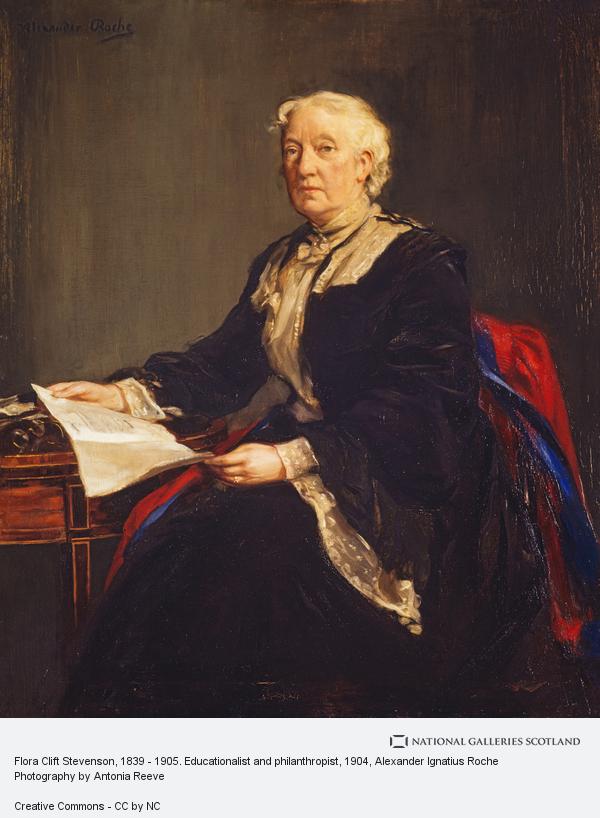
Turbulent Scots: Flora Stevenson, 1839-1905

Regular readers of this blog will be familiar with the Turbulent Londoners posts, where I celebrate the lives of Londoners who have played a part in the city’s rebellious history. As I recently moved to Edinburgh, I’ve decided to take a look at some of the women who made an impact on Scotland’s radical history. Next up is Flora Stevenson, a philanthropist and education campaigner who has recently been announced as the next face on Scotland’s £50 notes.


It was recently announced that philanthropist, educational campaigner and suffragist Flora Stevenson is going to be the first woman featured on the Scottish £50 note. It is very unusual for a woman to be chosen to feature on British currency (apart from the Queen), so I wanted to find out more about the woman who has been deemed worthy of such an honour.

Flora Stevenson was born on 30th October 1839, the youngest of 11 children. Her father was a wealthy Glasgow industrialist; when he retired the family moved to Edinburgh, and Flora spent most of her adult life living at 13 Randolph Crescent in the West End with her 3 sisters. The Stevenson sisters were all active in the mid-nineteenth century Scottish women’s movement. They all supported women’s suffrage, and were founding members of the Edinburgh Ladies’ Educational Association which was founded in 1868 to campaign for higher education for women. Flora was also committed to improving education for society’s poorest children; as a child she started a class in her home to teach messenger girls basic reading, writing, and maths skills.

In 1863 Flora joined the Edinburgh Association for Improving the Condition of the Poor as a district visitor, investigating the circumstances of charity claimants and assessing whether or not they were ‘deserving’ of support. She also joined the committee of the United Industrial Schools of Edinburgh, a voluntary body that organised schools for poor children. Flora believed that compulsory school attendance was central to improving the lives of poor children in big cities, but she was opposed to the state providing welfare support, as she believed it undermined the responsibility of parents to provide for their children. She argued that charities coordinating with school authorities was sufficient support.

In 1873 Flora was elected to the newly formed school board for Edinburgh. School boards were the first public bodies in Scotland which were open to women. As a result of her experience she was placed on the destitute children’s committee, where she was responsible for a scheme that gave food and clothes to poor children on the condition that they attended school. She also persuaded the school board to set up a day school for truants and juvenile delinquents, which was the first of its kind under the control of a school board. Flora’s expertise in this area was well respected; she served on several committees advising the government.

Flora’s belief in women’s rights carried over into her educational philosophy. She believed that girls and boys should be treated the same in education, and argued against the school board’s policy of giving girls 5 hours less teaching than boys every week so they could practice needlework. She believed that boys should be taught household management as well as girls, and that unmarried female teachers should receive equal pay.

Flora’s dedication to Edinburgh’s education system was respected and acknowledged. In 1899 a new primary school in Craigleith was named after her, and in 1900 she was unanimously elected to the Chair of the Edinburgh school board. In 1903 she was awarded an honorary degree by the University of Edinburgh, and two years later she was given the Freedom of the City in recognition of her service to Edinburgh’s philanthropic institutions and the school board. When she died in September 1905, thousands of schoolchildren lined the route of her funeral. She is buried with her family in Dean Cemetery in Edinburgh.

I may not agree with all of Flora’s politics – she was opposed to Irish Home Rule, and I find her perspectives on state welfare questionable – but there is no doubt that she was a formidable woman, who dedicated her life to public service at a time when women weren’t really supposed to do that. Hopefully her inclusion on the £50 is just the latest step in a long journey to properly acknowledge the contributions that women have made to society throughout history.

Sources and Further Reading

Corr, Helen. “Stevenson, Flora Clift.” Oxford Dictionary of National Biography. Last modified 23rd September 2004, accessed 30th June 2021. Available at: https://doi.org/10.1093/ref:odnb/46826 [Subscription required to access].
National Records of Scotland. “Flora Clift Stevenson (1839-1905).” No date, accessed 1st July 2021. Available at https://www.nrscotland.gov.uk/research/learning/hall-of-fame/hall-of-fame-a-z/stevenson-flora-clift

Wikipedia. “Flora Stevenson.” Last modified 26th June 2021, accessed 1st July 2021. Available at https://en.wikipedia.org/wiki/Flora_Stevenson

Young, Gregor. “First Woman to be Face of New Scottish £50 Note.” The National. Last modified 26th June 2021, accessed 30th June 2021. Available at https://www.thenational.scot/news/19400827.flora-stevenson-first-woman-face-new-scottish-50-note/

Turbulent Scots: Margo Macdonald, 1943-2014

Regular readers of this blog will be familiar with the Turbulent Londoners posts, where I celebrate the lives of Londoners who have played a part in the city’s rebellious history. As I recently moved to Edinburgh, I thought it would be fun to take a look at some of the women who made an impact on Scotland’s radical history. Last time I looked at Wendy Wood, artist and campaigner. This time it is the turn of Margo MacDonald, a charismatic politician and broadcaster.


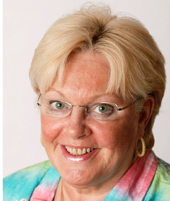
Margo MacDonald in 2011 (Contains information licensed under the Open Scottish Parliament Licence V.2).

The movement for independence in Scotland has been building momentum since the mid-twentieth century, and has made some significant gains over the last 50 years. Central to those gains have been the efforts of some charismatic and driven women, including Wendy Wood, who was the first Turbulent Scot I featured on this blog, and Margo MacDonald, the focus of this post. Like Wendy, Margo was passionate and likeable, although both women struggled with the constraints of membership in a political party.

Margo Aitken was born on the 19th of April 1943, one of 3 children. She grew up in East Kilbride, and trained as a PE teacher when she left school. In 1965 she married her first husband Peter MacDonald, they had 2 children. The couple ran a pub, and Margo’s experiences talking to customers and getting to know the regulars seems to have been influential on her later political beliefs.

Margo embarked on a political career in the early 1970s, winning the Glasgow Govan by-election in 1973 as an SNP candidate. She won by 571 votes. This was a remarkable achievement; the SNP wasn’t considered a serious political force at that point, and it was widely believed that they couldn’t win an election under a Conservative government. Margo proved all the doubters wrong. She wasn’t an MP for long though, as she lost her seat in the 1974 General Election. She lost further elections in 1978 and 1979, but her 1973 victory helped establish the SNP as a serious political force.

In 1974 Margo became Deputy Leader of the SNP. She was critical of the Party’s poor performance in the General Election that year, particularly the failure to convert more Labour voters. She was a prominent member of the 79 Group, which tried to persuade the SNP to move further left to appeal to the working classes. The Group was banned by the SNP in 1982, and many of its members left the Party. However, they were later readmitted to the party and several had successful careers, including Margo and Alex Salmond.

Margo’s membership of the 79 Group meant that she wasn’t re-elected as Deputy Leader of the SNP in 1979, and she was one of those who left the Party in 1982. She established herself as a successful radio presenter, and wrote for several Scottish newspapers. She remarried in 1981, to politician and columnist Jim Sillars. As devolution became more likely in the mid-1990s, Margo rejoined the SNP as she believed it was the only way to achieve Scottish independence. She was elected as an MSP for Lothian in 1999. Margo was popular, but was outspoken on lots of contentious issues such as sex worker’s rights and MSP’s salaries. She struggled with the restrictions of being part of a political party, and was disciplined in 2000 for not toeing the party line.

When the SNP chose its candidates for the Scottish elections in 2003, Margo was 5th on the list, almost guaranteeing that she would not get re-elected. She stood as an independent candidate in protest, and was kicked out of the SNP. Margo had been diagnosed with Parkinson’s disease in 1996; in the run up to the 2003 election this became public knowledge. Margo believed someone in the SNP had leaked the information in an attempt to hamper her chances of getting re-elected, which they denied. However her diagnosis got out, it didn’t prevent her getting elected. She went on to be reelected as an independent candidate in 2007 and 2011. Margo used her platform to continue to fight for what she believed in. She became a fierce advocate for assisted suicide; this was a particularly personal issue because of her illness.

Throughout her career, Margo was suspicious that the British Security Services were interfering in Scottish politics. She believed that MI5 infiltrated the SNP in the 1970s, and in the run up to the 2014 Independence Referendum she asked the Security Services to guarantee that they would not interfere. Throughout her career she supported the causes that mattered to her; she once joined an Anti-Trident protest outside the Scottish Parliament, and she campaigned to ban vuvuzelas in Scottish football grounds.

Known as firebrand and rebel, Margo remained a popular and well-known politician until her death on the 4th of April 2014. She was respected, if not always liked, by allies and opponents alike. Although she never had a smooth relationship with the SNP, she helped to establish the party as a serious political actor. I’m sure that many Scots remember her fondly.

Sources and Further Reading

Black, Andrew. “Margo MacDonald: The Life and Times of a Political ‘Blonde Bombshell.” BBC News. Last modified 4th April 2014, accessed 27th October 2020. Available at https://www.bbc.co.uk/news/uk-scotland-scotland-politics-26854930

Gander, Kashmira. “Margo MacDonald Dies: Tributes Pour in for ‘Britghtest Light’ Veteran Scottish Politician. The Independent. Last modified 5th April 2014, accessed 27th October 2020. Available at https://www.independent.co.uk/news/uk/home-news/margo-macdonald-dies-tributes-pour-veteran-scottish-politician-9239694.html

Mitchell, James. “Margo MacDonald, Independent Scot, 1943-2014.” The Conversation. Last modified 4th April 2014, accessed 6th November 2020. Available at https://theconversation.com/margo-macdonald-independent-scot-1943-2014-25299

Torrance, David. “Margo MacDonald.” The Glasgow Herald. Last modified 5th April 2014, accessed 27th October 2020. Available at https://www.heraldscotland.com/opinion/13154083.margo-macdonald/

Torrance, David. “MacDonald [nee Aitken], Margo Symington Jack.” Oxford Dictionary of National Biography. Last modified 15th February 2018, accessed 27th October 2020. Available at https://doi.org/10.1093/odnb/9780198614128.013.108517 [Subscription required to access]

Wikipedia, “Margo MacDonald.” Last modified 21st September 2020, accessed 27th October 2020. Available at https://en.wikipedia.org/wiki/Margo_MacDonald