Turbulent Londoners: Harriet Taylor Mill, 1807-1858

Turbulent Londoners is a series of posts about radical individuals in London’s history who contributed to the city’s contentious past, with a particular focus of women, whose contribution to history is often overlooked. My definition of ‘Londoner’ is quite loose, anyone who has played a role in protest in the city can be included. Any suggestions for future Turbulent Londoners posts are very welcome. The next Turbulent Londoner is Harriet Taylor Mill, a radical thinker who made a significant contribution to the work of John Stuart Mill.


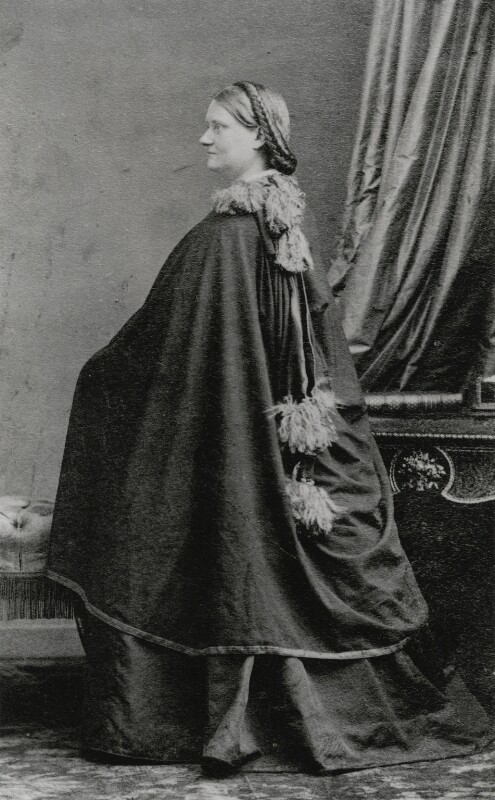
Harriet Taylor Mill
Harriet Mill (née Hardy) by Unknown artist. Oil on canvas laid on board, circa 1834
NPG 5489 (Source: National Portrait Gallery).

The well-known phrase ‘Behind every man is a great woman’ could have been invented for the philosopher John Stuart Mill. His wife Harriet Taylor Mill was hugely significant to his work, and, whilst we may never know the full extent of her contribution, she may well have co-authored substantial amounts of the writing attributed to him. She was also a radical thinker and writer in her own right.

Harriet Hardy was born in Walworth, south London on the 8th of October 1807. The daughter of a surgeon, she was educated at home. Her relationship with John Stuart  Mill was unconventional, even by modern standards. In 1826 Harriet married he first husband, the merchant John Taylor. They had three children. Four years into their marriage, Harriet became active in the Unitarian church community in London, and was introduced to John Stuart Mill. The two became close friends, exchanging essays on marriage and women’s rights. Mill was the first man to treat Harriet as an intellectual equal. Harriet was the more radical of the two, criticising the degrading effects of women’s economic dependence on men. She believed the situation could only be changed by the drastic reform of marriage laws.

By 1833, Harriet was living apart from John Taylor with her daughter, Helen. She spent six weeks in Paris with John Stuart Mill, and despite claiming they did not have a sexual relationship, they caused a scandal that left them both socially isolated. Harriet lived in a house in Walton-on-Thames, and Mill visited her at the weekends. John Taylor eventually accepted Harriet’s relationship with Mill, on the condition that she move back in with him.

John Taylor died in 1849, and Harriet married Mill two years later. The same year, 1851, ‘The Enfranchisement of Women’ was published by The Westminster Review. It is one of the few pieces of writing that can be solely attributed to Harriet, but at the time it was published in Mill’s name. Mill would build on Harriet’s arguments in The Subjection of Women (1869), although his arguments were less radical than Harriet’s.

Harriet published little of her own work, but contributed extensively to Mill’s. It is hard to know exactly the extent of this contribution though. At least, Harriet commented on all of Mill’s writing. In his autobiography, he claimed that she co-authored most of his work. In 1832, Early Essays on Marriage on divorce was published, co-authored by Harriet and Mill. It is unclear why Harriet might have been reluctant to take credit for her work– perhaps she was worried it would affect how the ideas were received. What was clear, however, was that Mill valued Harriet’s contribution; he dedicated On Liberty (1859) to her.

In her later years, Harriet traveled a lot due to ill health. She died in Avignon on the 3rd of November 1858. Mill bought a villa near Avignon, and spent most of the rest of the life there. Harriet’s daughter Helen helped Mill finish The Subjection of Women.

Even if Harriet Taylor Mill wasn’t a significant contributor to the work of John Stuart Mill, I think she would be worthy of admiration for to bravery she showed in pursuing happiness in her personal life in the face of social ostracism. Although the extent of her abilities will probably never be know for sure, she was also an accomplished thinker and writer. She deserves recognition.

Sources and Further Reading

Anschutz, Richard Paul. “John Stuart Mill.’ Encyclopaedia Britannica. Last modified June 15, 2017, accessed November 9, 2017. Available at  https://www.britannica.com/biography/John-Stuart-Mill.

Miller, Dale E. “Harriet Taylor Mill.’ Stanford Encyclopedia of Philosophy. Last modified October 5, 2015, accessed November 9, 2017. Available at  https://plato.stanford.edu/entries/harriet-mill/#EnfWom

Simkin, John. “Harriet Mill.” Spartacus Educational. Last modified August 2014, accessed November 9, 2017. Available at http://spartacus-educational.com/Wtaylor.htm

Wikipedia, “Harriet Taylor Mill.” Last modified August 22 2017, accessed September 28, 2017. Available at https://en.wikipedia.org/wiki/Harriet_Taylor_Mill

Turbulent Londoners: Katherine Chidley, 1590s-c.1653

Turbulent Londoners is a series of posts about radical individuals in London’s history who contributed to the city’s contentious past, with a particular focus of women, whose contribution to history is often overlooked. My definition of ‘Londoner’ is quite loose, anyone who has played a role in protest in the city can be included. Any suggestions for future Turbulent Londoners posts are very welcome. The next Turbulent Londoner is Katherine Chidley, an activist for religious toleration and a leader of Leveller women.


wenceslas_hollar_-_the_kitchen-maid_state_1
A drawing of a servant or housewife in 1640 by Wenceslas Hollar. Katherine Chidley might have dressed like this (Source: ECW Living History Resources).

The further back in time you go, the harder it is to find out about individuals who weren’t members of the aristocracy, especially if they were women. There are some women who managed to leave a trace in the archives, often thanks to their radicalism, such as Mary Astell (1666-1731) and Elizabeth Elstob (1683-1756). Katherine Chidley lived even earlier, between the 1590s and about 1653. She was a religious dissenter and a key member of the radical networks that preceded the Levellers, as well as the Levellers themselves.

The first time Katherine Chidley appears in the historical record she is already married with seven children. Along with her husband Daniel, she set up an independent church in Shrewsbury  in the 1620s which clashed with the local established church. At this point everyone was required by law to be a member of the Church of England, and there was no toleration for anyone who wanted to worship differently. Radical religious sects had an emphasis on church democracy, which meant that women played more of a role than in other sectors of society, as preachers, prophetesses and petitioners. In 1626 Katherine was charged with refusing to attend church, along with 18 others. She also got in trouble for refusing to attend church for an obligatory cleansing after childbirth.

The Chidley family moved to London in 1629. Katherine’s husband became a member of Haberdashers Company, and their oldest son Samuel started an apprenticeship in 1634 . The family’s views became more radical and separatist after they moved to London. Daniel and Samuel helped to establish a dissenting congregation headed by John Duppa. The congregation claimed the right to choose their own pastor not paid for by Church funds. The congregation itself was illegal, and its members faced harassment, arrest, and imprisonment.

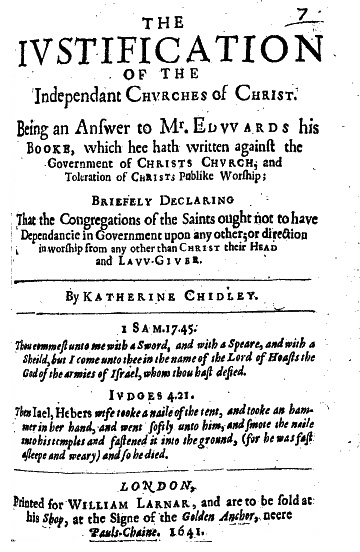
Katherine authored several pamphlets in defence of religious radicalism. Thomas Edwards was a popular puritan preacher at the time, who argued against religious Independents from a conservative Presbyterian perspective. In 1641 he published a pamphlet, addressed to Parliament, arguing against religious tolerance. Katherine was the first to attack Edwards’ arguments in print, in her first pamphlet. It was called The Justification of the Independent Churches of Christ, and it was very unusual for a woman to take such a step. Edwards ignored her response, embarrassed to have been so publicly confronted by a woman.

1641-10_Chidley_Justification_TP360
The front page of Katherine’s first pamphlet, from 1641 (Source: Online Library of Liberty).

Katherine’s concept of toleration was broad, even extending to Jews and Anabaptists, groups that faced extreme discrimination at the time. She believed that everyone should be able to organise their own churches if they so desired. Katherine did view women as weak and inferior to men, but she defended a wife’s right to make her own decisions about religion. She also frequently discussed examples of God using the weak or socially inferior to defeat the powerful and ungodly. Katherine may not have been a feminist by modern standards, but her views were radical for the time. She published 2 more pamphlets in 1645. The first was another attack on Thomas Edwards, called  A New-Yeares-Gift, or a Brief Exhortation to Mr. Thomas Edwards; that he may breake off his old sins, in the old yeare, and begin the New yeare, with new fruits of Love, first to God, and then to his Brethren. They didn’t really go for snappy titles in the seventeenth century.

When the Leveller network emerged, Katherine became a leader of Leveller women. The Levellers were a radical movement that argued for popular sovereignty, equality before the law, and religious toleration. They gained significant popular support between the First and Second English Civil Wars, but were considered too radical even for Oliver Cromwell and the Protectorate. Daniel died in 1649, and it seems as though Katherine took over his business with the help of Samuel. As well as being a religious radical, she was also a successful businesswoman, handling government contracts worth significant amounts. In 1649 Katherine was one of the organisers, and probably the author, of a women’s petition to free four Leveller leaders from the Tower of London. In 1653, when Leveller leader John Lilburne was again imprisoned and charged with treason, Katherine led a group of 12 women to Parliament to present a petition demanding his release signed by 6000 women.

Leveller Women 1647
An image of a meeting of Leveller women in 1647, created by Red Saunders in 2014 as part of the Hidden Project (Source: Red Saunders).

Although much of her activism involved male family members, and she believed that women were inferior to men, Katherine Chidley was a fierce woman who fought for the right to make her own decisions about how she worshipped. There is no trace of her in the historical record after 1653, so the rest of her life is a mystery.

Sources and Further Reading

Rees, John. The Leveller Revolution: Radical Political Organisation in England, 1640-1650. London: Verso, 2016.

Wikipedia, “Katherine Chidley.” Last modified 28 May 2017, accessed 15 August 2017. Available at https://en.wikipedia.org/wiki/Katherine_Chidley

Turbulent Londoners: Mary Macarthur, 1880-1921

Turbulent Londoners is a series of posts about radical individuals in London’s history who contributed to the city’s contentious past, with a particular focus of women, whose contribution to history is often overlooked. My definition of ‘Londoner’ is quite loose, anyone who has played a role in protest in the city can be included. Any suggestions for future Turbulent Londoners posts are very welcome. The next Turbulent Londoner is Mary MacArthur, a suffragist and trade unionist.


Mary Macarthur (Source: LSE Library TWL 2002 78).

Mary Reid Macarthur was a Scottish suffragist and trade unionist, who was instrumental in the expansion of female trade union membership in the early twentieth century. Born on 13th August 1880, Mary was the oldest of six children in a relatively well-off family. She attended Glasgow Girls High School, where she developed an interest in writing and journalism.

In 1901 Mary attended a meeting of the Shop Assistants Union, expecting to write a scathing report. She instead became a strong beleiever in trade unions, becoming secretary of the Ayr branch of the Shop Assistants Union. In  1902 she attended the Union’s national conference, where she became the first female to be elected to the national executive.

In 1903 Mary moved to London, where she became Secretary of the Women’s Trade Union League (WTUL), a congress for women’s unions. The League brought together women-only unions from a variety of different trades, which meant it had a mixed-classed membership. Through her activism, Mary realised that small, scattered unions would always struggle because of their inability to raise enough money to provide strike pay. To counter this, Mary founded the National Federation of Women Workers (NFWW) in 1906, a general labour union for women. It was open to all women who weren’t allowed to join the appropriate union, or who worked in trades that weren’t unionised. The NFWW became part of the National Union of General Workers in 1921, but in its 15 years it significantly advanced the cause of women in trade unions.

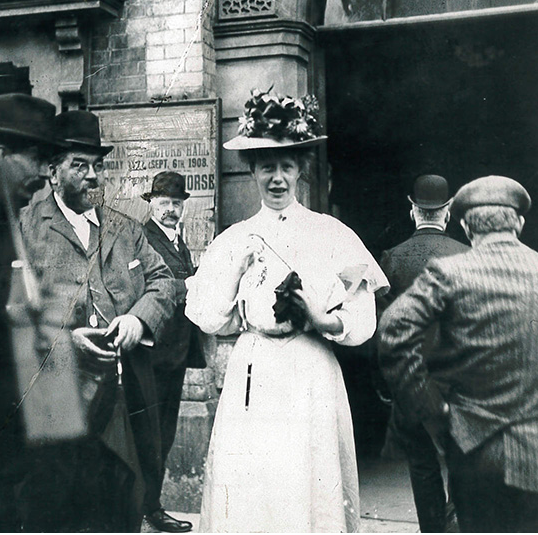
Mary Macarthur Speaking
Mary Macarthur speaking to a mostly male crowd in Trafalgar Square about a boxmakers strike in August 1908 (Photo: TUC Library Collections).

Mary also tried to help female workers in other ways, helping to organise the Exhibition of Sweated Industries in 1905 and getting involved in the foundation of the Anti-Sweating League the following year. Sweated trades we’re characterised by long hours, low  wages, and unsafe and insanitary working conditions. In 1907 Mary founded The Woman Worker, a monthly magazine for female trade unionists. She was a brilliant editor, but gave it up to concentrate on her activism. Mary spent time in the poorer parts of London collecting evidence about what it was like to work in sweated industries. She caught diptheria and spent 6 weeks in hospital, but she was able to present her findings to the Select Committee on Home Working in 1908.

Mary was also active in the campaign for the vote, although she opposed the National Union of Women’s Suffrage Societies and the Women’s Social and Political Union, the two main campaign groups. This was because they were willing to accept only certain groups of women bring given the vote. Mary believed this would disadvantage the working classes, and possibly delay universal adulthood suffrage.

Mary Macarthur TUC 1908
Mary Macarthur at the Trade Union Congress in Nottingham in 1908 (Source: TUC Library Collections).

The Trades Board Act was passed in 1909, largely due to the efforts of Mary and the organisations she worked with. The Act regulated sweated industries and introduced a minimum wage. The female chainmakers at Chadley Heath in the West Midlands became the first test case of the new Act in 1910. Mary convinced the women to fight for the wage they were entitled to; they won the dispute after a 10 week strike. Mary used her skills as a journalist to publicise the women’s cause, giving interviews, writing copy and arranging photo opportunities of the striking women with chains around their necks. She also made use of the new technology of cinema; a Pathe newsreel film of the strikers was seen by an estimated 10 million people. The publicity campaign raised a lot for the strike fund, the leftovers were used to build the Bradley Heath Worker’s Institute, which is now part of the West Country Living Museum.

Mary opposed the first world war, but she worked throughout it to promote the rights of female workers, campaigning for equal pay for equal work. She was a member of the Reconstruction Committee from 1916, set up to give advice on the employment of women after the war. Female trade union membership tripled during the war. After the war, Mary stood in the 1919 general election as the Labour candidate for Stourbridge in Worcestershire but was defeated, along with most other anti-war candidates.

Mary married William Crawford Anderson, the chairman of the executive committee of the Labour Party, in 1911. Anderson had first proposed marriage almost 10 years earlier, but Mary had decided to concentrate on her activism. Sadly their first child died at birth in 1913, but Anne Elizabeth was born in 1915. William died in the 1919 influenza epidemic. Mary herself died of cancer 2 years later, at the age of just 40.

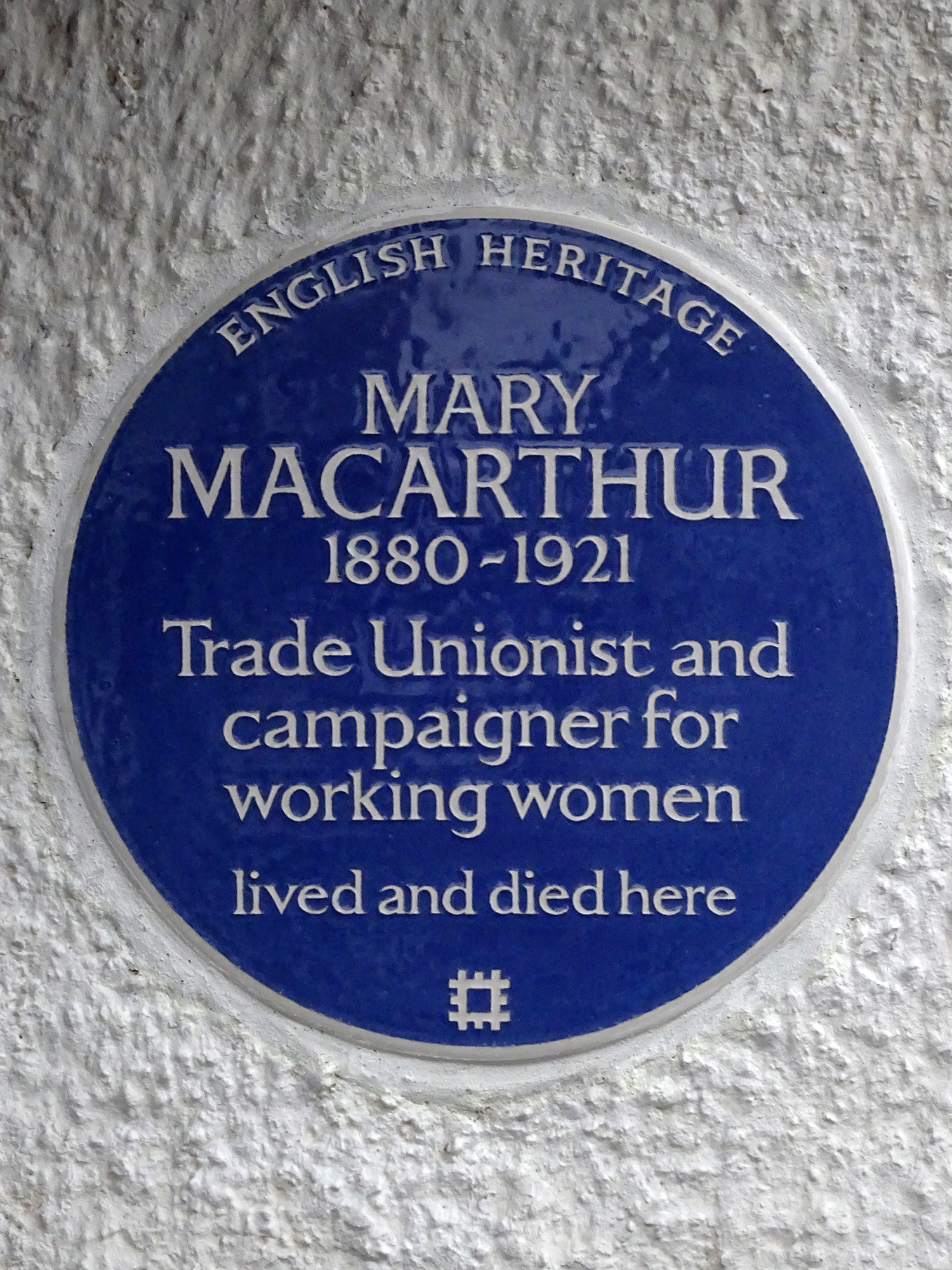
Blue plaque erected on 7th March 2017 by English Heritage at 42 Woodstock Road, Golders Green, London NW11 8ER, London Borough of Barnet. “MARY MACARTHUR 1880-1921 Trade Unionist and campaigner for working women lived and died here” (Source: Spudgun67).

Mary’s legacy lives on in the Mary Macarthur Holiday Trust and the Mary Macarthur Educational Trust, which provide grants to working women. A blue plaque commemorating Mary’s campaigning efforts on behalf trade unions and working women was installed on her house in Golders Green in north London in March 2017. As such, it might be said that she is better remembered than some of the other Turbulent Londoners featured on this blog. She deserves this recognition however, because of her huge contribution to the cause of women’s working conditions.

The TUC has an online exhibition about the life of Mary Macarthur that you can download HERE.

Sources and Further Reading 

Black Country Living Museum. “Mary Reid Macarthur, 1880-1921.” No date, accessed 22 March 2017. Available at  https://www.bclm.co.uk/media/learning/library/witr_marymacarthur.pdf

Simkin, John. “Mary Macarthur.” Spartacus Educational. Last modified August 2014, accessed 22 March 2017. Available at http://spartacus-educational.com/TUmacarthur.htm

Wikipedia, “Mary Macarthur.” Last modified 12 March 2017, accessed 13 March 2017. Available at https://en.wikipedia.org/wiki/Mary_Macarthur

Working Class Movement Library. “Mary Macarthur.” No date, accessed 22 March 2017. Available at http://www.wcml.org.uk/our-collections/activists/mary-macarthur/

Turbulent Londoners: Jayaben Desai, 1933-2010

Turbulent Londoners is a series of posts about radical individuals in London’s history who contributed to the city’s contentious past, with a particular focus of women, whose contribution to history is often overlooked. My definition of ‘Londoner’ is quite loose, anyone who has played a role in protest in the city can be included. Any suggestions for future Turbulent Londoners posts are very welcome. The 20th Turbulent Londoner is Jayaben Desai, the fierce and inspirational leader of the 1976-8 Grunwick Strike.


Throughout it’s history, London has relied on immigration to function. Jayaben Desai was one such immigrant, who refused to accept the long hours, low pay, and poor working conditions that have also been a feature of London for most of it’s history. She was one of the most prominent leaders of the Grunwick Strike, which

Born on 2nd April 1933 in the north-western state of Gujarat in India, Jayaben was defiant and headstrong from an early age. At school, she rejected passive obedience in favour of supporting the Indian independence movement. In 1955 she married Suryakant Desai, a tyre-factory manager from Tanganyika. The couple settled there in 1965, by which point the country had united with Zanzibar to become Tanzania. East African Asians were members of the mercantile and administrative classes, and Jayaben had a comfortable lifestyle. It did not last however, the Desais were expelled along with tens of thousands of others as part of “africanisation” policies. They fled to Britain and settled in the north London borough of Brent. The couples’ socio-economic status dropped considerably; Suryakant got a job as an unskilled labourer and Jayaben worked part time as a sewing machinist whilst bringing up their two children, Shivkumar and Rajiv. In 1974 Desai started work at the Grunwick factory which processed mail order photographic film.

Two years later, on 23rd August 1976, Jayaben walked out of the Grunwick factory. The final straw was being ordered to work overtime; she persuaded 100 of her colleagues to go with her. Jayaben was known for having a way with words; she apparently told her manager: “What you are running is not a factory, it is a zoo. But in a zoo there are many types of animals. Some are monkeys who dance on your fingertips. Others are lions who can bite your head off. We are those lions, Mr Manager.”

Jayaben is known as being a trade unionist, but I don’t think that really does justice to what her and her colleagues achieved. They were not members of a union when they first walked out, the Trades Union Council advised them to join Apex, a white collar union that is now part of the GMB. The strikers were also mainly Asian and women, two groups who did not have a strong tradition of striking in the past.

Another factor which set the Grunwick strike apart was the solidarity that the strikers received from employees in other workplaces and industries. Newly arrived migrants accepted (and still do) long hours and low pay because they had no choice. This has frequently caused resentment amongst British workers. The Grunwick strikers, however, received significant moral and practical support from other workers. For example, postal workers in the local sorting office in Cricklewood refused to handle Grunwick’s post. As the factory processed mail-order photographs, this move almost won the strike for Jayaben and her colleagues. In November a High Court ruling forced the postmen to start handling Grunwick post again, a big blow to the strikers. The strike committee visited more than 1000 workplaces around the country garnering support- many workers came to join the picket lines outside the factory. On 11th July 1977 the TUC organised a 20000 strong march to the factory. The workers at Cricklewood again refused to handle Grunwick’s mail. They were suspended for 3 weeks for their defiant act of solidarity.

The Labour Prime Minister, James Callahan, persuaded the TUC and Apex to allow a court of inquiry under Lord Justice Scarman to resolve the dispute. It was highly unusual for employers to defy the conclusions of inquiry, but Jayaben was convinced that Grunwick’s managing director, George Ward, would. She was right; Scarman recommended that the strikers be given their jobs back and that their union be recognised. Ward refused. With few options left and almost two years of hardship behind them, the strikers conceded defeat on 14th July 1978.

After the strike, Jayaben’s health declined. She got another sewing job, which led to teaching for the Brent Indian Association, and she developed an Asian dressmaking course at Harrow College. She passed her driving test aged 60, and when her husband retired the couple traveled extensively. She passed away on 23rd December 2010.

At just 4ft 10in, Jayaben Desai shocked many with her strength and resolve. She was inspirational, and known for her charm, tact, and diplomacy, even in the face of aggression and threatening behaviour from police and the Grunwick bosses. Although the Grunwick strike failed, it had a big impact on industrial relations for women and ethnic minorities, forcing the union establishment to taken them seriously for the first time. Whilst Jayaben did not do this alone, her bravery and determination should be remembered, celebrated, and learnt from.

2016 was the 40th anniversary of the start of the Grunwick strike. The Grunwick40 group was set up to commemorate this event. They organised events, a museum exhibition, and a mural. More information can be found about their work here.

Sources and Further Reading

Dromey, Jack. “Jayaben Desai Obituary.” The Guardian. Last updated 23 February 2012, accessed 20 December 2016. Available at  https://www.theguardian.com/politics/2010/dec/28/jayaben-desai-obituary

Pattinson, Terry.”Jayaben Desai: Trade Unionist Who Shot to National Prominence during the Bitter Grunwick Dispute of 1976-77.” The Independent. Last updated 21 February, 2011, accessed 24 December 2016. Available at  http://www.independent.co.uk/news/obituaries/jayaben-desai-trade-unionist-who-shot-to-national-prominence-during-the-bitter-grunwick-dispute-of-2220589.html

Wikipedia, “Jayaben Desai.” Last updated 17 December 2016, accessed 20 December 2016. Available at https://en.wikipedia.org/wiki/Jayaben_Desai

On This Day: The Mud March, 9th February 1907

At the start of the twentieth century, the campaign for women’s suffrage was gathering momentum. The National Union of Women’s Suffrage Societies (NUWSS) organised the first large march for the cause on the 9th of February 1907. The women planned to march from Hyde Park to Exeter Hall, a large meeting hall on the north side of the Strand. Unfortunately the weather was not on the marchers’ side, and heavy rain made the streets of London very muddy, hence the name of the march. Despite this, the march was considered a great success.

mud-march-flyer
A flyer advertising the event which became known as the Mud March (Source: Woman and her Sphere).

Unlike the Women’s Social and Political Union (WSPU), the NUWSS refused to use militant or violent tactics in its attempt to win the vote for women. They were known as suffragists, which differentiated them from the suffragettes in the WSPU. However, they understood the need to have a visible presence in society; this march was their first attempt at using protest marches to attract attention.

Around 3000 women took part, from a range of social classes and occupations, and representing over 40 suffrage organisations. The march was organised by Phillipa Strachey, daughter of Lady Strachey. The march was considered so successful that she went on to organise all the NUWSS’s large marches. The march was led by Millicent Fawcett, leader of the NUWSS, and Lady Strachey, Lady Frances Balfour, and Keir Hardie, also prominent suffragists. The Artist’s Suffrage League designed posters and postcards advertising the march, and designed and made around 80 embroidered banners for the march itself.

Despite the wet weather, thousands of people turned out to watched the march. The sight of thousands of women from across social divides marching together was enough of a novelty to persuade people to brave the rain. Press from across Europe and America were fascinated by the diversity of women involved. At the time, it was perceived that women were reluctant to make displays of themselves in public. As such, the participants in the march were considered to be even more dedicated to the suffrage because they were willing to put themselves through such an experience. Kate Frye was on the march, and she obviously relished taking part, writing in her diary that she “felt like a martyr of old and walked proudly along.”

The suffragists marched from Hyde Park to Exeter Hall in the Strand, where the Strand Palace Hotel stands today. The Hall was opened in 1831 as an organisational and meeting space for evangelical groups. The Great Hall could hold 4000 people, and lots of causes held meetings there, including anti-Slavery and temperance. In 1880 Exeter Hall was taken over by the YMCA, but the Great Hall could still be used for meetings. The suffragists’ rally must have been one of the last meetings to take place there, as the building was sold and demolished in 1907. It required expensive alterations that the YMCA were unwilling to pay for. The suffragist’s rally featured music from an all-female orchestra, and speakers such as Keir Hardy, Israel Zangwill, Millicent Fawcett, and Lady Strachey.

The success of the Mud March, despite the foul weather, established the large-scale organised procession as a key tactic for the campaign for women’s suffrage in Britain. It has also been argued that the march gave the women’s suffrage movement a sense of respectability that the militant tactics of the WSPU did not.

Sources and Further Reading

Cowie, Leonard W. “Exeter Hall.” History Today 18, no. 6 (1968): 390-397.

Crawford, Elizabeth. “Kate Frye’s Suffrage Diary: The Mud March, 9 February 1907.” Woman and her Sphere. Last  updated 21 November 2012, accessed 24 December 2016. Available at https://womanandhersphere.com/2012/11/21/kate-fryes-suffrage-diary-the-mud-march-9-february-1907/

The Armchair Anglophile. “The Mud March.” Last updated 7 February 2012, accessed 24 December 2016. Available at http://www.armchairanglophile.com/the-mud-march/

Wikipedia. “Mud March (Suffragists)” Last updated 17 December 2016, accessed 21 December 2016. Available at https://en.wikipedia.org/wiki/Mud_March_(Suffragists)

Turbulent Londoners: Barbara Leigh Smith Bodichon, 1827-1891

Turbulent Londoners is a series of posts about radical individuals in London’s history who contributed to the city’s contentious past, with a particular focus of women, whose contribution to history is often overlooked. My definition of ‘Londoner’ is quite loose, anyone who has played a role in protest in the city can be included. Any suggestions for future Turbulent Londoners posts are very welcome. Today I’m looking at Barbara Leigh Smith Bodichon, a feminist and campaigner for women’s rights.


Barbara Leigh Smith Bodichon by Disdéri, copied by Emery Walker Ltd. Copy glass plate negative of an albumen carte-de-visite, circa 1860. NPG x200062 (Source: National Portrait Gallery).

Barbara Leigh Smith was born on the 8th of April 1827, the oldest of 5 children. Her mother was Anne Longden, a milliner, and her father was Ben Leigh Smith, a radical Whig politician. Barbara’s parents never married, but lived openly together, so she must have been used to controversy from a young age. Ben Leigh Smith held radical political views, despite being a member of the landed gentry. He treated all five of his children the same; he gave each of them £300 a year when they turned 21. It was highly unusual to for women to be treated this way. Like Elisabeth Jesser Reid, Barbara’s wealth gave her independence, a rare condition for single women at the time.

Barbara used her wealth to start a progressive school in London, researching other schools in London when deciding how to set it up. Later in life she co-founded Girton College in Cambridge, the first residential college for women that offered education to degree level. She gave generously to the college, in terms of both time and money. Her primary concern, however, was women’s rights. She was a member of one of the first organised women’s movements, known as The Ladies of Langham Place. They were a group of women who met regularly during the 1850s at no. 19 Langham Place to discuss women’s rights. They campaigned on many issues, including the property rights of married women. Langham Place served as sort of gentlemen’s club for women; it had a reading room, coffee shop, and meeting room. In 1858 it also became the base of the English Women’s Journal. Barbara set up the monthly periodical  for the discussion of women’s employment and equality, such as expanding employment opportunities and legal rights.

As well as a campaigner and publisher, Barbara was also an author. In 1854 she published Brief Summary of the Laws of England Concerning Women, and in 1858 she wrote Women and Work, in which she argued that women’s dependence on their husbands was degrading. She practiced what she preached too; as a young woman she fell in love with John Chapman, the editor of the Westminster Review. She refused to marry Chapman because of her views on the legal position of married women. Barbara did marry eventually however, to French physician Dr. Eugene Bodichon in 1857. This is also the year that the Matrimonial Causes Act was passed. The Act protected the property rights of divorced women, and allowed divorce through the courts rather than by an act of Parliament, which was a slow and expensive process. Barbara had testified to a House of Commons committee looking into the legal position of married women, which led to the Act.

Married life did not mellow Barbara, however. Although she started spending the winter in Algiers, she continued to take an active role in women’s rights campaigns. In 1866 she founded the first ever group asking for women’s suffrage. The Women’s Suffrage Committee organised a petition, which was presented to the House of Commons by John Stuart Mill.

Barbara Leigh Smith Bodichon was a strong character, sympathetic to many causes. Her primary cause, however, was women’s rights, and she used the full range of skills and opportunities available to her to advance this cause. Her efforts had very real effects, particularly in relation to married women.

Sources and Further Reading

Girton College. “Girton’s Past.”No date, accessed 8 December 2016. Available at  https://www.girton.cam.ac.uk/girtons-past

Simkin, John. “Barbara Bodichon.” Spartacus Educational. No date, accessed 8 December 2016. Available at http://spartacus-educational.com/Wbodichon.htm

Wikipedia, “Barbara Bodichon.” Last modified 1 December 2016, accessed 8 December 2016. Available at https://en.wikipedia.org/wiki/Barbara_Bodichon

Turbulent Londoners: Jane Cobden, 1851-1947

Turbulent Londoners is a series of posts about radical individuals in London’s history who contributed to the city’s contentious past, with a particular focus of women, whose contribution to history is often overlooked. My definition of ‘Londoner’ is quite loose, anyone who has played a role in protest in the city can be included. Any suggestions for future Turbulent Londoners posts are very welcome. My next Turbulent Londoner is Jane Cobden, one of the first women to be elected to the London County Council.


(Emma) Jane Catherine Cobden Unwin by Fradelle & Young. Albumen print, 1890s. NPG x131220 (Source: National Portrait Gallery).

Fans of Victorian crime drama Ripper Street might recognise Jane Cobden from series 2 and 3. Played by Leanne Best, Cobden was a strong, opinionated London County Councillor, more than a match for love interest Detective Inspector Edmund Reid. But how does the character match up to the real Jane Cobden?

Born Emma Jane Catherine Cobden on the 28th of April 1851 in Westbourne Terrace, London, Jane was the fourth of sixth children of the well-known reformer and politician Richard Cobden. She devoted her life to campaigning for women’s rights and protecting and developing her father’s legacy- she was committed to the’Cobdenite’ issues of land reform, peace and social justice.

In 1869 Jane moved to South Kensington with her sisters Ellen, Anne and Kate, also dedicated activists. Jane was active on the radical wing of the Liberal Party, and became increasingly committed to the cause of women’s suffrage over the 1870s. In 1871, she attended the Women’s Suffrage Conference in London with her sister Anne. In about 1879 she joined the National Society for Women’s Suffrage, and by the following year she was the organisation’s Treasurer.

The National Society was cautious, avoiding close association with political parties and excluding married women from their demand for the vote. This was too conservative for some, and the Central National Society broke away in 1888. In 1889 this group split again, and the Women’s Franchise League (WFL) was formed, including Cobden and Emmeline Pankhurst. The WFL’s aims were more radical- they wanted votes for women on the same basis as men, and women to be eligible for all political offices. Jane was politically pragmatic as well as ambitious, however. She disagreed with the mainstream Liberal Party’s stance on many issues, but remained a member because she believed it was the best way to advance her causes.

In the late 1880s, no one was sure whether women could serve as councillors or not; the law was unclear. In November 1888, the Society for Promoting the Return of Women as County Councillors (SPRWCC) was set up to test the law. This catchily-named organisation set up a £400 election fund and choose two women to stand as Liberal candidates for the newly established London County Council. Jane stood in Bromley and Bow, and Margaret Sandhurst stood in Brixton. Jane campaigned on a variety of issues, including opposition the tax on coal, better housing for the poor, “fair” wages, and opposition to sweat shops. Both women won, but their positions were not secure; there were many who opposed their election and tried to overturn the results. Sandhurst’s election was challenged by the man she defeated, and her election was declared invalid. Jane was supported by her runner-up, who was also a member of the Liberal Party. However, a judge eventually ruled that Jane’s election was unlawful, and therefore so were her votes in the council. She quietly served the rest of her term, and did not stand for reelection. It wasn’t until the Qualification of Women Act in 1907 that women legally gained the right to sit on county councils; Cobden was truly a woman before her time.

In 1892, aged 41, Jane married Thomas Fisher Unwin, a publisher. Encouraged by him, Jane expanded her interests to include international peace and justice, and rights of aboriginal people around the world. The couple strongly opposed the Boer War. In 1893, Jane represented the WFL at the World Congress of Representative Women in Chicago.

jane-cobden-ripper-street
Jane Cobden as portrayed by Leanne Best in BBC/Amazon drama Ripper Street (Photo: BBC).

As the campaign for women’s suffrage gained pace after 1900, Jane chose not to participate in the illegal activities of the WSPU, but she fiercely defended her sister, Anne, when she was imprisoned for a month in October 1906. She organised the Indian women’s delegation in the Women’s Coronation Procession on the 17th of June 1911, a few days before the coronation of George V. Cobden never gave up on a political solution to women’s suffrage. The Conciliation Bills of 1910-12 would have given a small number of propertied women the vote. Cobden asked the Irish Parliamentary Party to support the doomed bills, because of the support that women had given to the Land League campaign in England. She also continued to campaign for other causes she cared about during this time, publishing two books on the subject of land reform: The Hungry Forties: Life Under the Bread Tax (1904) and The Land Hunger: Life Under Monopoly (1913).

Jane Cobden died on the 7th of July 1974, aged 96. The BBC’s synopsis of her character in Ripper Street describes her as “one of the giants on whose shoulders the Suffragette Movement was to stand,” and it doesn’t exaggerate. Cobden may be more well-known than other women’s rights pioneers because of her portrayal in Ripper Street, but I think her achievements still deserve more recognition.

Sources and Further Reading

Baldwin, Anne. “Women’s History Month: Persistence Pays Off, as Women are Finally Elected to the London County Council.” Women’s History Network. Last updated 5 March 2010, accessed 31 October 2016. Available at http://womenshistorynetwork.org/blog/?tag=jane-cobden

Hurley, Ann. “Emma Jane Catherine Cobden-Unwin 1851-1947.” Hurley and Skidmore Family History. No date, accessed 31 October 2016. Available at http://www.hurleyskidmorehistory.com.au/emma-jane-catherine-cobden-.html

Richardson, Sarah. “What Next, and Next? The Cobden Movement: Fleeting or Fundamental?” Liberty Fund. Last updated 8 January 2015, accessed 31 October 2016. Available at http://oll.libertyfund.org/pages/lm-cobden

Wikipedia. “Jane Cobden.” Last updated 4 September 2016, Accessed 31 October 2016. Available at https://en.wikipedia.org/wiki/Jane_Cobden

Turbulent Londoners: Minnie Baldock, c.1864-1954

Turbulent Londoners is a series of posts about radical individuals in London’s history who contributed to the city’s contentious past, with a particular focus on women, whose contribution to history is often overlooked. My definition of ‘Londoner’ is quite loose, anyone who has played a role in protest in the city can be included. Any suggestions for future Turbulent Londoners posts are very welcome. My next Turbulent Londoner Minnie Baldock, an early member of the WSPU who helped establish the organisation in East London


Minnie Baldock 1909: Photograph by Colonel L. Blathwayt (Source: Wikipedia, image in the public domain). 

Minnie Baldock was an early member of the Women’s Social and Political Union (WSPU), who helped the organisation establish a presence in London, particularly amongst the working class women of the East End. Born in the East End in about 1864, she worked in a shirt factory as a young woman, and had two sons after her marriage to Harry Baldock.

Female suffrage was not the cause which brought out Minnie’s radicalism; she was a member of the Independent Labour Party, and in 1903 held a public meeting to complain about women’s low wages with her MP, Keir Hardie. As a member of the WSPU, however, Minnie flourished as an activist.

Minnie joined the WSPU early on, before it moved to London, and was soon involved in many of its activities in the capital. In December 1905 she was ejected from not one but two public meetings for heckling Herbert Asquith and Henry Campbell Bannerman, leader of the Liberal Party. In January 1906, Minnie established the first London branch of the WSPU in Canning Town, in an attempt to recruit working class women. Several other branches soon followed in the East End. Minnie was at the heart of networks of radical women in London; she helped Annie Kenney make connections when she first moved to London, she knew Sylvia Pankhurst and Charlotte Despard, and was a mentor to Daisy Parsons.

Also in 1906, Minnie became a full-time organiser for the WSPU. For the next few years she toured the country, promoting the cause of female suffrage. In October that year she was arrested at the opening of Parliament. She was arrested again outside Parliament in February 1908, and this time spent a month in Holloway Prison. She was worried about leaving her two sons alone with her husband, which illustrates the tension many female activists feel between their activism and their caring responsibilities.

Minnie worked for the WSPU until 1911, when she became seriously ill with cancer. She did not return to the WSPU after she recovered, although she remained a member of the Church League for Women’s Suffrage, which united all kinds of suffragists who were also religious. This suggests that she had become disillusioned by the WSPU’s methods rather than their main objective; they became increasingly violent, authoritarian, and dismissive of the concerns of working class women in the years before the First World War. Minnie moved to Southampton with her family in 1913, and was living in Poole when she died in 1954.

The WSPU was much more than the Pankhurst family; women like Minnie Baldock were essential to the successful running of the organisation. Minnie helped the WSPU establish a presence in London, and went on to campaign tirelessly for them around the country. Her name may not have survived the lottery of history, but the impact of her actions still resonates.

Sources and Further Reading

Brooker, Janice. “Suffragette.” Lost in London. Last modified 1st May 2007, accessed 11th October 2016. Available at http://www.brooker.talktalk.net/suffragette.htm

Simkin, John. “Minnie Baldock.” Spartacus Educational. Last modified January 2015, accessed 12th October 2016. Available at http://spartacus-educational.com/WbaldockM.htm

Walker, John. “Forest Gate’s Proud Suffragette Legacy.”E7 Now and Then. Last modified 6th March 2015, accessed 14th October 2016. Available at http://www.e7-nowandthen.org/2015/03/forest-gates-proud-suffragette-legacy.html

Turbulent Londoners: Mary Astell, 1666-1731

Turbulent Londoners is a series of posts about radical individuals in London’s history who contributed to the city’s contentious past. My definition of ‘Londoner’ is quite loose, anyone who has played a role in protest in the city can be included. Any suggestions for future Turbulent Londoners posts are very welcome. Next up is Mary Astell, a philosopher and writer who is considered by many to be England’s first feminist.


The title page of Astell's first publication.
The title page of Astell’s first publication.

Mary Astell was a philosopher and writer from Newcastle whose ability to reason and argue made her a formidable force in intellectual circles in London in the late 17th and early 18th centuries. Her advocacy of women’s education and her opinions on marriage has led her to be seen by many as England’s first feminist.

Mary was born in Newcastle on the 12th of November 1666 to an upper middle class family; her father managed a local coal company. Mary’s father died when she was 12, leaving her family with very little income. She received some education from her uncle, who was affiliated with a group of radical philosophers in Cambridge, but she also taught herself by reading widely. After her mother died in 1684, Mary moved to Chelsea in London, where she became acquainted with an influential and wealthy circle of women who helped her to develop and publish her work.

Between 1694 and 1709, Mary published a number of texts on a range of subjects, but she is best known for her arguments relating to women. She used her extensive understanding of philosophical ideas to argue that women were just as rational as men, and therefore just as deserving of education. After withdrawing from public life in 1709, Mary set up a charity school for girls in Chelsea. She devised the curriculum, putting her ideas into practice. Mary Astell died of cancer on the 11th of May 1731, leaving behind a lasting legacy.

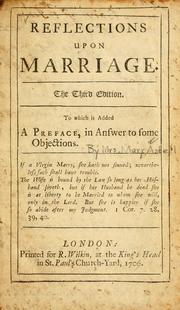
The title page of the third edition of Astell's 'Reflections Upon Marriage.'
The title page of the third edition of Astell’s ‘Reflections Upon Marriage.’

Mary’s first publication came out in 1694 and was entitled Serious Proposal to the Ladies for the Advancement of their True and Greatest Interest. In it, she proposes a female-only college, where women learn through reading and discussion, rather than a formal, hierarchical program of study. In Some Reflections Upon Marriage (1700), Mary continues advocating for women. She argues that an education would enable women to make better matrimonial choices, and be better prepared for married life. She warns women against making hasty choices when it came to marriage, and believed marriage should be based on friendship rather than necessity or fleeting attraction.

Mary’s ideas were groundbreaking for more than just their content. The way that she used philosophical ideas to support her arguments was unique, and she addressed women directly in her writing- talking to them, not about them. Her arguments disputed the Protestant belief, dominant at the time, that reason and emotion should be separate; for Mary, knowledge was intimately connected to happiness. Linked to this, one of the most frequent criticisms levelled against Mary’s ideas was that they were ‘too Catholic’; her plan for an all-female college sounded too much like a nunnery to be accepted by mainstream society. Mary’s ideas about women’s education caused substantial debate, and she was widely respected for her ability to debate freely and confidently with both men and women, but she did not receive widespread support.

“If all Men are born free, how is it that all Women are born slaves?”

Astell, Some Reflections Upon Marriage

The above quote is probably Mary Astell’s most famous, and it is easy to see why. This was a truly radical sentiment in the early eighteenth century. Not only did she express these radical ideas, Mary could support them with reasoned, rational, philosophical arguments. And she did all this at a time when there were few historical campaigners for women’s rights from which she could take inspiration and hope. As one of England’s first feminists she deserves to be remembered and celebrated, but she can also be for contemporary campaigners something she herself didn’t have- a role model.

Sources and Further Reading

Anon. ‘Astell, Mary.’ Encyclopaedia.com. Last modified 2005, accessed 28th July 2015.  http://www.encyclopedia.com/topic/Mary_Astell.aspx

Anon. ‘Mary Astell.’ Wikipedia. Last modified 19th May 2015, accessed 28th July 2015.  https://en.wikipedia.org/wiki/Mary_Astell

Manzanedo, Julia Cabaleiro. ‘The Love of Knowledge: Mary Astell.’ Women’s Research Centre, University of Barcelona. Last modified 2004, accessed 28th July 2015.  http://www.ub.edu/duoda/diferencia/html/en/secundario2.html

Sowaal, Alice. ‘Mary Astell.’ Stanford Encyclopaedia of Philosophy. Last modified 12th August 2008, accessed 28th July 2015. http://plato.stanford.edu/entries/astell/