Turbulent Londoners: Lady Constance Lytton, 1869-1923

Turbulent Londoners is a series of posts about radical individuals in London’s history who contributed to the city’s contentious past, with a particular focus of women, whose contribution to history is often overlooked. My definition of ‘Londoner’ is quite loose, anyone who has played a role in protest in the city can be included. Any suggestions for future Turbulent Londoners posts are very welcome. To celebrate the centenary of the Representation of the People Act, all of the Turbulent Londoners featured in 2018 will have been involved in the campaign for women’s suffrage. This post is about Lady Constance Lytton, an aristocrat who was imprisoned four times for the suffrage movement.


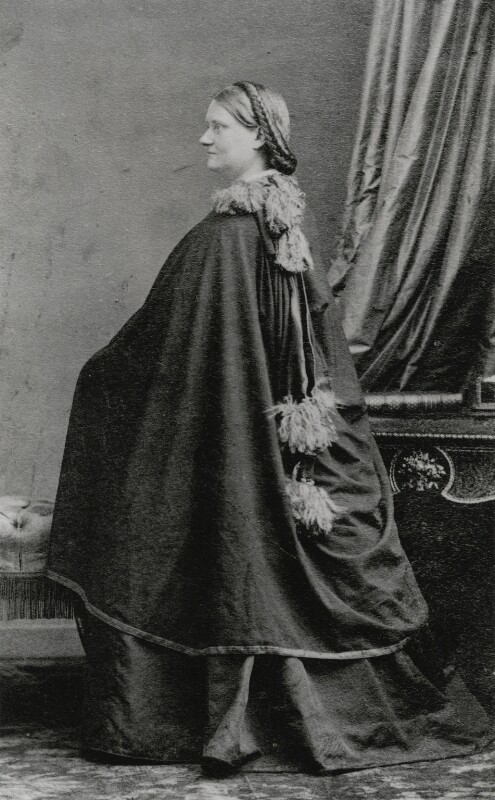
Lady Constance Georgina Bulwer-Lytton by Bassano Ltd. Whole-plate glass negative, 23 January 1911. NPG x28367 (Source: National Portrait Gallery).

Lady Constance Georgina Bulwer-Lytton was a woman of privilege, although she was never really comfortable with the aristocratic life. Suffering from poor health for most of her life, she struggled to find a purpose to life until she decided to join the Women’s Social and Political Union (WSPU) in 1910. Her dedication to the suffrage movement dovetailed with her interest in prison reform, and she relished being imprisoned four times for the cause. On the third occasion she was force fed.

Constance Lytton was born on the 12th of January 1869 in Vienna. The third of seven children of Edith Villiers and Robert Bulwer-Lytton, the first Earl of Lytton, to say that Constance was privileged is a bit of an understatement. Her father was the Viceroy of India, and she lived there until she was 11. She was private and shy, and never really took to the aristocratic way of life. When her father died in 1891 she retired from public life to look after her mother. The following year, her mother refused to allow her to marry someone from a ‘lower social order.’ Constance spent several years hoping her mother would change her mind, but it was not to be, and Constance never married.

In 1905, Constance was left £1000 by her great-aunt. She wanted to donate the money to the revival of morris dancing, and her brother suggested she give it to the Esperance Club, founded by Emmeline Pethwick-Lawrence and Mary Neal. Both suffrage campaigners themselves, Emmeline and Mary established the Esperance Club, a dance and drama club for working class girls. Over the next few years, Constance met other suffragettes, including Annie Kenney. Constance had an interest in prison reform and was initially sympathetic to suffragette prisoners, although she disapproved of their militant methods. Her objections were eventually overcome, however, and she joined the WSPU in January 1909.

Constance became a paid WSPU organiser in June 1910; she travelled the country making pro-Suffrage speeches and used her family connections to lobby Parliament. She wasted no time getting involved in the direct action side of the suffrage campaign though, on the 24th of February 1909 she took part in a demonstration at the House of Commons which earnt her her first prison sentence. Constance had a weak heart, and spent most of her sentence in the infirmary, being treated well. Whilst in prison, she attempted to carve ‘Votes for Women’ into her own skin, from her chest to her cheek, so her allegiance would always be visible. She carved the V above her heart, but was prevented from completing this unorthodox protest when she asked for a sterile dressing.

The second time Constance was imprisoned, she was released as soon as she began a hunger strike and a doctor discovered her weak heart. The government were reluctant to make a martyr of such a prominent, well-connected suffragette. Convinced that her social status was earning her special treatment, Constance adopted the persona of Jane Warton, a working-class London seamstress. Jane Warton travelled to Liverpool in October 1909 and was sentenced to fourteen days hard labour after throwing rocks at an MP’s car. She went on hunger strike, and was force fed eight times before her true identity was discovered and she was released.

Severely weakened by her ordeal, Constance wrote accounts of her experiences for The Times and Votes for Women, the WSPU’s newspaper. She also gave lectures about Jane Warton’s time in prison, and her accounts are credited with helping to end the practice of force feeding suffragettes. It came at a high price; Constance had a heart attack in August 1910, followed by several strokes that left her right side paralysed. In November 1911, Constance was imprisoned again, and found conditions for suffragettes much improved. Her health forced her to step back from direct action campaigning, but she continued to write pamphlets and other materials in support of women’s suffrage. In 1914 Prisons and Prisoners, her account of her experiences in prison, was published.

At the outbreak of the First World War in 1914, the WSPU suspended their pro-suffrage campaigning. Constance turned her attention to Marie Stopes’ campaign to establish birth control clinics. Her health never recovered, and she was looked after by her mother for the rest of her life. She died on the 2nd May 1923.

Constance Lytton was never comfortable with her privilege, but she used it to campaign for women’s right to vote, and to expose the cruelty of the treatment of suffrage campaigners in prison. She sacrificed her already poor health to draw attention to the disparity between the treatment of working- and upper-class prisoners, and I admire her determination.

Sources and Further Reading

Birkby, Michelle. “Lady Constance Lytton: The Suffering Suffragette.” Historia. Last modified 5th February 2018, accessed 17th May 2018. Available at http://www.historiamag.com/lady-constance-lytton-suffragette/

Jenkins, Lyndsey. Lady Constance Lytton: Aristocrat, Suffragette, Martyr. London: Biteback, 2015.

Simkin, John. “Constance Lytton.” Spartacus Educational. Last modified February 2015, accessed 17th May 2018. Available at http://spartacus-educational.com/Wlytton.htm 

Wikipedia, “Lady Constance Bulwer-Lytton.” Last modified 1st January 2018, accessed 17th May 2018. Available at https://en.wikipedia.org/wiki/Lady_Constance_Bulwer-Lytton
Turbulent Londoners: Rosa May Billinghurst, 1875-1953

Turbulent Londoners is a series of posts about radical individuals in London’s history who contributed to the city’s contentious past, with a particular focus of women, whose contribution to history is often overlooked. My definition of ‘Londoner’ is quite loose, anyone who has played a role in protest in the city can be included. Any suggestions for future Turbulent Londoners posts are very welcome. To celebrate the centenary of the Representation of the People Act, all of the Turbulent Londoners featured in 2018 will have been involved in the campaign for women’s suffrage. Next up is Rosa May Billinghurst, known at the time as ‘the cripple suffragette.’


Rosa May Billinghurst tricycle
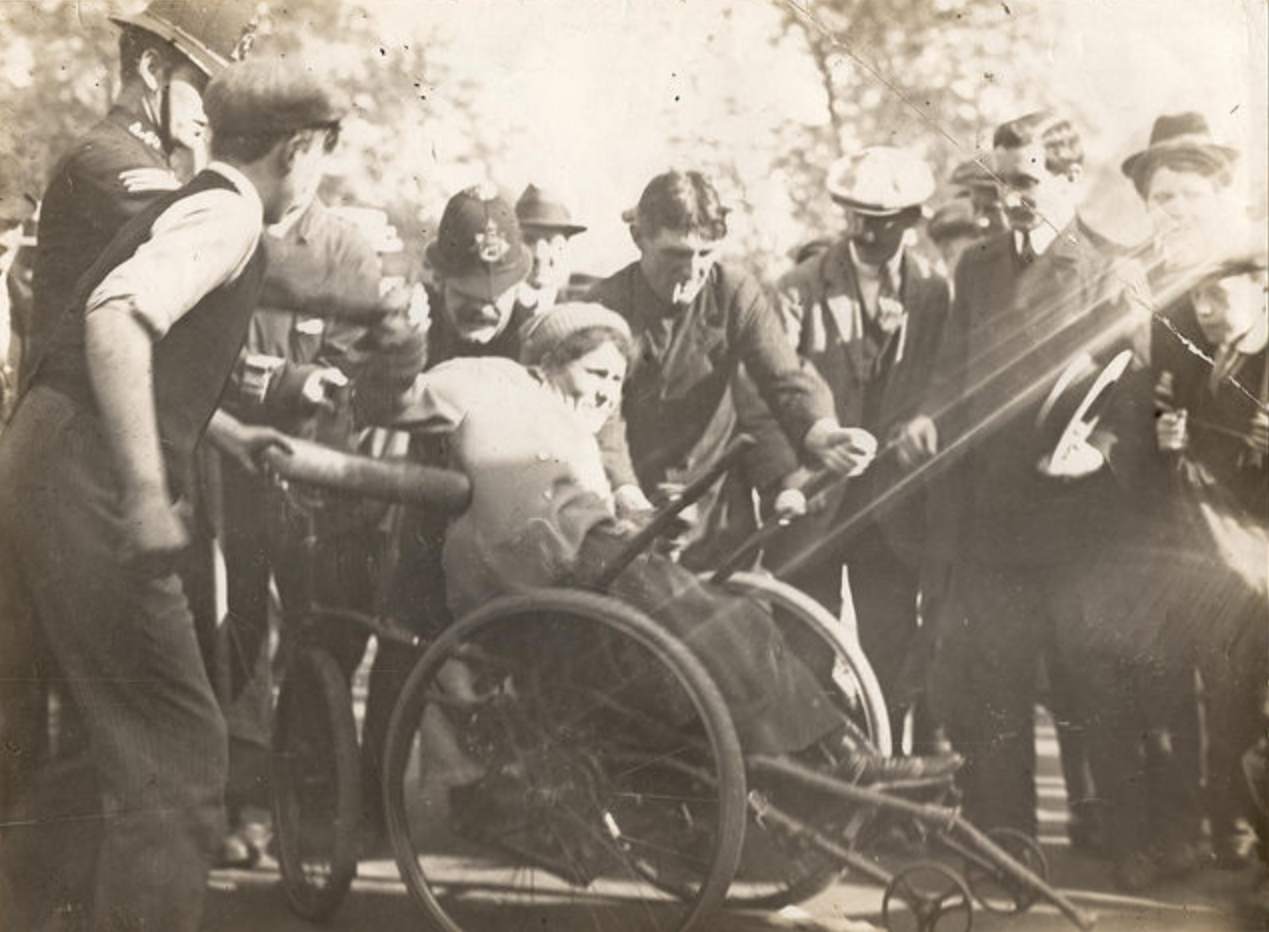
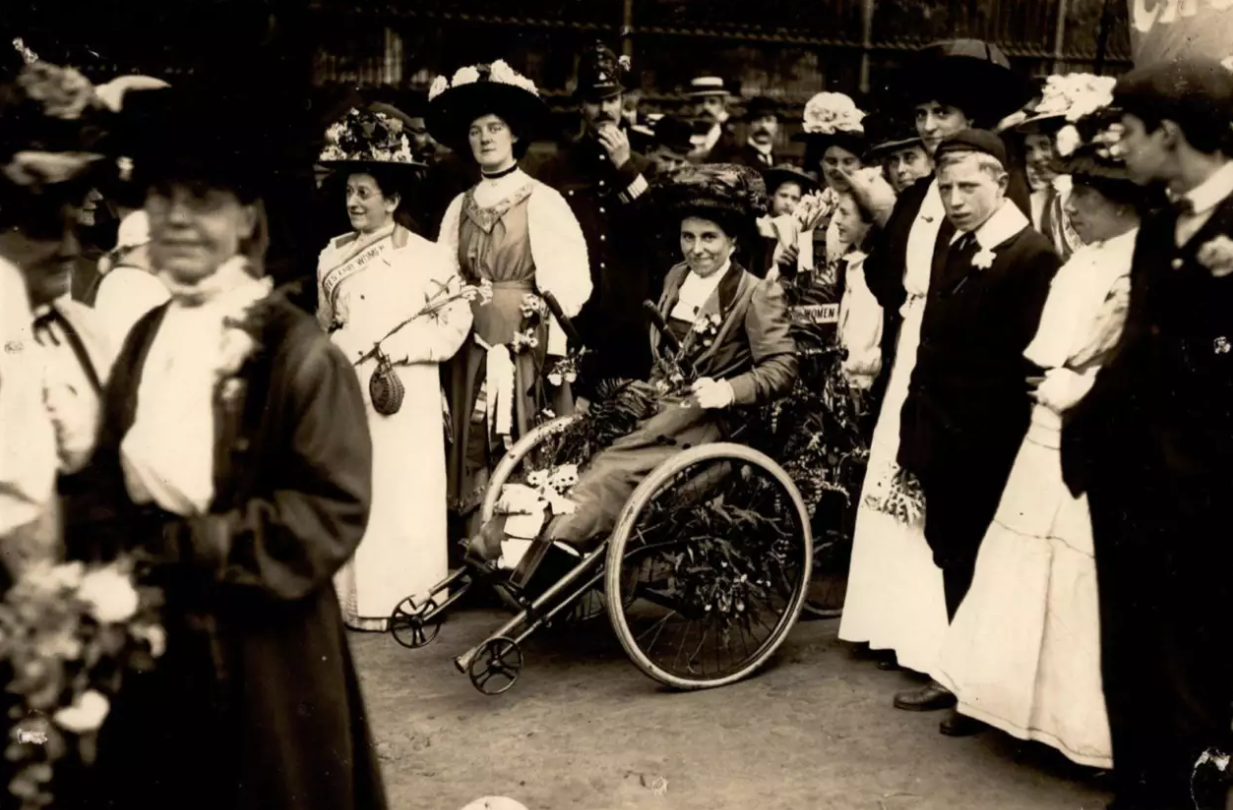
Rosa and her adapted tricycle at a Votes for Women demonstration (Source: LSE Library 7ewd j 55).

Rosa May Billinghurst was born on the 31st May 1875 to a well-off middle class family in Lewisham, south east London. She suffered with polio as a young child which left her unable to walk; she wore leg irons and used crutches or a modified tricycle for the rest of her life. This would not prevent her from throwing herself headlong into the campaign for women’s suffrage however. In fact, she often used her disability to the advantage of the cause.

As a young women Rosa volunteered with the poor in Greenwich, taught Sunday School, and was a member of the Band of Hope, a charity which taught children about the benefits of sobriety and teetotalism. She was also a member of the Women’s Liberal Association, although she later rejected the Liberal Party because of its approach to women’s suffrage. Rosa came to believe that women’s inferior position in society held back society as a whole.

Rosa joined the Women’s Social and Political Union (WSPU) in 1907 and took an active part in marches and demonstrations despite her limited mobility. In 1910, she founded a Greenwich branch of the WSPU and served as its Secretary. On the 18th of November, she took part in the demonstration that would become known as Black Friday. The demonstration was organised to protest the government’s abandonment of the Conciliation Bill, which would have given about one million of the wealthiest women the right to vote. The police used excessive force in quelling the demonstration, arresting 119 people, and assaulting many more. In a pattern that would become familiar to Rosa, police officers threw her out of her tricycle and sabotaged it, leaving her unable to move. Unfortunately, this behaviour was echoed by police officers almost a century later, when Jody McIntyre was pulled from his wheelchair twice during the Student Tuition Fee Demonstrations in 2010.

Rosa used her tricycle to its full advantage however. During demonstrations, she would decorate her tricycle with coloured ribbons and WSPU banners. During confrontations with the police, she would place her crutches on either side of the tricycle and repeatedly charge at police lines, happy to use herself as a battering ram. She was also known to hide the tools of the suffragette’s trade–stones for smashing windows and packages of thick brown liquid for pouring into post boxes and destroying letters–under the blanket that covered her knees. In addition, Rosa was fully aware of the publicity she could attract as a disabled suffragette; it was very difficult to portray her in a negative light without seeming particularly callous.

rosa May Billinghurst and police.PNG
Rosa grappling with police (Source: LSE Library twl 2009 02 045).

In March 1912 Rosa took part the WSPU’s campaign of mass window smashing. She was sentenced to one month’s hard labour for smashing a window on Henrietta Street. The sentence caused confusion amongst prison authorities, who did not know what kind of labour she could be put to. In December, she was caught sabotaging post boxes in Deptford, also part of a wider WSPU campaign. She was apparently glad to be arrested, believing that it would finally get the media attention the campaign had been trying to achieve. Rosa was sentenced to 8 months in prison. She went on hunger strike, and the subsequent force-feeding had such an effect on her health that she was released after two weeks.

Despite this traumatic ordeal, Rosa continued to participate in direct action. On the 24th of May 1913, she chained herself to the gates of Buckingham Palace. The following month, on the 14th of June, she took part in Emily Wilding Davison’s funeral procession. Emily had died after attempting to attach a Votes for Women sash to the King’s horse during the Epsom Derby, and she was celebrated as a martyr for the cause.

Emmeline and Christabel’s decision to suspend WSPU campaigning at the outbreak of the First World War in order to concentrate on the war effort was a controversial one. Rosa joined the Women’s Freedom League, who continued to campaign, suggesting that she didn’t personally agree with the Pankhurst’s decision. However, she remained loyal to the Pankhursts and the WSPU, helping in Christabel’s 1918 election campaign in Smethwick as the candidate for the Women’s Party. Emmeline and Christabel had founded the Women’s Party when the dissolved the WSPU in November 1917. Christabel lost, but only by 800 votes.

Rosa withdrew from activism after the passage of the Representation of the People Act in 1918. During her time in the WSPU, however, she was a fierce campaigner who used her disability to the best possible advantage.

Sources and Further Reading

Fox, Kathryn. “Rosa May Billinghurst: Disabled Suffragette Campaigner.” Huffpost UK. Last modified 23rd December 2017, accessed 22nd March 2018. Available at  https://www.huffingtonpost.co.uk/entry/rosa-may-billinghurst-disabled-suffragette-campaigner_uk_5a37f1dde4b02bd1c8c608c8

Fox, Katie. “Rosa May Billinghurst: The Disabled Suffragette Abused by Police and Force-fed in Prison.” i. Last modified 5th February 2018, accessed 22nd March 2018. Available at https://inews.co.uk/news/uk/rosa-may-billinghurst-disabled-suffragette-abused-police-force-fed-prison/

Hanlon, Sheila. “Rosa May Billinghurst: Suffragette on Three Wheels.” SheilaHanlon.com. No date, accessed 22nd March 2018. Available at http://www.sheilahanlon.com/?page_id=1314 

John Simkin. “May Billinghurst.” Spartacus Educational. Last modified March 2017, accessed 22nd March 2018. Available at http://spartacus-educational.com/Wbillinghurst.htm 

Wikipedia. “Rosa May Billinghurst.” Last modified 4th February 2018, accessed 22nd March 2018. Available at https://en.wikipedia.org/wiki/Rosa_May_Billinghurst

Wikipedia. “Women’s Party (UK).” Last modified 29th January 2018, accessed 23rd March 2018. Available at https://en.wikipedia.org/wiki/Women%27s_Party_(UK)

Vote 100 UK: But When did Other Women Around the World Get the Right to Vote?

It is now fairly well known that some women in Britain won the right to vote 100 years ago, in 1918 (women weren’t given the right to vote on equal terms as men until 1928). I recently heard that women in France did not get the right to vote until 1944. That got me thinking about when other countries gave women the right to vote. New Zealand was first, in 1893. The last, perhaps unsurprisingly, was Saudi Arabia, in 2015. There is still one country, however where women are not allowed at vote, Vatican City. Granted, the only elections that occur there are for the pope, but only cardinals can elect a new pope, and women are not allowed to be cardinals. Perhaps more of a problem is the fact that it is still very difficult for women to vote in many countries, despite them being entitled to. There is still work to be done, but we’ve also come a long way. Below are some examples that illustrate both how far we’ve come and how far we have to go.

1893: New Zealand

New Zealand Suffrage Cartoon
New Zealand Graphic and Ladies’ Journal. New Zealand graphic and ladies journal :The Summit At Last. [Engraving by an unknown artist. 1894]. New Zealand Graphic & Ladies Journal. Ref: PUBL-0126-1894-01. Alexander Turnbull Library, Wellington, New Zealand. /records/22777263

New Zealand was the first country in the world which gave women the right to vote in national elections. This included Maori women, which would also prove to be groundbreaking; most colonial countries did not give aboriginal women the right to vote until some time after white women. The women’s suffrage movement in New Zealand developed at the same time as other movements in northern Europe and the US, in the late nineteenth-century. However, it also had a fairly strong moral element–the campaign was led by a New Zealand branch of the American Women’s Christian Temperance Union (WCTU). As such, women’s suffrage in New Zealand was opposed by the liquor industry as well as the other usual suspects. Nevertheless a petition in 1893 signed by 32,000 people (almost a quarter of the European female adult population) helped make the demand impossible to refuse, and women’s right to vote became law on the 19th of September 1893.

1902: Australia

Women in Australia were granted the right to vote in national elections in 1902. The right to vote in local elections was granted by individual states at different times; the first was South Australia, in 1895, and the last was Victoria, in 1908. The suffragette Muriel Matters moved to London from South Australia in 1905, so is perhaps not surprising that she became an active member of the UK’s suffrage movement.  The very same act that gave European women the right to vote, however, excluded aboriginal people from voting. Aboriginal and Torres Straight Islanders were not given the right to vote in Australia until 1962, when the US Civil Rights Movement helped draw attention to the fact that indigenous people were treated so poorly.

1906: Finland

First_Female_Parliamentarians_in_the_world_in_Finland_in_1907
Some of the first female MPs in the world, elected in Finland in 1907. Conservative parliamentarians wore black tops, whilst social democrats wore white (Source: Wikipedia).

Finland was the first European country which granted women the right to vote. In 1906, it was part of Russia, although it was governed by the Diet, which dated from the time of Swedish rule. Only a small number of Finns could vote in the elections for the Diet, so it was not just women who felt disenfranchised. In 1905, unrest in Russia spread to Finland, and culminated with a general strike in October and November. Eager to restore peace, the Russian authorities conceded significant reforms, including parliamentary reform and universal and equal suffrage. Women were granted to right to vote, and at the same time the ability to stand in elections. It was the first country in the world that recognised women’s eligibility to stand for office. In March 1907, 19 women were elected to the new Parliament.

1930: South Africa

The campaign to grant white women the vote in South Africa was also started by the Women’s Christian Temperance Union, who felt that their demands would be ignored if they did not have the right to vote. The first Women’s Enfranchisement League was established in Durban in 1902, and this organisation became the Women’s Enfranchisement Association of the Union as more branches were established across the country. In the run up to the 1929 General Election, Prime Minister James Herzog promised to raise the issue in Parliament if women supported his re-election campaign. They did, and white women were given the right to vote on the 19th of May 1930. Solidarity for black women, however, was almost non-existent. Black South Africans, both female and male, were not able to vote until Apartheid ended in 1994. This was something I found particularly shocking, as it is within my lifetime. Sometimes it is easy to take advances in social justice for granted, particularly if you don’t have personal experience of what it was like before.

1971: Switzerland

In Switzerland, a change to the constitution requires a national referendum- it is one of the oldest and most direct democracies in the world. Yet it was the last European country to grant women the right to vote. It was not the government that had to be persuaded, it was the men, and that turned out to be a much harder job. Women’s suffrage was rejected by 67% of Swiss men in a referendum in 1959. It wasn’t until another referendum was held twelve years later that women in Switzerland won the right to vote in federal elections. One possible explanation for it taking so long is Switzerland’s neutrality during World War Two. Women did not get the same chance to prove their ability to maintain and run the country as in France, German and Britain. Whatever the explanation, it undoubtedly held women’s rights back; men had control over their wives’ bank accounts until 1985, and maternity leave wasn’t introduced until 2005.

Sources and Further Reading

Aspinall, Georgia. “Here are the Countries Where it’s Still Really Difficult for Women to Vote.” The Debrief. Last modified 6th February 2018, accessed 25th March 2018. Available at https://thedebrief.co.uk/news/politics/countries-where-women-can-t-vote/

Atkinson, Neill. “Voting Rights.” Te Ara: The Encyclopaedia of New Zealand. Last modified 17th February 2015, accessed 26th March 2018. Available at  https://teara.govt.nz/en/voting-rights 

Australian Electoral Commission. “Women and the Right to Vote in Australia.” Last modified 14th April 2015, accessed 26th March 2018. Available at  http://www.aec.gov.au/Elections/Australian_Electoral_History/wright.htm

Gatten, Emma. “Swiss Suffragettes were Still Fighting for the Right to Vote in 1971.” The Independent. Last modified 25th September 2015, accessed 25th March 2018. Available at  https://www.independent.co.uk/news/world/politics/swiss-suffragettes-were-still-fighting-for-the-right-to-vote-in-1971-10514445.html

Krulwich, Robert. “Non! Nein! No! A Country That Wouldn’t Let Women Vote Till 1971.” National Geographic. Last modified 26th August 2016, accessed 25th March 2018. Available at https://news.nationalgeographic.com/2016/08/country-that-didnt-let-women-vote-till-1971/

Ministry for Culture and Heritage, New Zealand Government. “Brief History: Women and the Vote.” Last modified 13th March 2018, accessed 26th March 2018. Available at https://nzhistory.govt.nz/politics/womens-suffrage/brief-history

Ministry for Foreign Affairs of Finland. “Finnish Women Won the Right to Vote a Hundred Years Ago.” Last modified 30th January 2006, accessed 26th March 2018. Available at http://www.finland.lt/public/default.aspx?contentid=121094&nodeid=38417&contentlan=2&culture=en-US

Parliamentary Education Office. “Indigenous Australians and the Vote.” No date, accessed 26th March 2018. Available at https://getparliament.peo.gov.au/electing-members-of-parliament/indigenous-australians-and-the-vote

South African History Online. “White Women Achieve Suffrage in South Africa. Last modified 18th May 2017, accessed 26th March 2018. Available at  http://www.sahistory.org.za/dated-event/white-women-achieve-suffrage-south-africa

The Nellie McClung Foundation. “Timelines of Women’s Suffrage Granted.” No date, accessed 25th March 2018. Available at https://www.ournellie.com/learn/womens-suffrage/political-equality-timeline/

Zarya, Valentina. “There is Now Only Once Country Left in the World Where Women Can’t Vote.” Fortune. 11th December, 2015, accessed 25th March 2018. Available at  http://fortune.com/2015/12/11/one-country-women-vote/

Turbulent Londoners: Millicent Garrett Fawcett, 1847-1929

Turbulent Londoners is a series of posts about radical individuals in London’s history who contributed to the city’s contentious past, with a particular focus of women, whose contribution to history is often overlooked. My definition of ‘Londoner’ is quite loose, anyone who has played a role in protest in the city can be included. Any suggestions for future Turbulent Londoners posts are very welcome. To celebrate the centenary of the Representation of the People Act, all of the Turbulent Londoners featured in 2018 will have been involved in the campaign for women’s suffrage. The second of my suffragists is Millicent Garrett Fawcett, a pioneer of the campaign before the WSPU was even a twinkle in Emmeline Pankhurst’s eye.


Millicent Garrett Fawcett (Source: Bain News Service/Library of Congress).

A few weeks ago, my sister and I were having a conversation about Millicent Garrett Fawcett being the first woman to be commemorated with a statue in Parliament Square. When our Dad, a man with quite high levels of general knowledge, responded to the conversation by asking “who?”, I knew who my next Turbulent Londoner was going to be. Millicent Garrett Fawcett was a writer and campaigner, and was President of the National Union of Women’s Suffrage Societies (NUWSS) for more than two decades.

Millicent Garrett was born in Aldeburgh, Suffolk, on the 11th of June 1847, the eighth of ten children. The family was close and prosperous, and Millicent’s childhood was happy. The children were encouraged to read, speak their minds, and take an interest in politics. At the age of 12, Millicent was sent to school in Blackheath with her sister Elizabeth. Her older sisters introduced her to radical ideas and thinkers. In 1866, Millicent went to hear a speech given by John Stuart Mill, an early supporter of women’s suffrage. His words helped her decide to take action. That same year, at the age of 19, she became the Secretary of the London Society for Women’s Suffrage.

Through her new political connections Millicent soon met Henry Fawcett, the radical Liberal MP for Brighton. Despite the 14-year age gap they were married in 1867, and had their first and only child, Philippa, in April 1868. The couple were politically well matched, and it seems that they had a happy and loving marriage.

Henry was blinded in a shooting accident in 1858, so Millicent acted as his Secretary, alongside her activism and a successful writing career. In 1868, she joined the London Suffrage Committee, and spoke at the first public pro-suffrage meeting. It was unusual for women to speak in the public at the time, and Millicent got very nervous before making a speech. Despite this, she was known for her clear speaking voice, and her ability to explain complex arguments simply. In 1870, Millicent published Political Economy for Beginners. It was very successful, going through 10 editions in 41 years. Along with her sister Agnes, Millicent also raised 4 of her cousins whose parents had died.

Henry Fawcett; Dame Millicent Fawcett by Ford Madox Brown. Oil on canvas, 1872. NPG 1603 (Source: National Picture Gallery).

Millicent was a strong supporter of women’s education. In 1875, she co-founded Newnham College, one of the first Cambridge Colleges for women. She also supported a controversial campaign for women to actually receive degrees from the University of Cambridge, rather than just being able to study there. This wasn’t achieved until 1948.

Henry died unexpectedly in November 1884, leaving Millicent a widow at the age of 38. She sold the family homes in Cambridge and London, and took Philippa to live with Agnes. When she re-entered public life in 1885, Millicent began to concentrate on politics. She was a key member of what became the Women’s Local Government Society–a cross party group that campaigned for women to be allowed to stand as local councillors. This goal was achieved in 1907.

After the death of Lydia Becker in 1890, Millicent became the Chair of the Central Committee of the National Society for Women’s Suffrage. In 1897, the National Union of Women’s Suffrage Societies (NUWSS) was formed as an umbrella organisation for all the suffrage societies in the country. Millicent became President of this new group, a role she kept until 1919. Although the Women’s Social and Political Union (WSPU) frequently commanded the headlines and publicity, the NUWSS consistently had the majority of the support of the women’s movement. By 1905, the NUWSS had 305 constituent societies and 50,000 members. Millicent disapproved of militant tactics, believing that they alienated politicians and the general public. Despite this, she admired the courage of militant activists.

In July 1901, Millicent was asked to lead a commission of women to South Africa to investigate allegations that the families of Boer soldiers were being held in awful conditions in concentrations camps during the Boer War. It was the first time British women were trusted with such a responsibility in war time.

The NUWSS lost patience with the Liberal Party in early 1912, giving up the long-held hope that they would eventually give women the vote. Instead, they formed an electoral alliance with the Labour Party, which was the only political party that supported women’s suffrage. By 1913, the NUWSS had 100000 members, and organised the Women’s Suffrage Pilgrimage to demonstrate how many women wanted the vote. On the 18th of June, NUWSS members from all over the country set off for London, meeting in Hyde Park six weeks later on the 29th of July. Now aged 66, Millicent took an active part in the pilgrimage, and was the headline speaker at the Hyde Park rally.

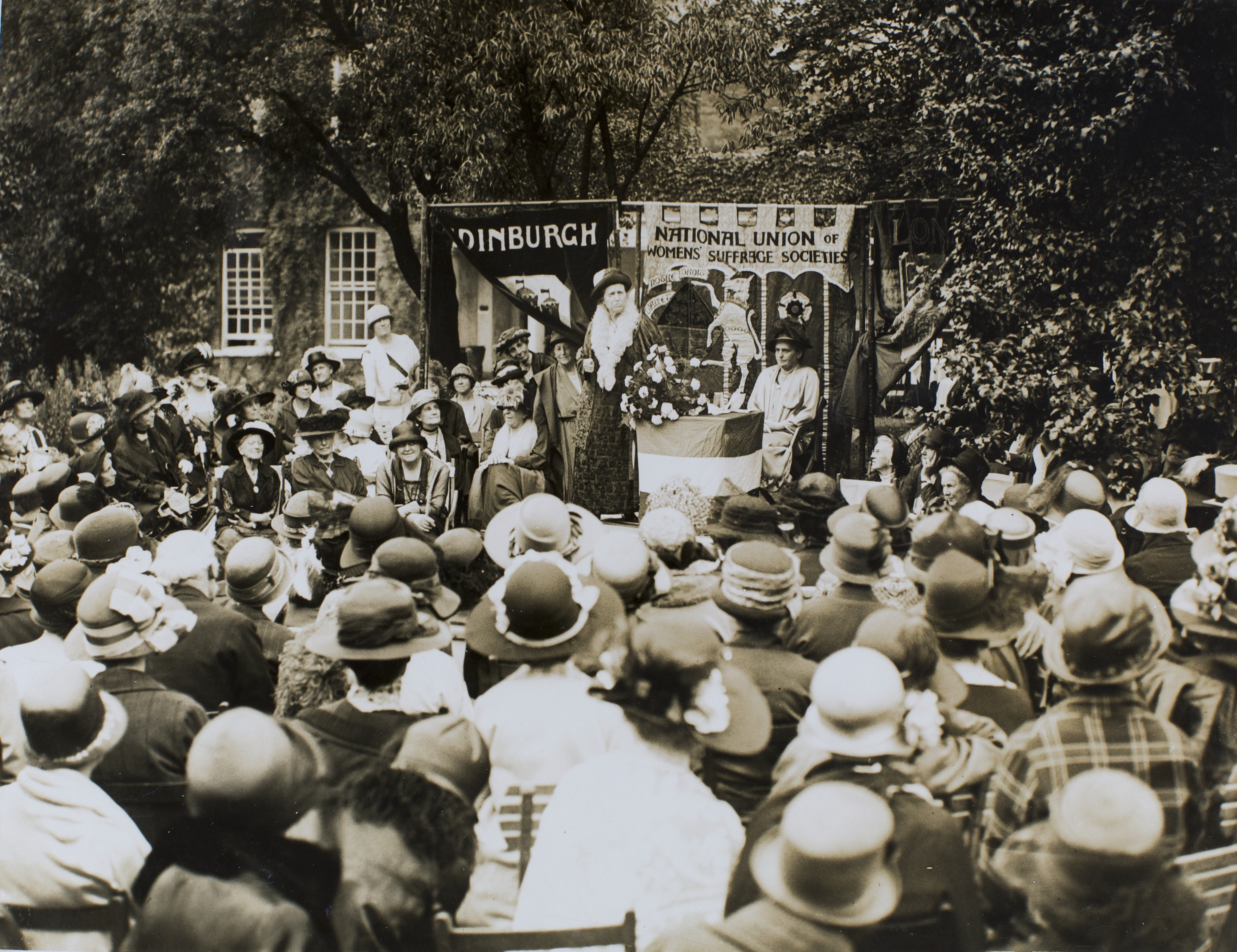
Millicent Garrett Fawcett and Eleanor Rathbone, 1925. Photograph, printed, paper, monochrome, Millicent Garrett Fawcett and Eleanor Rathbone at NUSEC open-air platform at Aubrey House, Camden Hill, Kensington, with National Union of Women’s Suffrage Societies (NUWSS) banner behind them, speak to a large audience of seated women; on reverse, printed ‘Copyright photograph by PHOTOPRESS, Johnson’s Court, Fleet Street EC. Telephone: City 7070′, ’23 Jul 1925 With affectionate thanks to Mary Fielden for all she did to make this party the success it was’ (Millicent’s handwriting) (Source: LSE Library TWL.2009.02.189).

Millicent was a not a pacifist, but the NUWSS continued to campaign for the vote during the First World War, unlike the WSPU. It will never be possible to find out whether the NUWSS or the WSPU’s campaigning methods were more effective for winning women the right to vote. There is no doubt, however, that Millicent Garrett Fawcett played a huge role in winning that right. After the Representation of the People Act was passed in 1918, Millicent largely withdrew from the suffrage campaign. Throughout her long career, however, she had supported a large number of campaigns, not all of which were successful. These included: raising the age of sexual consent; criminalising incest; preventing child marriage; repealing the Contagious Diseases Act; and Clementina Black’s campaign to help protect low-paid female workers.

Her hard work and dedication were recognised in 1925, when she was made a Dame Grand Cross of the British Empire. She passed away four years later on the 5th of August 1929. In 1953, the London’s Society for Women’s Suffrage was renamed the Fawcett Society in her honour. The Society continues to campaign for women’s rights and gender equality. In 2017, it was announced that Millicent would become the first woman to be commemorated with a statue in Parliament Square, which is due to be unveiled in February 2018.

After Emmeline and Christabel Pankhurst, Millicent Garrett Fawcett is perhaps one of the best-known suffragists. But that doesn’t mean she is well-known. Despite having a charity named after and a statue in Parliament Square planned to honour her, most people don’t seem to recognise her name, let alone are aware of what she achieved. I think that’s a real shame.

Sources and Further Reading

Biography Online. “Millicent Fawcett.” No date, accessed 29 January 2018. Available at https://www.biographyonline.net/politicians/uk/millicent-fawcett.html

Fawcett Society. “About.” No date, accessed 31 January 2018. Available at https://www.fawcettsociety.org.uk/about

Murray, Jenni. A History of Britain in 21 Women. London: Oneworld, 2017.

Simkin, John. “Millicent Garrett Fawcett.” Spartacus Educational. Last modified June 2017, accessed 31 January 2018. Available at http://spartacus-educational.com/WfawcettM.htm

Simkin, John. “Women’s Pilgrimage.” Spartacus Educational. Last modified February 2015, accessed 31 January 2018. Available at http://spartacus-educational.com/Wpilgimage.htm

Sutherland, Gillian. “History of Newnham.” Newnham College, University of Cambridge. No date, accessed 31 January 2018. Available at http://www.newn.cam.ac.uk/about/history/history-of-newnham/

Wikipedia. “Millicent Fawcett.” Last modified 28 January 2018, accessed 29 January 2018. Available at https://en.wikipedia.org/wiki/Millicent_Fawcett

Women’s Local Government Society. “Women’s Local Government Society.” Suffrage Pioneers. No date, accessed 29 January 2018. Available at http://www.suffrage-pioneers.net/wlgs/

Turbulent Londoners: Mary Macarthur, 1880-1921

Turbulent Londoners is a series of posts about radical individuals in London’s history who contributed to the city’s contentious past, with a particular focus of women, whose contribution to history is often overlooked. My definition of ‘Londoner’ is quite loose, anyone who has played a role in protest in the city can be included. Any suggestions for future Turbulent Londoners posts are very welcome. The next Turbulent Londoner is Mary MacArthur, a suffragist and trade unionist.


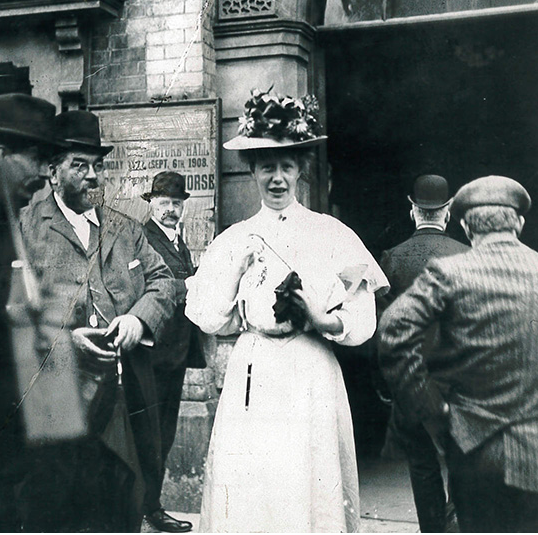
Mary Macarthur (Source: LSE Library TWL 2002 78).

Mary Reid Macarthur was a Scottish suffragist and trade unionist, who was instrumental in the expansion of female trade union membership in the early twentieth century. Born on 13th August 1880, Mary was the oldest of six children in a relatively well-off family. She attended Glasgow Girls High School, where she developed an interest in writing and journalism.

In 1901 Mary attended a meeting of the Shop Assistants Union, expecting to write a scathing report. She instead became a strong beleiever in trade unions, becoming secretary of the Ayr branch of the Shop Assistants Union. In  1902 she attended the Union’s national conference, where she became the first female to be elected to the national executive.

In 1903 Mary moved to London, where she became Secretary of the Women’s Trade Union League (WTUL), a congress for women’s unions. The League brought together women-only unions from a variety of different trades, which meant it had a mixed-classed membership. Through her activism, Mary realised that small, scattered unions would always struggle because of their inability to raise enough money to provide strike pay. To counter this, Mary founded the National Federation of Women Workers (NFWW) in 1906, a general labour union for women. It was open to all women who weren’t allowed to join the appropriate union, or who worked in trades that weren’t unionised. The NFWW became part of the National Union of General Workers in 1921, but in its 15 years it significantly advanced the cause of women in trade unions.

Mary Macarthur Speaking
Mary Macarthur speaking to a mostly male crowd in Trafalgar Square about a boxmakers strike in August 1908 (Photo: TUC Library Collections).

Mary also tried to help female workers in other ways, helping to organise the Exhibition of Sweated Industries in 1905 and getting involved in the foundation of the Anti-Sweating League the following year. Sweated trades we’re characterised by long hours, low  wages, and unsafe and insanitary working conditions. In 1907 Mary founded The Woman Worker, a monthly magazine for female trade unionists. She was a brilliant editor, but gave it up to concentrate on her activism. Mary spent time in the poorer parts of London collecting evidence about what it was like to work in sweated industries. She caught diptheria and spent 6 weeks in hospital, but she was able to present her findings to the Select Committee on Home Working in 1908.

Mary was also active in the campaign for the vote, although she opposed the National Union of Women’s Suffrage Societies and the Women’s Social and Political Union, the two main campaign groups. This was because they were willing to accept only certain groups of women bring given the vote. Mary believed this would disadvantage the working classes, and possibly delay universal adulthood suffrage.

Mary Macarthur TUC 1908
Mary Macarthur at the Trade Union Congress in Nottingham in 1908 (Source: TUC Library Collections).

The Trades Board Act was passed in 1909, largely due to the efforts of Mary and the organisations she worked with. The Act regulated sweated industries and introduced a minimum wage. The female chainmakers at Chadley Heath in the West Midlands became the first test case of the new Act in 1910. Mary convinced the women to fight for the wage they were entitled to; they won the dispute after a 10 week strike. Mary used her skills as a journalist to publicise the women’s cause, giving interviews, writing copy and arranging photo opportunities of the striking women with chains around their necks. She also made use of the new technology of cinema; a Pathe newsreel film of the strikers was seen by an estimated 10 million people. The publicity campaign raised a lot for the strike fund, the leftovers were used to build the Bradley Heath Worker’s Institute, which is now part of the West Country Living Museum.

Mary opposed the first world war, but she worked throughout it to promote the rights of female workers, campaigning for equal pay for equal work. She was a member of the Reconstruction Committee from 1916, set up to give advice on the employment of women after the war. Female trade union membership tripled during the war. After the war, Mary stood in the 1919 general election as the Labour candidate for Stourbridge in Worcestershire but was defeated, along with most other anti-war candidates.

Mary married William Crawford Anderson, the chairman of the executive committee of the Labour Party, in 1911. Anderson had first proposed marriage almost 10 years earlier, but Mary had decided to concentrate on her activism. Sadly their first child died at birth in 1913, but Anne Elizabeth was born in 1915. William died in the 1919 influenza epidemic. Mary herself died of cancer 2 years later, at the age of just 40.

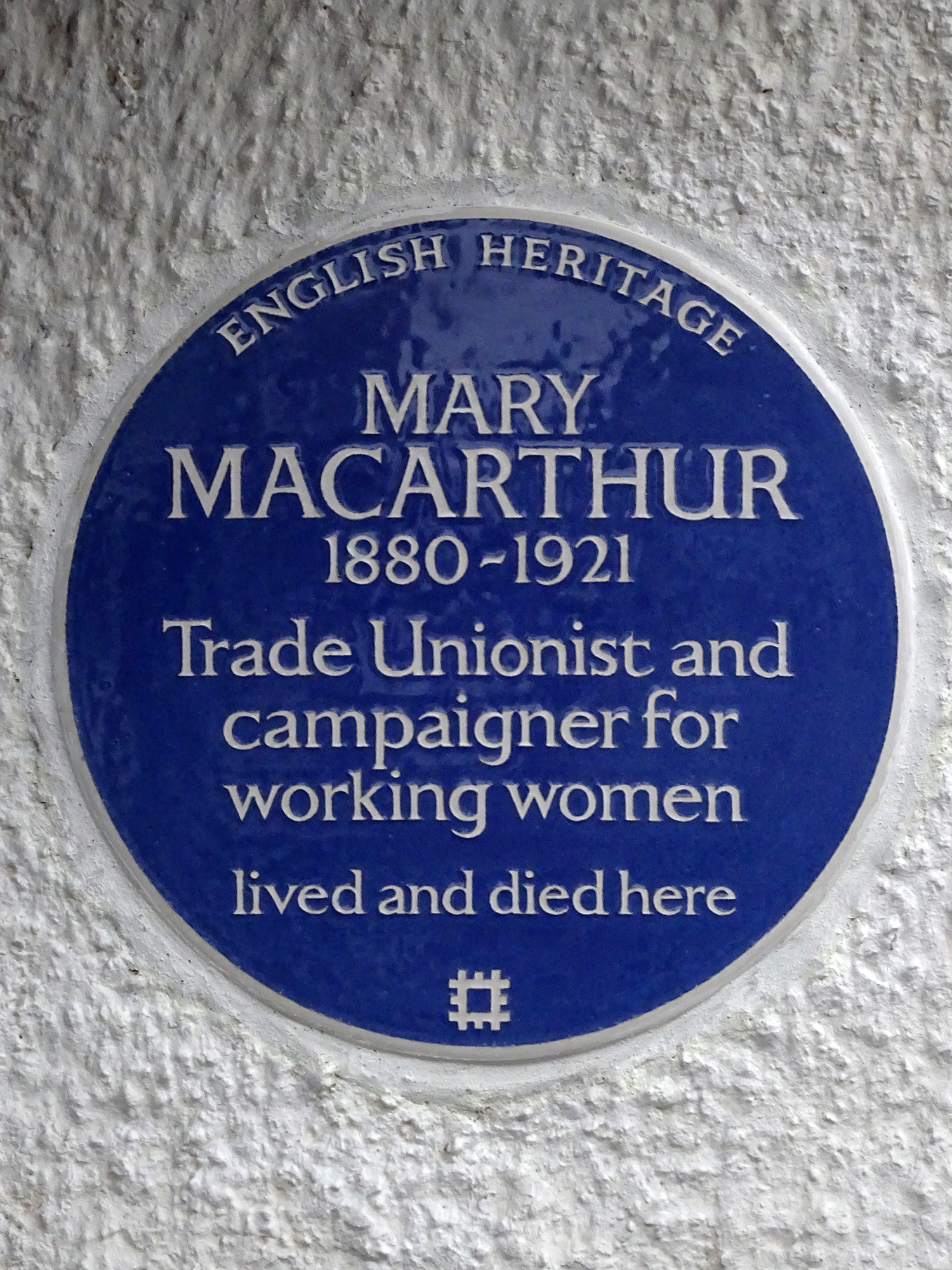
Blue plaque erected on 7th March 2017 by English Heritage at 42 Woodstock Road, Golders Green, London NW11 8ER, London Borough of Barnet. “MARY MACARTHUR 1880-1921 Trade Unionist and campaigner for working women lived and died here” (Source: Spudgun67).

Mary’s legacy lives on in the Mary Macarthur Holiday Trust and the Mary Macarthur Educational Trust, which provide grants to working women. A blue plaque commemorating Mary’s campaigning efforts on behalf trade unions and working women was installed on her house in Golders Green in north London in March 2017. As such, it might be said that she is better remembered than some of the other Turbulent Londoners featured on this blog. She deserves this recognition however, because of her huge contribution to the cause of women’s working conditions.

The TUC has an online exhibition about the life of Mary Macarthur that you can download HERE.

Sources and Further Reading 

Black Country Living Museum. “Mary Reid Macarthur, 1880-1921.” No date, accessed 22 March 2017. Available at  https://www.bclm.co.uk/media/learning/library/witr_marymacarthur.pdf

Simkin, John. “Mary Macarthur.” Spartacus Educational. Last modified August 2014, accessed 22 March 2017. Available at http://spartacus-educational.com/TUmacarthur.htm

Wikipedia, “Mary Macarthur.” Last modified 12 March 2017, accessed 13 March 2017. Available at https://en.wikipedia.org/wiki/Mary_Macarthur

Working Class Movement Library. “Mary Macarthur.” No date, accessed 22 March 2017. Available at http://www.wcml.org.uk/our-collections/activists/mary-macarthur/

Turbulent Londoners: Barbara Leigh Smith Bodichon, 1827-1891

Turbulent Londoners is a series of posts about radical individuals in London’s history who contributed to the city’s contentious past, with a particular focus of women, whose contribution to history is often overlooked. My definition of ‘Londoner’ is quite loose, anyone who has played a role in protest in the city can be included. Any suggestions for future Turbulent Londoners posts are very welcome. Today I’m looking at Barbara Leigh Smith Bodichon, a feminist and campaigner for women’s rights.


Barbara Leigh Smith Bodichon by Disdéri, copied by Emery Walker Ltd. Copy glass plate negative of an albumen carte-de-visite, circa 1860. NPG x200062 (Source: National Portrait Gallery).

Barbara Leigh Smith was born on the 8th of April 1827, the oldest of 5 children. Her mother was Anne Longden, a milliner, and her father was Ben Leigh Smith, a radical Whig politician. Barbara’s parents never married, but lived openly together, so she must have been used to controversy from a young age. Ben Leigh Smith held radical political views, despite being a member of the landed gentry. He treated all five of his children the same; he gave each of them £300 a year when they turned 21. It was highly unusual to for women to be treated this way. Like Elisabeth Jesser Reid, Barbara’s wealth gave her independence, a rare condition for single women at the time.

Barbara used her wealth to start a progressive school in London, researching other schools in London when deciding how to set it up. Later in life she co-founded Girton College in Cambridge, the first residential college for women that offered education to degree level. She gave generously to the college, in terms of both time and money. Her primary concern, however, was women’s rights. She was a member of one of the first organised women’s movements, known as The Ladies of Langham Place. They were a group of women who met regularly during the 1850s at no. 19 Langham Place to discuss women’s rights. They campaigned on many issues, including the property rights of married women. Langham Place served as sort of gentlemen’s club for women; it had a reading room, coffee shop, and meeting room. In 1858 it also became the base of the English Women’s Journal. Barbara set up the monthly periodical  for the discussion of women’s employment and equality, such as expanding employment opportunities and legal rights.

As well as a campaigner and publisher, Barbara was also an author. In 1854 she published Brief Summary of the Laws of England Concerning Women, and in 1858 she wrote Women and Work, in which she argued that women’s dependence on their husbands was degrading. She practiced what she preached too; as a young woman she fell in love with John Chapman, the editor of the Westminster Review. She refused to marry Chapman because of her views on the legal position of married women. Barbara did marry eventually however, to French physician Dr. Eugene Bodichon in 1857. This is also the year that the Matrimonial Causes Act was passed. The Act protected the property rights of divorced women, and allowed divorce through the courts rather than by an act of Parliament, which was a slow and expensive process. Barbara had testified to a House of Commons committee looking into the legal position of married women, which led to the Act.

Married life did not mellow Barbara, however. Although she started spending the winter in Algiers, she continued to take an active role in women’s rights campaigns. In 1866 she founded the first ever group asking for women’s suffrage. The Women’s Suffrage Committee organised a petition, which was presented to the House of Commons by John Stuart Mill.

Barbara Leigh Smith Bodichon was a strong character, sympathetic to many causes. Her primary cause, however, was women’s rights, and she used the full range of skills and opportunities available to her to advance this cause. Her efforts had very real effects, particularly in relation to married women.

Sources and Further Reading

Girton College. “Girton’s Past.”No date, accessed 8 December 2016. Available at  https://www.girton.cam.ac.uk/girtons-past

Simkin, John. “Barbara Bodichon.” Spartacus Educational. No date, accessed 8 December 2016. Available at http://spartacus-educational.com/Wbodichon.htm

Wikipedia, “Barbara Bodichon.” Last modified 1 December 2016, accessed 8 December 2016. Available at https://en.wikipedia.org/wiki/Barbara_Bodichon

Turbulent Londoners: Jane Cobden, 1851-1947

Turbulent Londoners is a series of posts about radical individuals in London’s history who contributed to the city’s contentious past, with a particular focus of women, whose contribution to history is often overlooked. My definition of ‘Londoner’ is quite loose, anyone who has played a role in protest in the city can be included. Any suggestions for future Turbulent Londoners posts are very welcome. My next Turbulent Londoner is Jane Cobden, one of the first women to be elected to the London County Council.


(Emma) Jane Catherine Cobden Unwin by Fradelle & Young. Albumen print, 1890s. NPG x131220 (Source: National Portrait Gallery).

Fans of Victorian crime drama Ripper Street might recognise Jane Cobden from series 2 and 3. Played by Leanne Best, Cobden was a strong, opinionated London County Councillor, more than a match for love interest Detective Inspector Edmund Reid. But how does the character match up to the real Jane Cobden?

Born Emma Jane Catherine Cobden on the 28th of April 1851 in Westbourne Terrace, London, Jane was the fourth of sixth children of the well-known reformer and politician Richard Cobden. She devoted her life to campaigning for women’s rights and protecting and developing her father’s legacy- she was committed to the’Cobdenite’ issues of land reform, peace and social justice.

In 1869 Jane moved to South Kensington with her sisters Ellen, Anne and Kate, also dedicated activists. Jane was active on the radical wing of the Liberal Party, and became increasingly committed to the cause of women’s suffrage over the 1870s. In 1871, she attended the Women’s Suffrage Conference in London with her sister Anne. In about 1879 she joined the National Society for Women’s Suffrage, and by the following year she was the organisation’s Treasurer.

The National Society was cautious, avoiding close association with political parties and excluding married women from their demand for the vote. This was too conservative for some, and the Central National Society broke away in 1888. In 1889 this group split again, and the Women’s Franchise League (WFL) was formed, including Cobden and Emmeline Pankhurst. The WFL’s aims were more radical- they wanted votes for women on the same basis as men, and women to be eligible for all political offices. Jane was politically pragmatic as well as ambitious, however. She disagreed with the mainstream Liberal Party’s stance on many issues, but remained a member because she believed it was the best way to advance her causes.

In the late 1880s, no one was sure whether women could serve as councillors or not; the law was unclear. In November 1888, the Society for Promoting the Return of Women as County Councillors (SPRWCC) was set up to test the law. This catchily-named organisation set up a £400 election fund and choose two women to stand as Liberal candidates for the newly established London County Council. Jane stood in Bromley and Bow, and Margaret Sandhurst stood in Brixton. Jane campaigned on a variety of issues, including opposition the tax on coal, better housing for the poor, “fair” wages, and opposition to sweat shops. Both women won, but their positions were not secure; there were many who opposed their election and tried to overturn the results. Sandhurst’s election was challenged by the man she defeated, and her election was declared invalid. Jane was supported by her runner-up, who was also a member of the Liberal Party. However, a judge eventually ruled that Jane’s election was unlawful, and therefore so were her votes in the council. She quietly served the rest of her term, and did not stand for reelection. It wasn’t until the Qualification of Women Act in 1907 that women legally gained the right to sit on county councils; Cobden was truly a woman before her time.

In 1892, aged 41, Jane married Thomas Fisher Unwin, a publisher. Encouraged by him, Jane expanded her interests to include international peace and justice, and rights of aboriginal people around the world. The couple strongly opposed the Boer War. In 1893, Jane represented the WFL at the World Congress of Representative Women in Chicago.

jane-cobden-ripper-street
Jane Cobden as portrayed by Leanne Best in BBC/Amazon drama Ripper Street (Photo: BBC).

As the campaign for women’s suffrage gained pace after 1900, Jane chose not to participate in the illegal activities of the WSPU, but she fiercely defended her sister, Anne, when she was imprisoned for a month in October 1906. She organised the Indian women’s delegation in the Women’s Coronation Procession on the 17th of June 1911, a few days before the coronation of George V. Cobden never gave up on a political solution to women’s suffrage. The Conciliation Bills of 1910-12 would have given a small number of propertied women the vote. Cobden asked the Irish Parliamentary Party to support the doomed bills, because of the support that women had given to the Land League campaign in England. She also continued to campaign for other causes she cared about during this time, publishing two books on the subject of land reform: The Hungry Forties: Life Under the Bread Tax (1904) and The Land Hunger: Life Under Monopoly (1913).

Jane Cobden died on the 7th of July 1974, aged 96. The BBC’s synopsis of her character in Ripper Street describes her as “one of the giants on whose shoulders the Suffragette Movement was to stand,” and it doesn’t exaggerate. Cobden may be more well-known than other women’s rights pioneers because of her portrayal in Ripper Street, but I think her achievements still deserve more recognition.

Sources and Further Reading

Baldwin, Anne. “Women’s History Month: Persistence Pays Off, as Women are Finally Elected to the London County Council.” Women’s History Network. Last updated 5 March 2010, accessed 31 October 2016. Available at http://womenshistorynetwork.org/blog/?tag=jane-cobden

Hurley, Ann. “Emma Jane Catherine Cobden-Unwin 1851-1947.” Hurley and Skidmore Family History. No date, accessed 31 October 2016. Available at http://www.hurleyskidmorehistory.com.au/emma-jane-catherine-cobden-.html

Richardson, Sarah. “What Next, and Next? The Cobden Movement: Fleeting or Fundamental?” Liberty Fund. Last updated 8 January 2015, accessed 31 October 2016. Available at http://oll.libertyfund.org/pages/lm-cobden

Wikipedia. “Jane Cobden.” Last updated 4 September 2016, Accessed 31 October 2016. Available at https://en.wikipedia.org/wiki/Jane_Cobden

Turbulent Londoners: Minnie Baldock, c.1864-1954

Turbulent Londoners is a series of posts about radical individuals in London’s history who contributed to the city’s contentious past, with a particular focus on women, whose contribution to history is often overlooked. My definition of ‘Londoner’ is quite loose, anyone who has played a role in protest in the city can be included. Any suggestions for future Turbulent Londoners posts are very welcome. My next Turbulent Londoner Minnie Baldock, an early member of the WSPU who helped establish the organisation in East London


Minnie Baldock 1909: Photograph by Colonel L. Blathwayt (Source: Wikipedia, image in the public domain). 

Minnie Baldock was an early member of the Women’s Social and Political Union (WSPU), who helped the organisation establish a presence in London, particularly amongst the working class women of the East End. Born in the East End in about 1864, she worked in a shirt factory as a young woman, and had two sons after her marriage to Harry Baldock.

Female suffrage was not the cause which brought out Minnie’s radicalism; she was a member of the Independent Labour Party, and in 1903 held a public meeting to complain about women’s low wages with her MP, Keir Hardie. As a member of the WSPU, however, Minnie flourished as an activist.

Minnie joined the WSPU early on, before it moved to London, and was soon involved in many of its activities in the capital. In December 1905 she was ejected from not one but two public meetings for heckling Herbert Asquith and Henry Campbell Bannerman, leader of the Liberal Party. In January 1906, Minnie established the first London branch of the WSPU in Canning Town, in an attempt to recruit working class women. Several other branches soon followed in the East End. Minnie was at the heart of networks of radical women in London; she helped Annie Kenney make connections when she first moved to London, she knew Sylvia Pankhurst and Charlotte Despard, and was a mentor to Daisy Parsons.

Also in 1906, Minnie became a full-time organiser for the WSPU. For the next few years she toured the country, promoting the cause of female suffrage. In October that year she was arrested at the opening of Parliament. She was arrested again outside Parliament in February 1908, and this time spent a month in Holloway Prison. She was worried about leaving her two sons alone with her husband, which illustrates the tension many female activists feel between their activism and their caring responsibilities.

Minnie worked for the WSPU until 1911, when she became seriously ill with cancer. She did not return to the WSPU after she recovered, although she remained a member of the Church League for Women’s Suffrage, which united all kinds of suffragists who were also religious. This suggests that she had become disillusioned by the WSPU’s methods rather than their main objective; they became increasingly violent, authoritarian, and dismissive of the concerns of working class women in the years before the First World War. Minnie moved to Southampton with her family in 1913, and was living in Poole when she died in 1954.

The WSPU was much more than the Pankhurst family; women like Minnie Baldock were essential to the successful running of the organisation. Minnie helped the WSPU establish a presence in London, and went on to campaign tirelessly for them around the country. Her name may not have survived the lottery of history, but the impact of her actions still resonates.

Sources and Further Reading

Brooker, Janice. “Suffragette.” Lost in London. Last modified 1st May 2007, accessed 11th October 2016. Available at http://www.brooker.talktalk.net/suffragette.htm

Simkin, John. “Minnie Baldock.” Spartacus Educational. Last modified January 2015, accessed 12th October 2016. Available at http://spartacus-educational.com/WbaldockM.htm

Walker, John. “Forest Gate’s Proud Suffragette Legacy.”E7 Now and Then. Last modified 6th March 2015, accessed 14th October 2016. Available at http://www.e7-nowandthen.org/2015/03/forest-gates-proud-suffragette-legacy.html

Book Review: March, Women, March

'March, Women, March' by Lucinda Hawksley.
‘March, Women, March’ by Lucinda Hawksley.

Hawksley, Lucinda. March, Women, March. London: André Deutsch, 2013.

Lucinda Hawksley’s March, Women, March, recently released in paperback, serves as a fantastic introduction to the history of the women’s movement in the UK, introducing the reader to all the key players from Mary Wollstoncraft through to Christabel Pankhurst, including quite a few who are not so well known nowadays. The book traces the struggle for women’s rights and female suffrage from the end of the eighteenth century to the late 1920s, using extensive quotes from those directly involved to help tell the story.

Hawksley uses numerous extracts from the diaries, letters and publications from those directly involved in the events she describes, so much of the story is told in the words of those who were there and took part. Not only does this act as proof of the huge amount of research that must have gone into the book, it also gives it a personal feel; you can almost feel the determination and strength of the women emanating from the pages.

One of the great strengths of this book is the fact that it tells the whole story of the women’s movement, putting the well-known suffragettes into the context of their predecessors and contemporaries. The Women’s Social and Political Union (WSPU) and the suffragettes did not spring up out of nowhere- they were inspired by, and worked alongside, vast numbers of other women such as Caroline Norton, Clementina Black and Charlotte Despard. March, Women, March acknowledges and celebrates the whole of this history, not just the bits that have successfully made their way into the collective consciousness.

In fact, my main criticism of the book is that I would have liked more detail about the early pioneers of the women’s movement. Women such as Caroline Norton, who railed against the way that she was treated by both her husband and the law after her marriage, and campaigned tireless for the rights of married women to see their children and control their own income, are much less familiar to me than the Pankhursts, and I would have liked to hear more about them.

March, Women, March also puts the campaign for suffrage into the context of other campaigns that aimed to benefit women, such as attempts to raise awareness about sexual health and contraception, and the ‘rational dress’ movement, which sought to free women from the physical constraints of tight corsets, high heels and excess frills and bows. These campaigns made social pariahs of their champions, appalling mainstream society with their frank and radical opinions. Many of the campaigners, such as Clementina Black who worked tirelessly to improve the conditions of working women, believed that the situation would not truly improve until women were granted the vote, for why should politicians listen to them when they could not influence the outcome of elections? Everything came back to suffrage.

If you are acquainted with the events and figures of the women’s suffrage campaign after 1900, much of this book will feel familiar, although you will probably still learn something new. If you are not familiar with the activities of the WSPU and others, then this book is an ideal introduction to the topic. Either way, March, Women, March is a very enjoyable read, and I would highly recommend it.