Turbulent Londoners: Flora Drummond, 1879-1949

Turbulent Londoners is a series of posts about radical individuals in London’s history who contributed to the city’s contentious past, with a particular focus on women, whose contribution to history is often overlooked. My definition of ‘Londoner’ is quite loose, anyone who has played a role in protest in the city can be included. Any suggestions for future Turbulent Londoners posts are very welcome. To celebrate the centenary of the Representation of the People Act, all of the Turbulent Londoners featured in 2018 will have been involved in the campaign for women’s suffrage. This post is about Flora Drummond, a WSPU organiser who was nicknamed ‘The General.’


Florence Flora Drummond; Dame Christabel Pankhurst by Unknown photographer. Bromide print, early 1930s NPG x29896 (Source: National Portrait Gallery).

Flora Drummond (nee. Gibson, later Simpson) was a talented organiser and public speaker. She became involved in the suffrage movement after a personal experience of injustice, and went on to become one of the most well-known organisers in the Women’s Social and Political Union (WSPU). Thanks to her effective organisation skills she became known as ‘the General’ and embraced this nickname, leading suffragette marches dressed in military style uniform and riding a horse.

Flora Gibson was born on 4th August 1878, the daughter of a tailor. Although she was born in Manchester, she grew up on the Isle of Arran in Scotland. When she was 14 she left school and moved to Glasgow to continue her education. She completed the qualification to be a postmistress, but was denied a job because of new regulations that required workers to be at least 5 foot 2 inches tall. Flora was 5 foot 1 inch. She felt this injustice very deeply, believing that the rule discriminated against women because they were shorter on average. Despite this setback, she went on to get further qualifications in short hand and typing.

In 1898, Flora married Joseph Drummond, and the couple moved to Manchester. Both were active in the Fabian Society and International Labour Party. Flora worked in various factories, so she could better understand what life was like for the women who had no choice but to work there. When her husband became unemployed, however, Flora became the sole breadwinner and worked as manager at the Oliver Typewriter Company.

Flora joined the WSPU in Manchester, and moved with it down to London in 1906, when she became a paid full-time organiser, along with Annie Kenney and Minnie Baldock. Her extensive organisational skills were quickly recognised by the WSPU; in 1908 she was put in charge of the group’s headquarters in Clement’s Inn. She was popular and innovative in this role. Flora also had a flair for dramatic protests. That same year, she hired a boat and floated on the Thames outside the Houses of Parliament, addressing the MPs that were sat on the riverside terrace. In October, Flora was a key organiser of a rally in Trafalgar Square. Because of her role, she was arrested for inciting suffragettes to rush the House of Commons, and was sentenced to 3 months in prison, alongside Emmeline and Christabel Pankhurst. She was released early when it was discovered she was pregnant. Flora would be imprisoned a total of 9 times for the suffrage cause, and went on hunger strike on several of those occasions. It was around this time that Flora acquired the nickname ‘the General,’ for her enthusiastic and effective organisation skills. She embraced the nickname, and began wearing a military style uniform on demonstrations.

In October 1909, Flora moved to Glasgow and organised the first militant pro-suffrage march in Edinburgh. She also ran the WSPU’s general election campaign in 1910, before returning to London in 1911. Flora was captain of the WSPU’s Cycling Scouts. Based in London, this group of women would cycle out to the surrounding countryside to give pro-suffrage speeches. By 1914, Flora’s health was suffering from repeated imprisonments and hunger strikes. She returned to the Isle of Arran to recuperate, but came back to London when war broke out. From this point onward, however, she focused on public speaking and administration, avoiding direct action in order to minimise her chances of arrest; her organisational skills meant she was more useful to the cause outside of prison anyway. During the First World War, Flora stayed loyal to Emmeline and Christabel Pankhurst and threw herself behind the war effort. Proving she had abandoned the left-wing politics of her youth, Flora toured the country trying to persuade trade unionists not to strike.

In 1918, Flora helped Christabel in her unsuccessful election campaign standing for the Women’s Party in Smethick. In 1922, she divorced Joseph and later married Alan Simpson. Flora co-founded the Women’s Guild of Empire, a right-wing campaign group opposed to both communism and fascism. The group’s main aim was to increase patriotism amongst working-class women and prevent strikes and lockouts. In 1925, the group had 40,000 members. The following year, Flora led the Great Prosperity March, which demanded an end to the unrest which would soon peak with the General Strike.

Flora Drummond older
A portrait of Flora by the artist Flora Lion painted in 1936. Flora is wear a medal in the WSPU colours (Source: National Galleries Scotland).

Flora died on the Isle of Arran on 7th January 1949. Well-liked, witty, and innovative, she is well known as one of the most dynamic members of the WSPU. She continued campaigning for what she believed in even after women won right to the vote, and even in her old age she was a good-natured and determined woman. Although I disagree with her later politics, I wouldn’t mind being a bit more ‘Flora.’

Sources and Further Reading

BBC Scotland. “Ballots, Bikes and Broken Windows: How Two Scottish Suffragettes Fought for the Right to Vote. Last modified 6 February 2018, accessed 6 August 2018. Available at  http://www.bbc.co.uk/programmes/articles/5cdhGvg5Lcy52KPV7xY7YBS/ballots-bikes-and-broken-windows-how-two-scottish-suffragettes-fought-for-the-right-to-vote

Cowman, Crista. “Drummond [nee Gibson; other married name Simpson], Flora McKinnon.” Oxford Dictionary of National Biography. Last modified 6 January 2011, accessed 6 August 2018. Available at https://doi.org/10.1093/ref:odnb/39177 [this reference requires a subscription to access].

Simkin, John. “Flora Drummond. ” Last modified January 2015, accessed 6 August 2018. Available at http://spartacus-educational.com/Wdrummond.htm

The Herald Scotland. “Belated Salute to the General.” Last modified 15th May 2001, accessed 6 August 2018. Available at http://www.heraldscotland.com/news/12168905.Belated_salute_to_the__apos_General_apos__At_last_a_memorial_is_to_be_erected_to__an_extraordinary_Scots_suffragette___as_Jennifer_Cunningham_discovers/

Wikipedia. “Flora Drummond.” Last modified 11 July 2018, accessed 6 August 2018. Available at https://en.wikipedia.org/wiki/Flora_Drummond

Represent! Exhibition at the People’s History Museum

2018-09-01 13.06.03.jpg
The People’s History Museum is devoted to the development of democracy in Britain (Photo: Hannah Awcock).

Last week, I wrote about my visit to the Voice and Vote exhibition in Westminster Hall at the Houses of Parliament. As I noted in that post, there a lot of books, events, documentaries, and exhibitions commemorating the centenary of some women winning the right to vote. I recently visited another exhibition inspired by this anniversary, this time at the People’s History Museum in Manchester. The museum’s collections are all about the development of democracy in Britain, so the centenary of the Representation of the People Act is an event they really couldn’t ignore. The result is Represent! Voices 100 Years On, a thoughtful exhibition that explores how far political representation, in a variety of forms, has come since 1918.

2018-09-01 12.25.04.jpg
The Represent! exhibition is on at the People’s History Museum until 3rd February 2019 (Photo: Hannah Awcock).

Represent! is crowd-sourced and inspired by zines–low-cost, self-published magazines that have been closely associated with radical culture since the 1960s. Acknowledging that voting is only one form of political representation, the exhibition also considers other kinds of representation, such as media, self-representation, and voice (protest). It also asks questions about the ‘legacy’ of 1918, questioning whether you (the visitor) feels sufficiently represented, and what can be done to reduce inequality and increase representation of marginalised groups. The exhibition includes images, placards, banners, art, clothing, and films. Much of the text is in the form of quotes from those who contributed the items (such as activists, historians, and journalists), so it feels as if they are telling their story in their own words. There are also a series of ‘referendums’ dotted around the exhibition (e.g. is it ever justified to break the law during a protest? Should the voting age be lowered 16?), so visitors can add their voice to the exhibition too.

The centrepiece of the exhibition is a recently rediscovered banner from the Manchester branch of the Women’s Social and Political Union (WSPU). It was uncovered last year in a charity shop in Leeds, and was bought by the People’s History Museum, partially thanks to a Crowdfunder campaign. There are links throughout the exhibition between the women’s suffrage campaign and modern social movements: a replica suffragette’s outfit is contrasted with the outfit worn by a member of Sisters Uncut at a recent protest; and connections are drawn between suffragette’s experiences of prison and Safety4Sisters, whose work includes campaigning for the rights to detained migrant women. These connections encourage the visitor to think about how far we have (or haven’t) come in the 100 years since the Representation of the People Act.

dav
The centrepiece of the exhibition is a WSPU banner, more than a century old, that the museum bought last year after it was discovered in a charity shop (Photo: Hannah Awcock).

There is no obvious order in which to move around the exhibition, no single narrative to follow. This is apparently becoming an increasingly common strategy for museums, giving visitors the freedom to choose how they experience exhibitions. Whilst I understand the logic behind it, I still find it a bit disconcerting, like if left to my own devices I might ‘do it wrong.’ This is something that I will probably get used to as I encounter more museums designed in this way; the Museum of Warsaw is another example of this unstructured style that I have visited recently. For now, however, it does make me feel a bit uncomfortable.

Represent! is a thought-provoking exhibition that asks more questions than it answers; I think that is the intention. It is critical and reflective, representing a range of different ideas and voices. I visited on a Saturday and there were very few other people there, which is a real shame, I think it is a fantastic exhibition which as many people should visit as possible. It is open until the 3rd of February 2019, so do go and check it out if you get the chance!

Voice and Vote Exhibition at the Houses of Parliament

IMG_601p70
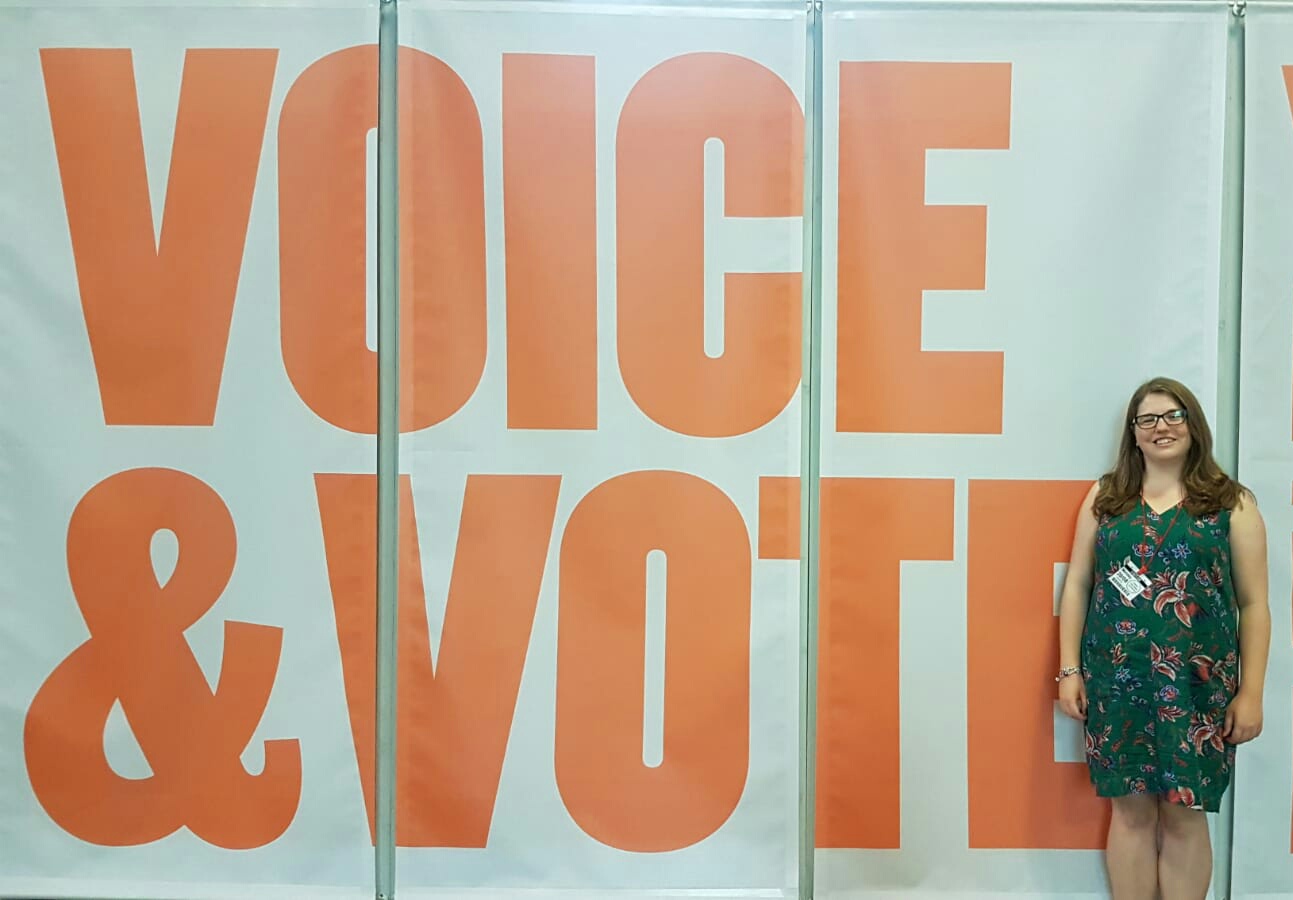
Me at the Voice and Vote exhibition in Westminster Hall at the UK Parliament (Photo: Graeme Awcock).

2018 marks the 100th anniversary of some women being given the right to vote in the UK. The anniversary has been marked with a whole range of events, books, documentaries and exhibitions (I have collected together all my blog posts on the topics here). One of the exhibitions is Voice and Vote: Women’s Place in Parliament in Westminster Hall at the Houses of Parliament. It is only a small exhibition, but it does a great job of putting the story of women’s fight for the right to vote in the context of the spaces women have occupied in Parliament both before and after 1918.

The exhibition is divided into 4 areas: the ventilator, the cage, the tomb, and the chamber. Each area includes a reconstruction of a particular space that women have inhabited in parliament over the last few centuries. These spaces include a ventilator shaft in the loft space above the House of Commons chamber which women used to listen to debates before Parliament was destroyed during a fire in 1834; the Ladies Gallery, a small and stuffy viewing space high up in the rebuilt chamber; the broom cupboard in which Emily Wilding Davison hid on the night of the 1911 census; the Lady Members’ room (known as ‘the tomb’) which became increasingly overcrowded as female MPs were elected in the years after 1918; and the chamber of the House of Commons, in which 208 women now sit.

IMG_5026
The Voice and Votes exhibition in Westminster Hall makes good use of its limited space (Photo: Hannah Awcock).

Alongside these recreated spaces are items, documents, images and quotes that illustrate women’s relationship with the UK’s democratic system both before and after they won the right to vote. Parliament has quite substantial archival collections of its own, and many of the items on display came from these collections. Personal highlights for me were a banner used during a protest in which Muriel Matters and Helen Fox chained themselves to the bars covering the windows of the Ladies Gallery in 1908, and a pair of bolt cutters bought afterwards so that similar protests could be dealt with more easily. They were used in April 1909 to remove members of the WSPU that had chained themselves to statues in St. Stephen’s Hall. Other items are loaned from elsewhere, including papers and objects relating to Leicester suffragette Alice Hawkins, which are still owned by her family.

Voice and Vote is a small exhibition, but it makes the most of the space. It contains a lot of items and information, but it doesn’t feel overcrowded. The recreated spaces are an effective way of putting the visitor in the shoes of the women who interacted with Parliament over the last few centuries, even when they were not welcome. They are a clear way of structuring the exhibition, and they are something a bit different–a creative and novel way of engaging with history.

I would highly recommend a visit to Voice and Vote. It is well designed, and puts the campaign for women’s suffrage in wider context of women in Parliament. I also think it will appeal to those who have limited background knowledge, and those who already know quite a bit about women’s history in British politics. The capacity of the exhibition is limited, so it is recommended that you book, and it runs until 6th of October 2018.

Book Review: Hearts and Minds- The Untold Story of the Great Pilgrimage and How Women Won the Vote

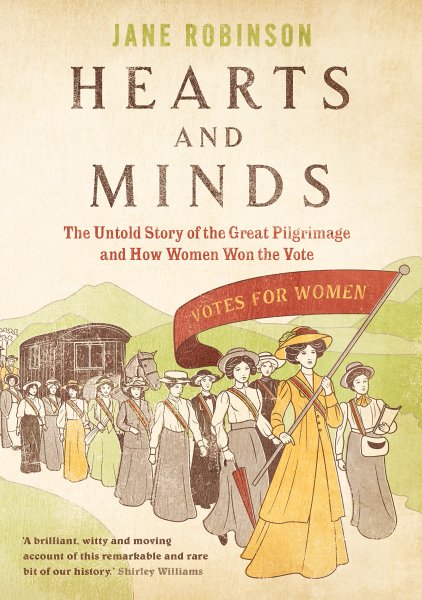
Hearts and Minds Front Cover
Hearts and Minds by Jane Robinson.

Jane Robinson. Hearts and Minds: The Untold Story of the Great Pilgrimage and How Women Won the Vote. London: Doubleday, 2018. RRP £20 hardback.

When I first heard about Hearts and Minds: The Untold Story of the Great Pilgrimage and How Women Won the Vote, I was determined to wait until it came out in paperback. Both my purse and my bookshelves would thank me for it. However, a few months ago I went to see author Jane Robinson give a talk about the book at the Lancashire Archives, and she was so good that I bought the hardback copy there and then. It was a good purchase.

Hearts and Minds tells the story of the Great Pilgrimage, a six-week epic organised by the National Union of Women’s Suffrage Societies (NUWSS), representing the non-militant arm of the women’s suffrage movement. Over 6 weeks in the summer of 1913, hundreds of women marched to London from all over the country in an attempt to prove how many respectable, law-abiding women wanted the vote. In some places they were welcomed, in others they faced fierce and even violent opposition from opponents and people who mistook them for suffragettes. Overall, however, the pilgrimage was an overwhelming success, building bonds within the NUWSS, attracting media attention, and developing the confidence and skill sets of women around the country.

Jane Robinson has written an engaging account of a fascinating and lesser-known event in the history of the women’s suffrage campaign. There are two big things, and several little things, that combine to make Hearts and Minds a very good book. The first big thing is that the book is thoroughly researched; Robinson makes extensive use of diaries, letters, and other personal sources that give us a real insight into how the women participating in the Pilgrimage felt about their experiences. This effect is enhanced by Robinson’s occasional use of creative writing. The description of Marjory Lees and other pilgrims huddling terrified in their caravan as a group of angry locals attempt to set fire to it in Thame, Oxfordshire, is a particularly effective example.

The second big thing I like about Hearts and Minds is its coverage of events after the Great Pilgrimage. A lot of accounts of the campaign for women’s suffrage stop when the First World War starts. Many activists put their desire for the vote on hold and threw themselves into the war effort. But that is by no means the end of the story. Robinson recounts what many pilgrims  and other suffrage campaigners did during the war. Some, such as Florence Lockwood and Sylvia Pankhurst, vocally opposed the war, which was a very lonely and dangerous position to take. Others, such as Vera Chute Collum, Dr. Elsie Inglis, and Katherine Harley undertook dangerous and exhausting work treating injured soldiers in field hospitals across Europe run by the Scottish Women’s Hospitals. Katherine Harley was killed by a shell whilst looking after refugees in modern-day Macedonia on the 7th of March 1917.

As well as telling the stories of these remarkable women, Hearts and Minds also describes what happens after some women were given the vote in 1918. The Pankhursts may not have continued the fight, but others campaigned for women to be given the vote on equal terms as men, led by the Six Points Group and the NUWSS (rebranded as the National Union of Societies for Equal Citizenship). These few chapters at the end of the book helped contextualise the women’s suffrage campaign in a way that I haven’t seen before, and I found it really interesting.

There are lots of little things I like about Hearts and Minds too, such as the helpful lists of important pro- and anti-suffrage organisations, key people featured in the book, and important dates in the campaign for women’s suffrage. Pictures are dispersed throughout the book, not just in the middle (although there is a section of coloured images in the middle of the book too), and there is a map of the 6 Pilgrimage routes (Stuart Maconie’s Long Road from Jarrow is one recent book that would have been  improved by more and better maps).

The campaign for women’s suffrage was much broader and more varied than the popular imagination suggests. This year, the centenary of some women gaining the right to vote, is an opportunity to make more people aware of organisations and individuals beyond the WSPU. Hearts and Minds is an entertaining and informing way of doing just that.

Turbulent Londoners: Dora Montefiore, 1851-1933

Turbulent Londoners is a series of posts about radical individuals in London’s history who contributed to the city’s contentious past, with a particular focus of women, whose contribution to history is often overlooked. My definition of ‘Londoner’ is quite loose, anyone who has played a role in protest in the city can be included. Any suggestions for future Turbulent Londoners posts are very welcome. To celebrate the centenary of the Representation of the People Act, all of the Turbulent Londoners featured in 2018 will have been involved in the campaign for women’s suffrage. Next up is Dora Montefiore, a journalist, pamphleteer and socialist.


Dora Montefiore
A photograph of Dora Montefiore in her autobiography, From a Victorian to a Modern, published in 1927. (Source: Working Class Movement Library.)

The women who campaigned for the right to vote are usually divided into two camps: suffragettes and suffragists. Some women, however, blurred the lines. Dora Montefiore was one such woman, who was a member of a dizzying number of groups, including the National Union of Women’s Suffrage Societies (NUWSS), the Women’s Tax Resistance League, the Women’s Social and Political Union (WSPU), the Adult Suffrage Society, the Women’s Freedom League (WFL), the Social Democratic Federation/British Socialist Party, and the Communist Party of Great Britain. She held prominent positions in some of these groups, and also contributed her skills as a writer to the women’s movement and socialism.

Born Dora Fuller in Surrey on the 20th December 1851 into a wealthy family, Dora had a privileged childhood, with a good education from governesses and a private school in Brighton. In 1874, she moved to Sydney to help her brother’s wife. She met wealthy merchant George Barrow Montefiore, and they were married in February 1881. They had two children in 1883 and 1887. George died in 1889, and Dora discovered that she didn’t have the automatic right to become guardian of her own children, it had to be specified in her husband’s will. It was this stark inequality that converted Dora into a women’s rights campaigner. In March 1891, she held the first meeting of the Womanhood Suffrage League of New South Wales at her house.

In 1892 Dora left Australia, spending a few years in Paris before settling in England. She threw herself into the women’s movement here, serving on the executive of the NUWSS under Millicent Garrett Fawcett and founding the Women’s Tax Resistance League in 1897. She refused to pay taxes during the Boer War (1899-1902) on the grounds that the money would be used to fund a war that she had no say in. Bailiffs seized and auctioned her goods to cover the tax bill.

When the WSPU was formed Dora also became an enthusiastic member. She was good friends with Minnie Baldock, and was a regular speaker at the Canning Town branch of the WSPU, which was the first branch in East London, founded by Minnie. In 1906, Dora refused to pay her taxes again, this time until women were given the right to vote. In May and June, she barricaded herself into her house in Hammersmith for 6 weeks to prevent bailiffs seizing her goods. She hung a banner on the wall that read: “Women should vote for the laws they obey and the taxes they pay.” In October, she was arrested and imprisoned, along with several others, for demanding the right to vote in the lobby of the House of Commons.

Dora was nothing if not principled, however, and by the end of 1906 she had left the WSPU because she disagreed with it’s autocratic structure that gave significant power to a small group of wealthy women. The following year, she joined the Adult Suffrage Society, and was elected honorary secretary in 1909. The Adult Suffrage Society believed that a limited franchise would disadvantage the working classes and might delay universal adult suffrage, rejecting the idea that is was an important stepping stone.

After leaving the WSPU, Dora remained close to Sylvia Pankhurst, who shared her belief in socialism. Dora was a longstanding member of the Social Democratic Federation, later the British Socialist Party. She advocated a socialism that was also concerned with women’s issues and in 1904, she helped establish the party’s women’s organisation. She left the group in 1912 because of her opposition to militarism. When the Communist Party of Great Britain was formed in 1920, Dora, aged 69, was elected to the provisional council.

Dora was a journalist, writer, and pamphleteer. In 1898, she published a book of poetry called Singings through the Dark. From 1902 to 1906 she wrote a women’s column in The New Age, and she contributed to the Social Democratic Foundation’s journal, Justice. She would later write for the Daily Herald and New York Call. In 1911, whilst in Australia visiting her son, she edited the International Socialist Review of Australasia when its owner fell ill. Most of the pamphlets she wrote were about women and socialism. For example, in 1907 she wrote Some Words to Socialist Women.

In 1921, Dora’s son died from the effects of mustard gas poisoning he had received fighting on the Western Front during the war. She had to promise not to engage in Communist campaigning in order to be allowed to visit her daughter-in-law and grandchildren in Australia. Despite this promise, Dora used the time to make connections with the Australian communist movement; in 1924, she represented the Communist Party of Australia in Moscow at the fifth World Congress of the Communist International. She had long taken an international approach to her campaigning, attending conferences in Europe, the United States, Australia, and South Africa.

Dora Montefiore died at her home in Hastings, Sussex, on the 21st of December 1933. She is commemorated on the plinth of Millicent Garrett Fawcett’s statue in Parliament Square. She was a committed socialist and suffrage campaigner, and did what she thought was right, even when that meant leaving groups that she had previously devoted herself to. She also pioneered one of the lesser-known tactics of the women’s suffrage movement, tax resistance. It was a strategy that combined civil disobedience with non-violence, and became an important tool in the suffrage arsenal. She is not well-known today, that does not make her contribution any less significant.

Sources and Further Reading

LBHF Libraries. “Local Suffragettes.” LBHF Libraries and Archives. Last modified March 23 2018, accessed September 27 2022. Available at: https://lbhflibraries.wordpress.com/2018/03/23/local-suffragettes/

Matgamna, Sean. “Dora Montefiore: A Half-forgotten Socialist Feminist.” Marxists.org. No date, accessed June 15, 2018. Available at  https://www.marxists.org/archive/montefiore/biography.htm

Simkin, John. “Adult Suffrage Society.” Spartacus Educational. Last modified August 2014, accessed June 15, 2018. Available at http://spartacus-educational.com/Wadult.htm

Simkin, Jon. “Dora Montefiore.” Spartacus Educational. Last modified February 2015, accessed June 15, 2018. Available at http://spartacus-educational.com/Wmontefefiore.htm

Wikipedia. “Dora Montefiore. Last modified April 26, 2018, accessed June 15, 2018. Available at https://en.wikipedia.org/wiki/Dora_Montefiore

Working Class Movement Library. “Dora Montefiore.” No date, accessed June 15, 2018. Available at https://www.wcml.org.uk/our-collections/activists/dora-montefiore/

On This Day: Women’s Sunday, 21st June 1908

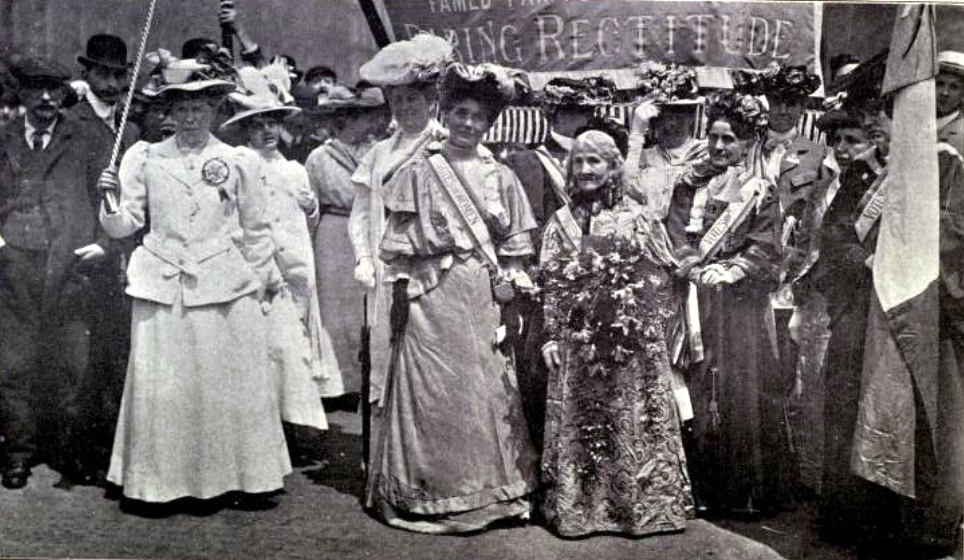
Head of the procession, Women’s Sunday (suffragette march), Hyde Park, London, 21 June 1908. At the front: Emmeline Pankhurst and Elizabeth Wolstenholme Elmy of the Women’s Social and Political Union (Source: Sylvia Pankhurst (1911). The Suffragette: The History of the Women’s Militant Suffrage Movement, 1905–1910. New York: Sturgis & Walton Company)

On the 13th of June 1908, the National Union of Women’s Suffrage Societies (NUWSS), organised a huge march in London to demonstrate the strength of their commitment to women’s suffrage. Just a week later, on the 21st of June, the Women’s Social Political Union (WSPU) organised a ‘monster meeting,’ also in London. The WSPU was much smaller than the NUWSS, but its militant tactics were better at grabbing headlines, and it is by far the best-known women’s suffrage group now. In June 1908, however, the WSPU decided to try a more peaceful method of campaigning, which was a resounding success. Up to 500,000 people gathered in Hyde Park to hear 80 speakers talk about women’s suffrage at the biggest political demonstration the UK had ever seen.

The meeting was organised by WSPU Treasurer, Emmeline Pethick-Lawrence, and her husband Frederick. Like the NUWSS’s march a week earlier, the demonstration was organised in response to Prime Minister Herbert Asquith’s challenge to prove the strength of feeling behind the demand that women be given the vote. Special trains were chartered to transport WSPU supporters to London from around the country, and a Sunday was chosen in order to maximise working class attendance.

7 processions totaling 30,000 suffragettes marched from around London to Hyde Park. This was the first time that the WSPU’s now infamous colours of purple, green, and white were featured in public. Women were asked to wear white dresses, and accessorise with green and purple. The effect was striking. Emmeline Pankhurst and Elizabeth Wolstenholme-Elmy led the procession from Euston Road, Annie Kenney headed the march from Paddington, and Christabel Pankhurst and Emmeline Pethick-Lawrence helmed the demonstration from Victoria Embankment. Flora ‘the General’ Drummond, a formidable suffragette known for leading marches in a military-style uniform, visited each of the 7 processions. Like the NUWSS procession the previous week, banners played an important role in the marches. The suffragettes carried up to 700, although none are known to survive.

20 raised platforms had been constructed in Hyde Park, from which 80 prominent supporters of women’s suffrage gave speeches, including Emmeline Pankhurst (of course!) Keir Hardy, Barnard Shaw, Israel Zangwill, and Amy Catherine Robbins (wife of H.G. Wells). The meeting was considered to be a great success, although several newspapers pointed out that most of those attending were there out of curiosity rather than support for the cause. I don’t really see this as a problem though; surely it was a good opportunity to win over a few converts to the cause.

It seems unlikely that the WSPU deliberately planned Women’s Sunday to be a week after the NUWSS procession, but the sight of women marching through the streets of London, proud, defiant, and well-ordered, was still enough of a novelty to draw hundreds of thousands of people to Hyde Park.

Sources and Further Reading

Marches, Protest, and Militancy. “Women’s Sunday: Hyde Park 1908.” Last modified 14 April 2016, accessed 6 June 2018. Available at  https://womenofinfluencesite.wordpress.com/2016/04/14/womens-sunday-hyde-park-1908/

Wikipedia. “Women’s Sunday.” Last modified 18th March 2018, accessed 6 June 2018. Available at https://en.wikipedia.org/wiki/Women%27s_Sunday

Women of Tunbridge Wells History Project. “‘Women’s Sunday’: Hyde Park Rally 21st June 1908.” Inspiring Women: Hidden Histories from West Kent. No date, accessed 11 June 2018. Available at https://www.kent.ac.uk/sspssr/womenshistorykent/themes/suffrage/womenssunday.html

On This Day: NUWSS Suffrage Procession, 13th June 1908

NUWSS procession on 13 June 1908
Photograph, mechanically printed, gelatin silver chloride print on card, showing male and female suffragists from Westmorland, Cumbria amassing at the National Union of Women’s Suffrage Societies demonstration, London; supporters carry banners representing Kendal, Ambleside, Penrith, Carlisle and Keswick; pictured second left Canon Trench, holding the Kendal banner, fourth left Miss E Johnson; and centre Catherine Marshall, holding the North Western Federation of Women’s Suffrage Societies banner (Source: LSE Library 2ASL/11/55/2).

As the first decade of the twentieth century drew to a close, the campaign for women’s suffrage had been going on for half a century. As the decades wore on, the women involved became increasingly creative with their tactics. The National Union of Women’s Suffrage Societies (NUWSS) was founded as the National Society for Women’s Suffrage in 1872. They were suffragists, believing in peaceful, constitutional campaigning. The NUWSS had first experimented with mass marches the previous year; despite the wet weather, what came to be known as the Mud March was a resounding success. The women were praised for their determination and organisation skills. In the summer of 1908, the NUWSS decided to hold another march.

In 1908, women’s suffrage seemed both tantalisingly close, and as distant as ever. In February, a women’s suffrage bill was blocked by the government after passing its second reading in Parliament. Herbert Asquith became Prime Minister in April, and challenged British women to prove that they wanted to vote. The NUWSS organised their Suffrage Procession in response to this challenge, and also to prove that their organisational skills were such that they deserved the vote.

Artist and illustrator Caroline Watts designed the Bugler Girl poster to advertise the march. Despite her military appearance, the NUWSS were keen to emphasise her peaceful nature, and the image went on to be used quite often within the suffrage campaign in both the UK and the US. On the afternoon of the 13th of June 1908, 10,000 women gathered on the Embankment in central London. They then proceeded to march, in neat rows of either 4 or 6, to the Royal Albert Hall where a meeting was held. Every detail of the march was planned, including the order of the procession, which was as follows: provincial NUWSS groups, in alphabetical order; colonials and internationals; professions, including medical women, business women, writers, actors, and farmers; other societies, including the Women’s Co-operative Guild, the National Union of Women Workers, Liberals, Fabians, Conservatives and the Women’s Freedom League (who’s President was Charlotte Despard); and finally, the local branches of the London Society for Women’s Suffrage. The march was led by NUWSS president, Millicent Garrett Fawcett, and Lady Frances Balfour.

The International Conference for Women’s Suffrage began in Amsterdam on the 15th of June, which meant that a lot of important international suffragists could be in London for the march, adding another feather to the NUWSS’s cap. Representatives came from around the world, including the US, Australia, Russia, Hungary, South Africa, and France. The marchers were accompanied by 15 marching bands. The women carried 76 banners designed and made by the Artist’s Suffrage League (ASL), a group of professional artists established in 1907 to produce banners, posters, postcards, and similar materials for the suffrage campaign. Many of the banners were designed by Mary Lowndes, chair of the ASL and designer of stained-glass windows.

There were two main types of banners. The first type represented the various branches of the NUWSS. The organisers wanted to emphasise that the demonstration was representative of the whole country. The second type of banner commemorated prominent women, both past and present, including: Marie Curie, Jane Austen, the Bronte sisters, Joan of Arc, Elizabeth I, Mary Wollstonecraft, Caroline Herschel, Florence Nightingale, and Queen Victoria (despite her vehement opposition to women’s suffrage). The banners were on display in Caxton Hall in Westminster, which was frequently used by suffrage campaigners, for a few days before the march, and they toured the country afterwards. Local suffrage groups could hire the banners to host exhibitions, and they were displayed in Manchester, Cambridge, Birmingham, Liverpool, and Brighton, amongst others. Many of the banners were also used in later marches and demonstrations.

The 1908 NUWSS Suffrage Procession was a great success. The women demonstrated their commitment to the cause, as well as illustrating their significant organisational skills, part of an attempt to persuade the public that women were capable of shouldering the responsibility of voting. The beautiful, hand-made banners also showed off the women’s feminine side, as well as capturing the attention of spectators and the media. Peaceful mass demonstrations were an ideal way for the suffragists to attract publicity and show their conviction. But the suffragettes also made use of such tactics, holding their own ‘Monster Meeting’ in London only a week after the NUWSS.

Sources and Further Reading

Crawford, Elizabeth. “Suffrage Stories: An Army of Banners- Designed for the NUWSS Suffrage Procession 13 June 1908.” Woman and her Sphere. Last modified 26 November 2014. Accessed 4 June 2018. Available at  https://womanandhersphere.com/2014/11/26/suffrage-stories-an-army-of-banners-designed-for-the-nuwss-suffrage-procession-13-june-1908/

Crawford, Elizabeth. “Suffrage Stories/Women Artists: Caroline Watts and the Bugler Girl.” Woman and her Sphere. Last modified 3 December 2014, accessed 6 June 2018. Available at https://womanandhersphere.com/2014/12/03/suffrage-storieswomen-artists-caroline-watts-and-the-bugler-girl/ 

Keyte, Suzanne. “Celebrating 100 Years of Votes for Women: Women’s Suffrage at the Royal Albert Hall.” Royal Albert Hall. Last modified 5 February 2018. Accessed 4 June 2018. Available at https://www.royalalberthall.com/about-the-hall/news/2018/february/celebrating-100-years-of-votes-for-women-womens-suffrage-and-the-royal-albert-hall/

Observer, The. “From the Observer Archive, 14 June 1908: 10000 Women March for Suffrage. Last modified 17 June 2012. Accessed 4 June 2018. Available at  https://www.theguardian.com/news/2012/jun/17/archive-1908-suffragette-march

Turbulent Londoners: Lady Constance Lytton, 1869-1923

Turbulent Londoners is a series of posts about radical individuals in London’s history who contributed to the city’s contentious past, with a particular focus of women, whose contribution to history is often overlooked. My definition of ‘Londoner’ is quite loose, anyone who has played a role in protest in the city can be included. Any suggestions for future Turbulent Londoners posts are very welcome. To celebrate the centenary of the Representation of the People Act, all of the Turbulent Londoners featured in 2018 will have been involved in the campaign for women’s suffrage. This post is about Lady Constance Lytton, an aristocrat who was imprisoned four times for the suffrage movement.


Lady Constance Georgina Bulwer-Lytton by Bassano Ltd. Whole-plate glass negative, 23 January 1911. NPG x28367 (Source: National Portrait Gallery).

Lady Constance Georgina Bulwer-Lytton was a woman of privilege, although she was never really comfortable with the aristocratic life. Suffering from poor health for most of her life, she struggled to find a purpose to life until she decided to join the Women’s Social and Political Union (WSPU) in 1910. Her dedication to the suffrage movement dovetailed with her interest in prison reform, and she relished being imprisoned four times for the cause. On the third occasion she was force fed.

Constance Lytton was born on the 12th of January 1869 in Vienna. The third of seven children of Edith Villiers and Robert Bulwer-Lytton, the first Earl of Lytton, to say that Constance was privileged is a bit of an understatement. Her father was the Viceroy of India, and she lived there until she was 11. She was private and shy, and never really took to the aristocratic way of life. When her father died in 1891 she retired from public life to look after her mother. The following year, her mother refused to allow her to marry someone from a ‘lower social order.’ Constance spent several years hoping her mother would change her mind, but it was not to be, and Constance never married.

In 1905, Constance was left £1000 by her great-aunt. She wanted to donate the money to the revival of morris dancing, and her brother suggested she give it to the Esperance Club, founded by Emmeline Pethwick-Lawrence and Mary Neal. Both suffrage campaigners themselves, Emmeline and Mary established the Esperance Club, a dance and drama club for working class girls. Over the next few years, Constance met other suffragettes, including Annie Kenney. Constance had an interest in prison reform and was initially sympathetic to suffragette prisoners, although she disapproved of their militant methods. Her objections were eventually overcome, however, and she joined the WSPU in January 1909.

Constance became a paid WSPU organiser in June 1910; she travelled the country making pro-Suffrage speeches and used her family connections to lobby Parliament. She wasted no time getting involved in the direct action side of the suffrage campaign though, on the 24th of February 1909 she took part in a demonstration at the House of Commons which earnt her her first prison sentence. Constance had a weak heart, and spent most of her sentence in the infirmary, being treated well. Whilst in prison, she attempted to carve ‘Votes for Women’ into her own skin, from her chest to her cheek, so her allegiance would always be visible. She carved the V above her heart, but was prevented from completing this unorthodox protest when she asked for a sterile dressing.

The second time Constance was imprisoned, she was released as soon as she began a hunger strike and a doctor discovered her weak heart. The government were reluctant to make a martyr of such a prominent, well-connected suffragette. Convinced that her social status was earning her special treatment, Constance adopted the persona of Jane Warton, a working-class London seamstress. Jane Warton travelled to Liverpool in October 1909 and was sentenced to fourteen days hard labour after throwing rocks at an MP’s car. She went on hunger strike, and was force fed eight times before her true identity was discovered and she was released.

Severely weakened by her ordeal, Constance wrote accounts of her experiences for The Times and Votes for Women, the WSPU’s newspaper. She also gave lectures about Jane Warton’s time in prison, and her accounts are credited with helping to end the practice of force feeding suffragettes. It came at a high price; Constance had a heart attack in August 1910, followed by several strokes that left her right side paralysed. In November 1911, Constance was imprisoned again, and found conditions for suffragettes much improved. Her health forced her to step back from direct action campaigning, but she continued to write pamphlets and other materials in support of women’s suffrage. In 1914 Prisons and Prisoners, her account of her experiences in prison, was published.

At the outbreak of the First World War in 1914, the WSPU suspended their pro-suffrage campaigning. Constance turned her attention to Marie Stopes’ campaign to establish birth control clinics. Her health never recovered, and she was looked after by her mother for the rest of her life. She died on the 2nd May 1923.

Constance Lytton was never comfortable with her privilege, but she used it to campaign for women’s right to vote, and to expose the cruelty of the treatment of suffrage campaigners in prison. She sacrificed her already poor health to draw attention to the disparity between the treatment of working- and upper-class prisoners, and I admire her determination.

Sources and Further Reading

Birkby, Michelle. “Lady Constance Lytton: The Suffering Suffragette.” Historia. Last modified 5th February 2018, accessed 17th May 2018. Available at http://www.historiamag.com/lady-constance-lytton-suffragette/

Jenkins, Lyndsey. Lady Constance Lytton: Aristocrat, Suffragette, Martyr. London: Biteback, 2015.

Simkin, John. “Constance Lytton.” Spartacus Educational. Last modified February 2015, accessed 17th May 2018. Available at http://spartacus-educational.com/Wlytton.htm 

Wikipedia, “Lady Constance Bulwer-Lytton.” Last modified 1st January 2018, accessed 17th May 2018. Available at https://en.wikipedia.org/wiki/Lady_Constance_Bulwer-Lytton

Turbulent Londoners: Rosa May Billinghurst, 1875-1953

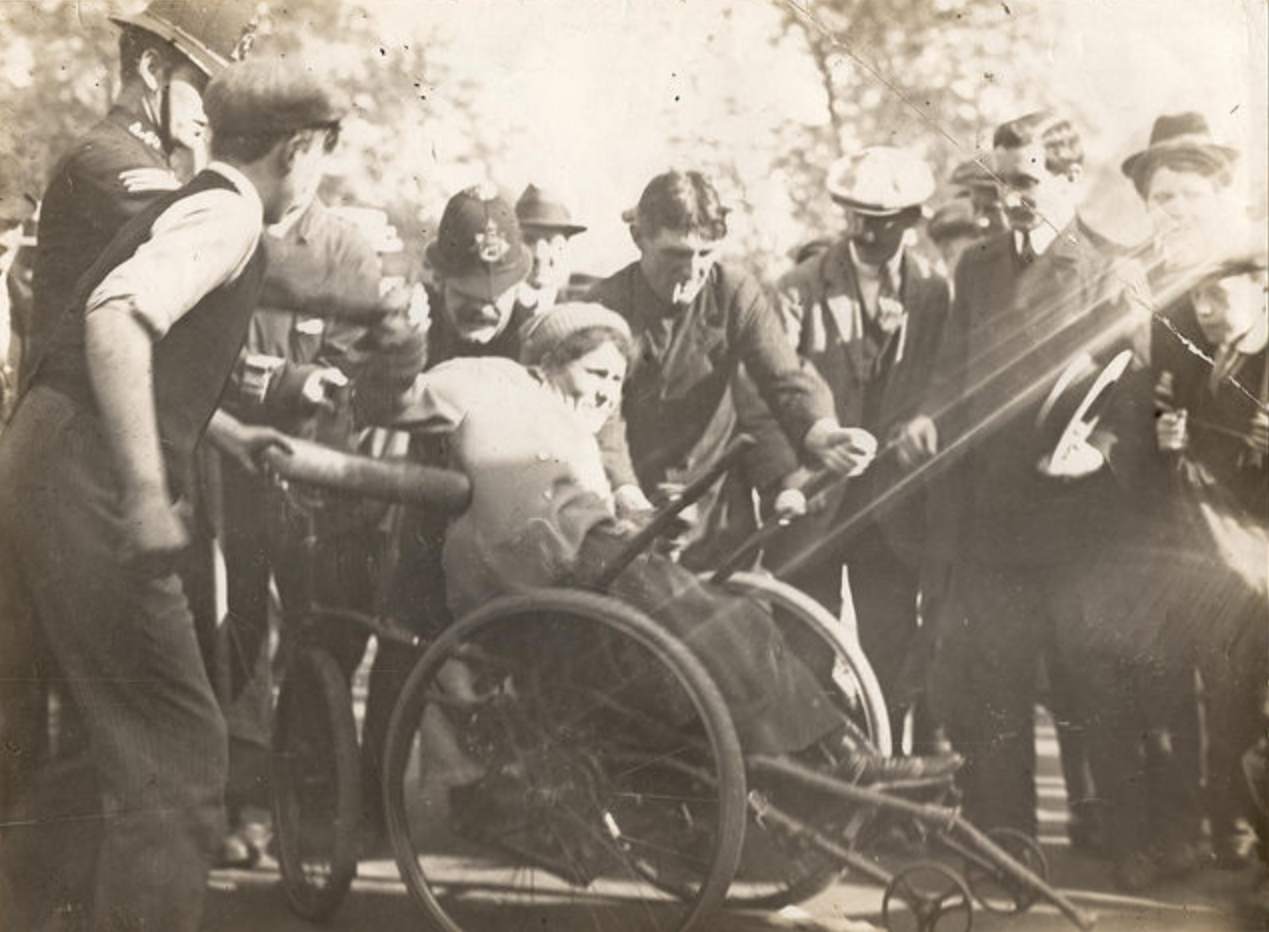
Turbulent Londoners is a series of posts about radical individuals in London’s history who contributed to the city’s contentious past, with a particular focus of women, whose contribution to history is often overlooked. My definition of ‘Londoner’ is quite loose, anyone who has played a role in protest in the city can be included. Any suggestions for future Turbulent Londoners posts are very welcome. To celebrate the centenary of the Representation of the People Act, all of the Turbulent Londoners featured in 2018 will have been involved in the campaign for women’s suffrage. Next up is Rosa May Billinghurst, known at the time as ‘the cripple suffragette.’


Rosa May Billinghurst tricycle
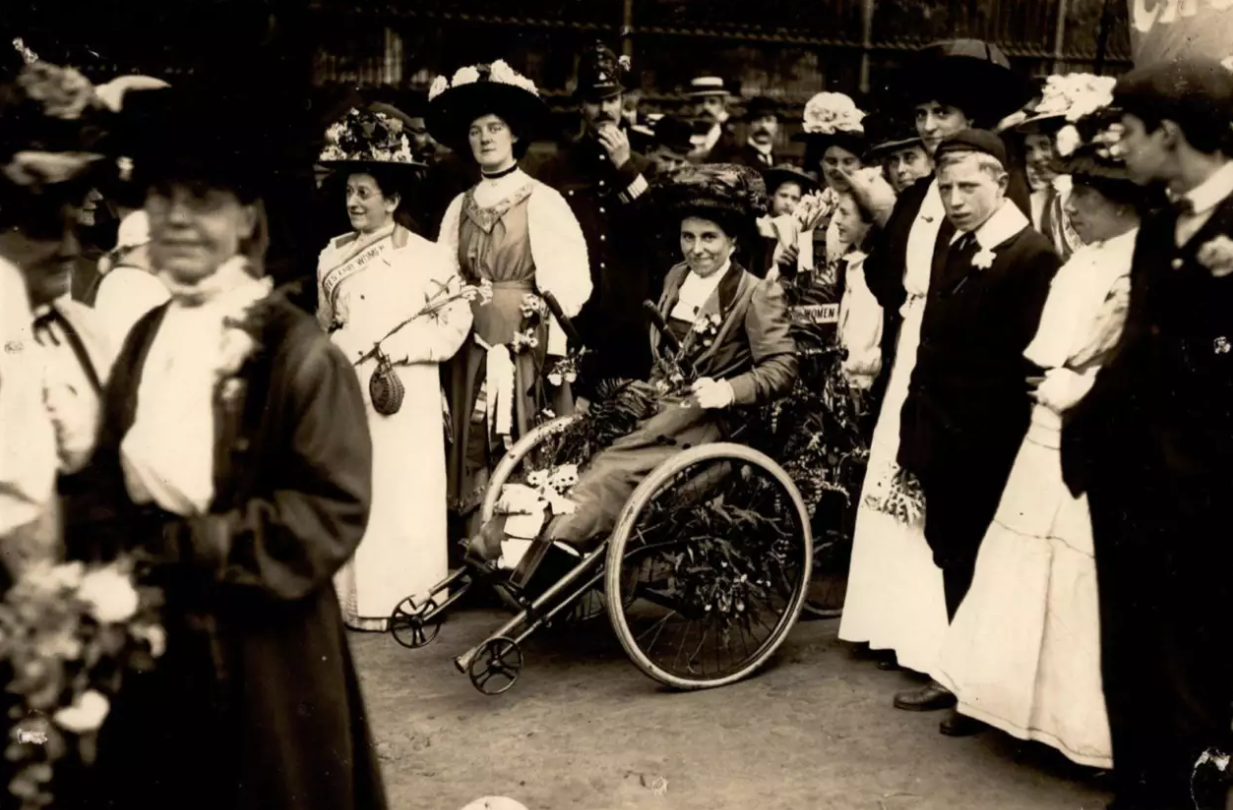
Rosa and her adapted tricycle at a Votes for Women demonstration (Source: LSE Library 7ewd j 55).

Rosa May Billinghurst was born on the 31st May 1875 to a well-off middle class family in Lewisham, south east London. She suffered with polio as a young child which left her unable to walk; she wore leg irons and used crutches or a modified tricycle for the rest of her life. This would not prevent her from throwing herself headlong into the campaign for women’s suffrage however. In fact, she often used her disability to the advantage of the cause.

As a young women Rosa volunteered with the poor in Greenwich, taught Sunday School, and was a member of the Band of Hope, a charity which taught children about the benefits of sobriety and teetotalism. She was also a member of the Women’s Liberal Association, although she later rejected the Liberal Party because of its approach to women’s suffrage. Rosa came to believe that women’s inferior position in society held back society as a whole.

Rosa joined the Women’s Social and Political Union (WSPU) in 1907 and took an active part in marches and demonstrations despite her limited mobility. In 1910, she founded a Greenwich branch of the WSPU and served as its Secretary. On the 18th of November, she took part in the demonstration that would become known as Black Friday. The demonstration was organised to protest the government’s abandonment of the Conciliation Bill, which would have given about one million of the wealthiest women the right to vote. The police used excessive force in quelling the demonstration, arresting 119 people, and assaulting many more. In a pattern that would become familiar to Rosa, police officers threw her out of her tricycle and sabotaged it, leaving her unable to move. Unfortunately, this behaviour was echoed by police officers almost a century later, when Jody McIntyre was pulled from his wheelchair twice during the Student Tuition Fee Demonstrations in 2010.

Rosa used her tricycle to its full advantage however. During demonstrations, she would decorate her tricycle with coloured ribbons and WSPU banners. During confrontations with the police, she would place her crutches on either side of the tricycle and repeatedly charge at police lines, happy to use herself as a battering ram. She was also known to hide the tools of the suffragette’s trade–stones for smashing windows and packages of thick brown liquid for pouring into post boxes and destroying letters–under the blanket that covered her knees. In addition, Rosa was fully aware of the publicity she could attract as a disabled suffragette; it was very difficult to portray her in a negative light without seeming particularly callous.

rosa May Billinghurst and police.PNG
Rosa grappling with police (Source: LSE Library twl 2009 02 045).

In March 1912 Rosa took part the WSPU’s campaign of mass window smashing. She was sentenced to one month’s hard labour for smashing a window on Henrietta Street. The sentence caused confusion amongst prison authorities, who did not know what kind of labour she could be put to. In December, she was caught sabotaging post boxes in Deptford, also part of a wider WSPU campaign. She was apparently glad to be arrested, believing that it would finally get the media attention the campaign had been trying to achieve. Rosa was sentenced to 8 months in prison. She went on hunger strike, and the subsequent force-feeding had such an effect on her health that she was released after two weeks.

Despite this traumatic ordeal, Rosa continued to participate in direct action. On the 24th of May 1913, she chained herself to the gates of Buckingham Palace. The following month, on the 14th of June, she took part in Emily Wilding Davison’s funeral procession. Emily had died after attempting to attach a Votes for Women sash to the King’s horse during the Epsom Derby, and she was celebrated as a martyr for the cause.

Emmeline and Christabel’s decision to suspend WSPU campaigning at the outbreak of the First World War in order to concentrate on the war effort was a controversial one. Rosa joined the Women’s Freedom League, who continued to campaign, suggesting that she didn’t personally agree with the Pankhurst’s decision. However, she remained loyal to the Pankhursts and the WSPU, helping in Christabel’s 1918 election campaign in Smethwick as the candidate for the Women’s Party. Emmeline and Christabel had founded the Women’s Party when the dissolved the WSPU in November 1917. Christabel lost, but only by 800 votes.

Rosa withdrew from activism after the passage of the Representation of the People Act in 1918. During her time in the WSPU, however, she was a fierce campaigner who used her disability to the best possible advantage.

Sources and Further Reading

Fox, Kathryn. “Rosa May Billinghurst: Disabled Suffragette Campaigner.” Huffpost UK. Last modified 23rd December 2017, accessed 22nd March 2018. Available at  https://www.huffingtonpost.co.uk/entry/rosa-may-billinghurst-disabled-suffragette-campaigner_uk_5a37f1dde4b02bd1c8c608c8

Fox, Katie. “Rosa May Billinghurst: The Disabled Suffragette Abused by Police and Force-fed in Prison.” i. Last modified 5th February 2018, accessed 22nd March 2018. Available at https://inews.co.uk/news/uk/rosa-may-billinghurst-disabled-suffragette-abused-police-force-fed-prison/

Hanlon, Sheila. “Rosa May Billinghurst: Suffragette on Three Wheels.” SheilaHanlon.com. No date, accessed 22nd March 2018. Available at http://www.sheilahanlon.com/?page_id=1314 

John Simkin. “May Billinghurst.” Spartacus Educational. Last modified March 2017, accessed 22nd March 2018. Available at http://spartacus-educational.com/Wbillinghurst.htm 

Wikipedia. “Rosa May Billinghurst.” Last modified 4th February 2018, accessed 22nd March 2018. Available at https://en.wikipedia.org/wiki/Rosa_May_Billinghurst

Wikipedia. “Women’s Party (UK).” Last modified 29th January 2018, accessed 23rd March 2018. Available at https://en.wikipedia.org/wiki/Women%27s_Party_(UK)

Vote 100 UK: But When did Other Women Around the World Get the Right to Vote?

It is now fairly well known that some women in Britain won the right to vote 100 years ago, in 1918 (women weren’t given the right to vote on equal terms as men until 1928). I recently heard that women in France did not get the right to vote until 1944. That got me thinking about when other countries gave women the right to vote. New Zealand was first, in 1893. The last, perhaps unsurprisingly, was Saudi Arabia, in 2015. There is still one country, however where women are not allowed at vote, Vatican City. Granted, the only elections that occur there are for the pope, but only cardinals can elect a new pope, and women are not allowed to be cardinals. Perhaps more of a problem is the fact that it is still very difficult for women to vote in many countries, despite them being entitled to. There is still work to be done, but we’ve also come a long way. Below are some examples that illustrate both how far we’ve come and how far we have to go.

1893: New Zealand

New Zealand Suffrage Cartoon
New Zealand Graphic and Ladies’ Journal. New Zealand graphic and ladies journal :The Summit At Last. [Engraving by an unknown artist. 1894]. New Zealand Graphic & Ladies Journal. Ref: PUBL-0126-1894-01. Alexander Turnbull Library, Wellington, New Zealand. /records/22777263

New Zealand was the first country in the world which gave women the right to vote in national elections. This included Maori women, which would also prove to be groundbreaking; most colonial countries did not give aboriginal women the right to vote until some time after white women. The women’s suffrage movement in New Zealand developed at the same time as other movements in northern Europe and the US, in the late nineteenth-century. However, it also had a fairly strong moral element–the campaign was led by a New Zealand branch of the American Women’s Christian Temperance Union (WCTU). As such, women’s suffrage in New Zealand was opposed by the liquor industry as well as the other usual suspects. Nevertheless a petition in 1893 signed by 32,000 people (almost a quarter of the European female adult population) helped make the demand impossible to refuse, and women’s right to vote became law on the 19th of September 1893.

1902: Australia

Women in Australia were granted the right to vote in national elections in 1902. The right to vote in local elections was granted by individual states at different times; the first was South Australia, in 1895, and the last was Victoria, in 1908. The suffragette Muriel Matters moved to London from South Australia in 1905, so is perhaps not surprising that she became an active member of the UK’s suffrage movement.  The very same act that gave European women the right to vote, however, excluded aboriginal people from voting. Aboriginal and Torres Straight Islanders were not given the right to vote in Australia until 1962, when the US Civil Rights Movement helped draw attention to the fact that indigenous people were treated so poorly.

1906: Finland

First_Female_Parliamentarians_in_the_world_in_Finland_in_1907
Some of the first female MPs in the world, elected in Finland in 1907. Conservative parliamentarians wore black tops, whilst social democrats wore white (Source: Wikipedia).

Finland was the first European country which granted women the right to vote. In 1906, it was part of Russia, although it was governed by the Diet, which dated from the time of Swedish rule. Only a small number of Finns could vote in the elections for the Diet, so it was not just women who felt disenfranchised. In 1905, unrest in Russia spread to Finland, and culminated with a general strike in October and November. Eager to restore peace, the Russian authorities conceded significant reforms, including parliamentary reform and universal and equal suffrage. Women were granted to right to vote, and at the same time the ability to stand in elections. It was the first country in the world that recognised women’s eligibility to stand for office. In March 1907, 19 women were elected to the new Parliament.

1930: South Africa

The campaign to grant white women the vote in South Africa was also started by the Women’s Christian Temperance Union, who felt that their demands would be ignored if they did not have the right to vote. The first Women’s Enfranchisement League was established in Durban in 1902, and this organisation became the Women’s Enfranchisement Association of the Union as more branches were established across the country. In the run up to the 1929 General Election, Prime Minister James Herzog promised to raise the issue in Parliament if women supported his re-election campaign. They did, and white women were given the right to vote on the 19th of May 1930. Solidarity for black women, however, was almost non-existent. Black South Africans, both female and male, were not able to vote until Apartheid ended in 1994. This was something I found particularly shocking, as it is within my lifetime. Sometimes it is easy to take advances in social justice for granted, particularly if you don’t have personal experience of what it was like before.

1971: Switzerland

In Switzerland, a change to the constitution requires a national referendum- it is one of the oldest and most direct democracies in the world. Yet it was the last European country to grant women the right to vote. It was not the government that had to be persuaded, it was the men, and that turned out to be a much harder job. Women’s suffrage was rejected by 67% of Swiss men in a referendum in 1959. It wasn’t until another referendum was held twelve years later that women in Switzerland won the right to vote in federal elections. One possible explanation for it taking so long is Switzerland’s neutrality during World War Two. Women did not get the same chance to prove their ability to maintain and run the country as in France, German and Britain. Whatever the explanation, it undoubtedly held women’s rights back; men had control over their wives’ bank accounts until 1985, and maternity leave wasn’t introduced until 2005.

Sources and Further Reading

Aspinall, Georgia. “Here are the Countries Where it’s Still Really Difficult for Women to Vote.” The Debrief. Last modified 6th February 2018, accessed 25th March 2018. Available at https://thedebrief.co.uk/news/politics/countries-where-women-can-t-vote/

Atkinson, Neill. “Voting Rights.” Te Ara: The Encyclopaedia of New Zealand. Last modified 17th February 2015, accessed 26th March 2018. Available at  https://teara.govt.nz/en/voting-rights 

Australian Electoral Commission. “Women and the Right to Vote in Australia.” Last modified 14th April 2015, accessed 26th March 2018. Available at  http://www.aec.gov.au/Elections/Australian_Electoral_History/wright.htm

Gatten, Emma. “Swiss Suffragettes were Still Fighting for the Right to Vote in 1971.” The Independent. Last modified 25th September 2015, accessed 25th March 2018. Available at  https://www.independent.co.uk/news/world/politics/swiss-suffragettes-were-still-fighting-for-the-right-to-vote-in-1971-10514445.html

Krulwich, Robert. “Non! Nein! No! A Country That Wouldn’t Let Women Vote Till 1971.” National Geographic. Last modified 26th August 2016, accessed 25th March 2018. Available at https://news.nationalgeographic.com/2016/08/country-that-didnt-let-women-vote-till-1971/

Ministry for Culture and Heritage, New Zealand Government. “Brief History: Women and the Vote.” Last modified 13th March 2018, accessed 26th March 2018. Available at https://nzhistory.govt.nz/politics/womens-suffrage/brief-history

Ministry for Foreign Affairs of Finland. “Finnish Women Won the Right to Vote a Hundred Years Ago.” Last modified 30th January 2006, accessed 26th March 2018. Available at http://www.finland.lt/public/default.aspx?contentid=121094&nodeid=38417&contentlan=2&culture=en-US

Parliamentary Education Office. “Indigenous Australians and the Vote.” No date, accessed 26th March 2018. Available at https://getparliament.peo.gov.au/electing-members-of-parliament/indigenous-australians-and-the-vote

South African History Online. “White Women Achieve Suffrage in South Africa. Last modified 18th May 2017, accessed 26th March 2018. Available at  http://www.sahistory.org.za/dated-event/white-women-achieve-suffrage-south-africa

The Nellie McClung Foundation. “Timelines of Women’s Suffrage Granted.” No date, accessed 25th March 2018. Available at https://www.ournellie.com/learn/womens-suffrage/political-equality-timeline/

Zarya, Valentina. “There is Now Only Once Country Left in the World Where Women Can’t Vote.” Fortune. 11th December, 2015, accessed 25th March 2018. Available at  http://fortune.com/2015/12/11/one-country-women-vote/