Turbulent Londoners: Muriel Matters, 1877-1969

Turbulent Londoners is a series of posts about radical individuals in London’s history who contributed to the city’s contentious past, with a particular focus of women, whose contribution to history is often overlooked. My definition of ‘Londoner’ is quite loose, anyone who has played a role in protest in the city can be included. Any suggestions for future Turbulent Londoners posts are very welcome. To celebrate the centenary of the Representation of the People Act, all of the Turbulent Londoners featured in 2018 will have been involved in the campaign for women’s suffrage. The third of my suffrage activists is Muriel Matters, an Australian actress, lecturer, and journalist with a flair for dramatic stunts.
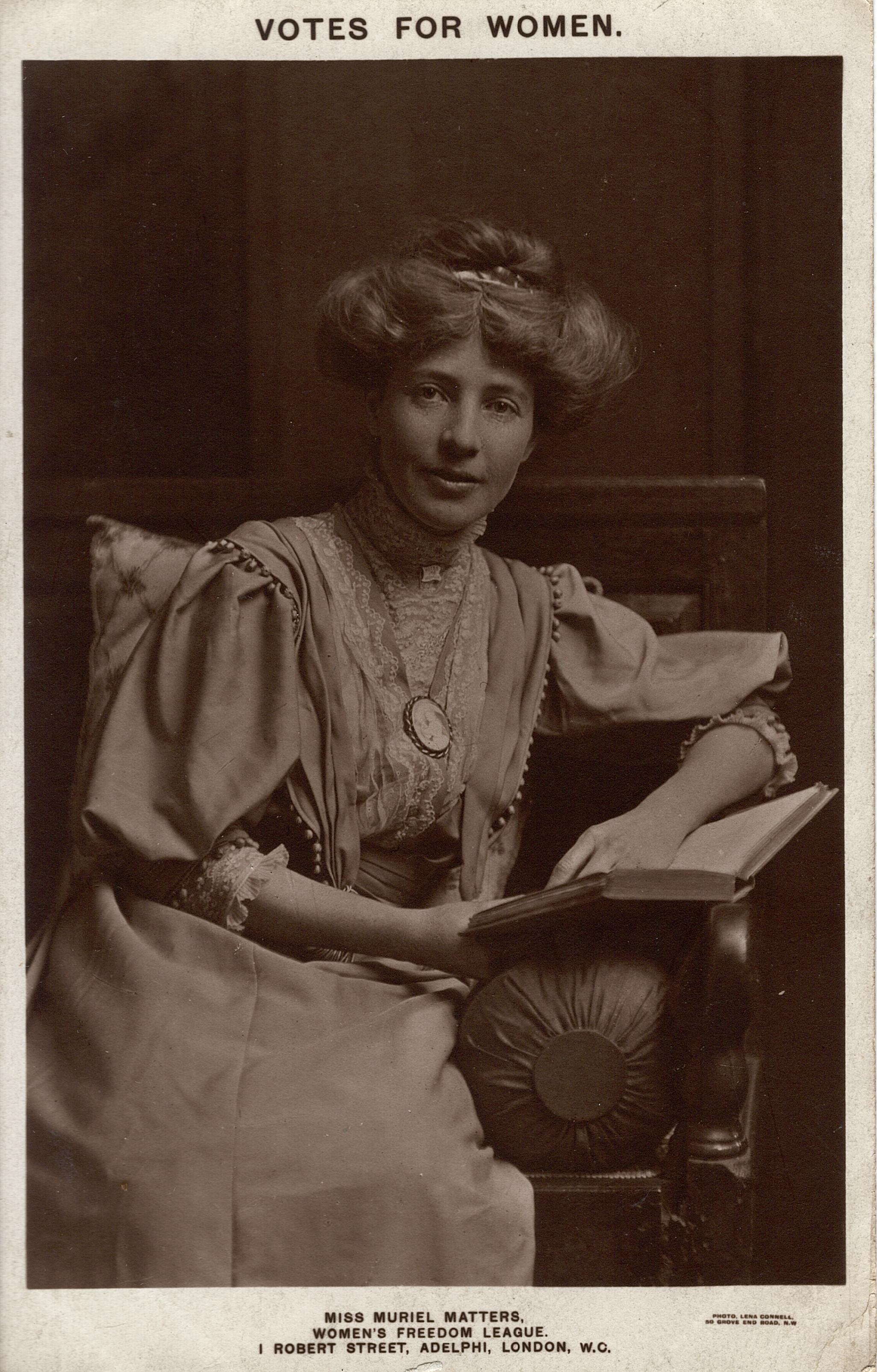

Muriel Matters, 1877-1968 (Source: LSE Library twl 2002 67)

All of the suffrage campaigners I have featured so far as Turbulent Londoners have been British. London has always been a city of migrants, however, and many of the activists involved in the campaign for women’s suffrage were born elsewhere. Muriel Matters was an Australian lecturer, journalist, actress, and elocutionist who put her flair for the dramatic to good use fighting for a right that South Australian women had had since 1894.

Muriel Matters was born on the 12th of November 1877 to a large Methodist family in Adelaide, South Australia. As a child she was introduced to the writing of Walt Whitman and Henrik Ibsen, who strongly influenced her political consciousness. In 1894, when Muriel was still a teenager, South Australia became the first self-governing territory to give women the vote on the same standing as men.

Muriel studied music at the University of Adelaide, and by the late 1890s she was acting and conducting recitals in Adelaide, Sydney, and Melbourne. In 1905, at the age of 28, Muriel moved to London to try and further her acting career. Leaving a country where women had the right to vote in all federal elections, Muriel arrived in a country where women could not vote at all. Facing stiff competition for acting work, Muriel also had to take on work as a journalist. She interviewed the exiled anarchist Prince Peter Kropotkin, and later performed at his home. Kropotkin challenged Muriel to do something more useful with her talents than acting–she later identified this as a defining moment in her life. She joined the Women’s Freedom League (WFL), a group which had broken away from the WSPU in 1907 because of the lack of democracy in the organisation. The President of the WFL was Charlotte Despard, a formidable woman who is one of my favourite Turbulent Londoners.

Women’s Freedom League caravan tour: Muriel Matters seated in the window, [in Guildford, Surrey], 1908 (Source: LSE Library twl 2002 326).

Between early May and Mid-October 1908, Muriel was the ‘Organiser in Charge’ of the first ‘Votes for Women’ caravan tour around the South of England. WFL activists visited towns in Surrey, Sussex, East Anglia, and Kent, with the aim of talking about women’s suffrage and forming new branches. Despite problems with hecklers, the tour was very successful, and many of the other suffrage societies would later run caravan tours of their own.

Not one to rest on her laurels, on the 28th of October 1908 Muriel took part in a dramatic protest at the House of Parliament organised by the WFL. They were protesting against an iron grille in the Ladie’s Gallery that obscured the view of the House of Commons and was seen as a symbol of women’s oppression. Muriel and another activist called Helen Fox chained themselves to the offending grille, and loudly lectured the MPs below on the benefits of women’s enfranchisement. The grille had to be removed so that a blacksmith could remove the two women. Released without charge, Muriel rejoined the protest outside the House of Commons, and was eventually arrested for trying to rush the lobby. The next day she was sentenced to one month in Holloway Prison.

A few months later, the state opening of Parliament on the 16th of February 1909 was marked by a procession led by King Edward. In order to gain attention and promote the suffrage cause, Muriel hired a dirigible air balloon. With ‘Votes for Women’ on one side, and ‘WFL’ on the other, she planned to fly over central London, showering the King and Parliament with pro-suffrage leaflets. The weather conditions and a poor motor meant that Muriel didn’t make it to Westminster, but she did fly over London for one and a half hours, dropping 56lbs of leaflets. The stunt made headlines all over the world.

From May to July 1910, Muriel embarked on a lecture tour of Australia. She was an engaging speaker, making use of illustrations and even changing into a replica of the dress she wore whilst in prison. She advocated prison reform, equal pay, and the vote. At the end of the tour, she helped persuade the Australian senate to pass a resolution informing the British Prime Minister Asquith of the positive experiences of women’s suffrage. In October 1913, Muriel helped persuade the National Federation of Mineworker’s to support women’s suffrage.

On the 15th October 1914, Muriel married William Arnold Porter, a divorced dentist from Boston. She decided to double-barrel her surname. In June 1915, she laid out her opposition to war in an address called ‘The False Mysticism of War.’ She argued that it was not an effective method of solving problems, and justifications for it were based on false pretences. She particularly objected to Christianity as a justification for war, and questioned the significance of nationality. Views such as these were extremely unpopular at the time, and it took great bravery to voice them.

In 1916 Muriel went to Barcelona for a year to learn about the Montesorri method of teaching, a child-centred approach which promotes the development of the whole child, including physical, social, emotional, and cognitive development. Muriel believed that access to education should be universal, and she took what she learnt in Barcelona back to charity work she was doing in East London. In 1922, she toured Australia again, this time advocating the Montesorri method.

In the 1924 General Election, Muriel ran as the Labour candidate for Hastings. She ran on a socialist platform, advocating a fairer distribution of wealth, work for the unemployed, and gender equality. She didn’t win- Hastings was a safe Conservative seat, and wasn’t won by Labour until 1997. The ability to stand in itself was victory enough for Muriel. After the election, Muriel and her husband settled in Hastings. William died in 1949, and Muriel died 20 years later, on the 17th of November 1969, at the age of 92. Provocative until the end, she was remembered locally as being partial to a spot of skinny dipping at the nearby Pelham Beach.

Australian-born Muriel Matters launched herself wholeheartedly into the the campaign for women’s suffrage in her adopted country. Her flair for dramatic acts of non-violent civil disobedience helped her attract valuable attention and publicity for the cause of women’s suffrage.

Sources and Further Reading

Fallon, Amy. “Muriel Matters: An Australian Suffragette’s Unsung Legacy.” Last modified 11 October 2013, accessed 8 February 2018. Available at https://www.theguardian.com/culture/2013/oct/11/muriels-neglecting-an-australian-suffragettes-unsung-legacy

Friends of Hastings Cemetery. “Muriel Matters Porter.” No date, accessed 8 February. Available at http://friendsofhastingscemetery.org.uk/mattersm.html

The Muriel Matters Society Inc. “About Muriel.” No date, accessed 8 February 2018. Available at https://murielmatterssociety.com.au/home-page/who-was-muriel-matters/

Wikipedia. “Muriel Matters.” Last modified 20 January 2018, accessed 8 February 2018. Available at https://en.wikipedia.org/wiki/Muriel_Matters

Turbulent Londoners: Millicent Garrett Fawcett, 1847-1929

Turbulent Londoners is a series of posts about radical individuals in London’s history who contributed to the city’s contentious past, with a particular focus of women, whose contribution to history is often overlooked. My definition of ‘Londoner’ is quite loose, anyone who has played a role in protest in the city can be included. Any suggestions for future Turbulent Londoners posts are very welcome. To celebrate the centenary of the Representation of the People Act, all of the Turbulent Londoners featured in 2018 will have been involved in the campaign for women’s suffrage. The second of my suffragists is Millicent Garrett Fawcett, a pioneer of the campaign before the WSPU was even a twinkle in Emmeline Pankhurst’s eye.


Millicent Garrett Fawcett (Source: Bain News Service/Library of Congress).

A few weeks ago, my sister and I were having a conversation about Millicent Garrett Fawcett being the first woman to be commemorated with a statue in Parliament Square. When our Dad, a man with quite high levels of general knowledge, responded to the conversation by asking “who?”, I knew who my next Turbulent Londoner was going to be. Millicent Garrett Fawcett was a writer and campaigner, and was President of the National Union of Women’s Suffrage Societies (NUWSS) for more than two decades.

Millicent Garrett was born in Aldeburgh, Suffolk, on the 11th of June 1847, the eighth of ten children. The family was close and prosperous, and Millicent’s childhood was happy. The children were encouraged to read, speak their minds, and take an interest in politics. At the age of 12, Millicent was sent to school in Blackheath with her sister Elizabeth. Her older sisters introduced her to radical ideas and thinkers. In 1866, Millicent went to hear a speech given by John Stuart Mill, an early supporter of women’s suffrage. His words helped her decide to take action. That same year, at the age of 19, she became the Secretary of the London Society for Women’s Suffrage.

Through her new political connections Millicent soon met Henry Fawcett, the radical Liberal MP for Brighton. Despite the 14-year age gap they were married in 1867, and had their first and only child, Philippa, in April 1868. The couple were politically well matched, and it seems that they had a happy and loving marriage.

Henry was blinded in a shooting accident in 1858, so Millicent acted as his Secretary, alongside her activism and a successful writing career. In 1868, she joined the London Suffrage Committee, and spoke at the first public pro-suffrage meeting. It was unusual for women to speak in the public at the time, and Millicent got very nervous before making a speech. Despite this, she was known for her clear speaking voice, and her ability to explain complex arguments simply. In 1870, Millicent published Political Economy for Beginners. It was very successful, going through 10 editions in 41 years. Along with her sister Agnes, Millicent also raised 4 of her cousins whose parents had died.

Henry Fawcett; Dame Millicent Fawcett by Ford Madox Brown. Oil on canvas, 1872. NPG 1603 (Source: National Picture Gallery).

Millicent was a strong supporter of women’s education. In 1875, she co-founded Newnham College, one of the first Cambridge Colleges for women. She also supported a controversial campaign for women to actually receive degrees from the University of Cambridge, rather than just being able to study there. This wasn’t achieved until 1948.

Henry died unexpectedly in November 1884, leaving Millicent a widow at the age of 38. She sold the family homes in Cambridge and London, and took Philippa to live with Agnes. When she re-entered public life in 1885, Millicent began to concentrate on politics. She was a key member of what became the Women’s Local Government Society–a cross party group that campaigned for women to be allowed to stand as local councillors. This goal was achieved in 1907.

After the death of Lydia Becker in 1890, Millicent became the Chair of the Central Committee of the National Society for Women’s Suffrage. In 1897, the National Union of Women’s Suffrage Societies (NUWSS) was formed as an umbrella organisation for all the suffrage societies in the country. Millicent became President of this new group, a role she kept until 1919. Although the Women’s Social and Political Union (WSPU) frequently commanded the headlines and publicity, the NUWSS consistently had the majority of the support of the women’s movement. By 1905, the NUWSS had 305 constituent societies and 50,000 members. Millicent disapproved of militant tactics, believing that they alienated politicians and the general public. Despite this, she admired the courage of militant activists.

In July 1901, Millicent was asked to lead a commission of women to South Africa to investigate allegations that the families of Boer soldiers were being held in awful conditions in concentrations camps during the Boer War. It was the first time British women were trusted with such a responsibility in war time.

The NUWSS lost patience with the Liberal Party in early 1912, giving up the long-held hope that they would eventually give women the vote. Instead, they formed an electoral alliance with the Labour Party, which was the only political party that supported women’s suffrage. By 1913, the NUWSS had 100000 members, and organised the Women’s Suffrage Pilgrimage to demonstrate how many women wanted the vote. On the 18th of June, NUWSS members from all over the country set off for London, meeting in Hyde Park six weeks later on the 29th of July. Now aged 66, Millicent took an active part in the pilgrimage, and was the headline speaker at the Hyde Park rally.

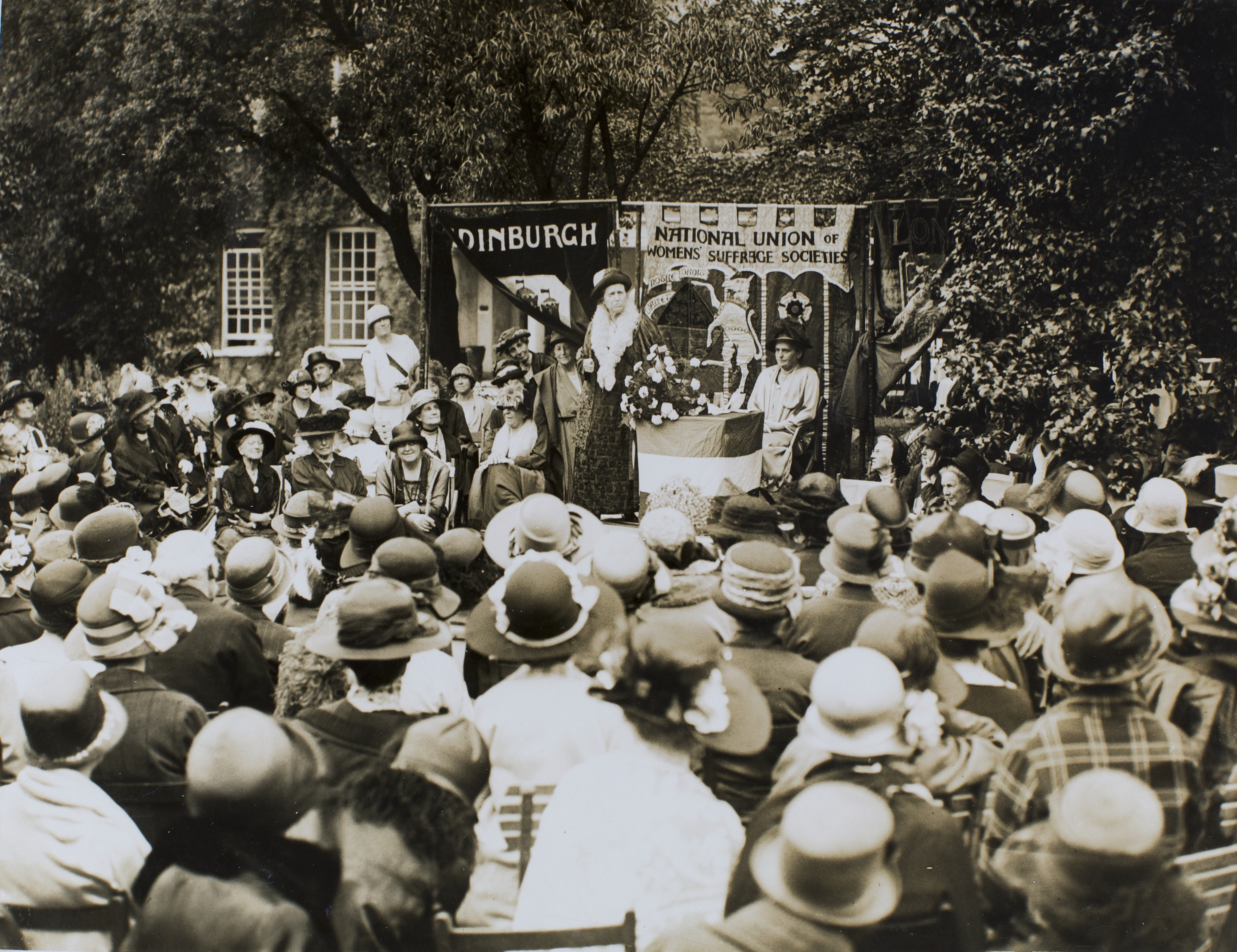
Millicent Garrett Fawcett and Eleanor Rathbone, 1925. Photograph, printed, paper, monochrome, Millicent Garrett Fawcett and Eleanor Rathbone at NUSEC open-air platform at Aubrey House, Camden Hill, Kensington, with National Union of Women’s Suffrage Societies (NUWSS) banner behind them, speak to a large audience of seated women; on reverse, printed ‘Copyright photograph by PHOTOPRESS, Johnson’s Court, Fleet Street EC. Telephone: City 7070′, ’23 Jul 1925 With affectionate thanks to Mary Fielden for all she did to make this party the success it was’ (Millicent’s handwriting) (Source: LSE Library TWL.2009.02.189).

Millicent was a not a pacifist, but the NUWSS continued to campaign for the vote during the First World War, unlike the WSPU. It will never be possible to find out whether the NUWSS or the WSPU’s campaigning methods were more effective for winning women the right to vote. There is no doubt, however, that Millicent Garrett Fawcett played a huge role in winning that right. After the Representation of the People Act was passed in 1918, Millicent largely withdrew from the suffrage campaign. Throughout her long career, however, she had supported a large number of campaigns, not all of which were successful. These included: raising the age of sexual consent; criminalising incest; preventing child marriage; repealing the Contagious Diseases Act; and Clementina Black’s campaign to help protect low-paid female workers.

Her hard work and dedication were recognised in 1925, when she was made a Dame Grand Cross of the British Empire. She passed away four years later on the 5th of August 1929. In 1953, the London’s Society for Women’s Suffrage was renamed the Fawcett Society in her honour. The Society continues to campaign for women’s rights and gender equality. In 2017, it was announced that Millicent would become the first woman to be commemorated with a statue in Parliament Square, which is due to be unveiled in February 2018.

After Emmeline and Christabel Pankhurst, Millicent Garrett Fawcett is perhaps one of the best-known suffragists. But that doesn’t mean she is well-known. Despite having a charity named after and a statue in Parliament Square planned to honour her, most people don’t seem to recognise her name, let alone are aware of what she achieved. I think that’s a real shame.

Sources and Further Reading

Biography Online. “Millicent Fawcett.” No date, accessed 29 January 2018. Available at https://www.biographyonline.net/politicians/uk/millicent-fawcett.html

Fawcett Society. “About.” No date, accessed 31 January 2018. Available at https://www.fawcettsociety.org.uk/about

Murray, Jenni. A History of Britain in 21 Women. London: Oneworld, 2017.

Simkin, John. “Millicent Garrett Fawcett.” Spartacus Educational. Last modified June 2017, accessed 31 January 2018. Available at http://spartacus-educational.com/WfawcettM.htm

Simkin, John. “Women’s Pilgrimage.” Spartacus Educational. Last modified February 2015, accessed 31 January 2018. Available at http://spartacus-educational.com/Wpilgimage.htm

Sutherland, Gillian. “History of Newnham.” Newnham College, University of Cambridge. No date, accessed 31 January 2018. Available at http://www.newn.cam.ac.uk/about/history/history-of-newnham/

Wikipedia. “Millicent Fawcett.” Last modified 28 January 2018, accessed 29 January 2018. Available at https://en.wikipedia.org/wiki/Millicent_Fawcett

Women’s Local Government Society. “Women’s Local Government Society.” Suffrage Pioneers. No date, accessed 29 January 2018. Available at http://www.suffrage-pioneers.net/wlgs/

Book Review: A History of Britain in 21 Women by Jenni Murray

A History of Britain in 21 Women Front Cover
A History of Britain in 21 Women by Jenni Murray

Jenni Murray. A History of Britain in 21 Women. London: Oneworld, 2016. RRP £9.99 paperback.

A few weeks before Christmas, I was browsing a bookshop when I noticed the vibrant cover of A History of Britain in 21 Women by Jenni Murray. I was sorely tempted, but, remembering my overflowing bookshelves and the growing piles of books at the bottom of my bed, I restrained myself. I put the book on my Christmas list instead, so I at least didn’t have myself to blame when my piles of books grew a little bit taller. I am very glad that I was given the book; it is a thoroughly enjoyable read that has left me more determined than ever not to allow misogyny to hold me back.

The twenty-one women in this book rose above the low expectations of their gender and defied anyone who insisted ‘a girl can’t do that.’ Slowly, slowly, over the centuries, they changed the gender landscape for those of us who came after.

Murray, 2016; p.4

As the name implies, A History of Britain in 21 Women profiles 21 women from British history. Each chapter is about 15 pages long, and details the women’s biography, their achievements, and their impact on society, politics, and culture. The selection is historically comprehensive, beginning in the first century with Boadicea, and ending in the modern day with Nicola Sturgeon. Inevitably, many women are left out, but Murray is careful to justify her choices, explaining why the 21 she chose resonate with her personally.

The book is more personal than I was expecting. It does have the subtitle A Personal Selection, but this is only mentioned in the front matter, not on the title. After initially being unsure about this, I came to enjoy Murray’s short personal reflections and anecdotes. I was particularly charmed by a conversation she describes having with one of her sons when John Major took over from Margaret Thatcher as prime minister.

Beyond being thrown at first by the tone of the book, I can find very little to criticise in A History of Britain in 21 Women. Each chapter is self-contained, so it feels almost like a collection of short stories, but I wasn’t put off if I read several chapters in one sitting, as I often am with similarly structured books. Each chapter is accompanied by a portrait by Peter Locke, the style of which suits the book’s message really well. Locke’s sketches don’t feel idealised or ‘touched up,’ the women in the sketches feel…real; they look like they’ve lived. It’s quite hard to put my finger on it, but I like them.

It is the women themselves, their lives, actions, experiences, and attitudes that are the real stars of this book. Some of them are familiar–such as Elizabeth I, Jane Austen, and Margaret Thatcher–whilst others are less well-known–like Aphra Behn, Mary Somerville, Gwen John. But they are all remarkable. Every one exelled in the field they chose, whether it be medicine, art, politics, or science, often despite massive obstacles and prejudice. They are inspirational.

I was given A History of Britain in 21 Women as a Christmas present, and I do think it makes a wonderful gift, even for those who aren’t avid readers. It’s especially good for those who need a reminder of just how much it can be possible to achieve.

Turbulent Londoners: Emmeline Pethick-Lawrence, 1867-1954

Turbulent Londoners is a series of posts about radical individuals in London’s history who contributed to the city’s contentious past, with a particular focus of women, whose contribution to history is often overlooked. My definition of ‘Londoner’ is quite loose, anyone who has played a role in protest in the city can be included. Any suggestions for future Turbulent Londoners posts are very welcome. To celebrate the centenary of the Representation of the People Act, all of the Turbulent Londoners featured in 2018 will have been involved in the campaign for women’s suffrage. First up is Emmeline Pethick-Lawrence, one of the key members of the Women’s Social and Political Union until 1913.


Emmeline Pethick-Lawrence by Bassano Ltd. Whole-plate glass negative, 28 October 1910. NPG x28361 (Source: National Picture Gallery).

Most of you probably know this already, but 2018 marks the centenary of the Representation of the People Act, which granted some British women the right to vote. There are a huge number of events, exhibitions and book publications happening this year to commemorate the event, but I wanted to play my own small part in marking the event on Turbulent London. As such, all Turbulent Londoners featured this year will have played some role in the campaign for women’s suffrage. First up is Emmeline Peckith-Lawrence, one of the key members of the Women’s Social and Political Union (WSPU) between 1906 and 1913.

Emmeline Peckith was born in Bristol on the 21st of October 1867 to a wealthy Methodist family. One of 13 children, Emmeline was sent to boarding school at the age of 8. Reluctant to conform from an early age, she was often in trouble at school, and the teachers thought she was a bad influence on other children. In 1891 Emmeline moved to London to work with some of the city’s poorest inhabitants as a voluntary social worker. She worked at the Sisterhood of the West London Mission, where she helped to run the girl’s club. It was here that Emmeline became a socialist.

Growing frustrated with the constraints of the Mission, in 1895 Emmeline left to co-found the Esperance Club, a girl’s club which experimented with dance and drama. She also started the Maison Esperance, a dress-making co-operative with a minimum wage, an 8 hour day and a holiday scheme. She wanted to give the young women she worked with a practical example of socialism. In 1899 Emmeline met, and fell for, the wealthy lawyer Frederick Lawrence, but she refused to marry him unless he shared her socialist ideals. By 1901, he had come around to her way of thinking. The equality of their marriage was unheard of in polite society–they chose to double-barrel their surnames and kept separate bank accounts to retain their independence.

In 1906, Emmeline joined the WSPU. She must have thrown herself into the movement wholeheartedly; in October of that year she was arrested and imprisoned with other prominent suffragists such as Annie Kenney, Dora Montefiore, and Adela and Sylvia Pankhurst after a ‘riot’ in the House of Commons lobby. Emmeline would go to prison six times for her political beliefs. Frederick publicly declared that he would donate £10 to the suffrage movement for each day that his wife remained in prison. It was the start of a close relationship between the Pethick-Lawrence’s and the WSPU’s finances–Emmeline became the group’s Treasurer, and raised £134000 over 6 years. The couple also donated large amounts of their own money. Also in 1906, the Pankhursts moved the headquarters of the WSPU from Manchester to London. The Peckith-Lawrences offered their own home as the location for the new offices. They also opened their home to activists recovering from prison sentences. The couple masterminded, edited, and funded the journal Votes for Women from 1907.

Emmeline Pethick-Lawrence; Dame Christabel Pankhurst by Unknown photographer. Postcard print, 21 June 1908. NPG x45194 (Source: National Picture Gallery).

As the years passed the WSPU turned to increasingly violent tactics. In 1912, Emmeline and Christabel Pankhurst endorsed a campaign of window smashing. Emmeline Peckith-Lawrence did not support these violent methods, but remained loyal to the WSPU. In March, she was arrested along with her husband and imprisoned for conspiracy, despite not participating in the window smashing. Christabel Pankhurst escaped to France, but the Peckith-Lawrences spent 9 months in prison, including being force-fed. They were also successfully sued for the costs of the window smashing campaign, which left them close to bankruptcy. After the Pethick-Lawrence’s release, the Pankhursts announced plans for the WSPU to begin a campaign of arson. For Emmeline and Frederick this was too far, and they spoke out against the increasingly violent actions and rhetoric of the WSPU. Emmeline and Christabel Pankhurst hated dissent within the WSPU, and despite all the Pethick-Lawrences had done for the group, they were expelled.

For Emmeline Pethick-Lawrence, the expulsion was a personal as well as a political betrayal. It did not halt or even slow her activism however. She joined the Women’s Freedom League, which had formed after another group of campaigners left the WSPU in 1907 (Charlotte Despard was the group’s first President). She also joined the United Suffragists, which was formed in 1914 by former WSPU members. Unlike the WSPU, they admitted men and non-violent suffragists, and continued to campaign throughout World War One. The United Suffragists adopted Votes for Women as their official paper.

During the war, Emmeline was a member of the Women’s International League for Peace. She saw the conflict as the ultimate demonstration of men’s unsuitability to being responsible for humanity. At the beginning of the war, Emmeline was invited to America to promote the cause of women’s suffrage. She went, hoping she could also persuade Americans to support peace negotiations. Because she was travelling from the US and not Britain, Emmeline was one of only 3 British women who were able to attend the Women’s Peace Congress at the Hague in 1915. At the end of the war, she argued that  a fair peace settlement was the only way to prevent further conflict. She lived long enough to see herself proved right.

EPL at Women's Peace Congress
Emmeline Pethick-Lawrence travelled to the 1915 Women’s Peace Congress with the American delegation–she is on the far left of this picture (Source: Bain News Service/United States Library of Congress)

When women finally won the right to vote in 1918, Emmeline stood as the Labour candidate for Manchester-Rusholme, with policies such as nationalisation and equal pay. Pacifists were incredibly unpopular at the time however, and she came last, winning a sixth of the vote. During the 1920s and 30s she worked for the Women’s International League, which campaigned for World Peace. Between 1925 and 1935, she was President of the Women’s Freedom League. She was also involved in Marie Stopes’ campaign to provide information on birth control to working class women. Emmeline continued campaigning until she had a serious accident in 1950. Frederick looked after her until her death on the 11th of March 1954.

At the time, Emmeline Pethick-Lawrence was one of the most well-known campaigners for women’s suffrage. Nowadays, she is largely unknown, which I think is a real shame. Born into privilege, she used her advantages to help others, and to fight for what she believed in. Her political activism spanned six decades and huge social and political change. As I’m sure will become clear as 2018 progresses there were many brave and remarkable women involved in the campaign for women’s suffrage. Emmeline Pethick-Lawrence is just one of many who deserves our admiration and respect.

Sources and Further Reading

Hawksley, Lucinda. March, Women, March: Voices from the Women’s Movement from the First Feminist to the Suffragettes. London: Andre Deutsch, 2013.

Simkin, John. “Emmeline Pethick-Lawrence.” Spartacus Educational. Last modified September 2015, accessed 17 January 2018. Available at  http://spartacus-educational.com/Wpethick.htm 

The Men Who Said No. “Emmeline Pethick-Lawrence.” No date, accessed 17 January 2018. Available at  http://menwhosaidno.org/context/women/pethicklawrence_e.html

Wikipedia. “Emmeline Pethick-Lawrence, Baroness Pethick-Lawrence.” Last modified 28 December 2017, accessed 17 January 2018. Available at  https://en.wikipedia.org/wiki/Emmeline_Pethick-Lawrence,_Baroness_Pethick-Lawrence

Turbulent Londoners: Mary Macarthur, 1880-1921

Turbulent Londoners is a series of posts about radical individuals in London’s history who contributed to the city’s contentious past, with a particular focus of women, whose contribution to history is often overlooked. My definition of ‘Londoner’ is quite loose, anyone who has played a role in protest in the city can be included. Any suggestions for future Turbulent Londoners posts are very welcome. The next Turbulent Londoner is Mary MacArthur, a suffragist and trade unionist.


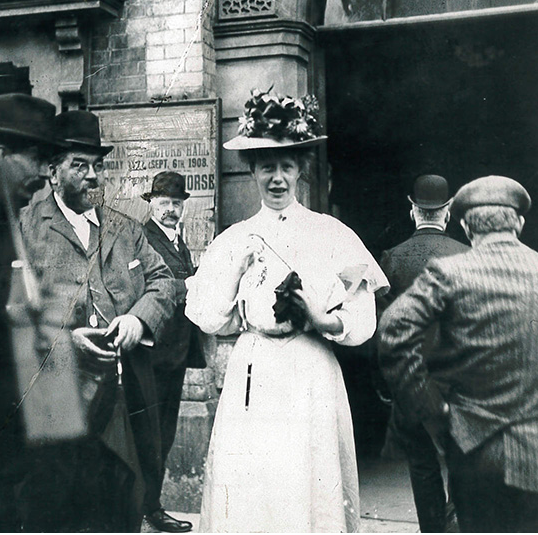
Mary Macarthur (Source: LSE Library TWL 2002 78).

Mary Reid Macarthur was a Scottish suffragist and trade unionist, who was instrumental in the expansion of female trade union membership in the early twentieth century. Born on 13th August 1880, Mary was the oldest of six children in a relatively well-off family. She attended Glasgow Girls High School, where she developed an interest in writing and journalism.

In 1901 Mary attended a meeting of the Shop Assistants Union, expecting to write a scathing report. She instead became a strong beleiever in trade unions, becoming secretary of the Ayr branch of the Shop Assistants Union. In  1902 she attended the Union’s national conference, where she became the first female to be elected to the national executive.

In 1903 Mary moved to London, where she became Secretary of the Women’s Trade Union League (WTUL), a congress for women’s unions. The League brought together women-only unions from a variety of different trades, which meant it had a mixed-classed membership. Through her activism, Mary realised that small, scattered unions would always struggle because of their inability to raise enough money to provide strike pay. To counter this, Mary founded the National Federation of Women Workers (NFWW) in 1906, a general labour union for women. It was open to all women who weren’t allowed to join the appropriate union, or who worked in trades that weren’t unionised. The NFWW became part of the National Union of General Workers in 1921, but in its 15 years it significantly advanced the cause of women in trade unions.

Mary Macarthur Speaking
Mary Macarthur speaking to a mostly male crowd in Trafalgar Square about a boxmakers strike in August 1908 (Photo: TUC Library Collections).

Mary also tried to help female workers in other ways, helping to organise the Exhibition of Sweated Industries in 1905 and getting involved in the foundation of the Anti-Sweating League the following year. Sweated trades we’re characterised by long hours, low  wages, and unsafe and insanitary working conditions. In 1907 Mary founded The Woman Worker, a monthly magazine for female trade unionists. She was a brilliant editor, but gave it up to concentrate on her activism. Mary spent time in the poorer parts of London collecting evidence about what it was like to work in sweated industries. She caught diptheria and spent 6 weeks in hospital, but she was able to present her findings to the Select Committee on Home Working in 1908.

Mary was also active in the campaign for the vote, although she opposed the National Union of Women’s Suffrage Societies and the Women’s Social and Political Union, the two main campaign groups. This was because they were willing to accept only certain groups of women bring given the vote. Mary believed this would disadvantage the working classes, and possibly delay universal adulthood suffrage.

Mary Macarthur TUC 1908
Mary Macarthur at the Trade Union Congress in Nottingham in 1908 (Source: TUC Library Collections).

The Trades Board Act was passed in 1909, largely due to the efforts of Mary and the organisations she worked with. The Act regulated sweated industries and introduced a minimum wage. The female chainmakers at Chadley Heath in the West Midlands became the first test case of the new Act in 1910. Mary convinced the women to fight for the wage they were entitled to; they won the dispute after a 10 week strike. Mary used her skills as a journalist to publicise the women’s cause, giving interviews, writing copy and arranging photo opportunities of the striking women with chains around their necks. She also made use of the new technology of cinema; a Pathe newsreel film of the strikers was seen by an estimated 10 million people. The publicity campaign raised a lot for the strike fund, the leftovers were used to build the Bradley Heath Worker’s Institute, which is now part of the West Country Living Museum.

Mary opposed the first world war, but she worked throughout it to promote the rights of female workers, campaigning for equal pay for equal work. She was a member of the Reconstruction Committee from 1916, set up to give advice on the employment of women after the war. Female trade union membership tripled during the war. After the war, Mary stood in the 1919 general election as the Labour candidate for Stourbridge in Worcestershire but was defeated, along with most other anti-war candidates.

Mary married William Crawford Anderson, the chairman of the executive committee of the Labour Party, in 1911. Anderson had first proposed marriage almost 10 years earlier, but Mary had decided to concentrate on her activism. Sadly their first child died at birth in 1913, but Anne Elizabeth was born in 1915. William died in the 1919 influenza epidemic. Mary herself died of cancer 2 years later, at the age of just 40.

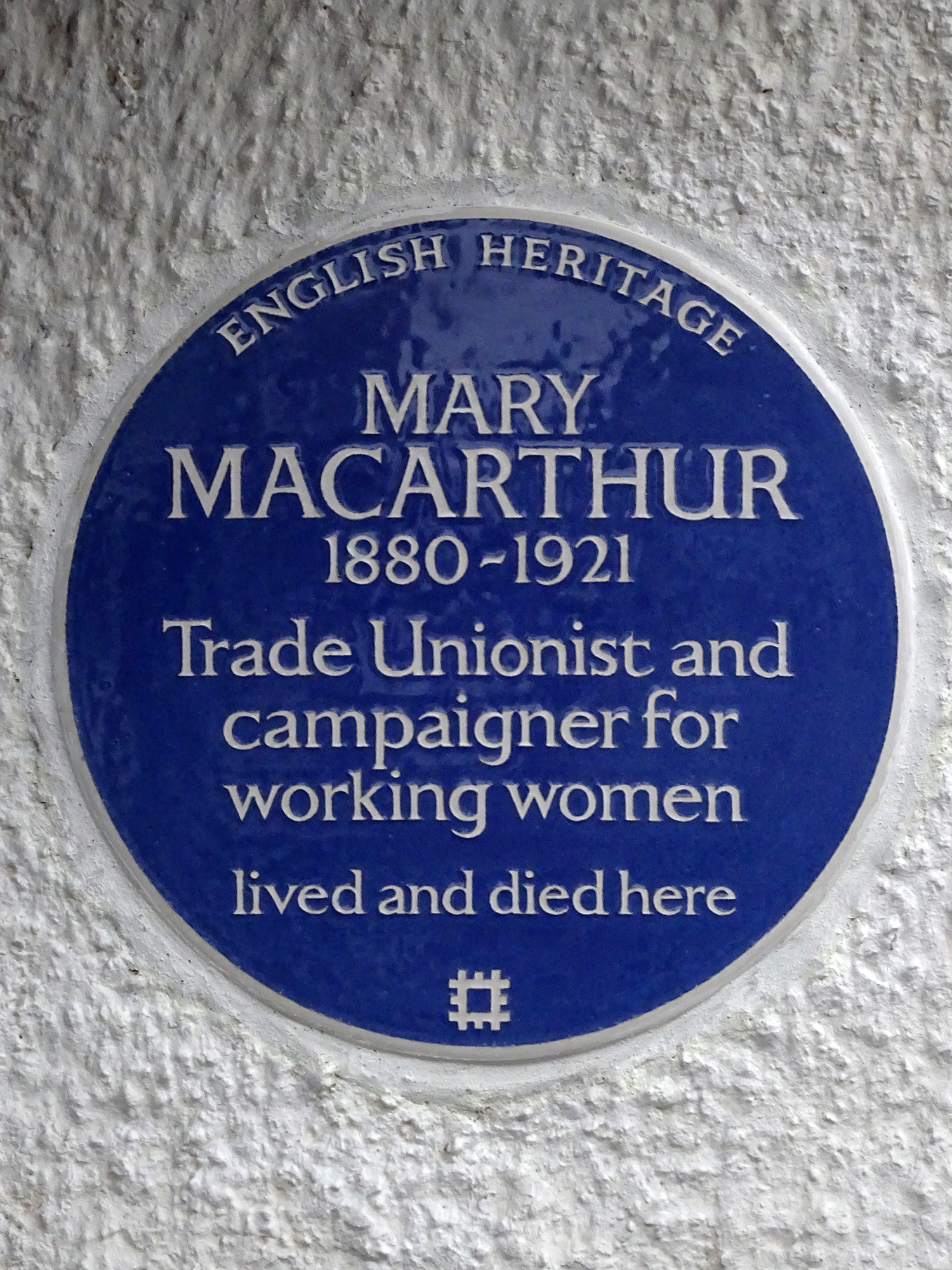
Blue plaque erected on 7th March 2017 by English Heritage at 42 Woodstock Road, Golders Green, London NW11 8ER, London Borough of Barnet. “MARY MACARTHUR 1880-1921 Trade Unionist and campaigner for working women lived and died here” (Source: Spudgun67).

Mary’s legacy lives on in the Mary Macarthur Holiday Trust and the Mary Macarthur Educational Trust, which provide grants to working women. A blue plaque commemorating Mary’s campaigning efforts on behalf trade unions and working women was installed on her house in Golders Green in north London in March 2017. As such, it might be said that she is better remembered than some of the other Turbulent Londoners featured on this blog. She deserves this recognition however, because of her huge contribution to the cause of women’s working conditions.

The TUC has an online exhibition about the life of Mary Macarthur that you can download HERE.

Sources and Further Reading 

Black Country Living Museum. “Mary Reid Macarthur, 1880-1921.” No date, accessed 22 March 2017. Available at  https://www.bclm.co.uk/media/learning/library/witr_marymacarthur.pdf

Simkin, John. “Mary Macarthur.” Spartacus Educational. Last modified August 2014, accessed 22 March 2017. Available at http://spartacus-educational.com/TUmacarthur.htm

Wikipedia, “Mary Macarthur.” Last modified 12 March 2017, accessed 13 March 2017. Available at https://en.wikipedia.org/wiki/Mary_Macarthur

Working Class Movement Library. “Mary Macarthur.” No date, accessed 22 March 2017. Available at http://www.wcml.org.uk/our-collections/activists/mary-macarthur/

On This Day: The Mud March, 9th February 1907

At the start of the twentieth century, the campaign for women’s suffrage was gathering momentum. The National Union of Women’s Suffrage Societies (NUWSS) organised the first large march for the cause on the 9th of February 1907. The women planned to march from Hyde Park to Exeter Hall, a large meeting hall on the north side of the Strand. Unfortunately the weather was not on the marchers’ side, and heavy rain made the streets of London very muddy, hence the name of the march. Despite this, the march was considered a great success.

mud-march-flyer
A flyer advertising the event which became known as the Mud March (Source: Woman and her Sphere).

Unlike the Women’s Social and Political Union (WSPU), the NUWSS refused to use militant or violent tactics in its attempt to win the vote for women. They were known as suffragists, which differentiated them from the suffragettes in the WSPU. However, they understood the need to have a visible presence in society; this march was their first attempt at using protest marches to attract attention.

Around 3000 women took part, from a range of social classes and occupations, and representing over 40 suffrage organisations. The march was organised by Phillipa Strachey, daughter of Lady Strachey. The march was considered so successful that she went on to organise all the NUWSS’s large marches. The march was led by Millicent Fawcett, leader of the NUWSS, and Lady Strachey, Lady Frances Balfour, and Keir Hardie, also prominent suffragists. The Artist’s Suffrage League designed posters and postcards advertising the march, and designed and made around 80 embroidered banners for the march itself.

Despite the wet weather, thousands of people turned out to watched the march. The sight of thousands of women from across social divides marching together was enough of a novelty to persuade people to brave the rain. Press from across Europe and America were fascinated by the diversity of women involved. At the time, it was perceived that women were reluctant to make displays of themselves in public. As such, the participants in the march were considered to be even more dedicated to the suffrage because they were willing to put themselves through such an experience. Kate Frye was on the march, and she obviously relished taking part, writing in her diary that she “felt like a martyr of old and walked proudly along.”

The suffragists marched from Hyde Park to Exeter Hall in the Strand, where the Strand Palace Hotel stands today. The Hall was opened in 1831 as an organisational and meeting space for evangelical groups. The Great Hall could hold 4000 people, and lots of causes held meetings there, including anti-Slavery and temperance. In 1880 Exeter Hall was taken over by the YMCA, but the Great Hall could still be used for meetings. The suffragists’ rally must have been one of the last meetings to take place there, as the building was sold and demolished in 1907. It required expensive alterations that the YMCA were unwilling to pay for. The suffragist’s rally featured music from an all-female orchestra, and speakers such as Keir Hardy, Israel Zangwill, Millicent Fawcett, and Lady Strachey.

The success of the Mud March, despite the foul weather, established the large-scale organised procession as a key tactic for the campaign for women’s suffrage in Britain. It has also been argued that the march gave the women’s suffrage movement a sense of respectability that the militant tactics of the WSPU did not.

Sources and Further Reading

Cowie, Leonard W. “Exeter Hall.” History Today 18, no. 6 (1968): 390-397.

Crawford, Elizabeth. “Kate Frye’s Suffrage Diary: The Mud March, 9 February 1907.” Woman and her Sphere. Last  updated 21 November 2012, accessed 24 December 2016. Available at https://womanandhersphere.com/2012/11/21/kate-fryes-suffrage-diary-the-mud-march-9-february-1907/

The Armchair Anglophile. “The Mud March.” Last updated 7 February 2012, accessed 24 December 2016. Available at http://www.armchairanglophile.com/the-mud-march/

Wikipedia. “Mud March (Suffragists)” Last updated 17 December 2016, accessed 21 December 2016. Available at https://en.wikipedia.org/wiki/Mud_March_(Suffragists)

Turbulent Londoners: Jane Cobden, 1851-1947

Turbulent Londoners is a series of posts about radical individuals in London’s history who contributed to the city’s contentious past, with a particular focus of women, whose contribution to history is often overlooked. My definition of ‘Londoner’ is quite loose, anyone who has played a role in protest in the city can be included. Any suggestions for future Turbulent Londoners posts are very welcome. My next Turbulent Londoner is Jane Cobden, one of the first women to be elected to the London County Council.


(Emma) Jane Catherine Cobden Unwin by Fradelle & Young. Albumen print, 1890s. NPG x131220 (Source: National Portrait Gallery).

Fans of Victorian crime drama Ripper Street might recognise Jane Cobden from series 2 and 3. Played by Leanne Best, Cobden was a strong, opinionated London County Councillor, more than a match for love interest Detective Inspector Edmund Reid. But how does the character match up to the real Jane Cobden?

Born Emma Jane Catherine Cobden on the 28th of April 1851 in Westbourne Terrace, London, Jane was the fourth of sixth children of the well-known reformer and politician Richard Cobden. She devoted her life to campaigning for women’s rights and protecting and developing her father’s legacy- she was committed to the’Cobdenite’ issues of land reform, peace and social justice.

In 1869 Jane moved to South Kensington with her sisters Ellen, Anne and Kate, also dedicated activists. Jane was active on the radical wing of the Liberal Party, and became increasingly committed to the cause of women’s suffrage over the 1870s. In 1871, she attended the Women’s Suffrage Conference in London with her sister Anne. In about 1879 she joined the National Society for Women’s Suffrage, and by the following year she was the organisation’s Treasurer.

The National Society was cautious, avoiding close association with political parties and excluding married women from their demand for the vote. This was too conservative for some, and the Central National Society broke away in 1888. In 1889 this group split again, and the Women’s Franchise League (WFL) was formed, including Cobden and Emmeline Pankhurst. The WFL’s aims were more radical- they wanted votes for women on the same basis as men, and women to be eligible for all political offices. Jane was politically pragmatic as well as ambitious, however. She disagreed with the mainstream Liberal Party’s stance on many issues, but remained a member because she believed it was the best way to advance her causes.

In the late 1880s, no one was sure whether women could serve as councillors or not; the law was unclear. In November 1888, the Society for Promoting the Return of Women as County Councillors (SPRWCC) was set up to test the law. This catchily-named organisation set up a £400 election fund and choose two women to stand as Liberal candidates for the newly established London County Council. Jane stood in Bromley and Bow, and Margaret Sandhurst stood in Brixton. Jane campaigned on a variety of issues, including opposition the tax on coal, better housing for the poor, “fair” wages, and opposition to sweat shops. Both women won, but their positions were not secure; there were many who opposed their election and tried to overturn the results. Sandhurst’s election was challenged by the man she defeated, and her election was declared invalid. Jane was supported by her runner-up, who was also a member of the Liberal Party. However, a judge eventually ruled that Jane’s election was unlawful, and therefore so were her votes in the council. She quietly served the rest of her term, and did not stand for reelection. It wasn’t until the Qualification of Women Act in 1907 that women legally gained the right to sit on county councils; Cobden was truly a woman before her time.

In 1892, aged 41, Jane married Thomas Fisher Unwin, a publisher. Encouraged by him, Jane expanded her interests to include international peace and justice, and rights of aboriginal people around the world. The couple strongly opposed the Boer War. In 1893, Jane represented the WFL at the World Congress of Representative Women in Chicago.

jane-cobden-ripper-street
Jane Cobden as portrayed by Leanne Best in BBC/Amazon drama Ripper Street (Photo: BBC).

As the campaign for women’s suffrage gained pace after 1900, Jane chose not to participate in the illegal activities of the WSPU, but she fiercely defended her sister, Anne, when she was imprisoned for a month in October 1906. She organised the Indian women’s delegation in the Women’s Coronation Procession on the 17th of June 1911, a few days before the coronation of George V. Cobden never gave up on a political solution to women’s suffrage. The Conciliation Bills of 1910-12 would have given a small number of propertied women the vote. Cobden asked the Irish Parliamentary Party to support the doomed bills, because of the support that women had given to the Land League campaign in England. She also continued to campaign for other causes she cared about during this time, publishing two books on the subject of land reform: The Hungry Forties: Life Under the Bread Tax (1904) and The Land Hunger: Life Under Monopoly (1913).

Jane Cobden died on the 7th of July 1974, aged 96. The BBC’s synopsis of her character in Ripper Street describes her as “one of the giants on whose shoulders the Suffragette Movement was to stand,” and it doesn’t exaggerate. Cobden may be more well-known than other women’s rights pioneers because of her portrayal in Ripper Street, but I think her achievements still deserve more recognition.

Sources and Further Reading

Baldwin, Anne. “Women’s History Month: Persistence Pays Off, as Women are Finally Elected to the London County Council.” Women’s History Network. Last updated 5 March 2010, accessed 31 October 2016. Available at http://womenshistorynetwork.org/blog/?tag=jane-cobden

Hurley, Ann. “Emma Jane Catherine Cobden-Unwin 1851-1947.” Hurley and Skidmore Family History. No date, accessed 31 October 2016. Available at http://www.hurleyskidmorehistory.com.au/emma-jane-catherine-cobden-.html

Richardson, Sarah. “What Next, and Next? The Cobden Movement: Fleeting or Fundamental?” Liberty Fund. Last updated 8 January 2015, accessed 31 October 2016. Available at http://oll.libertyfund.org/pages/lm-cobden

Wikipedia. “Jane Cobden.” Last updated 4 September 2016, Accessed 31 October 2016. Available at https://en.wikipedia.org/wiki/Jane_Cobden

Turbulent Londoners: Minnie Baldock, c.1864-1954

Turbulent Londoners is a series of posts about radical individuals in London’s history who contributed to the city’s contentious past, with a particular focus on women, whose contribution to history is often overlooked. My definition of ‘Londoner’ is quite loose, anyone who has played a role in protest in the city can be included. Any suggestions for future Turbulent Londoners posts are very welcome. My next Turbulent Londoner Minnie Baldock, an early member of the WSPU who helped establish the organisation in East London


Minnie Baldock 1909: Photograph by Colonel L. Blathwayt (Source: Wikipedia, image in the public domain). 

Minnie Baldock was an early member of the Women’s Social and Political Union (WSPU), who helped the organisation establish a presence in London, particularly amongst the working class women of the East End. Born in the East End in about 1864, she worked in a shirt factory as a young woman, and had two sons after her marriage to Harry Baldock.

Female suffrage was not the cause which brought out Minnie’s radicalism; she was a member of the Independent Labour Party, and in 1903 held a public meeting to complain about women’s low wages with her MP, Keir Hardie. As a member of the WSPU, however, Minnie flourished as an activist.

Minnie joined the WSPU early on, before it moved to London, and was soon involved in many of its activities in the capital. In December 1905 she was ejected from not one but two public meetings for heckling Herbert Asquith and Henry Campbell Bannerman, leader of the Liberal Party. In January 1906, Minnie established the first London branch of the WSPU in Canning Town, in an attempt to recruit working class women. Several other branches soon followed in the East End. Minnie was at the heart of networks of radical women in London; she helped Annie Kenney make connections when she first moved to London, she knew Sylvia Pankhurst and Charlotte Despard, and was a mentor to Daisy Parsons.

Also in 1906, Minnie became a full-time organiser for the WSPU. For the next few years she toured the country, promoting the cause of female suffrage. In October that year she was arrested at the opening of Parliament. She was arrested again outside Parliament in February 1908, and this time spent a month in Holloway Prison. She was worried about leaving her two sons alone with her husband, which illustrates the tension many female activists feel between their activism and their caring responsibilities.

Minnie worked for the WSPU until 1911, when she became seriously ill with cancer. She did not return to the WSPU after she recovered, although she remained a member of the Church League for Women’s Suffrage, which united all kinds of suffragists who were also religious. This suggests that she had become disillusioned by the WSPU’s methods rather than their main objective; they became increasingly violent, authoritarian, and dismissive of the concerns of working class women in the years before the First World War. Minnie moved to Southampton with her family in 1913, and was living in Poole when she died in 1954.

The WSPU was much more than the Pankhurst family; women like Minnie Baldock were essential to the successful running of the organisation. Minnie helped the WSPU establish a presence in London, and went on to campaign tirelessly for them around the country. Her name may not have survived the lottery of history, but the impact of her actions still resonates.

Sources and Further Reading

Brooker, Janice. “Suffragette.” Lost in London. Last modified 1st May 2007, accessed 11th October 2016. Available at http://www.brooker.talktalk.net/suffragette.htm

Simkin, John. “Minnie Baldock.” Spartacus Educational. Last modified January 2015, accessed 12th October 2016. Available at http://spartacus-educational.com/WbaldockM.htm

Walker, John. “Forest Gate’s Proud Suffragette Legacy.”E7 Now and Then. Last modified 6th March 2015, accessed 14th October 2016. Available at http://www.e7-nowandthen.org/2015/03/forest-gates-proud-suffragette-legacy.html