5 Reasons Why I Love My PhD

Some bits of your PhD are tough, and some bits are damn hard. I have been going through a particularly difficult stretch recently; I am coming into the last few months, and everything is taking about twice as long as I need it to. On some days, it is difficult to remember why I signed up for this in the first place. But I do love my PhD, and I want to hold on to that, so I made a list of all the things about my PhD that I enjoy:

1. My topic. I have always loved history and geography, and protest is a topic I’ve been interested in since the Student Tuition Fee Protests in 2010. I was an undergraduate, and it was the first time I got involved in protest. The connections between my experiences and my studies in Geography were obvious. London is a fantastic city to research as well, I love being able to spend my days finding out more about the people and events that have shaped the history of one of my favourite cities in the world.

The British Library (Source: Dutch Simba)

2. Working in the archives. Whilst I was conducting research on the Gordon Riots, I spent quite a bit of time in the Rare Books and Manuscripts room at the British Library. I consulted the diary of John Wilkes, radical politician and perpetual pain in the neck of the government in the middle of the eighteenth century. I got a little thrill knowing I was touching pages that he had written. I also just enjoy spending time in libraries and archive reading rooms, surrounded by books, in peace and quiet. The Bishopsgate Institute Library in London is a particular favourite of mine, it is exactly what a good library should look like!

10982088_10153267771471228_3739659062134779945_n
I loved exploring Chicago during time out from the AAG (Photo: Llinos Brown).

3. Going to conferences. Conferences are long and tiring, but I really enjoy them. They are great opportunities for finding out about the latest ideas and research, and for meeting new people, and catching up with others that you met at previous conferences. Doing a PhD can be a lonely experience, and conferences are an enjoyable social respite. They can also be an excuse to travel; last year I was lucky enough to go to Chicago for the Annual Conference of the Association of American Geographers, and I had a fantastic time exploring the city.

4. Teaching. I have been lucky enough to get plenty of teaching opportunities during my PhD. I’ve had a go at marking, demonstrating, lecturing, and running seminars, and I’ve enjoyed most of them. I’ve also helped on the undergraduate field trip to New York.

5. Writing this blog. There have been several occasions over the last few months when I have considered taking a hiatus from Turbulent London, or at least decreasing the frequency of posts in order to concentrate on my thesis. Every time I have decided not too, because I enjoy it too much. The writing style comes to me more easily than the formal academic style, and it feels great when someone responds to a post. So I’m going to try and keep it going for as long as I can.

So there you have it; 5 reasons why I love my PhD. I think it’s really important to be open about the negative elements of postgraduate study and academia, but sometimes you just need to stop and take stock of all the good things.
The Postgraduate Forum: When Human and Physical Geographers Meet

sdr
Last week I began my eighth year of study at Royal Holloway (Photo: Hannah Awcock).

Last week was my eighth Welcome Week at Royal Holloway (although it was still called Fresher’s Week in my day!), and my fifth as a postgraduate. Every year, as part of the Welcome Week programme in the Geography Department, two PhD students organise the Postgraduate Forum, a one-day conference in which current PhD students present their work. It gives current PhD students the chance to present in a friendly environment, and introduces new Masters and PhD students to the breadth of postgraduate research going on in the department.

The research community at Royal Holloway is split into three research groups: the Centre for Quaternary Research (which is where you’ll find the physical geographers), the Politics, Development and Sustainability group, and the Social, Cultural, and Historical Geography group (which is where you’ll find me!) For most of the year, these three groups operate quite separately, although there is quite a lot of overlap between the PDS and SCHG groups. On just one day a year, at the Postgraduate Forum, these three groups come together to share their research with each other, and I think it’s great.

dav
Ashley Abrook very helpfully adapted his presentation to suit his audience, and included an explanation of what the Quaternary period is (Photo: Hannah Awcock).

Geography is a a very broad academic discipline which encompasses a wide range of topics, methodologies  and theoretical approaches. For example, the Forum was organised this year by Rachael Squire and Rachel Devine (who did a fantastic job, by the way). Rachael Squire’s PhD is about the geopolitics of the ocean, focusing on the US Navy’s Sealab projects during the Cold War. Rachel Devine’s PhD is about trying to find evidence to support a new theory about what caused a period of cooling during the last interglacial transition (apologies in advance if I haven’t summarised the projects well!) You couldn’t get much more different than that, and because the different areas of geography can be so diverse, you don’t often get human and physical geographers in the same room discussing each other’s research. Which is why  the Postgraduate Forum is such a good event. In the space of just one day we heard about: using the size of fossil teeth to investigate past climates; a radical eco-squat in Camden; the response of vegetation to centennial-scale climate variations; the tensions involved in being a black Christian rapper from Ealing; using rocks to reconstruct the movement of glaciers;  and whether or not the Estonian government’s use of digital technologies are creating a more transparent and accountable form of government.

A few weeks ago I wrote about the RGS-IBG Annual Conference acting as a social nexus. I was kind of joking, but the analogy actually works quite well here too. The Postgraduate Forum brings PhD students together who otherwise might never interact. At the Postgraduate Forum, I met second- and third-year PhD students who are studying in the same department as me, but who I have never met before, because we’re not in the same research group. In one respect, it’s a shame that I haven’t had the chance to get to know them until now, but on the other hand I’m really pleased that we get this chance every year.

So whilst I hope, for the sake of my sanity and my bank balance, that this is the last Postgraduate Forum I will attend at Royal Holloway (as a student anyway- I’ll gladly stick around if they’d pay me!), I hope that it carries on for many more Welcome Weeks.

The RGS-IBG Annual Conference: A Social Nexus

dav
The Royal Geographical Society with the Institute of British Geographers Annual Conference took place this year at the RGS-IBG in Kensington (Photo: Hannah Awcock).

I spent most of last week at the Royal Geographical Society with the Institute of British Geographers (more commonly known as the RGS-IBG to save time!) Annual Conference in South Kensington. It is the fourth big international conference I have attended since I started my PhD, and apart from being more familiar with big conferences and how they work, I noticed one big difference from my previous conference experiences: I know people now. During the tea breaks, lunch breaks, and drinks receptions, I could be fairly confident that I would find someone I know to talk to. Not that there’s anything wrong starting a conversation with a stranger; I did a little of that too. But knowing that I could probably find someone I already knew to talk to make the prospect of networking less intimidating.

The overarching theme of the conference this year was Nexus Thinking. One of the latest buzzwords in geography, a nexus is a space of connections, of junctures, and of interaction. It got me thinking about the way in which conferences bring people together from a wide range of geographical locations and subject areas- they function as social nexuses (see what I did there?).

I saw lots of people that I know at the RGS-IBG, many that I haven’t seen in quite a while. There were previous Royal Holloway students who have now moved on to further study at other universities; current Hollowegians who I haven’t seen since the end of the summer term, or who I don’t normally get to talk to in the day-to-day life of my PhD; and people that I only really see at conferences.

bty
Myself with some fellow Hollowegians during a lunch break. From left to right: Ben Newman, Rachel Squire, Innes Keighren, Hannah Awcock (Photo: Hannah Awcock).

Many of them were fellow PhD students, whose PhDs I have followed via conference papers and chats over tea and biscuits, lunch, or a drink in the pub at the end of the day. I have watching from afar as their research has developed and progressed, and it was really nice to see them last week, as we all come in to the final stretch.

The RGS-IBG Historical Geography Research Group too, have been an intermittent presence throughout my PhD, particularly at the annual Practising Historical Geography conferences. The more established members are so supportive and generous with their time, never seeming to get tired of the incessant questioning from postgraduate students.

Sometimes when I am sat at home at my desk staring at a computer screen for hours on end, a PhD can feel quite lonely. Last week I was reminded that I have become part of a community; a group of people who know and understand what I’m going through, and that feels really nice. It might be a largely long-distance community, that requires a social nexus like the RGS-IBG Annual Conference to bring us together, but it is one that means a lot to me. And I am now confident that I will always be able to find someone to eat with during the conference lunch breaks.

The Self-Motivation Society: PhD by Timetable

Timetable Altug Karakoc.jpg
I have found timetables a useful way of motivating myself during my PhD (Photo: Altug Karakoc).

A PhD is a very individual experience; everyone works in different ways, and finds different aspects challenging. For me, one of the hardest things has been keeping myself motivated. Doing a PhD, it is largely up to you how you spend your time. You might get guidance from your supervisors, you might have work, family or other commitments that you have to work around, but ultimately it comes down to you. Self-motivation is a really important part of doing a PhD!

When I started my PhD, I had 3-4 years to write 100000 words, a mammoth task that seemed both hard to comprehend and far away. It was difficult to know how much work I needed to do each day, week, month, in order to get it done. I tried to stick to a 9 to 5, Monday to Friday schedule, but it was easy enough to talk myself into an afternoon or a day off if I got a more appealing offer, or even if I just wasn’t in the right frame of mind. My favourite argument I used on myself was “well, 9-5 Monday to Friday is a social construct anyway, so why should I stick to it?”-  I wonder if that one works on employers? Now, as I approach the end of my third year, the panic has set in but I still find it hard to motivate myself to work on occasion.

Something that I have found useful in recent months is timetables. I never used to find them helpful, I was never one of those people who made revision timetables in the run up to exams, for example. At Royal Holloway, PhD students have to undertake Annual Reviews to make sure they are still on track. One of the materials you have to produce for the annual review is a timetable of the work you plan to do over the next year. I must admit that for the first few years, I made the timetable then promptly forgot all about it. However, as the end of my PhD started to loom, I decided to try and make a timetable and actually stick to it.

I planned out every week until the end of my PhD, including conferences, teaching, and time off. I included self-imposed deadlines, on which I have to send pieces of writing to my supervisors, so I have concrete objectives to work towards. And for the most part, I have found it very helpful. I know what I need to get done by the end of each week, and from that I can work out what I need to do each day. It is helping to keep me focused and motivated, as well as breaking down the PhD into chucks that are more manageable.

I have also discovered one important caveat, however. Timetables are only helpful for as long as they are actually helping. There is a fine line between good pressure, which forces you to get on with things, and bad pressure, which puts your mental health at risk. Sometimes things happen which you didn’t predict, and sometimes specific tasks take longer than you anticipated, despite your best efforts. When I was writing up my most recent case study, it became obvious that I just didn’t have the material to analyse the issues convincingly. I had to spend another two weeks doing more research. It put me behind schedule, but it was necessary to ensure I come out with a good quality PhD. In fact, I have revised my timetable several times since I decided to take it seriously. I have even moved my self-imposed final deadline back by a month, because it was becoming clear that my previous date was unrealistic (I was aiming for December, I am now hoping to submit by the end of January. Royal Holloway requires me to submit by the end of September 2017, so I still have some wiggle room). My timetable isn’t set in stone; it is there to help me, and if it’s not helping me, then I can change it.

As I have said, the process of doing a PhD is different for everyone, and what I find useful might not be helpful for everyone, or even anyone, else. However, I think its important for PhD students to talk openly about our experiences, and discuss what works and what doesn’t. So please let me know if you’ve tried timetables, and if so, whether or not they’ve been useful to you.

Getting Grants, Getting Published and Staying Sane: Life After the PhD

dav
Getting Grants: Getting Published and Staying Sane: Life after PhD was organised by History Lab Plus at the Institute of Historic Research in London on the 15th of July 2016 (Photo: Hannah Awcock).

As I near the end of the third year of my PhD, what comes after is starting to loom increasingly large on my mind. As a result, I signed up for an event organised by History Lab Plus about life after the PhD. Getting Grants, Getting Published and Staying Sane: Life after the PhD took place on the 15th of July at the Institute of Historical Research in London, and I found it very helpful. There was a workshop about our post-PhD hopes and fears, and four panel-based sessions on making the transition, getting funding grants, getting published, and jobs outside academia/impact/public history.

The thing about advice is that it is personal; you can only really talk from your own experience, and it quickly became obvious that the post-PhD period is just as varied as the PhD itself. For example, it is very hard to get an academic job without a publication, but almost everyone seems to know at least one person who managed it. Any career is an individual experience, and people can only really give advice from their own personal experiences, which may not be relevant to yours for any number of reasons. This is something I always try to remember when given advice.

One piece of advice that does seem to be universally applicable is to spend time thinking about what you want to do after your PhD. Do you want an academic career? Do you want to turn your thesis into a book? Do you want to focus more on teaching or research? Think about what you want to achieve, and then decide which jobs/opportunities/ experiences will help you to get there. Also think about what skills you have, what you can offer to a potential employer. What are you interested in, and what are you good at? I spend a lot of time thinking about life after the PhD, but before this event it hadn’t occurred to me to try and think in these practical, concrete terms that might actually be helpful instead of just terrifying.

sdr
There were four panels covering multiple different aspects of life after the PhD (Photo: Hannah Awcock).

There were other bits of advice that I think would be useful for everyone; for example Emily Russell, an editor at Palgrave Macmillan, gave a talk about the process of converting a thesis into a book, but I think the aspect of the day that I found most helpful was the sense that we are all the same boat here. There must have been around 30 people sitting in that room, all of whom are coming close to finishing their PhD, or just recently had, who all had very similar questions about what comes next. As a PhD student, I am constantly being made aware of how difficult it is to get an academic job, how competitive it is (the ‘CV arms race’ is an analogy I like). As a result, I often find it hard to be happy for my contemporaries when they achieve something that might give them an advantage over me if we applied for the same job. My first reaction is frequently jealously, or despair that I haven’t managed to achieve the same thing yet, and I hate it. Life After the PhD was a reminder that we are all in the same boat. We are all dealing with the pressure, we are all getting frustrated about the structural systems that make academia so tough in the first place, and we are all worrying about how we are going to pay rent and feed ourselves when our funding runs out (those of use who were lucky enough to get funding in the first place). So we need to look out for one another. This can take the form of joining a union or a campaign like FACE (Fighting Against Casualisation in Academia), or simply being nice to one another- one of my favourite pieces of advice from the day came from Dr. Will Pooley and is a favourite saying of comedian Adam Hills: “Don’t be a dick!” Will posted the text of his talk on his blog.

I am scared about what is going to happen when I finish my PhD- this is the first time in my life when I don’t know what I’m going to do next, where I don’t have a solid, concrete plan that I know is going to work out. However, events like Life After the PhD  help me to put it into perspective. As well as providing advice, the day was an opportunity to discuss my fears, and my ambitions, with others who are going through the same thing, which I found helpful.

I would like to thank History Lab Plus for organising the event, particularly Kelly Spring and Jessica Hammett.

Times Are A Changin’: Temporality, Memory and Social Movements in the Digital Age

Times Are A Changin'
The Times Are A Changin’ Symposium was held at the University of Westminster on the 2nd and 3rd of June 2016 (Photo: Hannah Awcock).

I spent Thursday and Friday of last week at Times Are A Changing: Temporality, Memory and Social Movements in the Digital Age, a two-day symposium at the University of Westminster organised by Dr. Samuel Merrill and Dr. Anastasia Kavada. I really enjoyed the chance to meet new people, listen to some fantastic presentations and engage with some new concepts. Most of the other attendees were from Memory Studies or Media Studies, so there were a lot of new ideas for me to think about, particularly around the key themes of the symposium, temporality and memory.

As a Geographer, I am aware of just how significant time is (although space will always be my favourite!) However, the ways that different temporalities can impact, and be used by, activists and social movements is not something I had considered before. In her paper, Dr. Veronica Barassi argued that temporalities are constructed through practice, which means that activists can resist or reproduce hegemonic temporalities through their actions. Dr. Kavada’s presentation about the recent Nuit Debout protests in France provided a good example of this. The activists varied the speed at which they posted on social media depending on when they wanted attention; they would increase the intensity of posts before a important protest or meeting, for example. Dr. Kavada called this ‘temporal agency’; activists can gain power by negotiating with, or interfering in, temporal rhythms. It could be interesting to think through these ideas in the context of my PhD as the activists involved in my case studies had very different media technologies available to them, which all involved different temporalities.

The other key theme of the symposium was memory. For some activists and social movements, the memory of past events, people, and movements can be an important source of inspiration, morale, and identity. There were several papers relating to the various ways in which activists carry out ‘memory-work,’ such as Lorenzo Zamponi’s paper on #ioricordo, a hashtag created to memorialise the 2001 Genoa G8 protests. Archives have a significant role to play in the preservation of memory. Foteini Aravani, the Digital Curator at the Museum of London, gave a fascinating presentation about the museum’s experiences collecting items and digital media relating to recent protests, such as Occupy London. You do not have to be a museum to create an archive, however, and some movements choose to keep their own records.  Dr. Anne Kaun’s paper, entitled “Archiving Protest: Changing Temporal Regimes of the Archive,” discussed how modern social movement groups create their own digital archives. Occupy Wall Street had an archiving working group in order to capture representations of the movement from their own perspective. For my case study on the Battle of Cable Street, I am focusing on the various ways in which the Battle has been remembered, and how these memories are constructed and used, so this element of the symposium was also very helpful for me.

I have only mentioned a few of the great papers and speakers from Times Are A Changin’, there was so much interesting research presented that I can’t discuss it all. Suffice it to say that the symposium gave me a lot to think about, and I am confident that my own research will be better because I went. With that in mind, I would like to thank Sam Merrill and Anastasia Kavada for organising the symposium, and particularly Sam Merrill for inviting me. I look forward to seeing what comes next.

Reflections on Twitter as a Historical Source

Last week, I detailed my clunky and ad-hoc method for collecting and analysing old tweets. I have now finished my data collection (I read almost 26,000 tweets in total), so it seemed like a good time to reflect a little more on the experience of the process and what I found, rather than just how I did it. The tweets I read were all written during 4 days in November and December 2010. During this period a nationwide campaign was trying to persuade the British government not to make dramatic changes to the way that higher education was funded, which included raising university tuition fees to up to £9000 a year.

The Student Tuition Fee Protests in 2010 is the only one of my case studies (the others are the Gordon Riots (1780), the Hyde Park Railings Affair (1866), and the Battle of Cable Street (1936)) that I lived through and participated in. I have my opinions about the issues contested in each of the other case studies, but researching events that you yourself experienced is very different. I was a second year undergraduate in late 2010, my younger sister would be affected by the proposed increased fees, and I cared very much about what happened. Reading through tweets from the four days of protest in London brought back a lot of emotions; the desire to do something; hope that we could make a difference, disbelief that anyone thought the proposals were a good idea; betrayal at the Liberal Democrats’ U-turn; anger at those who dismissed students as ignorant, lazy and apathetic; all soured by the knowledge that we didn’t change anything. Compounding this is the tendency people have to be more arrogant and abrasive on the internet than they ever would be in person. Because of this some Tweets were quite offensive, and it was hard not to take it personally. I found myself fighting the urge to reply to some of the most irritating Tweets, repeatedly reminding myself how strange it would be to get a reply to something written 6 years ago. Reading the tweets caused me to re-live many of the feelings I experienced back in 2010, which meant that this research was often quite draining emotionally.

049
Some tweets expressed extreme opinions, which I often found difficult to read (Source: Twitter/@purpleline).

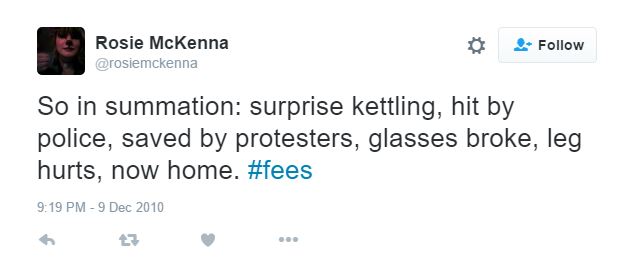
One of the biggest problems I have faced so far in my PhD research is that the further back in time you go, the less archival material there is which records the perspectives and experiences of ordinary people. This is a challenge for many historical researchers, but it has been particularly difficult for me because the wealthy elites don’t tend to be the people participating in protest and dissent. The internet is relatively accessible, with only 11% of British adults having never used the internet (Office of National Statistics, 2015). This does not mean that 89% of British people use Twitter, but it does give me the opportunity to see what ‘ordinary’ people were saying about the protests, which is a rare treat for me. Twitter revealed some wonderfully fine-grained details about the protests and what it was like to be there. For example, a woman called Rosie McKenna broke her glasses and hurt her leg whilst being kettled by police on the 9th of December. It was great to be able to develop such a clear picture of what it was like to be part of the protests, rather than having to rely heavily on imagination.

040
Twitter preserves the experience of protesting in finer detail than traditional archival sources (Source: Twitter/Rosie McKenna).

Another aspect of the research that I really enjoyed was seeing how various processes present in my other case studies played out through this modern technology. A common feature of protests and social movements is conspiracy theories; people speculate about who the ‘real’ organisers of a protest event are, or who might be manipulating the course of events to suit their own aims. The Gordon Riots, for example, were blamed on the American, Spanish or French governments. Scholars have argued that these theories developed because at that point it was not generally believed that the lower classes were capable of organising themselves in such a manner; they need someone to tell them what to do (Leon, 2011; Tackett; 2000). Conspiracy theories persist, however, despite modern society holding a less patronising view of the working and middle classes.One of the best known events of the 2010 Student Protests was the occupation of 30 Millbank, the building in which the Conservative Party campaign headquaters were housed. The response of the Metropolitan Police on this occasion was rather slow and inadequate. The most likely explanation is that they were surprised by the strength of feeling amongst the protesters, and had not prepared for trouble on that scale. However, it was suggested by some Twitter users that the police had deliberately responded slowly, because policing was facing its own budget cuts under the austerity regime, and wanted to demonstrate their usefulness to the government. The saying ‘the more things change, the more they stay the same’ springs to mind…

060
Twitter gives modern conspiracy theories related to protest a new platform on which to be transmitted and debated (Source: Twitter/Simon Bayley).

After a long period of writing, I really enjoyed getting to doing some research again, and exploring a new source of data. Working with Twitter was tiring, physically as well as emotionally (I had to take regular breaks because of the strain on my eyes), but also very rewarding. It has provided me with evidence to back up my arguments, as well as leading me to develop some new ones, and I feel like my PhD will be stronger because I tried this new (to me) research method.

Sources and Further Reading

León, Pablo Sánchez. “Conceiving the Multitude: Eighteenth-Century Popular Riots and the Modern Language of Social Disorder.’ International Review of Social History 56, no. 3 (2011): 511–533.

Tackett, Timothy. “Conspiracy Obsession in a Time of Revolution: French Elites and the Origins of the Terror 1789–1792.” The American Historical Review, 105, no. 3 (2000): 691–713.

#demo2010: Harvesting Old Tweets as a Research Method

The long time scale of my PhD means I have to deal with vastly different sources in my research. For the Gordon Riots (1780), I use mainly eyewitness accounts and court records. For the Battle of Cable Street (1936), I have access to images and videos of what happened. For the 2010 Student Tuition Fee Protests, the choices are almost endless. One of the sources I decided to utilise was Twitter, the social media website that allows its users to post updates of up to 140 characters. Every type of source presents different challenges for the researcher, and I found the unique challenges of Twitter rather difficult to cope with at first. This post is about the method I developed for my research, and I hope it will act as a catalyst for discussion amongst other scholars dealing with similar issues. My research was conducted on a computer with a Windows 10 operating system, and I do not know how well my method would translate to a different operating system.

Whilst there are programmes which collect tweets in real time as they are tweeted, many of which are open access, there are fewer designed to harvest pre-existing tweets. Those there are are aimed at a commercial rather than academic market, and their cost is beyond the scope of my research budget. So I had to develop my own ad-hoc, ‘low tech’ method of harvesting old tweets, using Twitter’s Advanced Search function.

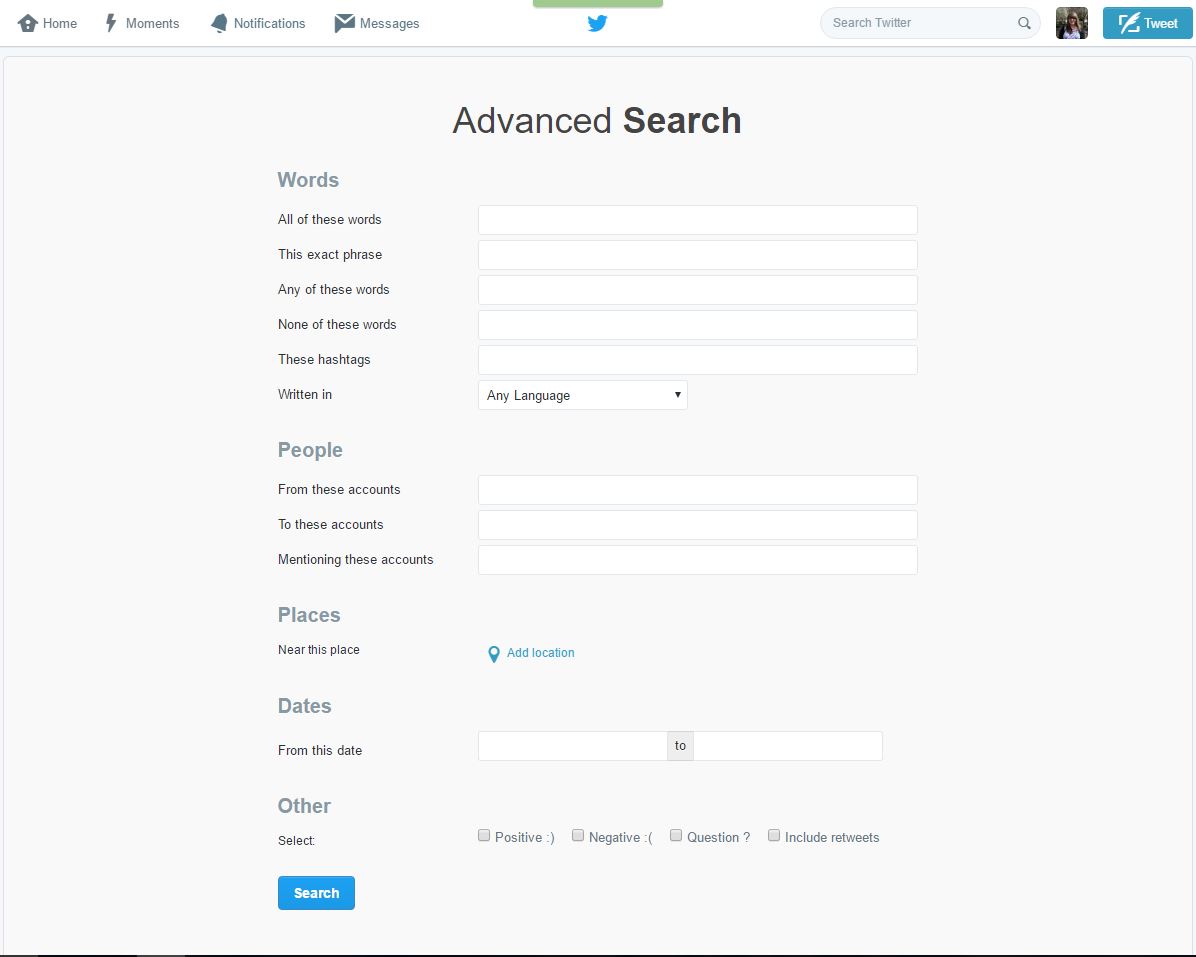
In 2014 Twitter began allowing users to search for tweets more than 7 days old in its Advanced Search function (accessed from the options menu of a bog standard Twitter search result page, or by googling ‘Twitter Advanced Search’. You have to have a Twitter account to use this function). Advanced Search lets you combine a whole variety of search parameters, including date, location, hash tags, Twitter accounts, key words, sentiment (whether a Tweet is positive or negative). You can even input words you don’t want to be included.

Twitter Advanced Search
Twitter’s Advanced Search function looks a little like this (Source: Twitter).

Once I decided I was using Advanced Search, I had to decide on search parameters. The Student Tuition Fee Protests were a series of demonstrations, occupations and marches on both a national and local scale that took place between the 10th of November and the 9th of December 2010. I wanted to see Tweets from the four days of action that took place in London, on the 10th, 24th, and 30th of November, and the 9th of December. I started by searching for tweets that had been geotagged with London on the revelant days. Only a small percentage of tweets are geotagged, but it provided me with an idea of the hashtags and keywords that were were being used in regards to the demonstrations. I used this to decide on my search parameters. For example, for the demonstration on the 9th of December I searched for ‘Any of these words: protester, protesters, students, tuition, fees, protests’ and ‘These hashtags: #demo2010 #dayx3 #fees #solidarity #studentprotest #ukuncut’. For each demonstration, I used a slightly different combination of hashtags and keywords, in an attempt to find as many relevant tweets as possible. I acknowledge, however, that I probably did not find every tweet about the demonstrations. I also altered the dates as appropriate, then started the search.

Twitter Search Results
This is the top of the search results page I got for the protests on the 9th of December 2010 (Source: Twitter).

Now for the long-winded part. I have not found a way to download multiple tweets at once. You can use your browser’s print function to save the search results as a pdf, but there are several disadvantages to this. You cannot expand the tweets to see what time they were tweeted, and it will only save the tweets that have loaded- you have to scroll all the way down to the bottom of the search results to save them all, and this can take a long time when searches yield more than a few thousand tweets. I did save the search results as a pdf, so I can go back to them at a later date if I want to, but only once I had read them all.

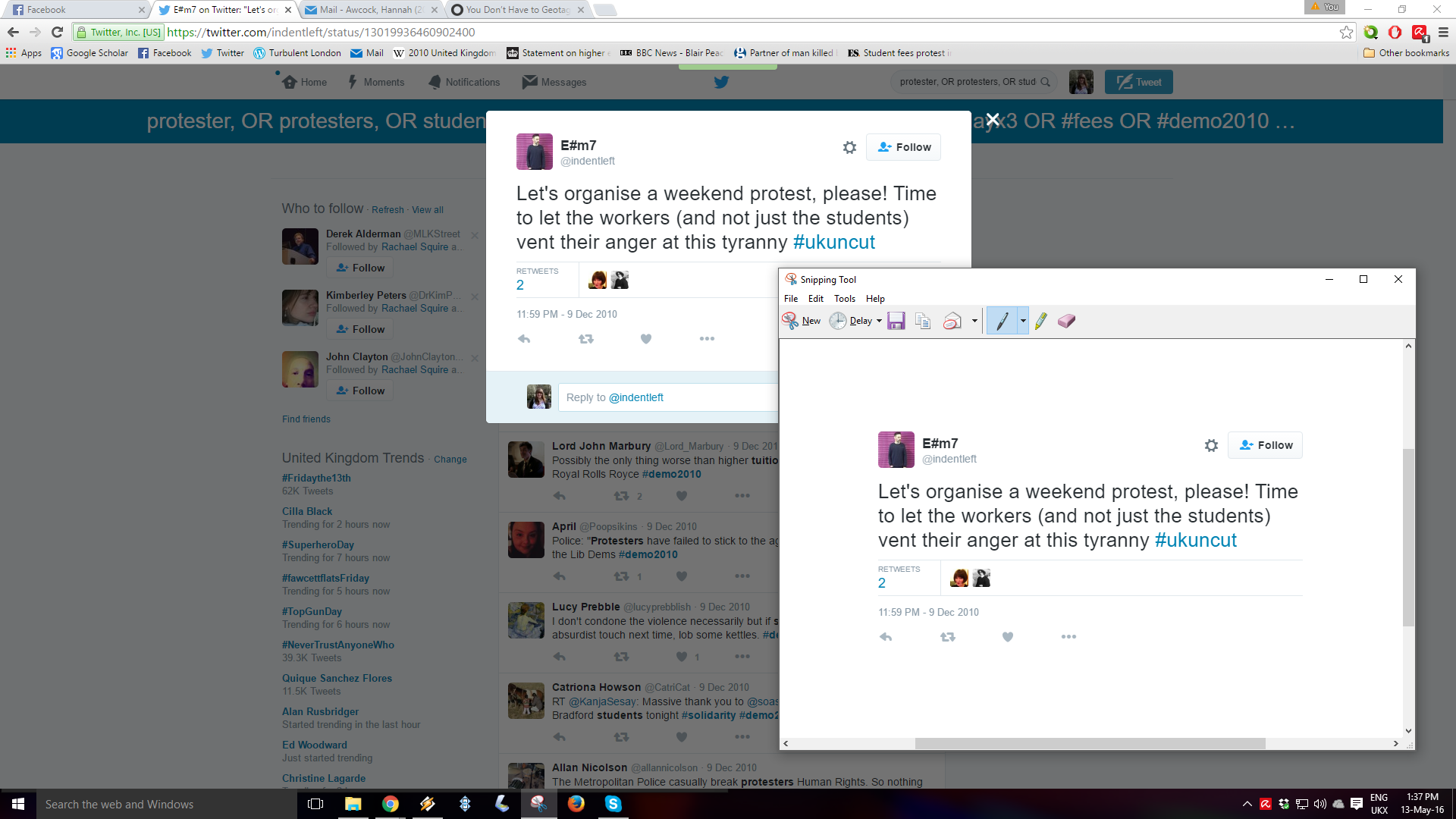
And that is how I analysed the search results, by reading every single tweet. Any tweets that I thought might be relevant to my research, I saved as a jpeg using the Snip tool, with it’s own individual number (001, 002, 003, 004 etc.). I also pasted each tweet into a word document, so I could go back to them later without having to open each individual jpeg. I coded the saved tweets as I went along, making a note of the tweet’s number and the key theme it related to. I also kept a count of how many tweets I had read as I went along. I wouldn’t say it was very reliable, but I can at least say roughly how many tweets I analysed for each demonstration. For example, I read almost 8000 tweets related to the demonstration on the 10th of November 2010.

Snip Tool.png
The Snip tool allows you to make an image from your computer screen. It works a little like print screen, but you are able to select a particular area that you want to capture, like this tweet from the 9th of December 2010 (Source: Hannah Awcock).
dav
Sometimes, the simplest way of doing things is the best. I counted every tweet I read, and coded the most relevant ones using a good old fashioned notebook and pen (Source: Hannah Awcock).

So there you have it; my ad hoc, low tech (for Twitter!) method for collecting and analysing old Tweets for academic research. It is a rather clunky method, and I suspect that someone with more technological know-how than me could improve it dramatically, but it has allowed me to see how social media was being used during the 2010 Student Protests in London. If you have experience with this sort of research, or just have an opinion on it, then I would love to hear from you!

Practising Historical Geography

Last Wednesday (the 28th of October), the 21st Practising Historical Geography conference took place at the University of Sussex in Brighton. The conference is organised by the Historical Geography Research Group of the Royal Geographical Society with the Institute of British Geographers (or HGRH and RGS-IBG for short!), and is aimed at undergraduates and postgraduates. This was my forth year attending the conference (previously held at the University of Bristol (2014), University of Central Lancashire in Preston (2013) and the University of Hull (2012). I first attended as a Masters student (all those studying the MA Cultural Geography at Royal Holloway are encouraged to attend), and even now, in the third year of my PhD, I still found it to be a beneficial and enjoyable experience.

The Royal Holloway contingent at the 21st Practising Historical Geography conference at the University of Sussex (Photo: Innes Keighren).

The conference combines keynote speakers, workshops, and chances to network. The first keynote was given by Dr. Simon Rycroft (University of Sussex) and was entitled ‘Mid-century Representation: John Latham’s Cosmos.’ Using the work of artist John Latham, Dr. Rycroft argued that it is important to be alert to the changing practices of representation. Representations reflect the ways we think about materials, which changes over time. Academics need to take such things into account when analysing representations.

Dr. Simon Rycroft talking about the work of artist John Latham (Photo: Hannah Awcock).

After the first keynote is a section called Postgraduate Voices, where someone who has recently completed their PhD gives advice based on their experiences. This year, Dr. Jake Hodder talked about the 3 major crises he faced during his PhD, which roughly align with the 3(ish) years that a PhD takes:

  1. Imposter syndrome:  The fear that someone will realise you are not good enough to be here, and tell you to go home, in a very public and humiliating way.
  2. Project isn’t coming together: At some points it can feel like you will never be able to make a coherent whole out of all the work you have done.
  3. Uncertainty: Particularly in the third and fourth years, financial insecurity and a sense of ‘what the hell am I going to do next?!’ can take its toll.

I found myself agreeing with everything Jake said. It is always reassuring to know that others are facing the same difficulties as you, and knowing that Jake overcame them to become Dr. Hodder is a welcome confidence boost!

Every year, the Historical Geography Research Group runs a competition for undergraduate dissertations in the field of historical geography. This year, the prize was won by Victoria Bellamy (University of Cambridge), who told us about her research on Victoria Park in East London in the second half of the nineteenth century. Parks are ideologically contested spaces; there is constant debate about their purpose and how they can be used. Victoria’s research explores how some of these debates played out in Victoria Park, surrounded by some of the most deprived areas of Victorian London. She did a fantastic job of presenting her work.

2015-10-28 11.20.29
Victoria Bellamy summarised her prize-winning undergraduate dissertation in just 10 minutes (Photo: Hannah Awcock).

The middle section of the day is taken up by 2 workshops, which focus on what it’s like to actually do historical research. Previous workshops have involved all kinds of things, from taxidermy to the Preston bus station, but this year they focused on extreme weather events in Britain (run by Dr. Lucy Veale, University of Nottingham) and the spatial politics of British households in the nineteenth-century, particularly the relationships between domestic servants and employers (run by  Dr. Fae Dussart, University of Sussex). Chances to discuss the practice of researching the past with other researchers are rare, so I always look forward to this part of the day. It is an opportunity to talk about the difficulties of historical research, as well as explore some methodologies that may be unfamiliar.

Lucy Veale running a workshop about researching extreme weather events in the archive (Photo: Hannah Awcock).

The day was rounded off by the second keynote speaker, Dr. James Kneale (University College London), who spoke on the subject of ‘Looking for Drink in the Archive.’ Dr. Kneale has been researching alternative approaches to Victorian understandings of alcohol. There is plenty of evidence of the moral debates surrounding alcohol in the archives, but the Victorians didn’t just talk about alcohol, they experienced it in a whole range of other ways. Dr. Kneale has been using the archive to investigate practice, which is no simple task.

2015-10-28 15.46.58
James Kneale discussing looking for evidence of alcohol in the archives (Photo: Hannah Awcock).

If all goes according to plan, I will probably be too busy putting the finishing touches to my thesis to attend the 22nd Practising Historical Geography conference next year. This is a shame, as it is a great event. I would thoroughly recommend it for any Masters or PhD students whose work even remotely relates to historical geography, especially if you are relatively new to academia. The atmosphere is friendly and welcoming, and it would be an ideal first conference. I have learnt a lot over the past four years, and met people who have become both colleagues and friends. Thank you to the Historical Geography Research Group (particularly Lucy Veale, who has organised the last 3 conferences) for putting on such wonderful events.

The 2012-3 MA Cultural Geography cohort in a pub in Hull the night before the 18th Practising Historical Geography conference (Photo: Innes Keighren).
The Royal Holloway contingent in a pub in Preston the night before the 19th Practising Historical Geography conference in 2013 (Photo: Innes Keighren).
The Royal Holloway contingent at the 20th Practising Historical Geography conference in Bristol- we don't spend all our time in pubs! (Photo: Innes Keighren).
The Royal Holloway contingent at the 20th Practising Historical Geography conference in Bristol- we don’t spend all our time in pubs! (Photo: Innes Keighren).

Following the Chartists around London

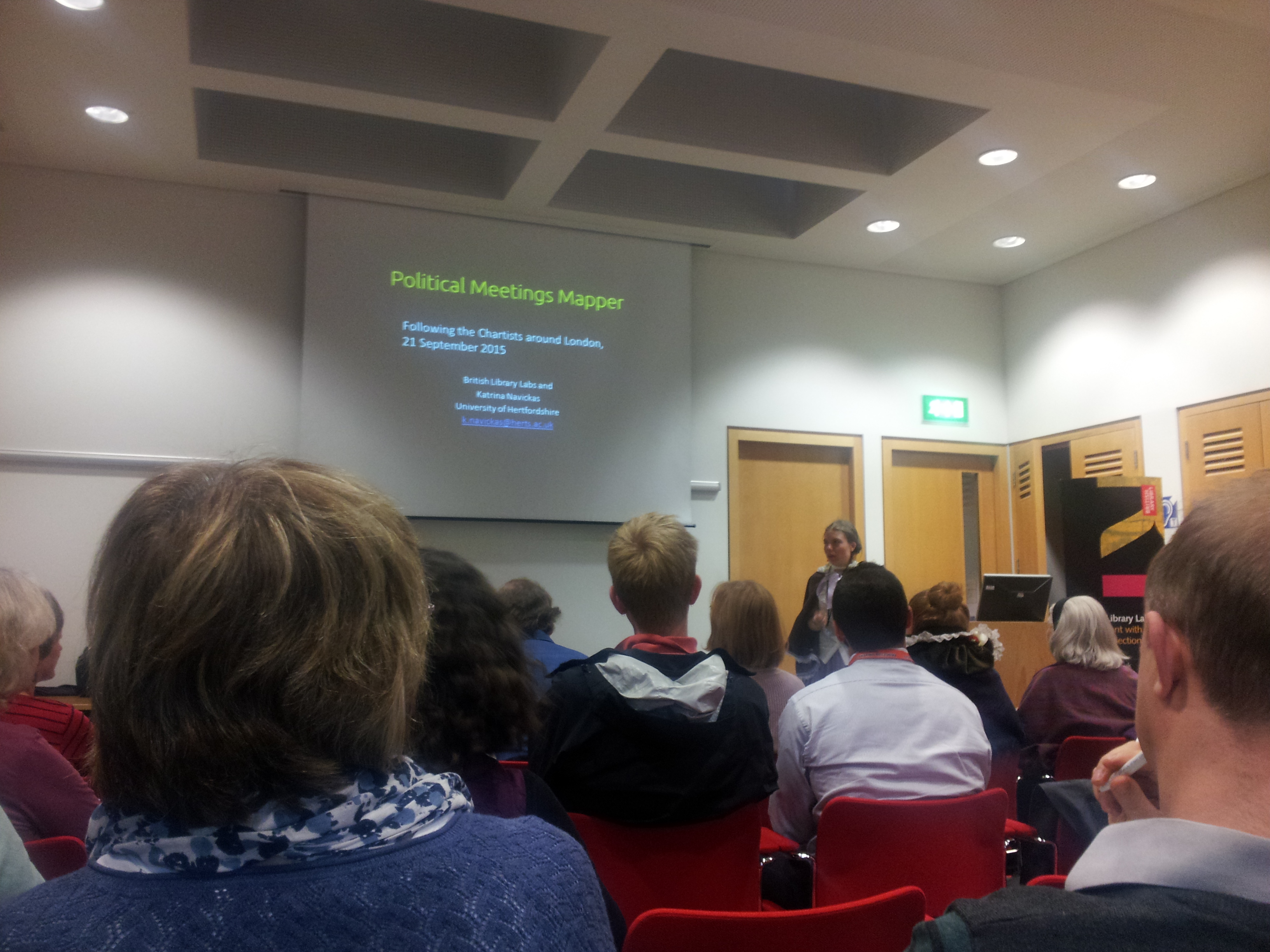
Last Monday, I took part in an event organised by Dr. Katrina Navickas of the University of Hertfordshire and British Library Labs called Following the Chartists around London. Dr. Navickas won a competition run by the Labs to develop a project that makes use of the British Library’s digital resources. As a result she is currently working on the Political Meetings Mapper, a project mapping all of the Chartist meetings listed in the Northern Star, one of the most popular Chartist newspapers. The Following the Chartists event was part of this project.

Katrina Navickas, in full Chartist costume, introduces her Political Meetings Mapper project.
Dr. Katrina Navickas, in full Chartist costume, introduces her Political Meetings Mapper project (Photo: Hannah Awcock).

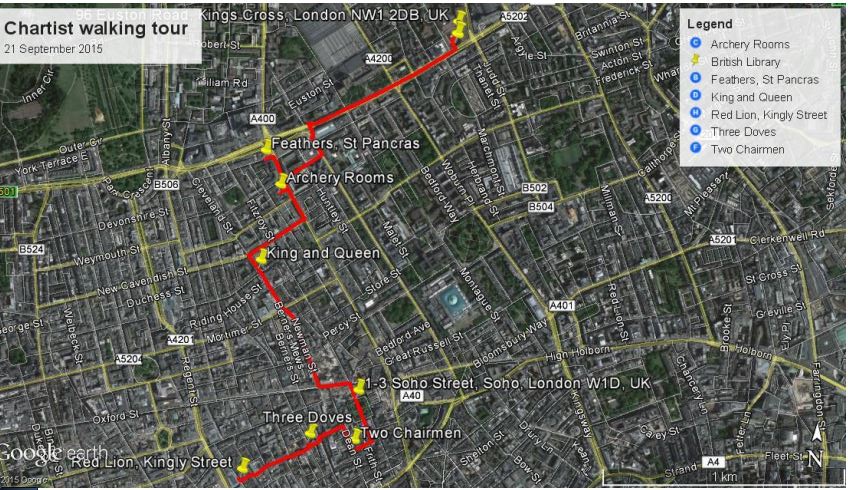
The afternoon began with lunch and a series of talks. Mahendra Mahey, manager of the British Library Labs project, introduced the British Library Labs and their work. Dr. Navickas explained the Political Meetings Mapper and gave a brief history of the Chartists. Dr. Matthew Sangster (Birmingham University) talked about his website romanticlondon.org, which uses contemporary maps and representations to explore romantic-era London. Finally, Professor Ian Haywood (Roehampton University) discussed the visual representations of ‘monster’ meetings- large, outdoor political meetings. The Chartists used this tactic frequently. We then embarked on a rather damp walking tour of Bloomsbury and Soho, visiting the sites of Chartist meeting places. In some cases, the pubs are still there, in others they have become stationary shops, or the building sadly no longer exists. The tour ended at the Red Lion in Kingly Street in Soho, which hosted meetings of both the Chartists and the London Corresponding Society.

Following the Chartists around London walking tour route (Source: Katrina Navickas).

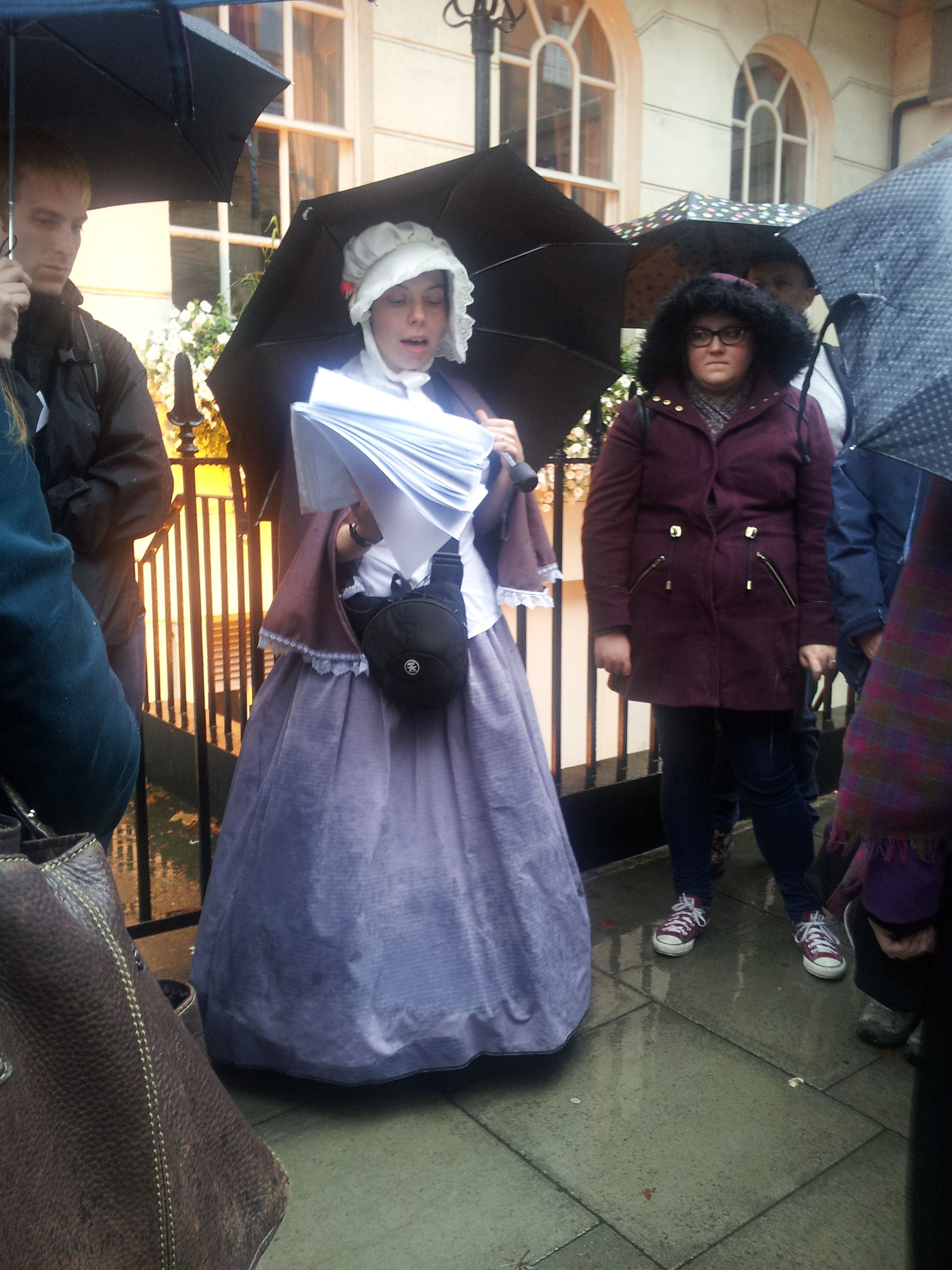
At the Red Lion we re-enacted a Chartist meeting that took place in December 1838. This is where I came in; I played the roles of a female Chartist of St. Pancras/ Mr. Cardo, who proposed the following resolution:

This is the most important crisis that has existed for the working classes. At the present moment we possess a power most mighty in its operation, one that is to be viewed by us with the highest feelings of delight and by our enemies with dread and alarm (Cheers.) … the Radicals are determined to be staunch to a man, and the people united will carry the day.

RESOLUTION: That this meeting considers a perfect union among all the Radicals absolutely necessary for the accomplishment of Universal Suffrage.

A recent Chartist conference in Edinburgh had proved devisive, and there was a sense that all the various groups and factions needed to get back on the same track, quickly. Only with a united front could universal (male) suffrage be won. Mr. Cardo’s motion was passed unanimously by our meeting.

We weren't about to let a little bit of rain stop us!
We weren’t about to let a little bit of rain stop us! (Photo: Hannah Awcock).

The whole afternoon was great fun. I thoroughly enjoyed wearing a bonnet and apron, even if we did get some funny looks as we wandered around London. The talks highlighted the potential of digital research methods in relation to archives. Around 2% of the British Library’s collections have been digitised, which may not sound like a lot, but considering the Library holds well over 150 million items, it is a huge amount. Dr. Navickas has used computer programmes to transcribe newspaper articles, date meetings, and create maps that begin to interpret the data. The transcription software still needs a human to check its results, and all of this could have been done by hand, but it would have taken an awful lot longer. When it is finished, I think the Political Meetings Mapper will be a valuable tool for academics, students, and the simply curious; a resource which others can use to develop our understanding of the Chartist movement.The walking tour and re-enactment demonstrated how the Political Meetings Mapper could be used.

The British Library Labs project is doing valuable work raising awareness and promoting engagement with the Library’s digital collections. I learnt a lot about the possibilities of digital research methods, and would love to try and work it into my own work somehow!

If you want to do the walking tour yourself, see Dr. Navickas’ guide here.