Reading the Riot Act 2: Luddites and Micks

Last year, I wrote a post about the protest-related origins of the phrase ‘reading the riot act,’ amongst others, and since then I have been on the lookout for other phrases which also have their origins in periods of strife. What I’ve found are two terms to describe people. If you have ever called someone, or been called by someone, a ‘Luddite’ or a ‘Mick’ (to describe an Irish person, not someone who’s name is Michael), then you have been referring to Britain’s long history of dissent.

A Luddite is someone who dislikes technology (Source: Poughkeepsie Day School).

A Luddite is a term frequently used to refer to someone who disapproves of new technologies. For most people, it is an insult, but others embrace the name with pride. If the origins of the term were more widely known, perhaps more people would be proud of the name. The Luddites was the collective name given to English textile workers who protested against the mechanization of their trade between 1811 and 1816. The new technologies of the Industrial Revolution meant that textiles could be mass-produced by unskilled, low-wage workers, forcing skilled artisans out of work.

The (probably) fictional leader of this movement was called General, or King, Ludd, and reportedly lived in Sherwood Forest, the home of another mythical champion of the people, Robin Hood. The name may come from Ned Ludd, who allegedly smashed two stocking frames in 1779.  The Luddite protests began in Nottinghamshire and quickly spread through the midlands and North of England. The demonstrators sent threatening letters to employers and broke into factories to destroy new machines. In 1812, machine breaking became punishable by death, and 17 men were executed the following year. Obviously the Luddites were unsuccessful at halting the march of the Industrial Revolution, but they made such an impression that their name is still used, 200 years later.

‘Mick’ is a derogatory word to describe an Irish person. There are several explanations for the origin of the term, but my favourite comes from London’s contentious past. Michael Barrett has the dubious honour of being the last person to be publicly hanged in England. In May 1868 he was executed for his role in the Clerkenwell Outrage on the 13th of December 1867. 12 people were killed in a bombing outside the Middlesex House of Detention in Clerkenwell, shocking Londoners and turning them against the cause of Irish nationalism. Michael Barrett’s name became synonymous with all Irish people.

The bomb was a failed jailbreak that went disastrously wrong. Prominent Fenians Richard O’Sullivan Burke and Joseph Casey were being held in the Clerkenwell prison. A barrel of gunpowder was placed against the wall of the prison’s exercise yard and set off with a firework, with the aim of blowing a hole in the wall so Burke and Casey could escape. Far too much gunpowder was used and the blast damaged a row of tenement houses on the other side of the road. 12 people were killed and up to 120 were injured. The prison authorities knew something was being planned, so the prisoners were locked in their cells instead of exercising at the time of the bombing, and Burke and Casey failed to escape. Although Michael Barrett was charged along with several others, he was the only one who was actually convicted of the bombing.

The English language has many phrases which, when you actually stop to think about them, appear to be absolute nonsense. But when you start to trace it back, you often find a great story that explains it, and offers a tiny window onto Britain’s chequered past.

Sources and Further Reading

Anon. “Luddite.” Wikipedia. Last modified 7th June 2015, accessed 12th June 2015. https://en.wikipedia.org/wiki/Luddite

Anon. “Michael Barrett (Fenian).” Wikipedia. Last modified 17th December 2014, accessed 23rd June 2015. https://en.wikipedia.org/wiki/Michael_Barrett_(Fenian)

Anon. “Mick.” No date, accessed 12th June 2015. http://www.urbandictionary.com/define.php?term=Mick

Webb, Simon. Dynamite, Treason and Plot: Terrorism in Victorian and Edwardian London. Stroud: The History Press, 2012.

Protest: What’s the Point?

When I posted a link to Reddit about the End Austerity Now demonstration in June I said it was a ‘big success’. Several comments reacted to this rather sarcastically with one asking if austerity is now over. Whilst I didn’t appreciate the tone of the comments, I realised that ‘what makes a successful protest?’ is a perfectly valid question. It is true that protests rarely bring about large scale change, but they serve other purposes too, such as raising awareness, recruitment, demonstrating solidarity and boosting morale.

Some of the comments I received when I said on the website Reddit that the End Austerity Now demonstration in June 2015 was a 'big success'.
Some of the comments I received when I said on the website Reddit that the End Austerity Now demonstration in June 2015 was a ‘big success’.

It can be difficult to find examples where protest has directly led to wide-scale change, although the 1990 Poll Tax Riots is one case where protest significantly contributed to change. It is much easier to find examples of protests that have led directly to small-scale, local change. For example, housing protest groups like FocusE15 and Housing Action Southwark and Lambeth (HASL) have managed to prevent an increasing number of evictions and long-distance relocations by London councils over the past few years. Looking further back, the female workers at the Bryant and May match factory in Bow, East London won themselves better working conditions and helped to kick start New Unionism when they went on strike back in 1888. These examples demonstrate that protest is not always as ‘unsuccessful’ as it is perceived to be.

Even protests that do not lead to direct change can be ‘successful’. For example, a protest can raise awareness of an issue amongst those who witness it and the wider public via media coverage. Fathers4Justice are a group that know how to garner publicity, as their tactic of scaling landmarks dressed as various superheroes demonstrates. As well as dramatic or comic stunts, violence can also increase press coverage, as happened in the student tuition fee demonstrations in London in late 2010. It’s a risk though, as violence can often alienate would-be supporters. On the 13th December 1867 the Irish Republican Brotherhood attempted a prison breakout in Clerkenwell by blowing up the prison wall. They used too much gunpowder however, and the explosion killed 12 people. The event became known as the Clerkenwell Outrage, and support for the Fenians in London, which had been quite strong up to this point, evaporated. Nevertheless, regardless of exactly how you go about it, protest can be an effective way of raising the profile of an issue you care about.

Linked to raising awareness, protests can also help with recruitment. Put simply, you can’t attract new recruits if nobody knows who you are. Protests get people talking, and provide the opportunity to win people over. After the publicity resulting from the fourth anniversary demonstration of the British Union of Fascists (BUF) in 1936, which has since become know as the Battle of Cable Street, BUF membership spiked. Membership in London almost doubled, jumping from under 3000 to around 5000 (Tilles, 2011). Whilst this is not a positive example, it does show just how effective protest can be at attracting new activists to a cause.

Solidarity is a crucial concept amongst protest groups and social movements. Holding a protest, or attending someone else’s, is a good way of providing both practical and emotional support. The work of Lesbians and Gay Support the Miners (LGSM) during the 1984-5 miner’s strike, popularised by the 2014 film Pride, is a good example of this. The actions of LGSM not only raised money for the miners, but let them know that they were not alone. In return a delegation of miners led the 1985 London Pride parade, and voted for gay rights motions at Labour and TUC conferences (Kelliher, 2015). Protest can help build and maintain ties between diverse groups.

Miner Dai Donovan (played by Paddy Considine) explains his definition of solidarity to Mark Ashton (Ben Schnetzer), founder of LGSM, in the film Pride (Source: Pride, 2014).
Miner Dai Donovan (played by Paddy Considine) explains solidarity to Mark Ashton (Ben Schnetzer), founder of LGSM, in the film Pride (Source: Pride, 2014).

The final purpose that protest serves isn’t easy to pin down, but I think is best described as morale boosting. Being active in a social movement can be difficult and draining. It often feels as though you are putting in a lot of time and effort for very little return. Protests can provide a sense of accomplishment, of getting something done. They can also be fun; protests often have a carnivalesque atmosphere which provides the chance to relax and let go. Chanting a slogan at the top of your voice surrounded by tens, hundreds, or thousands of others who share your frustration and anger can be a wonderful feeling. It can be hugely helpful to be reminded that you are not the only one who feels the way you do, and this is rarely more obvious than at a protest.

There are several ways in which protest can be successful. It may well be that protests frequently fail to cause change, but this does not mean that they fail as a tactic for dissent. Protests also serve to raise awareness, recruit new activists, show solidarity and boost morale, and at these tasks they are very successful. Austerity may still be in place after the End Austerity Now demo, but I stand by my statement that it was a big success.

Sources and Further Reading

Kellier, Diarmaid. ‘The 1984-5 Miners’ Strike and the Spirit of Solidarity.’ Soundings 60 (2015): 118-129.

Tilles, Daniel. “The Myth of Cable Street.” History Today 61, no. 10 (2001): 41-47.

Experiences of an Inexperienced Blogger

To celebrate one year of the Turbulent London blog, I thought I would put together some of my top tips for blog-writing. I don’t pretend to be an expert, but over the past year I have learnt a few things about blogging. I have found it a really enjoyable and beneficial experience, and I want to encourage as many people as possible to have a go for themselves. So with that in mind, here are my top 5 tips for writing a blog:

  1. People ARE interested in what you have to say. One of the biggest problems I had when I started blogging was that I didn’t believe that anyone would actually want to read my writing. But the longer I’ve been blogging, and the more compliments I’ve had, the more confident I’ve become. Which is also great for my PhD, and my life in general. So if you’re hesitating about starting a blog due to a lack of confidence, don’t!
Turns out people find protest quite interesting actually. This photo was taken at London Pride, on the 27th of June 2015.
Turns out people find protest quite interesting actually. This photo was taken at London Pride, on the 27th of June 2015 (Photo: Hannah Awcock).
  • Keep it short, stupid! Blog posts are not generally something people are willing to commit a lot of time to reading. I try to keep my posts to between 500 and 700 words. That way, they take less than 5 minutes to read, and you don’t get people not reading your posts because they’re TL;DR (Too Long; Didn’t Read).
  • Play to your strengths. I take a lot of pictures, and read a lot of books, so I use a lot of photos and review a lot of books in my blog. It just makes sense to do this kind of thing, because it saves me time, and I enjoy it! Think about whether there are any elements of your life that you could incorporate into your blog. If you’re doing a blog based on your PhD, there should be a lot of overlap anyway.
  • IMG_8221
    I am a keen amateur photographer, and I use that as much as possible in my blog posts! (Photo: Hannah Awcock).
  • Think about when to publish. I generally publish a blog post every week on a Thursday morning. I have a list of ideas for potential posts so I rarely get stuck on what to write, and I try to have a ‘back-up’ post ready in case I have a busy week and don’t get a chance to write anything. This way I can post regularly, which I think is more important than posting frequently. I try to publish my posts at about 8 in the morning, so that people will see the post when they are checking social media on the way to work/university, and read it whilst they are travelling. I know of at least one person who reads my blog on their morning commute, so it’s worth considering.
  • Publicise! A blogger’s job is not over once a post has been written, it’s important to promote your blog if you want lots of people to see it (and trust me you will, the WordPress stats page is addictive!) I publicise every post I write on Facebook and Twitter, and I put links to specific posts on other websites depending on their contents. Think about who might be interested in reading your work, and how you can make them aware of your blog.
  • Turbulent London's daily viewing stats for June. Trying to improve your viewing stats can become addictive!
    Turbulent London’s daily viewing stats for June. Trying to improve your viewing stats can become addictive! (Source: WordPress)

    So there you have it, the top 5 lessons I have learnt during my year of writing Turbulent London. Perhaps I’ll have another 5 tips for you in a year’s time!

    Turbulent London: 2014 in Review

    WordPress.com has very helpfully put together a summary of Turbulent London’s stats from 2014. The blog has only been going since July, and I am very proud of what it has achieved in that time. I had been wanting to start a blog based around my PhD, for some time, but had got stuck trying to think of a name. Once I finally got Turbulent London up and running however, I discovered that blogging is an exciting and dynamic means of communication which has been greatly beneficial to me, as well as thoroughly enjoyable.

    As the summary shows, people in 41 countries have read Turbulent London, which is  just amazing to me. I get a buzz of excitement every time I see that someone from Finland, Iraq, or Algeria has read my writing. Closer to home, I am always humbled when one of my friends, colleagues or fellow PhD students tell me that they read and enjoyed a post.

    I am aware that this may be coming across as overly emotional or self-promoting, but really I just wanted to take this opportunity to share my enjoyment of Turbulent London, and to thank everyone for taking the time to read and engage with my posts. Also, if you have been considering starting a blog yourself, I strongly advise you do it, because it is fantastic.

    I hope you all had a lovely Christmas, and I wish you all the best for 2015.

    Here’s an excerpt:

    A San Francisco cable car holds 60 people. This blog was viewed about 1,600 times in 2014. If it were a cable car, it would take about 27 trips to carry that many people.

    Click here to see the complete report.

    “Those Meddling Kids!”: Student Protest in London in the Twentieth Century

    The Scooby Doo gang are often called ‘meddling kids’ by the people they unmask (Source: Krusty Da Clown).

    When the Scooby Doo gang unmasked the dastardly villain at the end of each episode, they always lamented “I would have got away with it too, if it wasn’t for those meddling kids, and their dumb dog!” Apart from the dog, I think the gang have a lot in common with the students and young people of London, who have been holding those in authority to account for decades, despite their tender years.

    The student demonstrations over tuition fees and the Educational Maintenance Allowance (EMA) in 2010 are still fresh in the minds of many. Students from secondary schools, sixth form colleges and universities made their opinions on the government’s plans to raise tuition fees and scrap EMA known in no uncertain terms. As well as the national marches in central London in November and December, there were countless occupations and smaller demonstrations throughout the capital and across the UK.

    The 2010 Student Tuition Fee Demonstrations shocked many in their scale and violence (Source: Sarah).

    But student protest in the capital did not begin with the debate over tuition fees and EMA. The very first student occupation took place at the London School of Economics in 1967, in protest at the appointment of a director who had previously been director of the University College in racist Rhodesia. LSE was occupied again the following year to provide accommodation for a huge Vietnam march. Also in 1968, the Revolutionary Socialist Students’ Federation was formed after a conference at LSE, which had obviously become a focus of radical left-wing politics amongst university students.

    Some students did not wait until they got to university to make their voices heard. in 1889 and 1911 there were waves of national school strikes, as children struggled with the authorities over compulsory schooling. Usually sparked by a student being punished too severely, the strikes focussed on issues such as the school day, corporal punishment, holidays, the school leaving age, and unpleasant teachers. Schoolchildren would use pickets, marches and demonstrations to get their point across. Such strikes continued in London until 1939. They were mostly met with amusement by the authorities, but some considered them a serious threat, attributing the strikes to class divisions as well as generational ones.

    Whether because of the confidence or idealism of youth, or for the more practical reasons of having more free time and fewer responsibilities or dependents than adults, London’s youth does seem to be particularly riotous. For a section of society that are frequently accused of being apathetic and disengaged, they  have proved themselves to be quite the opposite, time and again. Many of them were too young to vote when they took part in their protests, but that did not stop them engaging with the political process in any way that they could.

    Sources and further reading

    Bloom, Clive. Violent London: 2000 Years of Riots, Rebels and Revolts. Basingstoke: Palgrave Macmillan, 2010.

    German, Lindsey, and John Rees. A People’s History of London. London: Verso, 2012.

    Guy Fawkes: Terrorist or Freedom Fighter?

    Remember, remember the fifth of November

    Gunpowder, treason and plot.

    I see no reason, why gunpowder treason

    Should ever be forgot.

    Guy Fawkes, guy, t’was his intent

    To blow up king and parliament.

    Three score barrels were laid below

    To prove old England’s overthrow.

    By God’s mercy he was catch’d

    With a darkened lantern and burning match.

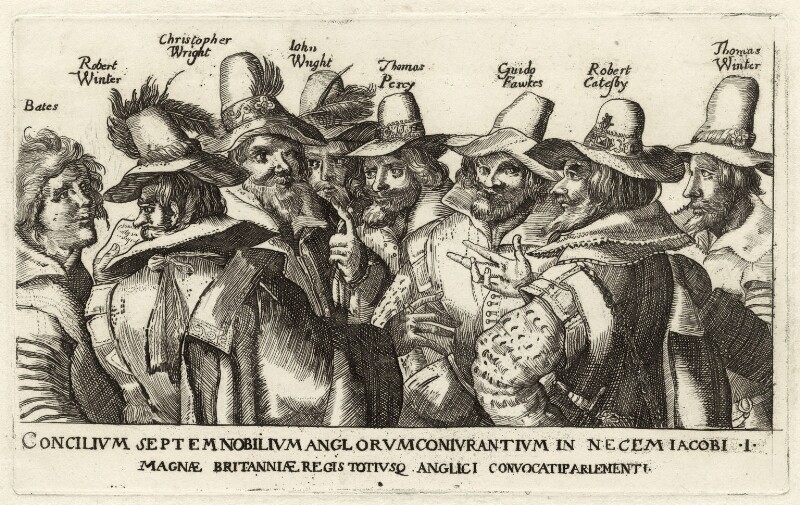
    The Gunpowder Plot Conspirators
    after Heinrich Ulrich
    etching, late 18th to early 19th century
    NPG D28145
    © National Portrait Gallery, London

    Bonfire Night, Fireworks Night, Guy Fawkes Night; there are several names for the celebrations which take place on the 5th of November every year. For most it is an evening of bonfires, fireworks, sparklers, hot drinks and cold noses. Its origins are rather more sinister though. The tradition started on the 5th of November 1605, when Londoners lit bonfires across the city to celebrate the foiling of the Gunpowder Plot. It is a story familiar to many, largely due to the celebration of Guy Fawkes Night. A group of Catholics had planned to assassinate the Protestant King James I and his Parliament by blowing up the House of Commons. Guy Fawkes was caught guarding the barrels of gunpowder, and has become by far the most well-known of the conspirators.

    Largely secular now, the annual celebrations became a focus of anti-Catholic feeling. Although Guy Fawkes was executed by being hung, drawn, and quartered, one tradition surrounding the evening is to burn a ‘Guy’ in effigy on the bonfire. It is no longer a common part of the celebrations, but it demonstrates how strong anti-Catholic sentiment used to be. Guy Fawkes was viewed as a traitorous, treasonous terrorist, and treated accordingly.

    In the past few decades however, Guy Fawkes has received a new lease of life in the form of the Guy Fawkes mask worn by the main character of the graphic novel V for Vendetta. Set in a dystopic 1984-style future, V is a mysterious man in a mask that sparks a popular insurrection that brings down the fascist, authoritarian government. One of his first acts in the novel is to succeed where Guy Fawkes failed, blowing up the houses of Parliament in spectacular fashion. V dies towards the end of the novel but others take up his mask, and his true identity is never revealed, turning him a symbolic figure of just rebellion. Initially unpopular when it was first published in the early 1980s, V for Vendetta has increased in popularity in recent years, perhaps due to its adaptation into a film in 2006. The Guy Fawkes masks have become a common feature of protests and demonstrations, serving both a symbolic purpose as the spirit of rebellion, and a practical one in helping to hide the faces and identities of protesters from police. In this context, Guy Fawkes is a hero who fought, and won, against overwhelming odds. He is a freedom fighter.

    DSCF5728
    The ‘V for Vendetta’ mask has become a common sight at demonstrations in recent years (Photo: Hannah Awcock).

    I have been thinking about the phrase ‘One man’s terrorist is another man’s freedom fighter’ a lot recently. ‘Terrorism’ has felt almost ubiquitous in the Western world over the last decade or so of the War on Terror, but it is an incredibly subjective term. The same act can be perceived as mindless violence or just necessity, depending on the attitude of those perceiving it. The changing perceptions of Guy Fawkes proves this. I am in no way condoning the way that some people choose to resort to extreme violence in order to make their point, but I do think we should be aware of the complex and subjective nature of the term ‘terrorist’, and should use it accordingly.

    Reading the Riot Act: Protest in Everyday Language

    2017-06-13 19.51.13.jpg
    A Riot Act tea towel (Photo: Hannah Awcock).

    How often were you ‘read the riot act’ as a child? When I started researching historical protest in London two years ago, I learnt the origins of this phrase. The Riot Act was passed in 1714, and gave local authorities the power to declare a gathering of twelve or more people illegal, which meant the group would either have to disperse or face arrest. The Act was read to the offending group, after which they had one hour to disperse peacefully. Although the act was often interpreted incorrectly and, as a result, complicated the  policing of public order rather than simplifying it, it was only repealed relatively recently, in 1967. So that is why you are ‘read the riot act’ when you are causing trouble, it basically means stop or face the consequences.

    I recently discovered that the Riot Act is not the only element of the history of protest that has made it into everyday language. When recently reading a book about the numerous revolts and revolutions in Europe during the tumultuous year of 1848 (Rapport, 2008), I learnt that the Italians have a phrase which basically means ‘a right royal mess’: ‘un vero quarantotto’, or, in English, ‘a real 48.’ The events of that year stuck in the minds of Italians to the extent that it became synonymous with any situation where chaos reigned.

    These two examples demonstrate just how important protest is to society and culture. Protests and contentious politics can be huge events, standing out in the collective memory as a time of dramatic upheaval, great achievements, or perhaps abject fear for the future. It shouldn’t really be surprising that they can work their way into everyday language in this manner.

    Delighted with my discovery of ‘a real 48’, I have been racking my brains for any similar phrases in everyday language that come from a protest of contentious politics. I have yet to think of any, but perhaps the collective wisdom of my readership could help me out? Please comment on this post if you know any, in English or otherwise!

    References

    Rapport, Mike. 1848: Year of Revolution. London: Abacus, 2008.

    What’s in a Name?

    This sculpture of Wat Tyler and other participants in the Peasant’s Revolt stands in the Wat Tyler Country Park in Pitsea in Essex (Source: Andreas-photography).

    Occupy. The French Revolution. The Notting Hill Riots. The Battle of Cable Street. The Gordon Riots. The American War of Independence.

    Many episodes of protest and contentious politics have been given a catchy name by which they are remembered. It is one of those things that you ( or I, anyway) don’t tend to think about very much. A name is often the first thing you learn about an event or period of time, and it is frequently the only thing you remember long after you have forgotten any other details. As such, it has a lot of power to shape perceptions of the event or time period they are referring to. But names can be misleading, creating perceptions that are inaccurate, or even flat out wrong. I have recently come across several examples of such misconceptions, which highlight the importance of  an awareness of how these names came about, who came up with them, what their purpose was, and, on occasion, the need for a new name.

    The recent BBC2 series Melvyn Bragg’s Radical Lives devotes an entire episode to John Ball, fourteenth century preacher and inspiration behind the Peasant’s Revolt of 1381. In it, Bragg briefly argues the the Peasant’s Revolt is a misnomer, because  it was not only peasants that took part. Artisans, shopkeepers and other members of the middle class were also involved in the insurrection. Bragg doesn’t mention where the title Peasant’s Revolt came from, but it clearly may have served to belittle and minimise the movement by attributing it solely to the least powerful group in society. It may even have been a deliberate attempt to reduce the significance of the event in the eyes of history, by hiding the fact that a cross section of society were not supportive of the government, rather than just one group.

    A similar example is the Matchgirl’s Strike of 1888. Louise Raw’s excellent book Striking a Light argues for the use of the term ‘matchwomen’ instead of ‘matchgirls’. Although many of the women involved were very young, the use of the word ‘girls’ rather than ‘women’ paints a particular picture of the strikers, portraying them as innocent, inexperienced, vulnerable, and in need of help. This image served the purposes of both supporters and critics of the strike at the time, but it has contributed to a skewing of the way that history views the events. Over time the agency of the women has been removed reducing the popular narrative of what happened  during the strike to an inaccurate caricature.

    The effects of these derogatory names are not always negative, however. During the course of the wonderful East London Suffragette’s Festival recently, I learnt that the name ‘Suffragette’ was coined by a reporter for the Daily Mail, aiming to shame and belittle these women conducting themselves in such an outrageous manner. The insult backfired however, as the women of the suffrage movement embraced the title, taking ownership and turning it from an insult to a celebration of the women’s tactics.

    Of course it is not possible for a name to encompass every single aspect of a protest or social movement, and I am not arguing that it should be able to. I am merely pointing out that, like most things, names are not neutral, unbiased descriptors. Like almost everything else, they should be viewed with a critical eye, and their purpose and effects should be carefully considered.

    References

    ‘Now is the Time: John Ball.’ Melvyn Bragg’s Radical Lives. BBC2. Broadcast 2nd August 2014.

    Raw, Louise. Striking a Light: The Bryant and May Matchwomen and their Place in History. London: Bloomsbury, 2011.

    Call for Papers: Contesting the Capital- Historical Geographies of Protest in London

    International Conference of Historical Geographers 2015, London, 5-10 July 2015

    “Contesting the capital: Historical geographies of protest in London”

    Convenors: Hannah Awcock (Royal Holloway, University of London, UK) and Diarmaid Kelliher (University of Glasgow, UK).

    In recent years London has been the site for a wide range of protests: marches against austerity, student occupations, the 2011 riots, UK Uncut and protests by (and against) the English Defence League. Such protests in the capital and elsewhere have coincided with a growing interest in protest in the past amongst geographers and historians (Navickas 2012). Within this work there has often been a strong rural focus (for example, Griffin 2014). This session seeks to explore the historical geographies of protest in London as a contribution to these debates.

    A number of recent works in geography have suggested ways in which the politics of London is embedded in expansive translocal and international connections (Featherstone 2010; McDowell, Anitha, and Pearson 2012; Brown and Yaffe 2014). From the Peasants’ Revolt to Women Against Pit Closures marching in London during the 1984-5 miners’ strike, the national and imperial capital has also often functioned as a focus for a broad political imaginary. This session invites both empirically-based papers and methodological debates on researching London’s relationship to historical geographies of protest. A broad understanding of ‘protest’ will be employed, and we welcome papers reflecting on what constitutes protest.

    Please send abstracts of no more than 200 words to both convenors by 29 August. In a separate paragraph, please provide details of any special audio-visual requirements or mobility requirements.

    Hannah Awcock, Department of Geography, Royal Holloway, University of London, hannah.awcock.2009@live.rhul.ac.uk; Diarmaid Kelliher, School of Geographical and Earth Sciences, University of Glasgow, UK, d.kelliher.1@research.gla.ac.uk.

    Further details on the ICHG Conference are available at:
    http://www.ichg2015.org/

    Details of conference fees are available at:
    http://www.ichg2015.org/registration/

    References
    Brown, Gavin, and Helen Yaffe (2014). Practices of Solidarity: Opposing Apartheid in the Centre of London. Antipode 46(1): 34–52.
    Featherstone, David (2010). Contested Relationalities of Political Activism: The Democratic Spatial Practices of the London Corresponding Society. Cultural Dynamics 22(2): 87–104.
    Griffin, Carl (2014). Protest, Politics and Work in Rural England, 1700-1850.
    McDowell, Linda, Sundari Anitha, and Ruth Pearson (2012). Striking Similarities: Representing South Asian Women’s Industrial Action in Britain. Gender, Place & Culture 19(2): 133–152.
    Navickas, Katrina (2012). Protest History or the History of Protest? History Workshop Journal 73(1): 302–307.