Book Review: Hearts and Minds- The Untold Story of the Great Pilgrimage and How Women Won the Vote

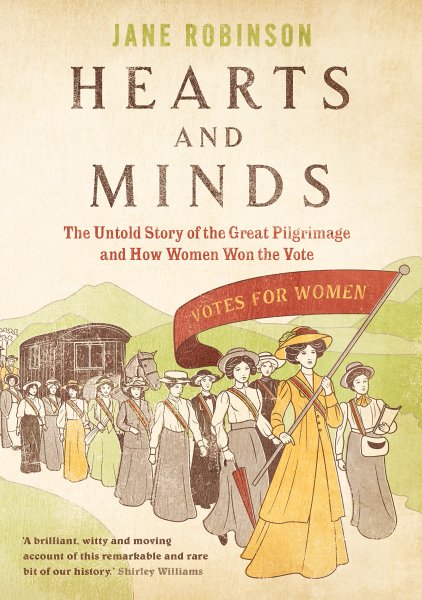
Hearts and Minds Front Cover
Hearts and Minds by Jane Robinson.

Jane Robinson. Hearts and Minds: The Untold Story of the Great Pilgrimage and How Women Won the Vote. London: Doubleday, 2018. RRP £20 hardback.

When I first heard about Hearts and Minds: The Untold Story of the Great Pilgrimage and How Women Won the Vote, I was determined to wait until it came out in paperback. Both my purse and my bookshelves would thank me for it. However, a few months ago I went to see author Jane Robinson give a talk about the book at the Lancashire Archives, and she was so good that I bought the hardback copy there and then. It was a good purchase.

Hearts and Minds tells the story of the Great Pilgrimage, a six-week epic organised by the National Union of Women’s Suffrage Societies (NUWSS), representing the non-militant arm of the women’s suffrage movement. Over 6 weeks in the summer of 1913, hundreds of women marched to London from all over the country in an attempt to prove how many respectable, law-abiding women wanted the vote. In some places they were welcomed, in others they faced fierce and even violent opposition from opponents and people who mistook them for suffragettes. Overall, however, the pilgrimage was an overwhelming success, building bonds within the NUWSS, attracting media attention, and developing the confidence and skill sets of women around the country.

Jane Robinson has written an engaging account of a fascinating and lesser-known event in the history of the women’s suffrage campaign. There are two big things, and several little things, that combine to make Hearts and Minds a very good book. The first big thing is that the book is thoroughly researched; Robinson makes extensive use of diaries, letters, and other personal sources that give us a real insight into how the women participating in the Pilgrimage felt about their experiences. This effect is enhanced by Robinson’s occasional use of creative writing. The description of Marjory Lees and other pilgrims huddling terrified in their caravan as a group of angry locals attempt to set fire to it in Thame, Oxfordshire, is a particularly effective example.

The second big thing I like about Hearts and Minds is its coverage of events after the Great Pilgrimage. A lot of accounts of the campaign for women’s suffrage stop when the First World War starts. Many activists put their desire for the vote on hold and threw themselves into the war effort. But that is by no means the end of the story. Robinson recounts what many pilgrims  and other suffrage campaigners did during the war. Some, such as Florence Lockwood and Sylvia Pankhurst, vocally opposed the war, which was a very lonely and dangerous position to take. Others, such as Vera Chute Collum, Dr. Elsie Inglis, and Katherine Harley undertook dangerous and exhausting work treating injured soldiers in field hospitals across Europe run by the Scottish Women’s Hospitals. Katherine Harley was killed by a shell whilst looking after refugees in modern-day Macedonia on the 7th of March 1917.

As well as telling the stories of these remarkable women, Hearts and Minds also describes what happens after some women were given the vote in 1918. The Pankhursts may not have continued the fight, but others campaigned for women to be given the vote on equal terms as men, led by the Six Points Group and the NUWSS (rebranded as the National Union of Societies for Equal Citizenship). These few chapters at the end of the book helped contextualise the women’s suffrage campaign in a way that I haven’t seen before, and I found it really interesting.

There are lots of little things I like about Hearts and Minds too, such as the helpful lists of important pro- and anti-suffrage organisations, key people featured in the book, and important dates in the campaign for women’s suffrage. Pictures are dispersed throughout the book, not just in the middle (although there is a section of coloured images in the middle of the book too), and there is a map of the 6 Pilgrimage routes (Stuart Maconie’s Long Road from Jarrow is one recent book that would have been  improved by more and better maps).

The campaign for women’s suffrage was much broader and more varied than the popular imagination suggests. This year, the centenary of some women gaining the right to vote, is an opportunity to make more people aware of organisations and individuals beyond the WSPU. Hearts and Minds is an entertaining and informing way of doing just that.

Book Review: A Radical History of Britain by Edward Vallance

A Radical History of Britain front cover
A Radical History of Britain by Edward Vallance.

Edward Vallance. A Radical History of Britain. London: Abacus, 2010. RRP £13.99 paperback.

The British have a reputation for being a bit passive when it comes to protest, rebellion, and revolution. The Glorious Revolution in 1688 is celebrated for being ‘bloodless,’ and when the rest of Europe was wracked with revolutions in the mid-nineteenth century we had the largely peaceful Chartist movement. Books such as A Radical History of Britain, however, demonstrate that us Brits can rebel with the best of them.

A Radical History of Britain pretty much does what it says on the tin, although Vallance does admit in the introduction that it is largely about England rather then Britain. The book is split into seven parts, each with several chapters, that focus on particularly contentious periods in English history, including: the English Civil Wars; British radicalism around the time of the French Revolution; Chartism; and the Women’s Suffrage movement. In each case, Vallance focuses on two elements that make A Radical History of Britain more than just a straightforward narrative. The first is a concern with ideas as well as events; Vallances devotes significant attention to the theories and writings that inspired and drove radicalism, from those of the Levellers, to Thomas Paine, Feargus O’Connor, and the Pankhursts. The second element that makes the book stand out is discussion of how protests and periods of radicalism were used by later activists and campaigners as sources of inspiration, justification, and legitimisation. Social movements often draw on the history of radicalism in lots of ways, and A Radical History of Britain traces that process.

Our freedom lies in our power. Pessimists may point to demonstrations against the war in Iraq as evidence of modern government’s capacity to ignore the will of the people. However, the millions who marched against that illegal war also remind us of the readiness of the British people once again, in the words of Shelley, to rise ‘like lions after slumber.’ This is the lesson of Britain’s radical history: the struggle for our freedom goes on.

Vallance, 2010; p 552.

Last year, I reviewed The English Rebel by David Horspool. It too tells the story of English radicalism, although Horspool is more explicit about the English focus. On the surface, the two books are quite similar; they are telling the same story, and feature many of the same events. They also both indulge in my  pet hate of collecting images together rather than dispersing them throughout the text. However, there are differences. The English Rebel is more of a straightforward narrative, whilst A Radical History of Britain explores radical ideas and legacies, as I have mentioned. David Horspool’s overall message is that the English have always been more radical than our reputation implies. Edward Vallance’s key message is that rights are something that the English fought long and hard for, and they can be lost if they are not defended. The narrative in The English Rebel is more complete than in A Radical History of Britain; Vallance sacrifices breadth for depth in some places, so skips over some time periods, and finishes in the mid-twentieth century, whilst Horspool goes right through to the nineteen-nineties. I personally found The English Rebel easier to read, but that doesn’t necessarily make it a better book, it depends what the reader is looking for. I understand that not everyone enjoys reading about the history of protest as much as I do, so if you only want to read one, I can offer some advice. If you’re after a more general overview of protest in England throughout history, I would recommend The English Rebel. If you would prefer something with more analysis, then I would suggest A Radical History of Britain.

A Radical History of Britain presents some interesting arguments about how legacies of protests and radicalism are shaped and used by radicals that come after, and it also provides a thorough introduction to the history of radical ideas in Britain. It is not the easiest book to read, but I think it is worth the effort.

Author Meets Critics at the AAG

I spent last week at the Annual Conference of the Association of American Geographers (AAG), a mammoth event with hundreds of sessions spread over 5 days and 3 hotels in New Orleans, Louisiana. I had a fantastic time at the conference, and I loved exploring New Orleans in my time off. I have attended the conference before, in Chicago in 2015, so I knew what to expect from this epic exchange of knowledge and research. But I also had some new experiences, including participating as a panellist in an Author Meets Critics session.

Representing my new employer, the University of Central Lancashire, at the Association of American Geographers Annual Meeting in New Orleans (Photo: Hannah Awcock).

Author Meets Critics sessions are odd. Primarily designed to publicise recent books (I think!), panellists speak about the book, and the author(s) then respond to those comments. Most of the time, the majority of the audience has not read the book, so it can be hard to formulate questions when the floor is opened up to audience discussion. The number of critics depends on the length of the session, but can range from 3 to 5.

At the AAG, I was taking on the role of critic for Revolting New York: How 400 Years of Riot, Rebellion, Revolution, and Uprising Shaped a City, which attempts to document almost four centuries of contentious history in one of the most famous cities in the world. I really enjoyed reading the book, and I had an idea what I wanted to say about it, but I had never actually been to an Author Meets Critics session before, and I wasn’t sure if what I wanted to say was appropriate. So I went to two other Author Meets Critics sessions before the Revolting New York one. The critics in the two sessions took very different approaches, and I liked one much more than the other.

sdr
The Author Meets Critics panel for Space Invaders by Paul Routledge at the 2018 AAG (Photo: Hannah Awcock).

The first session I went to was for Paul Routledge’s new book, Space Invaders: Radical Geographies of Protest (2017). Routledge, and most of the panellists, have published work that has been influential on my understanding of the geography of social movements and protests, so that was a second reason for me to go along. I haven’t read the book, in fact I wasn’t aware of its existence until I saw the title in the conference programme. All of the critics (and there were five of them!) talked about what they liked about the book, and what they didn’t like. It was effectively a verbal review. Times five. With the author in the room. Whilst none of the reviews were overwhelmingly bad, it still felt pretty brutal. I felt quite uncomfortable during the session, and I also found it quite difficult to engage with the discussion.

The second Author Meets Critics was for Tear Gas: From the Battlefields of WW1 to the Streets of Today (2017) by Anna Feigenbaum. I have read this book, and I thoroughly enjoyed it. I also got a lot more out of the discussion of the book. There were only three critics, which gave Feigenbaum the time to briefly outline the book for those who hadn’t read it, as well as responding to the critics at the end. In addition, rather than reviewing Tear Gas, the two critics built on it, discussing which elements they found most interesting and how the book fit in to contemporary academic debates. As an audience member, I found this approach much more engaging.

sdr
The Author Meets Critics Panel for Tear Gas by Anna Feigenbaum at the 2018 AAG (Photo: Hannah Awcock).

Luckily, this was the approach I had decided to take in my role as critic for Revolting New York. I do not think it is perfect, but I didn’t feel comfortable pointing out what I didn’t like/agree with when the book’s editor, and several of the authors, were in the room. This doesn’t mean I wasn’t critical, however; it is possible to critique something without being negative about it. I instead discussed the elements of Revolting New York that got me thinking, the issues it throws up that I think are worthy of further discussion. The two issues I focused on were: comparisons between New York and London; and the impact of terminology and whether we study events alone or as part of wider social movements. I think it went pretty well, if I do say so myself, and the terminology issue in particular carried on through the audience discussion.

I suspect that not everyone will agree with me on this, some people might not have a problem with pointing out a book’s weaknesses with the author in the room; it can even be argued that it is more fair than publishing a review to which opportunities for response are limited. For the audience however, I think it is downright awkward. I personally think the constructive approach is more engaging for the audience, particularly if they haven’t read the book yet. I would definitely take this approach again if I get asked to participate in another Author Meets Critics panel.

Book Review: Vanishing for the Vote- Suffrage, Citizenship and the Battle for the Census

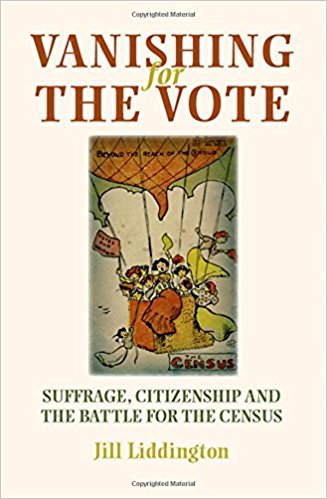
Jill Liddington Vanishing for the Vote
Vanishing for the Vote: Suffrage, Citizenship and the Battle for the Census by Jill Liddington.

Jill Liddington. Vanishing for the Vote: Suffrage, Citizenship and the Battle for the Census. Manchester: Manchester University Press, 2014. RRP £16.99 Paperback.

The centenary of the Representation of the People Act 1918 is being marked in a number of ways, including the publication of a number of books on various aspects of the campaign for women’s suffrage. There are already a significant amount of excellent studies on the campaign for women’s suffrage however, including Vanishing for the Vote: Suffrage, Citizenship and the Battle for the Census by Jill Liddington, published in 2014.

Vanishing for the Vote focuses on one particular tactic in the campaign to gain women the right to vote, the 1911 census boycott. On the night of Sunday the 2nd of April, women from across the suffrage spectrum evaded, boycotted, or refused to complete the most comprehensive census survey ever attempted. The argument was that if women did not count as full citizens, then they should should not allow the government to count them. Not every suffrage campaigner agreed with the tactic however; some believed that it was more important that social policy be informed by accurate data about the population.

This census rebellion would not be a violent confrontation, like forcible feeding in prison or street battles with the police. Rather, it would be peaceful civil disobedience to challenge the very meaning of citizenship. What did it mean, in an otherwise supposedly mature democracy like Edwardian Britain, to be a grown women, yet to be treated politically like a child, a criminal or a lunatic?

Liddington, 2014; p. 2

In Vanishing for the Vote, Jill Liddington explores the boycott in depth, including: the census itself; the Women’s Freedom League, which spearheaded the boycott; some of the key personalities involved; the events of census night itself; and the protests’ significance and implications. In 2009 the original 1911 census schedules were made public by The National Archives, providing researchers with a wealth of new resources. Liddington and another historian, Elizabeth Crawford, tracked down 500 census schedules of women involved in the campaign for women’s suffrage, in order to conduct the first in-depth analysis of what happened during the boycott. The book looks big, but around half of it is actually a Gazetteer of these census schedules, a fantastic resource for anyone interested in suffrage campaigners.

The book is clear and well-written, and although the structure appears unusual at first, it makes sense as the book unfolds. In the Introduction, Jill argues that Vanishing for the Vote is suitable for  academic and popular audiences. Whilst the writing is accessible, I think some of the content would alienate readers that are just interested in history; Liddington explains the methodology of collecting the census details and explores the relevant literature in quite some detail, so it feels more like an academic history book than a popular one. Liddington takes a balanced approach to the debate about the boycott, taking the time to explain the history of, and logic behind, the census itself as well as the campaign to boycott it. As a result, Vanishing for the Vote is not just about how suffrage campaigners asserted their rights as British citizens, but also about how the Edwardian state was attempting to improve the lives of its citizens. As Liddington often argues, it was government by the people versus government for the people. Supporters of women’s suffrage had to decide what was more important to them–the right to vote, or accurate data to inform social reform.

Most people are familiar with the suffragette tactics of smashing windows, arson, and hunger strikes. Vanishing for the Vote is a thorough, engaging, and balanced exploration of one of the lesser known tactics employed by campaigners for women’s suffrage. If your curiosity has been piqued by the centenary celebrations, then it is definitely worth a read.

Book Review: Long Road from Jarrow-A Journey through Britain then and Now

Long Road from Jarrow Front Cover
Long Road from Jarrow by Stuart Maconie

Stuart Maconie. Long Road from Jarrow: A Journey through Britain Then and Now. London: Ebury Press, 2017. RRP £16.99 hardback.

Before I read of Long Road from Jarrow: A Journey Through Britain Then and Now, I kind of knew who Stuart Maconie was, mainly through his radio-presenting double act with Mark Radcliffe. I was drawn to the book because of my interest in the Jarrow Crusade; a protest march by a group of unemployed men from Jarrow in Newcastle to London in late 1936. To mark the 80th anniversary of the Crusade, Maconie recreated it, following the exact route and timetable that the marchers took almost a century ago. Along the way he talks to the people he meets about the Crusade, their knowledge and opinions of it, and their perspective on modern politics (Brexit looms large throughout). As a result, the book is a lot of things: a travelogue, a history book, a memoir, a snapshot of two particularly turbulent moments in British politics, and a reflection on the way society remembers and commemorates its history. I can’t remember ever having come upon a protest-based travelogue before, and I thoroughly enjoyed it.

‘Jarrow’ (the whole matrix of events reducible to one word like ‘Aberfan’, ‘Hillsborough’ or ‘Orgreave’) has become mythic, storied; a thing of lore and romance as much as hard fact, one whose details and legacy are still debated today.

Maconie, 2017; p.7

Maconie is a likeable narrator, striking a nice balance between the serious and the humourous, the personal and the general. His reflections on modern society feel considered and genuine. I really like the chance meetings and discussions he has with people he meets along the way, highlights of which include: the dogwalker on the A41; Julia, the Russian waitress in Leeds; the well-known author and graphic novelist Alan Moore; Lynn, a guide at the John Bunyan museum in Bedford; and Labour MP for Luton North Kevin Hopkins. Some of these encounters are only brief, but they are nonetheless brilliant insights into the wonderful variety of people living in modern Britain. The spontaneity of these meetings demonstrates how open and welcoming strangers can be.

The book is very time specific; for example Maconie often discusses Twitter exchanges he had on his journey, including one with then Education Secretary Michael Gove over the scrapping of the Art History A Level. Whilst these details make the narrative rich, the book may age quickly as a result– it runs the risk of rapidly feeling out-of-date. The book is also much more about the cities, towns, and villages Maconie passes through than the journey itself. Again, this is not necessarily a criticism, but if you’re expecting a book about walking, you’ll be disappointed. One issue that definitely is a criticism is the distinct lack of pictures and maps– there is only a basic map of the route on the back cover. Maconie describes the places he visits well, but I still would have liked some pictures to document his journey. And what self-respecting Geographer wouldn’t be disappointed with a lack of maps?

Long Road from Jarrow is a curious hybrid of travelogue, history book, and memoir, framed by the Jarrow March. It is a comparison between two distinct moments in British history, 1936 and 2016. It is well written and engaging, and I would happily read anything else Maconie has written. The book provides a competent day-by-day account of the Jarrow March. It is also a thoughtful reflection on the way that historical events are remembered, mythologised, and commemorated. I would highly recommend it.

Book Review: Walk the Lines- The London Underground, Overground

Walk the Lines Cover
Walk the Lines: The London Underground, Overground by Mark Mason.

Mark Mason. Walk the Lines: The London Underground, Overground. London: Random House, 2011. RRP £8.99 paperback.

The London Underground is one of the most distinctive elements of the city, but it does result in a disjointed perception of the metropolis–I don’t feel like I really got to know how the various areas of London fit together until I moved there and started to walk or get the bus more. Walk the Lines: The London Underground, Overground is the ultimate exercise in getting to know London; author Mark Mason walked the route of every underground line from beginning to end, then wrote a book about it.

I think the concept for this book is excellent; but unfortunately I am not so keen on its execution. I think it would be really interesting to repeat this challenge in a decade or so, London changes so quickly that some of Mason’s observations already feel out of date.

Sadly, I did not get on so well with Mark Mason’s writing. I did not like the tone of the book at all when I started reading it; it felt like Mason was trying too hard to be funny. This did become less noticeable as I progressed through the book, but I couldn’t say whether it’s because the tone improves or because I just got used to it. I also dislike Mason’s heavy use of footnotes. They interrupt the flow of the writing, and sometimes I missed the superscript, and found myself searching the page for the relevant point. I think they are unnecessary in Walk the Lines.

I also found Mason himself to be a bit arrogant–one of his reasons for undertaking the challenge was to own London, a desire which I think is conceited and a bit odd, quite frankly (p. 4-5). Nobody owns London. If anything, the opposite is true; there have been several occasions when I have felt that London’s influence over my life has been a bit too significant for comfort. In addition, Mason is snobbish about anything that is ‘not London.’ He seems to look down on other cities and London’s suburbs, and view them as automatically inferior. I understand that both of these attitudes come from a great love of London, I too am captivated by it. I am just not so keen on how this affection manifests itself in Mason’s writing.

The final significant issue with Walk the Lines is the lack of photographs. This is a book about the many different faces of London, but there is not a single image of Mason or the different aspects of London he encountered on his walks.

The concept of Walk the Lines is not the only element of the book that I liked however. I enjoyed Mason’s musings on the subjectivity and power of maps, although these are not new ideas to geographers. The book also contains some decent historical facts. For example, London cabbies call the junction on which the Royal Geographical Society sits ‘Hot and Cold Corner,’ because the building has statures of David Livingstone and Ernest Shackleton. Finally, I enjoyed the sections when Mason stops along his walks to talk to other people about their perceptions of London, such as: artist and ex-Popstar Bill Drummond; The Archers actor Tim Bentinck, who was the ‘Mind the Gap’ voice on the Piccadilly Line for 15 years; and John Pearson, the official biographer of the Kray twins.

I enjoy reading books about London, and I admire the inventive approach in Walk the Lines. I’ve always thought that the best way to get to know a city is to walk around it, and I like the idea of using a city’s transport network, effectively its circulatory system, to organise such exploration. However, I am not so keen on Mason’s writing style or attitude towards London. This is not a bad book, it just isn’t a great one either.

Book Review: Buda’s Wagon- A Brief History of the Car Bomb

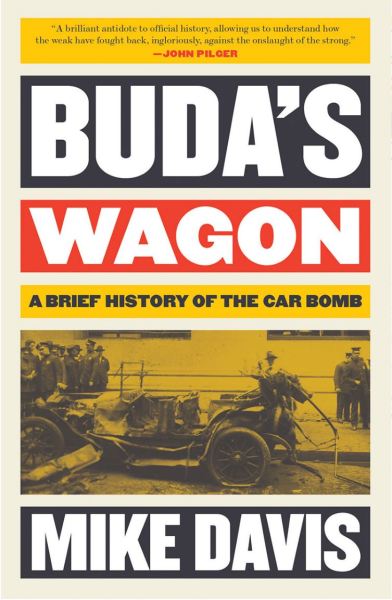
Buda's Wagon Front cover
The front cover of the 2017 edition of Buda’s Wagon: A Brief History of the Car Bomb by Mike Davis.

Mike Davis. Buda’s Wagon: A Brief History of the Car Bomb. London: Verso, 2017. RRP £9.99 paperback.

Among geographers, Mike Davis is particularly well-known for his writing on cities. Books like Planet of the Slums and City of Quartz are staples of undergraduate Geography reading lists. Buda’s Wagon: A Brief History of the Car Bomb is not one I was familiar with, until Verso released new editions of some of his works at the start of 2017. My family can always tell when I’m enjoying what I’m reading because I bombard them with facts and stories from the book. My family have had to listen to a lot of facts about car bombs.

It is the car bombers’ incessant blasting-away at the moral and physical shell of the city, not the more apocalyptic threats of nuclear or bioterrorism, that is producing the most significant mutations in city form and urban lifestyle.

Davies, 2017: p. 7

Buda’s Wagon doesn’t have an introduction as such, instead launching into the story of Mario Buda, an Italian anarchist living in New York who packed his horse-drawn wagon with explosives and iron slugs, drove it to Wall Street, and left it there. At midday, the wagon exploded, killing 40 and injuring more than 200. Mario Buda has the dubious distinction of being the world’s first car bomber-sort of. From there, Buda’s Wagon ricochets around the world and through a century of conflict, finishing up in the Middle East in the early 2000s. Davis makes a convincing case for the car bomb as a powerful leveller for terrorists and insurgent groups confronting powerful and well-resourced  governments. He also conveys the human cost of a weapon that is indiscriminate at best. At it’s worst, it is deliberately meant to cause further hatred and violence.

Davis does not explicitly state his opinion on the issues he’s writing about, he lets the statistics he uses and the stories he tells speak for themselves. I like this style, it feels like Davis is trusting the reader to form their own opinion. At some points, it highlights the strength of Davis’ feeling, as you can almost sense his opinion fighting its way out through his non-judgmental language.

There aren’t many pictures in Buda’s Wagon, which some readers might not like, but I think was a sensible decision. It would be difficult to include many pictures without becoming ghoulish. I did find the narrative a bit difficult to follow when it reached the Middle East, but I imagine simplifying the politics in a way that would make them comprehensible for most readers would be a very difficult task.

Buda’s Wagon is a poignant, engaging read, that thinks systematically about the car bomb in a way that is scholarly, but not insensitive. I would recommend it to anyone interested in contentious politics or geopolitics, or anyone who wants to try and understand what can seem like a senseless and inexplicable act.

Book Review: The English Rebel- One Thousand Years of Trouble-making from the Normans to the Nineties

the-english-rebel-by-david-horspool
The English Rebel by David Horspool.

David Horspool. The English Rebel: One Thousand Years of Trouble-making from the Normans to the Nineties. London: Penguin, 2010. RRP £12.99 paperback.

I have read several books about the history of protest in London, but I recently realised that I haven’t read much about the national history of protest. The English Rebel: One Thousand Years of Trouble-making from the Normans to the Nineties is a good place to start for anyone interested in how dissent has shaped the history of England. It is well-written, well-paced, and I thoroughly enjoyed reading it.

David Horspool sets out to disprove the stereotype that the English are peaceful and submissive by demonstrating that “from Cornwall to Norfolk, from Sussex to Northumbria, England is crisscrossed with the ghosts of rebels marching, meeting, and fighting” (p xvi). The book is arranged chronologically, starting with opposition to the Norman invasion in 1066. Contrary to popular belief, the English did not just roll over and submit after the Battle of Hastings. Horspool then traces the history of rebellion in England featuring well known examples, such as the Peasant’s Revolt (1381) and the English Civil Wars (1642-51), as well as more obscure events, such as the Revolt of the Earls in 1075 and an uprising in Norfolk led by Robert Kett in 1549. I don’t pretend to know everything about the history of protest (far from it!), but I have been studying it for more than four years now, and there was quite a bit in there that was new to me.

The English rebel may only rarely be a triumphant or even a particularly likeable character. But he and she are as much a part of the fabric of English history as the monarchs, law-makers and political leaders they defied. They serve as inspiration, as warning, and sometimes simply as example.

Horspool, 2010; p. xxiii

In his Introduction, Horspool is very clear about the parameters of The English Rebel. He defines a rebel as a political opponent who risks their life or their liberty. Their opposition does not have to be aimed at government or the state, nor does it have to be violent or left-wing. The decision to focus only on England was also a deliberate one; Horspool argued that rebellions in a British or imperial context tend to have different objectives from English ones. It can be easy to criticise a project for leaving things out (I see it quite often in academia), and by explaining his decisions about what to include, Horspool fends off such criticism before its even made.

Rebels are drawn towards centres of power so the content of the book is inevitably skewed towards London and the south east, but Horspool does his best to balance it out. My biggest complaint about The English Rebel is a pet hate of mine–putting all the images together in the middle, then not mentioning them in the main text, so they feel rather detached and unnecessary. This is only a minor gripe however.

The English Rebel is an engaging read, which I would highly recommend for those with a general interest in history, as well as those with a more specific interest in protest and dissent. Horspool makes a convincing case that the English are much more rebellious than the stereotypes make out. I’ve always seen myself as British rather than English, but I feel just a bit more proud of my Anglo-Saxon heritage after reading The English Rebel.

Book Review: The Rebellious Life of Mrs. Rosa Parks

the-rebellious-life-of-mrs-rosa-parks-front-cover
The Rebellious Life of Mrs. Rosa Parks by Jeanne Harris

Jeanne Theoharis. The Rebellious Life of Mrs. Rosa Parks (Boston: Beacon Press, 2013). RRP £16.99.

I buy a lot of books. To the extent that I cannot read books as fast as I buy them. As a result, I have a lot of unread books sitting on my bookshelves. Whenever I finish reading a book I go to my bookcase, look at all the unread books, and see which one takes my fancy to read next. A few weeks ago, it was the turn of The Rebellious Life of Mrs. Rosa Parks, by Jeanne Theoharis. It has been sitting on my shelves since the great book-buying spree of ’15, during my trip to New York two years ago. I wish it hadn’t taken me so long to get round to reading it- I loved this book.

Theoharis starts this book at the end, with all the pomp and circumstance surrounding the funeral of Rosa Parks when she died in 2005. Perhaps one of the best known individuals in American history for her role in kickstarting the civil rights movement, Parks became a legend in her own lifetime. The quiet, soft-spoken seamstress who refused to give up her seat on the bus for a white man in Montgomery, Alabama is well known the world over. However, the legend of Rosa Parks bears only passing resemblance to the real woman. An activist all her life, her decision not to move on that bus was the result of years of anger and frustration at American injustice, not tired feet.

In this thoroughly researched, well-paced book, Theoharis details the life of a woman who was brought up with a sense of pride and her own self-worth, who was willing to stand up and defend herself if she was attacked. Along with others, Parks campaigned for civil rights in Montgomery for decades before her bus protest in 1955. The protest took its toll, leaving Parks, her husband, and her mother economically insecure and dealing with constant threats. In 1957, the family moved to Detroit, where Rosa continued to campaign for civil rights for the next four days. Whilst segregation was not legally enforced in northern US states, Parks saw it as just as pervasive as in the south, and continued to fight in any way she could.

In The Rebellious Life of Mrs. Rosa Parks, Theoharis looks at the myth of Rosa Parks, considering its purpose and effects, then dismantles it, writing a biography of a life-long activist who was not afraid to ruffle some feathers. Rosa Parks was a fascinating woman who had a fascinating life; she was a great admirer of both Martin Luther King and Malcolm X, and she supported both the civil rights movement and the more antagonistic Black Power movement. Parks threw herself into so many campaigns and activities that her life is like a slice though the struggle for racial equality in mid- and late-twentieth century America.

I think most people are familiar with the myth of Rosa Parks, and know that she was someone special. The Rebellious Life of Mrs. Rosa Parks reveals that the reality is much more interesting than the myth.

Book Review: The Leveller Revolution- Radical Political Organisation in England, 1640-1650

the-leveller-revolution-front-cover
The Leveller Revolution by John Rees.

John Rees. The Reveller Revolution: Radical Political Organisation in England, 1640-1650. London: Verso, 2016. £25.

John Rees co-authored one of my favourite books, A People’s History of London. As such, I was really looking forward to the publication of The Leveller Revolution: Radical Political Organisation in England, 1640-1650, and I had high expectations. Whilst it doesn’t quite live up to A People’s History of London, it is a very good book.

The Leveller Revolution is derived from Rees’ doctoral research. As such it is thoroughly researched, as evidenced by the detailed content and and considered analysis. The book is not just a narrative of the rise and fall of the Levellers as a political force, it is also an intervention in the scholarly debate on the nature and significance of the Levellers. Rees argues that whilst other groups used similar organisational and campaigning tactics, no one else used them as consistently and to such effect as the Levellers. He also argues that the Levellers were the only group to focus on popular politics and mobilisation, as opposed to social and political elites.

I have tried to…examine the Levellers as a political movement integrating activists from different constituencies, and creating still broader alliances with other political currents, for the joint pursuance of revolutionary ends.

(Rees, The Leveller Revolution, p. xx)

The Leveller Revolution has multiple strengths. Rees’ arguments are persuasive; he makes a strong case that the Leveller organisation emerged out of pre-existing radical networks consisting of individuals who already had extensive experience of activism. Rees argues that London was significant to the development of the Levellers, but the book is not London-centric; many of the examples Rees uses to demonstrate his arguments come from elsewhere in the country. In addition, whenever there is historical doubt (e.g. over the authorship of a pamphlet, or exactly who was present at a particular event), Rees is open about that uncertainty, then justifies his own opinion. I always appreciate it when authors who are willing to acknowledge these kind of metholodogical subtleties.

Unfortunately, I often struggled to keep track of the book’s narrative, and I think there are 2 reasons for this. The first is that there were a large number of individuals involved in the radical networks around the time of the English Civil Wars, many of whom had quite similar names. As such, I found it difficult to remember who was who. Whilst there is little Rees could have done about the number of individuals involved and their names, a dramatis personae might have been helpful. The second reason for my confusion is, I think, that Rees assumes that the reader has a confident knowledge of the chronology of the Civil Wars. The book refers to events or battles by name only, making it hard to follow the narrative if you do not know when they took place or what happened. I did study the period as part of an A-level in Early Modern History, but that was almost a decade ago, and my knowledge is a bit rusty. If you are not familiar with the period, then I suggest reading The Leveller Revolution in conjunction with another book that details the key events of that time (I would recommend A Brief History of The English Civil Wars: Roundheads, Cavaliers and the Execution of the King by John Miller).

The Leveller Revolution is a thoroughly-researched, well-argued book. Whilst I found it less approachable than A People’s History of London, I would definitely recommend it to anyone who has a interest in the English Civil Wars, or the history of protest and dissent.