Turbulent Scots: Lady Agnes Campbell (~1526-in or after 1591)

Turbulent Scots is a series of posts about radical individuals from history who were either born in, or had an impact on, Scotland. Most of the Turbulent Scots I feature are women, because their contribution to history has so often been overlooked. Any suggestions for future Turbulent Scots posts are very welcome. Next up is Lady Agnes Campbell, a member of the aristocracy in the sixteenth century who was skilled at politics and negotiation.


We tend to think of aristocratic women in the early modern period as powerless pawns, to be married off for political or financial gain. There are several examples, however, that prove that the situation was not always that simple. Elizabeth I is perhaps the most famous, but I recently came across the story of another, Lady Agnes Campbell.

Agnes Campbell was born in around 1526, the second daughter and fifth child of Janet Gordon and Colin Campbell, the third Earl of Argyll. She was well educated at the Scottish court, learning to speak multiple languages. In 1545 she married James MacDonald of Dunyvaig and the Glens, chief of one of the branches of Clan Donald. Over the next twenty years she had five children. During this period there was a struggle between Irish, English, and sometimes Scottish aristocracy for control of Northern Ireland. The MacDonalds of Dunyvaig had started settling in Antrim, and sometimes worked with the local O’Neill clan against the English, but at other times their interests clashed dramatically. On 2nd May 1565 James and his brother Sorley Boy were defeated in battle and captured at Glenshesk in Ireland by Shane O’Neill. James died from his injuries in captivity in August. Shane was assassinated by the MacDonalds in 1567, and the relationship between Sorley Boy and Shane’s successor, Turlough Luineach O’Neill improved so much that on 5th August 1869 Agnes married Turlough.

Agnes took more than 1000 redshanks (Highland infantry mercenaries who fought for Irish chieftans) to Ulster when she got married. In 1570 and 1571, Agnes returned to Scotland to recruit more redshanks for her husband’s cause. The following year, Walter Devereux, the Earl of Essex, was providing military support to English colonists trying to settle in Ulster. In December Agnes left for Scotland, taking a large number of redshanks with her. The English hoped that Agnes’ marriage was collapsing, but actually she was swapping the men for fresh mercenaries. The Earl of Essex withdrew in 1575, after Agnes had negotiated significant land grants for Turlough. Agnes frequently acted as Turlough’s delegate in negotiations. This may have been because it provided him with distance from any agreements and allowed him to go back on his word if it became convenient later, but it was also widely acknowledged that Agnes was a skilled negotiator. Her support for Turlough was invaluable in driving away the Earl of Essex.

In November 1575, Agnes and Turlough met with Henry Sidney, the Lord Deputy of Ireland. Turlough offered to submit to Sidney’s authority in return for an Earldom, land grants, and recognition of Agnes’ sons claims to the Glens in Scotland (Sorley boy, Agnes’ former brother-in-law, also claimed the Glens). Despite Sidney demanding that Agnes stop bringing redshanks from Scotland to Ireland to fight for her husband, she continued to do so. The English believed she had significant influence over Turlough, and she was also seen as a powerful political force in her own right.

In September 1579, Turlough refused to negotiate with Elizabeth I’s representatives without his wife. Throughout the 1580s, Agnes continued to travel back and forth to Scotland to make sure that support for her husband remained strong. She also supported the interests of her sons; she negotiated land for them, and intervened in disputes. In March 1588 she traveled to Edinburgh to plead with James VI on her son’s behalf. She was back in Scotland in April 1590, but after that she disappears from the records.

The further back in time you go, the harder it is to find information about remarkable women. This is not because they didn’t exist, but because they weren’t considered worthy of being recorded. Lady Agnes Campbell was one such remarkable woman, and we do know a bit about her, probably because of her status as an aristocrat. She played a significant role in Irish resistance to English colonisation, she was a skilled negotiator, and a powerful political presence in her own right.

Sources and Further Reading

Barry, Judy. “Campbell, Lady Agnes. Last modified October 2009, accessed 17th May 2022. Available at https://doi.org/10.3318/dib.006945.v1

Undiscovered Scotland. “Lady Agnes Campbell.” No date, accessed 17th May 2022. Available at https://www.undiscoveredscotland.co.uk/usbiography/c/agnescampbell.html

Walshe, Helen Coburn. “Campbell, Lady Agnes.” Oxford Dictionary of National Biography. Last modified 3rd January 2008, accessed 17th May 2022. Available at https://doi.org/10.1093/ref:odnb/69172 [Subscription required to access].
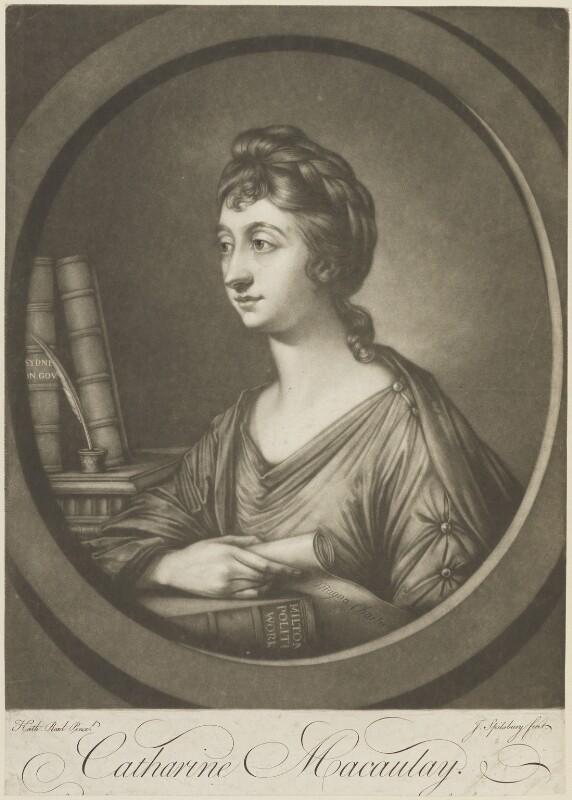
Turbulent Londoners: Catharine Macaulay, 1731-1791

Turbulent Londoners is a series of posts about radical individuals in London’s history who contributed to the city’s contentious past, with a particular focus of women, whose contribution to history is often overlooked. My definition of ‘Londoner’ is quite loose, anyone who has played a role in protest in the city can be included. Any suggestions for future Turbulent Londoners posts are very welcome. This week it is the turn of Catharine Macaulay, who was a radical and a republican, as well as the first female English historian.


Catharine Macaulay (née Sawbridge) by Jonathan Spilsbury, after Katharine Read mezzotint, published September 1764 NPG D15235 (Source: National Portrait Gallery)

A lot of the women I feature on Turbulent London probably wouldn’t describe themselves as activists or campaigners; many of them wouldn’t even describe themselves as feminists (the term didn’t exist before the late 1880s). These women advanced women’s rights by simply striving for, and achieving, the things they wanted, even if they were told they couldn’t because they were female. Catharine Macaulay, the first female English historian, falls into this category. Her determination to conduct and publish historical research in a time where there were no other female historians in the world made her remarkable. Her successful career as a historian was her primary goal, and the advancement of women’s rights was just a side effect.

Born Catharine Sawbridge on 23rd of March 1731 to parents who were wealthy landowners, Catharine had a comfortable childhood. She was educated at home by a governess in Kent. We don’t know much about the quality of her education, but by her twenties she was a voracious reader and had a deep love of history. On 20th June 1760, Catharine married a Scottish physician, Dr. George Macaulay. The couple moved to St. James’ place in London, where they had one daughter, Catharine Sophia.

It was during this first marriage that Catharine began to publish The History of England from James I to the Revolution. It was a sprawling, detailed historical account of the seventeenth-century that would eventually run to 8 volumes, the last of which was published in 1783. Not only was it remarkable for a woman to undertake such a task (it was deemed inappropriate for a woman to be a historian), it was very unusual for her husband to support her endeavours. But George did support Catharine, and after the publication of the first volume she became an overnight celebrity.

Catharine believed that English society during the Anglo-Saxon period was characterised by freedom and equality, but that this ideal society was lost after the Norman conquest. She argued that all of English history since 1066 had been about the attempt to win back the rights crushed by the “Norman yoke.” This stance was very popular with Whigs, who saw her work as an alternative to Hume’s ‘Tory’ History of England. However, when Volume 4 was published in 1768, Catharine alienated her Whig supporters by justifying the execution of Charles I. She was a republican, and believed that if Kings become tyrants, as Charles did, then they forfeit the right to rule. She was no fan of Oliver Cromwell’s either though; she blamed him for the downfall of the English republic.

Catharine was also critical of the 1688 Glorious Revolution. She acknowledged that it had limited the power of the monarchy, but argued that it was a missed opportunity to create a second English republic. She was also anti-Catholic, believing that Catholicism was incompatible with a “free constitution.” Catharine was very concerned with the morals of the historical figures she wrote about; she argued that self-interest was the worst fault that a King or politician could possess, and believed that only a virtuous people could create a successful republic.

Macaulay-History-title-page-vol-1-1769
The title page of a 1769 reprint of Volume 1 of History of England (Source: Journal of the American Revolution).

After George’s death in 1766, Catharine’s London home became a gathering place for reformers, American sympathisers and visiting Americans, an important node in a transatlantic network of campaigners, radicals, and republicans. In 1774, Catharine moved to Bath, where she was treated by a physician, Dr. James Graham. There were rumours of a relationship, but in November 1778 Catharine married Dr. Graham’s brother, William. The significant age gap (she was 47, he 21) was controversial, and many of Catherine’s friends and supporters abandoned her. However, it seems that her second marriage was as happy as her first.

In July 1784, Catharine became the first English radical to visit a newly independent United States. Her books had been influential on American radical thought, and she was much admired there. Catharine and William stayed with George Washington and his family, and he allowed her to see his personal papers with the goal of writing a history of the War of Independence, although it was eventually written by another of Catharine’s American supporters, Mercy Otis Warren.

After the last volume of History was published in 1783, Catharine continued to write and publish. Like Mary Wollstonecraft, Catharine believed that women’s ‘weakness’ was due to their lack of education, and if they had the same opportunities as men they would excel. She also called for the abolition of capital punishment, reform of the penal system, and the abolition of slavery.

Catharine Macaulay died on 22nd June 1791, after suffering from poor health for many years. She was not a campaigner for women’s rights, but she furthered this cause because of the way she lived her life. Catharine acted as if gender equality already existed: she refused to leave the room with other women after dinner, and she once said that “a historian is of no sex.” She was determined to achieve her goals, no matter whether or not society deemed them appropriate. By achieving those goals, she paved the way for other women to follow similar paths.

Sources and Further Reading

Donnelly, Lucy Martin. “The Celebrated Mrs. Macaulay,” William and Mary Quarterly. Vol. VI (1949): pp. 173–205.

Gleason, Emily Gilbert. “Macaulay, Catharine (1731-1791).” Women in World History: A Biographical Encyclopedia. Last modified 2002, accessed 9th May 2019. Available at https://www.encyclopedia.com/women/encyclopedias-almanacs-transcripts-and-maps/macaulay-catharine-1731-1791

Hill, Bridget. The Republican Virago: The Life and Times of Catharine Macaulay, Historian. Oxford: Oxford University Press, 1992.

Hill, Bridget. “Macaulay [nee Strawbridge; other married name Graham], Catharine.” Oxford Dictionary of National Biography. Last modified 24th May 2012, accessed 9th May 2019. Available at https://doi.org/10.1093/ref:odnb/17344 (subscription required to access).

Wikipedia. “Catharine Macaulay.” Last modified 11th April 2019, accessed 9th May 2019. Available at https://en.wikipedia.org/wiki/Catharine_Macaulay

On This Day: The Massacre of St. George’s Fields, 10th May 1768

John Wilkes
John Wilkes was a vocal critic of George III and enjoyed significant popular support. By William Dickinson, after Robert Edge Pine mezzotint, published 1768 NPG D4799 (Source: National Picture Gallery)

Most people have probably never heard of John Wilkes, but in the eighteenth century he was one of London’s most popular radicals. On the 10th May 1768, soldiers opened fire on some of his supporters outside the King’s Bench Prison in Southwark where Wilkes was being held. 6 or 7 people were killed, including bystanders, in an event that would become known as the Massacre of St. George’s Fields.

John Wilkes was a radical MP, and in June 1762 he started a newspaper, The North Briton, which was very critical of both the government and the monarchy. He was protected by parliamentary privilege, which means that MPs have legal immunity for things they do or say in the course of their duties. This only protected Wilkes up to a point, however, and he eventually went too far, publishing a poem that the House of Lords deemed to be obscene and blasphemous. They started the process of expelling Wilkes from the House of Commons, which would have removed his parliamentary privilege and left him open to prosecution. Wilkes fled to Paris before this could happen. In his absence he was found guilty of obscene and seditious libel and declared an outlaw on the 19th of January 1764.

Wilkes hoped that a change of government would lead to the charges against him being dropped. He ran out of money before that happened, however, and had to return to England. He wasn’t immediately arrested, as the government feared it would only increase his support base. Wilkes was elected as MP for Middlesex, but in April decided to waive his parliamentary privilege and hand himself over to the court of the King’s Bench. He was sentenced to 10 months in prison and given a £500 fine.

Wilkes was taken to the King’s Bench Prison in Southwark, on the edge of a large open space called St. George’s Field (an area stretching from Waterloo Station to Borough High Street today). As news of Wilkes’ imprisonment spread, his supporters began to gather on St. George’s Fields. The numbers increased daily, and by the 10th of May there were around 15,000 people there. Fearful of the large crowd, four Justices of the Peace requested military support, and a detachment of Horse Grenadier Guards were sent. This only increased tensions, however, as the crowd taunted the soldiers.

A group of soldiers chased one man who was being particularly offensive into a nearby barn. They opened fire, killing William Allen, an innocent bystander. As news of Allen’s death spread, the situation on St. George’s Fields only got worse. The Riot Act was read and more soldiers were called for, amongst fears that the crowd would attempt to break Wilkes out of prison. The crowd began to throw stones at the soldiers, who opened fire. In total, 6 or 7 people were killed, including another innocent bystander, and about 15 people were injured. Admittedly this isn’t a large number of casualties, but at the time it was quite significant. Understandably afraid for their lives, the crowd on St. George’s Field broke up, but as news of what had happened spread through London, sporadic rioting broke out across the city.

Two soldiers were charged with the murder of William Allen, but they were not convicted. Allen’s father presented a petition to parliament asking for justice for his son, which led to a debate about whether the government, who had supported the soldiers, was too oppressive. Nothing came of it though. In a letter to some of his supporters in America, Wilkes suggested that the massacre may have been pre-planned by the government, although there is no evidence of this. Wlkes was released from prison in March 1770. He was re-elected as an MP several times, and each time Parliament expelled him. Instead, he was appointed a Sheriff of London, becoming Lord Mayor in 1774. During the 1780 Gordon Riots, Wilkes fought against the rioters, which significantly damaging his reputation with the people and other radicals.

John Wilkes was a champion of anti-government feeling and the right to free speech. His popularity with the people of London terrified the authorities, which may explain why the situation on St. George’s Fields escalated so quickly. Or, it could just be an example of poor policing exacerbating a crowd, which has happened on many other occasions. Either way, it was a dramatic and deadly episode in the constant struggle between the authorities and the people for London’s streets.

Sources and Further Reading

German, Lindsey, and John Rees. A People’s History of London. London: Verso, 2012.

Harris, Sean. “The Massacre of St. George’s Fields and the Petition of William Allen.” UK Parliament. Last modified 31 October 2016, accessed 23rd April 2019. Available at https://www.parliament.uk/business/committees/committees-a-z/commons-select/petitions-committee/petition-of-the-month/the-massacre-of-st-georges-fields-and-the-petition-of-william-allen-the-elder/

Simkin, John. “St. George’s Fields Riot.” Spartacus Educational. Last modified August 2014, accessed 23rd April 2019. Available at https://spartacus-educational.com/LONstgeorge.htm

TeachingHistory.org. “Boston’s Bloody Affray.” No date, accessed 7th May 2019. Available at https://teachinghistory.org/history-content/ask-a-historian/23472

White, Jerry. London in the Eighteenth Century: A Great and Monstrous Thing. London: The Bodley Head, 2012.

Wikipedia. “Massacre of St George’s Fields.” Last modified 15th March 2019, accessed 23rd April 2019. Available at https://en.wikipedia.org/wiki/Massacre_of_St_George%27s_Fields

Book Review: When the Clyde Ran Red- A Social History of Red Clydeside

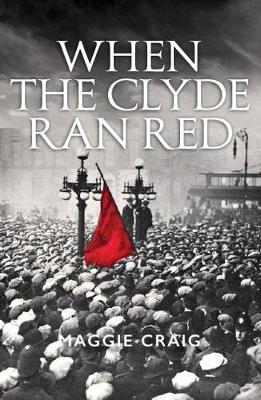
When the Clyde ran Red
When the Clyde Ran Red by Maggie Craig.

Maggie Craig. When the Clyde Ran Red: A Social History of Red Clydeside. Edinburgh: Birlinn, 2018. RRP £9.99 paperback.

I don’t need much of an excuse to go book shopping, but traveling is one of them. Whenever I go somewhere new, I keep an eye out for books about local history, particularly relating to protest and dissent. On a recent trip to Scotland, I bought When the Clyde Ran Red: A Social History of Red Clydeside by Maggie Craig. The book tells the story of a period in Glasgow’s history known as Red Clydeside. In the first half of the twentieth century Glasgow and the surrounding areas experienced a period of radical politics which saw a number of dedicated campaigners fighting to improve the lives of working-class Glaswegians. When the Clyde Ran Red tells the story of Glasgow between the Singer Sewing Machine Factory strike in 1911 and the Clydebank Blitz in 1941.

Warm and witty, kind-hearted and generous, interested in everything and everyone, the spirited men and women of Red Clydeside had one goal they set above all things…to create a fair and just society, one in which the children of the poor had as much right as the children of the rich to good health, happiness, education and opportunity.

Craig, p. 301

When the Clyde Ran Red is an engaging and lively read, it is a book that I thoroughly enjoyed. Maggie Craig has an informal writing style, her prose peppered with phrases in Scots that helps to transport the reader to Glasgow in the first half of the twentieth century. The book is comprehensive, covering everything from party politics undertaken by idealistic and self-sacrificing men, to rent strikes organised by fierce and determined housewives. Craig also brings in social history, explaining the context of Red Clydeside by describing the social, economic, and cultural life of Glasgow. For example, the Scottish Exhibition (1911), the Empire Exhibition (1938) and the popularity of increasingly ‘raunchy’ dance styles as a form of social revolution.

I criticised the last book I reviewed, The Road Not Taken by Frank McLynn (LINK), for going into too much detail. Sometimes, When the Clyde Ran Red goes to far in the opposite direction. I occasionally found its lack of detail frustrating. For example, the Singer Sewing Machine Factory strike in 1911 failed, but Craig does not any offer explanations about what went wrong. There were several points where I just wanted more information. Nevertheless, I think the book is a good introduction to an area of history that I previously knew very little about, and I can always find more detail elsewhere about all the events featured if I wanted to. When the Clyde Ran Red is an excellent starting point.

I admit that my knowledge of Scottish history is patchy at best, but When the Clyde Ran Red was an enjoyable way of filling some of those gaps. I would recommend it to anyone interested in labour history, the history of protest, or Scottish history.

Book Review: The Road Not Taken- How Britain Narrowly Missed a Revolution, 1381-1926

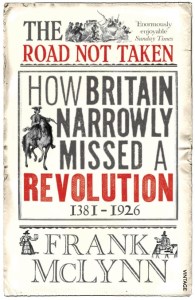
The Road Not Taken Front cover
The Road Not Taken by Frank McLynn

Frank McLynn. The Road Not Taken: How Britain Narrowly Missed a Revolution, 1381-1926. London: Vintage, 2013. RRP £12.99 paperback.

There are several books that document and discuss the history of protest in Britain. I have reviewed two of them–A Radical History of Britain (2010) by Edward Vallance and The English Rebel (2010) by David Horspool–on this blog. The Road Not Taken: How Britain Narrowly Missed a Revolution, 1381-1926, takes a very different approach to the previous two and, despite being quite difficult to read, manages to bring something new to the table.

The Road Not Taken is based on the premise that whilst Britain has never experienced a revolution, defined as an “overthrow of a regime and a drastic change of direction, politically, economically, socially,” it has come close at several points (McLynn, 2013; ix). McLynn analyses these moments in great detail, considering why they happened, what happened, and why they failed to achieve revolution. The revolutionary moments he considers are: the Peasant’s Revolt (1381), Jack Cade’s Rebellion (1450), the English Civil War (1642-51), the 1745 Jacobite Rising, Chartism (1837-48), and the General Strike (1926).

“why has there been no true revolution in British history? It goes without saying that Britain never approached anything like the socio-economic convulsions of the Russian, Chinese, or Cuban Revolutions. The nearest the nation came to something like the upheavals in the French and Mexican varieties was in the aftermath of the English Civil War, but Cromwell slammed the brakes on hard and turned abruptly right.”

(McLynn, 2013; p.479)

In the Conclusion, McLynn evaluates different explanations for why Britain has never experienced a revolution, including Britain’s island status isolating it from the worst impacts of land-based war, the monarchy, the British Empire, and Methodism. He gives each argument a fair hearing, evaluating its strengths and weaknesses. My issue is that McLynn never comes to a conclusion. He has valid reasons for why every hypothesis is flawed, but he doesn’t explain what he thinks is the best explanation. McLynn does the same thing in the Appendix, where he evaluates the different theories and typologies of revolution more generally, but he doesn’t draw conclusions.

I also found McLynn’s writing style difficult to get along with. The text is dense, and includes unnecessarily complicated words like “fissiparious” (p127), “galimaufry” (p312), and “exiguous” (p430). All that such a writing style does is make a narrative or argument much harder to follow. Academics often write in this way, perhaps in an attempt to appear more impressive. All it does, however, is widen the gap between academics and the general population, particularly when it is used in a book aimed at a popular audience such as The Road not Taken. The history of protest is one of the thing I am most interested in, but even I struggled to stay engaged with the book at some points.

The Road Not Taken does manage to bring something new to the topic of Britain’s history of protest. It may well prove useful to me in my research someday, with its detailed and measured analysis. However, I would not recommend it as a ‘fun’ read, something to relax with curled up on the sofa or in the bath.

Book Review: London Fog- The Biography

London fog cover
London Fog by Christine L. Corton.

Christine L. Corton. London Fog: The Biography. Cambridge, MA: Harvard University Press, 2017. RRP £13.95 paperback.

I like books about London, and I like books that take very specific objects or phenomena, such as a particular weather condition, and links them to wider political, social, economic, cultural, and historical contexts (Tear Gas by Anna Feigenbaum is a really good example of this). So when I found London Fog: The Biography, I was excited to read it.

Although London’s location in the Thames basin means it has always been susceptible to mist and damp, London Fog begins in the 1840s, when the city’s rapid expansion and industrialisation meant London began to suffer from fog in earnest. The book’s narrative ends in the 1960s; the last major period of fog London experienced was in December 1962. For more than a century the city suffered from dense, cloying fog during the winter months that was capable of shutting down the city by reducing visibility to almost zero, and caused breathing difficulties, respiratory illnesses, and even death.

Christine L. Corton uses the fog to tell a social, cultural, and political history of London between those two dates. She explores the way that fog was constructed and interpreted in various narratives, including political debates and identity. Over the course of the century in which fog was a defining characteristic of London life it was the subject of many arguments about what caused the fog, what was so dangerous about it, what could be done to prevent it, and whose responsibility it was. Corton traces these debates with skill and patience.

There is also a lot of literary and art criticism in London Fog; Corton devotes significant attention to how fog in London has been represented in various art forms including paintings, photography, novels, and films. In this way, London Fog reminds me of Nightwalking by Mathew Beaumont, which explores the literary history of London at night. Whereas Nightwalking suffers from a distinct lack of female writers, however, London Fog does discuss female artists.

London Fog is obviously the product of extensive and detailed research. It is full of wonderful images, often in colour. This is a big plus; it is quite unusual for books like this to have so many high-quality images. The narrative is incredibly detailed, which occasionally causes the pacing to suffer; readers with only a mild interest in the topic may struggle.

There are a huge number of books about London’s history, and it takes a lot to write one that stands out from the crowd. London Fog is about a subject that is quintessentially London, but also manages to be original. It is an excellent example about how something small and specific can be used to better understand the large and general.

The Historical Geographies of Protest Reading List

(Source: Shena Tschofen)

As part of my thesis revisions, I had to read as much academic research on the historical geographies of protest as I could get my hands on. To keep track of it all, I made a database using Zotero, an open-source referencing programme. For those of you who aren’t familiar, Zotero is a wonderful free-to-use (unlike EndNote or RefWorks) referencing software that I have used to keep track of all my academic reading since I started my PhD. It occured to me that I might not be the only person that would find this list useful, so I have made it publicly accessible. You can view the database here. Each book or journal article is tagged with key information such as the time period and location of case studies, as well as key themes, ideas, theories, and thinkers addressed.

Zotero screen grab
A screen shot of the Historical Geographies of Protest reading list.

I will keep adding to the list as I find more. I am sure that I have missed things out too, so please do let me know and I will add them in. For example, the list is quite Anglo-centric so far, it would be great if we could get some more references about non-English speaking places. Or even some literature that is not written in English! I would really like this to be a resource that lots of people both contribute to and benefit from, so please do get in touch if you have something to add.

Book Review: A Radical History of Britain by Edward Vallance

A Radical History of Britain front cover
A Radical History of Britain by Edward Vallance.

Edward Vallance. A Radical History of Britain. London: Abacus, 2010. RRP £13.99 paperback.

The British have a reputation for being a bit passive when it comes to protest, rebellion, and revolution. The Glorious Revolution in 1688 is celebrated for being ‘bloodless,’ and when the rest of Europe was wracked with revolutions in the mid-nineteenth century we had the largely peaceful Chartist movement. Books such as A Radical History of Britain, however, demonstrate that us Brits can rebel with the best of them.

A Radical History of Britain pretty much does what it says on the tin, although Vallance does admit in the introduction that it is largely about England rather then Britain. The book is split into seven parts, each with several chapters, that focus on particularly contentious periods in English history, including: the English Civil Wars; British radicalism around the time of the French Revolution; Chartism; and the Women’s Suffrage movement. In each case, Vallance focuses on two elements that make A Radical History of Britain more than just a straightforward narrative. The first is a concern with ideas as well as events; Vallances devotes significant attention to the theories and writings that inspired and drove radicalism, from those of the Levellers, to Thomas Paine, Feargus O’Connor, and the Pankhursts. The second element that makes the book stand out is discussion of how protests and periods of radicalism were used by later activists and campaigners as sources of inspiration, justification, and legitimisation. Social movements often draw on the history of radicalism in lots of ways, and A Radical History of Britain traces that process.

Our freedom lies in our power. Pessimists may point to demonstrations against the war in Iraq as evidence of modern government’s capacity to ignore the will of the people. However, the millions who marched against that illegal war also remind us of the readiness of the British people once again, in the words of Shelley, to rise ‘like lions after slumber.’ This is the lesson of Britain’s radical history: the struggle for our freedom goes on.

Vallance, 2010; p 552.

Last year, I reviewed The English Rebel by David Horspool. It too tells the story of English radicalism, although Horspool is more explicit about the English focus. On the surface, the two books are quite similar; they are telling the same story, and feature many of the same events. They also both indulge in my  pet hate of collecting images together rather than dispersing them throughout the text. However, there are differences. The English Rebel is more of a straightforward narrative, whilst A Radical History of Britain explores radical ideas and legacies, as I have mentioned. David Horspool’s overall message is that the English have always been more radical than our reputation implies. Edward Vallance’s key message is that rights are something that the English fought long and hard for, and they can be lost if they are not defended. The narrative in The English Rebel is more complete than in A Radical History of Britain; Vallance sacrifices breadth for depth in some places, so skips over some time periods, and finishes in the mid-twentieth century, whilst Horspool goes right through to the nineteen-nineties. I personally found The English Rebel easier to read, but that doesn’t necessarily make it a better book, it depends what the reader is looking for. I understand that not everyone enjoys reading about the history of protest as much as I do, so if you only want to read one, I can offer some advice. If you’re after a more general overview of protest in England throughout history, I would recommend The English Rebel. If you would prefer something with more analysis, then I would suggest A Radical History of Britain.

A Radical History of Britain presents some interesting arguments about how legacies of protests and radicalism are shaped and used by radicals that come after, and it also provides a thorough introduction to the history of radical ideas in Britain. It is not the easiest book to read, but I think it is worth the effort.

Revolting New York: How 400 Years of Riot, Revolt, Uprising, and Revolution Shaped a City

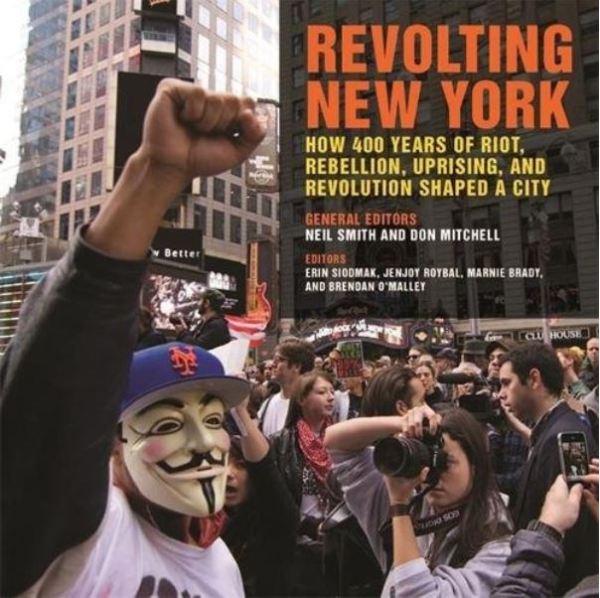
Revolting New York cover
Revolting New York will be published early next year.

On my trips to New York City (in 2015 and 2016), I have scoured bookshops looking for a history of protest in the city, assuming that there must be one. After all, there are at least two books about London’s turbulent past. Whilst there is lots of great research about dissent in New York, there has not been an overarching survey–until now. Next year, a book will be published not just about the history of protest in New York, but about the historical geography of protest in the city. Revolting New York: How 400 Years of Riot, Revolt, Uprising, and Revolution Shaped a City began as a project by Neil Smith with some of his post-graduate students at the City University of New York. When he passed away in 2012, Professor Don Mitchell took over the task of editing the collection, and it is finally being published next year. As you can imagine, I’m quite excited about it, whilst also being a bit frustrated that I didn’t get there first!

Last week, Professor Mitchell gave a lecture about the project at Queen Mary, University of London. I went along to find about more about the project. Mitchell used various examples to demonstrate the strength of the relationship between dissent and the material landscape. We tend to view demonstrations, riots, and other expressions of dissent as unusual events, but they are actually very common, particularly in large cities like London and New York. It is actually more uncommon to have a peaceful period.

Mitchell started the lecture with an in-depth look at a decade of bombings in New York, culminating in anarchist Mario Buda’s attack on Wall Street on the 16th of September 1920 (I have written a review of Mike Davis’ excellent book about this bombing’s part in the early history of the car bomb here.) The bombings contributed to the deindustrialization of New York, as the small-scale manufacturing and transport networks that produced and planted the bombs were driven out of the city. Finance, insurance, and real estate came to dominate the city’s economy. In attempting to strike a devastating blow against the bankers of Wall Street, Buda inadvertently helped them tighten their grip on New York.

Mitchell used this narrative, and others, to argue that “landscape is power materialised.” Whilst this is not a new argument, Revolting New York applies it in a new context. Space is produced through social struggle, the result of constant negotiation and conflict between groups with different visions for that space. Protest is just one form that this process takes. As such, protest shapes and reshapes the city you see when you look out the window (apologies to those of you who are not currently in a city!)

The lecture was an introduction to the Revolting New York project, outlining it’s history, structure, and key arguments. It is particularly exciting for me because of its parallels with my own work on London. The book will be affordable too, less than £25 for the paperback, so hopefully it will help bring historical geography to a wider audience. I for one can’t wait to read it!

On This Day: Occupation of the Savoy, 14th September 1940

THE LONDON UNDERGROUND AS AIR RAID SHELTER, LONDON, ENGLAND, 1940 (D 1675) People sheltering from air raids line the platform and tracks at Aldwych Underground Station in London. A row of coats can be seen hanging on the wall. Copyright: © IWM. Original Source: http://www.iwm.org.uk/collections/item/object/205192916

When we think of London during the Second World War, we think of the Blitz. When we think of the Blitz, we think of the Blitz spirit epitomising the British stiff upper lip. There is a collective imaginary of Londoners banding stoically together, facing down the Nazis with a grim smile, a cup of tea, and maybe a sing song. But London was not always united in the face of the enemy. The occupation of the Savoy Hotel on the night of the 14th September 1940, the 8th night of the Blitz, was a manifestation of some of these divisions.

In the early days of the Blitz, there was a serious lack of deep shelters in the East End, which was particularly hard hit due to the high levels of industry in the area. Pre-war planning by the government had rejected deep shelters in London, afraid that a ‘shelter mentality’ would develop. They decided instead to issue gas masks and rely on surface level shelters, such as the Anderson shelter. It very quickly became obvious that this provision was insufficient. What shelters there were lacked facilities and were overcrowded.

The Communist Party immediately took up the cause. the London district printed 100,000 leaflets and 5,000 posters calling for better provision of shelters and the requisitioning of empty houses for the homeless. The East End Communists decided to march for better air raid shelters in the East End, and to highlight the fact that not all Londoners suffered the effects of the bombs equally.

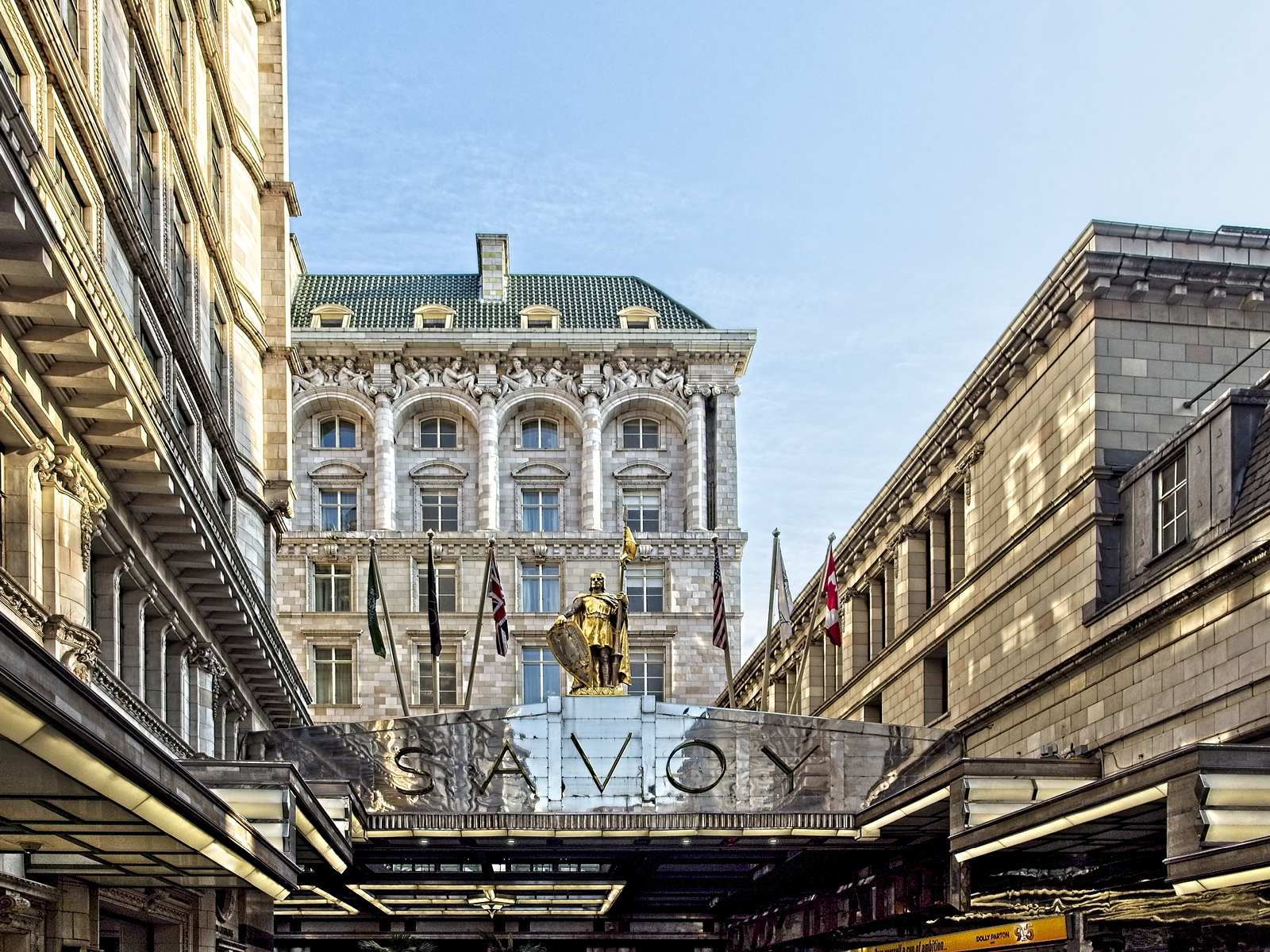
The Savoy Hotel (Source: Dave–Pressing the Shutter Button).

With the help of some sympathetic waiters, between 40 and 70 protesters occupied the Savoy’s luxurious air raid shelter. The shelter was divided into cubicles, with beds and armchairs. Nurses and waiters served the hotel’s guests during raids. When the air raid siren went off, the Savoy’s manager realised he could not chuck the occupiers out; they would have to stay the night. After some negotiation with the catering staff, the occupiers were provided with tea, bread, and butter. All in all, it was a pretty pleasant way of drawing attention to the disparity of deep shelter provision across the capital.

The contrast between the shelter conditions for the rich and the poor called for exposure. This was done…One Saturday evening we gathered some seventy people, among them a large sprinkling of children, and we took them to the Savoy Hotel. We had heard from building workers of the well-constructed and luxurious shelter which had been built for their guests. We decided that what was good enough for the Savoy Hotel parasites was reasonably good enough for Stepney workers and their families.

Phil Piratin, Our Flag Stays Red (London: Lawrence and Wishart, 2006); p. 73. Phil Piratin was a prominent member of the Communist Party, and became one of the party’s first MPs in 1945. He was present during the occupation of the Savoy.

The Blitz was one of the darkest periods in London’s history. By the time it ended 43,000 British civilians had been killed, half of them in London. Protest and dissent was less common during the world wars than in peace time, but Londoners were willing to fight for decent air raid shelter provision. Thanks to actions such as the occupation of the Savoy Hotel, the situation greatly improved, making the lives of Londoners that much more bearable as the bombs fell.

Sources and Further Reading

German, Lindsey, and John Rees. A People’s History of London. London: Verso, 2012.

Piratin, Phil. Our Flag Stays Red. London: Lawrence and Wishart, 2006.

Sweet, Matthew. “When Max Levitas Stormed the Savoy.” Spitalfields Life. Last modified 3 November, 2011. Accessed 23 August, 2017. Available at http://spitalfieldslife.com/2011/11/03/when-max-levitas-stormed-the-savoy/