This is not technically a sticker, but I like the work of this artist, so I decided to include it (Photo: Hannah Awcock, Oxford Street, 15/04/15).
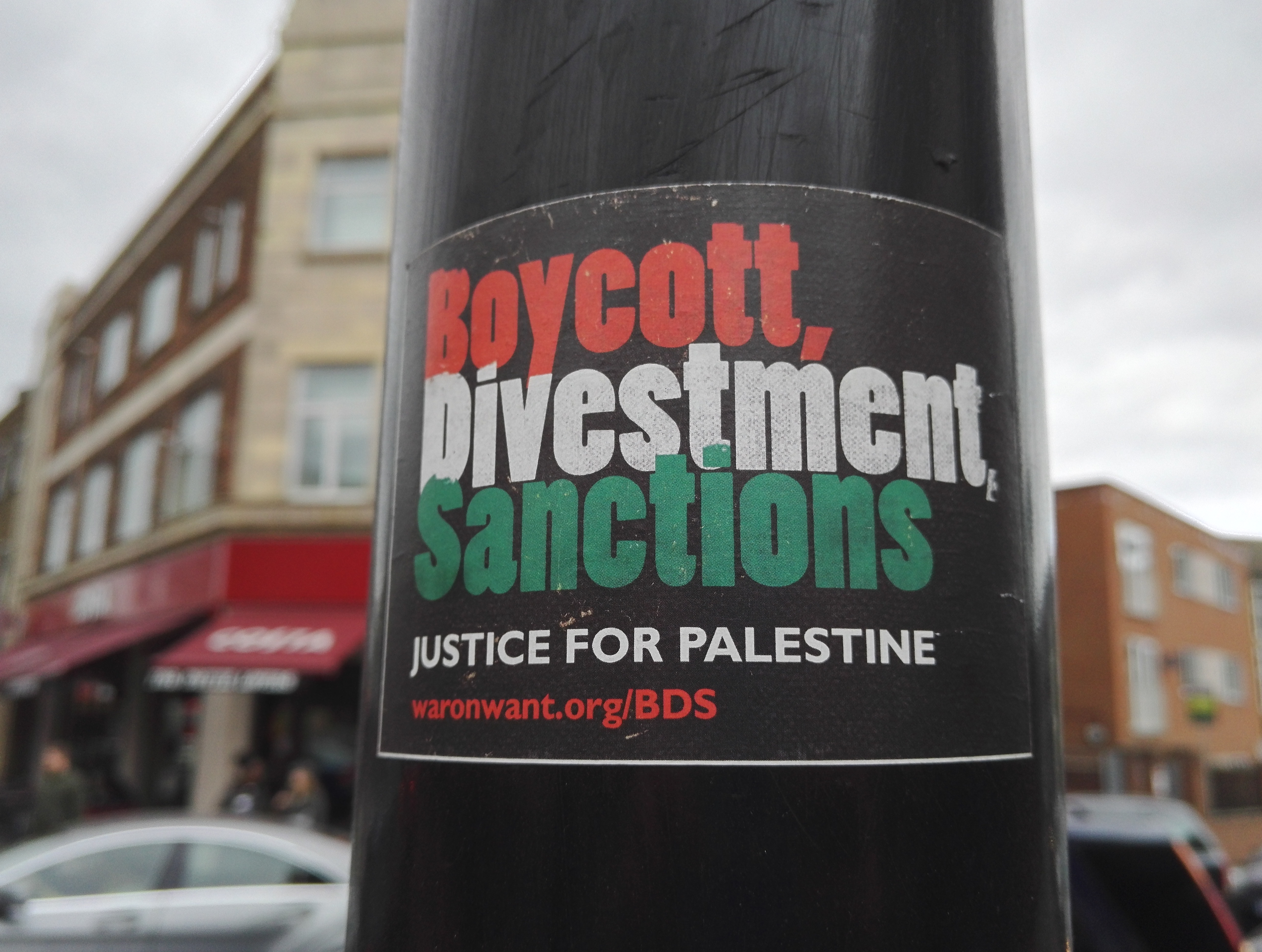
On the 25th of August, Frankfurt City Council approved a bill that will ban the use of municipal funds for Boycott, Divestment Sanctions (BDS) activities targeting Israel, if it is approved by the city parliament. Frankfurt is the first German city to take this step, but it looks like Munich will follow suit in the autumn (Jerusalem Post, 2017).Uwe Becker, the deputy mayor and city treasurer for Frankfurt, argues that the movement is anti-Semitic. The BDS movement campaigns to put economic pressure on the Israeli state in order to compel Israel to obey international law in its dealings with Palestine. Founded in 2005, BDS is a coalition of groups from Palestine and around the world. London’s protest stickers suggest that support for the BDS movement is much stronger here than it is in Germany. In fact, every sticker I have found in relation to the Israel-Palestine conflict in London is pro-Palestine.
The colour scheme of BDS stickers usually reflects the Palestinian flag, which has three horizontal strips of black, white, and green, overlaid with a red triangle on the left hand side. War on Want is an organisation that campaigns on multiple issues relating to human rights, social justice, and the root causes of poverty (Photo: Hannah Awcock, Lewisham Way, 20/03/16).
This sticker, which features the Palestian flag, is produced by the Palestine Solidarity Campaign, which claims to be the biggest organisation in the UK campaigning for Palestinian human rights (Photo: Hannah Awcock, Royal Mint Street, 25/02/15).
This sticker doesn’t directly refer to the BDS campaign, but it does also use the colours of the Palestinian flag (Photo: Hannah Awcock, Cable Street, 25/02/15).
Again, this sticker uses the colour scheme of the Palestinian flag (Photo: Hannah Awcock, Pentonville Road, 23/03/17)
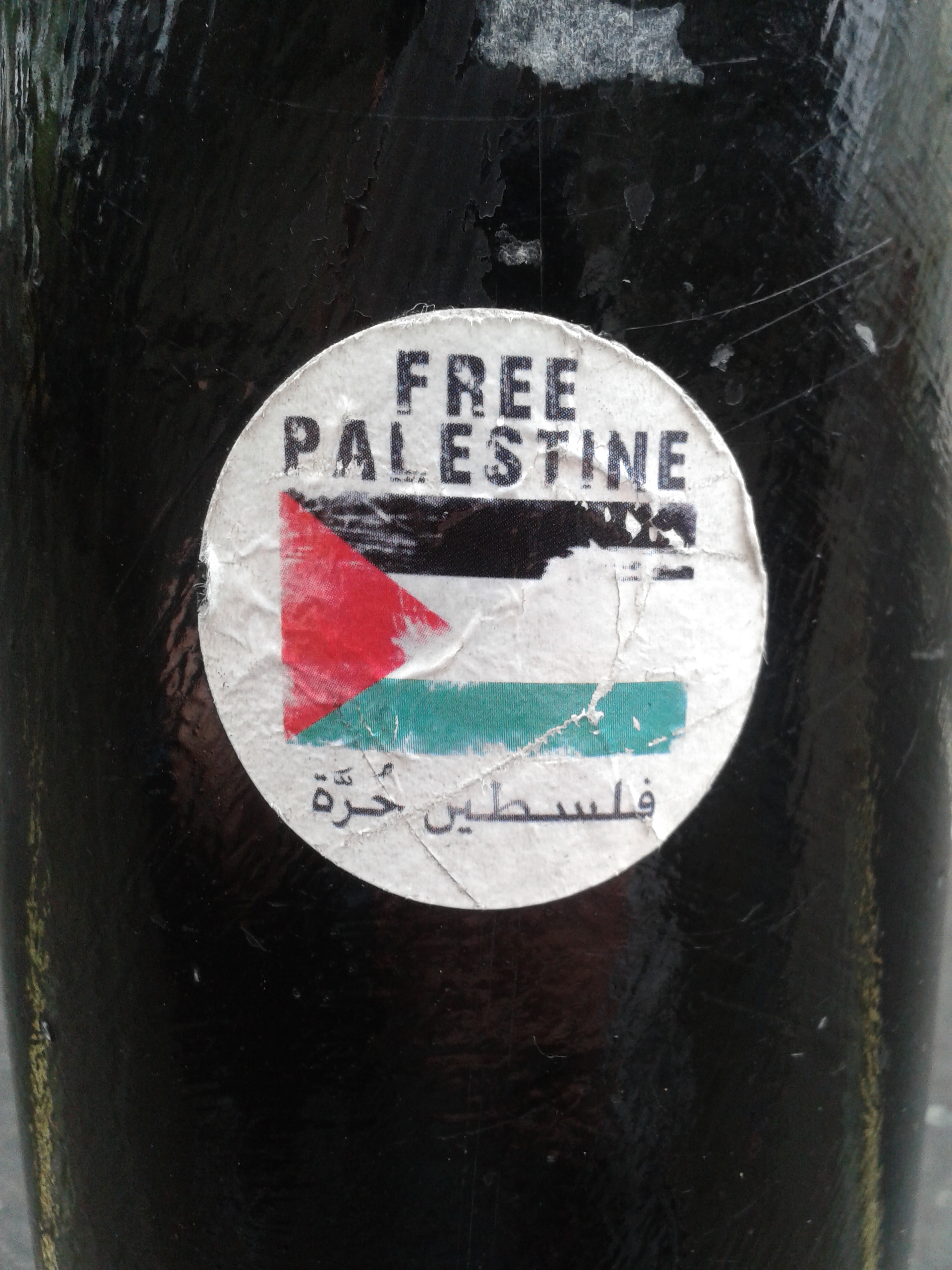
I suspect that this sticker was designed to be worn by people rather than street furniture, because of its small, round shape. However, stickers worn on street furniture tends to last longer than stickers worn on clothes (Photo: Hannah Awcock, British Museum, 12/05/15).
This sticker was produced by the Socialist Worker Student Society, the student arm of the Socialist Worker’s Party, a revolutionary party that campaigns for socialism and internationalism (Photo: Hannah Awcock, Malet Street, 28/05/17).
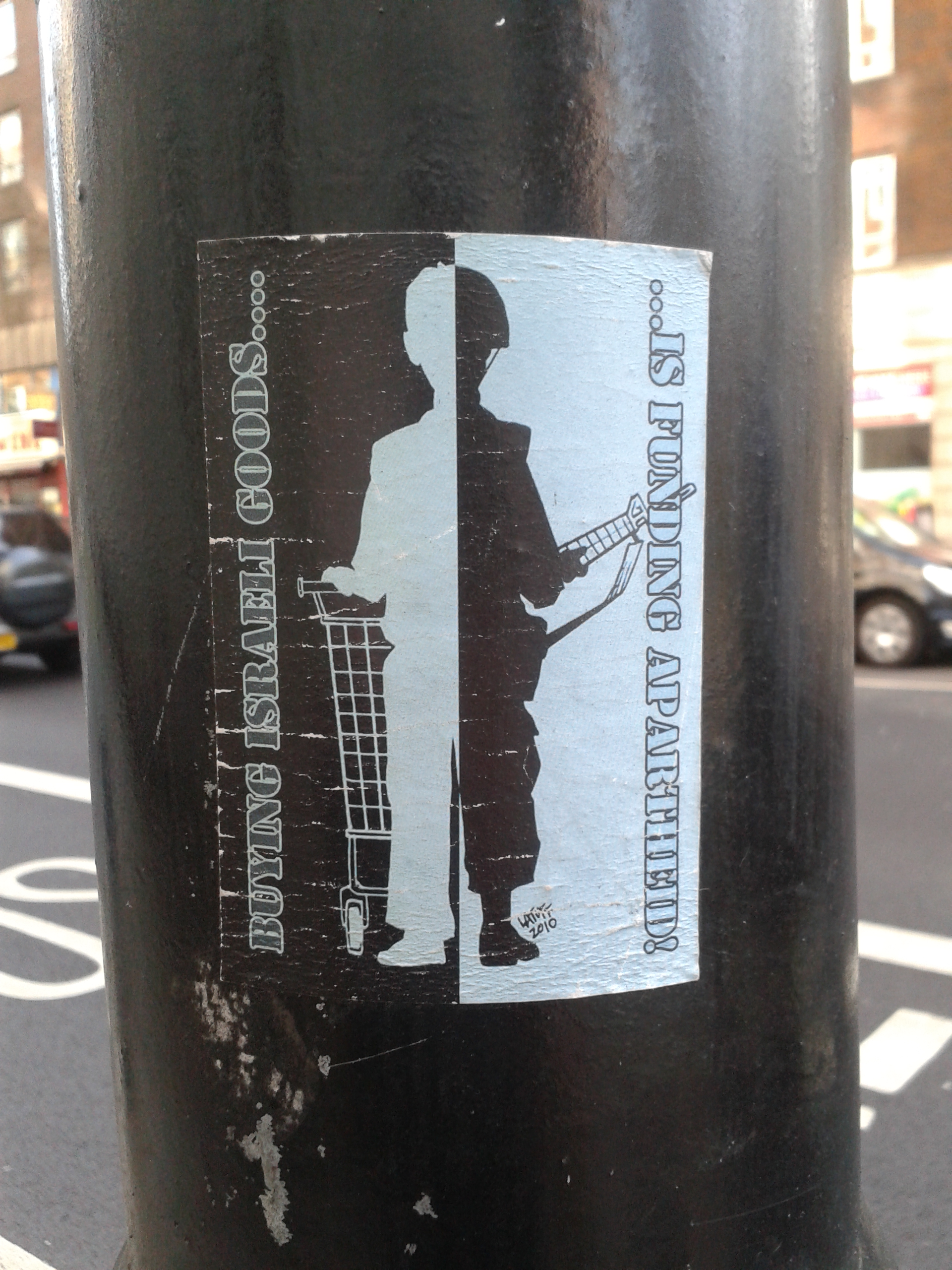
This sticker does not use the traditional BDS colour scheme, but it does illustrate the logic behind BDS in a way that I think is quite striking (Photo: Hannah Awcock, Russell Square, 15/04/15).
The boycott element of BDS includes academia. In 2015, the SOAS Student Union held a referendum over whether or not the university should implement an academic boycott. The students voted yes to the boycott (Photo: Hanna Awcock, Malet Street, 17/02/15).
This sticker Revolutionary Socialism in the 21st century is a group that campaigns on a whole range of issues. This sticker is calling for BDS, using the image of Benjamin Netanyahu, Israel’s prime minister (Photo: Hannah Awcock, Gordon Street, Bloomsbury, 09/08/15).
Walk the Lines: The London Underground, Overground by Mark Mason.
Mark Mason. Walk the Lines: The London Underground, Overground. London: Random House, 2011. RRP £8.99 paperback.
The London Underground is one of the most distinctive elements of the city, but it does result in a disjointed perception of the metropolis–I don’t feel like I really got to know how the various areas of London fit together until I moved there and started to walk or get the bus more. Walk the Lines: The London Underground, Overground is the ultimate exercise in getting to know London; author Mark Mason walked the route of every underground line from beginning to end, then wrote a book about it.
I think the concept for this book is excellent; but unfortunately I am not so keen on its execution. I think it would be really interesting to repeat this challenge in a decade or so, London changes so quickly that some of Mason’s observations already feel out of date.
Sadly, I did not get on so well with Mark Mason’s writing. I did not like the tone of the book at all when I started reading it; it felt like Mason was trying too hard to be funny. This did become less noticeable as I progressed through the book, but I couldn’t say whether it’s because the tone improves or because I just got used to it. I also dislike Mason’s heavy use of footnotes. They interrupt the flow of the writing, and sometimes I missed the superscript, and found myself searching the page for the relevant point. I think they are unnecessary in Walk the Lines.
I also found Mason himself to be a bit arrogant–one of his reasons for undertaking the challenge was to own London, a desire which I think is conceited and a bit odd, quite frankly (p. 4-5). Nobody owns London. If anything, the opposite is true; there have been several occasions when I have felt that London’s influence over my life has been a bit too significant for comfort. In addition, Mason is snobbish about anything that is ‘not London.’ He seems to look down on other cities and London’s suburbs, and view them as automatically inferior. I understand that both of these attitudes come from a great love of London, I too am captivated by it. I am just not so keen on how this affection manifests itself in Mason’s writing.
The final significant issue with Walk the Lines is the lack of photographs. This is a book about the many different faces of London, but there is not a single image of Mason or the different aspects of London he encountered on his walks.
The concept of Walk the Lines is not the only element of the book that I liked however. I enjoyed Mason’s musings on the subjectivity and power of maps, although these are not new ideas to geographers. The book also contains some decent historical facts. For example, London cabbies call the junction on which the Royal Geographical Society sits ‘Hot and Cold Corner,’ because the building has statures of David Livingstone and Ernest Shackleton. Finally, I enjoyed the sections when Mason stops along his walks to talk to other people about their perceptions of London, such as: artist and ex-Popstar Bill Drummond; The Archers actor Tim Bentinck, who was the ‘Mind the Gap’ voice on the Piccadilly Line for 15 years; and John Pearson, the official biographer of the Kray twins.
I enjoy reading books about London, and I admire the inventive approach in Walk the Lines. I’ve always thought that the best way to get to know a city is to walk around it, and I like the idea of using a city’s transport network, effectively its circulatory system, to organise such exploration. However, I am not so keen on Mason’s writing style or attitude towards London. This is not a bad book, it just isn’t a great one either.
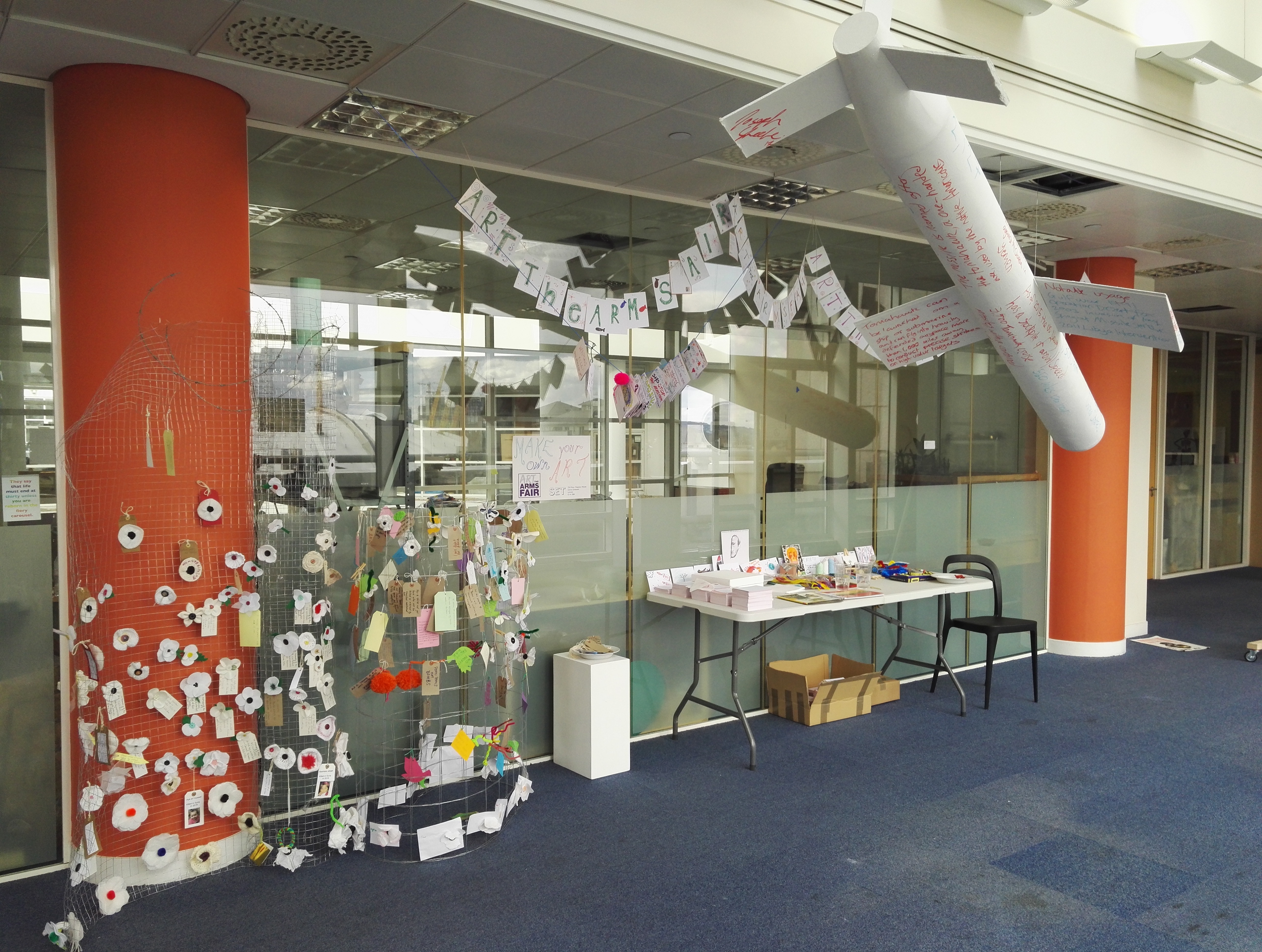
Poppies in a rocket (2017) by Anonymous. One of the pieces on display at the Art the Arms Fair exhibition (Photo: Hannah Awcock).
Every two years, the Defence and Security International exhibition, known colloquially as the DSEI arms fair, takes place in the vast ExCel Centre in East London. People come from all over the world to see and purchase the latest weapons and defence technology at one of the world’s largest arms fairs. Every year, there are protests attempting to stop, disrupt, and draw attention to the event. This year, at the same time, the 12th-15th of September, a very different kind of exhibition also took place in East London, with the aim of raising awareness of the DSEI, an event which most Londoners have no idea exists. The Art the Arms Fair exhibition took place at SET Studios in Capstan House in Poplar. It was preceded by an art event on the 9th of September at the ExCel Centre, where artists produced works in a variety of mediums. The exhibition displayed art that responded to the arms trade. Events, such as spoken word and comedy, were held in the space in the evenings. Works were sold to support the Campaign Against Arms Trade (CAAT), an organisation which aims to end the international arms trade. I have always been a little sceptical about the significance and power of art, so I went along to see if I could be convinced.
To begin with, SET Studios is not your typical art gallery. SET is an initiative that provides artists with affordable studio and project space in buildings that would otherwise be empty. Capstan House is a stylish new office block, with an imposing foyer and fancy elevators. SET occupies the seventh floor, with beautiful views across the Thames to the O2 arena and the Emirates Airline Cable Car. You can see the artists’ studio space through the glass walls that are so fashionable in modern offices. The art, some of it attached haphazardly to plywood display boards, sits oddly in this environment. But none of that detracted from the effect the exhibition had on me. In fact, it might well have contributed to the disconcerted feeling with which I left the exhibition.
Capstan House in Poplar, the location of the Art the Arms Fair exhibition (Photo: Hannah Awcock).
The Art the Arms Fair was not housed in what I would describe as a typical art gallery space, but I think that only added to its impact (Photo: Hannah Awcock).
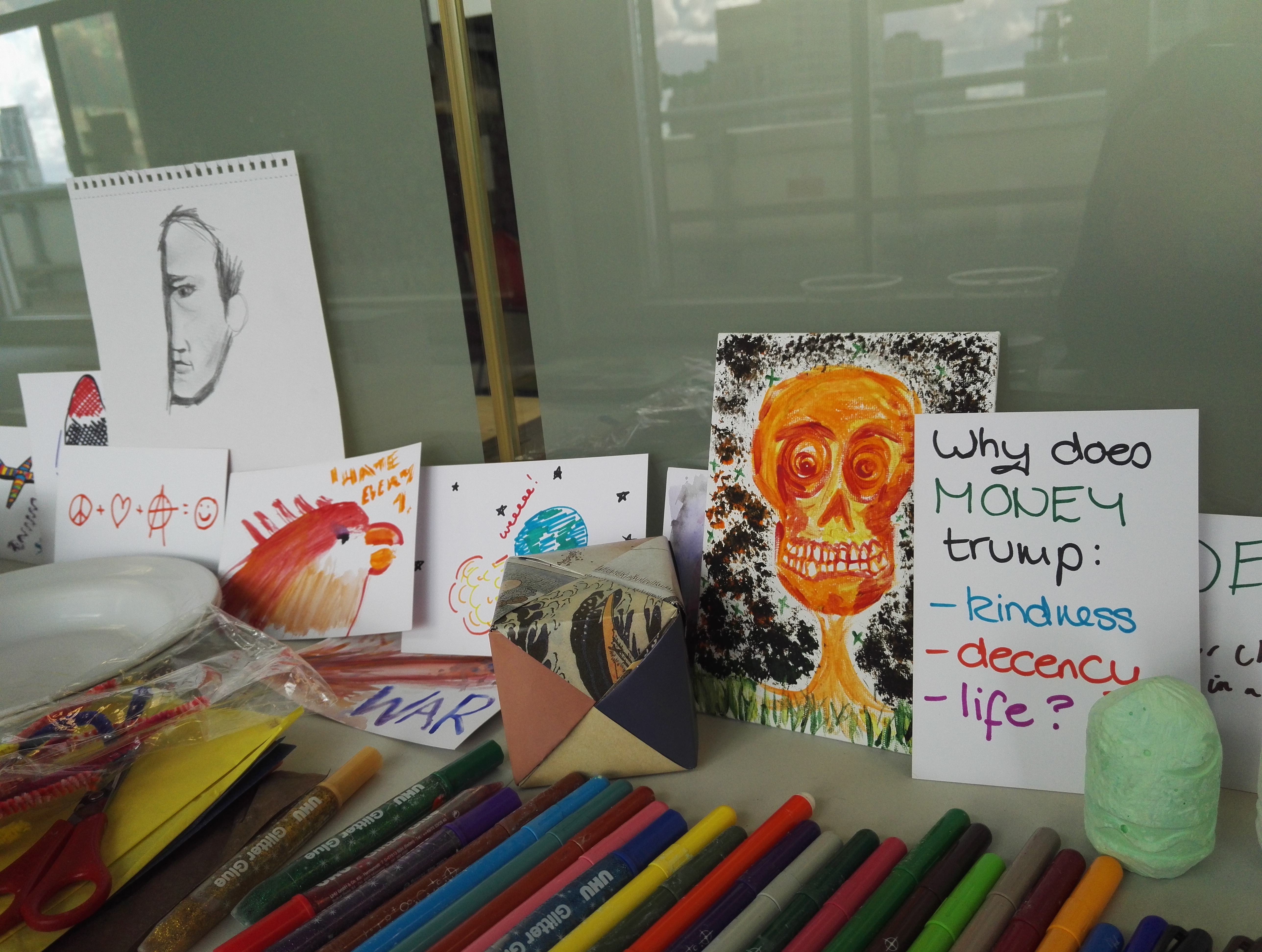
As I said at the beginning of this post, I am not a great believer in the power of art. I did not need to be convinced that the arms trade was a bad thing; I was already a strong believer in the futility and cruelty of war. But I left the exhibition feeling a lot more emotional than I expected to. Whilst I thought some of the artwork was good, I think what really affected me was the opportunity to ‘Make Your Own Art’ on blank postcards. Attempting to focus my response to the arms trade on one small rectangle of white card clarified and crystalised my feelings in a way that I was not expecting.
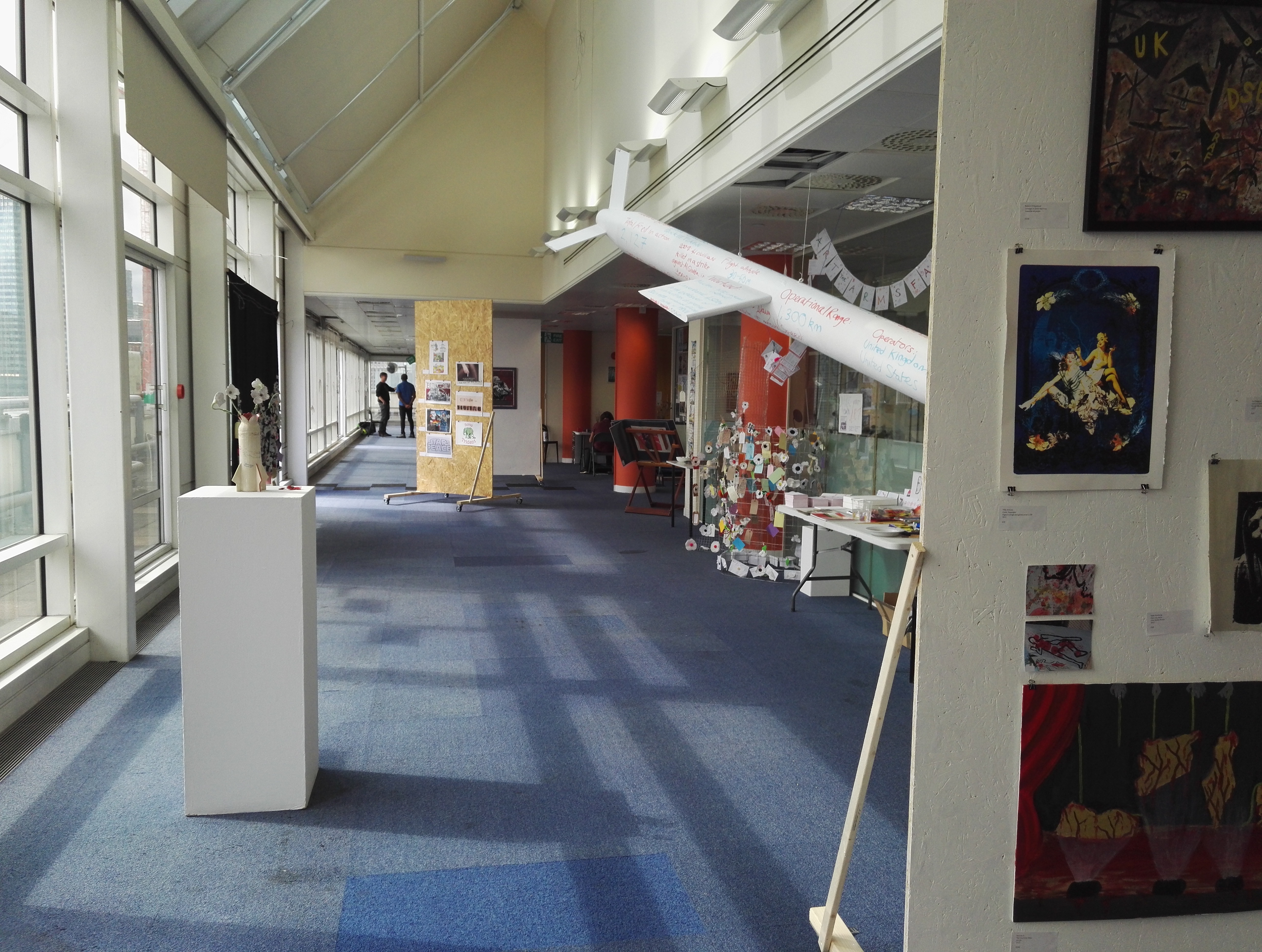
The ‘Make Your Own Art Section’ of the exhibition. The piece suspended from the ceiling is Half scale Tomahawk missile by Joseph Steele (2017). I think this is what made me connect with the exhibition so much (Photo: Hannah Awcock).
Some of the art produced by visitors to the exhibition (I’m not going to say which one is mine!) (Photo: Hannah Awcock).
The Art the Arms Fair exhibition was powerful and emotive. It’s main stated goal was to make the DSEI arms fair visible, to make people aware of its existence. It would be hard to say how far that goal was achieved; the exhibition was nowhere near the ExCel Centre, and the area didn’t seem like the kind of place that people just pass through, so it was unlikely to attract many people who didn’t already intend to visit. I do wonder if an art exhibition in an out-of-the-way office block in East London is really the best way to raise the profile of the DSEI. Nevertheless, it hopefully raised some money for CAAT, and provided a space for creative opposition to the arms trade. At the end of the day, I am reluctant to criticise anyone who is attempting to make a positive difference in the world, as doing something is very often better than doing nothing.
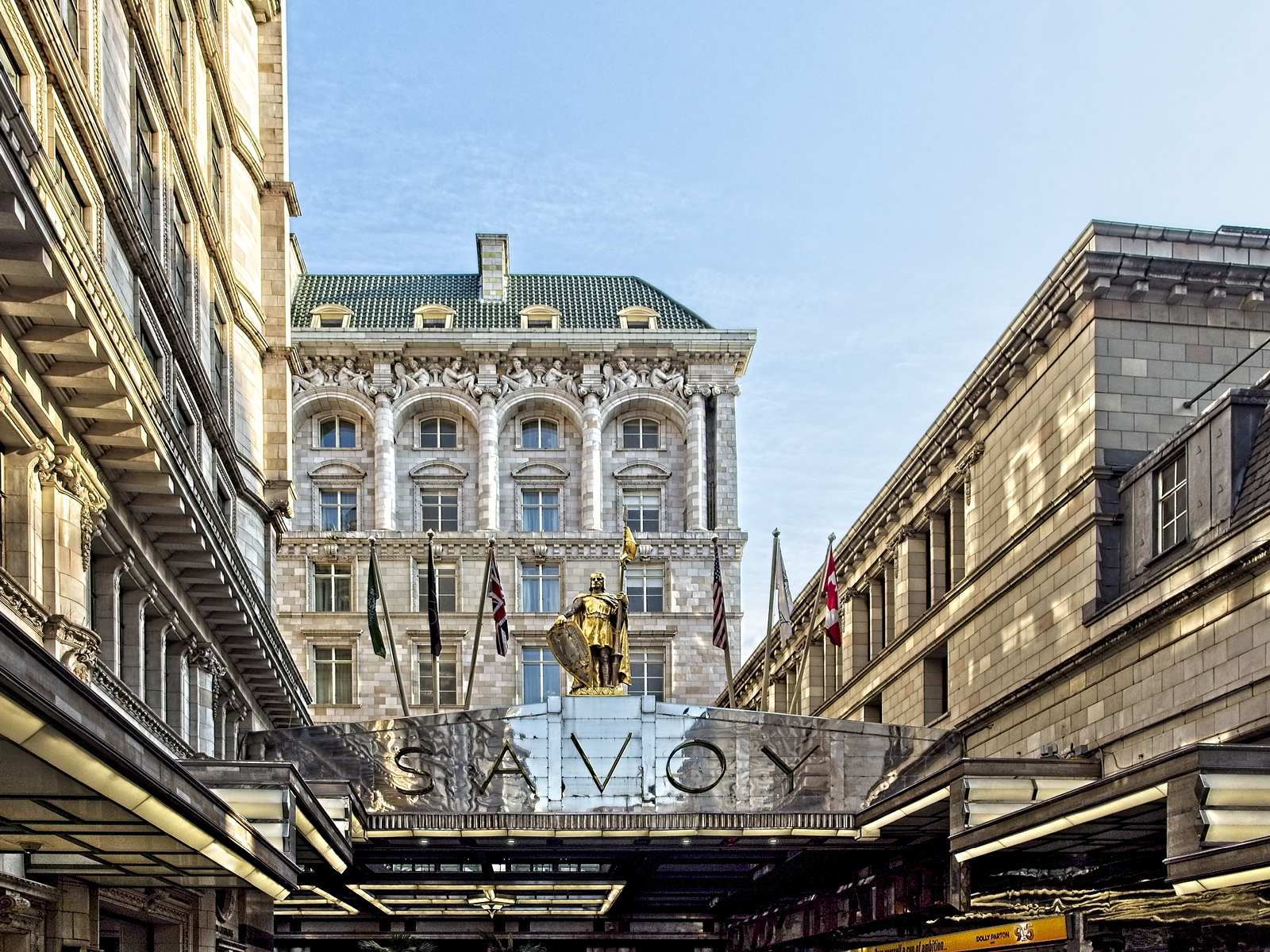
When we think of London during the Second World War, we think of the Blitz. When we think of the Blitz, we think of the Blitz spirit epitomising the British stiff upper lip. There is a collective imaginary of Londoners banding stoically together, facing down the Nazis with a grim smile, a cup of tea, and maybe a sing song. But London was not always united in the face of the enemy. The occupation of the Savoy Hotel on the night of the 14th September 1940, the 8th night of the Blitz, was a manifestation of some of these divisions.
In the early days of the Blitz, there was a serious lack of deep shelters in the East End, which was particularly hard hit due to the high levels of industry in the area. Pre-war planning by the government had rejected deep shelters in London, afraid that a ‘shelter mentality’ would develop. They decided instead to issue gas masks and rely on surface level shelters, such as the Anderson shelter. It very quickly became obvious that this provision was insufficient. What shelters there were lacked facilities and were overcrowded.
The Communist Party immediately took up the cause. the London district printed 100,000 leaflets and 5,000 posters calling for better provision of shelters and the requisitioning of empty houses for the homeless. The East End Communists decided to march for better air raid shelters in the East End, and to highlight the fact that not all Londoners suffered the effects of the bombs equally.
With the help of some sympathetic waiters, between 40 and 70 protesters occupied the Savoy’s luxurious air raid shelter. The shelter was divided into cubicles, with beds and armchairs. Nurses and waiters served the hotel’s guests during raids. When the air raid siren went off, the Savoy’s manager realised he could not chuck the occupiers out; they would have to stay the night. After some negotiation with the catering staff, the occupiers were provided with tea, bread, and butter. All in all, it was a pretty pleasant way of drawing attention to the disparity of deep shelter provision across the capital.
The contrast between the shelter conditions for the rich and the poor called for exposure. This was done…One Saturday evening we gathered some seventy people, among them a large sprinkling of children, and we took them to the Savoy Hotel. We had heard from building workers of the well-constructed and luxurious shelter which had been built for their guests. We decided that what was good enough for the Savoy Hotel parasites was reasonably good enough for Stepney workers and their families.
Phil Piratin, Our Flag Stays Red (London: Lawrence and Wishart, 2006); p. 73. Phil Piratin was a prominent member of the Communist Party, and became one of the party’s first MPs in 1945. He was present during the occupation of the Savoy.
The Blitz was one of the darkest periods in London’s history. By the time it ended 43,000 British civilians had been killed, half of them in London. Protest and dissent was less common during the world wars than in peace time, but Londoners were willing to fight for decent air raid shelter provision. Thanks to actions such as the occupation of the Savoy Hotel, the situation greatly improved, making the lives of Londoners that much more bearable as the bombs fell.
Sources and Further Reading
German, Lindsey, and John Rees. A People’s History of London. London: Verso, 2012.
Piratin, Phil. Our Flag Stays Red. London: Lawrence and Wishart, 2006.
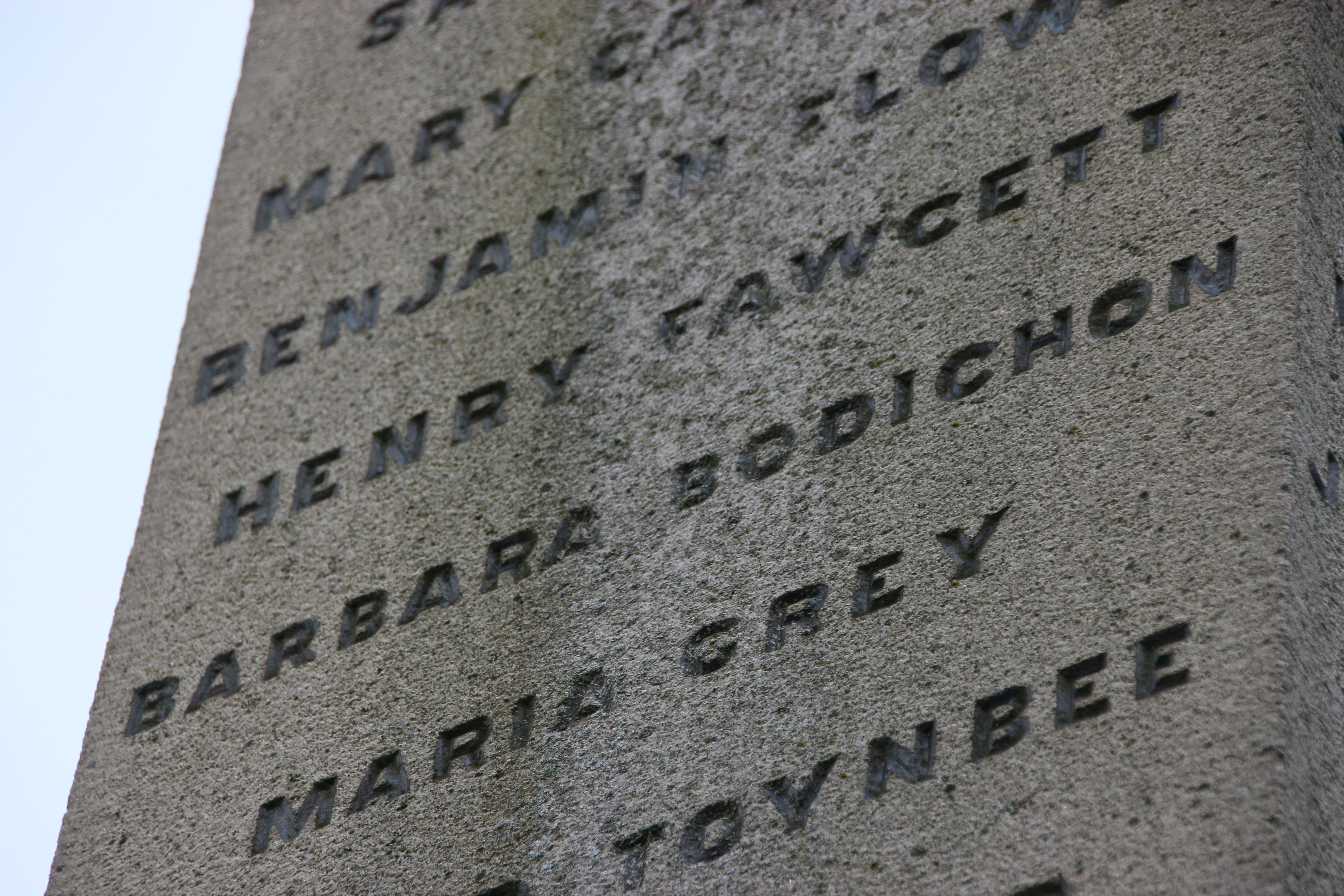
The Reformers’ Memorial stands in the non-conformist section of Kensal Green Cemetery in the London borough of Brent (Photo: Hannah Awcock).
The Reformers’ Memorial in Kensal Green Cemetery in Brent in north east London is a lesser-known memorial to 75 British reformers. Some of the better known include: Elizabeth Fry, prison reformer; Charles Bradlaugh, MP and atheist; John Ruskin, writer, artist, and social reformer; William Cobbett, parliamentary reformer; and John Stuart Mill, philosopher and political economist. Erected in 1858, the memorial was update in 1907, restored in 1997, and given Grade II listed status in 2001.
Kensal Green Cemetery was the first of the ‘Magnificent 7’, cemeteries established in the 1830s and 40s in what was then the suburbs of London to reduce overcrowding in inner city burial grounds. Highgate Cemetery, the final resting place of Karl Marx, was the third of the Magnificent 7 to be established, in 1839. Kensal Green Cemetery is well worth a visit in its own right, it has a peaceful, eerie beauty that contrasts sharply with the often manic atmosphere of modern London.
The Reformers’ Memorial is located in the non-conformist section of the cemetery, located close to the main entrance, near the crossroads of Harrow Road and Ladbroke Grove/Killburn Lane (I’m giving detailed directions because I had trouble finding the memorial–I entered the cemetery by a smaller gate, where they weren’t giving out maps).
The memorial and it’s pair, an obelisk dedicated to the memory of Robert Owen, stand out amongst the graves of Kensal Green Cemetery’s non-conformist section (Photo: Hannah Awcock).
The two memorials in around 1900. The Reformer’s Memorial only had 50 names inscribed on it at this point; the rest were added in 1907 by Emma Corfield (Photo: People’s Collection Wales).
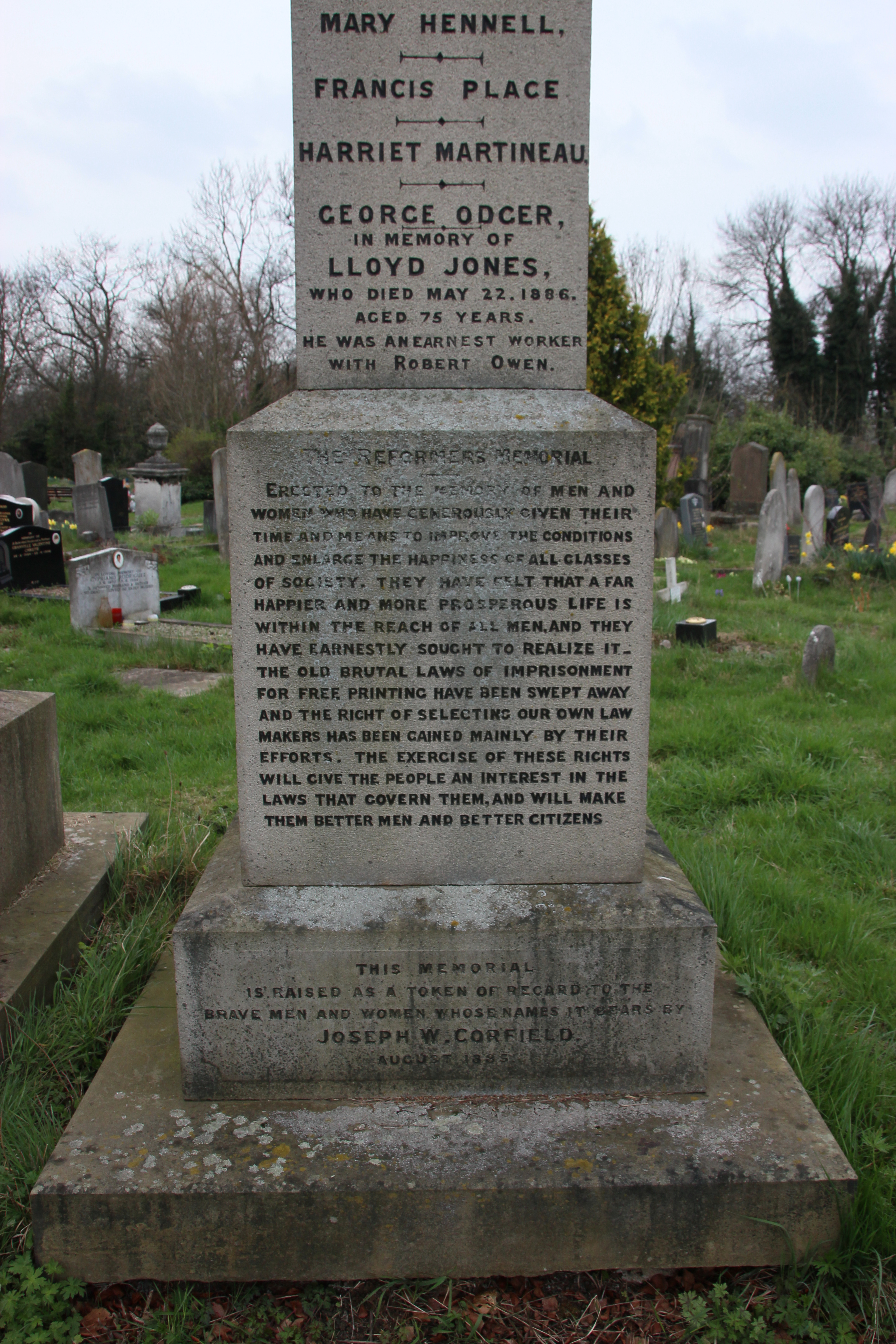
The memorial is a grey granite obelisk on a sandstone base, signed by J.S. Farley masons. It was erected in 1885 by Joseph William Corfield. The names of 50 well-reformers, “who have generously given their time and means to improve the conditions and enlarge the happiness of all classes of society,” were inscribed in the stone. Two decades later, in 1907, Joseph’s daughter Emma added a further 25 names. It is a pair to the Robert Owen memorial, a pink and grey granite obelisk erected in 1879, by public subscription organised by Joseph Corfield. Owen was a Welsh social reformer, and one of the founders of the cooperative movement. Both memorials were refurbished in 1997, at the instigation of Stan Newens, an MP and MEP for both the Labour and Co-operative parties. Both memorials were given Grade II listed status in 2001 for their “special architectural or historic interest” (Historic England, n.d.). It is unusual to have non-funerary monuments in a public cemetery, so the two memorials stand out in this regard too.
The main inscription of the Reformer’s Memorial (Photo: Hannah Awcock).
Radicals and activists place a great deal of significance on the past; historical movements, groups, and individuals, are a powerful source of inspiration, encouragement, and identity. Both the Reformer’s Memorial and the Robert Owen Memorial are a reflection of this appreciation of the past. They give us an insight into how late-Victorian non-Conformists perceived their radical history. The reformers listed on the memorial indicate who the Corfield family looked up (or back) to, and what kinds of behaviour and causes they were inspired by. Memorials are as much a reflection of the time in which they were produced as they are of the past they are representing, which is one of the things that makes them so interesting.
Some of the names on the Reformer’s Memorial are beginning to be obscured by the effects of the weather and time (Photo: Hannah Awcock).
I don’t imagine that the Reformer’s Memorial receives that many visitors. It’s a little obscure; even a stonemason working in the cemetery didn’t know what it was when I asked for directions. It is also starting to look a bit weathered, and some of the names at the top of the obelisk are partially obscured. I for one think this is a shame, so if you ever find yourself with a bit of time to kill in London, why not pay it a visit, and commemorate those who “felt that a happier and more prosperous life is within the reach of all.”
People’s Collection Wales, “Robert Owen Memorial Obelisk at Kensal Green Cemetery, London, c.1900.” No date, accessed 13th August 2017. Available at https://www.peoplescollection.wales/items/7192
In a previous On This Day post, I wrote about the death of PC Keith Blakelock in the Broadwater Farm Riots in 1985. He was only the second police officer to be killed in a British riot since 1833. In June 1919, Station-Sargeant Green died of injuries received during a riot of Canadian soldiers in Epsom. The officer killed in 1833 was PC Robert Culley, who was stabbed in the chest during the Coldbath Field Riot over 150 years before. The response of the public to the two deaths in 1985 and 1833 was vastly different, demonstrating just how much the Metropolitan Police’s reputation with Londoners has improved since its foundation in 1829.
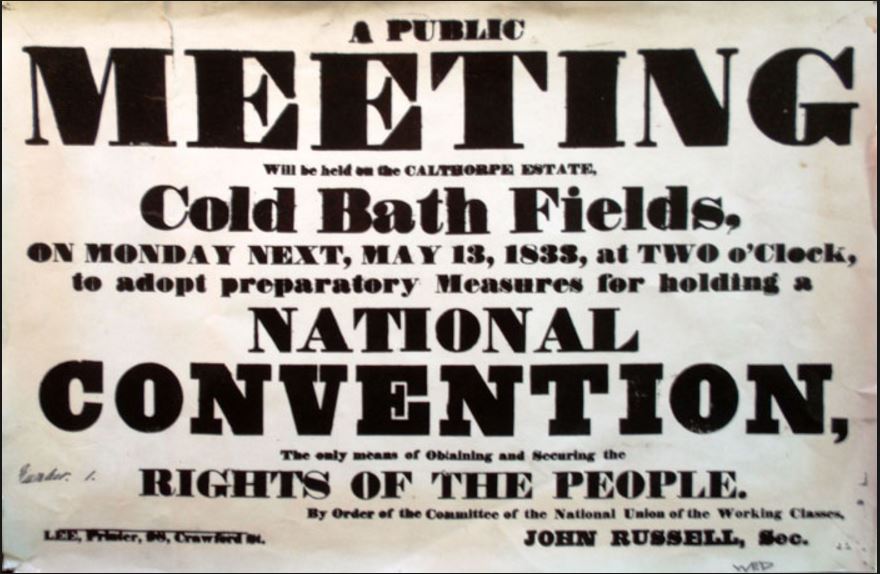
A poster advertising the protest that would become the Coldbath Fields Riots, produced by the National Union of the Working Classes.
The Coldbath Fields Riot on the 13th of May 1833 was the first major clash between radicals and the young Metropolitan Police. The National Union of the Working Classes (NUWC) organised a demonstration in Coldbath Fields in Islington against the 1832 Reform Act. The Reform Act increased the number of men allowed to vote, but only by a small amount, and it didn’t go far enough for the NUWC. The Home Secretary, Lord Melbourne, declared the meeting illegal, but it went ahead anyway. On the afternoon of the 13th of May a large crowd had gathered, listening to speeches given from the back of open wagons.
After a while, a large detachment of police arrived and began to clear the crowd. The high number of police officers raised tensions, leading to shouted insults. The police trapped some of the protesters in nearby Calthorpe Street, who then attempted to fight their way out. In the ensuing chaos, three police officers were stabbed; Sergeant John Brooks, PC Henry Redwood and PC Robert Culley. Brooks and Redwood both survived, but Culley only made it to the nearby Calthorpe Arms before he died.
FIGHT BETWEEN POLICE AND MOB AT COLDBATH FIELDS IN 1833 From: ”Mysteries of Police and Crime” by Arthur Griffiths, published by Cassell in London 1899
Robert Culley was one of the first men to join the Metropolitan Police, aged 23, when it was founded. Although the murderer wasn’t caught, the inquest into Culley’s death began two days later, in an upstairs room of the same pub where he died. The 17 men of the jury returned a verdict of Justifiable Homicide, arguing that the police had provoked the crowd with their violent approach to policing the protest. The men of the jury were local shopkeepers and householders, not radicals, and their verdict reflected the extensive mistrust and disregard that most Londoners felt for the Metropolitan Police at the time. Many resented the state intervention that the new force represented, and the jury became local heroes. The following month, a riverboat trip was arranged for them and their families to Twickenham, and crowds lined the river to cheer them on, despite heavy rain. In a similar way, George Fursey, the man who stabbed the other two police officers, was acquitted in his trial at the Old Bailey in July.
The public outcry and widespread condemnation after the death of PC Blakelock during the Broadwater Farm Riots could hardly seem more different to the reaction to the death of PC Culley 150 years before. The Metropolitan Police is not universally liked today, but it is hard to imagine the death of an officer during a protest receiving such a callous response. For better or worse, the police force has become part of the fabric of modern London in a way that might surprise an onlooker from the early nineteenth-century.
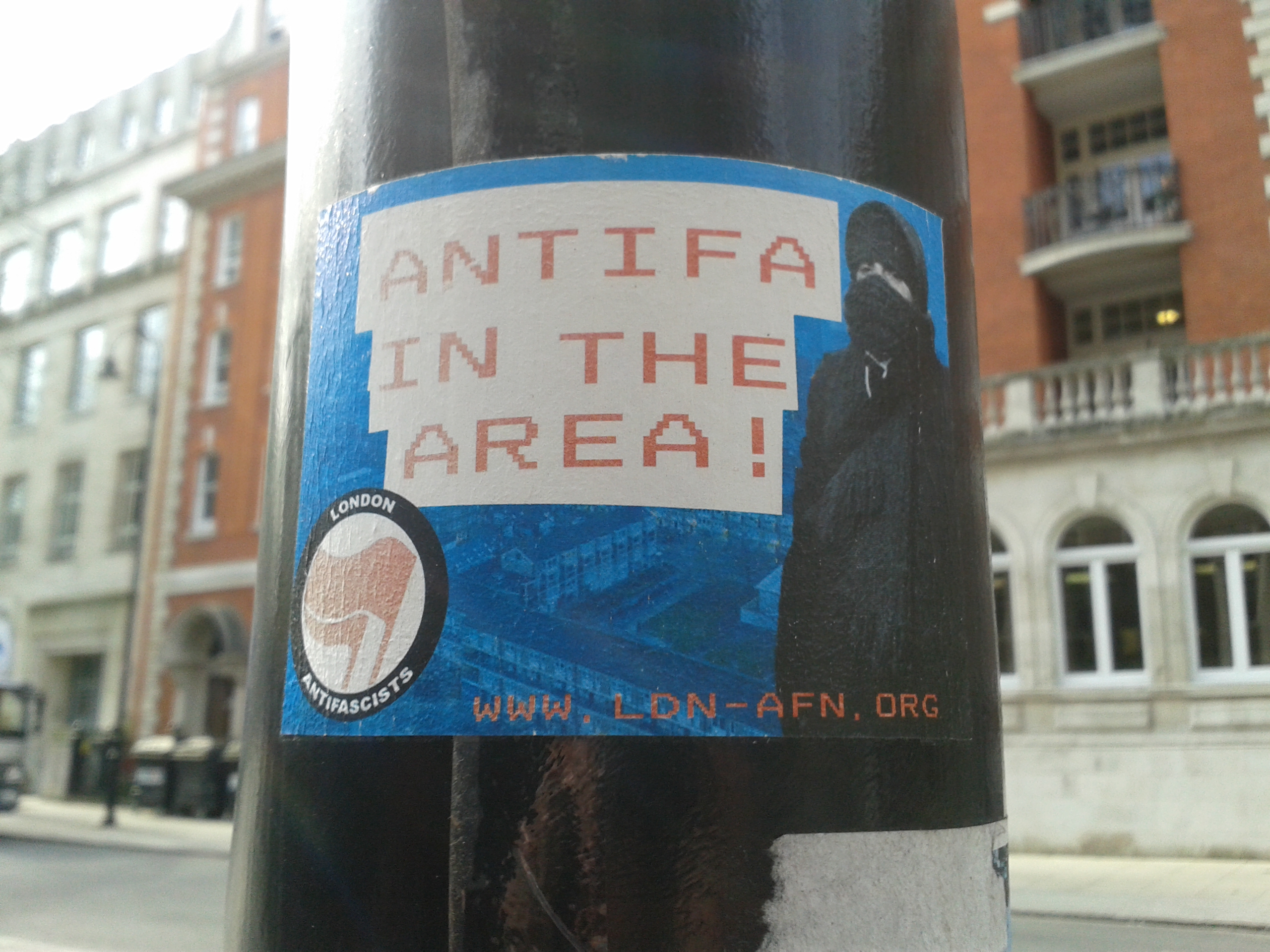
An anti-fascist sticker in front of the Cable Street mural (Photo: Hannah Awcock, St. George’s Gardens, 09/10/16).
Apart from anarchists, anti-fascist groups may be the most prolific sticker-ers that I have ever come across. So much so that they’ve provided me with enough material for a second blog post (the first post can be found here). In this post, I am focusing on the ways in which anti-fascist groups interact with, and make use of, history and geography. For many activists and social movements, the memory of past protests and events is an important source of inspiration and morale. This process is demonstrated by stickers that refer to significant moments in the history of anti-fascism. Geography also seems to be significant to anti-fascists, as many stickers refer to particular locations or local groups. It seems like anti-fascists might be as pre-occupied by time and space as geographers are!
The location of all the stickers featured in this post and others are marked here, on the Turbulent London Map.
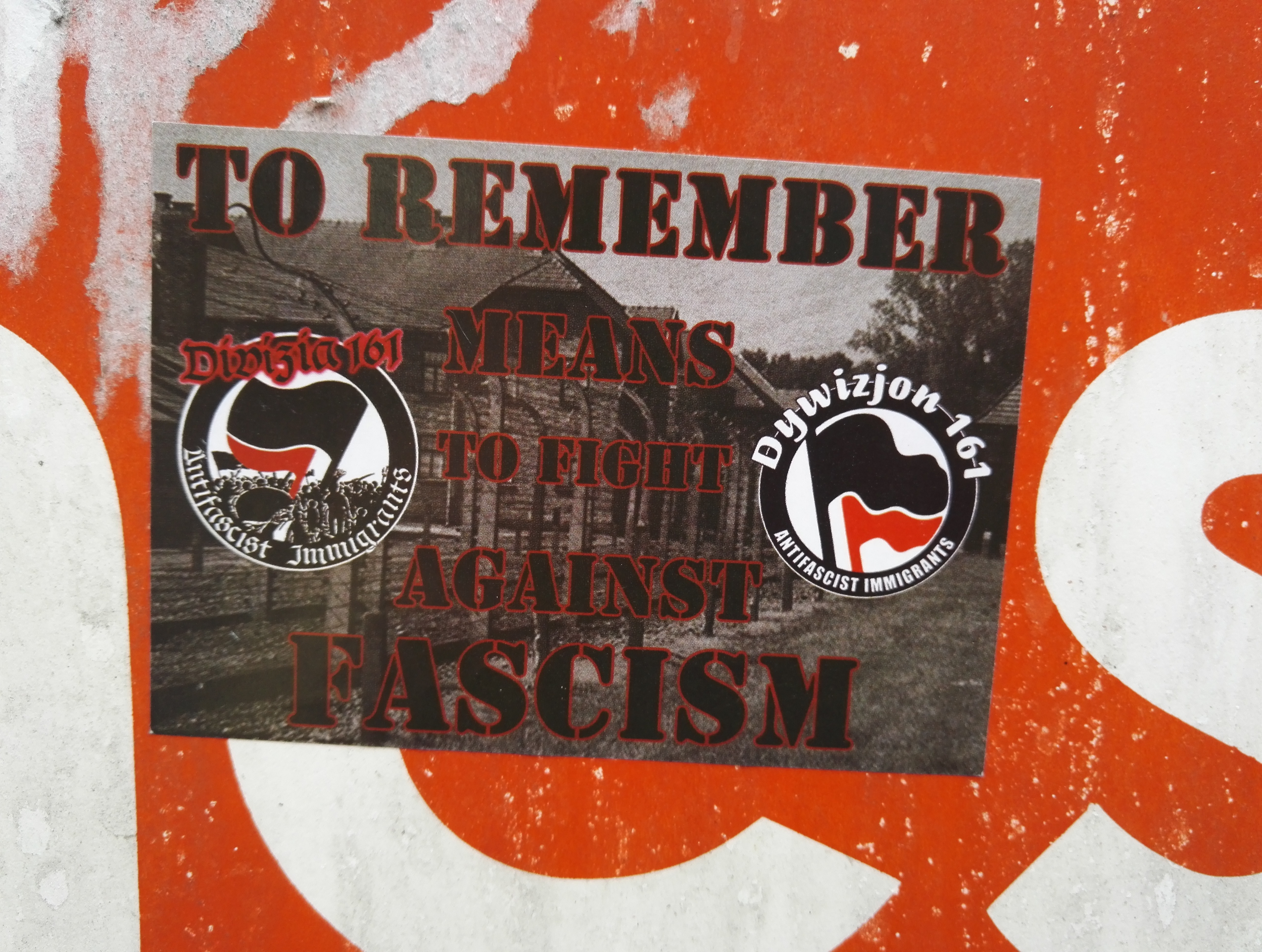
Based on the background of this sticker, I assume it is referring to the holocaust, a powerful reminder of the atrocious acts committed because of fascism. This sticker is one of those that appeared on Cable Street around the 80th anniversary celebrations of the Battle of Cable Street, a significant moment in anti-fascist history (Photo: Hannah Awcock, 09/10/16).
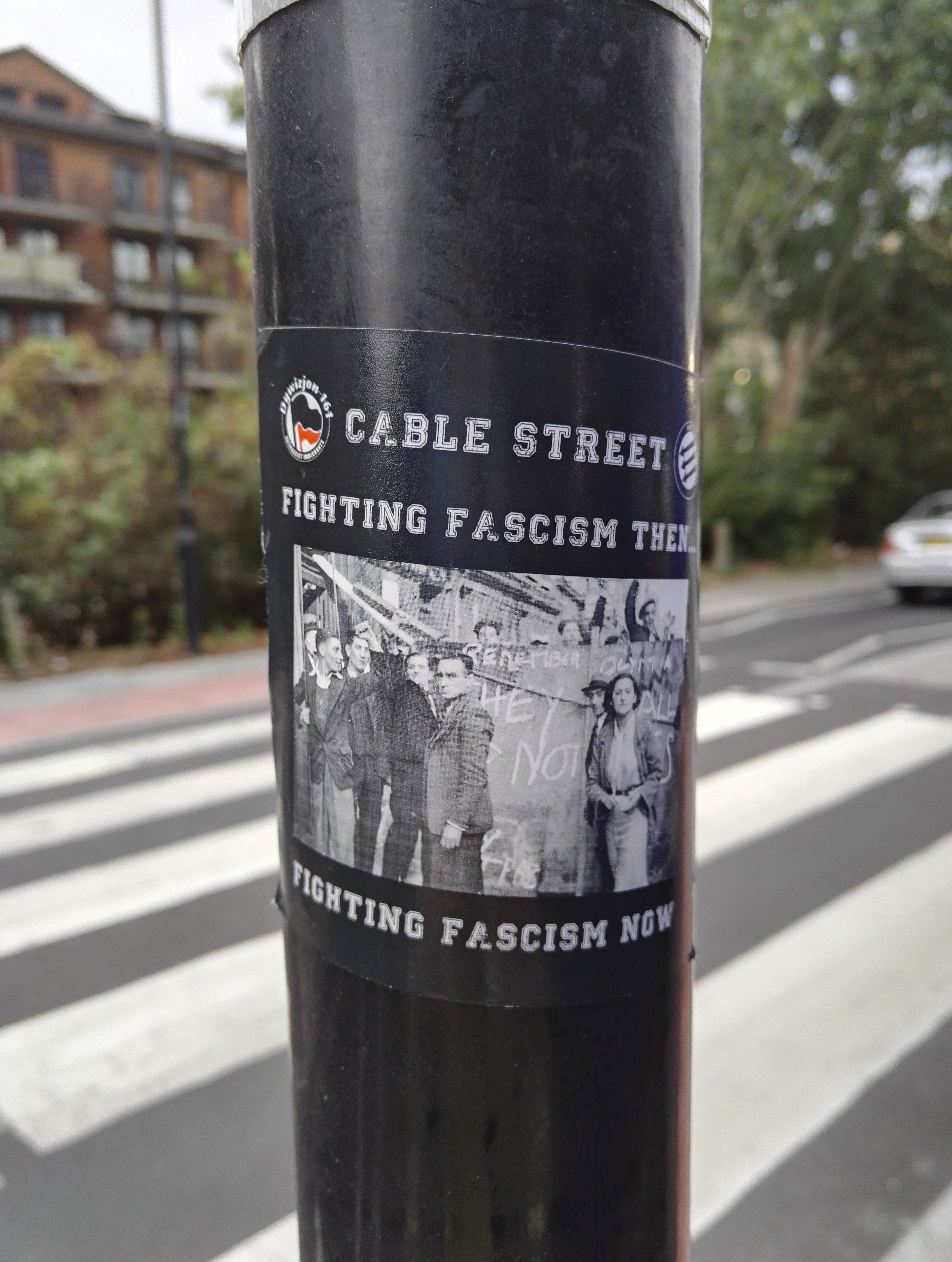
This sticker directly refers to the Battle of Cable Street, making a connection between past anti-fascist movements and present ones. I found this sticker in Cable Street itself, so the connection between past and present is even stronger (Photo: Hannah Awcock, 09/10/16).
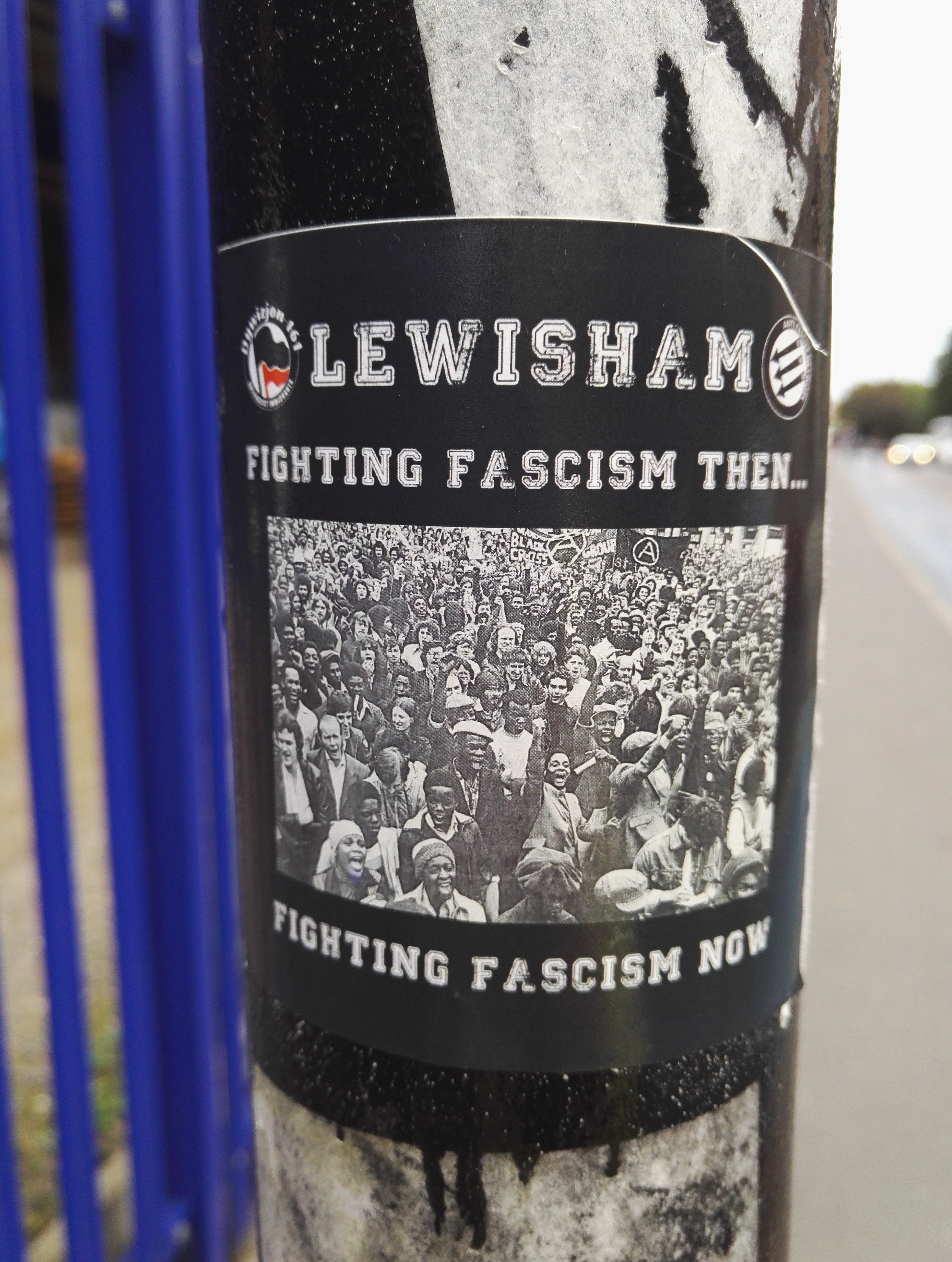
Using the same text and layout as the sticker above connects the Battle of Lewisham into this narrative of anti-fascism in London. On the 13th of August 1977, a National Front march in East London was met by counter-demonstrations, leading to violent clashes between the two groups and the police. There are striking similarities with the Battle of Cable Street (Photo: Hannah Awcock, 09/10/16).
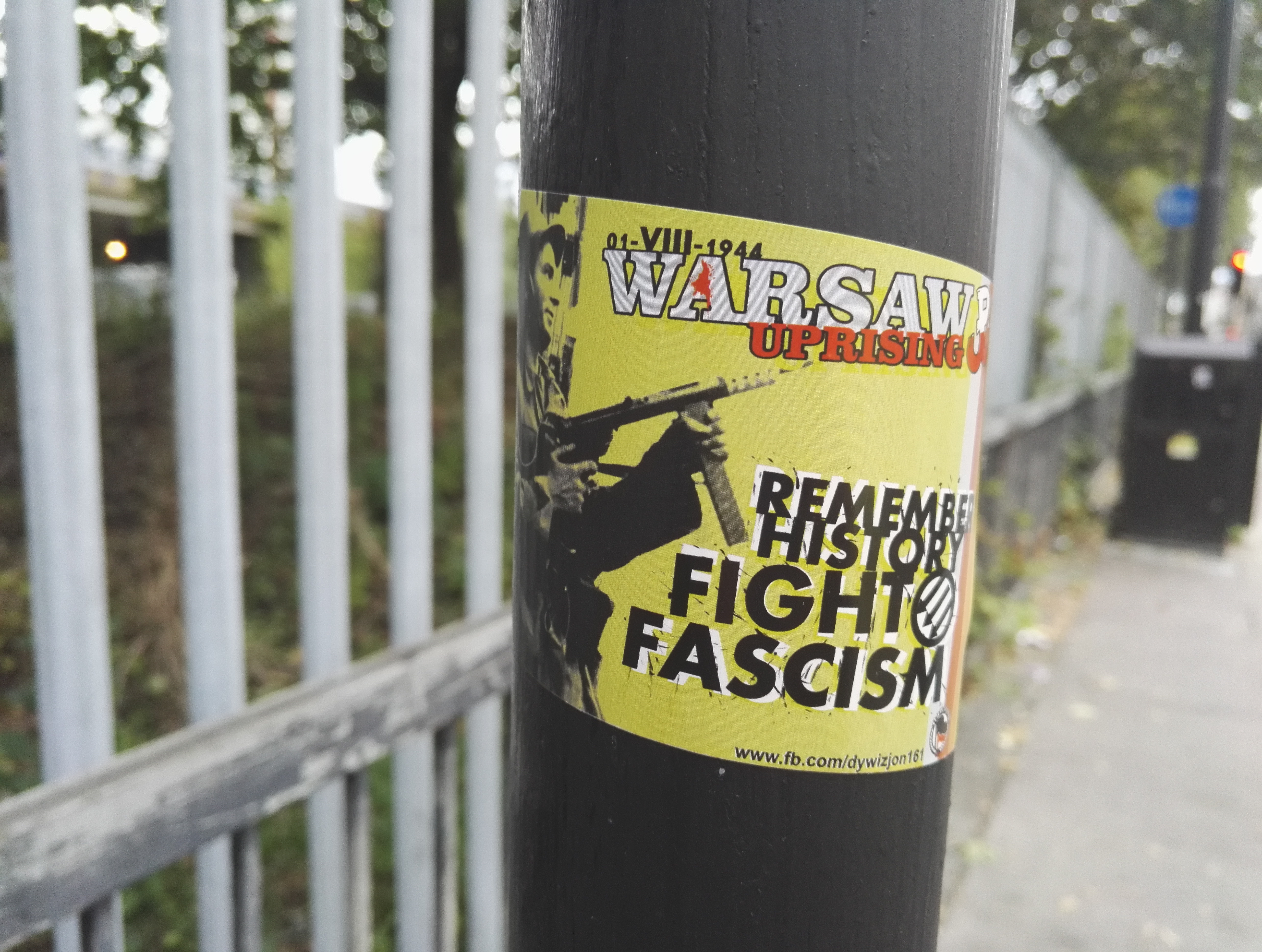
This sticker is also using the past to inspire modern-day anti-fascism, this time the Warsaw Uprising in 1944. The Polish resistance timed the uprising in occupied Warsaw to coincide with the advance of the Soviet Army, but the Russians halted their advance, leaving the resistance to face the German Army alone. They held out for 63 days before they were defeated (Photo: Hannah Awcock, Cable Street, 09/10/16).
This sticker is not making a direct connection between past and present ant-fascism, but it is referring to a victory in anti-fascist history. In July 1936 a military coup in Barcelona was thwarted by forces loyal to the government and members of an anarchist union. It was one of the events that contributed to the start of the Spanish Civil War (Photo: Hannah Awcock, New Cross Road, 20/03/16).
If history is important to anti-fascists, then so is geography. Anti-fascist groups often make stickers with their name and location on, placing them in their local area and when they travel to different towns and cities. This sticker was put up by the London Anti-fascists on their home turf, Euston Road (Photo: Hannah Awcock, 03/09/15).
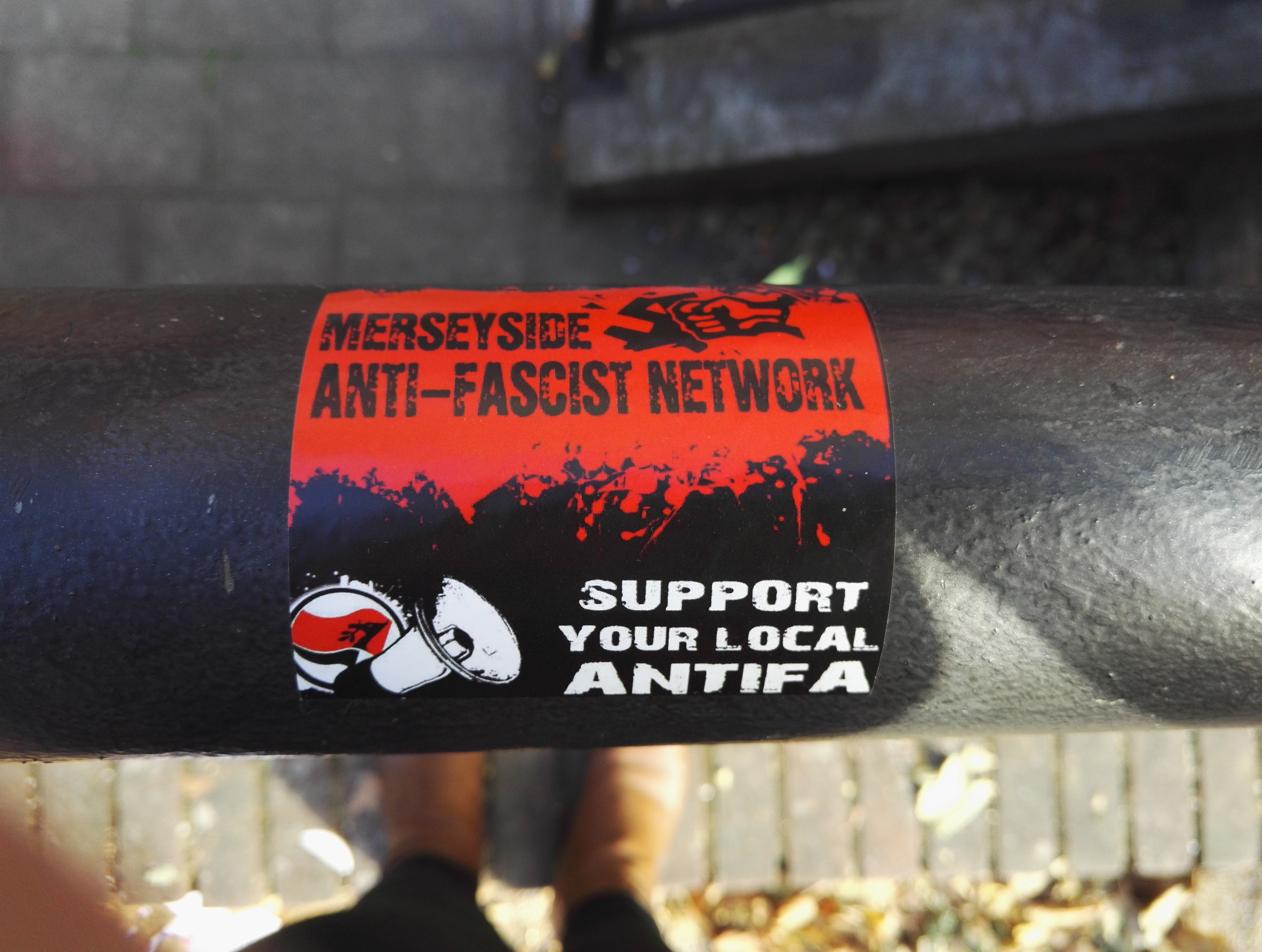
I found this sticker, produced by the Merseyside Anti-Fascist Network, in front of the Cable Street Mural after the 80th anniversary march of the Battle of Cable Street. I suspect that someone from the Network came to London for the anniversary, but didn’t want to leave without leaving their mark (Photo: Hannah Awcock, 09/10/16).
Some anti-fascist groups come from even further afield. This sticker is produced by the 161 Crew, a Polish group (Photo: Hannah Awcock, Elephant and Castle, 15/07/16).
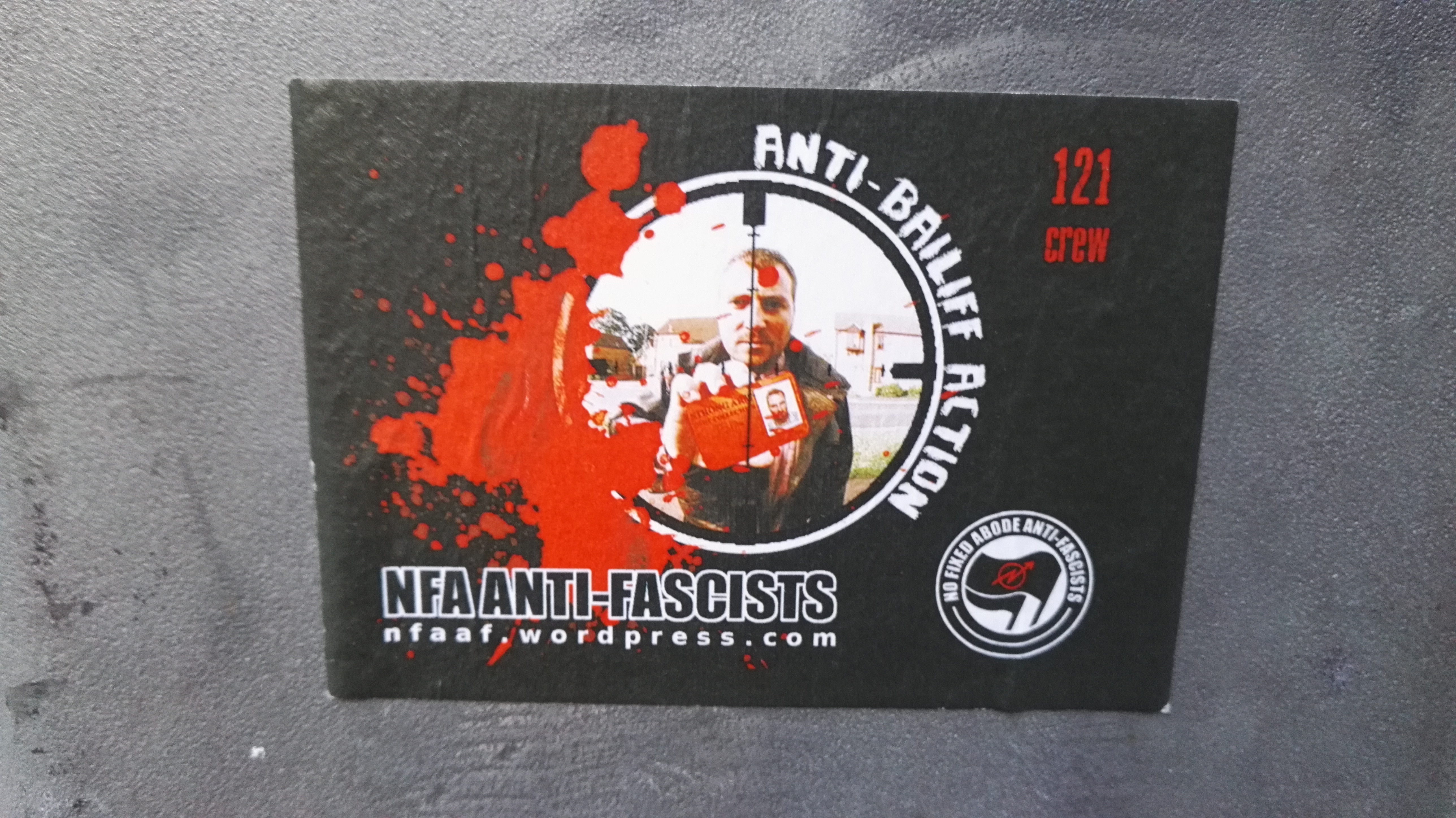
Most anti-fascist groups have a location, but the No-Fixed Abode Anti-Fascists are unusual. They are a group of squatters, travellers, and homeless people, focusing particularly on bailiffs (Photo: Hannah Awcock, Tavistock Square, 09/02/16).
Anti-fascist groups can sometimes be quite territorial, using stickers to declare certain areas ‘Anti-fascist zones’ or simply by making their presence known, as in this sticker (Photo: Hannah Awcock, Malet Street, 12/03/15).
The ‘We are the Lions’ Exhibition was at the Willesden Library in Brent from the 19th October 2016 until the 26th March 2017 (Source: Hannah Awcock).
The 20th of August 2016 marked the 40th anniversary of the start of the Grunwick strike, a 2-year dispute that was an important turning point in the history of trade unions and solidarity. Workers at the Grunwick photograph processing factory in Willesden, northwest London, walked out after an employee was fired for working too slowly. To celebrate the anniversary, a group called Grunwick 40 organised an exhibition about the strike at Willesden Library in Brent, which ran from the 19th October 2016, to the 26th March 2017. The exhibition was called ‘We are the Lions,’ taken from a quote by Jayaben Desai, one of the leaders of the strike. I finally managed to visit the exhibition in its last week, and I’m really glad I made the effort.
The exhibition was well balanced; it mentioned that Jayaben Desai was a leader of the strike, but didn’t devote too much attention to her. In fact, it didn’t spend much time on the leaders of the strike at all, which I thought was good; it is very easy to get distracted by charismatic leaders. Instead, the exhibition focuses on trade union politics and solidarity, detailing how the strikers won solidarity from a wide spectrum of workers. The factory owners refused to back down, however, and as the dispute dragged on the strikers were abandoned by union leaders, a sadly familiar story. The strike eventually failed, but it remained significant because it was the first time that migrant workers received widespread solidarity from British workers.
A banner designed by Jayandi and painted with Vipin Magdani for the Grunwick strikers in 1976 (Source: People’s History Museum NBS I/D 391).
The exhibition draws aesthetic inspiration from a distinctive banner produced for the strikers in 1976. It is owned by the People’s History Museum in Manchester, but it took centre stage at this exhibition. It was also part of the Disobedient Objects exhibition at the V&A museum in late 2014 and early 2015, so it might be familiar to some. There weren’t many objects in the exhibition; images of people, events, and texts were relied on heavily to illustrate the narrative. You do tend to expect objects when you visit a museum, but I realised that protests don’t often leave a lot of things behind, and what there is (banners, placards, clothing, flyers etc.) is ephemeral, and not intended to be kept or preserved. This must present a challenge for museums wanting to represent dissent.
The exhibition was firmly grounded in the local community, past, present, and future. There was a case of items putting the strike into the context of other radical events in Willesden’s history. There was a series of events associated with the exhibition, and its location in the local library made it quite accessible, although there are no guarantees that visitors to the library also went to the exhibition. There are also plans to produce a mural commemorating the strike, which will serve as a lasting legacy, long after the exhibition has been deconstructed.
Unfortunately, this post comes too late for me to encourage you to visit the exhibition. What I can do is congratulate the organisers for putting together such a brilliant exhibition. The Grunwick Strike was a key moment in the history of trade unions and solidarity. It often feels to me that solidarity is not something that we do so well anymore in modern society. We are the Lions was an timely reminder of how powerful it can be.
Turbulent Londoners is a series of posts about radical individuals in London’s history who contributed to the city’s contentious past, with a particular focus of women, whose contribution to history is often overlooked. My definition of ‘Londoner’ is quite loose, anyone who has played a role in protest in the city can be included. Any suggestions for future Turbulent Londoners posts are very welcome. The next Turbulent Londoner is Mary MacArthur, a suffragist and trade unionist.
Mary Reid Macarthur was a Scottish suffragist and trade unionist, who was instrumental in the expansion of female trade union membership in the early twentieth century. Born on 13th August 1880, Mary was the oldest of six children in a relatively well-off family. She attended Glasgow Girls High School, where she developed an interest in writing and journalism.
In 1901 Mary attended a meeting of the Shop Assistants Union, expecting to write a scathing report. She instead became a strong beleiever in trade unions, becoming secretary of the Ayr branch of the Shop Assistants Union. In 1902 she attended the Union’s national conference, where she became the first female to be elected to the national executive.
In 1903 Mary moved to London, where she became Secretary of the Women’s Trade Union League (WTUL), a congress for women’s unions. The League brought together women-only unions from a variety of different trades, which meant it had a mixed-classed membership. Through her activism, Mary realised that small, scattered unions would always struggle because of their inability to raise enough money to provide strike pay. To counter this, Mary founded the National Federation of Women Workers (NFWW) in 1906, a general labour union for women. It was open to all women who weren’t allowed to join the appropriate union, or who worked in trades that weren’t unionised. The NFWW became part of the National Union of General Workers in 1921, but in its 15 years it significantly advanced the cause of women in trade unions.
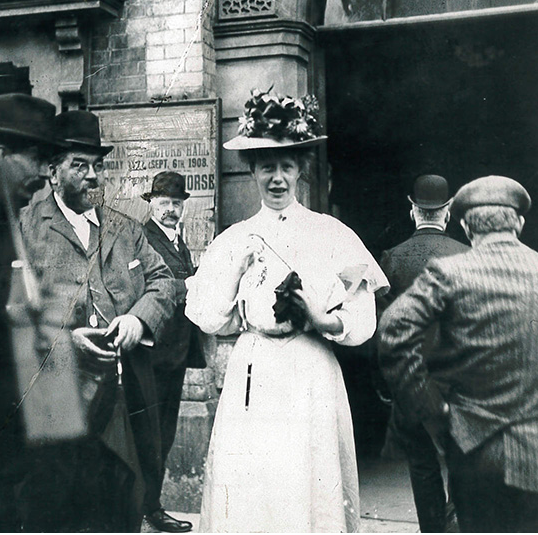
Mary Macarthur speaking to a mostly male crowd in Trafalgar Square about a boxmakers strike in August 1908 (Photo: TUC Library Collections).
Mary also tried to help female workers in other ways, helping to organise the Exhibition of Sweated Industries in 1905 and getting involved in the foundation of the Anti-Sweating League the following year. Sweated trades we’re characterised by long hours, low wages, and unsafe and insanitary working conditions. In 1907 Mary founded The Woman Worker, a monthly magazine for female trade unionists. She was a brilliant editor, but gave it up to concentrate on her activism. Mary spent time in the poorer parts of London collecting evidence about what it was like to work in sweated industries. She caught diptheria and spent 6 weeks in hospital, but she was able to present her findings to the Select Committee on Home Working in 1908.
Mary was also active in the campaign for the vote, although she opposed the National Union of Women’s Suffrage Societies and the Women’s Social and Political Union, the two main campaign groups. This was because they were willing to accept only certain groups of women bring given the vote. Mary believed this would disadvantage the working classes, and possibly delay universal adulthood suffrage.
Mary Macarthur at the Trade Union Congress in Nottingham in 1908 (Source: TUC Library Collections).
The Trades Board Act was passed in 1909, largely due to the efforts of Mary and the organisations she worked with. The Act regulated sweated industries and introduced a minimum wage. The female chainmakers at Chadley Heath in the West Midlands became the first test case of the new Act in 1910. Mary convinced the women to fight for the wage they were entitled to; they won the dispute after a 10 week strike. Mary used her skills as a journalist to publicise the women’s cause, giving interviews, writing copy and arranging photo opportunities of the striking women with chains around their necks. She also made use of the new technology of cinema; a Pathe newsreel film of the strikers was seen by an estimated 10 million people. The publicity campaign raised a lot for the strike fund, the leftovers were used to build the Bradley Heath Worker’s Institute, which is now part of the West Country Living Museum.
Mary opposed the first world war, but she worked throughout it to promote the rights of female workers, campaigning for equal pay for equal work. She was a member of the Reconstruction Committee from 1916, set up to give advice on the employment of women after the war. Female trade union membership tripled during the war. After the war, Mary stood in the 1919 general election as the Labour candidate for Stourbridge in Worcestershire but was defeated, along with most other anti-war candidates.
Mary married William Crawford Anderson, the chairman of the executive committee of the Labour Party, in 1911. Anderson had first proposed marriage almost 10 years earlier, but Mary had decided to concentrate on her activism. Sadly their first child died at birth in 1913, but Anne Elizabeth was born in 1915. William died in the 1919 influenza epidemic. Mary herself died of cancer 2 years later, at the age of just 40.
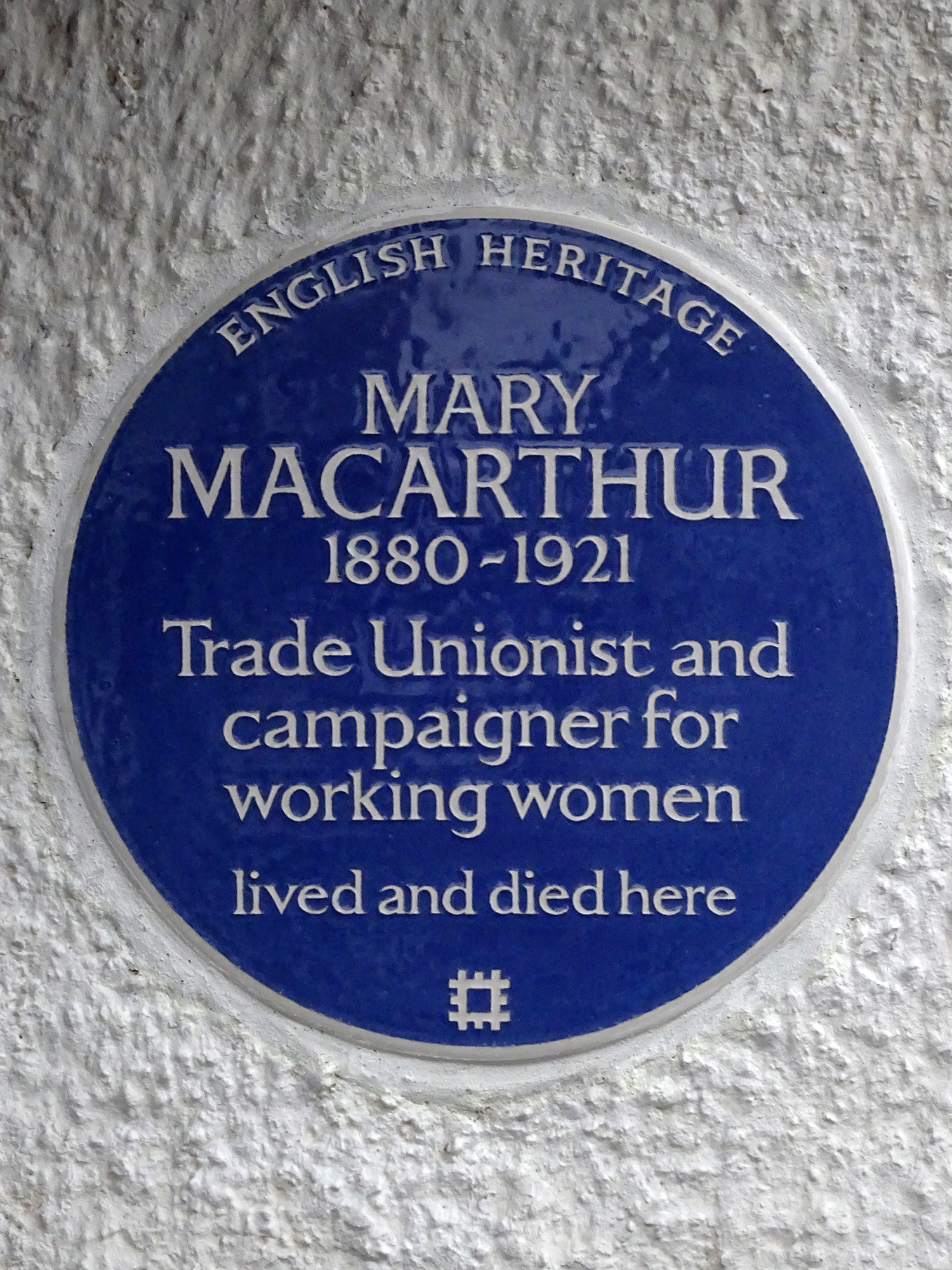
Blue plaque erected on 7th March 2017 by English Heritage at 42 Woodstock Road, Golders Green, London NW11 8ER, London Borough of Barnet. “MARY MACARTHUR 1880-1921 Trade Unionist and campaigner for working women lived and died here” (Source: Spudgun67).
Mary’s legacy lives on in the Mary Macarthur Holiday Trust and the Mary Macarthur Educational Trust, which provide grants to working women. A blue plaque commemorating Mary’s campaigning efforts on behalf trade unions and working women was installed on her house in Golders Green in north London in March 2017. As such, it might be said that she is better remembered than some of the other Turbulent Londoners featured on this blog. She deserves this recognition however, because of her huge contribution to the cause of women’s working conditions.
The TUC has an online exhibition about the life of Mary Macarthur that you can download HERE.
Turbulent Londoners is a series of posts about radical individuals in London’s history who contributed to the city’s contentious past, with a particular focus of women, whose contribution to history is often overlooked. My definition of ‘Londoner’ is quite loose, anyone who has played a role in protest in the city can be included. Any suggestions for future Turbulent Londoners posts are very welcome. The 20th Turbulent Londoner is Jayaben Desai, the fierce and inspirational leader of the 1976-8 Grunwick Strike.
Throughout it’s history, London has relied on immigration to function. Jayaben Desai was one such immigrant, who refused to accept the long hours, low pay, and poor working conditions that have also been a feature of London for most of it’s history. She was one of the most prominent leaders of the Grunwick Strike, which
Born on 2nd April 1933 in the north-western state of Gujarat in India, Jayaben was defiant and headstrong from an early age. At school, she rejected passive obedience in favour of supporting the Indian independence movement. In 1955 she married Suryakant Desai, a tyre-factory manager from Tanganyika. The couple settled there in 1965, by which point the country had united with Zanzibar to become Tanzania. East African Asians were members of the mercantile and administrative classes, and Jayaben had a comfortable lifestyle. It did not last however, the Desais were expelled along with tens of thousands of others as part of “africanisation” policies. They fled to Britain and settled in the north London borough of Brent. The couples’ socio-economic status dropped considerably; Suryakant got a job as an unskilled labourer and Jayaben worked part time as a sewing machinist whilst bringing up their two children, Shivkumar and Rajiv. In 1974 Desai started work at the Grunwick factory which processed mail order photographic film.
Two years later, on 23rd August 1976, Jayaben walked out of the Grunwick factory. The final straw was being ordered to work overtime; she persuaded 100 of her colleagues to go with her. Jayaben was known for having a way with words; she apparently told her manager: “What you are running is not a factory, it is a zoo. But in a zoo there are many types of animals. Some are monkeys who dance on your fingertips. Others are lions who can bite your head off. We are those lions, Mr Manager.”
Jayaben is known as being a trade unionist, but I don’t think that really does justice to what her and her colleagues achieved. They were not members of a union when they first walked out, the Trades Union Council advised them to join Apex, a white collar union that is now part of the GMB. The strikers were also mainly Asian and women, two groups who did not have a strong tradition of striking in the past.
Another factor which set the Grunwick strike apart was the solidarity that the strikers received from employees in other workplaces and industries. Newly arrived migrants accepted (and still do) long hours and low pay because they had no choice. This has frequently caused resentment amongst British workers. The Grunwick strikers, however, received significant moral and practical support from other workers. For example, postal workers in the local sorting office in Cricklewood refused to handle Grunwick’s post. As the factory processed mail-order photographs, this move almost won the strike for Jayaben and her colleagues. In November a High Court ruling forced the postmen to start handling Grunwick post again, a big blow to the strikers. The strike committee visited more than 1000 workplaces around the country garnering support- many workers came to join the picket lines outside the factory. On 11th July 1977 the TUC organised a 20000 strong march to the factory. The workers at Cricklewood again refused to handle Grunwick’s mail. They were suspended for 3 weeks for their defiant act of solidarity.
The Labour Prime Minister, James Callahan, persuaded the TUC and Apex to allow a court of inquiry under Lord Justice Scarman to resolve the dispute. It was highly unusual for employers to defy the conclusions of inquiry, but Jayaben was convinced that Grunwick’s managing director, George Ward, would. She was right; Scarman recommended that the strikers be given their jobs back and that their union be recognised. Ward refused. With few options left and almost two years of hardship behind them, the strikers conceded defeat on 14th July 1978.
After the strike, Jayaben’s health declined. She got another sewing job, which led to teaching for the Brent Indian Association, and she developed an Asian dressmaking course at Harrow College. She passed her driving test aged 60, and when her husband retired the couple traveled extensively. She passed away on 23rd December 2010.
At just 4ft 10in, Jayaben Desai shocked many with her strength and resolve. She was inspirational, and known for her charm, tact, and diplomacy, even in the face of aggression and threatening behaviour from police and the Grunwick bosses. Although the Grunwick strike failed, it had a big impact on industrial relations for women and ethnic minorities, forcing the union establishment to taken them seriously for the first time. Whilst Jayaben did not do this alone, her bravery and determination should be remembered, celebrated, and learnt from.
2016 was the 40th anniversary of the start of the Grunwick strike. The Grunwick40 group was set up to commemorate this event. They organised events, a museum exhibition, and a mural. More information can be found about their work here.


















 Turbulent Isles