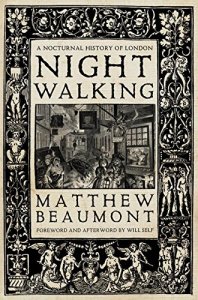
Matthew Beaumont. Nightwalking: A Nocturnal History of London. London: Verso, 2015. £9.99
Nightwalking by Matthew Beaumont is an exploration of London at night through the eyes of the men (and it is all men) who wrote about it. Starting with Chaucer, Beaumont traces evolving societal attitudes to night time and darkness in the city. He ends the book with Dickens (well, sort of- Edgar Allen Poe features heavily in the conclusion), “the great heroic and neurotic nightwalker of the nineteenth century” (Beaumont, 2015; p.6). The writers Beaumont studies walked the line between polite society and the world of the social outcasts; the prostitutes, criminals, orphans, and homeless who inhabited London’s streets after dark. Some writers managed the balance better than others.
Who walks the streets alone at night? The sad, the mad, the bad. The lost, the lonely. The hypomanic, the catatonic. The sleepless, the homeless. All the city’s internal exiles.
Beaumont, 2015; p.3
When I first got Nightwalking, I was a little disappointed to realise that it had a literary focus. I like to read, but I’m not a fan of literary analysis; perhaps there are too many bad memories from GCSE and A-Level English Literature. I thought Nightwalking was a straight social history, and I wasn’t sure I would enjoy the literary angle.
I needn’t have worried. Beaumont uses the cultural history of the London night to explore its social, political and economic history. He strikes a nice balance between detailed textual analysis and wider contextual discussion. The social and legal discourses surrounding those who wander the streets of the city at night have developed over time, but in an uneven manner. For hundreds of years, being caught outside after dark was a criminal offence. As society and technology developed, the night became a space of recreation, initially just for the wealthy; the evolution of cheap and effective street lighting is one factor that contributed to this process. Although the legal restrictions faded, moral restrictions remained, dictating which kinds of activity, and which kinds of people, were acceptable on London’s streets after dark.
London’s writers were drawn to this moral ambiguity, taking to the streets at night in order to better understand the city or themselves, to have a good time, and sometimes because they had no choice. Men such as Chaucer, Shakespeare, Johnson, Blake, and Dickens “used the night as a means of creatively thinking the limits of an increasingly enlightened, rationalist culture” (Beaumont, 2015; p.10). Beaumont balances all the contradictory and sometimes vague associations and motivations for nightwalking well, explaining his arguments in a clear and concise manner. It is obvious to me that Beaumont is an academic, and that the book is based on extensive scholarly research, but I don’t think that the book would be unapproachable to non-academics, although another reviewer has said his style can be “cloudily academic.”
Nightwalking is a well-researched, well-reasoned book that manages to tell a complicated story in a way that is easy to follow. I can see this book being useful to students of English Literature and History alike, but I would also recommend it to those who just enjoy reading a good book.
In August 1918, female tram conductors in Willesden started a wildcat strike which quickly spread around the country and to other sectors of public transport. Initially demanding the same war bonus that had been given to men, their demands morphed into equal pay, over 40 years before the Equal Pay Act.
During the First World War, women took over many of the jobs that had previously been done by men. Public transport was one area where female employees became key. By the end of the war, the London General Omnibus Company employed 3500 women, and thousands more were employed by other bus and train operators in London as well as on the Underground. Lots of women joined unions, but the unions were more interested in protecting the long-term job security of men rather than the employment rights of women. The unions wanted to make sure that men could return to their pre-war jobs with the same working conditions when the war finished, so they didn’t want women to get too comfortable. In addition, both unions and management refused to entertain the idea of equal pay, arguing that the work that women did was not worth the same as men’s.
In mid-1918, male workers were given a 5 shilling a week wartime bonus to help cope with the increased cost of living. Women were not given this bonus, and some workers in London were not willing to accept this. On the 16th of August, a meeting of women at Willesden bus garage decided to go on strike the following day, without informing their bosses or unions.
The next morning, they were quickly joined by women at the Hackney, Holloway, Archway and Acton depots and garages, and the strike continued to spread throughout the day. At first the women demanded the same 5 shilling per week bonus as men, but their demands soon escalated to equal pay, and they adopted the slogan ‘Same Work- Same Pay.’
By the 23rd of August, female bus and tram workers around the country had joined the strike, including in Bath, Bristol, Birmingham, Brighton, and Weston-super-mare. Some women working on the London Underground also joined the strike- it mainly affected the Bakerloo Line. It is estimated 18000 out of a total 27000 women working in the public transport industry participated.
The strikers held a series of mass meetings at the Ring, on Blackfriars Road in Southwark. It was a boxing arena that had been destroyed by aerial bombing. Many women brought their children and picnics with them. The strike was settled on the 25th of August after a contentious meeting at the Ring- many women did not want to go back to work. The tube workers didn’t go back to work until the 28th. The women won the 5 shilling bonus, but not equal pay.
The Equal Pay Act was passed in 1970 but even now, almost a hundred years after the women transport workers’ strike, women are not paid the same as men for the same jobs. London’s female public transport workers were some of the first to make a demand that is still yet to be fully realised. Without the aid of the experienced unions, the women were able to win the same bonus as men, if not the same wage. Little is known about how the women organised, which is a shame, although it might make a very nice research project!
Welsh, Dave. “The 90th anniversary of the Equal Pay strike on the London Underground.” Campaign Against Tube Privatisation- History. No date, accessed 15th June 2016. Available at http://www.catp.info/CATP/History.html
Turbulent Londoners is a series of posts about radical individuals in London’s history who contributed to the city’s contentious past, with a particular focus of women, whose contribution to history is often overlooked. My definition of ‘Londoner’ is quite loose, anyone who has played a role in protest in the city can be included. Any suggestions for future Turbulent Londoners posts are very welcome. My next Turbulent Londoner is Ada Salter, a social reformer, environmentalist, and pacifist, who became the first female mayor in London.
A statue of Ada Salter in Rotherhithe, London. It is by artist Diane Gorvin (Source: Loz Pycock).
Ada Salter was a strong-willed and radical woman, who dedicated her life to the people of Bermondsey. Originally moving there as a charity worker, she became a local councillor and eventually mayor, the first in London (Daisy Parsons became Mayor of West Ham in 1936, 14 years after Ada). Born Ada Brown on the 20th of July 1866 in Raunds, Northamptonshire, Ada was an active Methodist and member of the radical wing of the Liberal Party from an early age. In 1896, aged 30, she moved to London to work as a ‘Sister of the People’ in the St. Pancras slums. The following year she moved to the Bermondsey Settlement, and joined the community which she would spend the rest of her life fighting for.
The Settlement movement started in the 1880s, and encouraged the rich and poor to live closely together in interdependent communities. Volunteers lived in the Settlements and shared knowledge and culture with their low income neighbours, as well as alleviating poverty. The Bermondsey Settlement was founded in 1892, and stayed open until 1967. Ada worked with young women, and was admired for her ability to get through to them. Whilst at the Settlement Ada met Dr. Alfred Salter, whom she persuaded to convert to Christianity and join the Liberal Party (he was previously a socialist). They were married on the 22nd of August 1900.
After the Salters’ marriage Ada wanted to stay in Bermondsey, so Alfred set up a GP practice in Jamaica Road, whilst Ada continued to work at the Settlement. In 1902 the couples’ only child, Ada Joyce, was born. Four years later Ada left the Liberal Party because they reneged on their promise to grant women the vote. She joined the International Labour Party (ILP) and co-founded the Women’s Labour League (WLL). The ILP was the best party in regards to womens’ rights, and they wanted to stand female candidates at the next local council elections, including Ada. As a Liberal Councillor for the London County Council, Ada’s move must have put her husband in an awkward position. He supported her, however, and eventually joined her, founding a Bermonsdey branch of the ILP in 1908.
In November 1909, Ada was elected the first female and first Labour councillor in Bermondsey. Tragedy struck the following year when Ada Joyce was killed by scarlet fever in one the periodic epidemics that swept through the overcrowded community. The Salters’ had made the conscious decision not to send their daughter away from Bermondsey to protect her health. Joyce attended the local Keeton’s Road School, and caught scarlet fever 3 times in her 8-year life. It was an admirable decision to keep their entire family within Bermondsey, but the guilt after Joyce’s death must have been overwhelming.
Devastated, Ada threw herself into her political and charity work. She started to recruit local female factory workers into the National Federation of Women Workers. At first there was little response, but in August 1911, 14000 women struck for, and won, better working conditions. Ada was hailed as the inspiration of the ‘Bermondsey Uprising,’ although in fact she was only one contributing factor. She continued to support worker’s disputes, setting up food relief points during strikes. Ada became National Treasurer of the WLL, and President in 1914. The WLL wasn’t affiliated to any specific suffrage movement, but Ada supported the non-violent Women’s Freedom League (she was friends with the President, Charlotte Despard). The Salters had become Quakers in the early 1900s, which had solidified Ada’s commitment to non-violence.
After the start of the First World War the Salters’ dedicated themselves to campaigning against it. Ada was a founding member of the Women’s International League for Peace and Freedom, and they both worked for the Non-Conscription League from 1916. They used their house in Kent to help conscientious objectors recover from harsh treatment in prison. In 1915 the government prevented Ada from attending the Hague Peace Conference, but she did make it to Bern, Switzerland to represent the ILP at a conference of socialist women opposed to the war. Vocally opposing the war was an incredibly brave stance to take, and the Salters were threatened and abused for their views.
Whilst in the WLL Ada conducted research into social housing; she advocated replacing slums with council houses designed to suit the needs of working class women. She also believed that fresh air and nature helped physically, mentally, and morally, so advocated urban gardening and pioneered organised campaigning against air pollution in London. In 1919 Ada was re-elected to Bermondsey Council, and in 1920 she launched the Beautification Committee, which went on to plant 9000 trees and 60000 plants.
In 1922 Ada was made Mayor, which gave her the power to launch a housing campaign. She demolished slums, and beautified those that couldn’t be knocked down with window boxes, trees and flowers. Also believing in the ‘beautification’ of the individual, Ada organised cultural and sporting events across the borough. She finally managed to get her perfect council housing built in Wilson Grove, small cottages inspired by the Garden City movement. They were too low density to really be a solution to housing problems in London, but the small estate was successful, and still stands today.
Despite the risks, the Salters’ refused to leave Bermondsey at the outbreak of the Second World War. Their house was bombed in 1942, and Ada died on the 4th of December 1942. Ada Salter was a brave and determined woman who dedicated most of her life to the community of Bermondsey. She didn’t compromise, even refusing to wear the mayoral chain because it contradicted her Quaker beliefs. She is an important figure in local London history, and her perspectives on social housing are still relevant today, as the fight for affordable housing in the capital increases in intensity.
Ben Judah. This is London: Life and Death in the World City London: Picador, 2016. £18.99
This is London: Life and Death in the World City is the latest in a long line of books that try to say something new about one of the most written about cities in the world. Ben Judah does this by trying to get to know London’s immigrants, the people who make up almost half of the city’s population, but who only ever get talked about with scaremongering statistics and dehumanising metaphors. It takes all sorts to make a city, and Judah talks to all kinds of people in this book; the wife of a Russian oligarch, a Nigerian policeman, a Polish builder, Filipina maids, a Polish registrar, Afghani shopkeepers, a Nigerian teacher.
I was born in London but I no longer recognize this city. I don’t know if I love the new London or if it frightens me: a city where at least 55 per cent of people are not ethnically British, nearly 40 per cent were born abroad, and 5 per cent are living illegally in the shadows. I have no idea who these Londoners are. Or even what their London really is.
(Judah, 2016; p.3)
This is London starts in the same place that many European migrants arrive in London; Victoria Coach Station- “our miserable Ellis Island” (Judah, 2016; p.1). It ends where some of the city’s one million Muslim inhabitants (according to the 2011 census) end their lives; the mortuary of a mosque in Leyton. It covers a large number of major life events and experiences in between; marriage, birth, employment, illness, faith, and recreation. The book has no introduction or conclusion, which I think is fitting. This is not a story with a nice neat beginning and ending, it is not even a single story. When I review books about London, I try to find a quote in which the author summarises London. I couldn’t find one in This is London. London is complex, multiple, and heterogeneous, it is almost impossible to sum it up. Ben Judah doesn’t offer any solutions or grand plans, he tells stories, and allows the reader to interpret them.
Unfortunately, I have some serious issues with This is London. The biggest is Judah’s ethics and attitudes towards his interviewees. On several occasions he lied to the people he was talking to about who he was, covering up the fact he is a journalist. When he visits Harlesdon Road to try and talk to some of the customers of London’s 1773 betting shops, he has little success until he pretends to be conducting a survey for William Hill (Judah, 2016; p.294). As an academic, I am horrified by the prospect that some people were trusting Judah with their stories, some of them highly personal and traumatic, without knowing what he was going to do with them. Maybe journalists don’t care about informed consent, but I do.
There are other points where Judah seems to relish his power over his interviewees in a way that made me feel very uncomfortable. In the first chapter he follows three recently arrived Roma women from Victoria Coach Station all the way to Hyde Park because he wanted to talk to them. He continued to follow them even once they realised they were being followed. Judah eventually forces a Romanian busker to talk to him, saying “I know he wants to leave but I won’t let him. I have power over him for a few seconds. And I want him to speak” (Judah, 2016; p.8). Later on, he talks to some prostitutes in Ilford Lane, paying them to talk to him. They sit in his car, as one woman, Diana, talks about another woman who was murdered there. He seems to enjoy forcing the second woman to talk; “I know she does not want to talk about this. That she would rather I just fucked them both- or hit them, the way some of the men enjoy doing- than ask about what happened to Mariana. But I don’t care. And I gesture. I want you to talk now” (Judah, 2016; p.370). He exploited the women’s vulnerability in a way that I find completely unacceptable.
I have conflicted feelings about This isLondon. I really enjoyed the stories the book tells, and reading about parts of London that are completely unfamiliar to me. However, I cannot condone Judah’s methods in obtaining some of these stories; he was unethical, insensitive, and exploitative. Because of this, I think there are other books out there that do similar things to This is London, better. For example, Londoners: The Days and Nights of London Nowby Craig Taylor (London: Granta, 2012), provides snapshots of what it’s like to live and work in London without making me feel deeply uncomfortable. I would recommend it much more highly than This is London.
Turbulent Londoners is a series of posts about radical individuals in London’s history who contributed to the city’s contentious past, with a particular focus of women, whose contribution to history is often overlooked. My definition of ‘Londoner’ is quite loose, anyone who has played a role in protest in the city can be included. Any suggestions for future Turbulent Londoners posts are very welcome. This post is about Mary Prince, a woman who escaped slavery to become a key figure in the campaign to abolish slavery.
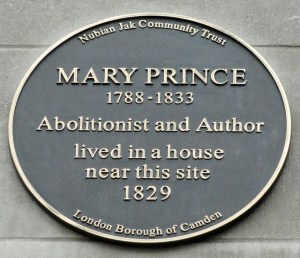
There are no surviving images of Mary Prince, but this plaque, on Senate House in Bloomsbury, commemorates her (Source: Peter Hughes).
In 1807, the Abolition Act abolished the slave trade, marking a great victory for abolitionists. They had won a significant battle, but had not yet won the war; the slave trade was gone, but slavery itself was not. Slaves, and any children they had, remained indentured. Women were over a century away from winning the vote in Britain, but they found other ways to influence politics and were key to the success of the abolition movement. As the main food purchasers, they were ideally placed to organise boycotts of slave-grown sugar in the 1790s, 1820s, and 1830s. Mary Prince was both a slave and a woman, significant disadvantages in the early nineteenth century. However it was these characteristics that made her such a powerful tool for the abolition movement.
Prince was born to an enslaved family in Bermuda in 1788. She was passed between owners and suffered from awful treatment. In 1815 she was bought by the Wood family, her last owners, for $300. In December 1826, Prince was in Antigua when she married Daniel James, a former slave who had bought his freedom. She did not seek permission from the Wood family, and they badly beat her as punishment.
Despite a deteriorating relationship with the Woods, they took Prince with them when they travelled to England in 1828. She ran away, but was legally only free in England. The Woods refused to emancipate or sell her, so if she returned to her husband in Antigua the Woods would have been able to claim her as their property once again. She petitioned Parliament to grant her freedom, but this too failed.
Prince got a job with Thomas Pringle, an abolitionist writer and Secretary of the Anti-slavery Society. With the help of the Society, she published an autobiography entitled The History of Mary Prince: A West Indian Slave (1831). It was the first account of a black woman’s life published in Great Britain. The book went through three printings in its first year; Mary’s personal story helped to raise awareness of how bad conditions still were for those in slavery.
Nobody knows what happened to Prince after her book was published. In 1833, the Slavery Abolition Act was passed, which banned slavery in the British Empire. Colonies were given time to allow their economies to adapt, so slavery was abolished in Bermuda in 1834 and the West Indies in 1838. If she was still alive, Prince could have gone back to her place of birth or to her husband.
Mary Prince was not seen as a campaigner in her own right, not even by her supporters; as a black, working class woman her social status was about as low as it could get. Nevertheless, her powerful and shocking narrative played an important role in maintaining the momentum of the abolition movement. Sarah Salih, who edited a recent edition of Prince’s book, argues that Mary was a defiant woman; her illicit marriage, and her tendency to defend herself and others both verbally and physically, hinted at a rebellious streak that culminated with the publication of her History. Mary may not have been respected in her lifetime, but she certainly deserves our respect now.
Stickers of all kinds are ubiquitous on street furniture in London, like this post box in Brick Lane (Photo: Hannah Awcock, 07/06/15).
Along with anti-fascists, anarchists are some of the most prolific stickerers I’ve come across in London. The Anarchist Federation (AFed) are particularly keen on stickers as a method of protest. At its simplest, anarchism is the belief in a society based on voluntary, cooperative institutions. Force, compulsion and government are not required. Anarchists believe that this is the only way to achieve a fair and just society. The Anarchist Federation is a working class organisation that works towards achieving that.
As anarchist communists we fight for a world without leaders, where power is shared equally amongst communities, and people are free to reach their full potential. We do this by supporting working class resistance to exploitation and oppression, organise alongside our neighbours and workmates, host informative events, and produce publications that help make sense of the world around us.
This is the most recognisable style of stickers that AFed make. The colours, logo, and web address remain the same, but the content changes. This photo was taken on 20/05/15 in Upper Street, Islington (Photo: Hannah Awcock).
This is another variation of the classic AFed sticker. The group advocates direct action for achieving their goals (Photo: Hannah Awcock, Malet Street, 12/01/16).
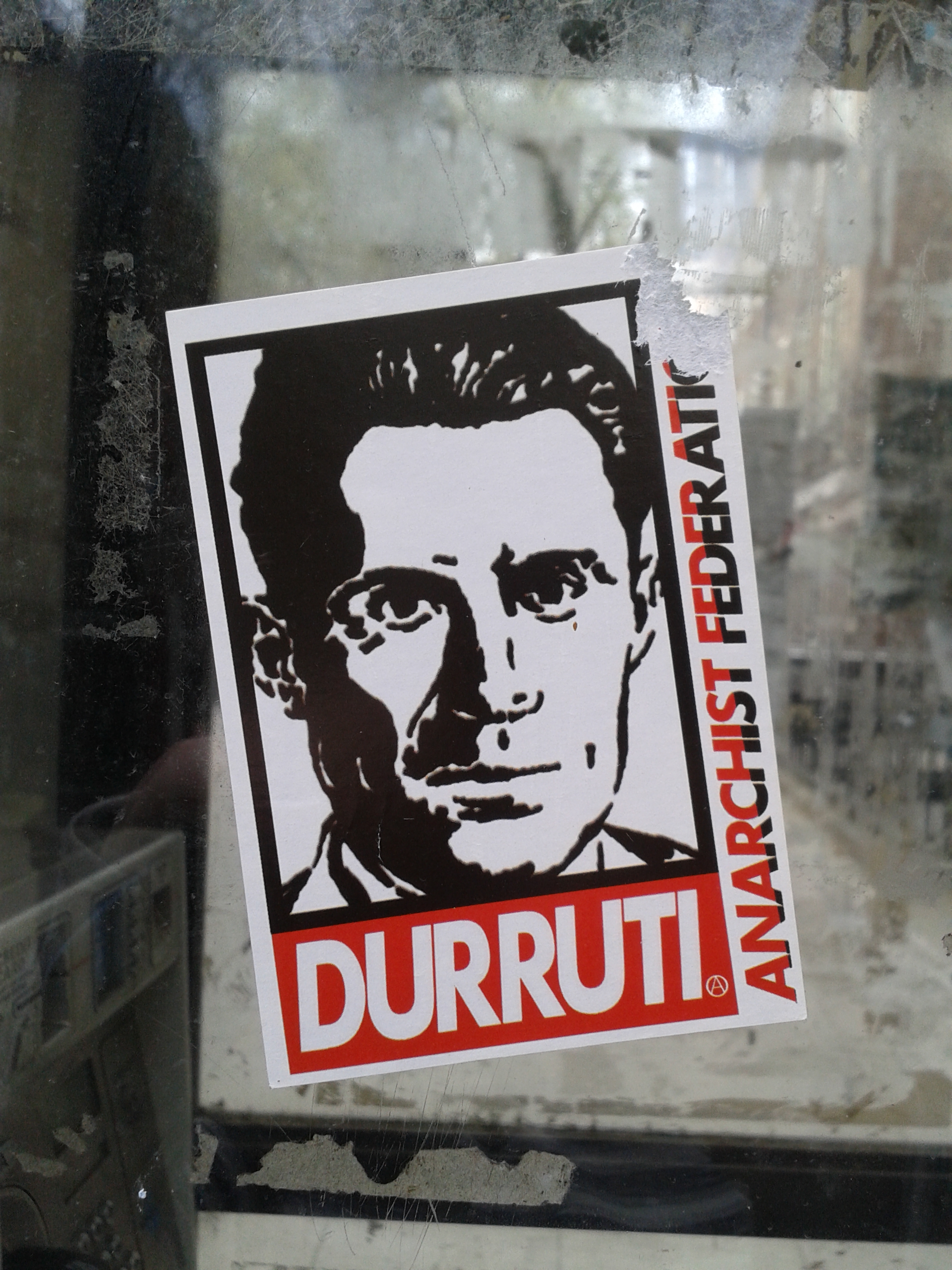
This sticker is part of another series that the AFed produce featuring prominent figures in anarchist history. This is Buenaventura Durruti, a Spaniard who was very active in the run up to the Spanish Civil War, as well as the War itself. He was killed by a sniper in November 1936 (Photo: Hannah Awcock, Malet Street, 17/04/15).
Emma Goldman (1869-1940) was, and still is, well known for her anarchist writing and speeches. Born in present-day Lithuania, she moved to America when she was 16, and was significant in the development of anarchist philosophy in the US (Photo: Hannah Awcock, Byng Place, 12/05/15).
This is one of the best known quotes attributed to Emma Goldman. I don’t know who made this sticker, but it is a sentiment I have seen in other AFed stickers. (Photo: Hannah Awcock, Regent’s Canal Tow Path, 20/05/15).
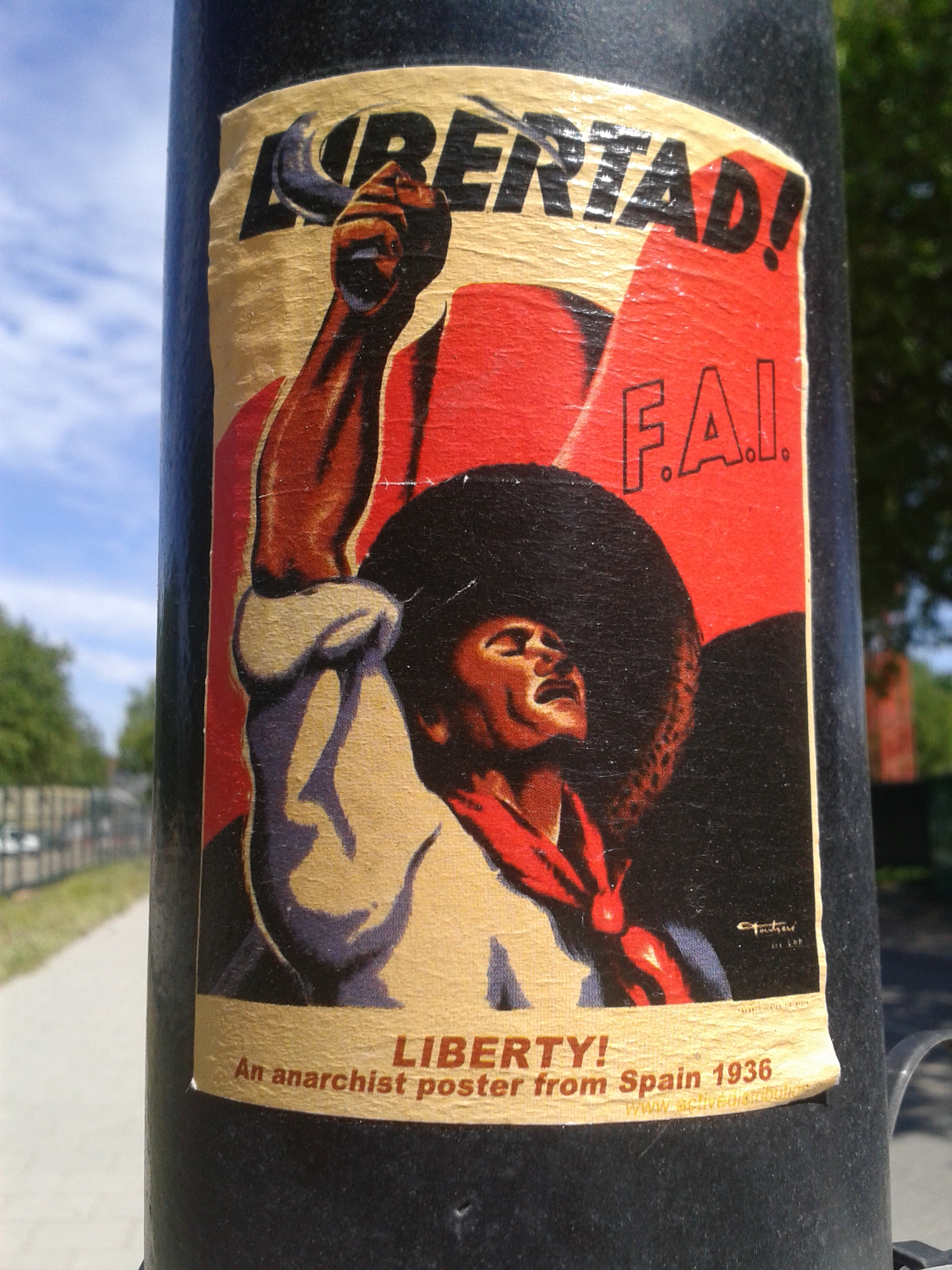
This sticker is one of my favourites. It is made by Active Distribution, which makes and sells all things anarchic. I come across their stickers quite often (Photo: Hannah Awcock, Heygate Road, 04/06/15).
AFed have also been known to use references to popular culture in their stickers. This sticker features Finn and Jake, the main characters of an animated TV series called Adventure Time. It is made for children, but has developed a large adult following (Photo: Hannah Awcock, Elephant and Castle, 25/06/15).
And who doesn’t love a good yoda impression?! (Photo: Hannah Awcock, Euston Station, 27/02/15).
AFed stickers can often be funny. This is a relatively new sticker (I think!), and is particularly pertinent in the context of the Islamaphobia that our society is currently struggling with (Photo: Hannah Awcock, Euston Road, 09/02/16)
This is another one by Active Distribution; you can just make out the web address in the top right corner. I found this sticker on the Ayslebury Estate during the occupation that took place there last year (Photo: Hannah Awcock, Ayslebury Estate, 05/05/15).
This sticker echoes the sentiments of the Emma Goldman quote above. It looks like someone objected to the message however, as the sticker has been quite badly torn. It reads “never be deceived that the rich will permit you to vote away their wealth” (Photo: Hannah Awcock, Tottenham Court Road, 19/05/15).
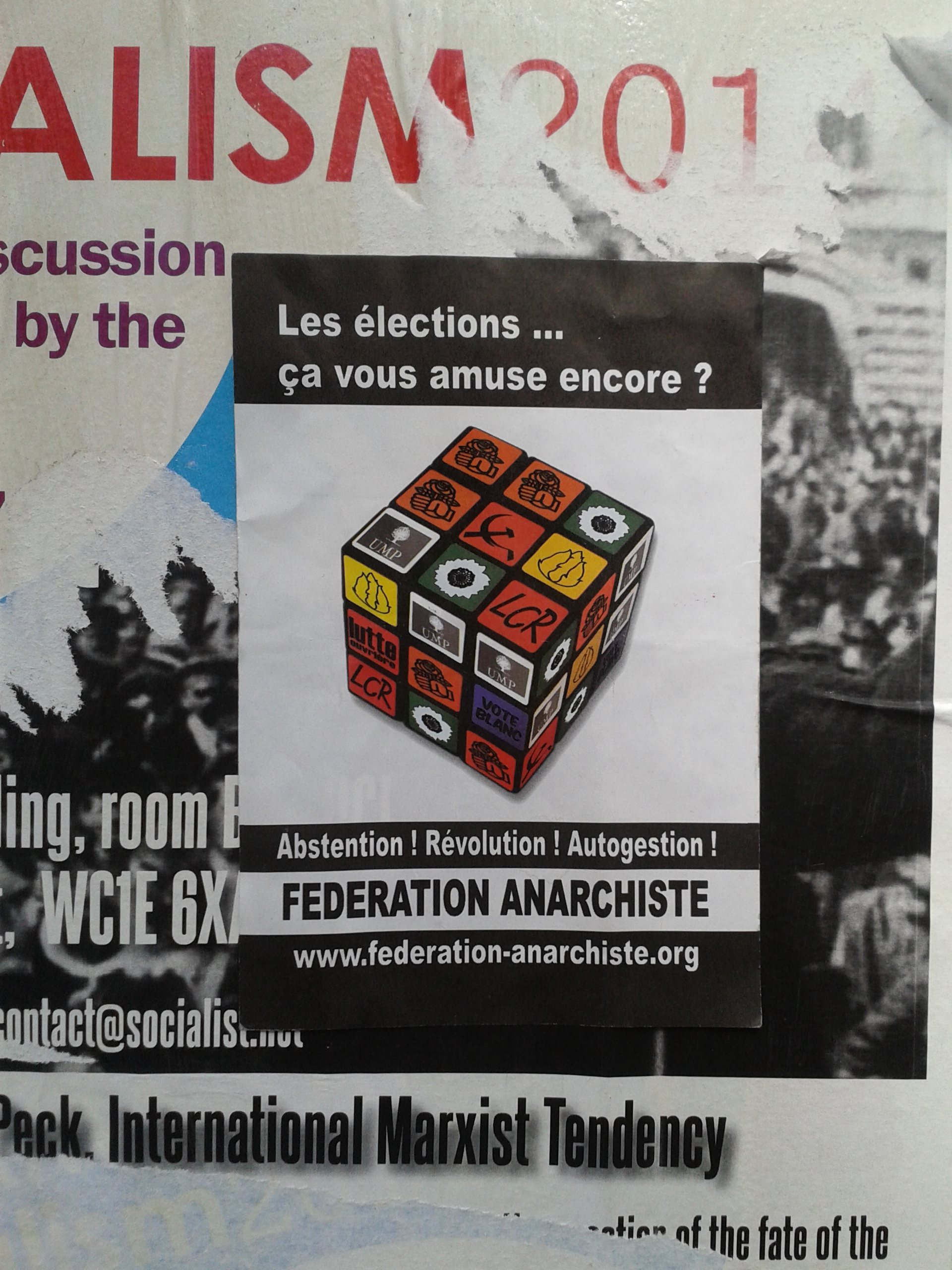
My French is rusty, but I know enough to identify this as an anarchist sticker! I think that it roughly translates to “The elections…are you still having fun? Abstention” Revolution! Self Management!” (Photo: Hannah Awcock, Malet Street, 17/04/15).
Opened in 2007, the current Wembley Stadium is visually impressive (Photo: Hannah Awcock).
This month, I have been lucky enough to see two concerts at Wembley Stadium in the space of two weeks. On the 5th of June, I saw Bruce Springsteen and the E Street Band, and on the 16th, I saw the second of Coldplay’s 4-day run. They are two very different artists, with two very different performance styles. However, both used the opportunity of 70,000(ish) strong audiences to promote political viewpoints, although the two viewpoints, and the way they were were presented, were also very different.
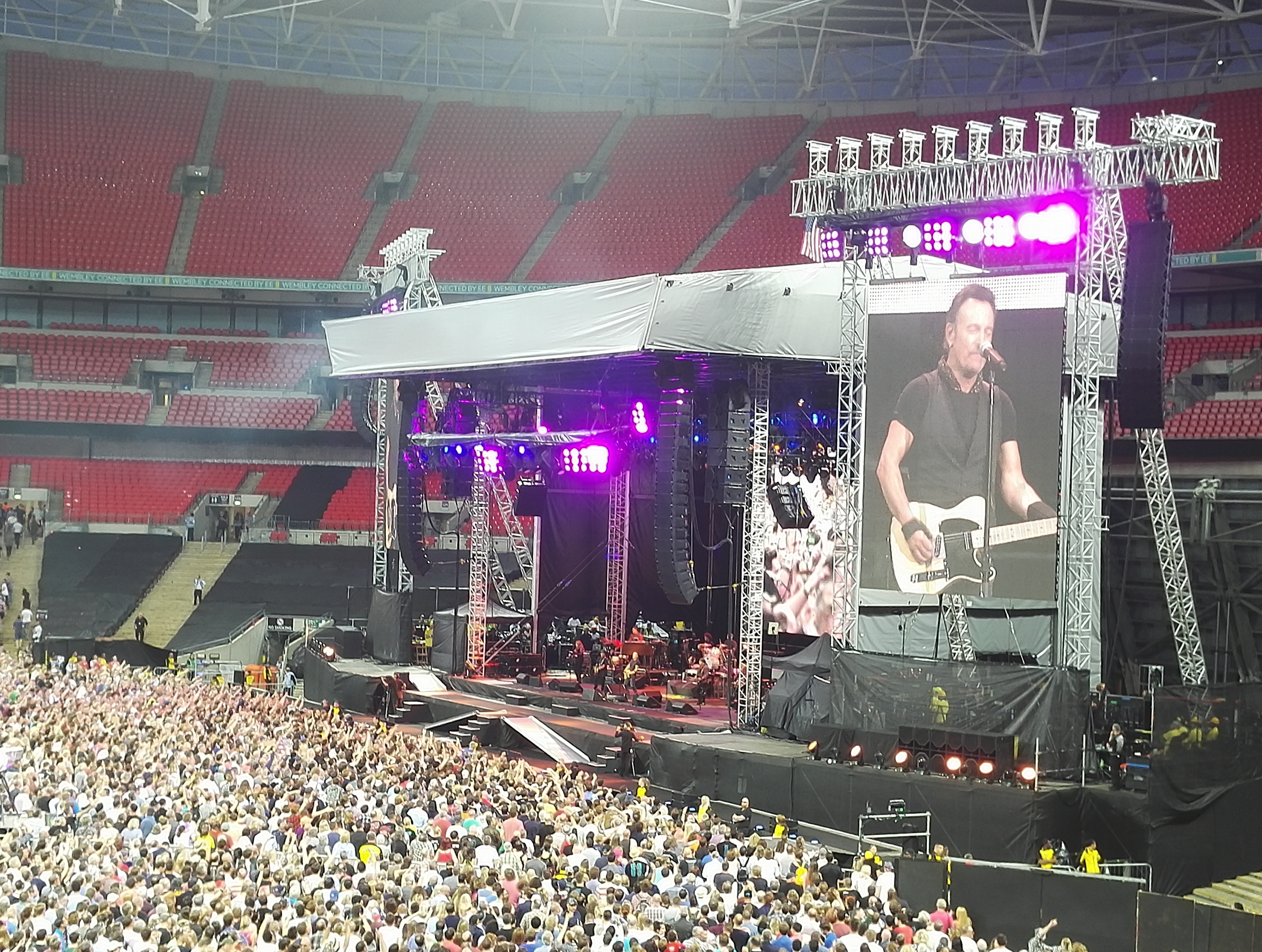
Wembley Stadium has a capacity of 90,000, but this is reduced to about 70000 for concerts. This is the stage set up for Bruce Springsteen’s concert on the 5th June 2016 (Photo: Hannah Awcock).
Bruce Springsteen has always been known for his vocal political stance. A liberal, he has campaigned against nuclear power and on behalf of Amnesty International, supported labour unions and gay rights and gay marriage, and endorsed two Democrat presidential candidates, John Kerry and Barack Obama. He also uses his music to explore political ideas, particularly class relations and the impact of economic recession on American towns and cities. Songs such as Born in the USA (1984), The Ghost of Tom Joad (1995), and Death to my Hometown (2012) are powerful criticisms of some of the biggest faults in American society. Springsteen’s live performances are legendary; he has been known to perform for four hours straight. The staging is simple, he does not use elaborate lighting or pyrotechnics, he allows the music to speak for itself. He is a consummate showman; he performs every song with the energy of a finale, and his skill and passion are obvious.
For me, one of the things that makes Springsteen’s political songs so powerful is the way that they continue to resonate with current events, sometimes even decades after they were first recorded. Towards the end of the concert, Springsteen performed American Skin (41 Shots). First performed at Madison Square Gardens at the end of a 1999-2000 world tour, the song was written about Amadou Diallo, a 22-year-old who was shot dead outside of his apartment block in the Bronx by four New York City police officers. They fired 41 bullets at the unarmed man. In 2012, Springsteen dedicated a performance of the song to Trayvon Martin, who was killed by police in Florida that year. With the recent deaths of Michael Brown, Eric Garner and others, it is painfully apparent that the song’s lyric “you can get killed just for living in your American skin” is just as true now as it ever was.
Springsteen does not use elaborate staging at his live concerts, allowing his music and performance do the talking (Photo: Hannah Awcock).
Coldplay use elaborate visual effects in their live performances (Photo: Hannah Awcock).
To say Coldplay’s style of performance is not as understated as Springsteen’s is putting it mildly. The show was visually spectacular, including pyrotechnics, videos, and light-up wristbands which are given to every member of the audience creating a beautiful effect throughout the stadium. Their performance may be more dramatic than Springsteen’s but their politics is not as obvious. Their lyrics are not overtly political, and the band members are not as clear about their personal politics as Springsteen.
Love buttons, which were handed out at Coldplay’s concerts. The band is a supporter of the Love Button Movement (Photo: Hannah Awcock).
You could find politics at Coldplay’s concert however, if you looked closely. As you entered the stadium, you were offered the wristbands and some button badges with the word ‘love’ on them. On closer inspection, the buttons turned out to have 3 web addresses on the rim; www.coldplay.com, www.globalcitizen.org, and www.lovebutton.org. The Coldplay address is fairly self-explanatory, but the other two I had to follow up. Global Citizen is a website that encourages people to take action to fight extreme poverty and inequality; safe, legal, actions like sharing videos, signing petitions and donating money. The Love Button Movement is a kind of ‘pay it forward’ campaign- it encourages participants to give strangers love buttons and overcome the “fears that keep us from seeing what we have in common.” This upbeat attitude fits in with Coldplay’s performance style and the buoyant tone of the band’s last 2 albums. It would be easy to sneer at them for this approach, this kind of politics can be seen as naive and overly optimistic. However, I am inclined to agree with journalist Richard Bradley when he says “We have plenty of bands singing about why George Bush is a crummy president, and that’s fine. Let Coldplay sing about love. Isn’t that political enough?” Let Coldplay promote global citizenship and love, sometimes a little positivity is exactly what I need.
Both Global Citizen and the Love Button Movement take a positive approach to alternative politics which is very different to Springsteen’s scathing critique of the American dream- the campaigns provide small, manageable actions that people can take to make the world a better place, whilst Springsteen’s lyrics can sometimes leave me feeling a little hopeless. I am not going to say I prefer one approach over the other- I think both Bruce Springsteen and Coldplay are fantastic musicians and performers, and I admire the fact that they both use their influential position as incredibly popular acts to try and make a difference. There is more than one way to skin a cat, as the old, if a little distasteful, saying goes.
Kershaw, Tom. “The Religion and Political Views of Bruce Springsteen.” The Hollowverse. Last modified 15th May 2012, accessed 20th June 2016. Available at http://hollowverse.com/bruce-springsteen/
Turbulent Londoners is a series of posts about radical individuals in London’s history who contributed to the city’s contentious past, with a particular focus of women, whose contribution to history is often overlooked. My definition of ‘Londoner’ is quite loose, anyone who has played a role in protest in the city can be included. Any suggestions for future Turbulent Londoners posts are very welcome. My next Turbulent Londoner is Daisy Parsons, a Suffragette and the first female Mayor of West Ham.
Daisy Parsons was a formidable woman. Despite leaving school at the age of 12 to help support her family she became a force to be reckoned with in East End politics, working closely with Sylvia Pankhurst in the East London Federation of Suffragettes (ELFS), then going on to become the first female Mayor of West Ham.
Born Marguerite Lena Millo on the 25th of May 1890, Daisy must have had a difficult childhood. She was born in Poplar in East London, her family moving to nearby Canning Town when Daisy was 8 months old. She had 5 younger brothers, and because her father was an invalid, her mother had to take on washing and charring work. Daisy was given a certificate of exemption in 1902 so that she could leave Beckton Road School early to look after her brothers, a necessity she always regretted. When she was 14 she left home to work as a maid, but later became a cigarette packer at the Carreras Tobacco Company in Aldgate, because the pay was better. Women and girls were paid 3d for every 1000 cigarettes they packed (most managed about 3000 a day).
It was whilst working at the tobacco company that Daisy had her first contact with the trade union movement; male employees at the factory had a fixed lunch hour and a space to eat because their union had fought for them. Female employees had to eat in the toilets! Daisy’s husband Tom was a driver for Stepney Borough Council and an active union member. They married in December 1908 when Daisy was 18.
Daisy obviously had a keen interest in politics in her own right- she joined the Women’s Social and Political Union and the International Labour Party, and was one of the founding members and the secretary of the ELFS. She was remembered as being assertive and persuasive. She was clearly not one to shy away from action- at Suffragette demonstrations she carried a ‘Saturday Nights’ (a length of hemp rope tied at one end, a sort of improvised cosh) hidden up her sleeve in case she needed to defend herself.
Daisy took part in a deputation of working women to Prime Minister Asquith on the 12th of June 1914, trying to persuade him of the necessity of female suffrage. By this point she had 2 daughters, and was also looking after her niece. Daisy stuck with Sylvia Pankhurst after the split with her mother and sister, and ELFS worked tirelessly during the first world war, setting up a Mother and Child Welfare Centre in West Ham to help women who were struggling whilst their husbands were away, or had been killed.
When women over 30 were given the right to vote in 1918 Daisy still couldn’t vote because she was only 29! This did not deter her from moving into mainstream local politics however, and she was elected as a Labour Councillor for Beckton ward in 1922. She became deputy Mayor of West Ham in 1931, and Mayor in 1936. She also became a Justice of the Peace in 1933, and an Alderman of West Ham in 1935. During World War 2 Daisy organised the evacuation of local children and helped to organise the Women’s Voluntary Service. Her efforts did not spare her from tragedy however; her brother and niece were killed in the Blitz.
Daisy Parsons was obviously respected and admired. She was awarded the Freedom of West Ham in 1939, the highest honour which the borough can bestow, and was made an MBE in 1951 in recognition of her public service. She had gone from radical Suffragette to respected local official, but I get the impression she retained her determined and caring nature.
Last week, I detailed my clunky and ad-hoc method for collecting and analysing old tweets. I have now finished my data collection (I read almost 26,000 tweets in total), so it seemed like a good time to reflect a little more on the experience of the process and what I found, rather than just how I did it. The tweets I read were all written during 4 days in November and December 2010. During this period a nationwide campaign was trying to persuade the British government not to make dramatic changes to the way that higher education was funded, which included raising university tuition fees to up to £9000 a year.
The Student Tuition Fee Protests in 2010 is the only one of my case studies (the others are the Gordon Riots (1780), the Hyde Park Railings Affair (1866), and the Battle of Cable Street (1936)) that I lived through and participated in. I have my opinions about the issues contested in each of the other case studies, but researching events that you yourself experienced is very different. I was a second year undergraduate in late 2010, my younger sister would be affected by the proposed increased fees, and I cared very much about what happened. Reading through tweets from the four days of protest in London brought back a lot of emotions; the desire to do something; hope that we could make a difference, disbelief that anyone thought the proposals were a good idea; betrayal at the Liberal Democrats’ U-turn; anger at those who dismissed students as ignorant, lazy and apathetic; all soured by the knowledge that we didn’t change anything. Compounding this is the tendency people have to be more arrogant and abrasive on the internet than they ever would be in person. Because of this some Tweets were quite offensive, and it was hard not to take it personally. I found myself fighting the urge to reply to some of the most irritating Tweets, repeatedly reminding myself how strange it would be to get a reply to something written 6 years ago. Reading the tweets caused me to re-live many of the feelings I experienced back in 2010, which meant that this research was often quite draining emotionally.
Some tweets expressed extreme opinions, which I often found difficult to read (Source: Twitter/@purpleline).
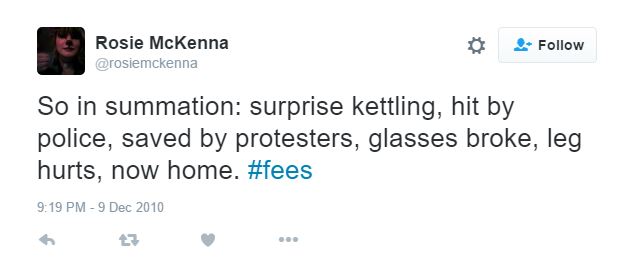
One of the biggest problems I have faced so far in my PhD research is that the further back in time you go, the less archival material there is which records the perspectives and experiences of ordinary people. This is a challenge for many historical researchers, but it has been particularly difficult for me because the wealthy elites don’t tend to be the people participating in protest and dissent. The internet is relatively accessible, with only 11% of British adults having never used the internet (Office of National Statistics, 2015). This does not mean that 89% of British people use Twitter, but it does give me the opportunity to see what ‘ordinary’ people were saying about the protests, which is a rare treat for me. Twitter revealed some wonderfully fine-grained details about the protests and what it was like to be there. For example, a woman called Rosie McKenna broke her glasses and hurt her leg whilst being kettled by police on the 9th of December. It was great to be able to develop such a clear picture of what it was like to be part of the protests, rather than having to rely heavily on imagination.
Twitter preserves the experience of protesting in finer detail than traditional archival sources (Source: Twitter/Rosie McKenna).
Another aspect of the research that I really enjoyed was seeing how various processes present in my other case studies played out through this modern technology. A common feature of protests and social movements is conspiracy theories; people speculate about who the ‘real’ organisers of a protest event are, or who might be manipulating the course of events to suit their own aims. The Gordon Riots, for example, were blamed on the American, Spanish or French governments. Scholars have argued that these theories developed because at that point it was not generally believed that the lower classes were capable of organising themselves in such a manner; they need someone to tell them what to do (Leon, 2011; Tackett; 2000). Conspiracy theories persist, however, despite modern society holding a less patronising view of the working and middle classes.One of the best known events of the 2010 Student Protests was the occupation of 30 Millbank, the building in which the Conservative Party campaign headquaters were housed. The response of the Metropolitan Police on this occasion was rather slow and inadequate. The most likely explanation is that they were surprised by the strength of feeling amongst the protesters, and had not prepared for trouble on that scale. However, it was suggested by some Twitter users that the police had deliberately responded slowly, because policing was facing its own budget cuts under the austerity regime, and wanted to demonstrate their usefulness to the government. The saying ‘the more things change, the more they stay the same’ springs to mind…
Twitter gives modern conspiracy theories related to protest a new platform on which to be transmitted and debated (Source: Twitter/Simon Bayley).
After a long period of writing, I really enjoyed getting to doing some research again, and exploring a new source of data. Working with Twitter was tiring, physically as well as emotionally (I had to take regular breaks because of the strain on my eyes), but also very rewarding. It has provided me with evidence to back up my arguments, as well as leading me to develop some new ones, and I feel like my PhD will be stronger because I tried this new (to me) research method.
Sources and Further Reading
León, Pablo Sánchez. “Conceiving the Multitude: Eighteenth-Century Popular Riots and the Modern Language of Social Disorder.’ International Review of Social History 56, no. 3 (2011): 511–533.
Tackett, Timothy. “Conspiracy Obsession in a Time of Revolution: French Elites and the Origins of the Terror 1789–1792.” The American Historical Review, 105, no. 3 (2000): 691–713.
The long time scale of my PhD means I have to deal with vastly different sources in my research. For the Gordon Riots (1780), I use mainly eyewitness accounts and court records. For the Battle of Cable Street (1936), I have access to images and videos of what happened. For the 2010 Student Tuition Fee Protests, the choices are almost endless. One of the sources I decided to utilise was Twitter, the social media website that allows its users to post updates of up to 140 characters. Every type of source presents different challenges for the researcher, and I found the unique challenges of Twitter rather difficult to cope with at first. This post is about the method I developed for my research, and I hope it will act as a catalyst for discussion amongst other scholars dealing with similar issues. My research was conducted on a computer with a Windows 10 operating system, and I do not know how well my method would translate to a different operating system.
Whilst there are programmes which collect tweets in real time as they are tweeted, many of which are open access, there are fewer designed to harvest pre-existing tweets. Those there are are aimed at a commercial rather than academic market, and their cost is beyond the scope of my research budget. So I had to develop my own ad-hoc, ‘low tech’ method of harvesting old tweets, using Twitter’s Advanced Search function.
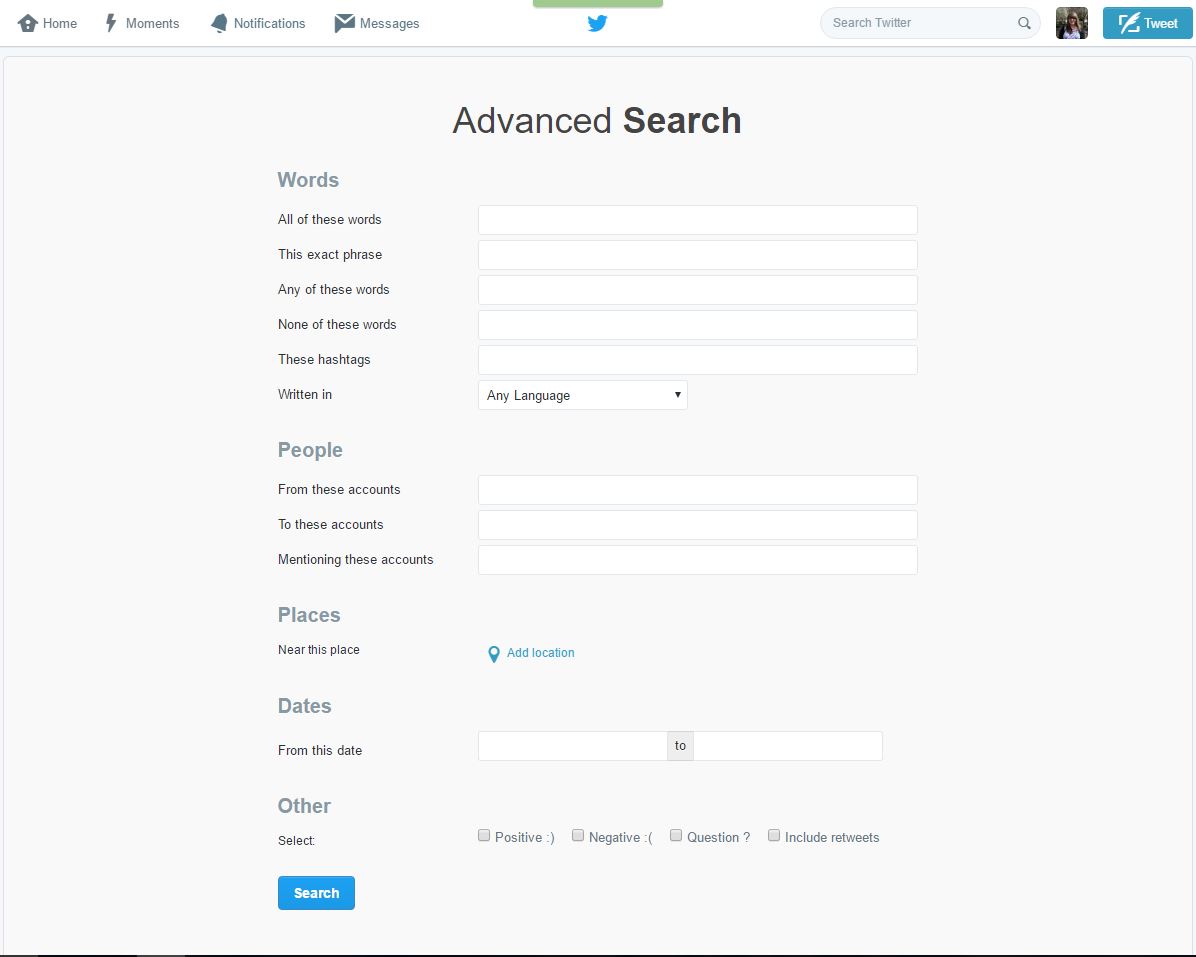
In 2014 Twitter began allowing users to search for tweets more than 7 days old in its Advanced Search function (accessed from the options menu of a bog standard Twitter search result page, or by googling ‘Twitter Advanced Search’. You have to have a Twitter account to use this function). Advanced Search lets you combine a whole variety of search parameters, including date, location, hash tags, Twitter accounts, key words, sentiment (whether a Tweet is positive or negative). You can even input words you don’t want to be included.
Twitter’s Advanced Search function looks a little like this (Source: Twitter).
Once I decided I was using Advanced Search, I had to decide on search parameters. The Student Tuition Fee Protests were a series of demonstrations, occupations and marches on both a national and local scale that took place between the 10th of November and the 9th of December 2010. I wanted to see Tweets from the four days of action that took place in London, on the 10th, 24th, and 30th of November, and the 9th of December. I started by searching for tweets that had been geotagged with London on the revelant days. Only a small percentage of tweets are geotagged, but it provided me with an idea of the hashtags and keywords that were were being used in regards to the demonstrations. I used this to decide on my search parameters. For example, for the demonstration on the 9th of December I searched for ‘Any of these words: protester, protesters, students, tuition, fees, protests’ and ‘These hashtags: #demo2010 #dayx3 #fees #solidarity #studentprotest #ukuncut’. For each demonstration, I used a slightly different combination of hashtags and keywords, in an attempt to find as many relevant tweets as possible. I acknowledge, however, that I probably did not find every tweet about the demonstrations. I also altered the dates as appropriate, then started the search.
This is the top of the search results page I got for the protests on the 9th of December 2010 (Source: Twitter).
Now for the long-winded part. I have not found a way to download multiple tweets at once. You can use your browser’s print function to save the search results as a pdf, but there are several disadvantages to this. You cannot expand the tweets to see what time they were tweeted, and it will only save the tweets that have loaded- you have to scroll all the way down to the bottom of the search results to save them all, and this can take a long time when searches yield more than a few thousand tweets. I did save the search results as a pdf, so I can go back to them at a later date if I want to, but only once I had read them all.
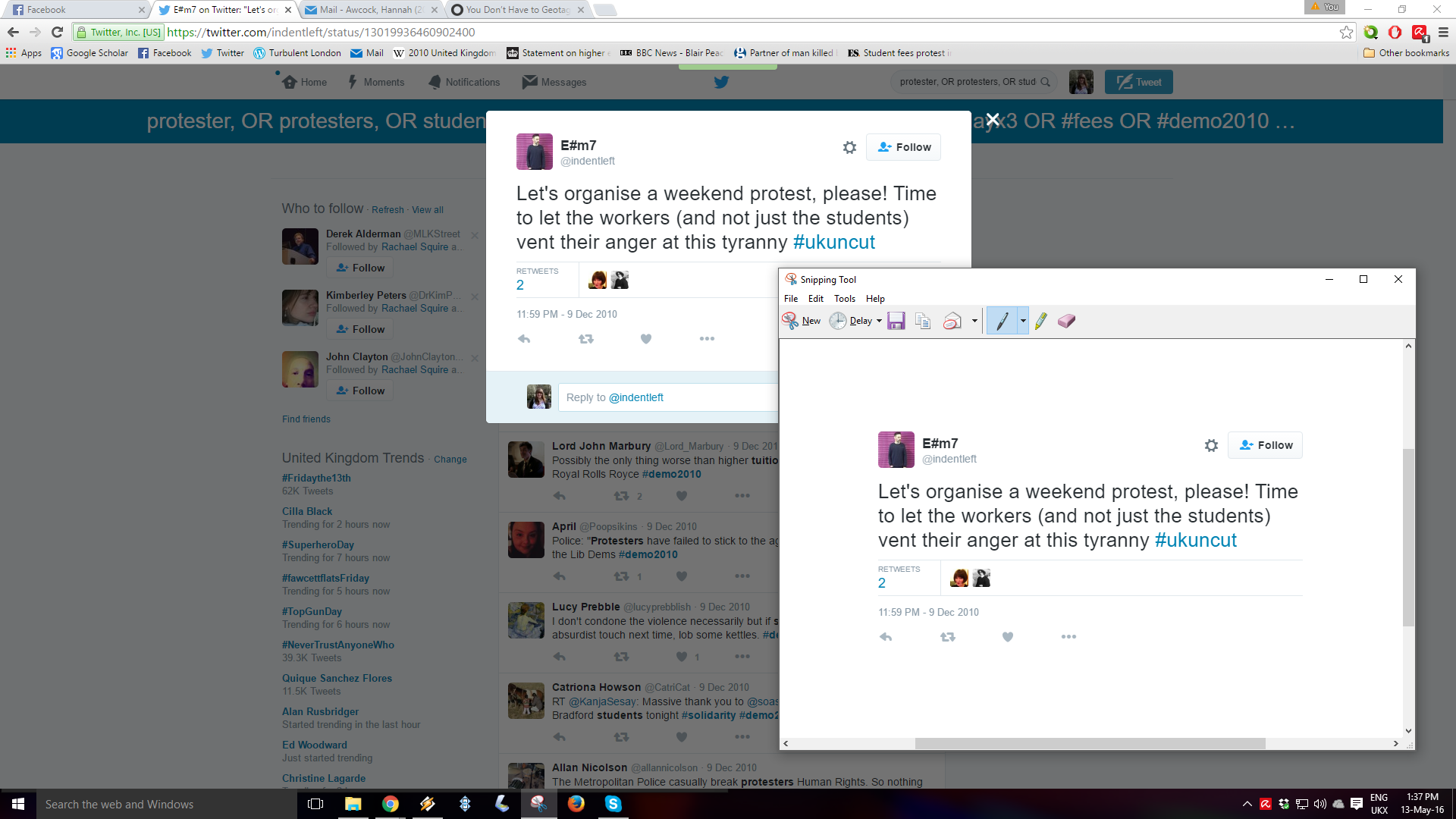
And that is how I analysed the search results, by reading every single tweet. Any tweets that I thought might be relevant to my research, I saved as a jpeg using the Snip tool, with it’s own individual number (001, 002, 003, 004 etc.). I also pasted each tweet into a word document, so I could go back to them later without having to open each individual jpeg. I coded the saved tweets as I went along, making a note of the tweet’s number and the key theme it related to. I also kept a count of how many tweets I had read as I went along. I wouldn’t say it was very reliable, but I can at least say roughly how many tweets I analysed for each demonstration. For example, I read almost 8000 tweets related to the demonstration on the 10th of November 2010.
The Snip tool allows you to make an image from your computer screen. It works a little like print screen, but you are able to select a particular area that you want to capture, like this tweet from the 9th of December 2010 (Source: Hannah Awcock).
Sometimes, the simplest way of doing things is the best. I counted every tweet I read, and coded the most relevant ones using a good old fashioned notebook and pen (Source: Hannah Awcock).
So there you have it; my ad hoc, low tech (for Twitter!) method for collecting and analysing old Tweets for academic research. It is a rather clunky method, and I suspect that someone with more technological know-how than me could improve it dramatically, but it has allowed me to see how social media was being used during the 2010 Student Protests in London. If you have experience with this sort of research, or just have an opinion on it, then I would love to hear from you!
















 Turbulent Isles