On This Day: The London Women Transport Workers Strike, 16th August 1918

AN ENGLISH BUS CONDUCTRESS (Q 61348) A bus No 18 (Willesden Route) conductress selling a ticket to a RFC serviceman. Copyright: © IWM. Original Source: http://www.iwm.org.uk/collections/item/object/205026963

In August 1918, female tram conductors in Willesden started a wildcat strike which quickly spread around the country and to other sectors of public transport. Initially demanding the same war bonus that had been given to men, their demands morphed into equal pay, over 40 years before the Equal Pay Act.

During the First World War, women took over many of the jobs that had previously been done by men. Public transport was one area where female employees became key. By the end of the war, the London General Omnibus Company employed 3500 women, and thousands more were employed by other bus and train operators in London as well as on the Underground. Lots of women joined unions, but the unions were more interested in protecting the long-term job security of men rather than the employment rights of women. The unions wanted to make sure that men could return to their pre-war jobs with the same working conditions when the war finished, so they didn’t want women to get too comfortable. In addition, both unions and management refused to entertain the idea of equal pay, arguing that the work that women did was not worth the same as men’s.

In mid-1918, male workers were given a 5 shilling a week wartime bonus to help cope with the increased cost of living. Women were not given this bonus, and some workers in London were not willing to accept this. On the 16th of August, a meeting of women at Willesden bus garage decided to go on strike the following day, without informing their bosses or unions.

The next morning, they were quickly joined by women at the Hackney, Holloway, Archway and Acton depots and garages, and the strike continued to spread throughout the day. At first the women demanded the same 5 shilling per week bonus as men, but their demands soon escalated to equal pay, and they adopted the slogan ‘Same Work- Same Pay.’

By the 23rd of August, female bus and tram workers around the country had joined the strike, including in Bath, Bristol, Birmingham, Brighton, and Weston-super-mare. Some women working on the London Underground also joined the strike- it mainly affected the Bakerloo Line. It is estimated 18000 out of a total 27000 women working in the public transport industry participated.

The strikers held a series of mass meetings at the Ring, on Blackfriars Road in Southwark. It was a boxing arena that had been destroyed by aerial bombing. Many women brought their children and picnics with them. The strike was settled on the 25th of August after a contentious meeting at the Ring- many women did not want to go back to work. The tube workers didn’t go back to work until the 28th. The women won the 5 shilling bonus, but not equal pay.

The Equal Pay Act was passed in 1970 but even now, almost a hundred years after the women transport workers’ strike, women are not paid the same as men for the same jobs. London’s female public transport workers were some of the first to make a demand that is still yet to be fully realised. Without the aid of the experienced unions, the women were able to win the same bonus as men, if not the same wage. Little is known about how the women organised, which is a shame, although it might make a very nice research project!

Sources and Further Reading

Stuart. “London Buses in Wartime.” Great War London. Last modified 30th December 2014, accessed 15th June 2016. Available at  https://greatwarlondon.wordpress.com/2014/12/30/london-buses-at-war-1914-1918/

View from the Mirror. “From Prayer to Palestra: The Ring at Blackfriars.” View from the Mirror: A Cabbie’s London. Last modified 4th February 2013, accessed 20th June 2016. Available at https://blackcablondon.net/2013/02/04/from-prayer-to-palestra-the-ring-at-blackfriars/

Walker, Michael. “London Women Tram Workers – Equal Pay Strike 1918.” Hayes People’s History. Last modified 13th February 2007, accessed 15th June 2016. Available at http://ourhistory-hayes.blogspot.co.uk/2007/02/women-tramworkers-equal-pay-strike-1918.html

Weller, Ken. “The London Transport Women Workers Strike 1918.” libcom.org. Last modified 19th December 2012, accessed 15th June 2016. Available at  https://libcom.org/history/london-transport-women-workers-strike-1918

Welsh, Dave. “The 90th anniversary of the Equal Pay strike on the London Underground.” Campaign Against Tube Privatisation- History. No date, accessed 15th June 2016. Available at  http://www.catp.info/CATP/History.html
Protest Stickers: London Road, Brighton

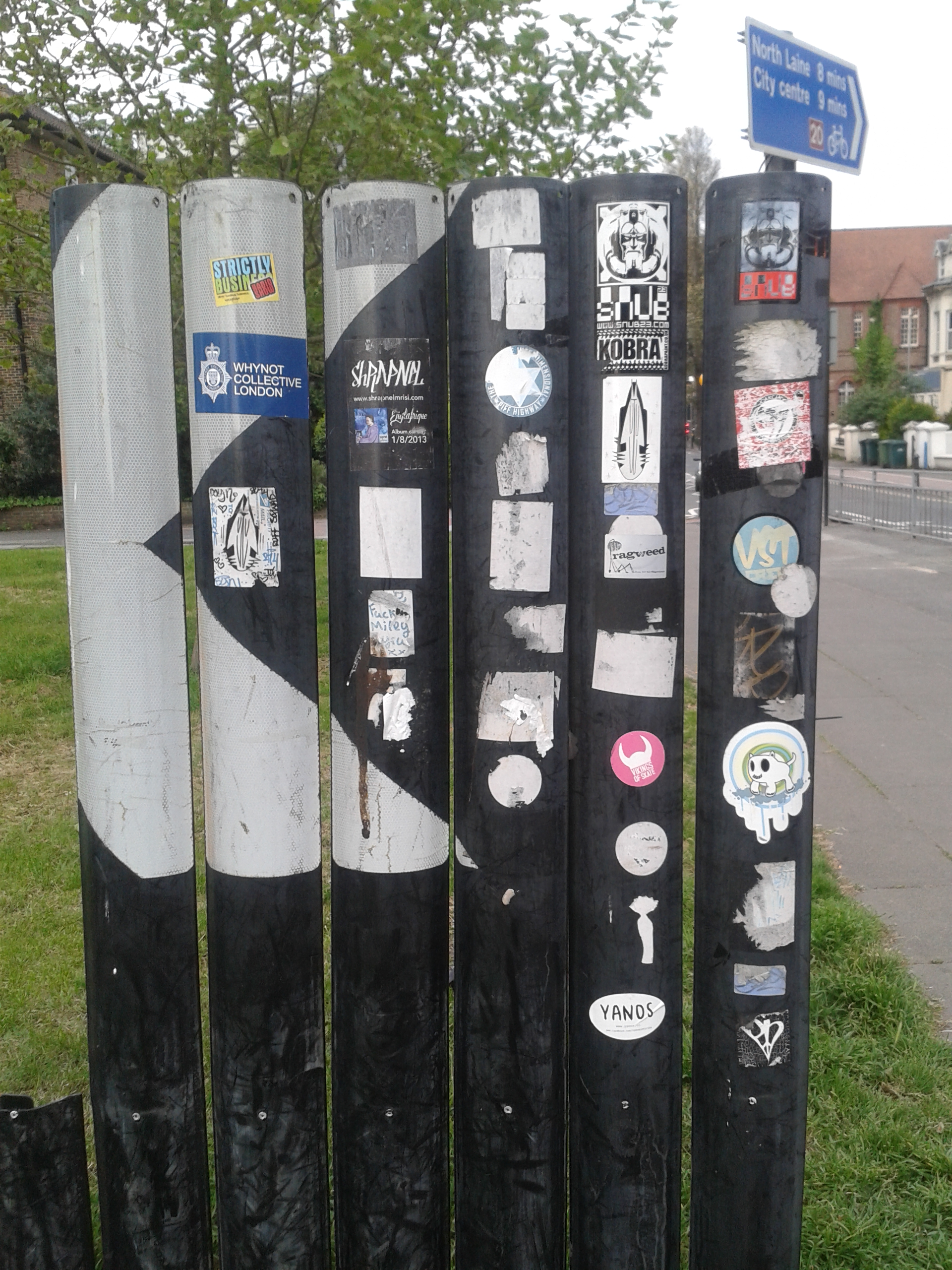
Like most other cities, stickers of all kinds are a common sight on the streets of Brighton.
Like most other cities, stickers of all kinds are a common sight on the streets of Brighton (Photo: Hannah Awcock).

Brighton is a coastal city in the south of England, about an hour away from London by train. It is well known for being an open and accepting city, and it also happens to be my home town, so it’s very special to me. I have written about protest and dissent in Brighton on Turbulent London before, but the city also has an awful lot of protest stickers so I think it deserves (at least) one more post. I took the pictures featured here on a walk down a single (admittedly quite long) road in the city. London Road runs from the city centre to the outskirts in the direction of London, funnily enough. Quite run down when I was younger, the area along the road is going through a rapid process of gentrification, to the extent that is known by some as the Shoreditch of Brighton. Gentrification is frequently a contested process however, and London Road has no shortage of protest stickers.

This is a tile stuck to the wall of a Greggs bakery, so not technically a protest sticker, but I couldn't resist putting it in because I like it so much. London Road is changing rapidly, and not everyone supports the changes.
This is a tile stuck to the wall of a Greggs bakery, so not technically a protest sticker, but I couldn’t resist putting it in because I like it so much. London Road is changing rapidly, and not everyone supports the changes (Photo: Hannah Awcock).
Le Turnip produces quite a few satirical stickers, and I have featured some of them before on the blog. This one apes CCTV warning signs, but refers to Sauron, the personification of evil in the Lord of the Rings. Sauron's eye sits atop a huge tower, and can see everything that goes on in Middle Earth.
Le Turnip produces quite a few satirical stickers, and I have featured some of them before on the blog. This one apes CCTV warning signs, but refers to Sauron, the personification of evil in the Lord of the Rings. Sauron’s eye sits atop a huge tower, and can see everything that goes on in Middle Earth (Photo: Hannah Awcock).
Many of the issues protested in London Road stickers are similar to those in London. This striking sticker criticises the reliance of the state on police forces. Brighton generally has an anti-authoritarian vibe.
Many of the issues protested in London Road stickers are similar to those in London. This striking sticker criticises the reliance of the state on police forces. Brighton generally has an anti-authoritarian vibe (Photo: Hannah Awcock).
The anti-authoritarian vibe is also played out through this sticker, variations of which are common throughout Brighton, not just in London Road. The dome which the cannabis leaf is imposed on is frequently used as a symbol of Brighton. It comes from the Brighton Pavilion, a palace built by George IV.
The anti-authoritarian vibe is also played out through this sticker, variations of which are common throughout Brighton, not just in London Road. The dome which the cannabis leaf is imposed on is frequently used as a symbol of Brighton. It comes from the Brighton Pavilion, a palace built by George IV (Photo: Hannah Awcock).
Another cause close to the hearts of many Brightonians is environmentalism. The city elected the first ever Green Party MP in 2010, and had one of the first Green-run councils in the country.
Another cause close to the hearts of many Brightonians is environmentalism. The city elected the first ever Green Party MP in 2010, and had one of the first Green-run councils in the country (Photo: Hannah Awcock).
Some stickers along London Road are about less familiar issues however. Most of this sticker has been obscured, but it is still possible to make out that it is declaring solidarity with the zapatistas, a topic which I have not seen in a London sticker yet.
Some stickers along London Road are about less familiar issues however. Most of this sticker has been obscured, but it is still possible to make out that it is declaring solidarity with the Zapatistas, a topic which I have not seen in a London sticker yet (Photo: Hannah Awcock).
Unfortunately, not everyone in Brighton is liberal and accepting, this sticker declares a vicious anti-immigration stance in support of UKIP. This was not the first time I have seen this sticker around the city, and I must admit I have removed them from the streets in the past.
Unfortunately, not everyone in Brighton is liberal and accepting, this sticker declares a vicious anti-immigration stance in support of UKIP. This was not the first time I have seen this sticker around the city, and I must admit I have removed them from the streets in the past (Photo: Hannah Awcock).
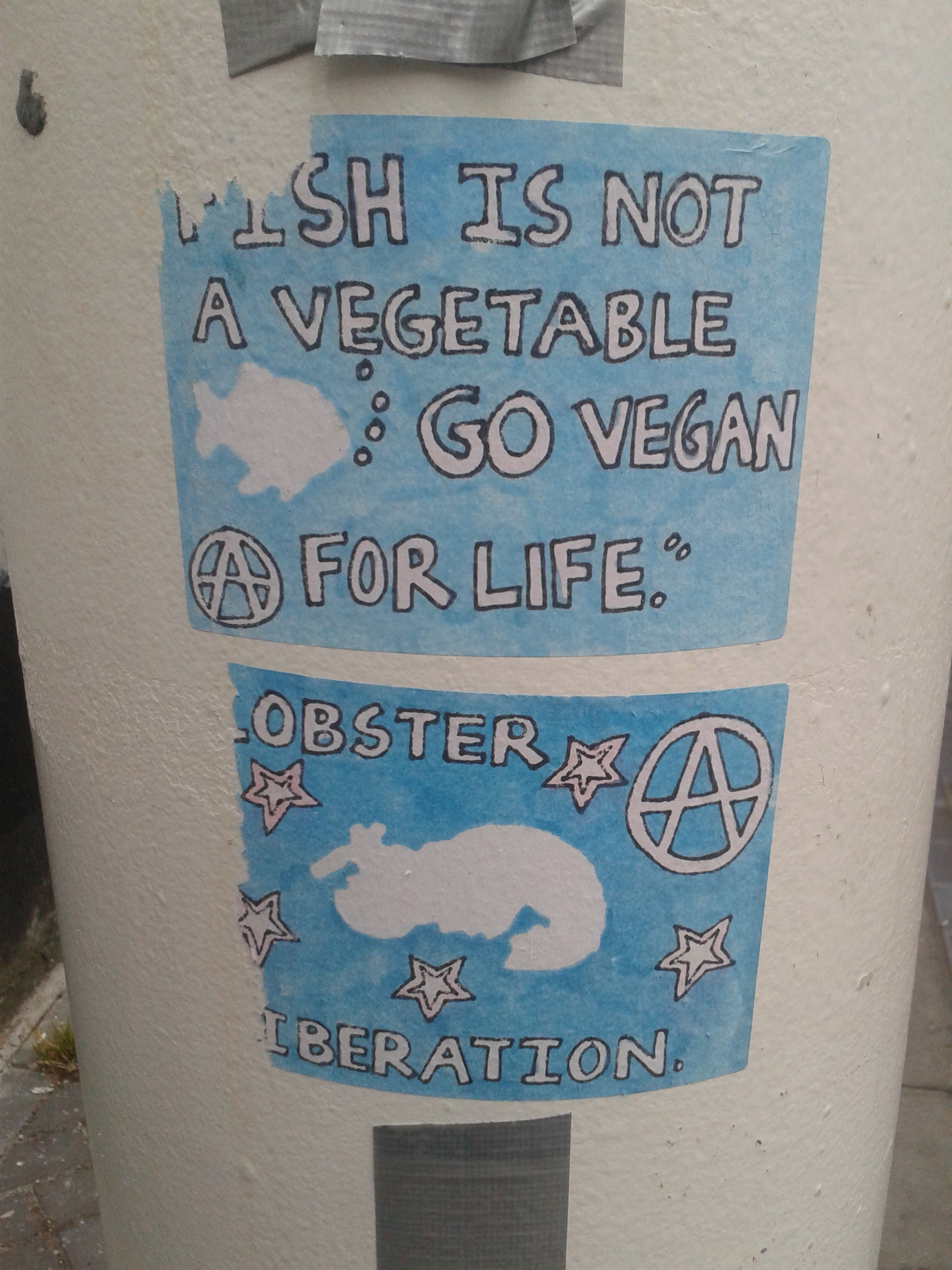
The location of stickers can sometimes be important. These stickers were on the entrance to the London Road open market, which has fish stalls.
The location of stickers can sometimes be important. These stickers were on the entrance to the London Road open market, which has fish stalls (Photo: Hannah Awcock).
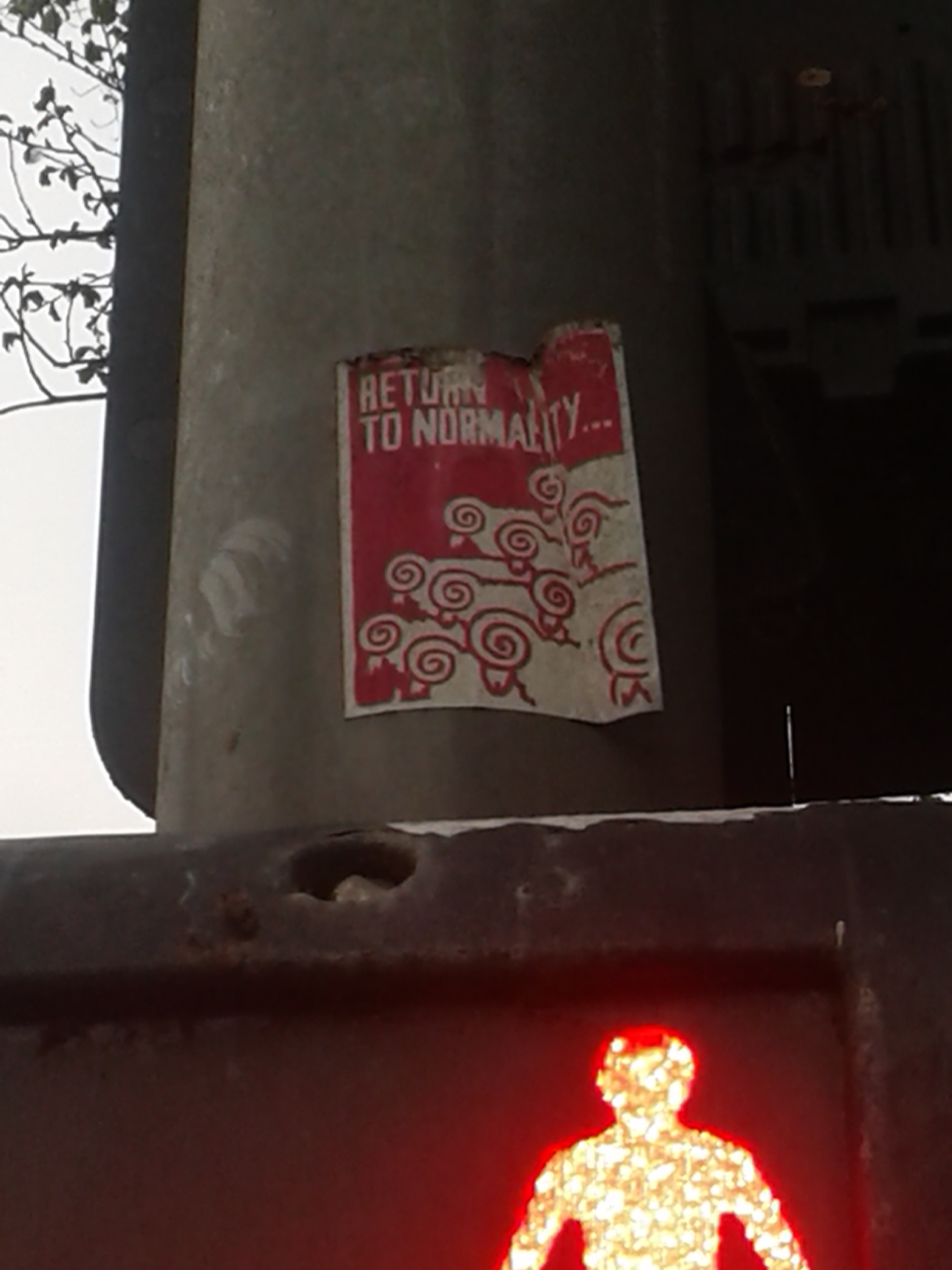
There are many people in Brighton who are not afraid to be different. Nevertheless this sticker accuses people of being sheep, blindly following the herd.
There are many people in Brighton who are not afraid to be different. Nevertheless this sticker accuses people of being sheep, blindly following the herd (Photo: Hannah Awcock).
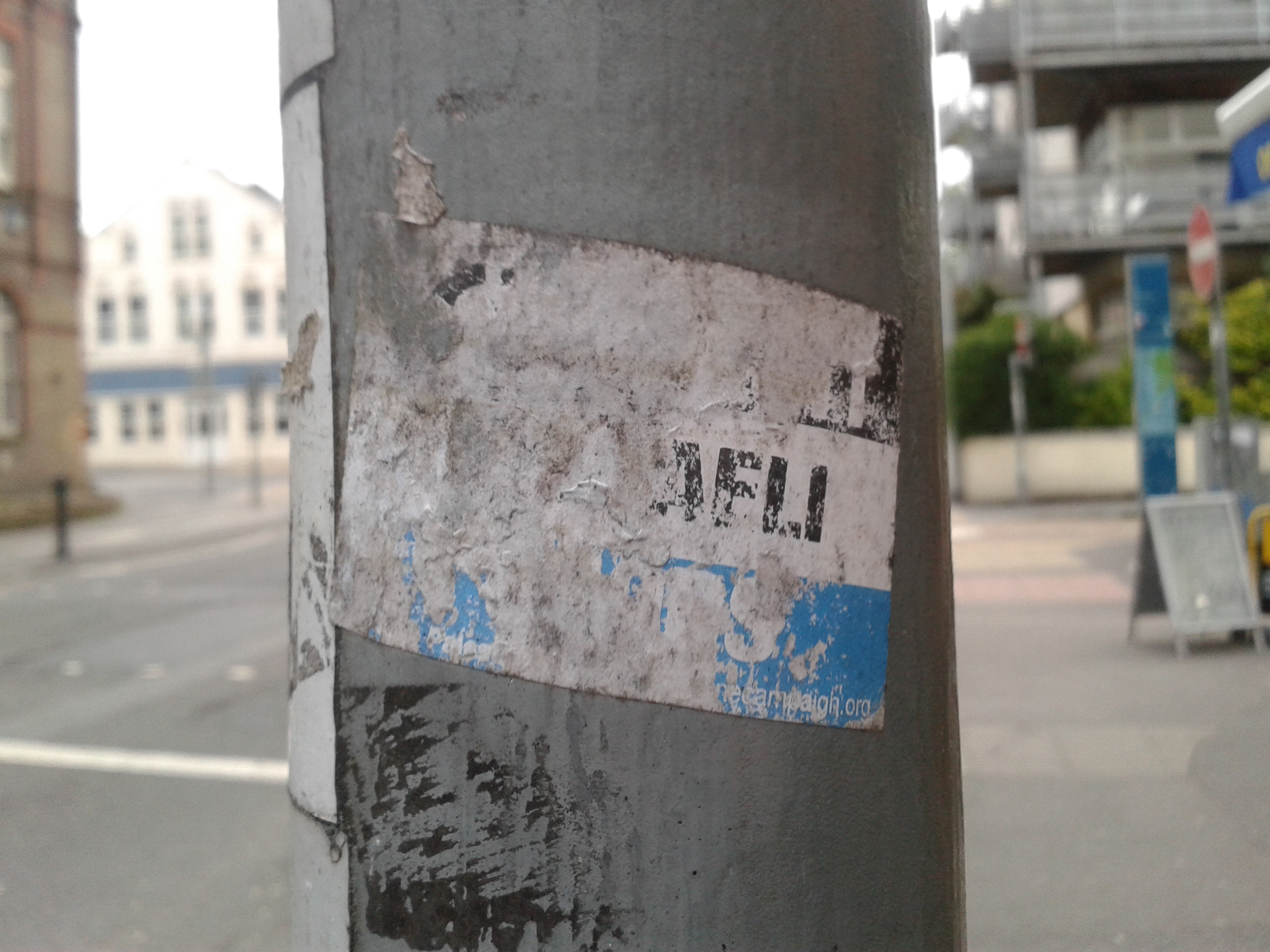
Just like in London, protest stickers in Brighton are subject to the ravages of time. It is just possible to make out that this sticker is calling for the boycott of Israeli goods, although the colours have faded and most of the letters have worn away.
Just like in London, protest stickers in Brighton are subject to the ravages of time. It is just possible to make out that this sticker is calling for the boycott of Israeli goods, although the colours have faded and most of the letters have worn away (Photo: Hannah Awcock).
Anti-fascism is another prominent issue in Brighton, largely due to the March for England demonstrations that are frequently held in the city. This stickers adapts the norm anti-fascist logo to reflect the city's large LGBTQ population.
Anti-fascism is another prominent issue in Brighton, largely due to the March for England demonstrations that are frequently held in the city. This stickers adapts the normal anti-fascist logo to reflect the city’s large LGBTQ population (Photo: Hannah Awcock).
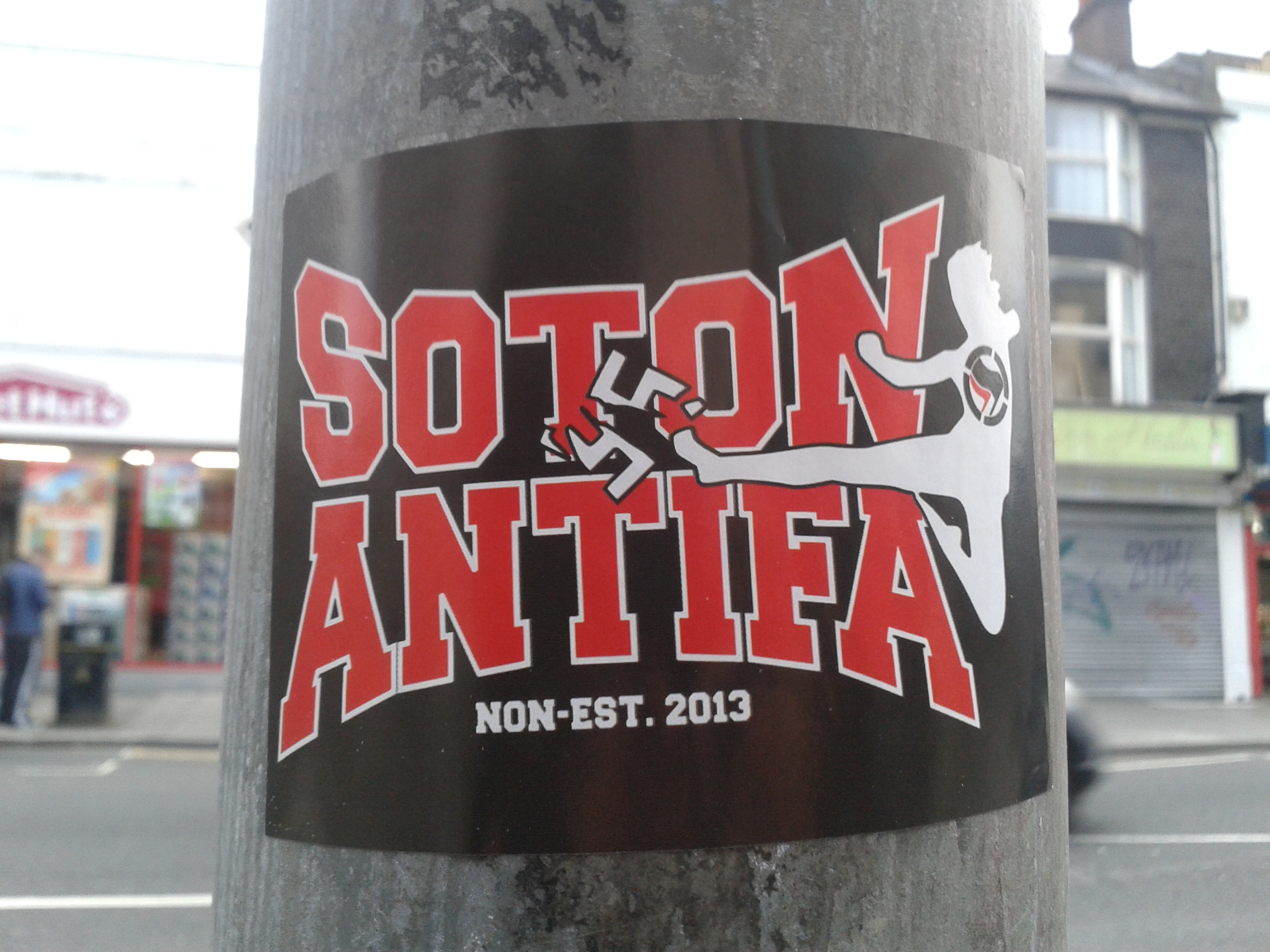
The March for England events draw participants and opponents from elsewhere to Brighton.  This stickers comes from Southampton, a city along the coast to the  west.
The March for England events draw participants and opponents from elsewhere to Brighton. This stickers comes from Southampton, a city along the coast to the west of Brighton (Photo: Hannah Awcock).

London’s Protest Stickers: Anarchism

07-06-15 Brick Lane (2)
Stickers of all kinds are ubiquitous on street furniture in London, like this post box in Brick Lane (Photo: Hannah Awcock, 07/06/15).

Along with anti-fascists, anarchists are some of the most prolific stickerers I’ve come across in London. The Anarchist Federation (AFed) are particularly keen on stickers as a method of protest. At its simplest, anarchism is the belief in a society based on voluntary, cooperative institutions. Force, compulsion and government are not required. Anarchists believe that this is the only way to achieve a fair and just society. The Anarchist Federation is a working class organisation that works towards achieving that.

As anarchist communists we fight for a world without leaders, where power is shared equally amongst communities, and people are free to reach their full potential. We do this by supporting working class resistance to exploitation and oppression, organise alongside our neighbours and workmates, host informative events, and produce publications that help make sense of the world around us.

(Anarchist Federation, no date.)

01_20-05-15 Upper Street, Islington (2)
This is the most recognisable style of stickers that AFed make. The colours, logo, and web address remain the same, but the content changes. This photo was taken on 20/05/15 in Upper Street, Islington (Photo: Hannah Awcock).
dav
This is another variation of  the classic AFed sticker. The group advocates direct action for achieving their goals (Photo: Hannah Awcock, Malet Street, 12/01/16).
03_17-04-15 Malet Street (2)
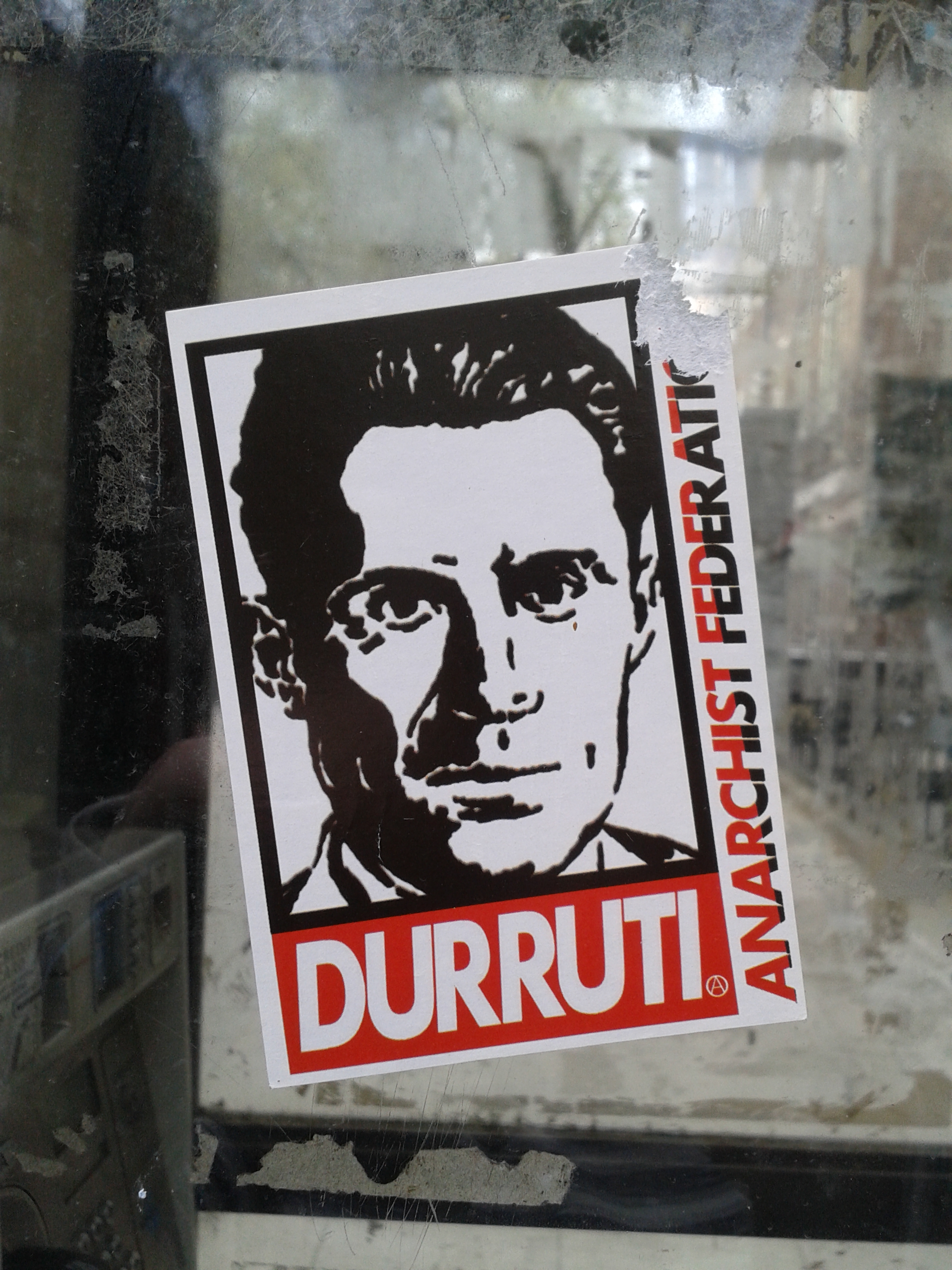
This sticker is part of another series that the AFed produce featuring prominent figures in anarchist history. This is Buenaventura Durruti, a Spaniard who was very active in the run up to the Spanish Civil War, as well as the War itself. He was killed by a sniper in November 1936 (Photo: Hannah Awcock, Malet Street, 17/04/15).
04_12-05-15 Byng Place
Emma Goldman (1869-1940) was, and still is, well known for her anarchist writing and speeches. Born in present-day Lithuania, she moved to America when she was 16, and was significant in the development of anarchist philosophy in the US (Photo: Hannah Awcock, Byng Place, 12/05/15).
05_20-05-15 Regent's Canal Towpath Islington-Camden (12)
This is one of the best known quotes attributed to Emma Goldman. I don’t know who made this sticker, but it is a sentiment I have seen in other AFed stickers. (Photo: Hannah Awcock, Regent’s Canal Tow Path, 20/05/15).
06_04-06-15 Heygate Road
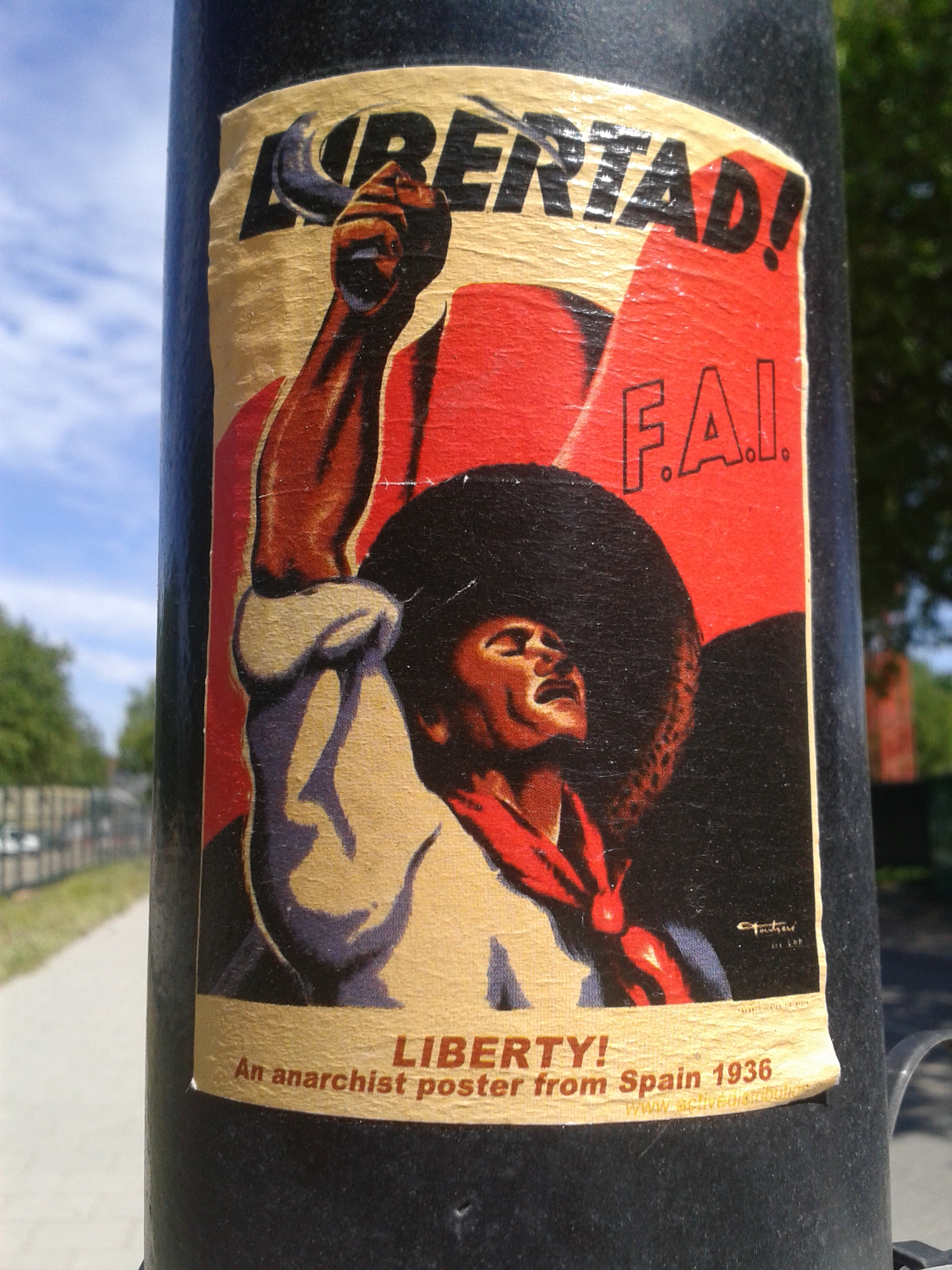
This sticker is one of my favourites. It is made by Active Distribution, which makes and sells all things anarchic. I come across their stickers quite often (Photo: Hannah Awcock, Heygate Road, 04/06/15).
07_25-06-15 Elephant and Castle
AFed have also been known to use references to popular culture in their stickers. This sticker features Finn and Jake, the main characters of an animated TV series called Adventure Time. It is made for children, but has developed a large adult following (Photo: Hannah Awcock, Elephant and Castle, 25/06/15).
08_27-02-15 Euston
And who doesn’t love a good yoda impression?! (Photo: Hannah Awcock, Euston Station, 27/02/15).
dav
AFed stickers can often be funny. This is a relatively new sticker (I think!), and is particularly pertinent in the context of the Islamaphobia that our society is currently struggling with (Photo: Hannah Awcock, Euston Road, 09/02/16)
10_05-05-15 Aylsebury Estate (6)
This is another one by Active Distribution; you can just make out the web address in the top right corner. I found this sticker on the Ayslebury Estate during the occupation that took place there last year (Photo: Hannah Awcock, Ayslebury Estate, 05/05/15).
11_19-05-15 Tottenham Court Road (4)
This sticker echoes the sentiments of the Emma Goldman quote above. It looks like someone objected to the message however, as the sticker has been quite badly torn. It reads “never be deceived that the rich will permit you to vote away their wealth” (Photo: Hannah Awcock, Tottenham Court Road, 19/05/15).
12_17-04-15 Malet Street (4)
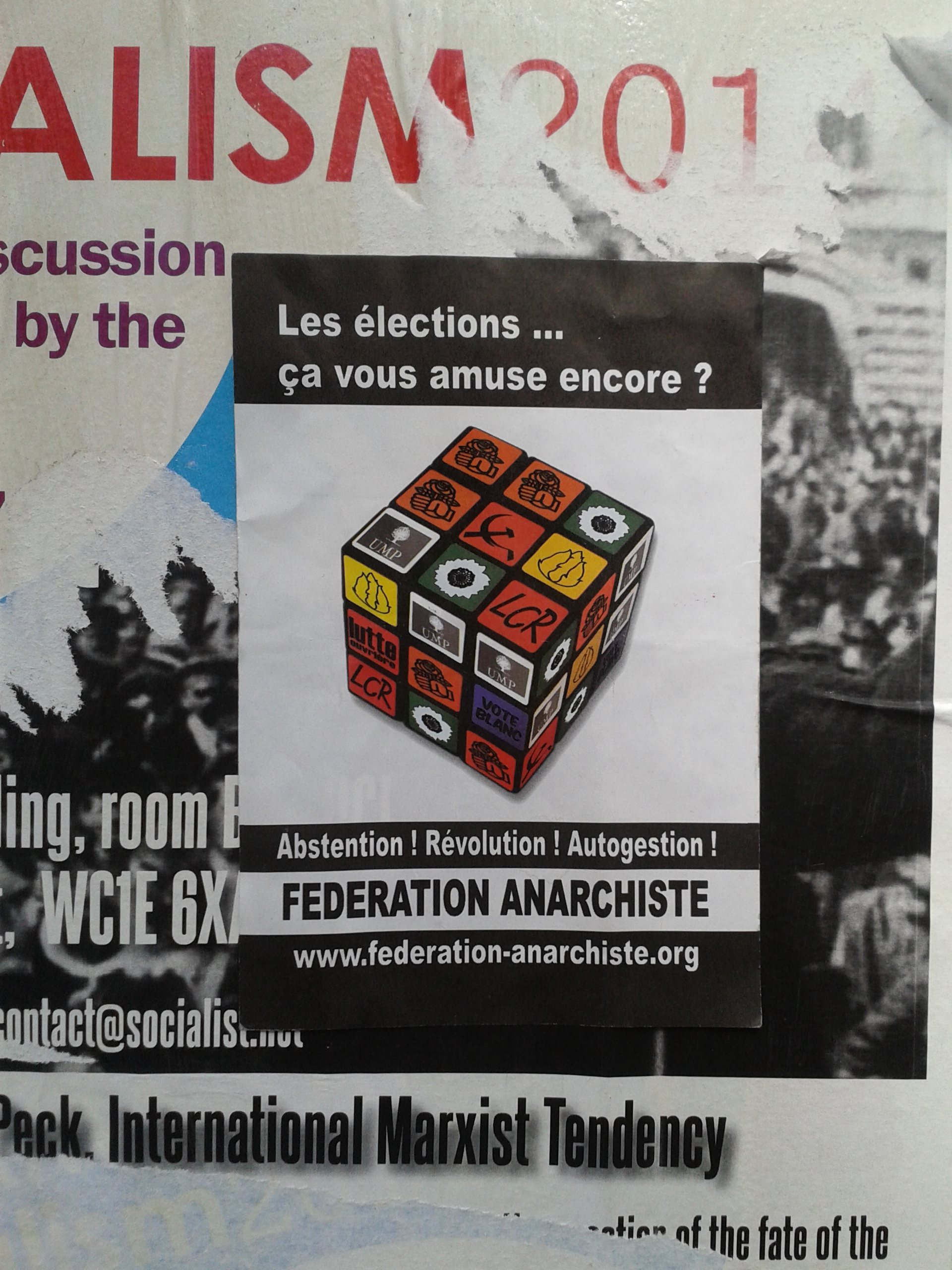
My French is rusty, but I know enough to identify this as an anarchist sticker! I think that it roughly translates to “The elections…are you still having fun?  Abstention” Revolution! Self Management!” (Photo: Hannah Awcock, Malet Street, 17/04/15).

You can see where I found these stickers on the Turbulent London map.

Times Are A Changin’: Temporality, Memory and Social Movements in the Digital Age

Times Are A Changin'
The Times Are A Changin’ Symposium was held at the University of Westminster on the 2nd and 3rd of June 2016 (Photo: Hannah Awcock).

I spent Thursday and Friday of last week at Times Are A Changing: Temporality, Memory and Social Movements in the Digital Age, a two-day symposium at the University of Westminster organised by Dr. Samuel Merrill and Dr. Anastasia Kavada. I really enjoyed the chance to meet new people, listen to some fantastic presentations and engage with some new concepts. Most of the other attendees were from Memory Studies or Media Studies, so there were a lot of new ideas for me to think about, particularly around the key themes of the symposium, temporality and memory.

As a Geographer, I am aware of just how significant time is (although space will always be my favourite!) However, the ways that different temporalities can impact, and be used by, activists and social movements is not something I had considered before. In her paper, Dr. Veronica Barassi argued that temporalities are constructed through practice, which means that activists can resist or reproduce hegemonic temporalities through their actions. Dr. Kavada’s presentation about the recent Nuit Debout protests in France provided a good example of this. The activists varied the speed at which they posted on social media depending on when they wanted attention; they would increase the intensity of posts before a important protest or meeting, for example. Dr. Kavada called this ‘temporal agency’; activists can gain power by negotiating with, or interfering in, temporal rhythms. It could be interesting to think through these ideas in the context of my PhD as the activists involved in my case studies had very different media technologies available to them, which all involved different temporalities.

The other key theme of the symposium was memory. For some activists and social movements, the memory of past events, people, and movements can be an important source of inspiration, morale, and identity. There were several papers relating to the various ways in which activists carry out ‘memory-work,’ such as Lorenzo Zamponi’s paper on #ioricordo, a hashtag created to memorialise the 2001 Genoa G8 protests. Archives have a significant role to play in the preservation of memory. Foteini Aravani, the Digital Curator at the Museum of London, gave a fascinating presentation about the museum’s experiences collecting items and digital media relating to recent protests, such as Occupy London. You do not have to be a museum to create an archive, however, and some movements choose to keep their own records.  Dr. Anne Kaun’s paper, entitled “Archiving Protest: Changing Temporal Regimes of the Archive,” discussed how modern social movement groups create their own digital archives. Occupy Wall Street had an archiving working group in order to capture representations of the movement from their own perspective. For my case study on the Battle of Cable Street, I am focusing on the various ways in which the Battle has been remembered, and how these memories are constructed and used, so this element of the symposium was also very helpful for me.

I have only mentioned a few of the great papers and speakers from Times Are A Changin’, there was so much interesting research presented that I can’t discuss it all. Suffice it to say that the symposium gave me a lot to think about, and I am confident that my own research will be better because I went. With that in mind, I would like to thank Sam Merrill and Anastasia Kavada for organising the symposium, and particularly Sam Merrill for inviting me. I look forward to seeing what comes next.

Turbulent Londoners: Daisy Parsons, 1890-1957

Turbulent Londoners is a series of posts about radical individuals in London’s history who contributed to the city’s contentious past, with a particular focus of women, whose contribution to history is often overlooked. My definition of ‘Londoner’ is quite loose, anyone who has played a role in protest in the city can be included. Any suggestions for future Turbulent Londoners posts are very welcome. My next Turbulent Londoner is Daisy Parsons, a Suffragette and the first female Mayor of West Ham.


Daisy Parsons- Beckton Lido
Daisy Parsons at the opening of the Beckton Lido in August 1927 (Source: © Newham Heritage Service).

Daisy Parsons was a formidable woman. Despite leaving school at the age of 12 to help support her family she became a force to be reckoned with in East End politics, working closely with Sylvia Pankhurst in the East London Federation of Suffragettes (ELFS), then going on to become the first female Mayor of West Ham.

Born Marguerite Lena Millo on the 25th of May 1890, Daisy must have had a difficult childhood. She was born in Poplar in East London, her family moving to nearby Canning Town when Daisy was 8 months old. She had 5 younger brothers, and because her father was an invalid, her mother had to take on washing and charring work. Daisy was given a certificate of exemption in 1902 so that she could leave Beckton Road School early to look after her brothers, a necessity she always regretted. When she was 14 she left home to work as a maid, but later became a cigarette packer at the Carreras Tobacco Company in Aldgate, because the pay was better. Women and girls were paid 3d for every 1000 cigarettes they packed (most managed about 3000 a day).

It was whilst working at the tobacco company that Daisy had her first contact with the trade union movement; male employees at the factory had a fixed lunch hour and a space to eat because their union had fought for them. Female employees had to eat in the toilets! Daisy’s husband Tom was a driver for Stepney Borough Council and an active union member. They married in December 1908 when Daisy was 18.

Daisy obviously had a keen interest in politics in her own right- she joined the Women’s Social and Political Union and the International Labour Party, and was one of the founding members and the secretary of the ELFS. She was remembered as being assertive and persuasive. She was clearly not one to shy away from action- at Suffragette demonstrations she carried a ‘Saturday Nights’ (a length of hemp rope tied at one end, a sort of improvised cosh) hidden up her sleeve in case she needed to defend herself.

Daisy took part in a deputation of working women to Prime Minister Asquith on the 12th of June 1914, trying to persuade him of the necessity of female suffrage. By this point she had 2 daughters, and was also looking after her niece. Daisy stuck with Sylvia Pankhurst after the split with her mother and sister, and ELFS worked tirelessly during the first world war, setting up a Mother and Child Welfare Centre in West Ham to help women who were struggling whilst their husbands were away, or had been killed.

When women over 30 were given the right to vote in 1918 Daisy still couldn’t vote because she was only 29! This did not deter her from moving into mainstream local politics however, and she was elected as a Labour Councillor for Beckton ward in 1922. She became deputy Mayor of West Ham in 1931, and Mayor in 1936. She also became a Justice of the Peace in 1933, and an Alderman of West Ham in 1935. During World War 2 Daisy organised the evacuation of local children and helped to organise the Women’s Voluntary Service. Her efforts did not spare her from tragedy however; her brother and niece were killed in the Blitz.

Daisy Parsons was obviously respected and admired. She was awarded the Freedom of West Ham in 1939, the highest honour which the borough can bestow, and was made an MBE in 1951 in recognition of her public service. She had gone from radical Suffragette to respected local official, but I get the impression she retained her determined and caring nature.

Sources and Further Reading

Anon. ‘Daisy Parsons, MBE.’ The Newham Story. No date, accessed 21st March 2016.  http://newhamstory.com/node/991

Brooker, Janice. ‘Daisy Parsons.’ Lost in London. Last modified 1st May 2007, accessed 21st March 2016. http://www.brooker.talktalk.net/daisy_parsons.htm

McCarthy, Ka. ‘Daisy Parsons.’ The Great British Community. Last modified 8th March 2016, accessed 21st March 2016. http://greatbritishcommunity.org/daisy-parsons/

Reflections on Twitter as a Historical Source

Last week, I detailed my clunky and ad-hoc method for collecting and analysing old tweets. I have now finished my data collection (I read almost 26,000 tweets in total), so it seemed like a good time to reflect a little more on the experience of the process and what I found, rather than just how I did it. The tweets I read were all written during 4 days in November and December 2010. During this period a nationwide campaign was trying to persuade the British government not to make dramatic changes to the way that higher education was funded, which included raising university tuition fees to up to £9000 a year.

The Student Tuition Fee Protests in 2010 is the only one of my case studies (the others are the Gordon Riots (1780), the Hyde Park Railings Affair (1866), and the Battle of Cable Street (1936)) that I lived through and participated in. I have my opinions about the issues contested in each of the other case studies, but researching events that you yourself experienced is very different. I was a second year undergraduate in late 2010, my younger sister would be affected by the proposed increased fees, and I cared very much about what happened. Reading through tweets from the four days of protest in London brought back a lot of emotions; the desire to do something; hope that we could make a difference, disbelief that anyone thought the proposals were a good idea; betrayal at the Liberal Democrats’ U-turn; anger at those who dismissed students as ignorant, lazy and apathetic; all soured by the knowledge that we didn’t change anything. Compounding this is the tendency people have to be more arrogant and abrasive on the internet than they ever would be in person. Because of this some Tweets were quite offensive, and it was hard not to take it personally. I found myself fighting the urge to reply to some of the most irritating Tweets, repeatedly reminding myself how strange it would be to get a reply to something written 6 years ago. Reading the tweets caused me to re-live many of the feelings I experienced back in 2010, which meant that this research was often quite draining emotionally.

049
Some tweets expressed extreme opinions, which I often found difficult to read (Source: Twitter/@purpleline).

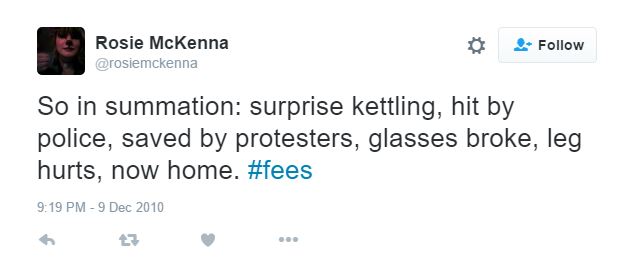
One of the biggest problems I have faced so far in my PhD research is that the further back in time you go, the less archival material there is which records the perspectives and experiences of ordinary people. This is a challenge for many historical researchers, but it has been particularly difficult for me because the wealthy elites don’t tend to be the people participating in protest and dissent. The internet is relatively accessible, with only 11% of British adults having never used the internet (Office of National Statistics, 2015). This does not mean that 89% of British people use Twitter, but it does give me the opportunity to see what ‘ordinary’ people were saying about the protests, which is a rare treat for me. Twitter revealed some wonderfully fine-grained details about the protests and what it was like to be there. For example, a woman called Rosie McKenna broke her glasses and hurt her leg whilst being kettled by police on the 9th of December. It was great to be able to develop such a clear picture of what it was like to be part of the protests, rather than having to rely heavily on imagination.

040
Twitter preserves the experience of protesting in finer detail than traditional archival sources (Source: Twitter/Rosie McKenna).

Another aspect of the research that I really enjoyed was seeing how various processes present in my other case studies played out through this modern technology. A common feature of protests and social movements is conspiracy theories; people speculate about who the ‘real’ organisers of a protest event are, or who might be manipulating the course of events to suit their own aims. The Gordon Riots, for example, were blamed on the American, Spanish or French governments. Scholars have argued that these theories developed because at that point it was not generally believed that the lower classes were capable of organising themselves in such a manner; they need someone to tell them what to do (Leon, 2011; Tackett; 2000). Conspiracy theories persist, however, despite modern society holding a less patronising view of the working and middle classes.One of the best known events of the 2010 Student Protests was the occupation of 30 Millbank, the building in which the Conservative Party campaign headquaters were housed. The response of the Metropolitan Police on this occasion was rather slow and inadequate. The most likely explanation is that they were surprised by the strength of feeling amongst the protesters, and had not prepared for trouble on that scale. However, it was suggested by some Twitter users that the police had deliberately responded slowly, because policing was facing its own budget cuts under the austerity regime, and wanted to demonstrate their usefulness to the government. The saying ‘the more things change, the more they stay the same’ springs to mind…

060
Twitter gives modern conspiracy theories related to protest a new platform on which to be transmitted and debated (Source: Twitter/Simon Bayley).

After a long period of writing, I really enjoyed getting to doing some research again, and exploring a new source of data. Working with Twitter was tiring, physically as well as emotionally (I had to take regular breaks because of the strain on my eyes), but also very rewarding. It has provided me with evidence to back up my arguments, as well as leading me to develop some new ones, and I feel like my PhD will be stronger because I tried this new (to me) research method.

Sources and Further Reading

León, Pablo Sánchez. “Conceiving the Multitude: Eighteenth-Century Popular Riots and the Modern Language of Social Disorder.’ International Review of Social History 56, no. 3 (2011): 511–533.

Tackett, Timothy. “Conspiracy Obsession in a Time of Revolution: French Elites and the Origins of the Terror 1789–1792.” The American Historical Review, 105, no. 3 (2000): 691–713.

#demo2010: Harvesting Old Tweets as a Research Method

The long time scale of my PhD means I have to deal with vastly different sources in my research. For the Gordon Riots (1780), I use mainly eyewitness accounts and court records. For the Battle of Cable Street (1936), I have access to images and videos of what happened. For the 2010 Student Tuition Fee Protests, the choices are almost endless. One of the sources I decided to utilise was Twitter, the social media website that allows its users to post updates of up to 140 characters. Every type of source presents different challenges for the researcher, and I found the unique challenges of Twitter rather difficult to cope with at first. This post is about the method I developed for my research, and I hope it will act as a catalyst for discussion amongst other scholars dealing with similar issues. My research was conducted on a computer with a Windows 10 operating system, and I do not know how well my method would translate to a different operating system.

Whilst there are programmes which collect tweets in real time as they are tweeted, many of which are open access, there are fewer designed to harvest pre-existing tweets. Those there are are aimed at a commercial rather than academic market, and their cost is beyond the scope of my research budget. So I had to develop my own ad-hoc, ‘low tech’ method of harvesting old tweets, using Twitter’s Advanced Search function.

In 2014 Twitter began allowing users to search for tweets more than 7 days old in its Advanced Search function (accessed from the options menu of a bog standard Twitter search result page, or by googling ‘Twitter Advanced Search’. You have to have a Twitter account to use this function). Advanced Search lets you combine a whole variety of search parameters, including date, location, hash tags, Twitter accounts, key words, sentiment (whether a Tweet is positive or negative). You can even input words you don’t want to be included.

Twitter Advanced Search
Twitter’s Advanced Search function looks a little like this (Source: Twitter).

Once I decided I was using Advanced Search, I had to decide on search parameters. The Student Tuition Fee Protests were a series of demonstrations, occupations and marches on both a national and local scale that took place between the 10th of November and the 9th of December 2010. I wanted to see Tweets from the four days of action that took place in London, on the 10th, 24th, and 30th of November, and the 9th of December. I started by searching for tweets that had been geotagged with London on the revelant days. Only a small percentage of tweets are geotagged, but it provided me with an idea of the hashtags and keywords that were were being used in regards to the demonstrations. I used this to decide on my search parameters. For example, for the demonstration on the 9th of December I searched for ‘Any of these words: protester, protesters, students, tuition, fees, protests’ and ‘These hashtags: #demo2010 #dayx3 #fees #solidarity #studentprotest #ukuncut’. For each demonstration, I used a slightly different combination of hashtags and keywords, in an attempt to find as many relevant tweets as possible. I acknowledge, however, that I probably did not find every tweet about the demonstrations. I also altered the dates as appropriate, then started the search.

Twitter Search Results
This is the top of the search results page I got for the protests on the 9th of December 2010 (Source: Twitter).

Now for the long-winded part. I have not found a way to download multiple tweets at once. You can use your browser’s print function to save the search results as a pdf, but there are several disadvantages to this. You cannot expand the tweets to see what time they were tweeted, and it will only save the tweets that have loaded- you have to scroll all the way down to the bottom of the search results to save them all, and this can take a long time when searches yield more than a few thousand tweets. I did save the search results as a pdf, so I can go back to them at a later date if I want to, but only once I had read them all.

And that is how I analysed the search results, by reading every single tweet. Any tweets that I thought might be relevant to my research, I saved as a jpeg using the Snip tool, with it’s own individual number (001, 002, 003, 004 etc.). I also pasted each tweet into a word document, so I could go back to them later without having to open each individual jpeg. I coded the saved tweets as I went along, making a note of the tweet’s number and the key theme it related to. I also kept a count of how many tweets I had read as I went along. I wouldn’t say it was very reliable, but I can at least say roughly how many tweets I analysed for each demonstration. For example, I read almost 8000 tweets related to the demonstration on the 10th of November 2010.

Snip Tool.png
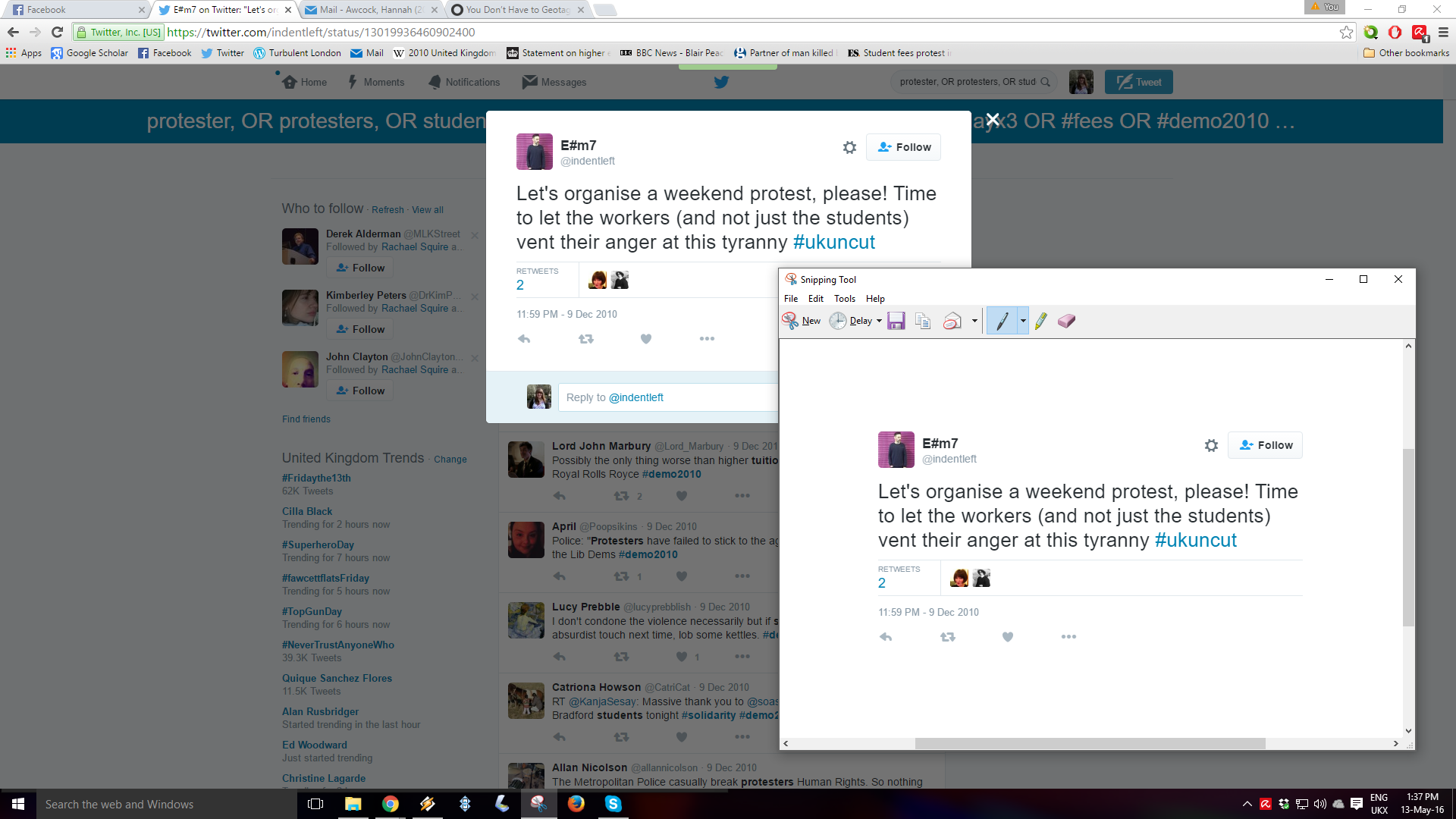
The Snip tool allows you to make an image from your computer screen. It works a little like print screen, but you are able to select a particular area that you want to capture, like this tweet from the 9th of December 2010 (Source: Hannah Awcock).
dav
Sometimes, the simplest way of doing things is the best. I counted every tweet I read, and coded the most relevant ones using a good old fashioned notebook and pen (Source: Hannah Awcock).

So there you have it; my ad hoc, low tech (for Twitter!) method for collecting and analysing old Tweets for academic research. It is a rather clunky method, and I suspect that someone with more technological know-how than me could improve it dramatically, but it has allowed me to see how social media was being used during the 2010 Student Protests in London. If you have experience with this sort of research, or just have an opinion on it, then I would love to hear from you!

Protest Stickers: New York City 2, Part 2

01_09-03-16 (2)
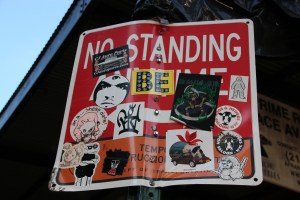
Stickers obscuring a road sign in New York City (Photo: Hannah Awcock).

Street art is everywhere in New York City, and it comes in all shapes and sizes. For those of you that are new to Turbulent London, I am especially interested in stickers, particularly those with political subject matter. So on a recent trip to New York City, I took my camera and my habit of photographing random bits of street furniture to see what protest stickers I could find on the streets of the city that never sleeps. This is the second time I have visited NYC since I started photographing protest stickers, and the first time I struggled to find many. This time however, I found so many stickers that I have decided to do two blog posts, hence the slightly awkward title (the first post, published last week, is here). In the last post, I looked at the different kinds of issues which protest stickers address, the different types of stickers you can find, and some of the most common themes in the stickers I found. This post is far less organised I’m afraid, its just everything else that I wanted to include!

02_11-03-16 (1)
Some American industries. including the building trade, still have very strong unions. Builders in New York tend to plaster their hard hats with stickers, so that they become a walking representation of their unions and the causes that they consider to be important (Photo: Hannah Awcock).
03_10-03-16 (1)
Last week I talked about some of the most common themes that came up in protest stickers, police brutality and the upcoming Presidential election. Animal rights was another common theme; this sticker contains the web addresses of meatvideo.com, which shows abuse at factory farms, and In Defense of Animals, a group which campaigns for animal rights, welfare and habitat (Photo: Hannah Awcock).
04_10-03-16 (11)
This sticker also references meatvideo.com, but it is not quite as well made as the last one. I remember seeing this sticker design when I was here in 2015, so there’s a chance this particular sticker has been there quite a while (Photo: Hannah Awcock).
05_15-03-16 (32)
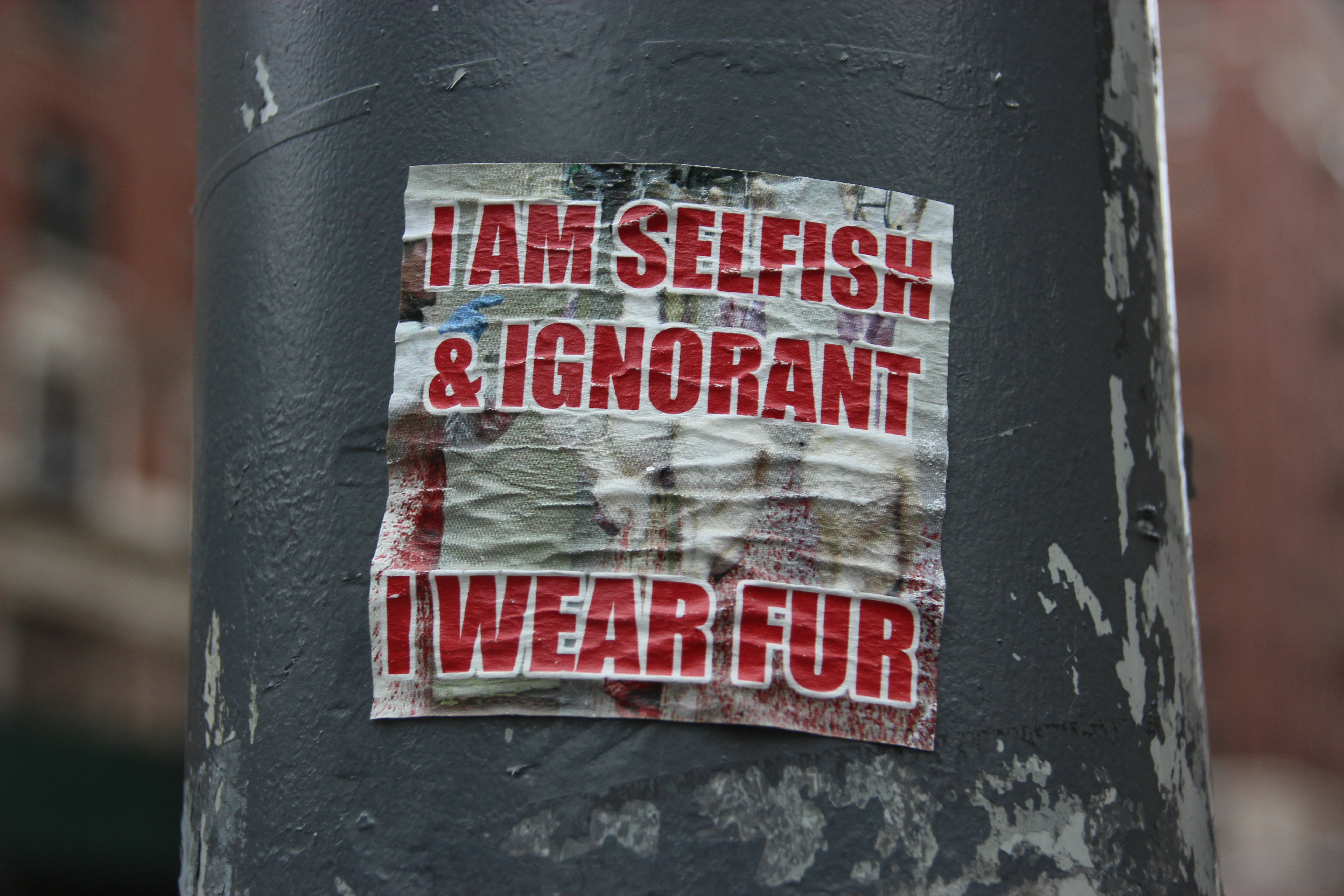
This sticker criticises people who wear fur. The picture is unclear because the sticker has been wrinkled by rain, but the message is still pretty clear thanks to the huge red writing (Photo: Hannah Awcock).
08_12-03-16 (51)
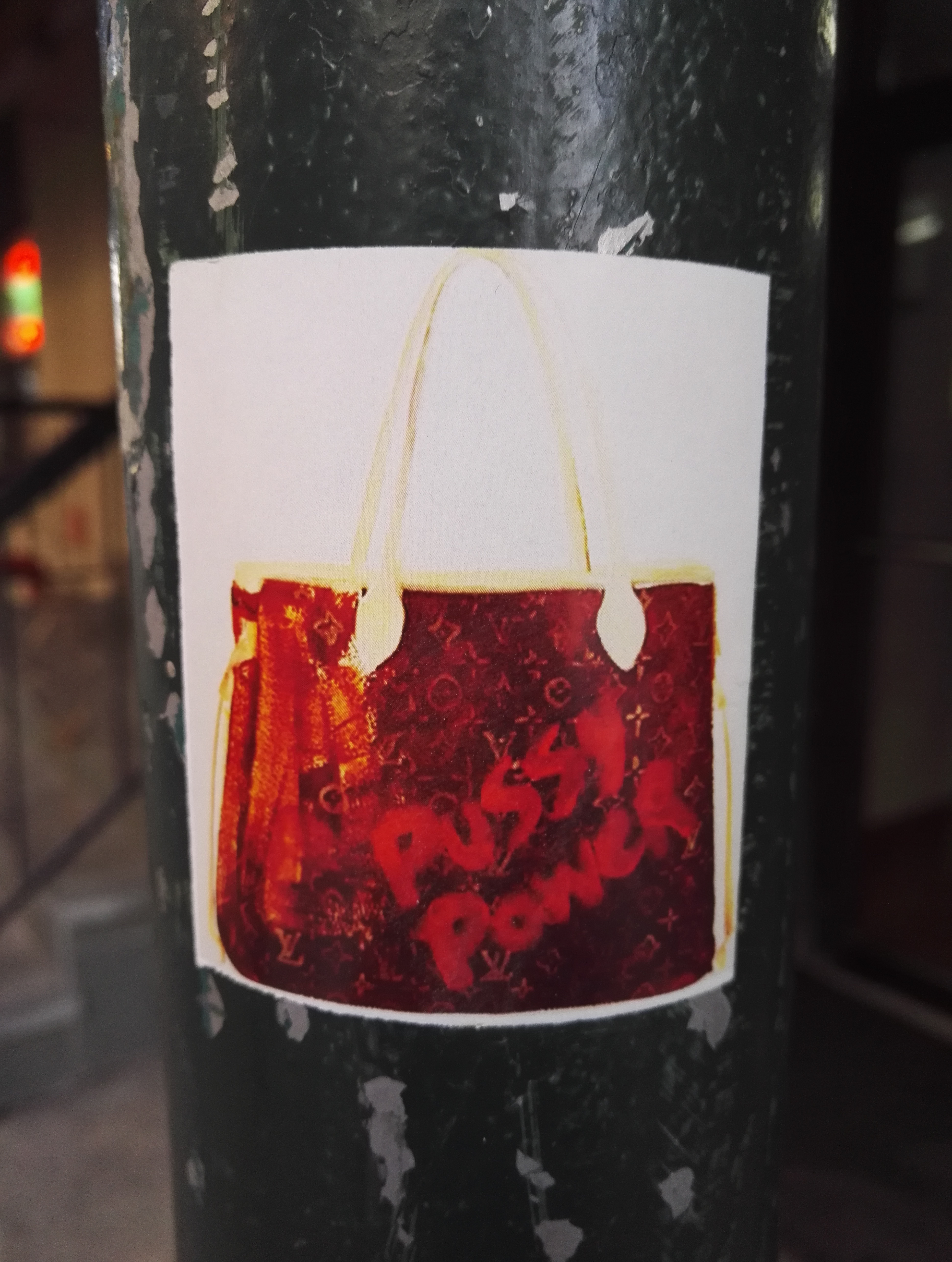
Feminism was a less common theme, but it did crop up now and again (Photo: Hannah Awcock).
dav
I found this sticker on some scaffolding right outside our hotel when we first arrived- I took it as a good omen for the trip! (Photo: Hannah Awcock).
06_12-03-16 (7)
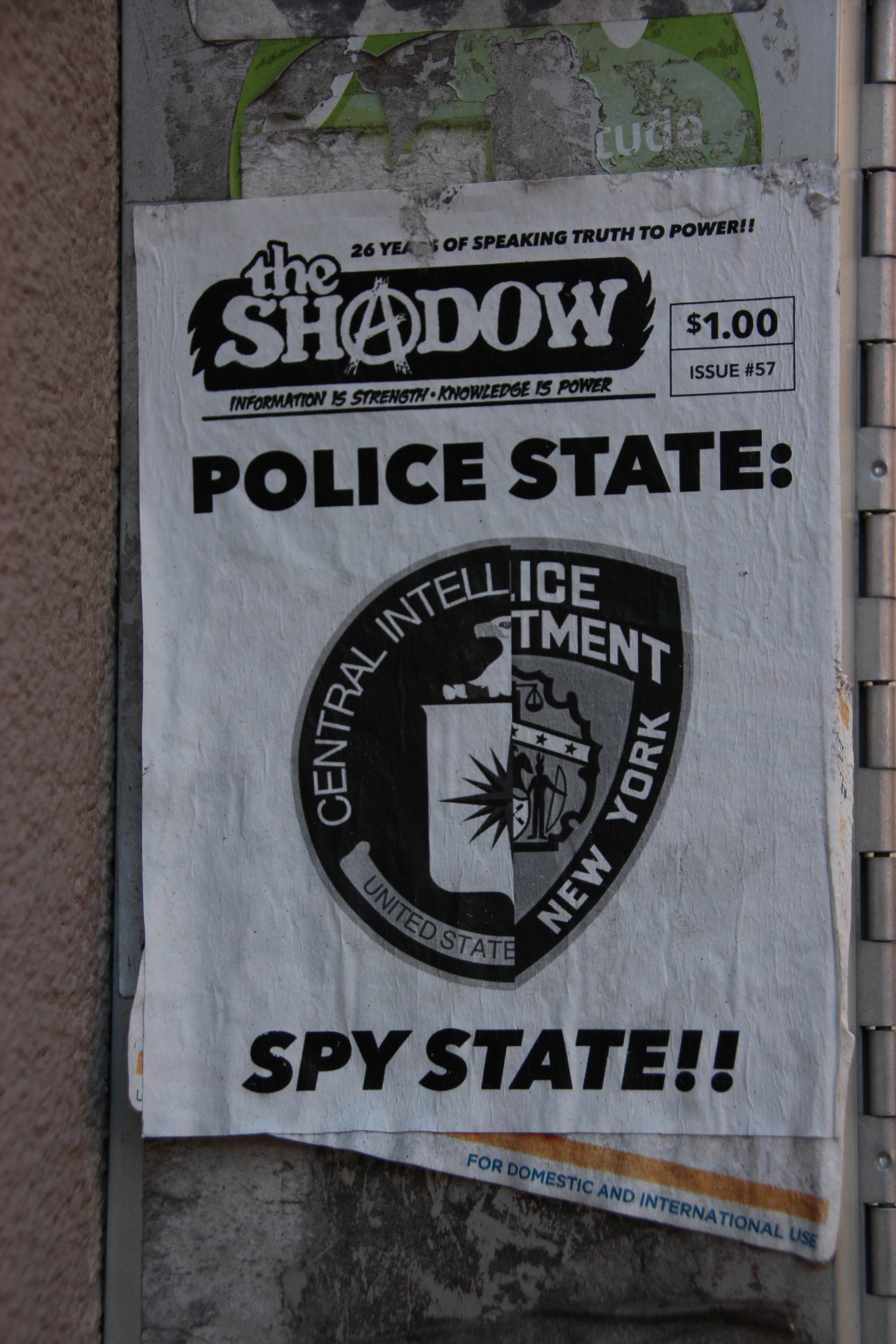
The East Village is one of the ‘coolest’ neighbourhoods on Manhattan, and some stickers are local to this area. The Shadow claims to be New York’s only underground newspaper, and is published from the lower East Side. It was started in 1989, after local people were disillusioned by the mainstream media’s coverage of the Tompkins Square Park riot in 1988. I featured one of The Shadow‘s stickers last time, but didn’t know the story behind it until this trip (Photo: Hannah Awcock).
07_12-03-16 (20)
This sticker was produced by the Museum of Reclaimed Urban Space, which is located in a squat on Avenue C. The Museum is volunteer-run, and focuses on grassroots campaigns to keep communal spaces in the city out of corporate hands (Photo: Hannah Awcock).
09-03-16 (1)
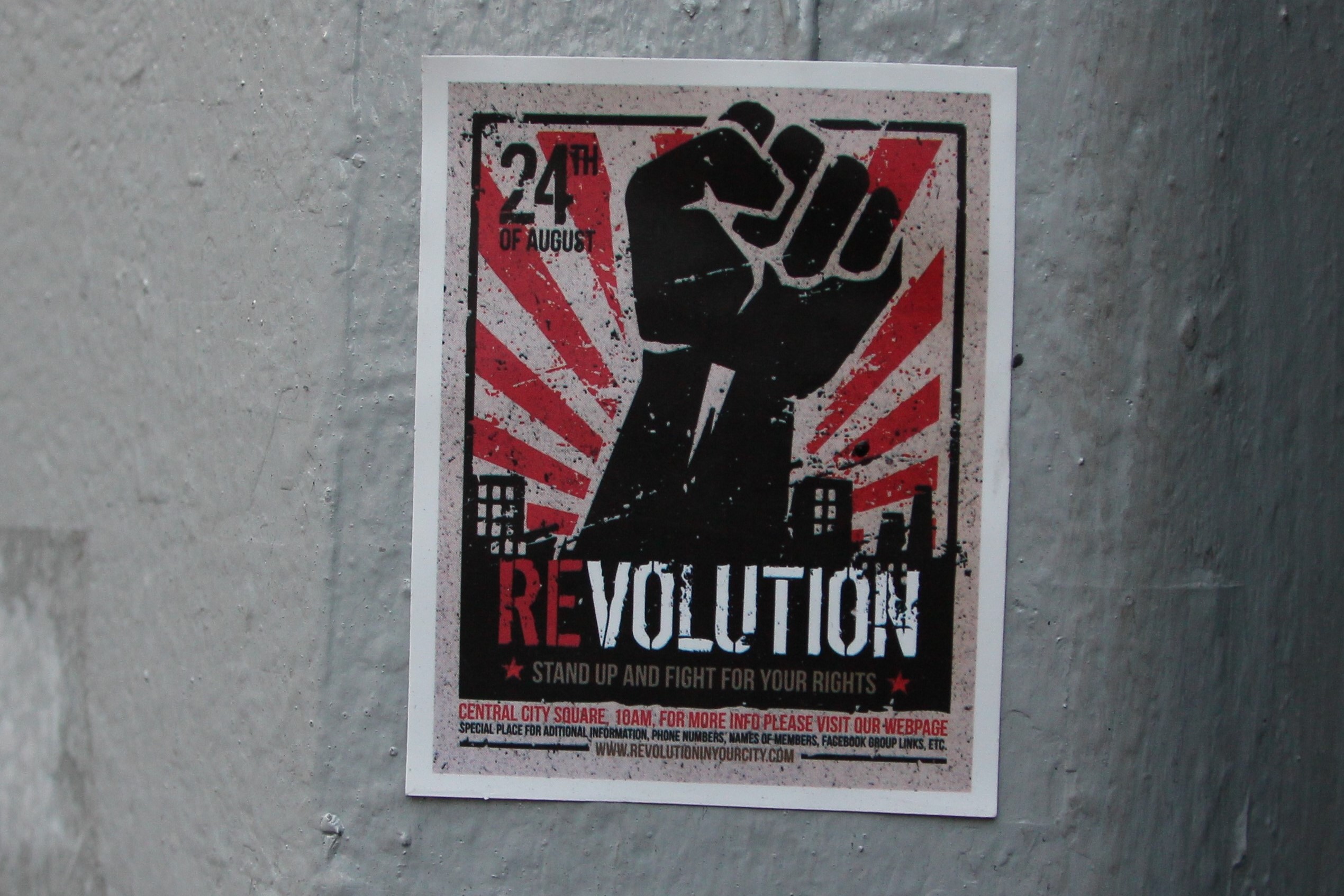
The clenched, raised fist is a common symbol of dissent (Photo: Hannah Awcock).
10_12-03-16 (34)
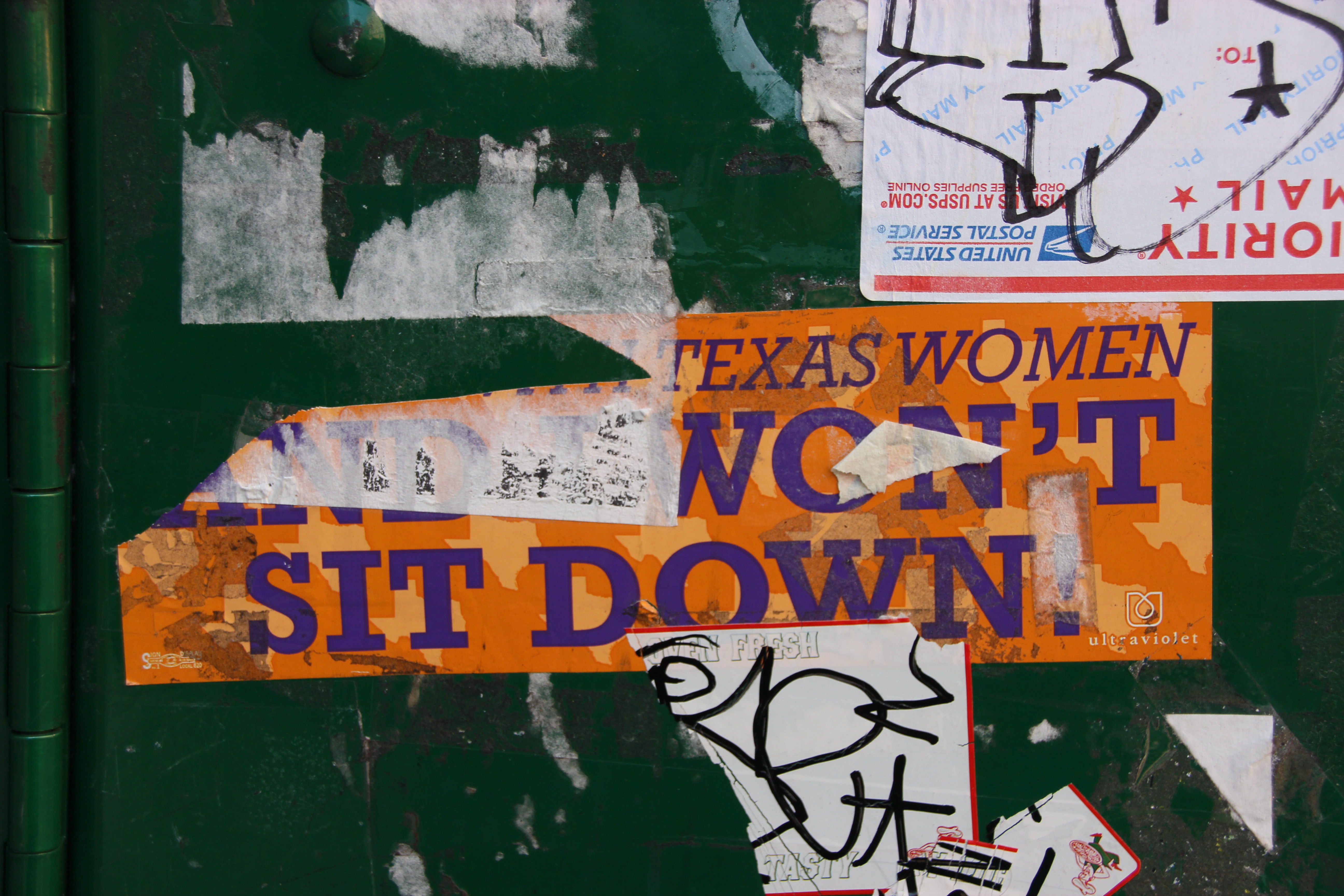
This sticker has been partially obscured, but it reads “We stand with Texas Women, and we won’t sit down!” It was produced by Ultraviolet, a group that campaigns for women’s rights. This particular campaign is about preventing attempts to restrict access to abortions in Texas (Photo: Hannah Awcock).
10-03-16 (7)
Being a millennial myself I find this a little harsh, but everyone is entitled to their opinion I guess! (Photo: Hannah Awcock).
12-03-16 (32)
The SEIU is the Services Employees International Union, and 32BJ is the local New York branch. It represents cleaners, security guards, and others whose work involves the maintenance and servicing of buildings (Photo: Hannah Awcock).
12-03-16 (42)
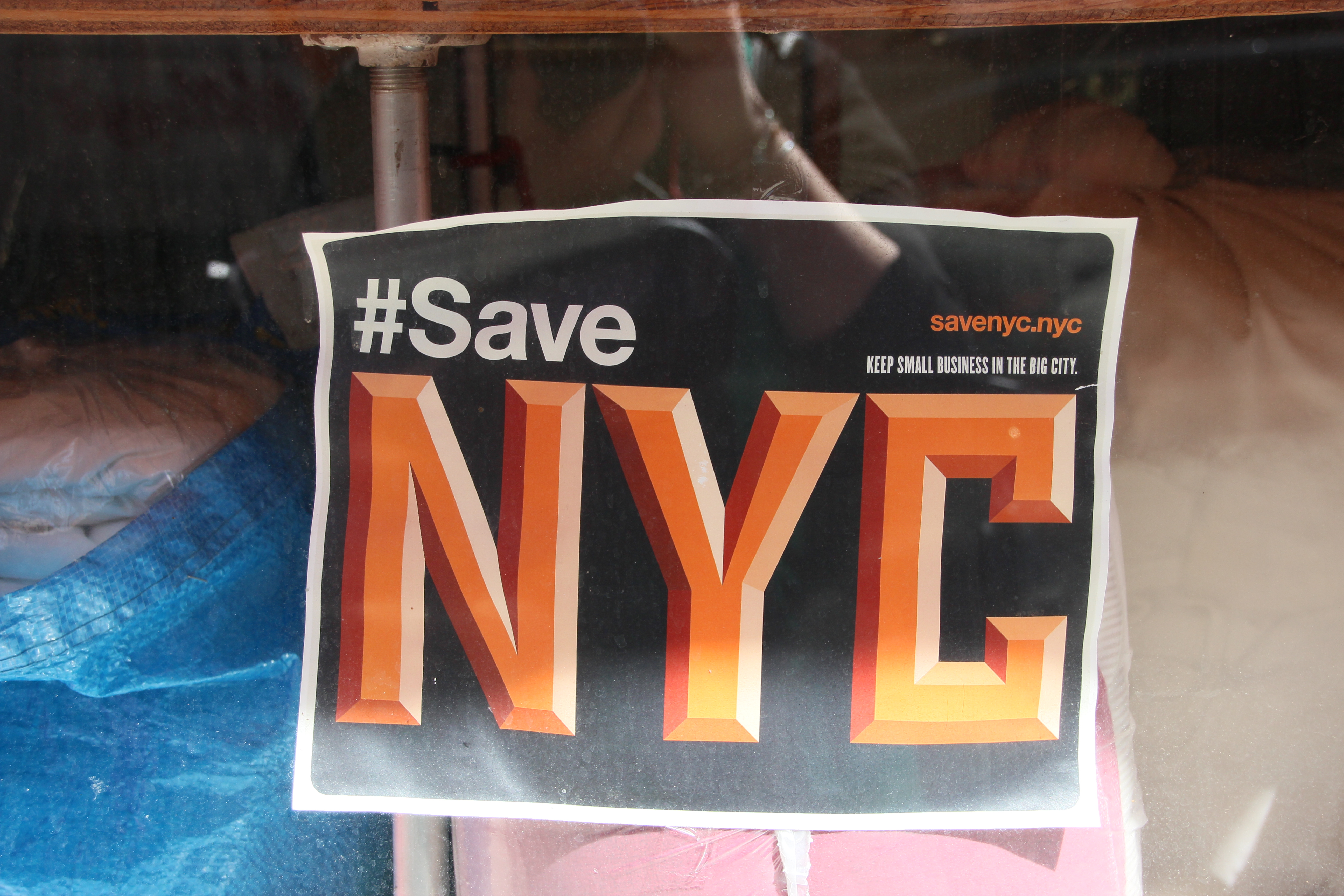
New York City has rents comparable to London, and it must be difficult for small businesses to survive. Save NYC is a campaign to “preserve the diversity and uniqueness” of New York. This was in the window of a dry cleaners in the East Village (Photo: Hannah Awcock).
15-03-16 (2)
This sticker has adapted the design of the one dollar bill to call for the legalisation of cannabis (Photo: Hannah Awcock).
15-03-16 (5)
This stickers celebrates the actions of Edward Snowden, a whistleblower who leaked information from the National Security Agency in 2013 which sparked intensive debate about the balance of individual privacy and national security. PeaceSupplies.org sells stickers, shirts and patches related to various campaigns (Photo: Hannah Awcock).
15-03-16 (9)
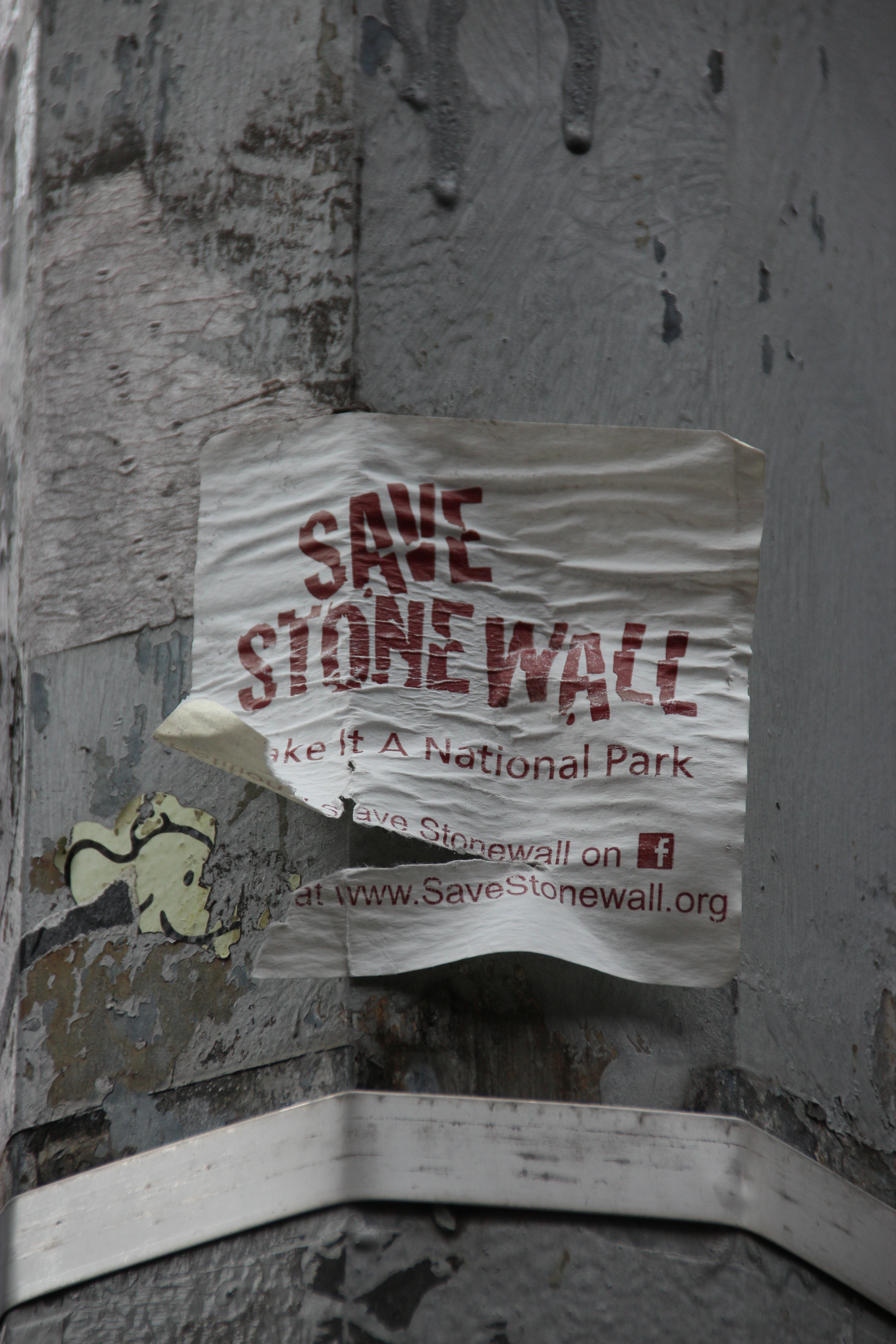
This sticker promotes Save Stonewall, a campaign to create a national park to commemorate the Stonewall Riots, which took place in Greenwich Village in 1969 (Photo: Hannah Awcock).
15-03-16 (10)
Parent Team is a group which supports parents of children dealing with drug or alcohol addiction. Here they are calling for free childcare for all, which doesn’t quite match up with their main purpose, but is an admirable goal none the less (Photo: Hannah Awcock).
15-03-16 (14)
This is a sticker produced by the street artist and anti-war activist Jef Campion (a.k.a. Army of One/JC2). He used his art to emphasise the ill effects of war. He passed away in 2014, but his memory lives on in his street art (Photo: Hannah Awcock).
15-03-16 (27)
This photo illustrates how the location of a sticker can influence or reinforce its meaning. This sticker was placed on the stop sign at a pedestrian crossing, emphasising its anti-gentrification message (Photo: Hannah Awcock).
15-03-16 (31)
The International Museum for Activist Art is a website which displays art that aims to raise awareness of the issues facing society, and I would definitely recommend having a browse through it (Photo: Hannah Awcock).
15-03-16 (29)
I found this in Washington Square Park on my last day in New York. It uses the story of Goldilocks to call for the preservation of our planet. Earth is ‘just right’ for human habitation, a rare attribute that we shouldn’t take for granted (Photo: Hannah Awcock).

Protest Stickers: New York City 2, Part 1

01_15-03-16 (12)
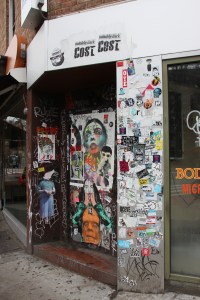
A doorway in Greenwich Village with a high concentration of street art and stickers (Photo: Hannah Awcock).

New York City has a thriving street art culture. Almost every neighbourhood has walls covered in art, both official and unofficial. There are also a lot of stickers, of all kinds- I spotted one sticker advertising a new novel, which is something I haven’t come across in London before. Lots of stickers generally means lots of protest stickers, and during the week that I was there in early March I found loads. I wouldn’t like to say whether the amount of protest stickers is increasing, or I have just got better at spotting them since I visited last time, but it certainly felt like there were a lot. I found so many in fact, that I have decided to split this post into 2 parts, with Part 2 being published this time next week.

Protest stickers are a great way of seeing what kinds of issues are important to the people of a city. Some themes crop up again and again, whilst other topics just appear to be a particular bug bear of one zealous stickerer (I am still looking for a less clumsy way of referring to people who put up stickers!) Stickers are just one of the ways in which protest imprints itself onto the physical fabric of a city, but they can also be one of the most long-lasting, although their transience is one of their defining characteristics.

02_12-03-16 (27)
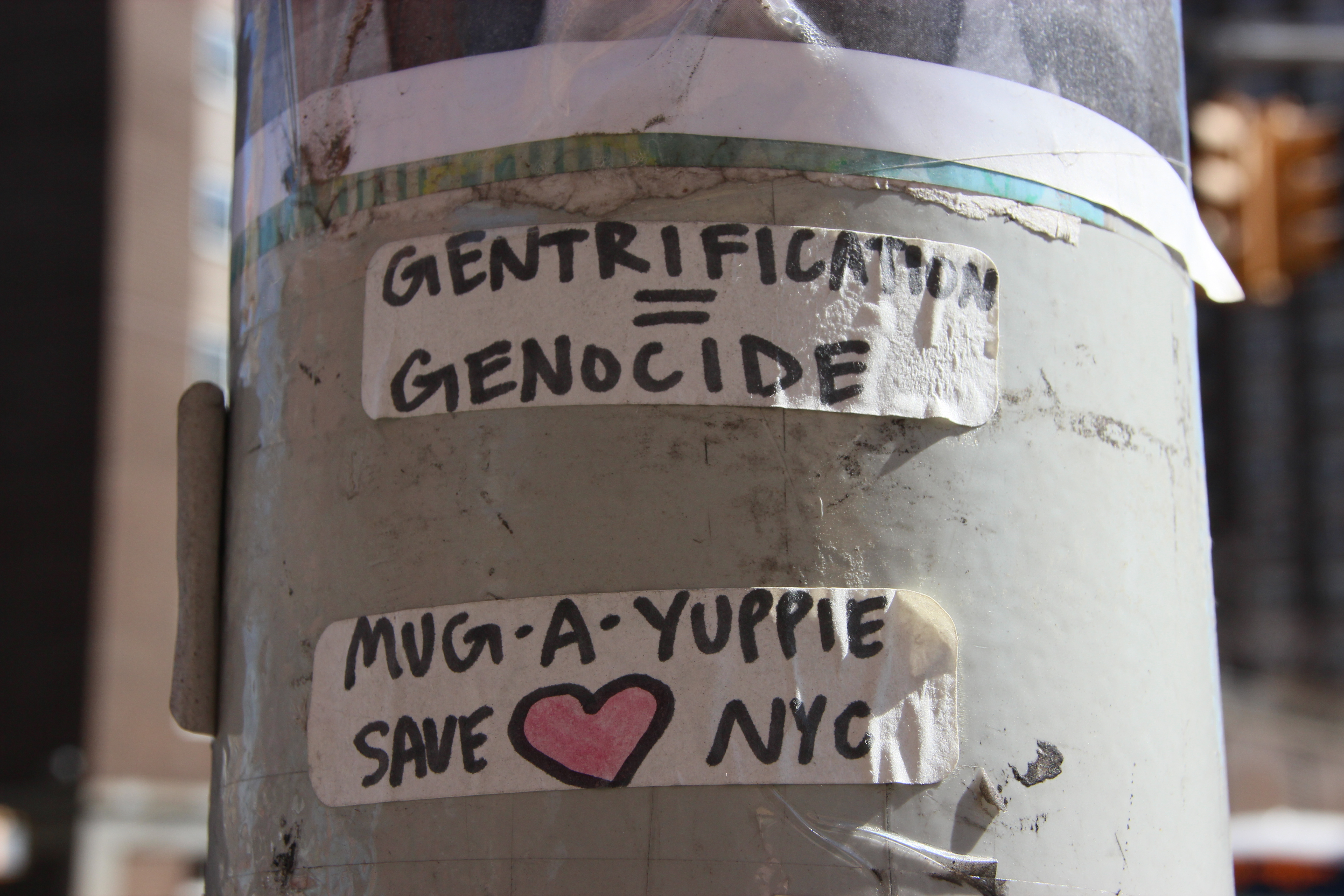
As in London, gentrification is a contentious issue in New York City. These stickers are drawing attention to the issue in a tongue-in-cheek manner (at least I hope it is!) (Photo: Hannah Awcock).
03_10-03-16 (19)
You can find stickers about a whole range of issues, relating to a whole range of scales. The relevance of this sticker is confined to New York City (Photo: Hannah Awcock).
04_10-03-16 (4)
Some stickers refer to national scale issues. The upcoming Presidential election is just about all anyone can talk about in America at the moment, and this obsession is reflected in New York’s protest stickers (Photo: Hannah Awcock).
05_12-03-16 (52)
Some stickers are about international scale issues. In case you can’t read the top line, this sticker says “Stop Iran- We Stand with Israel” (Photo: Hannah Awcock).
dav
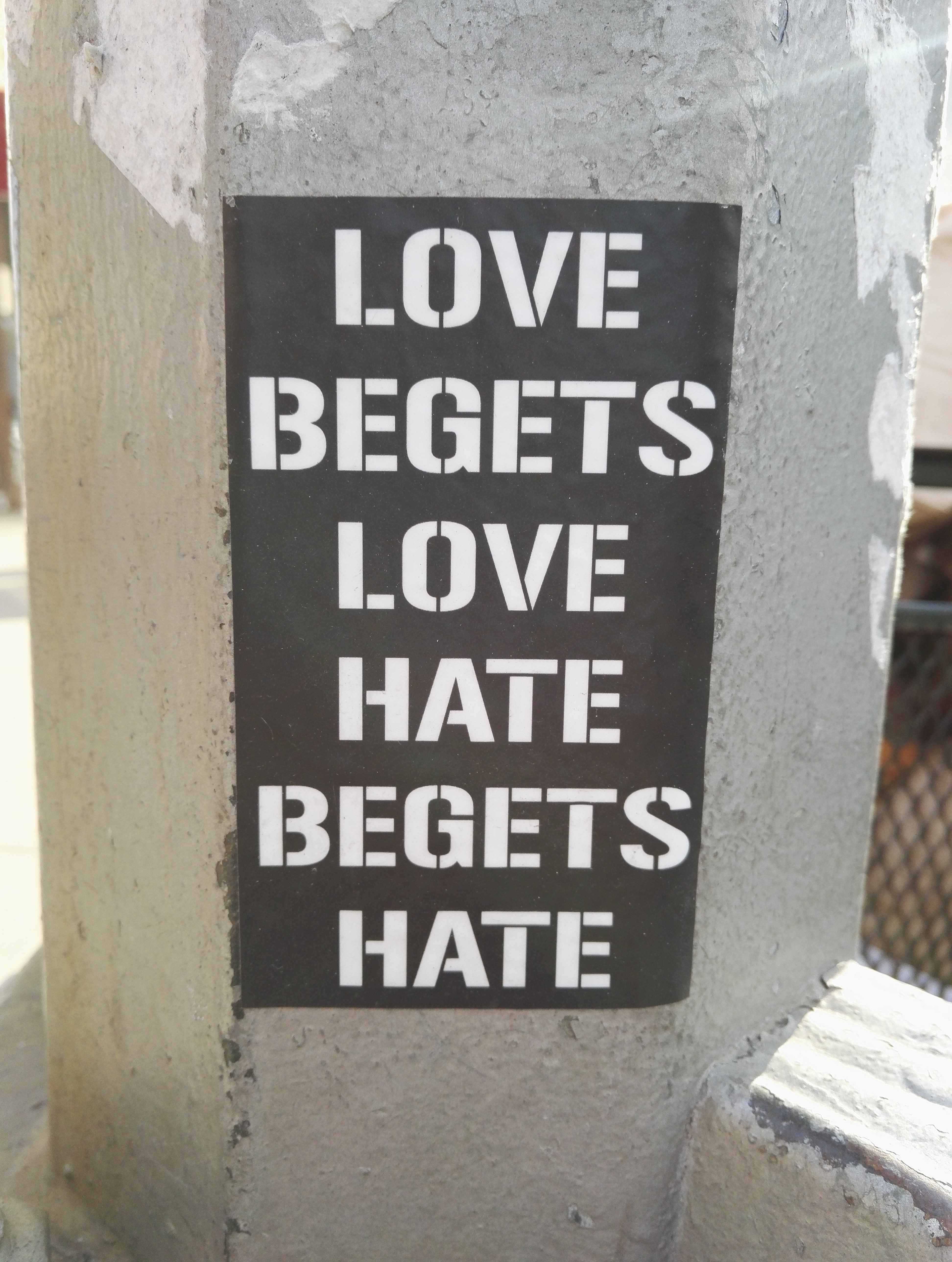
There are some stickers that defy scale; this sticker doesn’t refer to any issue in particular, instead advocating a more forgiving attitude that could probably help a lot of contentious situations (Photo: Hannah Awcock).
08_13-03-16 (2)
This sticker also takes an abstract approach. It is by a street artist called @ApillNYC who, despite the @, has very little information about them on the internet (Photo: Hannah Awcock).
06_14-03-16 (2)
Some stickers are not even remotely relevant to New York City. This sticker comes from the Hillsborough Justice Campaign, which seeks justice for the 96 people who died in a crush at Hillsborough Football Stadium in Sheffield in the United Kingdom. I have seen these stickers before in London and I was very excited to find them here, on the viewing platform at the top of the Rockefeller Centre (Photo: Hannah Awcock).
09_10-03-16 (12)
As well as relating to a whole range of scales, protest stickers come in a whole range of forms. This sticker is basic, and was probably quite easy to make (Photo: Hannah Awcock).
10_15-03-16 (15)
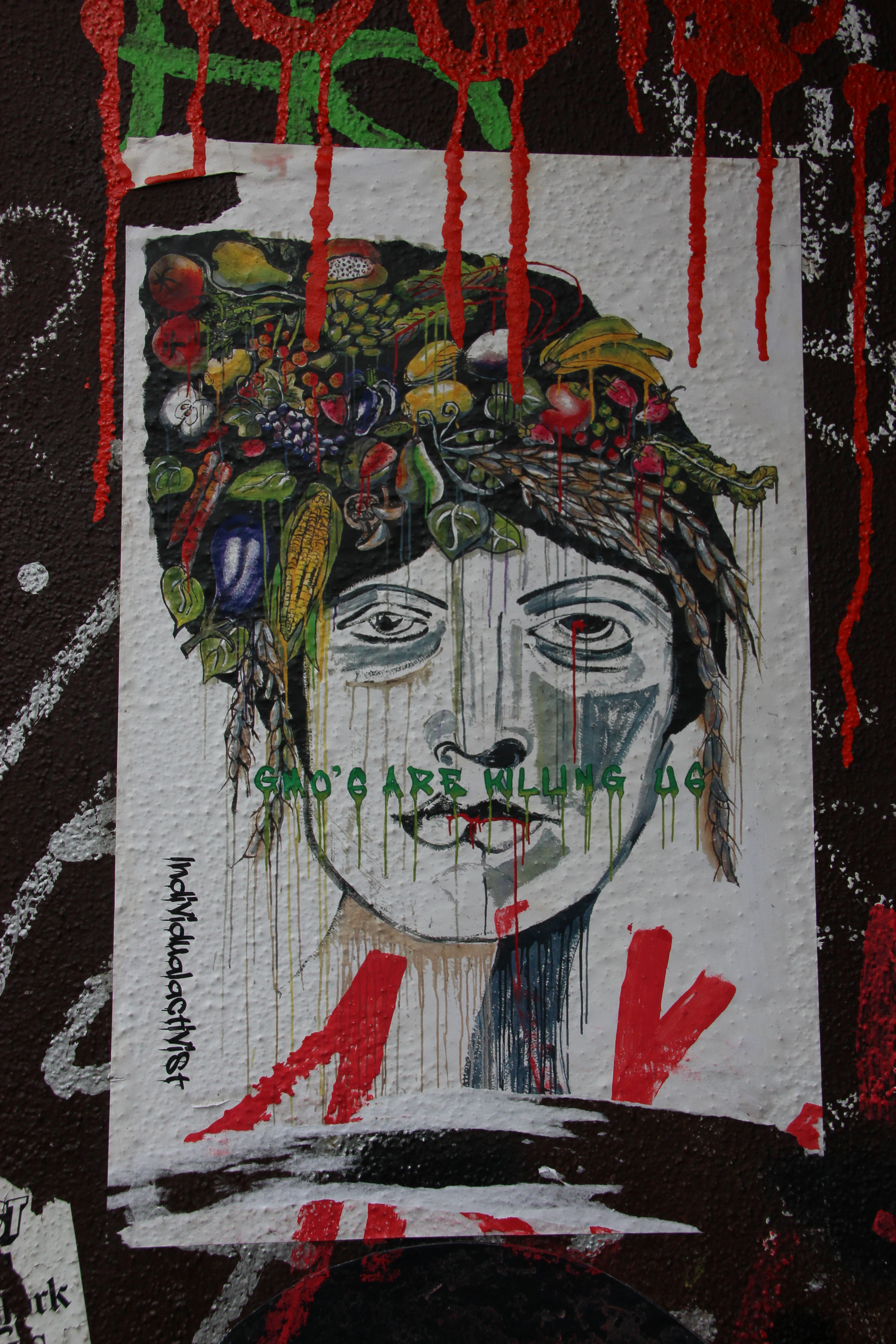
Whereas this sticker blurs the boundary between protest sticker and street art, and likely took a lot longer to produce. This sticker, which I suspect was pasted to the wall rather than being stuck with its own adhesive, is by someone called Individual Activist (Photo: Hannah Awcock).
10-03-16 (15)
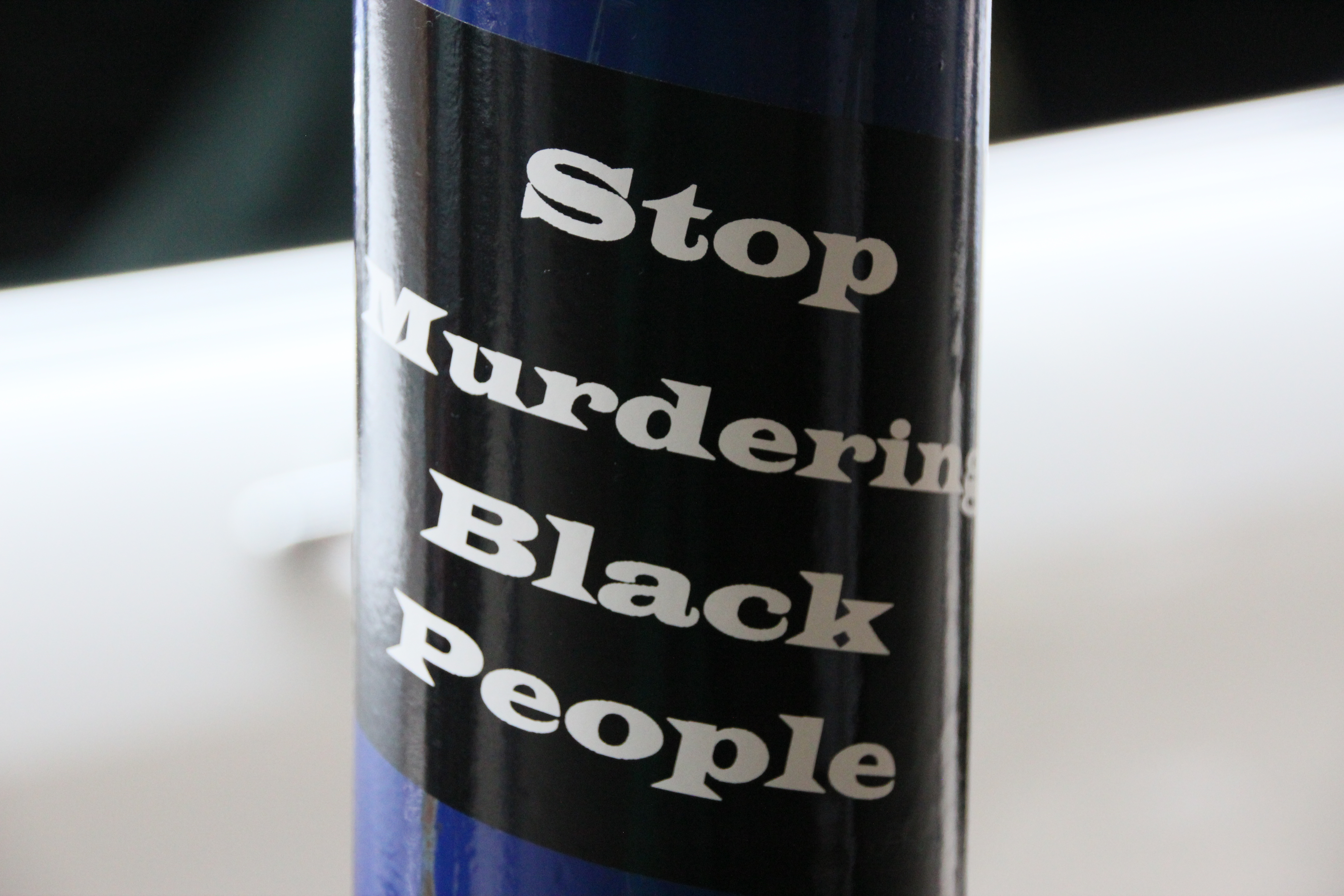
One of the most common themes of protest stickers in New York City is policing. There has been widespread controversy in America over the past few years over the treatment of civilians by police officers, particularly when it comes to ethnic minorities. Rise Up October was organised by the Stop Mass Incarceration Network (Photo: Hannah Awcock).
11_09-03-16 (7)
This sticker plays on the idea that the police should protect citizens, rather than pose a threat to them. In reality, the police can pose a threat, particularly to members of ethnic minorities (Photo: Hannah Awcock).
12_12-03-16 (10)
To serve and protect is another phrase commonly associated with the police. This sticker is implying that the police serve and protect property, rather than people (Photo: Hannah Awcock).
13_12-03-16 (37)
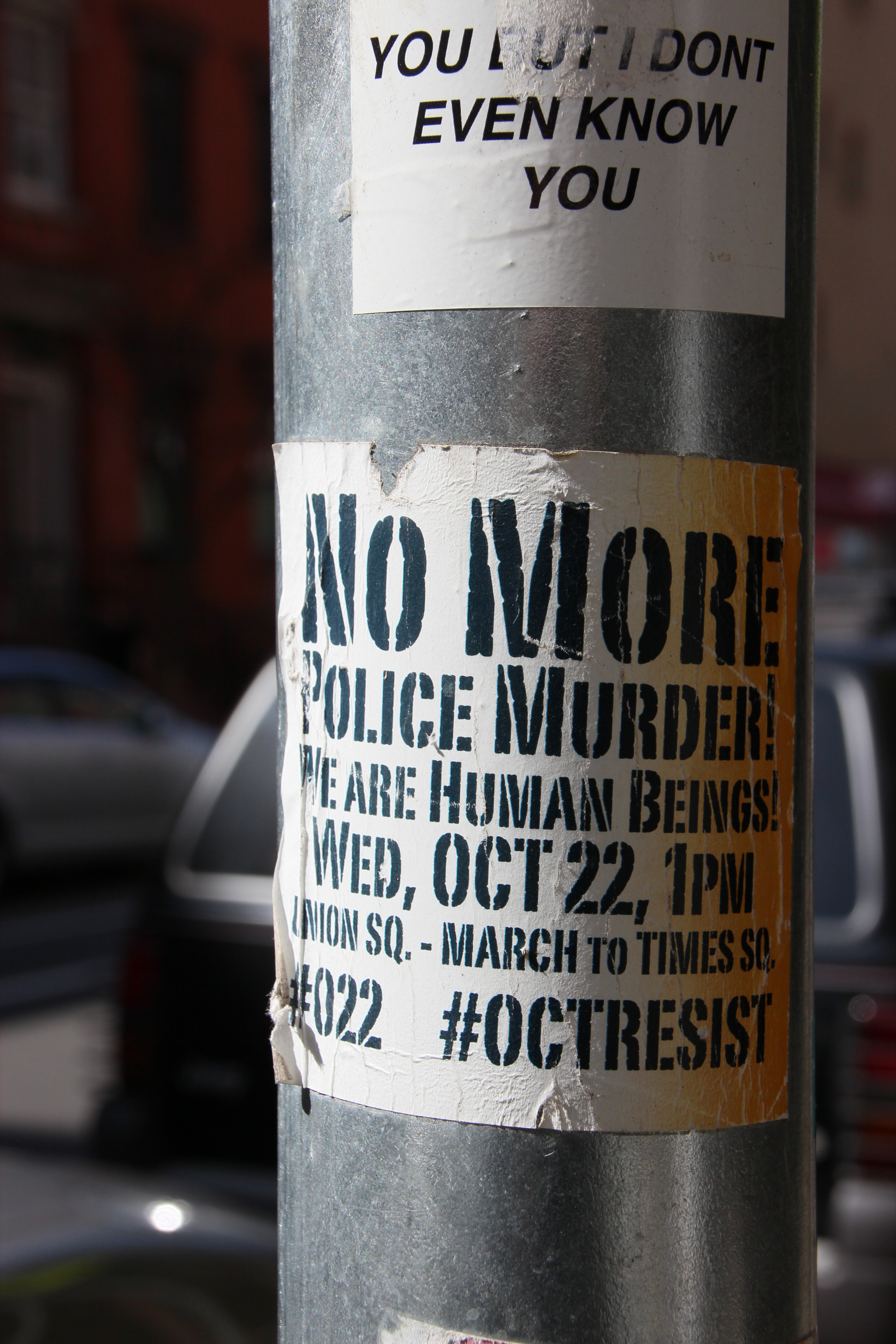
This sticker is advertising a different demonstration against police brutality. I think that #Octresist was also organised by the Stop Mass Incarceration Network, in 2014. If that is the case, then this sticker is getting quite old! (Photo: Hannah Awcock).
dav
Garden State Ultras are a sports fan group with a radical edge. ACAB (All Cops Are Bastards) is part of the international radical language (Photo: Hannah Awcock).
15_15-03-16 (36)
This sticker wouldn’t win any prizes for subtlety, but sometimes that is the best way to get your message across (Photo: Hannah Awcock).
dav
As I mentioned before, the Presidential Election is a hot topic in America. Donald Trump is a controversial figure who nobody seems to like, yet he keeps doing well in the primaries (Photo: Hannah Awcock).
18_12-03-16 (45)
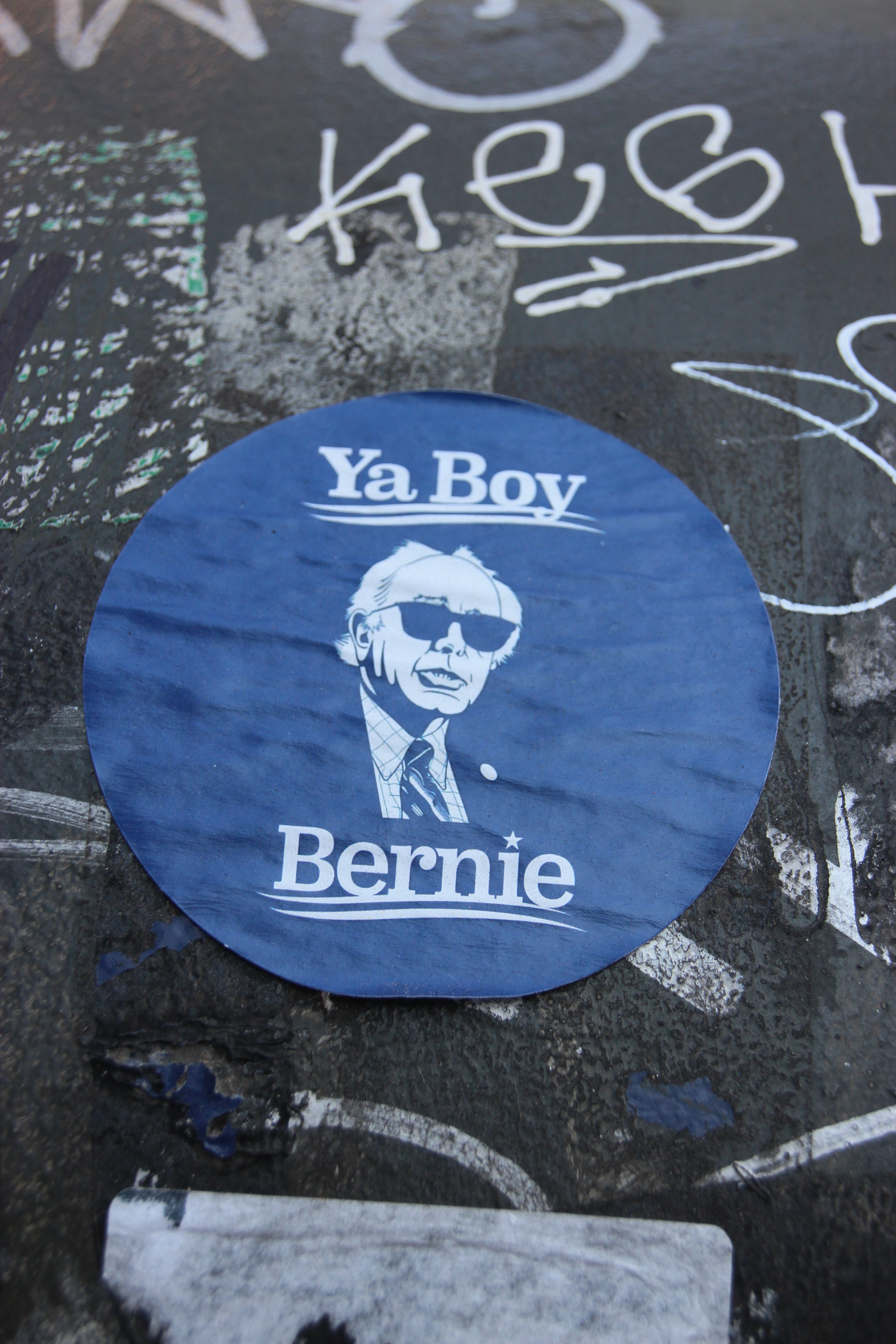
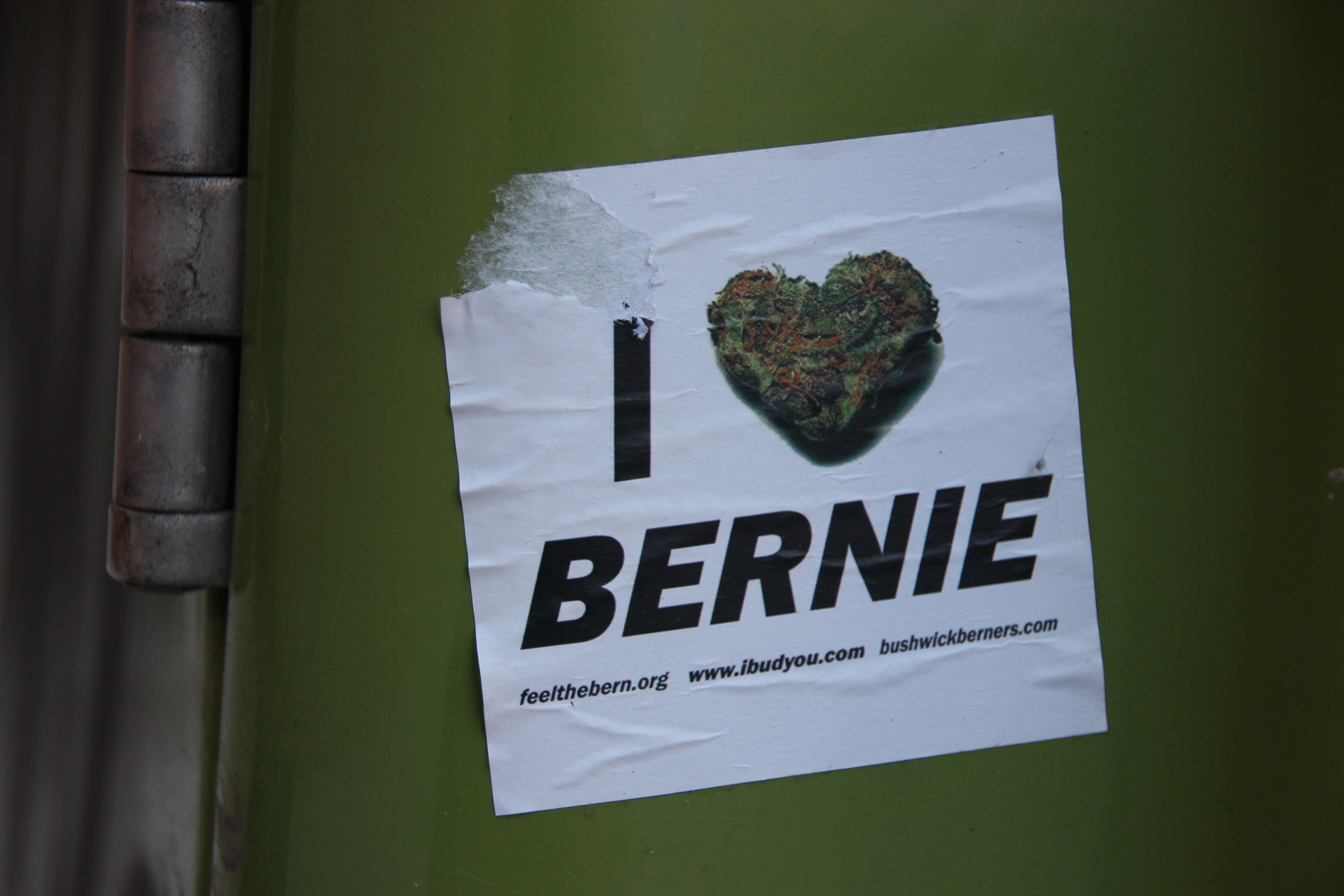
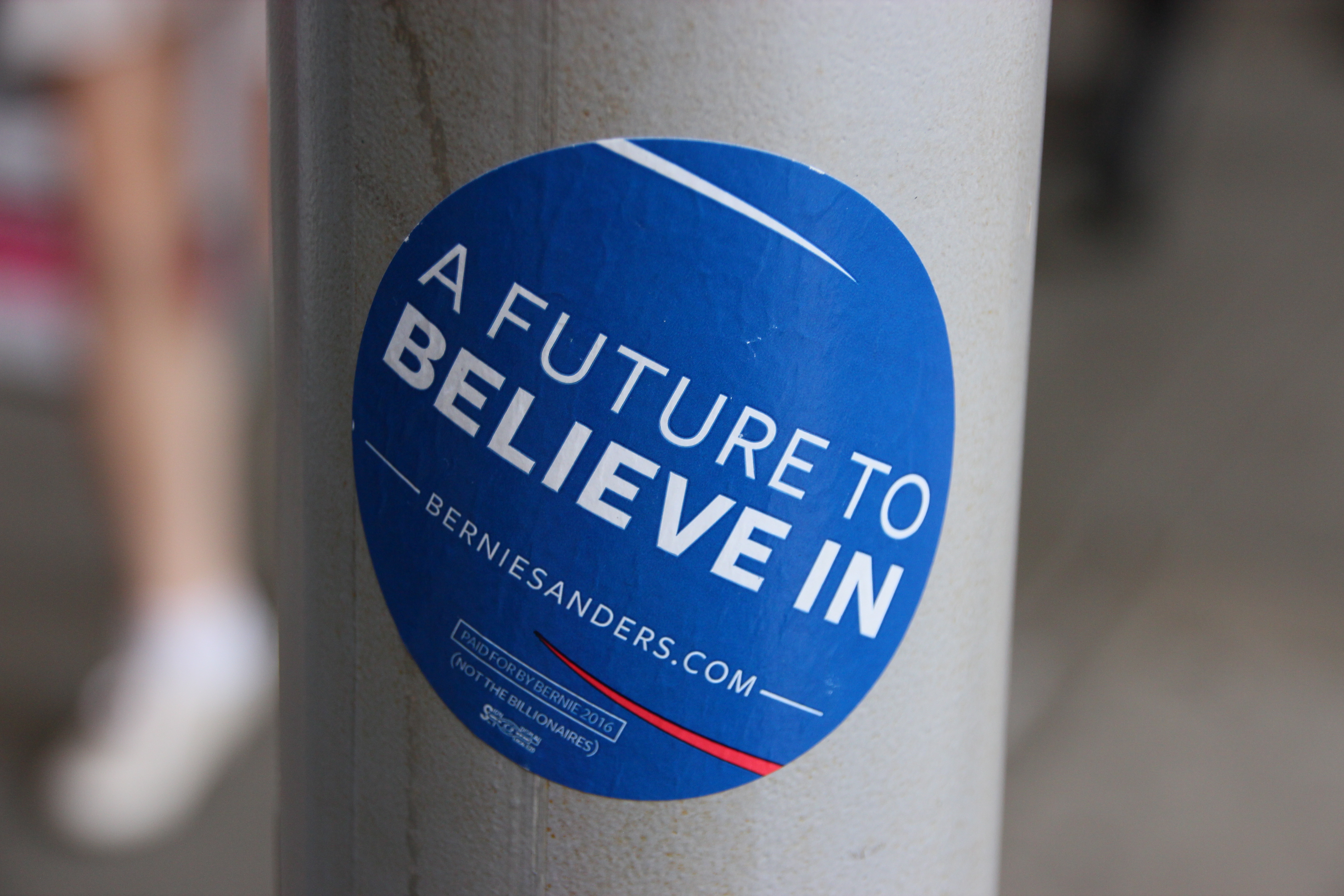
Most New York stickerers seem to be fans of Bernie Sanders. A democrat, he has been called America’s Jeremy Corbyn, he has been giving some people hope that politics can be done differently (Photo: Hannah Awcock).
19_12-03-16 (9)
This sticker was produced by The Personal Stash, which sells marijuana-themed accessories and promotes the reform of laws relating to marijuana (Photo: Hannah Awcock).
20_10-03-16 (17)
This sticker comes from Bernie Sander’s official campaign. Sometimes, the line between protest and formal politics can become blurred as radicals attempt to reform the system from within (Photo: Hannah Awcock).
21_12-03-16 (2)
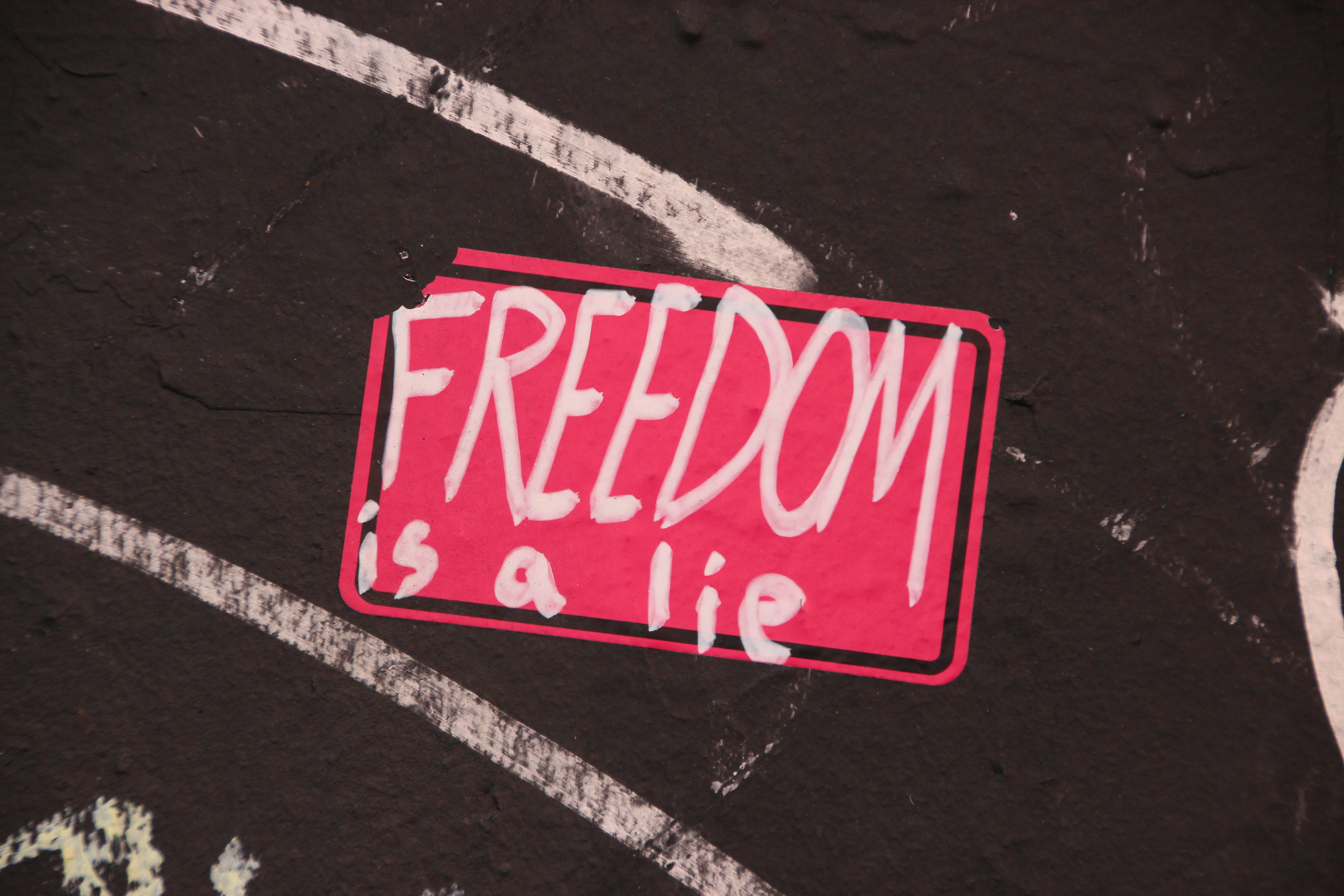
And just to end the post on a positive note…(Photo: Hannah Awcock)

Don’t forget to check back next week for Part 2 of Protest Stickers: New York City 2!

Book Review: ‘Blueprint for Revolution- How to Use Rice Pudding, Lego Men, and other Non-Violent Techniques to Galvanise Communities, Overthrow Dictators, or Simply Change the World’

Blueprint for Revolution Front Cover
The front cover of Blueprint for Revolution.

Srdja Popovic and Matthew Miller. Blueprint for Revolution: How to Use Rice Pudding, Lego Men, and Other Non-Violent Techniques to Galvanise Communities, Overthrow Dictators, or Simply Change the World. London: Scribe, 2015. £9.99

Srdja Popovic is particularly well qualified to give advice on the use of non-violent protest tactics. One of the leaders of Otpor!, the non-violent movement that overthrew Slobodan Milosevic in Serbia, he then decided to use his experience to help others and founded CANVAS, a non-profit organisation that gives advice and training to activists all over the world. Blueprint for Revolution is part how-to guide, part memoir, in which  Popovic uses stories of successful activism to illustrate his advice. Many of the stories come from his own experience as an “ordinary revolutionary” (p vi) and protest guru.

There is a false notion that only the elites in our societies matter and that all change, progress, or setbacks emanate magically from within their dark and greedy souls…The world we live in worships and respects the strong and the mighty. It’s an unfortunate fact of life that nobody gives enough credit to the weak and the humble. But, as we have learned, even the smallest creature can change the world.” (p260)

Some of Popovic’s advice might look more at home in a business manual than a protest one- branding is crucial, for example, and find out what the people want instead of trying to make them care about the same things you do- but it’s good advice nonetheless. As Popovic explains, Harvey Milk was elected on a promise to crack down on dog poo, not because of his stance on gay rights.

Popovic is a strong advocate of what he calls ‘laughtivism’ (he admits it isn’t the best name!); undermining authority through comedy and laughter. Those in power, particularly despots and dictators, are used to being taken seriously, and making fun of them can be a powerful weapon- “the only thing that could trump fear is laughter” (p100). My favourite example (which made me laugh as I read about it) was Otpor!’s idea of painting Milosevic’s face on an old barrel and putting it in a busy public street with a baseball bat and a sign inviting people to “smash his face” (p101-3). Popovic’s love of laughter shines through in his writing; Blueprint for Revolution is a fun and light-hearted read. He comes across as a genuinely nice guy, and even gives his personal email address at the end of the book, asking readers to “please keep in touch” (p261).

On occasion Popovic’s relentless positivity can grate slightly. He hopes that the book will inspire some to take action, “to get you on your feet and moving” (p ix). Call me cynical, but I’m not convinced a book can make an activist out of someone, no matter how good it is. This is a minor gripe however; overall the book’s tone is uplifting and did make me feel hopeful, which is not a common occurrence when it comes to politics. Also, the captions for all the illustrations are at the front of the book, so you have to flip back and forth for information about a picture (again, I am nitpicking).

Blueprint for Revolution: How to Use Rice Pudding, Lego Men, and Other Non-Violent Techniques to Galvanise Communities, Overthrow Dictators, or Simply Change the World may not be winning any prizes for short titles, but it is a fun read, which cannot be said for a lot of books about overthrowing violent dictators. It may not turn you into a non-violent revolutionary, but it certainly is an enjoyable way to spend a few hours.